
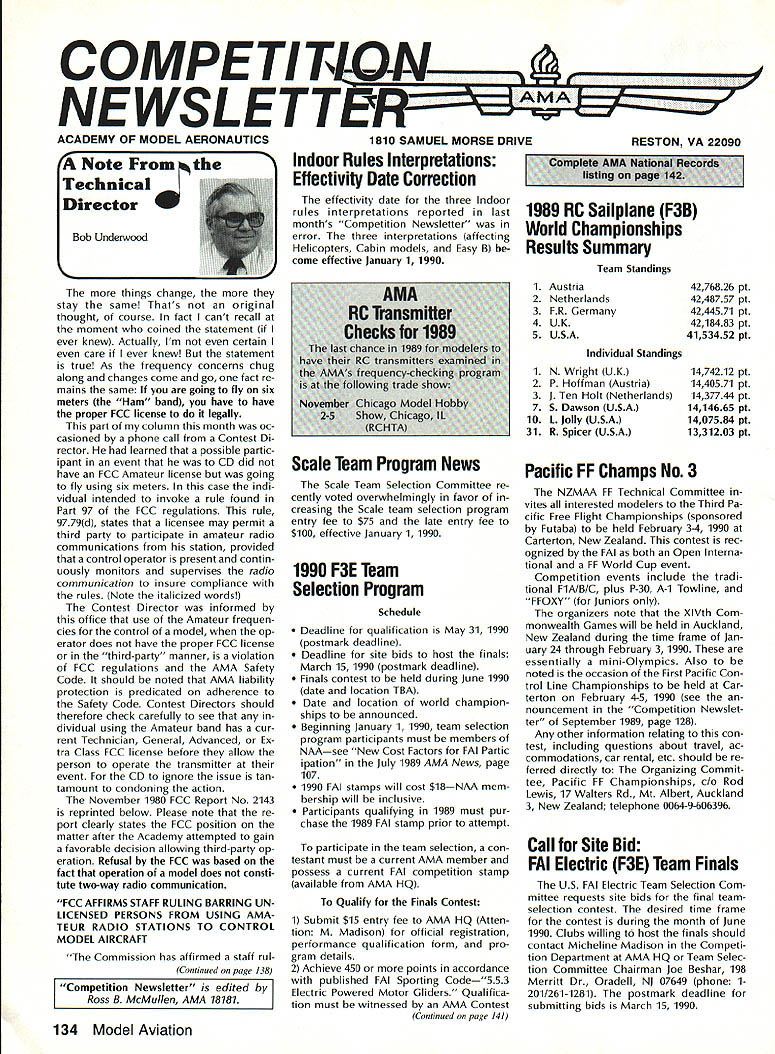
Competition Newsletter
A Note From the Technical Director
Bob Underwood
The more things change, the more they stay the same. As frequency concerns chug along and changes come and go, one fact remains the same: if you are going to fly on six meters (the "Ham" band), you must have the proper FCC license to do so legally.
This column was occasioned by a phone call from a Contest Director who learned a possible participant in an event did not have an FCC Amateur license but intended to fly using the six‑meter band. The individual planned to invoke Part 97 of the FCC regulations, specifically rule 97.79(d), which states that a licensee may permit a third party to participate in amateur radio communications from his station provided that a control operator is present and continuously monitors and supervises the radio communications to ensure compliance with the rules. Note the requirement that the control operator be present and continuously monitor and supervise.
The Contest Director was informed by AMA headquarters that use of Amateur frequencies for the control of a model by an operator who does not have the proper FCC license, or who operates in an improper "third‑party" manner, is a violation of FCC regulations and the AMA Safety Code. AMA liability protection is predicated on adherence to the Safety Code. Contest Directors should therefore verify that any individual using the Amateur band at an event holds a current Technician, General, Advanced, or Extra Class FCC license before allowing that person to operate a transmitter. Ignoring this issue is tantamount to condoning the action.
On this matter the November 1980 FCC Report No. 2143 is reprinted below. The report clearly states the FCC position after the Academy attempted to obtain a favorable decision allowing third‑party operation. The FCC refused, basing its decision on the finding that operation of a model using an Amateur radio station for control does not constitute two‑way radio communication.
It should also be noted that occasional suggestions to "wink and not concern ourselves" with minor rule violations are ill advised. An accident involving such an infraction could place individuals, clubs, and the Academy in an awkward legal position and could harm the Academy's relationship with the FCC. There are currently petitions before the FCC by groups desiring to share Amateur frequencies; condoning unauthorized use could weaken the Academy's ability to defend its interests.
On another subject: I had the opportunity to staff the AMA booth at the EAA Fly‑In in Oshkosh, WI. The booth drew many visitors — modelers, former modelers, and international guests — and it was a busy and rewarding week.
---
FCC Affirms Staff Ruling Barring Unlicensed Persons From Using AMA Amateur Radio Stations to Control Model Aircraft
The Commission affirmed the staff ruling barring unlicensed persons from using Amateur radio stations to control model aircraft, despite a request by the Academy of Model Aeronautics (AMA) to reverse the ruling.
Key points from the Commission's decision:
- The staff interpreted Section 97.79(d) as permitting an unlicensed person (third party) to participate in two‑way Amateur radio communications under the supervision of a control operator. The staff concluded that use of an Amateur radio station for controlling model aircraft constitutes a one‑way transmission; therefore, the rules do not permit its being operated by an unlicensed person.
- AMA argued that Section 97.79(d) should permit broader third‑party participation and that the Amateur Radio Service rules should parallel the Radio Control Service rules. The Commission rejected these arguments, noting Sections 97.79(d), 97.3(h), and 97.114 are interrelated and not intended to provide for the nonlicensed Amateur communications desired by AMA.
- The Commission also observed that nowhere in the related rulemaking was it proposed that all Radio Control Service rules would be carried over into the Amateur Radio Service for controlling remote objects.
- The Commission stated that Section 97.79(d) requires the presence of a control operator to continuously monitor message content; it would be impractical for the FCC to require monitoring of a steady hum or tone used in typical one‑way control signals.
- Any need for additional channels for control of model aircraft should be met in the Radio Control Service; AMA has an outstanding petition for rulemaking (RM‑3428) seeking such additional frequencies.
Action by the Commission: Order (FCC 80‑634), November 6, 1980.
---
Indoor Rules Interpretations — Effectivity Date Correction
The effectivity date of the three Indoor rules interpretations reported in last month’s Competition Newsletter was in error. The three interpretations affecting helicopters, cabin models, and Easy B become effective January 1, 1990.
---
Scale Team Program News
The Scale Team Selection Committee recently voted overwhelmingly to increase the Scale team selection program entry fee to $75; late entry fee $100, effective January 1, 1990.
---
1990 F3E Team Selection Program Schedule
- Deadline, qualification: May 31, 1990 (postmark deadline)
- Deadline, site bids to host finals: March 15, 1990 (postmark deadline)
- Finals contest held during June 1990 (date/location TBA)
- Date/location of world championships announced
Beginning January 1, 1990, team selection program participants must be members of the NAA. See New Cost Factors — FAI Participation, July 1989 AMA News, page 107. 1990 FAI stamps will cost $18. Participants qualifying in 1989 must purchase the 1989 FAI stamp prior to attempting to participate. Team selection contestants must be current AMA members and possess a current FAI competition stamp available from AMA HQ.
---
Qualify — Finals Contest / F3E Team Program Details
- Submit $15 entry fee to AMA HQ, Attention: Micheline Madison; include the official registration/performance qualification form and program details.
- Achieve 450 points in accordance with published FAI Sporting Code 5.5.3. Electric‑powered motor glider qualifications must be witnessed by an AMA contest official.
- Return the completed performance qualification form to AMA HQ (Attention: Micheline Madison) by May 31, 1990.
Additional notes:
- The three team members of the 1988 F3E team (Bridgeman, Neu, Vivas) are automatically prequalified for the 1990 finals upon entering the program by paying the $15 entry fee; they will also be required to pay the finals fee.
- All who qualify shall be invited to compete in the finals contest. The top three finalists shall comprise the U.S. entry for the 1990 world championships.
- The team shall have a team manager selected by the team members after consultation with the chairman of the team selection committee.
- Finals fee: $50, payable to AMA HQ, postmarked no later than 30 days prior to the finals. Requests for refunds must be received at AMA HQ no less than two days prior to the finals.
- The finals contest site shall be determined by bid and selected by the team selection committee. Bids must be postmarked no later than March 15, 1990.
- All fees collected are primarily for financing the U.S. team.
Team selection committee may allocate team fund monies for:
- Travel expenses not paid by AMA.
- Vehicle rentals.
- Excess baggage for model boxes (AMA pays only 80%).
- Other expenses approved by majority vote of the team selection committee.
---
Nats F1D Report
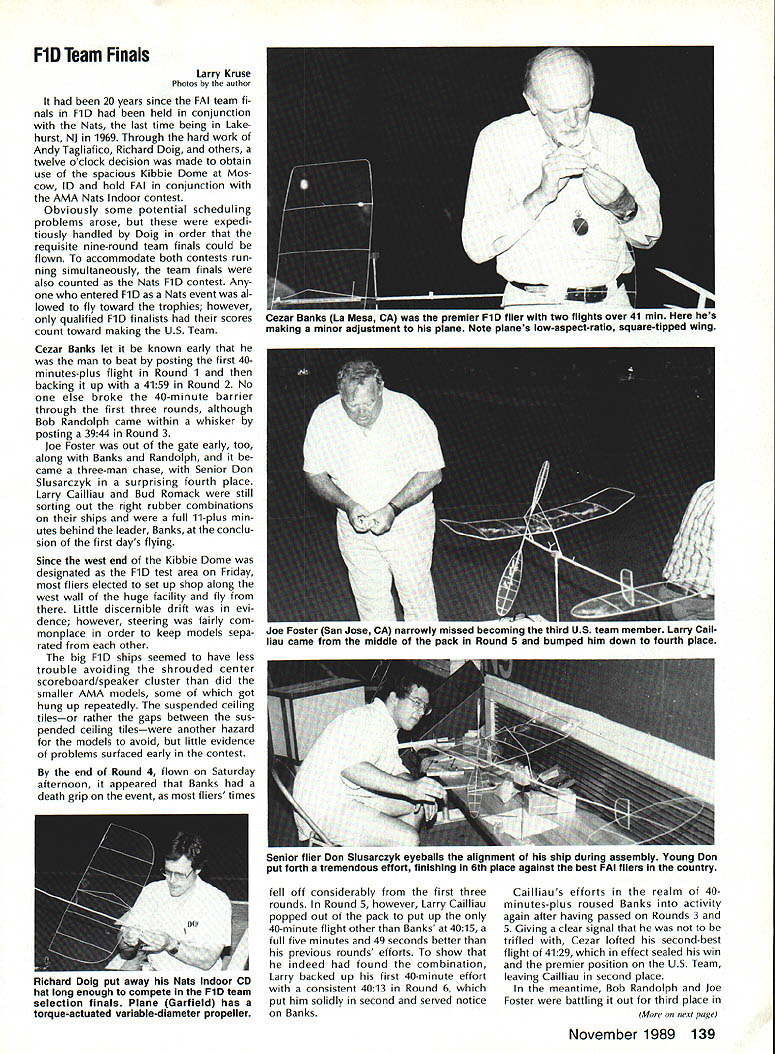
The F1D competition at the Nats featured intense, quiet skill and strong performances in the Kibbie Dome. Final standings (top competitors noted):
- 1st: Banks
- 2nd: Larry Cailliau (Westlake, CA) — mounted a strong challenge in Round 5
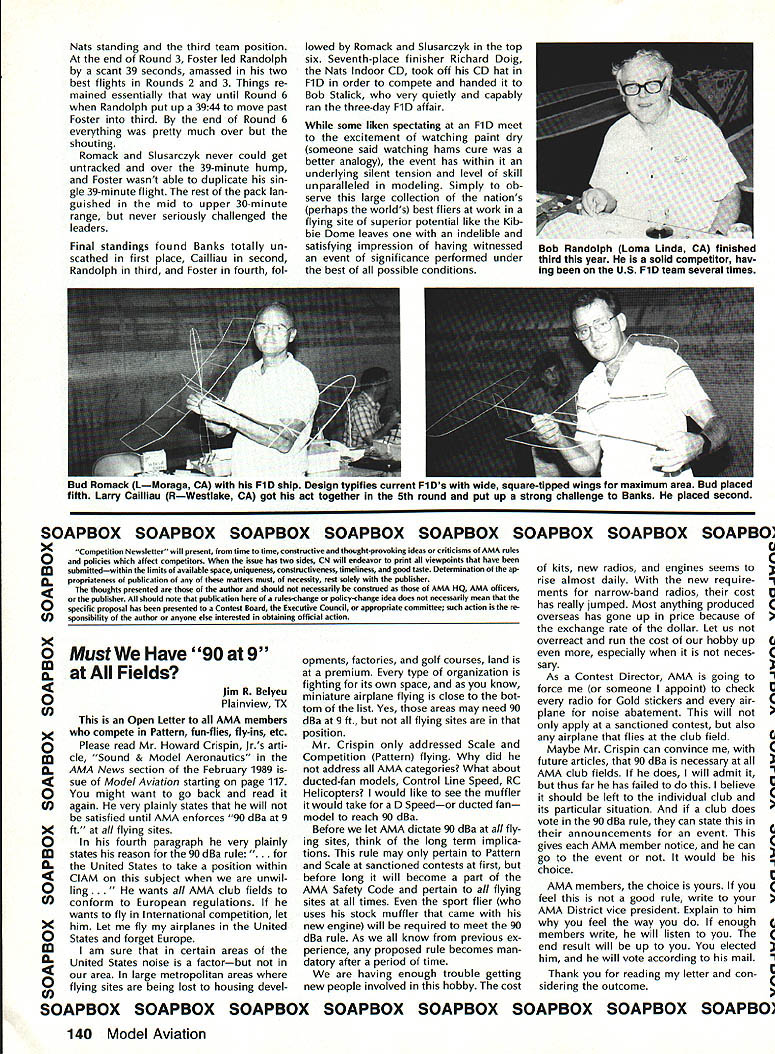
- 3rd: Bob Randolph (Loma Linda, CA) — a solid competitor and former U.S. F1D team member
- 4th: Foster
- 5th: Bud Romack (Moraga, CA) — flew a typical modern F1D design with wide, square‑tipped wings
- 6th: Slusarczyk
- 7th: Richard Doig (Nats Indoor CD) — stepped down from CD duties to compete; Bob Stalick ran the three‑day F1D event capably
While spectating at an F1D meet may seem quiet to the casual observer, the event contains a high level of silent tension and skill. Watching the nation’s (and perhaps the world's) best fliers at a venue like the Kibbie Dome leaves a lasting impression of an event conducted under excellent conditions.
Transcribed from original scans by AI. Minor OCR errors may remain.

