
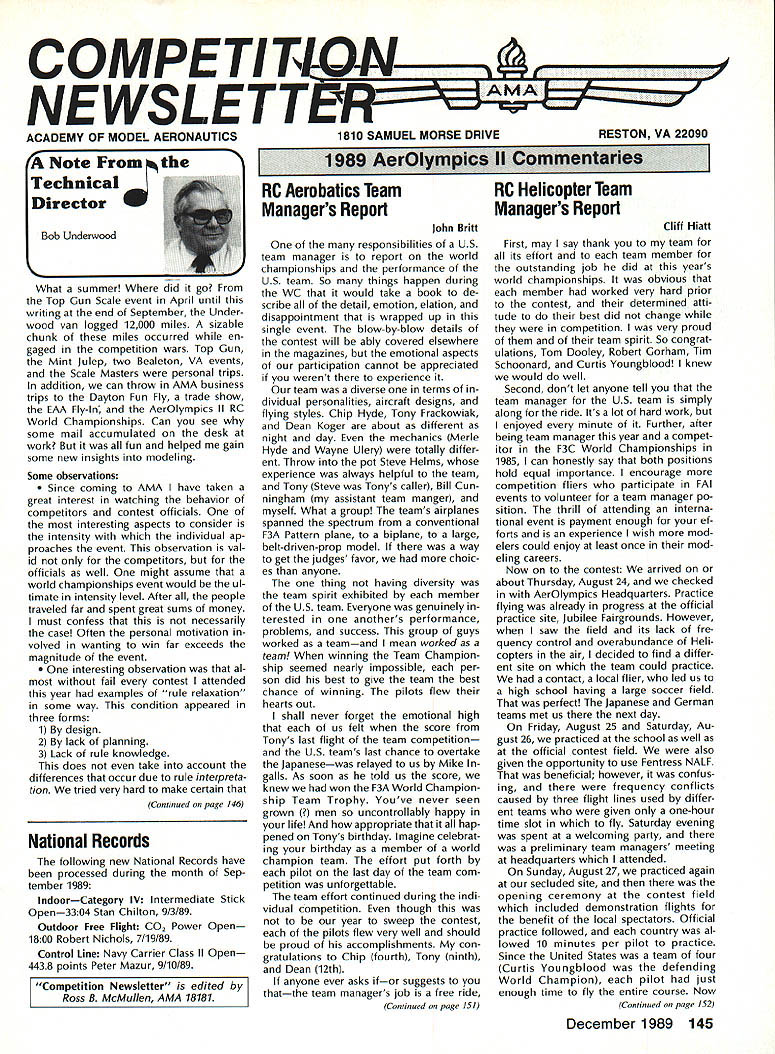
Competition Newsletter
ACADEMY OF MODEL AERONAUTICS 1810 Samuel Morse Drive, Reston, VA 22090
A Note From the Technical Director
By Bob Underwood
What a summer! From the Top Gun Scale event in April until this writing at the end of September, the Underwood van logged about 12,000 miles. A sizable chunk of those miles occurred while engaged in the competition wars: Top Gun, the Mint Julep, two Bealeton, VA events, the Scale Masters, and personal trips. In addition, there were AMA business trips to the Dayton Fun Fly, a trade show, the EAA Fly-In, and the AerOlympics II RC World Championships. It was all fun and helped me gain some new insights into modeling.
Some observations:
- Since coming to AMA I have taken a great interest in watching the behavior of competitors and contest officials. One of the most interesting aspects to consider is the intensity with which the individual approaches the event. This applies to competitors and officials alike.
- One might assume that a world championships event would be the ultimate in intensity — people travel far and spend considerable sums. I must confess this is not necessarily the case. Often the personal motivation to win far exceeds the magnitude of the event.
- An interesting observation at almost every contest I attended this year was examples of "rule relaxation." This occurred in three forms:
- By design.
- By lack of planning.
- By lack of rule knowledge.
This does not even take into account differences that occur due to rule interpretation. We tried very hard to make certain that the rules were strictly adhered to during the world championships. You must do this because, generally, the FAI competitor knows the rules well and does not hesitate to protest if necessary.
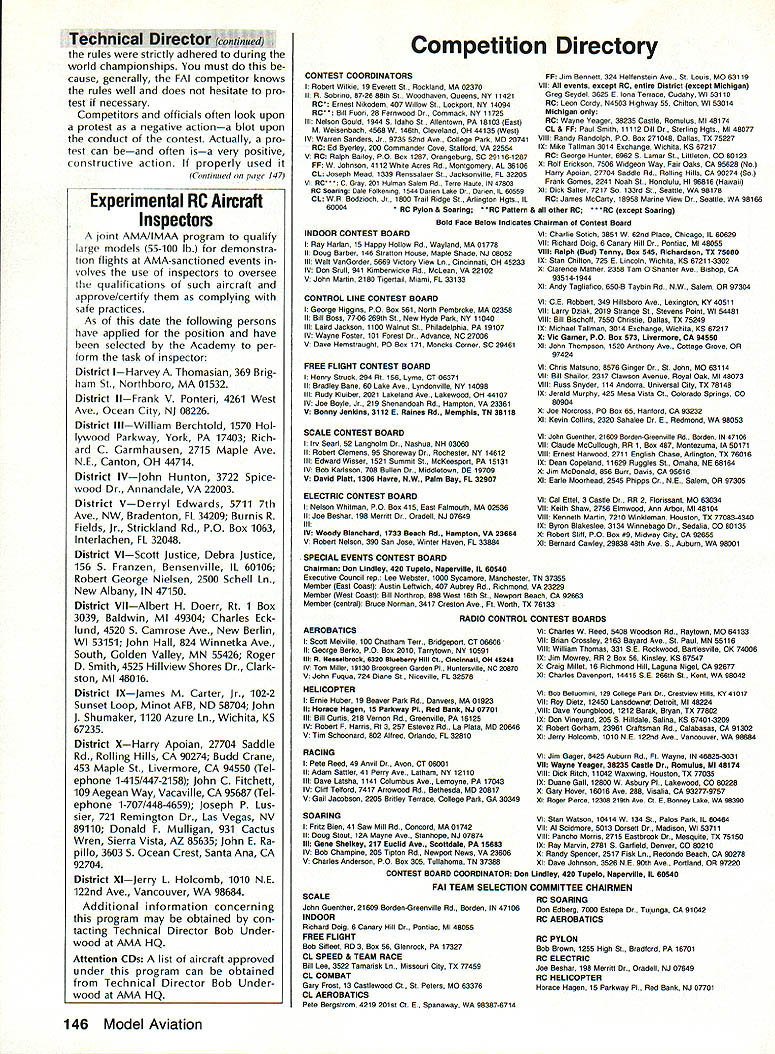
Competitors and officials often look upon a protest as a negative action — a blot upon the conduct of the contest. Actually, a protest can be a very positive, constructive action. If properly used it may be the springboard for improved rules interpretation and an ultimate change. As an official, I have on several occasions encouraged individuals to protest. In two cases at the Nats I actually wrote the protest for the contestant so he could give it to me and I could rule on it. In both those cases — one in RC Giant Scale and the other in Control Line Sport Scale — the protested items came to the attention of the Contest Boards, and a change was effected that improved the rules.
Some rules can be relaxed without a great deal of concern; other instances breed discontent. Of the Scale contests I attended this summer, only one observed proper processing in the form of weighing the models. In some competitions there is a governing weight and classes are sometimes determined by weight. To ignore weighing could result in someone competing in the wrong class.
One could argue that contest management simply was taking the modeler's word that he was entered in the proper class or had the proper size engine, but experience suggests that contestants' knowledge of the rules often has faults. Frequently we find the contestant never learned the rules in the first place — or "remembered" them incorrectly because he had not kept track of changes. Another problem centers on confusion about the correct applicability of the rules associated with two or more events — or mixing up rules between categories. For instance, people will bend rules from Precision into Sport or Giant when they don't belong.
All too often the same problems are faults found in officials running the event. Another example, at least in Scale, is ignoring time limits. One event this summer stuck strictly to the listed time limit. Another said they would have a watch on you but it was kind of (wink, wink) loose if you needed a little more time. A third event evidently didn't use the time limit at all — I know of one instance where 23 minutes of the 12 minutes allowed was used.
Can things like this affect the outcome of a contest? Yes. In most cases contest management allows this because they want to run a relaxed contest. That is a laudable motive, albeit not too practical. The person who comes prepared and follows the rules should not lose because someone else is allowed to rebuild his model on the flight line.
I witnessed another event this summer that has important ramifications not only for competition, but for all RC flying. It brought to mind an article I read in Readers' Digest years ago about a full-scale plane crash caused not by a single major incident but by a series of small, seemingly insignificant happenings. Items such as a late departure (hence increased density altitude), fuel overload, a malfunctioning instrument, misplaced runway markers, and a few others combined to cause the accident. While any one or two occurrences might have been harmless, the whole bundle together did it.
I witnessed a model crash at a contest that should not have happened. The words that follow are not designed to assess blame, nor to recall bad memories for the participants. Rather I mention the incident because, like the Readers' Digest story, it points up the need for everyone to be alert, concerned, and not trusting that the other guy will always save the day.
There were two flight lines at the event. Because of an abundance of certain RF frequencies, the same frequency was assigned to both lines in some instances. While this is not a practice a CD likes to encourage, it can work with extra care.
It was late in the event and everyone was hurrying a tad. The CD, with cards containing the frequencies in front of him, called two persons to the lines. They were on the same frequency. Flier one already had his transmitter and the frequency pin. Flier two went to the impound to obtain his transmitter and left the impound with it — but without the frequency pin. So far, three people should have caught the developing problem and stopped it.
Flier two proceeded to the line and called to the other flier to go ahead and start. He did, and once he was in the air, flier two turned on — and a model crashed.
Here is the kicker: the two fliers were very good friends, came to the contest together, and regularly fly together at the same home field — except they know they are on the same frequency and don't fly together there. Again, no one is attempting to assess blame. Having competed for years, I can think of a zillion reasons why any one of the four individuals (CD, transmitter impound person, two contestants) could be distracted enough to allow the incident. The fact that several lapses linked together is most unfortunate. All concerned felt very badly about the damage to the model. The positive to come from the crash is an object lesson for each one of us.
I would like to give a complete report of AerOlympics II, which I chaired in Chesapeake, VA — but I won't. You'll read about it in various publications, and I suspect most writers had a better view of the forest than I did. There were just too darn many trees in the way for me.
I cannot remember any two-week period in my life more intensive and physically draining (unless it was basic training in 1954). Days began at 6:00 a.m. and sometimes ended at midnight. I was supposed to be knowledgeable, calm, witty, friendly, and helpful. Not ever having been a Boy Scout, I had to work at it.
Around Wednesday of the second full week I found myself drifting off to sleep, and while in that dreamy limbo state I had a terrible feeling the week would never end and I would be stuck in transit between room 116 of the Holiday Inn and Frying Pan Island for the rest of my natural life.
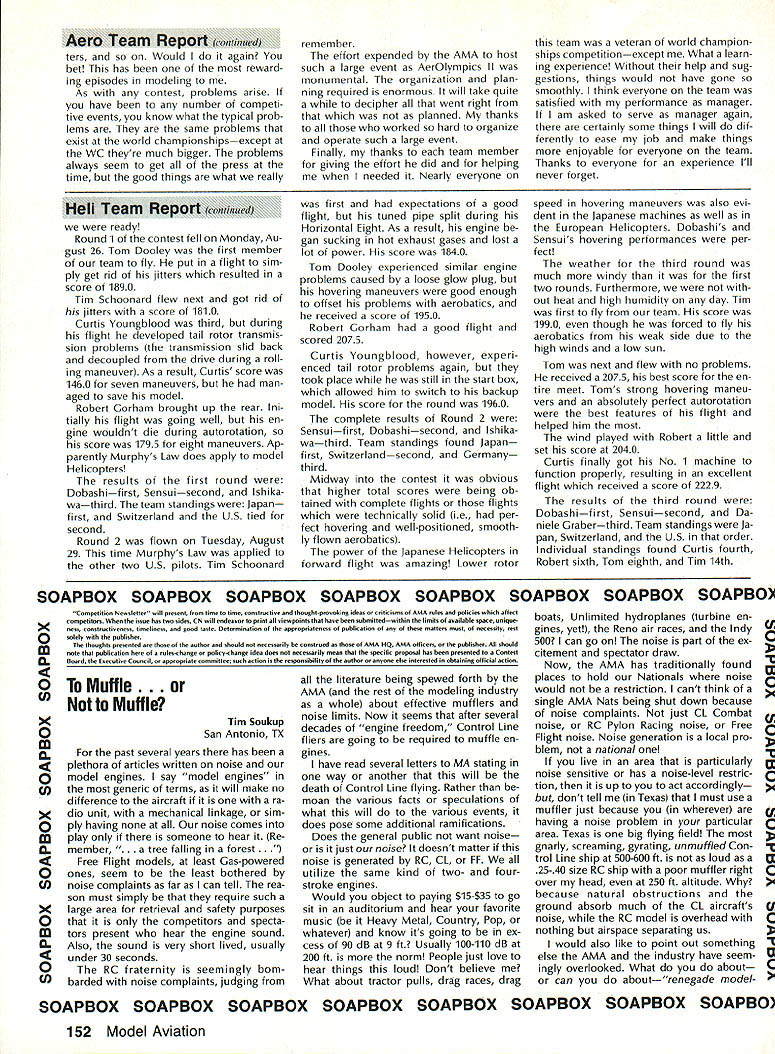
The event did end! Would I do it again? Without a doubt. One cannot describe the wonderful feeling that wraps snugly about you when involved in an event like that. Beyond the friendships that occurred with visiting competitors, consider the quality time spent with co-workers and old friends working the event. There were moments of pure delight when three or four of us would "FOD" a runway — picking up foreign objects lying on or near the edge that might be ingested by engines. We had to do that every day for miles of runway and taxiways.
As we drifted down the vast open expanse we had a chance to let our hair down, tell war stories, and just relax. All I can do is offer a profound "thank you" to all the people who worked the RC World Championships. What a team!
A brief comment concerning the EAA Fly-In we attended: the EAA operates 10 large forum tents throughout the week. Every hour and a half, a different presentation occurs in each tent. This year the AMA presented a session titled, "What Makes An Airplane Real?" The experience was most gratifying. Some 200 people attended our session. They represented the modeling community, EAA, and people interested in modeling. An informal poll indicated about 25% of those present were members of both EAA and AMA. Next year we hope to present two programs to better serve interested parties. If you've never been to Oshkosh during the week, there is a definite void in your aviation experience quotient. See you there in 1990!
---
1989 U.S. FAI Scale Team Selection Finals
By John R. Guenther Photos by the author
The host clubs for this year's event were the Buzzin Buzzards Control Line Club and the Dayton Wing Masters RC Club. Les Byrd was the CL Contest Director (CD), while Mark Wilson acted as RC CD. Coordinating the whole event from backstage was Phil Walters, a member of the Wing Masters. Phil was one of the first contacted in the Dayton area regarding hosting the FAI Scale event, and it was through his hard work that things fell into place with the host clubs, the Dayton Parks Department, and the local press. Their efforts made this Scale team selection event a success.
Headquarters for static judging and contestant/judges' meetings was the Holidome (near the Air Force Museum) on Wagoner Ford Road in north Dayton. Static judging began early Thursday morning around the naturally lighted indoor pool area. Near the restaurant, the models were placed on the floor inside a roped-off section of the foyer for local press and public viewing. With all the activity inside the Holidome, hardly anyone noticed the light rain that fell while static judging was taking place.
The CL Scale modelers outnumbered the RC entrants by 11 to 9 this year. Noticeably missing from the CL selection were Ron Sears and Jeff Perez, both former U.S. FAI CL Scale team members. Jeff sat out this team selection and volunteered to help judge the CL portion, hoping to send valuable insight to fellow modelers from his previous world championship experiences. Ron didn't get his current model finished in time and spent the contest encouraging his fellow CL fliers.
It seemed the big question for everyone was, "How come more modelers haven't turned out for the U.S. FAI Scale Team Selection event, both in CL and RC?" Was it because the 1990 Scale World Championships would be held in Poland and political unrest could affect travel? Or was it due to apathy, indifference, or lack of understanding in the U.S. AMA CL and RC Scale community about FAI Scale? Despite the small turnout, a high-caliber team was fielded this year.
The flying portion began early Friday, August 18, with Dave Brown, Don Lindley, and Don Love acting as the AMA FAI jury members for the F4B and F4C finals (CL and RC Scale). Mike Gretz, chief judge for CL, convened his judging team (Bert Dugan, Jeff Perez, Andy Siebert, and Mike Stott) under cool gray skies and light breeze. Several CL entrants remarked the practice and competition circles were the best they'd flown from in quite some time. Les Byrd (the CL CD) flew a warmup flight for the CL judges prior to the start of official competition flights.
The RC judging crew was headed by George Buso as chief judge, with Darlene Frederick, Vernon Altamarrino, Leroy Weber, and Bill Carper filling out the panel.
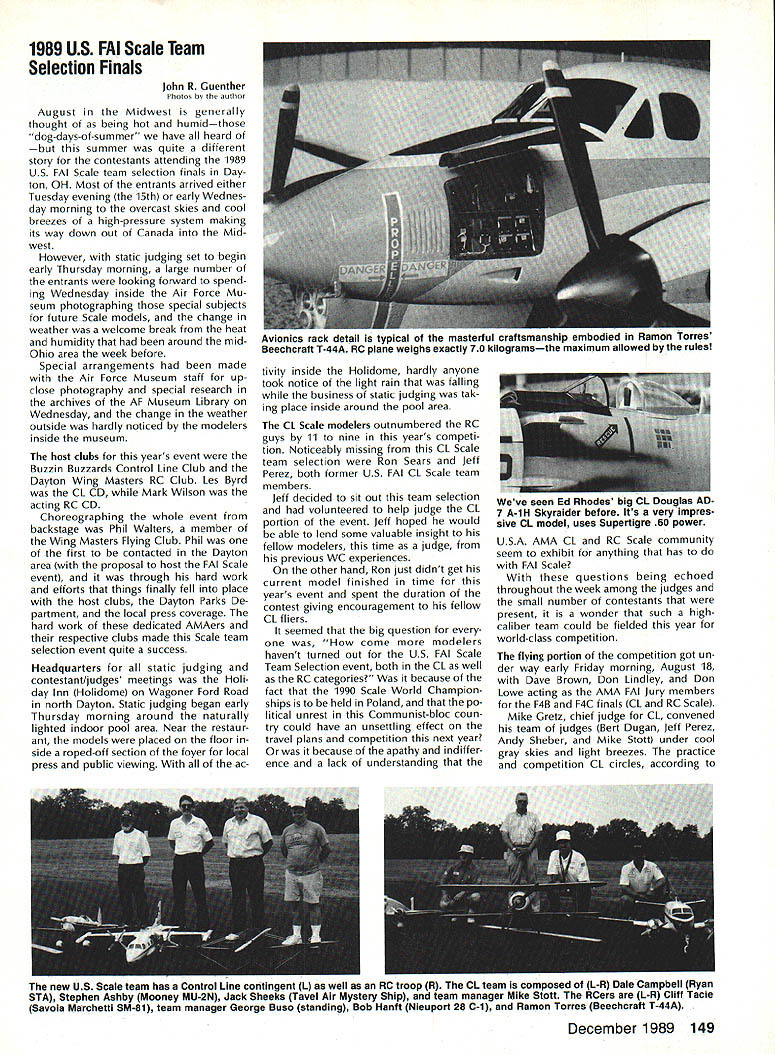
From the outset of RC competition, Ramon Torres, flying his new Beechcraft T-44A, was an entrant to be reckoned with. Ramon, a former U.S. FAI Scale team member, had learned his lessons well in Italy in 1988 and returned with a model accurate in outline and quiet in flight. At the end of the first round Ramon was already the person to beat.
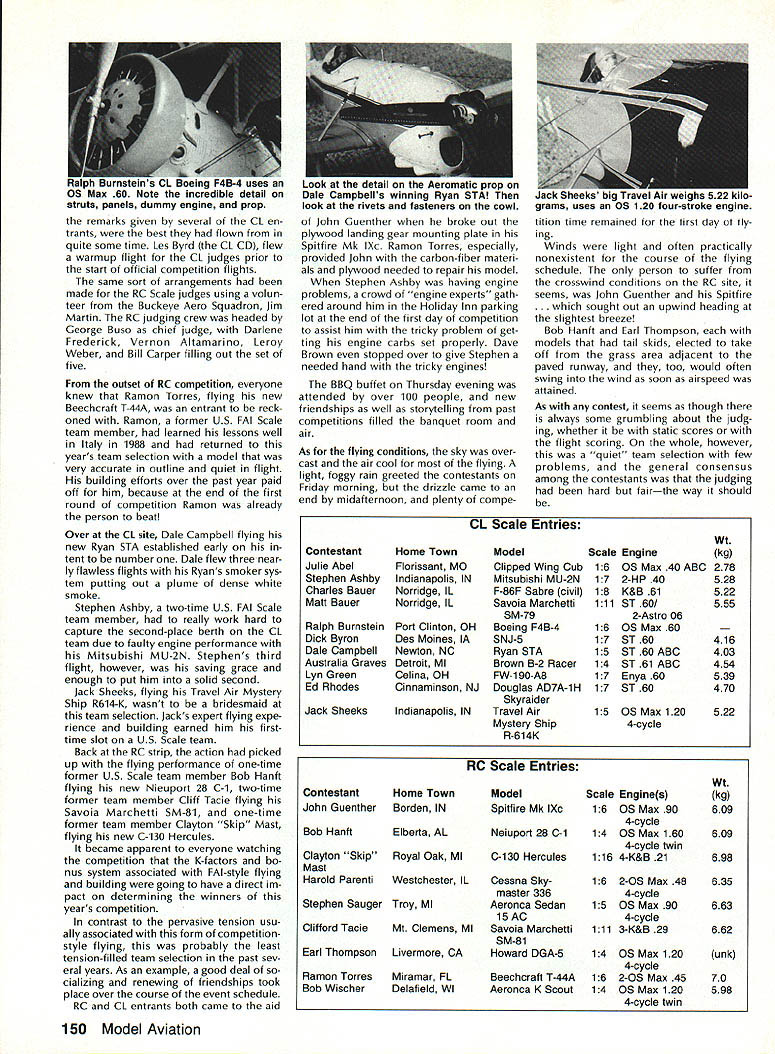
At the CL site, Dale Campbell flying his new Ryan STA established early his intent to be number one. Dale flew three nearly flawless flights with his Ryan's smoke system putting out a plume of dense white smoke.
Stephen Ashby, a two-time U.S. FAI Scale team member, had to work hard to capture the second-place berth on the CL team due to faulty engine performance with his Mitsubishi MU-2N. His third flight was his saving grace and enough to put him into solid second.
Jack Sheeks, flying his Air Mystery Ship R614K, wasn't to be a bridesmaid at this team selection. Jack's expert flying experience and building skills won him his first-time slot on a U.S. Scale team.
Back at the RC strip, the action picked up with the flying of former U.S. Scale team members: Bob Hanft with his new Nieuport 28 C.1, Cliff Tacie with his Savoia Marchetti SM-81, and Clayton "Skip" Mast flying his new C-130 Hercules.
It became apparent that the K-factors and bonus system associated with FAI-style flying and building would have a direct impact on determining the winners.
In contrast to the pervasive tension usually associated with style flying, this was probably the least tension-filled team selection in recent years. A good deal of socializing and renewing of friendships took place.
RC and CL entrants helped John Guenther when he broke out the plywood landing gear mounting plate in his Spitfire Mk IXc. Ramon Torres provided John with carbon-fiber materials and plywood needed to repair his model. When Stephen Ashby had engine problems, a crowd of "engine experts" gathered around him in the Holiday Inn parking lot to assist with carburetor settings. Dave Brown even stopped by to help.
The Thursday evening BBQ buffet was attended by over 100 people; new friendships and storytelling filled the banquet room and bar.
Flying conditions: skies were mostly overcast and cool. A light, foggy rain greeted contestants on Friday morning but ended by midafternoon. Winds were light and often practically nonexistent. The only person to suffer from the crosswind conditions on the RC site seemed to be John Guenther and his Spitfire, which sought an upwind heading at the slightest breeze. Bob Hanft and Earl Thompson, both with tail-skid-equipped models, elected to take off from grass adjacent to the paved runway and often swung into the wind as soon as airspeed was attained.
As with any contest, there were some grumblings about judging, but on the whole this was a quiet team selection with few problems. The general consensus among contestants was that judging had been fair.
The 1990 U.S. team managers are Mike Stott for F4B (CL) Scale and George Buso for F4C (RC) Scale. They have their work cut out getting models ready for the 1990 World Championships in Poland, and ensuring team members' documentation is as strong as possible. Finding time for the required practice flying will be a challenge for many team members who have full-time jobs and professional responsibilities. We should wish the new U.S. FAI Scale team members our best wishes and good luck in preparing for the upcoming competition.
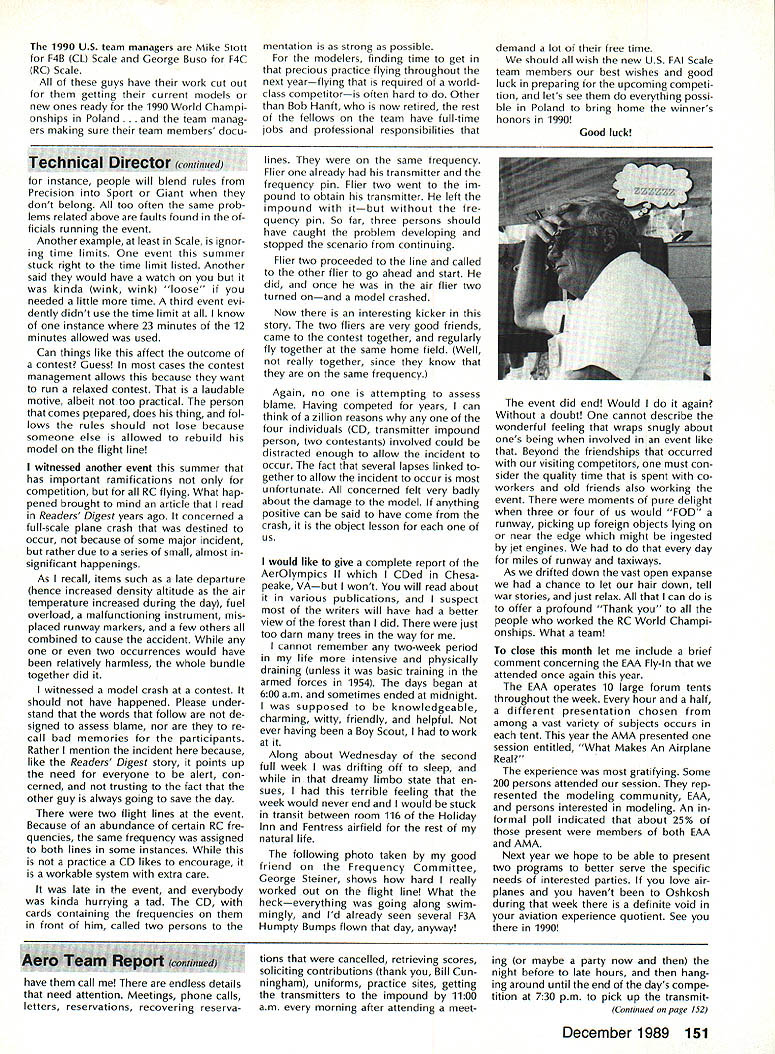
CL Scale Entries
- Jule Abel, Florissant, MO — Clipped Wing Cub, 1:6, OS Max .40 ABC, Wt. 2.78 kg
- Stephen Ashby, Indianapolis, IN — Mitsubishi MU-2N, 1:7, 2-HP .40, Wt. 5.28 kg
- Charles Bauer, Norridge, IL — F-86F Sabre (civil), 1:8, K&B .61, Wt. 5.22 kg
- Matt Bauer, Norridge, IL — Savoia Marchetti SM-79, 1:6, 2-Stroke, Wt. 5.55 kg
- Ralph Burnstein, Port Clinton, OH — Boeing F4B-4, 1:6, OS Max .60, Wt. 5.38 kg
- Dick Byron, Des Moines, IA — SNJ-5, 1:7, ST .60, Wt. 4.16 kg
- Dale Campbell, Newton, NC — Ryan STA, 1:5, ST .60 ABC, Wt. 4.03 kg
- Austin Graves, Detroit, MI — Brown B-2 Racer, 1:4, ST .61 ABC, Wt. 4.54 kg
- Lyn Green, Celina, OH — FW-190-A8, 1:7, Enya .60, Wt. 5.39 kg
- Ed Rhodes, Cinnaminson, NJ — Douglas AD-7A-1H Skyraider, 1:7, ST .60, Wt. 4.70 kg
- Jack Sheeks, Indianapolis, IN — Travel Air / Mystery Ship R614K, 1:5, OS Max 1.20 (4-cycle), Wt. 5.22 kg
RC Scale Entries
- John Guenther, Borden, IN — Spitfire Mk IXc, 1:6, OS Max .90, Wt. 6.09 kg
- Bob Hanft, Elberta, AL — Nieuport 28 C.1, 1:4, OS Max .61, Wt. 6.09 kg
- Clayton "Skip" Mast, Royal Oak, MI — C-130 Hercules, 1:16, (engines listed as 4-K&B .21?), Wt. 6.98 kg
- Harold Parenti, Westchester, IL — Cessna Skymaster, 1:6, 2-OS Max .48, Wt. 6.35 kg
- Stephen Sauger, Troy, MI — Aeronca Sedan, 1:5, OS Max .90, Wt. 6.63 kg
- Clifford Tacie, Mt. Clemens, MI — Savoia Marchetti SM-81, 1:1 (likely 1:10?), (engines listed as 3-K&B .29?), Wt. 6.62 kg
- Earl Thompson, Livermore, CA — Howard DGA-5, 1:4, OS Max 1.20 (unknown), Wt. not listed
- Ramon Torres, Miramar, FL — Beechcraft T-44A, 1:6, 2-OS Max .45, Wt. 7.00 kg
- Bob Wischer, Delafield, WI — Aeronca K Scout, 1:4, OS Max 1.20, Wt. 5.98 kg
(Note: some engine/class notations in the RC list were unclear in the source and are shown as recorded.)
---
National Records
The following new National Records were processed during September 1989:
- Indoor, Category IV, Intermediate, Stick, Open — 330.4 — Stan Chilton — 9/3/89
- Outdoor Free Flight, CO2 Power, Open — 1800 — Robert Nichols — 7/19/89
- Control Line, Navy Carrier, Class II, Open — 4438 points — Peter Mazur — 9/10/89
---
1989 AerOlympics II Commentaries
RC Aerobatics Team Manager's Report
By John Britt
As U.S. team manager, I report on the World Championships performance of the U.S. team.
So many things happen during a world championship it would take a book to describe the detail — emotion, elation, disappointment — all wrapped up in a single event. Blow-by-blow details of the contest will be covered elsewhere; the emotional aspects cannot be appreciated unless you've experienced them. The team was diverse in personalities, aircraft designs, and flying styles: Chip Hyde, Tony Frackowiak, Dean Koger — all different; Merle Hyde and Wayne Ulery totally different; Steve Helms' experience was always helpful. Tony's caller was Bill Cunningham; I served as assistant team manager.
What a group! The team's airplanes spanned from a conventional F3A pattern plane to biplanes and belt-driven props — models built to appeal to judges. Diversity and team spirit were exhibited by every member. Everyone was genuinely interested in another's performance, problems, and success. The group worked as a team.
Winning the Team Championship seemed nearly impossible, yet each person did his best to give the team the best chance. The pilots flew their hearts out. I'll never forget the emotional high when Mike Ingalls relayed Tony's last flight score in the team competition — the U.S. team's final chance to overtake Japan. As soon as we heard the score, we knew we had won the F3A World Championship Team Trophy. You've never seen grown men so uncontrollably happy. Appropriately, it happened on Tony's birthday. Imagine celebrating a birthday as a member of a world champion team after that effort — an unforgettable experience.
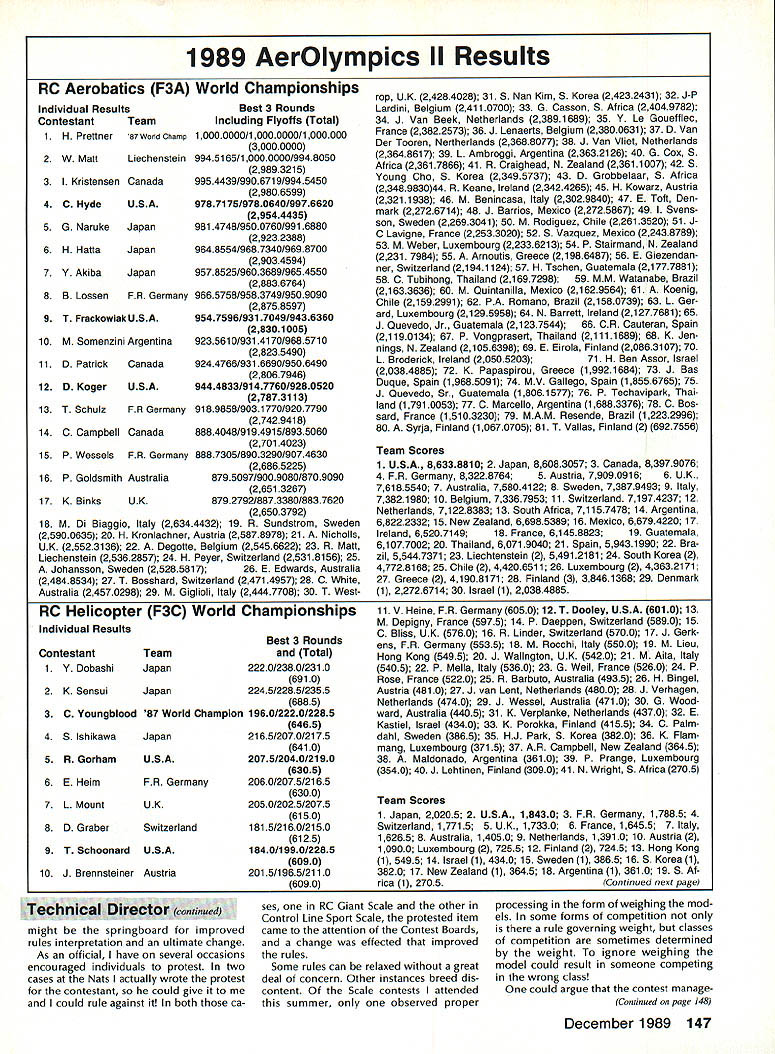
That team effort continued during the individual competition. Though we didn't sweep the contest, the pilots flew very well and should be proud. Congratulations to Chip (fourth), Tony (ninth), Dean (12th).
If anyone ever suggests the team manager's job is a free ride — it is not.
RC Helicopter Team Manager's Report
By Cliff Hiatt
First, thank you to the team for its effort. Team members did an outstanding job during the years leading up to the World Championships. It was obvious they worked very hard and had a determined attitude. They did the best they could and improved the competition. I am very proud of the team spirit. Congratulations to Tom Dooley, Robert Gorham, Tim Schoonard, and Curtis Youngblood — I knew they would do well.
Second, don't let anyone tell you the team manager of the U.S. team is simply along for the ride. It's a lot of hard work, and I enjoyed every minute. After being a team manager and competitor at the F3C World Championships in 1985, I can honestly say both roles are demanding and rewarding.
Transcribed from original scans by AI. Minor OCR errors may remain.

