
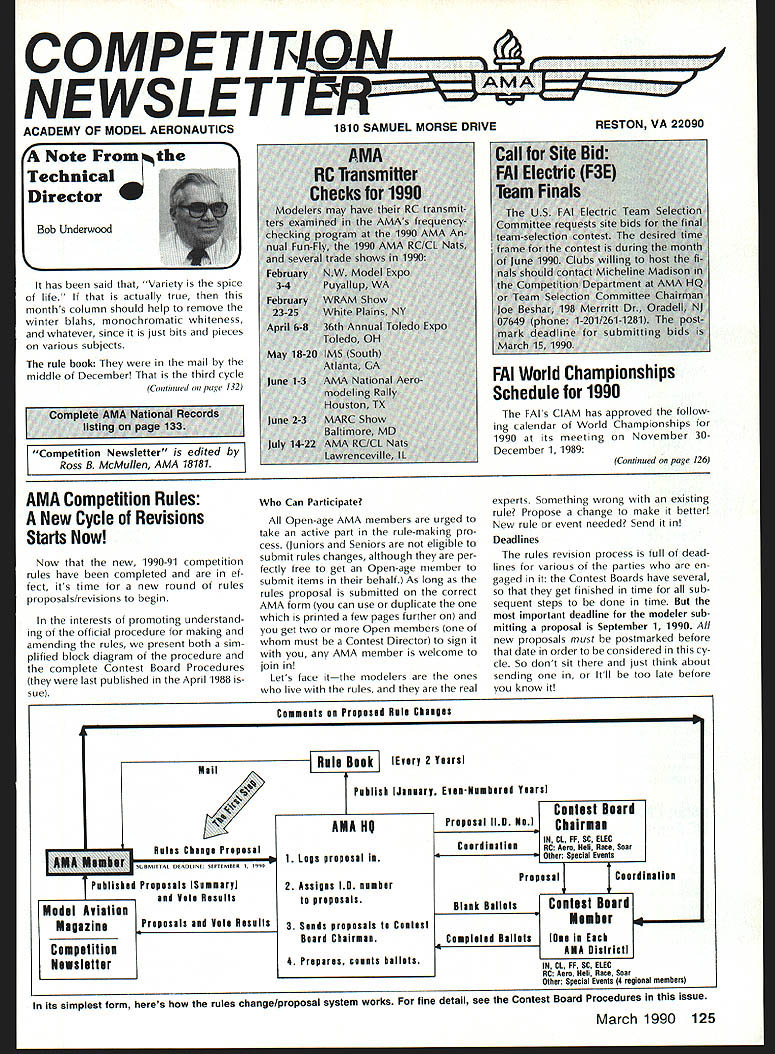
AMA Competition Rules: A New Cycle of Revisions Starts Now
Now that the new 1990–91 competition rules have been completed and are in effect, it's time for a new round of rules proposals and revisions to begin.
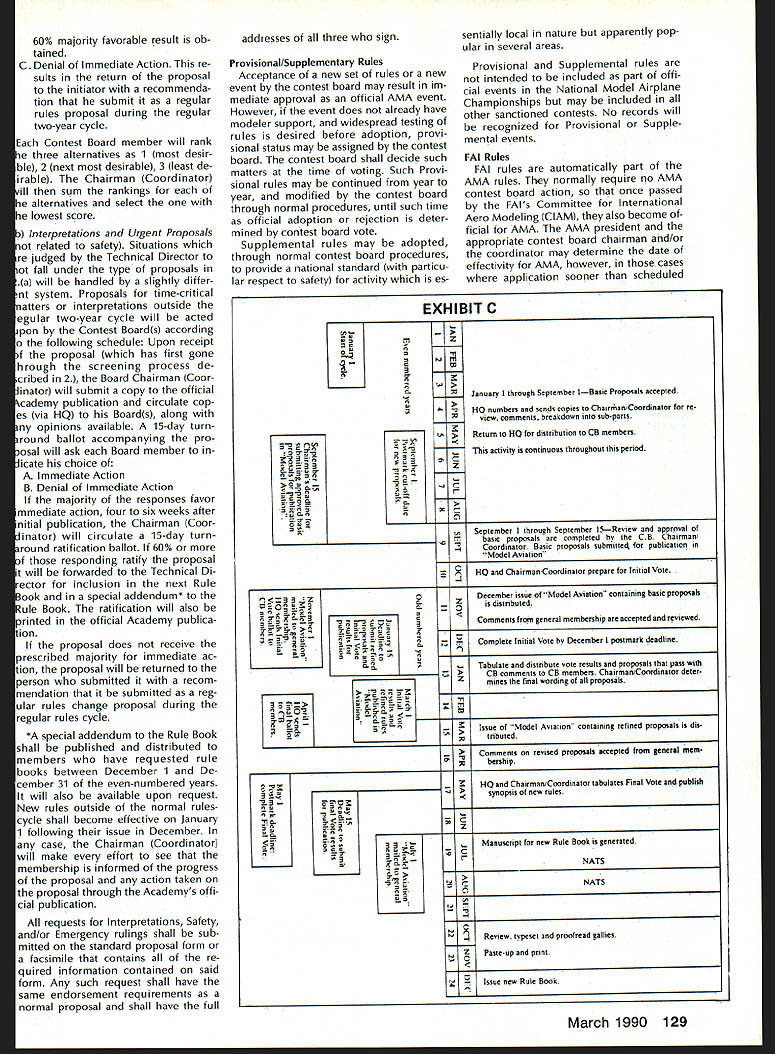
In the interests of promoting understanding of the official procedure for making and amending the rules, we present both a simplified block diagram of the procedure and the complete Contest Board Procedures (last published in the April 1988 issue).
Who Can Participate?
- All Open-age AMA members are urged to take an active part in the rule-making process.
- Juniors and Seniors are not eligible to submit rules changes, although they are free to have an Open-age member submit items on their behalf.
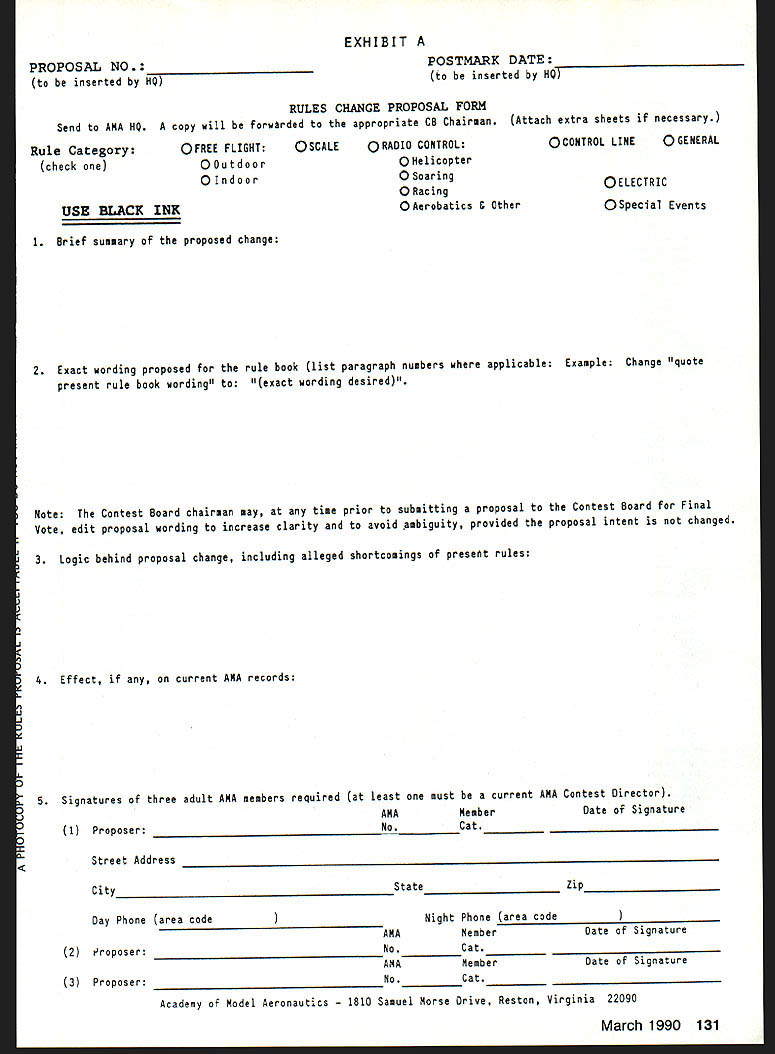
- A rules proposal must be submitted on the correct AMA form (a copy is printed a few pages further on). The proposal must be signed by two or more Open members, one of whom must be a Contest Director.
- Modelers are the people who live with the rules and are the real experts. If something is wrong with an existing rule, propose a change. If a new rule or event is needed, send it in!
Deadlines
- The most important deadline for the modeler submitting a proposal is September 1, 1990. All new proposals must be postmarked before that date to be considered in this cycle.
- Don’t delay — if you wait, it may be too late.
Comments on Proposed Rule Changes (process overview)
- Rule Book (Every 2 Years)
- Publish (January, even-numbered years)
- AMA HQ
- Logs proposals in.
- Assigns I.D. number to proposals.
- Sends proposals to Contest Board Chairman.
- Prepares, counts ballots.
- Contest Board Chairman
- Coordinates proposals, issues proposal I.D. number, sends blank ballots to Contest Board members.
- Contest Board Member (one in each AMA district)
- Completes ballots and returns completed ballots to Contest Board Chairman.
- AMA Member
- Submits Rules Change Proposal.
- SUBMITTAL DEADLINE: SEPTEMBER 1, 1990 (postmark)
- Published proposals (summary) and vote results appear in Model Aviation magazine and Competition Newsletter.
In its simplest form, that's how the rules change/proposal system works. For fine detail, see the Contest Board Procedures in this issue.
Addition to List of Experimental RC Aircraft Inspectors
A joint AMA/IMAA program to qualify large models (55–100 lb.) for demonstration flights at AMA-sanctioned events involves the use of inspectors to oversee qualification and to approve/certify compliance with safe practices.
The following individual has been added to the complete list of inspectors published in last month's Competition Newsletter (page 134):
- District X — Bill Hempel, 7025 E. 21st St., Tucson, AZ 85710
Additional information concerning this program may be obtained by contacting Technical Director Bob Underwood at AMA HQ.
Attention Contest Directors: A list of aircraft approved under this program can be obtained from Technical Director Bob Underwood at AMA HQ.
'90 World Champs (continued)
- June 11–18 — Space Models, Kiev, U.S.S.R.
- July 9–14 — Control Line (F2A/B/C/D), Blénod-les-Ponts, Mousson, France
- August 6–11 — Electroflight (F3E), Freistadt, Austria
- August 20–26 — Junior Free Flight (F1A/B/C), Mostar, Yugoslavia
- August 31–Sept. 10 — Scale (F4B/C), Warsaw, Poland
Team Selected for 1990 Junior Free Flight World Champs
The following young free-flight fliers were competitively selected as members of the U.S. team for the 1990 FAI Junior Free Flight World Championships (Mostar, Yugoslavia; August 20–26, 1990):
- F1A Towline Glider:
- Matthew Gagliano, Floral Park, NY
- Joel Grasmeyer, Grand Rapids, MI
- Mike Keller, Lancaster, CA
- (Matthew and Mike were members of the 1988 team.)
- F1B Wakefield Rubber:
- Roderick Joerger, York, PA
- Christopher Pelatowski, Ansonia, CT
- Adam Tracy, Maple Valley, WA
- (Adam was a member of the 1988 team.)
- F1C Power:
- Tony Hutchins, Portland, IN
- Craig Lippman, Lansdale, PA
- Jim Troutman, Marion, TX
- (Tony was a member of the 1988 team.)
Asian‑Pacific RC Aerobatics Champs Set for April 19–22, 1990
The Model Aeronautical Association of Australia, Inc. (MAAA) is proposing the establishment of a new off‑year international RC Aerobatics championship. To get the event started, the MAAA has offered to host the first meet in conjunction with its Kraft Masters contest; an application has already been made to the FAI for Open International status on the 1990 calendar.
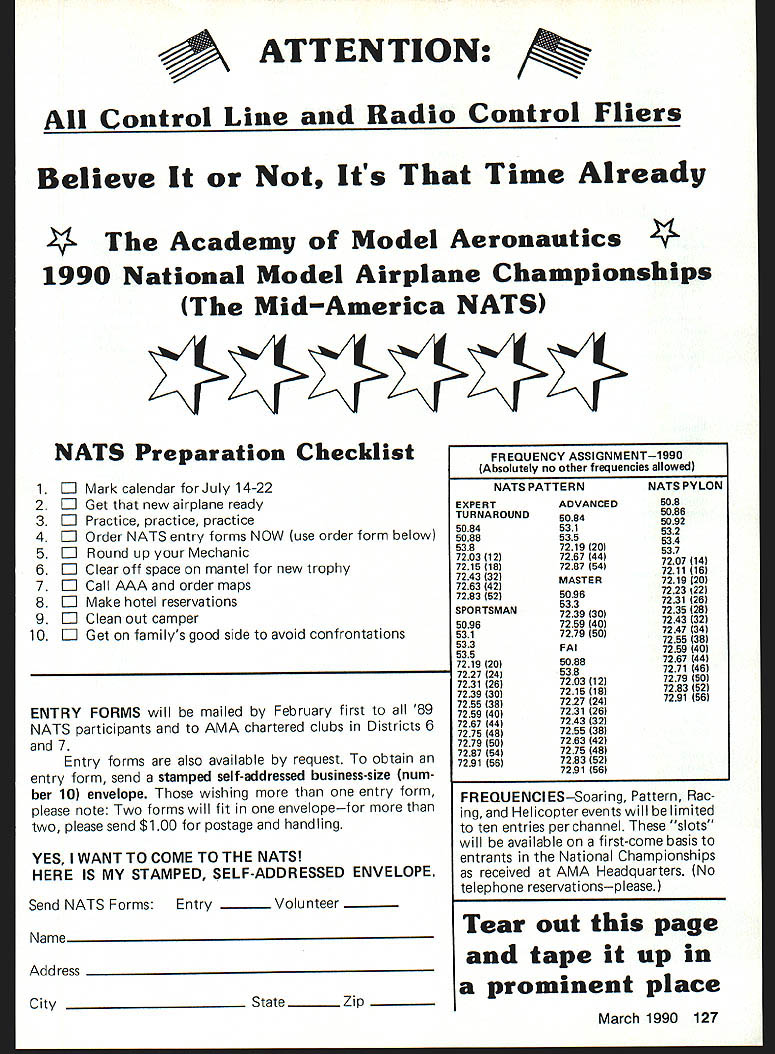
ATTENTION: All Control Line and Radio Control Fliers
Believe it or not, it's that time already:
The Academy of Model Aeronautics 1990 National Model Airplane Championships (The Mid‑America NATS)
NATS Preparation Checklist
- Mark calendar for July 14–22
- Get that new airplane ready
- Practice, practice, practice
- Order NATS entry forms NOW (use order form below)
- Round up your mechanic
- Clear off space on mantel for new trophy
- Call AAA and order maps
- Make hotel reservations
- Clean out camper
- Get on family's good side to avoid confrontations
ENTRY FORMS will be mailed by February 1 to all 1989 NATS participants and to AMA-chartered clubs in Districts 6 and 7.
Entry forms are also available by request. To obtain an entry form, send a stamped, self-addressed business-size (No. 10) envelope. Two forms will fit in one envelope; for more than two forms please send $1.00 for postage and handling.
YES, I WANT TO COME TO THE NATS! HERE IS MY STAMPED, SELF-ADDRESSED ENVELOPE.
Send NATS Forms: Entry ______ Volunteer ______
Name ___________________________________________ Address _________________________________________ City _________________ State _____ Zip ___________ (FREQUENCY ASSIGNMENT—1990)
FREQUENCIES — Soaring, Pattern, Racing, and Helicopter events will be limited to ten entries per channel. These slots will be available on a first-come basis to entrants in the National Championships as received at AMA Headquarters. (No telephone reservations, please.)
Tear out this page and tape it in a prominent place.
Competition Newsletter
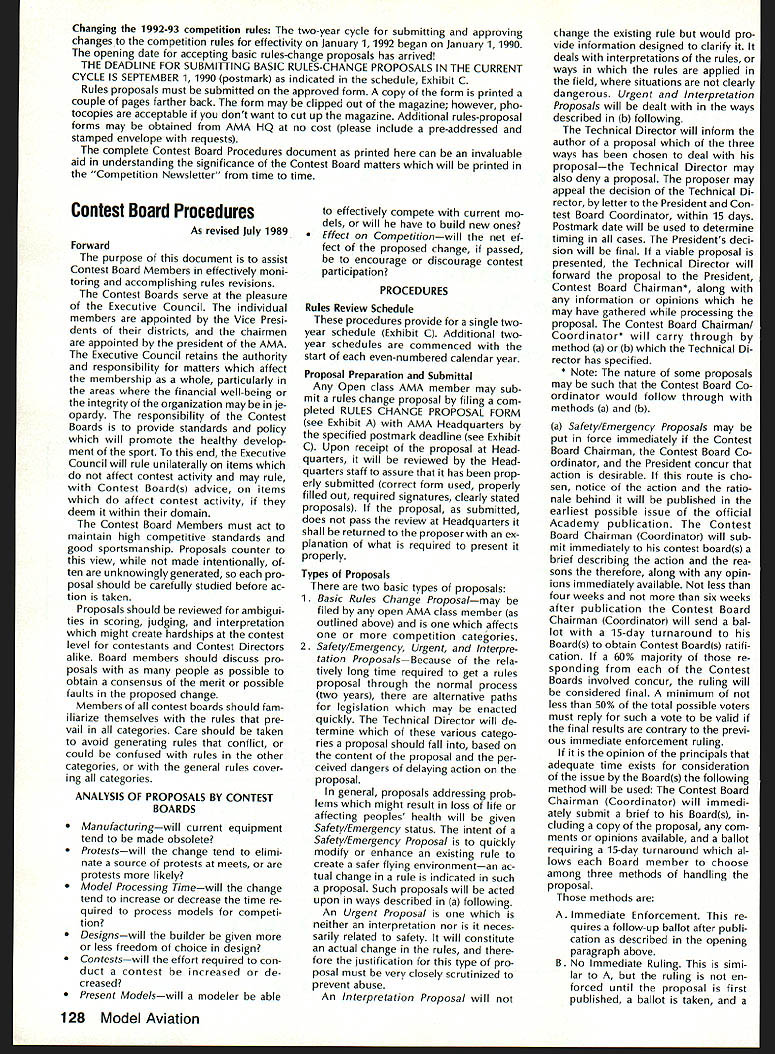
Changing the 1992–93 competition rules: The two-year cycle for submitting and approving changes to the competition rules (effective January 1, 1992) began on January 1, 1990. The opening date for accepting basic rules-change proposals has arrived!
THE DEADLINE FOR SUBMITTING BASIC RULES-CHANGE PROPOSALS IN THE CURRENT CYCLE IS SEPTEMBER 1, 1990 (postmark) as indicated in the schedule (Exhibit C).
- Rules proposals must be submitted on the approved form. A copy of the form is printed a couple of pages farther back. The form may be clipped from the magazine; photocopies are acceptable if you don't want to cut up the magazine.
- Additional rules-proposal stamps may be obtained from AMA HQ at no cost (please include a pre-addressed and stamped envelope with requests).
- The complete Contest Board Procedures printed here can be an invaluable aid in understanding Contest Board matters that will be printed in the Competition Newsletter from time to time.
Contest Board Procedures
As revised July 1989
Forward
The purpose of this document is to assist Contest Board members in effectively monitoring and accomplishing rules revisions.
- Contest Boards serve at the pleasure of the Executive Council. Individual members are appointed by the Vice Presidents of their districts; chairmen are appointed by the AMA president.
- The Executive Council retains authority and responsibility for matters affecting the membership as a whole, particularly where financial well-being or organizational integrity may be in jeopardy.
- Contest Boards are responsible for providing standards and policy to promote healthy development of the sport. The Executive Council may rule unilaterally on items that do not affect contest activity and may rule, with Contest Board(s)' advice, on items that do affect contest activity.
- Contest Board members must act to maintain high competitive standards and good sportsmanship. Proposals should be carefully studied before action is taken.
- Board members should review proposals for ambiguities in scoring, judging, and interpretation that might create hardships at contests for contestants and Contest Directors.
- Members should discuss proposals widely to obtain consensus on merits and possible faults.
- Contest Board members should familiarize themselves with rules in all categories and avoid proposals that conflict with rules in other categories or with general rules.
ANALYSIS OF PROPOSALS BY CONTEST BOARDS
When analyzing proposals, consider:
- Manufacturing — Will current equipment tend to be made obsolete?
- Protests — Will the change tend to eliminate a source of protests, or create more?
- Model Processing Time — Will processing models for competition take more or less time?
- Designs — Will builders have more or less freedom of choice in design?
- Contests — Will the effort required to conduct a contest be increased or decreased?
- Present Models — Will modelers be able to effectively compete with current models, or will they have to build new ones?
- Effect on Competition — Will the net effect of the proposal encourage or discourage contest participation?
PROCEDURES
Rules Review Schedule
- These procedures provide for a single two-year schedule (Exhibit C). Additional two-year schedules commence with the start of each even-numbered calendar year.
Proposal Preparation and Submittal
- Any Open-class AMA member may submit a rules change proposal by filing a completed RULES CHANGE PROPOSAL FORM (Exhibit A) with AMA Headquarters by the specified postmark deadline (Exhibit C).
- Upon receipt, Headquarters staff will review the submission to assure proper form, signatures, and clarity. Improper proposals will be returned with an explanation of what is required.
Types of Proposals
- Basic Rules Change Proposal — May be filed by any Open AMA member and affects one or more competition categories.
- Safety/Emergency, Urgent, and Interpretation Proposals — Because normal processing takes up to two years, alternate paths exist for time-critical matters. The Technical Director will determine which category a proposal falls into; the proposer may appeal that decision to the President and Contest Board Coordinator within 15 days (postmark date used).
- Safety/Emergency Proposals: Address situations that might result in loss of life or affect health. Intended to quickly modify or enhance an existing rule to create a safer environment. Such proposals will be acted upon per method (a) below.
- Urgent Proposals: Not interpretations and not necessarily safety-related. They constitute an actual change in the rules and require close scrutiny to prevent abuse.
- Interpretation Proposals: Do not change rules but provide clarification on application or interpretation where situations are not clearly dangerous.
The Technical Director will inform the author which method will be used to handle the proposal, and may deny a proposal. If viable, the Technical Director will forward the proposal to the President, Contest Board Chairman, and Contest Board Coordinator, along with any gathered information or opinions. The Contest Board Chairman/Coordinator will carry through by the chosen method.
(a) Safety/Emergency Proposals
- May be put in force immediately if the Contest Board Chairman, the Contest Board Coordinator, and the President concur that action is desirable. Notice and rationale will be published in the earliest possible issue of the official Academy publication.
- The Contest Board Chairman (Coordinator) will immediately submit a brief describing the action and available options to his contest board(s).
- Not less than four weeks and not more than six weeks after publication, the Chairman (Coordinator) will send a ballot with a 15-day turnaround to each Board(s) to obtain ratification. If a 60% majority of those responding from each of the Contest Boards involved concur, the ruling will be final. A minimum of at least 50% of the total possible voters must reply for such a vote to be valid if final results contradict the previous immediate enforcement ruling.
- If adequate time exists for Board consideration, the Chairman (Coordinator) will submit a brief to his Board(s), including the proposal and comments, and a ballot requiring a 15-day turnaround which allows each Board member to choose among three handling methods:
- A. Immediate Enforcement — Requires a follow-up ballot after publication as described above.
- B. No Immediate Ruling — Similar to A, but the ruling is not enforced until the proposal is published, a ballot is taken, and the required majority is obtained.
- C. Denial of Immediate Action — Proposal is returned to the initiator with recommendation to submit it as a regular rules proposal during the regular two-year cycle.
- Each Contest Board member ranks the three alternatives as 1 (most desirable), 2, 3 (least desirable). The Chairman (Coordinator) sums the rankings and selects the alternative with the lowest score.
(b) Interpretations and Urgent Proposals not related to safety
- The Technical Director may assign these to be handled outside the regular two-year cycle.
- Upon receipt and screening, the Board Chairman (Coordinator) will submit a copy to the official Academy publication and circulate copies (via HQ) to his Board(s), along with any opinions available. A 15-day turnaround will be allowed.
- Each Board member will indicate choice of:
- A. Immediate Action
- B. Denial of Immediate Action
- If the majority favors immediate action, four to six weeks after initial publication the Chairman (Coordinator) will circulate a 15-day turnaround ratification ballot. If 60% or more of those responding ratify the proposal, it will be forwarded to the Technical Director for inclusion in the next Rule Book and in a special addendum to the Rule Book. The ratification will also be published.
- If the proposal does not receive the prescribed majority for immediate action, it will be returned to the submitter with a recommendation to submit it as a regular rules change during the regular cycle.
Special Addendum
- A special addendum to the Rule Book shall be published and distributed to members who have requested rule books between December 1 and December 31 of even-numbered years. It will also be available upon request.
- New rules outside of the normal cycle shall become effective on January 1 following their issue in December.
- The Chairman (Coordinator) will inform the membership of proposal progress and actions through the Academy's official publication.
Other Requirements
- All requests for Interpretations, Safety, and/or Emergency rulings shall be submitted on the standard proposal form or a facsimile containing all required information. Such requests must have the same endorsement requirements as a normal proposal and must include full addresses of all three signers.
Provisional/Supplementary Rules
- Acceptance of a new set of rules or a new event may result in immediate approval as an official AMA event. If widespread testing is desired before adoption, provisional status may be assigned by the contest board.
- Provisional rules may continue from year to year and be modified by the contest board until official adoption or rejection.
- Supplemental rules may be adopted to provide national standards (particularly regarding safety) for activities that are essentially local but popular in several areas.
- Provisional and Supplemental rules are not intended to be included as official events in the National Model Airplane Championships but may be included in other sanctioned contests. No records will be recognized for Provisional or Supplemental events.
FAI Rules
- FAI rules are automatically part of the AMA rules. They normally require no AMA contest board action, so once passed by FAI's CIAM, they become official for AMA.
- The AMA president and appropriate contest board chairman/coordinator may determine the date of effectiveness for AMA where earlier application benefits AMA team selection or other FAI activities.
- FAI rules change proposals from the U.S. and U.S. participation in voting on proposals is governed by AMA presidential and Executive Council policy decisions.
Proposal Numbering
- A proposal number should have three basic sections:
- Category for which the proposal is filed
- Year in which the proposal is to become effective
- Proposal number for that category (assigned by AMA Headquarters in order of receipt)
Example:
- Category: RC — Year proposal is effective: 76 — Proposal: 1a*
- Category: CL — Year: 76 — Proposal: b
- Category: FF — Proposal: c
- (GEN, SC, IND similarly)
*Optional: If a basic proposal has component parts that should be voted on separately, a lower-case letter or a number may be added to designate each item.
Proposal Consideration
- Single Category — Upon receipt of a new proposal from AMA Headquarters, the contest board chairman shall review it for acceptability. There is no restriction on resubmittal of proposals previously denied.
- Proposals Affecting More Than One Category — These shall be sent by AMA Headquarters to the Contest Board Coordinator, who will determine acceptability.
Proposal Distribution
- If the contest board chairman/coordinator is satisfied that a proposal has been properly filed, he will notify AMA Headquarters to reproduce and distribute it to members of the appropriate board(s).
Contest Board Voting
- The Contest Board Coordinator does not vote except as a member of the Special Events Contest Board; the Special Events Contest Board votes only on issues presented to their Board. Members of the Scale Contest Board (SCB) do not vote on general rules proposals.
Single Contest Board
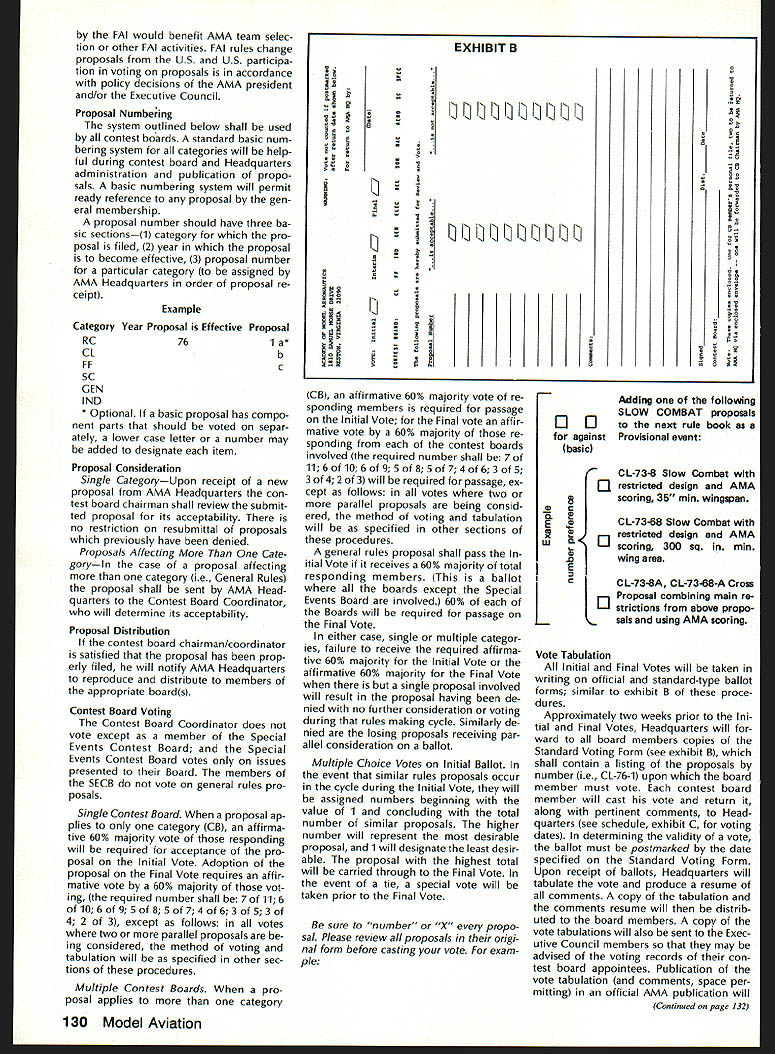
- When a proposal applies to only one contest board (category), an affirmative 60% majority of those responding is required for acceptance on the Initial Vote.
- For the Final Vote, an affirmative 60% majority of those responding from each of the contest boards involved is required for passage. Required numbers are: 7 of 11; 6 of 10; 6 of 9; 5 of 8; 5 of 7; 4 of 6; 3 of 5; 3 of 4; 2 of 3.
- Failure to receive the required 60% majority on either the Initial or Final Vote results in denial of the proposal for that rules-making cycle.
Multiple Contest Boards
- When a proposal applies to more than one category, the same 60% majority rules apply for Initial and Final Votes as described above.
Multiple Choice Votes on Initial Ballot
- If similar proposals occur in the cycle during the Initial Vote, they will be assigned numbers (1 through N) with higher numbers representing more desirable proposals.
- Each board member will rank or choose; the proposal with the highest total will be carried through to the Final Vote. In the event of a tie, a special vote will be taken prior to the Final Vote.
- Be sure to number or mark (X) every proposal. Review all proposals in their original form before casting your vote.
Example of similar proposals for Slow Combat (to be considered as Provisional events):
- CL-73-8: Slow Combat with restricted design and AMA scoring, 35" minimum wingspan.
- CL-73-68: Slow Combat with restricted design and AMA scoring, 300 sq. in. minimum wing area.
- CL-73-8A / CL-73-68-A: Cross proposal combining main restrictions from the above and using AMA scoring.
Vote Tabulation
- All Initial and Final Votes will be taken in writing on official ballot forms (similar to Exhibit B).
- Approximately two weeks prior to Initial and Final Votes, Headquarters will forward to all board members copies of the Standard Voting Form (Exhibit B), listing proposals by number (e.g., CL-76-1).
- Each contest board member will cast his vote and return it, along with comments, to Headquarters by the postmark date specified on the Standard Voting Form.
- Headquarters will tabulate votes, produce a report showing comments, and distribute a copy of the tabulation with comments to board members. A complete tabulation will also be sent to Executive Council members.
- Publication of vote tabulations (and comments, space permitting) will appear in an official AMA publication.
EXHIBIT A
RULES CHANGE PROPOSAL FORM
Send to AMA HQ. A copy will be forwarded to the appropriate Contest Board Chairman. (Attach extra sheets if necessary.)
Rule Category (check one):
- FREE FLIGHT (Outdoor / Indoor)
- SCALE
- RADIO CONTROL (Helicopter / Electric / Soaring / Special Events / Racing / Aerobatics & Other)
- CONTROL LINE
- GENERAL
USE BLACK INK
- Brief summary of the proposed change:
__________________________________________________________________________ __________________________________________________________________________
- Exact wording proposed for the rule book (list paragraph numbers where applicable; Example: Change "quote present rule book wording" to: "(exact wording desired)").
__________________________________________________________________________ __________________________________________________________________________ __________________________________________________________________________
Note: The Contest Board chairman may, at any time prior to submitting a proposal to the Contest Board for Final Vote, edit proposal wording to increase clarity and avoid ambiguity, provided the proposal intent is not changed.
- Logic behind proposal change, including alleged shortcomings of present rules:
- Effect, if any, on current AMA records:
- Signatures of three adult AMA members required (at least one must be a current AMA Contest Director).
AMA No. Member Cat. Date of Signature (1) Proposer: _________________________ AMA No. __________ Member Cat. _____ Date ___________ Street Address _________________________________________________________________ City _______________________________ State __________ Zip _____________________ Day Phone (area code _____) __________________ Night Phone (area code _____) ________________
(2) Proposer: _________________________ AMA No. __________ Member Cat. _____ Date ___________
(3) Proposer: _________________________ AMA No. __________ Member Cat. _____ Date ___________
Academy of Model Aeronautics 1810 Samuel Morse Drive, Reston, Virginia 22090
COMPETITION NEWSLETTER
Academy of Model Aeronautics 1810 Samuel Morse Drive Reston, VA 22090
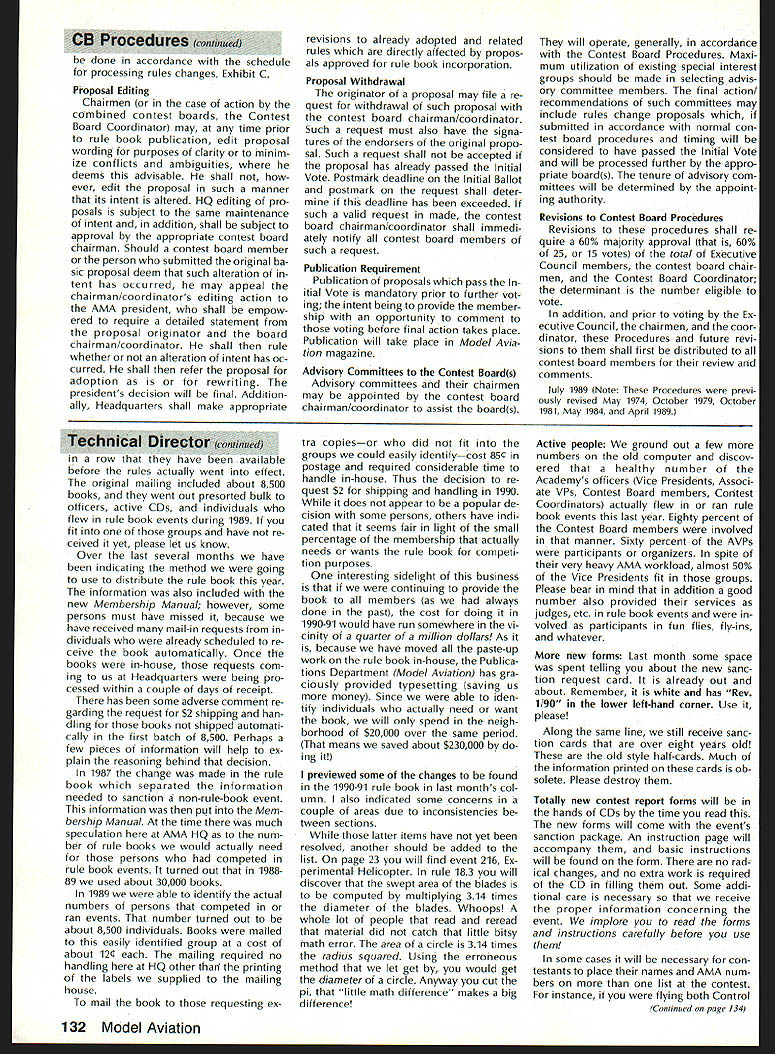
Note: Technical Director W. Bob Underwood has said, "Variety is the spice of life." This month's column includes bits and pieces on various subjects: rule book mail, mid‑December third-cycle items, etc.
FAI World Championships Schedule 1990
FAI's CIAM approved the following World Championships calendar at its November 30–December 1, 1989 meeting:
- Space Models — Kiev, USSR: June 11–18
- Control Line (F2A/B/C/D) — Blénod-les-Pont-à-Mousson, France: July 9–14
- Electroflight (F3E) — Freistadt, Austria: August 6–11
- Junior Free Flight (F1A/B/C) — Mostar, Yugoslavia: August 20–26
- Scale (F4B/C) — Warsaw, Poland: August 31–September 10
Team Selected — 1990 Junior Free Flight World Championships
The following young free-flight fliers were competitively selected as members of the U.S. team for the 1990 FAI Junior FF World Championships (Mostar, Yugoslavia; August 20–26, 1990):
- F1A Towline Glider:
- Matthew Gagliano, Floral Park, NY
- Joel Grasmeyer, Grand Rapids, MI
- Mike Keller, Lancaster, CA
- F1B Wakefield Rubber:
- Roderick Joerger, York, PA
- Christopher Pelatowski, Ansonia, CT
- Adam Tracy, Maple Valley, WA
- F1C Power:
- Tony Hutchins, Portland, IN
- Craig Lippman, Lansdale, PA
- Jim Troutman, Marion, TX
Asian‑Pacific RC Aerobatics Champs Set April 19–22, 1990
The MAAA has offered to host an off‑year international RC Aerobatics championship in conjunction with its Kraft Masters contest and has applied for FAI Open International status for 1990. A letter was recently received at AMA Headquarters.
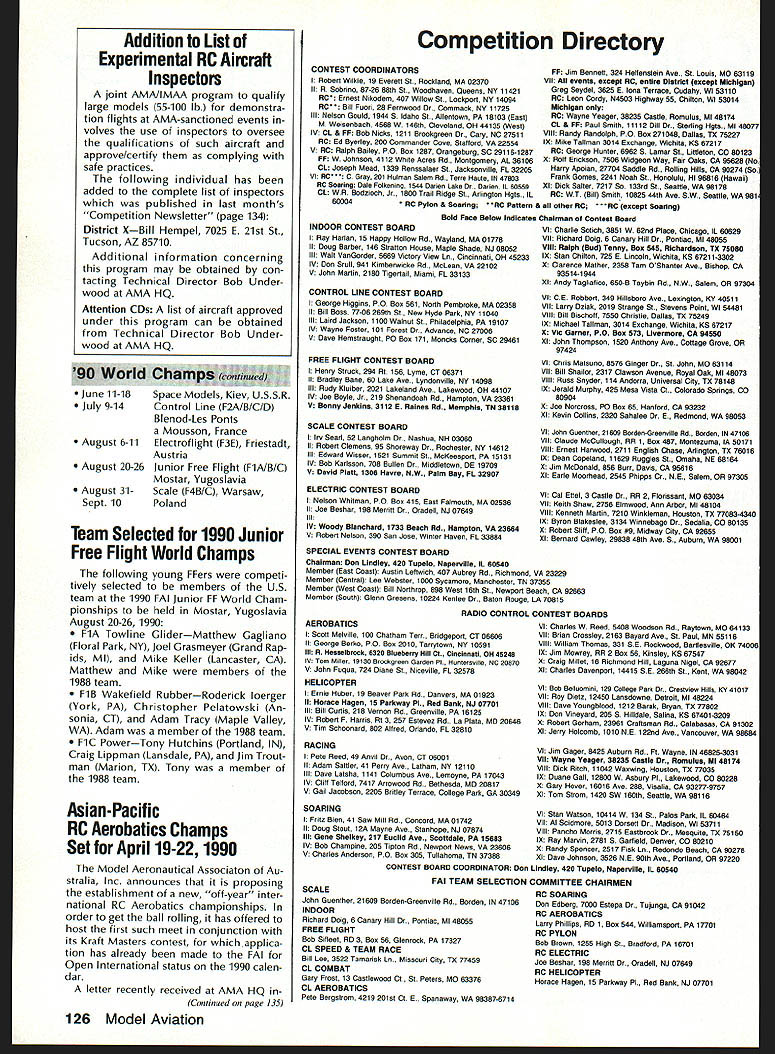
Competition Directory (partial)
CONTEST COORDINATORS
- FF: Jim Bennett, 324 Heitenstein Ave., St. Louis, MO 63119
- (additional coordinator listings continue)
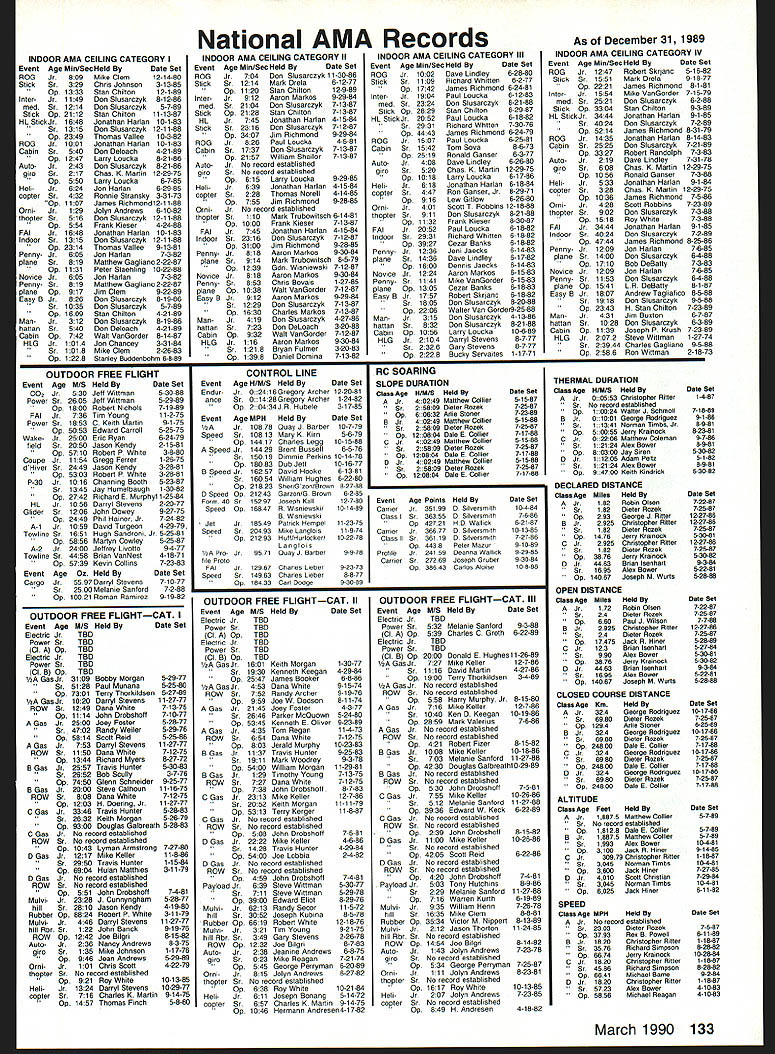
I inspected the scanned page carefully. One page is a full-page table titled "National AMA Records" and does not contain continuing text from the Competition Newsletter article you asked to extract. If you intended a different scanned page, please upload it. If you want the National AMA Records table transcribed instead, confirm and it will be extracted.
Competition Newsletter (continued)
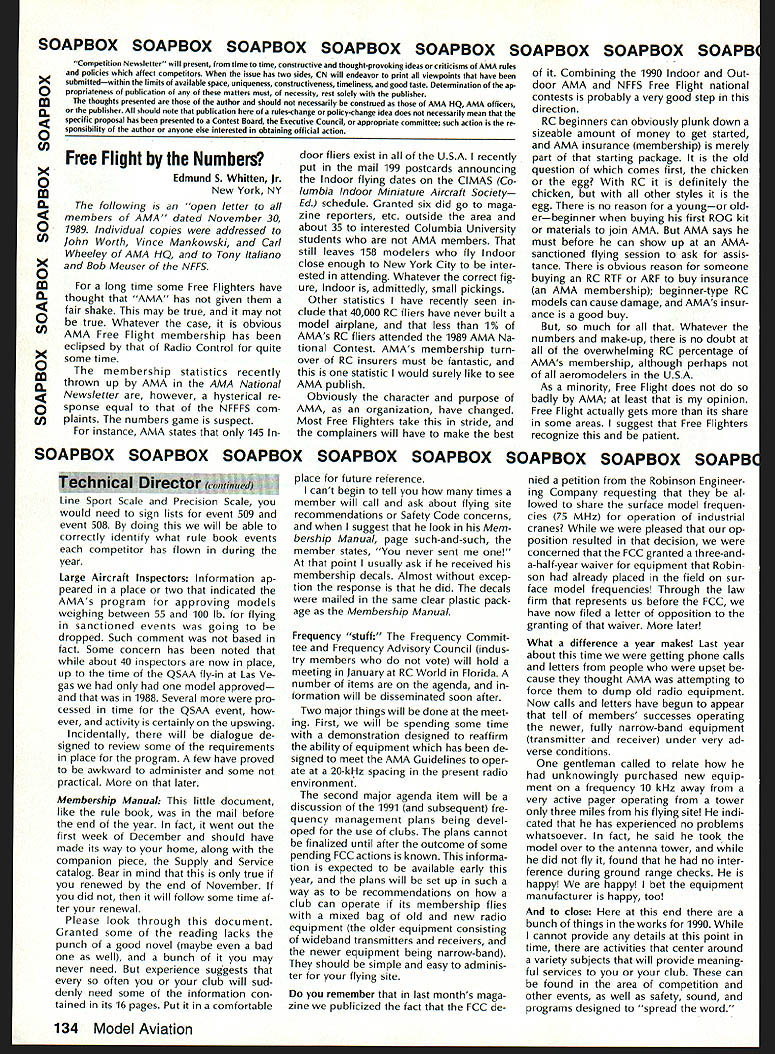
"Competition Newsletter" will present, from time to time, constructive and thought‑provoking ideas or criticisms of AMA rules and policies affecting competitions. When an issue has two sides, CN will endeavor to print all submitted viewpoints—within limits of space, uniqueness, constructiveness, timeliness, and good taste. Appropriateness of publication rests solely with the publisher.
The thoughts presented are those of the author and should not necessarily be construed as those of AMA HQ, AMA officers, or the publisher. Publication here does not necessarily mean the specific proposal has been presented to a Contest Board, the Executive Council, or an appropriate committee; such action is the responsibility of the author or anyone else interested in obtaining official action.
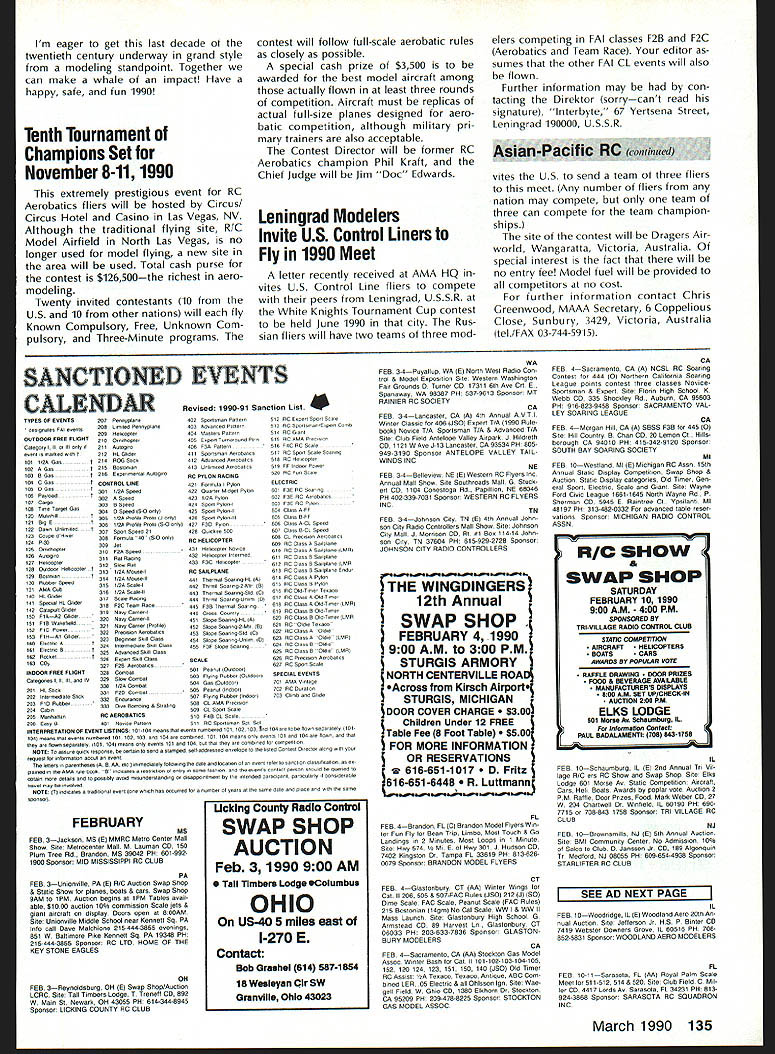
I'm eager to get this last decade of the twentieth century underway in grand style from a modeling standpoint. Together we can make a whale of an impact! Have a happy, safe, and fun 1990!
Tenth Tournament of Champions Set for November 8–11, 1990
- Event: RC Aerobatics Tournament of Champions
- Host: Circus Circus Hotel and Casino, Las Vegas, NV
- Dates: November 8–11, 1990
- Flying site: New site in the North Las Vegas area (traditional R/C Model Airfield no longer used)
- Total cash purse: $126,500 (richest in aeromodeling)
- Twenty invited contestants (10 from the U.S., 10 from other nations) will each fly Known Compulsory, Free, Unknown Compulsory, and Three-Minute programs.
- Contest will follow full-scale aerobatic rules as closely as possible.
- Special cash prize: $3,500 for best model aircraft flown in at least three rounds. Aircraft must be replicas of full-scale aerobatic planes (military or jet trainers also acceptable).
- Contest Director: Phil Kraft
- Chief Judge: Jim "Doc" Edwards
Leningrad Modelers Invite U.S. Control Liners to Fly in 1990 Meet
A letter received at AMA HQ invited U.S. Control Line fliers to compete with Leningrad fliers at the White Knights Tournament Cup contest (June 1990) in Leningrad, U.S.S.R. The Russian fliers will have teams competing in FAI classes F2B (Aerobatics) and F2C (Team Race). Other FAI C/L events are assumed to be flown as well.
Further information may be obtained by contacting:
- "Interflyev," 67 Vesenna Street, Leningrad 190000, U.S.S.R. (Director’s name illegible)
Asian‑Pacific RC (continued)
The Asian‑Pacific RC event invites the U.S. to send a team of three fliers. Any number of fliers from any nation may compete, but only one team of three can compete for the team championship.
- Site: Draggers Airworld, Wangaratta, Victoria, Australia
- No entry fee; model fuel will be provided to all competitors at no cost.
- For further information contact:
- Chris Greenwood, MAAA Secretary, 6 Coppelious Close, Sunbury, 3429, Victoria, Australia
- Tel./FAX: (03) 744-5915
Team Selected (restate)
1990 Junior Free Flight World Championships — The following young FFers were competitively selected as members of the U.S. team for the 1990 FAI Junior FF World Championships (Mostar, Yugoslavia; August 20–26, 1990):
- F1A Towline Glider:
- Matthew Gagliano, Floral Park, NY
- Joel Grasmeyer, Grand Rapids, MI
- Mike Keller, Lancaster, CA
- F1B Wakefield Rubber:
- Roderick Joerger, York, PA
- Christopher Pelatowski, Ansonia, CT
- Adam Tracy, Maple Valley, WA
- F1C Power:
- Tony Hutchins, Portland, IN
- Craig Lippman, Lansdale, PA
- Jim Troutman, Marion, TX
Transcribed from original scans by AI. Minor OCR errors may remain.

