
A Note From the Technical Director
Bob Underwood
Today's subject: the new 1990-91 AMA rule book. Good gosh! It's terrible — you have to correct the corrections!
Last month's column told of an error in the Indoor section which had to do with calculating the area of the rotor blades for autogiros. Somewhere along the way copy editing got busy and read, "Using the erroneous method that we let get by, you would get the diameter of a circle!" Nope! What we'd tried to say was you'd get the circumference! At this point I'd be happy if those darn blades would sweep a square. It's a lot easier to find the area of a square. (Let's see, the square of the hippopotamus times the framistan, divided by infinity ought to do it.)
Now on to other things. A couple months ago we provided the count for individuals that had flown in sanctioned rule-book events during 1989. We stated that the count only went through October 6, 1989; however, some folks must not have read that. Since then I've seen reports of the figures that talk "for the year." What are the "for-the-year" numbers? Behold, they falleth before your eyes:
Number of Entries — Rule Book Events (1989)
- Free Flight: 1,662
- Indoor: 514
- Control Line: 1,044
- RC Aerobatics: 2,097
- RC Pylon: 1,083
- RC Helicopter: 284
- RC Soaring: 2,235
- Scale: 774
- Electric: 77
- Special Events: 49
Total: 9,819
Addition to List of Experimental RC Aircraft Inspectors
A joint AMA/IMAA program to qualify large models (55–100 lb) for production flights at AMA‑sanctioned events involves the use of inspectors to oversee the qualifications of such aircraft and approve/certify them as complying with safe practices.
The following individual has been added to the complete list of inspectors which was published in the February 1990 edition of the "Competition Newsletter" (page 134):
- District XI — Charles R. Cgrade, 716 Hart Ln., Walla Walla, WA 99362
Additional information concerning this program may be obtained by contacting Technical Director Bob Underwood at AMA HQ.
Attention CDs: A list of aircraft approved under this program can be obtained from Technical Director Bob Underwood at AMA HQ.
No Sanctions (continued)
These planes must not be allowed to participate in sanctioned events.
All members, particularly Contest Directors, need to make note of this information.
AMA: Modelers Working for Modelers!
"Competition Newsletter" is edited by Ross B. McMullen, AMA 18181.
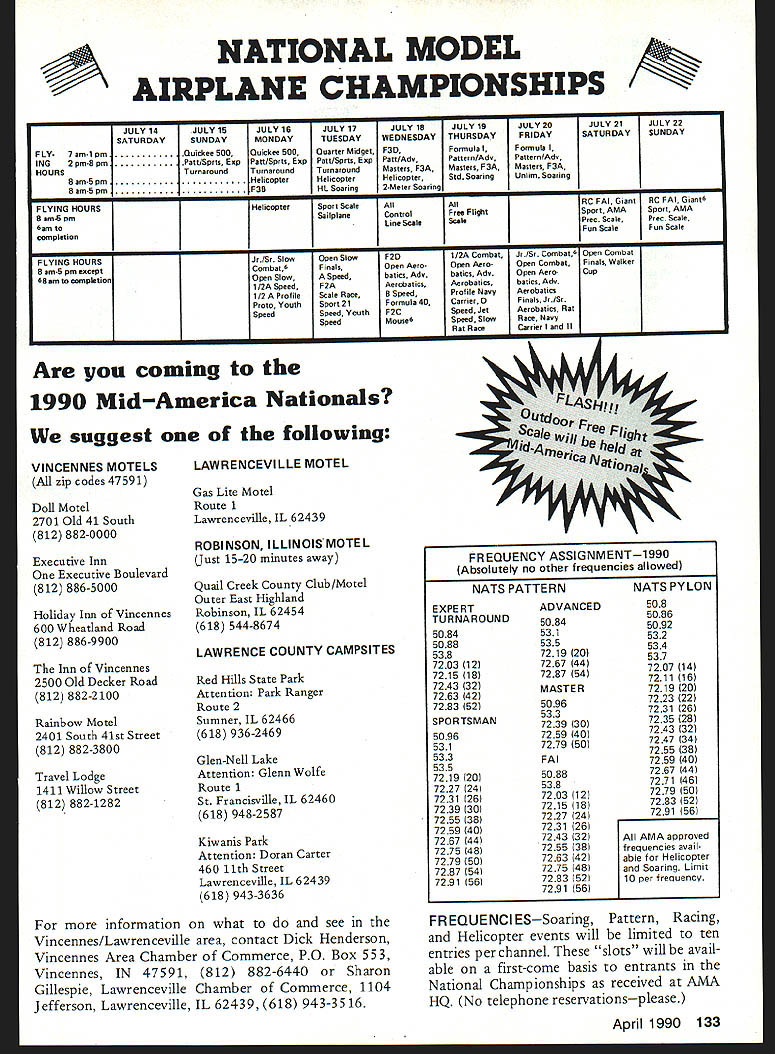
NATIONAL MODEL AIRPLANE CHAMPIONSHIPS
Are you coming to the 1990 Mid‑America Nationals?
We suggest one of the following:
Vincennes Motels
(All zip codes 47591)
- Doll Motel
2701 Old 41 South (812) 882-0000
- Executive Inn
One Executive Boulevard (812) 886-5000
- Holiday Inn of Vincennes
600 W. Wheatland Road (812) 886-9900
- The Inn of Vincennes
2500 Old Decker Road (812) 882-2100
- Rainbow Motel
2401 South 41st Street (812) 882-3800
- Travel Lodge
1411 Willow Street (812) 882-1282
Lawrenceville Motel
- Gas Lite Motel
Route 1 Lawrenceville, IL 62439
Robinson, Illinois (Just 15–20 minutes away)
- Quail Creek Country Club/Motel
Outer East Highland Robinson, IL 62454 (618) 544-8674
Lawrence County Campsites
- Red Hills State Park
Attention: Park Ranger Route 2 Sumner, IL 62466 (618) 936-2469
- Glen‑Nell Lake
Attention: Glenn Wolfe Route 1 St. Francisville, IL 62460 (618) 948-2587
- Kiwanis Park
Attention: Doran Carter 460 11th Street Lawrenceville, IL 62439 (618) 943-3636
For more information on what to do and see in the Vincennes/Lawrenceville area, contact Dick Henderson, Vincennes Area Chamber of Commerce, P.O. Box 553, Vincennes, IN 47591, (812) 882-6440, or Sharon Gillespie, Lawrenceville Chamber of Commerce, 1104 Jefferson, Lawrenceville, IL 62439, (618) 943-3516.
FLASH!!! Outdoor Free Flight Scale will be held at Mid‑America Nationals.
FREQUENCY ASSIGNMENT — 1990 (Absolutely no other frequencies allowed)
FREQUENCIES — Soaring, Pattern, Racing, and Helicopter events will be limited to ten entries per channel. These "slots" will be available on a first-come basis to entrants in the National Championships as received at AMA HQ. (No telephone reservations—please.)
1990-91 Competition Regulation Corrections and Information
Several areas of the new rule book require additional information or corrections:
Scale Rules Corrections
The following corrections and additions should be made to the Scale section of your 1990-91 Competition Regulations book.
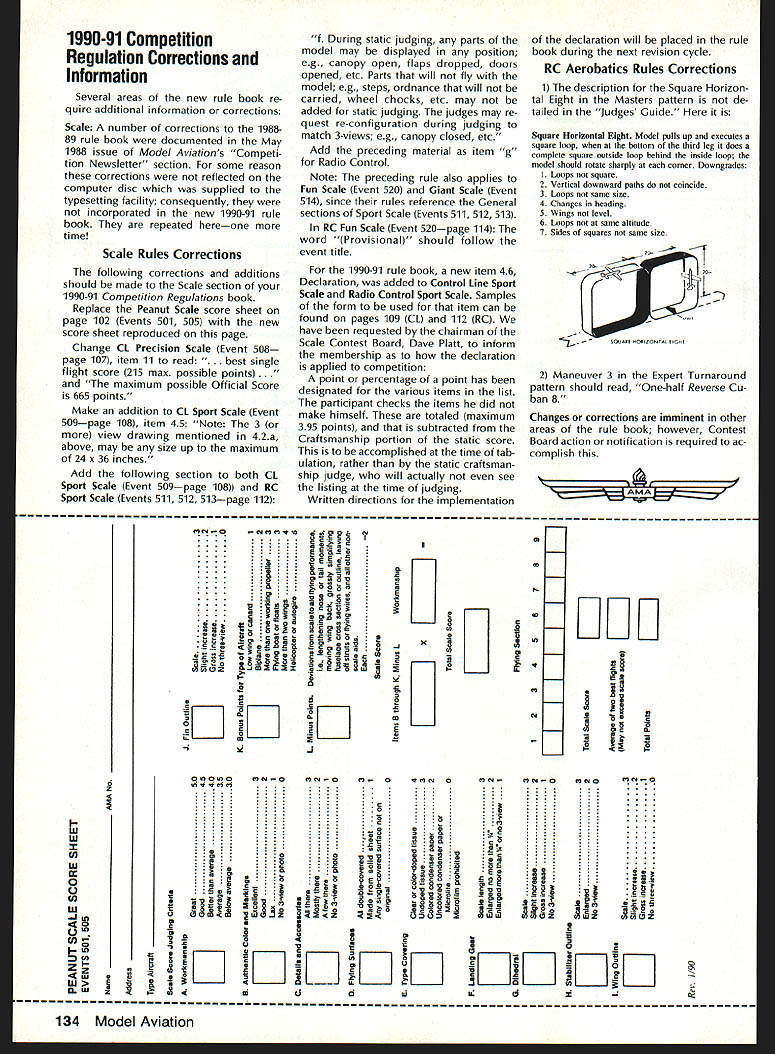
- Replace the Peanut Scale score sheet on page 102 (Events 501, 505) with the new score sheet reproduced on this page.
- Change CL Precision Scale (Event 508—page 107), item 11 to read: "... best single flight score (215 max. possible points) ..." and "The maximum possible Official Score is 665 points."
- Make an addition to CL Sport Scale (Event 509—page 108), item 4.5: "Note: The 3 (or more) view drawing mentioned in 4.2.a, above, may be any size up to the maximum of 24 x 36 inches."
- Add the following section to both CL Sport Scale (Event 509—page 108) and RC Sport Scale (Events 511, 512, 513—page 112):
"F. During static judging, any parts of the model may be displayed in any position; e.g., canopy open, flaps dropped, doors opened, etc. Parts that will not fly with the model; e.g., steps, ordnance that will not be carried, wheel chocks, etc., may not be added for static judging. The judges may request re-configuration during judging to match 3-views; e.g., canopy closed, etc."
- Add the preceding material as item "g" for Radio Control.
Note: The preceding rule also applies to Fun Scale (Event 520) and Giant Scale (Event 514), since their rules reference the General sections of Sport Scale (Events 511, 512, 513).
- In RC Fun Scale (Event 520—page 114): The word "(Provisional)" should follow the event title.
For the 1990-91 rule book, a new item 4.6, Declaration, was added to Control Line Sport Scale and Radio Control Sport Scale. Samples of the form to be used for that item can be found on pages 109 (CL) and 112 (RC). We have been requested by the chairman of the Scale Contest Board, Dave Platt, to inform the membership as to how the declaration is applied to competition:
- A point or percentage of a point has been designated for the various items in the list. The participant checks the items he did not make himself. These are totaled (maximum 3.95 points), and that is subtracted from the Craftsmanship portion of the static score. This is to be accomplished at the time of tabulation, rather than by the static craftsmanship judge, who will actually not even see the listing at the time of judging.
Written directions for the implementation of the declaration will be placed in the rule book during the next revision cycle.
RC Aerobatics Rules Corrections
- The description for the Square Horizontal Eight in the Masters pattern is not detailed in the "Judges' Guide." Here it is:
Square Horizontal Eight. Model pulls up and executes a square loop; when at the bottom of the third leg it does a complete square outside loop behind the inside loop; the model should rotate sharply at each corner.
Downgrades:
- Loops not square.
- Vertical downdraw paths do not coincide.
- Loops not same size.
- Changes in heading.
- Wings not level.
- Loops not at same altitude.
- Sides of squares not same size.
- Maneuver 3 in the Expert Turnaround pattern should read, "One-half Reverse Cuban 8."
Changes or corrections are imminent in other areas of the rule book; however, Contest Board action or notification is required to accomplish this.
Technical Director (continued)
Remember: That total includes those who entered multiple classifications. For a more realistic number of total individuals, the following speaks:
Number of Persons Flying Rule Book Events in 1989 — By Age Classifications
- Open: 7,664
- Senior Citizen: 553
- Senior: 317
- Junior: 314
Total: 8,848
If you are interested in the breakdown by AMA district, we have the following:
Number of Entrants Flying Rule Book Events in 1989 — By AMA District
- District I: 387
- District II: 597
- District III: 653
- District IV: 571
- District V: 954
- District VI: 812
- District VII: 677
- District VIII: 954
- District IX: 427
- District X: 2,071
- District XI: 625
Total: 8,728
You are correct. The last two totals don't match. That is because we have foreign entries in the 8,848 that don't show up in the district count. Note that this final total reflects an increase of 801 over the totals which were available October 6 and which were reported in my January 1990 column (page 131).
The same considerations are still true for these numbers as for the October 6th set. Due to the reports we had to use this time around, some of the numbers are higher than actual, while others are lower. Rather than repeat the reasons for that here, if you're interested zip back to that January issue and find out why.
So much for 1989.
Now what about 1990? We will be in a position to provide more accurate information about participation in specific events from now on. That is, we can provide the more accurate information if all CDs utilize the new Form 11 that accompanies all sanctions now being sent out!
I implore each CD to look over the new form (and its directions) carefully. The Form 11 replaces the old two-part registration form. The "11" is also two-part so that the CD may retain a copy. The only things required to be placed on the new form by the participant are name (printed, please! — manuscript is acceptable only from your penmanship purists) and AMA number. If the CD wishes to have the information, there is a space provided for the entrant's address.
If you're holding a rule book contest, at least one of the Form 11's will be included for every rule book event. At the top of the form is a place for the event number. All the names on that sheet will be the participants in that one numbered event.
So — ultimately we will be able to report how many individuals flew in a specific rule book event. Want to know how many persons flew in Hand‑Launched Glider? Or CL Combat? Or RC Quickie 500? We will be able to go to our computer terminal here at AMA HQ, punch in 140, 328, and 428 — and the numbers will tumble out.
The same report form will be used for fun fly and other flying events. The only difference is that the event name (not the event number) is used, and separate sheets for each event are not required.
This new system will allow us to track our activity far more accurately. We will be relying on the CDs to provide the forms and event numbers. Bear in mind that almost 400 sanctions were mailed out before the forms were available. Those packages contained the old registration sheets. If you are having rule book events and you'd like the new forms, just let us know the number of separate forms you need, and we will send them to you.
Another subject: Several months ago a competition-oriented member requested (informally — no official rule proposal form was submitted) definitions for the use of "should" and "shall" in the Competition Regulations. What followed was an interesting exercise in grammatical pedantry. After the collection of information was complete, the latter was sent to the chairpersons of our Contest Boards requesting their opinions concerning the usage of those two words in the regulations.
In the classic grammatical usage, "should" and "shall" are the same word. They differ only in tense, with "should" representing past tense, and "shall" expressing futurity. ("I should have completed the task yesterday." "I shall complete the task tomorrow.")
Modern usage has greatly eroded the use of the two words. This has resulted in usage that assigns a matter of degree to each word. The word "should," rather than playing its role of past tense, has assumed a softer meaning in all tenses, while "shall" is the harder, more positive form. The definitions included for each substantiate that position:
- Shall — Used to express determination or promise; inevitability; command; a directive or requirement.
- Should — Used to express obligation or duty; probability or expectation; conditionality or contingency. Used to moderate the bluntness of a statement.
We have further confused the issue by now requesting an ultimate directness to "will" beyond that of "shall." In simple terms, we might say:
- "You should do it." — Implies that it would be nice if you did, but the world won't end if you don't.
- "You shall do it!" — Implies that you are required to do it.
- "You will do it!" — Implies ... Well, I suspect that is evident.
The question of what to do with the use of "should" and "shall" in the Competition Regulations was brought to the attention of the Contest Board chairpersons. Three suggestions were offered:
- To edit the book according to modern usage (sort of "should" — harder "shall") and attempt to determine original intent.
- To establish the policy that we shall follow classic grammatical usage and edit the book correcting for proper tense.
- To assume that the book has utilized the modern usage interpretation all along, not edit at this time, and indicate this to the membership.
The majority of the chairpersons indicated their preferences for the third option. To that end we are informing the membership of that decision:
- The use of "shall" shall constitute a requirement when used in the Regulations.
- The use of "should" shall constitute a directive or expectation — but not necessarily a requirement.
In the event a person wishes to address a specific usage in any given rule, he may file a proposed change at any time during the current rule-change cycle.
And now here's a bunch of closing thoughts:
Don Lindley, Contest Board Coordinator, has asked that we remind the membership that ad hoc meetings of Contest Boards which might occur at events do not carry official status.
On occasion it appears that when a number of Contest Board members are in attendance at an event they often meet to discuss concerns. This is a healthy process; however, any rule revisions or interpretations that may be discussed are not binding on that (or any other) event until the proper processing of the item occurs. Last month's Model Aviation, beginning on page 128, detailed the entire procedure.
Please note that beginning January 1, 1991 a requirement is in effect stating that only "narrow-band" transmitters may be used at sanctioned events. This requirement was reaffirmed at a Frequency Committee meeting held January 20, 1990. I suggest that you watch next month's AMA News for a report of other activities and actions taken at that meeting.
You will be interested in the report of an experiment confirming the ability to use the 20-kHz spacing of frequencies. The experiment involved the simultaneous operation of as many as eight RC transmitters meeting the AMA Guidelines (using both odd- and even-numbered channels) while having up to four planes in the air. Also included in the report will be details of the frequency management plans for use at all flying sites.
Stay tuned!
FF Slope Champs (continued)
Models must be smaller than 5 sq. decimeters (approximately 77.5 sq. in.). A maximum-size model (150 sq. decimeters) would have approximately 2,325 sq. in. of area.
Contests are flown in five rounds, with the maximum flight time for each round between two and five minutes. The models are launched by hand from a slope, facing the wind. Normalized scoring is used.
The first F1E World Championships was held in Nowy Targ, Poland on September 19–24, 1989. Twenty-one competitors from seven countries participated.
The three top competitors were:
- Klaus Salzer (Austria)
- Rudolf Musil (Czechoslovakia)
- Ivan Crha (Czechoslovakia)
The order of finish by the national teams was:
- F.R. Germany
- Czechoslovakia
- Austria
- U.K.
- Italy
- Switzerland
- Poland
There's nothing to stop U.S. modelers from getting into this class of world competition (although your editor imagines that modelers in the flat Midwest could never find good enough flying sites to gain meaningful experience).
Transcribed from original scans by AI. Minor OCR errors may remain.

