
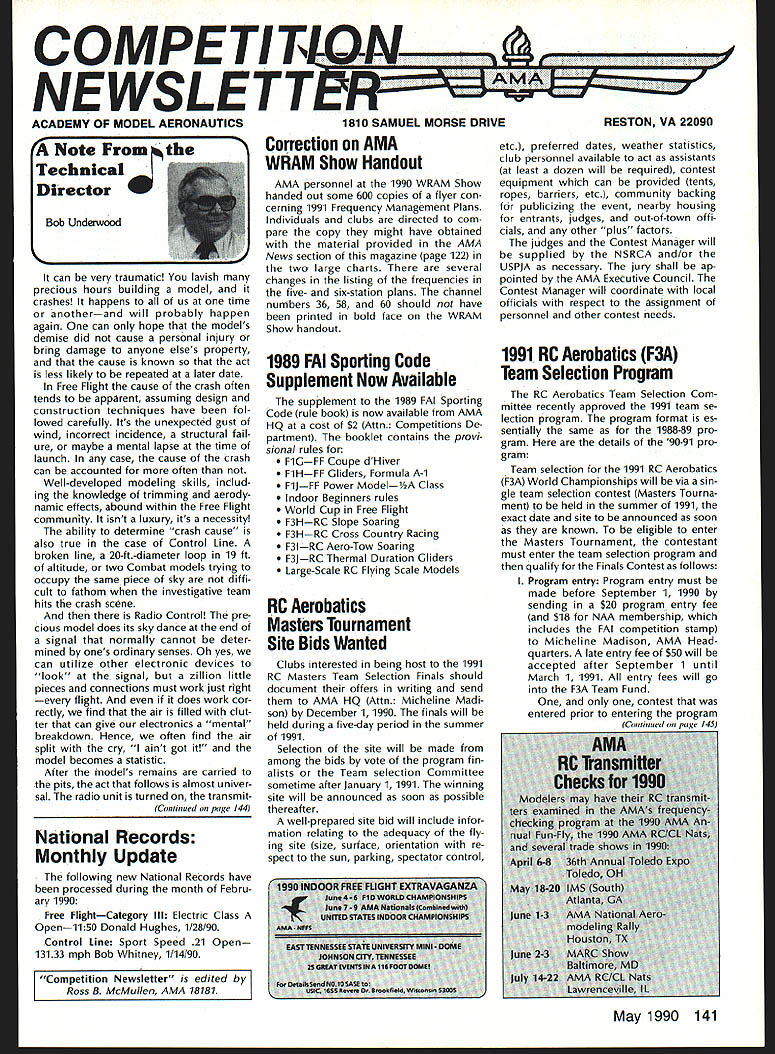
A Note From the Technical Director
Bob Underwood
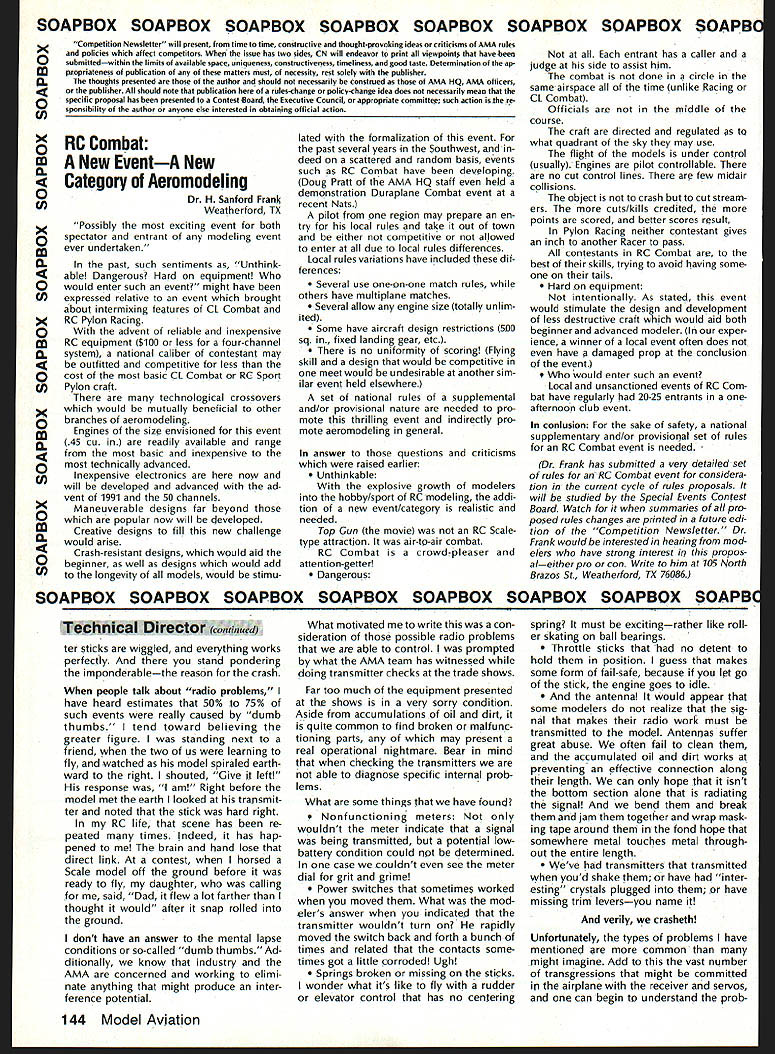
It can be very traumatic! You lavish many precious hours building a model, and it crashes. It happens to all of us at one time or another—and will probably happen again. One can only hope that the model's demise did not cause personal injury or damage to anyone else's property, and that the cause is known so that the act is less likely to be repeated.
In Free Flight the cause of the crash often tends to be apparent, assuming design and construction techniques have been followed carefully. It's the unexpected gust of wind, incorrect incidence, a structural failure, or maybe a mental lapse at the time of launch. In any case, the cause of the crash can be accounted for more often than not.
Well-developed modeling skills, including the knowledge of trimming and aerodynamic effects, abound within the Free Flight community. It isn't a luxury; it's a necessity. The ability to determine "crash cause" is also true in the case of Control Line. A broken line, a 20-ft.-diameter loop in 19 ft. of altitude, or two Combat models trying to occupy the same piece of sky are not difficult to fathom when the investigative team hits the crash scene.
And then there is Radio Control. The precious model does its sky dance at the end of a signal that normally cannot be determined by one's ordinary senses. Oh yes, we can utilize other electronic devices to "look" at the signal, but a zillion little pieces and connections must work just right every flight. And even if it does work correctly, we find that the air is filled with clutter that can give our electronics a "mental" breakdown. Hence, we often find the air split with the cry, "I ain't got it!" and the model becomes a statistic.
After the model's remains are carried to the pits, the act that follows is almost universal: the radio unit is turned on—the transmitter. Sticks are wiggled, and everything works perfectly. And you stand pondering the imponderable—the reason for the crash.
When people talk about "radio problems," I have heard estimates that 50% to 75% of such events were actually caused by "dumb thumbs." I tend toward believing the greater figure. I was standing next to a friend, when the two of us were learning to fly, and watched as his model spiraled earthward to the right. I shouted, "Give it left!" His response was, "I am!" Right before the model met the earth I looked at his transmitter and noted that the stick was hard right.
In my RC life, that scene has been repeated many times. Indeed, it has happened to me. At a contest, when I brought a Scale model off the ground before it was ready to fly, my daughter, who was calling for me, said, "Dad, it flew a lot farther than I thought it would" after it snapped, rolled into the ground.
I don't have an answer to the mental lapse conditions or so-called "dumb thumbs." Additionally, we know that industry and the AMA are concerned and working to eliminate anything that might produce an interference potential.
What motivated me to write this was a consideration of those possible radio problems that we are able to control. I was prompted by what the AMA team has witnessed while doing transmitter checks at the trade shows.
Far too often local interest assumes that the "faulty equipment" is the user's fault. A unit which appears questionable may be only the result of poor alignment, poor repair, or poor preparation; it is often due to an accumulation of minor things. Keep in mind that when checking the transmitter we are not able to diagnose specific internal problems.
What are some things that we have found?
- Nonfunctioning meters: Not only would the meter fail to indicate that a signal was being transmitted, but a potential low-battery condition could not be determined. In one case we couldn't even see the meter dial for grit and grime.
- Power switches that sometimes worked only when you moved them. What was the modeler's answer when you indicated that the transmitter wouldn't turn on? He rapidly moved the switch back and forth a bunch of times and related that the contacts sometimes got a little corroded.
- Springs broken or missing on the sticks. I wonder what it's like to fly without a rudder or elevator control that has no centering spring. It must be exciting—rather like roller skating on ball bearings.
- Throttle sticks that had no detent to hold them in position. I guess that makes some form of fail-safe, because if you let go of the stick, the engine goes to idle.
- And the antenna. It would appear that some modelers do not realize that the antenna is the most important part of the link to the model. Antennas suffer great abuse. We often fail to clean them, and the accumulated dirt and oil prevent an effective connection along their length. We can only hope that it isn't the bottom section that has a short—break the signal! We bend them and break them and jam them together and wrap masking tape around them in the hopes of holding broken sections together. They are often the parts that touch metal throughout their entire length.
- We've had transmitters that transmitted only when you'd shake them; intermittent crystals plugged into them; missing trim levers—you name it.
And verily, we crash.
Unfortunately, the types of problems I have mentioned are more common than many might imagine. Add to this the vast number of connections and installations inside the airplane—the receiver and servos—and one can begin to understand the problems.
Check around your field and note the improperly mounted servos, switches placed where they collect all the exhaust gunk, or receiver antennas doubled back on themselves (or cut shorter!) because it looks neater. And we haven't even considered the problems that might occur due to a lack of a frequency control system at the field!
Are we all prone to this type of behavior? Certainly not. Most modelers take the hobby/sport seriously, and they respect their investment. They carefully follow good procedures in mounting equipment, and they maintain it well. They perform frequent inspections. If they are new to the arena they seek help so they get through the "dumb thumb" stage often associated with the newcomer.
I loved the statement made by one newcomer at a trade show. He said, "The experienced fliers at my club have fewer radio problems." Maybe. Then again...
In next month's column I would like to share some information concerning flight instruction. This is a very important service that a club can provide and is one most needed by newcomers.
On another subject: There are several items floating about that will be of interest to many of you. Elsewhere in this issue is information about a demonstration involving Radio Control flying using a 20-kHz frequency spacing. Coupled with that, you will find frequency management plans designed to help clubs as we move toward that magical 1991 date when (all with a couple of exceptions based on technical considerations) the new RC channels will be approved for use. The material is easy to understand and quite informative.
And here's another: We are in a new rulemaking/revision cycle at the present time. Between now and September 1, 1990, proposals may be submitted to AMA Headquarters. Make certain that they are on the proper form (you can either request one from AMA HQ or cut/copy the one published on page 131 of the March issue of this magazine) and contain all the pertinent information relating to your proposed change.
Once here, they are reviewed in a very general way, the proposer's membership is verified, and they are then distributed to the appropriate contest board for consideration by its chairperson.
And still another: Check elsewhere in this edition of the "Competition Newsletter" for a minor editing change in the Indoor rules. It seems the 1990-91 book speaks of a "section 5" in Cabin Model (Event 204). Unfortunately, no "section 5" exists now.
Contest Directors are reminded that since January there have been new forms provided with the sanctions when they are returned. These are the Form 10 and Form 11. Since they are somewhat different from the old Form 10 and registration sheet, please read the instructions carefully. Remember that the CD places his signature at the bottom of the Form 10 attesting to the validity of the information. We have already had a problem this year with a new member joining at a sanctioned event and no membership application or money being forwarded to AMA HQ. In this case the membership application and fee were accepted by the person doing the registration, and the CD stated that he was not aware that the individual had joined. The new member had a temporary 30-day receipt; however, his permanent card did not arrive from AMA Headquarters because we did not have any paperwork.
I am looking forward to visiting with you this summer at the AMA events and some of the local contests. Let's see, where did I put my Scale presentation...
RC Aerobatics Pgm. (continued)
II. Qualifying:
- Contestants may qualify for the Finals (Masters Tournament) by any one of the following methods:
a) Enter and make at least one official flight in the F3A event (Turnaround) in five AMA-sanctioned contests between March 1, 1990 and March 1, 1991; or b) Finish in the upper 50% of the F3A event in at least two AMA-sanctioned contests between March 1, 1990 and March 1, 1991; or c) Finish in the upper 50% of the F3A event at the 1990 AMA Nationals. d) The three team members of the 1989 F3A U.S. team are automatically prequalified for the 1991 Masters Tournament upon payment of the entry fee of $20 and the Masters Tournament fee of $150.
Note: The number of contestants qualified at each contest will be rounded up (i.e., if seven are entered, the upper 50% would be rounded to the top four contestants). If members of the 1989 team are entered in the contest, they will not be counted in determining the number of contestants entered or in the results.
III. Finals: (Masters Tournament)
- Entry fee will be $150. (Entry fee must be sent to AMA Headquarters no later than 15 days prior to the Finals.)
- The Masters entry funds will be distributed according to the following formula:
- 50% to Team Fund.
- 25% to judges to partially compensate for travel.
- 25% to host club to cover appropriate expenses—any leftover funds to go to the Team Fund.
- The Finals will run from Tuesday through Saturday to allow for easier travel and emergency weather days.
- The Masters Tournament will be flown according to the F3A AMA-produced FAI Sporting Code (available through AMA HQ) as it pertains to world championships, except as amended by majority vote of the Team Selection Committee.
- All other details concerning site selection, dates, jury, judges, procedures, etc., will be determined and announced at a later date.
Changes to New 1990-91 Rule Book
Revised Sport Aerobatics Rule
The RC Aerobatics Contest Board has voted to revise Section 3.2 of the Sport Aerobatics rules (page 70 of the 1990-91 rule book).
The revision became necessary when it was discovered that the existing 3.2 states that the engine displacement (3.7 cu. in.) and aircraft weight limit (40 lb.) will be the same as for RC Giant Scale—but in the meantime the Giant Scale rules were changed for 1990 (to 60 cu. in. and 55 lb., including fuel). The Sport Aerobatic rule change is as follows: remove the wording "(3.7 cu. in. & 40 lb.)" from Section 3.2 (page 70).
The result of this change is that Sport Aerobatic models are limited to engines of 6.0 cu. in. (for two-cycle engines—9.6 cu. in. for four-cycle engines) and 55 lb. weight (including fuel) during the period 1990-91.
Indoor Rule Correction
Minor glitches in the new 1990-91 AMA rule book keep popping up. This one concerns Indoor Event 204, Cabin Model. The text in the rule book contains a reference to "section 5." Such a section no longer exists in the rules for the event.
The sentence containing the phrase should read, "When a covered superstructure is used to fulfill the requirements of these rules, Event 204 Cabin Model, the superstructure must entirely enclose the rubber motor(s) as defined in sentence five of the rules for this event."
Control Line Precision Aerobatics Rule Correction
With the addition of section 12 to the C/LPA rules (page 43), the necessity for reference to hand signals is removed.
Since "Official Flight" is defined by the final sentence in section 7 (page 42), "A flight will be termed official by the contestant's hand signal," the first sentence in section 11.1 (page 43), "The flight will become official upon the contestant giving a hand signal," shall be removed.
This correction will appear in the addendum to the 1990-91 rule book which will be published soon.
Scale Rule Clarification
The new section 4.6 in Sport Scale (Control Line rules page 109, and RC rules page 112) takes printed directions as to what to do with the total points to be deducted. The proposer's (Scale Contest Board Chairman; Dave Pratt) intent was that the declaration form be filled out at the time of entry and retained by the score tabulator (not the judge). The total is to be deducted (maximum of 3.95 points) from the craftsmanship score only.
This statement will be included in the special addendum to the 1990-91 rule book which will be published soon.
Transcribed from original scans by AI. Minor OCR errors may remain.

