
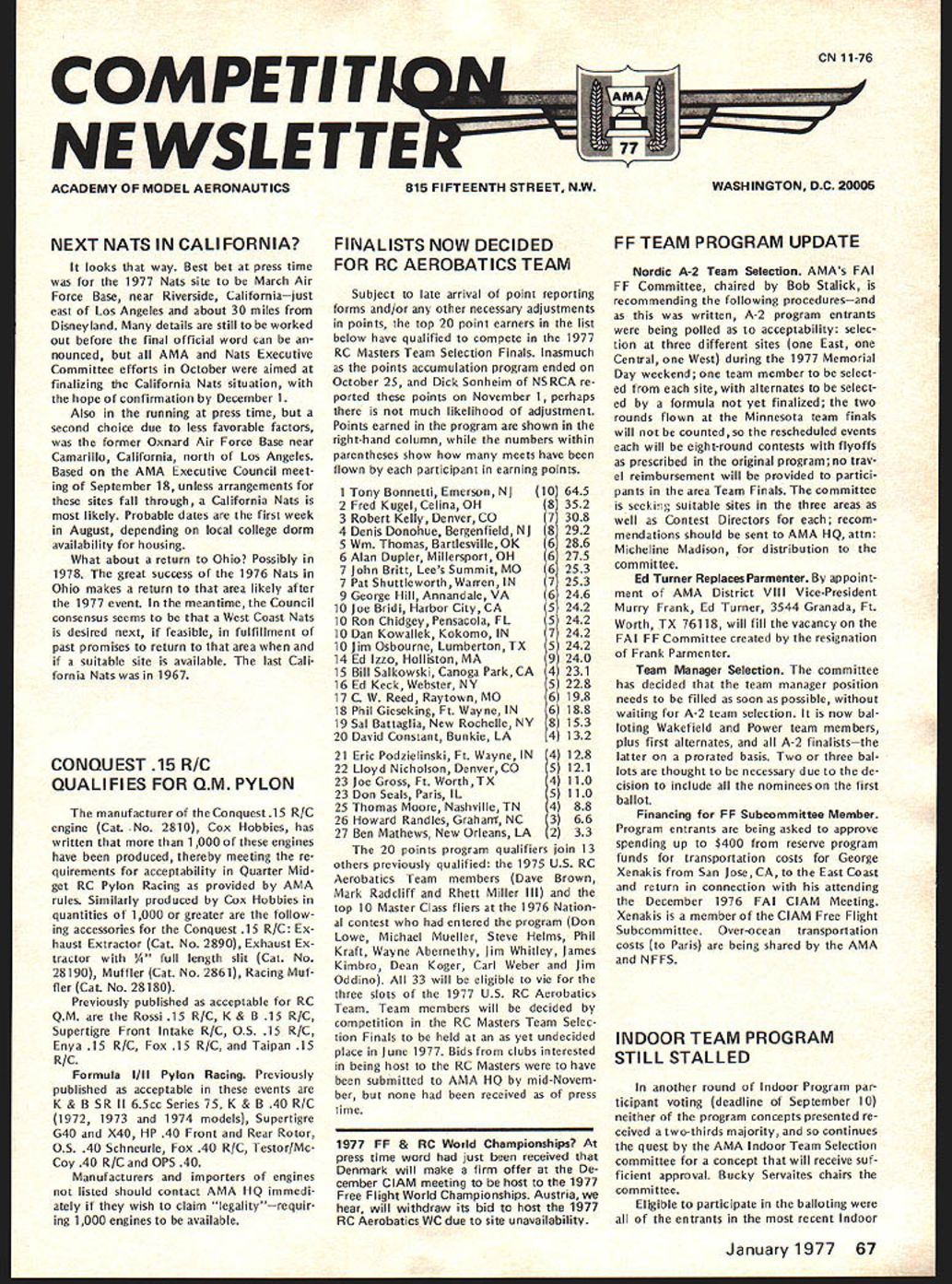
COMPETITION NEWSLETTER
NEXT NATS IN CALIFORNIA?
It looks that way. Best bet at press time was for the 1977 Nats site to be March Air Force Base, near Riverside, California—just east of Los Angeles and about 30 miles from Disneyland. Many details are still to be worked out before the final official word can be announced, but all AMA and Nats Executive Committee efforts in October were aimed at finalizing the California Nats situation, with the hope of confirmation by December 1.
Also in the running at press time, but a second choice due to less favorable factors, was the former Oxnard Air Force Base near Camarillo, California, north of Los Angeles. Based on the AMA Executive Council meeting of September 18, unless arrangements for these sites fall through, a California Nats is most likely. Probable dates are the first week in August, depending on local college dorm availability for housing.
What about a return to Ohio? Possibly in 1978. The great success of the 1976 Nats in Ohio makes a return to that area likely after the 1977 event. In the meantime, the Council consensus seems to be that a West Coast Nats is desired next, if feasible, in fulfillment of past promises to return to that area when and if a suitable site is available. The last California Nats was in 1967.
CONQUEST .15 R/C QUALIFIES FOR Q.M. PYLON
The manufacturer of the Conquest .15 R/C engine (Cat. No. 2810), Cox Hobbies, has written that more than 1,000 of these engines have been produced, thereby meeting the requirements for acceptability in Quarter Midget RC Pylon Racing as provided by AMA rules. Similarly produced by Cox Hobbies in quantities of 1,000 or greater are the following accessories for the Conquest .15 R/C: Exhaust Extractor (Cat. No. 2890), Exhaust Extractor with 3/4" full length slit (Cat. No. 28190), Muffler (Cat. No. 2861), Racing Muffler (Cat. No. 28180).
Previously published as acceptable for R/C Q.M. are the Rossi .15 R/C, K & B .15 R/C, Supertigre Front Intake R/C, O.S. .15 R/C, Enya .15 R/C, Fox .15 R/C, and Taipan .15 R/C.
Formula I/II Pylon Racing. Previously published as acceptable in these events are K & B SR II 6.5cc Series '75, K & B .40 R/C (1972, 1973 and 1974 models), Supertigre G40 and X40, HP .40 Front and Rear Rotor, O.S. .40 Schneurle, Fox .40 R/C, Testor/McCoy .40 R/C and OPS .40.
Manufacturers and importers of engines not listed should contact AMA HQ immediately if they wish to claim "legality"—requiring 1,000 engines to be available.
FINALISTS NOW DECIDED FOR RC AEROBATICS TEAM
Subject to late arrival of point reporting forms and/or any other necessary adjustments in points, the top 20 point earners in the list below have qualified to compete in the 1977 RC Masters Team Selection Finals. Inasmuch as the points accumulation program ended on October 25, and Dick Sonheim of NSRCA reported these points on November 1, perhaps there is not much likelihood of adjustment. Points earned in the program are shown in the right-hand column; numbers within parentheses show how many meets have been flown by each participant in earning points.
- Tony Bonnetti, Emerson, NJ (10) 64.5
- Fred Kugel, Celina, OH (8) 35.2
- Robert Kelly, Denver, CO (7) 30.8
- Denis Donohue, Bergenfield, NJ (8) 29.2
- Wim Thomas, Bartlesville, OK (6) 28.6
- Alan Dupler, Millersport, OH (6) 27.5
- John Britt, Lee's Summit, MO (6) 25.3
- Pat Shuttleworth, Warren, IN (7) 25.3
- George Hill, Annandale, VA (6) 24.6
- Joe Bridi, Harbor City, CA (5) 24.2
- Ron Chidgey, Pensacola, FL (4) 24.2
- Dan Kowallek, Kokomo, IN (5) 24.2
- Jim Osbourne, Lumberton, TX (4) 24.2
- Ed Izzo, Holliston, MA (5) 24.1
- Bill Salkowski, Canoga Park, CA (3) 24.0
- Ed Keck, Webster, NY (6) 23.1
- C. W. Reed, Raytown, MO (6) 22.8
- Phil Gieseking, Ft. Wayne, IN (6) 18.8
- Sal Battaglia, New Rochelle, NY (4) 13.2
- David Constant, Bunkie, LA (4) 12.8
- Eric Podzielinski, Ft. Wayne, IN (4) 12.2
- Lloyd Nicholson, Denver, CO (5) 11.1
- Joe Gross, Ft. Worth, TX (4) 11.0
- Don Seals, Paris, IL (4) 11.0
- Thomas Moore, Nashville, TN (4) 8.8
- Howard Randles, Graham, NC (3) 6.6
- Ben Mathews, New Orleans, LA (2) 3.2
The 20 points program qualifiers join 13 others previously qualified: the 1975 U.S. RC Aerobatics Team members (Dave Brown, Mark Radcliff and Rhett Miller III) and the top 10 Master Class fliers at the 1976 National contest who had entered the program (Don Lowe, Michael Mueller, Steve Helms, Phil Kraft, Wayne Abernethy, Jim Whitley, James Kimbro, Dean Koger, Carl Weber and Jim Oddino). All 33 will be eligible to vie for the three slots on the 1977 U.S. RC Aerobatics Team. Team members will be decided by competition in the RC Masters Team Selection Finals to be held at an as yet undecided place in June 1977. Bids from clubs interested in being host to the RC Masters were to have been sent to AMA HQ by mid-November, but none had been received as of press time.
1977 FF & RC World Championships? At press time word had just been received that Denmark will make a firm offer at the December CIAM meeting to be host to the 1977 Free Flight World Championships. Austria, we hear, will withdraw its bid to host the 1977 RC Aerobatics WC due to site unavailability.
FF TEAM PROGRAM UPDATE
Nordic A-2 Team Selection. AMA's FAI FF Committee, chaired by Bob Stalcik, is recommending the following procedures—and as this was written, A-2 program entrants were being polled as to acceptability: selection at three different sites (one East, one Central, one West) during the 1977 Memorial Day weekend; one team member to be selected from each site, with alternates to be selected by a formula not yet finalized; the two rounds flown at the Minnesota team finals will not be counted, so the rescheduled events each will be eight-round contests with flyoffs as prescribed in the original program; no travel reimbursement will be provided to participants in the area team finals. The committee is seeking suitable sites in the three areas as well as contest directors for each; recommendations should be sent to AMA HQ, attn: Micheline Madison, for distribution to the committee.
Ed Turner Replaces Parmenter. By appointment of AMA District VIII Vice-President Murry Frank, Ed Turner, 3544 Granada, Ft. Worth, TX 76118, will fill the vacancy on the FAI FF Committee created by the resignation of Frank Parmenter.
Team Manager Selection. The committee has decided that the team manager position needs to be filled as soon as possible and, without waiting for A-2 team selection, it is now balloting Wakefield and Power team members, plus first alternates, and all A-2 finalists—these latter on a prorated basis. Two or three ballots are thought to be necessary due to the decision to include all the nominees on the first ballot.
Financing for FF Subcommittee Member. Program entrants are being asked to approve spending up to $400 from reserve program funds for team transportation costs for George Xenakis from San Jose, CA, to the East Coast and return in connection with his attendance at the December 1976 FAI CIAM Meeting. Xenakis is a member of the CIAM Free Flight Subcommittee. Over-ocean transportation costs (to Paris) are being shared by the AMA and NFFS.
INDOOR TEAM PROGRAM STILL STALLED
In an attempt to obtain Indoor Program participant voting (deadline of September 10) neither of the program concepts presented received a two-thirds majority, and so continues the quest by the AMA Indoor Team Selection Committee for a concept that will receive sufficient approval. Bucky Servais chairs the committee.
Eligible to participate in the balloting were all of the entrants in the most recent Indoor
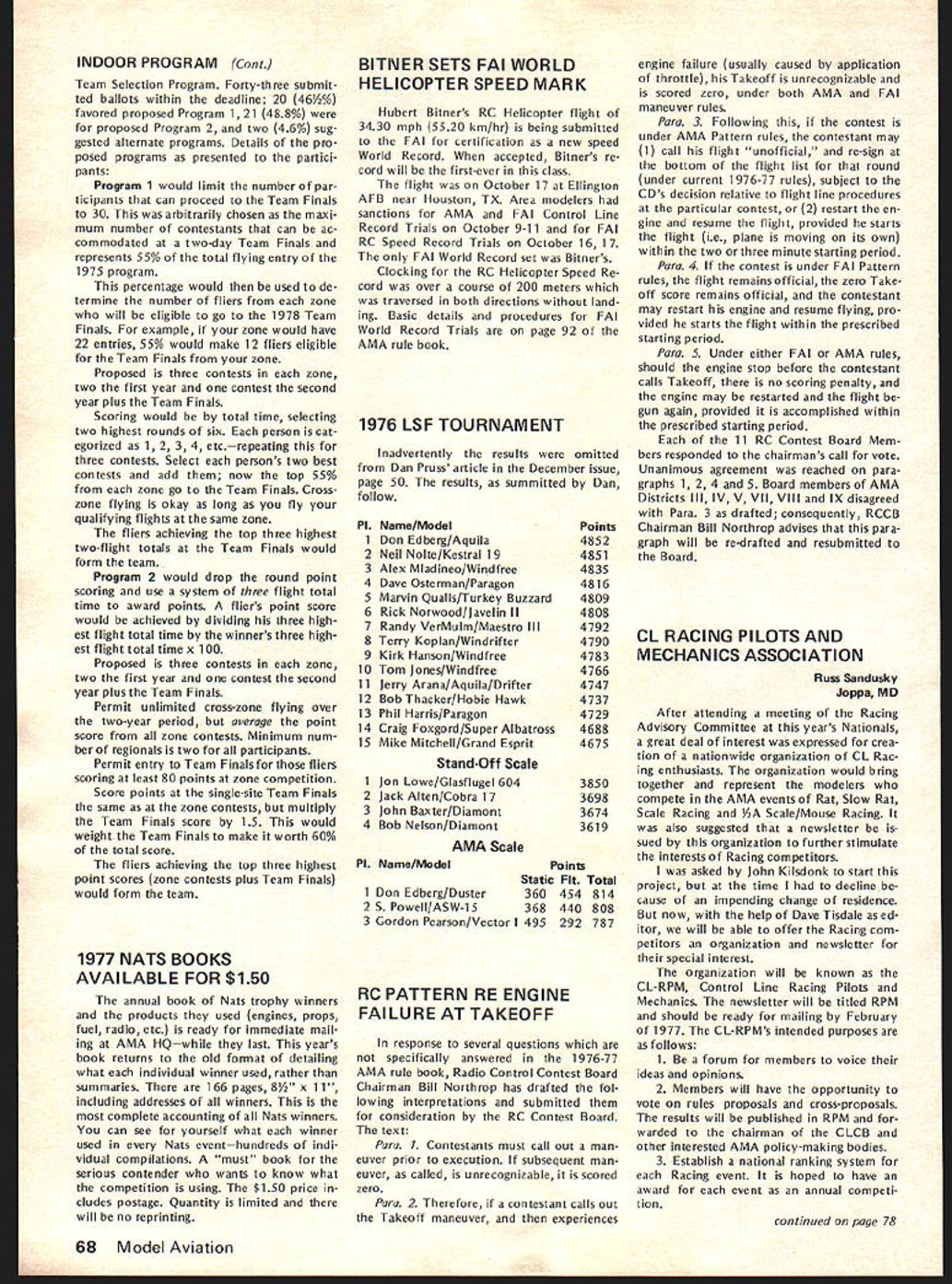
INDOOR PROGRAM (Cont.)
Team Selection Program. Forty-three submitted ballots within the deadline; 20 (46 2/3%) favored proposed Program 1, 21 (48.8%) were for proposed Program 2, and two (4.6%) suggested alternate programs. Details of the proposed programs as presented to the participants:
Program 1 would limit the number of participants that can proceed to the Team Finals to 30. This was arbitrarily chosen as the maximum number of contestants that can be accommodated at a two-day Team Finals and represents 55% of the total flying entry of the 1975 program.
This percentage would then be used to determine the number of fliers from each zone who will be eligible to go to the 1978 Team Finals. For example, if your zone would have 22 entries, 55% would make 12 fliers eligible for the Team Finals from your zone.
Proposed is three contests in each zone, two the first year and one contest the second year plus the Team Finals.
Scoring would be by total time, selecting two highest rounds of six. Each person is categorized as 1, 2, 3, 4, etc., repeating this for three contests. Select each person's two best contests and add them; now the top 55% from each zone go to the Team Finals. Cross-zone flying is okay as long as you fly your qualifying flights at the same zone.
The fliers achieving the top three highest two-flight totals at the Team Finals would form the team.
Program 2 would drop the round point scoring and use a system of three-flight total time to award points. A flier's point score would be achieved by dividing his three highest flight total time by the winner's three highest flight total time × 100.
Permit unlimited cross-zone flying over the two-year period, but average the point score from all zone contests. Minimum number of regionals is two for all participants.
Permit entry to Team Finals for those fliers scoring at least 80 points in zone competition.
Score points at the single-site Team Finals the same as at the zone contests, but multiply the Team Finals score by 1.5. This would weight the Team Finals to make it worth 60% of the total score.
The fliers achieving the top three highest point scores (zone contests plus Team Finals) would form the team.
Competition Newsletter
ACADEMY OF MODEL AERONAUTICS
NEXT NATS IN CALIFORNIA
Best bet at press time: 1977 Nats site — March Air Force Base near Riverside, California — just east of Los Angeles, about 30 miles from Disneyland. Details still being worked out; before final official word can be announced, AMA Nats Executive Committee efforts in October aimed at finalizing California Nats situation; hope confirmation by December 1. Also, running at press time, second choice (due to less favorable factors) is the former Oxnard Air Force Base near Camarillo, California (north of Los Angeles). Based on AMA Executive Council meeting September 18 — unless arrangements for sites fall through — California Nats likely. Probable dates: first week of August, depending on local college dorm availability/housing.
What about a return to Ohio? Possibly 1978. The great success of the 1976 Nats in Ohio makes a return to the area likely after the 1977 event. Meantime, Council consensus seems West Coast Nats desired next, feasible fulfillment of past promises to return to the area when a suitable site is available. The last California Nats was in 1967.
CONQUEST 15 R/C QUALIFIES FOR QM PYLON
Manufacturer Conquest 15 R/C engine, Cat. No. 2810, Cox Hobbies has reported 1,000 engines have been produced, thereby meeting requirements of acceptability for Quarter Midget RC Pylon Racing, provided AMA rules. Similarly produced by Cox Hobbies in quantities of 1,000 or greater are the following accessories: Conquest 15 R/C Exhaust Extractor, Cat. No. 2890; Exhaust Extractor (length slit), Cat. No. 28190; Muffler, Cat. No. 2861; Racing Muffler, Cat. No. 28180.
Previously published acceptable RC QM engines: Rossi 15 R/C; K & B 15 R/C; Supertigre Front Intake R/C; OS 15 R/C; Enya 15 R/C; Fox 15 R/C; Taipan 15 R/C.
Previously published acceptable Formula I/II Pylon Racing engines/events: K & B SR II 65cc Series 75; K & B 40 R/C (1972, 1973, 1974 models); Supertigre G40, X40, HP 40 Front/Rear Rotor; OS 40 Schneurle; Fox 40 R/C; Testor/McCoy 40 R/C; OPS 40.
Manufacturers/importers of engines listed should contact AMA HQ immediately if they wish to claim legality requiring 1,000 engines available. Subject to late arrival of point reporting forms and/or other necessary adjustments.
Points — top 20 point earners listed below have qualified to compete in the 1977 RC Masters Team Selection Finals. Inasmuch as the points-accumulation program ended October 25, Dick Sonheim, NSRCA, reported points November 1; perhaps there may be some likelihood of adjustment. Points earned in the program are shown in the right-hand column; numbers within parentheses show meets flown by the participant earning points.
- Tony Bonnetti, Emerson, NJ
- Fred Kugel, Celina, OH
- Robert Kelly, Denver, CO
- Denis Donohue, Bergenfield, NJ
- Win Thomas, Bartlesville, OK
- Alan Dupler, Millersport, OH
- John Britt, Lees Summit, MO
- Pat Shuttleworth, Warren, IN
- George Hill, Annandale, VA
- Joe Bridi, Harbor City, CA
- Ron Chidgey, Pensacola, FL
- Dan Kowallek, Kokomo, IN
- Jim Osbourne, Lumberton, TX
- Ed Izzo, Holliston, MA
- Bill Salkowski, Canoga Park, CA
- Ed Keck, Webster, NY
- C. W. Reed, Raytown, MO
- Phil Gieseking, Ft. Wayne, IN
- Sal Battaglia, New Rochelle, NY
- David Constant, Bunkie, LA
- Eric Podzielinski, Ft. Wayne, IN
- Lloyd Nicholson, Denver, CO
- Joe Gross, Fort Worth, TX
- Don Seals, Paris, IL
- Thomas Moore, Nashville, TN
- Howard Randles, Graham, NC
- Ben Mathews, New Orleans, LA
Twenty-point program qualifiers join 13 others previously qualified (1975 US RC Aerobatics Team members: Dave Brown, Mark Radcliff, Rhett Miller, III). Top 10 Master Class fliers in the 1976 national contest entered the program: Don Lowe, Michael Mueller, Steve Helms, Phil Kraft, Wayne Abernethy, Jim Whitley, James Kimbro, Dean Koger, Carl Weber, Jim Oddino. Thirty-three will be eligible to vie for three slots on the 1977 US RC Aerobatics Team. Team members will be decided by competition at the RC Masters Team Selection Finals held (yet undecided place) June 1977. Bids from clubs interested in being host for RC Masters were submitted to AMA HQ mid-November and had been received at press time.
1977 FF & RC WORLD CHAMPIONSHIPS
At press time, word just received: Denmark will make a firm offer in December.
Competition Newsletter
ACADEMY OF MODEL AERONAUTICS
NEXT NATS IN CALIFORNIA — Best bet at press time: 1977 Nats site, March Air Force Base near Riverside, California — just east of Los Angeles, about 30 miles from Disneyland. Details still being worked out before final official word can be announced. AMA Nats Executive Committee efforts in October were aimed at finalizing the California Nats situation; hope confirmation by December 1. Also, running at press time: second choice, due to less favorable factors, is the former Oxnard Air Force Base near Camarillo, California, north of Los Angeles. Based on the AMA Executive Council meeting September 18, unless arrangements/sites fall through, California Nats likely. Probable dates: first week of August, depending on local college dorm availability/housing.
What about a return to Ohio? Possibly 1978. The great success of the 1976 Nats in Ohio makes a return to that area likely after the 1977 event; meantime, Council consensus seems a West Coast Nats is desired next, when feasible. This would fulfill past promises to return to the area; the last California Nats was in 1967.
CONQUEST 15 R/C QUALIFIES FOR QM PYLON
Manufacturer Conquest 15 R/C engine, Cat. No. 2810 — Cox Hobbies has reported 1,000 engines have been produced, thereby meeting the requirements of acceptability for Quarter-Midget (QM) RC Pylon Racing, provided AMA rules. Similarly produced Cox Hobbies quantities (1,000 or greater) of the following accessories are acceptable:
- Conquest 15 R/C Exhaust Extractor, Cat. No. 2890
- Exhaust Extractor (length slit), Cat. No. 28190
- Muffler, Cat. No. 2861
- Racing Muffler, Cat. No. 28180
Previously published acceptable RC QM engines: Rossi 15 R/C; K & B 15 R/C; Supertigre Front Intake R/C; OS 15 R/C; Enya 15 R/C; Fox 15 R/C; Taipan 15 R/C. Previously published acceptable Formula I/II Pylon Racing engines: K & B SR II 65cc Series 75; K & B 40 R/C (1972, 1973, 1974 models); Supertigre G40, X40; HP 40 Front/Rear Rotor; OS 40 Schneurle; Fox 40 R/C; Testor/McCoy 40 R/C; OPS 40.
Manufacturers/importers of engines listed should contact AMA HQ immediately if they wish to claim legality, requiring 1,000 engines available. Subject to late arrival of point-reporting forms and/or other necessary adjustments.
COMPETITION NEWSLETTER
Round Three: To accelerate the contest, speed was flown first (this put it back-to-back with the previous round). Dave Thornberg with 4966.8 points was in the lead. On launch with a hand tow, his original design—Bird of Time—folded a wing. Because FAI rules don't permit a back-up ship to be flown within the same round, Dave had zeros posted for all three tasks—a really tough break. But his accident wasn't the first nor would it be the last. This scribe counted 18 (!) planes that were damaged enough not to be able to be repaired in time to complete a given round.
Bob Dodgson, designer of the Maestro and Caliente, flew a model of the latter through the speed trap in 12.2 seconds! In distance, Randy Vernum, also of Washington, earned the 1000 point score by flying his Maestro over 12.3 laps. It was an all-Washington round as Dave Banks—also flying a Maestro—was only six points from perfect with a 454 in duration, good enough for 1000 points. However, the winner of the round was LeMon Payne of Texas with 2526.9.
At this point in the contest one would have been merely guessing who the top three would eventually be. Many fliers who didn't win any of the tasks were definitely in the running. An average of 800 points or, to put it a different way, a score of 80% of a task winner across the board would definitely keep one in contention. There were quite a few in this range.
Round Four: One of those who could take it all was Gunsaullus, and his 1000 points in duration added hope for his Florida supporters. His 15.7 seconds in speed was respectable. Though it earned him a modest 705.5 points, his average still kept him in the money. But the distance task—which was to plague many—netted him only 259.3 points for his 2.3 lap run. His overall score was 1991.6—his lowest. The only consolation to him was that this hopefully would be his throwaway round—a tough compensation when one has to throw away a 1000-point task to boot.
Round Four saw Mike Regan of California turn in the fastest time of the contest—a blistering 11.5 seconds! His Paragoose (a modified Paragon) got an excellent launch, and the end result left Mike feeling a lot better after fighting a flu-type bug for three days. The distance honors went to Dwight Holley and his Maestro. It was windy during round four, and wind does lower the lap potential. Holley did 10.8—good enough for 1000 points and top overall in the round with 2546.0.
By the end of round four the top fliers were:
- Payne, TX . . . . . . 7331.5
- Miller, CO . . . . . . 7067.1
- Gunsaullus, FL . . . . 7032.7
- Hamilton, TX . . . . . 6902.6
- Wiseman, CA . . . . . 6851.4
- Banks, WA . . . . . . 6574.6
- Smith, AL . . . . . . 6520.5
- Hutter, OK . . . . . . 6503.4
- Gill, IL . . . . . . . 6473.7
- Robinson, MI . . . . 6397.6
Payne was definitely a tough guy to beat at this stage. But the other places could go to anybody. Bad luck would still be a factor, and it didn't play any favorites. When Payne crossed the center-line on his speed run in the first round, the zero score didn't necessarily stir up the personal hopes of the others. Three others met the same fate in that round. Though this had a most sobering effect, it still happened throughout the remaining speed tasks. In round four, Thornberg was back in form.
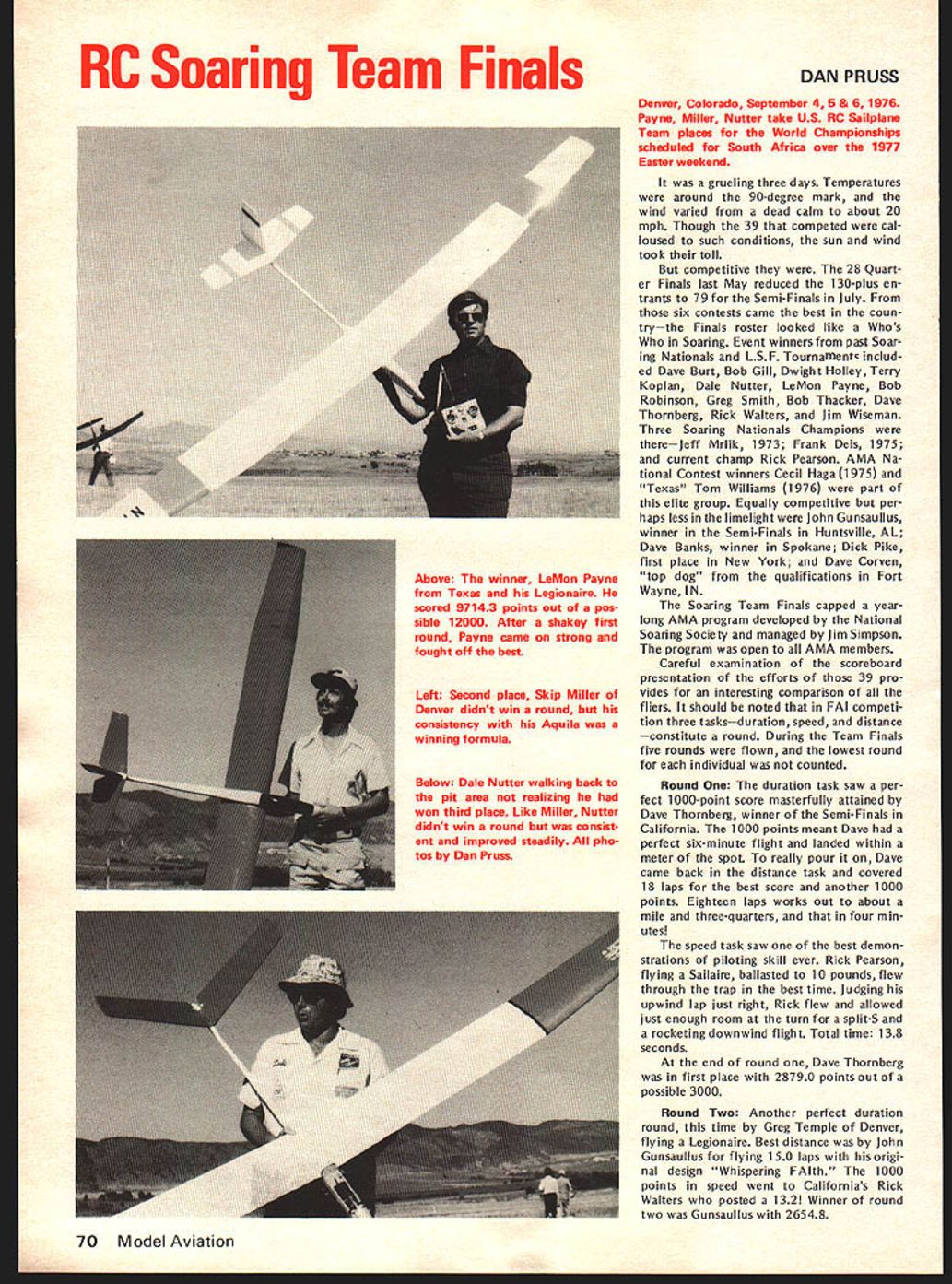
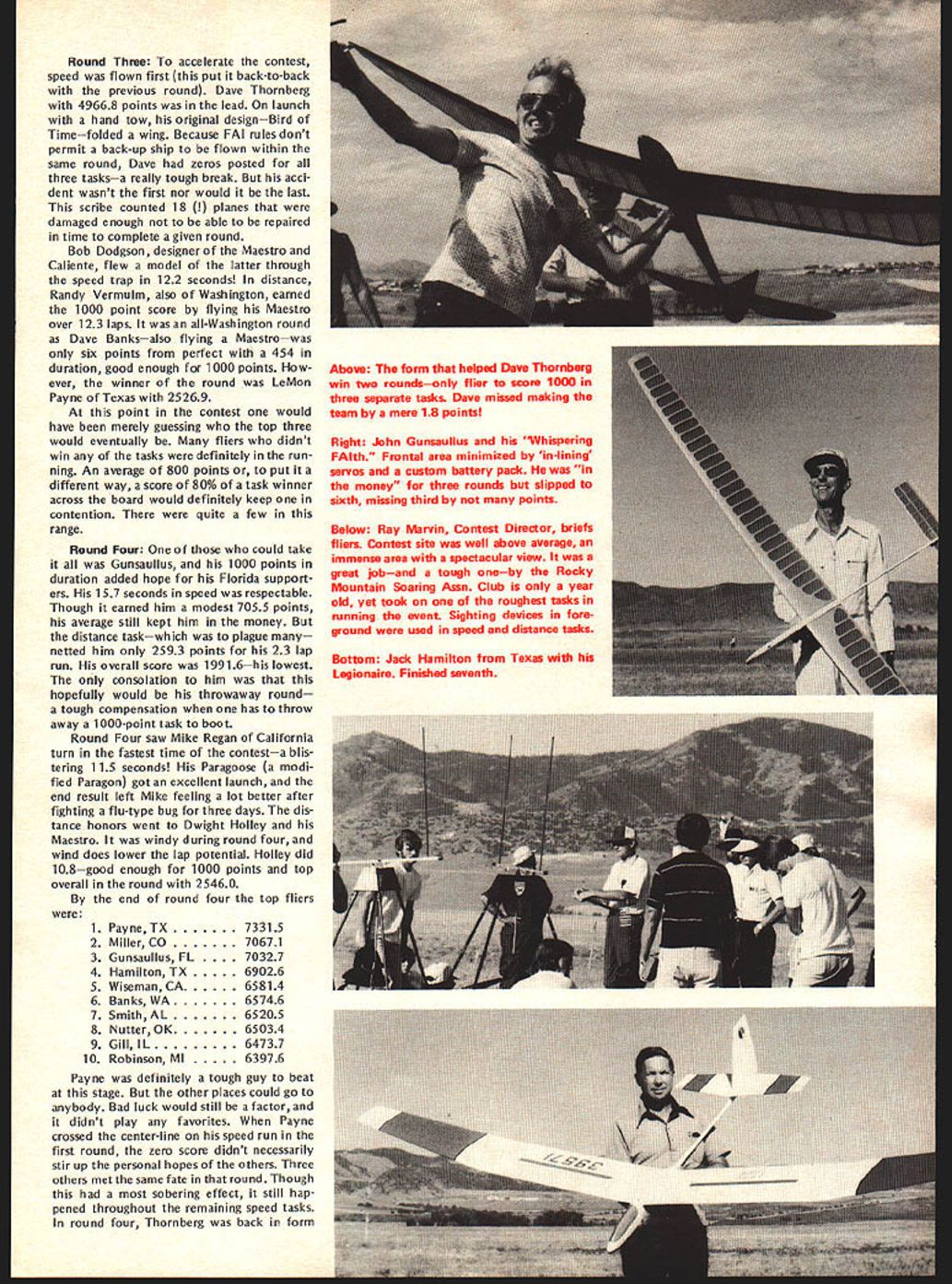
Above: The form that helped Dave Thornberg win two rounds—only flier to score 1000 in three separate tasks. Dave missed making the team by a mere 1.8 points!
Right: John Gunsaullus and his "Whispering Faith." Frontal area minimized by 'in-lining' servos and a custom battery pack. He was "in the money" for three rounds but slipped to sixth, missing third by not many points.
Below: Ray Marvin, Contest Director, briefs fliers. Contest site was well above average, an immense area with a spectacular view. It was a great job—and a tough one—by the Rocky Mountain Soaring Assn. Club is only a year old, yet took on one of the roughest tasks in running the event. Sighting devices in foreground were used in speed and distance tasks.
Bottom: Jack Hamilton from Texas with his Legionaire. Finished seventh.
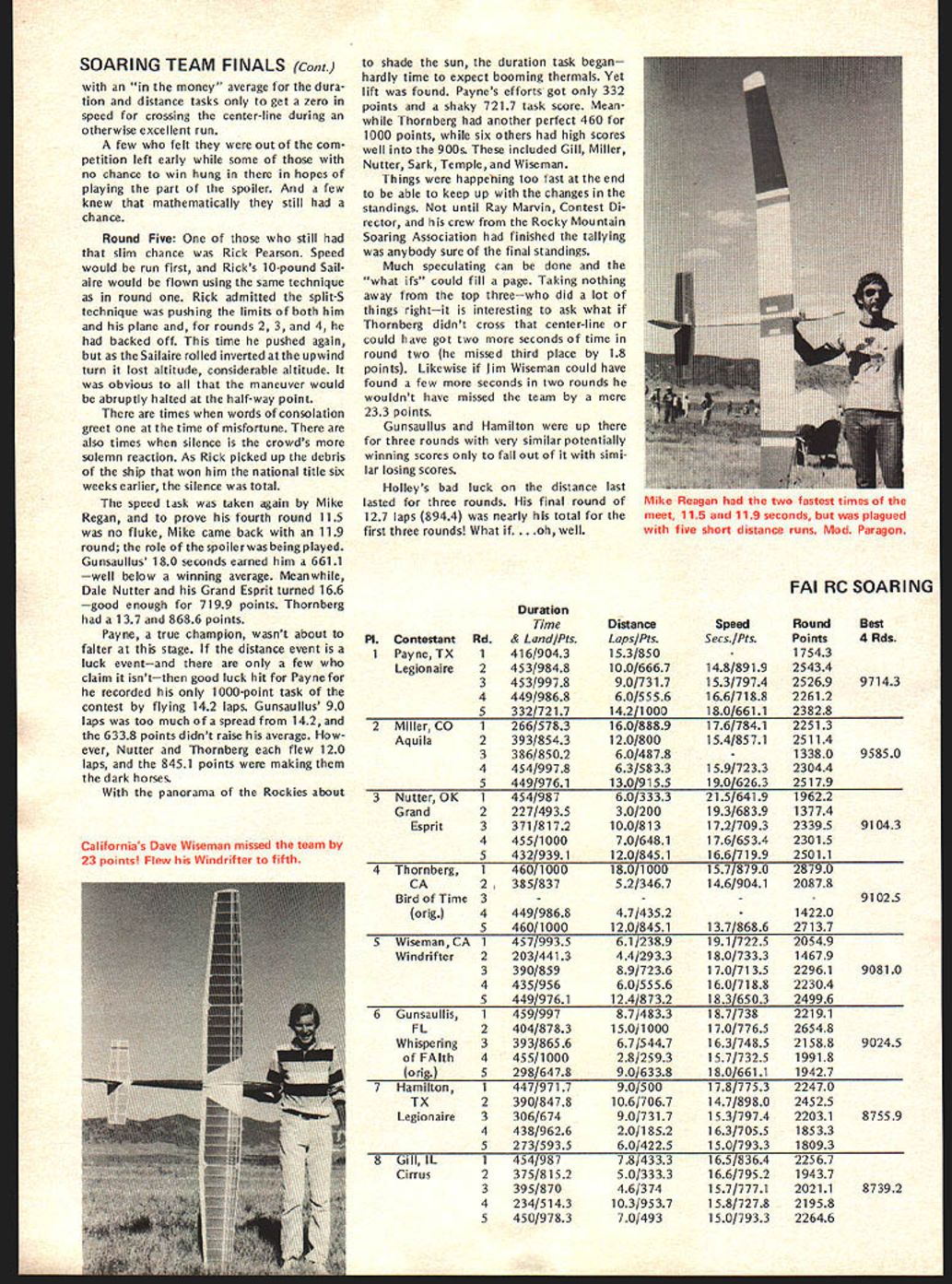
SOARING TEAM FINALS (Cont.)
with an "in the money" average for the duration and distance tasks only to get a zero in speed for crossing the center-line during an otherwise excellent run.
A few who felt they were out of the competition left early while some of those with no chance to win hung in there in hopes of playing the part of the spoiler. And a few knew mathematically they still had a chance.
Round Five: One of those who still had that slim chance was Rick Pearson. Speed would be run first, and Rick's 10-pound Sailaire would be flown using the same technique as in round one. Rick admitted the split-S technique was pushing the limits of both him and his plane and, for rounds 2, 3, and 4, he had backed off. This time he pushed again, but as the Sailaire rolled inverted at the upwind turn it lost altitude, considerable altitude. It was obvious to all that the maneuver would be abruptly halted at the half-way point.
There are times when words of consolation greet one at the time of misfortune. There are also times when silence is the crowd's more solemn reaction. As Rick picked up the debris of the ship that won him the national title six weeks earlier, the silence was total.
The speed task was taken again by Mike Regan, and to prove his fourth round 11.5 was no fluke, Mike came back with an 11.9 round; the role of the spoiler was being played. Gunsaullus' 18.0 seconds earned him a 661.1—well below a winning average. Meanwhile, Dale Nutter and his Grand Esprit turned 16.6—good enough for 719.9 points. Thornberg had a 13.7 and 868.6 points.
Payne, a true champion, wasn't about to falter at this stage. If the distance event is a luck event—and there are only a few who claim it isn't—then good luck hit for Payne for he recorded his only 1000-point task of the contest by flying 14.2 laps. Gunsaullus' 9.0 laps was too much of a spread from 14.2, and the 633.8 points didn't raise his average. However, Nutter and Thornberg each flew 12.0 laps, and the 845.1 points were making them the dark horses.
With the panorama of the Rockies about to shade the sun, the duration task began—hardly time to expect booming thermals. Yet lift was found. Payne's efforts got only 332 points and a shaky 721.7 task score. Meanwhile Thornberg had another perfect 460 for 1000 points, while six others had high scores well into the 900s. These included Gill, Miller, Nutter, Sark, Temple, and Wiseman.
Things were happening too fast at the end to be able to keep up with the changes in the standings. Not until Ray Marvin, Contest Director, and his crew from the Rocky Mountain Soaring Association had finished the tallying was anybody sure of the final standings.
"Much speculating can be done and the 'what ifs' could fill a page. Taking nothing away from the top three—who did a lot of things right—it is interesting to ask what if Thornberg didn't cross that center-line or could have got two more seconds of time in round two (he missed third place by 1.8 points). Likewise if Jim Wiseman could have found a few more seconds in two rounds he wouldn't have missed the team by a mere 23.3 points.
Gunsaullus and Hamilton were up there for three rounds with very similar potentially winning scores only to fall out of it with similar losing scores.
Holley's bad luck on the distance last lasted for three rounds. His final round of 12.7 laps (894.4) was nearly his total for the first three rounds! What if... oh, well."
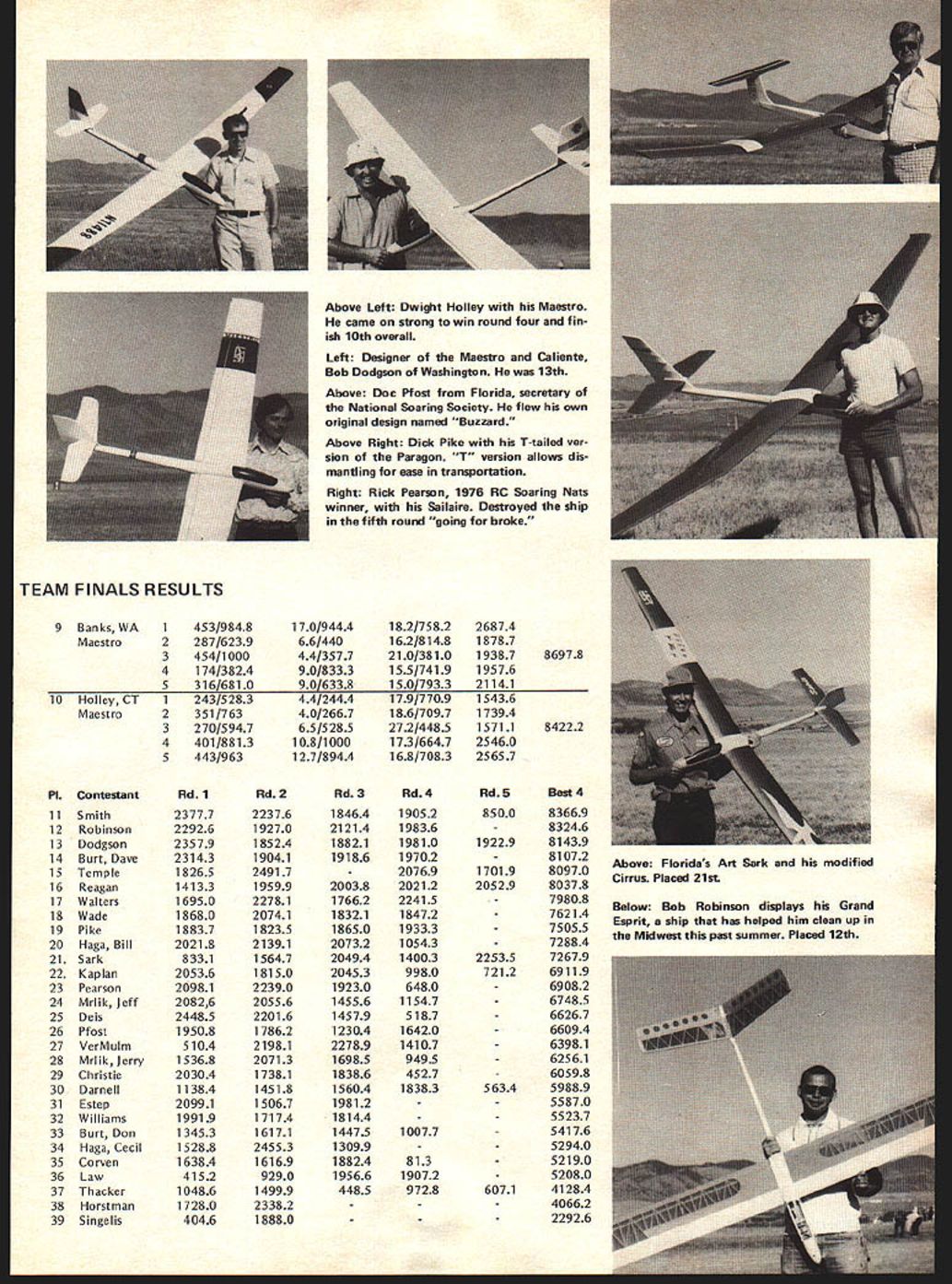
TEAM FINALS RESULTS
9 Banks, WA Maestro 1 453/984.8 17.0/944.4 18.2/758.2 2687.4 2 287/623.9 6.6/440 16.2/814.8 1878.7 3 454/1000 4.4/357.7 21.0/381.0 1938.7 8697.8 4 174/382.4 9.0/333.3 15.5/741.9 1957.6 5 316/681.0 9.0/633.8 15.0/793.3 2114.1
10 Holley, CT Maestro 1 243/528.3 4.4/244.4 17.9/770.9 1543.6 2 351/763 4.0/266.7 18.6/709.7 1739.4 3 270/594.7 6.5/528.5 27.2/448.5 1571.1 8422.2 4 401/881.3 10.8/1000 17.3/664.7 2546.0 5 443/963 12.7/894.4 16.8/708.3 2565.7
Pl. Contestant Rd. 1 Rd. 2 Rd. 3 Rd. 4 Rd. 5 Best 4
11 Smith 2377.7 2237.6 1846.4 1905.2 850.0 8366.9
12 Robinson 2292.6 1927.0 2121.4 1983.6 - 8324.6
13 Dodgson 2357.9 1852.4 1882.1 1981.0 1922.9 8143.9
14 Burt, Dave 2314.3 1904.1 1918.6 1970.2 - 8107.2
15 Temple 1826.5 2491.7 2076.9 1701.9 - 8097.0
16 Reagan 1413.3 1959.9 2003.8 2021.2 2052.9 8037.8
17 Walters 1695.0 2278.1 1766.2 2241.5 - 7980.8
18 Wade 1868.0 2074.1 1832.1 1847.2 - 7621.4
19 Pike 1883.7 1823.5 1865.0 1933.3 - 7505.5
20 Haga, Bill 2021.8 2139.1 2073.2 1054.3 2253.5 7288.4
21 Sark 833.1 1564.7 2049.4 1400.3 2253.5 7267.9
22 Kaplan 2053.6 1815.0 2045.3 998.0 721.2 6911.9
23 Pearson 2098.1 2239.0 1923.0 648.0 - 6908.2
24 Mirik, Jeff 2082.6 2055.6 1455.6 1154.7 - 6748.5
25 Deis 2448.5 2201.6 1457.9 518.7 - 6626.7
26 Pfost 1950.8 1786.2 1230.4 1642.0 - 6609.4
27 VerMulm 510.4 2198.1 2278.9 1410.7 - 6398.1
28 Mirik, Jerry 1536.8 2071.3 1698.5 945.9 - 6256.1
29 Christie 2030.4 1738.1 1838.6 452.7 - 6059.8
30 Darnell 1138.4 1451.8 1560.5 1838.3 563.4 5988.4
31 Estep 2099.1 1506.7 1981.2 - - 5587.0
32 Williams 1991.9 1717.4 1814.4 - - 5523.7
33 Burt, Don 1345.3 1617.1 1447.5 1007.7 - 5417.6
34 Haga, Cecil 1528.8 2455.3 1309.9 - - 5294.0
35 Corven 1638.4 1616.9 1882.4 81.3 - 5219.0
36 Law 415.2 929.0 1956.6 1907.2 - 5208.0
37 Thacker 1048.6 1499.9 448.5 972.8 607.1 4128.4
38 Horstman 1728.0 2338.2 - - - 4066.2
39 Singelis 404.6 1888.0 - - - 2292.6
Competition Newsletter
ACADEMY OF MODEL AERONAUTICS
NEXT NATS IN CALIFORNIA?
Best bet, press time: 1977 Nats site — March Air Force Base near Riverside, California, just east of Los Angeles, about 30 miles from Disneyland. Details still being worked out before final official word can be announced. AMA Nats Executive Committee efforts in October aimed at finalizing the California Nats situation hope confirmation by December 1. Also running, at press time, a second choice, due to less favorable factors, is the former Oxnard Air Force Base near Camarillo, California, north of Los Angeles. Based on the AMA Executive Council meeting September 18, unless arrangements at the sites fall through, California Nats likely. Probable dates: first week of August, depending on local college dorm availability/housing.
What about a return to Ohio? Possibly 1978. After the great success of the 1976 Nats in Ohio, a return to that area is likely after the 1977 event. In the meantime the Council consensus seems to favor West Coast Nats next as the most feasible fulfillment of past promises to return to the area, a suitable site available. The last California Nats was in 1967.
CONQUEST .15 R/C QUALIFIES FOR QM PYLON
Manufacturer Conquest .15 R/C engine, Cat. No. 2810. Cox Hobbies has reported 1,000 engines have been produced, thereby meeting requirements for acceptability in Quarter-Midget RC Pylon Racing, provided AMA rules. Similarly produced by Cox Hobbies in quantities of 1,000 or greater are the following accessories: Conquest .15 R/C Exhaust Extractor, Cat. No. 2890; Exhaust Extractor (length slit), Cat. No. 28190; Muffler, Cat. No. 2861; Racing Muffler, Cat. No. 28180.
Previously published acceptable RC QM engines: Rossi .15 R/C; K & B .15 R/C; Supertigre Front Intake R/C .05–.15; Enya .15 R/C; Fox .15 R/C; Taipan .15 R/C.
Previously published acceptable Formula I/II Pylon Racing engines: K & B SR II 65cc Series 75; K & B .40 R/C (1972, 1973, 1974 models); Supertigre G40, X40, HP40 (front, rear, rotor); OS .40 Schneurle; Fox .40 R/C; Testor/McCoy .40 R/C; OPS .40. Manufacturers/importers of engines listed should contact AMA HQ immediately if they wish to claim legality requiring 1,000 engines available. Subject to late arrival of reporting forms and/or other necessary adjustments.
Top 20 point earners listed below have qualified to compete in the 1977 RC Masters Team Selection Finals. Inasmuch as the points accumulation program ended October 25, Dick Sonheim, NSRCA, reported points November 1 — perhaps with some likelihood of adjustment. Points earned in the program are shown in the right-hand column; numbers within parentheses show meets flown by the participant earning points.
Twenty-point program qualifiers join 13 others previously qualified. 1975 US RC Aerobatics Team members Dave Brown, Mark Radcliff, Rhett Miller III, plus top 10 Master Class fliers from the 1976 national contest, entered the program: Don Lowe, Michael Mueller, Steve Helms, Phil Kraft, Wayne Abernethy, Jim Whitley, James Kimbro, Dean Koger, Carl Weber, Jim Oddino. Thirty-three will be eligible to vie for three slots on the 1977 US RC Aerobatics Team. Team members will be decided by competition at the RC Masters Team Selection Finals, to be held at a yet-undecided place in June 1977. Bids from clubs interested in being host for the RC Masters have been submitted to AMA HQ; mid-November was press time receipt.
1977 FF & RC World Championships — press-time word just received: Denmark will make a firm offer in December.
Competition Newsletter
ACADEMY OF MODEL AERONAUTICS
NEXT NATS IN CALIFORNIA
BEST BET, press time: 1977 NATS site — March Air Force Base near Riverside, California, just east of Los Angeles, about 30 miles from Disneyland. Details still being worked out before final official word can be announced. AMA Nats Executive Committee efforts in October aimed at finalizing California Nats situation; hope confirmation by December 1. Also running, press time, a second choice, due to less favorable factors: former Oxnard Air Force Base near Camarillo, California, north of Los Angeles. Unless arrangements or sites fall through, California Nats likely. Probable dates: first week in August, depending on local college dorm availability for housing.
What about a return to Ohio? Possibly 1978 — the great success of the 1976 Nats in Ohio makes a return to that area likely after the 1977 event. In the meantime, Council consensus seems to favor West Coast Nats as the next feasible fulfillment of past promises to return to that area; last California Nats was in 1967.
CONQUEST .15 R/C QUALIFIES FOR QM PYLON
Manufacturer Conquest 15 R/C engine, Cat. No. 2810, Cox Hobbies, has reported 1,000 engines have been produced, thereby meeting requirements for acceptability in Quarter‑Mile RC Pylon Racing, provided AMA rules.
Similarly produced by Cox Hobbies in quantities of 1,000 or greater are the following accessories: Conquest 15 R/C Exhaust Extractor, Cat. No. 2890; Exhaust Extractor (length slit), Cat. No. 28190; Muffler, Cat. No. 2861; Racing Muffler, Cat. No. 28180.
Previously published acceptable RC QM engines include Rossi 15 R/C; K & B 15 R/C; Supertigre front‑intake R/C; Enya 15 R/C; Fox 15 R/C; and Taipan 15 R/C.
Previously published acceptable Formula I/II pylon‑racing engines include K & B SR II 65cc series; K & B .40 R/C (1972, 1973, 1974 models); Supertigre G40, X40; HP 40 (front/rear rotor); OS 40 Schneurle; Fox 40 R/C; Testor/McCoy 40 R/C; and OPS 40. Manufacturers/importers of engines listed should contact AMA HQ immediately if they wish to claim legality requiring 1,000 engines available.
Competition Newsletter
FF TEAM FINALS (Cont.)
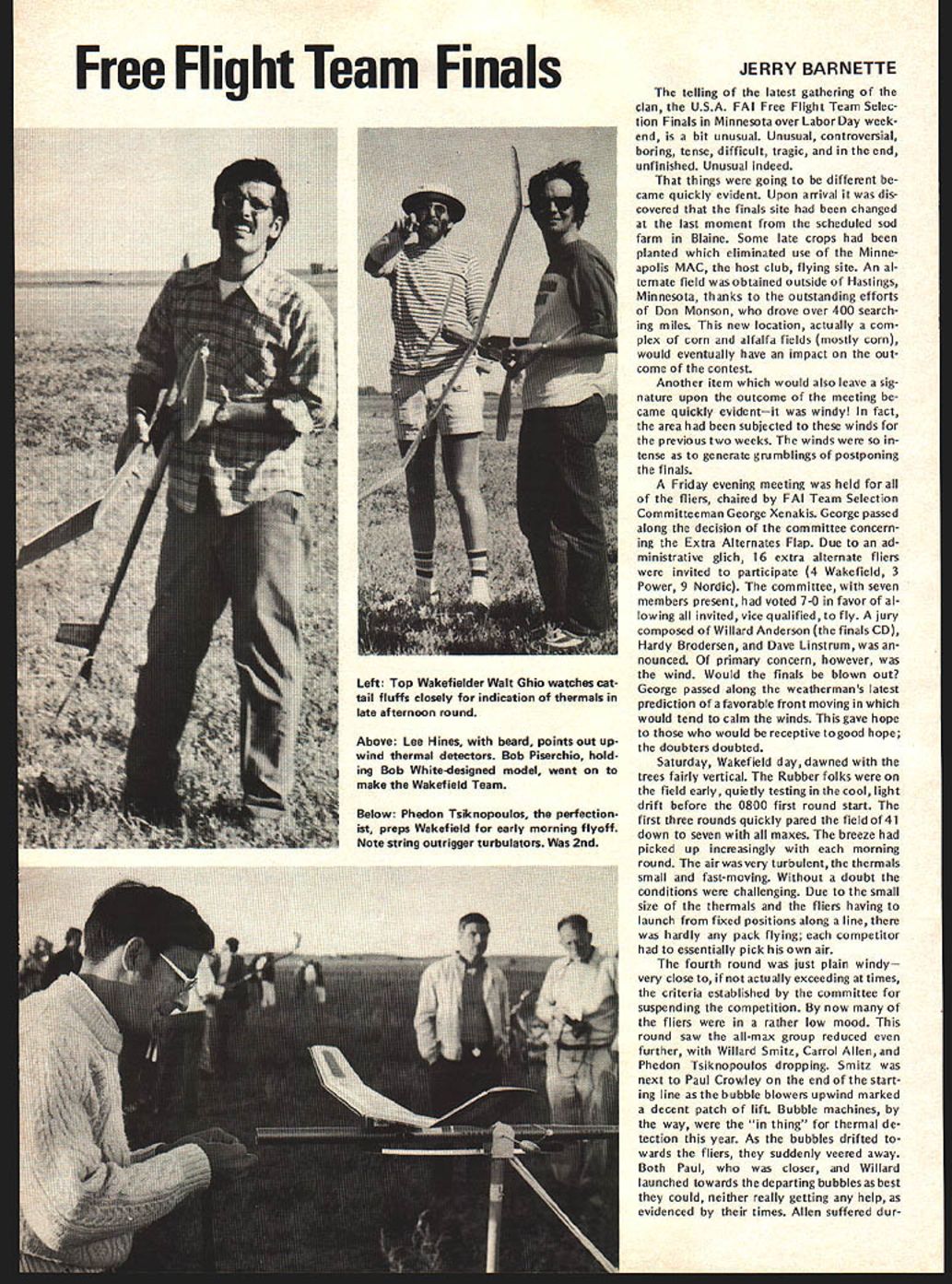
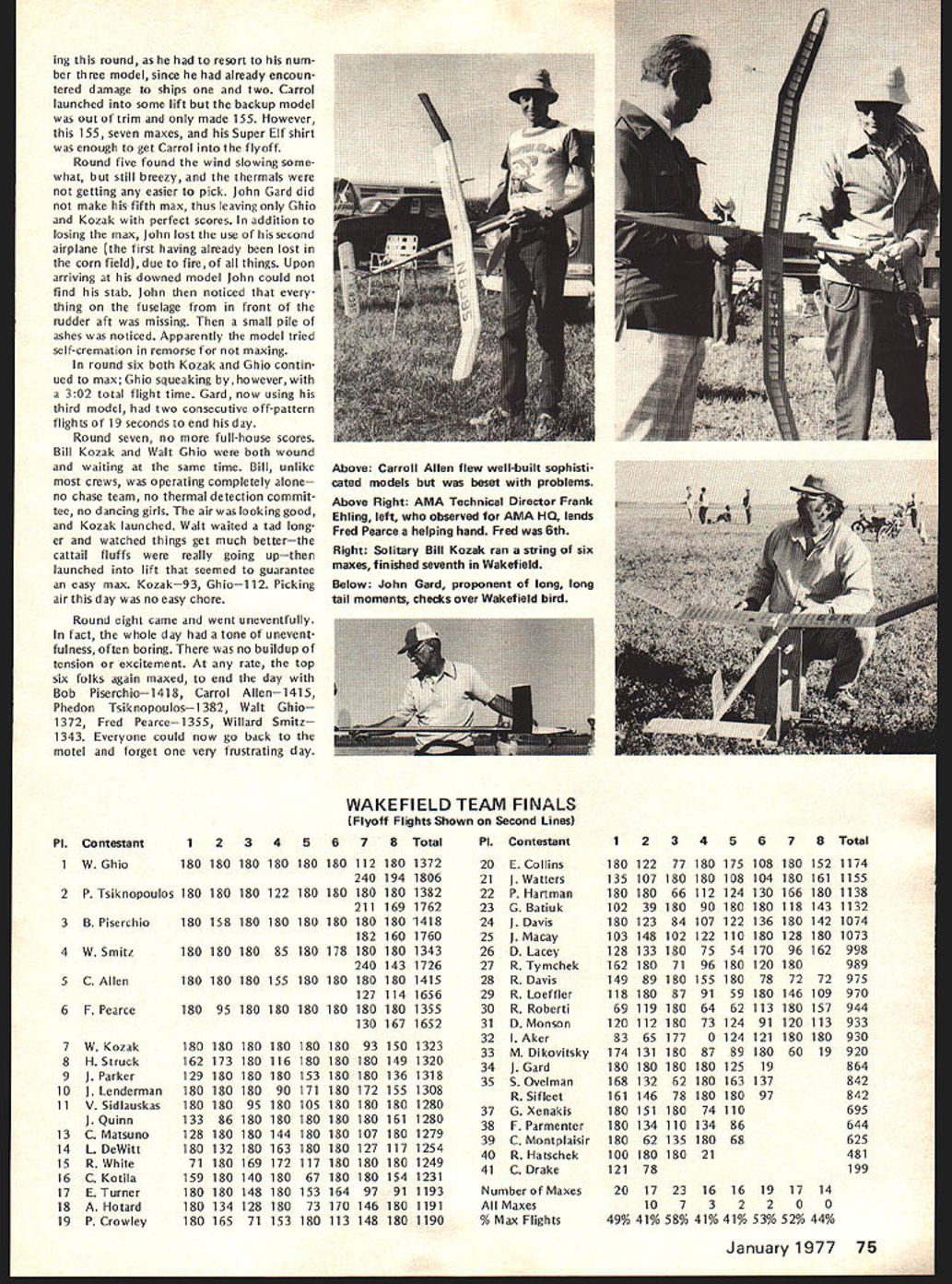
Everyone could relax. Everyone but the top six, who would be in the mandatory flyoff on the morrow.
Sunday, 0630. The air cold, a hint of a breeze, the ground damp with dew. Hot dog, a flyoff! The team selection procedures this year specified a mandatory two‑round (at least) flyoff composed of the top six contestants or all of those contestants within 98% of the highest score, whichever is the larger number.
In the first 15‑minute flyoff round Pearce was off first, followed by Allen, in turn followed very quickly by Piserchio. Carrol did not reach his normal altitude, due to the fact his prop hub assembly was accidentally dropped in the fine, gritty dirt. A short wait and Smitz got off a good flight. Another short pause, then Walt launched into nearly the same piece of air. Finally, just as the sun bumped over the horizon, Phedon got off to a good flight. Walt and Willard both made the four‑minute max. The standings reshuffle after all of the scores are in. Ghio is now first, twelve seconds ahead of Piserchio. Third place is going to be a scramble as Phedon is only one second ahead of Allen and Smitz is within spittin' distance, only 10 seconds back.
It has now come down to this last flight, the second flyoff round, to determine the U.S. Wakefield team. At the start of the round, Pearce is again away first, Ghio right behind, Piserchio quickly after that. Allen, who made a trim flight between rounds, is off next but power stalls, transitioning into the glide at a low altitude, with a slight stall all the way down. Willard launched next, looped over the top, but recovering well. Phedon then waited — wound, very poised, watching the cattail fluffies very carefully. Phedon launched his string‑outrigger turbulated model, which was so nicely constructed it should have been under a glass case, into a perfect pattern with a wide, beautiful glide. And that was it, an all‑California Wakefield team — Ghio, Tsiknopoulos, Piserchio.
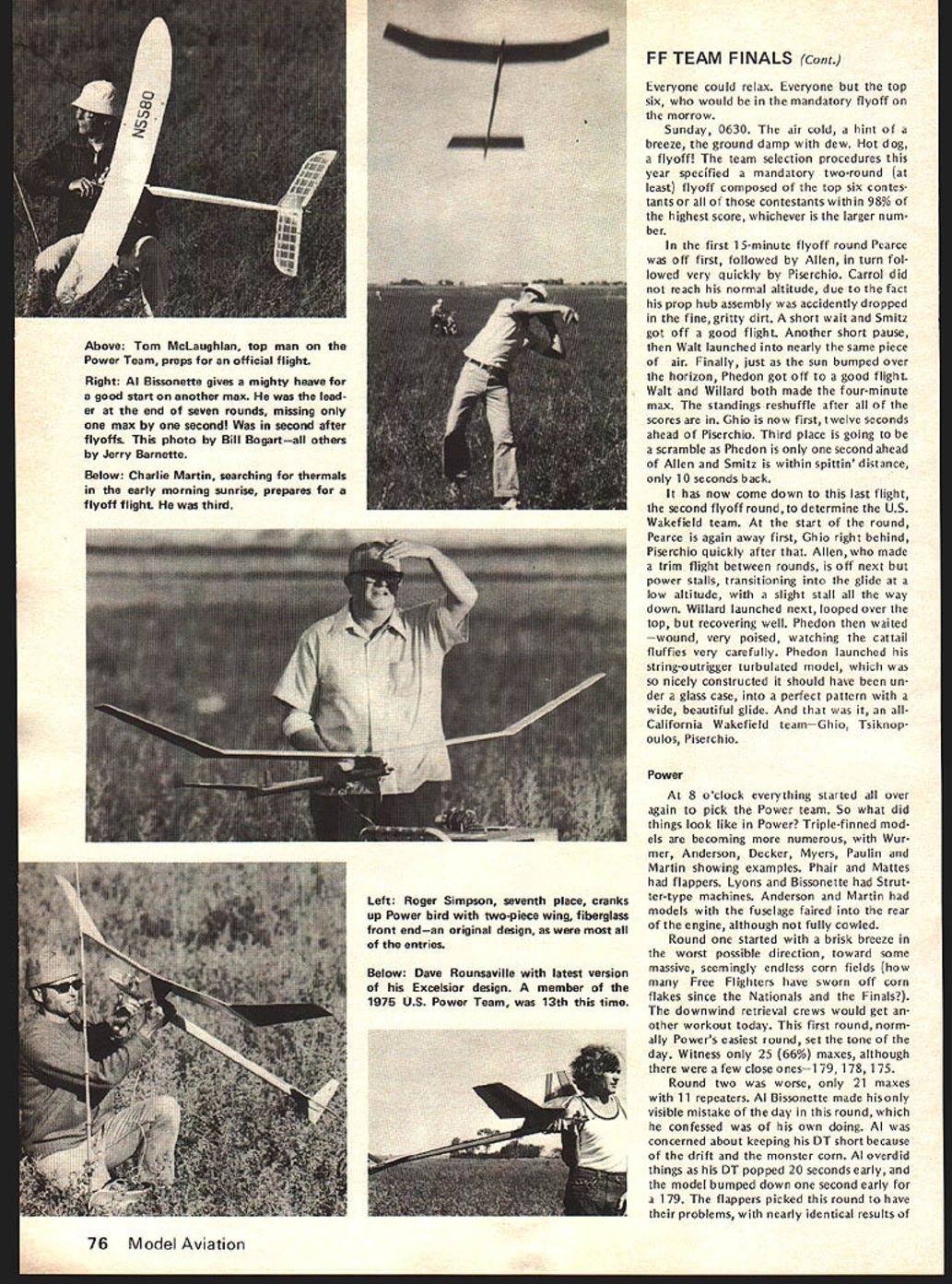
Power
At 8 o'clock everything started all over again to pick the Power team. So what did things look like in Power? Triple‑finned models are becoming more numerous, with Wurmer, Anderson, Decker, Myers, Paulin and Martin showing examples. Phair and Mattes had flappers. Lyons and Bissonette had strutter‑type machines. Anderson and Martin had models with the fuselage faired into the rear of the engine, although not fully cowled.
Round one started with a brisk breeze in the worst possible direction, toward some massive, seemingly endless corn fields (how many Free Flighters have sworn off corn flakes since the Nationals and the Finals?). The downwind retrieval crews would get another workout today. This first round, normally Power's easiest round, set the tone of the day. Witness only 25 (66%) maxes, although there were a few close ones — 179, 178, 175.
Round two was worse, only 21 maxes with 11 repeaters. Al Bissonette made his only visible mistake of the day in this round, which he confessed was of his own doing. Al was concerned about keeping his DT short because of the drift and the monster corn. Al overdid things as his DT popped 20 seconds early, and the model bumped down one second early for a 179. The flappers picked this round to have their problems, with nearly identical results of 47- and 48-second flights. Bob Mattes' model barely pulled out of a long vertical dive, recovering very low to the ground. Ken Phair was not as lucky. Doug Galbraith was another victim of mechanical gremlins. Doug's stab had a metal plate on which the VIT hammers pressed. The protective plate came off, allowing the VIT hammers to vibrate down into the balsa, with the result that the stab could not rise up to the glide setting. End result was a 57-second flight and a broken airplane. Ron Anderson was another unfortunate, rolling his number one airplane in under power on his first attempt.
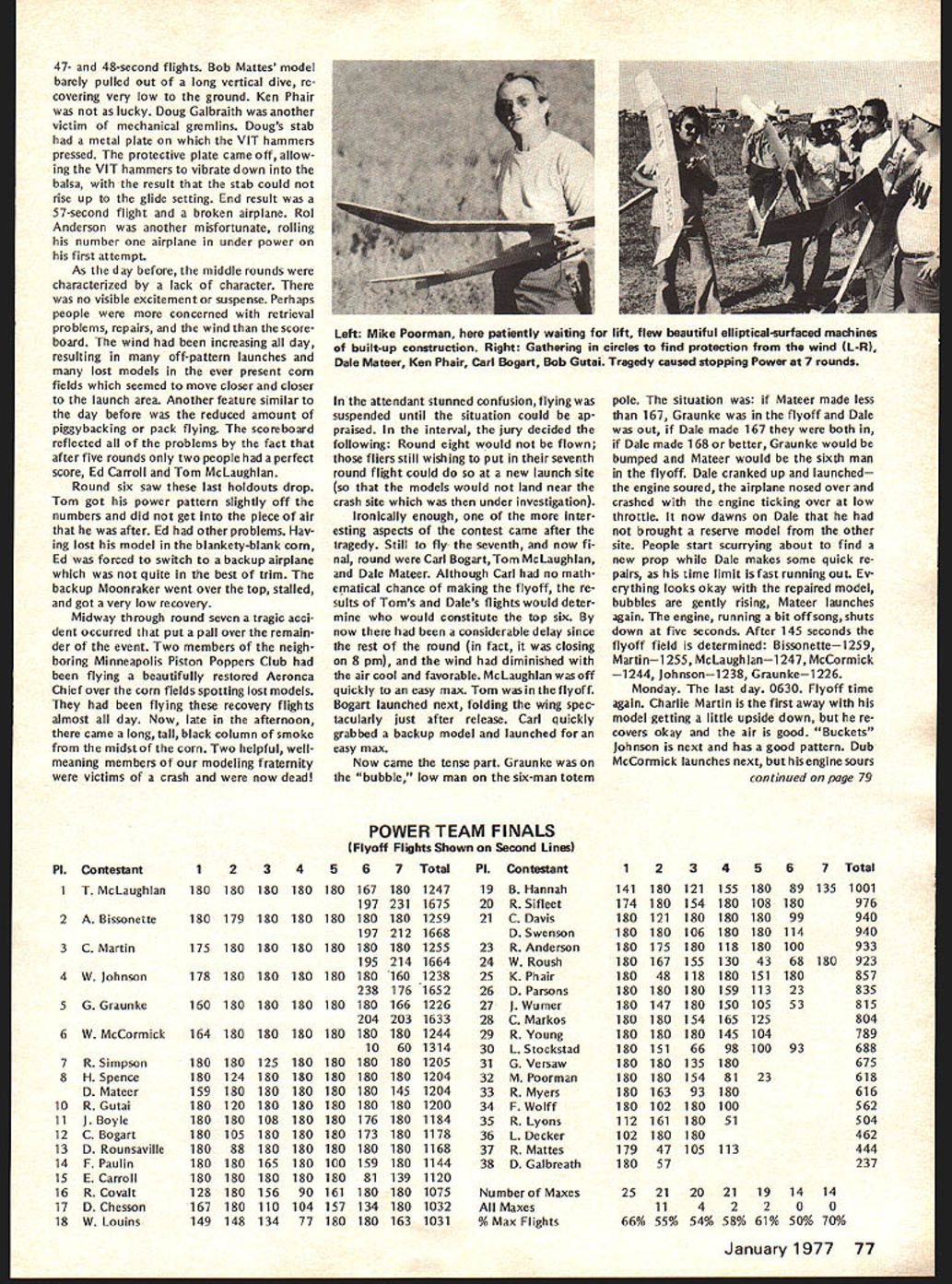
As the day before, the middle rounds were characterized by a lack of character. There was no visible excitement or suspense. Perhaps people were more concerned with retrieval problems, repairs, and the wind than the scoreboard. The wind had been increasing all day, resulting in many off-pattern launches and many lost models in the ever present corn fields which seemed to move closer and closer to the launch area. Another feature similar to the day before was the reduced amount of piggybacking or pack flying. The scoreboard reflected all of the problems by the fact that after five rounds only two people had a perfect score, Ed Carroll and Tom McLaughlan.
Round six saw these last holdouts drop. Tom got his power pattern slightly off the numbers and did not get into the piece of air that he was after. Ed had other problems. Having lost his model in the blankety-blank corn, Ed was forced to switch to a backup airplane which was not quite in the best of trim. The backup Moonraker went over the top, stalled, and got a very low recovery.
Midway through round seven a tragic accident occurred that put a pall over the remainder of the event. Two members of the neighboring Minneapolis Piston Poppers Club had been flying a beautifully restored Aeronca Chief over the corn fields spotting lost models. They had been flying these recovery flights almost all day. Now, late in the afternoon, there came a long, tall, black column of smoke from the midst of the corn. Two helpful, well-meaning members of our modeling fraternity were victims of a crash and were now dead!
In the attendant stunned confusion, flying was suspended until the situation could be appraised. In the interval, the jury decided the following: Round eight would not be flown; those fliers still wishing to put in their seventh round flight could do so at a new launch site (so that the models would not land near the crash site which was then under investigation). Ironically enough, one of the more interesting aspects of the contest came after the tragedy. Still to fly the seventh, and now final, round were Carl Bogart, Tom McLaughlan, and Dale Mateer. Although Carl had no mathematical chance of making the flyoff, the results of Tom's and Dale's flights would determine who would constitute the top six. By now there had been a considerable delay since the rest of the round (in fact, it was closing on 8 pm), and the wind had diminished with the air cool and favorable. McLaughlan was off quickly on an easy max. Tom was in the flyoff. Bogart launched next, folding the wing spectacularly just after release. Carl quickly grabbed a backup model and launched for an easy max.
Now came the tense part. Graunke was on the "bubble," low man on the six-man totem pole. The situation was: if Mateer made less than 167, Graunke was in the flyoff and Dale was out; if Dale made 167 they were both in, if Dale made 168 or better, Graunke would be bumped and Mateer would be the sixth man in the flyoff. Dale cranked up and launched — the engine soared, the airplane nosed over and crashed with the engine ticking over at low throttle. It now dawns on Dale that he had not brought a reserve model from the other site. People start scurrying about to find a new prop while Dale smokes some quick repairs, as his time limit is fast running out. Everything looks okay with the repaired model, but bubbles are gently rising. Mateer launches again. The engine, running a bit off song, shuts down at five seconds. After 145 seconds the flyoff field is determined: Bissonette — 1259, Martin — 1255, McLaughlan — 1247, McCormick — 1244, Johnson — 1238, Graunke — 1226.
Monday. The last day. 0630. Flyoff time — again. Charlie Martin is the first away with his model getting a little upside down, but he recovers okay and the air is good. "Buckets" Johnson is next and has a good pattern. Dub McCormick launches next, but his engine sours.
Transcribed from original scans by AI. Minor OCR errors may remain.

