
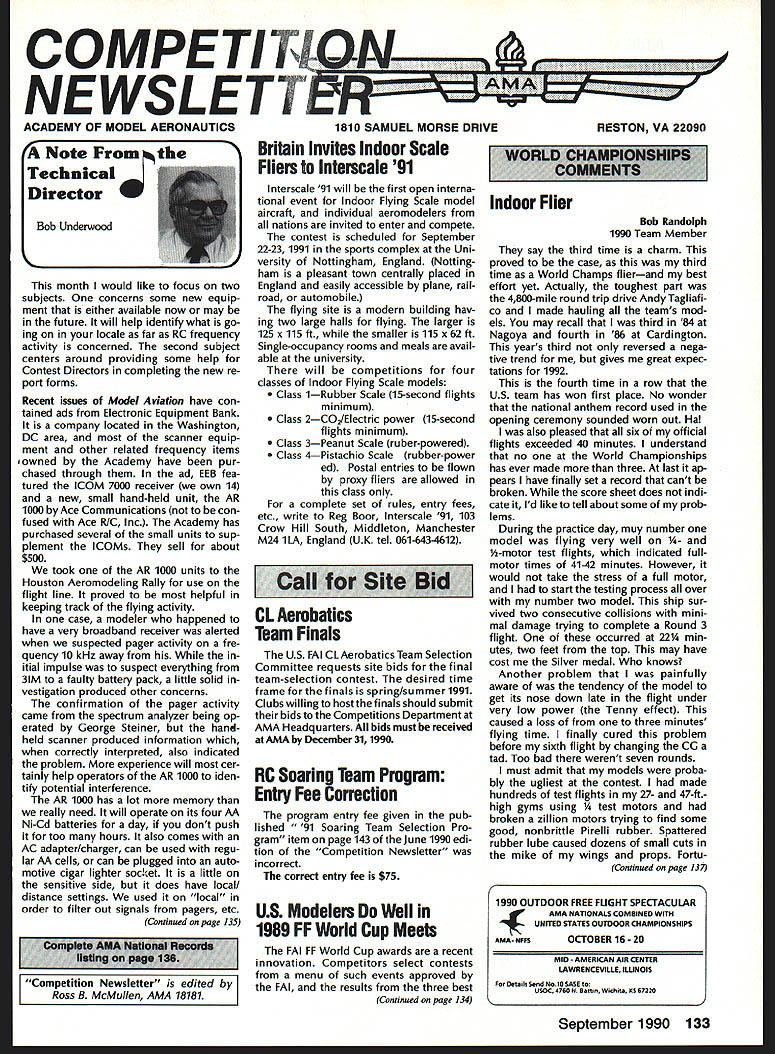
A Note From the Technical Director
Bob Underwood
This month I would like to focus on two subjects. One concerns some new equipment that is either available now or may be in the future. It will help identify what is going on in your locale as far as RC frequency activity is concerned. The second subject centers around providing some help for Contest Directors in completing the new report forms.
Recent issues of Model Aviation have contained ads from Electronic Equipment Bank. It is a company located in the Washington, DC area, and most of the scanner equipment and other related frequency items owned by the Academy have been purchased through them. In the ad, EEB featured the ICOM 7000 receiver (we own 14) and a new, small hand-held unit, the AR 1000 by Ace Communications (not to be confused with Ace R/C, Inc.). The Academy has purchased several of the small units to supplement the ICOMs. They sell for about $500.
We took one of the AR 1000 units to the Houston Aeromodeling Rally for use on the flight line. It proved to be most helpful in keeping track of the flying activity.
In one case, a modeler who happened to have a very broadband receiver was alerted when we suspected pager activity on a frequency 10 kHz away from his. While the initial impulse was to suspect everything from 31 MHz to a faulty battery pack, a little solid investigation produced other concerns. The confirmation of the pager activity came from the spectrum analyzer being operated by George Steiner, but the handheld scanner produced information which, when correctly interpreted, also indicated the problem. More experience will most certainly help operators of the AR 1000 to identify potential interference.
The AR 1000 has a lot more memory than we really need. It will operate on four AA Ni-Cd batteries for a day if not used continuously. It also comes with an AC adapter/charger, can be used with regular AA cells, or can be plugged into an automotive cigar lighter socket. It is a little on the sensitive side, but it does have local/distance settings. We used it on "local" in order to filter out signals from pagers and similar distant sources.
Addition to List of Experimental RC Aircraft Inspectors
A joint AMA/IMAA program to qualify large models (55–100 lb.) for demonstration flights at AMA‑sanctioned events involves the use of inspectors to oversee the flights and aircraft and approve/certify them as complying with safe practices.
The following individual has been added to the complete list of inspectors which was published in the August 1990 edition of the "Competition Newsletter" (page 134):
- District VIII — Dennis "Bo" Hinch, 2622 Marshall St., Sulphur, LA 70663.
Additional information concerning this program may be obtained by contacting Technical Director Bob Underwood at AMA HQ.
Attention CDs: A list of aircraft approved under this program can be obtained from Technical Director Bob Underwood at AMA HQ.
FF World Cup (continued)
Performances by a competitor (points are averaged through 14th place) determine the Cup winner in each of four classes: F1A (Towline Glider), F1B (Wakefield Rubber), F1C (Power), and F1E (Slope Soaring).
For 1989, the U.S. fliers had the following performance standings:
F1A — Out of a total of 75 fliers worldwide, seven U.S. modelers had the following placings: 4) Bob Isaacson (53 pt.); 5) Matt Gewain (45 pt.); 19) Pierre Brun (22 pt.); 20) Lee Hines (20 pt.); 35) Jim Parker (15 pt.); 46) Craig Cusick (12 pt.); 67) Tom Coussens (9 pt.). Stefan Rumpf of Germany was the winner for the third consecutive time with a percentage of 75 points.
F1B — Out of a total of 79 fliers worldwide, U.S. modelers had the following placings: 1) Norm Furutani (55 pt.); 8) Bob Piserchio (35 pt.); 9) Joe Foster (35 pt.); 12) George Xenakis (30 pt.); 17) Jim Quinn (25 pt.); 30) Ed Turner (20 pt.); 35) Bob Milligan (19 pt.); 42) Earl Boteler (12 pt.); 50) Rich Rohrke (11 pt.); 52) Walt Chico (10 pt.); 64) Bill Gibbons (9 pt.); 73) Bob White (8 pt.).
Technical Director (continued)
The AR 1000 does not have a field-strength meter. That is one definite advantage of the ICOM 7000. If your club is interested in owning a receiver (scanner), you may wish to look into either of the two units. If you are at a major event run by the Academy you can take a look at the units we will be operating there.
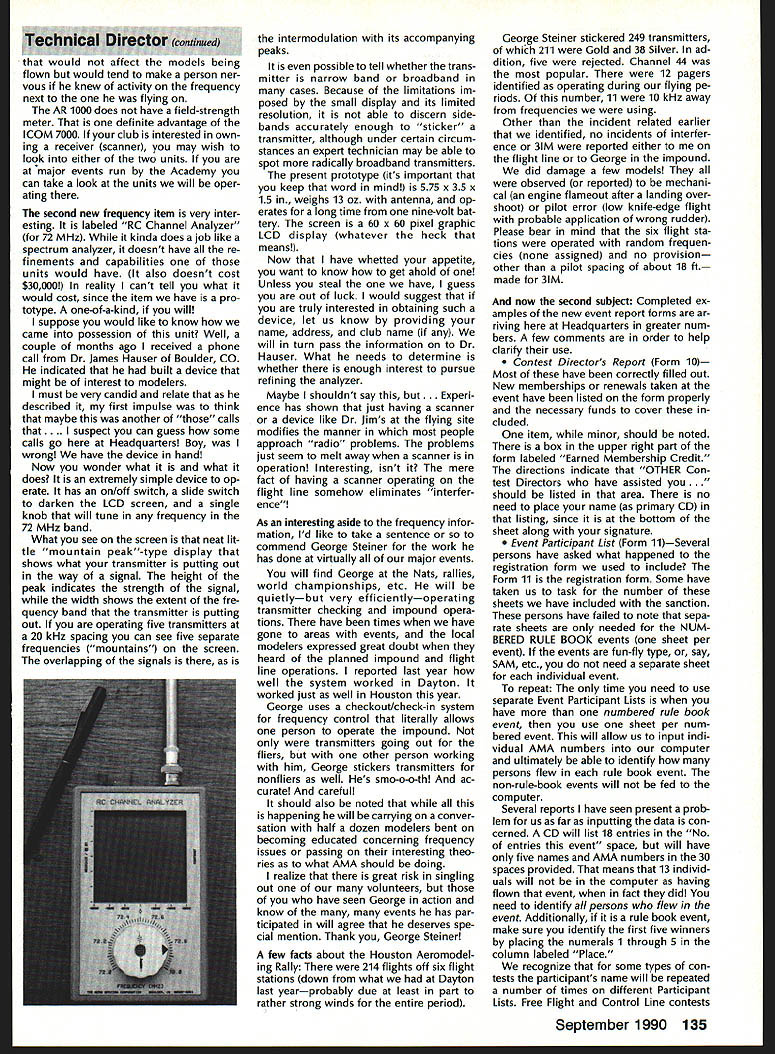
The second and new frequency item is very interesting. It is labeled "RC Channel Analyzer" (for 72 MHz). While it kind of does a little like a spectrum analyzer, it doesn't have all the refinements and capabilities one of those units would have. (It also doesn't cost $30,000!) In reality I can't tell you what it would cost, since the item we have is a prototype — a one-of-a-kind, if you will.
A couple of months ago I received a phone call from Dr. James Hauser of Boulder, CO. He indicated that he had built a device that might be of interest to modelers. As he described it, I confess my first impulse was skepticism — but I was wrong. We have the device in hand.
It is an extremely simple device to operate. It has an on/off switch, a slide switch to darken the LCD screen, and a single knob that will tune any frequency in the 72 MHz band.
What you see on the screen is that neat little "mountain peak" display that shows what your transmitter is putting out in the way of a signal. The height of the peak indicates the strength of the signal, while the width shows the extent of the frequency band that the transmitter is putting out. If you are operating five transmitters at a 20 kHz spacing you can see five separate frequencies ("mountains") on the screen. The overlapping of the signals is visible, as is intermodulation with its accompanying peaks.
It is even possible to tell whether the transmitter is narrow band or broadband in many cases. Because of the limitations imposed by the small display and its limited resolution, it is not able to discern sidebands accurately enough to "sticker" a transmitter, although under certain circumstances an expert technician may be able to spot radically broadband transmitters.
The present prototype (important word: prototype) is 5.75 x 3.5 x 1.5 in., weighs 13 oz. with antenna, and operates for a long time from one nine-volt battery. The screen is a 60 x 60 pixel graphic LCD display (whatever that means).
If you are interested in obtaining such a device, let us know by providing your name, address, and club name (if any). We will pass the information on to Dr. Hauser so he can determine whether there is enough interest to pursue refining the analyzer.
Experience has shown that just having a scanner or a device like Dr. Hauser's at the flying site modifies the manner in which most people approach "radio" problems. The problems just seem to melt away when a scanner is in operation. The mere fact of having a scanner operating on the flight line somehow eliminates "interference."
As an interesting aside to the frequency information, I'd like to commend George Steiner for the work he has done at virtually all of our major events. You will find George at the Nats, rallies, world championships, etc. He quietly — but very efficiently — operates transmitter checking and impound operations. There have been times when we have gone to areas with events and the local modelers expressed great doubt when they heard of the planned impound and flight line operations. I reported last year how well the system worked in Dayton. It worked just as well in Houston this year.
George uses a checkout/check-in system for frequency control that literally allows one person to operate the impound. Not only were transmitters going out for the flyers, but with one other person working with him, George stickered transmitters for nonfliers as well. He's smooth, accurate, and careful.
It should also be noted that while all this is happening he will be carrying on a conversation with half a dozen modelers bent on becoming educated about frequency issues or passing on other interesting theories as to what AMA should be doing.
I realize there is great risk in singling out one of our many volunteers, but those of you who have seen George in action know the man; many events he has participated in will agree that he deserves special mention. Thank you, George Steiner!
A few facts about the Houston Aeromodeling Rally: there were 214 flights off six flight stations (down from what we had at Dayton last year — probably due at least in part to rather strong winds for the entire period).
George Steiner stickered 249 transmitters, of which 211 were Gold and 38 Silver. In addition, five were registered. Channel 44 was the most popular. There were 12 pagers identified as operating during our flying periods. Of this number, 11 were 10 kHz away from frequencies we were using.
Other than the earlier incident that we identified, no incidents of interference or 3IM were reported either to me on the flight line or to George in the impound.
We did damage a few models. They were all observed (or reported) to be mechanical (an engine flameout after a landing overshoot) or pilot error (low knife-edge flight with probable application of wrong rudder). Please bear in mind that the six flight stations were operated with random frequencies (none assigned) and no provisions other than a pilot spacing of about 18 ft. were made for 3IM.
Contest Director's Report (Form 10)
Most Contest Director's Reports have been correctly filled out. New memberships or renewals taken at the event have been listed on the form properly and the necessary funds included.
One minor item should be noted. There is a box in the upper right part of the shaded area labeled "Earned Membership Credit." The directions indicate that "OTHER Contest Directors who have assisted you . . . should be listed in that area." There is no need to place your name (as primary CD) in that last listing, since your name appears at the bottom of the sheet along with your signature.
Event Participant Lists (Form 11)
Several persons have asked what happened to the registration form we used to include. The Form 11 is the registration form. Some have criticized the number of these sheets included with the sanction. Note that separate sheets are only needed for the NUMBERED RULE BOOK events (one sheet per event). If the events are fun-fly type, or, say, SAM, etc., you do not need a separate sheet for each individual event.
To repeat: use separate Event Participant Lists only when you have more than one numbered rule book event — one sheet per numbered event. This allows us to input individual AMA numbers into our computer and ultimately identify how many persons flew in each rule book event. The non-rule-book events will not be fed to the computer.
Several reports present a problem for us as far as inputting the data is concerned. A CD will list 18 entries in the "No. of entries this event" space but will have only five names and AMA numbers in the spaces provided. That means the remaining individuals will not be in the computer as having flown that event unless you have identified them. You need to list all persons who flew in the event. Additionally, if it is a rule book event, please make sure you identify the first five winners by placing the numerals 1 through 5 in the column labeled "Place."
We recognize that for some types of contests the participant's name will be repeated a number of times on different Participant Lists. Free Flight and Control Line contests will have the biggest problem with this.
One CD taped the sheets to the registration table, placed a sign over each sheet listing the event number and its rule book name (example: 102 — A Gas), and had the participants place their names and AMA numbers on the sheet. One person monitored the listings, made certain they were legible, and checked AMA cards. No sweat!
Other Contest Director Information
- Some of the sanction cards are coming in with incomplete information. Please make sure that the name(s) of the official(s) who will handle the event are present, that the event name and rule book number are listed, and that the sponsor is given.
- Several CDs have reported that Canadian entrants have convinced them that since the MAAC insurance coverage has been set up as "worldwide," the $10 Affiliate AMA membership is no longer required. While this may be true in the future, it is not true during this calendar year. Therefore, if you have participants from Canada at your event, they must be AMA Affiliate members for the remainder of 1990.
Indoor Flier (continued)
Fortunately, the many patches did not seem to affect flight performance.
Even though I tested the total Pirelli resources of Andy Faykun, Bud Romak, Bob Gibbs, and myself, I never found any really good Pirelli. I flew both the WC and the Nats on a small sample of great FAI Tan rubber provided by Joe Foster at the meet.
I also used the same 22-1/4 x 40 prop for all flights, and it worked flawlessly. I was able to get slow, consistent 16–18 minute climbs and still level off two feet below the beams. I fly on almost constant power winds and launch torque, and control altitude by means of a small nylon screw that adjusts high pitch.
There were many beautifully crafted models that failed to achieve their potential. I attribute this mainly to insufficient flight testing at home and failure to use partial test motors in small test sites. Variable-pitch (VP) props require an enormous amount of testing to work right. In my opinion, you can't get over 38 minutes at the ETSU Mini-dome without a good VP prop unless you're Jim Richmond. Finally, many fliers needed much more practice in steering. Some made real improvement by the last round.
It is always a pleasure to meet and talk with old friends. I hope more countries and fliers will make it next time. I truly love Indoor models and the challenge of competition. This World Championship was the smoothest-running one I've attended. It reflected the expertise and good planning of the AMA and NFFS staffs.
My personal thanks to everyone who worked hard to provide a successful contest and to all my friends who provided me with their help and assistance. You guys made me, at 67 years young, a happy man. I'm looking forward to the 1992 F1D World Championships with great enthusiasm.
1992 U.S. FAI CL Aerobatics Team Selection Program
I. Purpose
The CL Precision Aerobatics Team Selection Program for 1992 will use a single team-selection contest (Finals) to be held in the spring/summer of 1991. The Finals shall be used to select the three team members who will represent the United States at the 1992 FAI F2B World Championships. An alternate team member shall also be chosen to compete in the event that a team member is unable to fulfill his obligations.
II. Qualification
Only AMA members who have purchased the current FAI stamp ($18) and entered the team selection program are eligible to compete for a position on the team. The program entry fee of $100 must be sent to AMA Headquarters, postmarked no later than 30 days prior to the Finals. A late entry fee of $125 may be accepted at the Finals site the day prior to the contest.
Any fees collected on site must be forwarded to AMA Headquarters by the Contest Director immediately after the contest.
Refund requests will be honored if such a request is received at AMA HQ no later than two days prior to the first day of the Finals.
III. Contest Criteria
The location, date, and time of the Finals will be announced as soon as possible. The Finals contest shall be selected by vote of the Team Selection Committee from among all bids submitted to AMA HQ. Deadline for receiving Finals bids at AMA HQ is December 31, 1990.
Rules of the Finals contest shall be in accordance with the current "FAI Sporting Code."
An FAI jury appointed by the AMA Executive Council shall preside at the Finals. The Team Selection Committee shall submit five nominees for consideration as jury members. Nominees must fall within the guidelines of the "Standing Rules" to the Bylaws of the Academy of Model Aeronautics — FAI Jurors for Team Selections.
IV. Budget
All entry fees and donations will be held in an account at AMA Headquarters.
No more than 50% of total entry fees collected may be used for Finals expenses. The remainder of funds for Finals expenses and team expenses for the World Championships may be permitted with approval of the Team Selection Committee. All funds must be accounted for to the AMA in an audited manner.
Any reimbursement for officials (including travel and lodging expenses) will be made by AMA HQ only after a report is submitted by the CD, accompanied by receipts, and has received the approval of the Team Selection Committee. If possible, the CD should collect funds from contestants and submit it for approval to the Team Selection Committee prior to the Finals.
Money remaining in the team fund may be used for the following team expenses:
- Travel expenses not paid by AMA;
- Vehicle rental;
- Meals for the official practice days;
- Other expenses approved by a majority vote of the Team Selection Committee.
A budget must be submitted by the team manager prior to disbursement of team funds.
V. Team Selection Guidelines — If Approved by AMA Executive Council
The FAI Team Selection Guidelines shall take precedence over any possibly conflicting items contained in this program.
(The Team Selection Committee voted 8–2 to present this program to the program participants for a ratification vote. The program participants approved the program by a vote of 12–4.)
Transcribed from original scans by AI. Minor OCR errors may remain.

