
A Note From the Technical Director
Bob Underwood
A hearty "thank-you" must lead off this month's column. In all, I've received 26 responses from individuals, by phone, letter, or card regarding my column (June 1990) dealing with instructor programs. That represents a significant response. Many people requested the materials we have available. Others simply wanted to tell me that they have been trying to get their club off dead center. I am glad that the thoughts prompted some action on—or at least consideration of—instructor programs.
I want to spend the bulk of my word allotment this month on a subject that is emotional, philosophical, psychological—and that will probably get me into trouble, because all I can provide are opinions.
I have been working on the synopsis of the current crop of rules proposals. That effort, combined with the controversy that has swirled around the last set of proposals, prompted some thoughts during a long drive down I‑95 on our trip to Walt Disney for a vacation.
Over the years all sorts of new events have been added to the competition scene. Very often these have been orchestrated in an attempt to provide an entry-level event. The intent is to feed whatever mild interest an individual might have in competition and help make him a winner without his having to go the full‑blown distance (which usually requires high skill levels and, in some cases, a heck of a bunch of money). From this writer's point of view, that scenario doesn't seem to work! Or at least if it does, the effect is temporary.
If you have been in the competition scene for any time at all, you will have noted events that attempted this. You will find them in virtually every discipline in the book. The problem is that while the event may be designed to slow the models down or simplify them, it is open to any person who has an interest.
Now let's guess what is going to happen if you take any event, simple or complicated, and allow anyone to enter it. Logic suggests that the person who has developed the skills and gained experience over the years will win the event! On the other hand, if you work at limiting the "who" that enters the event, it tends to keep the level of competition more in line.
We have been attempting, with many of our new events, to legislate mediocrity! That can't be done—or at least not done very well. You cannot tell a person that he is not allowed to build a better model or find an innovative way to approach the rules.
I remember a dialogue that occurred some years ago at a contest I was attending at the time when surface detail began showing up on R/C Sport Scale models. One contestant was upset because he was getting the score he was accustomed to receiving with his smooth, nondetailed models. He argued that the intent (as he saw it) of Sport Scale was to provide an entry-level event, and surface detail should not be allowed. He went on to explain that what we should do in order to preserve the event was to pass a rule that said you could not use raised (or depressed) detail on a Sport Scale model. This, he felt, would rule out panel lines, rivets, etc.
Interestingly enough, there was a model at that event with a finish just as smooth as glass, yet the model had every panel line and rivet in place. It must have been that the builder of that model was an absolute nut with an airbrush, and the net effect (including simulated weathering), when viewed from just a few feet away, was impossible to distinguish from raised detail.
Now I realize that you could have wording in the rule which would say that there must be no representation of raised detail, but I am certain that you can figure some loopholes in that statement as well.
If you look back at many of the rules proposals developed after a new simple event made it into the book, they were an attempt to try and keep it simple. In most instances such activity has proved futile (or at least never-ending). The same concern creates flurries of interpretations as well. These then lead to confusion regarding the event.
I would like to point out one category that has tended to help prove the point I am trying to make. RC Aerobatics (Pattern) has maintained skill-level classes for many years. They qualify the flier, not the equipment.
Granted, the event has undergone some agony regarding what maneuvers these different levels should be flying, but when a person competes, it is against others having about the same skill level. It gives the individual time and incentive to build interest.
Competition Newsletter
edited Ros B. McMullen, AMA
National Records — Monthly Update
Following are new National Records processed during the month of July 1990:
- Indoor Category, Pennyplane, Senior — 9.56 m — Don DeLoach — 5/19/90
- Indoor Category IV, Intermediate Stick, Senior — 28.53 m — Don Slusarczyk — 6/8/90
- ROG Cabin, Senior — 27.10 m — Don Slusarczyk — 6/8/90
- Easy B, Senior — 19.53 m — Don Slusarczyk — 6/7/90
- Pennyplane, Senior — 14.06 m — Don Slusarczyk — 6/7/90
- Limited Pennyplane, Senior — 12.26 m — Don DeLoach — 6/7/90
- Helicopter, Open — 10.43 s — Thomas F. Vallee — 6/8/90
- Control Line Navy Carrier Class, Open — 4282 points — Peter Mazur — 6/24/90
- Navy Carrier Class II, Open — 4561 points — Peter Mazur — 6/24/90
- Outdoor Free Flight, P-30 Rubber, Senior — 2300 s — Don DeLoach — 6/23/90
- F1G Coupe, Junior — 3.02 m — Zachary Swarts — 5/28/90
- F1G Coupe, Open — 6.00 m — Stanley Buddenbohm — 5/28/90
- F1J / 2A Power, Open — 6.00 m — Randy Archer — 5/28/90
US Control Line Teams Fly 1990 World Championships
US modelers competed in Speed (F2A), Aerobatics (F2B), Team Racing (F2C), and Combat (F2D) at Blénod-lès-Pont-à-Mousson, France during July 9–14, 1990. Results summarized below.
- Speed (38 entries)
- Carl Dodge, USA — 302.01 km/h (187.7 mph)
- Sergei Kostin, USSR — 300.50 km/h
- Sergei Schelkalin, USSR — 298.25 km/h
- John Newton, USA — 281.47 km/h
- William Hughes, USA — 267.28 km/h
Team standings (18 nations)
- USSR — 894.81 points
- United Kingdom — 871.50 points
- USA — 851.34 points
- Aerobatics (65 entries)
- Ziang Xiangdong, People's Republic of China — 653.550 points
- Anatoly Kolesnikov, USSR — 643.900 points
- Paul Walker, USA — 641.000 points
- James Casale, USA — 629.850 points
- William Werwage, USA — 628.800 points
Team standings (25 nations)
- People's Republic of China — 192.370 points
- USA — 189.965 points
- USSR — 188.140 points
- Team Racing (44 entries) — results given as fastest heat time / finals time (minutes:seconds)
- Shabasov / Ivanov, USSR — 3:17.9 / 6:45.8
- Magli / Pirazzini, Italy — 3:22.3 / 7:01.8
- Voghera / Rossi, Italy — 3:18.5 / 7:32.1
- Willoughby / Oge, USA — 4:20.2
- Hollfelder / Gilott, USA — 4:42.6
- McCollum / Rudner, USA — 4:52.9
Team standings (18 nations)
- USSR — 95.77
- Italy — 103.45
- Austria — 105.04
- USA — 135.57
- Combat (46 entries)
- Viacheslav Belaiev, USSR — 9W/0L
- Mervyn Jones, United Kingdom — 7W/2L
- Henning Forbech, Denmark — 6W/2L
- Ard Rush, USA — 2W/2L
- Tom Fluker Jr., USA — 1W/2L
- Richard Lopez, USA — 1W/2L
Team standings (18 nations)
- USSR — 11 points
- Denmark — 6 points
- United Kingdom — 5 points
- USA — minus 2 points
V. Finance
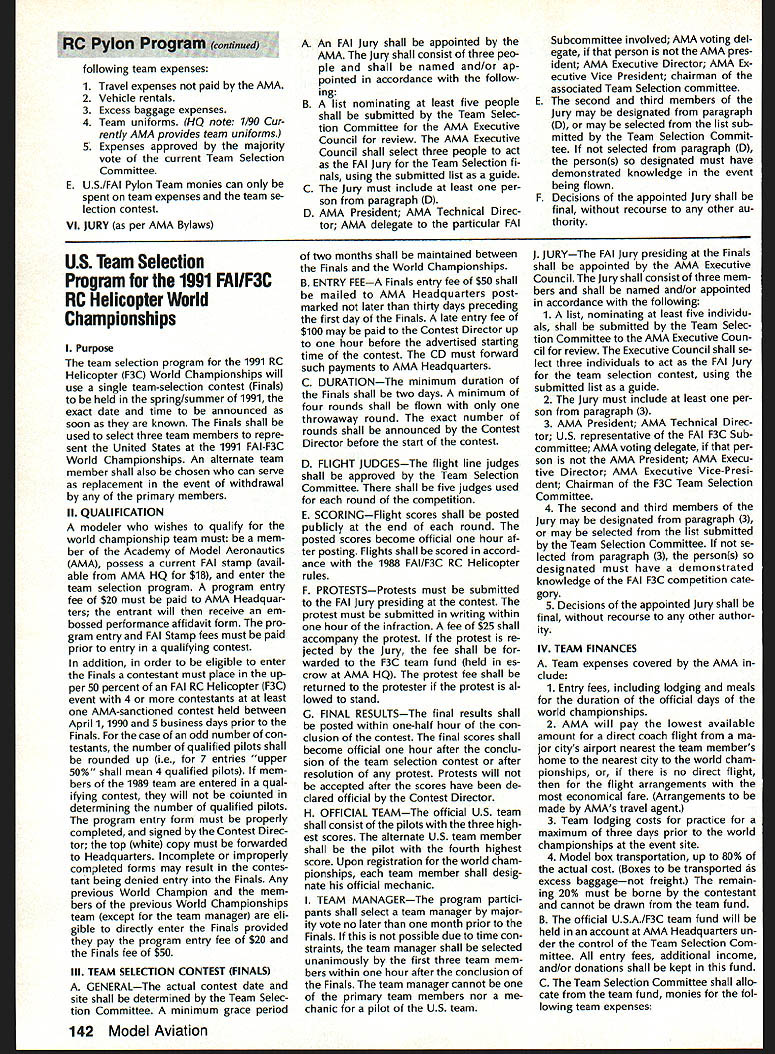
A. United States Pylon team expenses covered by the AMA:
- Entry fees, including lodging and meals for the duration of the official days of the World Championships.
- AMA will pay the lowest available amount for a direct coach flight from the major airport nearest the team member's home to the nearest city to the World Championship or, if there is no direct flight, then for the flight arrangements with the most economical fare.
- Team lodging costs for practice for a maximum of three days at the World Championship site.
- Model box transportation, up to 80% of the actual cost.
- A United States World Champion will be funded in the same manner as a team member.
B. The official U.S./F.A.I. Pylon Team Fund will be held in an account at AMA Headquarters and under the control of the Team Selection Committee. All entry fees, late fees, additional income, and/or donations shall be kept in this fund.
C. Team Trial Expenses, including those paid to the host club, shall be no more than 25% of the entry fees accrued from the Team Selection trials.
D. The Team Selection Committee shall allocate from the Team Fund monies for the following team expenses:
- Travel expenses not paid by the AMA.
- Vehicle rentals.
- Excess baggage expenses.
- Team uniforms. (HQ NOTE: 1/90 Currently AMA provides team uniforms.)
- Expenses approved by the majority vote of the current Team Selection Committee.
E. U.S./FAI Pylon Team monies can only be spent on team expenses and the team selection contest.
VI. JURY (as per AMA Bylaws)
A. An FAI Jury shall be appointed by the AMA. The Jury shall consist of three people and shall be named and/or appointed in accordance with the following:
B. A list nominating at least five people shall be submitted by the Team Selection Committee to the AMA Executive Council for review. The AMA Executive Council shall select three people to act as the FAI Jury for the Team Selection finals, using the submitted list as a guide.
C. The Jury must include at least one person from paragraph (D).
D. Possible designees include:
- AMA President
- AMA Technical Director
- AMA delegate to the particular FAI Subcommittee involved
- AMA voting delegate (if that person is not the AMA President)
- AMA Executive Director
- AMA Executive Vice-President
- Chairman of the associated Team Selection Committee
E. The second and third members of the Jury may be designated from paragraph (D), or may be selected from the list submitted by the Team Selection Committee. If not selected from paragraph (D), the person(s) so designated must have demonstrated knowledge in the event being flown.
F. Decisions of the appointed Jury shall be final, without recourse to any other authority.
U.S. Team Selection Program for the 1991 FAI/F3C RC Helicopter World Championships
I. Purpose
The team selection program for the 1991 RC Helicopter (F3C) World Championships will use a single team-selection contest (Finals) to be held in the spring/summer of 1991; the exact date and site will be announced as soon as they are known. The Finals shall be used to select three team members to represent the United States at the 1991 FAI-F3C World Championships. An alternate team member shall also be chosen to serve as replacement in the event of withdrawal by any of the primary members.
II. Qualification
A modeler who wishes to qualify for the world championship team must:
- Be a member of the Academy of Model Aeronautics (AMA).
- Possess a current FAI stamp (available from AMA HQ for $18).
- Enter the team selection program. A program entry fee of $20 must be paid to AMA Headquarters; the entrant will then receive an embossed performance affidavit form. The program entry and FAI stamp must be paid prior to entry in a qualifying contest.
In addition, to be eligible to enter the Finals a contestant must place in the upper 50 percent of an FAI RC Helicopter (F3C) event with four or more contestants at at least one AMA-sanctioned contest held between April 1, 1990 and five business days prior to the Finals. For an odd number of contestants, the number of qualified pilots shall be rounded up (i.e., for 7 entries "upper 50%" shall mean 4 qualified pilots). If members of the 1989 team are entered in a qualifying contest, they will not be counted in determining the number of qualified pilots. The program entry form must be properly completed and signed by the Contest Director; the top (white) copy must be forwarded to Headquarters. Incomplete or improperly completed forms may result in the contestants being denied entry into the Finals. Any previous World Champion and the members of the previous World Championships team (except for the team manager) are eligible to direct the Finals provided they pay the program entry fee of $20 and the Finals fee of $50.
III. Team Selection Contest (Finals)
A. General — The actual contest date and site shall be determined by the Team Selection Committee. A minimum grace period of two months shall be maintained between the Finals and the World Championships.
B. Entry Fee — A Finals entry fee of $50 shall be mailed to AMA Headquarters postmarked not later than thirty days preceding the first day of the Finals. A late entry fee of $100 may be paid to the Contest Director up to one hour before the advertised starting time of the contest. The Contest Director must forward such payments to AMA Headquarters.
C. Duration — The minimum duration of the Finals shall be two days. A minimum of four rounds shall be flown with only one throwaway round. The exact number of rounds shall be announced by the Contest Director prior to the start of the contest.
D. Flight Judges — The flight line judges shall be approved by the Team Selection Committee. There shall be five judges used for each round of the competition.
E. Scoring — Flight scores shall be posted publicly at the end of each round. The posted scores become official one hour after posting. Flights shall be scored in accordance with the 1988 FAI/F3C RC Helicopter rules.
F. Protests — Protests must be submitted to the FAI Jury presiding at the contest. The protest must be submitted in writing within one hour of the infraction. A fee of $25 shall accompany the protest. If the protest is rejected by the Jury, the fee shall be retained and become the property of the Contest Director (held in escrow at AMA HQ). The protest fee shall be returned to the protester if the protest is allowed.
G. Final Results — The final results shall be posted within one-half hour of the conclusion of the contest. The final scores shall become official one hour after they are posted, and are subject to the following: the Team Selection Committee will consider all protests prior to being declared final. No changes will be allowed regarding the official finish order once the results have been declared official.
H. Official Team — The official U.S. team shall consist of the three pilots with the highest finishes. An alternate U.S. team member shall be the pilot with the fourth highest score. Upon registration for the world championships, each team member shall designate his official mechanic for the U.S. team.
I. Team Manager — The program participants shall select a team manager by majority vote not later than one month prior to the Finals. If this is not possible due to time constraints, the team manager shall be selected by the first three team members who arrive at the Finals. The team manager shall not be a member of the primary team members nor a mechanic for a pilot of the U.S. team.
J. Jury — The FAI Jury presiding at the Finals shall be appointed by the AMA Executive Council. The Jury shall consist of three members and shall be named and/or appointed in accordance with the following:
- A list nominating at least five individuals shall be submitted by the Team Selection Committee to the AMA Executive Council for review. The Executive Council shall select three individuals to act as the FAI Jury for the team selection contest, using the submitted list as a guide.
- The Jury must include at least one person from paragraph (3).
- Possible designees include:
- AMA President
- AMA Technical Director
- U.S. representative of the FAI F3C Subcommittee
- AMA Executive Director
- AMA Executive Vice-President
- Chairman of the F3C Team Selection Committee
- The second and third members of the Jury may be designated from paragraph (3), or may be selected from the list submitted by the Team Selection Committee. If not selected from paragraph (3), the person(s) so designated must have demonstrated knowledge in the event being flown.
- Decisions of the appointed Jury shall be final, without recourse to any other authority.
IV. Team Finances
- Team expenses covered by the AMA include:
- AMA will pay the lowest available amount for a direct coach flight from the major airport nearest the team member's home to the nearest city to the World Championships, or if there is no direct flight, then for the flight arrangements with the most economical fare. (Arrangements to be made by AMA's travel agent.)
- Team lodging costs for a maximum of three days prior to the World Championships at the event site.
- Model box transportation, up to 80% of the actual cost. (Boxes to be transported as excess baggage—no freight.) The remaining 20% must be borne by the contestant and cannot be drawn from the team fund.
- The official U.S./FAI team fund will be held in an account at AMA Headquarters under the control of the Team Selection Committee. All entry fees, additional income, and/or donations shall be kept in this fund.
- Team expenses not covered by the AMA may include:
- Travel expenses not paid by the AMA.
- Vehicle rentals.
- Expenses approved by a majority vote of the Team Selection Committee (excluding excess baggage).
- Meals during the three practice days for which the AMA pays lodging.
D. U.S.A./FAI F3C team fund monies can only be spent on team expenses and the Finals.
Editorial Note
"Competition Newsletter" will present, from time to time, constructive and thought-provoking ideas or criticisms of AMA rules and policies which affect competitors. When the issue has two sides, CN will endeavor to print all viewpoints that have been submitted—within the limits of available space, uniqueness, constructiveness, timeliness, and good taste. Determination of the appropriateness of publication of any of these matters must, of necessity, rest solely with the publisher.
The thoughts presented are those of the author and should not be construed as those of the AMA HQ staff, AMA officers, or the publisher. All should note that publication here of a rules-change or policy-change idea does not necessarily mean that the specific proposal has been presented to a Contest Board, the Executive Council, or appropriate committee; such action is the responsibility of the author or anyone else interested in obtaining official action.
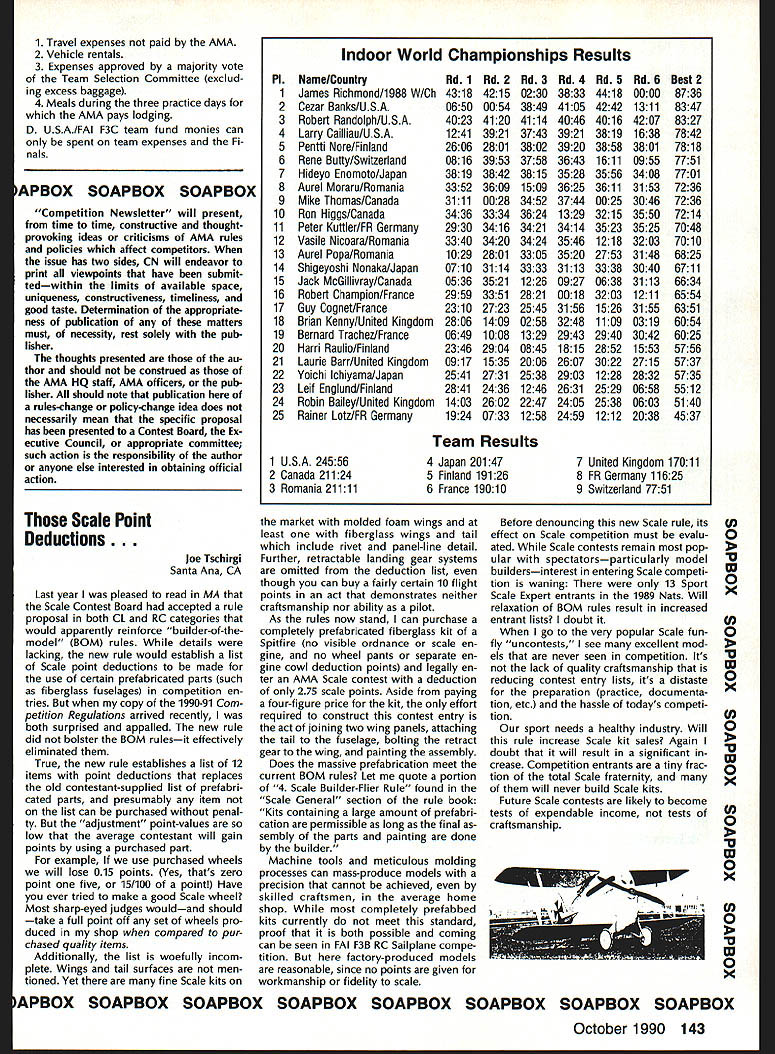
Indoor World Championships Results
- 1. James Richmond / 1988 W.Ch — Rd.1 43:18, Rd.2 42:15, Rd.3 02:30, Rd.4 38:33, Rd.5 44:18, Rd.6 00:00 — Best 2: 87:36
- 2. Cezar Banks / U.S.A. — Rd.1 06:50, Rd.2 00:54, Rd.3 38:49, Rd.4 41:05, Rd.5 42:42, Rd.6 13:11 — Best 2: 83:47
- 3. Robert Randolph / U.S.A. — Rd.1 42:03, Rd.2 41:20, Rd.3 41:24, Rd.4 40:46, Rd.5 46:12, Rd.6 42:07 — Best 2: 83:27
- 4. Larry Cailliau / U.S.A. — Rd.1 12:41, Rd.2 39:21, Rd.3 37:43, Rd.4 39:21, Rd.5 38:19, Rd.6 16:38 — Best 2: 78:42
- 5. Pentti Nore / Finland — Rd.1 26:06, Rd.2 28:01, Rd.3 38:02, Rd.4 39:20, Rd.5 38:58, Rd.6 38:31 — Best 2: 78:18
- 6. Rene Butty / Switzerland — Rd.1 08:16, Rd.2 39:53, Rd.3 37:56, Rd.4 36:43, Rd.5 16:11, Rd.6 09:55 — Best 2: 77:51
- 7. Hideyo Enomoto / Japan — Rd.1 38:19, Rd.2 38:42, Rd.3 38:15, Rd.4 35:28, Rd.5 35:56, Rd.6 34:08 — Best 2: 77:01
- 8. Aurel Moraru / Romania — Rd.1 33:52, Rd.2 36:09, Rd.3 35:10, Rd.4 35:13, Rd.5 41:31, Rd.6 51:53 — Best 2: 72:36
- 9. Mike Thomas / Canada — Rd.1 31:11, Rd.2 00:28, Rd.3 34:52, Rd.4 37:44, Rd.5 00:25, Rd.6 30:46 — Best 2: 72:36
- 10. Ron Higgs / Canada — Rd.1 34:36, Rd.2 33:34, Rd.3 41:03, Rd.4 35:10, Rd.5 35:50, Rd.6 25:50 — Best 2: 72:26
- 11. Peter Kuttler / FR Germany — Rd.1 29:30, Rd.2 34:16, Rd.3 34:21, Rd.4 34:46, Rd.5 35:23, Rd.6 35:25 — Best 2: 70:48
- 12. Vasile Nicora / Romania — Rd.1 33:40, Rd.2 34:20, Rd.3 34:24, Rd.4 35:46, Rd.5 12:18, Rd.6 32:03 — Best 2: 70:10
- 13. Aurel Popa / Romania — Rd.1 10:29, Rd.2 28:20, Rd.3 33:05, Rd.4 35:20, Rd.5 27:58, Rd.6 31:28 — Best 2: 68:25
- 14. Shigeyoshi Nonaka / Japan — Rd.1 07:10, Rd.2 31:34, Rd.3 31:13, Rd.4 33:37, Rd.5 33:38, Rd.6 34:30 — Best 2: 67:11
- 15. Jack McGillivray / Canada — Rd.1 05:36, Rd.2 35:21, Rd.3 22:29, Rd.4 35:07, Rd.5 27:43, Rd.6 10:26 — Best 2: 66:34
- 16. Robert Champion / France — Rd.1 29:59, Rd.2 33:51, Rd.3 28:21, Rd.4 00:18, Rd.5 32:03, Rd.6 12:11 — Best 2: 65:54
- 17. Guy Cognet / France — Rd.1 23:10, Rd.2 27:23, Rd.3 25:45, Rd.4 31:56, Rd.5 15:26, Rd.6 31:55 — Best 2: 63:51
- 18. Brian Kenny / United Kingdom — Rd.1 28:06, Rd.2 14:09, Rd.3 02:58, Rd.4 32:48, Rd.5 11:09, Rd.6 03:19 — Best 2: 60:54
- 19. Bernard Trachez / France — Rd.1 06:49, Rd.2 10:08, Rd.3 13:29, Rd.4 29:33, Rd.5 29:40, Rd.6 30:42 — Best 2: 60:25
- 20. Harri Raulio / Finland — Rd.1 23:46, Rd.2 29:04, Rd.3 08:45, Rd.4 18:15, Rd.5 28:52, Rd.6 15:53 — Best 2: 57:56
- 21. Laurie Barr / United Kingdom — Rd.1 09:17, Rd.2 15:35, Rd.3 20:06, Rd.4 26:07, Rd.5 30:22, Rd.6 27:15 — Best 2: 57:37
- 22. Yoichi Ichiyama / Japan — Rd.1 25:41, Rd.2 27:31, Rd.3 25:38, Rd.4 23:28, Rd.5 28:22, Rd.6 32:24 — Best 2: 57:35
- 23. Leif Englund / Finland — Rd.1 28:41, Rd.2 24:36, Rd.3 12:26, Rd.4 26:12, Rd.5 31:25, Rd.6 29:08 — Best 2: 55:12
- 24. Robin Bailey / United Kingdom — Rd.1 14:03, Rd.2 26:02, Rd.3 22:02, Rd.4 24:06, Rd.5 25:38, Rd.6 00:51 — Best 2: 51:40
- 25. Rainer Lotz / FR Germany — Rd.1 19:24, Rd.2 07:33, Rd.3 12:58, Rd.4 24:59, Rd.5 12:12, Rd.6 30:08 — Best 2: 45:37
Team Results
- 1. U.S.A. — 245:56
- 2. Canada — 211:24
- 3. Romania — 211:11
- 4. Japan — 201:47
- 5. Finland — 191:26
- 6. France — 190:10
- 7. United Kingdom — 170:11
- 8. FR Germany — 116:25
- 9. Switzerland — 77:51
Transcribed from original scans by AI. Minor OCR errors may remain.

