
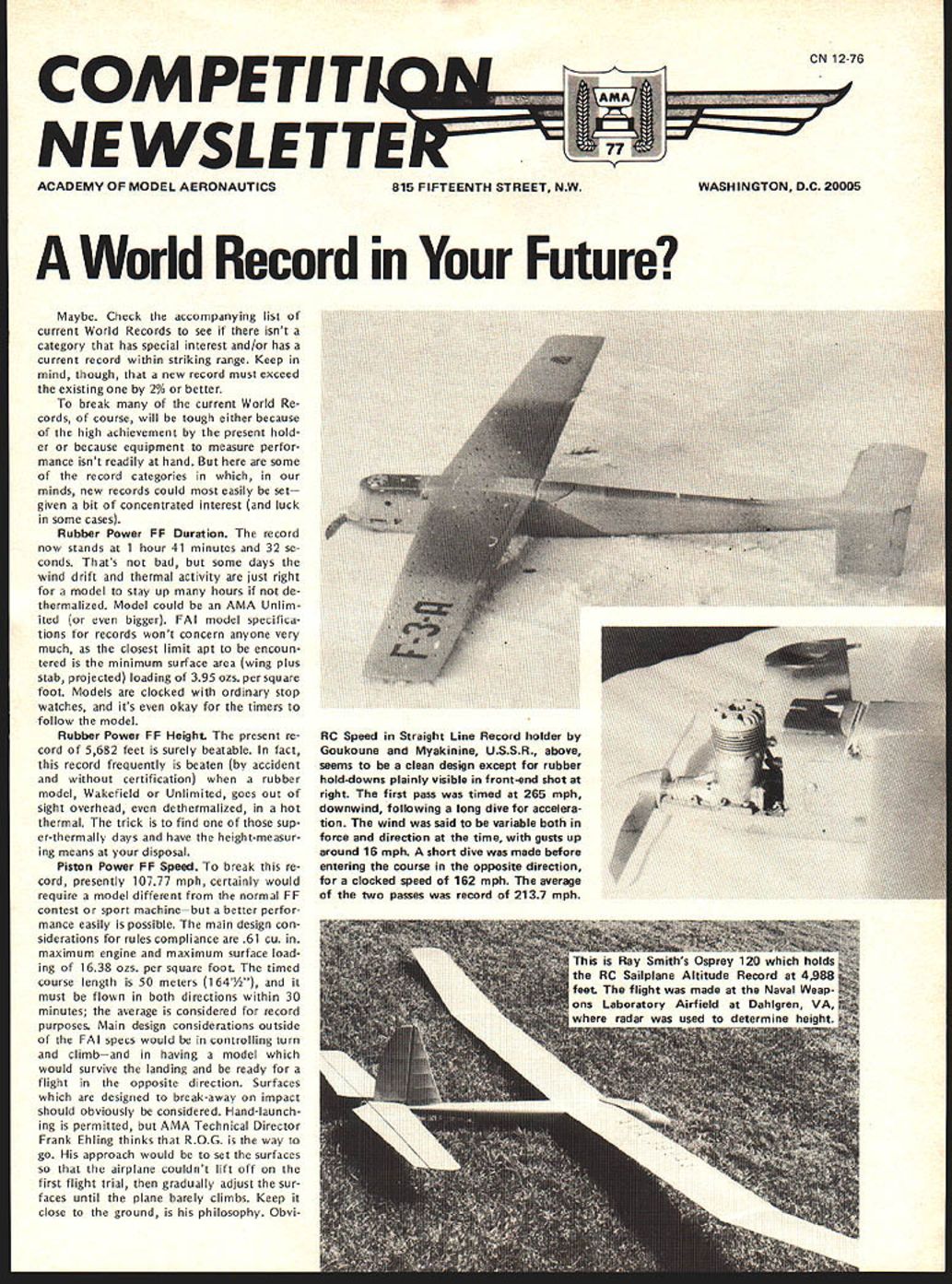
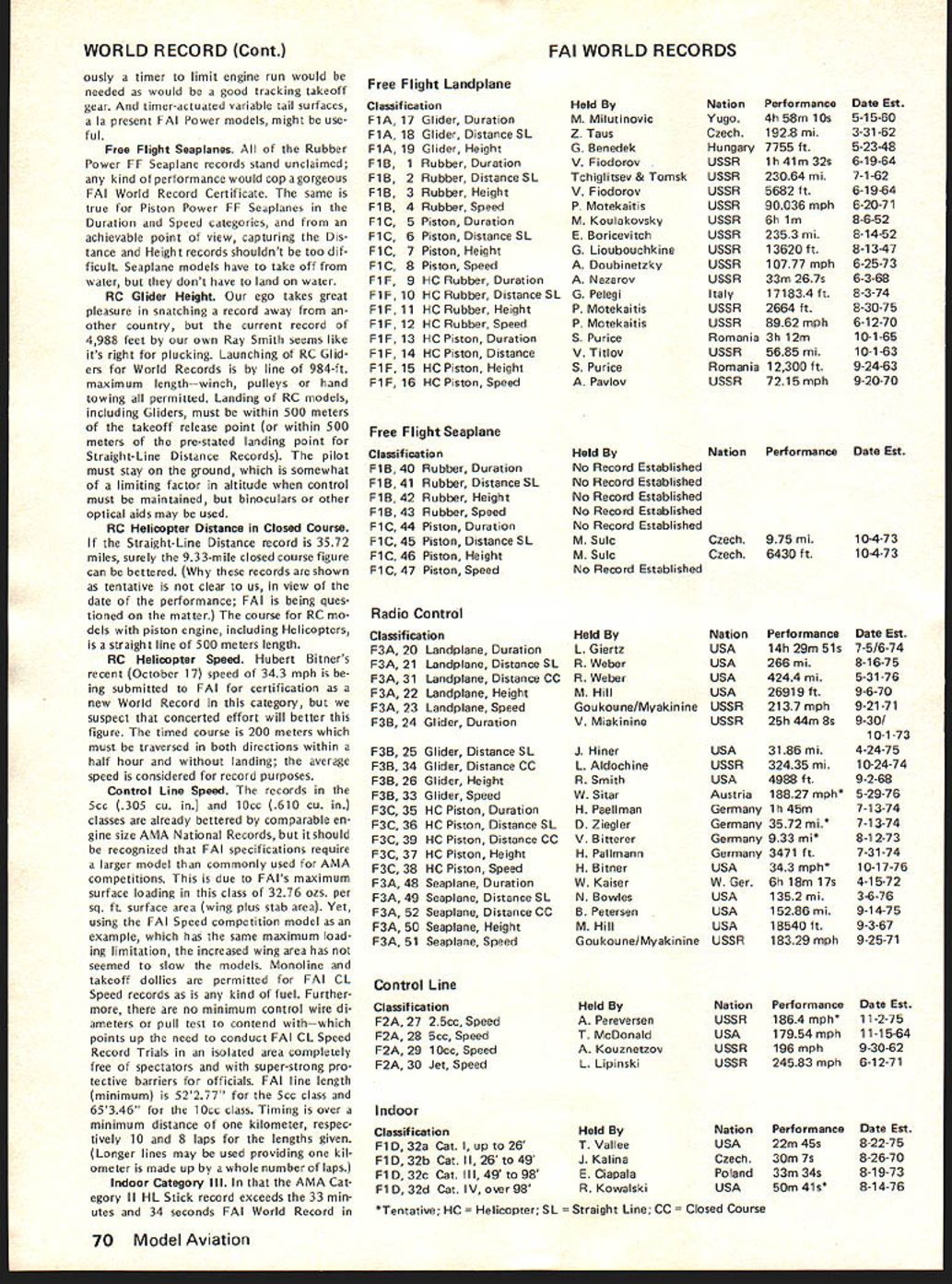
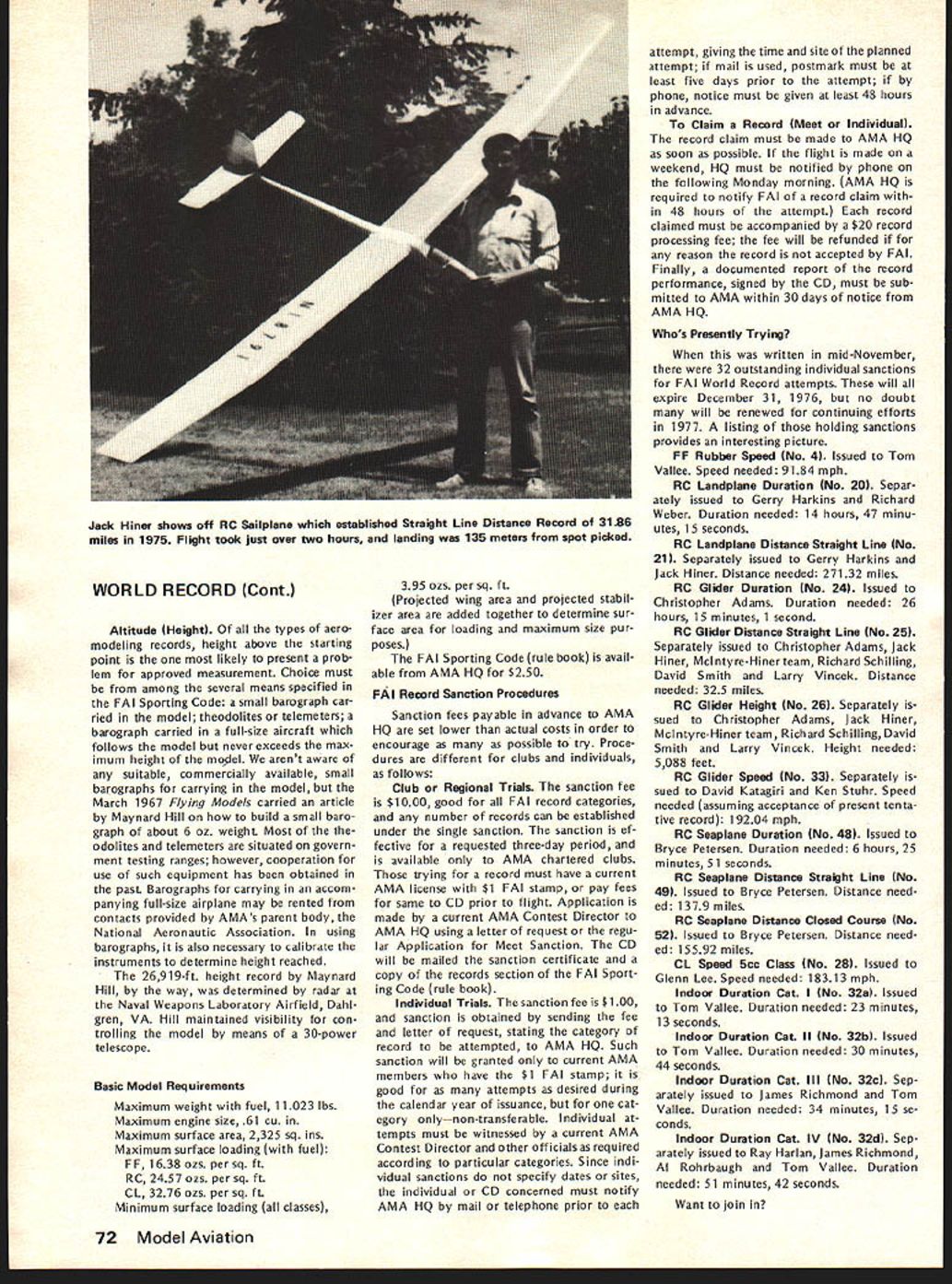
A World Record in Your Future?
Maybe. Check the accompanying list of current World Records to see if there isn't a category that has special interest and/or has a current record within striking range. Keep in mind, though, that a new record must exceed the existing one by 2% or better.
To break many of the current World Records, of course, will be tough either because of the high achievement by the present holder or because equipment to measure performance isn't readily at hand. But here are some of the record categories in which, in our minds, new records could most easily be set — given a bit of concentrated interest (and luck in some cases).
Rubber Power FF Duration. The record now stands at 1 hour 41 minutes and 32 seconds. That's not bad, but some days the wind drift and thermal activity are just right for a model to stay up many hours if not dethermalized. Model could be an AMA Unlimited (or even bigger). FAI model specifications for records won't concern anyone very much, as the closest limit apt to be encountered is the minimum surface area (wing plus stab, projected) loading of 3.95 ozs. per square foot. Models are clocked with ordinary stop watches, and it's even okay for the timers to follow the model.
Rubber Power FF Height. The present record of 5,682 ft is surely beatable. In fact, this record frequently is beaten (by accident and without certification) when a rubber model, Wakefield or Unlimited, goes out of sight overhead, even dethermalized, in a hot thermal. The trick is to find one of those super-thermally days and have the height-measuring means at your disposal.
Piston Power FF Speed. To break this record, presently 107.77 mph, certainly would require a model different from the normal FF contest or sport machine — but a better performance easily is possible. The main design considerations for rules compliance are .61 cu. in. maximum engine and maximum surface loading of 16.38 ozs. per square foot. The timed course length is 50 meters (164'2"), and it must be flown in both directions within 30 minutes; the average is considered for record purposes. Main design considerations outside of the FAI specs would be in controlling turn and climb — and in having a model which would survive the landing and be ready for a flight in the opposite direction. Surfaces which are designed to break-away on impact should obviously be considered. Hand-launching is permitted, but AMA Technical Director Frank Ehling thinks R.O.G. is the way to go. His approach would be to set the surfaces so that the airplane couldn't lift off on the first flight trial, then gradually adjust the surfaces until the plane barely climbs. Keep close to the ground, is his philosophy. Obviously a timer-limited engine run would be needed, and good tracking, takeoff gear and timer-actuated variable tail surfaces would be useful.
Free Flight Seaplanes. Rubber Power FF Seaplane records stand unclaimed — this kind of performance would cop a gorgeous FAI World Record Certificate. Same is true for Piston Power FF Seaplanes. Duration and Speed categories are achievable from the point of view of capturing Distance and Height records; they shouldn't be too difficult. Seaplane models have to take off from water — they don't have to land on water.
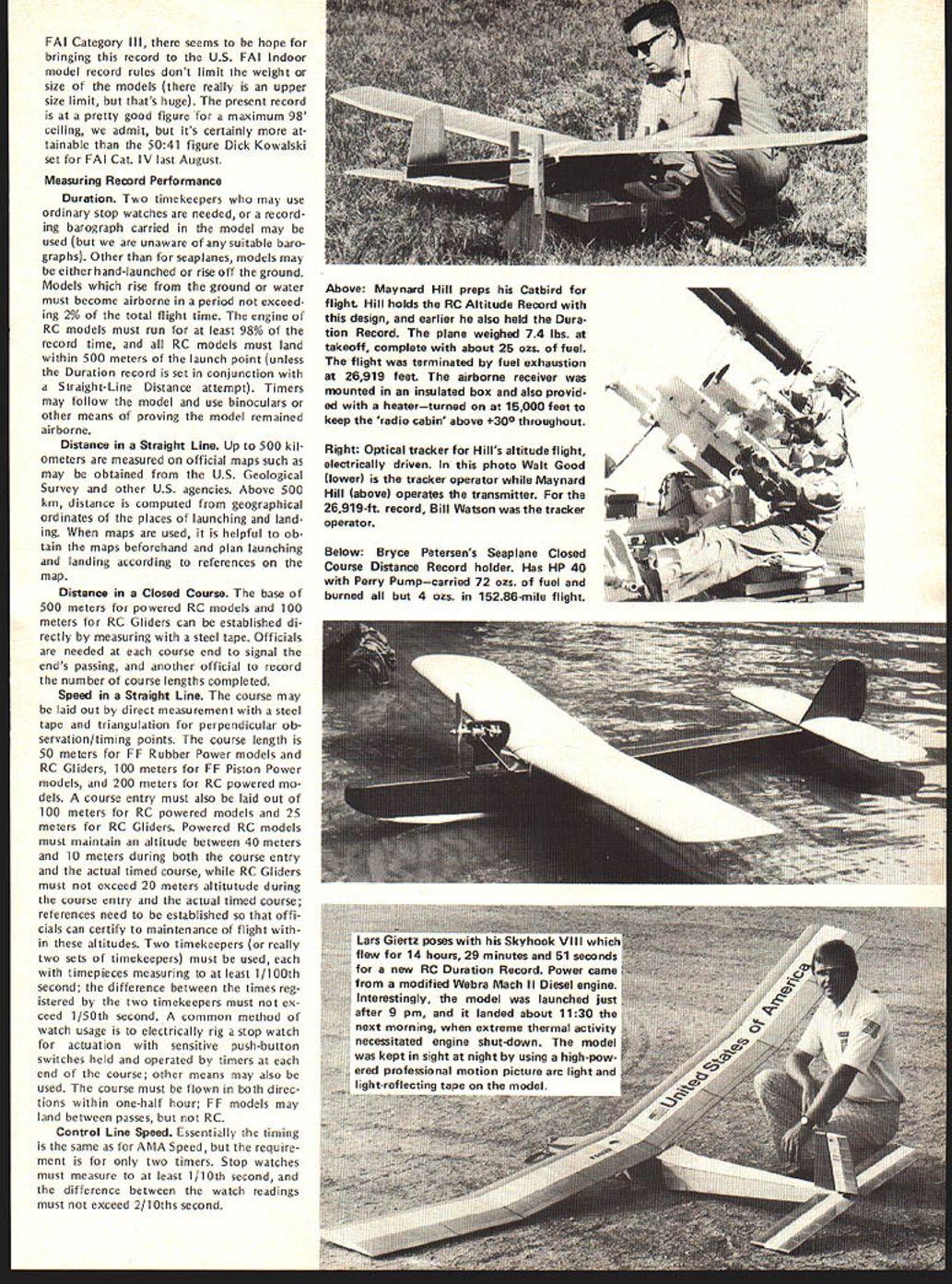
RC Glider Height. It takes great pleasure to snatch a record away from another country. The current record is 4,988 feet — our own Ray Smith seems to have the right ship for taking it.
Launching RC Gliders. World Records list a 984-ft maximum length; winch, pulleys and hand-towing are permitted. Landing RC models, including gliders, must land within 500 meters of the takeoff/release point or within a pre-stated landing point.
Straight-Line Distance Records. The pilot must stay on the ground, which is somewhat a limiting factor; altitude control must be maintained. Binoculars and other optical aids may be used.
RC Helicopter Distance. Closed-course straight-line distance record listed at 3,572 miles — surely the 933-mile closed-course figure can be bettered. Records shown are tentative until clear US and FAI verification of date and performance are accepted.
RC models with piston engines, including helicopters, are usually timed over a straight 500-meter length.
RC Helicopter Speed. Hubert Bitner's recent October 17 speed of 343 mph is being submitted for FAI certification as a new World Record; this will require a concerted effort with suitable tracking and timing equipment.
WORLD RECORD (Cont.)
Obviously a timer to limit engine run would be needed as would be a good tracking takeoff gear. And timer-actuated variable tail surfaces, as present FAI power models, might be useful.
Free Flight Seaplanes. All of the Rubber Power FF Seaplane records stand unclaimed; any kind of performance would cop a gorgeous FAI World Record Certificate. The same is true for Piston Power FF Seaplanes in the Duration and Speed categories, and from an achievable point of view, capturing the Distance and Height records shouldn't be too difficult. Seaplane models have to take off from water, but they don't have to land on water.
RC Glider Height. Our ego takes great pleasure in snatching a record away from the other country, but the current record of 4,988 feet by our own Ray Smith seems like it's right for plucking. Launching of RC Gliders for World Records is by line of 984-ft. maximum length — winch, pulleys or hand towing all permitted. Landing of RC models, including gliders, must be within 500 meters of the takeoff/release point (or within 500 meters of the pre-stated landing point for Straight-Line Distance Records). The pilot must stay on the ground, which is somewhat of a limiting factor in altitude when control must be maintained, but binoculars or other optical aids may be used.
RC Helicopter Distance in Closed Course. If the Straight-Line Distance record is 35.72 miles, surely the 9.33-mile closed-course figure can be bettered. (Why these records are shown as tentative is not clear to us, in view of the date of the performance; FAI is being questioned on the matter). The course for RC models with piston engine, including helicopters, is a straight line of 500 meters length.
RC Helicopter Speed. Hubert Bitner's recent (October 17) speed of 343.3 mph is being submitted to FAI for certification as a new World Record in this category, but we suspect that concerted effort will better this figure. The timed course is 200 meters which must be traversed in both directions within a half hour and without landing; the average speed is considered for record purposes.
Control Line Speed. The records in the 5cc (.305 cu. in.) and 10cc (.610 cu. in.) classes are already bettered by comparable engine-size AMA National Records, but it should be recognized that FAI specifications require a larger model than commonly used for AMA competition. This is due to FAI's maximum surface loading in this class of 32.76 ozs. per sq. ft. (surface area — wing plus stab area). Yet, using the FAI Speed competition model as an example, which has the same maximum loading limitation, the increased wing area has not seemed to slow the models. Monoline and takeoff dollies are permitted for FAI CL Speed records as is any kind of fuel. Furthermore, there are no minimum control wire diameters or pull tests to contend with — which points up the need to conduct FAI CL Speed Record Trials in an isolated area completely free of spectators and with super-strong protective barriers for officials. FAI line length (minimum) is 52.77' for the 5cc class and 65.34' for the 10cc class. Timing is over a minimum distance of one kilometer, respectively 10 and 8 laps for the lengths given. (Longer lines may be used providing one kilometer is made up by a whole number of laps.)
Indoor Category III. In that the AMA Category III HC Stick record exceeds the 33 minutes and 34 seconds FAI World Record in FAI Category III, there seems to be hope for bringing this record to the U.S. FAI Indoor model record rules don't limit the weight or size of the models (there really is an upper size limit, but that's huge). The present record is at a pretty good figure for a maximum 98' ceiling, we admit, but it's certainly more attainable than the 50:41 figure Dick Kowalski set for FAI Cat. IV last August.
Measuring Record Performance
Duration
Two timekeepers who may use ordinary stop watches are needed, or a recording barograph carried in the model may be used (but we are unaware of any suitable barographs). Other than for seaplanes, models may be either hand-launched or rise off the ground. Models which rise from the ground or water must become airborne in a period not exceeding 2% of the total flight time. The engine of RC models must run for at least 98% of the record time, and all RC models must land within 500 meters of the launch point (unless the Duration record is set in conjunction with a Straight-Line Distance attempt). Timers may follow the model and use binoculars or other means of proving the model remained airborne.
Distance in a Straight Line
Up to 500 kilometers are measured on official maps such as may be obtained from the U.S. Geological Survey and other U.S. agencies. Above 500 km, distance is computed from geographical ordinates of the places of launching and landing. When maps are used, it is helpful to obtain the maps beforehand and plan launching and landing according to references on the map.
Distance in a Closed Course
The base of 500 meters for powered RC models and 100 meters for RC Gliders can be established directly by measuring with a steel tape. Officials are needed at each course end to signal the end's passing, and another official to record the number of course lengths completed.
Speed in a Straight Line
The course may be laid out by direct measurement with a steel tape and triangulation for perpendicular observation/timing points. The course length is 50 meters for FF Rubber Power models and RC Gliders, 100 meters for FF Piston Power models, and 200 meters for RC powered models. A course entry must also be laid out of 100 meters for RC powered models and 25 meters for RC Gliders. Powered RC models must maintain an altitude between 40 meters and 10 meters during the course entry and the actual timed course, while RC Gliders must not exceed 20 meters altitude during the course entry and the actual timed course; references need to be established so that officials can certify to maintenance of flight within these altitudes. Two timekeepers (or really two sets of timekeepers) must be used, each with timepieces measuring to at least 1/100th second; the difference between the times registered by the two timekeepers must not exceed 1/50th second. A common method of watch usage is to electrically rig a stop-watch for actuation with sensitive push-button switches and be operated by timers at each end of the course; other means may also be used. The course must be flown in both directions within one-half hour; FF models may land between passes, but not RC.
Control Line Speed
Essentially the timing is the same as for AMA Speed, but the requirement is for only two timers. Stop watches must measure to at least 1/10th second, and the difference between the watch readings must not exceed 2/10ths second.
WORLD RECORD (Cont.)
Altitude (Height). Of all the types of aeromodeling records, height above the starting point is the one most likely to present a problem for approved measurement. Choice must be from among the several means specified in the FAI Sporting Code: a small barograph carried in the model; theodolites or telemeters; a barograph carried in a full-size aircraft which follows the model but never exceeds the maximum height of the model. We aren't aware of any suitable, commercially available, small barographs for carrying in the model, but the March 1967 Flying Models carried an article by Maynard Hill on how to build a small barograph of about 6 oz. weight. Most of the theodolites and telemeters are situated on government testing ranges; however, cooperation for use of such equipment has been obtained in the past. Barographs for carrying in an accompanying full-size airplane may be rented from contacts provided by AMA's parent body, the National Aeronautic Association. In using barographs, it is also necessary to calibrate the instruments to determine height reached. The 26,919-ft. height record by Maynard Hill, by the way, was determined by radar at the Naval Weapons Laboratory Airfield, Dahlgren, VA. Hill maintained visibility for controlling the model by means of a 30-power telescope.
Basic Model Requirements
- Maximum weight with fuel, 11.023 lbs.
- Maximum engine size, 61 cu. in.
- Maximum surface area, 2,325 sq. ins.
- Maximum surface loading (with fuel):
- FF, 16.38 ozs. per sq. ft.
- RC, 24.57 ozs. per sq. ft.
- CL, 32.76 ozs. per sq. ft.
- Minimum surface loading (all classes), 3.95 ozs. per sq. ft.
(Projected wing area and projected stabilizer area are added together to determine surface area for loading and maximum size purposes.)
The FAI Sporting Code (rule book) is available from AMA HQ for $2.50.
FAI Record Sanction Procedures
Sanction fees payable in advance to AMA HQ are set lower than actual costs in order to encourage as many as possible to try. Procedures are different for clubs and individuals, as follows:
Club or Regional Trials. The sanction fee is $10.00, good for all FAI record categories, and any number of records can be established under the single sanction. The sanction is effective for a requested three-day period, and is available only to AMA chartered clubs. Those trying for a record must have a current AMA license with $1 FAI stamp, or pay fees for same to CD prior to flight. Application is made by a current AMA Contest Director to AMA HQ using a letter of request or the regular Application for Meet Sanction. The CD will be mailed the sanction certificate and a copy of the record section of the FAI Sporting Code (rule book).
Individual Trials. The sanction fee is $1.00, and sanction is obtained by sending the fee and letter of request, stating the category of record to be attempted, to AMA HQ. Such sanction will be granted only to current AMA members who have the $1 FAI stamp; it is good for as many attempts as desired during the calendar year of issuance, but for one category only—nontransferable. Individual attempts must be witnessed by a current AMA Contest Director and other officials as required according to the particular categories. Since individual sanctions do not specify dates or sites, the individual or CD concerned must notify AMA HQ by mail or telephone prior to each attempt, giving the time and site of the planned attempt; if mail is used, postmark must be at least five days prior to the attempt; if by phone, notice must be given at least 48 hours in advance.
To Claim a Record (Meet or Individual). The record claim must be made to AMA HQ as soon as possible. If the flight is made on a weekend, HQ must be notified by phone on the following Monday morning. (AMA HQ is required to notify FAI of a record claim within 48 hours of the attempt.) Each record claimed must be accompanied by a $20 record processing fee; the fee will be refunded if for any reason the record is not accepted by FAI. Finally, a documented report of the record performance, signed by the CD, must be submitted to AMA within 30 days of notice from AMA HQ.
Who's Presently Trying?
When this was written in mid-November, there were 32 outstanding individual sanctions for FAI World Record attempts. These will all expire December 31, 1976, but no doubt many will be renewed for continuing efforts in 1977. A listing of those holding sanctions provides an interesting picture.
FF Rubber Speed (No. 4). Issued to Tom Vallee. Speed needed: 91.84 mph.
RC Landplane Duration (No. 20). Separately issued to Gerry Harkins and Richard Weber. Duration needed: 14 hours, 47 minutes, 15 seconds.
RC Landplane Distance Straight Line (No. 21). Separately issued to Gerry Harkins and Jack Hiner. Distance needed: 271.32 miles.
RC Glider Duration (No. 24). Issued to Christopher Adams. Duration needed: 26 hours, 15 minutes, 1 second.
RC Glider Distance Straight Line (No. 25). Separately issued to Christopher Adams, Jack Hiner, McIntyre-Hiner team, Richard Schilling, David Smith and Larry Vincek. Distance needed: 32.5 miles.
RC Glider Height (No. 26). Separately issued to Christopher Adams, Jack Hiner, McIntyre-Hiner team, Richard Schilling, David Smith and Larry Vincek. Height needed: 5,088 feet.
RC Glider Speed (No. 33). Separately issued to David Katagiri and Ken Stuhr. Speed needed (assuming acceptance of present tentative record): 192.04 mph.
RC Seaplane Duration (No. 48). Issued to Bryce Petersen. Duration needed: 6 hours, 25 minutes, 51 seconds.
RC Seaplane Distance Straight Line (No. 49). Issued to Bryce Petersen. Distance needed: 137.9 miles.
RC Seaplane Distance Closed Course (No. 52). Issued to Bryce Petersen. Distance needed: 155.92 miles.
CL Speed 5cc Class (No. 28). Issued to Glenn Lee. Speed needed: 183.13 mph.
Indoor Duration Cat. I (No. 32a). Issued to Tom Vallee. Duration needed: 23 minutes, 13 seconds.
Indoor Duration Cat. II (No. 32b). Issued to Tom Vallee. Duration needed: 30 minutes, 44 seconds.
Indoor Duration Cat. III (No. 32c). Separately issued to James Richmond and Tom Vallee. Duration needed: 34 minutes, 15 seconds.
Indoor Duration Cat. IV (No. 32d). Separately issued to Ray Harlan, James Richmond, Al Rohrbaugh and Tom Vallee. Duration needed: 51 minutes, 42 seconds.
Want to join in?
Competition Newsletter
Competition News will present, from time to time, constructive and thought-provoking ideas or criticisms of AMA rules and policies which affect competitors. When the issue has two sides, CN will endeavor to print all viewpoints that have been submitted—within the limits of available space, uniqueness, constructiveness, timeliness and good taste. Determination of the appropriateness of publication of any of these matters must of necessity rest solely with the publisher.
The thoughts presented are those of the author, and should not necessarily be construed as those of AMA HQ, AMA officers or the publisher. All should note that publication here of a rules-change or policy-change idea does not necessarily mean that specific proposal has been presented to the Contest Board, Executive Council, or appropriate committee; such action is the responsibility of the author or anyone else interested in obtaining official action.
RULES CHANGES AND ENGINES
Duke Fox Fox Manufacturing Co.
I understand the Control Line Contest Board is seriously considering rule changes which would disqualify our new Combat Special in the Slow Combat and Slow Rat Race events. If this were to happen, the effect on me would be disastrous. I have so far spent in the order of $200,000 working up this engine and getting it to the level of performance it is now. Our sales so far have been under $50,000. I need sales in all three events, plus the sport flyers to help amortize my investment and hopefully, in a few years, to make enough profit to support another new motor.
An almost identical situation did happen in 1966, when I had put every last one of my pesos into developing the Fox 74 engine which I planned to be the ultimate Pattern engine. Almost simultaneously with my first deliveries the AMA announced that, henceforth, Pattern would be limited to 10cc (60 size) engines, and immediately 98 percent of my market evaporated. For five years there was not money for any new Fox products. I like to think that all of modeling, as well as myself, were the losers.
I am sure that Cox, Testor, K & B and myself have supported American model activities a great deal more than any foreign manufacturer. I think that it is not unreasonable for us to ask that one of the considerations for any rules changes be, “what effect will this have on our capability to continue serving modelers?”
THE "SLOW" IN CL SLOW RAT
Dr. E. W. Schnitzer Snellville, GA
The new rules for Slow Rat allow any engine with a .36 cu. in. displacement. When our club, in conjunction with another club, formulated club rules for an event that has since become known as Slow Rat, the purpose was to allow people to become interested and to participate in a racing event without a large outlay of money, and to become competitive in a relatively short period of time. From reading articles in model magazines I know that this was the intent of other clubs, as well as illustrated by some of their rules—one of which was that the propeller must be 10x6.
I don't see the big gain of using a ball bearing engine (as permitted by AMA rules) and going 10 miles per hour faster than a plain bearing engine. In fact, I see a number of disadvantages. Even with a plain bearing engine the event has become sophisticated enough that if a person has to become competitive he either has to be a machinist, or somebody who can get the engine fast enough to be competitive—or else send it out to somebody to be reworked. With the addition of the bearings, there is that much more to work with.
Second, I think what's going to happen is that clubs will again formulate club rules for this event specifying plain bearing engines, just as some clubs are holding contests for Goodyear racing, saying no Rossis allowed.
I would like to see some nationally standard racing event that would allow a relative beginner to become competitive in a relatively short period of time. I would also like the rules to be free of modification for a long period of time. I don't see the advantage of adding quick fills, fuel shut-offs, ball bearing engines on all racing events. I think that one can have as much fun with one racing event without all of the above, and I would like to see Slow Rat become that kind of racing event.
SAFETY
John Gifford
The topic is safety. Safety for you, safety for me, safety for our families.
I know that we are all well aware of the AMA rules governing flight safety. I also know that we are all reasonable persons (or at least as reasonable as one can be and yet stay involved in R/C). However, there are times when we simply do not think.
For example: Your editor visited the Millard site one Sunday, and what he saw there scared him. Scared him so that he did not return.
Motors revved up, on the ground, in direct line with the spectators. Additionally, engines were started and run with an admiring circle of the innocent standing around. Men, women, children, lounging in comfort, parallel to and not 10 yards away from those churning mills at takeoff. Hoo-Boy!
Let's do a little simple arithmetic:
- A wooden “11 x 7” prop, weight two ounces (now we will figure a bit more).
- A “sixty” will turn out 12,000 rpm.
- Reasonable, no?
- So what, Gifford?
A. 11-inch diameter computes to 2.88 feet of circumference. B. 12,000 rpm breaks down to 200 revolutions per second. C. That prop-tip is moving 576 feet per second; 390 mph, my friend! D. Half of that 11" by 7" is one ounce, one-sixteenth of a pound. E. If anything lets go you have a system that will deliver slightly more than 36 ft.-lb. of impact energy.
- So what? Flat on, this will cause a fairly nasty bruise. Tip first, and it will penetrate nearly three inches of meat! That's what!
Can't happen? Back in '58 I saw one-half inch of a nylon prop go through the side panel of a Chevy. It was a Control Line Combat prop. Once someone “tipped” the ground on takeoff, and the prop exploded. I tell you—that Chevy and prop exploded.
To go through Africa, Sicily, from Omaha to the Rhine, Korea, Viet Nam, then to get zapped at a fun-fly in Kansas? No way, buddy!
I think it was Cyrano who said, “I can protect myself from my enemies, but only God can save me from my friends.”
The solution? Simple!
- Line up the runways and the spectator areas so that there is a reasonable distance between them. In addition, place the spectators so that a plane taking off is not moving parallel to or towards them.
- Designate a pit area away from the innocent. Anyone who starts or runs an engine outside of this area while grounded receives censure from the entire club.
I'm always ready to lend a hand in the pit. Anyone, anytime. If I do “get bit” there, it will be due to my own stupidity; and in my book stupidity is one of nature's capital offenses. But—to collect broken props as an innocent bystander—Casey Stengel said it very well, “Include me out.”
(Reprinted from Log, newsletter of the Riley County Fliers of Kansas.)
CAUTION—ADULTS AT PLAY!
Our hobby/sport is the construction and controlled flying of miniature airplanes. It is a demanding and very unforgiving activity. Errors of construction become evident very quickly as poor flight characteristics or actual in-flight failures of the airplane. Inadequacies of piloting skill also become evident equally quickly as our airplane plows into a spiral dive terminating in a cloud of balsa fragments and shredded MonoKote.
Anyone who considers that we are playing with men's toys had better stop and reconsider. Our toys cost upwards of $200.00 and many hours of painstaking work. And in flight, have more potential destructive energy than a 30-06 rifle.
A further misconception is that our planes are models. This just isn't true. Our planes are miniature airplanes. They are not smaller versions of full-sized machines. Aerodynamically, our planes operate in a different flight regime from any other class of airborne vehicle. They must obey the “laws of aerodynamics” but these laws are different for different sizes as well as for different speeds.
At one time I earned my living by designing and developing supersonic airplanes and a few of the more recent contributions to the state of the art in transonic dog-fighting techniques. The very low Reynolds Numbers of miniature airplanes imply that what is true at one scale is not necessarily true at another. We still tend to “toy” the image of grown men “playing with their toys.”
Perhaps part of the problem is ourselves. We call our planes “models.” We call our official publication of the AMA “Model Aviation.” The more people we are in touch with, the more influence we have and the more we must accept the kind of publicity we get.
I say it's time to think this off. We don't build models; we build miniature airplanes. The AMA should be called the Academy of Miniature Aeronautics and its magazine “Miniature Aviation.”
While we continue to call ourselves “modelers” we will be treated as men with toys. I say it's time to separate the men from the boys once and for all. What do you think?
(Reprinted from Streamlines, newsletter of the Romeo (Mich.) Radio Aero Club. Mike Naylor, editor.)
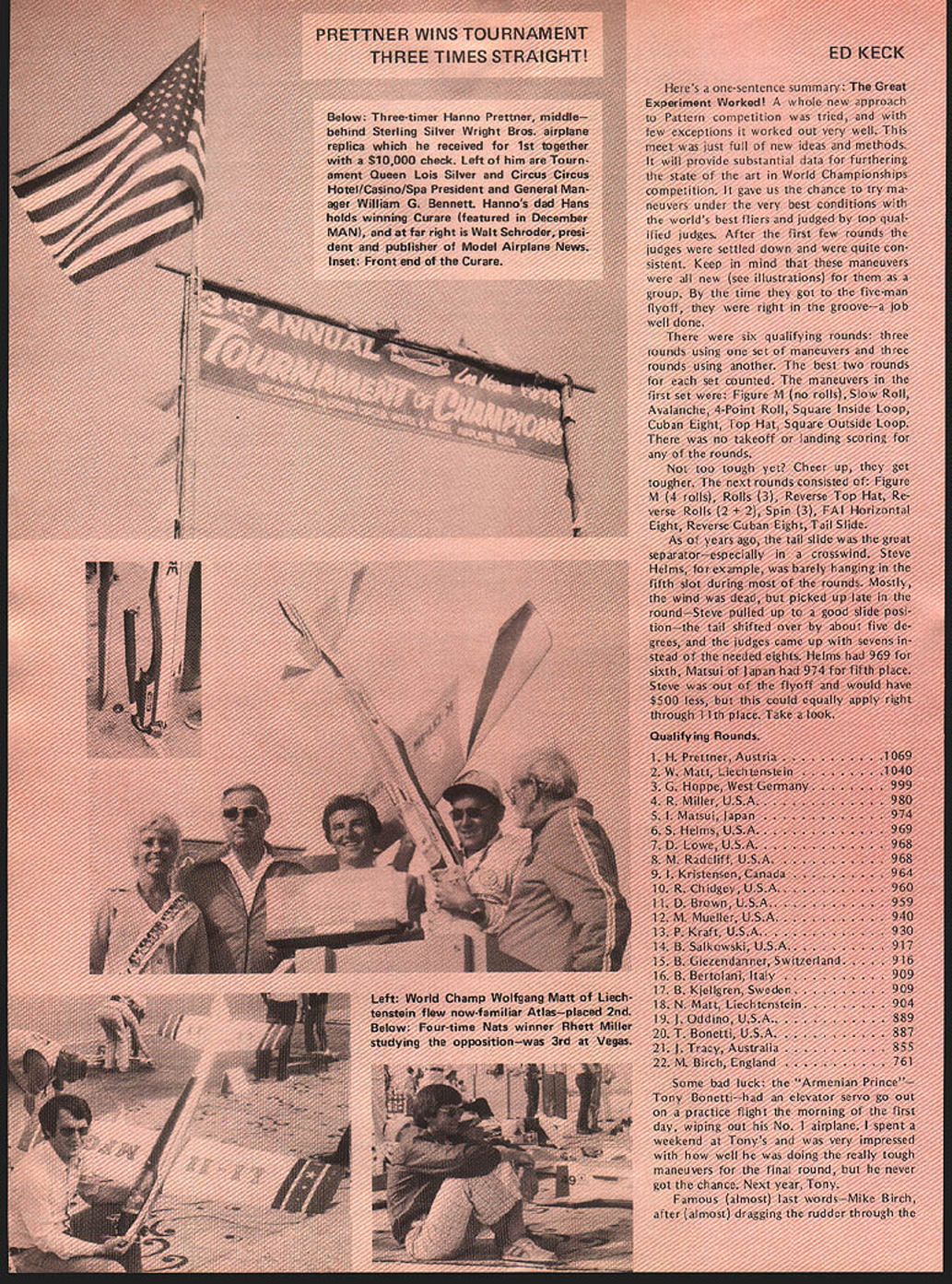
PRETTNER WINS TOURNAMENT THREE TIMES STRAIGHT!
ED KECK
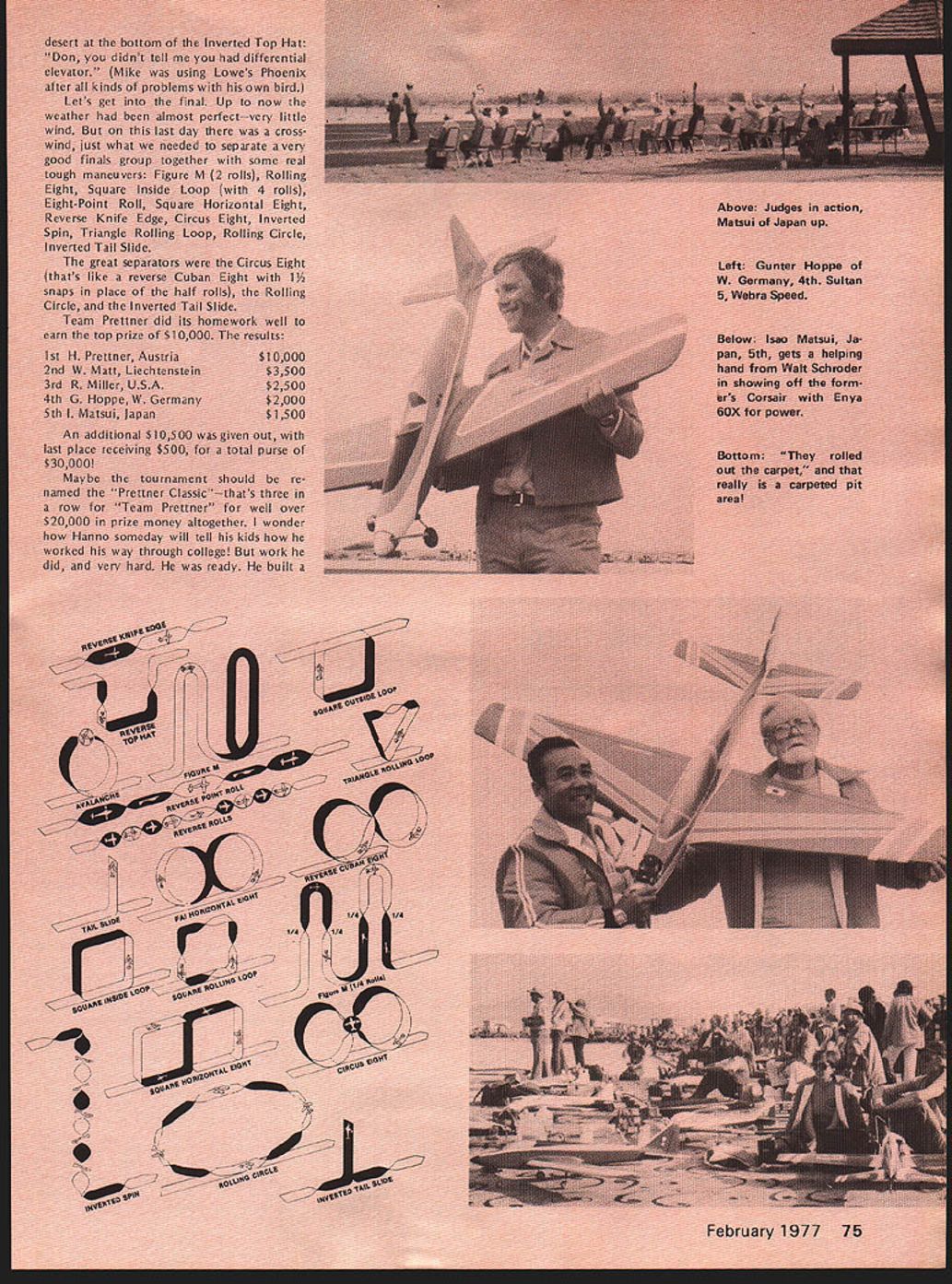
Here's a one-sentence summary: The Great Experiment Worked! A whole new approach to Pattern competition was tried, and with few exceptions it worked out very well. This meet was just full of new ideas and methods. It will provide substantial data for furthering the state of the art in World Championships competition. It gave us the chance to try maneuvers under the very best conditions with the world's best fliers and judged by top qualified judges. After the first few rounds the judges were settled down and were quite consistent. Keep in mind that these maneuvers were all new (see illustrations) for them as a group. By the time they got to the five-man flyoff, they were right in the groove - a job well done.
There were six qualifying rounds: three rounds using one set of maneuvers and three rounds using another. The best two rounds for each set counted. The maneuvers in the first set were: Figure M (no rolls), Slow Roll, Avalanche, 4-Point Roll, Square Inside Loop, Cuban Eight, Top Hat, Square Outside Loop. There was no takeoff or landing scoring for any of the rounds.
Not too tough yet? Cheer up, they got tougher. The next rounds consisted of: Figure M (4 rolls), Rolls (3), Reverse Top Hat, Reverse Rolls (2 + 2), Spin (3), FAI Horizontal Eight, Reverse Cuban Eight, Tail Slide.
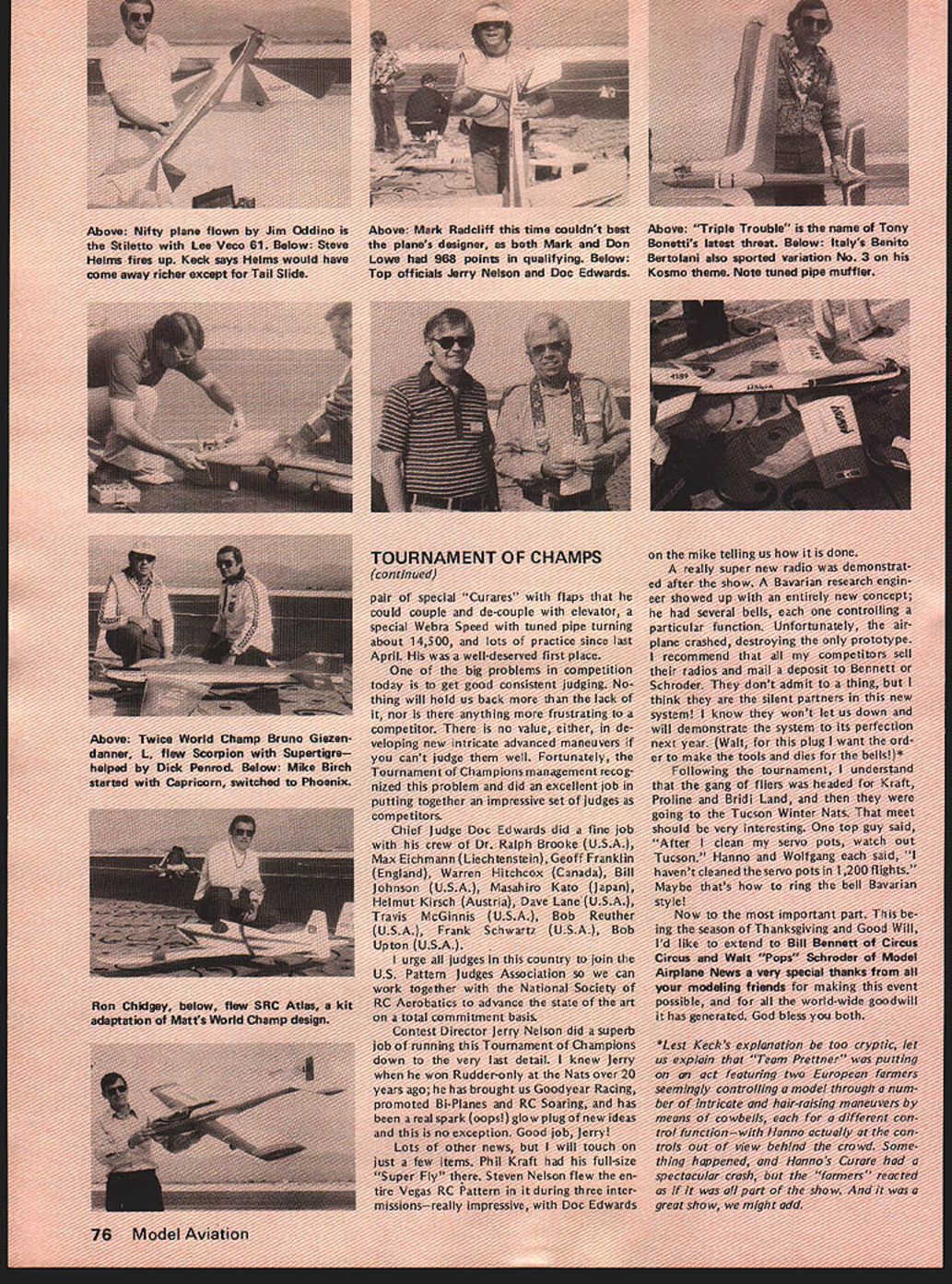
As of years ago, the tail slide was the great separator especially in a crosswind. Steve Helms, for example, was barely hanging in the fifth slot during most of the rounds. Mostly, the wind was dead, but picked up late in the round. Steve pulled up to a good slide position — the tail shifted over by about five degrees, and the judges came up with sevens instead of the needed eights. Helms had 969 for sixth. Matsui of Japan had 974 for fifth place. Steve was out of the flyoff and would have $500 less, but this could equally apply right through 11th place. Take a look.
Qualifying Rounds.
- H. Prettner, Austria........................1069
- W. Matt, Liechtenstein.......................1040
- G. Hoppe, West Germany.......................999
- R. Miller, U.S.A.............................980
- I. Matsui, Japan.............................974
- S. Helms, U.S.A..............................969
- D. Lowe, U.S.A...............................968
- M. Radcliff, U.S.A...........................968
- J. Kristensen, Canada........................964
- R. Chidsey, U.S.A...........................960
- D. Brown, U.S.A.............................959
- M. Mueller, U.S.A...........................940
- P. Kraft, U.S.A.............................930
- B. Sakowski, U.S.A..........................917
- B. Giezendanner, Switzerland...............916
- B. Bertolani, Italy.........................909
- B. Kellgren, Sweden.........................909
- N. Matt, Liechtenstein......................904
- D. Oddino, U.S.A...........................889
- T. Bonetti, U.S.A...........................887
- J. Tracy, Australia..........................855
- M. Birch, England...........................761
Some bad luck: the "Armenian Prince" Tony Bonetti had an elevator servo go out on a practice flight the morning of the first day, wiping out his No. 1 airplane. I spent a weekend at Tony's and was very impressed with how well he was doing the really tough maneuvers for the final round, but he never got the chance. Next year, Tony.
Famous (almost) last words—Mike Birch, after (almost) dragging the rudder through the desert at the bottom of the Inverted Top Hat: "Don, you didn't tell me you had differential elevator." (Mike was using Lowe's Phoenix after all kinds of problems with his own bird.)
Let's get into the final. Up to now the weather had been almost perfect—very little wind. But on this last day there was a crosswind, just what we needed to separate a very good finals group together with some real tough maneuvers: Figure M (2 rolls), Rolling Eight, Square Inside Loop (with 4 rolls), Eight-Point Roll, Square Horizontal Eight, Reverse Knife Edge, Circus Eight, Inverted Spin, Triangle Rolling Loop, Rolling Circle, Inverted Tail Slide.
The great separators were the Circus Eight (that's like a reverse Cuban Eight with 1½ snaps in place of the half rolls), the Rolling Circle, and the Inverted Tail Slide.
Team Prettner did its homework well to earn the top prize of $10,000. The results:
1st H. Prettner, Austria $10,000 2nd W. Matt, Liechtenstein $3,500 3rd R. Miller, U.S.A. $2,500 4th G. Hoppe, W. Germany $2,000 5th I. Matsui, Japan $1,500
An additional $10,500 was given out, with last place receiving $500, for a total purse of $30,000!
Maybe the tournament should be renamed the "Prettner Classic"—that's three in a row for "Team Prettner" for well over $20,000 in prize money altogether. I wonder how Hanno someday will tell his kids how he worked his way through college! But work he did, and very hard. He was ready. He built a
TOURNAMENT OF CHAMPS (continued)
pair of special "Curares" with flaps that he could couple and de-couple with elevator, a special Webra Speed with tuned pipe turning about 14,500, and lots of practice since last April. His was a well-deserved first place.
One of the big problems in competition today is to get good consistent judging. Nothing will hold us back more than the lack of it, nor is there anything more frustrating to a competitor. There is no value, either, in developing new intricate advanced maneuvers if you can't judge them well. Fortunately, the Tournament of Champions' management recognized this problem and did an excellent job in putting together an impressive set of judges as competitors.
Chief Judge Doc Edwards did a fine job with his crew of Dr. Ralph Brooke (U.S.A.), Max Eichmann (Liechtenstein), Geoff Franklin (England), Warren Hitchcock (Canada), Bill Johnson (U.S.A.), Masahiro Kato (Japan), Helmut Kirsch (Austria), Dave Lane (U.S.A.), Travis McGinnis (U.S.A.), Bob Reuther (U.S.A.), Frank Schwartz (U.S.A.), Bob Upton (U.S.A.).
I urge all judges in this country to join the U.S. Pattern Judges Association so we can work together with the National Society of R/C Aerobatics to advance the state of the art on a national basis.
Contest Director Jerry Nelson did a superb job of running this Tournament of Champions down to the very last detail. I knew Jerry when he won Rudder-only at the Nats over 20 years ago; he has brought us Goodyear Racers and noted biplanes and R/C Soaring, and has been a real spark (oops) of new ideas — and this is no exception. Good job, Jerry!
Lots of other news, but I will touch on just a few items. Phil Kraft had his full-size "Super Fly" there. Steven Nelson flew the entire Vegas R/C Pattern in it during the intermissions — really impressive, with Doc Edwards on the mike telling us how it is done.
A really super new radio was demonstrated after the show. A Bavarian research engineer showed up with an entirely new concept; he had several bells, each one controlling a particular function. Unfortunately, the airplane crashed, destroying the only prototype. I recommend that all my competitors sell their radios and mail a deposit to Bennett or Schroeder. They don't admit to a thing, but I think they are the silent partners in this system! I know they won't let us down and will demonstrate the system to its perfection next year. (Wait, for this plug I want them to make the tools and dies for the bells!)
Following the tournament, I understand that the gang of fliers was headed for Kraft, ProLine and Birdland, and then they were going to the Tucson Winter Nats. That must be very interesting. One top guy said, "After I clean my servo pots, watch out Tucson." Hanno and Wolfgang each said, "I haven't cleaned the servo pots in 2,000 flights." Maybe that's how to ring the bell Bavarian style!
Now to the most important part. This being the season of Thanksgiving and Good Will, I'd like to extend to Bill Bennett of Concentric and Walt "Pop" Schroeder of Model Airplane News a very special thanks from all of us who helped in making this event possible, and for all the goodwill that it has generated. God bless you both.
Lest Keck's explanation be too cryptic, let us explain that "Team Prettner" was putting on an act featuring two European performers. What they did was entertaining and effective — a nice finish to a great show.
Transcribed from original scans by AI. Minor OCR errors may remain.

