
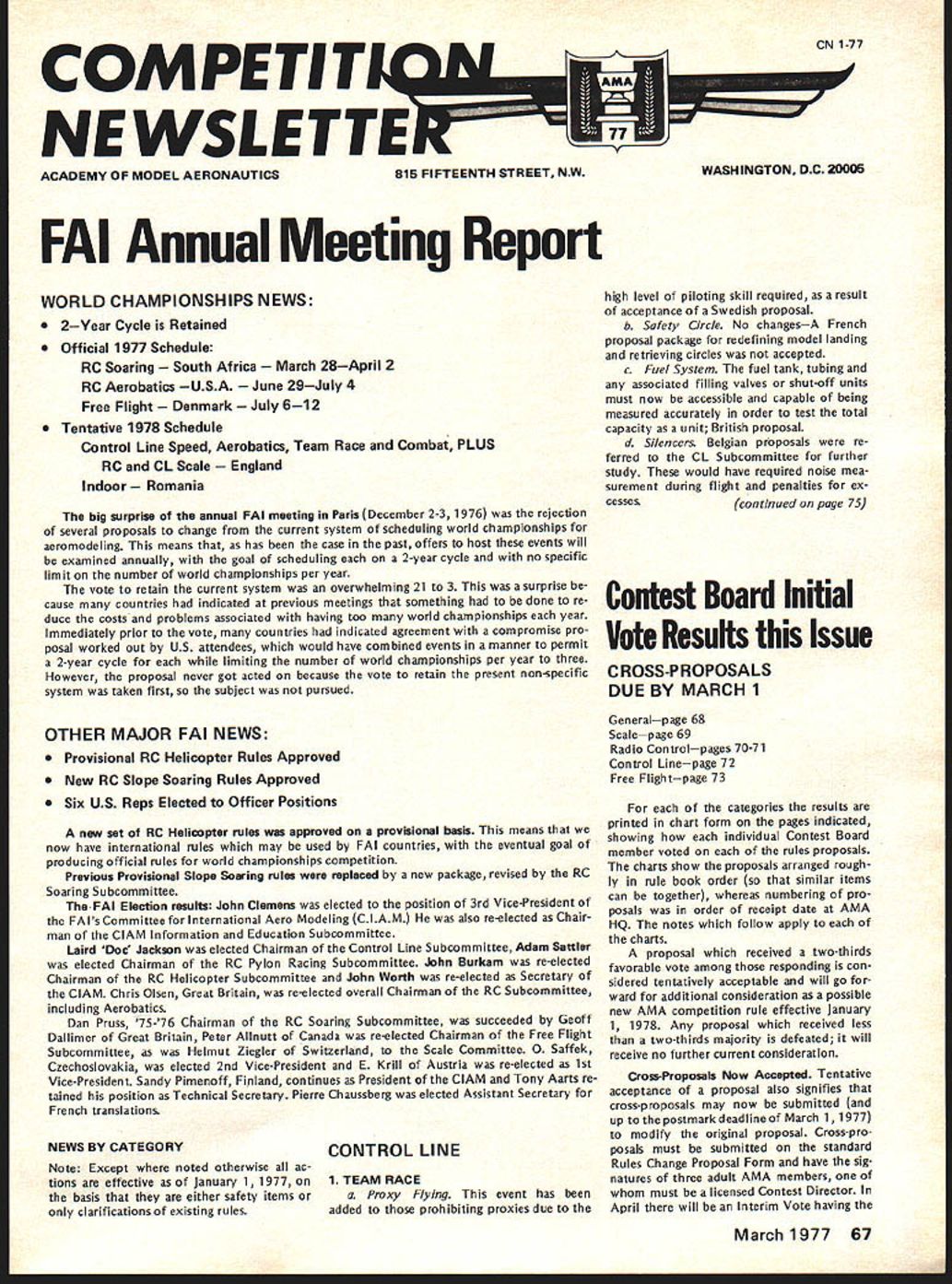
FAI Annual Meeting Report
WORLD CHAMPIONSHIPS NEWS:
- 2-Year Cycle is Retained
- Official 1977 Schedule:
- RC Soaring — South Africa — March 28–April 2
- RC Aerobatics — U.S.A. — June 29–July 4
- Free Flight — Denmark — July 6–12
- Tentative 1978 Schedule
- Control Line Speed, Aerobatics, Team Race and Combat, PLUS RC and CL Scale — England
- Indoor — Romania
The big surprise of the annual FAI meeting in Paris (December 2-3, 1976) was the rejection of several proposals to change from the current system of scheduling world championships for aeromodeling. This means that, as has been the case in the past, offers to host these events will be examined annually, with the goal of scheduling each on a 2-year cycle and with no specific limit on the number of world championships per year.
The vote to retain the current system was an overwhelming 21 to 3. This was a surprise because many countries had indicated at previous meetings that something had to be done to reduce the costs and problems associated with having too many world championships each year. Immediately prior to the vote, many countries had indicated agreement with a compromise proposal worked out by U.S. attendees, which would have combined events in a manner to permit a 2-year cycle for each while limiting the number of world championships per year to three. However, the proposal never got acted on because the vote to retain the present non-specific system was taken first, so the subject was not pursued.
OTHER MAJOR FAI NEWS:
- Provisional RC Helicopter Rules Approved
- New RC Slope Soaring Rules Approved
- Six U.S. Reps Elected to Officer Positions
A new set of RC Helicopter rules was approved on a provisional basis. This means that we now have international rules which may be used by FAI countries, with the eventual goal of producing official rules for world championships competition.
Previous Provisional Slope Soaring rules were replaced by a new package, revised by the RC Soaring Subcommittee.
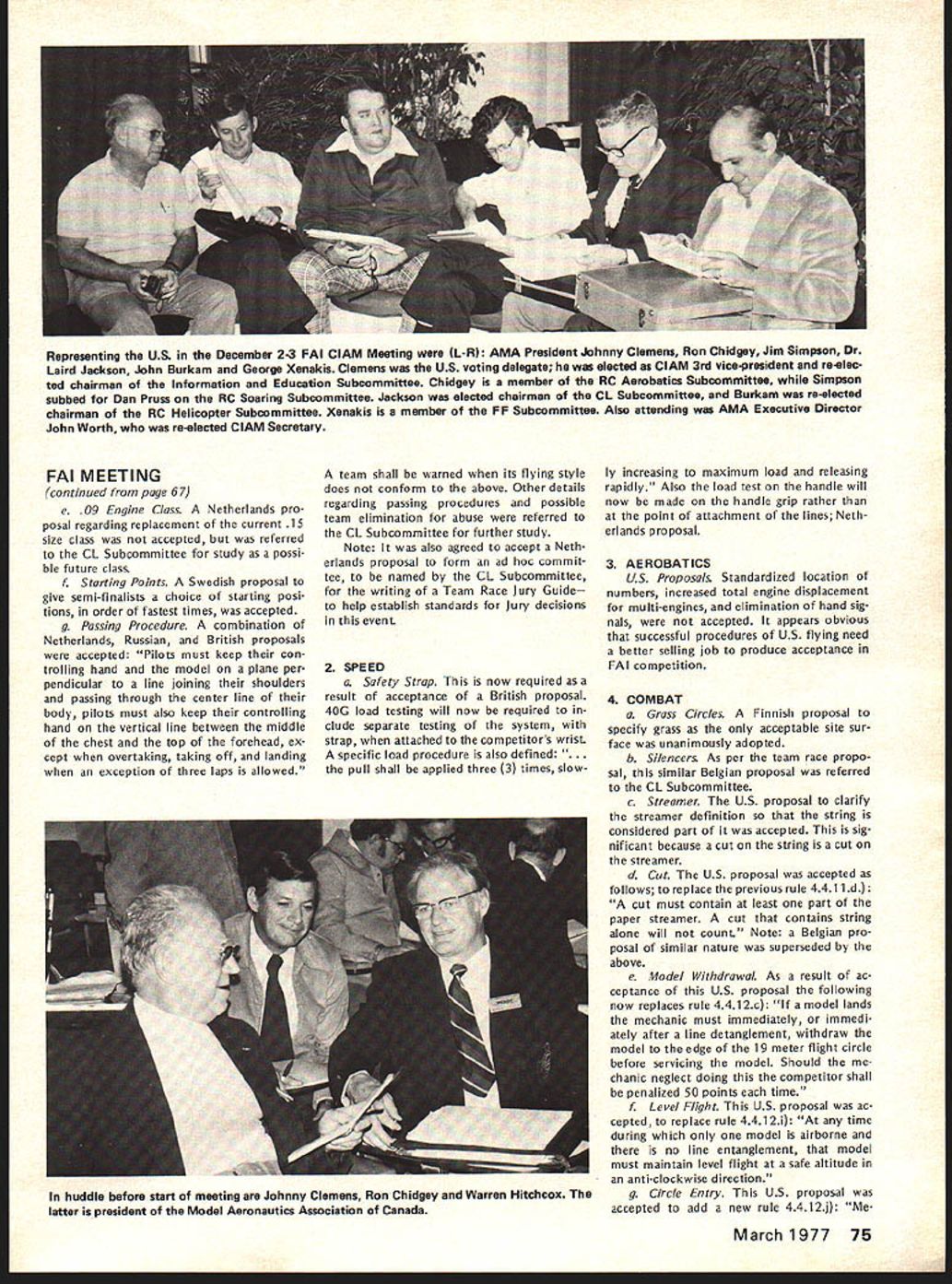
The FAI Election results: John Clemens was elected to the position of 3rd Vice-President of the FAI's Committee for International Aero Modeling (C.I.A.M.). He was also re-elected as Chairman of the CIAM Information and Education Subcommittee.
Laird 'Doc' Jackson was elected Chairman of the Control Line Subcommittee. Adam Sattler was elected Chairman of the RC Pylon Racing Subcommittee. John Burkam was re-elected Chairman of the RC Helicopter Subcommittee and John Worth was re-elected as Secretary of the CIAM. Chris Olsen, Great Britain, was re-elected overall Chairman of the RC Subcommittee, including Aerobatics.
Dan Pruss, '75-'76 Chairman of the RC Soaring Subcommittee, was succeeded by Geoff Dallimer of Great Britain. Peter Allnutt of Canada was re-elected Chairman of the Free Flight Subcommittee, as was Helmut Ziegler of Switzerland to the Scale Committee. O. Saffek, Czechoslovakia, was elected 2nd Vice-President and E. Krill of Austria was re-elected as 1st Vice-President. Sandy Pimenoff, Finland, continues as President of the CIAM and Tony Aarts retained his position as Technical Secretary. Pierre Chaussberg was elected Assistant Secretary for French translations.
NEWS BY CATEGORY
Note: Except where noted otherwise all actions are effective as of January 1, 1977, on the basis that they are either safety items or only clarifications of existing rules.
CONTROL LINE
- TEAM RACE
- a. Proxy Flying. This event has been added to those prohibiting proxies due to the high level of piloting skill required, as a result of acceptance of a Swedish proposal.
- b. Safety Circle. No changes—A French proposal package for redefining model landing and retrieving circles was not accepted.
- c. Fuel System. The fuel tank, tubing and any associated filling valves or shut-off units must now be accessible and capable of being measured accurately in order to test the total capacity as a unit; British proposal.
- d. Silencers. Belgian proposals were referred to the CL Subcommittee for further study. These would have required noise measurement during flight and penalties for excesses.
CB INITIAL VOTE (Cont.)
purpose of reducing and/or combining similar proposals and cross-proposals.
Also considered tentatively acceptable, and subject to modification by cross-proposals, are the proposals which were submitted by the various rules advisory committees (not shown in the voting charts). These are briefly described below; we suggest reference to earlier MA's be made for better descriptions; see reference to which particular issue by proposal number in the heading of each Board's voting chart.
RC Helicopter Advisory Committee: 3—Complete new RC Helicopter rules.
CL Speed Advisory Committee: 81—Reduction in classes (separately consider eliminating 1/2A Speed, A Speed, B Proto Speed, Jr./Sr., .40 C Speed); 82—Tuned pipe ban (separately consider applying to 1/2A Proto Speed, 1/2A Speed, B Proto, .40 C Speed, .65 D Speed); 83—For Seniors, limit exhaust extensions to same as Jrs.; 84—Minimum weight for Proto Speed models and Formula '40'; 85—Permit Sr. and Open entry of 1/2A Profile Proto models in 1/2A Proto events.
CL Racing Advisory Committee: 13—Consolidation of unified rules in a general section; 14—Rewrite of Rat Racing, Slow Rat Racing, Scale Racing and Mouse/1/2A Racing rules (to conform with unified rules); 15—New Formula '40 Scale Racing event; 16—Ban on exhaust extensions for all Racing events; 17—Racing general ban on internally-connected lines; 22—Establish Racing national records; 24—Eliminate all check court restrictions; 19—Increase number of required pit stops in Rat Racing; 27—Allow up to 12 Rat Racing finalists; 20—Restrictions on Slow Rat Racing engines; 21—Reduce min. control wire diameter for 1/2A Racing; 23—Eliminate hand-on-chest rule for Scale Racing; 18—Increase number of required pit stops in Scale Racing; 25—Allow up to 12 Scale Racing finalists; 26—Eliminate Scale Racing semifinal races.
CL Navy Carrier Advisory Committee: 69—Change division between Classes to .4028
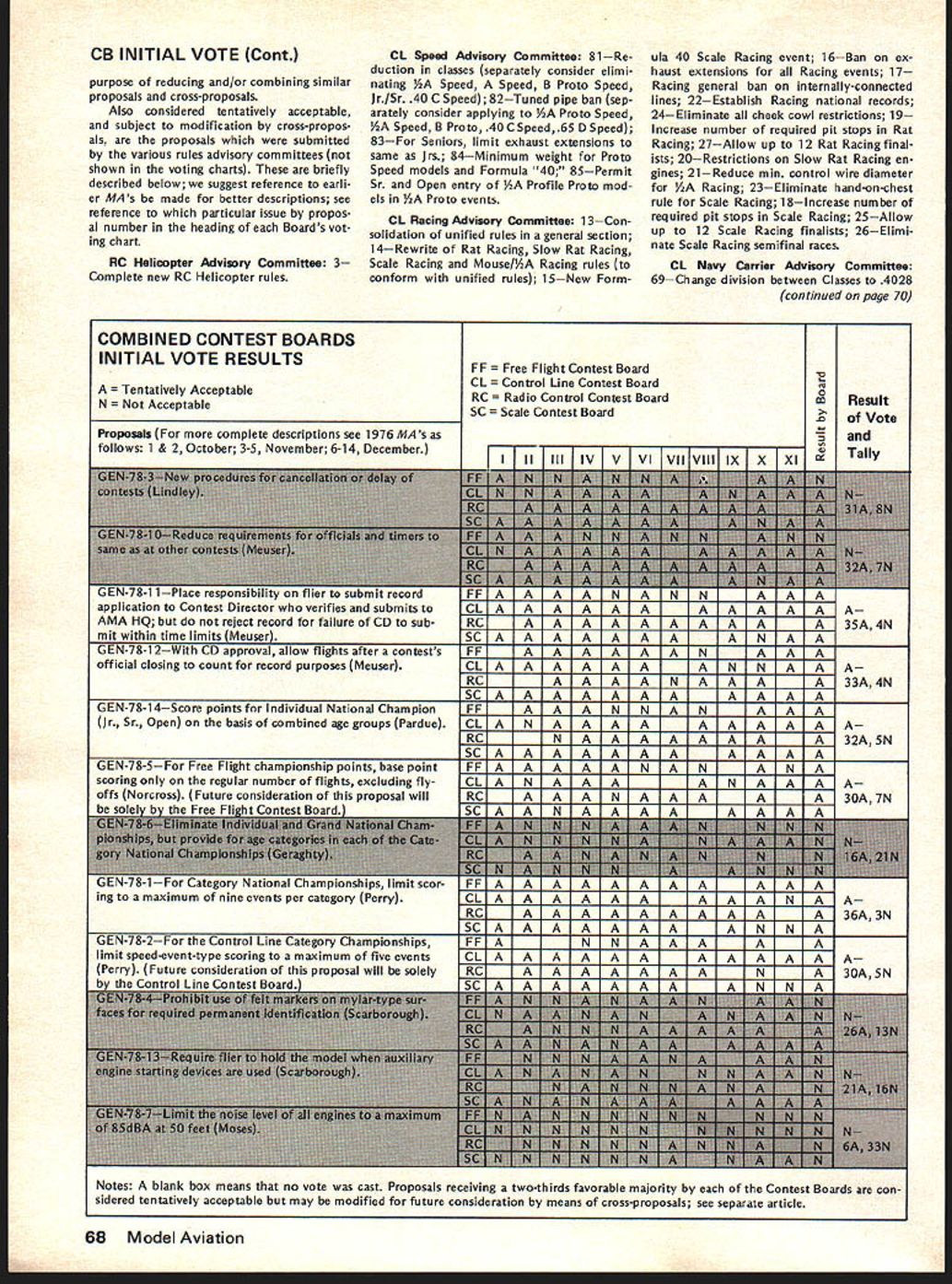
COMBINED CONTEST BOARDS INITIAL VOTE RESULTS
A = Tentatively Acceptable N = Not Acceptable
Proposals (For more complete descriptions see 1976 MA's as follows: 1 & 2, October; 3-5, November; 6-14, December.)
FF = Free Flight Contest Board CL = Control Line Contest Board RC = Radio Control Contest Board SC = Scale Contest Board
GEN-78-3 — New procedures for cancellation or delay of contests (Lindley). Result of Vote and Tally: 31A, 8N
GEN-78-10 — Reduce requirements for officials and timers to same as at other contests (Meuser). Result of Vote and Tally: 32A, 7N
GEN-78-11 — Place responsibility on flier to submit record application to Contest Director who verifies and submits to AMA HQ; but do not reject record for failure of CD to submit within time limits (Meuser). Result of Vote and Tally: A — 35A, 4N
GEN-78-12 — With CD approval, allow flights after a contest's official closing to count for record purposes (Meuser). Result of Vote and Tally: A — 33A, 4N
GEN-78-14 — Score points for Individual National Champion (Jr., Sr., Open) on the basis of combined age groups (Pardue). Result of Vote and Tally: A — 32A, 5N
GEN-78-5 — For Free Flight championship points, base point scoring only on the regular number of flights, excluding fly-offs (Norcross). (Future consideration of this proposal will be solely by the Free Flight Contest Board.) Result of Vote and Tally: A — 30A, 7N
GEN-78-6 — Eliminate Individual and Grand National Championships, but provide for age categories in each of the Category National Championships (Geraghty). Result of Vote and Tally: N — 16A, 21N
GEN-78-1 — For Category National Championships, limit scoring to a maximum of nine events per category (Perry). Result of Vote and Tally: A — 36A, 3N
GEN-78-2 — For the Control Line Category Championships, limit speed-event-type scoring to a maximum of five events (Perry). (Future consideration of this proposal will be solely by the Control Line Contest Board.) Result of Vote and Tally: A — 30A, 5N
GEN-78-4 — Prohibit use of felt markers on mylar-type surfaces for required permanent identification (Scarborough). Result of Vote and Tally: N — 26A, 13N
GEN-78-13 — Require flier to hold the model when auxiliary engine starting devices are used (Scarborough). Result of Vote and Tally: N — 21A, 16N
GEN-78-7 — Limit the noise level of all engines to a maximum of 85dBA at 50 feet (Moses). Result of Vote and Tally: N — 6A, 33N
Notes: A blank box means that no vote was cast. Proposals receiving a two-thirds favorable majority by each of the Contest Boards are considered tentatively acceptable but may be modified for future consideration by means of cross-proposals; see separate article.
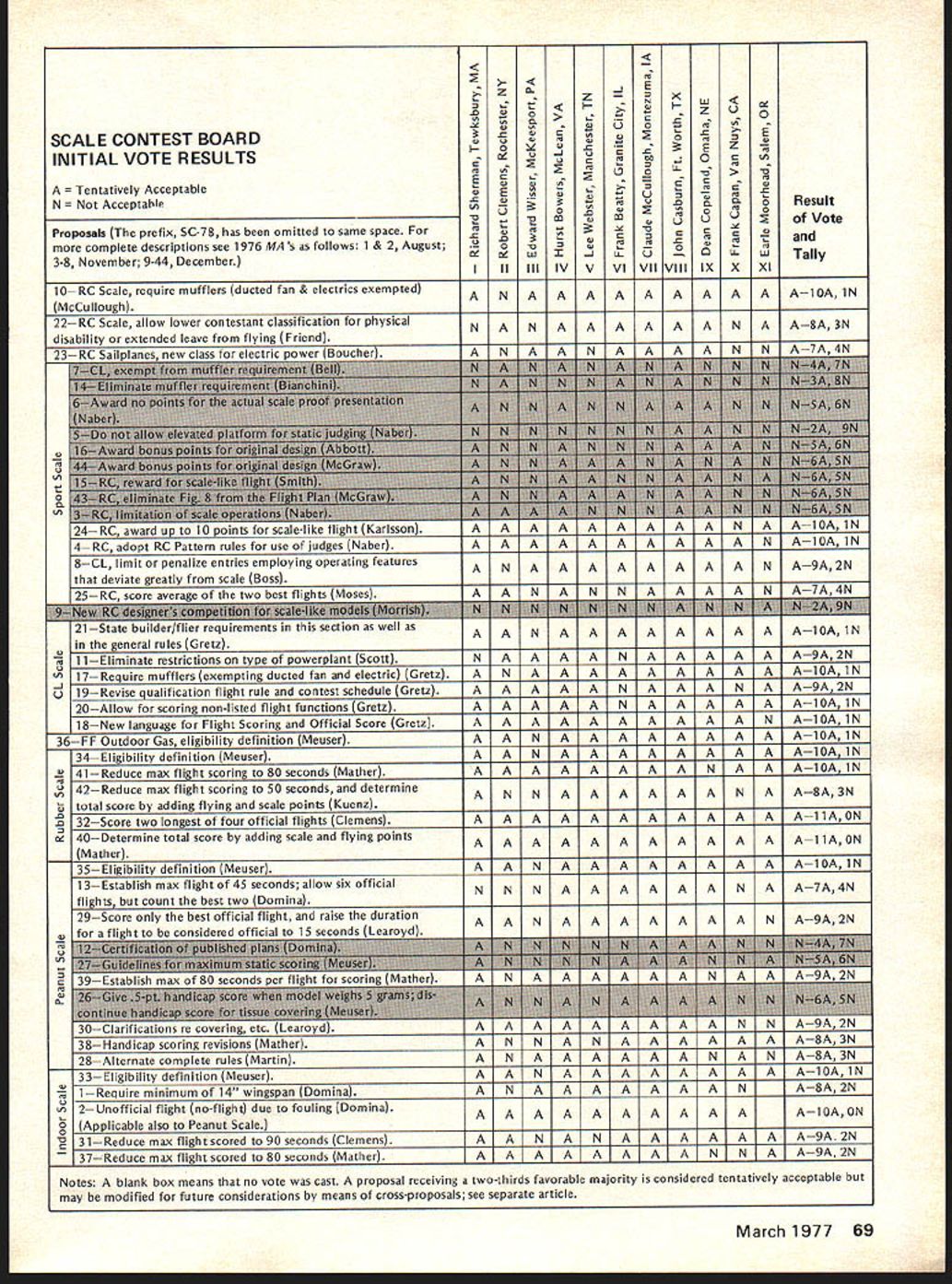
SCALE CONTEST BOARD INITIAL VOTE RESULTS
A = Tentatively Acceptable N = Not Acceptable
Proposals (The prefix, SC-78, has been omitted to save space. For more complete descriptions see 1976 M*A's as follows: 1 & 2, August; 3-8, November; 9-44, December.)
Sport Scale 10 — RC Scale, require mufflers (ducted fan & electrics exempted) (McCullough). Result of Vote and Tally: A — 10A, 1N
22 — RC Scale, allow lower contestant classification for physical disability or extended leave from flying (Friend). Result of Vote and Tally: A — 8A, 3N
23 — RC Sailplanes, new class for electric power (Boucher). Result of Vote and Tally: N — 7A, 4N
7 — CL, exempt from muffler requirement (Bell). Result of Vote and Tally: N — 4A, 7N
14 — Eliminate muffler requirement (Bianchini). Result of Vote and Tally: N — 3A, 8N
6 — Award no points for the actual scale proof presentation (Naber). Result of Vote and Tally: N — 5A, 6N
5 — Do not allow elevated platform for static judging (Naber). Result of Vote and Tally: N — 2A, 9N
16 — Award bonus points for original design (Abbott). Result of Vote and Tally: A — 5A, 6N
44 — Award bonus points for original design (McGraw). Result of Vote and Tally: N — 6A, 5N
15 — RC, reward for scale-like flight (Smith). Result of Vote and Tally: N — 6A, 5N
43 — RC, eliminate Fig. 8 from the Flight Plan (McGraw). Result of Vote and Tally: N — 6A, 5N
3 — RC, limitation of scale operations (Naber). Result of Vote and Tally: N — 6A, 5N
24 — RC, award up to 10 points for scale-like flight (Karlsson). Result of Vote and Tally: A — 10A, 1N
4 — RC, adopt RC Pattern rules for use of judges (Naber). Result of Vote and Tally: A — 10A, 1N
8 — CL, limit or penalize entries employing operating features that deviate greatly from scale (Boss). Result of Vote and Tally: A — 9A, 2N
25 — RC, score average of the two best flights (Moses). Result of Vote and Tally: A — 7A, 4N
9 — New RC designer's competition for scale-like models (Morrish). Result of Vote and Tally: N — 2A, 9N
21 — State builder/flier requirements in this section as well as in the general rules (Gretz). Result of Vote and Tally: A — 10A, 1N
CL Scale 11 — Eliminate restrictions on type of powerplant (Scott). Result of Vote and Tally: A — 9A, 2N
17 — Require mufflers (exempting ducted fan and electric) (Gretz). Result of Vote and Tally: A — 10A, 1N
19 — Revise qualification flight rule and contest schedule (Gretz). Result of Vote and Tally: A — 9A, 2N
20 — Allow for scoring non-listed flight functions (Gretz). Result of Vote and Tally: A — 10A, 1N
18 — New language for Flight Scoring and Official Score (Gretz). Result of Vote and Tally: A — 10A, 1N
36 — FF Outdoor Gas, eligibility definition (Meuser). Result of Vote and Tally: A — 10A, 1N
Rubber Scale 34 — Eligibility definition (Meuser). Result of Vote and Tally: A — 10A, 1N
41 — Reduce max flight scoring to 80 seconds (Mather). Result of Vote and Tally: A — 8A, 3N
42 — Reduce max flight scoring to 50 seconds, and determine total score by adding flying and scale points (Kucenz). Result of Vote and Tally: A — 8A, 3N
32 — Score two longest of four official flights (Clemens). Result of Vote and Tally: A — 11A, 0N
40 — Determine total score by adding scale and flying points (Mather). Result of Vote and Tally: A — 11A, 0N
35 — Eligibility definition (Meuser). Result of Vote and Tally: A — 10A, 1N
15 — Establish max flight of 45 seconds; allow six official flights, but count the best two (Domina). Result of Vote and Tally: N — 7A, 4N
29 — Score only the best official flight, and raise the duration for a flight to be considered official to 15 seconds (Laroyd). Result of Vote and Tally: A — 9A, 2N
12 — Certification of published plans (Domina). Result of Vote and Tally: N — 4A, 7N
27 — Guidelines for maximum static scoring (Meuser). Result of Vote and Tally: A — 9A, 2N
39 — Establish max of 80 seconds per flight for scoring (Mather). Result of Vote and Tally: A — 9A, 2N
26 — Give .5-pt. handicap score when model weighs 5 grams; discontinue handicap score for tissue covering (Meuser). Result of Vote and Tally: N — 6A, 5N
30 — Clarifications re covering, etc. (Laroyd). Result of Vote and Tally: A — 9A, 2N
38 — Handicap scoring revisions (Mather). Result of Vote and Tally: A — 8A, 3N
28 — Alternate complete rules (Martin). Result of Vote and Tally: A — 8A, 3N
33 — Eligibility definition (Meuser). Result of Vote and Tally: A — 8A, 2N
Indoor Scale 2 — Require minimum of 14" wingspan (Domina). Result of Vote and Tally: A — 10A, 1N
1 — Unofficial flight (no-flight) due to fouling (Domina). Result of Vote and Tally: A — 10A, 0N (Applicable also to Peanut Scale.)
31 — Reduce max flight scored to 90 seconds (Clemens). Result of Vote and Tally: A — 9A, 2N
37 — Reduce max flight scored to 80 seconds (Mather). Result of Vote and Tally: A — 9A, 2N
Notes: A blank box means that no vote was cast. A proposal receiving a two-thirds favorable majority is considered tentatively acceptable but may be modified for future considerations by means of cross-proposals; see separate article.
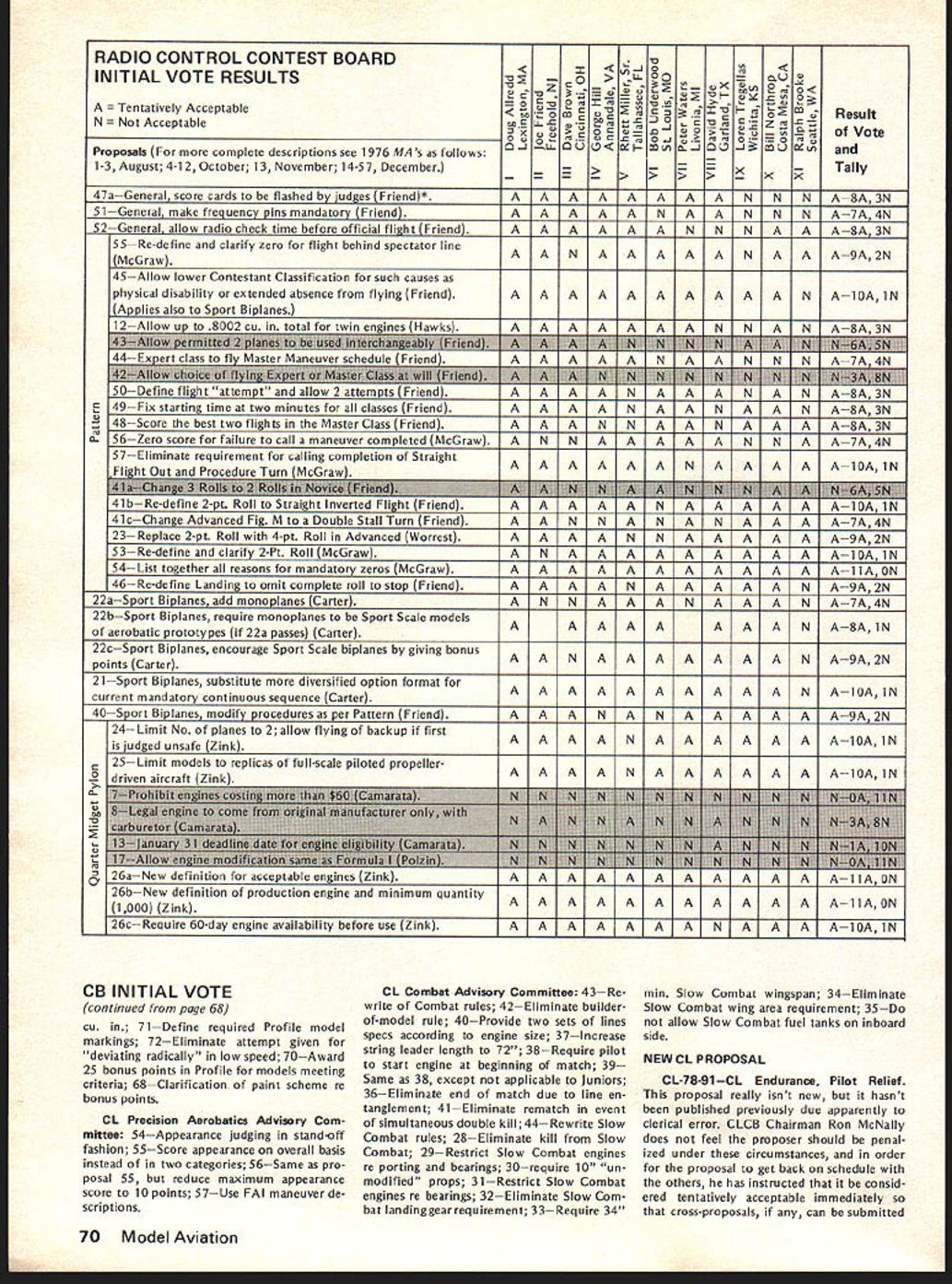
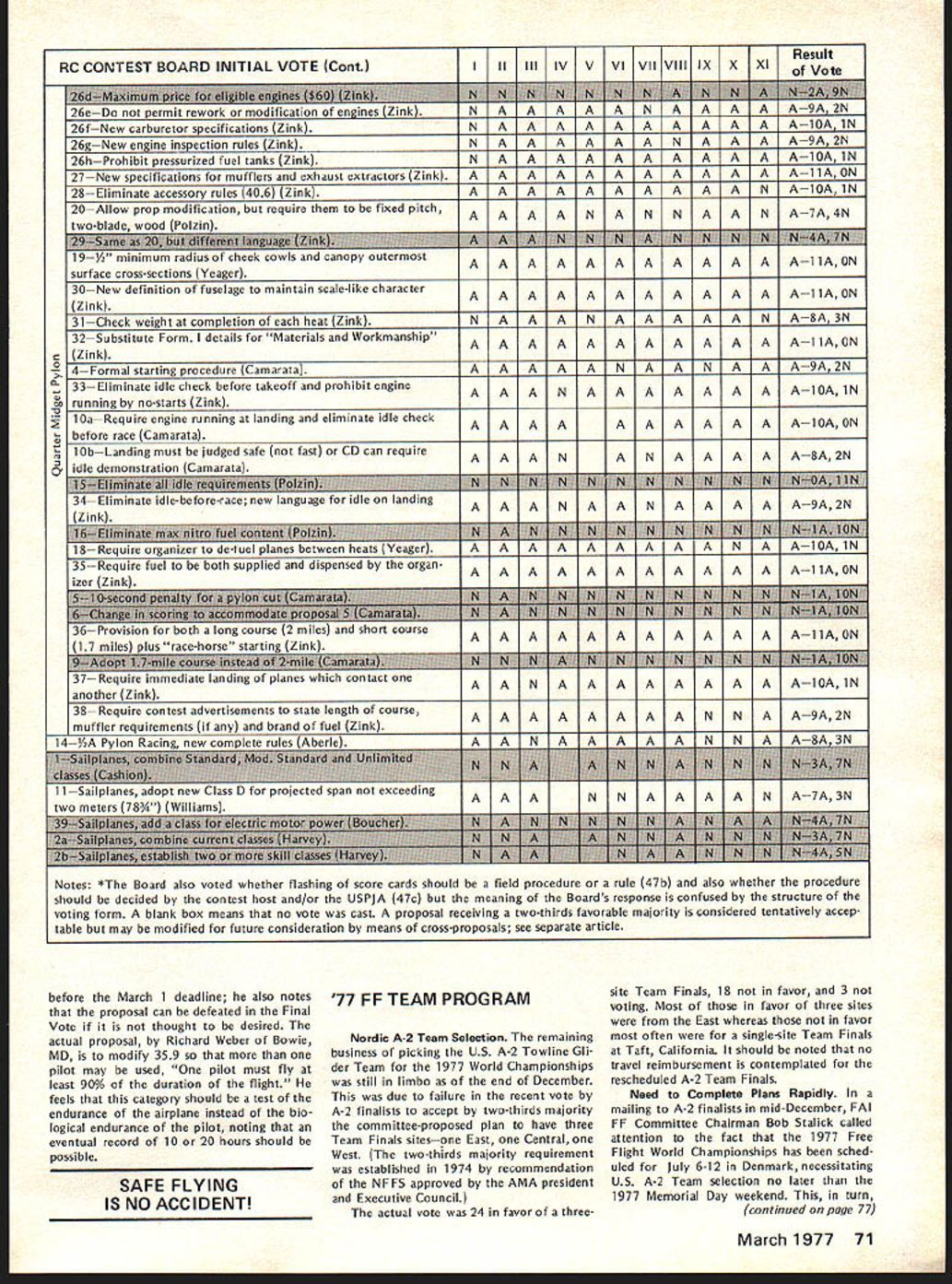
RADIO CONTROL CONTEST BOARD
INITIAL VOTE RESULTS
A = Tentatively Acceptable N = Not Acceptable
Proposals (For more complete descriptions see 1976 MA's as follows: 1-3, August; 4-12, October; 13, November; 14-57, December.)
- 47a — General, score cards to be flashed by judges (Friend). Result of Vote and Tally: A — 8A, 3N
- 51 — General, make frequency pins mandatory (Friend). Result of Vote and Tally: A — 7A, 4N
- 52 — General, allow radio check time before official flight (Friend). Result of Vote and Tally: A — 8A, 3N
- 55 — Re-define and clarify zero for flight behind spectator line (McGraw). Result of Vote and Tally: A — 9A, 2N
- 45 — Allow lower Contestant Classification for such causes as physical disability or extended absence from flying (Friend). (Applies also to Sport Biplanes.) Result of Vote and Tally: A — 10A, 1N
- 12 — Allow up to .8002 cu. in. total for twin engines (Hawks). Result of Vote and Tally: A — 8A, 3N
- 43 — Allow permitted 2 planes to be used interchangeably (Friend). Result of Vote and Tally: N — 6A, 5N
- 44 — Expert class to fly Master Maneuver schedule (Friend). Result of Vote and Tally: N — 7A, 4N
- 42 — Allow choice of flying Expert or Master Class at will (Friend). Result of Vote and Tally: N — 3A, 8N
- 50 — Define flight "attempt" and allow 2 attempts (Friend). Result of Vote and Tally: A — 8A, 3N
- 49 — Fix starting time at two minutes for all classes (Friend). Result of Vote and Tally: A — 8A, 3N
- 48 — Score the best two flights in the Master Class (Friend). Result of Vote and Tally: A — 8A, 3N
- 56 — Zero score for failure to call a maneuver completed (McGraw). Result of Vote and Tally: A — 7A, 4N
- 57 — Eliminate requirement for calling completion of Straight Flight Out and Procedure Turn (McGraw). Result of Vote and Tally: A — 10A, 1N
- 41a — Change 3 Rolls to 2 Rolls in Novice (Friend). Result of Vote and Tally: N — 6A, 5N
- 41b — Re-define 2-pt. Roll to Straight Inverted Flight (Friend). Result of Vote and Tally: A — 10A, 1N
- 41c — Change Advanced Fig. M to a Double Stall Turn (Friend). Result of Vote and Tally: A — 7A, 4N
- 23 — Replace 2-pt. Roll with 4-pt. Roll in Advanced (Worrest). Result of Vote and Tally: A — 9A, 2N
- 53 — Re-define and clarify 2-Pt. Roll (McGraw). Result of Vote and Tally: A — 10A, 1N
- 54 — List together all reasons for mandatory zeros (McGraw). Result of Vote and Tally: A — 11A, 0N
- 46 — Re-define Landing to omit complete roll to stop (Friend). Result of Vote and Tally: A — 9A, 2N
- 22a — Sport Biplanes, add monoplanes (Carter). Result of Vote and Tally: A — 7A, 4N
- 22b — Sport Biplanes, require monoplanes to be Sport Scale models of aerobatic prototypes (if 22a passes) (Carter). Result of Vote and Tally: A — 8A, 1N
- 22c — Sport Biplanes, encourage Sport Scale biplanes by giving bonus points (Carter). Result of Vote and Tally: A — 9A, 2N
- 21 — Sport Biplanes, substitute more diversified option format for current mandatory continuous sequence (Carter). Result of Vote and Tally: A — 10A, 1N
- 40 — Sport Biplanes, modify procedures as per Pattern (Friend). Result of Vote and Tally: A — 9A, 2N
- 24 — Limit No. of planes to 2; allow flying of backup if first is judged unsafe (Zink). Result of Vote and Tally: A — 10A, 1N
- 25 — Limit models to replicas of full-scale piloted propeller-driven aircraft (Zink). Result of Vote and Tally: A — 10A, 1N
- 7 — Prohibit engines costing more than $60 (Camarata). Result of Vote and Tally: N — 0A, 11N
- 8 — Legal engine to come from original manufacturer only, with carburetor (Camarata). Result of Vote and Tally: N — 3A, 8N
- 13 — January 31 deadline date for engine eligibility (Camarata). Result of Vote and Tally: N — 1A, 10N
- 17 — Allow engine modification same as Formula I (Polzin). Result of Vote and Tally: N — 0A, 11N
- 26a — New definition for acceptable engines (Zink). Result of Vote and Tally: A — 11A, 0N
- 26b — New definition of production engine and minimum quantity (1,000) (Zink). Result of Vote and Tally: A — 11A, 0N
- 26c — Require 60-day engine availability before use (Zink). Result of Vote and Tally: A — 10A, 1N
CB INITIAL VOTE (continued from page 68)
- 71 — Define required Profile model markings; 72 — Eliminate attempt given for "deviating radically" in low speed; 70 — Award 25 bonus points in Profile for models meeting criteria; 68 — Clarification of paint scheme or bonus points.
CL Precision Aerobatics Advisory Committee:
- 54 — Appearance judging in stand-off fashion;
- 55 — Score appearance on overall basis instead of in two categories;
- 56 — Same as proposal 55, but reduce maximum appearance score to 10 points;
- 57 — Use FAI maneuver descriptions.
CL Combat Advisory Committee:
- 43 — Rewrite of Combat rules;
- 42 — Eliminate builder-of-model rule;
- 40 — Provide two sets of lines specs according to engine size;
- 37 — Increase string leader length to 72";
- 38 — Require pilot to start engine at beginning of match;
- 39 — Same as 38, except not applicable to Juniors;
- 36 — Eliminate end of match due to line entanglement;
- 41 — Eliminate rematch in event of simultaneous double kill;
- 44 — Rewrite Slow Combat rules;
- 28 — Eliminate kill from Slow Combat scoring;
- 29 — Restrict Slow Combat engines re porting and bearings;
- 30 — Require 10" unmodified props;
- 31 — Restrict Slow Combat engines re bearings;
- 32 — Eliminate Slow Combat landing gear requirement;
- 33 — Require 34" minimum Slow Combat wingspan;
- 34 — Eliminate Slow Combat wing area requirement;
- 35 — Do not allow Slow Combat fuel tanks on inboard side.
NEW CL PROPOSAL CL-78-91 — CL Endurance, Pilot Relief. This proposal really isn't new, but it hasn't been published previously due apparently to clerical error. CL/CB Chairman Ron McNally does not feel the proposer should be penalized under these circumstances, and in order for the proposal to get back on schedule with the others, he has instructed that it be considered tentatively acceptable immediately so that cross-proposals, if any, can be submitted. before the March 1 deadline; he also notes that the proposal can be defeated in the Final Vote if it is not thought to be desired. The actual proposal, by Richard Weber of Bowie, MD, is to modify 35.9 so that more than one pilot may be used. "One pilot must fly at least 90% of the duration of the flight." He feels that this category should be a test of the endurance of the airplane instead of the biological endurance of the pilot, noting that an eventual record of 10 or 20 hours should be possible.
'77 FF TEAM PROGRAM
Nordic A-2 Team Selection. The remaining business of picking the U.S. A-2 Towline Glider Team for the 1977 World Championships was still in limbo as of the end of December. This was due to failure in the recent vote by A-2 finalists to accept by two-thirds majority the committee-proposed plan to have three Team Finals sites—one East, one Central, one West. (The two-thirds majority requirement was established in 1974 by recommendation of the NFFS and approved by the AMA president and Executive Council.)
The actual vote was 24 in favor of a three-site Team Finals, 18 not in favor, and 3 not voting. Most of those in favor of three sites were from the East whereas those not in favor most often were for a single-site Team Finals at Taft, California. It should be noted that no travel reimbursement is contemplated for the rescheduled A-2 Team Finals.
Need to Complete Plans Rapidly. In a mailing to A-2 finalists in mid-December, FAI FF Committee Chairman Bob Stalick called attention to the fact that the 1977 Free Flight World Championships have been scheduled for July 6-12 in Denmark, necessitating U.S. A-2 Team selection no later than the 1977 Memorial Day weekend. This, in turn,
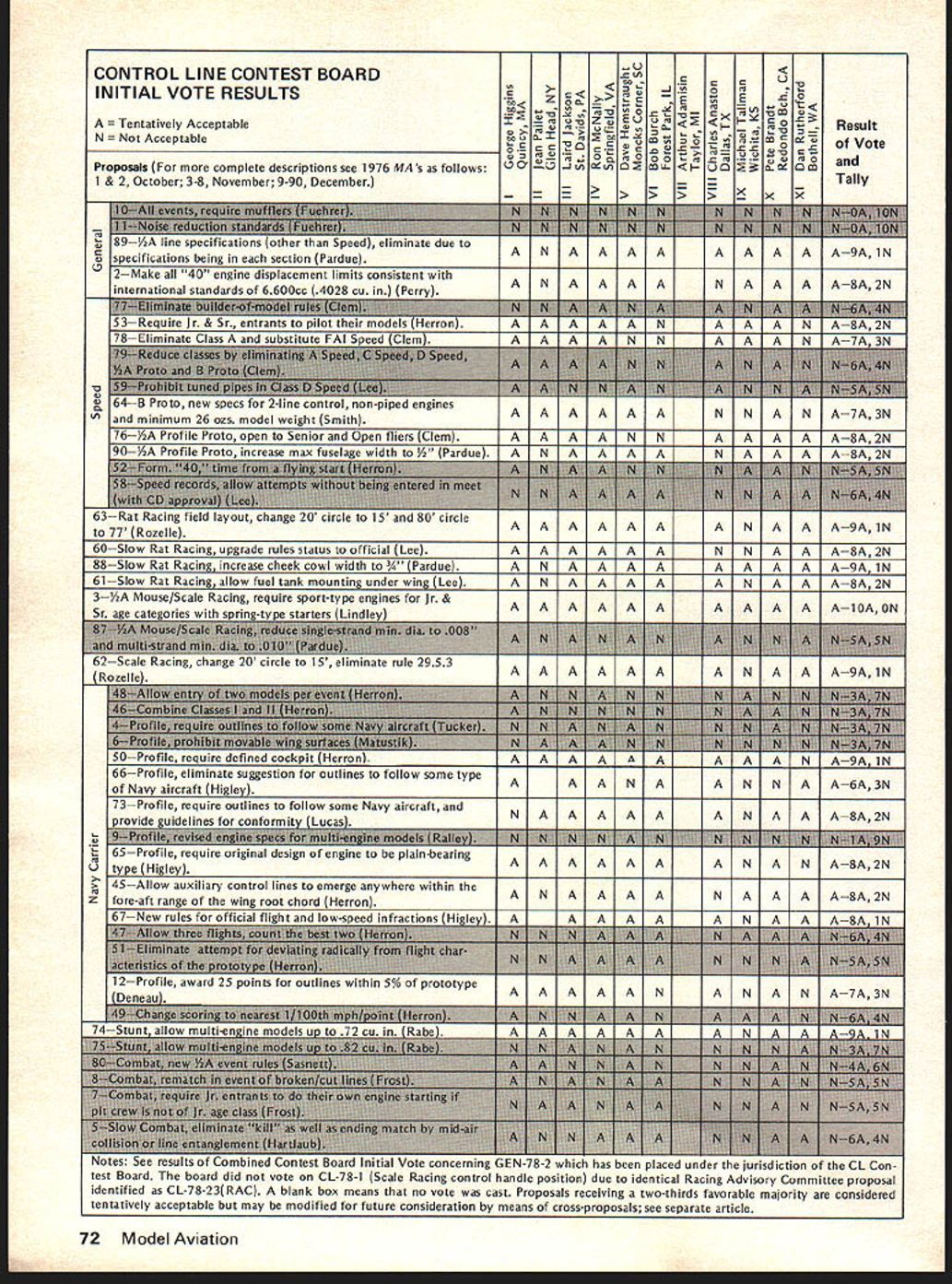
CONTROL LINE CONTEST BOARD INITIAL VOTE RESULTS
A = Tentatively Acceptable N = Not Acceptable
Proposals (For more complete descriptions see 1976 MA's as follows: 1 & 2, October; 3-8, November; 9-90, December.)
10 — All events, require mufflers (Fuehrer). N — 0A, 10N 11 — Noise reduction standards (Fuehrer). N — 0A, 10N 89 — ½A line specifications (other than Speed), eliminate due to specifications being in each section (Pardue). A — 9A, 1N 2 — Make all "40" engine displacement limits consistent with international standards of 6.500 cc (.4028 cu. in.) (Perry). A — 8A, 2N 77 — Eliminate builder-of-model rules (Clem). N — 6A, 4N 53 — Require Jr. & Sr. entrants to pilot their models (Herron). A — 8A, 2N 78 — Eliminate Class A and substitute FAI Speed (Clem). A — 7A, 3N 79 — Reduce classes by eliminating A Speed, C Speed, D Speed, ½A Proto and B Proto (Clem). N — 6A, 4N 59 — Prohibit tuned pipes in Class D Speed (Lee). N — 5A, 5N 64 — B Proto, new specs for 2-line control, non-piped engines and minimum 26 oz. model weight (Smith). A — 7A, 3N 76 — ½A Profile Proto, open to Senior and Open fliers (Clem). A — 8A, 2N 90 — ½A Profile Proto, increase max fuselage width to ½" (Pardue). A — 8A, 2N 52 — Form, "40", time from a flying start (Herron). N — 5A, 5N 58 — Speed records, allow attempts without being entered in meet (with CD approval) (Lee). N — 6A, 4N
63 — Rat Racing field layout, change 20' circle to 15' and 80' circle to 77' (Rozelle). A — 9A, 1N 60 — Slow Rat Racing, upgrade rules status to official (Lee). A — 8A, 2N 88 — Slow Rat Racing, increase check cowl width to ¾" (Pardue). A — 9A, 1N 61 — Slow Rat Racing, allow fuel tank mounting under wing (Lee). A — 8A, 2N 3 — ½A Mouse/Scale Racing, require sport-type engines for Jr. & Sr. age categories with spring-type starters (Lindley). A — 10A, 0N 87 — ½A Mouse/Scale Racing, reduce single-strand min. dia. to .008" and multi-strand min. dia. to .010" (Pardue). N — 5A, 5N 62 — Scale Racing, change 20' circle to 15', eliminate rule 29.5.3 (Rozelle). A — 9A, 1N
48 — Allow entry of two models per event (Herron). N — 3A, 7N 46 — Combine Classes I and II (Herron). N — 3A, 7N 4 — Profile, require outlines to follow some Navy aircraft (Tucker). N — 3A, 7N 6 — Profile, prohibit movable wing surfaces (Mastutik). N — 3A, 7N 50 — Profile, require defined cockpit (Herron). A — 9A, 1N 66 — Profile, eliminate suggestion for outlines to follow some type of Navy aircraft (Higley). A — 6A, 3N 73 — Profile, require outlines to follow some Navy aircraft, and provide guidelines for conformity (Lucas). A — 8A, 2N 9 — Profile, revised engine specs for multi-engine models (Ralley). N — 1A, 9N 65 — Profile, require original design of engine to be plain-bearing type (Higley). A — 8A, 2N 45 — Allow auxiliary control lines to emerge anywhere within the fore-aft range of the wing root chord (Herron). A — 8A, 2N 67 — New rules for official flight and low-speed infractions (Higley). A — 8A, 1N 47 — Allow three flights, count the best two (Herron). N — 6A, 4N 51 — Eliminate attempt for deviating radically from flight characteristics of the prototype (Herron). N — 5A, 5N 12 — Profile, award 25 points for outlines within 5% of prototype (Deneau). A — 7A, 3N 49 — Change scoring to nearest 1/100th mph/point (Herron). N — 6A, 4N
74 — Stunt, allow multi-engine models up to .72 cu. in. (Rabe). A — 9A, 1N 75 — Stunt, allow multi-engine models up to .82 cu. in. (Rabe). N — 3A, 7N 80 — Combat, new ½A event rules (Sassnet). N — 4A, 6N 8 — Combat, rematch in event of broken/cut lines (Frost). N — 5A, 5N 7 — Combat, require Jr. entrants to do their own engine starting if pit crew is not of Jr. age class (Frost). N — 5A, 5N 5 — Slow Combat, eliminate "kill" as well as ending match by mid-air collision or line entanglement (Hartlaub). N — 6A, 4N
Notes: See results of Combined Contest Board Initial Vote concerning GEN-78-2 which has been placed under the jurisdiction of the CL Contest Board. The board did not vote on CL-78-1 (Scale Racing control handle position) due to identical Racing Advisory Committee proposal identified as CL-78-23 (RAC). A blank box means that no vote was cast. Proposals receiving a two-thirds favorable majority are considered tentatively acceptable but may be modified for future consideration by means of cross-proposals; see separate article.
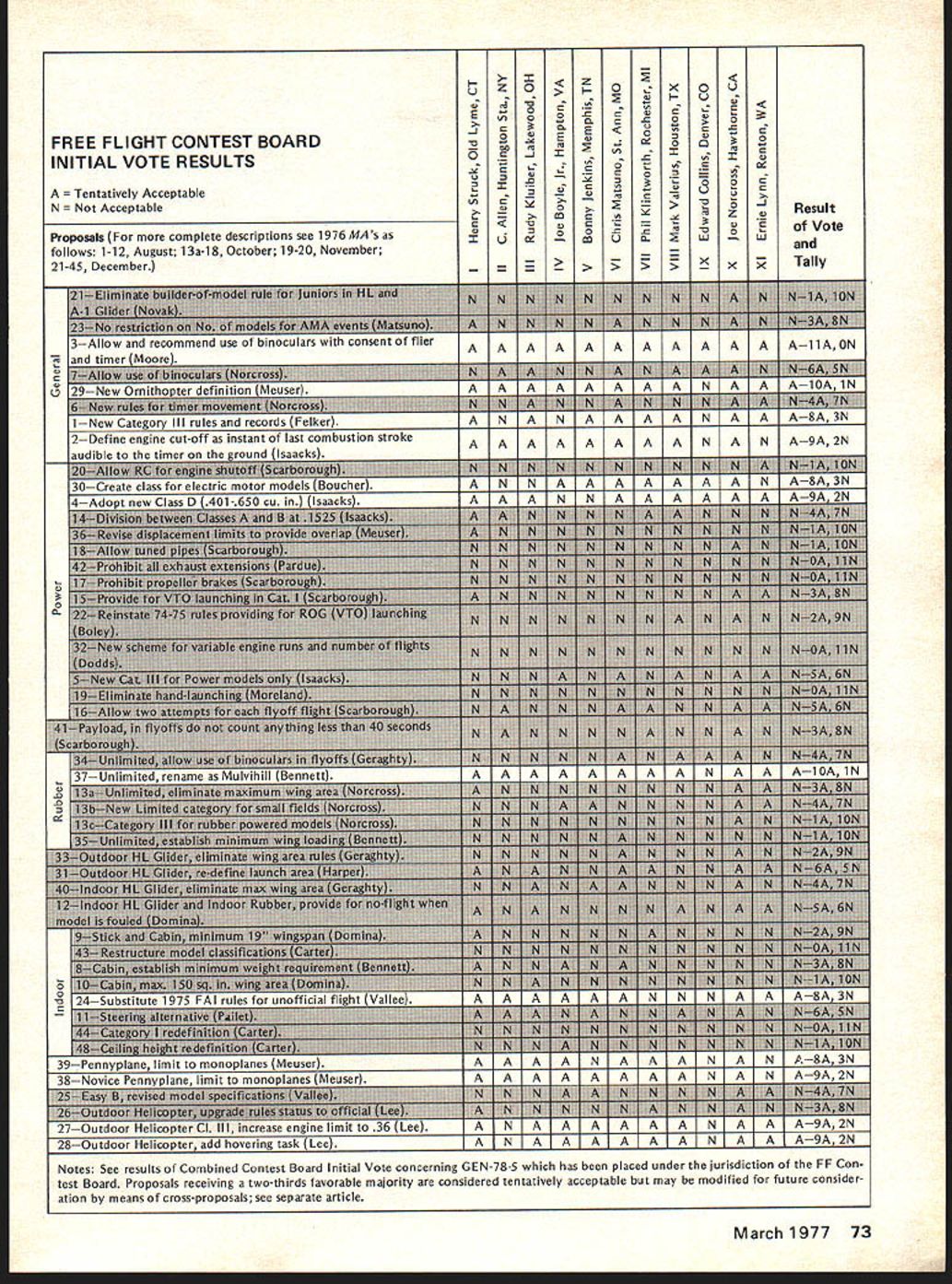
FREE FLIGHT CONTEST BOARD
INITIAL VOTE RESULTS
A = Tentatively Acceptable N = Not Acceptable
Proposals (For more complete descriptions see 1976 MA's as follows: 1-12, August; 13a-18, October; 19-20, November; 21-45, December.)
Notes: See results of Combined Contest Board Initial Vote concerning GEN-78-5 which has been placed under the jurisdiction of the FF Contest Board. Proposals receiving a two-thirds favorable majority are considered tentatively acceptable but may be modified for future consideration by means of cross-proposals; see separate article.
Competition Newsletter
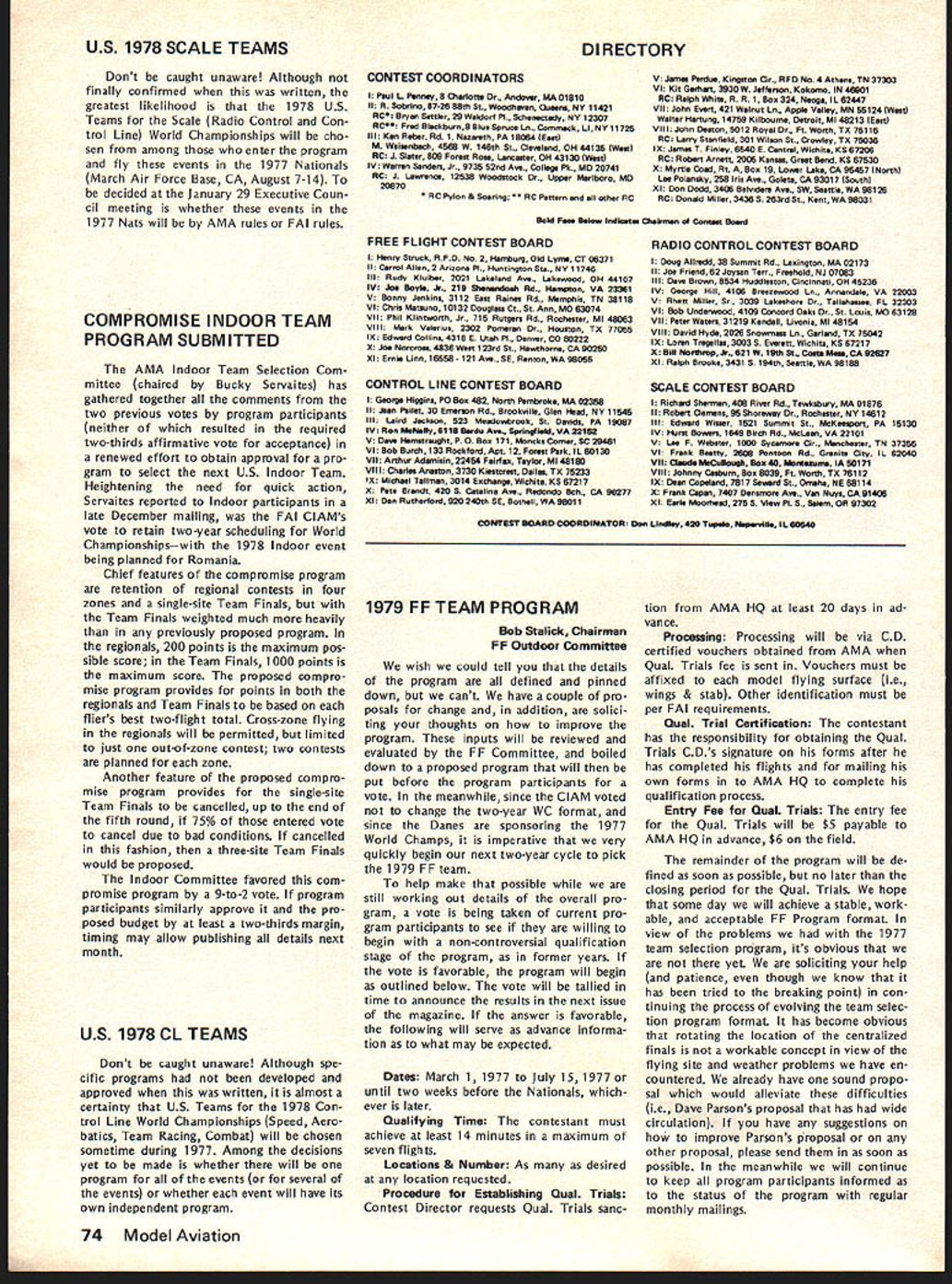
U.S. 1978 SCALE TEAMS
Don't be caught unaware! Although not finally confirmed when this was written, the greatest likelihood is that the 1978 U.S. Teams for the Scale (Radio Control and Control Line) World Championships will be chosen from among those who enter the program and fly at these events in the 1977 Nationals (March Air Force Base, CA, August 7-14). To be decided at the January 29 Executive Council meeting is whether these events in the 1977 Nats will be by AMA rules or FAI rules.
COMPROMISE INDOOR TEAM PROGRAM COMMITTED
The AMA Indoor Team Selection Committee (chaired by Bucky Servaites) has gathered together all the comments from the two previous votes by program participants (neither of which resulted in the required two-thirds affirmative vote for acceptance) in a renewed effort to obtain approval for a program to select the next U.S. Indoor Team. Heightening the need for quick action, Servaites reported to Indoor participants in a late December mailing, was the FAI CIAM's vote to retain two-year scheduling for World Championships—with the 1978 Indoor event being planned for Romania.
Chief features of the compromise program are retention of regional contests in four zones and a single-site Team Finals, but with the Team Finals weighted much more heavily than in any previously proposed program. In the regionals, 200 points is the maximum possible score; in the Team Finals, 1,000 points is the maximum score. The proposed compromise program provides for points in both the regionals and Team Finals to be based on each flier's best two-flight total. Cross-zone flying in the regionals will be permitted, but limited to just one out-of-zone contest; two contests are planned for each zone.
Another feature of the proposed compromise program provides for the single-site Team Finals to be cancelled, up to the end of the fifth round, if 75% of those entered vote to cancel due to bad conditions. If cancelled in this fashion, then a three-site Team Finals would be proposed.
The Indoor Committee favored this compromise program by a 9-to-2 vote. If program participants similarly approve it and the proposed budget by at least a two-thirds margin, timing may allow publishing all details next month.
U.S. 1978 CL TEAMS
Don't be caught unaware! Although specific programs had not been developed and approved when this was written, it is almost a certainty that U.S. Teams for the 1978 Control Line World Championships (Speed, Aerobatics, Team Racing, Combat) will be chosen sometime during 1977. Among the decisions yet to be made is whether there will be one program for all of the events (or for several of the events) or whether each event will have its own independent program.
FAI MEETING (continued from page 67)
e. .09 Engine Class. A Netherlands proposal regarding replacement of the current .15 size class was not accepted, but was referred to the CL Subcommittee for study as a possible future class.
f. Starting Points. A Swedish proposal to give semi-finalists a choice of starting positions, in order of fastest times, was accepted.
g. Passing Procedure. A combination of Netherlands, Russian, and British proposals were accepted: "Pilots must keep their controlling hand and the model on a plane perpendicular to a line joining their shoulders and passing through the center line of the body; pilots must also keep their controlling hand on the vertical line between the middle of the chest and the top of the forehead, except when overtaking, taking off, and landing when an exception of three laps is allowed."
A team shall be warned when its flying style does not conform to the above. Other details regarding passing procedures and possible team elimination for abuse were referred to the CL Subcommittee for further study.
Note: It was also agreed to accept a Netherlands proposal to form an ad hoc committee, to be named by the CL Subcommittee, for the writing of a Team Race Jury Guide—to help establish standards for jury decisions in this event.
- SPEED
a. Safety Strap. This is now required as a result of acceptance of a British proposal. 40G load testing will now be required to include separate testing of the system, with strap, when attached to the competitor's wrist. A specific load procedure is also defined: "... the pull shall be applied three (3) times, slowly increasing to maximum load and releasing rapidly." Also the load test on the handle will now be made on the handle grip rather than at the point of attachment of the lines; Netherlands proposal.
- AEROBATICS
U.S. Proposals. Standardized location of numbers, increased total engine displacement for multi-engines, and elimination of hand signals, were not accepted. It appears obvious that successful procedures of U.S. flying need a better selling job to produce acceptance in FAI competition.
- COMBAT
a. Grass Circles. A Finnish proposal to specify grass as the only acceptable site surface was unanimously adopted.
b. Silencers. As per the team race proposal, this similar Belgian proposal was referred to the CL Subcommittee.
c. Streamer. The U.S. proposal to clarify the streamer definition so that the string is considered part of it was accepted. This is significant because a cut on the string is a cut on the streamer.
d. Cut. The U.S. proposal was accepted as follows; to replace the previous rule 4.4.1.1.d.: "A cut must contain at least one part of the paper streamer. A cut that contains string alone will not count." Note: a Belgian proposal of similar nature was superseded by the above.
e. Model Withdrawal. As a result of acceptance of this U.S. proposal the following now replaces rule 4.4.12.c.: "If a model lands the mechanic must immediately, or immediately after a line detanglement, withdraw the model to the edge of the 19 meter flight circle before servicing the model. Should the mechanic neglect doing this the competitor shall be penalized 50 points each time."
f. Level Flight. This U.S. proposal was accepted, to replace rule 4.4.12.1: "At any time during which only one model is airborne and there is no line entanglement, that model must maintain level flight at a safe altitude in an anti-clockwise direction."
g. Circle Entry. This U.S. proposal was accepted to add a new rule 4.4.12.j: "Me-
FAI MEETING (CONT.)
chanics may not under any circumstances enter the flying circle at an oblique angle, or cut across the circle to reach a downed model. The flying circle may only be entered from the point on the circle closest to the model. Should the mechanic neglect this, the competitor shall be penalized 50 points for each infraction of this rule. The model may not be serviced unless section 12c requirements are satisfied.
h. Attempts. This U.S. proposal was accepted as applicable immediately from a safety standpoint, as originally proposed at the December 1975 CIAM meeting: "4.4.13.b. In the event of a model flyaway in which the airplane and streamer may not be retrievable due to distance flown, the affected pilot/pit crew may elect to use a new, full length streamer instead. The new streamer shall be immediately available from the circle marshall or judge."
Notes: All U.S. proposals listed above were accepted as immediately applicable for clarification or safety reasons. It was also agreed to accept a Netherlands proposal to form an ad hoc committee which is to be named by the CL Subcommittee to produce a rewritten set of Combat rules by 1978, to clear up discrepancies caused by piecemeal revision of many rules details over the past several years, with the goal of having a consistent set in time for the first Combat world championships.
RADIO CONTROL
1. GENERAL
a. Electric Power. A request for establishment of a separate subcommittee for such models was rejected. It was generally felt that this form of activity, though growing, is still too limited to justify special recognition. It was also noted that there is much feeling to the effect that a different form of power plant does not necessarily require its own competition rules. In the meantime, proposals regarding electric power models were referred to the RC Aerobatic Subcommittee for further study and recommendation.
b. Subcommittee Limit. It was unanimously approved that the sub-subcommittees within RC could have as many members as needed (five minimum), rather than be restricted as in the past.
2. AEROBATICS
a. Builder of the Model. A proposal by Germany to delete this requirement was not accepted.
b. Silencers. The proposal approved at the December 1975 CIAM meeting was recommended to the CASI (FAI's overall Sport Aviation Committee) for immediate implementation, rather than when the new FAI Sporting Code is published (1979). CASI consideration is expected in March 1977.
c. Monitoring. A Belgian proposal regarding monitoring responsibilities and flights affected by interference claims was referred to the subcommittee for further recommendation.
d. Dead Pass. The following subcommittee clarification was accepted for immediate application: "A pass will be made when the model flies over a line perpendicular to the center of the group of judges; the passes after Take-Off and before Approach are not mandatory; they may be made at the pilot's discretion."
e. Four- and Eight-Point Rolls. The following clarification was made to the reasons for downgrading these maneuvers: "Model does not maintain same heading and altitude during maneuver."
f. Provisional Rules. The subcommittee's proposal to change the final schedule maneuver total to 450 points was approved, as were several changes to maneuver descriptions and downgrade reasons. Basics of the FAI RC Aerobatics provisional rules were printed in the March 1975 Competition Newsletter.
3. PYLON RACING
All proposals were referred to the subcommittee for further study.
4. SOARING
a. Houlberg Rules. These rules, which had been in provisional status for many years, were ruled as obsolete and superseded by the current RC Soaring rules as per the FAI Sporting Code.
b. Telemetry. A Belgian proposal to delete the prohibition of devices which transmit information from the model to the pilot was referred to the subcommittee.
c. Attempts. The following Belgian proposal was accepted as a permitted reason for repeating an attempt: "If in the case of an unexpected event, duly witnessed by the official timekeepers or judges, the flight has been hindered or aborted."
d. 5.3.2.3.c. The following Belgian proposal was accepted: "A penalization of one point for each second flown in excess of the nine-minute period will be deducted from the flight time."
e. Belgian package proposal, effective 1979. 5.3.1.8j. Add: "For the distance task, the competitors must be arranged to fly in groups of at least three competitors (preferably more, up to six). A minimum number of groups, at the end of the list, should be so arranged that no single group counts less than two pilots.
5.3.2.4a). Replace with: From the order of the starter, each group is allocated an eight-minute period (nine minutes for motor gliders) to complete the flight, including the towing time.
5.3.2.4g). Add: "Inside each group having flown together, the pilot who flew the longest distance will be awarded a score of 1,000. All other scores inside the group are calculated according to 5.3.2.6(c)."
5.3.2.6). Add to the end of paragraph c), replace the words "distance covered by the winner of Task B" with "distance flown by the winner of the group in which the competitor flew during Task B."
5. RC HELICOPTER.
A complete package of provisional rules for this class was approved unanimously. Publication of these rules is planned for next month. Also approved was a new general definition of helicopters, applicable to Free Flight as well as RC:
"1.4.15. Helicopters, Free Flight or Radio Controlled: A helicopter is a heavier-than-air aeromodel which derives all of its lift and horizontal propulsion from a power-driven rotor system(s) rotating about a nominally vertical axis (or axes). Fixed horizontal supporting surfaces up to 4% of the swept area of the rotor(s) are permitted. A fixed or controllable horizontal stabilizer up to 2% of the swept area of the lifting rotor(s) is permitted. Ground effect machines (hovercraft), convertiplanes or aircraft which hover by means of propeller slipstream(s) deflected downward are not considered to be helicopters."
Specifications:
Area: Maximum swept area of the lifting rotor(s), counting only once any area of superimposition, 300 dm2, except for coaxial helicopters whose rotors are farther than one rotor radius apart, in which case the total area of both rotors is counted.
Weight: Maximum weight with fuel, 5 kg. For competition only, not for world record purposes, for a period of two years following provisional adoption of these rules the maximum weight without fuel may be 5 kg.
Piston Motor Displacement: Maximum 10 cm3.
Rubber Motor: No restrictions.
N.B.: Metal bladed rotors are forbidden.
SCALE
- MAXIMUM WEIGHT. U.S.A. and U.S.S.R. proposals to increase the maximum permissible weight were narrowly rejected.
- DUMMY PILOT. It was clarified that "the weight of the model with the dummy pilot added must not exceed 5.0 kg, without fuel."
- COMPLEXITY SCORING. A subcommittee proposal, to change the system of scoring for Fidelity to Scale, Craftsmanship and Complexity, was accepted as a recommendation for inclusion in the 1977 CIAM meeting agenda. It was not voted in at this meeting since the details had not been available in advance to all delegates. The proposal is included here, however, because it is significantly different from what is in the current sporting code and is possible to be accepted for the next world championships.
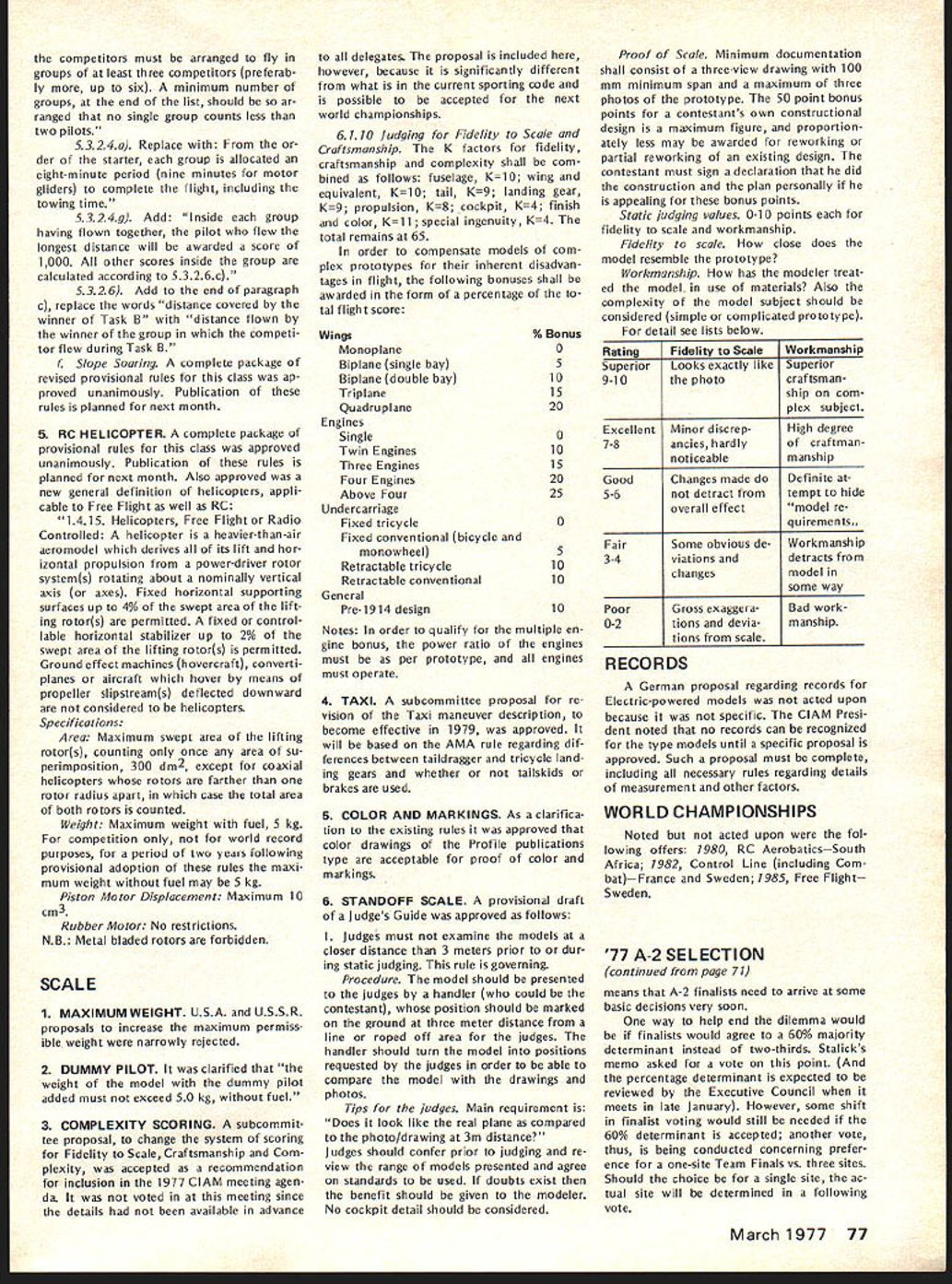
6.1.10 Judging for Fidelity to Scale and Craftsmanship. The K factors for fidelity, craftsmanship and complexity shall be combined as follows: fuselage, K=10; wing and equivalent, K=10; tail, K=9; landing gear, K=9; propulsion, K=8; cockpit, K=4; finish and color, K=11; special ingenuity, K=4. The total remains at 65.
In order to compensate models of complex prototypes for their inherent disadvantages in flight, the following bonuses shall be awarded in the form of a percentage of the total flight score:
Wings
- Monoplane 0
- Biplane (single bay) 5
- Biplane (double bay) 10
- Triplane 15
- Quadruplane 20
Engines
- Single 0
- Twin Engines 10
- Three Engines 15
- Four Engines 20
- Above Four 25
Undercarriage
- Fixed tricycle 0
- Fixed conventional (bicycle and monowheel) 5
- Retractable tricycle 10
- Retractable conventional 10
- Pre-1914 design 10
Notes: In order to qualify for the multiple engine bonus, the power ratio of the engines must be as per prototype, and all engines must operate.
4. TAXI.
A subcommittee proposal for revision of the Taxi maneuver description, to become effective in 1979, was approved. It will be based on the AMA rule regarding differences between taildragger and tricycle landing gears and whether or not tailskids or brakes are used.
5. COLOR AND MARKINGS.
As a clarification to the existing rules it was approved that color drawings of the profile publications type are acceptable for proof of color and markings.
6. STANDOFF SCALE.
A provisional draft of a Judge's Guide was approved as follows:
- Judges must not examine the models at a closer distance than 3 meters prior to or during static judging. This rule is governing.
Procedure. The model should be presented to the judges by a handler (who could be the contestant), whose position should be marked on the ground at three meters distance from a line or roped-off area for the judges. The handler should turn the model into positions requested by the judges in order to be able to compare the model with the drawings and photos.
Tips for the judges. Main requirement is: "Does it look like the real plane as compared to the photo/drawing at 3 m distance?" Judges should confer prior to judging and agree on the range of marks to be used and the duration of the judging. If doubts exist then the benefit should be given to the modeler. No cockpit detail should be considered.
Proof of Scale. Minimum documentation shall consist of a three-view drawing with 100 mm minimum span and a maximum of three photos of the prototype. The 50 point bonus for a contestant's own constructional design is a maximum figure, and proportionately less may be awarded for reworking or partial reworking of an existing design. The contestant must sign a declaration that he did the construction and the plan personally if he is appealing for these bonus points.
Static judging values. 0-10 points each for fidelity to scale and workmanship.
Fidelity to scale. How close does the model resemble the prototype?
Workmanship. How has the modeler treated the model in use of materials? Also the complexity of the model subject should be considered (simple or complicated prototype). For detail see lists below.
Rating | Fidelity to Scale | Workmanship
- Superior 9-10 | Looks exactly like the photo | Superior craftsmanship on complex subject.
- Excellent 7-8 | Minor discrepancies, hardly noticeable | High degree of craftsmanship.
- Good 5-6 | Changes made do not detract from overall effect | Definite attempt to hide "model requirements."
- Fair 3-4 | Some obvious deviations and changes | Workmanship detracts from model in some way.
- Poor 0-2 | Gross exaggerations and deviations from scale | Bad workmanship.
RECORDS
A German proposal regarding records for Electric-powered models was not acted upon because it was not specific. The CIAM President noted that no records can be recognized for the type models until a specific proposal is approved. Such a proposal must be complete, including all necessary rules regarding details of measurement and other factors.
WORLD CHAMPIONSHIPS
Noted but not acted upon were the following offers: 1980, RC Aerobatics—South Africa; 1982, Control Line (including Combat)—France and Sweden; 1985, Free Flight—Sweden.
'77 A-2 SELECTION (continued from page 71)
means that A-2 finalists need to arrive at some basic decisions very soon.
One way to help end the dilemma would be if finalists would agree to a 50% majority determinant instead of two-thirds. Stallick's memo asked for a vote on this point. (And the percentage determinant is expected to be reviewed by the Executive Council when it meets in late January). However, some shift in finalist voting would still be needed if the 50% determinant is accepted; another vote is being conducted concerning preference for a one-site Team Finals vs. three sites. Should the choice be for a single site, the actual site will be determined in a following vote.
Transcribed from original scans by AI. Minor OCR errors may remain.

