
CL Combat Team Selection Program
The 1977 program for selecting the U.S. Control Line Combat Team for the 1978 World Championships as recommended by the AMA Combat Team Selection Committee, members of which were proposed by the Miniature Aircraft Combat Association, has been approved as follows. It should be noted that three fliers (or teams) will be selected and that the 1978 Control Line World Championships (Speed, Aerobatics, Team Race and Combat—plus RC and CL Scale) is tentatively scheduled for England. The following details, edited, were supplied by Gary Frost, committee chairman.
Dates: July 2 and 3, 1977.
Place: Buder Park, St. Louis, MO.
Procedure: Advance registration is suggested and may be accomplished at the lowest cost. Advance registration consists of the entrant (team) sending his name, address and AMA number to AMA HQ along with a $25 check or money order, payable to AMA, and marked "FAI Combat Program Entry," postmarked no later than June 15, 1977. Early entry is recommended so that all those who are interested can be sent information concerning any late-breaking developments and to provide lodging assistance at the Team Finals if requested. Late entry at the site also is possible upon payment of a $50 program fee per entrant (team). In addition to the program entry fee, AMA membership is required plus the $5 FAI Stamp, or payment for same must be made at the site. Entry fees are used to cover program operating expenses and costs of team members within the U.S. An apportionment of AMA dues covers over-ocean travel.
It is expected that the FAI CIAM Bureau (officers) will consider at its April 1977 meeting whether a Combat entry in a World Championships consists of a specific pilot/pit-man team (in the fashion of CL Team Racing) or only of the pilot, with free choice and interchangeability of pit-men. Also, it is expected that the AMA Executive Council will consider when it meets in April whether AMA funding for over-ocean travel will cover only pilots or both pilots and pit-men. If either of these actions should result in the necessity for a change in the entry fee structure, for instance payment both by the pilot and pit-man, an announcement will be made as quickly as possible.
Details of the program were mainly developed through balloting sponsored by MACA. The Team Finals (flyoffs) will be two separate FAI contests back-to-back, each flown to current FAI rules. All program entrants will be placed in a pyramid for the first contest, which will be flown on Saturday, July 2. First round losers will be flown off, and the winners of this losers' round will be placed back into the second round—along with the winners of the first round. The pyramid will be restructured accordingly to end up with four semi-finalists. Flyoffs will then proceed to choose the first four places. The first place winner is undefeated and, therefore, becomes a member of the team.
On the second day (Sunday, July 3) an entirely new contest will be held. The entire event will be repeated, except the first place winner from the previous day will not be included. Again, half of the first round losers will earn a place in the second round (by winning their matches in the losers' round) exactly as per the rules. Flyoffs will proceed until four semi-finalists are obtained and four winners determined. The first place winner becomes a member of the team along with the previous day's winner.
The two second-place winners—one from each day—then fly off for the third team spot and first alternate. The two third-place winners fly off for second and third alternate.
If the CIAM decides that national teams consist only of pilots (at the April 1977 officers' meeting), then any U.S. team member does not have a "permanent" pit crew and can draw from others in the U.S. contingent, or find some other competent pit-man. And if so, at the Team Finals, two entries from the same two persons will be allowed if both can fly and pit.
In case of weather problems, Monday, July 4, is an alternate day. Buder Park has been reserved for this purpose.
Implementation: Buder Park, located in Valley Park, MO, at the intersection of I-44 and MO-141, has room for four Combat circles, two of which have asphalt centers. The area has been reserved exclusively for the Team Finals. The Greater St. Louis Modeling Association has pledged assistance; however, the basic judging will come from competitive Combat fliers, and MACA has assumed the responsibility for recruiting. Gary Frost is temporarily acting in the position of Contest Director for the Team Finals until the actual CD is named.
About the Program Development: Participating in the balloting were 28 fliers, amounting to over 50% of the FAI Combat entrants in the National Contest. The total plan was discussed several times in the MACA Newsletter. Feedback on the system was very favorable.
The location was chosen due to its being within 600 miles of the center of the country. The date was chosen to be prior to the Nats so that, in the event unforeseen problems arise, selection based on National Contest results could be considered.
Balloting: The issue was carried out in two sections in order to adequately discuss each point. The committee feels confident that the system as announced here represents a cross-section of Combat flier desires. And the system is thought to have many advantages. With the double elimination, each entrant is guaranteed four rounds between the two contests. He must lose four times in the first round to be out! Consistency will be maintained by having both contests together. And between the two days the U.S. team can be selected, leaving plenty of time before the National Contest and the World Championships. Furthermore, the program was developed by Combat fliers, and the event is being held apart from other CL team programs in order to avoid possible confusion with other events.
Committee Members: The AMA Combat Team Selection Committee, which was recommended by MACA, consists of the following members: Gary Frost (chairman), 22 Glynn Dr., Florissant, MO 63031; George Mattei (AMA District I), 105 Franklin Rd., Hamden, CT 06517; Bill Bird (III), 123 Beechwood Rd., Florham Park, NJ 07932; Gil Reedy (III), 915 Wakefield Ave., Mechanicsburg, PA 17055; Warren Saunders (IV), 9735 52nd Ave., College Park, MD 20740; John Gimbel (V), P.O. Box 1015, Gaffney, SC 29340; Kit Gehart (VI), 3930 West Jefferson, Kokomo, IN 46901; John Raddis, Jr. (VIII), 10574 Norton, Houston, TX 77034; Paul Smith (IX), 5834 E. Kincaid, Wichita, KS 67218; Patty Sak (X), 1443 McKinley Ave., Escondido, CA 92027; Phil Granderson (XI), 11326 15th St., N.E., Seattle, WA 98125.
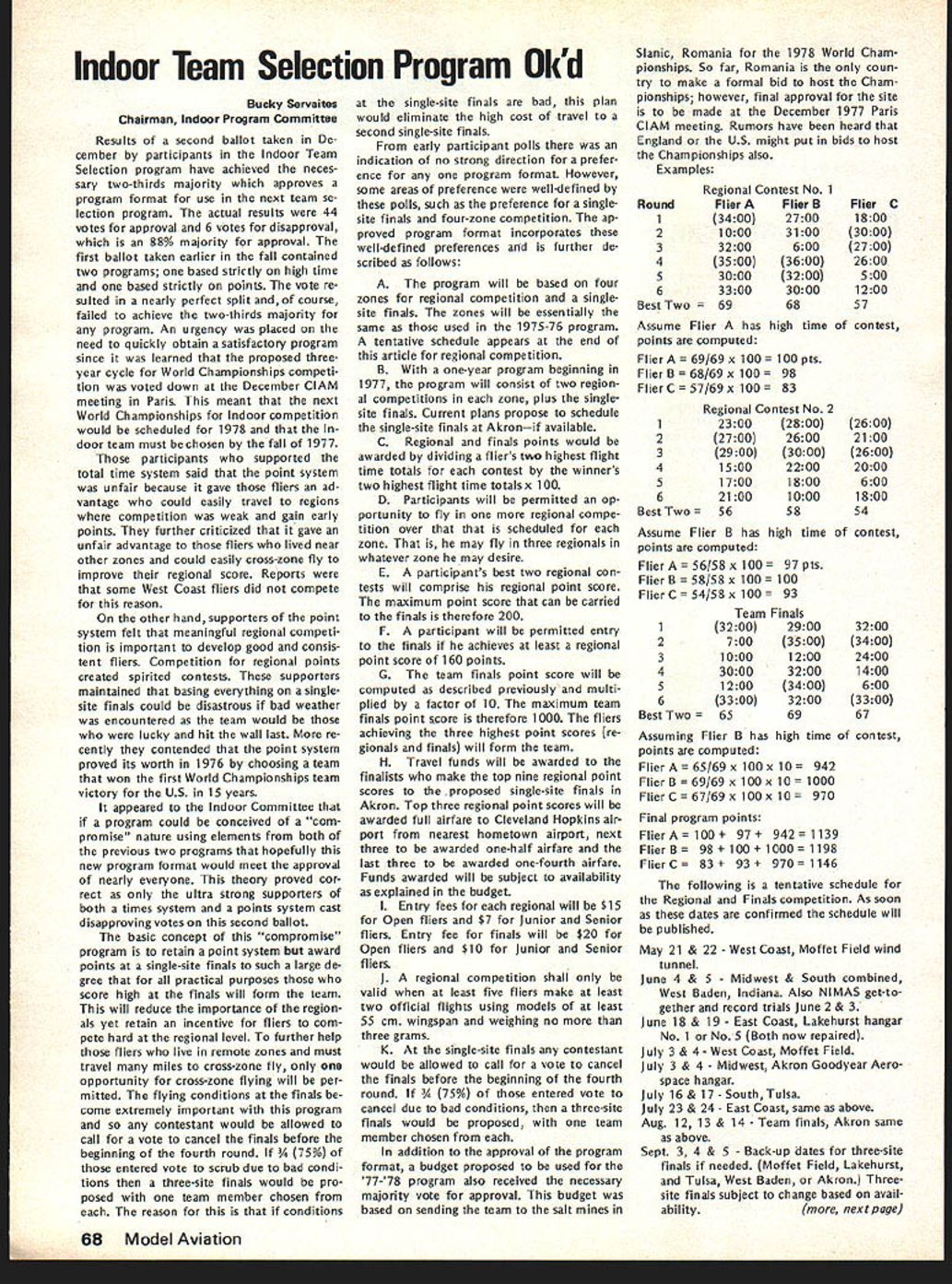
Indoor Team Selection Program Ok'd
Bucky Servaites Chairman, Indoor Program Committee
Results of a second ballot taken in December by participants in the Indoor Team Selection program have achieved the necessary two-thirds majority which approves a program format for use in the next team selection program. The actual results were 44 votes for approval and 6 votes for disapproval, which is an 88% majority for approval. The first ballot taken earlier in the fall contained two programs; one based strictly on high time and one based strictly on points. The vote resulted in a nearly perfect split and, of course, failed to achieve the two-thirds majority for any program. An urgency was placed on the need to quickly obtain a satisfactory program since it was learned that the proposed three-year cycle for World Championships competition was voted down at the December CIAM meeting in Paris. This meant that the next World Championships for Indoor competition would be scheduled for 1978 and that the Indoor team must be chosen by the fall of 1977.
Those participants who supported the total time system said that the point system was unfair because it gave those fliers an advantage who could easily travel to regions where competition was weak and gain early points. They further criticized that it gave an unfair advantage to those fliers who lived near other zones and could easily cross-zone fly to improve their regional score. Reports were that some West Coast fliers did not compete for this reason.
On the other hand, supporters of the point system felt that meaningful regional competition is important to develop good and consistent fliers. Competition for regional points created spirited contests. These supporters maintained that basing everything on a single-site finals could be disastrous if bad weather was encountered as the team would be those who were lucky and hit the wall last. More recently they contended that the point system proved its worth in 1976 by choosing a team that won the first World Championships team victory for the U.S. in 15 years.
It appeared to the Indoor Committee that if a program could be conceived of a "compromise" nature using elements from both of the previous two programs that hopefully this new program format would meet the approval of nearly everyone. This theory proved correct as only the ultra strong supporters of both a times system and a points system cast disapproving votes on this second ballot.
The basic concept of this "compromise" program is to retain a points system but award points at a single-site finals to such a large degree that for all practical purposes those who score high at the finals will form the team. This will reduce the importance of the regionals yet retain an incentive for fliers to compete hard at the regional level. To further help those fliers who live in remote zones and must travel many miles to cross-zone fly, only one opportunity for cross-zone flying will be permitted. The flying conditions at the finals become extremely important with this program and so any contestant would be allowed to call for a vote to cancel the finals before the beginning of the fourth round. If 3/4 (75%) of those entered vote to scrub due to bad conditions then a three-site finals would be proposed with one team member chosen from each. The reason for this is that if conditions at the single-site finals are bad, this plan would eliminate the high cost of travel to a second single-site finals.
From early participant polls there was an indication of no strong direction for a preference for any one program format. However, some areas of preference were well-defined by these polls, such as the preference for a single-site finals and four-zone competition. The approved program format incorporates these well-defined preferences and is further described as follows:
A. The program will be based on four zones for regional competition and a single-site finals. The zones will be essentially the same as those used in the 1975-76 program. A tentative schedule appears at the end of this article for regional competition.
B. With a one-year program beginning in 1977, the program will consist of two regional competitions in each zone, plus the single-site finals. Current plans propose to schedule the single-site finals at Akron—if available.
C. Regional and finals points would be awarded by dividing a flier's two highest flight time totals for each contest by the winner's two highest flight time totals x 100.
D. Participants will be permitted an opportunity to fly in one more regional competition over that is scheduled for each zone. That is, he may fly in three regionals in whatever zone he may desire.
E. A participant's best two regional contests will comprise his regional point score. The maximum point score that can be carried to the finals is therefore 200.
F. A participant will be permitted entry to the finals if he achieves at least a regional point score of 160 points.
G. The team finals' point score will be computed as described previously and multiplied by a factor of 10. The maximum team finals point score is therefore 1000. The fliers achieving the three highest point scores (regionals and finals) will form the team.
H. Travel funds will be awarded to the finalists who make the top nine regional point scores to the proposed single-site finals in Akron. Top three regional point scores will be awarded full airfare to Cleveland Hopkins airport from nearest hometown airport, next three to be awarded one-half airfare and the last three to be awarded one-fourth airfare. Funds awarded will be subject to availability as explained in the budget.
I. Entry fees for each regional will be $15 for Open fliers and $7 for Junior and Senior fliers. Entry fee for finals will be $20 for Open fliers and $10 for Junior and Senior fliers.
J. A regional competition shall only be valid when at least five fliers make at least two official flights using models of at least 55 cm. wingspan and weighing no more than three grams.
K. At the single-site finals any contestant would be allowed to call for a vote to cancel the finals before the beginning of the fourth round. If 3/4 (75%) of those entered vote to cancel due to bad conditions, then an alternate finals would be proposed, with one team member chosen from each.
L. In addition to approval of the program format, a budget proposal to be used for the '77-'78 program also received the necessary majority vote for approval. This budget was based on sending the team to the salt mines in Slanic, Romania for the 1978 World Championships. So far, Romania is the only country to make a formal bid to host the Championships; however, final approval for the site is to be made at the December 1977 Paris CIAM meeting. Rumors have been heard that England or the U.S. might put in bids to host the Championships also.
Examples:
Regional Contest No. 1 Round Flier A Flier B Flier C 1 (34:00) 27:00 18:00 2 10:00 31:00 (30:00) 3 32:00 6:00 (27:00) 4 (35:00) (36:00) 26:00 5 30:00 (32:00) 5:00 6 33:00 30:00 12:00 Best Two = 69 68 57
Assume Flier A has high time of contest, points are computed: Flier A = 69/69 x 100 = 100 pts. Flier B = 68/69 x 100 = 98 Flier C = 57/69 x 100 = 83
Regional Contest No. 2 Round Flier A Flier B Flier C 1 23:00 (28:00) (26:00) 2 (27:00) 26:00 21:00 3 29:00 (30:00) (26:00) 4 15:00 22:00 20:00 5 17:00 18:00 6:00 6 21:00 10:00 18:00 Best Two = 56 58 54
Assume Flier B has high time of contest, points are computed: Flier A = 56/58 x 100 = 97 pts. Flier B = 58/58 x 100 = 100 Flier C = 54/58 x 100 = 93
Team Finals Round Flier A Flier B Flier C 1 (32:00) 29:00 32:00 2 7:00 (35:00) (34:00) 3 10:00 12:00 24:00 4 30:00 32:00 14:00 5 12:00 (34:00) 6:00 6 (33:00) 32:00 (33:00) Best Two = 65 69 67
Assuming Flier B has high time of contest, points are computed: Flier A = 65/69 x 100 x 10 = 942 Flier B = 69/69 x 100 x 10 = 1000 Flier C = 67/69 x 100 x 10 = 970
Final program points: Flier A = 100 + 97 + 942 = 1139 Flier B = 98 + 100 + 1000 = 1198 Flier C = 83 + 93 + 970 = 1146
The following is a tentative schedule for the Regional and Finals competitions. As soon as these dates are confirmed the schedule will be published.
May 21 & 22 - West Coast, Moffet Field wind tunnel.
June 4 & 5 - Midwest & South combined, West Baden, Indiana. Also NIMAS get-together and record trials June 2 & 3.
June 18 & 19 - East Coast, Lakehurst hangar No. 1 or No. 5 (Both now repaired).
July 3 & 4 - West Coast, Moffet Field.
July 3 & 4 - Midwest, Akron Goodyear Aerospace hangar.
July 16 & 17 - South, Tulsa.
July 23 & 24 - East Coast, same as above.
Aug. 12, 13 & 14 - Team finals, Akron same as above.
Sept. 3, 4 & 5 - Back-up dates for three-site finals if needed. (Moffett Field, Lakehurst, and Tulsa, West Baden, or Akron.) Three-site finals subject to change based on availability. The 1975-76 program participants will automatically receive information through the mail on late-breaking news concerning the program. Those fliers who intend to compete on the 1978 Indoor Team, but did not compete in the last program, can receive this information by pre-registering for the next program. This is accomplished by sending $15 to the Academy of Model Aeronautics, 515 Fifteenth St., N.W., Washington, D.C. 20005, attention Micheline Madison, along with your intent to compete. For this fee you will be pre-registered in the program and will receive an affidavit sheet which indicates your entry fees have been paid for one regional contest. Juniors and Seniors pay only $7. Past program participants can also pre-register if they so desire by following the same procedure.
CL AEROBATICS, SPEED AND TEAM RACE TEAM PROGRAMS
Speed and Team Racing.
Previous program participants were being polled when this was written as to the acceptability of selecting the 1978 U.S. teams in conjunction with, but separate from, the 1977 National Contest at March Air Force Base, August 7-14. In one plan the contests for selecting teams would be during Nats week, but scheduled to not conflict with other CL Racing or Speed events; in the other, team selection contests would be on the weekend immediately preceding the Nats as in 1975 at Lake Charles. The questionnaire also provided for previous participants to recommend other sites and dates.
It is envisioned that U.S. team members will be selected from a single contest requiring no pre-qualification. All AMA members having the $5 FAI Stamp and model complying with the rules for FAI Speed and Team Racing (see AMA rule book) are eligible to try out for the teams. Although the entry fee has not yet been established it is expected to be in the same range as 1975's fee, which was $20 in advance and $40 late.
FAI Aerobatics.
A questionnaire to previous program entrants was about to be circulated when this was written, as a step in finalizing the 1977 program for selecting the 1978 U.S. team. Questions pertained to location and date of the team selection contest, including whether to hold the event in conjunction with the 1977 National Contest at March AFB, August 7-14. Alternatives in connection with the Nats consisted of just before (August 6-7), just after (August 13-14 or 14-15), or in conjunction with the Nats competition. Other choices of sites were St. Louis, MO, which has been used before, and Atlanta, GA. In connection with the latter two site possibilities, previous program participants were asked to consider dates of Labor Day weekend (September 3-4) and Columbus Day weekend (October 8-9).
Whatever location and dates are chosen, team selection is planned to be based on a single contest requiring no pre-qualifications. The entry fee has been fixed at $50 for Open age competitors and $25 for Juniors/Seniors. All AMA members having the $5 FAI Stamp and models complying with FAI CL Aerobatics rules are eligible to try out for the team. Basically the FAI model is the same as AMA, except that an engine muffler is required for FAI, and the maneuver schedule is essentially the same.
1978 CL World Championships. England tentatively is planning to be host for these events (Speed, Aerobatics, Team Racing and Combat), plus the RC and CL Scale World Championships. satisfied the Bureau (i.e., the CIAM officers and subcommittee chairmen), and it kept the events that had been on a two-year format at still flying on that basis. The U.S.A. subsequently withdrew two other proposals that were poorly supported by our people and submitted in their place, for the CIAM's consideration, the compromise proposal. We also made copies of our proposal, passed them around, and began lobbying for it with the delegates from the other countries the night before the meeting.
The proposal was quite favorably received, and suggestions for a minor change or two resulted and were accepted. Thus, we went into the meeting with an excellent chance to get adopted either our proposal or a Swedish proposal (which had Outdoor FF on two-year centers but which we would have had to try to modify to keep Indoor on the same basis); both preferable to the Bureau's three-year cycle proposal. As it turned out, however, the CIAM president, Sandy Pimenoff, first put the question to the meeting of whether any change was desired. The vote, 21 against any change and 3 for a change, effectively killed all of the proposals and kept things as they presently are.
It should be pointed out that even though the U.S.A. cast one of the three votes for a change, this should not be construed as a vote for the three-year program. The vote for a change was rather an attempt to move constructively to solve some of the problems in the present non-structured format of the World Championships. (AMA HQ Note—the present format does not guarantee a two-year cycle!) The compromise proposal solves most of these problems, and it was this proposal that the U.S. wanted to get adopted.
On the longer range aspects, it became obvious during the course of the meeting that if we are to have a chance to influence the outcome of CIAM actions, we must have our subcommittee members and chairmen in attendance at each CIAM meeting. The first day of the CIAM meeting is taken up with a series of technical meetings. Included this time were FF, RC Aerobatics, RC Soaring, RC Pylon, RC Helicopter, Scale, and Control Line. It is impossible for our voting delegate, John Clemens, and John Worth (who is secretary to the CIAM) to adequately cover each of the meetings. Furthermore, there is no adequate substitute for active and regular participation of our knowledgeable special interest subcommittee representatives at each technical meeting. You are only heard when you are there and can speak authoritatively for your specialty. The votes of the CIAM delegates the second day of the meetings are strongly influenced by the vote on the issue that is taken in the first day in the technical meetings.
In conclusion, I strongly endorse the attendance of our FAI CIAM subcommittee chairmen and members at all meetings of the CIAM and hope that the AMA can find a way to finance this attendance without placing the burden on the FAI program participants.
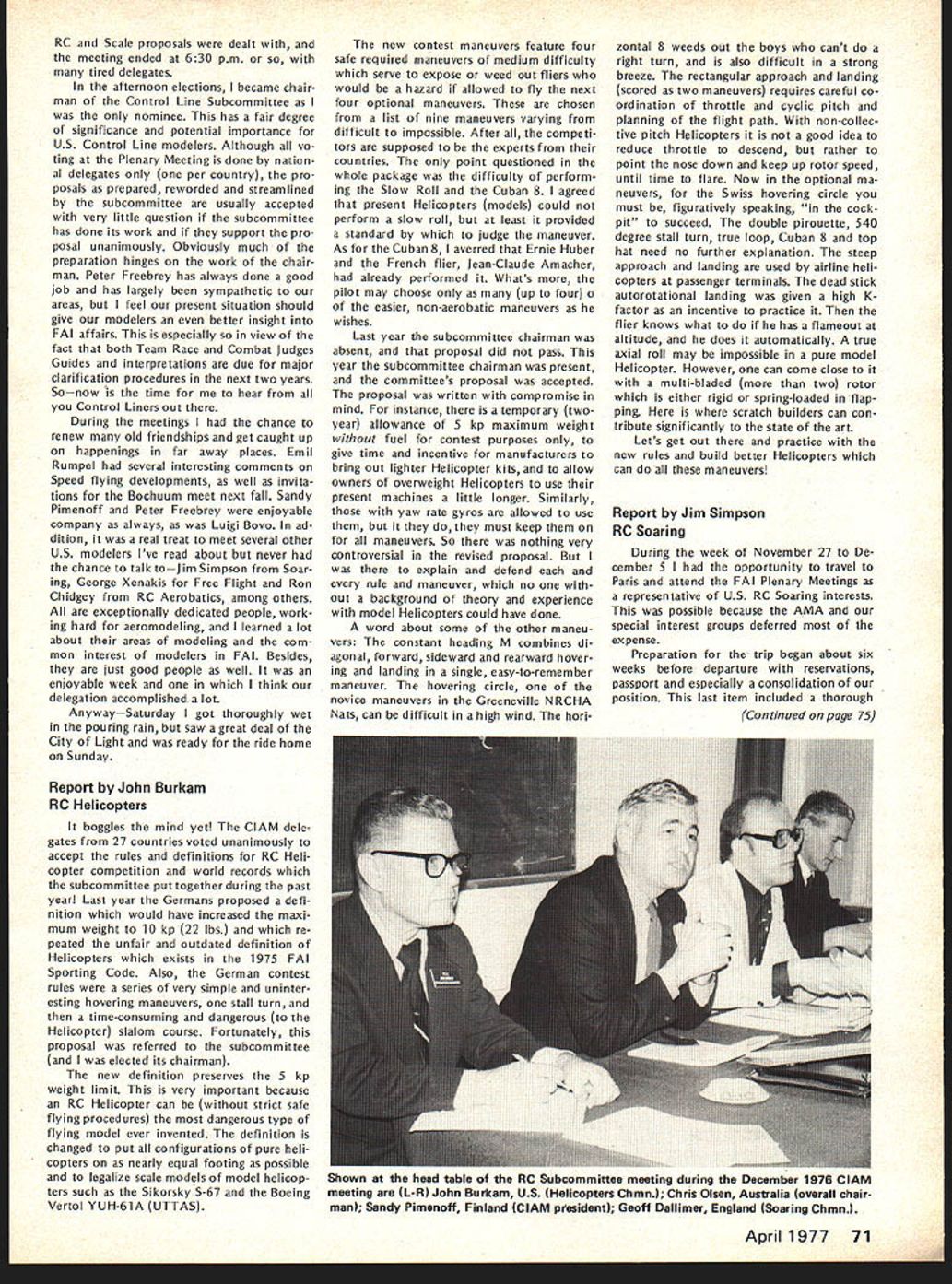
Report by Laird Jackson
Control Line
My impressions of the recently concluded FAI Plenary Meetings in Paris, France are multicolored. Assuming that the details of the rules changes and voting will have already been covered, I will only mention that most of the Control Line proposals of concern to the United States were accepted as we would have wanted them. Notable exceptions to this were the defeat of the Aerobatics proposals to increase the engine displacement limit (for multi-engine models) and to abolish the hand signal. Aside from these decisions the meeting produced no great surprises. A characteristic of such meetings is their conservative nature.
Perhaps some advantage to the membership can be gained by an individual diary of the trip itself. It must first be noted that all of the attendees were supported not only by AMA but also by their own special interest group. I, for example, received the backing of MACA, PAMPA and the FAICLS. Many attendees dug fairly deeply into their own pockets for expenses.
Our group met in New York at JFK Airport on Saturday the 27th of November for an anticipated 10:30 p.m. departure for Paris. Unfortunately, it appeared that Pakistan Airlines had only one airplane and their only spare engine was in Karachi. Therefore, we stayed in the International Hotel at JFK Saturday night. Sunday we were transferred to an Air France flight and finally departed almost 24 hours later than anticipated. The flight was pleasant, and John Worth certainly minimized all the usual inconveniences of travel and delays with his efficient attention to details.
We arrived in Paris in the early morning on Monday and checked in for a refreshing nap at the hotel. That evening John Worth introduced us to the Paris Metro, an extensive and efficient subway system which covers metropolitan Paris. Because of the lower price advantage of a week's excursion air fare package, we had 2-1/2 days of essentially free time available for sightseeing. Tuesday we took advantage of a half day of this before meeting at the hotel for an afternoon of working out the details of the rules proposals and our position on them. Wednesday we had a free day of sightseeing and gathered Wednesday evening to talk with other countries' delegates and to exchange pleasantries, as well as subtly introduce our thoughts on certain key issues.
Thursday the two days' meetings began at 9 a.m. Approximately half of the morning was spent in general discussion before breaking up into technical subcommittee meetings. These meetings took the remainder of the day until 4 o'clock. I was involved in the Control Line meeting, and this included Peter Freyberg, Great Britain, chairman; Tony Aarts, Holland; Yuri Sirotkin (and interpreter), U.S.S.R.; Luigi Bovo, Italy; Petrov Pekkow, Bulgaria; Emil Rumpel, W. Germany; Jean Magne, France, observer; and Albert Herzog, Belgium, observer. The meeting discussed all Control Line proposals and all general proposals bearing on Control Line activity. Considerable time was spent in combining proposals or rewording difficult items to make more clarity of them before submitting them to the general session vote.
At 4 p.m. we reconvened in general session to cover some remaining items and to have nominations for officers. In this I was fortunate (?) enough to be nominated for chairman of the Control Line Subcommittee. The meetings broke up before 6 p.m., and we reconvened at 9 the next morning. Friday was a long and difficult day as many items on the voting agenda generate far more discussion than one thinks they might. Surprisingly, the question of a three-year interval for World Championships generated little controversy. Two-year intervals are to be preserved, and the World Championships schedule appears reasonably well set for the next few years. Control Line has a firm offer for 1978 from Great Britain, a tentative offer for 1980 from France and a firm offer for 1980 from Sweden. Other Control Line matters were fairly smoothly and were dealt with after lunch (which means that Free Flight alone consumed the morning agenda—plus reports and such). The French alternate of the Team Race circle was discussed with some emotion, but all else went fairly smoothly. Finally, the RC and Scale proposals were dealt with, and the meeting ended at 6:30 p.m. or so, with many tired delegates.
In the afternoon elections, I became chairman of the Control Line Subcommittee as I was the only nominee. This has a fair degree of significance and potential importance for U.S. Control Line modelers. Although all voting at the Plenary Meeting is done by national delegates only (one per country), the proposals as prepared, reworded and streamlined by the subcommittee are usually accepted with very little question if the subcommittee has done its work and if they support the proposal unanimously. Obviously much of the preparation hinges on the work of the chairman. Peter Freebrey has always done a good job and has largely been sympathetic to our areas, but I feel our present situation should give our modelers an even better insight into FAI affairs. This is especially so in view of the fact that both Team Race and Combat judges Guides and interpretations are due for major clarification procedures in the next two years. So—now is the time for me to hear from all you Control Liners out there.
During the meetings I had the chance to renew many old friendships and get caught up on happenings in far away places. Emil Rumpel had several interesting comments on Speed flying developments, as well as invitations for the Bochum meet next fall. Sandy Pimenoff and Peter Freebrey were enjoyable company as always, as was Luigi Bovo. In addition, it was a real treat to me to meet several other U.S. modelers I've read about but never had the chance to talk to—Jim Simpson from Soaring, George Xenakis for Free Flight and Ron Chidgey from RC Aerobatics, among others. All are exceptionally dedicated people, working hard for aeromodelling, and I learned a lot about their areas of modeling and the common interest of modelers in FAI. Besides, they are just good people as well. It was an enjoyable week and one in which I think our delegation accomplished a lot.
Anyway—Saturday I got thoroughly wet in the pouring rain, but saw a great deal of the City of Light and was ready for the ride home on Sunday.
Report by John Burkam
RC Helicopters
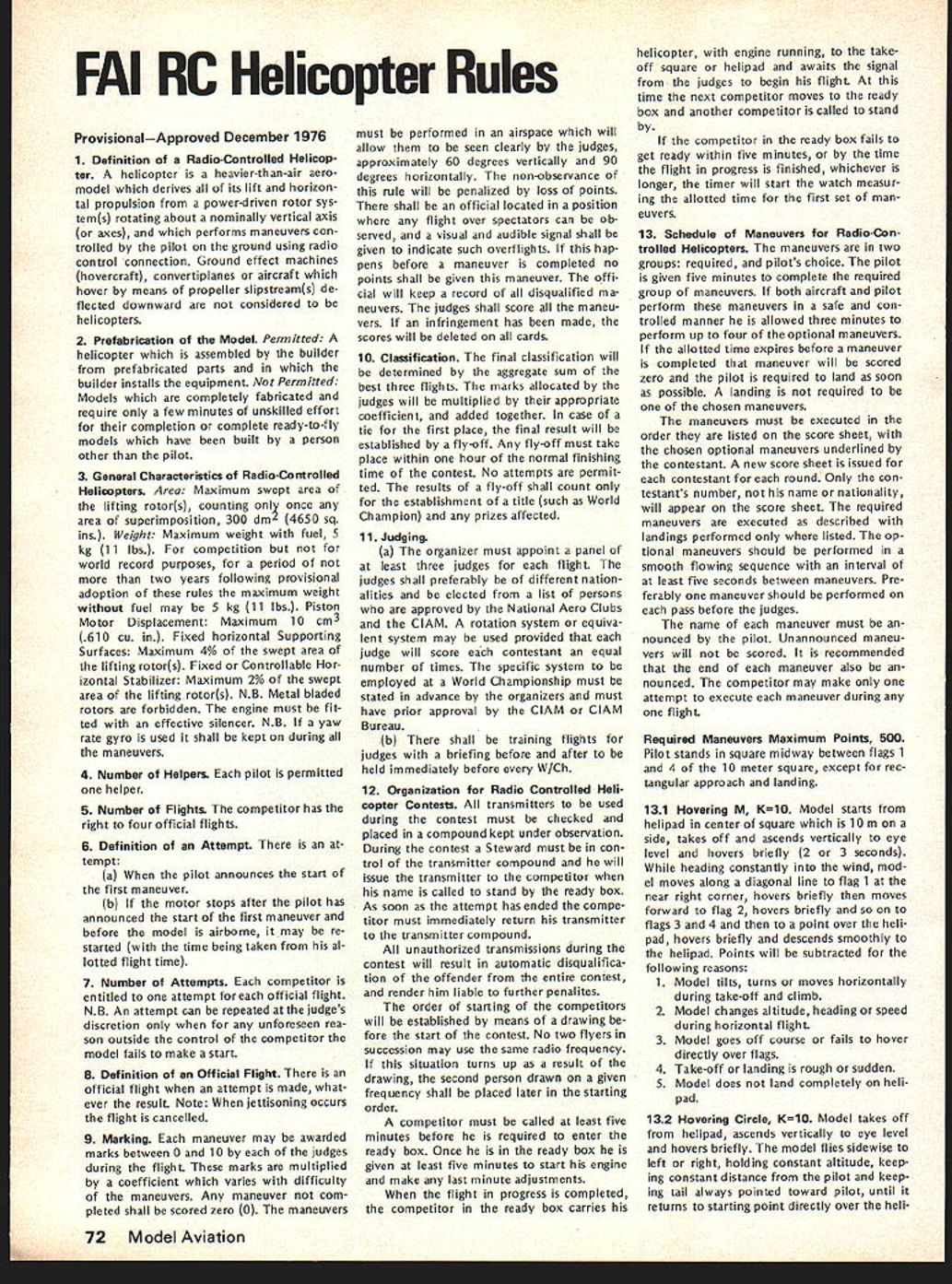
It boggles the mind yet! The CIAM delegates from 27 countries voted unanimously to accept the rules and definitions for RC Helicopter competition and world records which the subcommittee put together during the past year! Last year the Germans proposed a definition which would have increased the maximum weight to 10 kp (22 lbs.), and which repeated the unfair and outdated definition of Helicopters which exists in the 1975 FAI Sporting Code. Also, the German contest rules were a series of very simple and uninteresting hovering maneuvers, one stall turn, and then a time-consuming and dangerous (to the Helicopter) slalom course. Fortunately, this proposal was referred to the subcommittee (and I was elected its chairman).
The new definition preserves the 5 kp weight limit. This is very important because an RC Helicopter can be (without strict safe flying procedures) the most dangerous type of flying model ever invented. The definition is changed to put all configurations of pure helicopters on as nearly equal footing as possible and to legalize scale models of model helicopters such as the Sikorsky S-67 and the Boeing Vertol YUH-61A (UTTAS).
The new contest maneuvers feature four safe required maneuvers of medium difficulty which serve to expose or weed out fliers who would be a hazard if allowed to fly the next four optional maneuvers. These are chosen from a list of nine maneuvers varying from difficult to impossible. After all, the competitors are supposed to be the experts from their countries. The only point questioned in the whole package was the difficulty of performing the Slow Roll and the Cuban 8. I agreed that present Helicopters (models) could not perform a slow roll, but at least it provided a standard by which to judge the maneuver. As for the Cuban 8, I averred that Ernie Huber and the French flier, Jean-Claude Amacher, had already performed it. What's more, the pilot may choose only as many (up to four) of the easier, non-aerobatic maneuvers as he wishes.
Last year the subcommittee chairman was absent, and that proposal did not pass. This year the subcommittee chairman was present, and the committee's proposal was accepted. The proposal was written with compromise in mind. For instance, there is a temporary (two-year) allowance of 5 kp maximum weight without fuel for contest purposes only, to give time and incentive for manufacturers to bring out lighter Helicopter kits, and to allow owners of overweight Helicopters to use their present machines a little longer. Similarly those with yaw rate gyros are allowed to use them, but if they do, they must keep them on for all maneuvers. So there was nothing very controversial in the revised proposal. But I was there to explain and defend each and every rule and maneuver, which no one without a background of theory and experience with model Helicopters could have done.
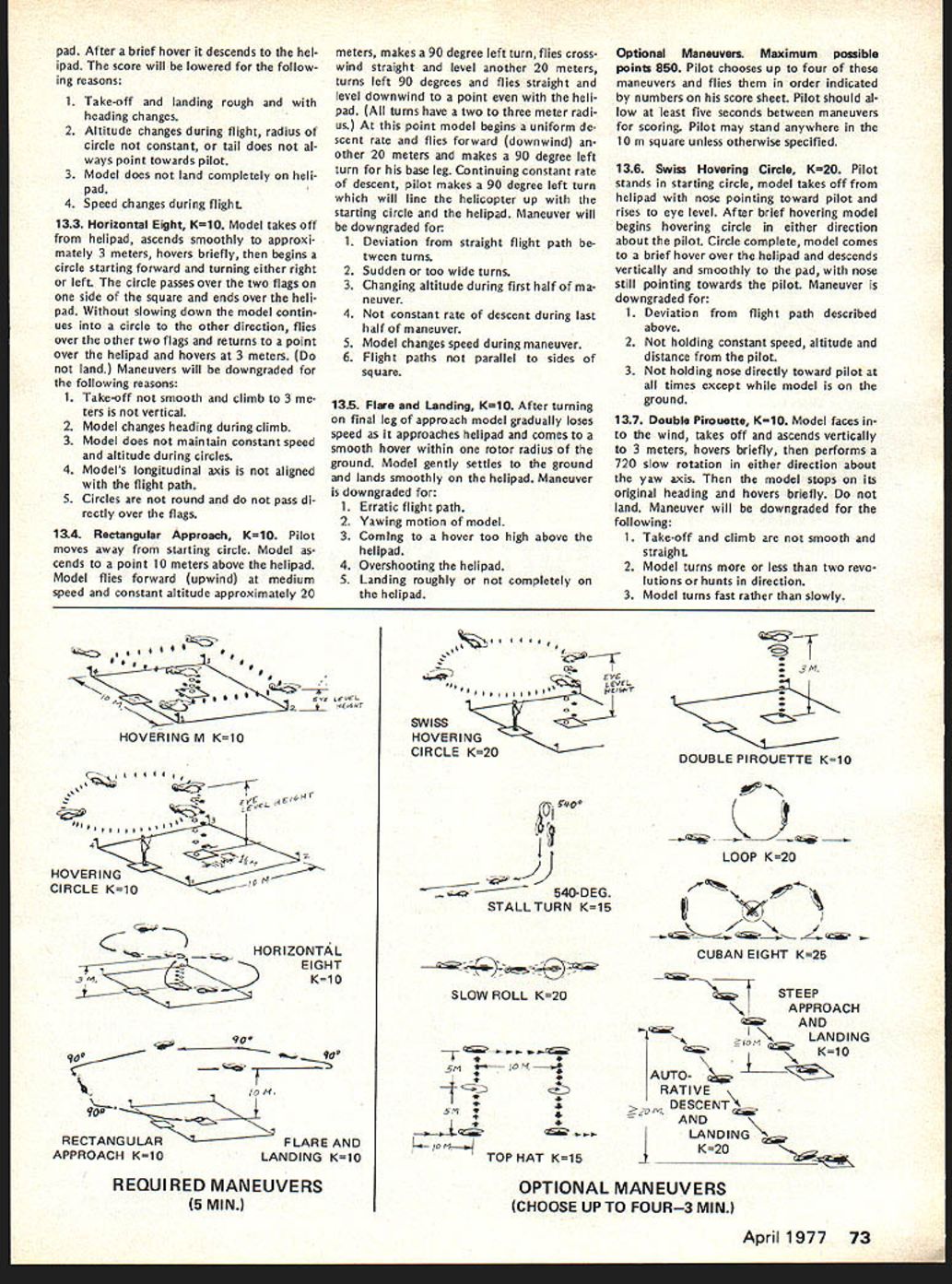
A word about some of the other maneuvers: The constant heading M combines diagonal, forward, sideward and rearward hovering and landing in a single, easy-to-remember maneuver. The hovering circle, one of the novice maneuvers in the Greenville NRCHA Nats, can be difficult in a high wind. The horizontal 8 weeds out the boys who can't do a right turn, and is also difficult in a strong breeze. The rectangular approach and landing (scored as two maneuvers) requires careful coordination of throttle and cyclic pitch and planning of the flight path. With non-collective pitch Helicopters it is not a good idea to reduce throttle to descend, but rather to point the nose down and keep up rotor speed, until time to flare. Now in the optional maneuvers, for the Swiss hovering circle you must be, figuratively speaking, "in the cockpit" to succeed. The double pirouette, 540 degree stall turn, true loop, Cuban 8 and top hat need no further explanation. The steep approach and landing are used by airline helicopters at passenger terminals. The dead stick autorotational landing was given a high K-factor as an incentive to practice it. Then the flier knows what to do if he has a flameout at altitude, and he does it automatically. A true axial roll may be impossible in a pure model Helicopter. However, one can come close to it with a multi-bladed (more than two) rotor which is either rigid or spring-loaded in flapping. Here is where scratch builders can contribute significantly to the state of the art.
Let's get out there and practice with the new rules and build better Helicopters which can do all these maneuvers!
Report by Jim Simpson
RC Soaring
During the week of November 27 to December 5 I had the opportunity to travel to Paris and attend the FAI Plenary Meetings as a representative of U.S. RC Soaring interests. This was possible because the AMA and our special interest groups deferred most of the expenses.
Preparation for the trip began about six weeks before departure with reservations, passport and especially a consolidation of our position. This last item included a thorough
Competition Newsletter
CL Combat Team Selection Program
The 1977 program selecting the U.S. Control Line Combat Team for the 1978 World Championships: recommended AMA Combat Team Selection Committee members proposed. The Miniature Aircraft Combat Association has approved the following. It should be noted three fliers will be selected for the 1978 Control Line World Championships (Speed, Aerobatics, Team Race, Combat plus RC, CL Scale) tentatively scheduled in England. The following details, edited and supplied by Gary Frost, committee chairman.
Dates: July 2-3, 1977 Place: Buder Park, St. Louis, MO
Procedure: Advance registration is suggested and may be accomplished at the lowest cost. Advance registration consists of the entrant team sending name, address, AMA number to AMA HQ along with a $25 check or money order payable to AMA marked "FAI Combat Program Entry" postmarked no later than June 15, 1977. Early entry is recommended. Interested persons can be sent information concerning late-breaking developments and provided lodging assistance. Team Finals will request late entry; site entry also possible upon payment of a $50 program fee per entrant team. In addition to the program entry fee, AMA membership is required plus a $5 FAI stamp; payment of the same must be made on site. Entry fees are used to cover program operating expenses and costs for team members within the U.S. An apportionment of AMA dues covers over-ocean travel expected. The FAI CIAM Bureau officers will consider at its April 1977 meeting whether Combat entry to the World Championships should consist of a specific pilot/pit-man team fashion. CL Team Racing pilot/pit interchangeability is under consideration. Also expected, the AMA Executive Council will consider at its April meeting whether AMA funding of over-ocean travel will cover pilots, both pilots and pit-men, or either. Such actions could result in a necessary change in the entry fee structure (for instance, payment for both pilot and pit-man). An announcement will be made as quickly as possible.
Details of the program were mainly developed through balloting sponsored by MACA. Team Finals flyoffs will be two separate FAI contests back-to-back, flown to current FAI rules. Program entrants will be placed in a pyramid. The first contest will be flown Saturday, July 2. First round losers will be flown off; winners and losers rounds will be placed back into a second round along winners from the first round; the pyramid will be restructured accordingly to end up with four semi-finalists. Flyoffs will proceed to choose the first four places. The first place winner undefeated therefore becomes a member of the team. On the second day, Sunday, July 3, an entirely new contest will be held; the entire event will be repeated except the first place winner from the previous day will be excluded. Again, half of the first round losers will earn a place in the second round by winning matching losers' rounds exactly per the rules. Flyoffs will proceed until four semi-finalists are obtained; four winners determined. The first place winner becomes a member of the team along with the previous day's winner. The two second-place winners (one from each day) fly off for the third team spot; the first alternate will be determined by the two third-place winners flying off for the second alternate.
CIAM decides national teams at its April 1977 officers meeting. A U.S. team member who does not have a permanent pit crew can draw others; the U.S. contingent may find some other competent pit-man. Team Finals: two entries consisting of the same two persons will be allowed; both can fly and pit in case of weather problems. Monday, July 4 is an alternate day. Buder Park has been reserved for this purpose.
Implementation: Buder Park, located near Valley Park, MO at the intersection of I-44 and MO-141, has room for four Combat circles; two have asphalt centers. The area has been reserved exclusively for the Team Finals. The Greater St. Louis Modeling Association has pledged assistance; however basic judging will come from competitive Combat fliers. MACA has assumed responsibility for recruitment. Gary Frost is temporarily acting in the position of Contest Director, Team Finals, until an actual Contest Director is named.
About Program Development: Participating in the balloting were 28 fliers, amounting to over 50% of FAI Combat entrants in the National Contest total. The plan was discussed several times in the MACA Newsletter. The feedback system was very favorable. The location was chosen due to its being within 600 miles of the center of the country; the date was chosen prior to the Nats in case unforeseen problems arise. Selection based on National Contest results could be considered. Balloting issues were carried out in two sections in order to adequately discuss points. The committee feels confident the system announced will be satisfactory. pad. After a brief hover it descends to the helipad. The score will be lowered for the following reasons:
- Take-off and landing rough and with heading changes.
- Altitude changes during flight, radius of circle not constant, or tail does not always point towards pilot.
- Model does not land completely on helipad.
- Speed changes during flight.
13.3. Horizontal Eight, K=10. Model takes off from helipad, ascends smoothly to approximately 3 meters, hovers briefly, then begins a circle starting forward and turning either right or left. The circle passes over the two flags on one side of the square and ends over the helipad. Without slowing down the model continues into a circle to the other direction, flies over the other two flags and returns to a point over the helipad and hovers at 3 meters. (Do not land.) Maneuvers will be downgraded for the following reasons:
- Take-off not smooth and climb to 3 meters is not vertical.
- Model changes heading during climb.
- Model does not maintain constant speed and altitude during circles.
- Model's longitudinal axis is not aligned with the flight path.
- Circles are not round and do not pass directly over the flags.
13.4. Rectangular Approach, K=10. Pilot moves away from starting circle. Model ascends to a point 10 meters above the helipad. Model flies forward (upwind) at medium speed and constant altitude approximately 20 meters, makes a 90 degree left turn, flies crosswind straight and level another 20 meters, turns left 90 degrees and flies straight and level downwind to a point even with the helipad. (All turns have a two to three meter radius.) At this point model begins a uniform descent rate and flies forward (downwind) another 20 meters and makes a 90 degree left turn for his base leg. Continuing a constant rate of descent, pilot makes a 90 degree left turn which will line the helicopter up with the starting circle and the helipad. Maneuver will be downgraded for:
- Deviation from straight flight path between turns.
- Sudden or too wide turns.
- Changing altitude during first half of maneuver.
- Not constant rate of descent during last half of maneuver.
- Model changes speed during maneuver.
- Flight paths not parallel to sides of square.
13.5. Flare and Landing, K=10. After turning on final leg of approach model gradually loses speed as it approaches helipad and comes to a smooth hover within one rotor radius of the ground. Model gently settles to the ground and lands smoothly on the helipad. Maneuver is downgraded for:
- Erratic flight path.
- Yawing motion of model.
- Coming to a hover too high above the helipad.
- Overshooting the helipad.
- Landing roughly or not completely on the helipad.
Optional Maneuvers. Maximum possible points 850. Pilot chooses up to four of these maneuvers and flies them in order indicated by numbers on his score sheet. Pilot should allow at least five seconds between maneuvers for scoring. Pilot may stand anywhere in the 10 m square unless otherwise specified.
13.6. Swiss Hovering Circle, K=20. Pilot stands in starting circle, model takes off from helipad with nose pointing toward pilot and rises to eye level. After brief hovering model begins hovering circle in either direction about the pilot. Circle complete, model comes to a brief hover over the helipad and descends vertically and smoothly to the pad, with nose still pointing towards the pilot. Maneuver is downgraded for:
- Deviation from flight path described above.
- Not holding constant speed, altitude and distance from the pilot.
- Not holding nose directly toward pilot at all times except while model is on the ground.
13.7. Double Pirouette, K=10. Model faces into the wind, takes off and ascends vertically to 3 meters, hovers briefly, then performs a 720 slow rotation in either direction about the yaw axis. Then the model stops on its original heading and hovers briefly. Do not land. Maneuver will be downgraded for the following:
- Take-off and climb are not smooth and straight.
- Model turns more or less than two revolutions or hunts in direction.
- Model turns fast rather than slowly.
13.8. Stall Turn with 540 Degree Rotation, K=15. Model flies fast straight and level then pulls up smoothly until it is flying straight up. Just as it stops, model pivots on its yaw axis 540 degrees or one and a half revolutions so that nose points down. Then the model recovers from the dive along the same path on which it entered the maneuver. Points will be deducted for the following:
- Model does not achieve vertical flight.
- Model drifts upwind or downwind during the vertical flight and turn.
- Model turns more or less than 540 degrees.
- Model comes out of maneuver on different heading, altitude or path than on which it entered the maneuver.
13.9. True Loop, K=20. Model flies straight and level at moderate to high speed, pulls up into an inside loop, keeping the nose pointed in the direction of flight. Model recovers from the loop and flies straight and level along the same heading and altitude at which it entered the maneuver. Maneuver is downgraded for the following:
- Loop is not round.
- Model rolls or deviates from the vertical plane in which the loop was started.
- Loop ends at different altitude than it started.
13.10. Slow Roll, K=20. Model flies straight and level and slowly rolls in either direction about an axis coincident with the flight path and continues rolling the same direction until it is again flying straight and level. Maneuver will be downgraded for the following reasons:
- Roll is too fast, i.e., more of snap roll.
- Model loses altitude during the roll.
- Model finishes the maneuver on a different heading from that on which it entered.
13.11. Cuban Eight, K=25. Model flies straight and level and pulls up into an inside loop, continues until heading downward at 45 degrees, does a half roll followed by another inside loop. At 45 degrees downward model does another half roll and recovers on the same altitude and heading as entry. Maneuver is downgraded for the following reasons:
- Model not level at start.
- Loops not round.
- Model deviates right or left.
- Model not at 45 degree down when rolls commenced.
- Second loop not same diameter as first.
- Model not level and at same altitude and heading as entry.
- Rolls not entered about crossover point.
13.12. Top Hat, K=15. Model flies 10 meters forward, straight and level, comes to a hover then ascends vertically for 5 meters and comes to a hover. Model makes a 360 degree pivot turn, hovers, ascends another 5 meters and comes to a hover. Then model moves forward 10 meters, hovers briefly and descends vertically 5 meters. After a brief hover it makes another 360 degree pivot turn, hovers and descends vertically 5 more meters. Another brief hover and the model flies straight forward 10 meters to complete the maneuver. Maneuver will be downgraded for the following:
- Not flying level in level places or vertically in the vertical places.
- Changing altitude or drifting horizontally during the 360 degree turns.
- Deviating to the right or left of the vertical plane of the maneuver.
- Not hovering briefly between each part of the maneuver.
- Not placing both 360 degree turns at the same altitude.
- Finishing the maneuver at a different altitude from the start.
- Turning more or less than 360 degrees.
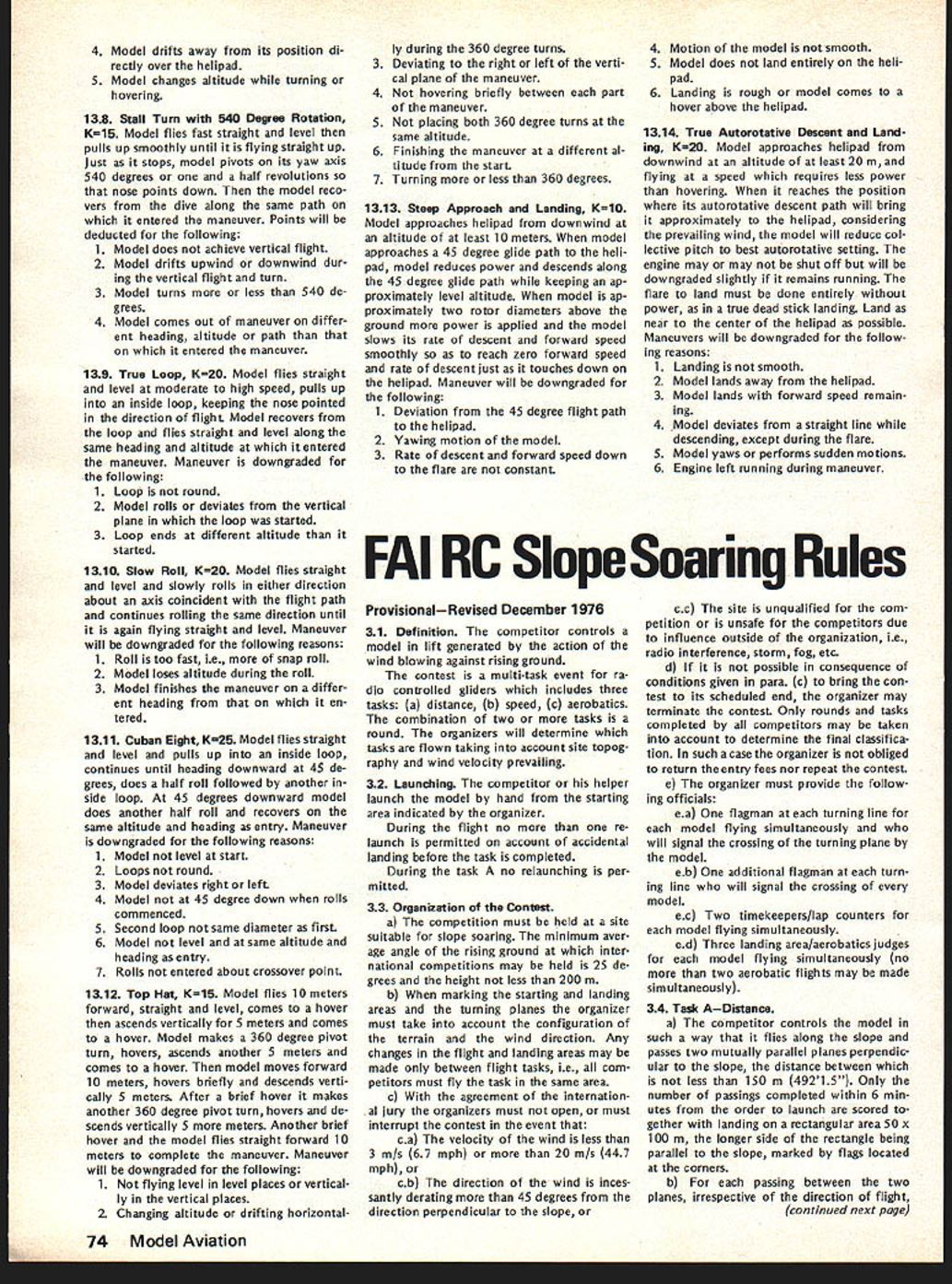
13.13. Steep Approach and Landing, K=10. Model approaches helipad from downwind at an altitude of at least 10 meters. When model approaches at a 45 degree glide path to the helipad, model reduces power and descends along the 45 degree glide path while keeping an approximately level altitude. When model is approximately two rotor diameters above the ground more power is applied and the model slows its rate of descent and forward speed smoothly so as to reach zero forward speed and rate of descent just as it touches down on the helipad. Maneuver will be downgraded for the following:
- Deviation from the 45 degree flight path to the helipad.
- Yawing motion of the model.
- Rate of descent and forward speed down to the flare are not constant.
- Motion of the model is not smooth.
- Model does not land entirely on the helipad.
- Landing is rough or model comes to a hover above the helipad.
13.14. True Autorotative Descent and Landing, K=20. Model approaches helipad from downwind at an altitude of at least 20 m, and flying at a speed which requires less power than hovering. When it reaches the position where its autorotative descent path will bring it approximately to the helipad, considering the prevailing wind, the model will reduce collective pitch to best autorotative setting. The engine may or may not be shut off but will be downgraded slightly if it remains running. The flare to land must be done entirely without power, as in a true dead stick landing. Land as near to the center of the helipad as possible. Maneuvers will be downgraded for the following reasons:
- Landing is not smooth.
- Model lands away from the helipad.
- Model lands with forward speed remaining.
- Model deviates from a straight line while descending, except during the flare.
- Model yaws or performs sudden motions.
- Engine left running during maneuver.
Competition Newsletter
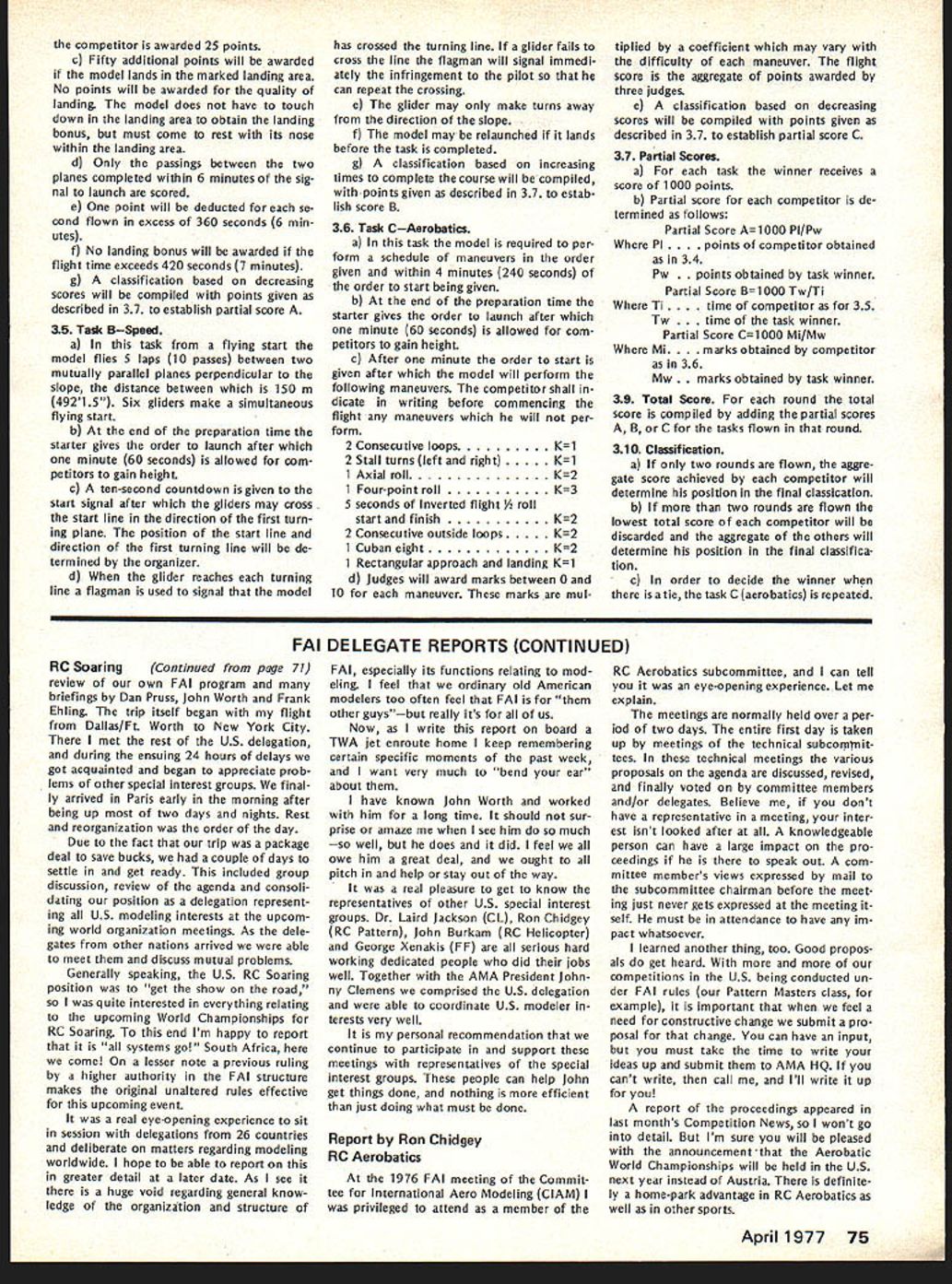
the competitor is awarded 25 points.
c) Fifty additional points will be awarded if the model lands in the marked landing area. No points will be awarded for the quality of landing. The model does not have to touch down in the landing area to obtain the landing bonus, but must come to rest with its nose within the landing area.
d) Only the passings between the two planes completed within 6 minutes of the signal to launch are scored.
e) One point will be deducted for each second flown in excess of 360 seconds (6 minutes).
f) No landing bonus will be awarded if the flight time exceeds 420 seconds (7 minutes).
g) A classification based on decreasing scores will be compiled with points given as described in 3.7, to establish partial score A.
3.5. Task B—Speed.
a) In this task from a flying start the model flies 5 laps (10 passes) between two mutually parallel planes perpendicular to the slope, the distance between which is 150 m (492'1.5"). Six gliders make a simultaneous flying start.
b) At the end of the preparation time the starter gives the order to launch after which one minute (60 seconds) is allowed for competitors to gain height.
c) A ten-second countdown is given to the start signal after which the gliders may cross the start line in the direction of the first turning plane. The position of the start line and direction of the first turning line will be determined by the organizer.
d) When the glider reaches each turning line a Flagman is used to signal that the model has crossed the turning line. If a glider fails to cross the line the flagman will signal immediately the infringement to the pilot so that he can repeat the crossing.
e) The glider may only make turns away from the direction of the slope.
f) The model may be relaunched if it lands before the task is completed.
g) A classification based on increasing times to complete the course will be compiled, with points given as described in 3.7, to establish score B.
3.6. Task C—Aerobatics.
a) In this task the model is required to perform a schedule of maneuvers in the order given and within 4 minutes (240 seconds) of the order to start being given.
c) After one minute the order to start is given after which the model will perform the following maneuvers. The competitor shall indicate in writing before commencing the flight any maneuvers which he will not perform.
- 2 Consecutive loops . . . . . . . . . . . . . . . . K=1
- 2 Stall turns (left and right) . . . . . . . . . K=1
- 1 Axial roll . . . . . . . . . . . . . . . . . . . . . K=2
- 1 Four-point roll . . . . . . . . . . . . . . . . . K=3
- 5 seconds of inverted flight 1/2 roll start and finish . . . . . . K=2
- 2 Consecutive outside loops . . . . . . . . . . . K=2
- 1 Cuban eight . . . . . . . . . . . . . . . . . . . . K=2
- 1 Rectangular approach and landing K=1
d) Judges will award marks between 0 and 10 for each maneuver. These marks are multiplied by a coefficient which may vary with the difficulty of each maneuver. The flight score is the aggregate of points awarded by three judges.
e) A classification based on decreasing scores will be compiled with points given as described in 3.7, to establish partial score C.
3.7. Partial Scores.
a) For each task the winner receives a score of 1000 points.
b) Partial score for each competitor is determined as follows:
Partial Score A = 1000 Pl/Pw Where Pl ... points of competitor obtained as in 3.4. Pw ... points obtained by task winner.
Partial Score B = 1000 Ti/Tw Where Ti ... time of competitor as for 3.5. Tw ... time of the task winner.
Partial Score C = 1000 Mi/Mw Where Mi ... marks obtained by competitor as in 3.6. Mw ... marks obtained by task winner.
3.9. Total Score. For each round the total score is compiled by adding the partial scores A, B, or C for the tasks flown in that round.
3.10. Classification.
a) If only two rounds are flown, the aggregate score achieved by each competitor will determine his position in the final classification.
b) If more than two rounds are flown the lowest total score of each competitor will be discarded and the aggregate of the others will determine his position in the final classification.
c) In order to decide the winner when there is a tie, the task C (aerobatics) is repeated.
Transcribed from original scans by AI. Minor OCR errors may remain.

