
1979 Free Flight Team Program Okayed
The initial phase of the program consisting of Qualifying Trials as detailed in the March issue was approved by participants, 172 to 14, and now, at the end of February, participants have approved primary details of the entire program for selection of the 1979 U.S. Free Flight World Championships Teams. To be selected are three team members in each of A-2 Glider, Wakefield Rubber, and FAI Power. Recorded in the overall program vote were 167 approvals and 30 opposed. This is 84.7%, well satisfying the requirement established by the AMA Executive Council of 55% when the voting participant total is from 100 to 199.
Details of the program, submitted to and accepted by participants in the previous program, were hammered out in a 97-minute telephone conference call on February 5 among members of AMA's FAI FF Committee, chaired by Bob Stalick. The conference call was authorized by the Executive Council on an experimental basis, and it was reported to be much more effective in dealing with these matters than mail—but not as good as a face-to-face meeting. It should be pointed out that the conference call followed over two months of individual committee phone calls and mailings.
The program actually is similar to the 1977 program—with the following items being the principle differences:
The time period for the Qualifying Trials has been extended to August 14, 1977.
The Team Finals site location is to be determined by site suitability rather than geographic location.
More rounds to be flown in the Team Finals.
Program Manager description has been developed to further establish the authority of officials.
A limitation upon the number who can qualify for the Team Finals has been established so that only about 33 per event will be eligible. (The 95% "rule" is retained.) Alternates to the Team Finals have been eliminated.
A limitation on the number of models which can be flown on any single day at the Team Finals has been established.
A new budget for income and expense was approved.
Qualification at AMA sanctioned Free Flight meets is permitted (as well as at AMA sanctioned Qualifying Trials). If qualification is to be attempted at a regularly scheduled FF meet rather than at an AMA sanctioned Qualifying Trial, the participant should ascertain from the Contest Director in advance whether he is prepared to accommodate the necessary timing and recording of seven flights.
The full program, as approved, follows: All AMA members having the $5 FAI Stamp and models complying with the rules (see AMA rule book) are eligible to participate in the program.
1979 FAI FREE FLIGHT TEAM SELECTION PROGRAM
Stage 1: Qualifying Trials
Qualification trials may be held by any AMA Contest Director between the dates of March 1, 1977 and August 14, 1977. Application to AMA for FAI FF Qualification Trials will provide the Contest Director with the necessary model processing vouchers and Qualifications Performance Affidavits.
Qualification may also be done at any AMA sanctioned Free Flight meet (with approval of the Contest Director), but the contestant is responsible for his own pre-entry in the program as well as having provided completed model processing vouchers and Qualification Performance Affidavits.
The responsibility rests with the qualifier to obtain the necessary Contest Director's signature on the Affidavit and return one copy of this form to AMA HQ no later than August 20, 1977.
To Qualify for the Semi-Finals. A contestant must score a minimum of 14 minutes during the course of a maximum of seven flights.
Certification of Models. Each model must have an identifying voucher on every removable surface of the model. Other specifications are as specified for that model type in the AMA rule book. These must be certified on the Affidavit as being in compliance with all pertinent rules.
Cost of Entry at Qualifications Trials Level. A contestant is entered upon payment by mail of $5.00 advance registration to AMA HQ. In submitting the program registration fee, the contestant must provide the name of the particular event to be entered plus full name, address and AMA number. A contestant who has not registered in advance may do so at a sanctioned Qualifications Trial with the payment of $6.00 to the Contest Director. One payment per event allows a contestant
'79 FF PROGRAM (Cont.)
to continue to compete for a berth at the Semi-Finals until such time as he qualifies. There is no charge for Junior age contestants entering the FAI FF Program.
Stage 2: Semi-Finals
Semi-Finals will be staged at a minimum of six and a maximum of eight sites in appropriate geographical locations throughout the country. They will be held over Labor Day weekend, 1977.
Semi-Finals Qualifiers. The 1979 FAI FF Program Manager will be responsible to inform all Semi-Finals Contest Directors of all contestants who qualify to fly at a Semi-Finals. However, the Contest Director at the Semi-Finals must accept any contestant who produces a valid Qualification Performance Affidavit, regardless of program manager notification.
Regulations Governing Semi-Finals. The following regulations govern the operations of a Semi-Finals. Deviations from these rules are the prerogative of the Contest Director but must be effected only if there is just cause.
- Competitors must fly on a line which is perpendicular to the wind position.
- No fixed thermal sniffers and other similar equipment is allowed inside the launch area.
- No "goating" is allowed.
- Round suspension is a Contest Director prerogative due to weather factors as per FAI Sporting Code. The Contest Director is required to use a wind meter to determine compliance.
- Time Restraints. All flying will be done in 1-1/2-hour rounds. The contestant will have no more than 20 minutes from arrival at the launch station until model is launched or lose his place in line and return to the end of the timer line. (Timing of A-2 contestants for purposes of this article will begin with arrival at the launch line until towline disconnect.)
- Rounds System.
- a. There will be eight 1-1/2 hour rounds.
- b. Rounds will follow this format:
- Round 1: 7:30 to 9:00 A.M.
- Round 2: 9:00 to 10:30 A.M.
- Round 3: 10:30 to Noon
- Round 4: Noon to 1:30 P.M.
- Round 5: 1:30 to 3:00 P.M.
- Round 6: 3:00 to 4:30 P.M.
- Round 7: 4:30 to 6:00 P.M.
- Round 8: 6:00 to 7:30 P.M.
- Semi-Finals Event Scheduling. Events at the Semi-Finals level will be scheduled during the three-day Labor Day weekend, 1977, at the discretion of the Semi-Finals Contest Director.
Advancement to the Team Finals. The following formula will be used to determine which fliers from the Semi-Finals will be advanced to the Team Finals: N = L/C x K, where
- N = Number of fliers advanced (rounded to nearest whole number).
- L = Number of local fliers (flying in an event at one Semi-Finals).
- C = Number of fliers in that event in the country in all Semi-Finals.
- K = 30 (a constant which will result in a manageable Team Finals).
Note: At least one flier will be advanced in each event from each Semi-Finals regardless of number of fliers at that Semi-Finals. Additionally, anyone making at least 95% of the winning time in his event at a Semi-Finals will be advanced even if he would not have been advanced under the conditions of the above formula.
Notification of those advancing to the Team Finals will be made by the Program Manager.
All 1977 team members will be automatically seeded to the Team Finals.
There will be no provision for alternates advancing to the Team Finals. Any contestant who does not fall into one of the above categories in this section will not be able to attend the Team Finals as a competitor. If a contestant who qualifies for the Team Finals is unable to attend, his spot will remain vacant.
Cost of Entry at the Semi-Finals Level. The entry fee for the Semi-Finals will be $17.00 per event per contestant. Junior fliers will be allowed entry without charge. Fees will be collected by the Semi-Finals Contest Director.
Stage 3: Team Finals
A single Team Finals will be held. There are to be no restrictions on site location. Site will be chosen on the basis of bids submitted to the Program Manager and measured against the site criteria standard now being developed by the FAI FF Committee. Site bids will be accepted for Team Finals location until December 31, 1977. Location of Team Finals site will be announced in January, 1978. The site will be selected solely upon its quality as a representative flying site for selecting the 1979 US World Championship Team.
Cost of Entry at the Finals. The entry fee will be $20.00 per event per contestant. Junior fliers will be allowed entry without charge. Fees are to be paid to the Program Manager at the Team Finals site.
Procedures and Rules for the Team Finals.
The Contest Director and Event Directors do not have the option to deviate from the rules in operation at the Team Finals. Rules to be followed are as outlined in this document, or in the absence of rules in this document, the FAI Sporting Code rules take effect.
- Models must be launched from a line and pole position which is perpendicular to the wind position.
- All models must be launched within five meters of the specified launch position. For F-1A (A-2), the helper must launch the model within five meters of the launch position. Selection of launch position shall be by random draw before each flight attempt.
- The contestant will have 20 minutes from arrival at his launch position to launch his model after which he loses his timer and must return to the end of the timer line. The contestant must return to the starting table even if there is no timer line at that moment. For F-1A, the contestant must have released his model (e.g., towline off the model and flight has started) no later than 20 minutes after arriving at his launch position.
- No stationary thermal sniffers or other stationary thermal sensing devices will be allowed in the launch area. Hand-held equipment is permitted in the launch area provided it does not exceed eight feet in height.
- The launch area is defined as a distance of plus or minus 15 meters from the launch line in F-1B (Wakefield) and F-1C (FAI Power) and plus or minus 65 meters in F-1A.
- Only the flier and a maximum of two helpers are permitted in the launch area.
- The use of thermal finding models (goats) will not be permissable. The judgment of the Contest Director on this issue will be final.
- A three-man FAI Jury will rule on decisions regarding suspension of rounds because of weather conditions.
Finals Rounds Format. The finals format shall be as follows:
- Six flights per event per day for three days will be flown.
- Rounds will be one hour in length with half-hour retrieval time between rounds.
- For each of the three days, there will be one early morning four-minute round—thus serving the equivalent of the current fly-off rounds.
- An afternoon break is characteristic of that tending to be used in the World Championships. This break will also provide some flexibility if the weather becomes inclement during the day.
- All three events are flown simultaneously.
- Rounds:
- Round 1: 6:30 to 7:30 A.M. (4-min. max)
- Round 2: 8:00 to 9:00 A.M. (3-min. max)
- Round 3: 9:30 to 10:30 A.M. (3-min. max)
- Round 4: 11:00 to Noon (3-min. max)
- Break: Noon to 3:00 P.M.
- Round 5: 3:00 to 4:00 P.M. (3-min. max)
- Round 6: 4:30 to 5:30 P.M. (3-min. max)
Totals: Three rounds of 4-min. maxes, 15 rounds of 3-min. maxes. Total: 18 rounds.
Number of Models Allowed. Each finalist will be allowed to compete with no more than three models per event per day. The models to be used on any given day must be stated in advance of that day's flying.
Program Manager Finals Administrator Team Finals Contest Director Event Directors
The following identifies the duties and responsibilities of designated officials. It is the responsibility of the FAI FF Committee to make these appointments.
- Program Manager.
a. Disseminates information about the current program. b. Collects Q.T. results and notifies contestants and Contest Directors of eligible participants at each level of competition. c. Informs participants via periodic publication of news affecting the current program. d. Reviews information pertinent to selection of Team Finals sites—including a site visit, if necessary, and makes recommendations to the FAI Committee for adoption or rejection of a Team Finals site. e. Acts as prime organizer and administrator for the necessary pre-Team Finals preparation, including but not limited to: selection of Contest Director, Administrator, and Event Directors; dissemination of site information; Team Finals organization and housing accommodations; other specifications affecting Team Finals operations as established in the guidelines to the 1979 program. f. Acts as an observer, arbiter and/or Jury member at the Team Finals. g. Insures completion of all necessary reports relative to all stages of the program including the Team Finals. h. Approves and has distributed any travel reimbursements due Team Finals participants in accord with the adopted program. i. Maintains a written record of all transactions for use by future program managers and committees. j. Other duties as may be assigned by the FAI FF Committee.
2. Team Finals Administrator.
a. Is responsible to the Program Manager.
b. With the Program Manager he:
- collects Semi-Finals results.
- distributes lists of Team Finals qualifiers to all program participants.
c. Selects Team Finals Contest Director with FAI FF Committee and Program Manager concurrence.
d. Concurs with Contest Director and Program Manager on Event Directors.
e. Arranges Team Finals logistics — to include, but not limited to:
- site facilities — porta-cans, motels, camping, etc.
- prepares and distributes site maps, directions, etc.
- arranges for stopwatches and other general equipment — PA systems, scoreboards, impound areas, processing equipment, etc.
f. Manages all Team Finals correspondence and communications to FF participants with support of Program Manager and AMA HQ.
g. Submits a proposed Team Finals budget to the FAI FF Committee by April 1, 1978.
h. Manages disbursement of Team Finals funds as approved.
i. Selects FAI Jury with FAI FF Committee concurrence.
3. Finals Contest Director.
a. Responsible for overall Team Finals contest operations.
b. Selects Event Directors with concurrence of Program Manager.
c. Implements guidelines, rules and procedures for Team Finals competition.
d. Recruits and selects Team Finals staff (processors, timers, tabulators, etc.).
e. Submits any questions arising on the FAI Sporting Code interpretation to the FAI Jury.
f. Responsible for keeping starting line perpendicular to the wind.
4. Event Directors.
a. Responsible for all matters associated with the operation of his assigned event: i.e., timers organization, pre-flight processing, impounding equipment, etc.
b. Responsible for other enforcement of regulations pertaining to the event as detailed in the program specifications and stated by the Team Finals Contest Director.
FAI Jury.
The FAI Jury will be selected by the Team Finals Administrator. It shall consist of three persons who are knowledgeable about FAI Sporting Code. No jury members may be competitors at the Team Finals level. The selection of the Jury is subject to ratification by the FAI FF Committee.
The duties of the Jury are only as follows:
- To rule on interpretations of the FAI Sporting Code.
- To make judgments regarding any protests which are filed, in writing, to them. These judgments are final and binding to all parties concerned.
- Jury decisions are based solely upon the FAI Sporting Code and no other document or sets of rules.
Note: Decisions or interpretations of program regulations are to be directed to the Contest Director who, with concurrence of the Program Manager, will render judgment. These judgments are final and binding to all concerned.
Limitations on Authority of the FAI FF Committee. The FAI FF Committee shall have no authority at the Team Finals site. All decisions affecting the operations will be handled by the appropriate persons as mentioned earlier.
Selection of the Team Manager. Once the team has been selected, a team manager will be chosen to operate the organization and logistics necessary to provide for the greatest possible competitive effort for the U.S. Team. The procedure for selection of this person is as follows:
- For a time of seven days following the Team Finals, all program participants may submit nominations for the position of Team Manager.
- The FAI FF Committee will then select the final list of nominees from those nominated in accordance with established qualification criteria.
- The new U.S. team plus the first alternate for each event (12 people in all) will then vote on the nominees.
- In the event that there is a tie between one or more nominees, the FAI FF Committee will resolve the tie with a formal vote.
- In order to be selected as Team Manager, the nominee must receive a simple majority of the vote.
(A list of the established criteria will be made available prior to the opening of nominations.)
1979 Program Budget. The expense budget total of $12,000 is comprised of: 1979 team stateside travel ($2,000), microbus rental at World Championships ($600), lodging for team prior to World Championships ($300), Semi-Finals expense ($320), Team Finals expense ($500), in-person committee meeting ($2,000), Team Finals travel reimbursement ($5,200), Program Manager expenses ($320), contingencies ($500). In order to qualify for the Team Finals travel reimbursement, participants must have had to travel one-way more than 900 miles and submit a mileage reimbursement form; all such finalists will then have their total mileage in excess of 900 calculated, and this will provide the amount per mile of each when it is divided into the $5,200 figure. (In the case of the most recent Team Finals, the amount reimbursed per mile in excess of 900 was nearly 12 cents.)
The income budget of $8,821 consists of entry fees from the Qualifying Trials ($2,238), Semi-Finals ($4,403) and Team Finals ($2,180). The FF Program Fund as of January 1, 1977 amounted to $12,857, and this is expected to be reduced by $2,800 due to approved funding for the 1977 U.S. FF Team.
FF CONTEST BOARD INITIAL VOTE ERROR
Proposal FF-78-42 by Bill Pardue to prohibit all exhaust extensions on Power models did, in fact, pass the Free Flight Contest Board Initial Vote (though it was shown by mistake in the March AMA as having failed). This proposal, thus, is still in the running as a possible new rule to be effective in 1978. The actual initial vote was seven in favor (Districts II, III, V, VI, VII, VIII and XI) and four opposed (I, IV, IX and X).
We regret the error.
THREE SITES FOR '77 NORDIC TEAM SELECTION
A-2 team finalists have approved by a vote of 24 to 14 (63%) rescheduling the A-2 Team Finals for three sites (East, Central, West) on May 28, 29 or 30, 1977. This percentage approval is in compliance with the new guidelines established by the Executive Council on January 29; 60% when the number of participants in a program are 200 or more, 55% when participants number between 100 and 199, 51% when there are 99 or fewer participants.
Approval in late March followed two previous ballots which failed to reach the required percentage of acceptance in force at the time (two-thirds for the first ballot in November, 60%—established by participant vote—for the second ballot in December). Each of the ballots was developed by the AMA FAI Free Flight Committee, chaired by Bob Stalick, through communications by phone and mail; a conference call by the Committee on February 5 was particularly useful in developing the third ballot (plus considerations for the 1979 program).
Other conditions agreed to by A-2 finalists:
No travel reimbursement from FAI Program funds.
Conditions as stated in the original program will be maintained, including eight rounds of competition, plus flyoffs, with the following changes: a. The finalists who qualify for one of the three team positions must declare in writing to the Contest Director on the day of qualifications that they intend to be a member of the U.S. team for the 1977 World Championships. If they are unwilling or unable to do so, the first alternate becomes the team member. b. Alternates to the team will be selected upon the basis of site placings. Example: If the team member (the flier who places first) at the Central site is unable to attend the World Championships, his place on the team will be taken by the flier who places second at that Central site. c. Finalists must complete a form (which will be mailed to them) which stipulates the site at which the contestant will fly. This statement of site attendance is considered binding and once submitted would be considered the "ticket of admission" to that site only.
'77 Budget Revision Approved
The previously approved budget did not take into account a change in funding whereby AMA, by apportionment of dues, would cover over-ocean travel and entry fees for U.S. teams at World Championships, and program funds (principally entry fees) by approval of participants would cover other travel by team members, plus expenses of the program. Voting 191 for and 6 against, FF Team Program participants have approved adding to the 1977 budget $2,000 for travel within the U.S. (10 men) and $800 for microbus rental overseas.
'77 Team Manager Selection
By a vote of Wakefield and Power team members, and A-2 Glider finalists, John Lenderman of Clatskanie, OR has been selected manager for the 1977 FF World Championships Team. The two other candidates were Bill Hartill and Bob Hatschke. Members of the Wakefield Team are Walt Ghio, Phedon Tsiknopoulos and Bob Piserchio. The Power Team is comprised of Tom McLaughlin, Al Bissonette and Charlie Martin.
PRUSS NAMED SOARING TEAM MANAGER
Dan Pruss has been named manager of the U.S. team for the RC Soaring World Championships in South Africa March 28-April 2. Appointment was made by AMA President Johnny Clemens on recommendation of Jim Simpson. Simpson, who was manager of the team selection program, was expected to be team manager—but he found that he would be unable to attend the World Championships. The U.S. team is comprised of LeMon Payne, Skip Miller and Dale Nutter—plus Team Manager Pruss and Dave Thornburg (first alternate and hand-towing helper).
Budget Approved. Entrants in the RC Soaring Team selection Program have voted 85 for and 3 against to approve a budget developed by Pruss, for use of program entry fee money, as follows: Inbound travel (five named above), $1,332. Over-ocean travel and entry fee for Thornburg, $1,168. Travel in South Africa (microbus rental), $628. Unknowns and miscellaneous, $296. Total budget estimate, $3,424. A total of $3,525 was collected in program entry fees.
Over-ocean travel for three competitors and the manager is provided by AMA through apportionment of dues.
SPORT SCALE PHOTO DOCUMENTATION
Scale Contest Board Interpretation. Responding to several requests for interpretation of whether the photo alternative in 47.5.2 requires the pictures to be taken from directly overhead and/or at exact right angles, Scale Contest Board Chairman Claude McCullough has drafted a clarification, and it has been unanimously approved by all Scale CB members, as follows:
"The photographs need not be taken from directly overhead or at exactly 90-degree angles to the side or front of the outlines, but can be pictures taken from oblique angles which allow the judge to interpret the outlines."
In a letter to the Scale CB McCullough said, "My opinion is that the intent of the statement (in the rule book) is that the pictures 'show' the plan shape or the outline shape or whatever, and that precise overhead or 90-degree photos are not necessary to do this. In fact, an overhead view is not as much use to the judge as an oblique view of the upper part of the aircraft, since he is 10 feet away from the model and cannot stand directly over it to compare it with the overhead type of picture."
"Further," he said, "my opinion of the intent of the Sport Scale judging rules is that all types of rare and unusual prototypes be encouraged. Surely the part allowing use of photographs only for the place presentation, without a 3-view being required, was stated to cover the situation where no 3-view exists for the prototype subject chosen. To require overhead plan view photographs, which exist for very few inplanes, would be contrary to the original intent of the rules and the purpose of the event."
RULES PROPOSALS SUPPORT IMPORTANT AS OPPOSITION
CN: The following was written by Ron McNally, chairman of the Control Line Contest Board, but the message is equally applicable to all categories.
The CLCB is considering a number of rules change proposals. We have received letters that are against some proposals, but to date I have not received any letters that support any proposal. This seems to be typical, judging from past rules-change cycles, and again judging from past cycles, some popular proposals fail simply for lack of support. Don't assume that a good proposal will automatically pass (or that a bad proposal will automatically fail)!
I assume that all proposals are made for good reasons, at least good for the proposer and those who endorsed it. It is not enough, however, to simply propose a rules change, as most proposals fail. Those competitors who support a given proposal(s) need to educate and persuade the Contest Board members.
The CL advisory committees have been doing an excellent job in this regard, but direct competitor inputs are needed. The advisory committees also may need some education and persuasion—certainly, they need to know how the competitors feel.
I urge you to let the CLCB and the appropriate CL advisory committee(s) know about your support as well as your opposition. Its best to contact Contest Board and advisory committee members direct, but letters sent to me will be distributed as appropriate.—Ron McNally, CLCB Chairman, 6118 Bardu Ave., Springfield, VA 22152.
RADIO CONTROL CROSS-PROPOSALS
Note: Basic proposals to which these cross-proposals relate were summarized in 1976 issues of MA as follows: 1-3, August; 4-12, Oct.; 13, November; 14-57, December. See March 1977 MA for which basic proposals passed the Initial Vote.
RC-78-11A—Sailplanes, Two-Meter Class. In order to prevent the proposed new Class D from overlapping existing classes, Kirby Parker, Sunnyvale, CA, feels it is necessary to limit the wing area as well as the span. His cross-proposal is to add to the wing specifications, "A. With a maximum chord limit of 22 centimeters or B. With a maximum area of 44 sq. decimeters (4400 sq. cm.)."
RC-78-14Ad—YA Pylon Racing Engines. In order to require engines used to be of stock configuration, Paul Yee, Madison, WI, cross-proposes adding the following to the wording of 3.2.1 in the basic proposal: "Engines must be of stock configuration. Component parts must be original parts, manufacturer's factory replacement parts, or parts equivalent to un-reworked manufacturer's replacement parts."
RC-78-14A—YA Pylon Racing Fuel Pressure. Paul Yee's cross-proposal is to eliminate the language of 3.2.3 in the basic proposal allowing any type of fuel pressure system, tapping the engine for pressure, open-bladder-type fuel systems and modified needle valve assemblies and substituting: "No pressurization of the fuel system except atmospheric pressure shall be allowed." His view is that the increase in cost, complexity and expertise required to be competitive under the original proposal would discourage participation by the average flier. Off. Included in the basic proposed para. 3.2.5 is a requirement that the cut-off must either be a mechanical valve or a device which simply closes off the fuel line—in either case actuated by the basic radio system. Paul Yee's cross-proposal is to eliminate the entire language of 3.2.5 in the basic proposal and substitute: "The aircraft must be equipped with a means to shut down the engine upon radio command by the pilot. All aircraft must land within five minutes after the launch signal. Failure to so land will result in a zero score for the offending contestant for that heat." His intention is to allow cut-off by means of a fixed fuel pickup and inverted flight, so as to not require a third servo (which he says would make unusable all present YA racer designs due to lack of room for the servo).
RC-78-14hB—YA Pylon Racing Fuel Cut-Off. Cross-proposal by William D. Simpson, Palos Verdes Peninsula, CA, to change the last word of 3.2.5 in the basic proposal from "unacceptable" to "acceptable," which would allow engine shut-off by inverted flight in connection with a rigid fuel tank pick-up. To operate a shut-off by up or down elevator is more dangerous and subject to system failure than rolling inverted.
RC-78-14hC—YA Pylon Racing, Fuel Cut-Off. Cross-proposal by Mack Moffat, Sun Valley, CA, to allow cut-off by means of a fixed tube pickup (and inverted flight). He states that this method works, and that complication should not be added.
RC-78-14jA—YA Pylon Racing, Fuel. Mack Moffat cross-proposes to eliminate all fuel requirements, noting that Quarter Midget Pylon has had problems due to fuel requirements.
RC-78-14jb—YA Pylon Racing, Fuel. William Simpson cross-proposes to retain only the last sentence of 3.2.7 in the basic proposal (allowing CD option of supplying fuel for all contestants), eliminating the remainder of the paragraph. Through this proposed revision any kind of fuel could be used (other than those with "exotic" chemicals banned by general rules) when not dispensed by the CD. Simpson notes the difficulty in determining nitro content and even whether fuel is homebrew or commercial. Further, he says the generally accepted max nitro content of 60% should be allowed.
ARE ALL THE CROSS-PROPOSALS VALID?
Not necessarily. A few submissions already have been invalidated by the appropriate Contest Board chairman because they were not proper cross-proposals. That is, they were not truly alternates or revisions to the basic proposals which were accepted in the boards' earlier Initial Vote.
It is possible that some of the cross-proposals shown in this issue similarly will be rejected as improper. CN's deadline was essentially the same date as the deadline for cross-proposal submission; therefore, there wasn't time for CB chairmen review (of some of the cross-proposals) before commitment to print of the summaries.
RC-78-141A—YA Pylon Racing Wing. Concerning planform, Paul Yee cross-proposes to delete this portion of 3.3.2 in the original basic proposal and substitute: "The wing planform must be constant chord although it may be swept forward or backward. Any portion of the wing that does not conform to the constant chord planform shall not count toward the minimum wing area requirement of this paragraph. (Prohibition of deltas and flying wings would continue unchanged.)" Yee believes the wording in the original basic proposal would result in a design contest to see who could develop the fastest YA-powered aircraft—to the detriment of preserving the event as a simple one at low cost and directed at the average RC flier. This cross-proposal, in conjunction with the following one, is intended to keep model speed at a reasonable level. Also, the constant chord will facilitate the computation of wing area by contest organizers.
RC-78-14mA—YA Pylon Racing Airfoil. Cross-proposal by Paul Yee to have the 7/8" minimum airfoil thickness be applicable for the entire span of the wing, with any portion not 7/8" not being counted toward meeting the 200 sq. in. minimum wing area requirement. This is intended to keep speeds down, as explained in RC-78-14Ad, and to alleviate the measurement problem inherent with the basic proposal language.
RC-78-14mB—YA Pylon Racing, Airfoil (wing). Mack Moffat feels that those kits presently available with 5/8" thickness airfoils should be allowed, and therefore he cross-proposes to reduce the required minimum airfoil thickness at the root chord from 7/8" to 5/8".
RC-78-14nA—YA Pylon Racing, Weight. Noting that new model radios and battery packs allow lighter planes than before, Mack Moffat cross-proposes to change the minimum allowable weight from 20 ounces to 18 ozs.
RC-78-14oA—YA Pylon Racing, Fuselage. The basic proposal contains no minimum dimensions. Paul Yee cross-proposes new language for 3.3.5 as follows: "The fuselage including canopy and cowlings but excluding fillets shall have a minimum height of four inches and a minimum width of two inches. These dimensions need not occur at the same fuselage cross-section, but they must occur in that length of the fuselage bounded by the wing root chord. Profile canopies and cowlings are prohibited. Canopies and cowlings must be at least one inch wide at their base and must have a cross-section like that found on an ordinary full-size aircraft in order to count as part of overall fuselage height or width." Yee states that the original basic proposal puts a premium on use of the latest, most miniature radio system—and it is conceivable that further system miniaturization will allow fuselage dimensions to decrease significantly. The minimum cross-section is intended to prevent the need of obtaining new small equipment each time it becomes available, and it also aids in keeping model speed within reasonable limits.
RC-78-14sA—YA Pylon Racing, Type of Launching. Cross-proposal by Mack Moffat to substitute new language for proposed rule 4.2.: "Unless advertised in advance, all launching will be by hand. Launches will be as close to simultaneous as possible." He feels that contestants should be allowed to launch their own planes if they wish, and a launching after others do (in order to avoid a mid-air, for instance) should be the contestant's option.
RC-78-14uA—YA Pylon Racing Cut Pylon. Instead of not counting a lap in which there is a pylon cut as per 4.4 of the basic proposal, Paul Yee cross-proposes the following substitution: "If a contestant cuts one pylon, he shall receive an automatic score of one point for that heat. If a contestant cuts two pylons, he shall receive a zero score for that heat. No extra laps are to be flown by a contestant who has cut a pylon. However, failure to complete 10 laps shall result in a zero score for that contestant for that heat." Yee notes that there basically is nothing wrong with the original proposal but that his suggested revision will eliminate the need for relaying information to the pilot and eliminate a source of confusion about which lap the airplane is flying; and it puts a premium on flying outside the pylons, thereby enhancing safety.
RC-78-14uB—YA Pylon Racing Cut Pylon. Similar in nature to RC-78-14uA, above, William Simpson's cross-proposal is to substitute the following for the language of 4.4 in the basic proposal: "If a pylon is cut by the contestant, the contestant will receive one point for that heat. If two or more pylons are cut, the contestant will get a zero for that heat." Simpson states that the original proposal is too complicated, and that there usually ...
RC CROSS-PROPOSALS (Cont.)
ly is no way of notifying a contestant that he has cut until after the race is over.
RC-78-14w-A—YA Pylon Racing, Engine Start-Up. Cross-proposal by Mack Moffat to reduce the starting time from two minutes to one and 1/4 minutes, and add clarity to who is to receive zero, by substituting the following for para. 4.6: "Engines must be started within a maximum of 1 1/4 minutes after the signal to start is given. Any contestant not launching before the lead aircraft completes its first lap shall receive a zero. If no aircraft are launched when the starting flag is dropped, all contestants in that race will receive a zero for that race."
RC-78-14w-B—YA Pylon Racing, Engine Start-Up. Noting that a one-ounce tank is commonly used in NA aircraft will supply fuel for 90 seconds and 10 flying laps, William Simpson cross-proposes changing the two-minute start-up time in para. 4.6 to 90 seconds. He states that the original proposed rule would require larger tanks which most present aircraft are not designed to accommodate.
RC-78-14y-A—YA Pylon Racing, Callers. Cross-proposal by Max Moffat to eliminate para. 4.8 so as to permit contestants to have callers if they want them.
RC-78-14y-B—YA Pylon Racing, Callers. William Simpson cross-proposes to entirely delete basic proposal para. 4.8 which prohibits any assistance to the pilot in calling No. 1 pylon turns. He says that contest officials would be unable to control some assistance or coaching from the contestant's assistant.
RC-78-20A—Quarter Midget Pylon Propellers. Cross-proposal by Wayne Yeager, Westland, MI, to allow the wooden or compression-molded continuous-strand fiberglass propellers (instead of only wooden props as called for in the basic proposal). He notes that these fiberglass props are much more durable and, therefore, are more economical. This cross-proposal does not include allowance of chopped fiber or injection-molded props; he says that both of these types are subject to breakage and should not be allowed.
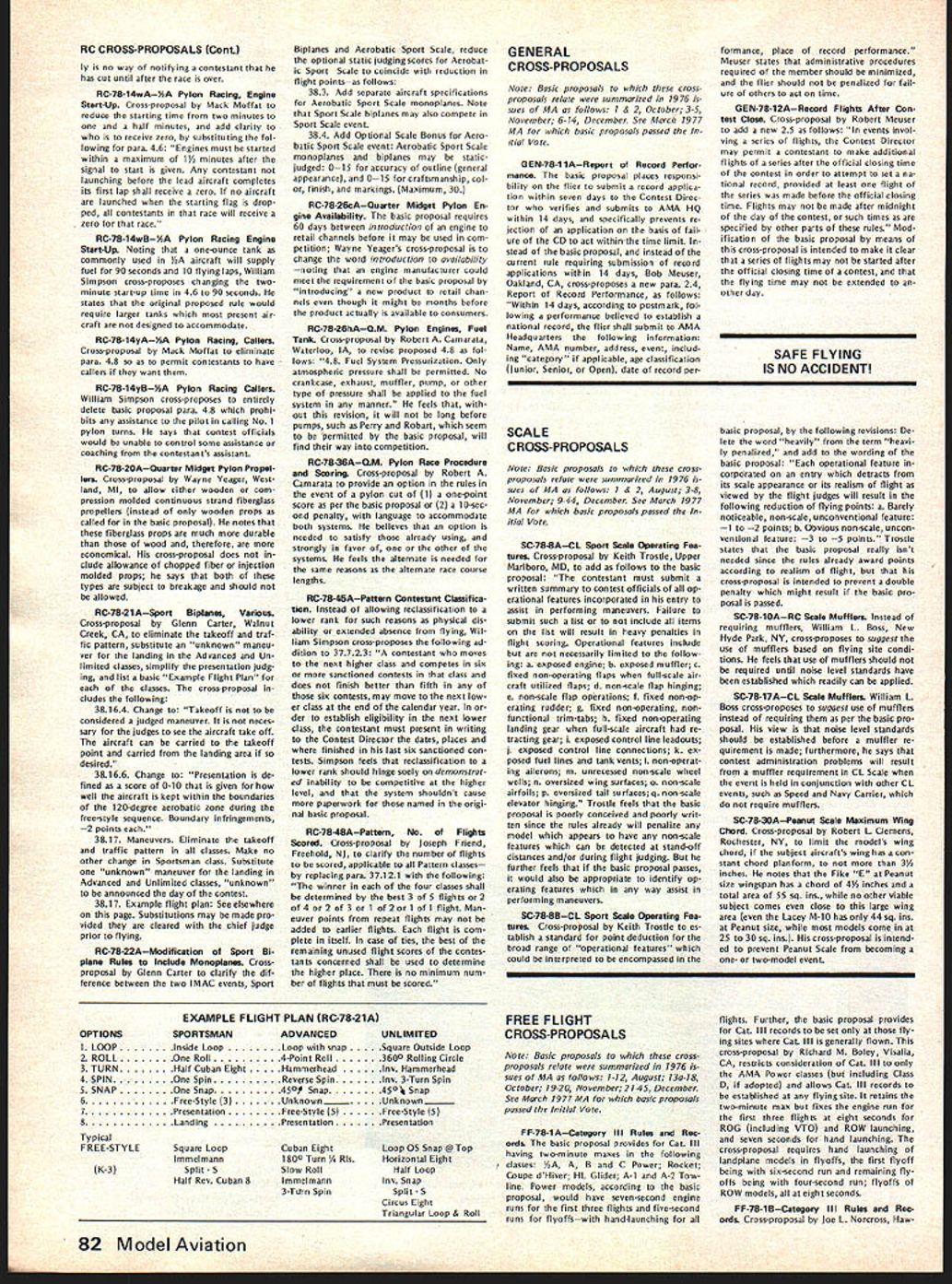
RC-78-21A—Sport Biplanes, Various. Cross-proposal by Glenn Carter, Walnut Creek, CA, to eliminate the takeoff and traffic pattern, substitute an "unknown" maneuver for the landing in the Advanced and Unlimited classes, simplify the presentation judging, and add a basic "Example Flight Plan" for each of the classes. The cross-proposal includes the following:
SB-16.4 Change to: "Takeoff is not to be considered a judged maneuver. It is not necessary for the judges to see the aircraft take off. The aircraft can be carried to the takeoff point and carried from the landing area if so desired."
SB-16.6 Change to: "Presentation is defined as a score of 0-10 that is given for how well the aircraft is kept within the boundaries of the 120-degree aerobatic box during the freestyle sequence. Boundary infringements are penalized."
SB-17.1 Maneuvers. Eliminate the takeoff and traffic pattern in all classes. Make no other change in Sportsman class. Substitute one "unknown" maneuver for the landing in Advanced and Unlimited classes; "unknown" to be announced the day of the contest.
SB-17.2 Example flight plan: See elsewhere on this page. Substitutions may be made provided they are consistent with the chief judge prior to flying.
RC-78-22A—Modification of Sport Biplane Rules to Include Monoplanes. Cross-proposal by Glenn Carter to clarify the difference between the two IMAC events, Sport Biplanes and Aerobatic Sport Scale, reduce the optional static judging scores for Aerobatic Sport Scale to coincide with reduction in flight points — with reduction in flight points — as follows:
38.3 Add separate aircraft specifications for Aerobatic Sport Scale monoplane. Note that Sport Scale biplanes may also compete in Sport Scale event.
38.4 Add Optional Scale Bonus for Aerobatic Sport Scale event: Aerobatic Sport Scale monoplane and biplanes may be static-judged: 0–15 for accuracy of outline (general appearance), and 0–15 for craftsmanship, color, finish, and markings. (Maximum, 30.)
RC-78-26A—Quarter Midget Pylon Engine Availability. The basic proposal requires 60 days between introduction of an engine to retail channels before it may be used in competition; Wayne Yeager's cross-proposal is to change the word "introduction" to "availability," noting that an engine manufacturer could meet the requirement of the basic proposal by "introducing" a new product to retail channels even though it might be months before the product actually is available to consumers.
RC-78-26B—Q.M. Pylon Engines, Fuel Tank. Cross-proposal by Robert A. Carman, Waterloo, IA, to revise proposed 4.8 as follows: "4.8 Fuel System Pressurization. Only atmospheric pressure shall be permitted. No crankcase, exhaust, muffler, pump, or other type of pressure shall be applied to the fuel system in any manner." He feels that without this revision, it will not be long before pumps, such as Perry and Robart, which seem to be permitted by the basic proposal, will find their way into competition.
RC-78-36A—Q.M. Pylon Race Procedure and Scoring. Cross-proposal by Robert A. Carman to provide an option in the rules in the event of a pylon cut of (1) a one-point score as per the basic proposal or (2) a 10-second penalty, with language to accommodate both systems. He believes that an option is needed to satisfy those already using, and strongly in favor of, one or the other of the systems. He also feels that the alternate is needed for the same reasons as the alternate race or lengths.
RC-78-45A—Pattern Contestant Classification. Instead of allowing reclassification at a lower rank for such reasons as physical disability or extended absence from flying, William Simpson cross-proposes the following addition to 37.2.3: "A contestant who wishes to be in the next higher class and who moves to the next higher class and competes in six or more sanctioned contests in that class and does not finish better than fifth in any of those contests, may move to the next lower class at the end of the calendar year. In order to establish eligibility in the next lower class, the contestant must present, in writing to the Contest Director, the dates, places and where finished in his last sanctioned contests." Simpson feels that reclassification to a lower rank should hinge solely on demonstrable inability to be competitive at the higher level, and that the system shouldn't cause more paperwork for those named in the original basic proposal.
RC-78-48A—Pattern, No. of Flights Scored. Cross-proposal by Joseph Friend, Freehold, NJ, to clarify the number of flights to be scored, applicable to all Pattern classes by replacing para. 37.12.1 with the following: "The number of flights scored shall be determined by the best 3 of 5 flights or 2 of 4 or 2 of 3 or 1 of 2 or 1 of 1 flight. Maneuvers repeated from repeated flights may not be added to earlier flights. Each flight is complete in itself. In case of ties the best of the remaining scored flights shall be used to determine the winner. There is no minimum number of flights that must be scored."
GENERAL CROSS-PROPOSALS
Note: Basic proposals to which these cross-proposals relate were summarized in 1976 issues of CN as follows: 1 & 2, October; 3-5, November; 6-14, December; See March 1977 for more which basic proposals passed the Initial Vote.
GEN-78-11A—Report of Record Performance. The basic proposal places responsibility on the flier to submit a record application within seven days to the Contest Director who verifies and submits to AMA HQ within 14 days, and specifically prevents rejection of an application on the basis of failure of the CD to act within the time limit. Instead of the basic proposal, and instead of the current rule requiring submission of record applications within 14 days, Bob Meuser, Oakland, CA, cross-proposes a new para. 2.4, "Report of Record Performance," as follows:
"Within 14 days, according to postmark, following a performance believed to establish a national record, the flier shall submit to AMA Headquarters the following information: Name, AMA number, address, event, including 'category' if applicable, age classification (Junior, Senior, or Open), date of record performance, place of record performance." Meuser states that administrative procedures required of the member should be minimized and the flier should not be penalized for failure of others to act on time.
GEN-78-12A—Record Flights After Contest Close. Cross-proposal by Robert Meuser to add a new 2.5 as follows: "In events involving a series of flights, the Contest Director may permit a contestant to make additional flights of certain series after the official closing time of the contest in order to attempt to set a national record, provided at least one flight of the series was made before the official closing time." Flights may not be made after midnight of the day of the contest, or such times as are specified by other parts of the rules.
SCALE CROSS-PROPOSALS
Note: Basic proposals to which these cross-proposals relate were summarized in 1976 issues of CN as follows: 1 & 2, August; 3-8, October; 9-14, December; See March 1977 for more which basic proposals passed the Initial Vote.
SC-78-8A—CL Sport Scale Operating Features. Cross-proposal by Keith Trostle, Upper Marlboro, MD, to add as follows to the basic proposal: "The contestant must submit a written summary to contest officials of all operational features incorporated in his entry to assist in performing maneuvers. Failure to do so shall result in heavy penalties in flight scoring. Operational features included but not limited to are pre-starting, pre-heating, exposed muffler; cowl flaps and exhaust; fixed non-operating flaps when full-scale aircraft used flaps; de-rigable flap hinge; nose/cowl intake for prop-driven operation; fixed non-operating retractable gear; fixed non-operating non-functional trim-tab flaps; fixed non-operating leading gear when full-scale aircraft had retracting gear; exposed control line leads; exposed fuel lines and tank vents; non-operating ailerons; non-operating flaps; non-operating trim tabs; over-sized intake; non-operating cowl flaps; exposed control line connections." Failure to list operational features or to include items on the list will result in heavy penalties.
SC-78-10A—CL Scale Mufflers. Instead of requiring mufflers, William L. Bruce, New Hyde Park, NY, cross-proposes to suggest that the use of mufflers be based on flying site conditions. He feels that use of mufflers should not be required until noise level standards have been established which readily can be applied.
SC-78-17A—CL Scale Mufflers. William L. Bruce cross-proposes to require mufflers as per the basic proposal. His view is that noise level standards should be established to measure the degree of engine noise; furthermore, he says that contest administration problems will result from a muffler requirement and many contests will be eliminated.
SC-78-20A—Peanut Scale Maximum Wing Chord. Cross-proposal by Robert L. Beers, Rochester, NY, to limit the model's wing chord to not more than 3/4 inch. He notes that the FAI "E" peanut size uses a 4-inch chord while his proposed maximum would limit certain designs; he suggests clarification and revision of the basic proposal to set a reasonable maximum wing chord for Peanut Scale.
SC-78-28A—CL Sport Scale Maximum Wing Chord. Cross-proposal by Robert L. Beers to establish maximum wing chord dimensions and to clarify measurement methods. He feels the basic proposal leaves too much to interpretation and that measurable limits should be set.
SC-78-88—CL Sport Scale Operating Features. Cross-proposal by Keith Trostle to establish a standard for point deduction for the broad range of "operational features" which could be interpreted to be encompassed in the basic proposal, by the following revisions: Delete the word "heavily" from the term "heavily penalized" and add to the wording of the basic proposal: "Each operational feature incorporated in an entry which detracts from its scale appearance or its realism of flight as viewed by the flight judges will result in the following reduction of flying points: A. Barely noticeable, non-scale, unconventional feature — 1 to 2 points; B. Obvious non-scale, unconventional feature — 3 to 5 points; C. Trostle states that the basic proposal really has the needed advice to the rules already and that by including a formal list of flight, but that his cross-proposal is intended to prevent double penalty which might result if the basic proposal is passed as printed."
SC-78-100A—CL Scale Mufflers. Instead of requiring mufflers, William L. Bruce, New Hyde Park, NY, cross-proposes to suggest that the use of mufflers be based on flying site conditions. He feels that use of mufflers should not be required until noise level standards have been established which readily can be applied.
SC-78-72A—CL Scale Mufflers. William L. Bruce cross-proposes to suggest that the use of mufflers be based on flying site conditions and that noise level standards be developed.
SC-78-73A—Peanut Scale Maximum Wing Chord. Cross-proposal by Robert L. Beers to limit Peanut Scale maximum wing chord. He suggests the limit be set to prevent Peanut Scale from becoming a one- or two-model event.
EXAMPLE FLIGHT PLAN (RC-78-21A)
OPTIONS SPORTSMAN ADVANCED UNLIMITED
- LOOP Inside Loop Loop with snap Square Outside Loop
- ROLL One Roll 1/4-Point Roll 360° Rolling Circle
- TURN Half Cuban Eight Hammerhead 2-Point Turn
- SPIN One Turn Reverse Spin 1/2-Spin
- SNAP One Snap (Free-Style) (Free-Style)
- Other Free-Style (1) Free-Style (1) Free-Style (1)
Typical FREE-STYLE Square Loop Cuban Eight Loop OS Snap @ Top (K-3) Half Rev, Cuban 3 180° Turn & Roll Horizontal Eight Split-S Slow Roll Half Loop 3-Turn Spin Loop & Roll Triangular Loop & Roll
FREE FLIGHT CROSS-PROPOSALS
Note: Basic proposals to which these cross-proposals relate were summarized in 1976 issues of CN as follows: 1 & 2, August; 3-18, October; 19-28, December; See March 1977 for what basic proposals passed the Initial Vote.
FF-78-1A—Category III Rules and Records. The basic proposal provides for Cat. III events for A, B, and C Power; Rocket; for Cat. III, H.P. Glider; A-1 and A-2 Towline; Power models, according to the basic proposal, would have servo-controlled timers for the first three flights with hand-launching for all flights. Further, the basic proposal provides for Cat. III records to be set only at those times the rules state Cat. III is generally flown. This cross-proposal by Richard H. Boley, Visalia, CA, restricts consideration of Cat. III to only the AMA Power classes (but including Class D, if adopted) and allows Cat. III records to be established as any flying site. It returns the two-minute shut time for flights in the engine run portion of Cat. III (including VTO) and ROW launching, and amends the proposal for the first flights and remaining flights being with six-second run and remaining flyoffs be with six-second run; flyoffs of ROW models, all at eight seconds.
FF-78-1B—Category III Rules and Records. Cross-proposal by Joel L. Norcross, Han-
1979 FAI FREE FLIGHT TEAM SELECTION PROGRAM
Stage 1 — Qualifying Trials
Qualification. AMA-sanctioned Free Flight meets and AMA-sanctioned Qualifying Trials are permitted. Qualification may be attempted at a regularly scheduled FF meet rather than at an AMA-sanctioned Qualifying Trial. A participant should ascertain from the Contest Director in advance whether the meet is prepared to accommodate the necessary timing and recording.
The full program consists of seven flights. AMA members having the $5 FAI stamp and models complying with the rules (see AMA rule book) are eligible to participate in the program. The initial phase program consisting of Qualifying Trials detailed in the March issue was approved. As of the end of February, 172 participants have approved the primary details of the entire program selection for the 1979 U.S. Free Flight World Championships teams. Three team members will be selected in A-2, Glider, Wakefield, Rubber and FAI Power. The overall program vote was 167 approvals, 30 opposed (84.7%), well satisfying the requirement established by the AMA Executive Council of 55% voting participant total.
Details of the program submitted were accepted. The program was hammered out in a 97-minute telephone conference call February 5 among members of AMA’s FAI Free Flight Committee, chaired by Bob Stalick. The conference call authorized the Executive Council on an experimental basis. The committee reported much effective dealing with matters by mail, but a good face-to-face meeting should be pointed out.
POSSIBLE RULES CHANGES IN SECOND STEP
September 1, 1976 deadline for basic proposals to revise current AMA competition rules with effectivity January 1, 1978. Summaries of basic proposals were printed in the August, October, November and December 1976 CN sections (Model Aviation). Basic proposals were subject to Initial Vote by various Contest Boards (combined CBs) on general proposals. Initial Vote results were printed in the March 1977 issue. Proposals passing a two-thirds majority go forward for additional consideration. Possible new rules also become subject to modification by means of cross-proposals; deadline for cross-proposals was March 1. Next vote by Contest Boards called the Interim Vote was to be concluded May 1. The purpose of that vote was to combine/reduce similar basic proposals and their counterpart cross-proposals. Cross-proposals were known under the absolute deadline issue March 3 and were summarized in that issue.
However, since the March 1 deadline pertains to postmark date, the possibility exists for acceptance of additional cross-proposals. A conference call followed, over two months, with individual committee phone calls and mailings. The program is actually similar to the 1977 program with the following items being principal differences:
- Time period: Qualifying Trials was extended to August 14, 1977.
- Team Finals site location: site suitability rather than geographic location determined rounds flown.
- Team Finals Program Manager description was developed further to establish authority of officials and limitation upon number who can qualify.
- Team Finals has established about 33 per event will be eligible; the 95% rule is retained. Alternates for Team Finals have eliminated limitation on number of models that can be flown in a single day.
- Team Finals has established provisions for those unable to report in a timely basis.
What You Can Do: Study the cross-proposals of interest and compare them to the basic proposals reported earlier (FF-78-1A, FF-78-1B are two separate cross-proposals; FF-78-1, for instance). Advise your Contest Board member or district representative in the appropriate category (CL, FF, RC, SC) by letter or personal contact whether you favor the basic proposal, the cross-proposal, or an alternate as soon as possible — preferably before mid-April. If a proposal is of interest, the advisory committee communicating opinion and, in addition, a representative of the advisory committee would be advisable.
Basic proposals passing the Initial Vote with no cross-proposals offered, or proposals resulting from combining/reducing in the Interim Vote, will be subject to the Contest Board Final Vote concluded September 1, 1977. Such proposals passing the Final Vote become new AMA competition rules effective January 1, 1978. Up until the time of the Final Vote, those interested in competition rules should take the time and trouble to advise Contest Board members, preferably by mail, how they feel about the various proposals. Take note of the fact that it is just as important to say why you favor a proposal as to say that you are against a proposal.
New budget income and expense were approved.
QUALIFICATION
AMA-sanctioned Free Flight meets and AMA-sanctioned Qualifying Trials are permitted. Qualification may be attempted at a regularly scheduled FF meet rather than at an AMA-sanctioned Qualifying Trial. A participant should ascertain from the Contest Director in advance whether the meet is prepared to accommodate the necessary timing and recording. The full program consists of seven flights. AMA members having the $5 FAI stamp and models complying with the rules (see AMA rule book) are eligible to participate in the program.
Transcribed from original scans by AI. Minor OCR errors may remain.

