
COMPETITION NEWSLETTER
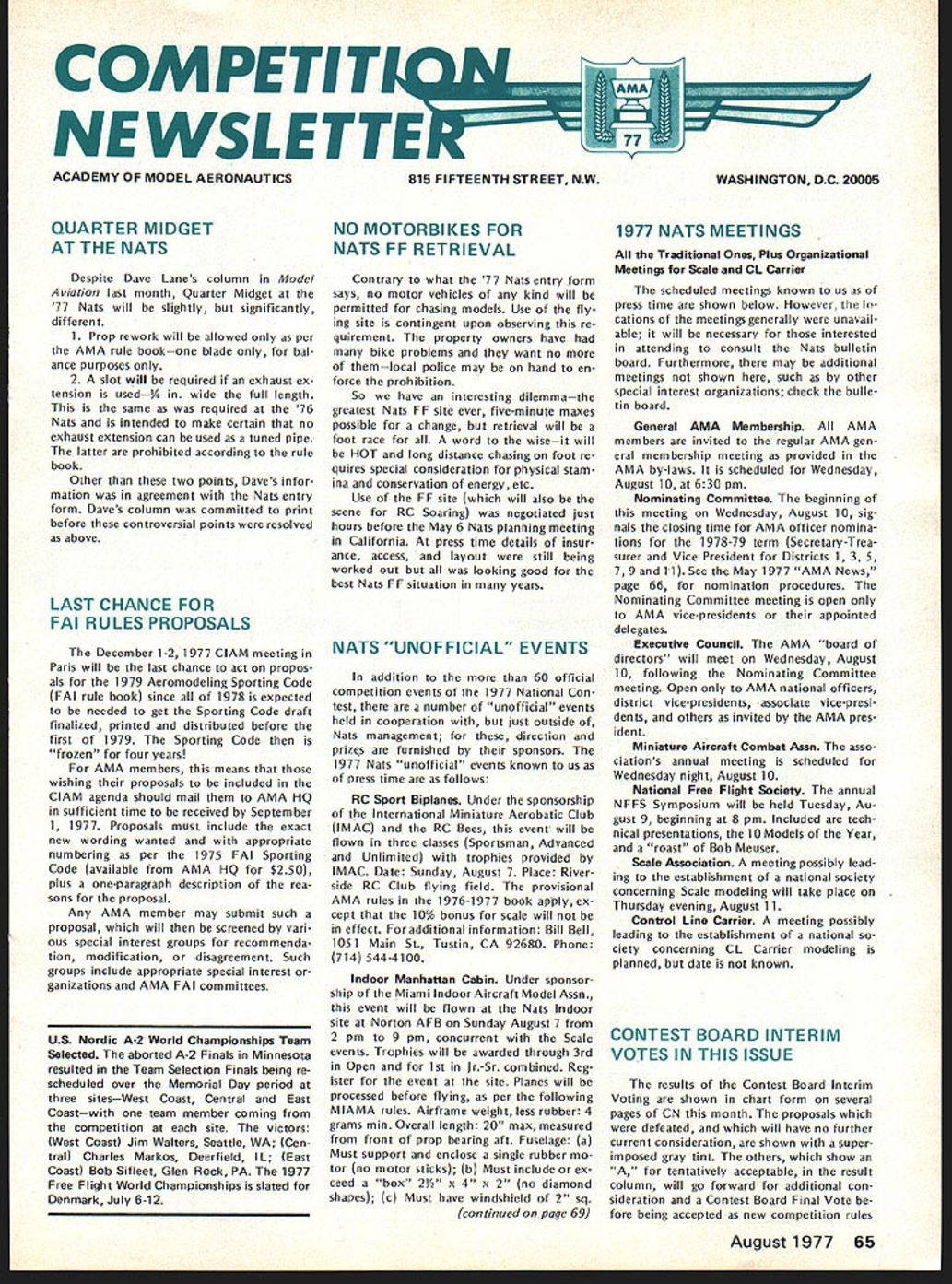
QUARTER MIDGET AT THE NATS
Despite Dave Lane's column in Model Aviation last month, Quarter Midget at the '77 Nats will be slightly, but significantly, different.
- Prop rework will be allowed only as per the AMA rule book—one blade only, for balance purposes only.
- A slot will be required if an exhaust extension is used—1/2 in. wide the full length. This is the same as was required at the '76 Nats and is intended to make certain that no exhaust extension can be used as a tuned pipe. The latter are prohibited according to the rule book.
Other than these two points, Dave's information was in agreement with the Nats entry form. Dave's column was committed to print before these controversial points were resolved as above.
LAST CHANCE FOR FAI RULES PROPOSALS
The December 1-2, 1977 CIAM meeting in Paris will be the last chance to act on proposals for the 1979 Aeromodelling Sporting Code (FAI rule book) since all of 1978 is expected to be needed to get the Sporting Code draft finalized, printed and distributed before the first of 1979. The Sporting Code then is "frozen" for four years!
For AMA members, this means that those wishing their proposals to be included in the CIAM agenda should mail them to AMA HQ in sufficient time to be received by September 1, 1977. Proposals must include the exact new wording wanted and with appropriate numbering as per the 1975 FAI Sporting Code (available from AMA HQ for $2.50), plus a one-paragraph description of the reasons for the proposal.
Any AMA member may submit such a proposal, which will then be screened by various special interest groups for recommendation, modification, or disagreement. Such groups include appropriate special interest organizations and AMA FAI committees.
U.S. Nordic A-2 World Championships Team Selected. The aborted A-2 Finals in Minnesota resulted in the Team Selection Finals being rescheduled over the Memorial Day period at three sites—West Coast, Central and East Coast—with one team member coming from the competition at each site. The victors: (West Coast) Jim Walters, Seattle, WA; (Central) Charles Markos, Deerfield, IL; (East Coast) Bob Sifleet, Glen Rock, PA. The 1977 Free Flight World Championships is slated for Denmark, July 6-12.
NO MOTORBIKES FOR NATS FF RETRIEVAL
Contrary to what the '77 Nats entry form says, no motor vehicles of any kind will be permitted for chasing models. Use of the flying site is contingent upon observing this requirement. The property owners have had many bike problems and they want no more of them—local police may be on hand to enforce the prohibition.
So we have an interesting dilemma—the greatest Nats FF site ever, five-minute maxes possible for a change, but retrieval will be a foot race for all. A word to the wise—it will be HOT and long distance chasing on foot requires special consideration for physical stamina and conservation of energy, etc.
Use of the FF site (which will also be the scene for RC Soaring) was negotiated just before the May 6 Nats planning meeting in California. At press time details of insurance, access, and layout were still being worked out but all was looking good for the best Nats FF situation in many years.
NATS "UNOFFICIAL" EVENTS
In addition to the more than 60 official competition events of the 1977 National Contest, there are a number of "unofficial" events held in cooperation with, but just outside of, Nats management; for these, direction and prizes are furnished by their sponsors. The 1977 Nats "unofficial" events known to us as of press time are as follows:
- RC Sport Biplanes. Under the sponsorship of the International Miniature Aerobatic Club (IMAC) and the RC Bees, this event will be flown in three classes (Sportsman, Advanced and Unlimited) with trophies provided by IMAC. Date: Sunday, August 7. Place: Riverside RC Club flying field. AMA rules in the 1976-1977 book apply, except that the 10% bonus for scale will not be in effect. For additional information: Bill Bell, 1051 Main St., Tustin, CA 92680. Phone (714) 544-4100.
- Indoor Manhattan Cabin. Under sponsorship of the Miami Indoor Aircraft Model Assn., this event will be flown at the Nats Indoor site at Norton AFB on Sunday, August 7 from 2 pm to 9 pm, concurrent with the Scale events. Trophies will be awarded through 3rd in Open and 1st in Jr.-Sr. combined. Register for the event at the site. Planes will be processed before flying as per the following MIAMA rules. Airframe weight, less rubber: 4 grams min. Overall length: 20" max, measured from front of prop bearing aft. Fuselage: (a) Must support and enclose a single rubber motor (no motor sticks); (b) Must include or exceed a "box" 2½" x 4" x 2" (no diamond shapes); (c) Must have windshield of 2" sq.
1977 NATS MEETINGS
All the Traditional Ones, Plus Organizational Meetings for Scale and CL Carrier
The scheduled meetings known to us as of press time are shown below. However, the locations of the meetings generally were unavailable; it will be necessary for those interested in attending to consult the Nats bulletin board. Furthermore, there may be additional meetings not shown here, such as by other special interest organizations; check the bulletin board.
General AMA Membership. All AMA members are invited to the regular AMA general membership meeting as provided in the AMA by-laws. It is scheduled for Wednesday, August 10, at 6:30 pm.
Nominating Committee. The beginning of this meeting on Wednesday, August 10, signals the closing time for AMA officer nominations for the 1978-79 term (Secretary-Treasurer and Vice President for Districts 1, 3, 5, 7, 9 and 11). See the May 1977 "AMA News," page 66, for nomination procedures. The Nominating Committee meeting is open only to AMA vice-presidents or their appointed delegates.
Executive Council. The AMA "board of directors" will meet on Wednesday, August 10, following the Nominating Committee meeting. Open only to AMA national officers, district vice-presidents, associate vice-presidents, and others as invited by the AMA president.
Miniature Aircraft Combat Assn. The association's annual meeting is scheduled for Wednesday night, August 10.
National Free Flight Society. The annual NFFS Symposium will be held Tuesday, August 9, beginning at 8 pm. Included are technical presentations, the 10 Models of the Year, and a "roast" of Bob Meuser.
Scale Association. A meeting possibly leading to the establishment of a national society concerning Scale modeling will take place on Thursday evening, August 11.
Control Line Carrier. A meeting possibly leading to the establishment of a national society concerning CL Carrier modeling is planned, but date is not known.
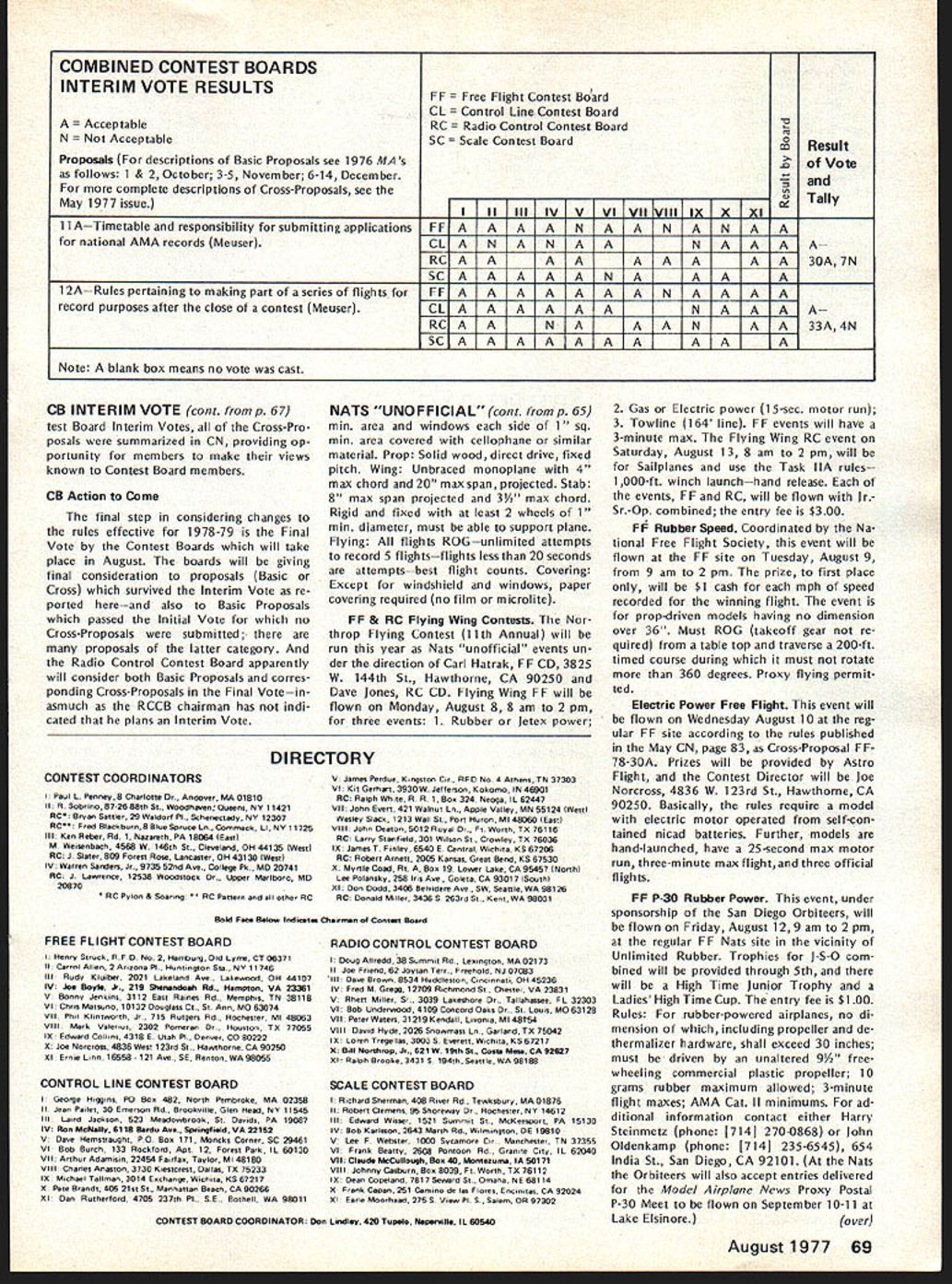
CONTEST BOARD INTERIM VOTES IN THIS ISSUE
The results of the Contest Board interim voting are shown in chart form on several pages of CN this month. The proposals which were defeated, and which will have no further current consideration, are shown with a superscript "a". The others, which show an "A" for tentatively acceptable in the result column, will go forward for additional consideration and a Contest Board Final Vote before being accepted as new competition rules.
CB INTERIM VOTES (cont.)
beginning in 1978.
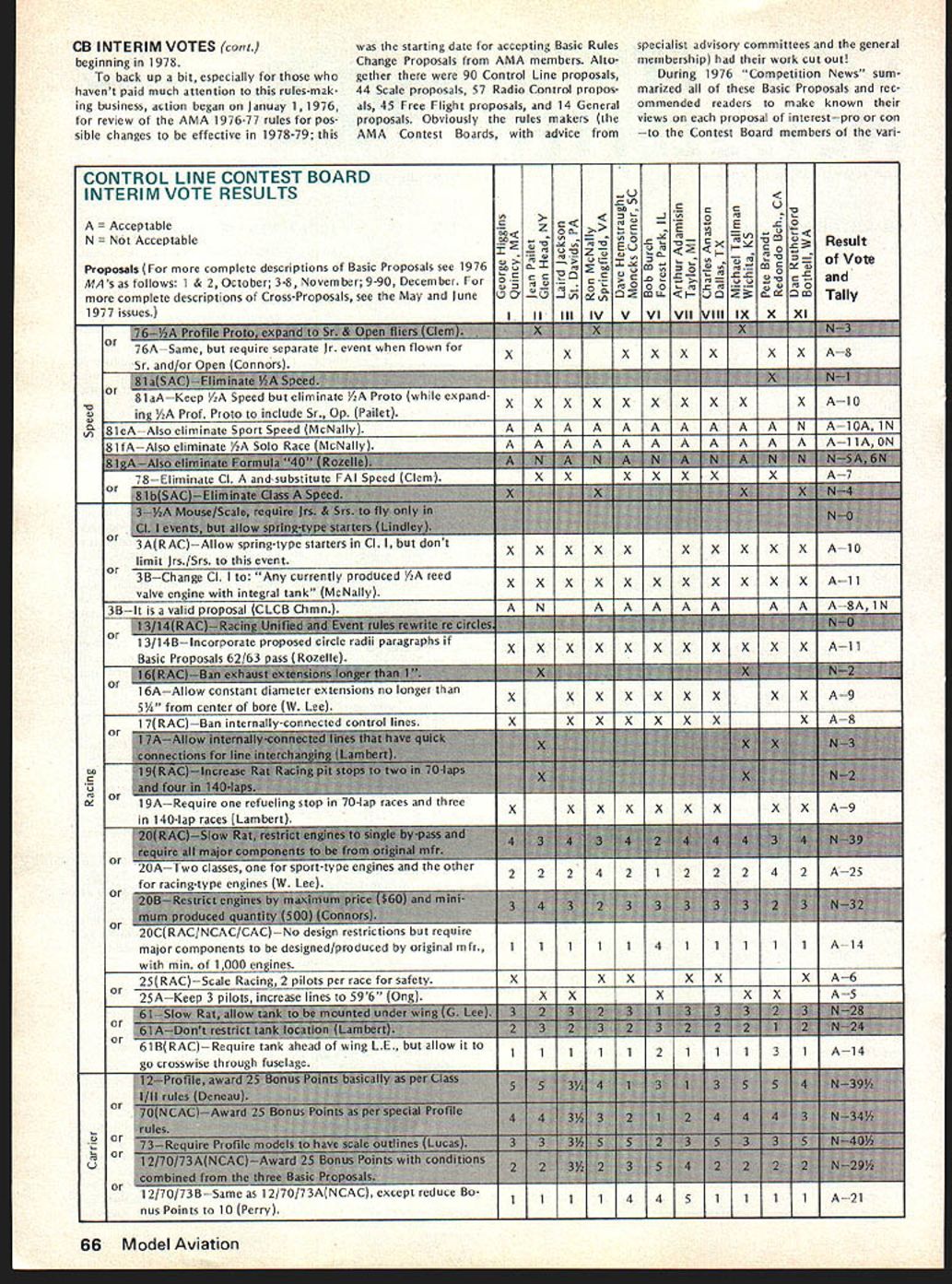
To back up a bit, especially for those who haven't paid much attention to this rules-making business, action began on January 1, 1976, for review of the AMA 1976-77 rules for possible changes to be effective in 1978-79; this was the starting date for accepting Basic Rules Change Proposals from AMA members. Altogether there were 90 Control Line proposals, 44 Scale proposals, 57 Radio Control proposals, 45 Free Flight proposals, and 14 General proposals. Obviously the rules makers (the AMA Contest Boards, with advice from specialist advisory committees and the general membership) had their work cut out!
During 1976 "Competition News" summarized all of these Basic Proposals and recommended readers to make known their views on each proposal of interest—pro or con—to the Contest Board members of the vari-
CONTROL LINE CONTEST BOARD INTERIM VOTE RESULTS
A = Acceptable N = Not Acceptable
Proposals (For more complete descriptions of Basic Proposals see 1976 AMA's as follows: 1 & 2, October; 3-8, November; 9-90, December. For more complete descriptions of Cross-Proposals, see the May and June 1977 issues.)
(or) 76—½A Profile Proto, expand to Sr. & Open fliers (Clem). ........................................ Result of Vote and Tally: N-3
(or) 76A—Same, but require separate Jr. event when flown for Sr. and/or Open (Connors). .......... Result: A-8
(or) 81a(SAC)—Eliminate ½A Speed. .............................................................................. Result: N-1
(or) 81aA—Keep ½A Speed but eliminate ½A Proto (while expanding ½A Prof. Proto to include Sr., Op.) (Pailet). Result: A-10
(or) 81cA—Also eliminate Sport Speed (McNally). ...................................................... Result: A—10A, 1N
(or) 81fA—Also eliminate ½A Solo Race (McNally). .................................................... Result: A—11A, 0N
(or) 81gA—Also eliminate Formula "40" (Rozelle). .................................................... Result: N—5A, 6N
(or) 78—Eliminate Cl. A and substitute FAI Speed (Clem). .......................................... Result: A-7
(or) 81b(SAC)—Eliminate Class A Speed. ................................................................... Result: N-4
(or) 3—½A Mouse/Scale, require Jrs. & Srs. to fly only in Cl. I events, but allow spring-type starters (Lindley). Result: N-0
(or) 3A(RAC)—Allow spring-type starters in Cl. I, but don't limit Jrs./Srs. to this event. ......... Result: A-10
(or) 3B—Change Cl. I to: "Any currently produced ½A reed valve engine with integral tank" (McNally). Result: A-11
3B—It is a valid proposal (CLCB Chmn.). ..................................................................... Result: A—8A, 1N
(or) 13/14(RAC)—Racing Unified and Event rules rewrite re circles. ................................ Result: N-0
(or) 13/14B—Incorporate proposed circle radii paragraphs if Basic Proposals 62/63 pass (Rozelle). Result: A-11
(or) 16(RAC)—Ban exhaust extensions longer than 1". .................................................. Result: N-2
(or) 16A—Allow constant diameter extensions no longer than 5/4" from center of bore (W. Lee). Result: A-9
(or) 17(RAC)—Ban internally-connected control lines. ................................................ Result: A-8
(or) 17A—Allow internally-connected lines that have quick connections for line interchange (Lambert). Result: N-3
(or) 19(RAC)—Increase Rat Racing pit stops to two in 70-lap and four in 140-laps. .............. Result: N-2
(or) 19A—Require one refueling stop in 70-lap races and three in 140-lap races (Lambert). ..... Result: A-9
(or) 20(RAC)—Slow Rat, restrict engines to single bypass and require all major components to be from original mfr. Result: N-39
(or) 20A—Two classes, one for sport-type engines and the other for racing-type engines (W. Lee). Result: A-25
(or) 20B—Restrict engines by maximum price ($60) and minimum produced quantity (500) (Connors). Result: N-32
(or) 20C(RAC/NCAC/CAC)—No design restrictions but require major components to be designed/produced by original mfr., with min. of 1,000 engines. Result: A-14
(or) 25(RAC)—Scale Racing, 2 pilots per race for safety. ........................................... Result: A-6
(or) 25A—Keep 3 pilots, increase lines to 59'6" (Ong). ............................................... Result: A-5
(or) 61—Slow Rat, allow tank to be mounted under wing (G. Lee). .................................. Result: N-28
(or) 61A—Don't restrict tank location (Lambert). .......................................................... Result: A-14
(or) 61B(RAC)—Require tank ahead of wing L.E., but allow it to go crosswise through fuselage. Result: N-39½
(or) 12—Profile, award 25 Bonus Points basically as per Class I/II rules (Denney). ............. Result: N-34½
(or) 70(NCAC)—Award 25 Bonus Points as per special Profile rules. ................................ Result: N-34½
(or) 73—Require Profile models to have scale outlines (Lucas). .................................... Result: N-40½
(or) 12/70/73A(NCAC)—Award 25 Bonus Points with conditions combined from the three Basic Proposals. Result: N-29½
(or) 12/70/73B—Same as 12/70/73A(NCAC), except reduce Bonus Points to 10 (Perry). Result: A-21
(Note: The above reproduces the left-hand proposal descriptions and the final "Result of Vote and Tally" entries as shown on the page.)
Competition Newsletter
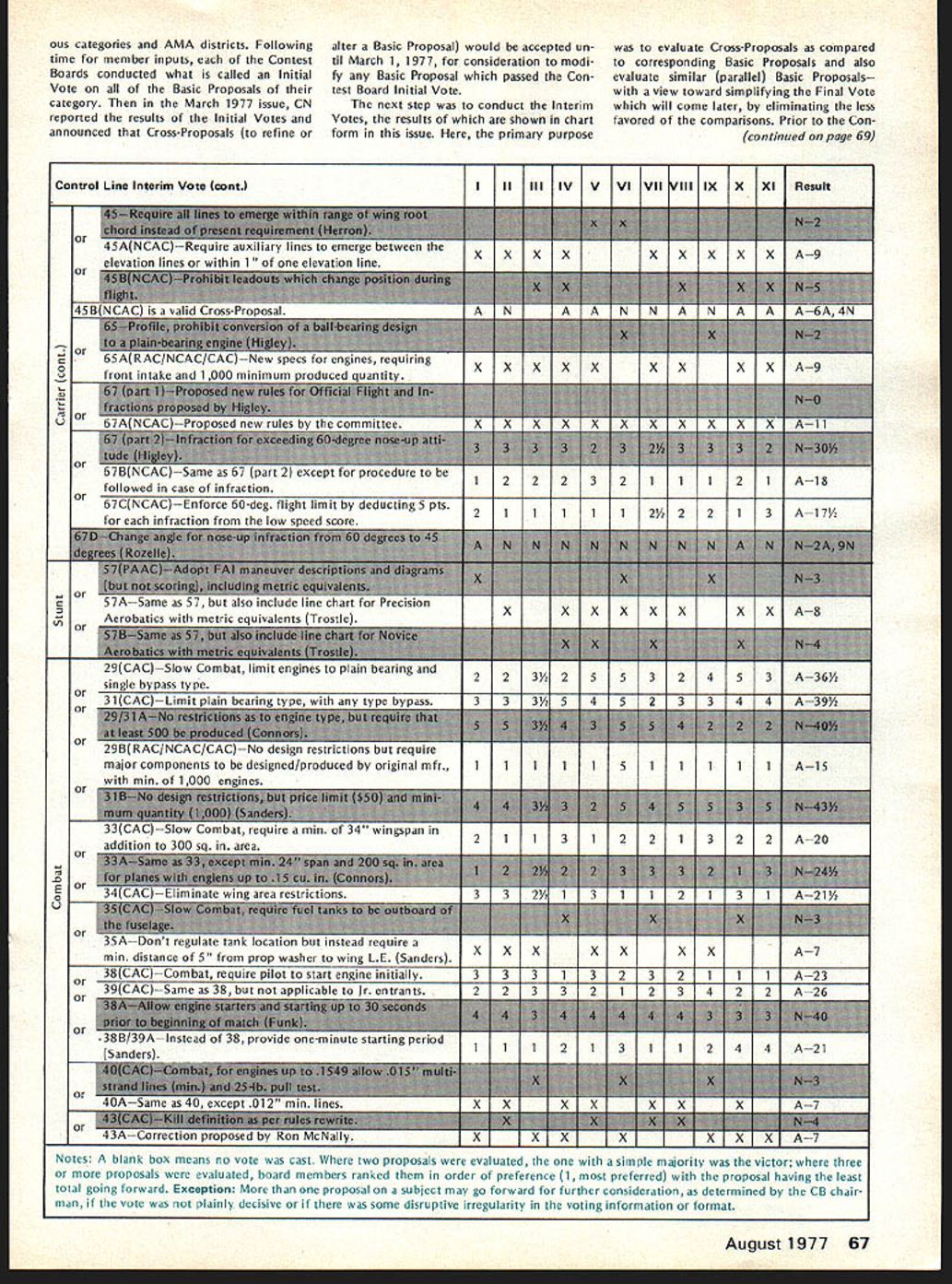
Control Line Interim Vote (cont.)
45—Require all lines to emerge within range of wing root chord instead of present requirement (Herron).
45A (NCAC)—Require auxiliary lines to emerge between the elevation lines or within 1" of one elevation line.
45B (NCAC)—Prohibit leadouts which change position during flight.
45B (NCAC) is a valid Cross‑Proposal.
65—Profile, prohibit conversion of a ball‑bearing design to a plain‑bearing engine (Higley).
65A (RAC/NCAC/CAC)—New specs for engines, requiring front intake and 1,000 minimum produced quantity.
67 (part 1)—Proposed new rules for Official Flight and Infractions proposed by Higley.
67A (NCAC)—Proposed new rules by the committee.
67 (part 2)—Infraction for exceeding 60‑degree nose‑up attitude (Higley).
67B (NCAC)—Same as 67 (part 2) except for procedure to be followed in case of infraction.
67C (NCAC)—Enforce 60‑deg. flight limit by deducting 5 pts. for each infraction from the low speed score.
67D—Change angle for nose‑up infraction from 60 degrees to 45 degrees (Rozelle).
57 (PAAC)—Adopt FAI maneuver descriptions and diagrams (but not scoring), including metric equivalents.
57A—Same as 57, but also include line chart for Precision Aerobatics with metric equivalents (Troste).
57B—Same as 57, but also include line chart for Novice Aerobatics with metric equivalents (Troste).
29 (CAC)—Slow Combat, limit engines to plain bearing and single bypass type.
31 (CAC)—Limit plain bearing type, with any type bypass.
29/31A—No restrictions as to engine type, but require that at least 500 be produced (Connors).
29B (RAC/NCAC/CAC)—No design restrictions but require major components to be designed/produced by original mfr., with min. of 1,000 engines.
31B—No design restrictions, but price limit ($50) and minimum quantity (1,000) (Sanders).
33 (CAC)—Slow Combat, require a min. of 34" wingspan in addition to 300 sq. in. area.
33A—Same as 33, except min. 24" span and 200 sq. in. area for planes with engines up to .15 cu. in. (Connors).
34 (CAC)—Eliminate wing area restrictions.
35 (CAC)—Slow Combat, require fuel tanks to be outboard of the fuselage.
35A—Don't regulate tank location but instead require a min. distance of 5" from prop washer to wing L.E. (Sanders).
38 (CAC)—Combat, require pilot to start engine initially.
39 (CAC)—Same as 38, but not applicable to Jr. entrants.
38A—Allow engine starters and starting up to 30 seconds prior to beginning of match (Funk).
38B/39A—Instead of 38, provide one‑minute starting period (Sanders).
40 (CAC)—Combat, for engines up to .1549 allow .015" multi‑strand lines (min.) and 25‑lb. pull test.
40A—Same as 40, except .012" min. lines.
43 (CAC)—Kill definition as per rules rewrite.
43A—Correction proposed by Ron McNally.
Notes: A blank box means no vote was cast. Where two proposals were evaluated, the one with a simple majority was the victor; where three or more proposals were evaluated, board members ranked them in order of preference (1, most preferred) with the proposal having the least total going forward. Exception: More than one proposal on a subject may go forward for further consideration, as determined by the CB chairman, if the vote was not plainly decisive or if there was some disruptive irregularity in the voting information or format.
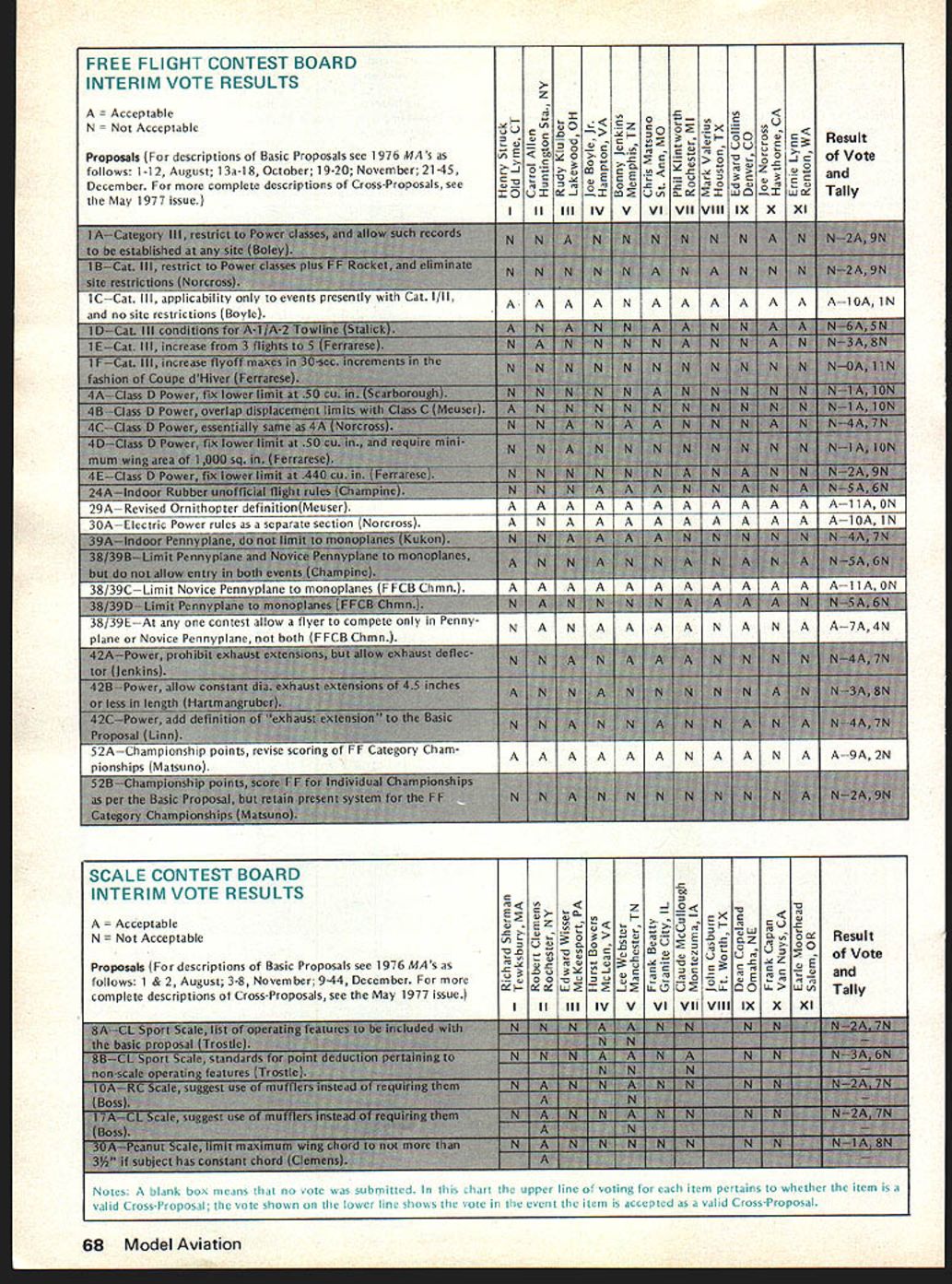
FREE FLIGHT CONTEST BOARD
INTERIM VOTE RESULTS
A = Acceptable N = Not Acceptable
Proposals (For descriptions of Basic Proposals see 1976 MA's as follows: 1-12, August; 13-18, October; 19-20, November; 21-45, December. For more complete descriptions of Cross-Proposals, see the May 1977 issue.)
1A—Category III, restrict to Power classes, and allow such records to be established at any site. (Boyle)
1B—Cat. III, restrict to Power classes plus FF Rocket, and eliminate site restrictions. (Norcross)
1C—Cat. III, applicability only to events presently with Cat. I/II, and no site restrictions. (Boyle)
1D—Cat. III conditions for A-1/A-2 Towline. (Stalick)
1E—Cat. III, increase from 3 flights to 5. (Ferrarese)
1F—Cat. III, increase flyoff maxes in 30-sec. increments in the fashion of Coupe d'Hiver. (Ferrarese)
4A—Class D Power, fix lower limit at .50 cu. in. (Scarborough)
4B—Class D Power, overlap displacement limits with Class C. (Meuser)
4C—Class D Power, essentially same as 4A. (Norcross)
4D—Class D Power, fix lower limit at .50 cu. in., and require minimum wing area of 1,000 sq. in. (Ferrarese)
4E—Class D Power, fix lower limit at .440 cu. in. (Ferrarese)
24A—Indoor Rubber unofficial flight rules. (Champine)
29A—Revised Ornithopter definition. (Meuser)
30A—Electric Power rules as a separate section. (Norcross)
39A—Indoor Pennyplane, do not limit to monoplanes. (Kukon)
38/39B—Limit Pennyplane and Novice Pennyplane to monoplanes, but do not allow entry in both events. (Champine)
38/39C—Limit Novice Pennyplane to monoplanes. (FFCB Chmn.)
38/39D—Limit Pennyplane to monoplanes. (FFCB Chmn.)
38/39E—At any one contest allow a flyer to compete only in Pennyplane or Novice Pennyplane, not both. (FFCB Chmn.)
42A—Power, prohibit exhaust extensions, but allow exhaust deflector. (Jenkins)
42B—Power, allow constant dia. exhaust extensions of 4.5 inches or less in length. (Hartmangruber)
42C—Power, add definition of "exhaust extension" to the Basic Proposal. (Linn)
52A—Championship points, revise scoring of FF Category Championships. (Matsuno)
52B—Championship points, score FF for Individual Championships as per the Basic Proposal, but retain present system for the FF Category Championships. (Matsuno)
Notes: A blank box means that no vote was submitted. In this chart the upper line of voting for each item pertains to whether the item is a valid Cross-Proposal; the vote shown on the lower line shows the vote in the event the item is accepted as a valid Cross-Proposal.
SCALE CONTEST BOARD
INTERIM VOTE RESULTS
A = Acceptable N = Not Acceptable
Proposals (For descriptions of Basic Proposals see 1976 MA's as follows: 1 & 2, August; 3-8, November; 9-44, December. For more complete descriptions of Cross-Proposals, see the May 1977 issue.)
8A—CL Sport Scale, list of operating features to be included with the basic proposal. (Troste)
8B—CL Sport Scale, standards for point deduction pertaining to non-scale operating features. (Troste)
10A—RC Scale, suggest use of mufflers instead of requiring them. (Boss)
17A—CL Scale, suggest use of mufflers instead of requiring them. (Boss)
30A—Peanut Scale, limit maximum wing chord to not more than 3/8" if subject has constant chord. (Clemens)
CB INTERIM VOTE (cont. from p. 67)
Contest Board Interim Votes, all of the Cross-Proposals were summarized in CN, providing opportunity for members to make their views known to Contest Board members.
CB Action to Come
The final step in considering changes to the rules effective for 1978-79 is the Final Vote by the Contest Boards which will take place in August. The boards will be giving final consideration to proposals (Basic or Cross) which survived the Interim Vote as reported here—and also to Basic Proposals which passed the Initial Vote for which no Cross-Proposals were submitted; there are many proposals of the latter category. And the Radio Control Contest Board apparently will consider both Basic Proposals and corresponding Cross-Proposals in the Final Vote—inasmuch as the RCCB chairman has not indicated that he plans an Interim Vote.
NATS "UNOFFICIAL" (cont. from p. 65)
min. area and windows each side of 1" sq. min. area covered with cellophane or similar material. Prop: Solid wood, direct drive, fixed pitch. Wing: Unbraced monoplane with 4" max chord and 20" max span, projected. Stab: 8" max span projected and 3½" max chord. Rigid and fixed with at least 2 wheels of 1" min. diameter, must be able to support plane. Flying: All flights ROG—unlimited attempts to record 5 flights—flights less than 20 seconds are attempts—best flight counts. Covering: Except for windshield and windows, paper covering required (no film or Microlite).
FF & RC Flying Wing Contests. The Northrop Flying Contest (11th Annual) will be run this year as Nats "unofficial" events under the direction of Carl Hatrak, FF CD, 3825 W. 144th St., Hawthorne, CA 90250 and Dave Jones, RC CD. Flying Wing FF will be flown on Monday, August 8, 8 am to 2 pm, for three events: 1. Rubber or Jetex power; 2. Gas or Electric power (15-sec. motor run); 3. Towline (164' line). FF events will have a 3-minute max. The Flying Wing RC event on Saturday, August 13, 8 am to 2 pm, will be for Sailplanes and use the Task III A rules—1,000-ft. winch launch—hand release. Each of the events, FF and RC, will be flown with Jr.-Sr. Op. combined; the entry fee is $3.00.
FF Rubber Speed. Coordinated by the National Free Flight Society, this event will be flown at the FF site on Tuesday, August 9, from 9 am to 2 pm. The prize, to first place only, will be $1 cash for each mph of speed recorded for the winning flight. The event is for prop-driven models having no dimension over 36". Must ROG (takeoff gear not required) from a table top and traverse a 200-ft. timed course during which it must not rotate more than 360 degrees. Proxy flying permitted.
Electric Power Free Flight. This event will be flown on Wednesday August 10 at the regular FF site according to the rules published in the May CN, page 83, as Cross-Proposal FF-78-30A. Prizes will be provided by Astro Flight, and the Contest Director will be Joe Norcross, 4836 W. 123rd St., Hawthorne, CA 90250. Basically, the rules require a model with electric motor operated from self-contained nicad batteries. Further, models are hand-launched, have a 25-second motor run, three-minute max flight, and three official flights.
FF P-30 Rubber Power. This event, under sponsorship of the San Diego Orbiters, will be flown on Friday, August 12, 9 am to 2 pm, at the regular FF Nats site in the vicinity of Unlimited Rubber. Trophies for 1.5-0 combined will be provided through 5th, and there will be a High Time Junior Trophy and a Ladies' High Time Cup. The entry fee is $1.00. Rules: For rubber-powered airplanes, no dimension of which, including propeller and thermals, shall exceed 30 inches; must be driven by an unaltered 9/16" free-wheeling commercial plastic propeller; 10 grams rubber maximum allowed; 3-minute flight maxima; AMA Cat. II minimums. For additional information contact either Harry Steinmetz (phone: [714] 270-0688) or John Oldenkamp (phone: [714] 235-6545), 654 India St., San Diego, CA 92101. (At the Nats the Orbiters will also accept entries delivered for the Model Airplane News Proxy Postal P-30 Meet to be flown on September 10-11 at Lake Elsinore.)
NATS "UNOFFICIAL" (cont.)
FF Night Flying. This West Coast specialty for Power models will be on Friday, August 12, from dark to midnight, at the regular Nats FF site. Coordinated by the National Free Flight Society.
FF Class D Power. Scheduled for Saturday, August 13, 9 am to 2 pm at the regular Nats FF site, rules will be the same as used at the U.S. FF Championships (Taft). Operation of the event is coordinated by the National Free Flight Society.
Control Line 1/2A Stunt. With prizes by Cox Hobbies, the Precision Aerobatics Model Pilots Assn. (PAMPA) will run this event in three AMA age classes (Junior, Senior, Open), with awards through third place in each. The event is scheduled for Saturday, August 13, starting in the morning, to be interrupted by the Walker Cup Finals, and continuing afterwards. AMA Precision Aerobatics rules apply except: .051 cu. in. maximum engine displacement; no builder-of-model requirement (may be ready-to-fly, built-up kit, or completely scratch-built); no appearance points; 1/2" AMA numbers permissible. The AMA maneuver schedule and attempt rules apply as do the .008" minimum diameter of the lines and 5-lb. pull test. For more details, check in at the PAMPA table at the Nats.
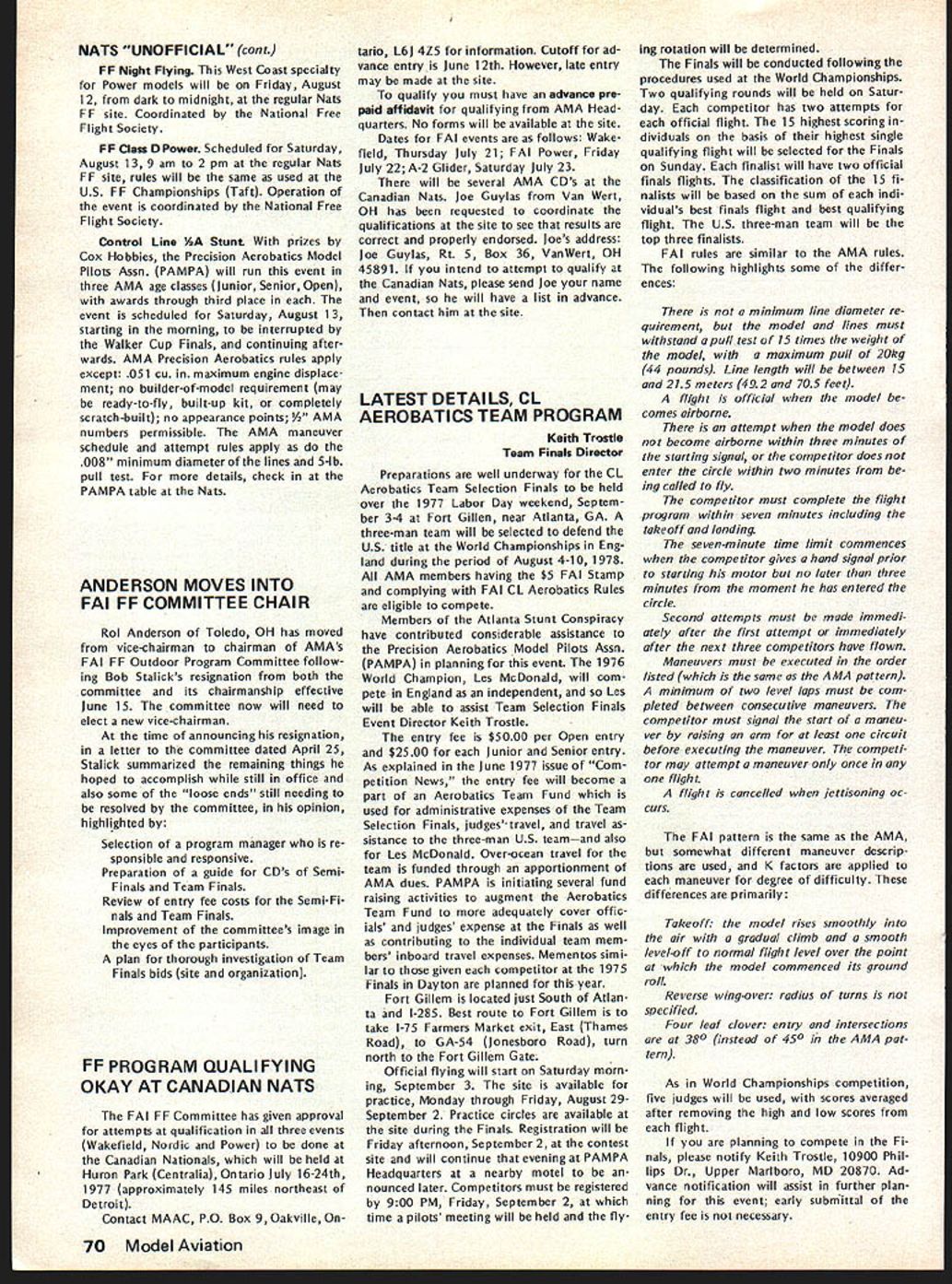
ANDERSON MOVES INTO FAI FF COMMITTEE CHAIR
Rol Anderson of Toledo, OH has moved from vice-chairman to chairman of AMA's FAI FF Outdoor Program Committee following Bob Stalick's resignation from both the committee and its chairmanship effective June 15. The committee now will need to elect a new vice-chairman.
At the time of announcing his resignation, in a letter to the committee dated April 25, Stalick summarized the remaining things he hoped to accomplish while still in office and also some of the "loose ends" still needing to be resolved by the committee, in his opinion, highlighted by:
- Selection of a program manager who is responsible and responsive.
- Preparation of a guide for CD's of Semi-Finals and Team Finals.
- Review of entry fee costs for the Semi-Finals and Team Finals.
- Improvement of the committee's image in the eyes of the participants.
- A plan for thorough investigation of Team Finals bids (site and organization).
FF PROGRAM QUALIFYING OKAY AT CANADIAN NATS
The FAI FF Committee has given approval for attempts at qualification in all three events (Wakefield, Nordic and Power) to be done at the Canadian Nationals, which will be held at Huron Park (Centralia), Ontario July 16-24th, 1977 (approximately 145 miles northeast of Detroit).
Contact MAAC, P.O. Box 9, Oakville, Ontario, L6J 4Z5 for information. Cutoff for advance entry is June 12th. However, late entry may be made at the site.
To qualify you must have an advance prepaid affidavit for qualifying from AMA Headquarters. No forms will be available at the site.
Dates for FAI events are as follows: Wakefield, Thursday July 21; FAI Power, Friday July 22; A-2 Glider, Saturday July 23.
There will be several AMA CD's at the Canadian Nats. Joe Guylas from Van Wert, OH has been requested to coordinate the qualifications at the site to see that results are correct and properly endorsed. Joe's address: Joe Guylas, Rt. 5, Box 36, Van Wert, OH 45891. If you intend to attempt to qualify at the Canadian Nats, please send Joe your name and event, so he will have a list in advance. Then contact him at the site.
LATEST DETAILS, CL AEROBATICS TEAM PROGRAM
Keith Trostle Team Finals Director
Preparations are well underway for the CL Aerobatics Team Selection Finals to be held over the 1977 Labor Day weekend, September 3-4 at Fort Gillem, near Atlanta, GA. A three-man team will be selected to defend the U.S. title at the World Championships in England during the period of August 4-10, 1978. All AMA members having the $5 FAI Stamp and complying with FAI CL Aerobatics Rules are eligible to compete.
Members of the Atlanta Stunt Conspiracy have contributed considerable assistance to the Precision Aerobatics Model Pilots Assn. (PAMPA) in planning for this event. The 1976 World Champion, Les McDonald, will compete in England as an independent, and so Les will be able to assist Team Selection Finals Event Director Keith Trostle.
The entry fee is $50.00 per Open entry and $25.00 for each Junior and Senior entry. As explained in the June 1977 issue of "Competition News," the entry fee will become a part of an Aerobatics Team Fund which is used for administrative expenses of the Team Selection Finals, judges' travel, and travel assistance to the three-man U.S. team—and also for Les McDonald. Over-ocean travel for the team is funded through an apportionment of AMA dues. PAMPA is initiating several fund raising activities to augment the Aerobatics Team Fund to more adequately cover officials' and judges' expenses at the Finals as well as contributing to the individual team members' intended travel expenses. Mementos similar to those given each competitor at the 1975 Finals in Dayton are planned for this year.
Fort Gillem is located just south of Atlanta and I-285. Best route to Fort Gillem is to take I-75 Farmers Market exit, East (Thames Road), to GA-54 (Jonesboro Road), turn north to the Fort Gillem Gate.
Official flying will start on Saturday morning, September 3. The site is available for practice, Monday through Friday, August 29-September 2. Practice circles are available at the site during the Finals. Registration will be Friday afternoon, September 2; activities will continue that evening at PAMPA Headquarters at a nearby motel to be announced later. Competitors must be registered by 9:00 PM, Friday, September 2, at which time a pilots' meeting will be held and the flying rotation will be determined.
The Finals will be conducted following the procedures used at the World Championships. Two qualifying rounds will be held on Saturday. Each competitor has two attempts for each official flight. The 15 highest scoring individuals on the basis of their highest single qualifying flight will be selected for the Finals on Sunday. Each finalist will have two official finals flights. The classification of the 15 finalists will be based on the sum of each individual's best finals flight and best qualifying flight. The U.S. three-man team will be the top three finalists.
FAI rules are similar to the AMA rules. The following highlights some of the differences:
- There is not a minimum line diameter requirement, but the model and lines must withstand a pull test of 15 times the weight of the model, with a maximum pull of 20 kg (44 pounds). Line length will be between 15 and 21.5 meters (49.2 and 70.5 feet).
- A flight is official when the model becomes airborne.
- There is an attempt when the model does not become airborne within three minutes of the starting signal, or the competitor does not enter the circle within two minutes from being called to fly.
- The competitor must complete the flight program within seven minutes including the takeoff and landing.
- The seven-minute time limit commences when the competitor gives a hand signal prior to starting his motor but no later than three minutes from the moment he has entered the circle.
- Second attempts must be made immediately after the first attempt or immediately after the next three competitors have flown.
- Maneuvers must be executed in the order listed (which is the same as the AMA pattern). A minimum of two level laps must be completed between consecutive maneuvers. Each competitor must signal the start of a maneuver by raising a fore or at least one signal prior to executing the maneuver. The competitor may attempt a maneuver only once in any one flight.
- A flight is cancelled when jettisoning occurs.
The FAI pattern is the same as the AMA, but somewhat different maneuver descriptions are used, and K factors are applied to each maneuver for degree of difficulty. These differences are primarily:
- Takeoff: the model rises smoothly into the air with a gradual climb and a smooth level-off to normal flight level over the point at which the model commenced its ground roll.
- Reverse wing-over: radius of turns is not specified.
- Four leaf clover: entry and intersections are at 38° (instead of 45° in the AMA pattern).
As in World Championships competition, five judges will be used, with scores averaged after removing the high and low scores from each flight.
If you are planning to compete in the Finals, please notify Keith Trostle, 10900 Phillips Dr., Upper Marlboro, MD 20708. Advance notification will assist in further planning for this event; early submittal of the entry fee is not necessary.
COMPETITION NEWSLETTER
Competition News will present, from time to time, constructive and thought-provoking ideas or criticisms of AMA rules and policies which affect competitors. When the issue has two sides, CN will endeavor to print all viewpoints that have been submitted—within the limits of available space, uniqueness, constructiveness, timeliness and good taste. Determination of the appropriateness of publication of any of these matters must of necessity rest solely with the publisher. The thoughts presented are those of the author, and should not necessarily be construed as those of AMA HQ, AMA officers or the publisher. All should note that publication here of a rules-change or policy-change idea does not necessarily mean that specific proposal has been presented to the Contest Board, Executive Council, or appropriate committee; such action is the responsibility of the author or anyone else interested in obtaining official action.
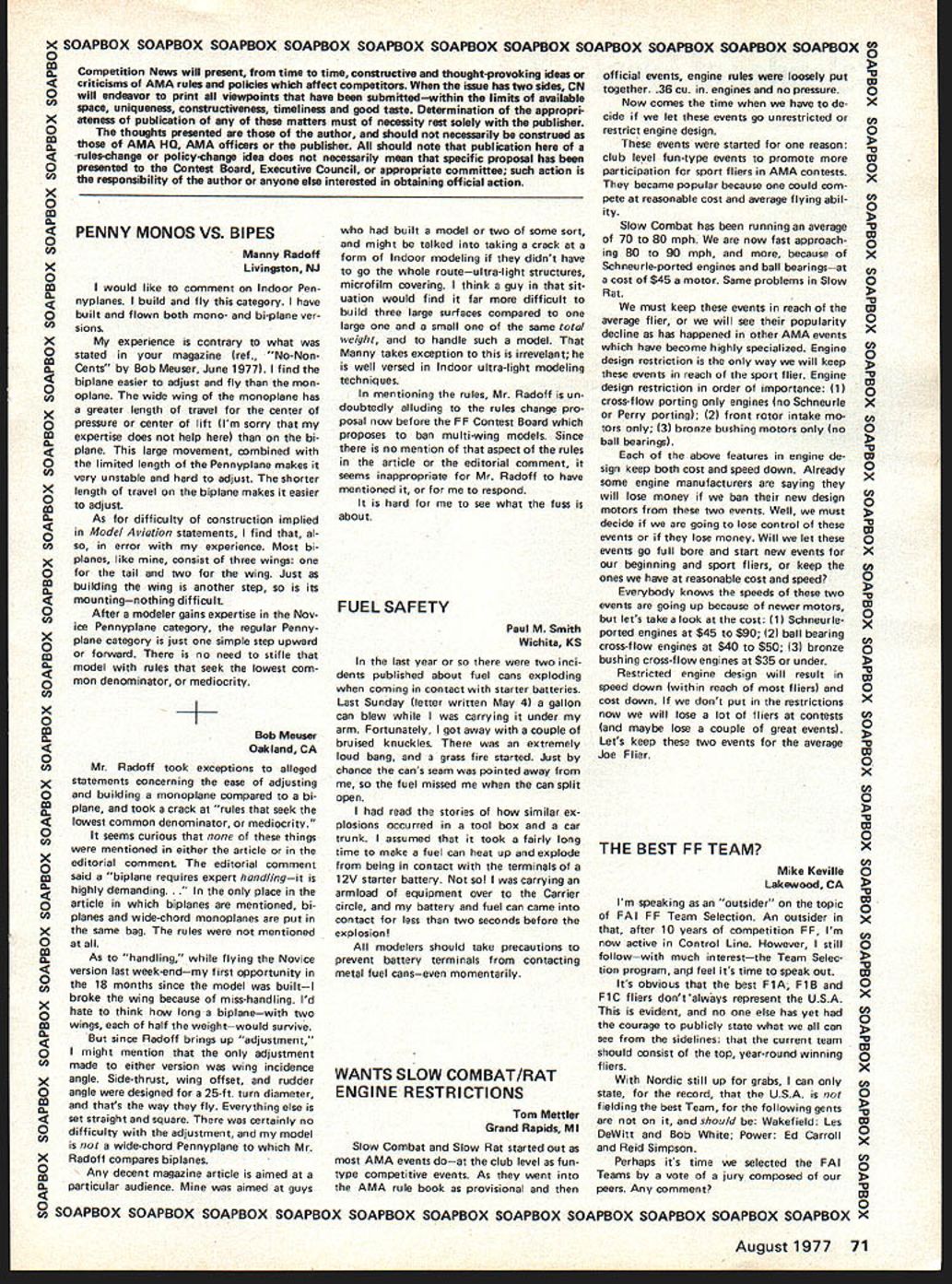
PENNY MONOS VS. BIPES
Manny Radoff Livingston, NJ
I would like to comment on Indoor Pennyplanes. I build and fly this category. I have built and flown both mono- and bi-plane versions.
My experience is contrary to what was stated in your magazine (ref., "No-Non-Cents" by Bob Meuser, June 1977). I find the biplane easier to adjust and fly than the monoplane. The wing of the monoplane has a greater length of travel for the center of pressure or center of lift (I'm sorry that my expertise does not help here) than on the biplane. This larger movement, combined with the limited length of the Pennyplane makes it very unstable and hard to adjust. The shorter length of travel on the biplane makes it easier to adjust.
As for difficulty of construction implied in Model Aviation statements, I find that, also, in error with my experience. Most biplanes, like mine, consist of three wings: one for the tail and two for the wing. Just as building the wing is another step, so is its mounting—nothing difficult.
After a modeler gains expertise in the Novice Pennyplane category, the regular Pennyplane category is just one simple step upward or forward. There is no need to stifle that model with rules that seek the lowest common denominator, or mediocrity.
— Bob Meuser Oakland, CA
Mr. Radoff took exceptions to alleged statements concerning the ease of adjusting and building a monoplane compared to a biplane, and took a crack at "rules that seek the lowest common denominator, or mediocrity."
It seems curious that none of these things were mentioned in either the article or in the editorial comment. The editorial comment said a "biplane requires expert handling—it is highly demanding." In the only place in the article in which biplanes are mentioned, biplanes and wide-chord monoplanes are put in the same bag. The rules were not mentioned at all.
As to "handling," while flying the Novice version last weekend—my first opportunity in the 18 months since the model was built—I broke the wing because of mis-handling. I'd hate to think how long a biplane—with two wings, each of half the weight—would survive.
But since Radoff brings up "adjustment," I might mention that the only adjustment made to either version was wing incidence angle. Side-thrust, wing offset, and rudder angle were designed for a 25-ft. turn diameter, and that's the way they fly. Everything else is straight and square. There was certainly no difficulty with the adjustment, and my model is not a wide-chord Pennyplane to which Mr. Radoff compares biplanes.
Any decent magazine article is aimed at a particular audience. Mine was aimed at guys who had built a model or two of some sort, and might be talked into taking a crack at a form of indoor modeling if they didn't have to go the whole route—ultra-light structures, microfilm covering. I think a guy in that situation would find it far more difficult to build three large surfaces compared to one large one and a small one of the same total weight, and to handle such a model. That is the reason I took exception to this issue.
Manny takes exception to this issue's irrelevance; he is well versed in indoor ultra-light modeling techniques.
In mentioning the rules, Mr. Radoff is undoubtedly alluding to the rules change proposal now before the FF Contest Board which proposes to ban multi-wing models. Since there is no mention of that aspect of the rules in the article or the editorial comment, it seems inappropriate for Mr. Radoff to have mentioned it, or for me to respond.
It is hard for me to see what the fuss is about.
NEW ACADEMY OF MODEL AERONAUTICS QUARTER MIDGET AT THE NATS
Despite Dave Lane's column in Model Aviation last month, Quarter Midget at the '77 Nats will be slightly—significantly—different.
- Prop rework will be allowed per AMA rule book—one-blade balance purposes.
- A slot will be required for exhaust extension used; wide full length same required. The '76 Nats intended make certain no exhaust extension can be used on tuned pipes; latter prohibited according to rule book.
Other two points in Dave's information are in agreement with the Nats entry form. Dave's column was committed to print before controversial points were resolved above.
LAST CHANCE FOR FAI RULES PROPOSALS
December 1-2, 1977 CIAM meeting, Paris, will be the last chance to act on proposals for the 1979 Aeromodeling Sporting Code (FAI rule book). Since a 1978 meeting is not expected, we need to get the Sporting Code draft finalized, printed and distributed before the first 1979 meeting. The Sporting Code is then frozen for four years. AMA members wishing proposals included on the CIAM agenda should mail them to AMA HQ in sufficient time to be received by September 1, 1977. Proposals must include the exact new wording wanted, appropriate numbering per the 1975 FAI Sporting Code (available from AMA HQ), $2.50 and a one-paragraph description giving reasons for the proposal. Any AMA member may submit such a proposal; it will be screened by various special interest groups for recommendation, modification or disagreement. Such groups include appropriate special interest organizations, AMA FAI committees, U.S. Nordic, etc.
A-2 WORLD CHAMPIONSHIPS TEAM SELECTED
Aborted A-2 Finals in Minnesota resulted in Team Selection Finals being re-scheduled over the Memorial Day period at three sites—West Coast, Central, East Coast—with team members coming from the competition site victors: West Coast: Jim Walters, Seattle, WA; Central: Charles Markos, Deerfield, IL; East Coast: Bob Sifleet, Glen Rock, PA.
1977 Free Flight World Championships slated: Denmark, July 6-12.
NO MOTORBIKES FOR NATS FF RETRIEVAL
Contrary to what the '77 Nats entry form says, no motor vehicles of any kind will be permitted in chasing models. Use of the flying site is contingent upon observing requirements property owners have—bikes cause problems; they want none of them; local police may and will enforce the prohibition. So we have an interesting dilemma—the greatest Nats FF site ever (five-minute maxes possible) will change retrieval to foot races. Word wise—it will be HOT. Long distance chasing on foot requires special consideration: physical stamina, conservation of energy, etc.
The FF site will also be the scene for RC Soaring—negotiated just hours before the May 6 Nats planning meeting. At California press time details of insurance, access and layout were still being worked out, but it's looking good—the best Nats FF situation in years.
NATS UNOFFICIAL EVENTS
In addition to 60 official competition events at the 1977 National Contest, a number of unofficial events will be held in cooperation just outside Nats management direction. Prizes are furnished by sponsors. 1977 Nats unofficial events known at press time follow:
- RC Sport Biplanes
Under sponsorship of International Miniature Aerobatic Club (IMAC). RC Bipes event will be flown in three classes: Sportsman, Advanced, Unlimited. Trophies provided by IMAC. Date: Sunday, August 7. Place: Riverside RC Club flying field (provisional). AMA rules 1976-1977 book apply except 10% bonus scale will not affect. Additional information: Bill Bell, 1051 Main St., Tustin, CA 92680. Phone: (714) 544-4100.
- Indoor Manhattan Cabin
Under sponsorship of Miami Indoor Aircraft Model Assn. Event will be flown at Nats indoor site, Norton AFB, Sunday, August 7, 2 p.m.–9 p.m., concurrent with Scale events. Trophies will be awarded through 3rd place Open, 1st Jr.-Sr. combined. Register at event site. Planes will be processed before flying per the following MIAMA rules: a. Airframe weight less rubber: 4 grams max. b. Overall length: 20" max measured from front prop bearing aft. c. Fuselage must support/enclose single rubber motor—no motor sticks. d. Must include exceed box 2/2 x 4 x 2—no diamond shapes. e. Must have windshield 2 sq. in.
(continued descriptions and specifics of rules and processing at event site)
1977 NATS MEETINGS
Traditional ones plus organizational meetings. Scale, CL, Carrier scheduled meetings known at press time shown below. However, locations for meetings generally unavailable; will necessary interested attending consult Nats bulletin.
Transcribed from original scans by AI. Minor OCR errors may remain.

