
Prettner Wins RC World Champs U.S. Team Tops
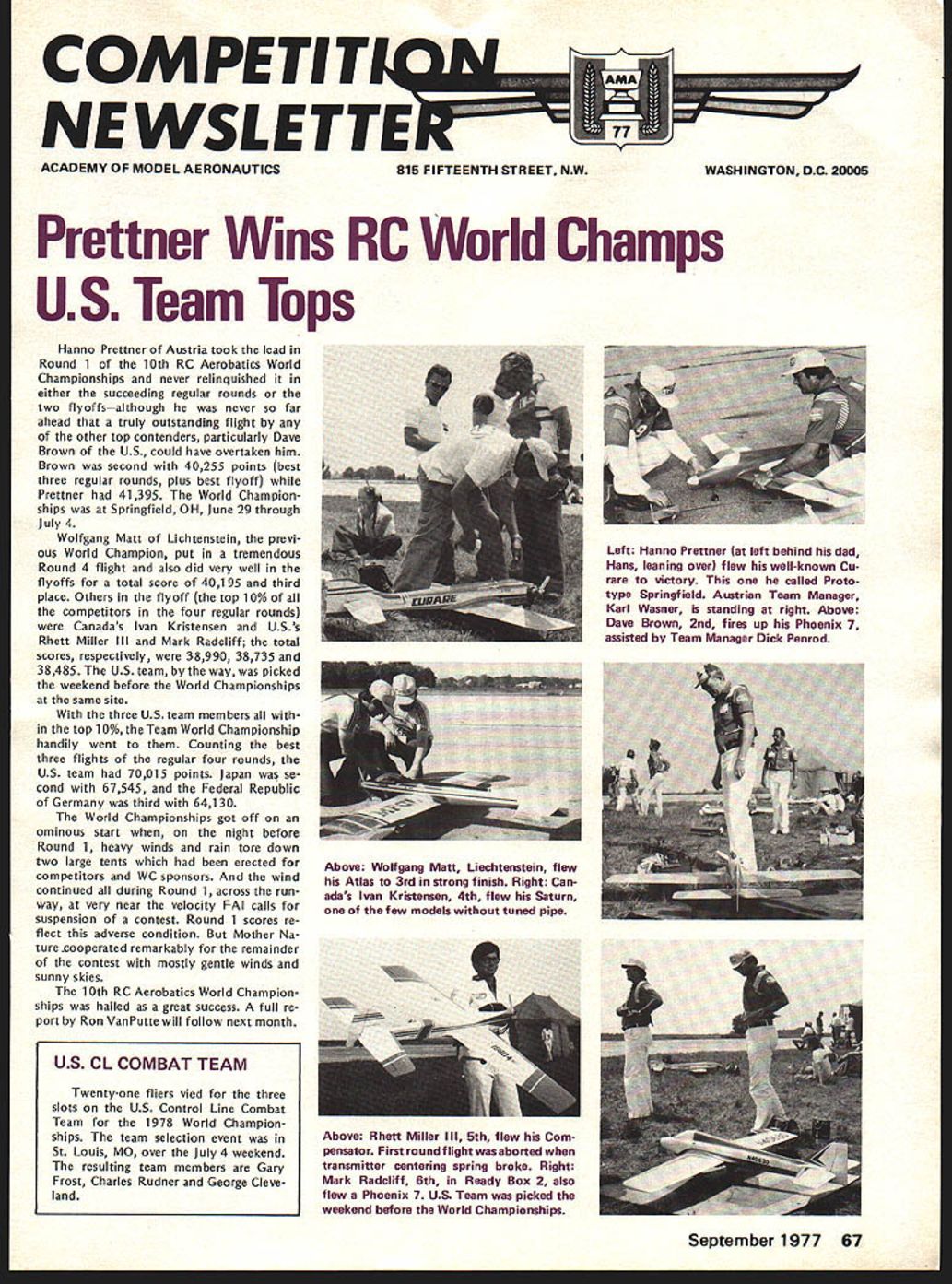
Hanno Prettner of Austria took the lead in Round 1 of the 10th RC Aerobatics World Championships and never relinquished it in either the succeeding regular rounds or the two flyoffs—although he was never so far ahead that a truly outstanding flight by any of the other top contenders, particularly Dave Brown of the U.S., could have overtaken him. Brown was second with 40,255 points (best three regular rounds, plus best flyoff) while Prettner had 41,395. The World Championships was at Springfield, OH, June 29 through July 4.
Wolfgang Matt of Liechtenstein, the previous World Champion, put in a tremendous Round 4 flight and also did very well in the flyoffs for a total score of 40,195 and third place. Others in the flyoff (the top 10% of the competitors in the four regular rounds) were Canada’s Ivan Kristensen and U.S.’s Rhett Miller III and Mark Radcliff; the total scores, respectively, were 38,990, 38,735 and 38,485. The U.S. team, by the way, was picked the weekend before the World Championships at the same site.
With the three U.S. team members all within the top 10%, the Team World Championship handily went to them. Counting the best three flights of the regular four rounds, the U.S. team had 70,015 points. Japan was second with 67,545, and the Federal Republic of Germany was third with 64,130.
The World Championships got off on an ominous start when, on the night before Round 1, heavy winds and rain tore down two large tents which had been erected for competitors and WC sponsors. And the wind continued all during Round 1, across the runway, at very near the velocity FAI calls for suspension of a contest. Round 1 scores reflect this adverse condition. But Mother Nature cooperated remarkably for the remainder of the contest with mostly gentle winds and sunny skies.
The 10th RC Aerobatics World Championships was hailed as a great success. A full report by Ron VanPutte will follow next month.
FF NORDIC TEAM SELECTION
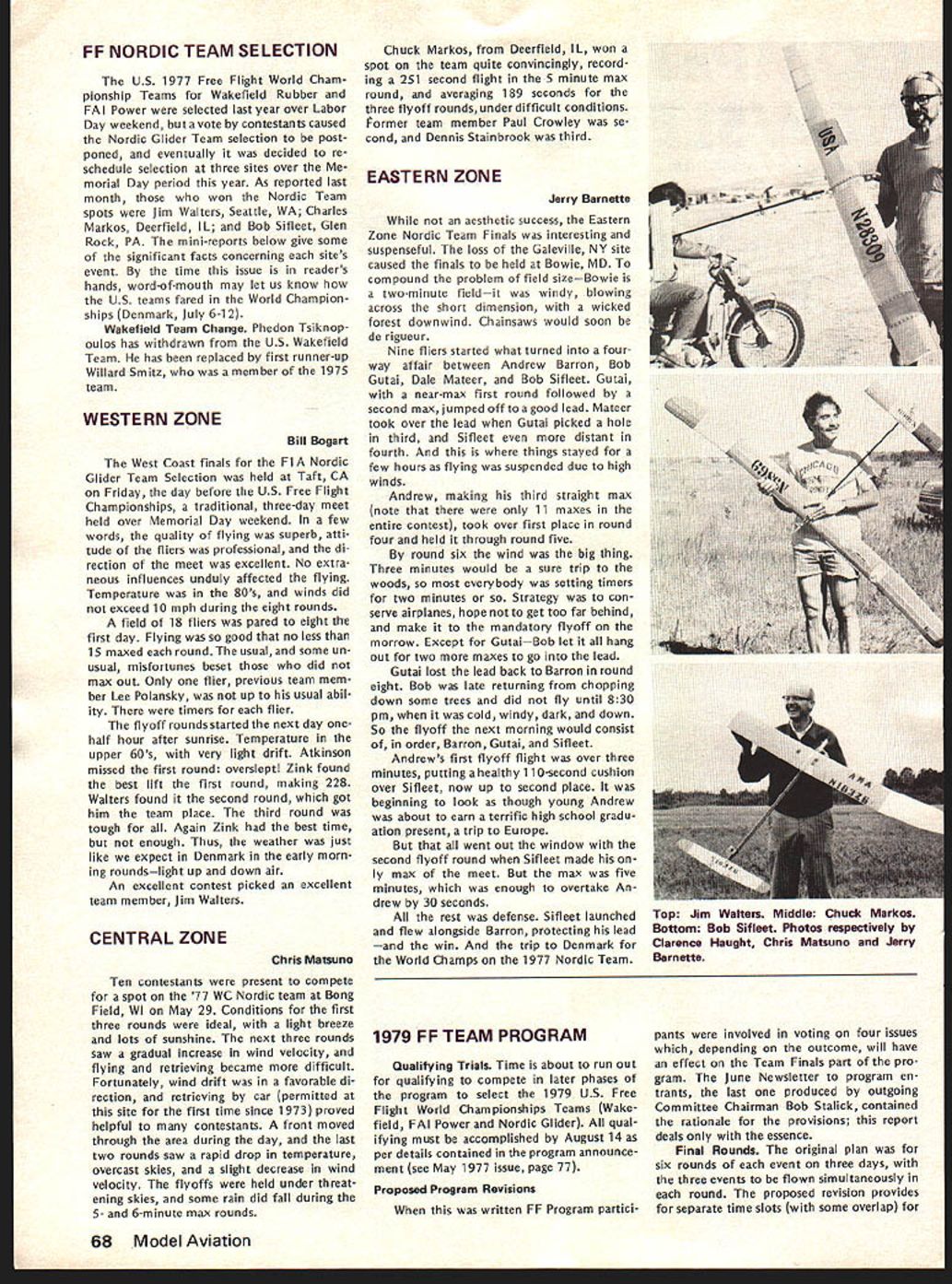
The U.S. 1977 Free Flight World Championship Teams for Wakefield Rubber and FAI Power were selected last year over Labor Day weekend, but a vote by contestants caused the Nordic Glider Team selection to be postponed, and eventually it was decided to re-schedule selection at three sites over the Memorial Day period this year. As reported last month, those who won the Nordic Team spots were Jim Walters, Seattle, WA; Charles Markos, Deerfield, IL; and Bob Sifleet, Glen Rock, PA. The mini-reports below give some of the significant facts concerning each site's event. By the time this issue is in readers' hands, word-of-mouth may let us know how the U.S. teams fared in the World Championships (Denmark, July 6-12).
Wakefield Team Change. Phedon Tsiknopoulos has withdrawn from the U.S. Wakefield Team. He has been replaced by first runner-up Willard Smitz, who was a member of the 1975 team.
WESTERN ZONE
Bill Bogert
The West Coast finals for the F/A Nordic Glider Team Selection was held at Taft, CA on Friday, the day before the U.S. Free Flight Championships, a traditional, three-day meet held over Memorial Day weekend. In a few words, the quality of flying was superb, attitude of the fliers was professional, and the direction of the meet was excellent. No extraneous influences unduly affected the flying. Temperature was in the 80's, and winds did not exceed 10 mph during the eight rounds.
A field of 18 fliers was pared to eight the first day. Flying was so good that no more than 15 maxed each round. The usual, and some unusual, misfortunes beset those who did not max out. Only one flier, previous team member Lee Polansky, was not up to his usual ability. There were timers for each flier.
The flyoff rounds started the next day one-half hour after sunrise. Temperature in the upper 60's, with very light drift. Atkinson missed the first round; overslept! Zink found the best lift the first round, making 228. Walters found it the second round, which got him the team place. The third round was tough for all. Again Zink had the best time, but not enough. Thus, the weather was just like we expect in Denmark in the early morning rounds—light up and down air.
An excellent contest picked an excellent team member, Jim Walters.
CENTRAL ZONE
Chris Matsuno
Ten contestants were present to compete for a spot on the '77 WC Nordic team at Bong Field, WI on May 29. Conditions for the first three rounds were ideal, with a light breeze and lots of sunshine. The next three rounds saw a gradual increase in wind velocity, and flying and retrieving became more difficult. Fortunately, wind drift was in a favorable direction, and retrieving by car (permitted at this site for the first time since 1973) proved helpful to many contestants. A front moved through the area during the day, and the last two rounds saw a rapid drop in temperature, overcast skies, and a slight decrease in wind velocity. The flyoffs were held under threatening skies, and some rain did fall during the 5- and 6-minute max rounds.
Chuck Markos, from Deerfield, IL, won a spot on the team quite convincingly, recording a 251 second flight in the 5 minute max round, and averaging 189 seconds for the three flyoff rounds, under difficult conditions. Former team member Paul Crowley was second, and Dennis Stainbrook was third.
EASTERN ZONE
Jerry Barnette
While not an aesthetic success, the Eastern Zone Nordic Team Finals was interesting and suspenseful. The Galleville, NY site caused the finals to be held at Bowie, MD. To compound the problem of field size—Bowie is a two-minute field—it was windy, blowing across the short dimension, with a wicked forest downwind. Chainsaws would soon be de rigueur.
Nine fliers started what turned into a four-way affair between Andrew Barron, Bob Gutai, Dale Mateer, and Bob Sifleet. Gutai, with a near-max first round followed by a second max, jumped off to a good lead. Mateer took over the lead when Gutai picked a hole in third, and Sifleet even more distant in fourth. And this is where things stayed for a few hours as flying was suspended due to high winds.
Andrew, making his third straight max (note that there were only 11 maxes in the entire contest), took over first place in round four and held it through round five.
By round six the wind was the big thing. Three minutes would be a sure trip to the woods, so most everybody was setting timers for two minutes or so. Strategy was to conserve airplanes, hope not to get too far behind, and make it to the mandatory flyoff on the morrow. Except for Gutai—Bob let it all hang out for two more maxes to go into the lead.
Gutai lost the lead back to Barron in round eight. Bob was late returning from chopping down some trees and did not fly until 8:30 pm, when it was cold, windy, dark, and down. So the flyoff the next morning would consist of, in order, Barron, Gutai, and Sifleet.
Andrew's first flyoff flight was over three minutes, putting a healthy 110-second cushion over Sifleet, now up to second place. It was beginning to look as though young Andrew was about to earn a terrific high school graduation present, a trip to Europe.
But that all went out the window with the second flyoff round when Sifleet made his only max of the meet. But the max was five minutes, which was enough to overtake Andrew by 30 seconds.
All the rest was defense. Sifleet launched and flew alongside Barron, protecting his lead—and the win. And the trip to Denmark for the World Champs on the 1977 Nordic Team.
1979 FF TEAM PROGRAM
Qualifying Trials. Time is about to run out for qualifying to compete in later phases of the program to select the 1979 U.S. Free Flight World Championships Teams (Wakefield, FAI Power and Nordic Glider). All qualifying must be accomplished by August 14 as per details contained in the program announcement (see May 1977 issue, page 77).
Proposed Program Revisions
When this was written FF Program partici- each of the events within each round, with the event sequence (which event goes off 1st, 2nd and 3rd) alternating on the three days.
Finals Cancellation Procedure.
The proposal is to adopt a procedure allowing an event to be cancelled by 75% contestant vote, with the decision to call for such vote resting with the CD of the Finals in agreement with the Program Manager. The proposal provides that the vote can be taken only at the end of the seventh round, and should an event be cancelled in this manner, the rescheduling will rest solely with the AMA FAI FF Committee.
Alternates to the Finals.
Although former programs have allowed alternates to compete in the Team Finals when the primary qualifiers from the Semi-Finals could not attend, the announced program for 1979 team selection had no provision for alternates whatsoever. Now, it is proposed to allow alternates from Semi-Finals to the Finals with the following rules: (A) The number of finalists plus alternates from any given Semi-Finals site is not to exceed the number allowed from that site by formula only (this excludes people advanced under the 95% rule); (B) For any alternate at any Semi-Finals to be invited to the Finals, he must have made at least 80% of the score (time) of the lowest finalist at that Semi-Final.
Team Finals Dates.
Program participants are being asked to choose between Labor Day weekend 1978 (September 2-4, 1978) or the week preceding the 1978 AMA National Contest (date unknown, possibly early August 1978).
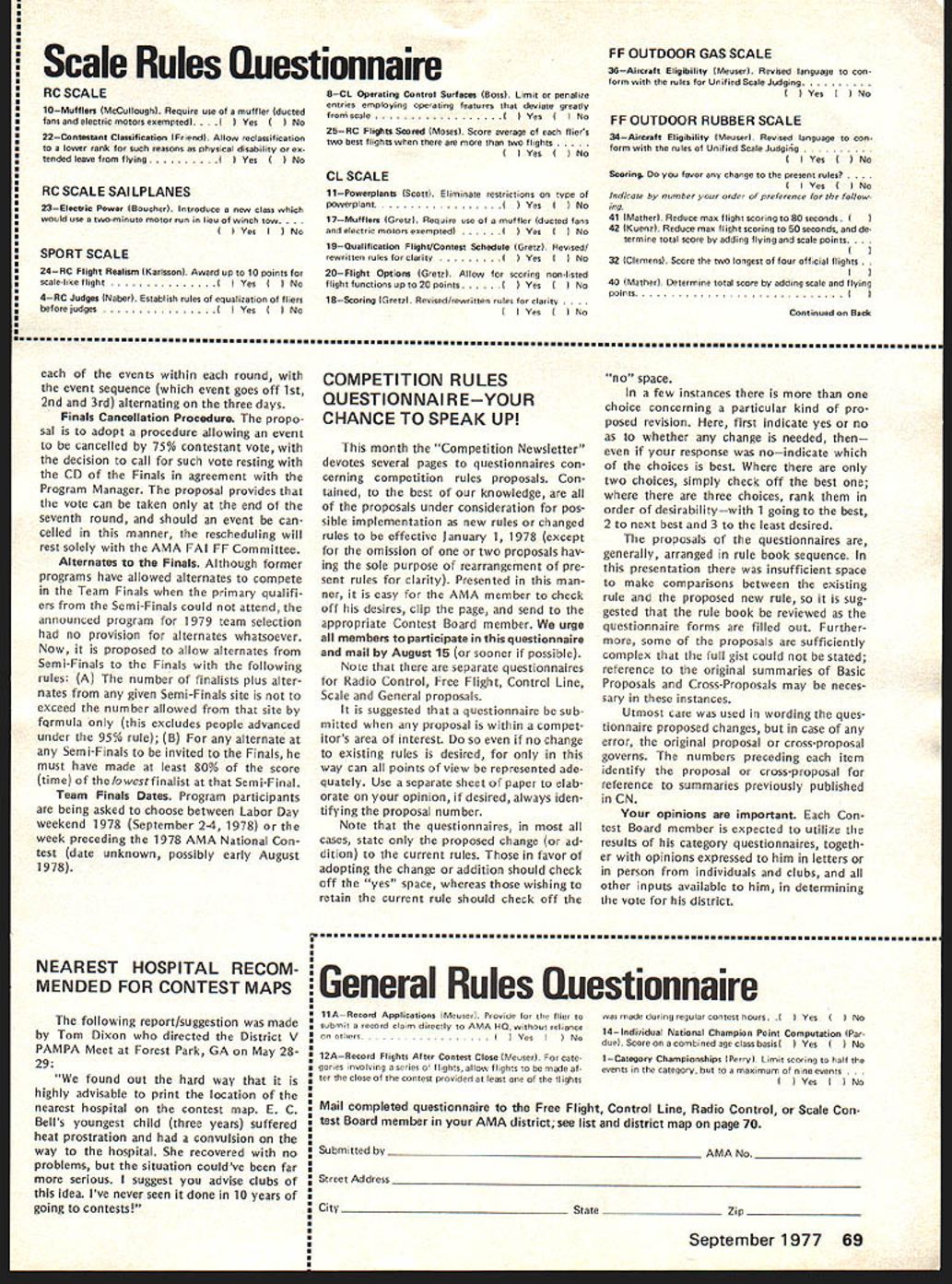
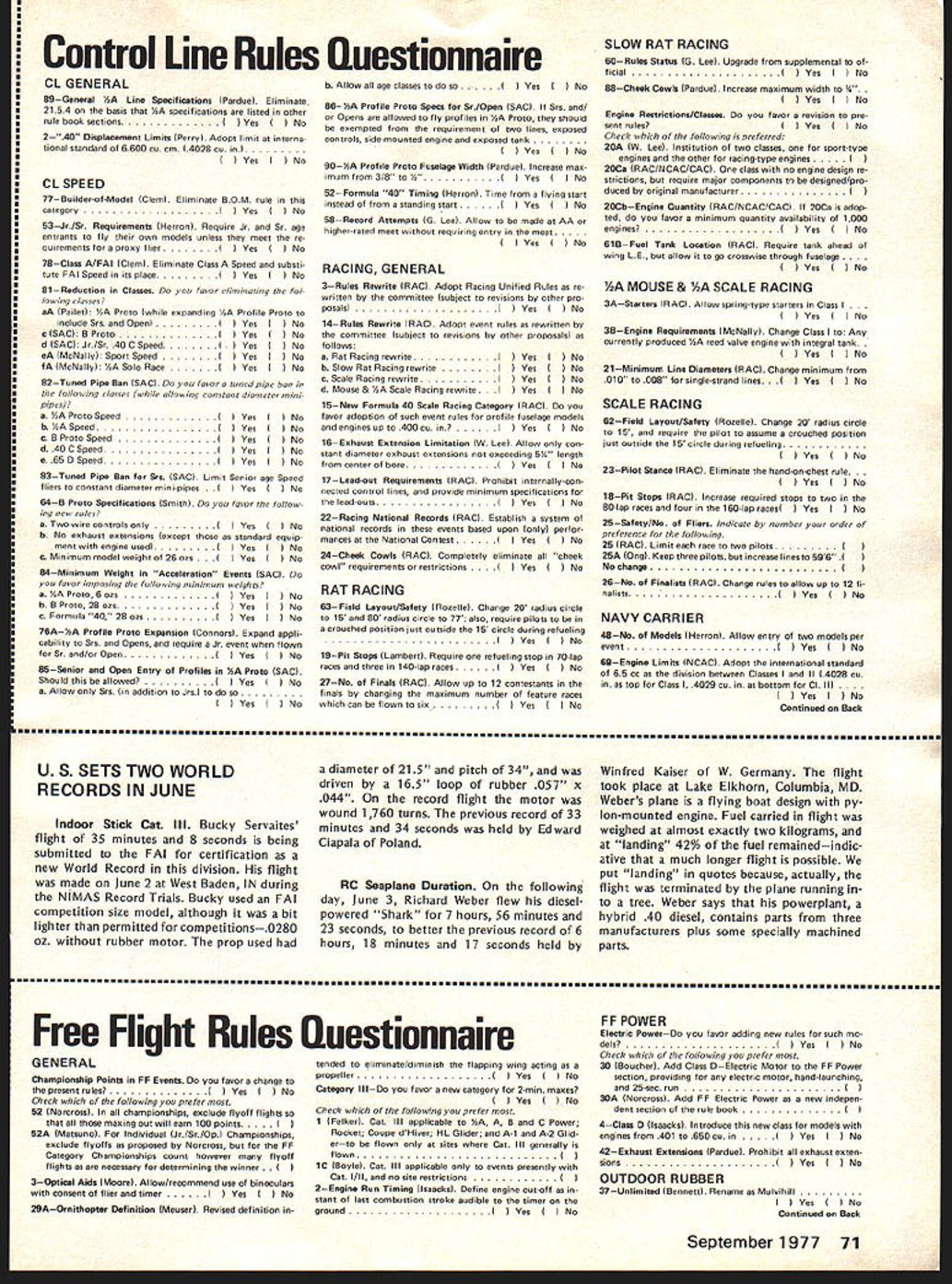
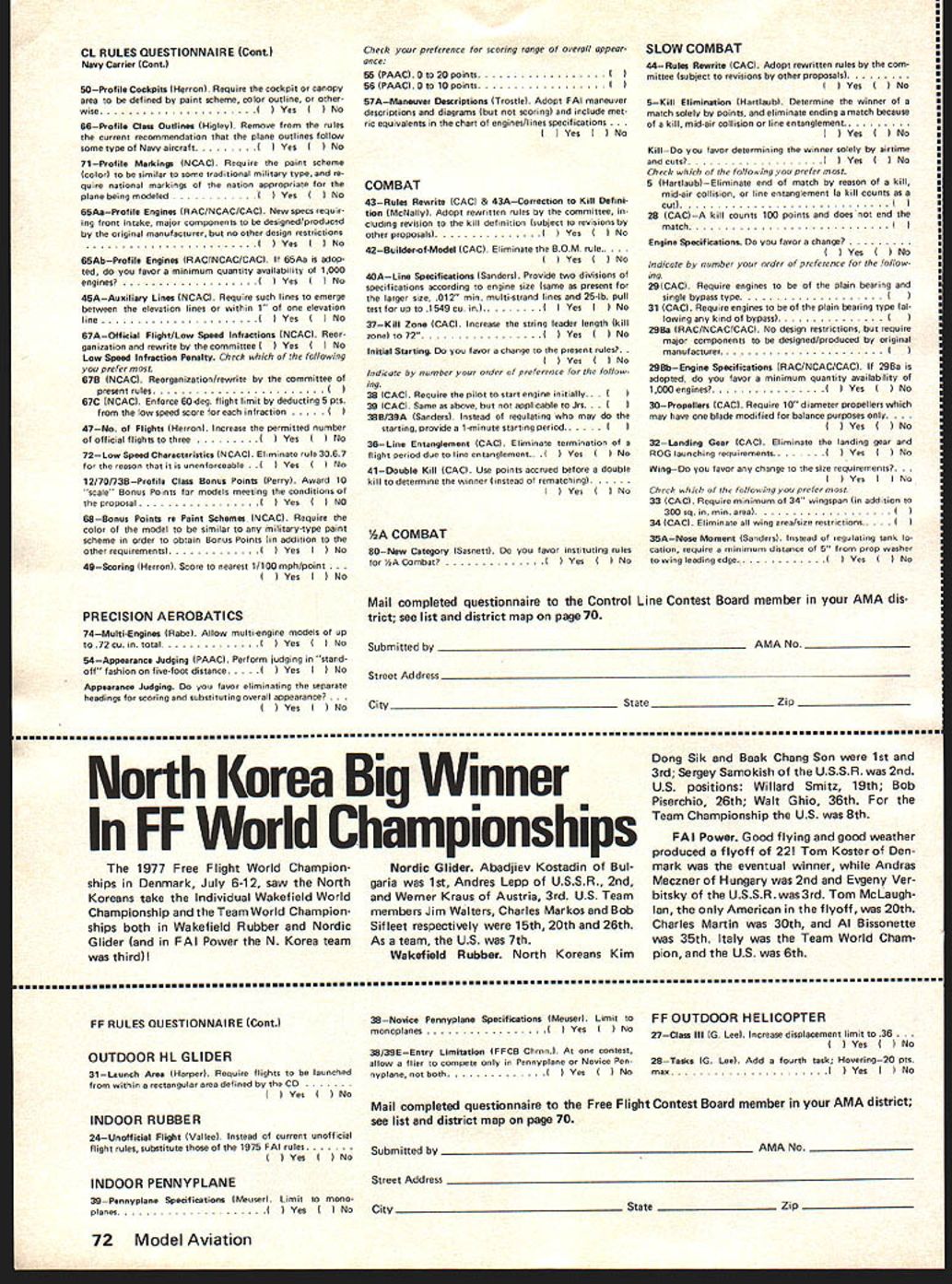
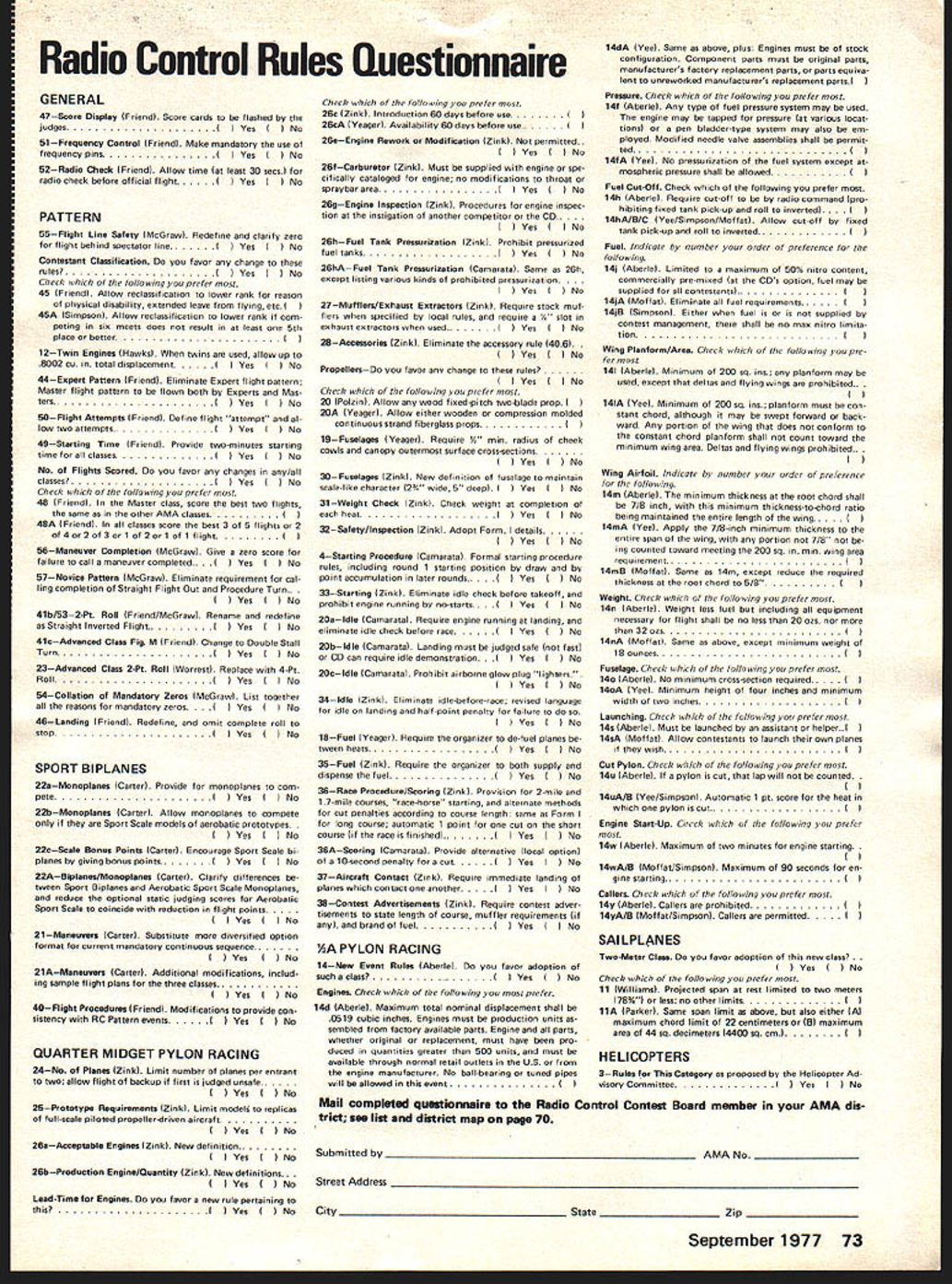
COMPETITION RULES QUESTIONNAIRE—YOUR CHANCE TO SPEAK UP!
This month the "Competition Newsletter" devotes several pages to questionnaires concerning competition rules proposals. Contained, to the best of our knowledge, are all of the proposals under consideration for possible implementation as new rules or changed rules to be effective January 1, 1978 (except for the omission of one or two proposals having the sole purpose of rearrangement of present rules for clarity). Presented in this manner, it is easy for the AMA member to check off his desires, clip the page, and send to the appropriate Contest Board member. We urge all members to participate in this questionnaire and mail by August 15 (or sooner if possible).
Note that there are separate questionnaires for Radio Control, Free Flight, Control Line, Scale and General proposals.
It is suggested that a questionnaire be submitted when any proposal is within a competitor's area of interest. Do so even if no change to existing rules is desired, for only in this way can all points of view be represented adequately. Use a separate sheet of paper to elaborate on your opinion, if desired, always identifying the proposal number.
Note that the questionnaires, in most all cases, state only the proposed change (or addition) to the current rules. Those in favor of adopting the change or addition should check off the "yes" space, whereas those wishing to retain the current rule should check off the "no" space.
In a few instances there is more than one choice concerning a particular kind of proposed revision. Here, first indicate yes or no as to whether any change is needed, then — even if your response was no — indicate which of the choices is best. Where there are only two choices, simply check off the best one; where there are three choices, rank them in order of desirability — with 1 going to the best, 2 to next best and 3 to the least desired.
The proposals of the questionnaires are, generally, arranged in rule book sequence. In this presentation there was insufficient space to make comparisons between the existing rule and the proposed new rule, so it is suggested that the rule book be reviewed as the questionnaire forms are filled out. Furthermore, some of the proposals are sufficiently complex that the full gist could not be stated; reference to the original summaries of Basic Proposals and Cross-Proposals may be necessary in these instances.
Utmost care was used in wording the questionnaire proposed changes, but in case of any error, the original proposal or cross-proposal governs. The numbers preceding each item identify the proposal or cross-proposal for reference to summaries previously published in CN.
Your opinions are important. Each Contest Board member is expected to utilize the results of his category questionnaires, together with opinions expressed to him in letters or in person from individuals and clubs, and all other inputs available to him, in determining the vote for his district.
DISTRICT X
FF CONTEST COORDINATION
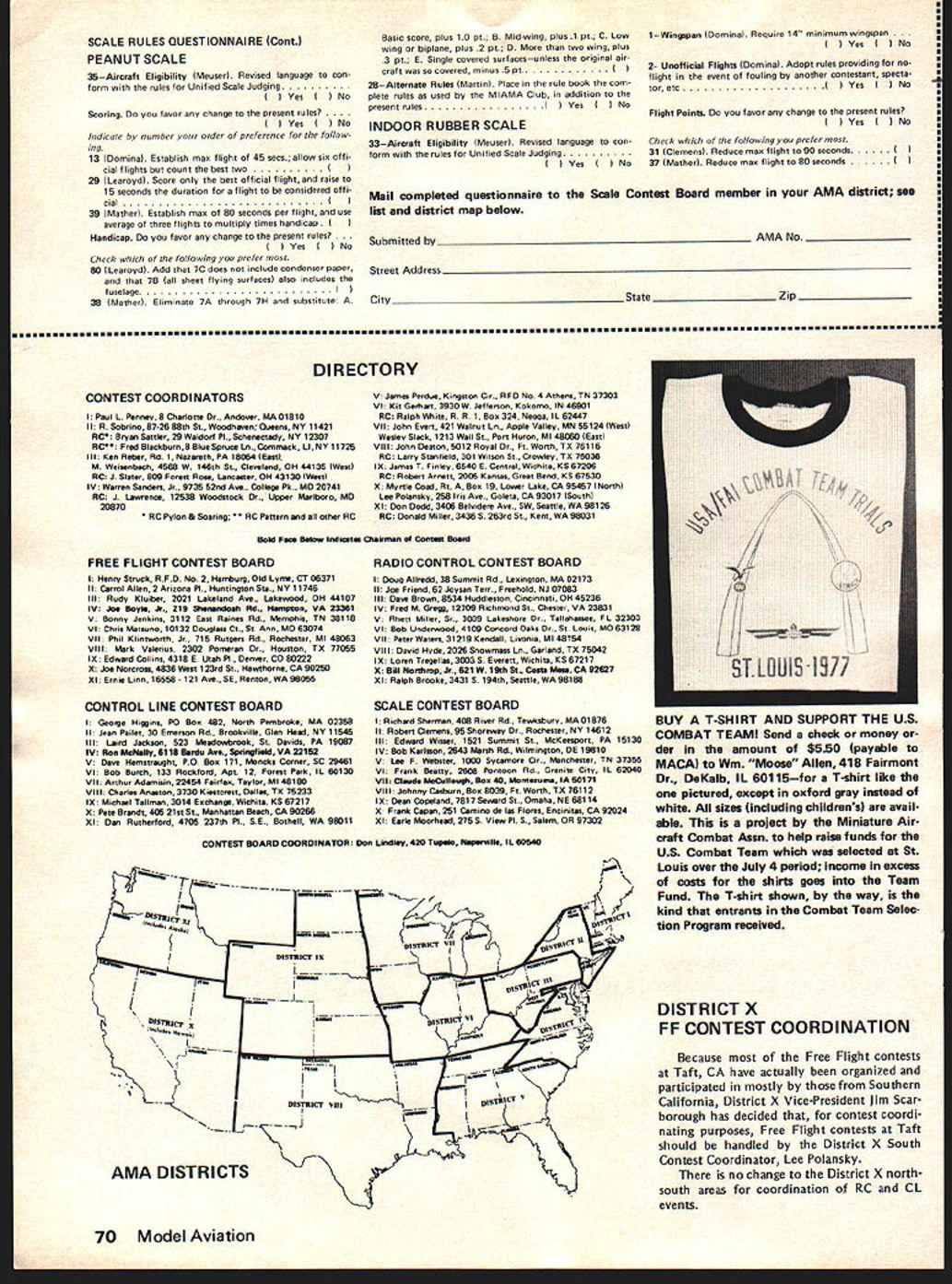
Because most of the Free Flight contests at Taft, CA have actually been organized and participated in mostly by those from Southern California, District X Vice-President Jim Scarborough has decided that, for contest coordinating purposes, Free Flight contests at Taft should be handled by the District X South Contest Coordinator, Lee Polansky.
There is no change to the District X north-south areas for coordination of RC and CL events.
Competition Newsletter
Prettner Wins RC World Champs; US Team Tops
Hanno Prettner, Austria, took the lead in Round 1 of the 10th RC Aerobatics World Championships and never relinquished it, either in succeeding regular rounds or in the two flyoffs, although never far ahead. A truly outstanding flight — and other top contenders, particularly Dave Brown, U.S., could have overtaken him. Brown was second, 402.55 points (best three regular rounds plus best flyoff); Prettner 413.95. World Championships, Springfield, OH, June 29 through July 4.
Wolfgang Matt, Liechtenstein, previous World Champion, put in a tremendous Round 4 flight and also did very well in the flyoffs; total score 401.95, third place. Others in the flyoff/top 10% of competitors in the four regular rounds were Canada's Ivan Kristensen and the U.S.'s Rhett Miller III and Mark Radcliff; total scores respectively 389.90, 387.35, 384.85.
The U.S. team was picked the weekend before the World Championships at the same site. Counting the best three flights of the regular four rounds, the U.S. team scored 700.15 points; Japan was second with 675.45 and the Federal Republic of Germany third with 641.30.
The World Championships got off to an ominous start the night before Round 1 when heavy winds and rain tore down two large tents erected for competitors by WC sponsors. Wind continued during Round 1 across the runway, very near the velocity at which FAI calls for suspension of the contest. Round 1 scores reflect the adverse conditions. Mother Nature cooperated remarkably for the remainder of the contest with mostly gentle winds and sunny skies. The 10th RC Aerobatics World Championships was hailed a great success. Full report by Ron VanPutte will follow next month.
U.S. CL Combat Team
Twenty-one fliers vied for three slots on the U.S. Control Line Combat Team for the 1978 World Championships in the team selection event at St. Louis, MO, over the July 4 weekend. The resulting team members were Gary Frost, Charles Rudner and George Cleveland.
Rhett Miller III finished fifth (flew Compensator). One first-round flight was aborted when a transmitter centering spring broke. Mark Radcliff was sixth (Ready Box 2), also flying Phoenix 7. The U.S. team was picked the weekend before the World Championships.
FF Nordic Team Selection
U.S. 1977 Free Flight World Championship teams — Wakefield, Rubber, FAI Power — were selected last year over the Labor Day weekend. A vote of contestants caused the Nordic Glider Team selection to be postponed and eventually decided by re-scheduling selection at three sites over the Memorial Day period this year.
As reported last month, the Nordic Team spots were won by Jim Walters, Seattle, WA; Chuck Markos, Deerfield, IL; and Bob Sifleet, Glen Rock, PA. Mini-reports below give some significant facts concerning sites and event times; issue readers with word-of-mouth may let us know how U.S. teams fared at the World Championships in Denmark, July 6-12.
Wakefield Team Change: Phedon Tsiknopoulos has withdrawn from the U.S. Wakefield Team and has been replaced by first runner-up Willard Smitz, member of the 1975 team.
Western Zone: Chuck Markos, Deerfield, IL, won a spot on the team quite convincingly, recording a 251-second second flight (5-minute max round) averaging 189 seconds in three flyoff rounds under difficult conditions. Former team member Paul Crowley was second; Dennis Stainbrook third.
Eastern Zone: Jerry Barnatte — aesthetic success. The Eastern Zone Nordic Team finals provided interesting, suspenseful action. The Galeville, NY site caused the finals to be held at the Bowie, MD compound because of field size: Bowie is a two-minute field with winds blowing across the short dimension. Nine fliers started what turned into a four-way affair between Andrew Barron, Bob Gutai, Dale Mateer and Bob Sifleet. Gutai near-max first round followed by a second max jumped him into a good lead; Mateer then took over the lead while Gutai picked a hole in the third; Sifleet was distant fourth. Flying was suspended for a few hours due to high winds.
North Korea Big Winner In FF World Championships
The 1977 Free Flight World Championships in Denmark, July 6-12, saw the North Koreans take the Individual Wakefield World Championship and the Team World Championships both in Wakefield Rubber and Nordic Glider (and in FAI Power the N. Korea team was third).
Nordic Glider. Abadjiev Kostadin of Bulgaria was 1st, Andres Lepa of U.S.S.R., 2nd, and Werner Kraus of Austria, 3rd. U.S. team members Jim Walters, Charles Markos and Bob Sifleet respectively were 15th, 20th and 26th. As a team, the U.S. was 7th.
Wakefield Rubber. North Koreans Kim Dong Sik and Baek Chong Son were 1st and 3rd; Sergey Samokish of the U.S.S.R. was 2nd. U.S. positions: Willard Smitz, 19th; Bob Piserchio, 26th; Walt Ghio, 36th. For the Team Championship the U.S. was 8th.
FAI Power. Good flying and good weather produced a flyoff of 221. Tom Koster of Denmark was the eventual winner, while Andras Meczner of Hungary was 2nd and Evgeny Verbitsky of the U.S.S.R. was 3rd. Tom McLaughlan, the only American in the flyoff, was 20th. Charles Martin was 30th, and Al Bissonette was 35th. Italy was the Team World Champion, and the U.S. was 6th.
Prettner Wins RC World Champs; US Team Tops
Hanno Prettner, Austria, took the lead in Round 1 of the 10th RC Aerobatics World Championships and never relinquished it. Either succeeding regular rounds or the two flyoffs — although never far ahead — a truly outstanding flight kept him ahead of other top contenders. Particularly Dave Brown (U.S.) could have overtaken him. Brown was second, 4,025.5 points (best three regular rounds plus best flyoff); Prettner, 4,139.5.
World Championships, Springfield, OH, June 29 through July 4. Wolfgang Matt, Liechtenstein, previous World Champion, put in a tremendous Round 4 flight and also did very well in the flyoffs, total score 4,019.5, third place. Others in the flyoff (top 10% of competitors from four regular rounds): Canada's Ivan Kristensen, U.S.'s Rhett Miller III, Mark Radcliff — total scores respectively 3,899.0; 3,873.5; 3,848.5.
The U.S. team was picked the weekend before the World Championships at the same site; three U.S. team members finished in the top 10% — the Team World Championship handily went to the U.S. Counting the best three flights of the regular four rounds, the U.S. team scored 7,001.5 points; Japan second, 6,754.5; Federal Republic of Germany third, 6,413.0.
The World Championships got off to an ominous start the night before Round 1 when heavy winds and rain tore down two large tents erected for the competitors and WC sponsors. Wind continued during Round 1 across the runway, very near the velocity the FAI calls for suspension of contest. Round 1 scores reflect the adverse conditions. Mother Nature cooperated remarkably for the remainder of the contest — mostly gentle winds and sunny skies. The 10th RC Aerobatics World Championships were hailed a great success. Full report by Ron VanPutte will follow next month.
Competition Newsletter
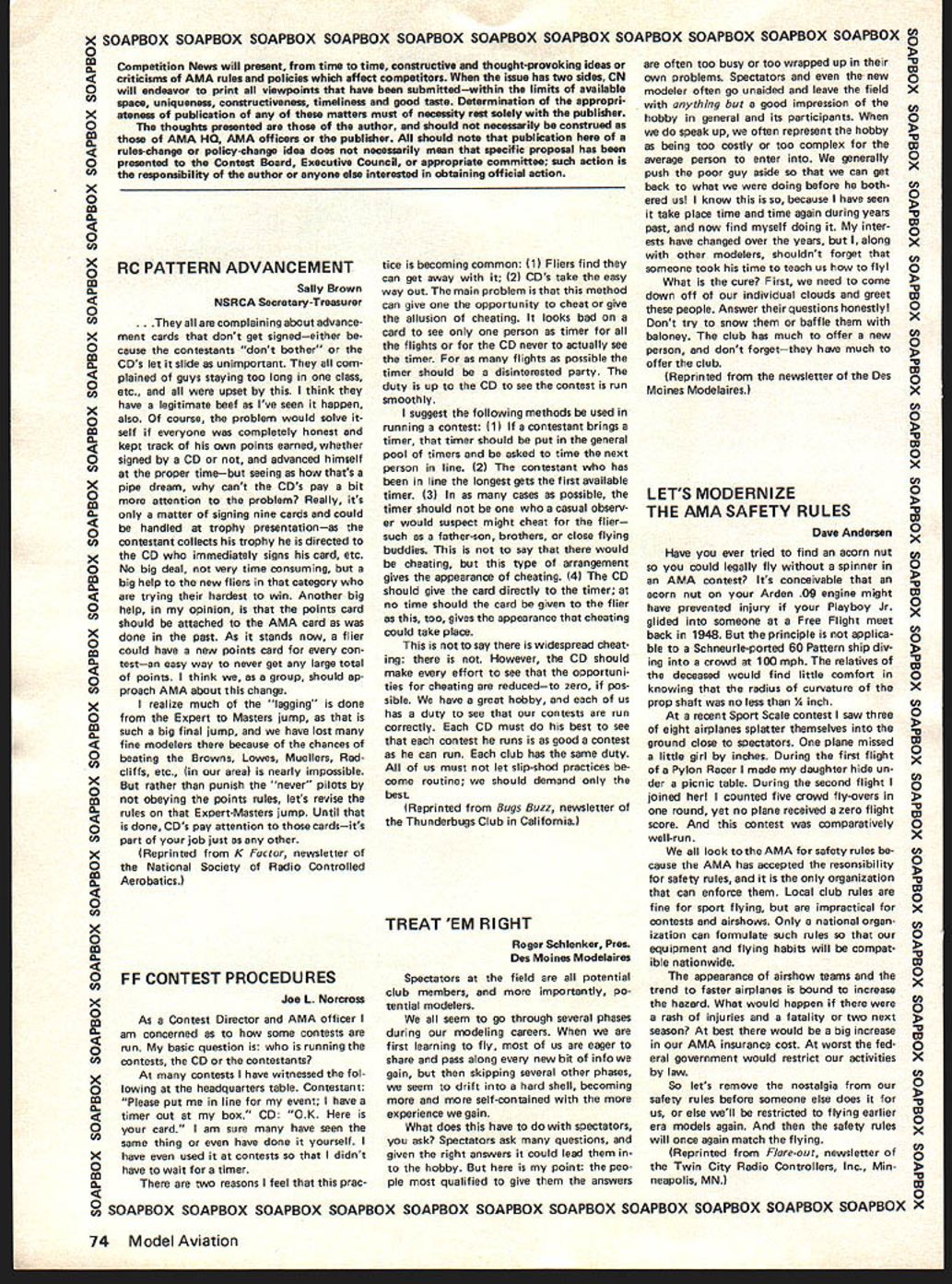
Competition News will present, from time to time, constructive and thought-provoking ideas or criticisms of AMA rules and policies which affect competitors. When the issue has two sides, CN will endeavor to print all viewpoints that have been submitted — within the limits of available space, uniqueness, constructiveness, timeliness and good taste. Determination of the appropriateness of publication of any of these matters must of necessity rest solely with the publisher.
The thoughts presented are those of the author, and should not necessarily be construed as those of AMA HQ, AMA officers or the publisher. All should note that publication here of a rules-change or policy-change idea does not necessarily mean that specific proposal has been presented to the Contest Board, Executive Council, or appropriate committee; such action is the responsibility of the author or anyone else interested in obtaining official action.
RC PATTERN ADVANCEMENT
Sally Brown NSRCA Secretary-Treasurer
...They all are complaining about advancement cards that don't get signed—either because the contestants "don't bother" or the CDs let it slide as unimportant. They all complained of guys staying too long in one class, etc., and all were upset by this. I think they have a legitimate beef as I've seen it happen, also. Of course, the problem would solve itself if everyone was completely honest and kept track of his own points earned, whether signed by a CD or not, and advanced himself at the proper time—but seeing as how that's a pipe dream, why can't the CDs pay a bit more attention to the problem? Really, it's only a matter of signing nine cards and could be handled at trophy presentation—as the contestant collects his trophy he is directed to the CD who immediately signs his card, etc. No big deal, not very time consuming, but a big help to the new fliers in that category who are trying their hardest to win. Another big help, in my opinion, is that the points card should be attached to the AMA card as was done in the past. As it stands now, a flier could have a new points card for every contest—an easy way to never get any large total of points. I think we, as a group, should approach AMA about this change.
I realize much of the "lagging" is done from the Expert to Masters jump, as that is such a big final jump, and we have lost many fine modelers there because of the chances of beating the Browns, Lowes, Muellers, Radcliffs, etc., (in our area) is nearly impossible. But rather than punish the "never" pilots by not obeying the points rules, let's revise the rules on that Expert-Masters jump. Until that is done, CDs pay attention to those cards—it's part of your job just as any other.
(Reprinted from K Factor, newsletter of the National Society of Radio Controlled Aerobatics.)
FF CONTEST PROCEDURES
Joe L. Norcross
As a Contest Director and AMA officer I am concerned as to how some contests are run. My basic question is: who is running the contests, the CD or the contestants?
At many contests I have witnessed the following at the judges' table. Contestants: "Please put me in line for my event; I have a timer out at my box." CD: "O.K. Here is your card." I am sure many have seen the same thing or even have done it yourself. I have even used it at contests so that I didn't have to wait for a timer.
There are two reasons I feel that this practice is becoming common: (1) Fliers find they can get away with it, (2) CDs take the easy way out. The main problem is that this method can give one the opportunity to cheat or give the illusion of cheating. It looks bad on a card to see only one person as timer for all the flights or for the CD never to actually see the timer. For as many flights as possible the timer should be a disinterested party. The duty is up to the CD to see the contest is run smoothly.
I suggest the following methods be used in running a contest: (1) If a contestant brings a timer, that timer should be put in the general pool of timers and be asked to time the next person in line. (2) The contestant who has been in line the longest gets the first available timer. (3) In as many cases as possible, the timer should not be one who a casual observer would suspect might cheat for the flier—such as a father-son, brothers, or close flying buddies. This is not to say that there would be cheating, but this type of arrangement gives the appearance of cheating. (4) The CD should give the card directly to the timer; at no time should the card be given to the flier as this, too, gives the appearance that cheating could take place.
This is not to say there is widespread cheating; there is not. However, the CD should make every effort so that opportunities for cheating are reduced—to zero, if possible. We have a great hobby, and each of us has a duty to see that our contests are run correctly. Each CD must do his best to see that each contest he runs is as good a contest as he can run. Each club has the same duty. All of us must not let slipshod practices become routine; we should demand only the best.
(Reprinted from Bugs Buzz, newsletter of the Thunderbirds Club in California.)
TREAT 'EM RIGHT
Roger Schlenker, Pres. Des Moines Modelaires
Spectators at the field are all potential club members, and more importantly, potential modelers.
We all seem to go through several phases during our modeling career. When we are first learning to fly, most of us are eager to share and pass along every bit of info we gain, but then skipping several other phases, we seem to drift into a hard shell, becoming more and more self-contained with the model experience we gain.
What does this have to do with spectators, you ask? Spectators ask many questions, and given the right answers it could lead them into the hobby. But here is my point: the people most qualified to give them the answers are often too busy or too wrapped up in their own problems. Spectators and even the novice modeler often go unasked and leave the field with anything but a good impression of the hobby in general and its participants. When we do speak up, we often represent the hobby as being too costly or too complex for the average person to enter into. We generally push the poor guy aside so that we can get back to what we were doing before he bothered us! I know this is so, because I have seen it take place time and time again during years past, and now find myself doing it. My interests have changed over the years, but I, along with other modelers, shouldn't forget that someone took his time to teach us how to fly.
What is the cure? First, we need to come down off of our individual clouds and greet these people. Answer their questions honestly! Don't try to snow them or baffle them with baloney. The club has much to offer a new person, and don't forget—they have much to offer the club.
(Reprinted from the newsletter of the Des Moines Modelaires.)
LET'S MODERNIZE THE AMA SAFETY RULES
Dave Andersen
Have you ever tried to find an acorn nut so you could legally fly without a spinner in an AMA contest? It's conceivable that an acorn nut on your .049 engine might have prevented injury if your Playboy Jr. clipped into someone at a Free Flight meet back in 1948. But the principle is not applicable to a Schnuerle-ported 60 percent ship diving into a crowd at 100 mph. The relative risk of the old rule would find little comfort in knowing that the radius of curvature of the prop shaft was no less than 1/4 inch.
At a recent Sport Scale contest I saw three of eight airplanes splatter themselves into the ground close to spectators. One plane made the ground close only by inches. During the first flight of a pylon racer I made my daughter hold under a picnic table. During the second flight I joined her! I counted five groundings under one round, yet no plane received a zero flight score. And this contest was comparatively well-run.
We all look to the AMA for safety rules because the AMA has accepted the responsibility for safety rules, and it is the only organization that can enforce them. Local club rules are fine for the local flying sites, but are impractical for contests and airshows. Only a national organization can formulate such rules so that our equipment and flying habits will be compatible nationwide.
The appearance of high power models and the trend to faster airplanes is bound to increase the hazard. What would happen if there were a rash of injuries and a fatality or two next season? At best there would be a big increase in our AMA insurance cost. At worst the federal government would restrict our activities by law.
So let's remove the nostalgia from our safety rules before someone else does it for us, or else we'll be restricted to flying earlier era models again. And then the safety rules will once again match the flying.
(Reprinted from Flare-out, newsletter of Twin City Radio Controllers, Inc., Minneapolis, Minn.)
Transcribed from original scans by AI. Minor OCR errors may remain.

