
CL FAI Combat Team Finals
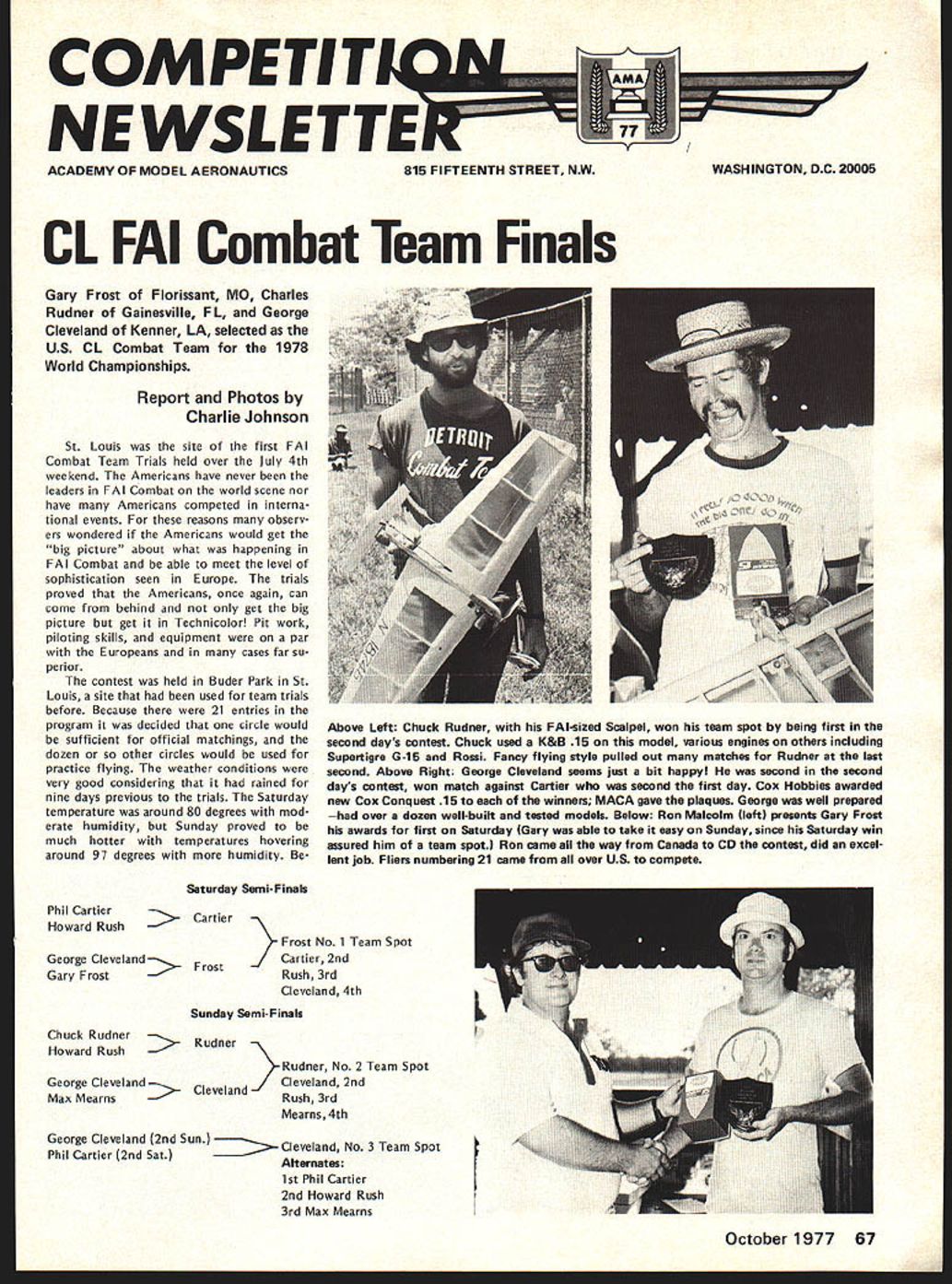
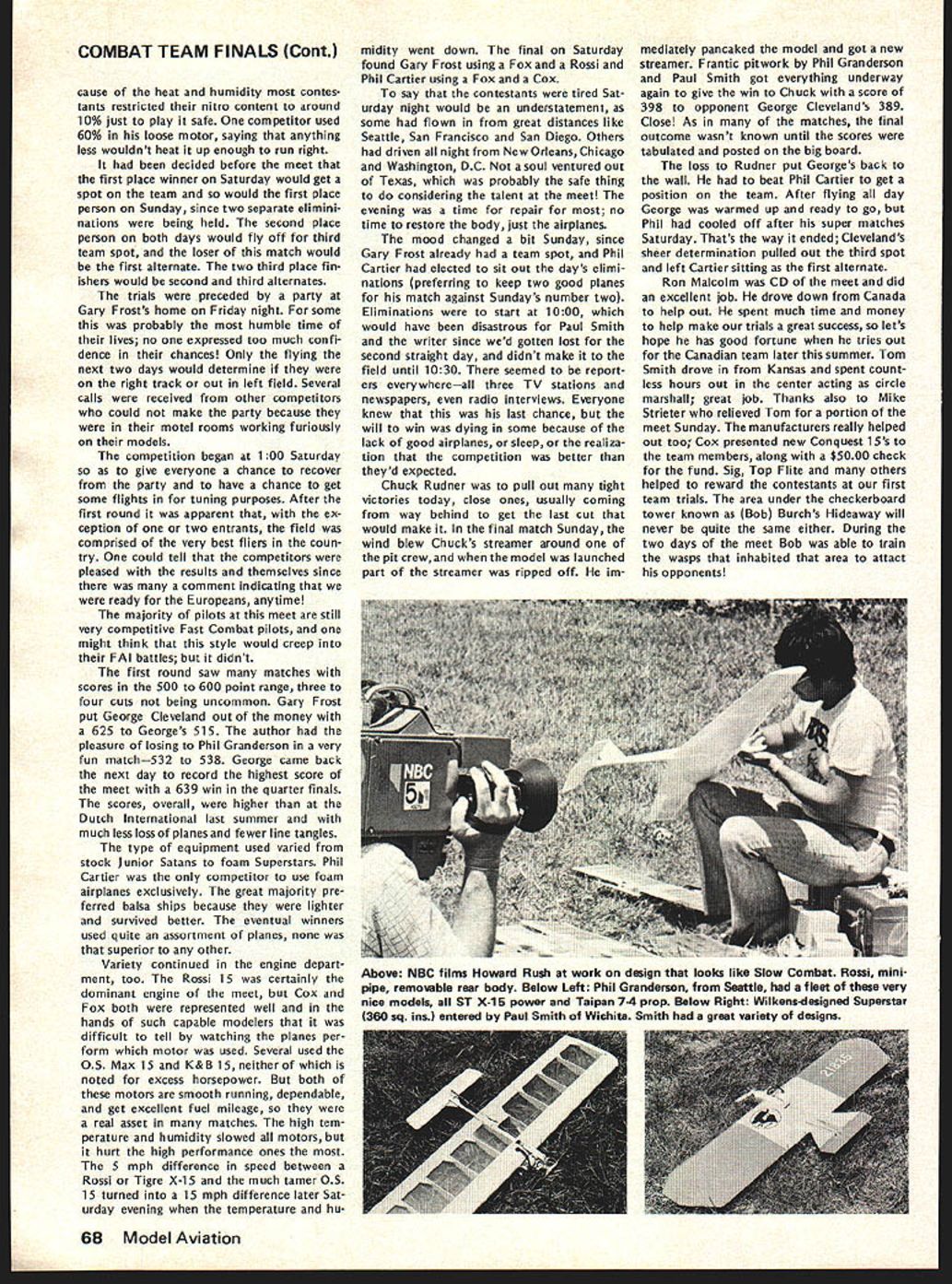
Gary Frost of Florissant, MO, Charles Rudner of Gainesville, FL, and George Cleveland of Kenner, LA, selected as the U.S. CL Combat Team for the 1978 World Championships.
Report and Photos by Charlie Johnson
St. Louis was the site of the first FAI Combat Team Trials held over the July 4th weekend. The Americans have never been the leaders in FAI Combat on the world scene nor have many Americans competed in international events. For these reasons many observers wondered if the Americans would get the "big picture" about what was happening in FAI Combat and be able to meet the level of sophistication seen in Europe. The trials proved that the Americans, once again, can come from behind and not only get the big picture but get it in Technicolor! Pit work, piloting skills, and equipment were on a par with the Europeans and in many cases far superior.
The contest was held in Buder Park in St. Louis, a site that had been used for team trials before. Because there were 21 entries in the program it was decided that one circle would be sufficient for official matchings, and the dozen or so other circles would be used for practice flying. The weather conditions were very good considering that it had rained for nine days previous to the trials. The Saturday temperature was around 80 degrees with moderate humidity, but Sunday proved to be much hotter with temperatures hovering around 97 degrees with more humidity. Because of the heat and humidity most contestants restricted nitro content around 10% just to play it safe. One competitor used 60% on a loose motor, saying anything less wouldn't heat up enough to run right.
It was decided before the meet that the first place winner Saturday would get a team spot and the first place person Sunday would get a team spot, since two separate eliminations were being held. The second place person both days would fly off for the third team spot; the loser of that match would be the first alternate. The two third place finishers would be second and third alternates.
Trials were preceded by a party at Gary Frost's home Friday night. Some probably had a humble time; few expressed too much confidence in their chances. Only flying the next two days would determine who was right and who was out in left field. Several calls were received from other competitors who could not make the party because motel rooms were full or they were working furiously on models. Competition began at 10:00 Saturday to give everyone a chance to recover from the party and have a chance to get some flights for tuning purposes.
After the first round, with the apparent exception of two entrants, the field comprised the very best fliers in the country. You could tell the competitors were pleased with the results and themselves since there were comments indicating "We're ready for the Europeans anytime." The majority of pilots met were still very competitive. Fast Combat pilots might think that style would creep into FAI battles; it didn't. In the first round we saw match scores in the 500-600 point range, three- or four-cut matches being uncommon. Gary Frost put George Cleveland out, 625-515. I had the pleasure of losing to Phil Granderson in a very fun match, 532-538. George came back the next day and recorded the highest score of the meet, 639, to win his quarter-final. Scores overall were higher than at the Dutch International last summer, with much less loss of planes and fewer line tangles. The type of equipment used varied from stock Juniors, Satans and foam Superstars. Phil Cartier is a competitor who uses foam airplanes exclusively, while the great majority preferred balsa ships because...
Saturday Semi-Finals
- Phil Cartier -> Cartier
- Howard Rush -> Cartier
Frost No. 1 Team Spot
- Cartier, 2nd
- Rush, 3rd
- Cleveland, 4th
- George Cleveland -> Frost
- Gary Frost -> Frost
Sunday Semi-Finals
- Chuck Rudner -> Rudner
- Howard Rush -> Rudner
Rudner, No. 2 Team Spot
- Cleveland, 2nd
- Rush, 3rd
- Mearns, 4th
- George Cleveland -> Cleveland
- Max Mearns -> Cleveland
George Cleveland (2nd Sun.) -> Cleveland, No. 3 Team Spot Phil Cartier (2nd Sat.)
Alternates: 1st Phil Cartier 2nd Howard Rush 3rd Max Mearns
COMBAT TEAM FINALS (Cont.)
they were lighter and survived better. The eventual winners used quite an assortment of planes, none was that superior to any other.
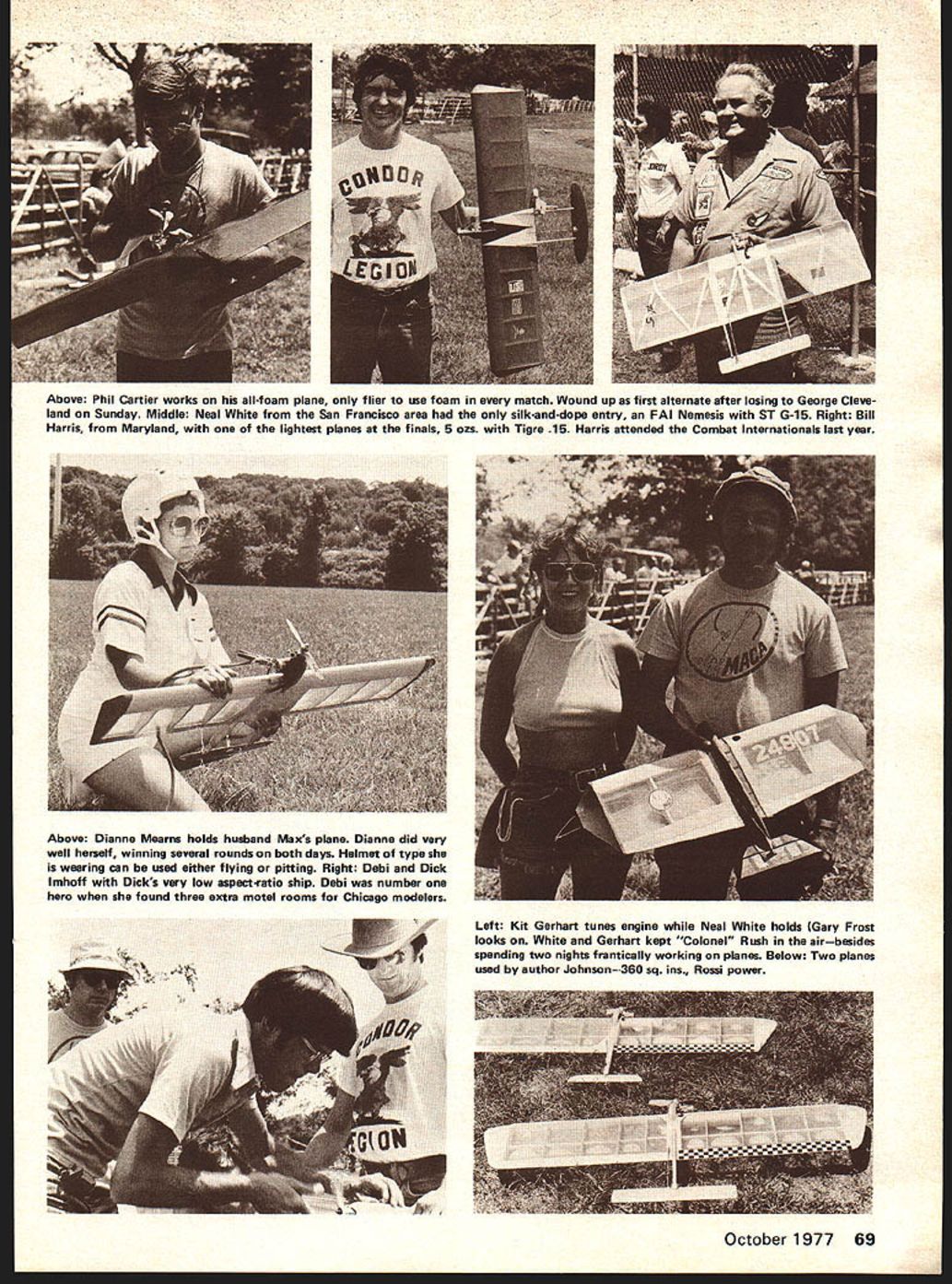
Variety continued in the engine department, too. The Rossi 15 was certainly the dominant engine of the meet, but Cox and Fox both were represented well and in the hands of such capable modelers that it was difficult to tell by watching the planes which motor was used. Several used the O.S. Max 15 and K & B 15, neither of which is noted for excess horsepower. But both of these motors are smooth running, dependable, and get excellent fuel mileage, so they were the logical choice for many fliers. The Rossi had the temperature and humidity slowed all motors, but the big difference in speed between a Rossi or Tigre X-15 and the much tamer O.S. 15 turned into a 15 mph difference later Saturday evening when the temperature and humidity went down. The final on Saturday found Gary Frost using a Fox and a Rossi and Phil Cartier using a Fox and a Cox.
To say that the contestants were tired Saturday night would be an understatement; some had flown in from great distances like Seattle, San Francisco and San Diego. Others had driven all night from New Orleans, Chicago and Washington, D.C. Not a soul ventured out of Texas, which was probably the safe thing to do considering the talent at the meet! The evening was a time for repair for most; no time to restore the body, just the airplanes.
The mood changed a bit Sunday, since Gary Frost already had a team spot, and Phil Cartier had elected to sit out the day's eliminations (preferring to keep two good planes for his match against Sunday's number two). Eliminations were to start at 10:00, which would have been disastrous for Paul Smith and the writer since we'd gotten lost for the second straight day, and didn't make it to the field until 10:30. There seemed to be reports everywhere—all three TV stations and newspapers, even radio interviews. Everyone knew that this was his last chance, but the will to win was dying in some because of the lack of good airplanes, or sleep, or the realization that the competition was better than they'd expected.
Chuck Rudner was to pull out many tight victories today, close ones, usually coming from way behind to get the last cut that would make it. In the final match Sunday, the wind blew Chuck's streamer around one of the pit crew, and when the model was launched part of the streamer was ripped off. He immediately pancaked the model and got a new streamer. Frantic pitwork by Phil Granderson and Paul Smith got everything underway again to give the win to Chuck with a score of 398 to opponent George Cleveland's 389. Close! As in many of the matches, the final outcome wasn't known until the scores were tabulated and posted on the big board.
The loss to Rudner put George's back to the wall. He had to beat Phil Cartier to get a position on the team. After flying all day George was warmed up and ready to go, but Phil had cooled off after his super matches Saturday. That's the way it ended; Cleveland's sheer determination pulled out the third spot and left Cartier sitting as the first alternate.
Ron Malcolm was CD of the meet and did an excellent job. He drove down from Canada to help out. He spent much time and money to help make our trials a great success, so let's hope he has good fortune when he tries out for the Canadian team later this summer. Tom Smith drove in from Kansas and spent countless hours out in the center acting as circle marshall; great job. Thanks also to Mike Streeter who relieved Tom for a portion of the meet Sunday. The manufacturers really helped out, too; Cox presented new Conquest 15's to the team members, along with a $50.00 check for the fund. Sig, Top Flite and many others helped to reward the contestants at our first team trials. The area under the checkerboard tower known as (Bob) Burch's Hideaway will never be quite the same either. During the two days of the meet Bob was able to train the wasps that inhabited that area to attack his opponents! Contestants, because of heat and humidity, were restricted to nitro content around 10% just to play safe. One competitor used 60% — saying anything less wouldn't heat up enough to run right.
It was decided before the meet that the first-place winner Saturday would get a spot on the team, and the first-place person Sunday (since two separate eliminations were being held) would get a spot. The second-place persons from both days would fly off for the third team spot; the loser of that match would be the first alternate. The two third-place finishers would be the second and third alternates.
The trials were preceded by a party at Gary Frost's home Friday night. Some probably had a humble time; few expressed too much confidence in their chances. Only flying the next two days would determine who was on the right track and who came out of left field. Several calls were received from other competitors who could make the party, but motel rooms were scarce. Working furiously on models, competition began at 1:00 Saturday to give everyone a chance to recover from the party and have time to get some flights for tuning purposes.
After the first round, with the apparent exception of two entrants, the field comprised the very best fliers in the country. You could tell competitors were pleased with the results themselves, since comments indicated they felt ready for Europeans anytime. The majority of pilots were still very competitive. Fast Combat pilots might think their style would creep into FAI battles, but it didn't. In the first round we saw matches with scores in the 500–600 point range; three- and four-cut matches were uncommon.
Gary Frost put George Cleveland out, 625–515. I had the pleasure of losing to Phil Granderson in a very fun match, 532–538. George came back the next day and recorded the highest score of the meet, 639, in a quarterfinals win. Quarterfinal scores were overall higher than at the Dutch International last summer; there were fewer losses of planes and fewer line tangles. The type of equipment used varied — stock Junior Satans, foam Superstars. Phil Cartier was the only competitor to use foam airplanes exclusively; the great majority preferred balsa ships because
COMBAT STREAMERS
Ron McNally CLCB Chairman
The 10-foot smooth crepe paper sheet required by the Combat Rules is apparently no longer being produced. Sheets 7-1/2-foot long are available, however.
MACA is seeing what can be done by contacting the manufacturers. The problem is not as simple as it might seem. FAI Combat requires three-meter lengths, so a quick change in the AMA rules won't solve all our problems (three meters is about two inches less than 10 feet). We don't know what the situation is regarding crepe paper availability in other countries.
So, until the situation can be fixed, either by finding sources of 10-foot sheet or by a rule change, both of which take time, it is permissible to use the 7-1/2-foot sheet. Care should be taken so that 10- and 7-1/2-foot streamers are not used in the same match. To be absolutely certain of no problems, you should use the length most available in your area for the entire contest.
CL RULES QUESTIONNAIRE
Eight items were included by mistake in the Contest Line Rules Questionnaire of the September issue, pages 71-72, they having been defeated in the Contest Board's initial vote as reported in the March 1977 issue. None of the mistakenly-included items can become new AMA competition rules in the current cycle no matter how strong the response to the questionnaire.
The proposals which should not have been included are as follows: Speed 77, 52, 58; Navy Carrier 48, 47, 49; Combat 80, 5. We regret the error.
FAI GLIDER SPEED RECORD UPPED?
The FAI has distributed to member aero clubs a notice of tentative world record of 242.9 mph for RC Gliders, Speed in a Straight Line (No. 33). This flight was made by Werner Sitar of Austria on June 18, 1977. Sitar holds the much-discussed previous record in this category of 188.27 mph which was established in 1976.
RC/WC LOST AND FOUND
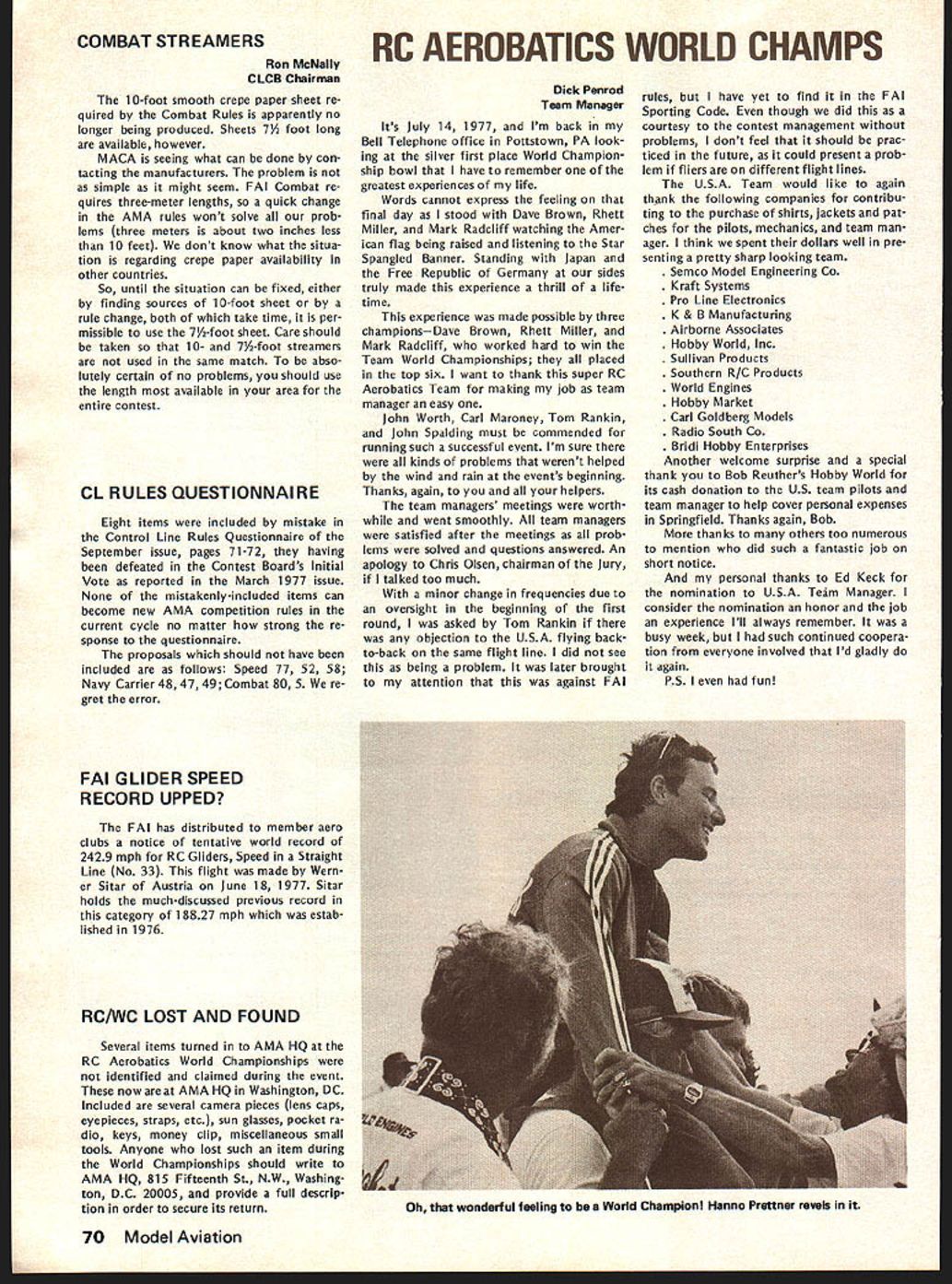
Several items turned in to AMA HQ at the RC Aerobatics World Championships were not identified and claimed during the event. These are now at AMA HQ in Washington, D.C. Included are several camera pieces (lens caps, eyepieces, straps, etc.), sunglasses, pocket radio, keys, money clip, miscellaneous small tools. Anyone who lost such an item during the World Championships should write to AMA HQ, 815 Fifteenth St., N.W., Washington, D.C. 20005, and provide a full description in order to secure its return.
Competition Newsletter
CL FAI Combat Team Finals
Gary Frost, Florissant, MO; Charles Rudner, Gainesville, FL; George Cleveland, Kenner, LA selected US CL Combat Team 1978 World Championships
Report, Photos: Charlie Johnson, St. Louis
COMBAT TEAM FINALS — Continued
Because of heat and humidity most contestants restricted nitro content around 10% — just to play safe. One competitor used 60% loose motor, saying anything less wouldn't heat up enough to run right. It had been decided before the meet that the first-place winner Saturday would get a team spot; the first-place person Sunday (since two separate eliminations were being held) would get a team spot; the second-place person both days would fly off for the third team spot. The loser of that flyoff match would be first alternate; the two third-place finishers would be second and third alternates.
Trials were preceded by a party at Gary Frost's home Friday night. Some probably had a humble time and none expressed too much confidence in their chances. Only the flying the next two days would determine who was right on track or out in left field. Several calls were received from other competitors who could make the party because motel rooms were booked; many were working furiously on models. Competition began 1:00 Saturday to give everyone a chance to recover from the party and have a chance to get some flights for tuning purposes.
After the first round, with the apparent exception of two entrants, the field comprised the very best fliers in the country. You could tell competitors were pleased with the results themselves, since there were no comments indicating they were “ready for Europeans” — any time. The majority of pilots met were still very competitive. Fast Combat pilots might think their style would creep into FAI battles — it didn't. The first round saw match scores in the 500–600 point range; three- or four-cut victories being uncommon. Gary Frost put George Cleveland out, money 625 to George's 515. The author enjoyed a very fun match with Phil Granderson, 532–538. George came back the next day with the highest score of the meet, 639, to win his quarterfinal. Scores overall were higher than at the Dutch International last summer, with much less loss of planes and fewer line tangles. The type of equipment used varied from stock Junior Satans to foam Superstars. Phil Cartier was a competitor who used foam airplanes exclusively, while the great majority preferred balsa ships because ... they were stiffer and held up better.
Contest conditions, because of the heat and humidity, had contestants restricted to nitro content around 10%, just to play safe. One competitor used 60% and, loose-mouthed, said anything less wouldn’t heat up enough to run right. It was decided before the meet that the first-place winner Saturday would get a spot on the team, the first-place person Sunday (since two separate eliminations were being held) would get a spot, the second-place persons both days would fly off for the third team spot; the loser of that match would be the first alternate; the two third-place finishers would be the second and third alternates.
Trials were preceded by a party at Gary Frost’s home Friday night. Some probably had a humble time; few expressed too much confidence — only flying the next two days would determine whether they were on the right track or out in left field. Several calls were received asking if other competitors could make the party because motel rooms were full. Competition began at 10:00 Saturday to give everyone a chance to recover from the party and to get some flights for tuning purposes.
After the first round, with the apparent exception of two entrants, the field comprised the very best fliers in the country. You could tell competitors were pleased with the results themselves, since there were no comments indicating they were “ready for Europeans” — any time. The majority of pilots met were still very competitive. Fast Combat pilots might have thought their style would creep into FAI battles — it didn’t. The first round saw match scores in the 500–600 point range; three- or four-cut victories were uncommon. Gary Frost put George Cleveland out, 625 to 515. The author enjoyed a very fun match with Phil Granderson, 532–538. George came back the next day with the highest score of the meet, 639, to win his quarterfinal.
Scores overall were higher than at the Dutch International last summer, with much less loss of planes and fewer line tangles. The type of equipment used varied from stock Junior Satans to foam Superstars. Phil Cartier was a competitor who used foam airplanes exclusively; the great majority preferred balsa ships because they were stiffer and held up better. Because of the heat and humidity, most contestants restricted nitro content to around 10%—just to play it safe. One competitor used 60% nitro in a "loose" motor, saying anything less wouldn't heat up enough to run right.
It was decided before the meet that the first-place winner Saturday would get a spot on the team; the first-place person Sunday, since two separate eliminations were being held, would also get a spot. The second-place persons both days would fly off for the third team spot; the loser of that match would be the first alternate. The two third-place finishers would be the second and third alternates.
Trials were preceded by a party at Gary Frost's home Friday night. Some probably had a humble time; few expressed too much confidence in their chances. Only the flying the next two days would determine who was right. Several calls were received from other competitors who could make the party because motel rooms were occupied; many worked furiously on models. Competition began at 1:00 Saturday to give everyone a chance to recover from the party and have a chance to get some flights for tuning purposes.
After the first round, with the apparent exception of two entrants, the field comprised the very best fliers in the country. One could tell the competitors were pleased with their results; there was no comment indicating they were ready for Europeans anytime soon. The majority of pilots at the meet were still very competitive. Fast Combat pilots might have thought their style would creep into FAI battles, but it didn't. The first round saw match scores in the 500–600 point range; three or four cuts were uncommon.
Gary Frost put George Cleveland out money 625–515 in what was, for the author, a very enjoyable match. Phil Granderson and others had fun matches as well. George came back the next day to record the highest score of the meet, a 639 in a quarterfinal win. Overall scores were higher than at the Dutch International the previous summer, with much less loss of planes and fewer line tangles. The type of equipment used varied from stock Junior Satans to foam Superstars; Phil Cartier competed using foam airplanes exclusively, though the great majority preferred balsa ships because they were stiffer and held up better.
Semi-finals and finals were hard-fought. Saturday’s results positioned Phil Cartier, Howard Rush, George Cleveland and Gary Frost among the top finishers, with Cartier earning the No. 1 team spot for that day. Sunday’s eliminations again shuffled the order, with Charles Rudner and George Cleveland taking top positions and the remaining team spots decided by the two-day results and fly-offs for the second and third team places.
The three selected to the U.S. CL Combat Team for the 1978 World Championships were Gary Frost (Florissant, MO), Charles Rudner (Gainesville, FL) and George Cleveland (Kenner, LA). The trials were a strong demonstration that Americans can compete with the level of sophistication seen in Europe and that, on this occasion, Americans came out on top.
Transcribed from original scans by AI. Minor OCR errors may remain.

