
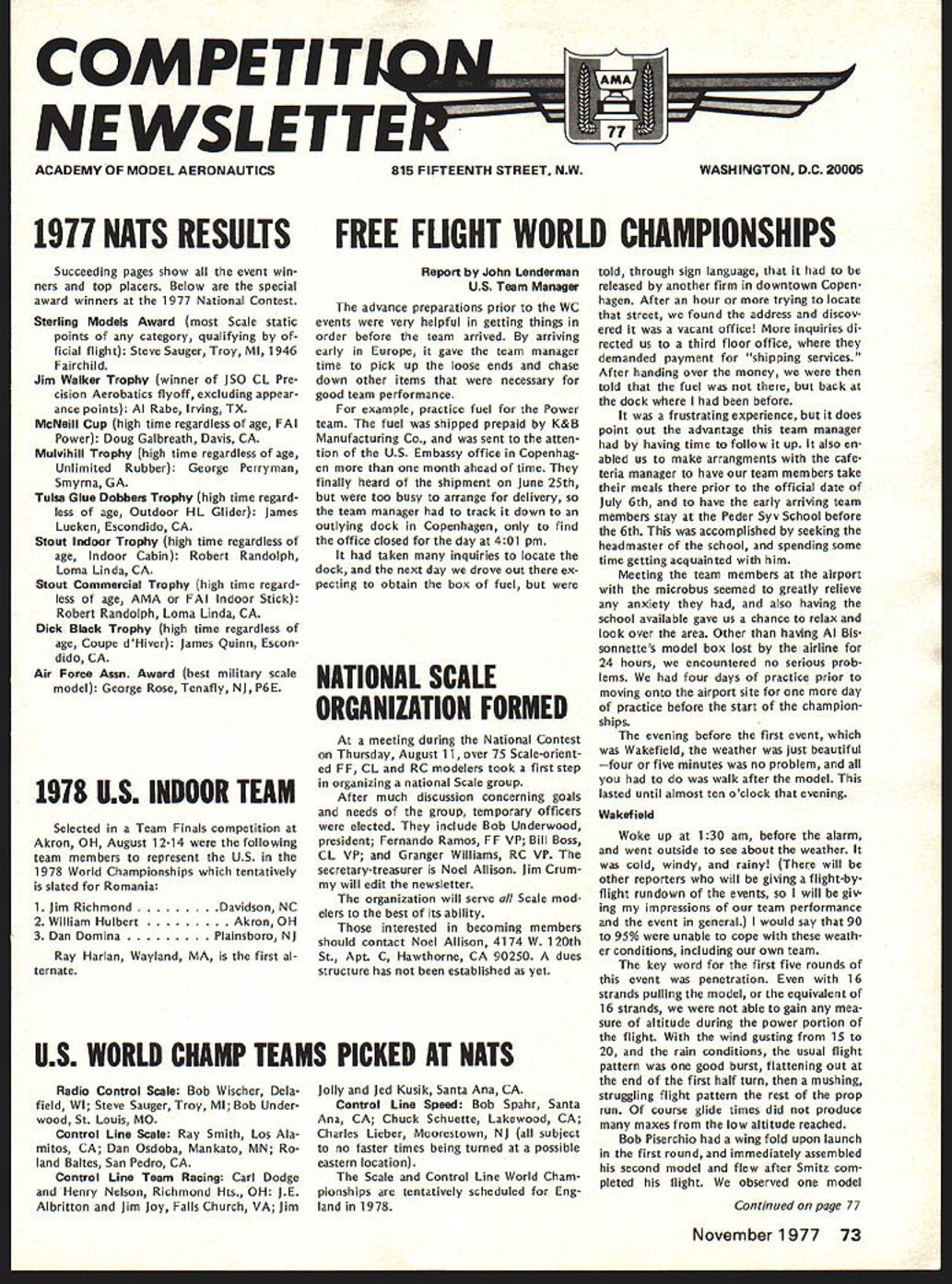
FREE FLIGHT WORLD CHAMPIONSHIPS
Report by John Lenderman U.S. Team Manager
The advance preparations prior to the WC events were very helpful in getting things in order before the team arrived. By arriving early in Europe, it gave the team manager time to pick up the loose ends and chase down other items that were necessary for good team performance.
For example, practice fuel for the Power team. The fuel was shipped prepaid by K&B Manufacturing Co., and was sent to the attention of the U.S. Embassy office in Copenhagen more than one month ahead of time. They finally heard of the shipment on June 25th, but were too busy to arrange for delivery, so the team manager had to track it down to an outlying dock in Copenhagen, only to find the office closed for the day at 4:01 pm.
It had taken many inquiries to locate the dock, and the next day we drove out there expecting to obtain the box of fuel, but were told, through sign language, that it had to be released by another firm in downtown Copenhagen. After an hour or more trying to locate that street, we found the address and discovered it was a vacant office! More inquiries directed us to a third floor office, where they demanded payment for "shipping services." After handing over the money, we were then told that the fuel was not there, but back at the dock where I had been before.
It was a frustrating experience, but it does point out the advantage this team manager had by having time to follow it up. It also enabled us to make arrangements with the cafeteria manager to have our team members take their meals there prior to the official date of July 6th, and to have the early arriving team members stay at the Peder Syv School before the 6th. This was accomplished by seeking the headmaster of the school, and spending some time getting acquainted with him.
Meeting the team members at the airport with the microbus seemed to greatly relieve any anxiety they had, and also having the school available gave us a chance to relax and look over the area. Other than having Al Bissonette's model box lost by the airline for 24 hours, we encountered no serious problems. We had four days of practice prior to moving onto the airport site for one more day of practice before the start of the championships.
The evening before the first event, which was Wakefield, the weather was just beautiful — four or five minutes was no problem, and all you had to do was walk after the model. This lasted until almost ten o'clock that evening.
Wakefield
Woke up at 1:30 am, before the alarm, and went outside to see about the weather. It was cold, windy, and rainy! (There will be other reporters who will be giving a flight-by-flight rundown of the events, so I will be giving my impressions of our team performance and the event in general.) I would say that 90 to 95% were unable to cope with these weather conditions, including our own team.
The key word for the first five rounds of this event was penetration. Even with 16 strands pulling the model, or the equivalent of 16 strands, we were not able to gain any measure of altitude during the power portion of the flight. With the wind gusting from 15 to 20, and the rain conditions, the usual flight pattern was one good burst, flattening out at the end of the first turn, then a rushing, struggling flight pattern the rest of the prop run. Of course glide times did not produce many maxes from the low altitude reached.
Bob Pieschich had a wing fold upon launch in the first round, and immediately assembled his second model and flew after Smith completed his flight. We observed one model
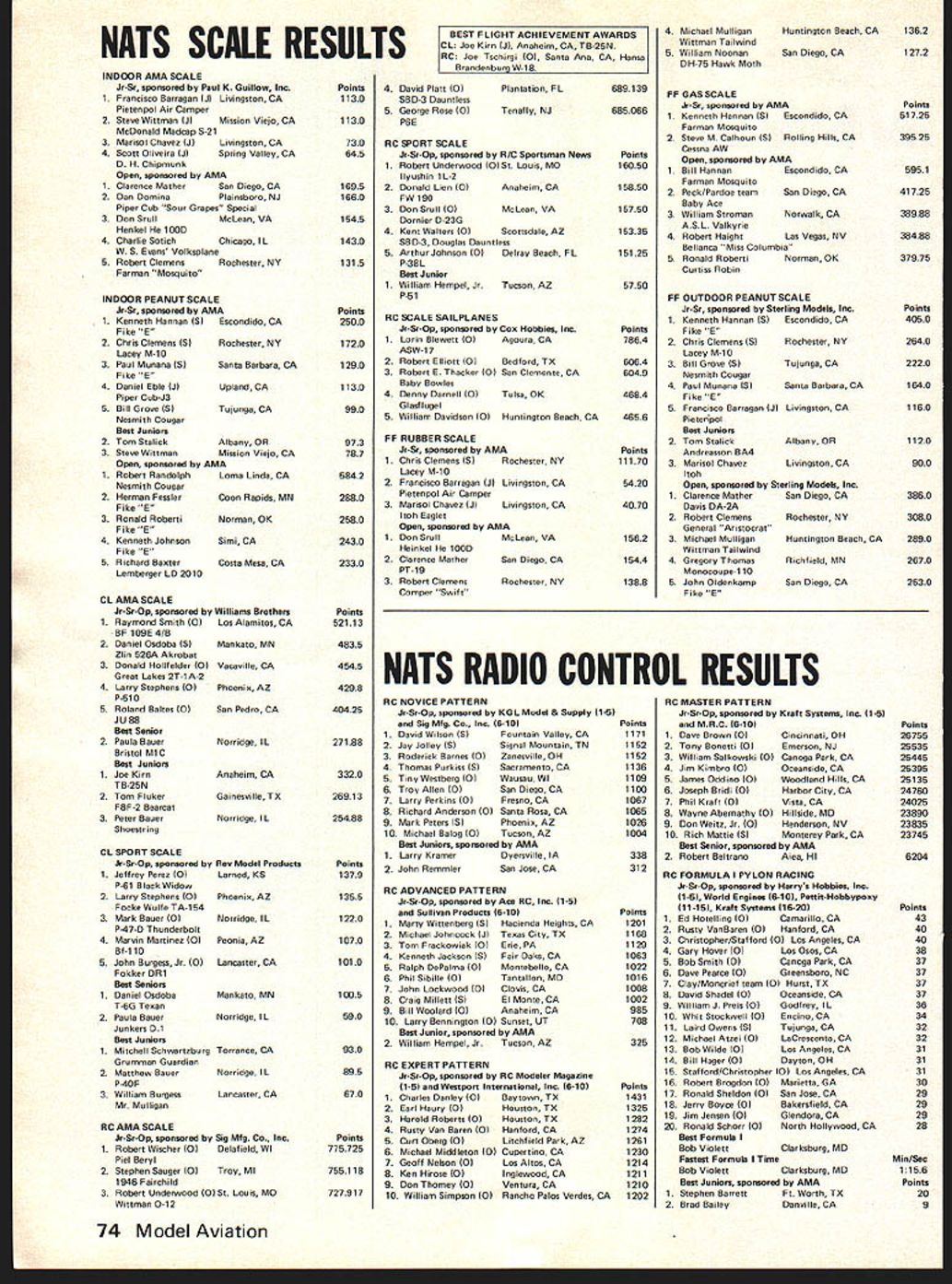
NATS SCALE RESULTS
Indoor AMA Scale Jr-Sr, sponsored by Paul K. Guillow, Inc.
- Francisco Barragan Jr., Livingston, CA — 113.0
- Pieperpol Air Camper — 113.0
- Steve Wittman (Jr), Mission Viejo, CA — 113.0
McDonald Madcap S-21
- Marisol Chavez (Jr), Livingston, CA — 74.0
- Scott Oliveira (Jr), Spring Valley, CA — 64.5
Open, sponsored by AMA
- Clarence Maher, San Diego, CA — 169.5
- Dan Domina, Plainsboro, NJ — 166.0
- Piper Cub "Sour Grapes" Special — 160.0
- Don Srull — 154.5
Henkel He 100D
- Charlie Storch, Chicago, IL — 143.0
W. S. Evans' Volksplane
- Robert Clemens, Rochester, NY — 131.5
Farman "Mosquito"
Indoor Peanut Scale Jr-Sr, sponsored by AMA
- Kenneth Hannan (S), Escondido, CA — 250.0
- Pike "E" — 172.0
- Chris Clemens (S), Rochester, NY — 172.0
Lacey M-10
- Paul Munana (S), Santa Barbara, CA — 129.0
Pike "E"
- Daniel Eble (J), Upland, CA — 99.0
Piper Cub-J3 Best Junior
- Bill Grove (S), Tujunga, CA — 99.0
Nemeth Cougar Best Seniors
- Tom Stalick, Albany, OR — 97.3
- Steve Wittman, Mission Viejo, CA — 78.7
Open, sponsored by AMA
- Robert Randolph, Loma Linda, CA — 684.2
- Nemeth Cougar, Rochester, NY — 285.0
- Herman Fessler, Coon Rapids, MN — 258.0
Pike "E"
- Ronald Roberti, Norman, OK — 258.0
Pike "E"
- Kenneth Johnson, Simi, CA — 243.0
Pike "E"
- Richard Baxter, Costa Mesa, CA — 233.0
Lemanager L/D 2010
CL AMA Scale Jr-Sr-Op, sponsored by Williams Brothers
- Raymond Smith (Cl), Los Alamitos, CA — 521.13
- BF 109E 4/8
- Daniel Osdoba (S), Mankato, MN — 483.5
Zlin 526A Akrobat
- Donald Hoelfelder (D), Vacaville, CA — 454.5
Great Lakes 2T-1A-2
- Larry Stephens (D), Phoenix, AZ — 420.8
P-51D
- Roland Baltes (O), San Pedro, CA — 404.25
U 88 Best Senior
- Paula Bauer, Norristown, IL — 271.88
Pistol M/C Best Juniors
- Joe Kirn, Anaheim, CA — 332.0
TB-25N
- Tom Fluker, Gainesville, TX — 269.13
- F8F-2 Bearcat
- Peter Bader, Norristown, IL
CL Sport Scale Jr-Sr-Op, sponsored by Rev Model Products
- Jeffrey Perez (O), Larned, KS — 137.9
P-61 Black Widow
- Larry Stephens (O), Phoenix, AZ — 135.6
P-40B
- Mark Bauer (O), Norristown, IL — 122.0
P-47D Thunderbolt
- Marvin Martinez (O), Peoria, AZ — 120.0
B-17G
- John Burgess Jr. (O), Lancaster, CA — 101.0
Focke Wulf Fw 190 Best Seniors
- Daniel Osdoba, Mankato, MN — 100.5
- Paula Bauer, Norristown, IL — 96.0
Junkers D.1 Best Juniors
- Mitchell Schweinfurth, Torrance, CA — 93.0
Grumman Guardian
- Matthew Bauer, Norristown, IL — 89.5
P-40F
- William Burgess, Lancaster, CA — 67.0
M. Mulligan
RC AMA Scale Jr-Sr-Op, sponsored by Sig Mfg. Co., Inc.
- Robert Wischer (O), Delafield, WI — 775.725
- Bill Perty Jr. (O), Troy, MI — 755.118
- Robert Underwood (O) St. Louis, MO — 727.917
Wittman O-12
BEST FLIGHT ACHIEVEMENT AWARDS CL: Joe Kirn (Jr), Anaheim, CA, TB-25N. RC: Joe Teschiri (O), Santa Ana, CA, Havoc. R/C: Brandenburg W-18
RC SPORT SCALE Jr-Sr-Op, sponsored by R/C Sportsman News
- Robert Underwood (O), St. Louis, MO — 160.50
Pylon IL-2
- Donald Lien (O), Anaheim, CA — 158.50
FW 190
- Don Srull (O), McLean, VA — 157.50
Dornier Do-23G
- Kent Walters (O), Scottsdale, AZ — 153.35
SBD-3, Douglas Dauntless
- Arthur Johnston (O), Delray Beach, FL — 151.25
P-3-AJ Best Junior
- William Hempel, Jr., Tucson, AZ — 57.50
P-51
RC Scale Sailplanes Jr-Sr-Op, sponsored by Cox Hobbies, Inc.
- John Blewett (O), Agoura, CA — 786.4
ASW-17
- Robert Elliott (O), Bedford, TX — 606.4
- Robert E. Thacker (O), San Clemente, CA — 604.9
Baby Bowes
- Denny Danell (O), Tulsa, OK — 468.4
Glasflugel
- William Davidson (O), Huntington Beach, CA — 465.6
FF Rubber Scale Jr-Sr, sponsored by AMA
- Chris Clemens (S), Rochester, NY — 111.70
Lacey M-10
- Francisco Barragan (Jr), Livingston, CA — 54.20
Pieperpol Air Camper
- Marisol Chavez (Jr), Livingston, CA — 40.70
- Open, sponsored by AMA
- Don Srull, McLean, VA — 156.2
Heinkel He 100D
- Clarence Maher, San Diego, CA — 154.4
PT-19
- Robert Clemens, Rochester, NY — 138.8
Comper "Swift"
FF Gas Scale Jr-Sr, sponsored by AMA
- Kenneth Hannan (S), Escondido, CA — 517.25
Farman Mosquito
- Steve M. Calhoun (S), Rolling Hills, CA — 395.25
Cessna A/V Open, sponsored by AMA
- Bill Hannon, Escondido, CA — 595.1
Farman Mosquito
- Peck/Pardo, San Diego, CA — 417.25
Baby Ace
- William Stroman, Norwalk, CA — 389.88
A.S.L. Valkyrie
- Robert Haight, Las Vegas, NV — 384.88
Bellanca "Miss Columbia"
- Ronald Roberti, Norman, OK — 379.75
Curtiss Robin
FF Outdoor Peanut Scale Jr-Sr, sponsored by Sterling Models, Inc.
- Kenneth Hannan (S), Escondido, CA — 405.0
Pike "E"
- Chris Clemens (S), Rochester, NY — 264.0
Lacey M-10
- Bill Grove (S), Tujunga, CA — 222.0
Nemeth Cougar
- Paul Munana (S), Santa Barbara, CA — 164.0
Pike "E"
- Francisco Barragan (Jr), Livingston, CA — 116.0
Pieperpol Best Juniors
- Tom Stalick, Albany, OR — 112.0
- Andreson B44
- Marisol Chavez, Livingston, CA — 90.0
Open, sponsored by Sterling Models, Inc.
- Clarence Maher, San Diego, CA — 386.0
Davis DA-2A
- Robert Clemens, Rochester, NY — 368.0
General "Airscraper"
- Michael Mulligan, Huntington Beach, CA — 289.0
Wittman Tailwind
- Gregory Thomas, Richfield, MN — 263.0
Monocoupe-110
- John Oldenkamp, San Diego, CA — 253.0
Pike "E"
US Indoor Team Selected Team finals competition Akron, OH, August 12-14. The following team members represent the U.S. for the 1978 World Championships (tentatively slated for Romania):
- Jim Richmond, Davidson, NC
- William Hulbert, Akron, OH
- Dan Domina, Plainsboro, NJ
Ray Harlan, Wayland, MA — first alternate
Report: John Lenderman, US Team Manager Advance preparations prior to WC events are very helpful in getting things in order before the team arrives. Arriving early in Europe gave the team manager time to pick up loose ends and chase down other items necessary for good team performance. For example, practice fuel for the power team was shipped prepaid; K&B Manufacturing Co. sent attention to the US Embassy office in Copenhagen a month ahead. Time finally heard shipment June 25th; they were too busy to arrange delivery. The team manager had to track down the outlying dock in Copenhagen, find the office closed, take inquiries to locate the dock the next day, drive out expecting to obtain the box of fuel and find the address a vacant office. Inquiries directed us to a third-floor office which demanded payment for shipping services. After handing over money we were told the fuel was back at the dock. This frustrating experience does point out the advantage of the team manager having time to follow up. It also enabled us to make arrangements with the cafeteria manager to have team members take meals prior to the official date July 6th, have early arriving team members stay at Peder Syv School before the 6th. This was accomplished by seeking out the headmaster and spending some time getting acquainted with him. Meeting team members at the airport with a microbus seemed to greatly relieve anxiety. Also having the school available gave us a chance to relax and look over the area. Another example: Al Bissonette's model box was lost by the airline for 24 hours; we encountered no serious problems. Four days of practice prior to moving onto the airport site gave a day practice before the start of the championships.
National Scale Organization Formed At a meeting during the National Contest Thursday, August 11, over 75 scale-oriented FF, CL, RC modelers took the first step in organizing a national scale group. After much discussion concerning goals and needs, the group elected temporary officers. They include Bob Underwood, president; Fernando Ramos, FF VP; Bill Boss, CL VP; Granger Williams, RC VP; Noel Allison, secretary-treasurer. Jim Crum will edit the newsletter. The organization will serve scale modelers to the best of its ability. Those interested in becoming members should contact Noel Allison, 4174 W. 120th St., Apt. C, Hawthorne, CA 90250. A dues structure has not been established yet.
US World Champ Teams Picked at NATS Radio Control Scale: Bob Wischer, Delafield, WI; Steve Sauger, Troy, MI; Bob Underwood, St. Louis, MO.
Control Line Scale: Ray Smith, Los Alamitos, CA; Dan Osdoba, Mankato, MN; Roland Baltes, San Pedro, CA.
Control Line Team Racing: Carl Dodge, Henry Nelson, Richmond Hts, OH; E.A. Birtton, Jim Joy, Falls Church, VA; Jim Jolly, Jed Kusik, Santa Ana, CA.
Control Line Speed: Bob Spahr, Santa Ana, CA; Chuck Schuette, Lakewood, CA; Charles Lieber, Moorestown, NJ.
(Note: Subject to no faster times being turned in; possible eastern location. Scale Control Line World Championships tentatively scheduled England 1978.)
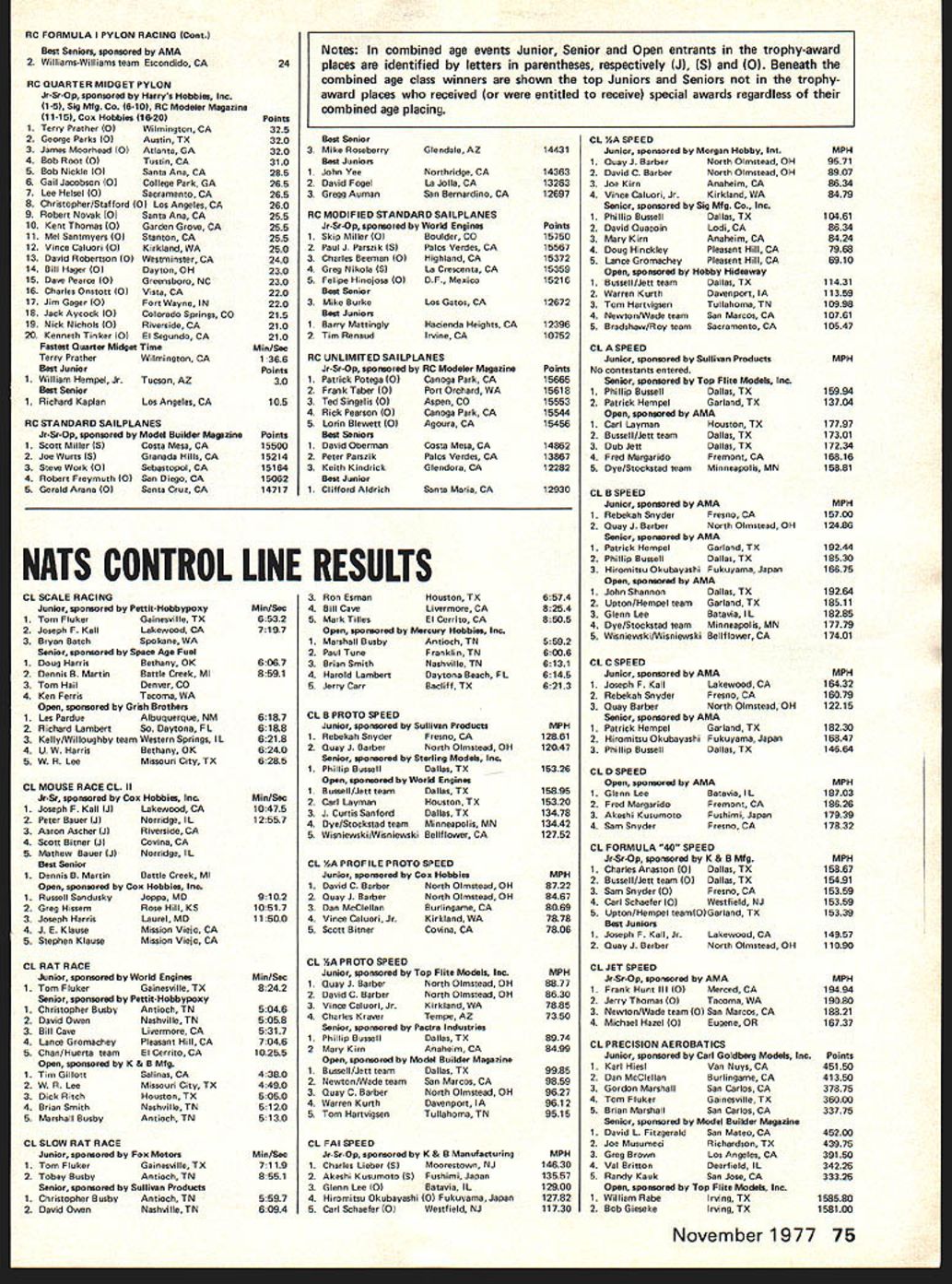
NATS CONTROL LINE RESULTS
CL SCALE RACING Junior, sponsored by Pettit-Hobbypoxy
- Tom Fisher, Gainesville, TX — 6:53.2
- Joseph F. Kall, Lakewood, CA — 7:19.7
- Bryan Bates, Spokane, WA
Senior, sponsored by Space Age Fuel
- Doug Harris, Bethany, OK — 6:06.7
- Dennis B. Martin, Battle Creek, MI — 8:59.1
- Tom Hail, Denver, CO
Open, sponsored by Grish Brothers
- Les Pardue, Albuquerque, NM — 6:18.7
- Richard Lambert, So. Daytona, FL — 6:18.8
- Kelly/Willoughby, team, Western Springs, IL — 6:24.0
CL MOUSE RACE CL II Junior, sponsored by Cox Hobbies, Inc.
- Joseph F. Kall, Lakewood, CA — 10:47.5
- Peter Bauer (Jr.), Norridge, IL — 12:55.7
- Aaron Ascher (Jr.), Riverside, CA
Senior, sponsored by Cox Hobbies, Inc.
- Dennis B. Martin, Battle Creek, MI — 9:10.2
- Russell Sondback, Detroit Creek, MI — 10:51.7
- Joseph Harris, Laurel, MD
CL RAT RACE Junior, sponsored by World Engines
- Tom Fisher, Gainesville, TX — 8:24.2
- Tony Baker, Gainesville, TX
- Christopher Busby, Antioch, TN
Senior, sponsored by Pettit-Hobbypoxy
- Bill Lowe, Nashville, TN — 5:04.8
- Don Giglio, Providence, RI — 5:05.6
- Bill Lowe, Nashville, TN — 5:59.7
CL SLOW RAT RACE Junior, sponsored by Fox Motors
- Tom Fisher, Gainesville, TX — 7:11.9
- Tony Baker, Gainesville, TX — 8:55.1
- David Owen, Nashville, TN — 6:09.4
CL B PROTO SPEED Junior, sponsored by Sullivan Products — MPH
- Reuben Snyder, Fresno, CA — 128.61
- Quay J. Barber, North Olmsted, OH — 120.47
- Paul V. Turner, Houston, TX — 115.92
Open, sponsored by Sterling Models, Inc. — MPH
- Phillip Russell, Dallas, TX — 153.26
- Earl Margadroid, Fremont, CA — 152.90
- D. D. Margadroid, Fremont, CA — 150.62
CL A PROTO SPEED Junior, sponsored by Top Flite Models, Inc. — MPH
- Quay J. Barber, North Olmsted, OH — 87.27
- Doug Barber, North Olmsted, OH — 84.67
- Vince Calouri, Jr., Kirkland, WA — 78.06
CL 1/2A PROTO SPEED Junior, sponsored by Top Flite Models, Inc. — MPH
- Quay J. Barber, North Olmsted, OH — 87.27
- Doug Barber, North Olmsted, OH — 86.30
- Vince Calouri, Jr., Kirkland, WA — 78.06
CL FAI SPEED Junior, sponsored by K & B Manufacturing — MPH
- Charles Lieber, Moorestown, NJ — 146.30
- Akashi Kusumoto (S), Fushimi, Japan — 135.57
- Glenn Lee (O), Batavia, IL — 129.00
RC STANDARD SAILPLANES Jr.-Sr.-Op., sponsored by Model Builder Magazine — Points
- Scott Miller (S), Costa Mesa, CA — 15500
- Joe Wittis (S), Granada Hills, CA — 15214
- Steve Wrok (O), Sebastopol, CA — 15142
- Robert Freymuth, San Diego, CA — 15062
- Gerald Arano (O), Santa Cruz, CA — 14717
RC MODIFIED STANDARD SAILPLANES Jr.-Sr.-Op., sponsored by World Engines — Points
- Skip Miller (O), Boulder, CO — 15580
- Paul J. Parski (S), Palos Verdes, CA — 15567
- Charles Benitez (O), Highland, CA — 15372
- Greg Nikols (O), La Crescenta, CA — 15322
- Felipe Hinojosa (O), D.F., Mexico — 15216
RC UNLIMITED SAILPLANES Jr.-Sr.-Op., sponsored by RC Modeler Magazine — Points
- Patrick Potega (O), Canoga Park, CA — 15665
- Frank Tabor (O), Port Orchard, WA — 15618
- Ted Spiegle (O), Aspen, CO — 15583
- Rick Pearson (O), Canoga Park, CA — 15466
- Lorin Blewett (O), Agoura, CA — 15456
Best Senior
- Mike Roseberry, Glendale, AZ — 14431
Best Juniors
- Terry Prather (O), Wilmington, CA — 32.5
- George Parks (O), Austin, TX — 32.0
(CL/YA SPEED and other speed columns follow)
CL 1/4A SPEED Junior, sponsored by Morgan Hobby, Int. — MPH
- Quay J. Barber — 95.71
- David C. Barber, North Olmsted, OH — 89.07
- Joe Kirn, Anaheim, CA — 86.34
CL A SPEED Junior, sponsored by Sullivan Products — MPH
- Quay J. Barber — 159.94
- Phillip Russell, Dallas, TX — 137.04
- Patrick Hempel, Garland, TX — 137.04
CL B SPEED Junior, sponsored by AMA — MPH
- Rebekah Snyder, Fresno, CA — 157.00
- Quay J. Barber, North Olmsted, OH — 124.86
- Joseph F. Kall, Lakewood, CA — 120.47
CL D SPEED Open, sponsored by AMA — MPH
- John Shannon, Dallas, TX — 192.64
- Upton/Herbel team, Garland, TX — 185.11
- G. Doyle/Stockstad team, Minneapolis, MN — 179.79
CL JET SPEED Jr.-Sr.-Op., sponsored by AMA — MPH
- Frank Hunt (O), Merced, CA — 194.94
- Jerry Thomas (O), Tacoma, WA — 190.83
- Michael Healy (O), Eugene, OR — 167.37
CL PRECISION AEROBATICS Junior, sponsored by Carl Goldberg Models, Inc. — Points
- Karl Hess, Van Nuys, CA — 451.50
- Danny McClellan, Burlingame, CA — 439.75
- Dean Sheehan, San Carlos, CA — 375.00
(Additional event listings and lower-place finishers are included in the full results on the page.)
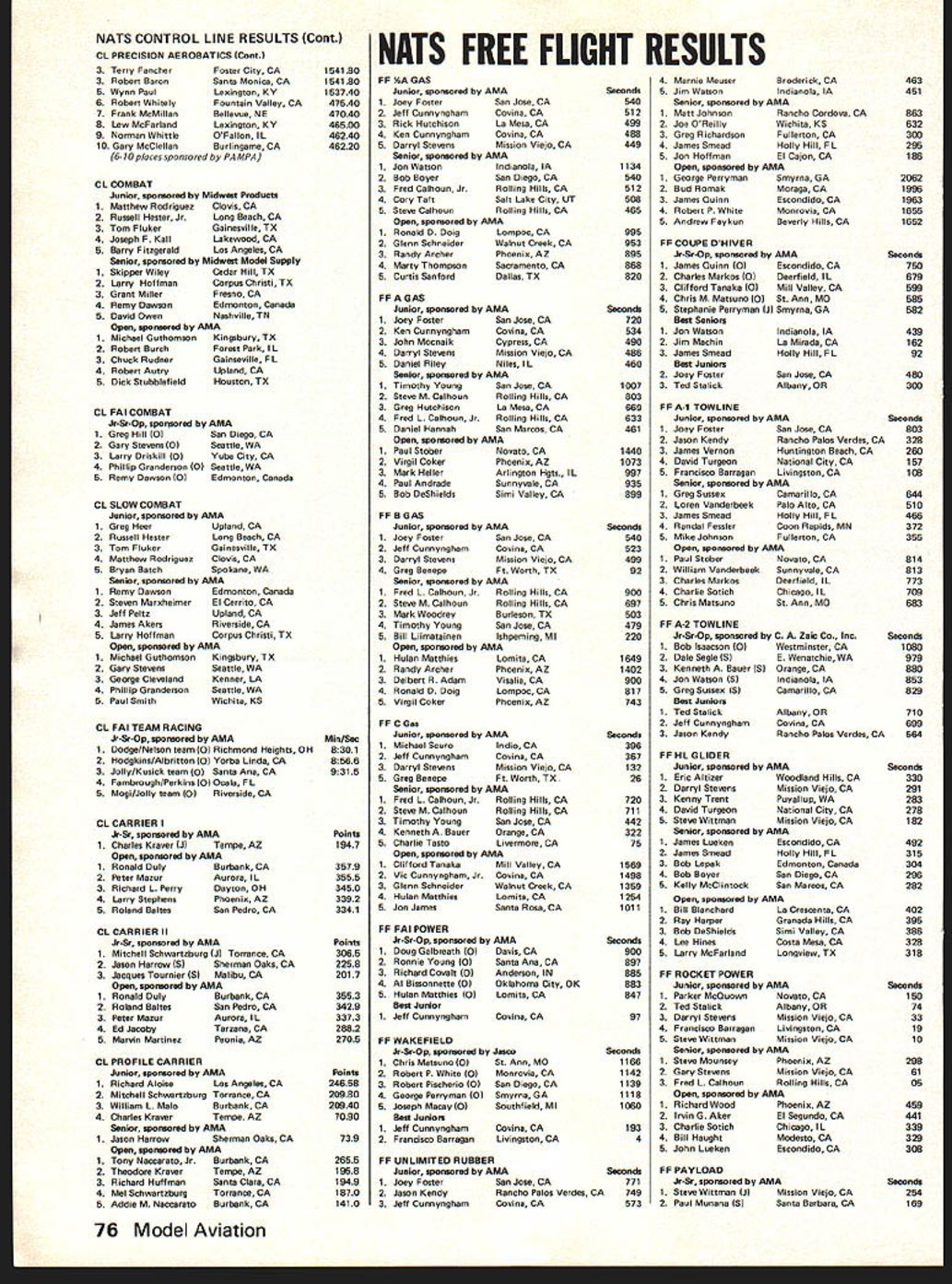
NATS FREE FLIGHT RESULTS
FF 1/4A GAS Junior, sponsored by AMA Seconds
- Joey Foster, San Jose, CA — 540
- Jeff Cunningham, Covina, CA — 512
- Rick Hutchison, La Mesa, CA — 499
- Ken Cunningham, Covina, CA — 488
- Darryl Stevens, Mission Viejo, CA — 449
Senior, sponsored by AMA
- Jon Watson, Indanola, IA — 1134
- Bob Boyer, San Diego, CA — 540
- Fred Calhoun, Jr., Rolling Hills, CA — 512
- Cory Tait, Salt Lake City, UT — 508
- Steve Calhoun, Rolling Hills, CA — 405
Open, sponsored by AMA
- Ronald D. Doig, Lompoc, CA — 995
- Glenn Schreider, Walnut Creek, CA — 953
- Randy Archer, Phoenix, AZ — 895
- Marty Thompson, Sacramento, CA — 868
- Curtis Sanford, Dallas, TX — 820
FF A GAS Junior, sponsored by AMA Seconds
- Joey Foster, San Jose, CA — 720
- Ken Cunningham, Covina, CA — 534
- John Mocniak, Cypress, CA — 490
- Darryl Stevens, Mission Viejo, CA — 486
- Daniel Riley, Niles, IL — 460
Senior, sponsored by AMA
- Timothy Young, San Jose, CA — 1007
- Steve M. Calhoun, Rolling Hills, CA — 803
- Greg Hutchison, La Mesa, CA — 669
- Fred L. Calhoun, Jr., Rolling Hills, CA — 633
- Daniel Hannah, San Marcos, CA — 461
Open, sponsored by AMA
- Paul Stober, Novato, CA — 1440
- Virgil Coker, Phoenix, AZ — 1073
- Mark Heller, Arlington Hts., IL — 997
- Paul Andrade, Sunnyvale, CA — 935
- Bob DeShields, Simi Valley, CA — 899
FF B GAS Junior, sponsored by AMA Seconds
- Joey Foster, San Jose, CA — 540
- Jeff Cunningham, Covina, CA — 523
- Daryl Stevens, Mission Viejo, CA — 499
- Greg Benpe? Ft. Worth, TX — 92
- ??? (illegible)
Senior, sponsored by AMA
- Fred L. Calhoun, Jr., Rolling Hills, CA — 900?
- Steve M. Calhoun, Rolling Hills, CA — 697
- Mark Woodrey, Burleson, TX — 503
- Timothy Young, San Jose, CA — 479
- Bill Ulimnainen? Ishpeming, MI — 220
Open, sponsored by AMA
- Hulan Mathies, Lomita, CA — 1649
- Randy Archer, Phoenix, AZ — 1402
- Delbert R. Adam, Visalia, CA — 900
- Ronald D. Doig, Lompoc, CA — 817
- Virgil Coker, Phoenix, AZ — 743
FF C GAS Junior, sponsored by AMA Seconds
- Michael Secura? Indio, CA — 306
- Jeff Cunningham, Covina, CA — 367
- Darryl Stevens, Mission Viejo, CA — 132
- Greg Benpe? Ft. Worth, TX — 26
- (illegible)
Senior, sponsored by AMA
- Fred L. Calhoun, Jr., Rolling Hills, CA — 720
- Steve M. Calhoun, Rolling Hills, CA — 711
- Timothy Young, San Jose, CA — 442
- Kenneth A. Bauer, Orange, CA — 322
- Charlie Tasto, Livermore, CA — 75
Open, sponsored by AMA
- Clifford Tanaka, Mill Valley, CA — 1569
- Vic Cunningham, Covina, CA — 1498
- Glenn Schneider, Walnut Creek, CA — 1359
- Hulan Mathies, Lomita, CA — 1254
- Jon James, Santa Rosa, CA — 1011
FF FAI POWER Jr.-Sr.-Op., sponsored by AMA Seconds
- Doug Galbreath (O), Davis, CA — 900
- Donnie Young (O), Santa Ana, CA — 897
- Richard Cowall (O), Andover, IN — 883
- Al Bissonette (O), Oklahoma City, OK — 847
- Hulan Mathies (O), Lomita, CA — 812
Best Junior
- Joey Foster, Covina, CA — 97
FF WAKEFIELD Jr.-Sr.-Op., sponsored by Jasco Seconds
- Chris Matuson (O), St. Ann, MO — 1166
- Robert W. White (O), Torrance, CA — 1142
- Richard P. Rorif? (O), San Diego, CA — 1139
- George Perryman (O), Smyrna, GA — 1118
- Joseph Macoy (O), Southfield, MI — 1060
Best Junior
- Jeff Cunningham, Covina, CA — 193
- Francisco Barraqan, Livingston, CA — 4
FF UNLIMITED RUBBER Junior, sponsored by AMA Seconds
- Joey Foster, San Jose, CA — 749
- Jason Kenc (?), Rancho Palos Verdes, CA — 749
- Jeff Cunningham, Covina, CA — 573
FF ROCKET POWER Junior, sponsored by AMA Seconds
- Parker McJowan, Novato, CA — 150
- Jay Stall, Albany, OR — 73
- Don Vetter, Mission Viejo, CA — 74
- Francisco Barraqan, Livingston, CA — 10
- Steve Matuson, Phoenix, AZ — 298
FF COUPE D'HIVER Sr.-Sr-Op., sponsored by AMA Seconds
- James Quinn (O), Escondido, CA — 750
- Charles Markos (O), Deerfield, IL — 699
- Clifford Tanaka (O), Mill Valley, CA — 659
- Chris M. Matsuno (O), St. Ann, MO — 585
- Stephanie Perryman (O), Smyrna, GA — 582
Best Seniors
- Jon Watson, Indanola, IA — 439
- Jim Mazzella? La Mirada, CA — 162
- James Smead Holly Hill, FL — 92
Best Juniors
- Joey Foster, San Jose, CA — 480
- Ted Staitick Albany, OR — 300
FF A-1 TOWLINE Junior, sponsored by AMA Seconds
- Joey Foster, San Jose, CA — 803
- Jason Kendrick, Rancho Palos Verdes, CA — 560
- James Vernon, Huntington Beach, CA — 260
- David Turgeon, National City, CA — 157
- Francisco Barragan, Livingston, CA — 108
Senior, sponsored by AMA
- Greg Suss? Camarillo, CA — 682
- Lorne Vandenberg, Palo Alto, CA — 510
- James Smead, Holly Hill, FL — 466
- Ronald Fessler, West Rapids, MN — 372
- Mike Johnson, Fullerton, CA — 355
Open, sponsored by AMA
- Paul Stober, Novato, CA — 814
- William Vanderbeek Sunnyvale, CA — 813
- Charles Marks? Deerfield, IL — 773
- C. Charles Stoich, Chicago, IL — 708
- Chris Matuson, St. Ann, MO — 683
FF A-2 TOWLINE Sr.-Sr-Op., sponsored by C. A. Zuk Co., Inc. Seconds
- Bob Jacobson (O), Westminster, CA — 1080
- Dale Slegie (O), E. Wenatchee, WA — 979
- Kenneth A. Bauer (O), Orange, CA — 880
- Jon Watson (O), Indanola, IA — 853
- Greg Suss? Camarillo, CA — 829
Best Juniors
- Ted Staitick, Albany, OR — 710
- Jeff Cunningham, Covina, CA — 690
- Jason Kecky, Rancho Palos Verdes, CA — 650
FF HL GLIDER Junior, sponsored by AMA Seconds
- Eric Aluizer? Woodland Hills, CA — 300
- David Thurston, Mission Viejo, CA — 291
- Keny? Trent? Puyallup, WA — 284
- David Turgeon, National City, CA — 273
- Steve Whitman, ??? — 182
Senior, sponsored by AMA
- James Smead, Escondido, CA — 492
- Bob Lepak, Escondido, CA — 315
- Bob Boyer, Dayton, OH — 294
- Bob Meyers?, Rancho?, CA — 292
- Bill Brodhead, La Crescenta, CA — 282
Open, sponsored by AMA
- Bob DeShields, Granada Hills, CA — 396
- Roy Cloyd, Simi Valley, CA — 386
- Bill Broderick, San Marino, CA — 326
- Larry McFarland, Longview, TX — 318
FF PAYLOAD Jr.-Sr.-Op., sponsored by AMA Seconds
- Steve Whitman (J), Mission Viejo, CA — 254
- Paul Munana (S) Santa Barbara, CA — 169
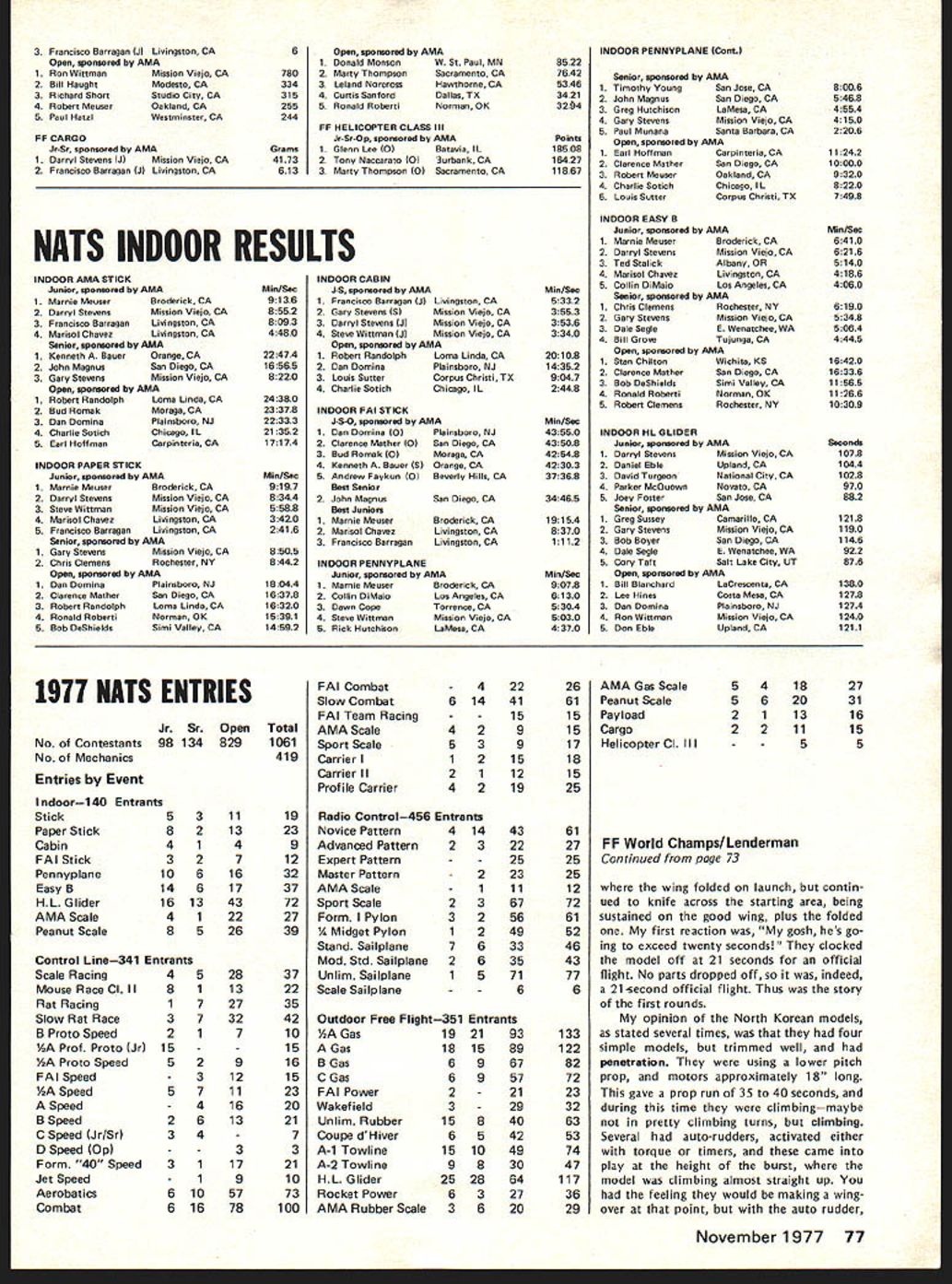
NATS INDOOR RESULTS
INDOOR AMA STICK Junior, sponsored by AMA
- Marnie Meuser, Broderick, CA — 9:13.6
- Darryl Stevens, Mission Viejo, CA — 8:55.2
- Francisco Barragan (J), Livingston, CA — 8:03.9
- Marisol Chavez, Livingston, CA — 4:48.0
Senior, sponsored by AMA
- Kenneth A. Bauer, Orange, CA — 22:47.4
- John Magnus, San Diego, CA — 16:56.5
- Gary Stevens, Mission Viejo, CA — 8:22.0
Open, sponsored by AMA
- Robert Randolph, Loma Linda, CA — 24:38.0
- Bud Romak, Moraga, CA — 23:37.8
- Dan Domina, Plainsboro, NJ — 22:33.3
- Charlie Sotich, Chicago, IL — 21:22.3
- Earl Hoffman, Carpinteria, CA — 17:17.7
INDOOR PAPER STICK Junior, sponsored by AMA
- Marnie Meuser, Broderick, CA — 9:19.7
- Darryl Stevens, Mission Viejo, CA — 8:34.4
- Steve Wittman, Mission Viejo, CA — 5:58.8
- Marisol Chavez, Livingston, CA — 3:42.8
- Francisco Barragan, Livingston, CA — 2:41.6
Senior, sponsored by AMA
- Gary Stevens, Mission Viejo, CA — 8:50.5
- Chris Clemens, Rochester, NY — 8:44.2
Open, sponsored by AMA
- Dan Domina, Plainsboro, NJ — 18:04.4
- Clarence Mathew, San Diego, CA — 16:37.8
- Robert Randolph, Loma Linda, CA — 16:32.0
- Roland Robert, Norman, OK — 15:59.1
- Bob DeShields, Simi Valley, CA — 14:59.2
INDOOR CABIN Jr., sponsored by AMA — Min/Sec
- Francisco Barragan (J), Livingston, CA — 5:33.2
- Gary Stevens (S), Mission Viejo, CA — 5:33.5
- Darryl Stevens (J), Mission Viejo, CA — 3:53.6
- Steve Wittman (J), Mission Viejo, CA — 3:34.0
Open, sponsored by AMA
- Robert Randolph, Loma Linda, CA — 20:10.8
- Dan Domina, Plainsboro, NJ — 14:35.2
- Louis Sutter, Corpus Christi, TX — 9:04.7
- Charlie Sotich, Chicago, IL — 2:44.8
INDOOR FAI STICK J-S-O, sponsored by AMA — Min/Sec
- Dan Domina? (listed) — 43:55.0
- Clarence Mathew (O), San Diego, CA — 43:50.0
- Bud Romak (O), Moraga, CA — 42:54.8
- Kenneth A. Bauer (S), Orange, CA — 42:30.3
- Andrew Faykun (O), Beverly Hills, CA — 37:36.8
INDOOR PENNYPLANE Junior, sponsored by AMA — Min/Sec
- Marnie Meuser, Broderick, CA — 9:07.8
- Collin DiMaio, Los Angeles, CA — 6:10.4
- Dawn Cope, Torrance, CA — 5:30.4
- Steve Wittman, Mission Viejo, CA — 5:03.0
- Rick Hutchison, LaMesa, CA — 4:37.0
INDOOR EASY B Junior, sponsored by AMA — Min/Sec
- Marnie Meuser, Broderick, CA — 6:41.0
- Darryl Stevens, Mission Viejo, CA — 6:21.6
- Ted Statick, Albany, OR — 5:14.0
- Marisol Chavez, Livingston, CA — 4:18.6
- Collin DiMaio, Los Angeles, CA — 4:06.0
Senior, sponsored by AMA
- Chris Clemens, Rochester, NY — 6:19.0
- Gary Stevens, Mission Viejo, CA — 5:34.8
- Dale Seigle, E. Wenatchee, WA — 5:06.4
- Bill Grove, Tujunga, CA — 4:44.5
Open, sponsored by AMA
- Stan Chilton, Wichita, KS — 16:42.0
- Clarence Mather, San Diego, CA — 13:36.5
- Bob DeShields, Simi Valley, CA — 11:56.6
- Roland Roberts, Norman, OK — 11:26.9
- Robert Clemens, Rochester, NY — 10:30.9
INDOOR HL GLIDER Junior, sponsored by AMA — Seconds
- Darryl Stevens, Mission Viejo, CA — 107.8
- Daniel Eble, Upland, CA — 104.4
- David Turgon, National City, CA — 102.8
- Parker McGowen, Novato, CA — 97.0
- Joey Foster, San Jose, CA — 88.2
Senior, sponsored by AMA
- Greg Suesey, Camarillo, CA — 121.8
- Gary Stevens, Mission Viejo, CA — 119.0
- Bob Boyer, San Diego, CA — 114.6
- Dale Seigle, E. Wenatchee, WA — 92.2
- Cory Tripp, Salt Lake City, UT — 87.6
Open, sponsored by AMA
- Bill Blanchard, LaCrescenta, CA — 138.0
- Lee Himes, Costa Mesa, CA — 127.8
- Don Domina, Plainsboro, NJ — 127.4
- Don Wittman, Mission Viejo, CA — 126.7
- Don Eble, Upland, CA — 121.1
1977 NATS ENTRIES
No. of Contestants
- Jr. 98
- Sr. 134
- Open 829
- Total 1061
No. of Mechanics 419
Entries by Event
Indoor — 140 Entrants
- Stick 5 3 11 19
- Paper Stick 8 2 13 23
- Cabin 3 2 4 9
- FAI Stick 3 1 2 6
- Pennyplane 10 6 16 32
- Easy B 14 6 17 37
- H.L. Glider 16 13 43 72
- AMA Scale 4 1 22 27
- Peanut Scale 8 5 26 39
Control Line — 341 Entrants
- Scale Racing 4 5 28 37
- Mouse Race Cl. II 1 1 23 25
- Rat Racing 1 7 27 35
- Slow Rat Race 3 7 32 42
- B Proto Speed 2 1 7 10
- 1/4 A Proto (Jr) 15 ? ? 15
- 1/2 A Proto Speed 5 2 9 16
- FAI Speed 3 7 11 21
- 1/4 A Speed 2 6 11 19
- A Speed 3 4 6 13
- B Speed 1 3 4 8
- C Speed (Jr/Sr) 2 3 4 9
- D Speed (Op) 1 1 3 5
- Form. "40" Speed 1 1 7 9
- Jet Speed 1 1 7 9
- Aerobatics 6 10 57 73
- Combat 6 16 78 100
Radio Control — 456 Entrants
- Novice Pattern 4 14 43 61
- Advanced Pattern 2 3 22 27
- Expert Pattern 4 2 25 31
- Master Pattern 1 2 5 8
- AMA Scale 3 2 11 16
- Sport Scale 2 3 67 72
- Form. 1 Pylon 2 2 56 60
- 1/8 Midget Pylon 3 2 49 54
- Stand. Sailplane 1 2 6 9
- Mod. Std. Sailplane 2 6 35 43
- Unlimited Sailplane 1 2 6 9
- Scale Sailplane 3 6 6 6
Outdoor Free Flight — 351 Entrants
- 1/2 A Gas 19 21 93 133
- A Gas 18 15 89 122
- B Gas 6 9 67 82
- C Gas 6 9 57 72
- FAI Power 2 3 21 26
- Wakefield 3 2 9 14
- Unlim. Rubber 15 8 40 63
- Coupe d'Hiver 6 5 42 53
- A-1 Towline 5 10 49 64
- A-2 Towline 1 8 30 39
- H.L. Glider 25 28 64 117
- Rocket Power 3 6 27 36
- AMA Rubber Scale 3 6 20 29
AMA Gas Scale 5 4 18 27 Peanut Scale 5 3 20 31 Payload 2 1 13 16 Cargo 2 2 11 15 Helicopter Cl. III 5 5
(End of primary article content on this page.)
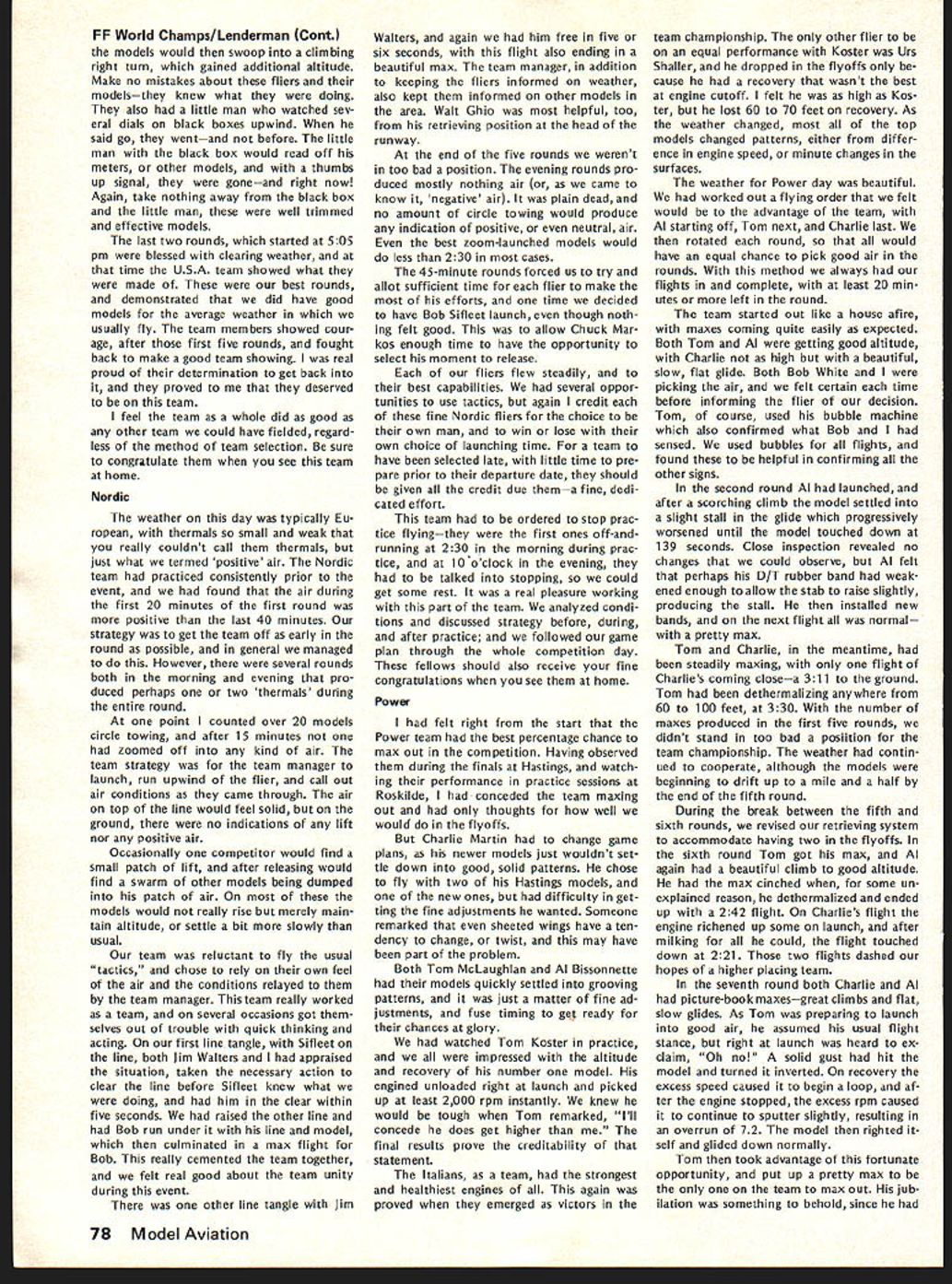
FF World Champs/Lenderman (Cont.)
the models would then swoop into a climbing right turn, which gained additional altitude. Make no mistakes about these fliers and their models—they knew what they were doing. They also had a little man who watched several dials on black boxes upwind. When he said go, they went—and not before. The little man with the black box would read off his meters, or other models, and with a thumbs up signal, they were gone—and right now! Again, take nothing away from the black box and the little man; these were well trimmed and effective models.
The last two rounds, which started at 5:05 pm were blessed with clearing weather, and at that time the U.S.A. team showed what they were made of. These were our best rounds, and demonstrated that we did have good models for the average weather in which we usually fly. The team members showed courage, after those first five rounds, and fought back to make a good team showing. I was real proud of their determination to get back into it, and they proved to me that they deserved to be on this team.
I feel the team as a whole did as good as any other team we could have fielded, regardless of the method of team selection. Be sure to congratulate them when you see this team at home.
Nordic
The weather on this day was typically European, with thermals so small and weak that you really couldn't call them thermals, but just what we termed "positive" air. The Nordic team had practiced consistently prior to the event, and we had found that the air during the first 20 minutes of the first round was more positive than the last 40 minutes. Our strategy was to get the team off as early in the round as possible, and in general we managed to do this. However, there were several rounds both in the morning and evening that produced perhaps one or two "thermals" during the entire round.
At one point I counted over 20 models circle towing, and after 15 minutes not one had zoomed off into any kind of air. The team strategy was for the team manager to launch, run upwind of the flier, and call out air conditions as they came through. The top of the line would feel solid, but on the ground, there were no indications of any lift nor any positive air.
Occasionally one competitor would find a small patch of lift, and after releasing would find a swarm of other models being dumped into his patch of air. On most of these the models would not really rise but merely maintain altitude, or settle a bit more slowly than usual.
Our team was reluctant to fly the usual "tactics," and chose to rely on their own feel of the air and the conditions relayed to them by the team manager. This team really worked as a team, and on several occasions got themselves out of trouble with quick thinking and action. On our first line tangle, with Silflet on the line, both Jim Walters and I had appraised the situation, taken the necessary action to clear the line before Silflet knew what we were doing, and had him in the clear within five seconds. We had raised the other line and had Bob run under it with his line and model, which then culminated in a max flight for Bob. This really cemented the team together, and we felt real good about the team unity during this event.
There was one other line tangle with Jim Walters, and again we had him free in five or six seconds, with this flight also ending in a beautiful max. The team manager, in addition to keeping the fliers informed on weather, also kept them informed on other models in the area. Walt Ghio was most helpful too, from his retrieving position at the head of the runway.
At the end of the five rounds we weren't in too bad a position. The evening rounds produced mostly nothing air (or, as we came to know it, "negative" air). It was plain dead, and no amount of circle towing would produce any indication of positive, or even neutral, air. Even the best zoom-launched models would do less than 2:30 in most cases.
The 45-minute rounds forced us to try and allot sufficient time for each flier to make the most of his efforts, and one time we decided to have Bob Silflet launch, even though nothing felt good. This was to allow Chuck Markos enough time to have the opportunity to select his moment to release.
Each of our fliers flew steadily, and to their best capabilities. We had several opportunities to use tactics, but again I credit each of these fine Nordic fliers for the choice to be their own man, and to win or lose with their own choice of launching time. For a team to have been selected late, with little time to prepare prior to their departure date, they should be given all the credit due them—a fine, dedicated effort.
This team had to be ordered to stop practice flying—they were the first ones off and running at 2:30 in the morning during practice, and at 10 o'clock in the evening, they had to be talked into stopping, so we could get some rest. It was a real pleasure working with this part of the team. We analyzed conditions and discussed strategy before, during, and after practice; and we followed our game plan through the whole competition day. These fellows should also receive your fine congratulations when you see them at home.
Power
I had felt right from the start that the Power team had the best percentage chance to max out in the competition. Having observed them during the finals at Hastings, and watching their performance in practice sessions at Roskilde, I had concluded the team maxing out and had only thoughts for how well we would do in the flyoffs.
But Charlie Martin had to change game plans, as his newer models just wouldn't settle down into good, solid patterns. He chose to fly with two of his Hastings models, and one of the new ones, but had difficulty in getting the fine adjustments he wanted. Someone remarked that even sheeted wings have a tendency to change, or twist, and this may have been part of the problem.
Both Tom McLaughlan and Al Bissonette had their models quickly settled into groove patterns, and it was just a matter of fine adjustments, and use timing to get ready for their chances at glory.
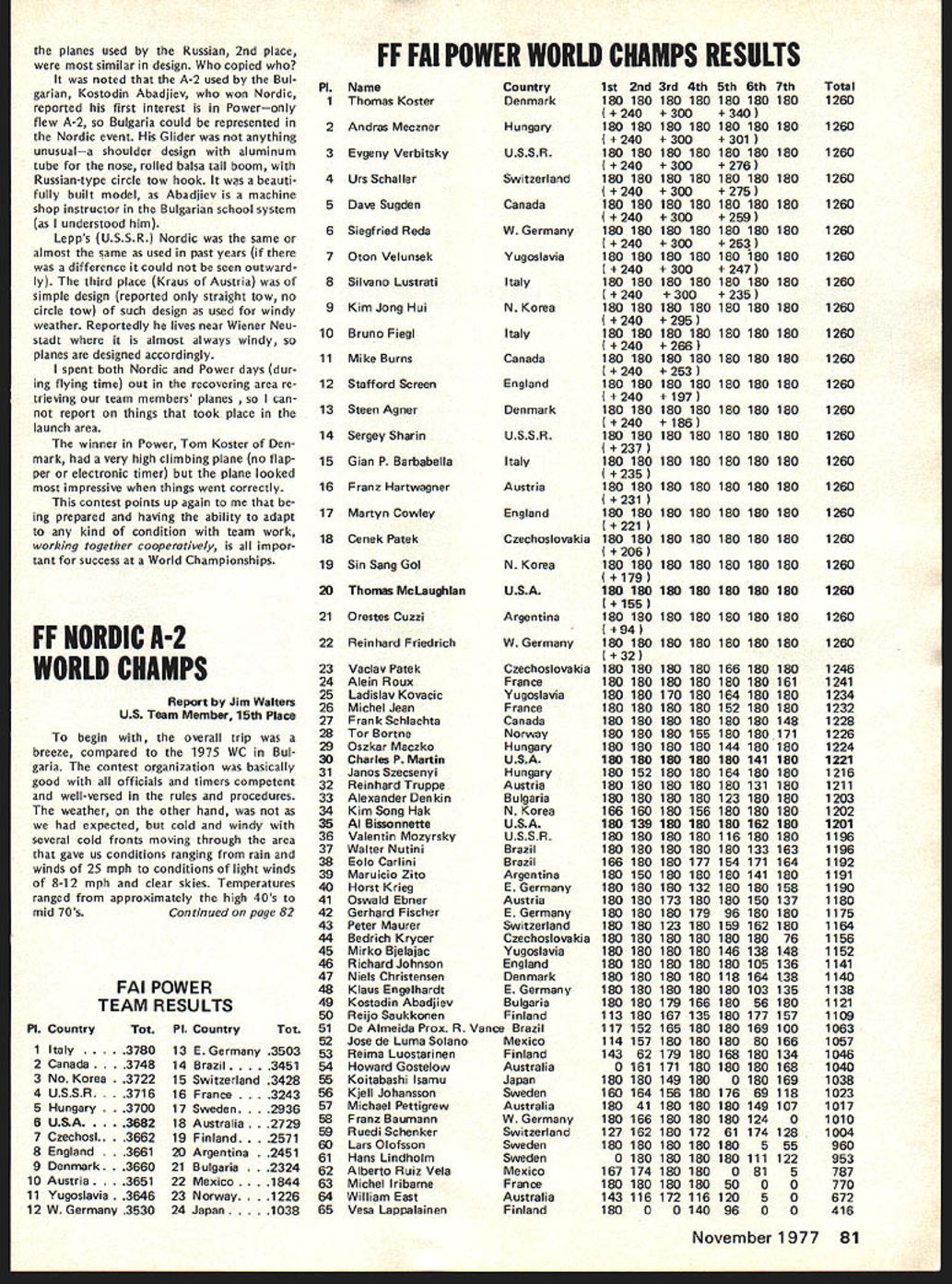
We had watched Tom Koster in practice, and we all were impressed with the altitude and recovery of his number one model. His engine unloaded right at launch and picked up at least 2,000 rpm instantly. We knew he would be tough when Tom remarked, "I'll concede he does get higher than me." The final results prove the credibility of that statement.
The Italians, as a team, had the strongest and healthiest engines of all. This again was proved when they emerged as victors in the team championship. The only other flier to be on an equal performance with Koster was Urs Shaller, and he dropped in the flyoffs only because he had a recovery that wasn't the best at engine cutoff. I felt he was as high as Koster, but he lost 60 to 70 feet on recovery. As the weather changed, most of the top models changed patterns, either from difference in engine speed, or minute changes in the surfaces.
The weather for Power day was beautiful. We had worked out a flying order that we felt would be to the advantage of the team, with Al starting off, Tom next, and Charlie last. We then rotated each round, so that all would have an equal chance to pick good air in the rounds. With this method we always had our flights in and complete, with at least 20 minutes or more left in the round.
The team started out like a house afire, with maxes coming quite easily as expected. Both Tom and Al were getting good altitude, with Charlie not as high but with a beautiful, slow, flat glide. Both Bob White and I were picking the air, and we felt certain each time before informing the flier of our decision. Tom, of course, used his bubble machine which also confirmed what Bob and I had sensed. We used bubbles for all flights, and found these to be helpful in confirming all the other signs.
In the second round Al had launched, and after a scorching climb the model settled into a slight stall in the glide which progressively worsened until the model touched down at 139 seconds. Close inspection revealed no changes that we could observe, but Al felt that perhaps his D/T rubber band had weakened enough to allow the stab to raise slightly, producing the stall. He then installed new bands, and on the next flight all was normal—with a pretty max.
Tom and Charlie, in the meantime, had been steadily maxing, with only one flight of Charlie's coming close—3:11 to the ground. Tom had been dematerializing anywhere from 60 to 100 feet, at 3:30. With the number of maxes produced in the first five rounds, we didn't stand in too bad a position for the team championship. The weather had continued to cooperate, although the models were beginning to drift up to a mile and a half by the end of the fifth round.
During the break between the fifth and sixth rounds, we revised our retrieving system to accommodate having two in the flyoffs. In the sixth round Tom got his max, and Al again had a beautiful climb to good altitude. He had the max cinched when, for some unexplained reason, he dematerialized and ended up with a 2:42 flight. On Charlie's flight the engine richened up some on launch and after trying for all he could, the flight touched down at 2:21. Those two flights dashed our hopes of a higher placing team.
In the seventh round both Charlie and Al had picture-book maxes—great climbs and flat, slow glides. As Tom was preparing to launch into good air, he assumed his usual flight stance, but right at launch was heard to exclaim, "Oh no!" A solid gust had hit the model and turned it inverted. On recovery the excess speed caused it to begin a loop, and after the engine stopped, the excess rpm caused it to continue to sputter slightly, resulting in an overrun of 7.2. The model then righted itself and glided down normally.
Tom then took advantage of this fortunate opportunity, and put up a pretty max to be the only one on the team to max out. His jubilation was something to behold, since he had missed the flyoff in the previous WC with a flight of 17 seconds.
There were 22 in the flyoffs, and preparations began immediately after round seven ended. Tom prepared two models, and carefully and methodically checked engine timers and fuse length. When the signal came to start the first flyoff round, we waited a bit until the first rush was over, and then set about to pick a good piece of air. Tom carefully adjusted the engine, and made a good launch. The model grooved nicely, and was beginning to pick up additional speed when the engine abruptly cut at 4.2 seconds! This could not be explained, since Tom and I had been so precise in getting the engine timer set properly.
The flight did not max, and after retrieving the model we made extensive checks to see what went wrong. It was only after much discussion that we decided it was probably Tom's little finger barely brushing the timer release during the engine warmup period that caused the timer to run down to that terrible 4.2 seconds. It was a real disappointment for Tom, but he deserves our congratulations for making the flyoff. Teamwise, we did well, although sixth place is not as good as first. I feel we had the capabilities, but didn't take advantage of them to have the team achieve perfect maxes.
Observations and Comments
After the competition was over I remarked to Tom Koster that it was hoped that we would do better, especially in Power, and his reply was, "You need more practice." I mentioned we had been there five or six days and organizing a World Championships—housing, eating, transportation, flying site, etc., and it takes the help of many different people and groups to be able to handle the people from so many different countries. A reported 32 nations participated.
Housing was at a young peoples' school where classrooms were converted into dormitories by removing tables and desks—and bringing in beds. The proximity of such rooms made it quite simple to get together with members of other countries. There was even a room set up as a bar, well stocked with Danish beer, for social gathering or relaxing.
Some members of our group arrived in Denmark early enough to acclimate themselves to the hours of the competition days, which consisted of getting up at 2 am, eating a box-type breakfast, flying from 3:40 am to 8:10 am, then eating a hot noon-day-type meal at the airfield cafeteria at about 8:30 am. Then the schedule called for rest or sleep at 1–2 pm, eating a box-type supper (Danish open-face sandwiches)—and more flying till the end of the day's competition—finally to relax and then go to bed. These hours were dictated by the hours the field was open to model flying; the other hours the airport was used for commercial flying—something different than what one is used to in flying U.S. contests.
One thing observed was that Europe has all kinds of weather, both good and bad. Most of the time I spent in Europe—in different places—I would consider conditions poor, quite windy most of the time.
Wakefield was flown in wet and windy, sometimes rainy, turbulent conditions. Glider and Power were flown in much more favorable conditions, in fact some of the best observed during my visit to Europe. All this brings out the fact that one must be prepared to fly in all kinds of weather conditions—both in plane design and in ability to handle weather.
It is noted that the North Koreans won again in Wakefield. They have planes that fly good rubber—and the ability to pick air. They have one person whose only job is to tell the flier when to fly—at least this was observed in Wakefield flying.
Rubber for Wakefield was a most talked about subject, concerning what is the best, where to get good rubber, and everyone trying to make the best of what rubber is available. The planes used by the Koreans for 1st and 3rd were almost identical in design, and the planes used by the Russian, 2nd place, were most similar in design. Who copied who? It was noted that the A-2 used by the Bulgarian, Kostodin Abadjiev, who won Nordic, reported his first interest is in Power—only flew A-2, so Bulgaria could be represented in the Nordic event. His glider was not anything unusual—a shoulder design with aluminum tube for the nose, rolled balsa tail boom, with Russian-type circle tow hook. It was a beautifully built model, as Abadjiev is a machine shop instructor in the Bulgarian school system (as I understood him).
Lepps (U.S.S.R.) Nordic was the same or almost the same as used in past years (if there was a difference it could not be seen outwardly). The third place (Kraus of Austria) was of simple design (reported only straight tow, no circle tow) of such design as used for windy weather. Reportedly he lives near Wiener Neustadt where it is almost always windy, so planes are designed accordingly.
I spent both Nordic and Power days (during flying time) out in the recovering area retrieving our team members' planes, so I cannot report on things that took place in the launch area.
The winner in Power, Tom Koster of Denmark, had a very high climbing plane (no flapper or electronic timer) but the plane looked most impressive when things went correctly.
This contest points up again to me that being prepared and having the ability to adapt to any kind of condition with team work, working together cooperatively, is all important for success at a World Championships.
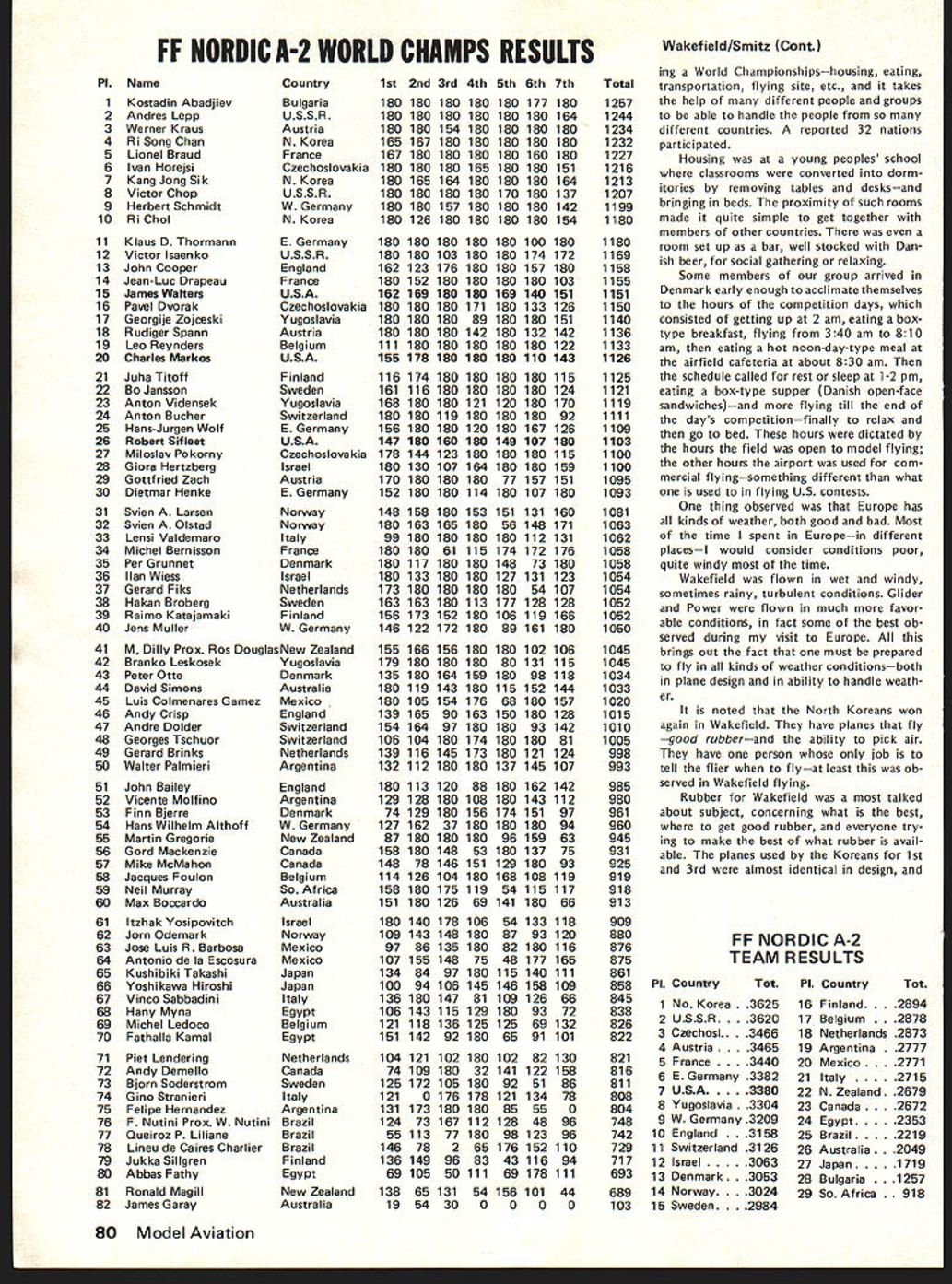
FF NORDIC A-2 WORLD CHAMPS
Report by Jim Walters
U.S. Team Member, 15th Place
To begin with, the overall trip was a breeze, compared to the 1975 WC in Bulgaria. The contest organization was basically good with all officials and timers competent and well-versed in the rules and procedures. The weather, on the other hand, was not as we had expected, but cold and windy with several cold fronts moving through the area that gave us conditions ranging from rain and winds of 25 mph to conditions of light winds of 8-12 mph and clear skies. Temperatures ranged from approximately the high 40's to mid 70's.
Nordic A-2/Walters (Cont.)
The three A-2 fliers, Chuck Markos, Bob Sifleet and myself, met in the sweat-soaked, overcrowded JFK Airport in New York where we became part of the "team." The trip over was relatively uneventful except for a broken bottle of Lux liquid in my "carry-on" bag and a couple of overindulgent airsick teenagers sitting in front of us. John Lenderman met us at the Copenhagen Airport as he had promised and, after procuring a station wagon, we drove to Roskilde and then to the school at Viby, 15 km away, which was to be our home for the next two weeks. Classrooms were set up with bunks providing adequate, but crowded, accommodations for up to 20 persons. Many teams shared rooms with teams from other countries with no apparent difficulties. As it turned out, we had enough "supporters" from the States to fill our room with friendly bodies.
Our typical practice day was to awake at 2:30 am, drive out to the practice field by 3:30 (we practiced at Halbraek, approximately 40 km away), fly till about 8:00 am, come into town or the airfield cafeteria for breakfast at 9, back to the dorm, sleep from 11 am till approximately 3 pm, back for lunch at 4 pm, then to the practice field by 5 and fly till dark, sleep by 11 pm and begin the operation all over again. We were to become quite accustomed to these weird hours as that is how the contest days would be organized. (I'm still waking at 2:30 am and going to the window to "check the weather".)
One thing is for certain in Denmark, the wind always blows and weather is constantly changing. Only on one evening did the wind subside enough to check out the full glide pattern without retrieving over a mile! During practice days, John Lenderman launched and watched all flights, and afterwards we all talked and critiqued each other's flights.
Opening ceremonies were brief but colorful with a marching band and a bevy of doves to signify the opening of VM 77 (World Champion). Conditions for the ceremonies were sunny and windy. The next morning, Wakefield day, was miserable with winds of 20 mph and light rain. Wet grass and crops between runways made retrieving difficult. Thermal activity was minimal, and only models with low pitched props were able to punch up through the turbulent cold wind.
The A-2 team provided the downwind retriever with Bissonnette and McLaughlan ferrying models back to the flying area via our microbus. Charles Martin aided timers, and team supporters manned the bubble machines and signal flag. Five rounds were flown before 8:00 am, and two rounds were flown from 5:00 pm to 7:00 pm. No one maxed out.
Nordic day began where Wakefield day left off ... cold and windy. Many fliers straight-towed but still quite a few circle-towed in the 12-15 mph wind. Thermals were extremely small and infrequent. Very seldom did models climb in lift—just maintaining line length would indicate a fairly strong thermal. Likewise, downdrafts were not strong. I believe the margin of victory in several cases was a strong catapult launch. Leop (U.S.S.R.) and his fellow teammates were particularly impressive with 30-50' altitude gain—that makes a max out of average air. On most flights we ran an escort along with John Lenderman and the flier to "hold real estate" (prevent other fliers from invading the circle-tow air space) and on a couple occasions, were able to successfully untangle our teammate's lines from other fliers and send him on his way. By the afternoon flights, the skies cleared and wind dropped slightly, but still thermals were difficult to detect. During A-2 day, the Wake team did the downwind retrieval.
Power day started clear and windy and improved as the day went on. During the early morning flight, models were going 1½ to 2 miles downwind. The day gradually improved until near perfect weather prevailed during the fly-off period, and as you all know, the hometown lad, Koster, made it all worthwhile, at least to the host country.
In closing I would like to express my thanks to AMA and others who made this a memorable experience, and many thanks to Manager John Lenderman, who, in my opinion, did an outstanding job in providing real team leadership and acting unselfishly as a servant to all the team members.
P.S. For those who wonder how we might some day win a Team Championship, it is worth noting that the U.S.S.R. A-2 team met for a two week period prior to the WC, and each member put in 1000 practice flights. Oh yes, the North Koreans beat the Russians and 28 other countries out for Team Championship—maybe they put in 2000 practice flights?!
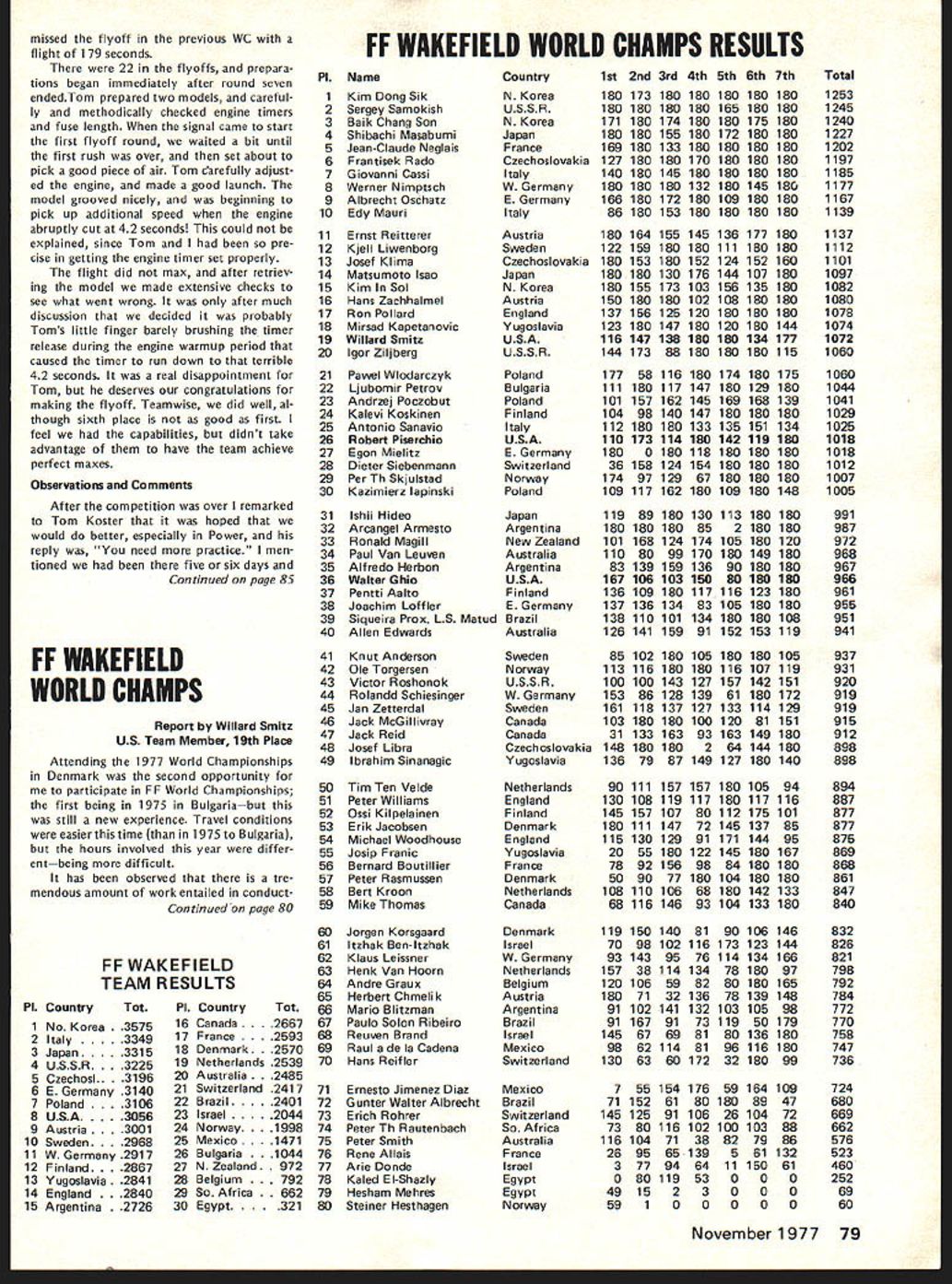
FF WAKEFIELD WORLD CHAMPS
Report by Walt Ghio
U.S. Team Member, 36th Place
My wife, Judy, and I arrived at Roskilde the evening of July 2 after driving from Amsterdam. The next evening I started to test fly with the team at a full-scale glider airport that we had permission to use. My models had not changed from home, and I was pleased with the test flying up to the contest day.
On the contest day we awoke to a 20 mph wind at 2:30 am. By the start of the first round at 3:50 am a steady rain was falling along with the wind. After the second round I changed to another model as my No. 1 model had become very wet. The rain had stopped, but the wind held up. By the evening rounds I had dried my models and used my No. 1 model again. The wind had dropped to approximately 15 mph with no rain.
Glider had a very good day—no sunshine, but low winds. Power day was with sunshine and the wind a little higher than glider day. We had worked out a good retrieving system, and no models were lost in the tall crops around the runways. The walkie-talkies we had did not work. I would like to see the AMA or NFFS supply the future teams with a small tent and a minimum of three walkie-talkies to help in high wind conditions and any rain.
The awards ceremony and dinner were very well-arranged as the whole World Championships had been. The Danes did a very good job of running the contest.
I would like to thank all the team supporters who helped out with our flying. The work that they did for us was appreciated very much by all the team members.
For future teams, they must buy the best motors that they can. I only watched the last two flyoff rounds due to chasing downwind all day. Altitude is the name of the game. The highest models did the best. The Nordic fliers have to become "tactical" fliers. There is no way we can win by flying alone. The good teams do not fly unless there is another model in a thermal. The Wakefield fliers need the best rubber that they can get. I hope the rubber that is coming out is good. As to motors and rubber, maybe it is about time that the U.S.A. teams are subsidized by AMA or the NFFS with the best that money can buy. You must test fly in all conditions and be in good physical condition.
FF NORDIC A-2 WORLD CHAMPS
Report by Chuck Markos
U.S. Team Member, 20th Place
Practice sessions: John Lenderman's cheerful voice woke us up to the call of "flying time"—2:30 am. Load up the autos, drive out to the practice site, an open field with rolling terrain. The first practice morning was cold, about 45 degrees, windy, 20-25 mph, drizzling and wet. We did fly under these conditions, and I did find definite lift at about 5:00 am. We were all thoroughly soaked, very cold, hungry, and tired by 7:30 when we packed up and went for breakfast and then back to bed. Our routine was much the same each practice day. We did not fly in the evenings the first day, but looked at alternate practice sites which we judged to be slightly better than the first. After our practice we would clean up, go to the evening practice till about 8 to 9 pm, depending on conditions.
The weather conditions changed from day to day during our six days of pre-contest flying. We felt that we could expect anything on the contest day, but especially felt that we must be prepared for wind conditions and poor thermal activity in the early morning rounds. The first two rounds seemed to be the windiest of every day. The practice fields were not large enough to organize chase crews or to put in flights of over 60 sec. duration on most days. The longest flight that I put in had the DT set at two minutes. We all felt that John Lenderman organized our practice sessions as intelligently as possible and that there was a definite team spirit developing. After each practice we would discuss our plans and solutions to problems which we had encountered.
The contest: "Good morning, it is now 2:00 am. Breakfast is available in the hall outside the processing room. The bus for the airport leaves at quarter to three and not one minute late." That was our wake up call, my first sleep-fogged memory from July 1 to 10. By this time we all had our routines of practice and were used to the early morning wake up. Here is my account of the second day of flying (Nordic Glider). First round: 3:40-4:40, overcast, cool, damp and breezy. Many gaggles were downwind, so far downward that it seemed visibility might be a problem. Our practice flights at this time of morning indicated buoyant air early in the round, but no positive lift. We settled accordingly. I spent both Nordic and Power days (during flying time) out in the recovering area retrieving our team members' planes, so I cannot report on things that took place in the launch area. The winner in Power, Tom Koster of Denmark, had a very high climbing plane (no flapper or electronic timer) but the plane looked most impressive when things went correctly. This contest points up again to me that being prepared and having the ability to adapt to any kind of condition with team work, working together cooperatively, is all important for success at a World Championships. tled on the tactic of flying early in the round and taking a 165 flight. Every day was different and several contestants who did not have the disadvantage of our knowledge got maxes.
Second round: 4:45-5:30, same weather as the first round, the wind was down a little. Our practice indicated that the buoyancy experienced in the first round would disappear, and poorer flight times would result. I circle-towed for 5-10 minutes, found some lift and did 178. I would have maxed if I had leaned into the zoom launch a little more. It was apparent that our practice sessions would not be indicative of lift conditions at the contest. In rounds 3 and 4 I circle-towed for maxes; air was getting easier to pick and drift was diminishing. My model was selected for a "random" check for minimum weight after it milked out a max in the third round.
Round 5: 7:25-8:10. The wind started to pick up, and we were rotated to the first starting pole in the heavy winds. I straight-towed down and crossing into the general area where I had launched the two previous rounds, felt some lift, and got another max.
We then broke for lunch at 9:00 am, went back to the school for a nap, shower, and box lunch (3:00) and back to the airport at 4:15.
The wind had picked up to approximately 15 mph, partly sunny skies and the temperature was in the 70's. I decided to go with my windy weather model, put up a test flight and promptly found good lift, just like Bong Fjeld!
Round 6: 5:05-6:05. In the 45 minutes from our arrival at the airport until the start of the round, conditions had changed to a general cloud cover, cool, and gradually diminishing winds. Lift was hard to find for everyone. I put my windy weather model away and got out the circle tow model. Disaster strikes! I ran out of towing time and had to launch into bad air for a 110, out of sight behind a row of trees.
Seventh round: 6:10-7:10. Conditions started to improve, the air felt a little warmer and cloud cover was thinning. I straight-towed upwind until I felt a little bump, zoomed off and again was 005 behind the trees at 143. Probably was good for another 20-30 seconds. Bob Sifleet was the only U.S.A. Nordic flier to max in the 7th round. He towed upwind about 400 meters, then circled until he found a weak thermal. The drift at this time had changed so the model flew nearly parallel in front of the whole field of waiting glider fliers with none of them realizing that he was in good air.
Chasing: Up to the start of the contest day we did not know what our chase plans would be because the use of automobiles and motorcycles had not been approved by the organizers. We were just about to trade in our rented moto-ped for bicycles when permission to use it was granted. Various teams started using autos and vans to bring back models, and pretty soon the use of these vehicles was permitted. Max flights flew up to two miles so that motorized assistance was necessary, especially considering some of the rounds were only 45 minutes long. Not one U.S.A. model was lost, and in fact each contestant had his model back at the launch site well before the start of each round. The walkie-talkies that Tom McLaughlan brought were not effective over distances greater than a few hundred yards.
The large red and white signal flag we used to tell the downwind crew that launching of a flight was imminent was very useful. For each flight the moto-ped operator would act as a primary spotter, pointing out the model to the downwind crew until he was sure that they had control and then go back to the launch area for the next flight. The van would also spot and wait for the model before going back upwind. The rest of the chase crew had to contend with cornfields (called wheat in the U.S.A.) as many flights were well off the airfield. It was necessary to be right on top of every DT to have a good line before they disappeared into the 3' high grain. We heard a report that an estimated $100 damage was done to crops the first day of the contest.
General impressions: The operations of the contest were generally smooth, and no complaints were registered by the U.S.A. team. Accommodations were adequate if rustic, with 15-20 people in makeshift dormitories set up in classrooms and a long walk to the showers or to the outdoor toilets. Food was plentiful, but waiting lines for the 9:00 am dinner were quite long. The boxed breakfast and afternoon meals were always on time, and the in-house bar was the cheapest source of beer in the area.
Commemorative t-shirts, posters, programs, plastic glasses and stick-on patches added an air of special importance to the proceedings. We felt welcome, and our hosts worked hard to solve unanticipated questions and problems.
Some snags did develop in that the impounded towlines and rubber motors were not guarded, and unscrupulous sorts could have opportunities to make changes. Most of the official fuel for the Power event did disappear before the contest, but enough was scrounged up so that this was not a problem.
Flying conditions in Denmark were definitely not similar to what U.S.A. teams have experienced at previous World Championships, that is, "Taft-like." From conversations with European modelers we learned that the WC contest has been quite fortunate in having ideal conditions at Wiener Neustadt and in Sweden. The Austrian site has been labeled a "wind bowl" by the local fliers. A contest held at Wiener Neustadt just a month previous to the WC was blown out, with many models flying into the city. The Swedes told me that the weather and wind in Sweden was typically very similar to Denmark with the sea-breezes dominating flying conditions throughout the year. U.S.A. FF teams must come prepared for wind!
Transcribed from original scans by AI. Minor OCR errors may remain.

