
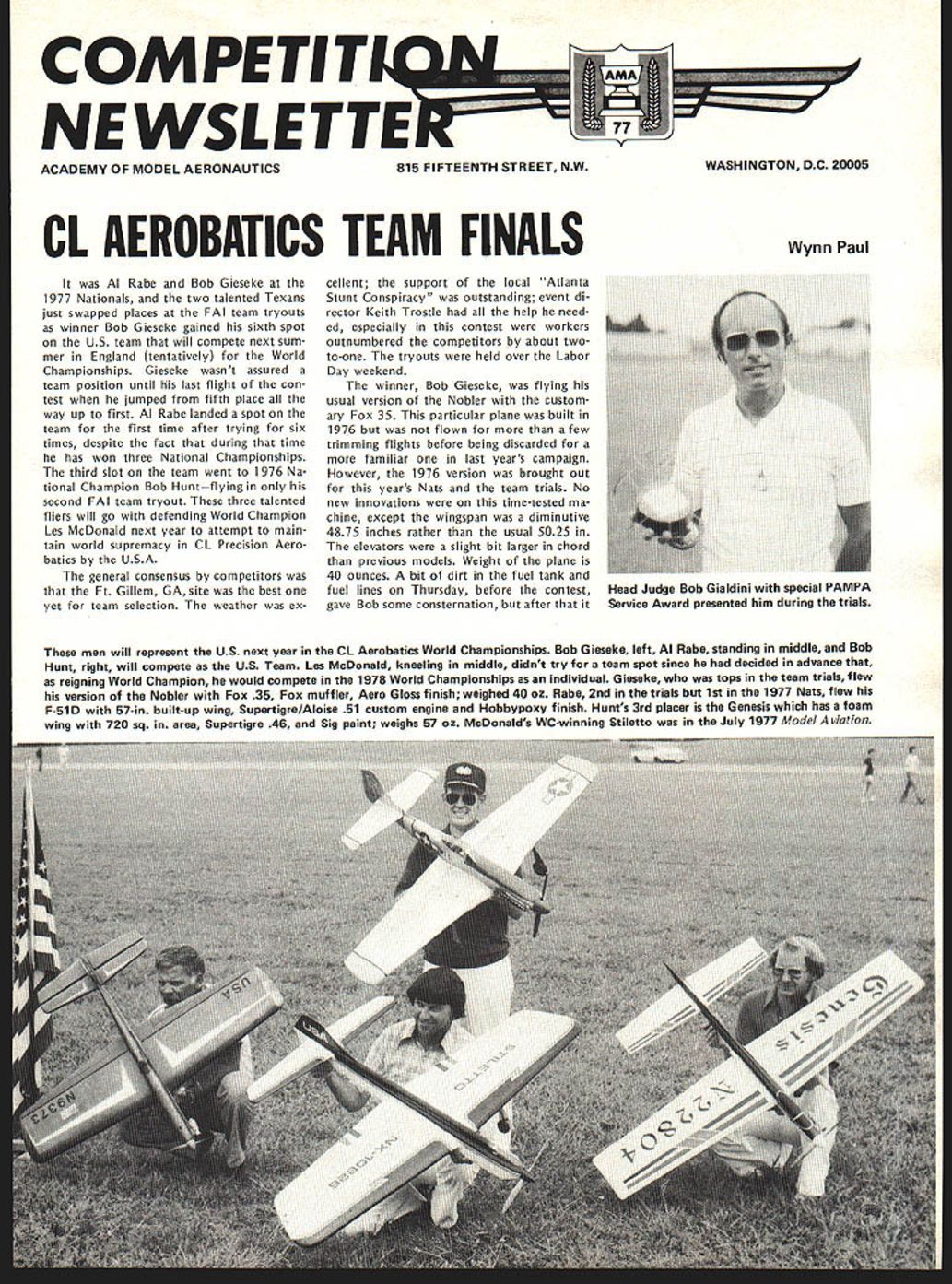
CL AEROBATICS TEAM FINALS
Wynn Paul
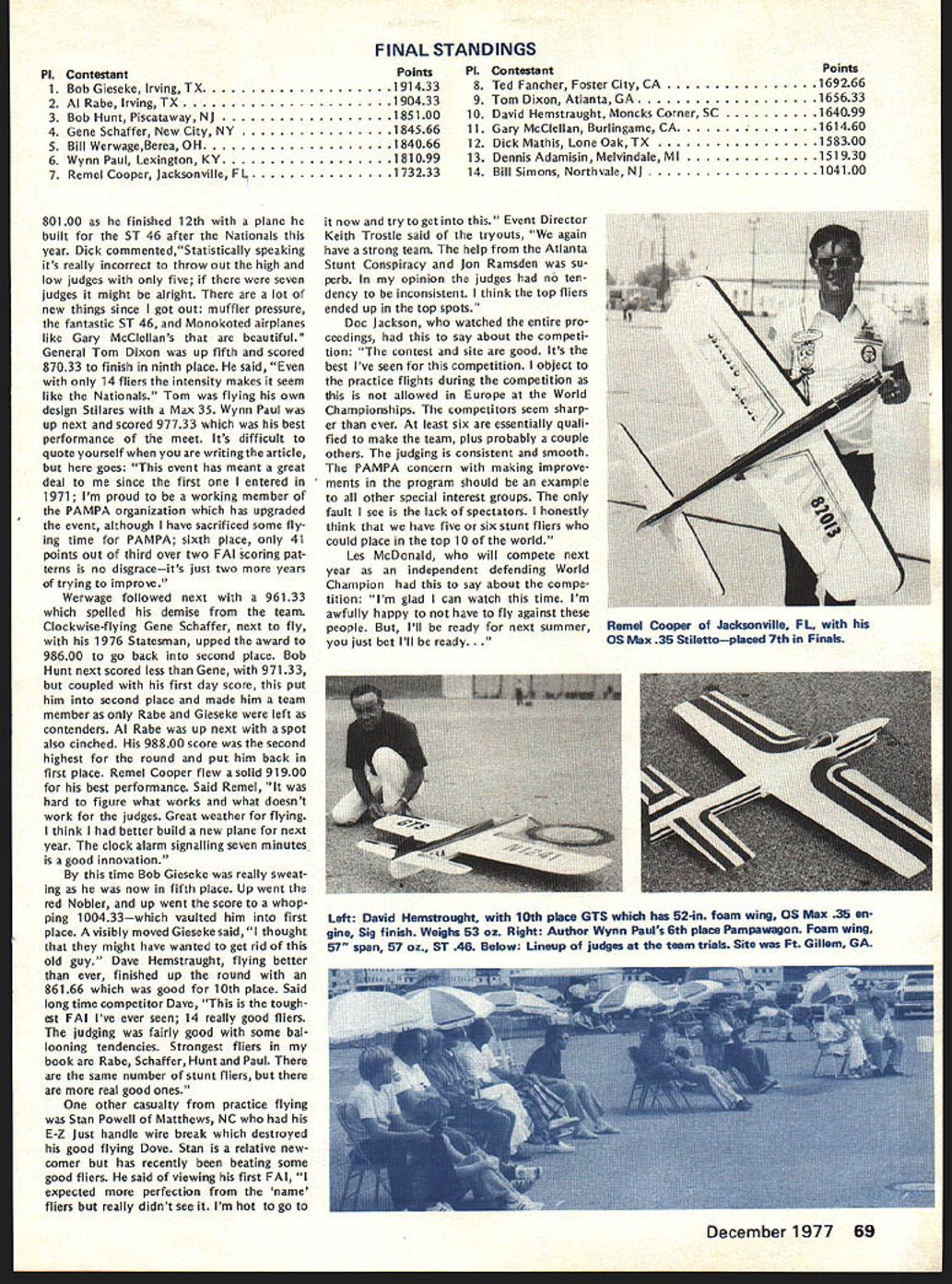
It was Al Rabe and Bob Gieseke at the 1977 Nationals, and the two talented Texans just swapped places at the FAI team tryouts as winner Bob Gieseke gained his sixth spot on the U.S. team that will compete next summer in England (tentatively) for the World Championships. Gieseke wasn't assured a team position until his last flight of the contest when he jumped from fifth place all the way up to first. Al Rabe landed a spot on the team for the first time after trying six times, despite the fact that during that time he has won three National Championships. The third slot on the team went to 1976 National Champion Bob Hunt — flying in only his second FAI team tryout. These three talented fliers will go with defending World Champion Les McDonald next year to attempt to maintain world supremacy in CL Precision Aerobatics by the U.S.A.
The general consensus by competitors was that the Ft. Gillem, GA, site was the best one yet for team selection. The weather was excellent; the support of the local "Atlanta Stunt Conspiracy" was outstanding; event director Keith Trostle had all the help he needed, especially in this contest where workers outnumbered the competitors by about two-to-one. The tryouts were held over the Labor Day weekend.
The winner, Bob Gieseke, was flying his usual version of the Nobler with the customary Fox .35. This particular plane was built in 1976 but was not flown for more than a few trimming flights before being discarded for a more familiar one in last year's campaign. However, the 1976 version was brought out for this year's Nats and the team trials. No new innovations were on this time-tested machine, except the wingspan was a diminutive 48.75 inches rather than the usual 50.25 in. The elevators were a slight bit larger in chord than previous models. Weight of the plane is 40 ounces. A bit of dirt in the fuel tank and fuel lines on Thursday, before the contest, gave Bob some consternation, but after that it was fine. It was practice, practice. Said a tired Gieseke back at the motel after the finals, "Sure am glad I came; this was a sweet victory."
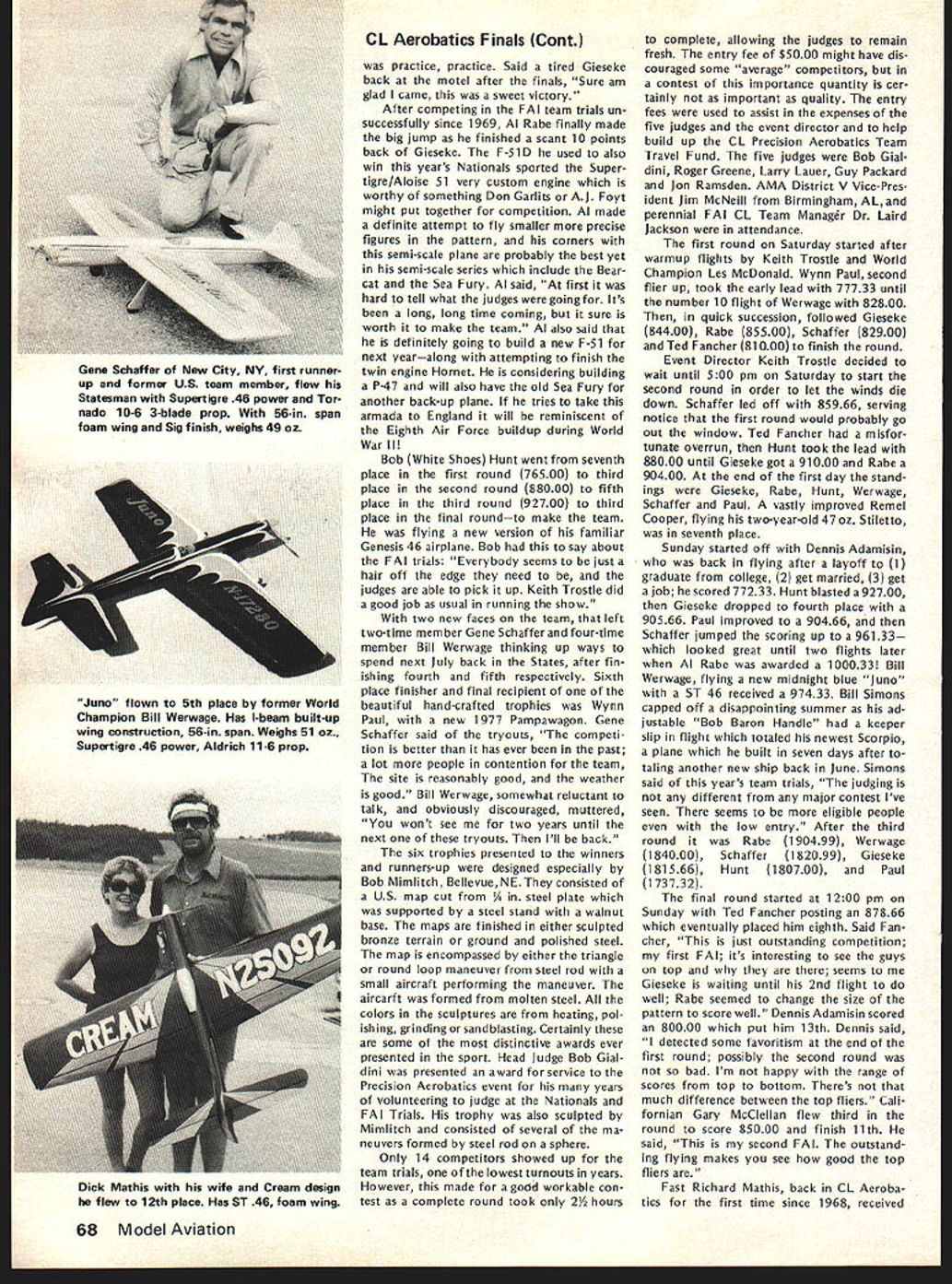
After competing in the FAI team trials unsuccessfully since 1969, Al Rabe finally made the big jump as he finished a scant 10 points back of Gieseke. The F-51D he used to also win this year's Nationals sported the Supertigre/Aloise .51 very custom engine which is worthy of something Don Garlits or A.J. Foyt might put together for competition. Al made a definite attempt to fly smaller, more precise figures in the pattern, and his corners with this semi-scale plane are probably the best yet in his semi-scale series which include the Bearcat and the Sea Fury. Al said, "At first it was hard to tell what the judges were going for. It's been a long, long time coming, but it sure is worth it to make the team." Al also said that he is definitely going to build a new F-51 for next year—along with attempting to finish the twin-engine Hornet. He is considering building a P-47 and will also have the old Sea Fury for another back-up plane. If he tries to take this armada to England it will be reminiscent of the Eighth Air Force buildup during World War II!
Bob (White Shoes) Hunt went from seventh place in the first round (765.00) to third place in the second round (880.00) to fifth place in the third round (927.00) to third place in the final round—to make the team. He was flying a new version of his familiar Genesis .46 airplane. Bob had this to say about the FAI trials: "Everybody seems to be just a hair off the edge they need to be, and the judges are able to pick it up. Keith Trostle did a good job as usual in running the show."
With two new faces on the team, that left two-time member Gene Schaffer and four-time member Bill Werwage thinking up ways to spend next July back in the States, after finishing fourth and fifth respectively. Sixth place finisher and final recipient of one of the beautiful hand-crafted trophies was Wynn Paul, with a new 1977 Pampawagon. Gene Schaffer said of the tryouts, "The competition is better than it has ever been in the past; a lot more people in contention for the team. The site is reasonably good, and the weather is good." Bill Werwage, somewhat reluctant to talk, and obviously discouraged, muttered, "You won't see me for two years until the next one of these tryouts. Then I'll be back."
The six trophies presented to the winners and runners-up were designed especially by Bob Mimlitch, Bellevue, NE. They consisted of a U.S. map cut from 1/8-in. steel plate which was supported by a steel stand with a walnut base. The maps are finished in either sculptured bronze terrain or ground and polished steel. The map is encompassed by either the triangle or round loop maneuver from steel rod with a small aircraft performing the maneuver. The aircraft was formed from molten steel. All the colors in the sculptures are from heating, polishing, grinding and sandblasting. Certainly these are some of the most distinctive awards ever presented in the sport. Head Judge Bob Gialdini was presented an award for service to the Precision Aerobatics event for his many years of volunteering to judge at the Nationals and FAI Trials. His trophy was also sculpted by Mimlitch and consisted of several of the maneuvers formed by steel rod on a sphere.
Only 14 competitors showed up for the team trials, one of the lowest turnouts in years. However, this made for a good workable contest as a complete round took only 2½ hours to complete, allowing the judges to remain fresh. The entry fee of $50.00 might have discouraged some "average" competitors, but in a contest of this importance quantity is certainly not as important as quality. The entry fees were used to assist in the expenses of the five judges and the event director and to help build up the CL Precision Aerobatics Team Travel Fund. The five judges were Bob Gialdini, Roger Greene, Larry Lauer, Guy Packard and Jon Ramsden. AMA District V Vice-President Jim McNeill from Birmingham, AL, and perennial FAI CL Team Manager Dr. Laird Jackson were in attendance.
The first round on Saturday started after warmup flights by Keith Trostle and World Champion Les McDonald. Wynn Paul, second flier up, took the early lead with 777.33 until the number 10 flight of Werwage with 828.00. Then, in quick succession, followed Gieseke (844.00), Rabe (855.00), Schaffer (829.00) and Ted Fancher (810.00) to finish the round.
Event Director Keith Trostle decided to wait until 5:00 pm on Saturday to start the second round in order to let the winds die down. Schaffer led off with 859.66, serving notice that the first round would probably go out the window. Ted Fancher had a misfortunate overrun, then Hunt took the lead with 880.00 until Gieseke got a 910.00 and Rabe a 904.00. At the end of the first day the standings were Gieseke, Rabe, Hunt, Werwage, Schaffer and Paul. A vastly improved Remel Cooper, flying his two-year-old 47-oz. Stiletto, was in seventh place.
Sunday started off with Dennis Adamsin, who was back in flying after a layoff to (1) graduate from college, (2) get married, (3) get a job; he scored 772.33. Hunt blasted a 927.00, then Gieseke dropped to fourth place with 905.66. Paul improved to a 904.66 and then Schaffer jumped the scoring up to a 961.33—which looked great until two flights later when Al Rabe was awarded a 1000.33! Bill Werwage, flying a new midnight blue "Juno" with a ST .46, received a 974.33. Bill Simons capped off a disappointing summer as his adjustable "Bob Baron Handle" had a keeper slip in flight which toasted his latest Scopio, a plane which he had built in seven days after totaling another new ship back in June. Simons said of this year's team trials, "The judging is not any different from any major contest I've seen. There seems to be more eligible people even within the low entry." After the third round it was Rabe (1904.99), Werwage (1840.00), Schaffer (1820.99), Gieseke (1815.66), Hunt (1807.00), and Paul (1737.32).
The final round started at 12:00 pm on Sunday with Ted Fancher posting an 878.66 which eventually placed him eighth. Said Fancher, "This was just outstanding competition; my first FAI; it's interesting to see the guys on top and why they are there; seems to me Gieseke is waiting until his second flight to do his best; Rabe seemed to change the size of the pattern to score well." Dennis Adamsin scored 800.00 which put him 13th. Dennis said, "I detected some favoritism at the end of the first round; possibly the second round was not so bad. I'm not happy with the range of judges from top to bottom. There's not that much difference between the top fliers." Californian Gary McClellan flew third in the round to score 850.00 and finish 11th. He said, "This is my second FAI. The outstanding flying makes you see how good the top fliers are."
Fast Richard Mathis, back in CL Aerobatics for the first time since 1968, received 801.00 as he finished 12th with a plane he built for the ST 46 after the Nationals this year. Dick commented, "Statistically speaking it's really incorrect to throw out the high and low judges with only five; if there were seven judges it might be alright. There are a lot of new things since I got out: muffler pressure, the fantastic ST 46, and Monokoted airplanes like Gary McClellan's that are beautiful." General Tom Dixon was up fifth and scored 870.33 to finish in ninth place. He said, "Even with only 14 fliers, the intensity makes it seem like the Nationals." Tom was flying his own design Stilares with a Max 35. Wynn Paul was up next and scored 977.33 which was his best performance of the meet. It's difficult to quote yourself when you are writing the article, but here goes: "This event has meant a great deal to me since the first one I entered in 1971; I'm proud to be a working member of the PAMPA organization which has upgraded the event, although I have sacrificed some flying time for PAMPA; sixth place, only 41 points out of third over two FAI scoring patterns is no disgrace - it's just two more years of trying to improve."
Werwage followed next with a 961.33 which spelled his demise from the team. Clockwise-flying Gene Schaffer, next to fly, with his 1976 Statesman, upped the award to 986.00 to go back into second place. Bob Hunt next scored less than Gene, with 971.33, but coupled with his first day score, this put him into second place and made him a team member as only Rabe and Gieseke were left as contenders. Al Rabe was up next with a spot also cinched. His 988.00 score was the second highest for the round and put him back in first place. Remel Cooper flew a solid 919.00 for his best performance. Said Remel, "It was hard to figure what works and what doesn't for the judges. Great weather for flying. I think I had better build a new plane for next year. The clock alarm signalling seven minutes is a good innovation."
By this time Bob Gieseke was really sweating as he was now in fifth place. Up went the red Nobler, and up went the score to a whopping 1004.33—which vaulted him into first place. A visibly moved Gieseke said, "I thought that they might have wanted to get rid of this old guy." Dave Hemstraught, flying better than ever, finished up the round with an 861.66 which was good for 10th place. Said long time competitor Dave, "This is the toughest FAI I've ever seen; 14 really good fliers. The judging was fairly good with some ballooning tendencies. Strongest fliers in my book are Rabe, Schaffer, Hunt and Paul. There are the same number of stunt fliers, but there are more real good ones."
One other casualty from practice flying was Stan Powell of Matthews, NC who had his E-Z Just handle wire break which destroyed his good flying Dove. Stan is a relative newcomer but has recently been beating some good fliers. He said of viewing his first FAI, "I expected more perfection from the 'name' fliers but really didn't see it. I'm not to go to it now and try to get into this." Event Director Keith Trostle said of the tryouts, "We again have a strong team. The help from the Atlanta Stunt Conspiracy and Jon Ramsden was superb. In my opinion the judges had no tendency to be inconsistent. I think the top fliers ended up in the top spots."
Doc Jackson, who watched the entire proceedings, had this to say about the competition: "The contest and site are good. It's the best I've seen for this competition. I object to the practice flights during the competition and this is not allowed in Europe at the World Championships. The competitors seem sharper than ever. At least six are essentially qualified to make the team, plus probably a couple others. The judging is consistent and smooth. The PAMPA concern with making improvements in the program should be an example to all other special interest groups. The only fault I see is the lack of spectators. I honestly think that we have five or six stunt fliers who could place in the top 10 of the world."
Les McDonald, who will compete next year as an independent defending World Champion had this to say about the competition: "I'm glad I can watch this time. I'm awfully happy to not have to fly against these people. But, I'll be ready for next summer, you just bet I'll be ready..."
INDOOR TEAM FINALS
Ed Whitten
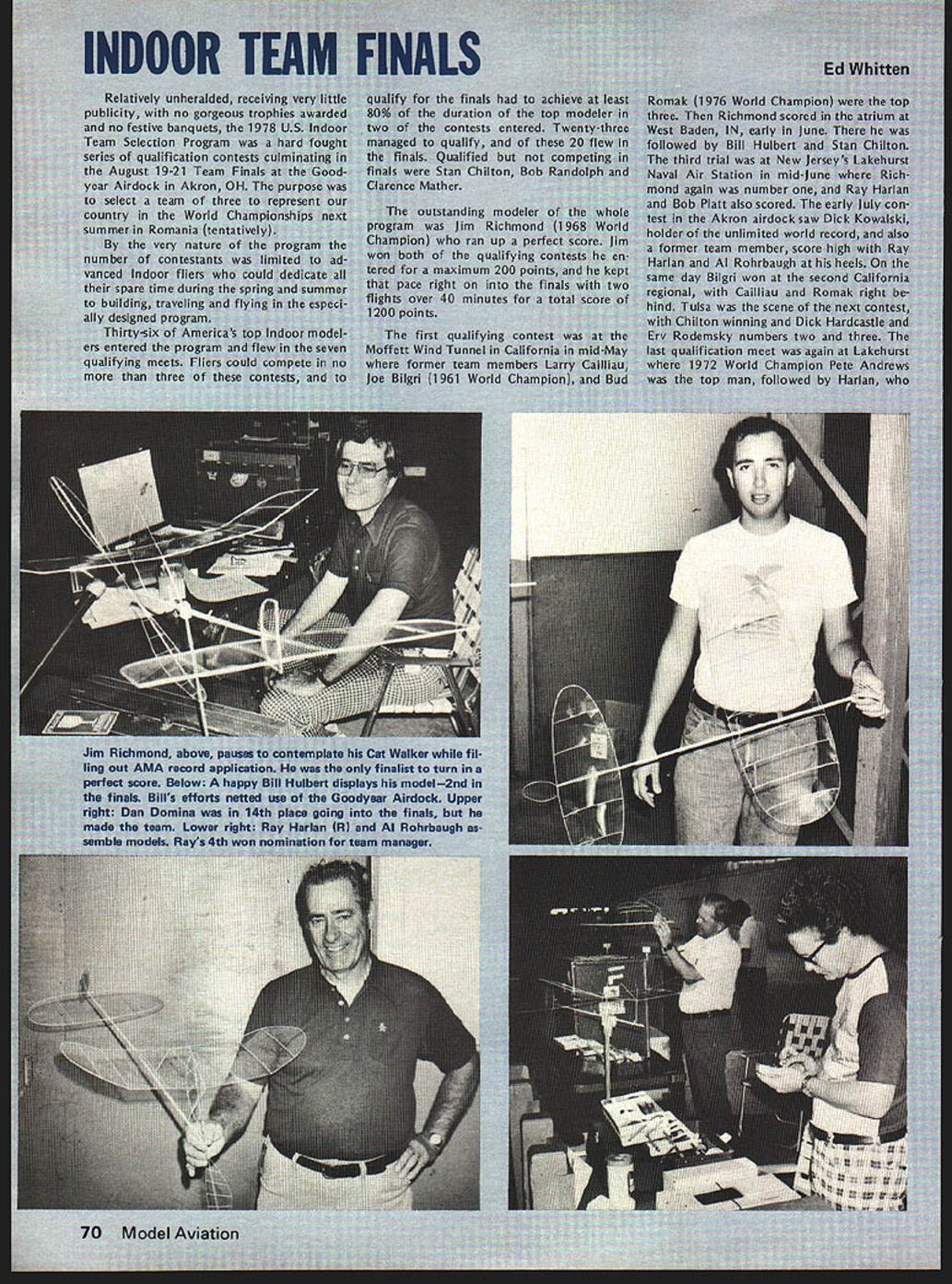
Relatively unheralded, receiving very little publicity, with no gorgeous trophies awarded and no festive banquets, the 1978 U.S. Indoor Team Selection Program was a hard fought series of qualification contests culminating in the August 19-21 Team Finals at the Goodyear Airdock in Akron, OH. The purpose was to select a team of three to represent our country in the World Championships next summer in Romania (tentatively).
By the very nature of the program the number of contestants was limited to advanced Indoor fliers who could dedicate all their spare time during the spring and summer to building, traveling and flying in the especially designed program.
Thirty-six of America's top Indoor modelers entered the program and flew in the seven qualifying meets. Fliers could compete in no more than three of these contests, and to qualify for the finals had to achieve at least 80% of the duration of the top modeler in two of the contests entered. Twenty-three managed to qualify, and of these 20 flew in the finals. Qualified but not competing in finals were Stan Chilton, Bob Randolph and Clarence Mather.
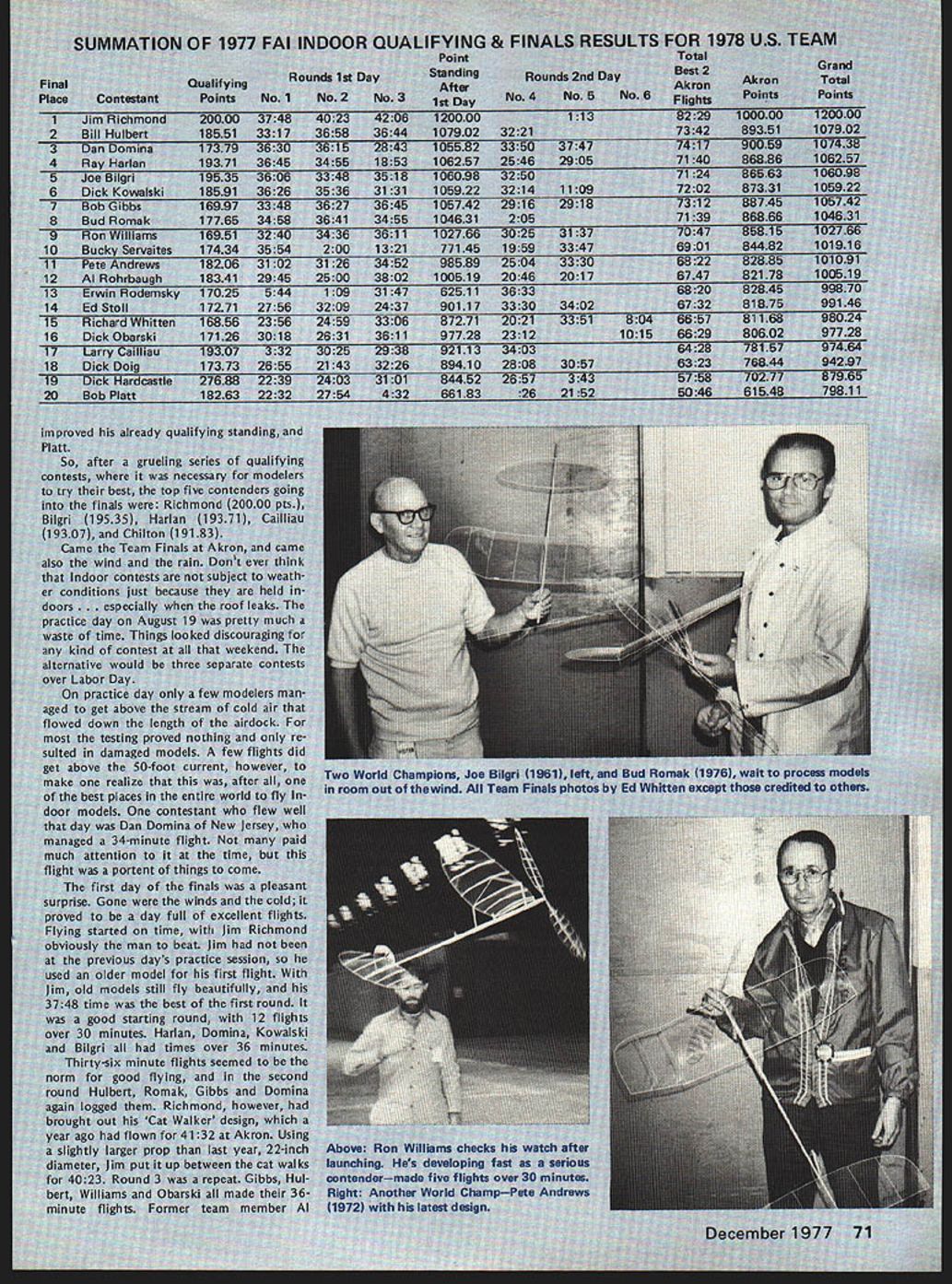
The outstanding modeler of the whole program was Jim Richmond (1968 World Champion) who ran up a perfect score. Jim won both of the qualifying contests he entered for a maximum 200 points, and he kept that pace right on into the finals with two flights over 40 minutes for a total score of 1200 points.
The first qualifying contest was at the Moffett Wind Tunnel in California in mid-May where former team members Larry Cailliau, Joe Bilgri (1961 World Champion), and Bud Romak (1976 World Champion) were the top three. Then Richmond scored in the atrium at West Baden, IN, early in June. There he was followed by Bill Hulbert and Stan Chilton. The third trial was at New Jersey's Lakehurst Naval Air Station in mid-June where Richmond again was number one, and Ray Harlan and Bob Platt also scored. The early July contest in the Akron Airdock saw Dick Kowalski, holder of the unlimited world record and a former team member, score high with Ray Harlan and Al Rohrbaugh right behind. On the same day Bill Bilgri won at the second California regional, with Cailliau and Romak right behind. Tulsa was the scene of the next contest, with Chilton winning and Dick Hardcastle and Erv Rodemsky numbers two and three. The last qualification meet was again at Lakehurst where 1972 World Champion Pete Andrews was the top man, followed by Harlan, who improved his already qualifying standing, and Platt.
So, after a grueling series of qualifying contests, where it was necessary for modelers to try their best, the top five contenders going into the finals were: Richmond (200.00 pts.), Bilgri (195.35), Harlan (193.71), Cailliau (193.07), and Chilton (191.83).
Came the Team Finals at Akron, and came also the wind and the rain. Don't ever think that Indoor contests are not subject to weather conditions just because they are held indoors . . . especially when the roof leaks. The practice day on August 19 was pretty much a waste of time. Things looked discouraging for any kind of contest at all that weekend. The alternative would be three separate contests over Labor Day.
On practice day only a few modelers managed to get above the stream of cold air that flowed down the length of the airdock. For most the testing proved nothing and only resulted in damaged models. A few flights did get above the 50-foot current, however, to make one realize that this was, after all, one of the best places in the entire world to fly indoor models. One contestant who flew well that day was Dan Domina of New Jersey, who managed a 34-minute flight. Not many paid much attention to it at the time, but this flight was a portent of things to come.
The first day of the finals was a pleasant surprise. Gone were the winds and the cold; it proved to be a day full of excellent flying. Flying started on time, with Jim Richmond obviously the man to beat. Jim had not been at the previous day's practice session, so he used an older model for his first flight. With Jim, old models still fly beautifully, and his 37:48 time was the best of the first round. It was a good starting round, with 12 flights over 30 minutes. Harlan, Domina, Kowalski and Bilgri all had times over 36 minutes.
Thirty-six minute flights seemed to be the norm for good flying, and in the second round Hulbert, Romak, Gibbs and Domina again logged them. Richmond, however, had brought out his 'Cat Walker' design, which a year ago had flown for 41:32 at Akron. Using a slightly larger prop than last year, 22.2-inch diameter, Jim put it up between the cat walks for 40:23. Round 3 was a repeat. Gibbs, Hulbert, Williams and Obarski all made their 36-minute flights. Former team member Al
Indoor Finals (Cont.)
Rohrbaugh really came to life to top them with 38:02. Once again, however, it was Richmond, flying carefully and calmly (he looked calm, anyway) who wrapped up the contest with a magnificent time of 42:06! It was truly a great flight, and, undoubtedly, the longest 35 cm, one gram FAI flight ever recorded anywhere. It broke two U.S.A. records!
Not only were Richmond's flights of championship quality, but the whole Team Finals flying was easily equal to a World Championships contest! Think of it, of the first three rounds' 60 flights, there had been 38 of them over 30 minutes long. Now, that is top-notch flying. Really, we could have picked four or five teams that could have done a creditable job at the World Champs. You can really compare our U.S.A. qualification contests and finals with Europe's national and international contests. America is about the same size as Europe and has about the same or more good indoor fliers. Yet we send only one team to the World Championships, while Europe sends six or seven. Our teams are always good, and when it is our turn to have enough going right, we win!
All day long we had been listening to radio broadcasts of weather predictions for the next day. Conditions would get worse, and thunderstorms were predicted for the afternoon. Should we fly one more round the first day? It seemed like a good idea, but was voted down. The majority is not always right, and it proved a mistake not to fly again. At the end of the first day, with poor weather predicted for the second day, Jim Richmond was easily conceded to be the winner. He was congratulated then and there. The battle now would be for the next three places. Bunched, due to those 36-minute flights, were Hulbert (1079.02 points), Harlan (1062.57), Bilgri (1060.98), Kowalski (1059.22), Gibbs (1057.42), Domina (1055.82) and Romak (1046.31). Rohrbaugh had that 38-minute time and if he could only get another good flight to go with it; and Obarski and Williams each had a 36-minute flight, too. So, for the second day the flight for a berth on the team
and the team manager nomination (4th place) would be between 10 strong contenders.
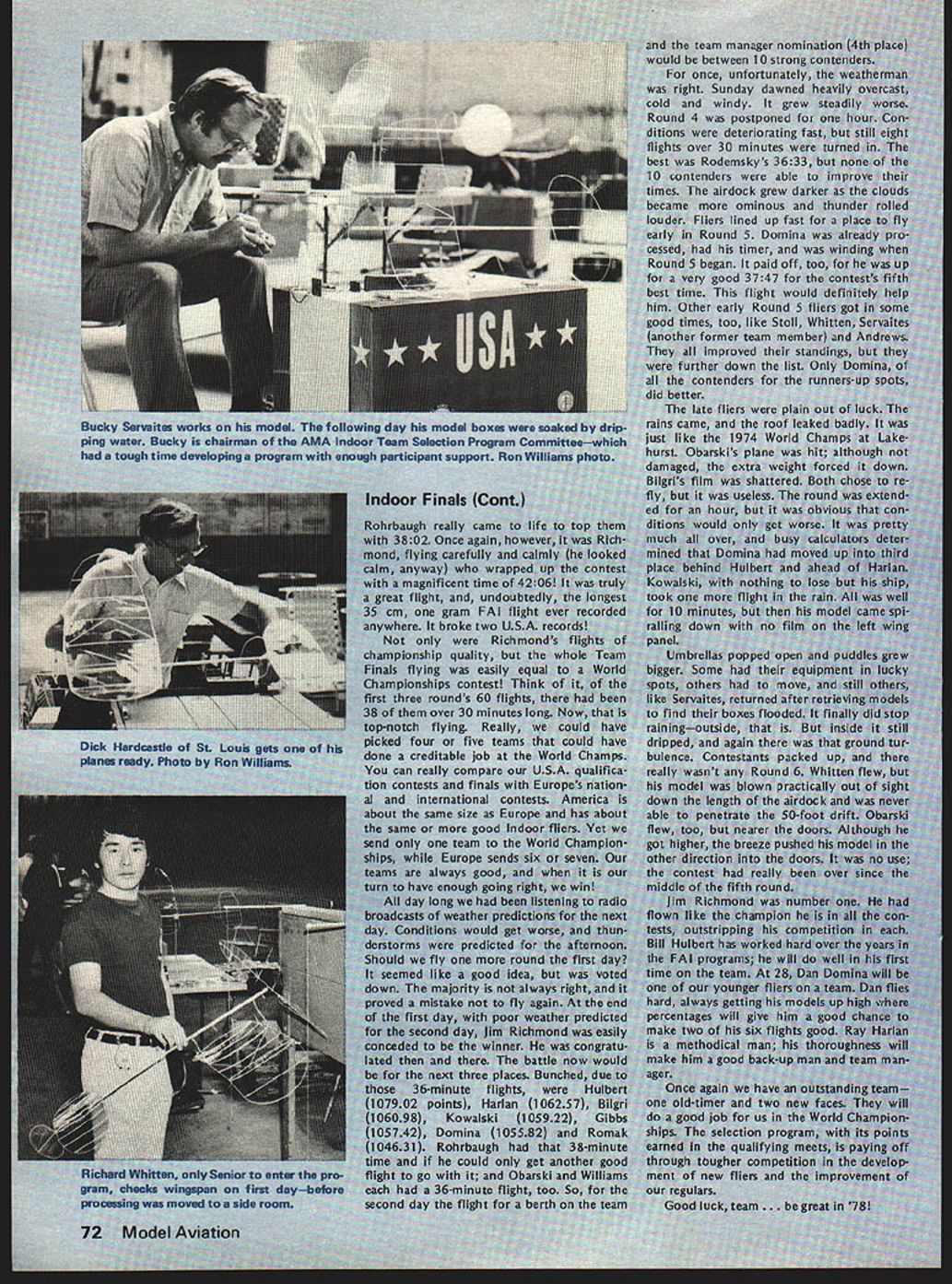
For once, unfortunately, the weatherman was right. Sunday dawned heavily overcast, cold and windy. It grew steadily worse. Round 4 was postponed for one hour. Conditions were deteriorating fast, but still eight flights over 30 minutes were turned in. The best was Rodemsky's 36:33, but none of the 10 contenders were able to improve their times. The airdock grew darker as the clouds became more ominous and thunder rolled louder. Fliers lined up fast for a place to fly early in Round 5. Domina was already processed, had his timer, and was winding when Round 5 began. It paid off, too, for he was up for a very good 37:47 for the contest's fifth best time. This flight would definitely help him. Other early Round 5 fliers got in some good times, too, like Stoll, Whitten, Servaites (another former team member) and Andrews. They all improved their standings, but they were further down the list. Only Domina, of all the contenders for the runners-up spots, did better.
The late fliers were plain out of luck. The rains came, and the roof leaked badly. It was just like the 1974 World Champs at Lakehurst. Obarski's plane was hit; although not damaged, the extra weight forced it down. Bilgri's film was shattered. Both chose to retry, but it was useless. The round was extended for an hour, but it was obvious that conditions would only get worse. It was pretty much all over, and busy calculators determined that Domina had moved up into third place behind Hulbert and ahead of Harlan. Kowalski, with nothing to lose but his ship, took one more flight in the rain. All was well for 10 minutes, but then his model came spiralling down with no film on the left wing panel.
Umbrellas popped open and puddles grew bigger. Some had their equipment in lucky spots, others had to move, and still others, like Servaites, returned after retrieving models to find their boxes flooded. It finally did stop raining—outside, that is. But inside it still dripped, and again there was that ground turbulence. Contestants packed up; and there really wasn't any Round 6. Whitten flew, but his model was blown practically out of sight down the length of the airdock and was never able to penetrate the 50-foot drift. Obarski flew, too, but nearer the doors. Although he got higher, the breeze pushed his model in the other direction into the doors. It was no use; the contest had really been over since the middle of the fifth round.
Jim Richmond was number one. He had flown like the champion he is in all the contests, outstripping his competition in each. Bill Hulbert has worked hard over the years in the FAI programs; he will do well in his first time on the team. At 28, Dan Domina will be one of our younger fliers on a team. Dan flies hard, always getting his models up high where percentages will give him a good chance to make two of his six flights good. Ray Harlan is a methodical man; his thoroughness will make him a good back-up man and team manager.
Once again we have an outstanding team—one old-timer and two new faces. They will do a good job for us in the World Championships. The selection program, with its points earned in the qualifying meets, is paying off through tougher competition and the improvement of new fliers and the improvement of our regulars.
Good luck, team ... be great in '78!
249.9 MPH GLIDER SPEED WORLD RECORD
Richard R. Weber Bowie, MD
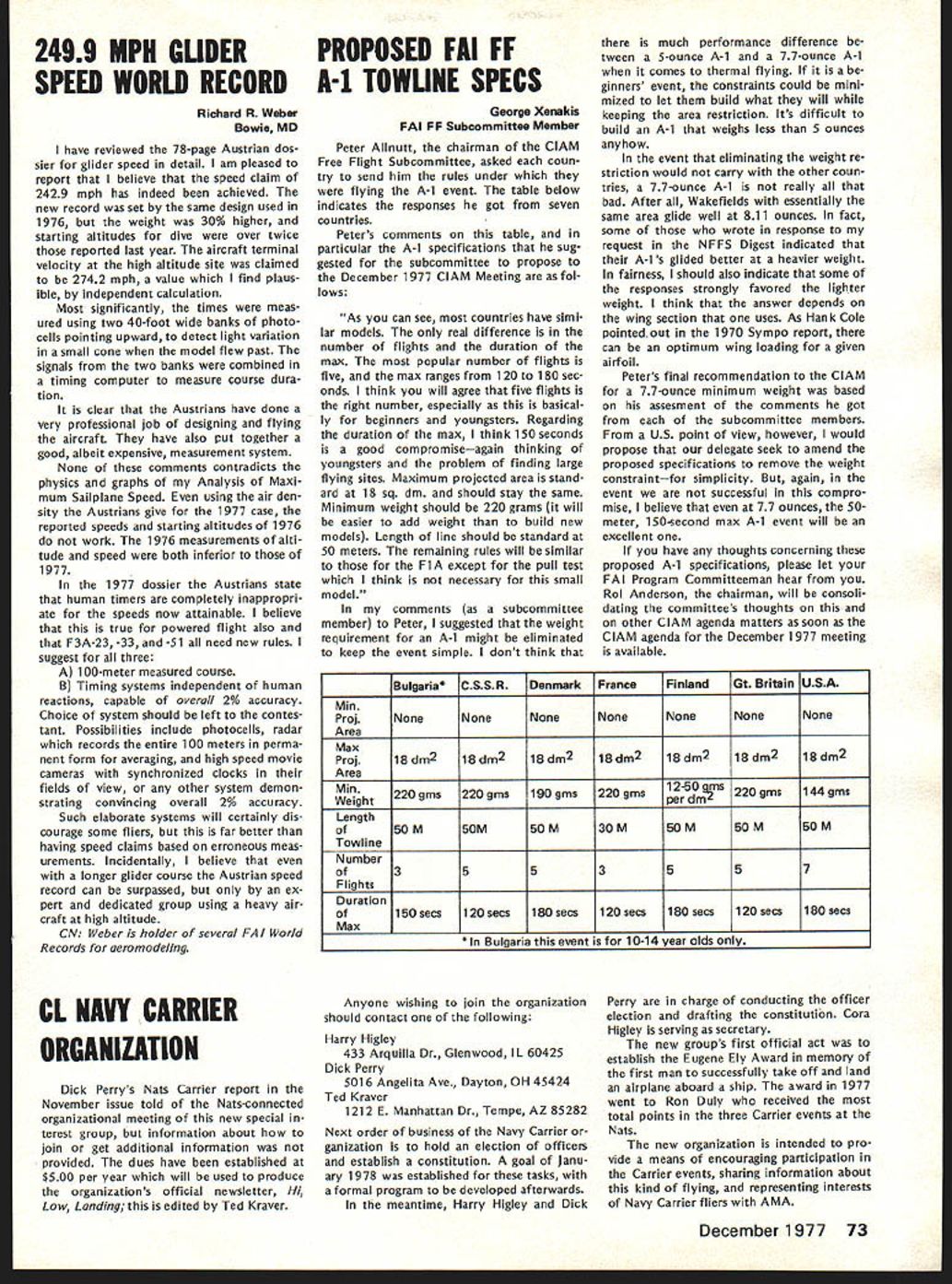
I have reviewed the 78-page Austrian dossier for glider speed in detail. I am pleased to report that I believe that the speed claim of 242.9 mph has indeed been achieved. The new record was set by the same design used in 1976, but the weight was 30% higher, and starting altitudes for dive were over twice those reported last year. The aircraft terminal velocity at the high altitude site was claimed to be 274.2 mph, a value which I find plausible by independent calculation.
Most significantly, the times were measured using two 40-foot wide banks of photocells pointing upward, to detect light variation in a small cone when the model flew past. The signals from the two banks were combined in a timing computer to measure course duration.
It is clear that the Austrians have done a very professional job of designing and flying the aircraft. They have also put together a good, albeit expensive, measurement system.
None of these comments contradicts the physics and graphs of my Analysis of Maximum Sailplane Speed. Even using the air density the Austrians give for the 1977 case, the reported speeds and starting altitudes of 1976 do not work. The 1976 measurements of altitude and speed were both inferior to those of 1977.
In the 1977 dossier the Austrians state that human timers are completely inappropriate for the speeds now attainable. I believe that this is true for powered flight also and that F3A-23, -33, and -51 all need new rules. I suggest for all three:
A) 100-meter measured course.
B) Timing systems independent of human reactions, capable of overall 2% accuracy. Choice of system should be left to the contestant. Possibilities include photocells, radar which records the entire 100 meters in permanent form for averaging, and high speed movie cameras with synchronized clocks in their fields of view, or any other system demonstrating convincing overall 2% accuracy.
Such elaborate systems will certainly discourage some fliers, but this is far better than having speed claims based on erroneous measurements. Incidentally, I believe that even with a longer glider course the Austrian speed record can be surpassed, but only by an expert and dedicated group using a heavy aircraft at high altitude.
CN: Weber is holder of several FAI World Records for aeromodeling.
CL TEAM RACE TEAM FINALS
Bill Lee
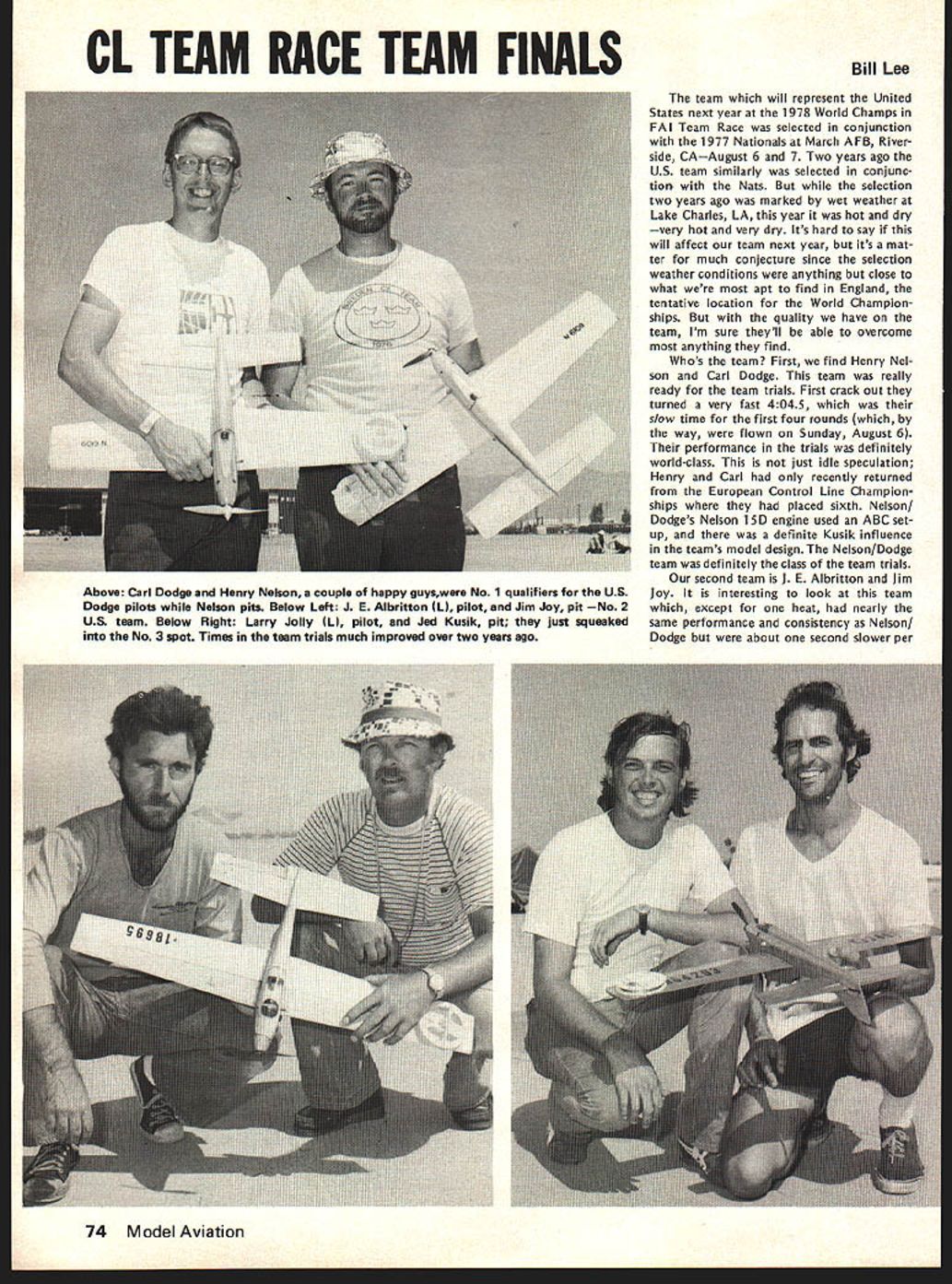
The team which will represent the United States next year at the 1978 World Champs in FAI Team Race was selected in conjunction with the 1977 Nationals at March AFB, Riverside, CA—August 6 and 7. Two years ago the U.S. team similarly was selected in conjunction with the Nats. But while the selection two years ago was marked by wet weather at Lake Charles, LA, this year it was hot and dry—very hot and very dry. It's hard to say if this will affect our team next year, but it's a matter for much conjecture since the selection weather conditions were anything but close to what we're most apt to find in England, the tentative location for the World Championships. But with the quality we have on the team, I'm sure they'll be able to overcome most anything they find.
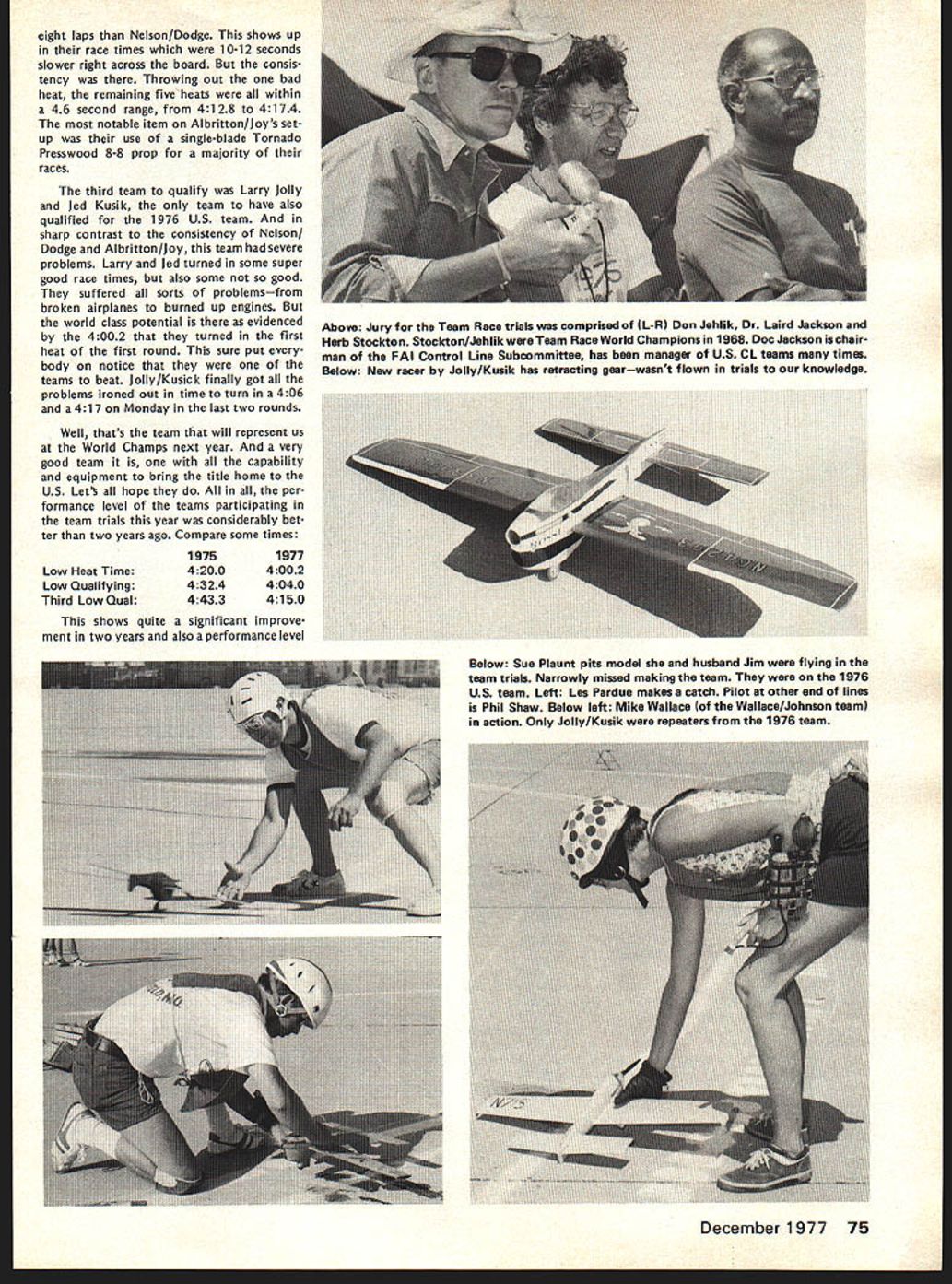
Who's the team? First, we find Henry Nelson and Carl Dodge. This team was really ready for the team trials. First crack out they turned a very fast 4:04.5, which was their slow time for the first four rounds (which, by the way, were flown on Sunday, August 6). Their performance in the trials was definitely world-class. This is not just idle speculation; Henry and Carl had only recently returned from the European Control Line Championships where they had placed sixth. Nelson/Dodge's Nelson 15D engine used an ABC set-up, and there was a definite Kusik influence in the team's model design. The Nelson/Dodge team was definitely the class of the team trials.
Our second team is J. E. Albritton and Jim Joy. It is interesting to look at this team which, except for one heat, had nearly the same performance and consistency as Nelson/Dodge but were about one second slower per lap. This shows up in their race times which were 10-12 seconds slower right across the board. But the consistency was there. Throwing out the one bad heat, the remaining five heats were all within a 4.6 second range, from 4:12.8 to 4:17.4. The most notable item on Albritton/Joy's setup was their use of a single-blade Tornado Presswood 8-8 prop for a majority of their races.
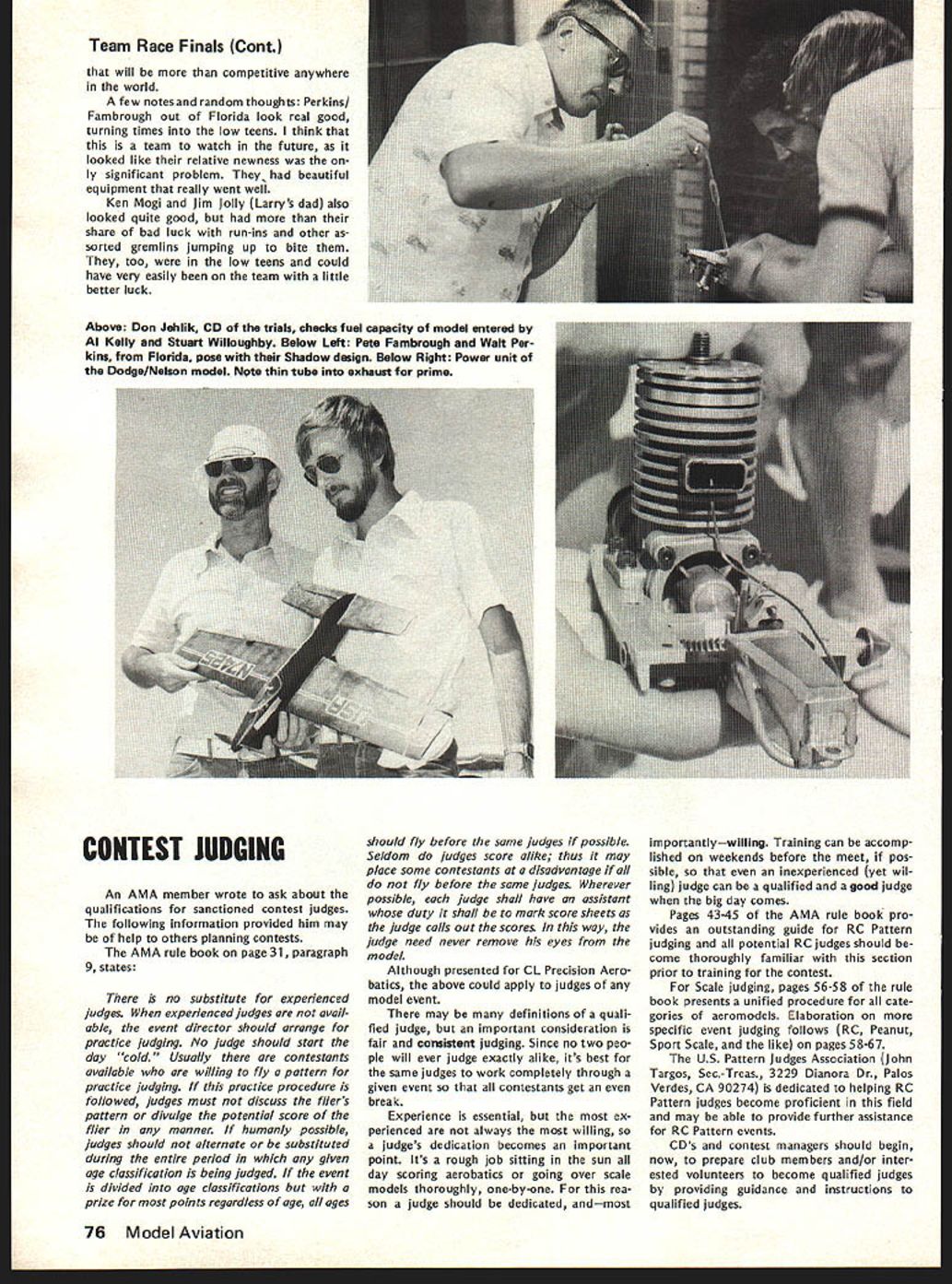
The third team to qualify was Larry Jolly and Jed Kusik, the only team to have also qualified for the 1976 U.S. team. And in sharp contrast to the consistency of Nelson/Dodge and Albritton/Joy, this team had severe problems. Larry and Jed turned in some super good race times, but also some not so good. They suffered all sorts of problems—from broken airplanes to burned up engines. But the world class potential is there as evidenced by the 4:00.2 that they turned in the first heat of the first round. Thus sure put everybody on notice that they were one of the teams to beat. Jolly/Kusik finally got all the problems ironed out in time to turn in a 4:06 and a 4:17 on Monday in the last two rounds.
Well, that's the team that will represent us at the World Champs next year. And a very good team it is, one with all the capability and equipment to bring the title home to the U.S. Let's all hope they do. All in all, the performance level of the teams participating in the team trials this year was considerably better than two years ago. Compare some times:
Low Heat Time: 1975 4:20.0 1977 4:00.2 Low Qualifying: 1975 4:32.4 1977 4:04.0 Third Low Qual: 1975 4:43.3 1977 4:15.0
This shows quite a significant improvement in two years and also a performance level
Team Race Finals (Cont.)
that will be more than competitive anywhere in the world.
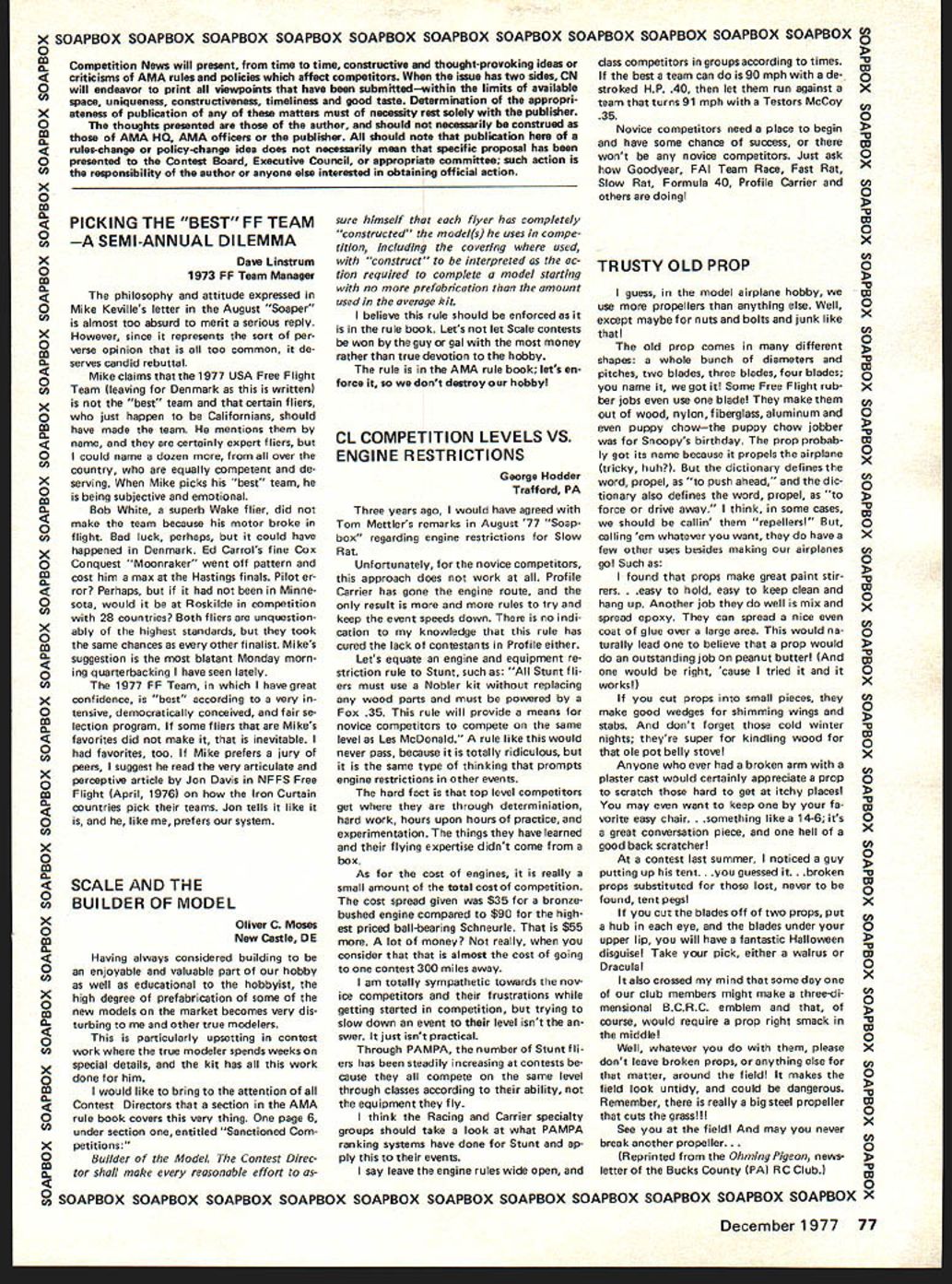
A few notes and random thoughts: Perkins/Fambrough out of Florida look real good, turning times into the low teens. I think that this is a team to watch in the future, as it looked like their relative newness was the only significant problem. They had beautiful equipment that really went well.
Ken Mogi and Jim Jolly (Larry's dad) also looked quite good, but had more than their share of bad luck with run-ins and other assorted gremlins jumping up to bite them. They, too, were in the low teens and could have very easily been on the team with a little better luck.
CONTEST JUDGING
An AMA member wrote to ask about the qualifications for sanctioned contest judges. The following information provided him may be of help to others planning contests.
The AMA rule book on page 31, paragraph 9, states:
There is no substitute for experienced judges. When experienced judges are not available, the event director should arrange for practice judging. No judge should start the day "cold." Usually there are contestants available who are willing to fly a pattern for practice judging. If this practice procedure is followed, judges must not discuss the flier's pattern or divulge the potential score of the flier in any manner. If humanly possible, judges should not alternate or be substituted during the entire period in which any given age classification is being judged. If the event is divided into age classifications but with a prize for most points regardless of age, all ages should fly before the same judges if possible. Seldom do judges score alike; thus it may place some contestants at a disadvantage if all do not fly before the same judges. Wherever possible, each judge shall have an assistant whose duty it shall be to mark score sheets as the judge calls out the scores. In this way, the judge need never remove his eyes from the model.
Although presented for CL Precision Aerobatics, the above could apply to judges of any model event.
There may be many definitions of a qualified judge, but an important consideration is fair and consistent judging. Since no two people will ever judge exactly alike, it's best for the same judges to work completely through a given event so that all contestants get an even break.
Experience is essential, but the most experienced are not always the most willing, so a judge's dedication becomes an important point. It's a rough job sitting in the sun all day scoring aerobatics or going over scale models thoroughly, one-by-one. For this reason a judge should be dedicated, and—most importantly—willing. Training can be accomplished on weekends before the meet, if possible, so that even an inexperienced (yet willing) judge can be a qualified and a good judge when the big day comes.
Pages 43-45 of the AMA rule book provides an outstanding guide for RC Pattern judging and all potential RC judges should become thoroughly familiar with this section prior to training for the contest.
For Scale judging, pages 56-58 of the rule book presents a unified procedure for all categories of aeromodels. Elaboration on more specific event judging follows (RC, Peanut, Sport Scale, and the like) on pages 58-67.
The U.S. Pattern Judges Association (John Targos, Sec.-Treas., 3229 Dinara Dr., Palos Verdes, CA 90274) is dedicated to helping RC Pattern judges become proficient in this field and may be able to provide further assistance for RC Pattern events.
CD's and contest managers should begin, now, to prepare club members and/or interested volunteers to become qualified judges by providing guidance and instructions to qualified judges.
Transcribed from original scans by AI. Minor OCR errors may remain.

