
1978-79 COMPETITION RULES ANNOUNCED
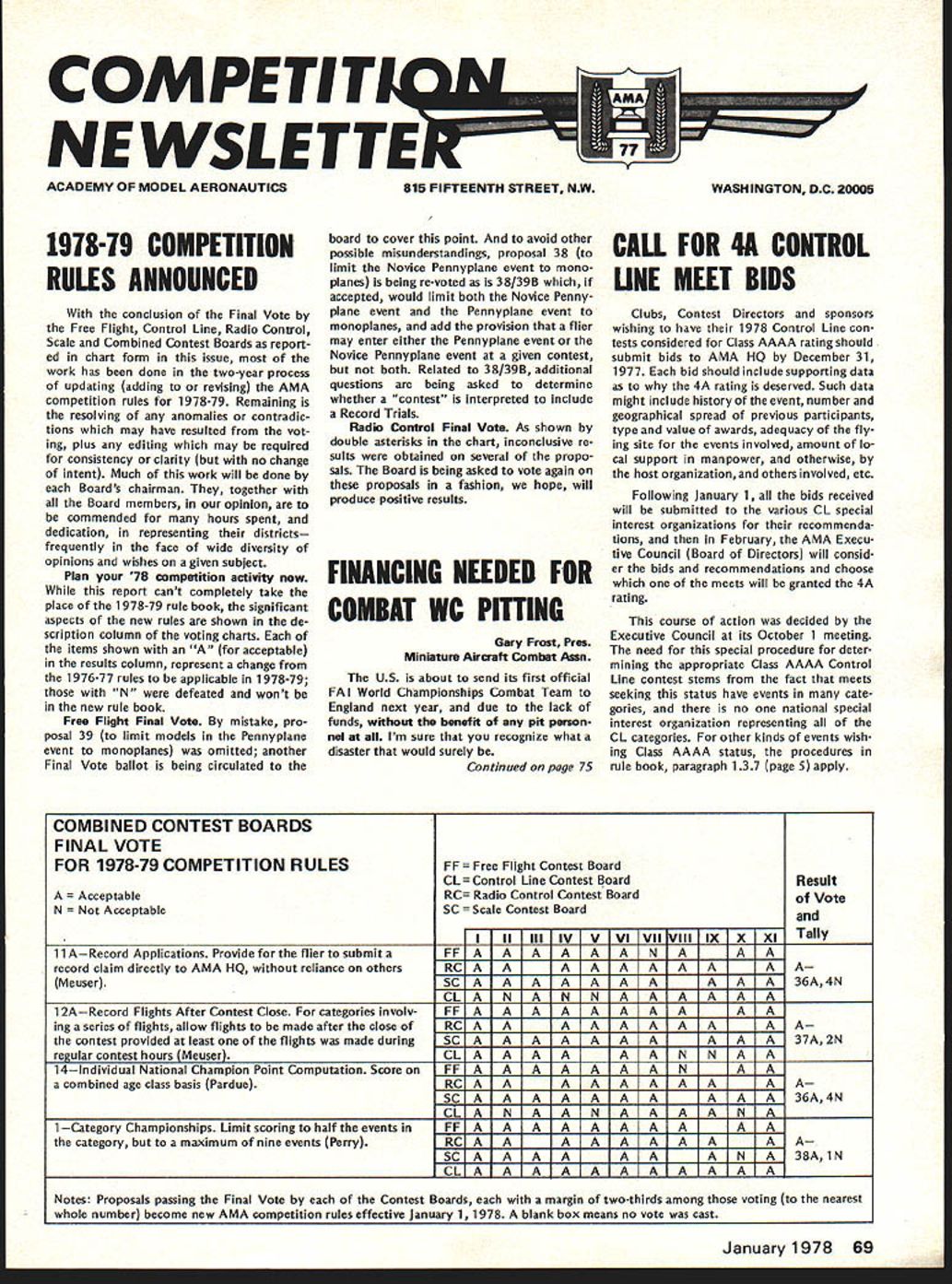
With the conclusion of the Final Vote by the Free Flight, Control Line, Radio Control, Scale and Combined Contest Boards as reported in chart form in this issue, most of the work has been done in the two-year process of updating (adding to or revising) the AMA competition rules for 1978-79. Remaining is the resolving of any anomalies or contradictions which may have resulted from the voting, plus any editing which may be required for consistency or clarity (but with no change of intent). Much of this work will be done by each Board's chairman. They, together with all the Board members, in our opinion, are to be commended for many hours spent, and dedication, in representing their districts—frequently in the face of wide diversity of opinions and wishes on a given subject.
Plan your '78 competition activity now. While this report can't completely take the place of the 1978-79 rule book, the significant aspects of the new rules are shown in the description column of the voting charts. Each of the items shown with an "A" (for acceptable) in the results column, represent a change from the 1976-77 rules to be applicable in 1978-79; those with an "N" were defeated and won't be in the new rule book.
Free Flight Final Vote. By mistake, proposal 39 (to limit models in the Pennyplane event to monoplanes) was omitted; another Final Vote ballot is being circulated to the board to cover this point. And to avoid other possible misunderstandings, proposal 38 (to limit the Novice Pennyplane event to monoplanes) is being re-voted as is 38/39B which, if accepted, would limit both the Novice Pennyplane event and the Pennyplane event to monoplanes, and add the provision that a flier may enter either the Pennyplane event or the Novice Pennyplane event at a given contest, but not both. Related to 38/39B, additional questions are being asked to determine whether a "contest" is interpreted to include Record Trials.
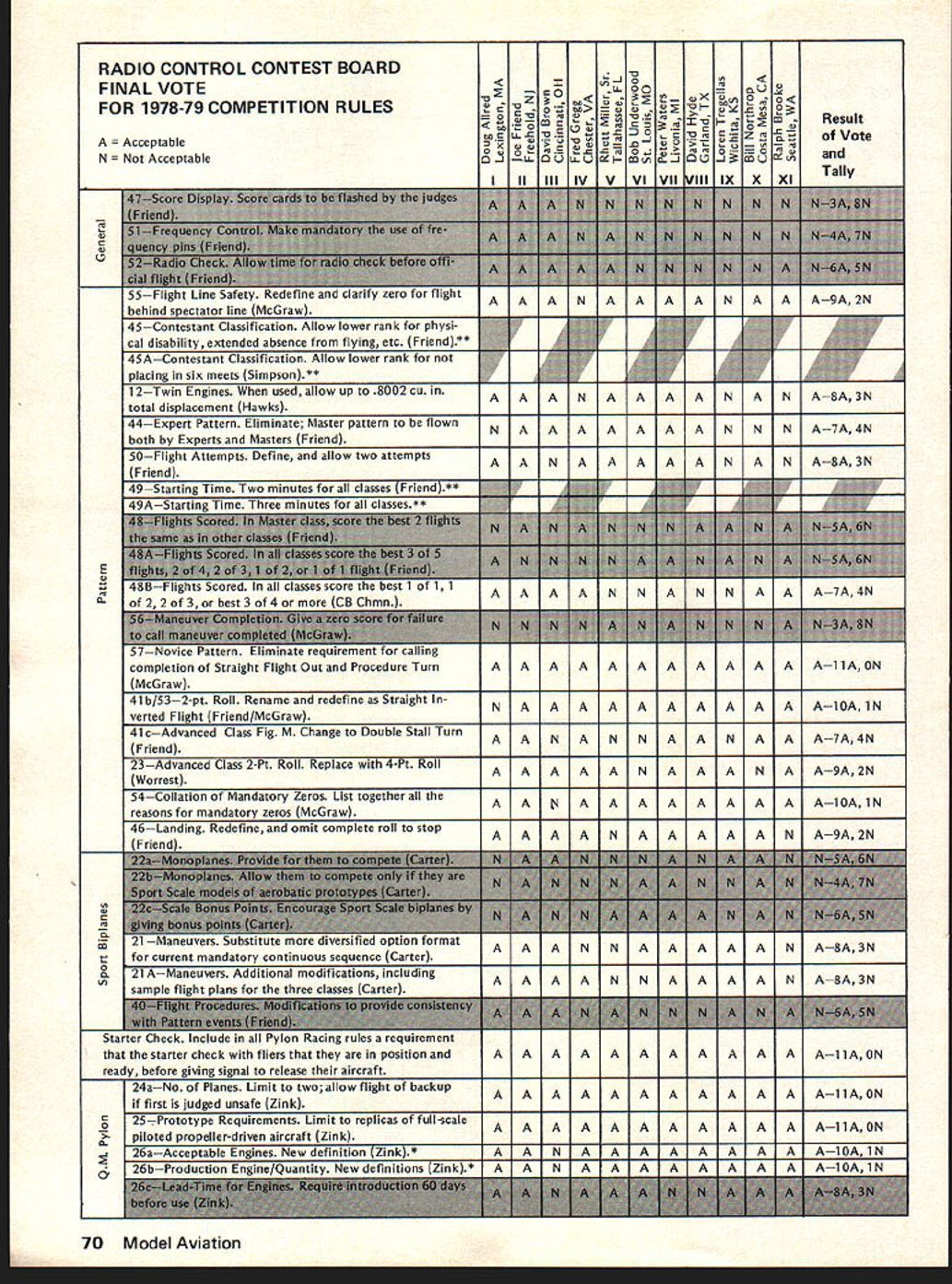
Radio Control Final Vote. As shown by double asterisks in the chart, inconclusive results were obtained on several of the proposals. The Board is being asked to vote again on these proposals in a fashion which, we hope, will produce positive results.
RADIO CONTROL CONTEST BOARD FINAL VOTE FOR 1978-79 COMPETITION RULES
A = Acceptable N = Not Acceptable
General
- 47—Score Display. Score cards to be flashed by the judges (Friend). Result of Vote and Tally: N = 3A, 8N
- 51—Frequency Control. Make mandatory the use of frequency pins (Friend). Result of Vote and Tally: N = 4A, 7N
- 52—Radio Check. Allow time for radio check before official flight (Friend). Result of Vote and Tally: N = 6A, 5N
- 55—Flight Line Safety. Redefine and clarify zero for flight behind spectator line (McGraw). Result of Vote and Tally: A = 9A, 2N
- 45—Contestant Classification. Allow lower rank for physical disability, extended absence from flying, etc. (Friend).**
- 45A—Contestant Classification. Allow lower rank for not placing in six meets (Simpson).**
- 12—Twin Engines. When used, allow up to .8002 cu. in. total displacement (Hawks). Result of Vote and Tally: A = 8A, 3N
- 44—Expert Pattern. Eliminate; Master pattern to be flown both by Experts and Masters (Friend). Result of Vote and Tally: A = 7A, 4N
- 50—Flight Attempts. Define, and allow two attempts (Friend). Result of Vote and Tally: A = 8A, 3N
- 49—Starting Time. Two minutes for all classes (Friend).**
- 49A—Starting Time. Three minutes for all classes.**
Pattern
- 48—Flights Scored. In Master class, score the best 2 flights the same as in other classes (Friend). Result of Vote and Tally: N = 5A, 6N
- 48A—Flights Scored. In all classes score the best 3 of 5 flights, 2 of 4, 2 of 3, 1 of 2, or 1 of 1 flight (Friend). Result of Vote and Tally: N = 5A, 6N
- 48B—Flights Scored. In all classes score the best 1 of 1, 1 of 2, 2 of 3, or best 3 of 4 or more (CB Chmn.). Result of Vote and Tally: A = 7A, 4N
- 56—Maneuver Completion. Give a zero score for failure to call maneuver completed (McGraw). Result of Vote and Tally: N = 3A, 8N
- 57—Novice Pattern. Eliminate requirement for calling completion of Straight Flight Out and Procedure Turn (McGraw). Result of Vote and Tally: A = 11A, 0N
- 41b/53—2-pt. Roll. Rename and redefine as Straight Inverted Flight (Friend/McGraw). Result of Vote and Tally: A = 10A, 1N
- 41c—Advanced Class Fig. M. Change to Double Stall Turn (Friend). Result of Vote and Tally: A = 7A, 4N
- 23—Advanced Class 2-Pt. Roll. Replace with 4-Pt. Roll (Worrest). Result of Vote and Tally: A = 9A, 2N
- 54—Collation of Mandatory Zeros. List together all the reasons for mandatory zeros (McGraw). Result of Vote and Tally: A = 10A, 1N
- 46—Landing. Redefine, and omit complete roll to stop (Friend). Result of Vote and Tally: A = 9A, 2N
Sport Biplanes
- 22a—Monoplanes. Provide for them to compete (Carter). Result of Vote and Tally: N = 5A, 6N
- 22b—Monoplanes. Allow them to compete only if they are sport scale models of aerobatic prototypes (Carter). Result of Vote and Tally: N = 4A, 7N
- 22c—Scale Bonus Points. Encourage Sport Scale biplanes by giving bonus points (Carter). Result of Vote and Tally: N = 6A, 5N
- 21—Maneuvers. Substitute more diversified option format for current mandatory continuous sequence (Carter). Result of Vote and Tally: A = 8A, 3N
- 21A—Maneuvers. Additional modifications, including sample flight plans for the three classes (Carter). Result of Vote and Tally: A = 8A, 3N
- 40—Flight Procedures. Modifications to provide consistency with Pattern events (Friend). Result of Vote and Tally: N = 5A, 5N
Starter Check. Include in all Pylon Racing rules a requirement that the starter check with fliers that they are in position and ready, before giving signal to release their aircraft.
Q.M. Pylon
- 24a—No. of Planes. Limit to two; allow flight of backup if first is judged unsafe (Zink). Result of Vote and Tally: A = 11A, 0N
- 25—Prototype Requirements. Limit to replicas of full-scale piloted propeller-driven aircraft (Zink). Result of Vote and Tally: A = 11A, 0N
- 26a—Acceptable Engines. New definition (Zink).* Result of Vote and Tally: A = 10A, 1N
- 26b—Production Engine/Quantity. New definitions (Zink).* Result of Vote and Tally: A = 10A, 1N
- 26c—Lead-Time for Engines. Require introduction 60 days before use (Zink). Result of Vote and Tally: A = 8A, 3N
Competition Newsletter
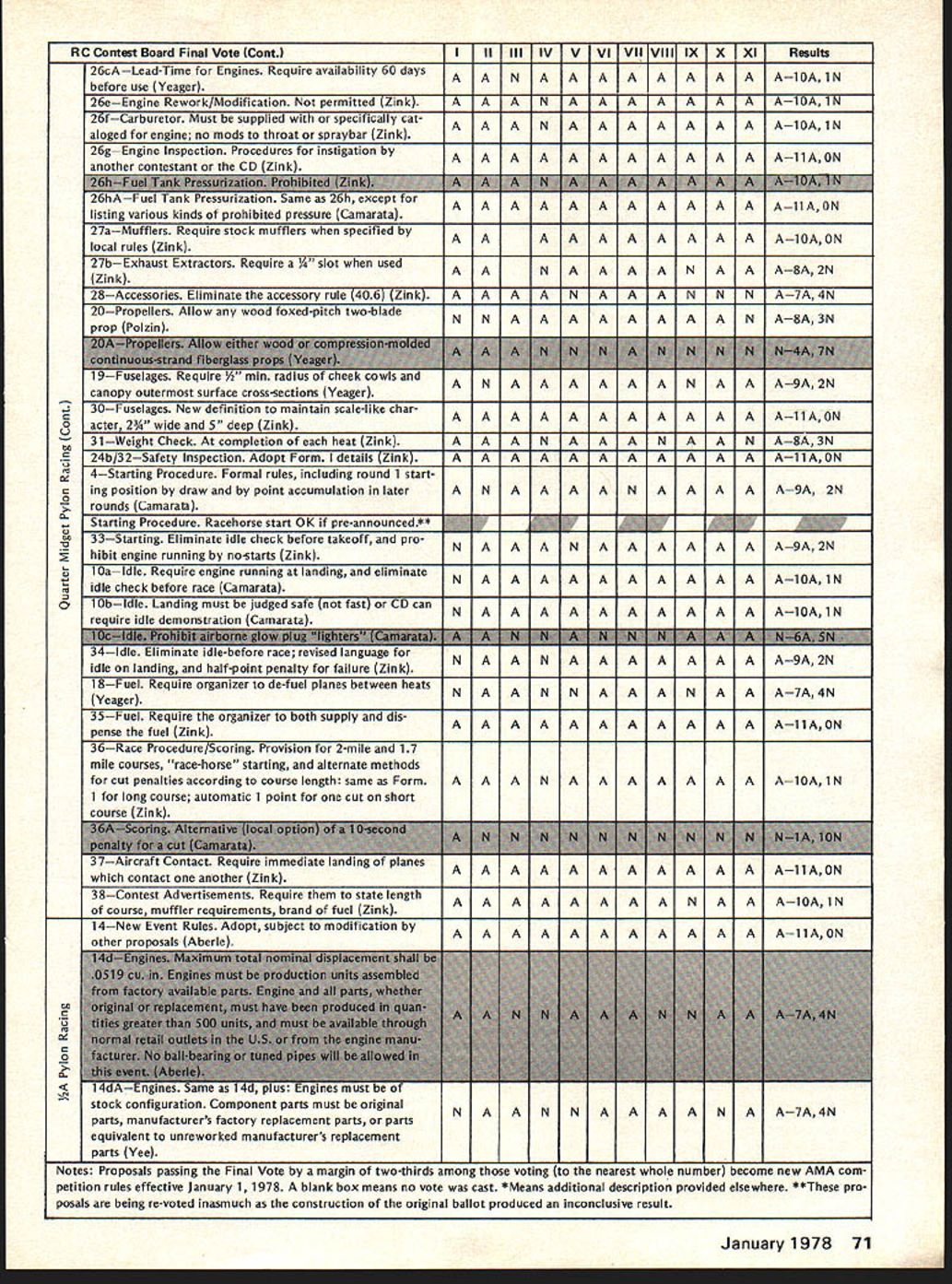
RC Contest Board Final Vote (Cont.)
26c—Lead‑Time for Engines. Require availability 60 days before use (Yeager). Results: A—10A, 1N
26e—Engine Rework/Modification. Not permitted (Zink). Results: A—10A, 1N
26f—Carburetor. Must be supplied with or specifically cataloged for engine; no mods to throat or sprayer (Zink). Results: A—10A, 1N
26g—Engine Inspection. Procedures for instigation by another contestant or the CD (Zink). Results: A—11A, 0N
26h—Fuel Tank Pressurization. Prohibited (Zink). Results: A—10A, 1N
26hA—Fuel Tank Pressurization. Same as 26h, except for listing various kinds of prohibited pressure (Camarata). Results: A—11A, 0N
27a—Mufflers. Require stock mufflers when specified by local rules (Zink). Results: A—10A, 0N
27b—Exhaust Extractors. Require a 1/4" slot when used (Zink). Results: A—8A, 2N
28—Accessories. Eliminate the accessory rule (40.6) (Zink). Results: A—7A, 4N
20—Propellers. Allow any wood fixed‑pitch two‑blade prop (Polzin). Results: N—8A, 3N
20A—Propellers. Allow either wood or compression‑molded continuous‑strand fiberglass props (Yeager). Results: N—4A, 7N
19—Fuselages. Require 1/2" min. radius of cheek cowls and canopy outermost surface cross‑sections (Yeager). Results: A—9A, 2N
30—Fuselages. New definition to maintain scale‑like character, 2 3/4" wide and 5" deep (Zink). Results: A—11A, 0N
31—Weight Check. At completion of each heat (Zink). Results: A—8A, 3N
24b/32—Safety Inspection. Adopt Form. 1 details (Zink). Results: A—11A, 0N
4—Starting Procedure. Formal rules, including round 1 starting position by draw and by point accumulation in later rounds (Camarata). Results: A—9A, 2N
Starting Procedure. Racehorse start OK if pre‑announced.**
33—Starting. Eliminate idle check before takeoff, and prohibit engine running by no‑starts (Zink). Results: A—9A, 2N
10a—Idle. Require engine running at landing, and eliminate idle check before race (Camarata). Results: A—10A, 1N
10b—Idle. Landing must be judged safe (not fast) or CD can require idle demonstration (Camarata). Results: A—10A, 1N
10c—Idle. Prohibit airborne glow plug "lighters" (Camarata). Results: N—6A, 5N
34—Idle. Eliminate idle‑before race; revised language for idle on landing, and half‑point penalty for failure (Zink). Results: A—9A, 2N
18—Fuel. Require organizer to de‑fuel planes between heats (Yeager). Results: A—7A, 4N
35—Fuel. Require the organizer to both supply and dispense the fuel (Zink). Results: A—11A, 0N
36—Race Procedure/Scoring. Provision for 2‑mile and 1.7 mile courses, "race‑horse" starting, and alternate methods for cut penalties according to course length: same as Form. 1 for long course; automatic 1 point for one cut on short course (Zink). Results: A—10A, 1N
36A—Scoring. Alternative (local option) of a 10‑second penalty for a cut (Camarata). Results: N—1A, 10N
37—Aircraft Contact. Require immediate landing of planes which contact one another (Zink). Results: A—11A, 0N
38—Contest Advertisements. Require them to state length of course, muffler requirements, brand of fuel (Zink). Results: A—10A, 1N
14—New Event Rules. Adopt, subject to modification by other proposals (Aberle). Results: A—11A, 0N
14d—Engines. Maximum total nominal displacement shall be .0519 cu. in. Engines must be production units assembled from factory available parts. Engine and all parts, whether original or replacement, must have been produced in quantities greater than 500 units, and must be available through normal retail outlets in the U.S. or from the engine manufacturer. No ball‑bearing or tuned pipes will be allowed in this event. (Aberle). Results: A—7A, 4N
14dA—Engines. Same as 14d, plus: Engines must be of stock configuration. Component parts must be original parts, manufacturer's factory replacement parts, or parts equivalent to unworked manufacturer's replacement parts (Yee). Results: N—7A, 4N
Notes: Proposals passing the Final Vote by a margin of two‑thirds among those voting (to the nearest whole number) become new AMA competition rules effective January 1, 1978. A blank box means no vote was cast. *Means additional description provided elsewhere. **These proposals are being re‑voted inasmuch as the construction of the original ballot produced an inconclusive result. 14f—Fuel Pressure. Any type of fuel pressure system may be used (Aberle). **
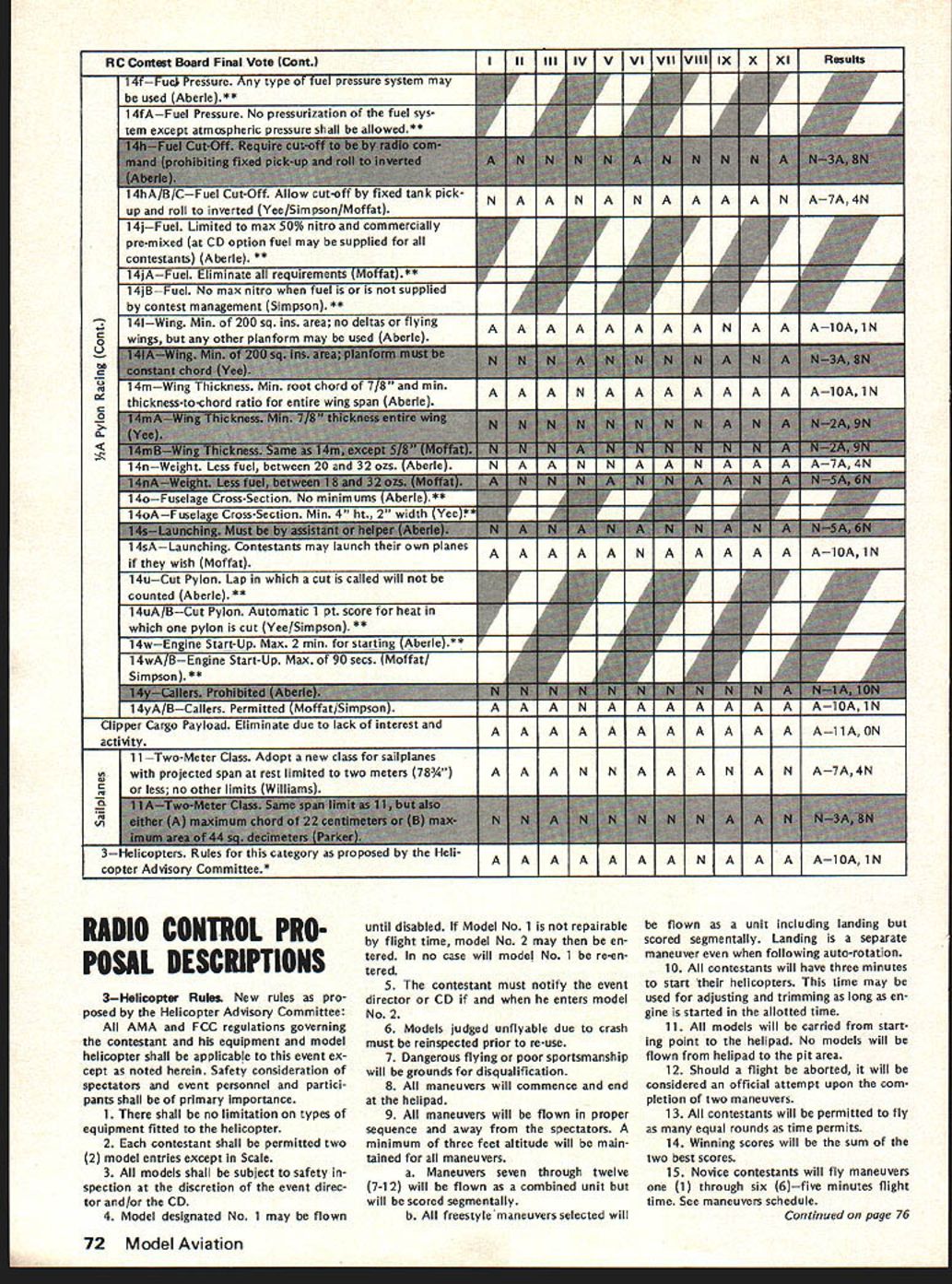
14fA—Fuel Pressure. No pressurization of the fuel system except atmospheric pressure shall be allowed. **
14h—Fuel Cut-Off. Require cut-off to be by radio command (prohibiting fixed pick-up and roll to inverted) (Aberle).
14hA/B/C—Fuel Cut-Off. Allow cut-off by fixed tank pick-up and roll to inverted (Yee/Simpson/Moffat).
14j—Fuel. Limited to max 50% nitro and commercially pre-mixed (at CD option fuel may be supplied for all contestants) (Aberle). **
14jA—Fuel. Eliminate all requirements (Moffat). **
14jB—Fuel. No max nitro when fuel is or is not supplied by contest management (Simpson). **
14l—Wing. Min. of 200 sq. ins. area; no deltas or flying wings, but any other planform may be used (Aberle).
14lA—Wing. Min. of 200 sq. ins. area; planform must be constant chord (Yee).
14m—Wing Thickness. Min. root chord of 7/8" and min. thickness-to-chord ratio for entire wing span (Aberle).
14mA—Wing Thickness. Min. 7/8" thickness entire wing (Yee).
14mB—Wing Thickness. Same as 14m, except 5/8" (Moffat).
14n—Weight. Less fuel, between 20 and 32 ozs. (Aberle).
14nA—Weight. Less fuel, between 18 and 32 ozs. (Moffat).
14o—Fuselage Cross-Section. No minimums (Aberle). **
14oA—Fuselage Cross-Section. Min. 4" ht., 2" width (Yee).
14s—Launching. Must be by assistant or helper (Aberle).
14sA—Launching. Contestants may launch their own planes if they wish (Moffat).
14u—Cut Pylon. Lap in which a cut is called will not be counted (Aberle). **
14uA/B—Cut Pylon. Automatic 1 pt. score for heat in which one pylon is cut (Yee/Simpson). **
14v—Engine Start-Up. Max. 2 min. for starting (Aberle). **
14vA/B—Engine Start-Up. Max. of 90 secs. (Moffat/Simpson). **
14y—Callers. Prohibited (Aberle).
14yA/B—Callers. Permitted (Moffat/Simpson).
Clipper Cargo Payload. Eliminate due to lack of interest and activity.
11—Two-Meter Class. Adopt a new class for sailplanes with projected span at rest limited to two meters (78¾") or less; no other limits (Williams).
11A—Two-Meter Class. Same span limit as 11, but also either (A) maximum chord of 22 centimeters or (B) maximum area of 44 sq. decimeters (Parker).
3—Helicopters. Rules for this category as proposed by the Helicopter Advisory Committee.
RADIO CONTROL PROPOSAL DESCRIPTIONS
3—Helicopter Rules. New rules as proposed by the Helicopter Advisory Committee:
All AMA and FCC regulations governing the contestant and his equipment and model helicopter shall be applicable to this event except as noted herein. Safety consideration of spectators and event personnel and participants shall be of primary importance.
- There shall be no limitation on types of equipment fitted to the helicopter.
- Each contestant shall be permitted two (2) model entries except in Scale.
- All models shall be subject to safety inspection at the discretion of the event director and/or the CD.
- Model designated No. 1 may be flown until disabled. If Model No. 1 is not repairable by flight time, Model No. 2 may then be entered. In no case will Model No. 1 be re-entered.
- The contestant must notify the event director or CD if and when he enters Model No. 2.
- Models judged unflyable due to crash must be reinspected prior to re-use.
- Dangerous flying or poor sportsmanship will be grounds for disqualification.
- All maneuvers will commence and end at the helipad.
- All maneuvers will be flown in proper sequence and away from the spectators. A minimum of three feet altitude will be maintained for all maneuvers.
a. Maneuvers seven through twelve (7–12) will be flown as a combined unit but will be scored segmentally. b. All freestyle maneuvers selected will be flown as a unit including landing but scored segmentally. Landing is a separate maneuver even when following auto-rotation.
- All contestants will have three minutes to start their helicopters. This time may be used for adjusting and trimming as long as engine is started in the allotted time.
- All models will be carried from starting point to the helipad. No models will be flown from helipad to the pit area.
- Should a flight be aborted, it will be considered an official attempt upon the completion of two maneuvers.
- All contestants will be permitted to fly as many equal rounds as time permits.
- Winning scores will be the sum of the two best scores.
- Novice contestants will fly maneuvers one (1) through six (6)—five minutes flight time. See maneuvers schedule.
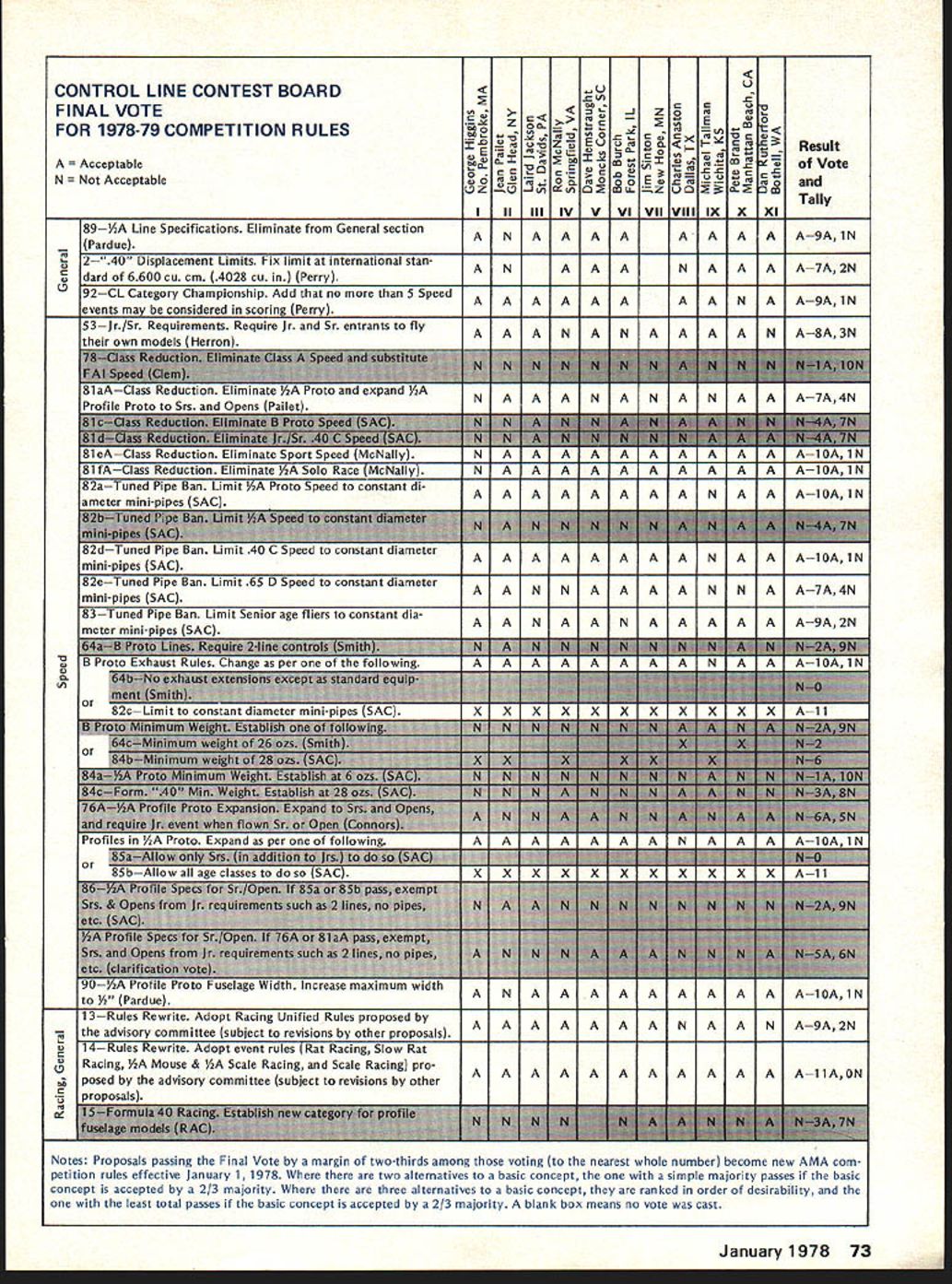
CONTROL LINE CONTEST BOARD
FINAL VOTE FOR 1978-79 COMPETITION RULES
A = Acceptable N = Not Acceptable
- 89–1/4A Line Specifications. Eliminate from General section (Pardue). Result of Vote and Tally: A–9A, 1N
- 2– "40" Displacement Limits. Fix limit at international standard of 6.600 cu. cm. (.4028 cu. in.) (Perry). Result of Vote and Tally: A–7A, 2N
- 92– CL Category Championship. Add that no more than 5 Speed events may be considered in scoring (Perry). Result of Vote and Tally: A–9A, 1N
- 53– Jr./Sr. Requirements. Require Jr. and Sr. entrants to fly their own models (Herron). Result of Vote and Tally: A–8A, 3N
- 78– Class Reduction. Eliminate Class A Speed and substitute FAI Speed (Clem). Result of Vote and Tally: N–1A, 10N
- 81aA– Class Reduction. Eliminate 1/2A Proto and expand 1/2A Profile Proto to Srs. and Opens (Paillet). Result of Vote and Tally: A–7A, 4N
- 81c– Class Reduction. Eliminate B Proto Speed (SAC). Result of Vote and Tally: N–4A, 7N
- 81d– Class Reduction. Eliminate Jr./Sr. .40 C Speed (SAC). Result of Vote and Tally: A–10A, 1N
- 81eA– Class Reduction. Eliminate Sport Speed (McNally). Result of Vote and Tally: A–10A, 1N
- 81fA– Class Reduction. Eliminate 1/2A Solo Race (McNally). Result of Vote and Tally: A–10A, 1N
- 82a– Tuned Pipe Ban. Limit 1/2A Proto Speed to constant diameter mini-pipes (SAC). Result of Vote and Tally: A–10A, 1N
- 82b– Tuned Pipe Ban. Limit 1/2A Speed to constant diameter mini-pipes (SAC). Result of Vote and Tally: N–4A, 7N
- 82d– Tuned Pipe Ban. Limit .40 C Speed to constant diameter mini-pipes (SAC). Result of Vote and Tally: A–10A, 1N
- 82e– Tuned Pipe Ban. Limit .65 D Speed to constant diameter mini-pipes (SAC). Result of Vote and Tally: A–7A, 4N
- 83– Tuned Pipe Ban. Limit Senior age fliers to constant diameter mini-pipes (SAC). Result of Vote and Tally: A–9A, 2N
- 64a– B Proto Lines. Require 2-line controls (Smith). Result of Vote and Tally: N–2A, 9N
B Proto Exhaust Rules. Change as per one of the following:
- 64b– No exhaust extensions except as standard equipment (Smith). Result of Vote and Tally: N–0
- 82c– Limit to constant diameter mini-pipes (SAC). Result of Vote and Tally: A–11
B Proto Minimum Weight. Establish one of following:
- 64c– Minimum weight of 26 ozs. (Smith). Result of Vote and Tally: N–2
- 84b– Minimum weight of 28 ozs. (SAC). Result of Vote and Tally: N–6
- 84a– 1/2A Proto Minimum Weight. Establish at 6 ozs. (SAC). Result of Vote and Tally: N–1A, 10N
- 84c– Form .40 Min. Weight. Establish at 28 ozs. (SAC). Result of Vote and Tally: N–3A, 8N
- 76A– 1/2A Profile Proto Expansion. Expand to Srs. and Opens, and require Jr. event when flown Sr. or Open (Connors). Result of Vote and Tally: N–6A, 5N
Profiles in 1/2A Proto. Expand as per one of following:
- 85a– Allow only Srs. (in addition to Jrs.) to do so (SAC). Result of Vote and Tally: N–0
- 85b– Allow all age classes to do so (SAC). Result of Vote and Tally: A–11
- 86– 1/2A Profile Specs for Sr./Open. If 85a or 85b pass, exempt Srs. & Opens from Jr. requirements such as 2 lines, no pipes, etc. (SAC). Result of Vote and Tally: N–2A, 9N
- 1/2A Profile Specs for Sr./Open. If 76A or 81aA pass, exempt Srs. and Opens from Jr. requirements such as 2 lines, no pipes, etc. (clarification note). Result of Vote and Tally: N–5A, 6N
- 90– 1/2A Profile Proto Fuselage Width. Increase maximum width to 5/8" (Pardue). Result of Vote and Tally: A–10A, 1N
Racing, General:
- 13– Rules Rewrite. Adopt Racing Unified Rules proposed by the advisory committee (subject to revisions by other proposals). Result of Vote and Tally: A–9A, 2N
- 14– Rules Rewrite. Adopt event rules (Rat Racing, Slow Rat Racing, 1/2A Mouse & 1/2A Scale Racing, and Scale Racing) proposed by the advisory committee (subject to revisions by other proposals). Result of Vote and Tally: A–11A, 0N
- 15– Formula 40 Racing. Establish new category for profile fuselage models (RAC). Result of Vote and Tally: N–3A, 7N
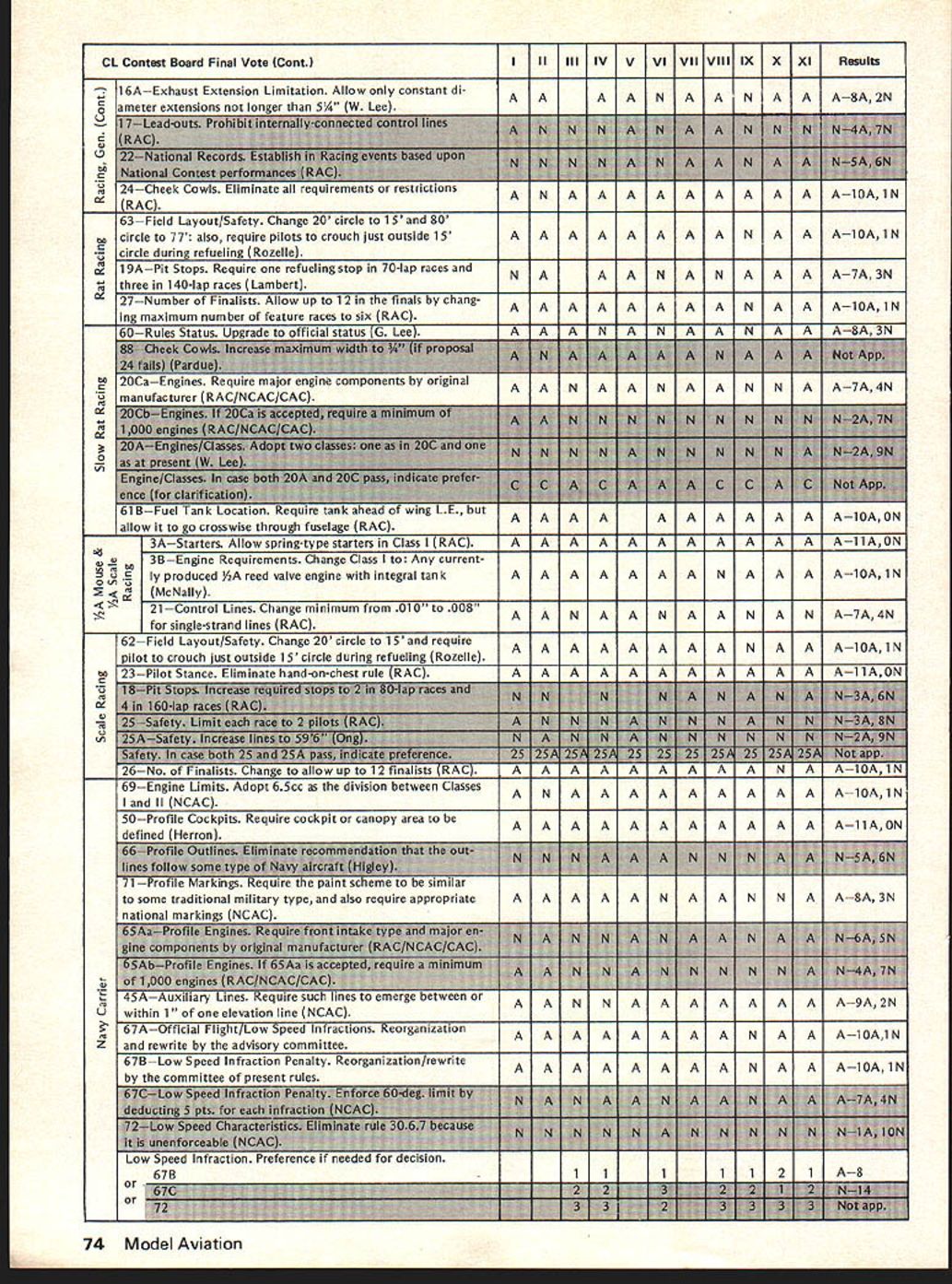
Notes: Proposals passing the Final Vote by a margin of two-thirds among those voting (to the nearest whole number) become new AMA competition rules effective January 1, 1978. Where there are two alternatives to a basic concept, the one with a simple majority passes if the basic concept is accepted by a 2/3 majority. Where there are three alternatives to a basic concept, they are ranked in order of desirability, and the one with the least total passes if the basic concept is accepted by a 2/3 majority. A blank box means no vote was cast. 16A—Exhaust Extension Limitation. Allow only constant-diameter extensions not longer than 5/4" (W. Lee). Result of Vote and Tally: A—8A, 2N
17—Lead-outs. Prohibit internally-connected control lines (RAC). Result of Vote and Tally: N—4A, 7N
22—National Records. Establish in Racing events based upon National Contest performances (RAC). Result of Vote and Tally: N—5A, 6N
24—Cheek Cowls. Eliminate all requirements or restrictions (RAC). Result of Vote and Tally: A—10A, 1N
63—Field Layout/Safety. Change 20' circle to 15' and 80' circle to 77'; also, require pilots to crouch just outside 15' circle during refueling (Rozelle). Result of Vote and Tally: A—10A, 1N
19A—Pit Stops. Require one refueling stop in 70-lap races and three in 140-lap races (Lambert). Result of Vote and Tally: A—7A, 3N
27—Number of Finalists. Allow up to 12 in the finals by changing maximum number of feature races to six (RAC). Result of Vote and Tally: A—10A, 1N
60—Rules Status. Upgrade to official status (G. Lee). Result of Vote and Tally: A—8A, 3N
88—Cheek Cowls. Increase maximum width to 3/4" (if proposal 24 fails) (Pardue). Result of Vote and Tally: Not App.
20Ca—Engines. Require major engine components by original manufacturer (RAC/NCAC/CAC). Result of Vote and Tally: A—7A, 4N
20Cb—Engines. If 20Ca is accepted, require a minimum of 1,000 engines (RAC/NCAC/CAC). Result of Vote and Tally: N—2A, 7N
20A—Engines/Classes. Adopt two classes: one as in 20C and one as at present (W. Lee). Result of Vote and Tally: N—2A, 9N
Engine/Classes. In case both 20A and 20C pass, indicate preference (for clarification). Result of Vote and Tally: Not App.
61B—Fuel Tank Location. Require tank ahead of wing L.E., but allow it to go crosswise through fuselage (RAC). Result of Vote and Tally: A—10A, 0N
3A—Starters. Allow spring-type starters in Class I (RAC). Result of Vote and Tally: A—11A, 0N
3B—Engine Requirements. Change Class I to: Any currently produced 3/4A reed valve engine with integral tank (McNally). Result of Vote and Tally: A—10A, 1N
21—Control Lines. Change minimum from .010" to .008" for single-strand lines (RAC). Result of Vote and Tally: A—7A, 4N
62—Field Layout/Safety. Change 20' circle to 15' and require pilot to crouch just outside 15' circle during refueling (Rozelle). Result of Vote and Tally: A—10A, 1N
23—Pilot Stance. Eliminate hand-on-chest rule (RAC). Result of Vote and Tally: A—11A, 0N
18—Pit Stops. Increase required stops to 2 in 80-lap races and 4 in 160-lap races (RAC). Result of Vote and Tally: N—3A, 6N
25—Safety. Limit each race to 2 pilots (RAC). Result of Vote and Tally: N—3A, 8N
25A—Safety. Increase lines to 59'6" (Ong). Result of Vote and Tally: N—2A, 9N
Safety. In case both 25 and 25A pass, indicate preference. Result of Vote and Tally: Not App.
26—No. of Finalists. Change to allow up to 12 finalists (RAC). Result of Vote and Tally: A—10A, 1N
69—Engine Limits. Adopt 6.5cc as the division between Classes I and II (NCAC). Result of Vote and Tally: A—10A, 1N
50—Profile Cockpits. Require cockpit or canopy area to be defined (Herron). Result of Vote and Tally: A—11A, 0N
66—Profile Outlines. Eliminate recommendation that the outlines follow some type of Navy aircraft (Higley). Result of Vote and Tally: N—5A, 6N
71—Profile Markings. Require the paint scheme to be similar to some traditional military type, and also require appropriate national markings (NCAC). Result of Vote and Tally: A—8A, 3N
65Aa—Profile Engines. Require front intake type and major engine components by original manufacturer (RAC/NCAC/CAC). Result of Vote and Tally: N—6A, 5N
65Ab—Profile Engines. If 65Aa is accepted, require a minimum of 1,000 engines (RAC/NCAC/CAC). Result of Vote and Tally: N—4A, 7N
45A—Auxiliary Lines. Require such lines to emerge between or within 1" of one elevation line (NCAC). Result of Vote and Tally: A—9A, 2N
67A—Official Flight/Low Speed Infractions. Reorganization and rewrite by the advisory committee. Result of Vote and Tally: A—10A, 1N
67B—Low Speed Infraction Penalty. Reorganization/rewrite by the committee of present rules. Result of Vote and Tally: A—10A, 1N
67C—Low Speed Infraction Penalty. Enforce 60-deg. limit by deducting 5 pts. for each infraction (NCAC). Result of Vote and Tally: A—7A, 4N
72—Low Speed Characteristics. Eliminate rule 30.6.7 because it is unenforceable (NCAC). Result of Vote and Tally: N—1A, 10N
Low Speed Infraction. Preference if needed for decision:
- 67B — 1 1 1 1 1 1 2 1 A—8
- or 67C — 2 2 2 2 2 2 3 2 N—14
- or 72 — 3 3 3 3 3 3 2 2 Not app.
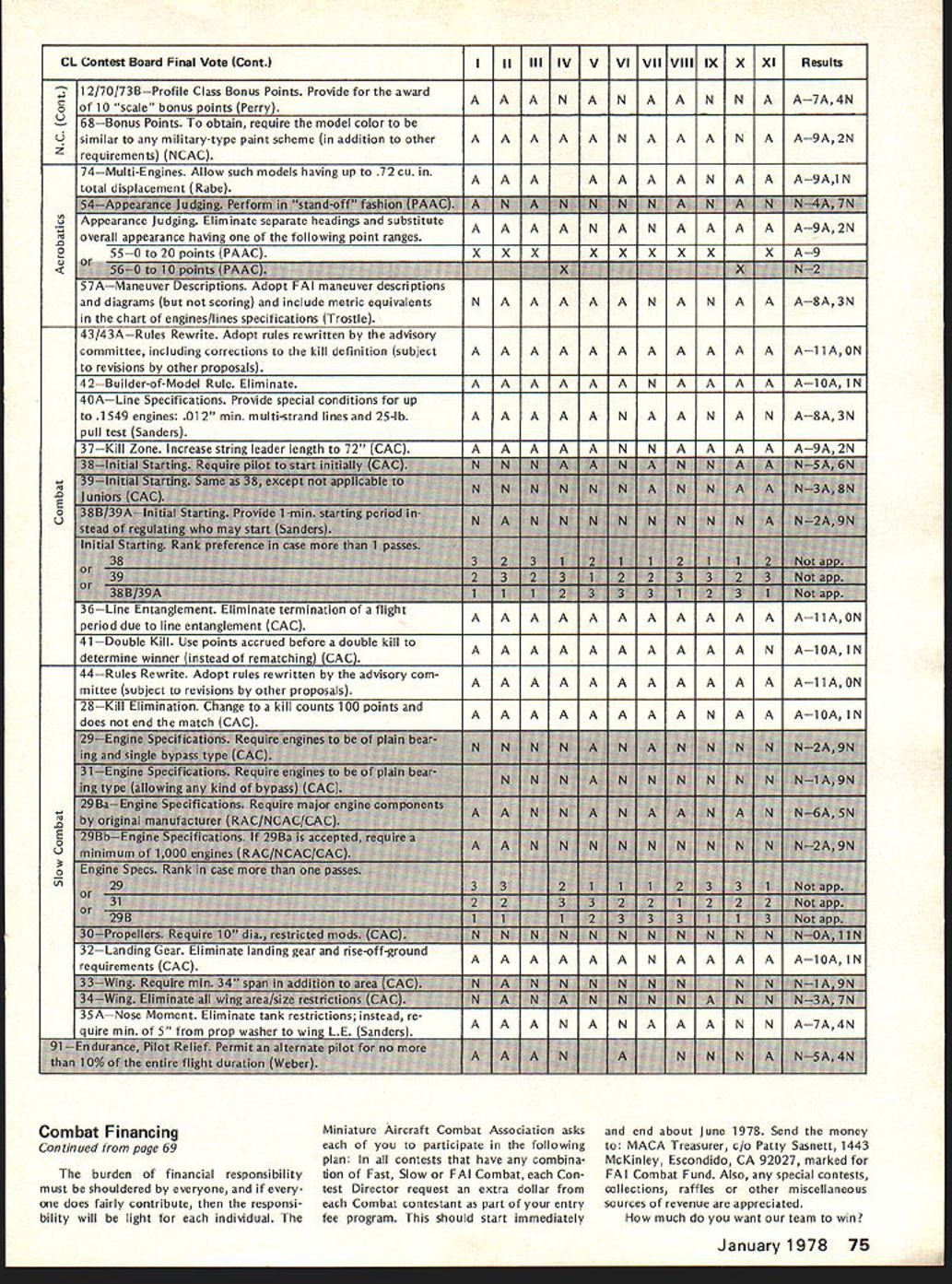
CL Contest Board Final Vote (Cont.)
12/70/73B—Profile Class Bonus Points. Provide for the award of 10 "scale" bonus points (Perry). Result: A—7A, 4N
68—Bonus Points. To obtain, require the model color to be similar to any military-type paint scheme (in addition to other requirements) (NCAC). Result: A—9A, 2N
74—Multi-Engines. Allow such models having up to .72 cu. in. total displacement (Rabe). Result: A—9A, 1N
54—Appearance Judging. Perform in "stand-off" fashion (PAAC). Result: N—4A, 7N
Appearance Judging. Eliminate separate headings and substitute overall appearance having one of the following point ranges:
- 55—0 to 20 points (PAAC). Result: A—9
- 56—0 to 10 points (PAAC). Result: N—2
57A—Maneuver Descriptions. Adopt FAI maneuver descriptions and diagrams (but not scoring) and include metric equivalents in the chart of engines/lines specifications (Trottie). Result: A—8A, 3N
43/43A—Rules Rewrite. Adopt rules rewritten by the advisory committee, including corrections to the kill definition (subject to revisions by other proposals). Result: A—11A, 0N
42—Builder-of-Model Rule. Eliminate. Result: A—10A, 1N
40A—Line Specifications. Provide special conditions for up to .1549 engines: .012" min. multi-strand lines and 25-lb. pull test (Sanders). Result: A—8A, 3N
37—Kill Zone. Increase string leader length to 72" (CAC). Result: A—9A, 2N
38—Initial Starting. Require pilot to start initially (CAC). Result: N—5A, 6N
39—Initial Starting. Same as 38, except not applicable to Juniors (CAC). Result: N—3A, 8N
38B/39A—Initial Starting. Provide 1-min. starting period instead of regulating who may start (Sanders). Result: N—2A, 9N
Initial Starting. Rank preference in case more than 1 passes:
- or 38
- or 39
- or 38B/39A
(Not applicable where shown)
36—Line Entanglement. Eliminate termination of a flight period due to line entanglement (CAC). Result: A—11A, 0N
41—Double Kill. Use points accrued before a double kill to determine winner (instead of rematching) (CAC). Result: A—10A, 1N
44—Rules Rewrite. Adopt rules rewritten by the advisory committee (subject to revisions by other proposals). Result: A—11A, 0N
28—Kill Elimination. Change to a kill counts 100 points and does not end the match (CAC). Result: A—10A, 1N
29—Engine Specifications. Require engines to be of plain bearing and single bypass type (CAC). Result: N—2A, 9N
31—Engine Specifications. Require engines to be of plain bearing type (allowing any kind of bypass) (CAC). Result: N—1A, 9N
29Ba—Engine Specifications. Require major engine components by original manufacturer (RAC/NCAC/CAC). Result: N—6A, 5N
29Bb—Engine Specifications. If 29Ba is accepted, require a minimum of 1,000 engines (RAC/NCAC/CAC). Result: N—2A, 9N
Engine Specs. Rank in case more than one passes:
- or 29
- or 31
- or 29B
(Not applicable where shown)
30—Propellers. Require 10" dia., restricted mods. (CAC). Result: N—0A, 11N
32—Landing Gear. Eliminate landing gear and rise-off-ground requirements (CAC). Result: A—10A, 1N
33—Wing. Require min. 34" span in addition to area (CAC). Result: N—1A, 9N
34—Wing. Eliminate all wing area/size restrictions (CAC). Result: N—3A, 7N
35A—Nose Moment. Eliminate tank restrictions; instead, require min. of 5" from prop washer to wing L.E. (Sanders). Result: A—7A, 4N
91—Endurance, Pilot Relief. Permit an alternate pilot for no more than 10% of the entire flight duration (Weber). Result: N—5A, 4N
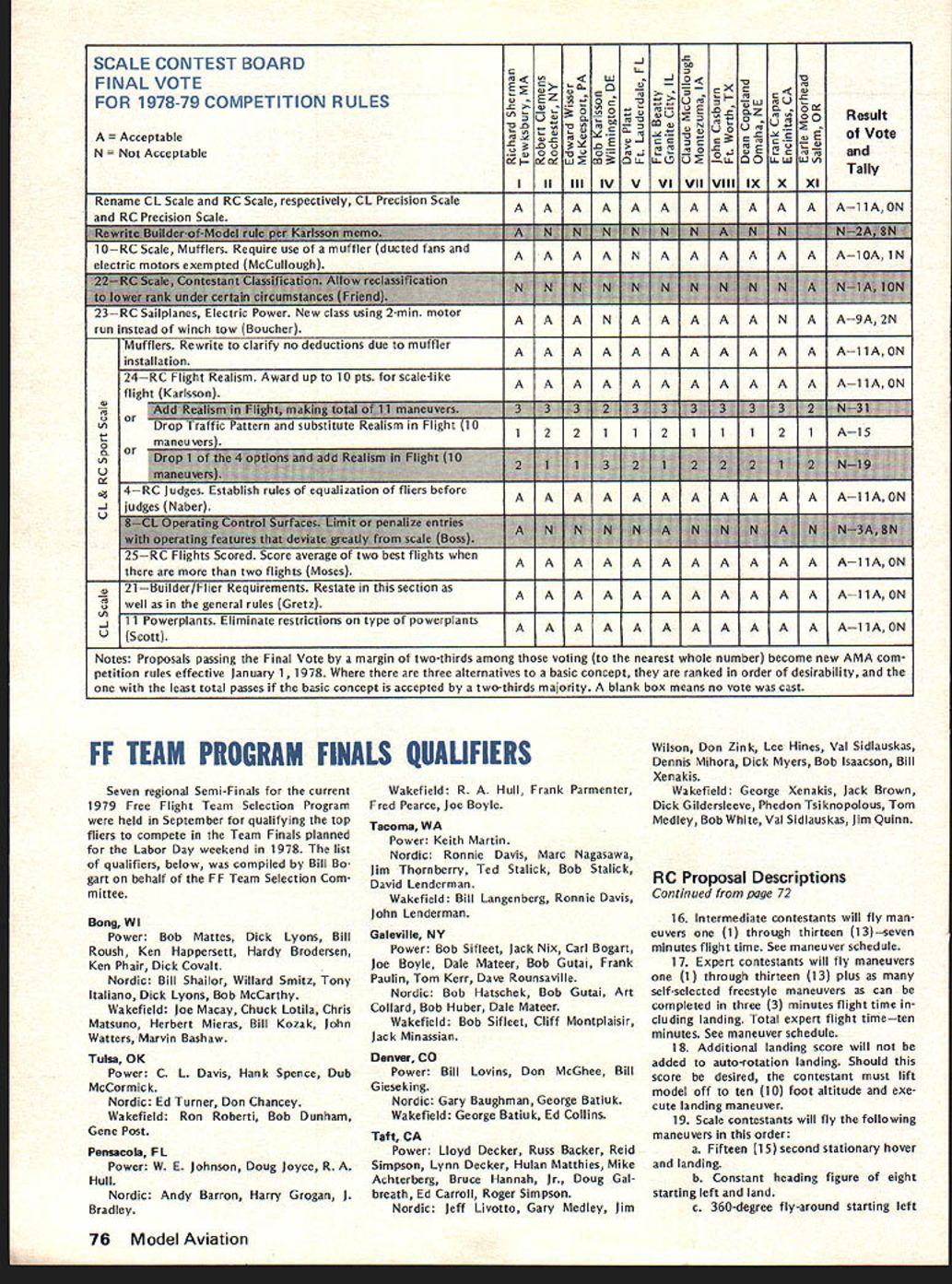
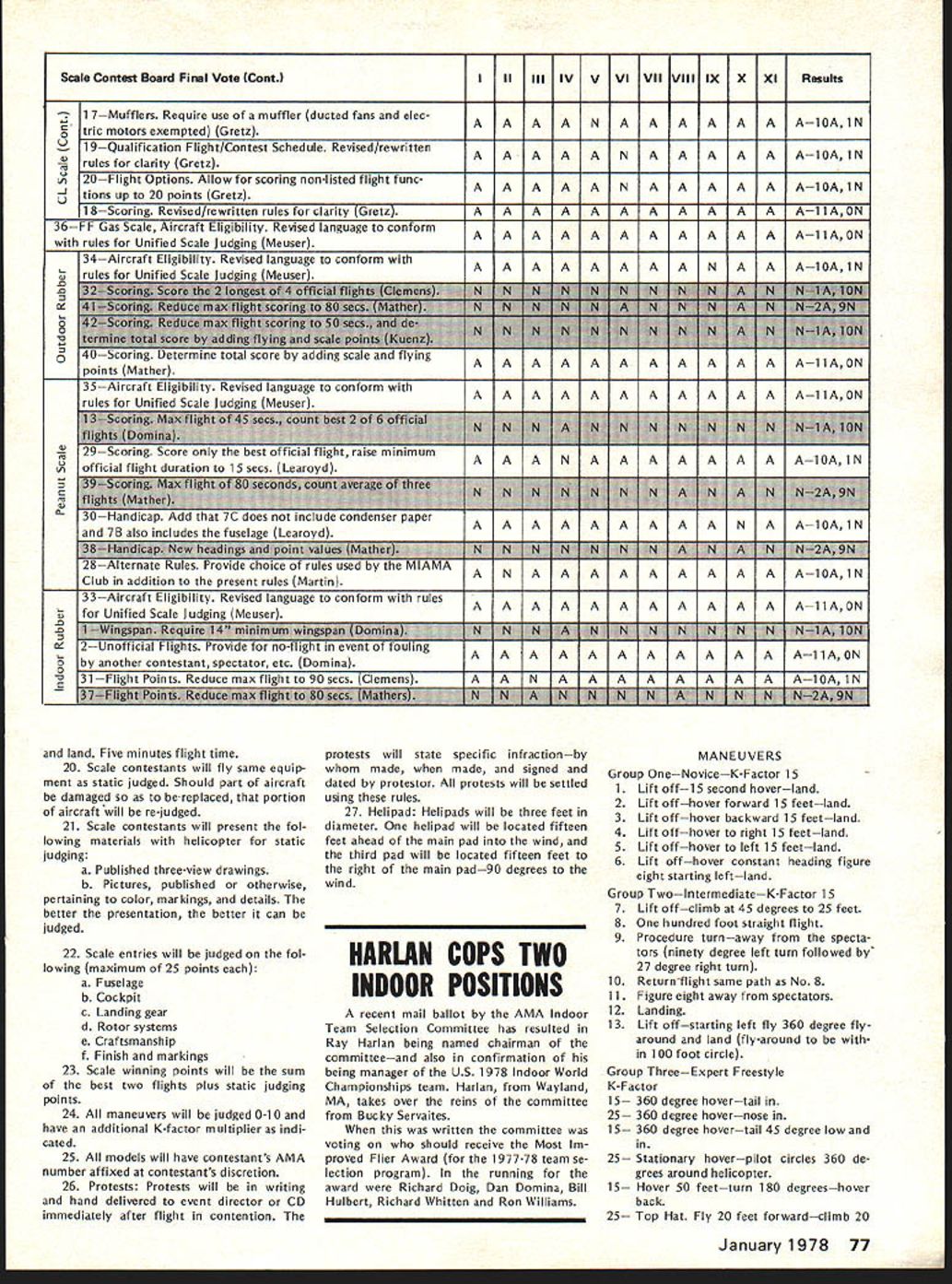
SCALE CONTEST BOARD FINAL VOTE FOR 1978-79 COMPETITION RULES
A = Acceptable N = Not Acceptable
- Rename CL Scale and RC Scale, respectively, CL Precision Scale and RC Precision Scale.
- Rewrite Builder-of-Model rule per. Karlsson memo.
- 10 — RC Scale, Mufflers. Require use of a muffler (ducted fans and electric motors exempted) (McCullough).
- 22 — RC Scale, Contestant Classification. Allow reclassification to lower rank under certain circumstances (Friend).
- 23 — RC Sailplanes, Electric Power. New class using 2-min. motor run instead of winch tow (Boucher).
- Mufflers. Rewrite to clarify no deductions due to muffler installation.
- 24 — RC Flight Realism. Award up to 10 pts. for scale-like flight (Karlsson).
- Add Realism in Flight, making total of 11 maneuvers.
- Drop Traffic Pattern and substitute Realism in Flight (10 maneuvers).
- Drop 1 of the 4 options and add Realism in Flight (10 maneuvers).
- 4 — RC Judges. Establish rules of equalization of fliers before judges (Naber).
- 8 — CL Operating Control Surfaces. Limit or penalize entries with operating features that deviate greatly from scale (Boss).
- 25 — RC Flights Scored. Score average of two best flights when there are more than two flights (Moses).
- 21 — Builder/Filer Requirements. Restate in this section as well as in the general rules (Gretz).
- 11 — Powerplants. Eliminate restrictions on type of powerplants (Scott).
Notes: Proposals passing the Final Vote by a margin of two-thirds among those voting (to the nearest whole number) become new AMA competition rules effective January 1, 1978. Where there are three alternatives to a basic concept, they are ranked in order of desirability, and the one with the least total passes if the basic concept is accepted by a two-thirds majority. A blank box means no vote was cast. and land. Five minutes flight time.
- Scale contestants will fly same equipment as static judged. Should part of aircraft be damaged so as to be replaced, that portion of aircraft will be re-judged.
- Scale contestants will present the following materials with helicopter for static judging:
a. Published three-view drawings. b. Pictures, published or otherwise, pertaining to color, markings, and details. The better the presentation, the better it can be judged.
- Scale entries will be judged on the following (maximum of 25 points each):
a. Fuselage b. Cockpit c. Landing gear d. Rotor systems e. Craftsmanship f. Finish and markings
- Scale winning points will be the sum of the best two flights plus static judging points.
- All maneuvers will be judged 0-10 and have an additional K-factor multiplier as indicated.
- All models will have contestant's AMA number affixed at contestant's discretion.
- Protests: Protests will be in writing and hand delivered to event director or CD immediately after flight in contention. The protests will state specific infraction—by whom made, when made, and signed and dated by protestor. All protests will be settled using these rules.
- Helipad: Helipads will be three feet in diameter. One helipad will be located fifteen feet ahead of the main pad into the wind, and the third pad will be located fifteen feet to the right of the main pad—90 degrees to the wind.
MANEUVERS
Group One—Novice—K-Factor 15
- Lift off—15 second hover—land.
- Lift off—hover forward 15 feet—land.
- Lift off—hover backward 15 feet—land.
- Lift off—hover to right 15 feet—land.
- Lift off—hover to left 15 feet—land.
- Lift off—hover constant heading figure eight starting left—land.
Group Two—Intermediate—K-Factor 15
- Lift off—climb at 45 degrees to 25 feet.
- One hundred foot straight flight.
- Procedure turn—away from the spectators (ninety degree left turn followed by 27 degree right turn).
- Return flight same path as No. 8.
- Figure eight away from spectators.
- Landing.
- Lift off—starting left fly 360 degree fly-around and land (fly-around to be within 100 foot circle).
Group Three—Expert Freestyle K-Factor 15—360 degree hover—tail in. 25—360 degree hover—nose in. 15—360 degree hover—tail 45 degree low and in. 25—Stationary hover—pilot circles 360 degrees around helicopter. 15—Hover 50 feet—turn 180 degrees—hover back. 25—Top Hat. Fly 20 feet forward—climb 20
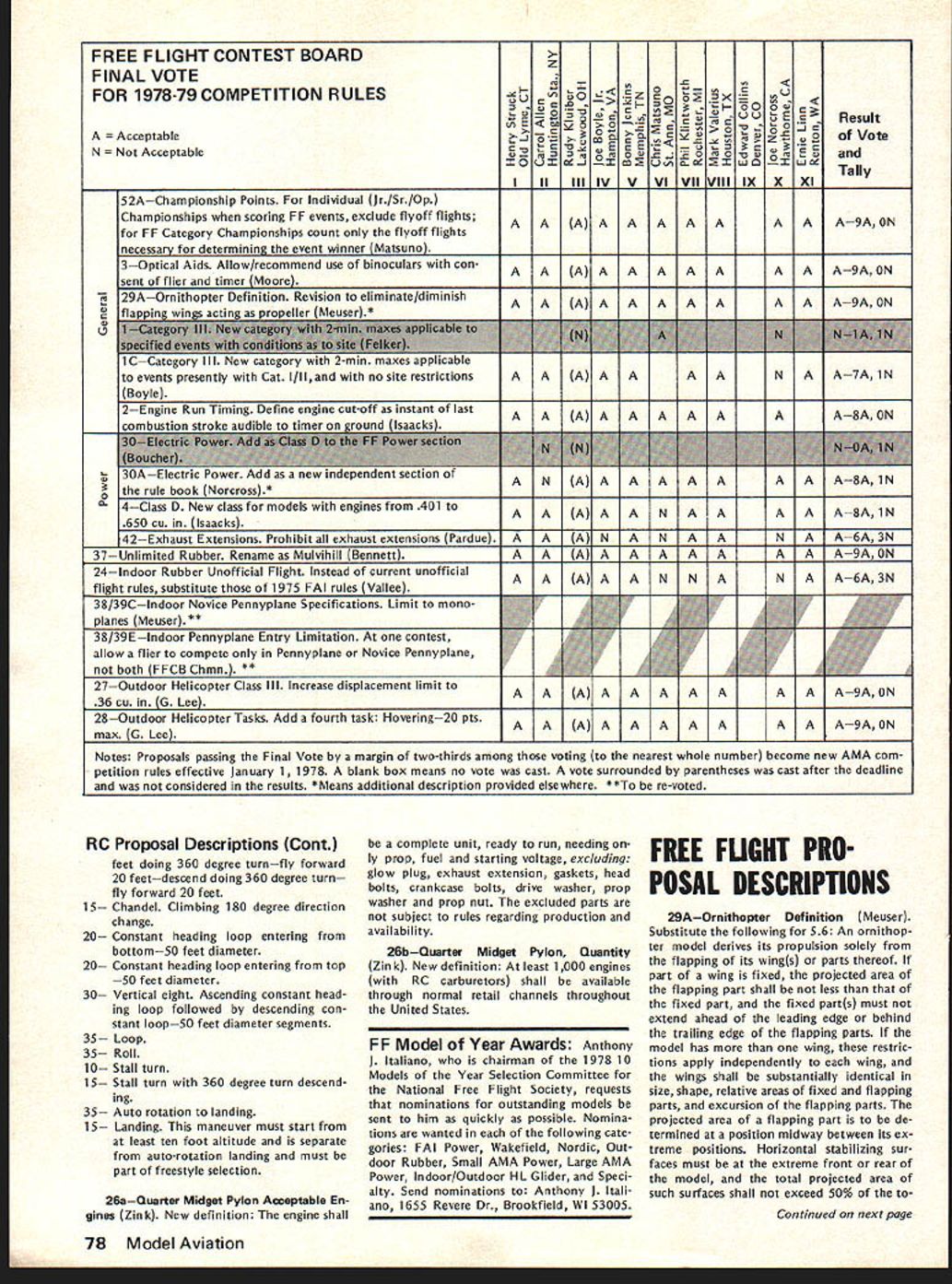
FREE FLIGHT CONTEST BOARD FINAL VOTE FOR 1978-79 COMPETITION RULES
A = Acceptable N = Not Acceptable
52A—Championship Points. For Individual (Jr./Sr./Op.). Championships when scoring FF events, exclude flyoff flights; for FF Category Championships count only the flyoff flights necessary for determining the event winner (Matsuno).
3—Optical Aids. Allow/recommend use of binoculars with consent of flier and timer (Moore).
29A—Ornithopter Definition. Revision to eliminate/diminish flapping wings acting as propeller (Meuser).*
1—Category III. New category with 2-min. maxes applicable to specified events with conditions as to site (Felker).
1C—Category III. New category with 2-min. maxes applicable to events presently with Cat. I/II, and with no site restrictions (Boyle).
2—Engine Run Timing. Define engine cut-off as instant of last combustion stroke audible to timer on ground (Isaacks).
30—Electric Power. Add as Class D to the FF Power section (Boucher).
30A—Electric Power. Add as a new independent section of the rule book (Norcross).
4—Class D. New class for models with engines from .401 to .650 cu. in. (Isaacks).
42—Exhaust Extensions. Prohibit all exhaust extensions (Pardue).
37—Unlimited Rubber. Rename as Mulvihill (Bennett).
24—Indoor Rubber Unofficial Flight. Instead of current unofficial flight rules, substitute those of 1975 FAI rules (Vallee).
38/39C—Indoor Novice Pennyplane Specifications. Limit to monoplanes (Meuser). **
38/39E—Indoor Pennyplane Entry Limitation. At one contest, allow a flier to compete only in Pennyplane or Novice Pennyplane, not both (FFCB Chmn.). **
27—Outdoor Helicopter Class III. Increase displacement limit to .36 cu. in. (G. Lee).
28—Outdoor Helicopter Tasks. Add a fourth task: Hovering—20 pts. max. (G. Lee).
Notes: Proposals passing the Final Vote by a margin of two-thirds among those voting (to the nearest whole number) become new AMA competition rules effective January 1, 1978. A blank box means no vote was cast. A vote surrounded by parentheses was cast after the deadline and was not considered in the results. *Means additional description provided elsewhere. **To be re-voted.
RC Proposal Descriptions (Cont.)
feet doing 360 degree turn—fly forward 20 feet—descend doing 360 degree turn—fly forward 20 feet.
15—Chandel. Climbing 180 degree direction change.
20—Constant heading loop entering from bottom—50 feet diameter.
20—Constant heading loop entering from top—50 feet diameter.
30—Vertical eight. Ascending constant heading loop followed by descending constant loop—50 foot diameter segments.
35—Loop.
35—Roll.
10—Stall turn.
15—Stall turn with 360 degree turn descending.
35—Auto rotation to landing.
15—Landing. This maneuver must start from at least ten foot altitude and is separate from auto-rotation landing and must be part of freestyle selection.
26a—Quarter Midget Pylon Acceptable Engines (Zink). New definition: The engine shall be a complete unit, ready to run, needing only prop, fuel and starting voltage, excluding: glow plug, exhaust extension, gaskets, head bolts, crankcase bolts, drive washer, prop washer and prop nut. The excluded parts are not subject to rules regarding production and availability.
26b—Quarter Midget Pylon, Quantity (Zink). New definition: At least 1,000 engines (with RC carburetors) shall be available through normal retail channels throughout the United States.
FF Model of Year Awards
Anthony J. Italiano, who is chairman of the 1978 Models of the Year Selection Committee for the National Free Flight Society, requests that nominations for outstanding models be sent to him as quickly as possible. Nominations are wanted in each of the following categories: FAI Power, Wakefield, Nordic, Outdoor Rubber, Small AMA Power, Large AMA Power, Indoor/Outdoor HL Glider, and Specialty. Send nominations to: Anthony J. Italiano, 1655 Revere Dr., Brookfield, WI 53005.
FREE FLIGHT PROPOSAL DESCRIPTIONS
29A—Ornithopter Definition (Meuser). Substitute the following for 5.6: An ornithopter model derives its propulsion solely from the flapping of its wing(s) or parts thereof. If part of a wing is fixed, the projected area of the flapping part shall be not less than that of the fixed part, and the fixed part(s) must not extend ahead of the leading edge or behind the trailing edge of the flapping parts. If the model has more than one wing, these restrictions apply independently to each wing, and the wings shall be substantially identical in size, shape, relative areas of fixed and flapping parts, and excursion of the flapping parts. The projected area of a flapping part is to be determined at a position midway between its extreme positions. Horizontal stabilizing surfaces must be at the extreme front or rear of the model, and the total projected area of such surfaces shall not exceed 50% of the total.
Transcribed from original scans by AI. Minor OCR errors may remain.

