
RC SOARING TEAM PROGRAM PLANNING
The 1978 program for selecting the 1979 U.S. Soaring World Championships Team will be quite similar to the previous 1976 program according to the results of a ballot to previous program entrants. Voting authorized the Team Selection Program Committee to modify the 1976 program by: (A) permitting quarter-final contests to be flown during the months of April, May and June, approved 74 to 5; (B) increasing the number of semi-final contests to as many as 10 if demand warrants it, approved 75 to 4; (C) permitting semi-final contests to be flown on the first weekend of July (1-3) or the second weekend of July (8-9), approved 75 to 4.
Participants also approved the chairman and AMA district members of the RC Soaring Team Selection Program Committee as follows: Ray Marvin, chairman; Dwight Holley, District I; Leon Pike II; Dave Burt III; Brian L. Foster IV; Jim W. Lenoir V; John Nielsen VI; Warren Tiahrt VII; Dale Nutter VIII; Skip Miller IX; Dave Thornburg X; Don Burt XI. The vote was 76 to 2 in favor of this group.
Ray Marvin, who was approved as chairman of the committee, was CD of the 1976 RC Soaring Team Finals; he was CD of the RC Soaring events of the 1977 AMA Nats in California, and he is the National Soaring Society FAI Coordinator.
FREE FLIGHT CONTEST BOARD
FINAL VOTE (RE-VOTE) FOR 1978-79 COMPETITION RULES
A = Acceptable N = Not Acceptable
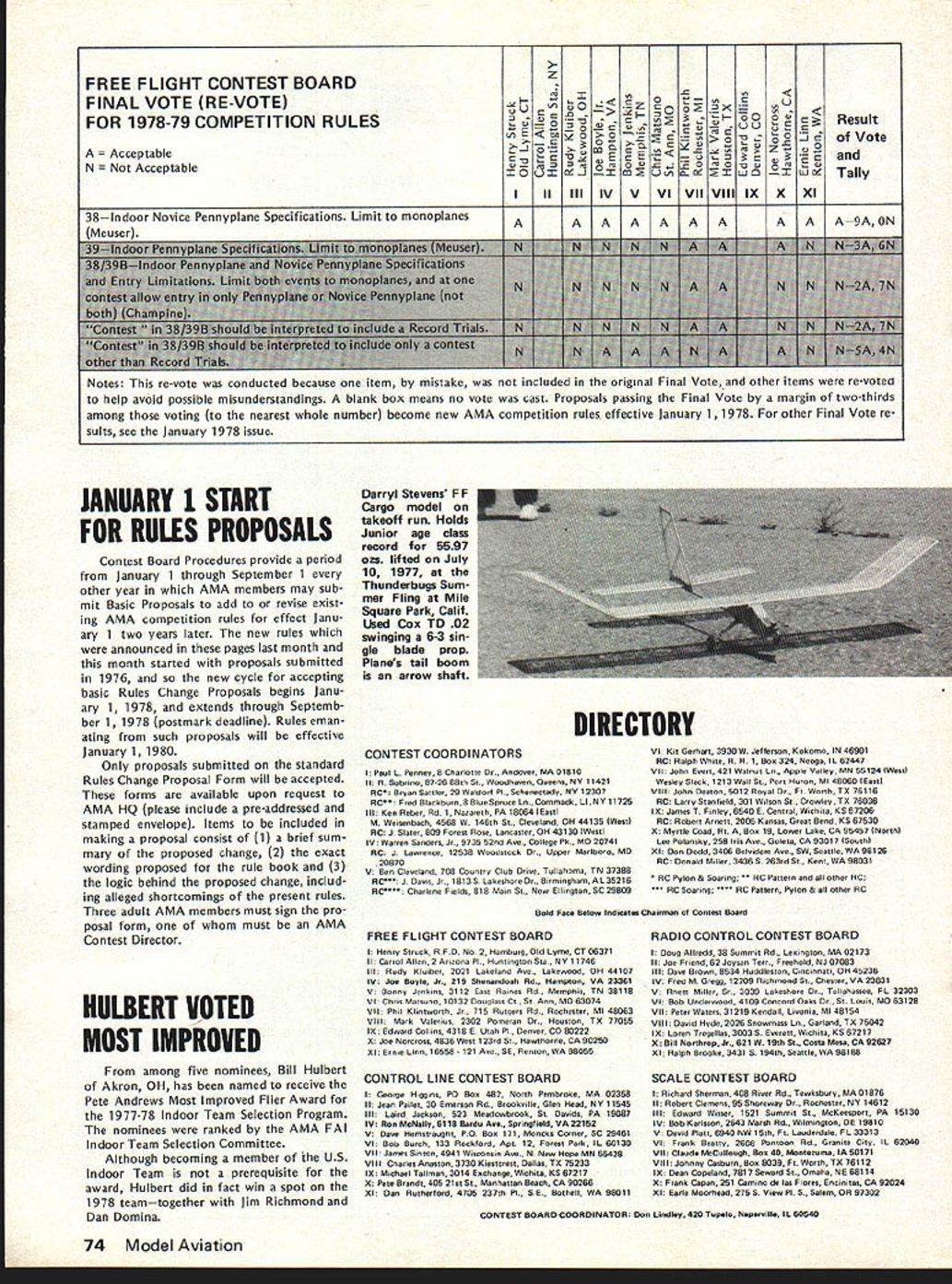
38 — Indoor Novice Pennyplane Specifications. Limit to monoplanes (Meuser). 39 — Indoor Pennyplane Specifications. Limit to monoplanes (Meuser). 38/39B — Indoor Pennyplane and Novice Pennyplane Specifications and Entry Limitations. Limit both events to monoplanes, and at one contest allow entry in only Pennyplane or Novice Pennyplane (not both) (Champine). "Contest" in 38/39B should be interpreted to include a Record Trials. "Contest" in 38/39B should be interpreted to include only a contest other than Record Trials.
Notes: This re-vote was conducted because one item, by mistake, was not included in the original Final Vote, and other items were re-voted to help avoid possible misunderstandings. A blank box means no vote was cast. Proposals passing the Final Vote by a margin of two-thirds among those voting (to the nearest whole number) become new AMA competition rules effective January 1, 1978. For other Final Vote results, see the January 1978 issue.
JANUARY 1 START FOR RULES PROPOSALS
Contest Board Procedures provide a period from January 1 through September 1 every other year in which AMA members may submit Basic Proposals to add to or revise existing AMA competition rules for effect January 1 two years later. The new rules which were announced in these pages last month and this month started with proposals submitted in 1976, and so the new cycle for accepting basic Rules Change Proposals begins January 1, 1978, and extends through September 1, 1978 (postmark deadline). Rules emanating from such proposals will be effective January 1, 1980.
Only proposals submitted on the standard Rules Change Proposal Form will be accepted. These forms are available upon request to AMA HQ (please include a pre-addressed stamped envelope). Items to be included in making a proposal consist of (1) a brief summary of the proposed change, (2) the exact wording proposed for the rule book and (3) the logic behind the proposed change, including alleged shortcomings of the present rules. Three adult AMA members must sign the proposal form, one of whom must be an AMA Contest Director.
HULBERT VOTED MOST IMPROVED
From among five nominees, Bill Hulbert of Akron, OH, has been named to receive the Pete Andrews Most Improved Flier Award for the 1977-78 Indoor Team Selection Program. The nominees were ranked by the AMA FAI Indoor Team Selection Committee.
Although becoming a member of the U.S. Indoor Team is not a prerequisite for the award, Hulbert did in fact win a spot on the 1978 team—together with Jim Richmond and Dan Domina.
Competition Newsletter
AMA ACADEMY OF MODEL AERONAUTICS 515 FIFTEENTH STREET NW WASHINGTON, DC 20005
RC SOARING TEAM PROGRAM PLANNING The 1978 program selecting the 1979 U.S. Soaring World Championships will be quite similar to the previous 1976 program according to results of a ballot of previous program entrants. Voting authorized the Team Selection Program Committee to modify the 1976 program permitting quarter-final contests flown during the months April, May and June (approved 74-5-B); increasing the number of semi-final contests to 10 if demand warrants (approved 75-4-C); permitting semi-final contests flown the first weekend, July 1-3, and the second weekend, July 8-9 (approved 75-4). Participants also approved the chairman and AMA district members of the RC Soaring Team Selection Program Committee as follows: Ray Marvin, chairman; Dwight Holley, District I; Leon Pike II; Dave Burt III; Brian L. Foster IV; Jim W. Lenoir V; John Nielsen VI; Warren Tiahrt VII; Dale Nutter VIII; Skip Miller IX; Dave Thornburg X; Don Burt XI. Vote 76-2 in favor. Ray Marvin approved chairman. Committee CD 1976 RC Soaring Team Finals CD RC Soaring events 1977 AMA Nats California National Soaring Society FAI Coordinator.
STOY INDOOR KL GUDER RECORD The Free Flight Contest Board, under chairmanship Joe Boyle Jr., is considering whether to rescind Stan Stoy's National AMA Record 1,088 seconds, Indoor Hand-Launch Glider category. The issue is whether the building used and its turbulent conditions are acceptable for record purposes. Descriptions of the circumstances surrounding the record appeared in Bob Meuser's December Free Flight Duration column and Bud Tenny's January 1978 Indoor column. The board is also considering whether there is a need to enact an emergency interpretation ruling concerning acceptable indoor sites. Board members were asked to suggest language for such an emergency ruling and to respond as to course of action.
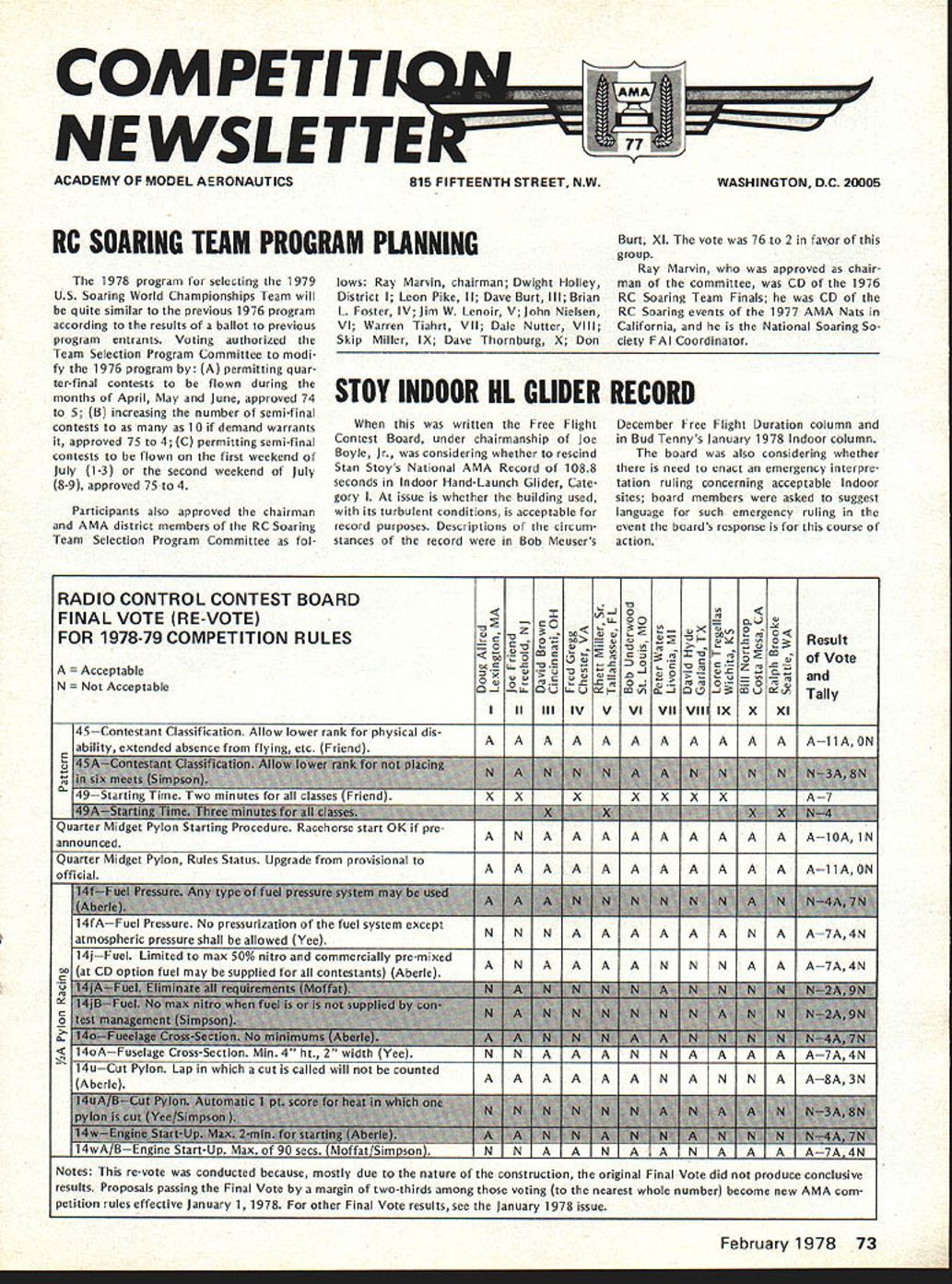
RADIO CONTROL CONTEST BOARD FINAL VOTE RE-VOTE FOR 1978-79 COMPETITION RULES (Notes: This re-vote was conducted because, mostly due to the nature of construction, the original Final Vote did not produce conclusive results. Proposals passing the Final Vote by a margin of two-thirds among voting (to the nearest whole number) become new AMA competition rules effective January 1, 1978. Other Final Vote results appear in the January 1978 issue.) No pressurization fuel system except atmospheric pressure shall be allowed. Fuel limited: max 50% nitro commercially pre-mixed with CD option; fuel may be supplied to contestants.
FREE FLIGHT CONTEST BOARD FINAL VOTE RE-VOTE FOR 1978-79 COMPETITION RULES (Notes: This re-vote was conducted because an item was mistakenly included in the original Final Vote; other items were re-voted to help avoid possible misunderstandings. A blank box means no vote cast. Proposals passing the Final Vote by a margin of two-thirds among voting (to the nearest whole number) become new AMA competition rules effective January 1, 1978. Other Final Vote results appear in the January 1978 issue.) Indoor Novice Pennyplane Specifications: Limit monoplanes.
JANUARY 1 START FOR RULES PROPOSALS Contest Board procedures provide a period January 1 through September 1 of each year during which AMA members may submit Basic Proposals to add or revise existing AMA competition rules, effective January 1 two years later. The new rules promulgated from proposals submitted in 1976 began the new cycle; the next cycle for accepting Basic Rules Change Proposals begins January 1, 1978, and extends through September 1, 1978 (postmark deadline). Rules emanating from such proposals will be effective January 1, 1980. Only proposals submitted on the standard Rules Change Proposal Form will be accepted; forms are available upon request from AMA HQ (please include a pre-addressed stamped envelope). Items to be included in making a proposal consist of: (1) a brief summary of the proposed change, (2) the exact wording proposed for the rule book, and (3) the logic behind the proposed change, including alleged shortcomings of the present rules. Three adult AMA members must sign the proposal form, one of whom must be an AMA Contest Director.
RC SOARING TEAM PROGRAM PLANNING
The 1978 program for selecting the 1979 U.S. Soaring World Championships will be quite similar to the previous 1976 program, according to results of a ballot of previous program entrants. Voting authorized the Team Selection Program Committee to modify the 1976 program by permitting quarter‑final contests flown during the months April, May and June (approved 74–5 B), increasing the number of semi‑final contests to 10 if demand warrants (approved 75–4 C), and permitting semi‑final contests flown the first weekend (July 1–3) and the second weekend (July 8–9) (approved 75–4).
Participants also approved the following chairman and AMA district members of the RC Soaring Team Selection Program Committee: Ray Marvin, chairman; Dwight Holley, District I; Leon Pike II, District II; Dave Burt III, District III; Brian L. Foster IV, District IV; Jim W. Lenoir V, District V; John Nielsen VI, District VI; Warren Tiahrt VII, District VII; Dale Nutter VIII, District VIII; Skip Miller IX, District IX; Dave Thornburg X, District X; Don Burt XI, District XI. Vote 76–2 in favor; Ray Marvin approved as chairman.
FREE FLIGHT CONTEST BOARD
Under the chairmanship of Joe Boyle Jr., the board is considering whether to rescind Stan Stoy’s National AMA record of 1,088 seconds in the Indoor Hand‑Launch Glider category. The issue is whether the building used, and its turbulent conditions, are acceptable for record purposes. Descriptions of the circumstances surrounding the record appeared in Bob Meuser’s December Free Flight Duration column and Bud Tenny’s January 1978 Indoor column. The board is also considering whether there is a need to enact an emergency interpretation ruling concerning acceptable indoor sites; board members were asked to suggest language for such an emergency ruling and the event boards’ responses will determine the course of action.
The Radio Control Contest Board conducted a re‑vote on several proposals for the 1978–79 competition rules because the original Final Vote did not produce conclusive results. Proposals passing the Final Vote by a margin of two‑thirds of the votes cast (rounded to the nearest whole number) will become new AMA competition rules effective January 1, 1978. Other Final Vote results appear in the January 1978 issue.
Competition Newsletter
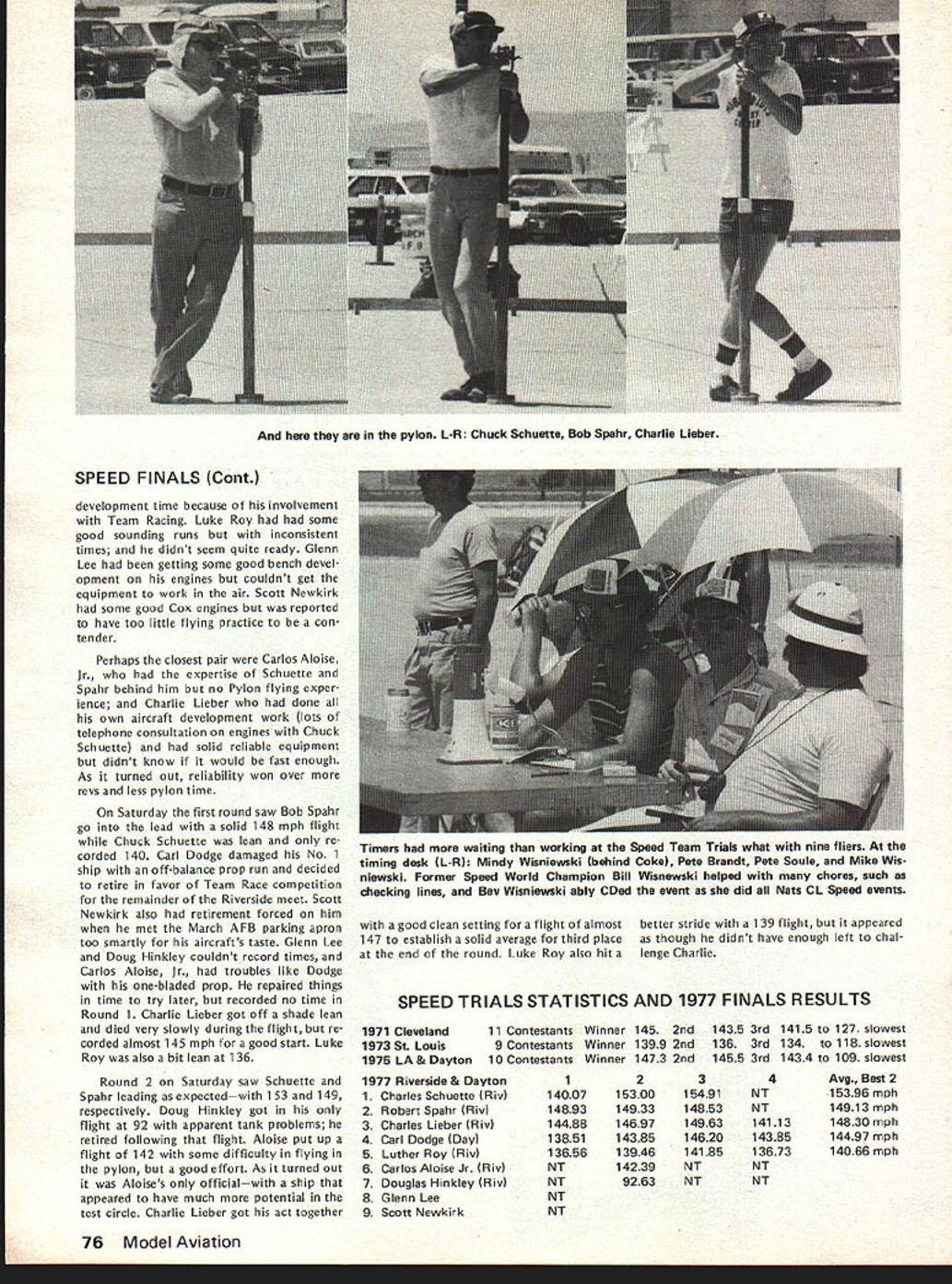
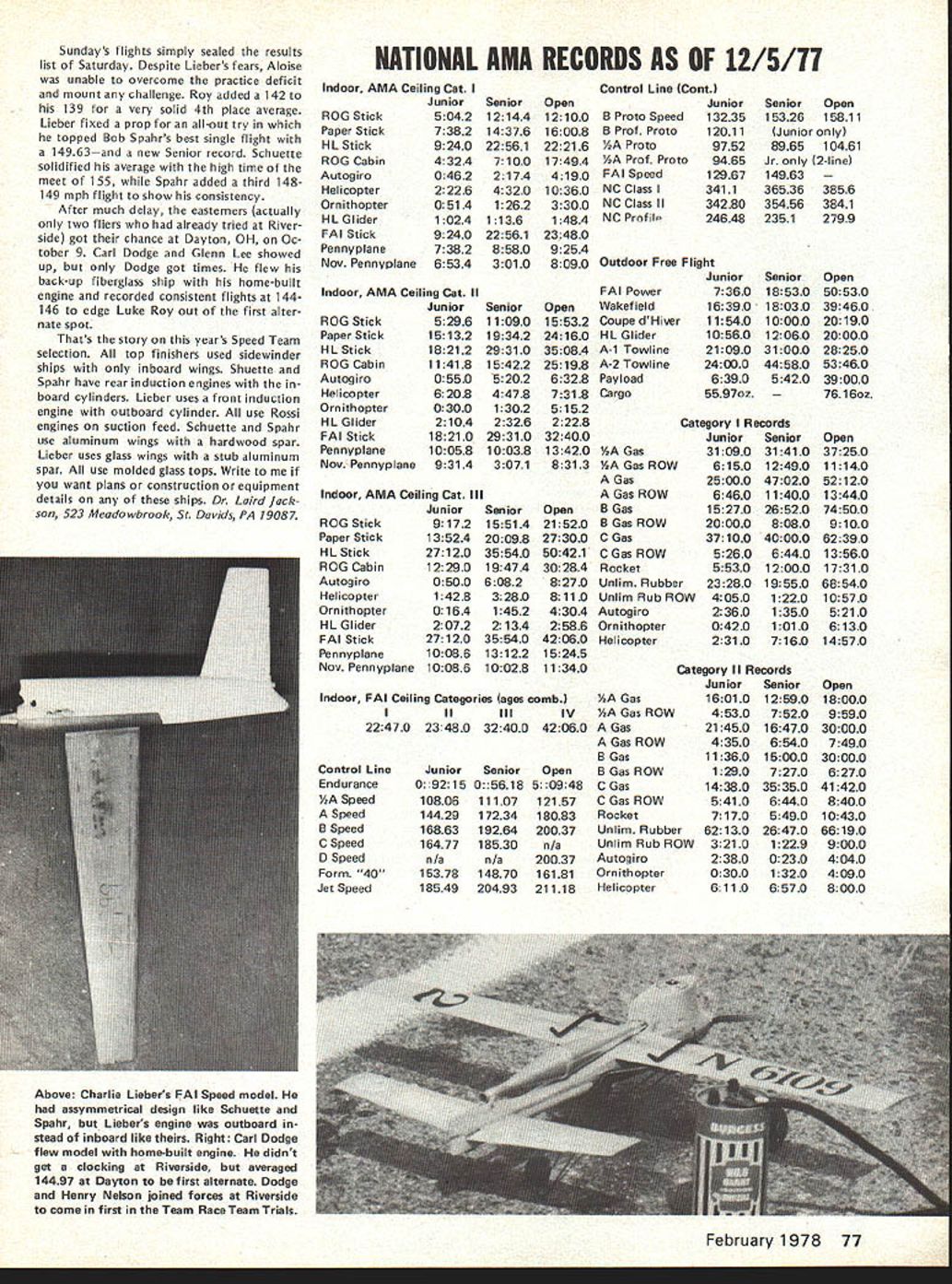
Sunday's flights simply sealed the results list of Saturday. Despite Lieber's fears, Aloise was unable to overcome the practice deficit and mount any challenge. Roy added a 142 to his 139 for a very solid 4th place average. Lieber fixed a prop for an all-out try in which he topped Bob Spahr's best single flight with a 149.63 — and a new Senior record. Schuette solidified his average with the high time of the meet of 155, while Spahr added a third 148–149 mph flight to show his consistency.
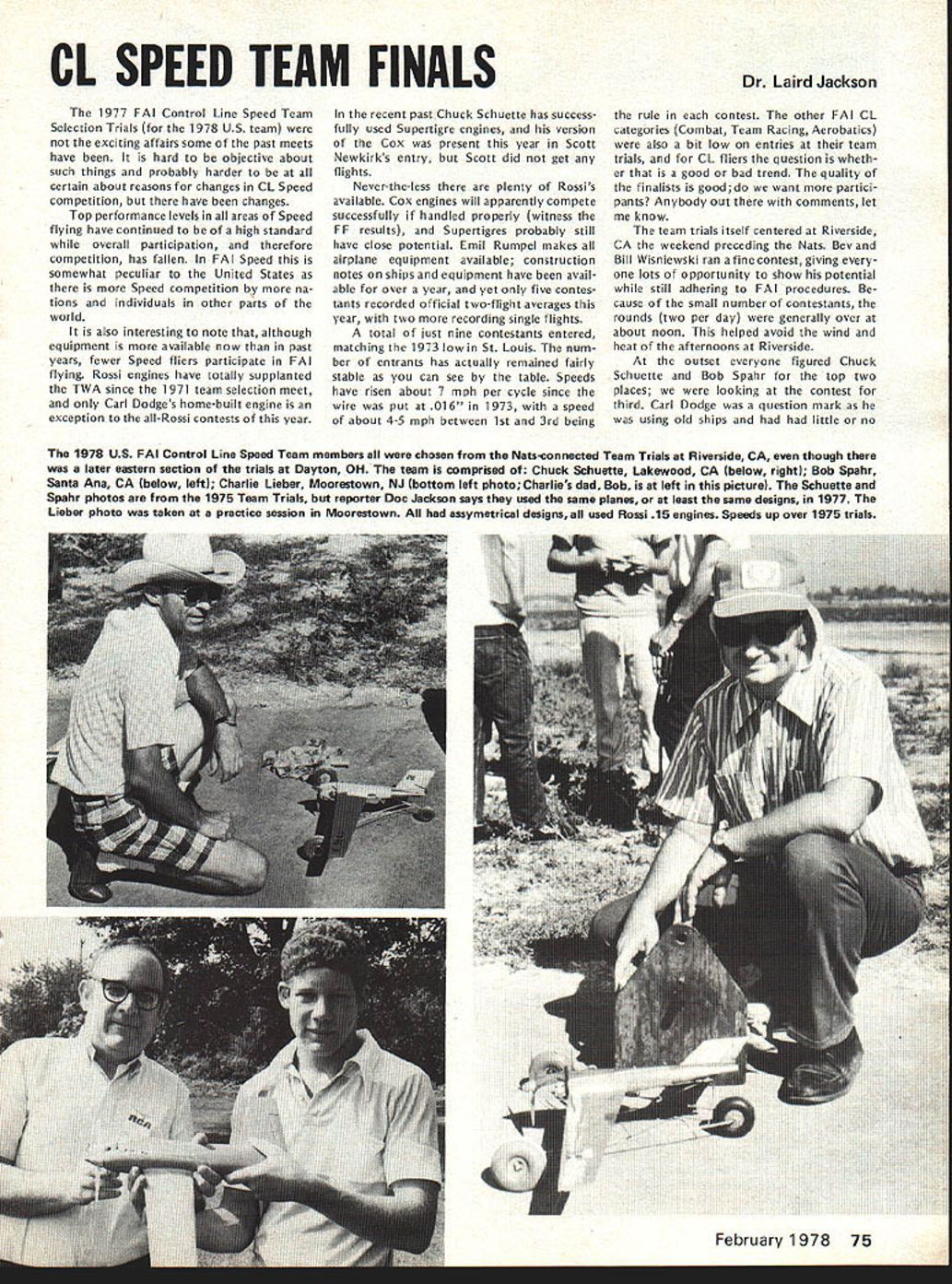
After much delay, the easterners (actually only two fliers who had already tried at Riverside) got their chance at Dayton, OH, on October 9. Carl Dodge and Glenn Lee showed up, but only Dodge got times. He flew his back-up fiberglass ship with his home-built engine and recorded consistent flights at 144–146 to close Luke Roy out of the first alternate spot.
That's the story on this year's Speed Team selection. All top finishers used sidewinder ships with only inboard wings. Schuette and Spahr have rear induction engines with the inboard cylinders. Lieber uses a front induction engine with outboard cylinder. All use Rossi engines on suction feed. Schuette and Spahr use aluminum wings with a hardwood spar. Lieber uses glass wings with a stub aluminum spar. All use molded glass tops. Write to me if you want plane plans or construction or equipment details on any of these ships.
Dr. Laird Jackson, 523 Meadowbrook, St. Davids, PA 19087. I examined the provided scanned page and could not find the "Competition Newsletter" article or any continuation of the text that ended in your PRIOR PAGE CONTEXT. This page is the "Tournament of Champions" / "Scale" feature and its photographs; it does not contain the Competition Newsletter text needed to continue the article.
Please provide the correct scan for page 6 that contains the "Competition Newsletter" continuation (or a higher-resolution crop of the area you believe contains it), and I will extract and correct the text. If you prefer, I can instead transcribe the visible "Tournament of Champions / Scale" article from this page. Which would you like? I examined the provided scanned page carefully. This page does NOT contain the "Competition Newsletter" article or a continuation of the text from your PRIOR PAGE CONTEXT.
What this page actually contains:
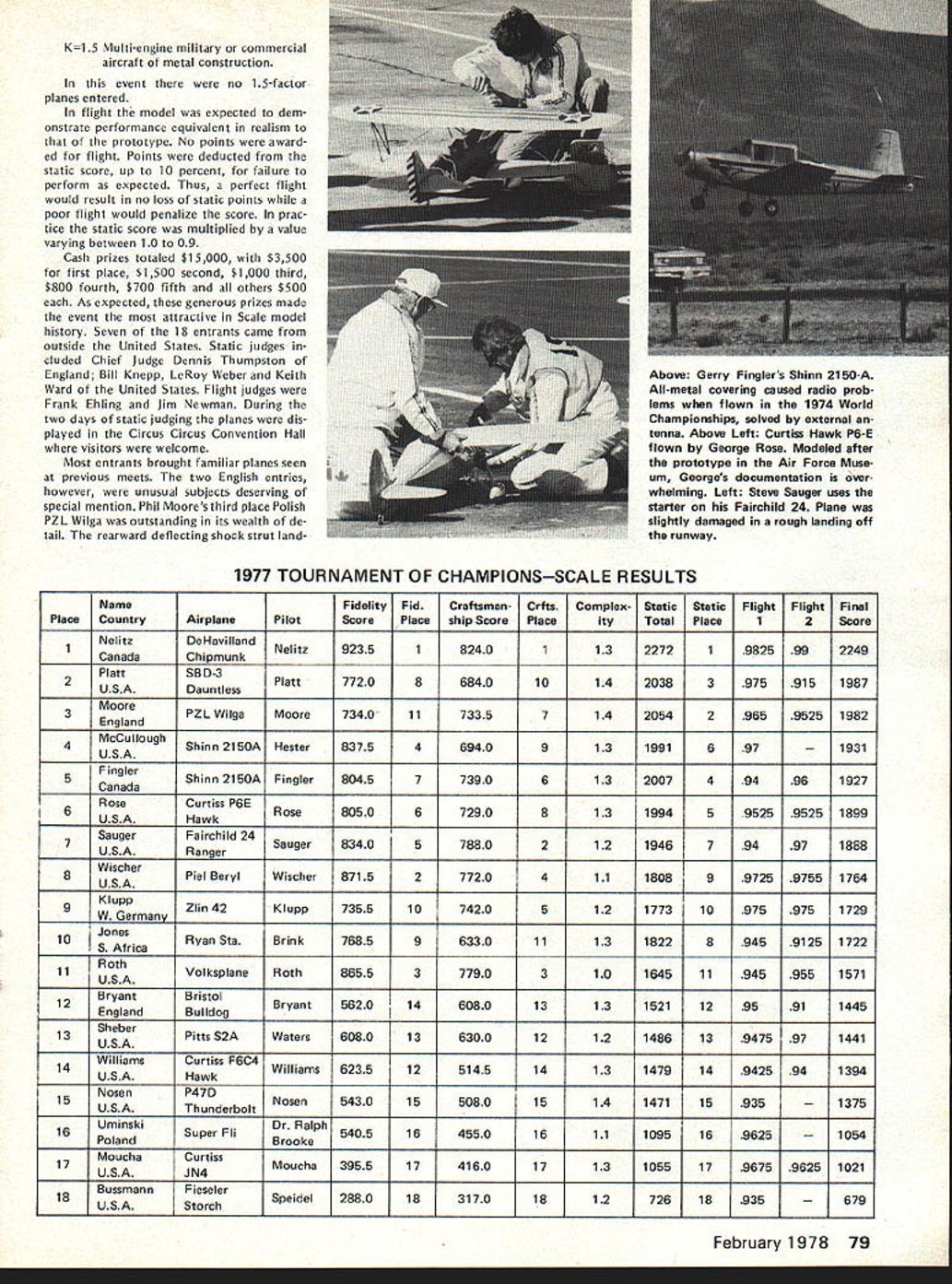
- A "1977 TOURNAMENT OF CHAMPIONS—SCALE RESULTS" table and related photos/captions.
Because the PRIMARY ARTICLE ("Competition Newsletter") is not present on this page, I cannot extract or correct its text from this scan.
Please do one of the following so I can continue:
- Upload the correct scanned page that contains the continuation of the "Competition Newsletter" (you indicated page 6 in your earlier message — please provide that).
OR
- If you prefer, I can transcribe the visible "Tournament of Champions — Scale Results" content from this page instead. Tell me which you want.
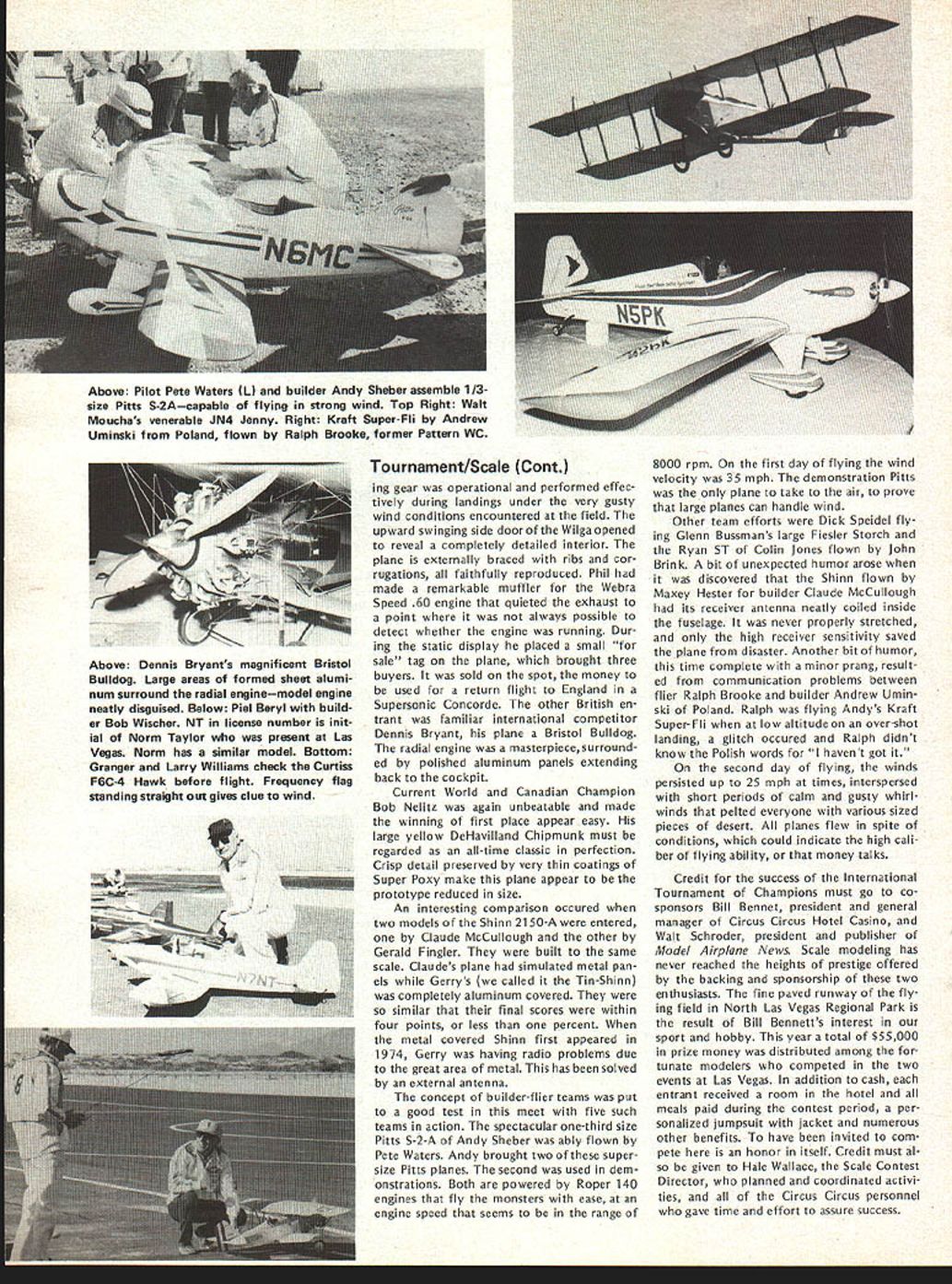
If you resend a scan, a higher-resolution crop of the area you believe contains the Competition Newsletter will help ensure an accurate transcription. I examined the scanned page carefully. This page does NOT contain the "Competition Newsletter" primary article or a continuation of it. It contains the continuation of a different article titled "Tournament/Scale (Cont.)" with photos and captions.
I cannot extract or correct the "Competition Newsletter" text from this page. Please choose one:
1) Re-upload the correct scanned page that contains the Competition Newsletter (a higher-resolution crop of the area would help). I will then extract and correct the primary article text.
2) If you prefer, I can transcribe and correct the visible "Tournament/Scale (Cont.)" article from this page now. Say “Transcribe Tournament/Scale” and I will proceed.
Which would you like?
PATTERN
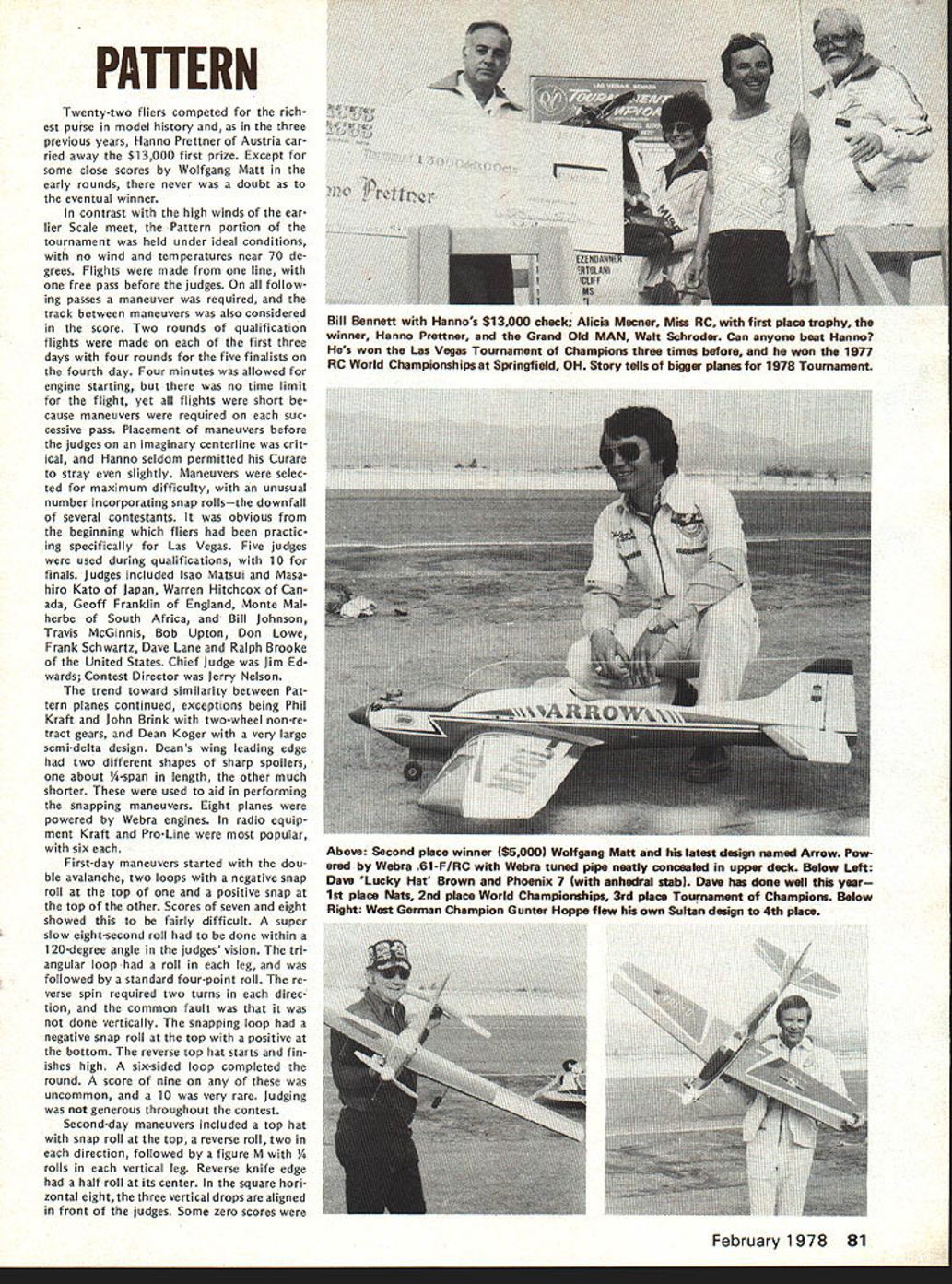
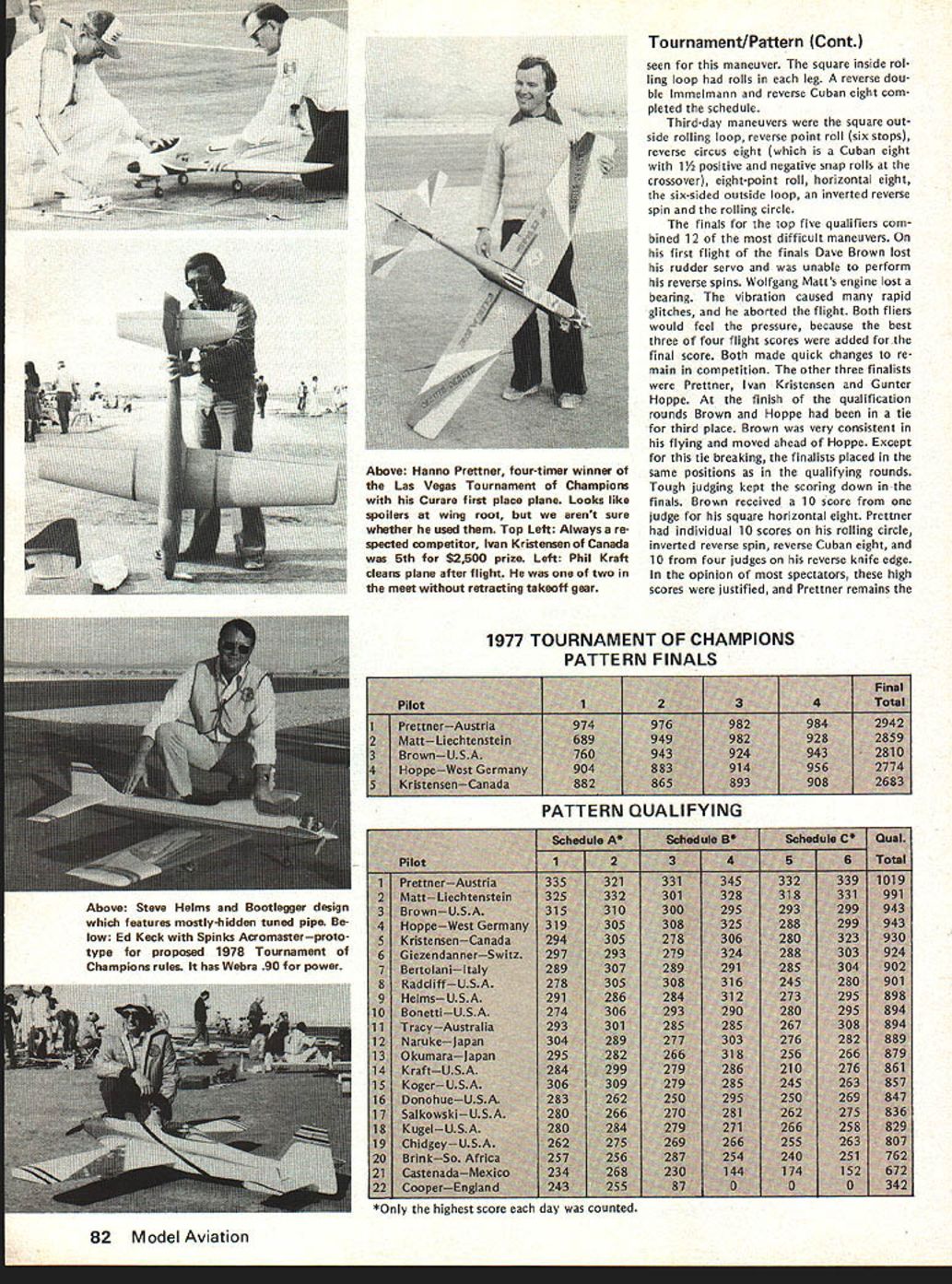
Twenty-two fliers competed for the richest purse in model history and, as in the three previous years, Hanno Prettner of Austria carried away the $13,000 first prize. Except for some close scores by Wolfgang Matt in the early rounds, there never was a doubt as to the eventual winner.
In contrast with the high winds of the earlier Scale meet, the Pattern portion of the tournament was held under ideal conditions, with no wind and temperatures near 70 degrees. Flights were made from one line, with one free pass before the judges. On all following passes a maneuver was required, and the track between maneuvers was also considered in the score. Two rounds of qualification flights were made on each of the first three days with four rounds for the five finalists on the fourth day. Four minutes was allowed for engine starting, but there was no time limit for the flight, yet all flights were short because maneuvers were required on each successive pass. Placement of maneuvers before the judges on an imaginary centerline was critical, and Hanno seldom permitted his Curare to stray even slightly. Maneuvers were selected for maximum difficulty, with an unusual number incorporating snap rolls—the downfall of several contestants. It was obvious from the beginning which fliers had been practicing specifically for Las Vegas. Five judges were used during qualifications, with 10 for finals. Judges included Isao Matsui and Masahiro Kato of Japan, Warren Hitchcock of Canada, Geoff Franklin of England, Monte Malherbe of South Africa, and Bill Johnson, Travis McGinnis, Bob Upton, Don Lowe, Frank Schwartz, Dave Lane and Ralph Brooke of the United States. Chief Judge was Jim Edwards; Contest Director was Jerry Nelson.
The trend toward similarity between Pattern planes continued, exceptions being Phil Kraft and John Brink with two-wheel non-retract gears, and Dean Koger with a very large semi-delta design. Dean's wing leading edge had two different shapes of sharp spoilers, one about 1/4-span in length, the other much shorter. These were used to aid in performing the snapping maneuvers. Eight planes were powered by Webra engines. In radio equipment Kraft and Pro-Line were most popular, with six each.
First-day maneuvers started with the double avalanche, two loops with a negative snap roll at the top of one and a positive snap at the top of the other. Scores of seven and eight showed this to be fairly difficult. A super slow eight-second roll had to be done within a 120-degree angle in the judges' vision. The triangular loop had a roll in each leg, and was followed by a standard four-point roll. The reverse spin required two turns in each direction, and the common fault was that it was not done vertically. The snapping loop had a negative snap roll at the top with a positive at the bottom. The reverse top hat starts and finishes high. A six-sided loop completed the round. A score of nine on any of these was uncommon, and a 10 was very rare. Judging was not generous throughout the contest.
Second-day maneuvers included a top hat with snap roll at the top, a reverse roll, two in each direction, followed by a figure M with 1/4 rolls in each vertical leg. Reverse knife edge had a half roll at its center. In the square horizontal eight, the three vertical drops are aligned in front of the judges. Some zero scores were seen for this maneuver. The square inside rolling loop had rolls in each leg. A reverse double Immelmann and reverse Cuban eight completed the schedule.
Third-day maneuvers were the square outside rolling loop, reverse point roll (six stops), reverse circus eight (which is a Cuban eight with 1-1/2 positive and negative snap rolls at the crossover), eight-point roll, horizontal eight, the six-sided outside loop, an inverted reverse spin and the rolling circle.
The finals for the top five qualifiers combined 12 of the most difficult maneuvers. On his first flight of the finals Dave Brown lost his rudder servo and was unable to perform his reverse spins. Wolfgang Matt's engine lost a bearing. The vibration caused many rapid glitches, and he aborted the flight. Both fliers would feel the pressure, because the best three of four flight scores were added for the final score. Both made quick changes to remain in competition. The other three finalists were Prettner, Ivan Kristensen and Gunter Hoppe. At the finish of the qualification rounds Brown and Hoppe had been in a tie for third place. Brown was very consistent in his flying and moved ahead of Hoppe. Except for this tie breaking, the finalists placed in the same positions as in the qualifying rounds. Tough judging kept the scoring down in the finals. Brown received a 10 score from one judge for his square horizontal eight. Prettner had individual 10 scores on his rolling circle, inverted reverse spin, reverse Cuban eight, and 10 from four judges on his reverse knife edge. In the opinion of most spectators, these high scores were justified, and Prettner remains the man to beat. Matt's score for his reverse top hat was downgraded when he made the last roll too late, almost as an afterthought. His position in the score totals was not affected by the mistake, however.
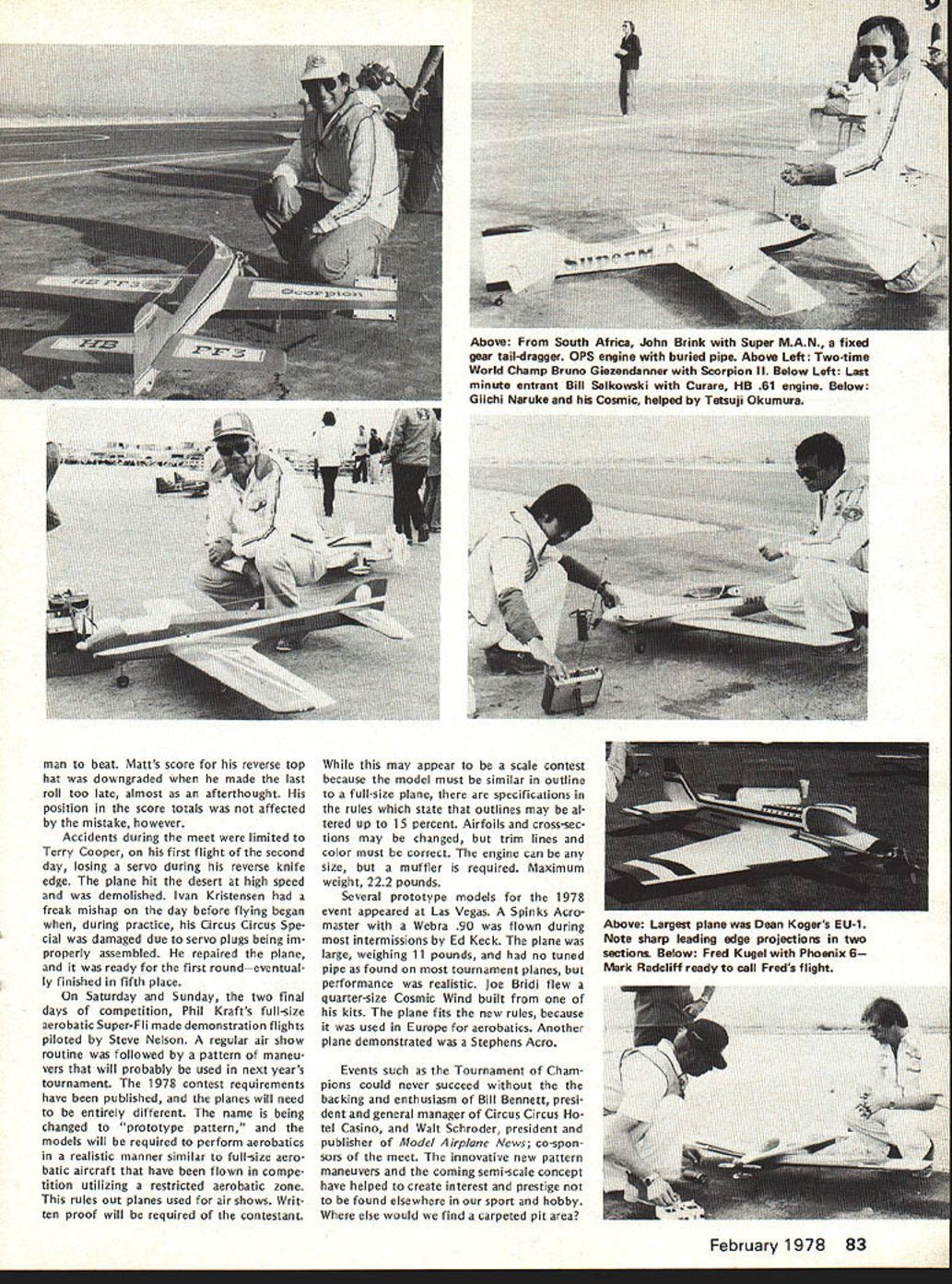
Accidents during the meet were limited to Terry Cooper, on his first flight of the second day, losing a servo during his reverse knife edge. The plane hit the desert at high speed and was demolished. Ivan Kristensen had a freak mishap on the day before flying began when, during practice, his Circus Circus Special was damaged due to servo plugs being improperly assembled. He repaired the plane, and it was ready for the first round — eventually finished in fifth place.
On Saturday and Sunday, the two final days of competition, Phil Kraft's full-size aerobatic Super-Fli made demonstration flights piloted by Steve Nelson. A regular air show routine was followed by a pattern of maneuvers that will probably be used in next year's tournament. The 1978 contest requirements have been published, and the planes will need to be entirely different. The name is being changed to "prototype pattern," and the models will be required to perform aerobatics in a realistic manner similar to full-size aerobatic aircraft that have been flown in competition utilizing a restricted aerobatic zone. This rules out planes used for air shows. Written proof will be required of the contestant.
While this may appear to be a scale contest because the model must be similar in outline to a full-size plane, there are specifications in the rules which state that outlines may be altered up to 15 percent. Airfoils and cross-sections may be changed, but trim lines and color must be correct. The engine can be any size, but a muffler is required. Maximum weight, 22.2 pounds.
Several prototype models for the 1978 event appeared at Las Vegas. A Spinks Acro-master with a Webra .90 was flown during most intermissions by Ed Keck. The plane was large, weighing 11 pounds, and had no tuned pipe as found on most tournament planes, but performance was realistic. Joe Bridi flew a quarter-size Cosmic Wind built from one of his kits. The plane fits the new rules, because it was used in Europe for aerobatics. Another plane demonstrated was a Stephens Acro.
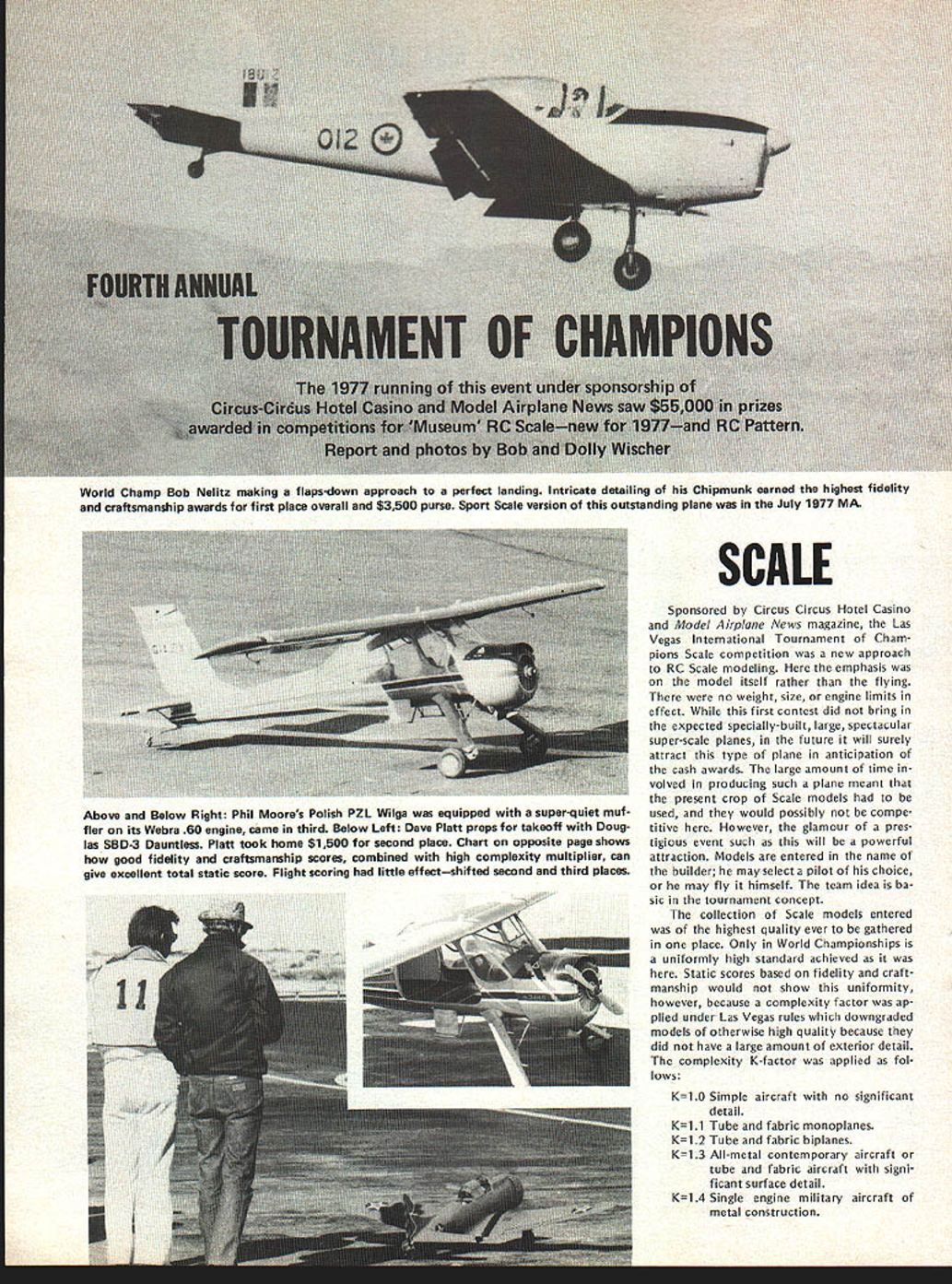
Events such as the Tournament of Champions could never succeed without the backing and enthusiasm of Bill Bennett, president and general manager of Circus Circus Hotel Casino, and Walt Schroder, president and publisher of Model Airplane News; co-sponsors of the meet. The innovative new pattern maneuvers and the coming semi-scale concept have helped to create interest and prestige not to be found elsewhere in our sport and hobby. Where else would we find a carpeted pit area?
Transcribed from original scans by AI. Minor OCR errors may remain.

