
FAI RC SOARING TEAM SELECTION PROGRAM
Ray Marvin, Chairman
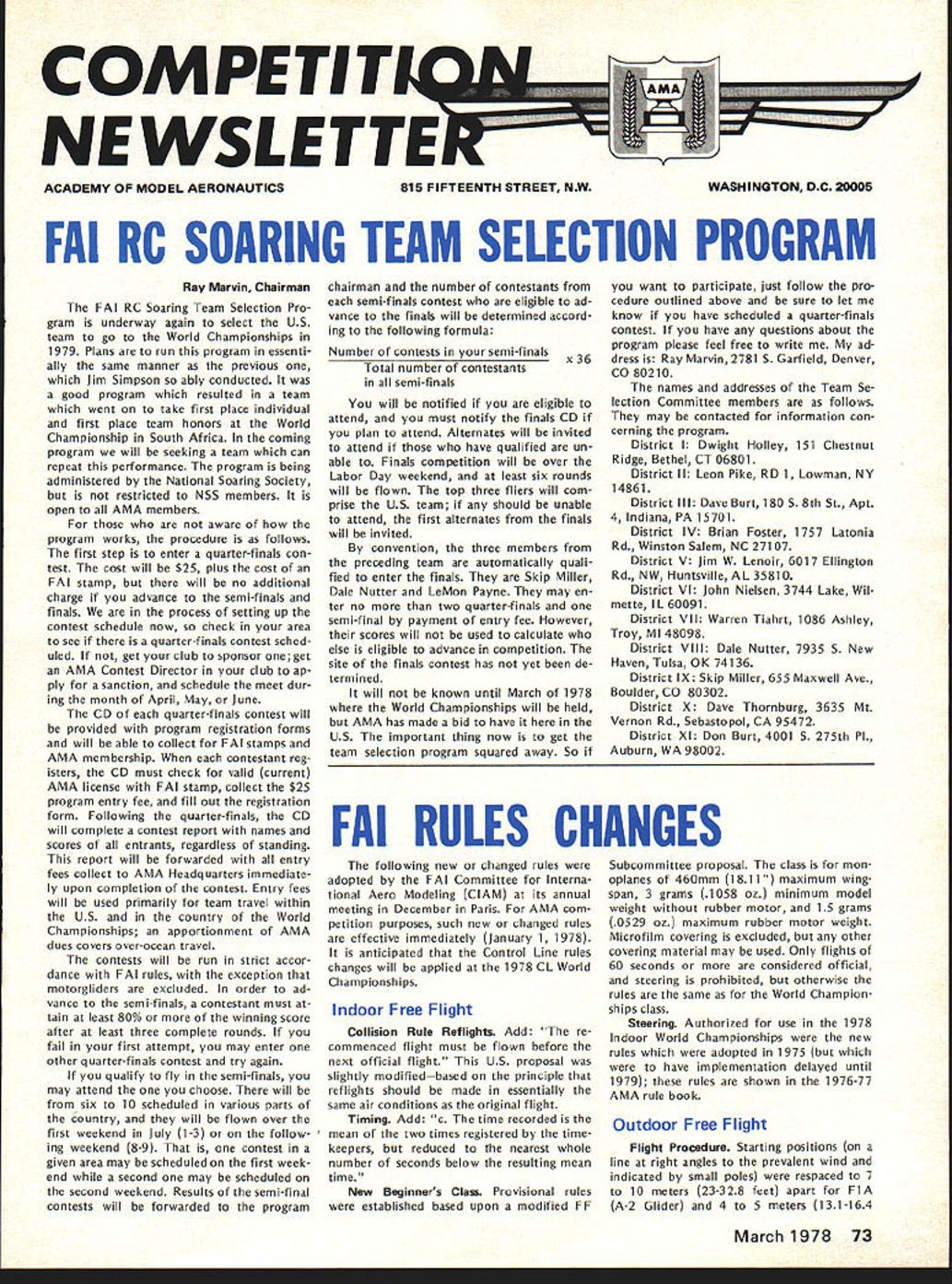
The FAI RC Soaring Team Selection Program is underway again to select the U.S. team to go to the World Championships in 1979. Plans are to run this program essentially the same manner as the previous one, which Jim Simpson so ably conducted. It was a good program which resulted in a team which went on to take first place individual and first place team honors at the World Championship in South Africa. In the coming program we will be seeking a team which can repeat this performance. The program is being administered by the National Soaring Society, but is not restricted to NSS members. It is open to all AMA members.
For those who are not aware of how the program works, the procedure is as follows. The first step is to enter a quarter-finals contest. The cost will be $25, plus the cost of an FAI stamp, but there will be no additional charge if you advance to the semi-finals and finals. We are in the process of setting up the contest schedule now, so check in your area to see if there is a quarter-finals contest scheduled. If not, get your club to sponsor one; get an AMA Contest Director in your club to apply for a sanction, and schedule the meet during the month of April, May, or June.
The CD of each quarter-finals contest will be provided with program registration forms and will be able to collect for FAI stamps and AMA membership. When each contestant registers, the CD must check for valid (current) AMA license with FAI stamp, collect the $25 program entry fee, and fill out the registration form. Following the quarter-finals, the CD will complete a contest report with names and scores of all entrants, regardless of standing. This report will be forwarded with all entry fees collected to AMA Headquarters immediately upon completion of the contest. Entry fees will be used primarily for team travel within the U.S. and in the country of the World Championships; an apportionment of AMA dues covers over-ocean travel.
The contests will be run in strict accordance with FAI rules, with the exception that motorgliders are excluded. In order to advance to the semi-finals, a contestant must attain at least 80% or more of the winning score after at least three complete rounds. If you fail in your first attempt, you may enter one other quarter-finals contest and try again.
If you qualify to fly in the semi-finals, you may attend the one you choose. There will be from six to 10 scheduled in various parts of the country, and they will be flown over the first weekend in July (1-3) or on the following weekend (8-9). That is, one contest in a given area may be scheduled on the first weekend, while a second one is scheduled on the second weekend. Results of the semi-final contests will be forwarded to the program chairman and the number of contestants from each semi-finals contest who are eligible to advance to the finals will be determined according to the following formula:
Number of contests in your semi-finals x 36 ----------------------------------------- Total number of contestants in all semi-finals
You will be notified if you are eligible to attend, and you must notify the finals CD if you plan to attend. Alternates will be invited to attend if those who have qualified are unable to. Finals competition will be over the Labor Day weekend, and at least six rounds will be flown. The top three fliers will comprise the U.S. team; if any should be unable to attend, the first alternates from the finals will be invited.
By convention, the three members from the preceding team are automatically qualified to enter the finals. They are Skip Miller, Dale Nutter and LeMon Payne. They may enter no more than two quarter-finals and one semi-final by payment of entry fee. However, their scores will not be used to calculate who else is eligible to advance in competition. The site of the finals contest has not yet been determined.
It will not be known until March of 1978 where the World Championships will be held, but AMA has made a bid to have it here in the U.S. The important thing now is to get the team selection program squared away. So if you want to participate, just follow the procedure outlined above and be sure to let me know if you have scheduled a quarter-finals contest. If you have any questions about the program please feel free to write me. My address is: Ray Marvin, 2781 S. Garfield, Denver, CO 80210.
The names and addresses of the Team Selection Committee members are as follows. They may be contacted for information concerning the program.
- District I: Dwight Holley, 151 Chestnut Ridge, Bethel, CT 06801.
- District II: Leon Pike, RD 1, Lowman, NY 14861.
- District III: Dave Burt, 180 S. 8th St., Apt. 4, Indiana, PA 15701.
- District IV: Brian Foster, 1757 Latonia Rd., Winston Salem, NC 27107.
- District V: Jim W. Lenoir, 6017 Ellington Rd. NW, Huntsville, AL 35810.
- District VI: John Nielsen, 3744 Lake, Wilmette, IL 60091.
- District VII: Warren Tiahrt, 1086 Ashley, Troy, MI 48098.
- District VIII: Dale Nutter, 7935 S. New Haven, Tulsa, OK 74136.
- District IX: Skip Miller, 655 Maxwell Ave., Boulder, CO 80302.
- District X: Dave Thornburg, 3635 Mt. Vernon Rd., Sebastopol, CA 95472.
- District XI: Don Burt, 4001 S. 275th Pl., Auburn, WA 98002.
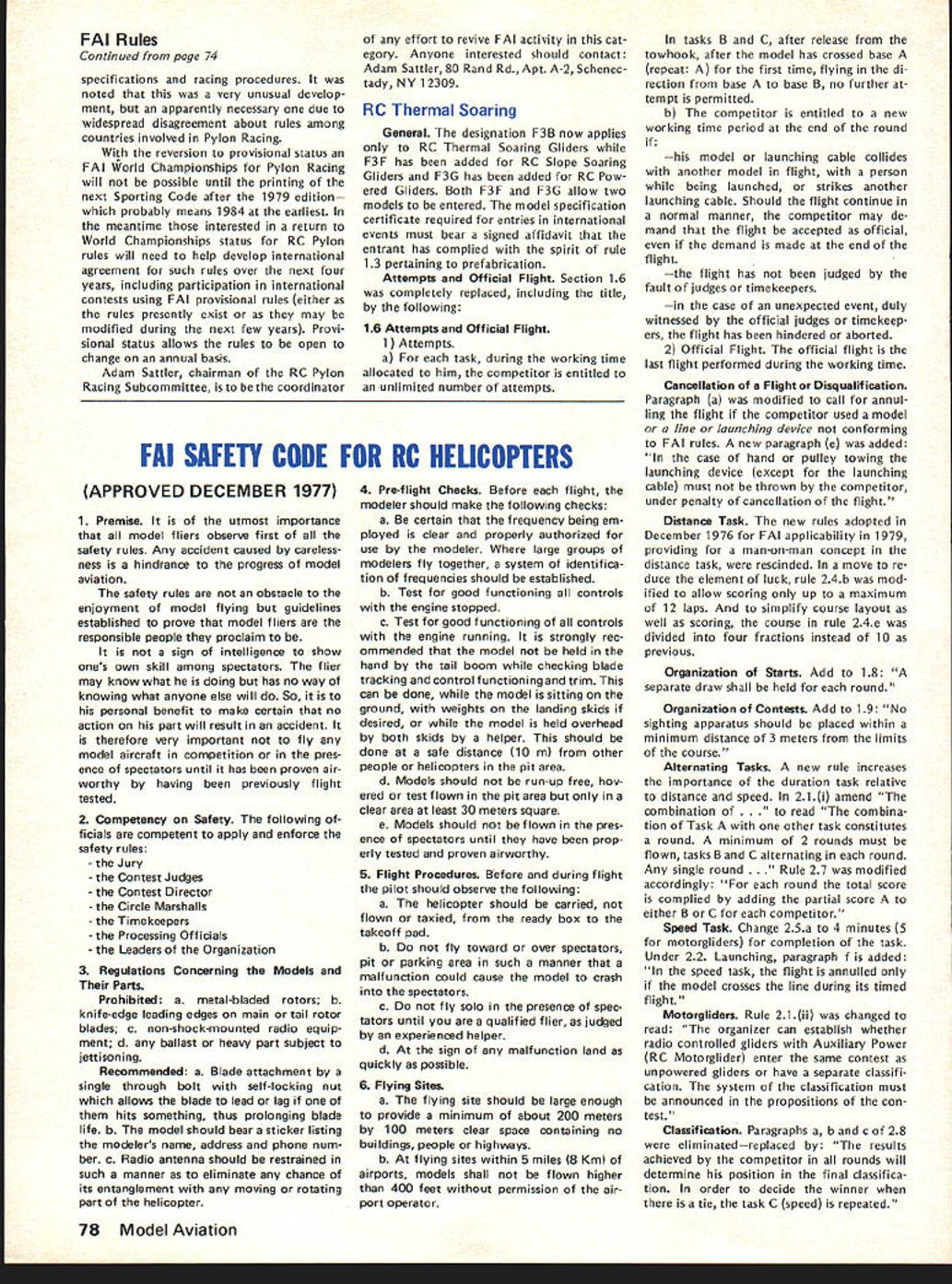
FAI Rules (Cont.)
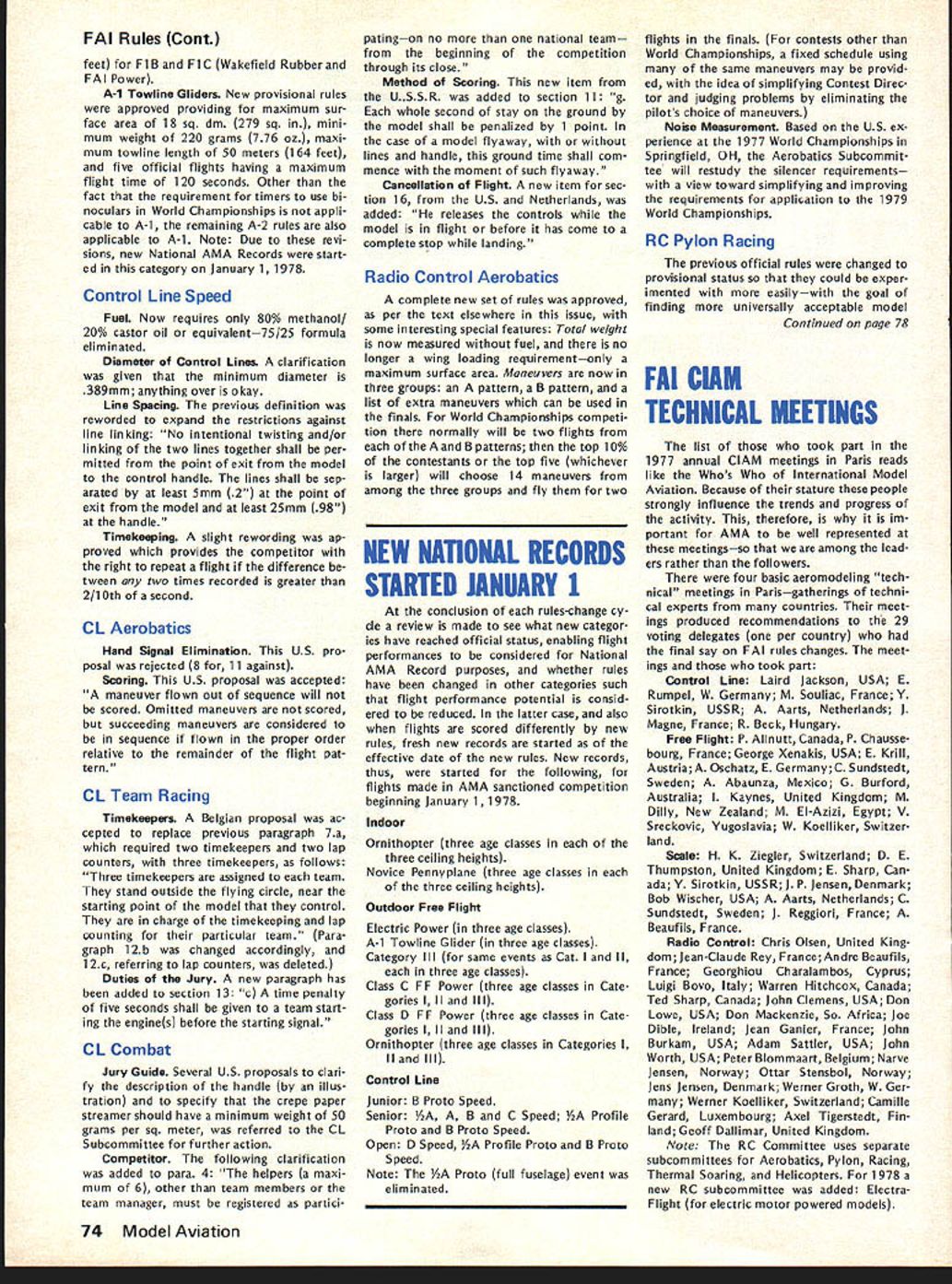
A-1 Towline Gliders. New provisional rules were approved providing for maximum surface area of 18 sq. dm. (279 sq. in.), minimum weight of 220 grams (7.76 oz.), maximum towline length of 50 meters (164 feet), and five official flights having a maximum flight time of 120 seconds. Other than the fact that the requirement for timers to use binoculars in World Championships is not applicable to A-1, the remaining A-2 rules are also applicable to A-1. Note: Due to these revisions, new National AMA Records were started in this category on January 1, 1978.
Control Line Speed
Fuel. Now requires only 80% methanol/20% castor oil or equivalent—75/25 formula eliminated.
Diameter of Control Lines. A clarification was given that the minimum diameter is .389 mm; anything over is okay.
Line Spacing. The previous definition was reworded to expand the restrictions against line linking: "No intentional twisting and/or linking of the two lines together shall be permitted from the point of exit from the model to the control handle. The lines shall be separated by at least 5 mm (.2") at the point of exit from the model and at least 25 mm (.98") at the handle."
Timekeeping. A slight rewording was approved which provides the competitor with the right to repeat a flight if the difference between any two times recorded is greater than 2/10th of a second.
CL Aerobatics
Hand Signal Elimination. This U.S. proposal was rejected (8 for, 11 against).
Scoring. This U.S. proposal was accepted: "A maneuver flown out of sequence will not be scored. Omitted maneuvers are not scored, but succeeding maneuvers are considered to be in sequence if flown in the proper order relative to the remainder of the flight pattern."
CL Team Racing
Timekeepers. A Belgian proposal was accepted to replace previous paragraph 7.a, which required two timekeepers and two lap counters, with three timekeepers, as follows: "Three timekeepers are assigned to each team. They stand outside the flying circle, near the starting point of the model that they control. They are in charge of the timekeeping and lap counting for their particular team." (Paragraph 12.b was changed accordingly, and the reference to lap counters was deleted.)
Duties of the Jury. A new paragraph has been added to section 13: "(c) A time penalty of five seconds shall be given to a team starting the engine(s) before the starting signal."
CL Combat
Jury Guide. Several U.S. proposals to clarify the description of the handle (by an illustration) and to specify that the crepe paper streamer should have a minimum weight of 50 grams per sq. meter, was referred to the CL Subcommittee for further action.
Competitor. The following clarification was added to para. 4: "The helpers (a maximum of 6), other than team members or the team manager, must be registered as participating—on no more than one national team—from the beginning of the competition through its close."
Method of Scoring. This new item from the U.S.S.R. was added to section 11: "8. Each whole second of stay on the ground by the model shall be penalized by 1 point. In the case of a model flyaway, with or without lines and handle, this ground time shall commence with the moment of such flyaway."
Cancellation of Flight. A new item for section 16, from the U.S. and Netherlands, was added: "He releases the controls while the model is in flight or before it has come to a complete stop while landing."
Radio Control Aerobatics
A complete new set of rules was approved, as per the text elsewhere in this issue, with some interesting special features: Total weight is now measured without fuel, and there is no longer a wing loading requirement—only a maximum surface area. Maneuvers are now in three groups: an A pattern, a B pattern, and a list of extra maneuvers which can be used in the finals. For World Championships competition there normally will be two flights from each of the A and B patterns; then the top 10% of the contestants or the top five (whichever is larger) will choose 14 maneuvers from among the three groups and fly them for two flights in the finals. (For contests other than World Championships, a fixed schedule using many of the same maneuvers may be provided, with the idea of simplifying Contest Director and judging problems by eliminating the pilot's choice of maneuvers.)
Noise Measurement. Based on the U.S. experience at the 1977 World Championships in Springfield, OH, the Aerobatics Subcommittee will restudy the silencer requirements—with a view toward simplifying and improving the requirements for application to the 1979 World Championships.
RC Pylon Racing
The previous official rules were changed to provisional status so that they could be experimented with more easily—with the goal of finding more universally acceptable model
NEW NATIONAL RECORDS STARTED JANUARY 1
At the conclusion of each rules-change cycle a review is made to see what new categories have reached official status, enabling flight performances to be considered for National AMA Record purposes, and whether rules have been changed in other categories such that flight performance potential is considered to be reduced. In the latter case, and also when flights are scored differently by new rules, fresh new records are started as of the effective date of the new rules. New records, thus, were started for the following, for flights made in AMA sanctioned competition beginning January 1, 1978.
Indoor
- Ornithopter (three age classes in each of the three ceiling heights).
- Novice Pennyplane (three age classes in each of the three ceiling heights).
Outdoor Free Flight
- Electric Power (in three age classes).
- A-1 Towline Glider (in three age classes).
- Category III (for the same events as Cat. I and II, each in three age classes).
- Class C FF Power (three age classes in Categories I, II and III).
- Class D FF Power (three age classes in Categories I, II and III).
- Ornithopter (three age classes in Categories I, II and III).
Control Line
- Junior: ½A Proto Speed.
- Senior: ½A, A, B and C Speed; ½A Profile Proto and B Proto Speed.
- Open: D Speed, ½A Profile Proto and B Proto Speed.
Note: The ½A Proto (full fuselage) event was eliminated.
FAI CIAM TECHNICAL MEETINGS
The list of those who took part in the 1977 annual CIAM meetings in Paris reads like the Who's Who of International Model Aviation. Because of their stature these people strongly influence the trends and progress of the activity. This, therefore, is why it is important for AMA to be well represented at these meetings—so that we are among the leaders rather than the followers.
There were four basic aeromodeling "technical" meetings in Paris—gatherings of technical experts from many countries. Their meetings produced recommendations to the 29 voting delegates (one per country) who had the final say on FAI rules changes. The meetings and those who took part:
- Control Line: Laird Jackson, USA; E. Rumpel, W. Germany; M. Soulac, France; Y. Sirotkin, USSR; A. Aarts, Netherlands; J. Magne, France; R. Beck, Hungary.
- Free Flight: P. Alinutt, Canada; P. Chaussebourg, France; George Xenakis, USA; E. Krill, Austria; A. Oschatz, E. Germany; C. Sundstedt, Sweden; A. Abauzza, Mexico; G. Burford, Australia; I. Keynes, United Kingdom; M. Dilly, New Zealand; M. El-Azizi, Egypt; V. Sreckovic, Yugoslavia; W. Koelliker, Switzerland.
- Scale: H. K. Ziegler, Switzerland; D. E. Thumpton, United Kingdom; E. Sharp, Canada; Y. Sirotkin, USSR; P. Jensen, Denmark; Bob Wischer, USA; A. Aarts, Netherlands; C. Sundstedt, Sweden; J. Reggi, France; A. Beaufils, France.
- Radio Control: Chris Olsen, United Kingdom; Jean-Claude Rey, France; Andre Beaufils, France; Georges Charalambos, Cyprus; Luigi Bovo, Italy; Warren Hitchcock, Canada; Sid Sharp, Canada; John Clements, USA; Roy Lowe, USA; Don Mackenzie, So. Africa; Joe Dible, Ireland; Jean Garnier, France; Jean Burkman, USA; Adam Saltler, USA; John Worth, USA; Peter Blomant, Belgium; Narve Jensen, Norway; Ottar Stensbol, Norway; Jens Jensen, Denmark; Werner Groth, W. Germany; Werner Koelliker, Switzerland; Camille Gerard, Luxembourg; Axel Tigerstedt, Finland; Geoff Dallimore, United Kingdom.
Note: The RC Committee uses separate subcommittees for Aerobatics, Pylon, Racing, Thermal Soaring, and Helicopters. For 1978 a new RC subcommittee was added: Electric Flight (for electric motor powered models).
FAI RC AEROBATIC POWER MODELS (F3A)
AS ADOPTED DECEMBER 1977
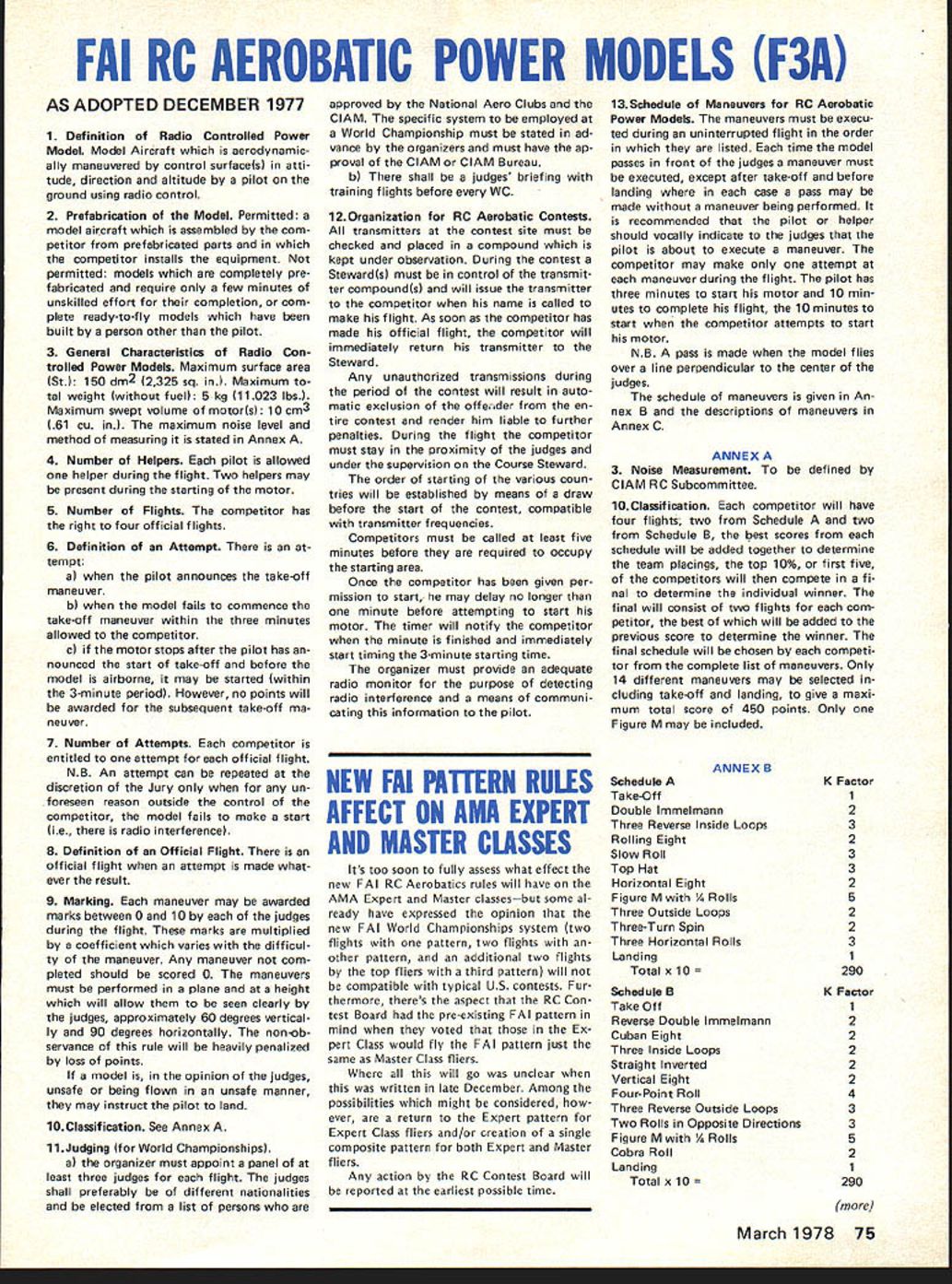
- Definition of Radio Controlled Power Model. Model Aircraft which is aerodynamically maneuvered by control surfaces in attitude, direction and altitude by a pilot on the ground using radio control.
- Prefabrication of the Model. Permitted: a model aircraft which is assembled by the competitor from prefabricated parts and in which the competitor installs the equipment. Not permitted: models which are completely prefabricated and require only a few minutes of unskilled effort for their completion, or complete ready-to-fly models which have been built by a person other than the pilot.
- General Characteristics of Radio Controlled Power Models. Maximum surface area (S.t.): 150 dm2 (2,325 sq. in.). Maximum total weight (without fuel): 5 kg (11.02 lbs.). Maximum swept volume of motor(s): 10 cm3 (0.61 cu. in.). The maximum noise level and method of measuring it is stated in Annex A.
- Number of Helpers. Each pilot is allowed one helper during the flight. Two helpers may be present during the starting of the motor.
- Number of Flights. The competitor has the right to four official flights.
- Definition of an Attempt. There is an attempt:
a) when the pilot announces the take-off maneuver. b) when the model fails to commence the take-off maneuver within the three minutes allowed to the competitor. c) if the motor stops after the pilot has announced the start of take-off and before the model is airborne, it may be restarted (within the 3-minute period). However, no points will be awarded for the subsequent take-off maneuver.
- Number of Attempts. Each competitor is entitled to one attempt for each official flight.
N.B. An attempt can be repeated at the discretion of the Jury only when for any unforeseen reason outside the control of the competitor, the model fails to make a start (i.e., there is radio interference).
- Definition of an Official Flight. There is an official flight when an attempt is made whatever the result.
- Marking. Each maneuver may be awarded marks between 0 and 10 by each of the judges during the flight. These marks are multiplied by a coefficient which varies with the difficulty of the maneuver. Any maneuver not completed should be scored 0. The maneuvers must be performed in a plane and at a height which will allow them to be seen clearly by the judges, approximately 60 degrees vertically and 90 degrees horizontally. The non-observance of this rule will be heavily penalized by loss of points.
If a model is, in the opinion of the judges, unsafe or being flown in an unsafe manner, they may instruct the pilot to land.
- Classification. See Annex A.
- Judging (for World Championships).
a) The organizer must appoint a panel of at least three judges for each flight. The judges shall preferably be of different nationalities and be elected from a list of persons who are approved by the National Aero Clubs and the CIAM. The specific system to be employed at a World Championship must be stated in advance by the organizers and must have the approval of the CIAM or CIAM Bureau. b) There shall be a judges' briefing with training flights before every WC.
- Organization for RC Aerobatic Contests.
All transmitters at the contest site must be checked and placed in a compound which is kept under observation. During the contest a Steward(s) must be in control of the transmitter compound(s) and will issue the transmitter to the competitor when his name is called to make his flight. As soon as the competitor has made his official flight, the competitor will immediately return his transmitter to the Steward.
Any unauthorized transmissions during the period of the contest will result in automatic exclusion of the offender from the entire contest and render him liable to further penalties. During the flight the competitor must stay in the proximity of the judges and under the supervision of the Course Steward.
The order of starting of the various countries will be established by means of a draw before the start of the contest, compatible with transmitter frequencies.
Competitors must be called at least five minutes before they are required to occupy the starting area.
Once the competitor has been given permission to start, he may delay no longer than one minute before attempting to start his motor. The timer will notify the competitor when the minute is finished and immediately start timing the 3-minute starting time.
The organizer must provide an adequate radio monitor for the purpose of detecting radio interference and a means of communicating this information to the pilot.
- Schedule of Maneuvers for RC Aerobatic Power Models. The maneuvers must be executed during an uninterrupted flight in the order in which they are listed. Each time the model passes in front of the judges a maneuver must be executed, except after take-off and before landing where in each case a pass may be made without a maneuver being performed. It is recommended that the pilot or helper should vocally indicate to the judges that the pilot is about to execute a maneuver. The competitor may make only one attempt at each maneuver during the flight. The pilot has three minutes to start his motor and 10 minutes to complete his flight; the 10 minutes to start when the competitor attempts to start his motor.
N.B. A pass is made when the model flies over a line perpendicular to the center of the judges.
The schedule of maneuvers is given in Annex B and the descriptions of maneuvers in Annex C.
ANNEX A
- Noise Measurement. To be defined by CIAM RC Subcommittee.
- Classification. Each competitor will have four flights, two from Schedule A and two from Schedule B. The best scores from each schedule will be added together to determine the team placings; the top 10%, or first five, of the competitors will then compete in a final to determine the individual winner. The final will consist of two flights for each competitor, the best of which will be added to the previous score to determine the winner. The final schedule will be chosen by each competitor from the complete list of maneuvers. Only 14 different maneuvers may be selected including take-off and landing, to give a maximum total score of 450 points. Only one Figure M may be included.
ANNEX B
Schedule A
- Take-Off ........................................ 1
- Double Immelmann ........................... 2
- Three Reverse Inside Loops .............. 3
- Rolling Eight ................................. 3
- Slow Roll ...................................... 3
- Top Hat ......................................... 3
- Horizontal Eight ............................. 2
- Figure M with 1/2 Rolls .................. 5
- Three Outside Loops ....................... 2
- Three-Turn Spin ............................ 2
- Three Horizontal Rolls .................... 3
- Landing ......................................... 1
Total x 10 = 290
Schedule B
- Take Off ........................................ 1
- Reverse Double Immelmann .............. 2
- Cuban Eight .................................. 2
- Three Inside Loops ........................ 2
- Straight Inverted ............................ 2
- Vertical Eight ................................ 3
- Four-Point Roll .............................. 4
- Three Reverse Outside Loops .......... 4
- Two Rolls in Opposite Directions .... 3
- Figure M with 1/2 Rolls .................. 5
- Cobra Roll .................................... 2
Total x 10 = 290
FAI Pattern Rules (Cont.)
List of Extra Maneuvers for Finals K Factor
- Avalanche .......................................................... 1
- Inverted Spin ................................................... 3
- Square Horizontal Eight ................................. 4
- Eight-Point Roll ............................................... 3
- Vertical Roll .................................................... 3
- Aileron Turn .................................................... 3
- Figure M ........................................................... 3
- Square Loop with Four ½ Rolls ....................... 5
- Two Snap Rolls in Opposite Directions .......... 5
- Reverse Knife Edge ......................................... 4
- Inverted Top Hat ............................................ 4
- Reverse Cuban Eight ...................................... 4
- Reverse Point Roll .......................................... 2
- Triangle Rolling Loop .................................... 4
ANNEX C
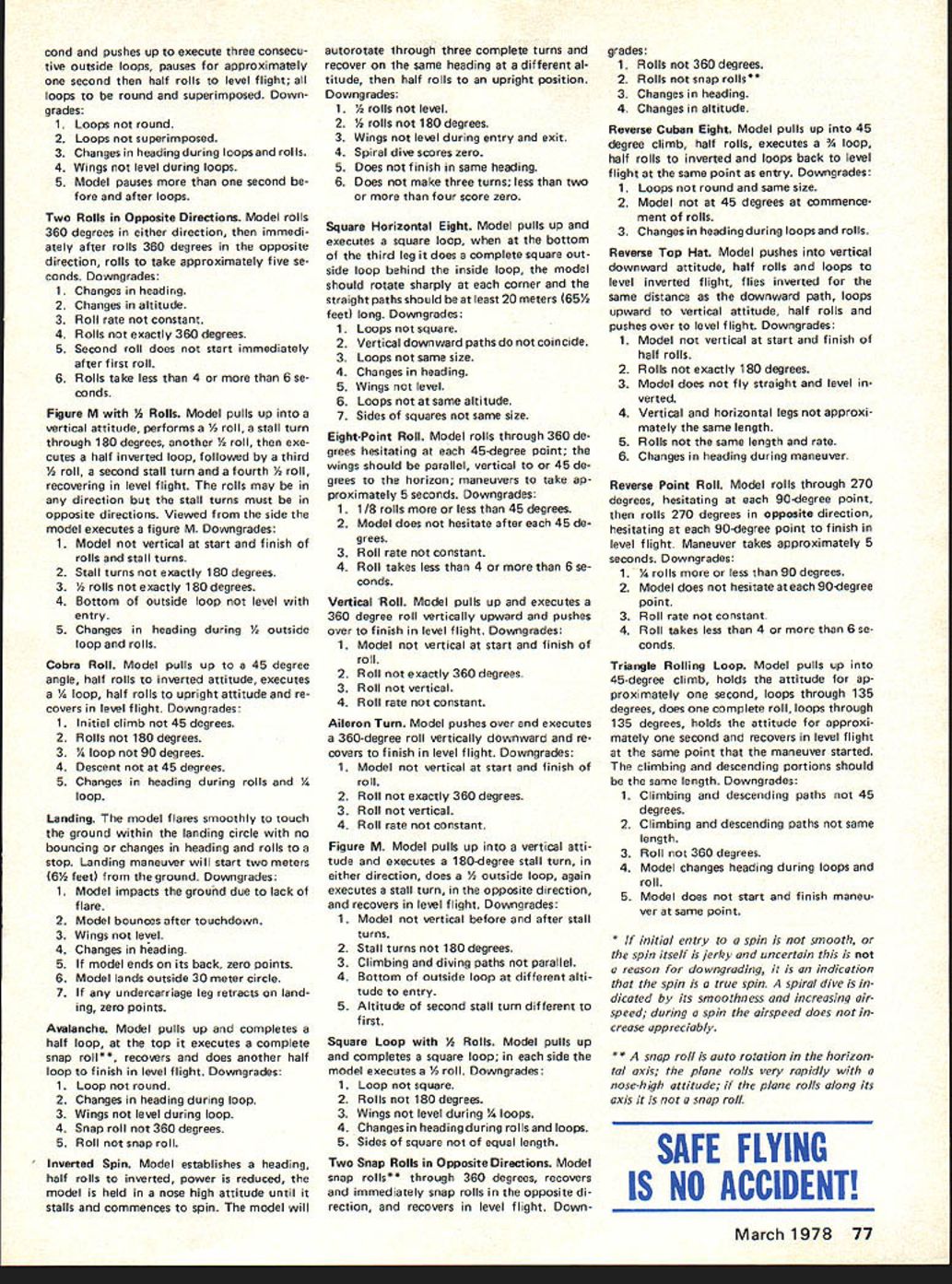
DESCRIPTIONS OF MANEUVERS
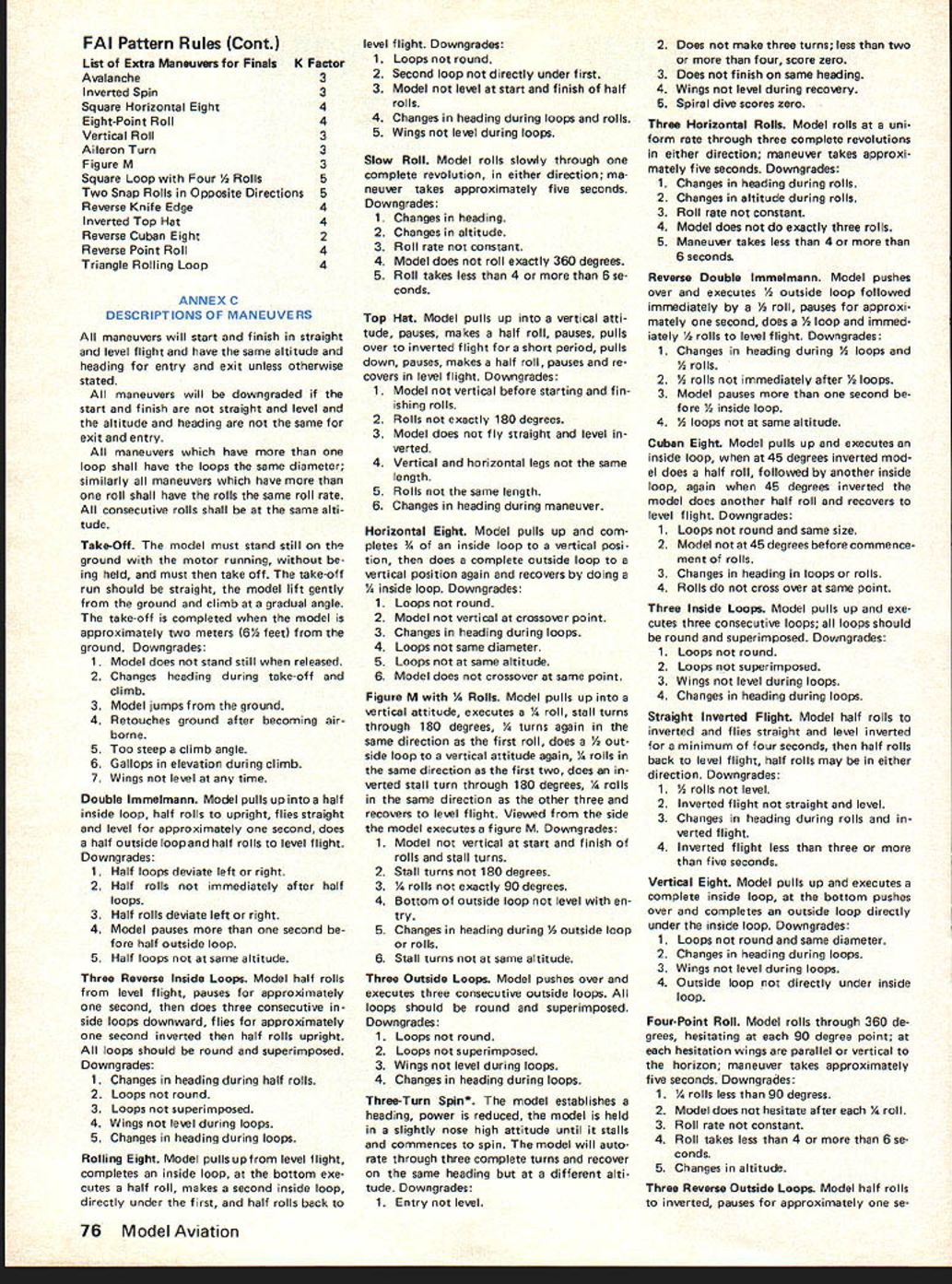
All maneuvers will start and finish in straight and level flight and have the same altitude and heading for entry and exit unless otherwise stated.
All maneuvers will be downgraded if the start and finish are not straight and level and the altitude and heading are not the same for exit and entry.
All maneuvers which have more than one loop shall have the loops the same diameter; similarly all maneuvers which have more than one roll shall have the rolls the same roll rate. All consecutive rolls shall be at the same altitude.
Take-Off.
The model must stand still on the ground with the motor running, without being held, and must then take off. The take-off run should be straight, the model lift gently from the ground and climb at a gradual angle. The take-off is completed when the model is approximately two meters (6½ feet) from the ground. Downgrades:
- Model does not stand still when released.
- Changes heading during take-off and climb.
- Model jumps from the ground.
- Retouches ground after becoming airborne.
- Too steep a climb angle.
- Gallops in elevation during climb.
- Wings not level at any time.
Double Immelmann.
Model pulls up into a half inside loop, half rolls to upright, flies straight and level for approximately one second, does a half outside loop and half rolls to level flight. Downgrades:
- Half loops deviate left or right.
- Half rolls not immediately after half loops.
- Half rolls deviate left or right.
- Model pauses more than one second before half outside loop.
- Half loops not at same altitude.
Three Reverse Inside Loops.
Model half rolls from level flight, pauses for approximately one second, then does three consecutive inside loops downward, flies for approximately one second inverted then half rolls upright. All loops should be round and superimposed. Downgrades:
- Changes in heading during half rolls.
- Loops not round.
- Loops not superimposed.
- Wings not level during loops.
- Changes in heading during loops.
Rolling Eight.
Model pulls up from level flight, completes an inside loop, at the bottom executes a half roll, makes a second inside loop directly under the first, and half rolls back to level flight. Downgrades:
- Loops not round.
- Second loop not directly under first.
- Model not level at start and finish of half rolls.
- Model does not finish on same heading.
- Wings not level during recovery.
Slow Roll.
Model rolls slowly through one complete revolution, in either direction; maneuver takes approximately five seconds. Downgrades:
- Changes in heading.
- Changes in altitude.
- Roll rate not constant.
- Model does not roll exactly 360 degrees.
- Roll takes less than 4 or more than 6 seconds.
Top Hat.
Model pulls up into a vertical attitude, pauses, makes a half roll, pauses, pulls over to inverted flight for a short period, pulls down, pauses, makes a half roll, pauses and recovers in level flight. Downgrades:
- Model not vertical before starting and finishing rolls.
- Rolls not exactly 180 degrees.
- Model does not fly straight and level inverted.
- Vertical and horizontal legs not the same length.
- Rolls not the same length.
- Changes in heading during maneuver.
Horizontal Eight.
Model pulls up and completes ½ of an inside loop to a vertical position, then does a complete outside loop to a vertical position again and recovers by doing a ½ inside loop. Downgrades:
- Loops not round.
- Model not vertical at crossover point.
- Changes in heading during loops.
- Loops not same diameter.
- Loops not at same altitude.
- Model does not crossover at same point.
Figure M with ½ Rolls.
Model pulls up into a vertical attitude, executes a ½ roll, stall turns through 180 degrees, ¼ turns again in the same direction as the first roll, does a ½ outside loop to a vertical attitude again, ½ rolls in the same direction as the first two, does an inverted stall turn through 180 degrees, ¼ and recovers to level flight. Viewed from the side the model executes a figure M. Downgrades:
- Model not vertical at start and finish of rolls and stall turns.
- Stall turns not 180 degrees.
- ½ rolls not exactly 90 degrees.
- Bottom of outside loop not level with entry.
- Changes in heading during ½ outside loop or rolls.
- Stall turns not at same altitude.
Three Outside Loops.
Model pushes over and executes three consecutive outside loops. All loops should be round and superimposed. Downgrades:
- Loops not round.
- Loops not superimposed.
- Wings not level during loops.
- Changes in heading during loops.
Three-Turn Spin.
The model establishes a heading, power is reduced, the model is held in a slightly nose high attitude until it stalls and commences to spin. The model will autorotate through three complete turns and recover on the same heading but at a different altitude. Downgrades:
- Entry not level.
- Does not make three turns; less than two or more than four, score zero.
- Does not finish on same heading.
- Wings not level during recovery.
- Spiral dive scores zero.
Three Horizontal Rolls.
Model rolls at a uniform rate through three complete revolutions in either direction; maneuver takes approximately five seconds. Downgrades:
- Changes in heading during rolls.
- Changes in altitude during rolls.
- Roll rate not constant.
- Model does not do exactly three rolls.
- Maneuver takes less than 4 or more than 6 seconds.
Reverse Double Immelmann.
Model pushes over and executes ½ outside loop followed immediately by a ½ roll, pauses for approximately one second, does a ½ inside loop and immediately ½ rolls to level flight. Downgrades:
- Changes in heading during ½ loops and ½ rolls.
- ½ rolls not immediately after ½ loops.
- Model pauses more than one second before ½ inside loop.
- ½ loops not at same altitude.
Cuban Eight.
Model pulls up and executes an inside loop, when at 45 degrees inverted model does a half roll, followed by another inside loop, again when 45 degrees inverted the model does another half roll and recovers to level flight. Downgrades:
- Loops not round and same size.
- Model not at 45 degrees before commencement of rolls.
- Changes in heading in loops or rolls.
- Rolls do not cross over at same point.
Three Inside Loops.
Model pulls up and executes three consecutive inside loops; all loops should be round and superimposed. Downgrades:
- Loops not round.
- Loops not superimposed.
- Wings not level during loops.
- Changes in heading during loops.
Straight Inverted Flight.
Model half rolls to inverted and flies straight and level inverted for a minimum of four seconds, then half rolls back to level flight; half rolls may be in either direction. Downgrades:
- ½ rolls not level.
- Inverted flight not straight and level.
- Changes in heading during rolls and inverted flight.
- Inverted flight less than three or more than five seconds.
Vertical Eight.
Model pulls up and executes a complete inside loop, at the bottom pushes over and completes an outside loop directly under the inside loop. Downgrades:
- Loops not round and same diameter.
- Changes in heading during loops.
- Wings not level during loops.
- Outside loop not directly under inside loop.
Four-Point Roll.
Model rolls through 360 degrees, hesitating at each 90 degree point; at each hesitation wings are parallel with the horizon; maneuver takes approximately five seconds. Downgrades:
- ¼ rolls less than 90 degrees.
- Model does not hesitate at each ¼ roll.
- Roll rate not constant.
- Roll takes less than 4 or more than 6 seconds.
- Changes in altitude.
Three Reverse Outside Loops.
Model half rolls to inverted, pauses for approximately one second, then executes three consecutive outside loops downward, flies for approximately one second upright then half rolls upright. All loops should be round and superimposed. Downgrades:
- Loops not round.
- Loops not superimposed.
- Wings not level during loops.
- Changes in heading during loops.
Competition Newsletter
ACADEMY OF MODEL AERONAUTICS 815 Fifteenth Street NW Washington, DC 20005
FAI RC Soaring Team Selection Program
Ray Marvin, Chairman
FAI RC Soaring Team Selection Program underway again to select U.S. team to go to the World Championships 1979. Plans run the program essentially the same manner Jim Simpson ably conducted the last program which resulted in the team that went and took first place individual and first place team honors at the World Championship in South Africa. In the coming program we will be seeking a team that can repeat that performance. The program is being administered by the National Soaring Society; entry is restricted to NSS members but open to AMA members. Those aware the program works, procedure follows.
First step: enter quarter-final contest; cost will be $25 plus cost of FAI stamp; there will be no additional charge. Advance, semi-finals and finals process: setting up contest schedule now. Check your area to see quarter-final contests scheduled; get a club sponsor; get an AMA Contest Director; club apply for sanction and schedule meet during the months April, May, June. The CD of a quarter-final contest will be provided program registration forms and will be able to collect FAI stamps and AMA membership. When a contestant registers, the CD must check a valid current AMA license and FAI stamp, collect the $25 program entry fee and fill out the registration form.
Following quarter-finals the CD will complete the contest report (names, scores of entrants regardless of standing) and the report will be forwarded and entry fees collected to AMA Headquarters immediately upon completion of the contest. Entry fees will be used primarily for team travel within the U.S.; country apportionment for World Championships. AMA dues covers over-ocean travel. Contests will run strictly in accordance with FAI rules, with the exception that motorgliders are excluded.
In order to advance to semi-finals a contestant must attain at least 80% of the winning score after at least three complete rounds. If a contestant fails on the first attempt he may enter other quarter-final contests and try again to qualify. Those who qualify for the semi-finals may attend. There will be six to 10 semi-finals scheduled in various parts of the country. They will be flown over the first weekend (July 1–3) and the following weekend (July 8–9); contests given in an area may be scheduled the first weekend or the second weekend.
Results of semi-final contests will be forwarded to the program chairman. The number of contestants from each semi-final contest eligible to advance to the finals will be determined according to the following formula:
Number contests semi-finals x 36 Total number contestants semi-finals
Contestants will be notified if eligible to attend and must notify the finals CD if they plan to attend. Alternates will be invited to attend if those who have qualified are unable. Finals competition will be over Labor Day weekend; at least six rounds will be flown. The top three fliers will comprise the U.S. team. Should one be unable to attend, the first alternate will be invited. The convention three members preceding the team are automatically qualified to enter finals: Skip Miller, Dale Nutter, LeMon Payne may enter no two quarter-finals or semi-finals payment entry fee. However, scores will be used to calculate eligibility to advance. Competition site for the finals contest has yet to be determined; it will be known until March 1978. World Championships will be held [in 1979]; AMA has made a bid to have the U.S. host. The important thing now is to get the team selection program squared away.
So, if you want to participate, just follow the procedure outlined above. Be sure to let us know if you have scheduled a quarter-final contest. If you have questions about the program, please feel free to write or address Ray Marvin, 2781 S. Garfield, Denver, CO 80210.
Names and addresses of Team Selection Committee members follow; they may be contacted for information concerning the program:
- District I: Dwight Holley, 151 Chestnut Ridge, Bethel, CT 06801
- District II: Leon Pike, RD 1, Lowman, NY 14861
- District III: Dave Burt, 1805 8th St., Apt. 4, Indiana, PA 15701
- District IV: Brian Foster, 1757 Latonia Rd., Winston-Salem, NC 27107
- District V: Jim W. Lenoir, 6017 Ellington Rd. NW, Huntsville, AL 35810
- District VI: John Nielsen, 3744 Lake, Wilmette, IL 60091
- District VII: Warren Tiahrt, 1086 Ashley, Troy, MI 48098
- District VIII: Dale Nutter, 7935 S. New Haven, Tulsa, OK 74136
- District IX: Skip Miller, 655 Maxwell Ave., Boulder, CO 80302
- District X: Dave Thornburg, 3635 Mt. Vernon Rd., Sebastopol, CA 95472
- District XI: Don Burt, 40015 275th Pl., Auburn, WA 98002
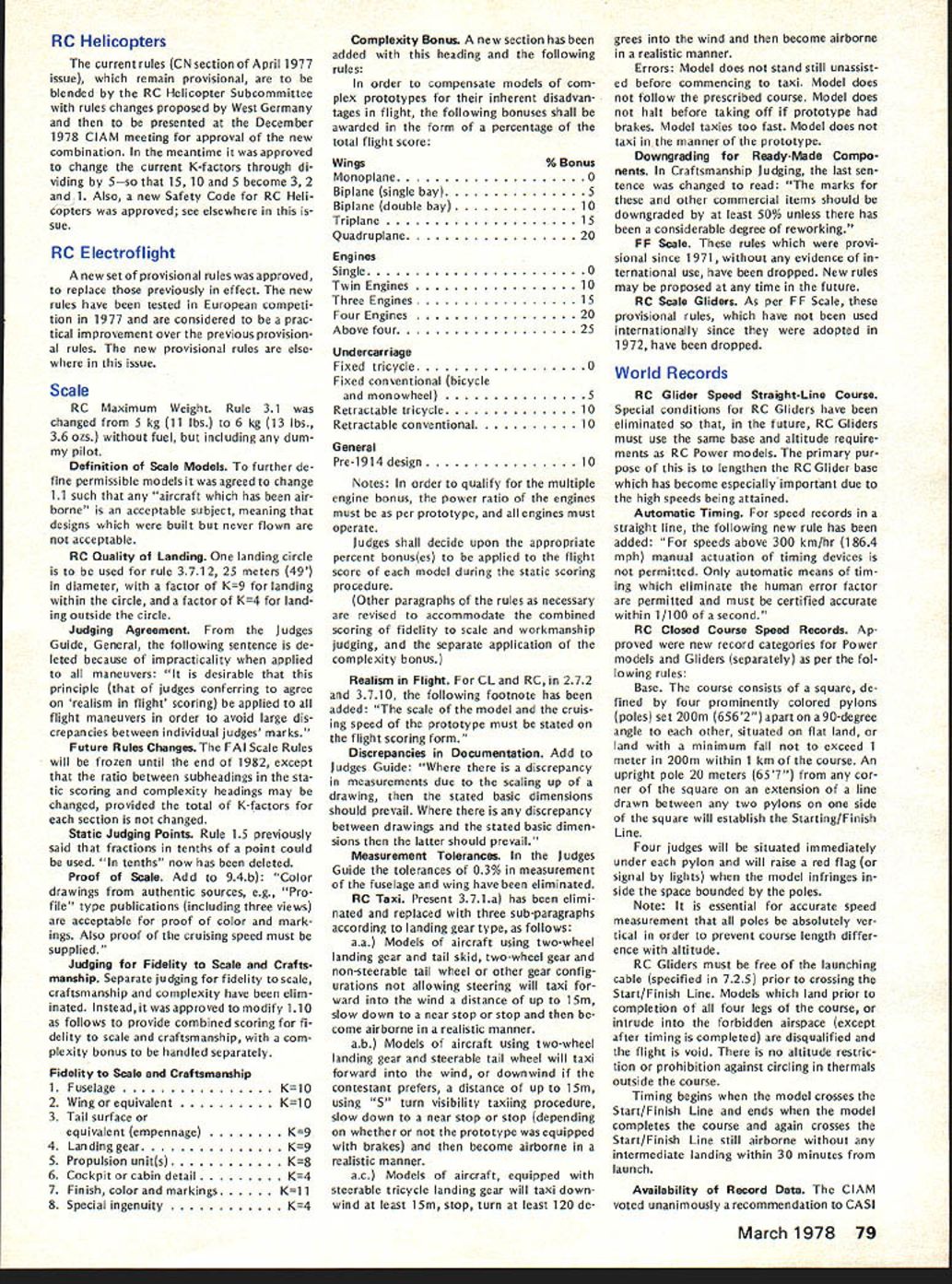
RC Helicopters
The current rules (CN section of April 1977 issue), which remain provisional, are to be blended by the RC Helicopter Subcommittee with rules changes proposed by West Germany and then to be presented at the December 1978 CIAM meeting for approval of the new combination. In the meantime it was approved to change the current K-factors through dividing by 5 — so that 15, 10 and 5 become 3, 2 and 1. Also, a new Safety Code for RC Helicopters was approved; see elsewhere in this issue.
RC Electroflight
A new set of provisional rules was approved, to replace those previously in effect. The new rules have been tested in European competition in 1977 and are considered to be a practical improvement over the previous provisional rules. The new provisional rules are elsewhere in this issue.
Scale
RC Maximum Weight. Rule 3.1 was changed from 5 kg (11 lbs.) to 6 kg (13 lbs., 3.6 ozs.), without fuel, but including any dummy pilot.
Definition of Scale Models. To further define permissible models it was agreed to change 1.1 such that any "aircraft which has been airborne" is an acceptable subject, meaning that designs which were built but never flown are not acceptable.
RC Quality of Landing. One landing circle is to be used for rule 3.7.12, 25 meters (49') in diameter, with a factor of K=9 for landing within the circle, and a factor of K=4 for landing outside the circle.
Judging Agreement. From the Judges Guide, General, the following sentence is deleted because of impracticality when applied to all maneuvers: "It is desirable that this principle (that of judges conferring to agree on 'realism in flight' scoring) be applied to all flight maneuvers in order to avoid large discrepancies between individual judges' marks."
Future Rules Changes. The FAI Scale Rules will be frozen until the end of 1982, except that the ratio between subheadings in the static scoring and complexity headings may be changed, provided the total of K-factors for each section is not changed.
Static Judging Points. Rule 1.5 previously said that fractions in tenths of a point could be used. "In tenths" now has been deleted.
Proof of Scale. Add to 9.4.b): "Color drawings from authentic sources, e.g., 'Profile' type publications (including three views) are acceptable for proof of color and markings. Also proof of the cruising speed must be supplied."
Judging for Fidelity to Scale and Craftsmanship. Separate judging for fidelity to scale, craftsmanship and complexity have been eliminated. Instead, it was approved to modify 1.10 as follows to provide combined scoring for fidelity to scale and craftsmanship, with a complexity bonus to be handled separately.
Fidelity to Scale and Craftsmanship
- Fuselage ........................................ K=10
- Wing or equivalent ............................ K=10
- Tail surface or equivalent (empennage) ... K=9
- Landing gear .................................. K=9
- Propulsion unit(s) ............................ K=8
- Cockpit or cabin detail ..................... K=4
- Finish, color and markings .................. K=11
- Special ingenuity ............................. K=4
Complexity Bonus
A new section has been added with this heading and the following rules:
In order to compensate models of complex prototypes for their inherent disadvantages in flight, the following bonuses shall be awarded in the form of a percentage of the total flight score:
Wings
- Monoplane ................................... 0%
- Biplane (single bay) ........................ 5%
- Biplane (double bay) ....................... 10%
- Triplane .................................... 15%
- Quadruplane ................................ 20%
Engines
- Single ...................................... 0%
- Twin Engines ............................... 10%
- Three Engines ............................. 15%
- Four Engines ............................... 20%
- Above four ................................ 25%
Undercarriage
- Fixed tricycle ............................. 0
- Fixed conventional (bicycle and monowheel) . 5
- Retractable tricycle ........................ 10
- Retractable conventional .................... 10
General
- Pre-1914 design ............................. 10
Notes: In order to qualify for the multiple engine bonus, the power ratio of the engines must be as per prototype, and all engines must operate.
Judges shall decide upon the appropriate percent bonus(es) to be applied to the flight score of each model during the static scoring procedure.
(Other paragraphs of the rules as necessary are revised to accommodate the combined scoring of fidelity to scale and workmanship judging, and the separate application of the complexity bonus.)
Realism in Flight. For CL and RC, in 2.7.2 and 3.7.10, the following footnote has been added: "The scale of the model and the cruising speed of the prototype must be stated on the flight scoring form."
Discrepancies in Documentation. Add to Judges Guide: "Where there is a discrepancy in measurements due to the scaling up of a drawing, then the stated basic dimensions should prevail. Where there is any discrepancy between drawings and the stated basic dimensions then the latter should prevail."
Measurement Tolerances. In the Judges Guide the tolerances of 0.3% in measurement of the fuselage and wing have been eliminated.
RC Taxi. Present 3.7.1.a) has been eliminated and replaced with three subparagraphs according to landing gear type, as follows: a.1) Models of aircraft using two-wheel landing gear and tail skid, two-wheel gear and non-steerable tail wheel or other gear configurations not allowing steering will taxi forward into the wind a distance of up to 15m, slow down to a near stop or stop and then become airborne in a realistic manner. a.2) Models of aircraft using two-wheel landing gear and steerable tail wheel will taxi forward into the wind, or downwind if the contestant prefers, a distance of up to 15m, using "S" turn visibility taxiing procedure, slow down to a near stop or stop (depending on whether or not the prototype was equipped with brakes) and then become airborne in a realistic manner. a.3) Models of aircraft, equipped with steerable tricycle landing gear will taxi downwind at least 15m, stop, turn at least 120 degrees into the wind and then become airborne in a realistic manner.
Errors: Model does not stand still unassisted before commencing to taxi. Model does not follow the prescribed course. Model does not halt before taking off if prototype had brakes. Model taxies too fast. Model does not taxi in the manner of the prototype.
Downgrading for Ready-Made Components. In Craftsmanship Judging, the last sentence was changed to read: "The marks for these and other commercial items should be downgraded by at least 50% unless there has been a considerable degree of reworking."
FF Scale. These rules which were provisional since 1971, without any evidence of international use, have been dropped. New rules may be proposed at any time in the future.
RC Scale Gliders. As per FF Scale, these provisional rules, which have not been used internationally since they were adopted in 1972, have been dropped.
World Records
RC Glider Speed Straight-Line Course. Special conditions for RC Gliders have been eliminated so that, in the future, RC Gliders must use the same base and altitude requirements as RC Power models. The primary purpose of this is to lengthen the RC Glider base which has become especially important due to the high speeds being attained.
Automatic Timing. For speed records in a straight line, the following new rule has been added: "For speeds above 300 km/hr (186.4 mph) manual actuation of timing devices is not permitted. Only automatic means of timing which eliminate the human error factor are permitted and must be certified accurate within 1/100 of a second."
RC Closed Course Speed Records. Approved were new record categories for Power models and Gliders (separately) as per the following rules:
Base. The course consists of a square, defined by four promontories or equivalent pylons (poles) set 200m (656'2") apart on a 90-degree angle to each other, situated on flat land, or land with a minimum fall not to exceed 1 meter in 200m within 1 km of the course. An uphill pole 20 meters (65'7") from any corner of the square on an extension of a line drawn between any two pylons on one side of the square will establish the Starting/Finish Line.
Four judges will be situated immediately under each pylon and will raise a red flag (or signal by lights) when the model infringes inside the space bounded by the poles.
Note: It is essential for accurate speed measurement that all poles be absolutely vertical in order to prevent course length difference with altitude.
RC Gliders must be free of the launching cable (specified in 7.2.5) prior to crossing the Start/Finish Line. Models which land prior to completion of all four legs of the course, or intrude into the forbidden airspace (except after timing is completed) are disqualified and the flight is void. There is no altitude restriction or prohibition against circling in thermals outside the course.
Timing begins when the model crosses the Start/Finish Line and ends when the model completes the course and again crosses the Start/Finish Line still airborne without any intermediate landing within 30 minutes from launch.
Availability of Record Data. The CIAM voted unanimously a recommendation to CASI...
Competition Newsletter
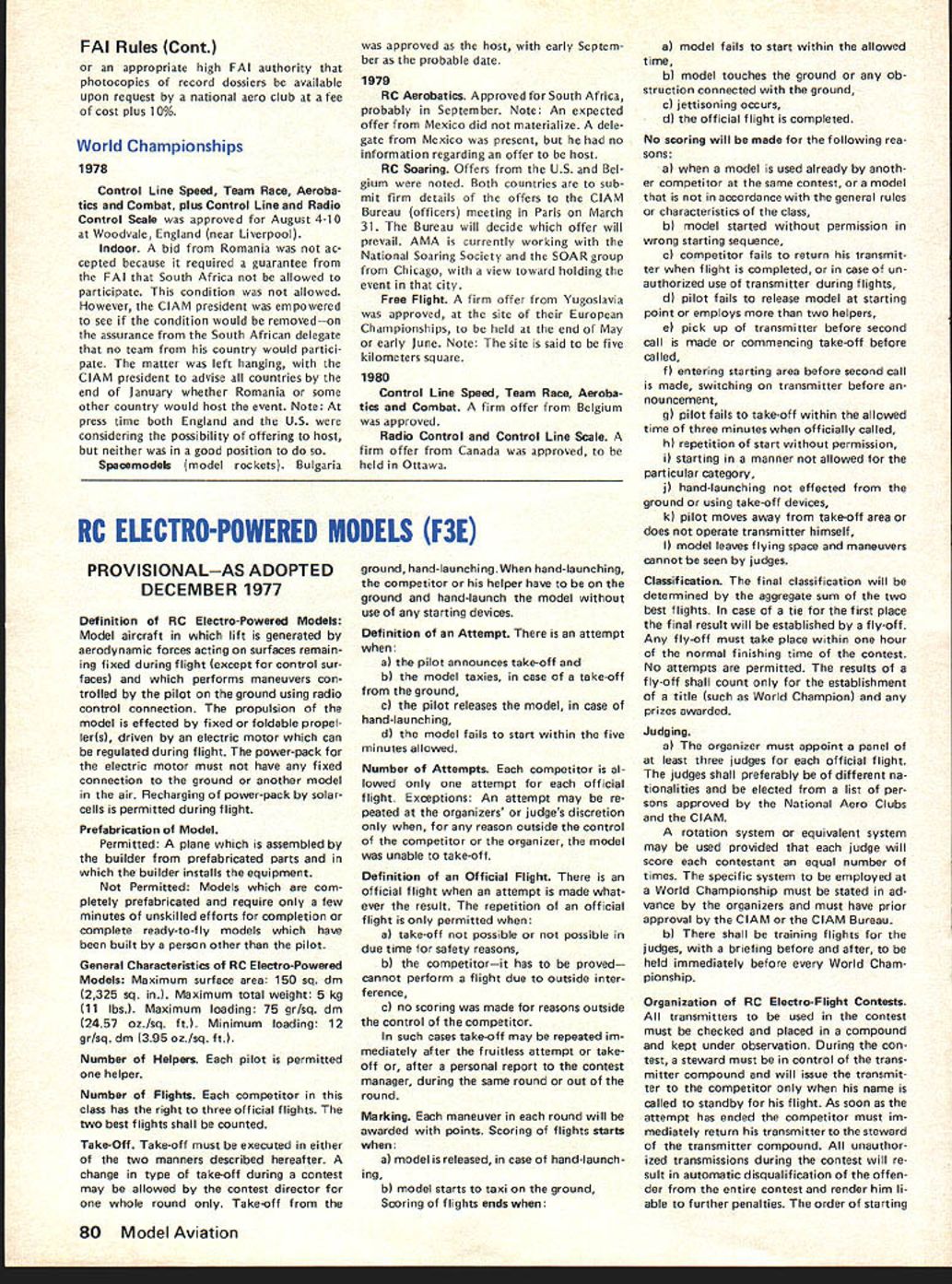
FAI Rules (Cont.)
or an appropriate high FAI authority that photocopies of record dossiers be available upon request by a national aero club at a fee of cost plus 10%.
World Championships
1978
Control Line Speed, Team Race, Aerobatics and Combat, plus Control Line and Radio Control Scale was approved for August 4-10 at Woodvale, England (near Liverpool).
Indoor. A bid from Romania was not accepted because it required a guarantee from the FAI that South Africa not be allowed to participate. This condition was not allowed. However, the CIAM president was empowered to see if the condition would be removed — on the assurance from the South African delegate that no team from his country would participate. The matter was left hanging, with the CIAM president to advise all countries by the end of January whether Romania or some other country would host the event. Note: At press time both England and the U.S. were considering the possibility of offering to host, but neither was in a good position to do so.
Spacemodels (model rockets). Bulgaria was approved as the host, with early September as the probable date.
1979
RC Aerobatics. Approved for South Africa, probably in September. Note: An expected offer from Mexico did not materialize. A delegate from Mexico was present, but he had no information regarding an offer to be host.
RC Soaring. Offers from the U.S. and Belgium were noted. Both countries are to submit firm details of the offers to the CIAM Bureau (officers) meeting in Paris on March 31. The Bureau will decide which offer will prevail. AMA is currently working with the National Soaring Society and the SOAR group from Chicago, with a view toward holding the event in that city.
Free Flight. A firm offer from Yugoslavia was approved, at the site of their European Championships, to be held at the end of May or early June. Note: The site is said to be five kilometers square.
1980
Control Line Speed, Team Race, Aerobatics and Combat. A firm offer from Belgium was approved.
Radio Control and Control Line Scale. A firm offer from Canada was approved, to be held in Ottawa. Competitors must be called at least five minutes before they are required to occupy the starting area. The organizer must provide a radio-monitor for the purpose of detecting possible interferences.
Suggested Schedule of Maneuvers (F3E) Special. Out of the 14 maneuvers listed below, six must be chosen and flown by the competitor. The sequence of these maneuvers has to be laid down in writing and is valid for all rounds. Take-off from the ground is permitted without scoring, provided another maneuver is replacing it.
The schedule has to be completed within a time of max. 5 minutes, counting from the second of the official call.
Maneuvers Coefficient
- Hand-launching . . . . . . . . . . . . no scoring
- Take-off from ground . . . . . . . . . 1
- Two inside loops . . . . . . . . . . . . 2
- Two outside loops . . . . . . . . . . . 2
- Double Immelmann . . . . . . . . . . . 2
- Turn . . . . . . . . . . . . . . . . . . . . 1
- Spin—three turns . . . . . . . . . . . 2
- Cuban Eight . . . . . . . . . . . . . . . 2
- Running Eight (starting down) . . . . 2
- Eight (starting in middle) . . . . . . . 2
- Three horizontal rolls . . . . . . . . 1
- Four-point roll . . . . . . . . . . . . . 2
- Slow roll (min. 4 sec.) . . . . . . . . 3
- Approach, rectangular, four legs . . 2
14.a Landing 30 m circle . . . . . . . . . 1 14.b Landing 15 m circle . . . . . . . . . 2
Suggested Schedule of Maneuvers F3E (Junior) Models with two axes radio control steering. Engine running radio-controlled. Landing aids. The schedule has to be completed within a time of 5 minutes, counting from the second of the official call.
After launching by hand the following maneuvers have to be flown in the given order:
Maneuvers Coefficient
- Two outside loops . . . . . . . . . . . 3
- Turn . . . . . . . . . . . . . . . . . . . . 2
- Inverted flight (starting and ending with 1/4 loop) . . . . . . . . 2
- Spin—two turns . . . . . . . . . . . . . 2
- Approach . . . . . . . . . . . . . . . . . . 2
6.a Landing, 30 m circle . . . . . . . . . 2 6.b Landing, 15 m circle . . . . . . . . . 2
Schedule of Maneuvers Electro-Motorgliders. There are two "turnlines" at a distance of 150 meters. In the middle of the distance shall be a "gate." Gate: two poles 3 m high at a distance of 20 m. At each turnline there shall be a timekeeper and a flagman.
The model with running engine is hand-launched. The owner of release to be taken by one timekeeper. For his first task, the pilot has a total flight-time of 200 sec. He has to decide how much he will use for climb and how much for gliding. The competitor has to shut-starts without delay. Now total time for climb and gliding will be 300 sec. Again it is up to the competitor to decide how much time he will use for climb and how much for gliding. For each second of gliding time the competitor is given one point.
For every second over 300 sec. total flight time, one point shall be deducted.
It is important that the gliding time is taken when the motor is cut and that gliding time ends when the motor is restarted for "pull." However, the motor may be "reversed" after announcement. Landing approach and landing are included in the gliding time. Having announced the landing approach, the pilot may use any landing aid. Landing in 30 m circle: Coefficient = 1, in 15 m circle = 2. Total flight time ends when model touches the ground.
This program aims at the development of models with a good rate of descent at a minimum speed and a relatively high rate of climb in power-flight.
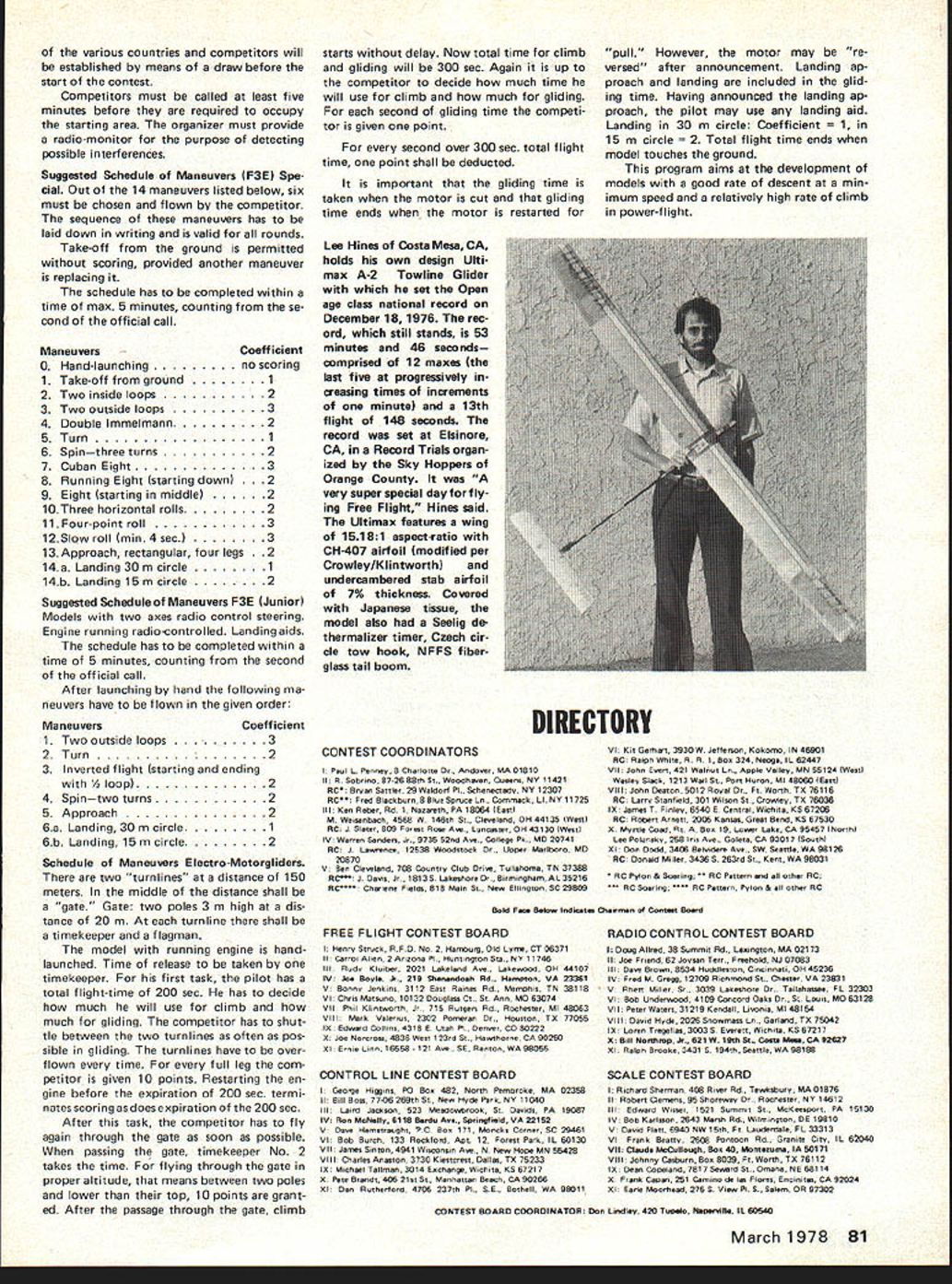
Lee Hines of Costa Mesa, CA, holds his own design Ultimax A-2 Towline Glider with which he set the Open age class national record on December 18, 1976. The record, which still stands, is 53 minutes and 46 seconds—comprised of 12 maxes (the last five at progressively increasing times of increments of one minute) and a 13th flight of 148 seconds. The record was set at Elsinore, CA, in a Record Trials organized by the Sky Hoppers of Orange County. It was "A very super special day for flying Free Flight," Hines said. The Ultimax features a wing of 15.18:1 aspect ratio with CH-407 airfoil (modified per Crowley/Klintworth) and undercambered stab airfoil of 7% thickness. Covered with Japanese tissue, the model also had a Seelig dethermalizer timer, Czech circle tow hook, NFFS fiberglass tail boom.
Competition Newsletter
Competition News will present, from time to time, constructive and thought-provoking ideas or criticisms of AMA rules and policies which affect competitors. When the issue has two sides, CN will endeavor to print all viewpoints that have been submitted—within the limits of available space, uniqueness, constructiveness, timeliness and good taste. Determination of the appropriateness of publication of any of these matters must of necessity rest solely with the publisher. The thoughts presented are those of the author, and should not necessarily be construed as those of AMA HQ, AMA officers or the publisher. All should note that publication here of a rules-change or policy-change idea does not necessarily mean that specific proposal has been presented to the Contest Board, Executive Council, or appropriate committee; such action is the responsibility of the author or anyone else interested in obtaining official action.
THE "BEST" FF TEAM
Bill Bogart 1975 FF Team Manager
Mike Keville's letter in the August issue expressed his opinion of the quality of the 1977 U.S. FAI Free Flight Team. Dave Linstrum commented on Mike's letter in the December issue, calling the "philosophy and attitude" in Mike's letter "almost too absurd." But Dave's reasoning in discussing the mistakes of Bob White and Ed Carroll at the Team Finals is strange. His logic is this: if a flier makes a mistake at the Finals, he may well make the same mistake at the World Championships. If this is logical, then the opposite must be true; e.g., if a flier's timer doesn't malfunction at the Finals, it is not likely to malfunction at the WC. Balderdash! That logic is absurd.
What Mike laments, and others are thinking about, is that our system of team selection hasn't been developing and selecting the fliers who have the greatest propensity or potential to win in their event.
Tonight (October 24) the Los Angeles Rams wiped up the Colosseum with the Minnesota Vikings. In a playoff last fall, the Vikings made the Rams look silly. The point is that on any given outing, whether one day or three, a flier may do well or poorly—any flier. Over a number of contests the best fliers will be on the top. It is in this very way that we develop opinions as to who our best fliers are.
If you have viewed the Semi-finals results from this past Labor Day weekend, you will have noticed a large number of excellent fliers who will not be going to the Finals—the result of a one-day contest.
It all boils down to not enough flying in the team selection. We still seem to be making our team selection simple and economic. As long as we continue in this manner, we shall be destined among the also-rans at the WC. Only when we start to spend much more time and money in our sport will we develop fliers of World Champion status.
Support the manufacturers who make the engines, timers, towhooks, etc., that make the World Champs possible. It takes numbers as well as fanatics. We have to entice new blood into the program to give us future teams.
I believe that the World Champs is the ultimate contest, and flyoffs should be expected and planned for. There are hundreds of other contests each year featuring FAI classes, and the rules should keep those contests and their entrants well in mind. Without them, there would be no World Champs required.
FF FAI RULES—GO SLOW!
Steve Helmick
After every World Champs, with up to 40 in the flyoff for each event, there is an uproar over limiting performance, more so that there is no flyoff. The way I see it is that with the caliber of fliers at the WC level, where simply has to be lousy conditions to eliminate max-outs!
But I wonder, should we modify the rules with the World Champs in mind, or should we consider the guys like myself who seldom max-out anyway, but like the events and are trying to improve? Limit the performance more through rules changes, and watch the average guy desert the sinking ship.
Remember that it takes a large number of entries to support the class financially, and to
PROPOSAL TO REORGANIZE THE AMA
Dick Singer Phoenix, AZ
This proposal is offered to attempt to give modeling and model flying back to the "Youth of America."
MEMBERSHIP IN "NEW" AMA:
- Remove all members over 18 years old.
- Regular members of AMA to be 8 to 18.
- Associate members, over 18, must be sponsored by regular member, 8 to 18.
- Regular members, 8 to 18, may sponsor only two associate members, each.
AMA SPONSORED CONTESTS:
- There shall be events for regular members, associate members and open events.
- For every associate event there must be three regular member events.
ASSOCIATE MEMBER OATH: In order for an associate member, adult, to remain an AMA member he or she must stimulate at least two persons "each" year to become regular members 8 to 18, and the associate member promises to assist and help these new members become happy and competent modelers and model fliers.
Submitted by all modelers concerned with our youth and the future of our hobby.
RAILROAD CROSSING—STOP, LOOK, LISTEN
Dick Radcliffe
There are many reasons why we crash. Most of them, by now, you have heard of, seen, or experienced yourself. The type of crash we can add more avoidance to is the one where the "other guy" turns on to your frequency. If you did not have the proper frequency clip you were in the wrong. If you were "the guy" with the proper clip, you were in the right. If the "guy" with the clip feels having the clip is enough, then read no further. However, if you feel that being in the right is just not enough, in a hobby where anyone is at times in the wrong, then read on!
Today, railroad-highway intersections have flashing lights, bells, and automatic gates. Yesterday, all that stood was a sign. I read, RAILROAD CROSSING—STOP, LOOK, LISTEN. Why stop if you could see up and down the tracks? If you could see up and down the tracks, then you would have been on the tracks! On the tracks was the wrong place to be. Before you get on the tracks, LISTEN!
Instead of STOP-LOOK-LISTEN in our flying, let's use COOL. We all agree the only time we can turn on is when you have the correct clip. Okay, you have the proper clip. Turn on and then immediately off, say, at a one-second interval. Now LISTEN! If nobody yells, "I'm hit," then turn on again and off for about a three-second interval. Again, LISTEN! If still nobody yells, it is a safe bet you will not shoot anybody down. If the "other guy" uses this on/off precaution, then you won't get shot down either.
This on/off technique does not take much time, and after several flying sessions will be second nature to you. Many clubs have added methods to their safety rules to avoid crashes. Add this one to your list until we get flashing lights, ringing bells, or an automatic something or other that will stop all crashes.
Have the correct Clip turn On turn Off then Listen
Do it again. Cool it, man!
Helpful reminder: Add a sign to your frequency clipboard and label it COOL CLIPS. (Reprinted from Prop Wash, newsletter of the Mercer County RC Club, Trenton, N.J.)
STAR NOVICE RC PATTERN
M. Buck Peck Norfolk, VA
Pattern had simply gotten too complicated for fun, so said old curmudgeons such as I. Novice, the entry point, was populated with open gimbles, white bucks, retracts, and now even tuned pipes! For years we had tried to brainstorm a more simplistic starting point to no avail.
Tidewater RC was scheduled to host The 1977 Virginia State Championship, then or never! We sat down with CD Jay Jennings and invented Star Novice.
- Entrant must not have previously placed in sanctioned Pattern contests.
- Retracts (if installed) not to be used.
- Before each flight, entrant will line out any two maneuvers of his choice on the Novice score sheet (will neither fly nor be scored on those two).
Easy to run, it turned out successfully. Entrants were lumped in with the regular Novice group and identified only with small stars. The judges and scorers had nothing different to do. Extra trophies were more than funded by entry fees.
They loved it! Good club fliers of several years' experience who had previously felt outclassed by equipment and impression points gave it a whirl. Beginners with only a year or so experience weren't stigmatized with a label. Competent fliers won with straightforward four-channel Pattern craft. All had fun and experienced competition.
AMA CDs are licensed, without fee, to try our patented Star Novice.
Competition Newsletter
FAI RC SOaring Team Selection Program
Ray Marvin, Chairman
FAI RC Soaring Team Selection Program underway again to select US team to go to World Championships 1979. Plans are to run the program essentially the same manner as the previous one Jim Simpson ably conducted. His good program resulted in the team that went to take first place individual and first place team honors at the World Championship in South Africa. The coming program will be seeking a team that can repeat the performance. The program is being administered by the National Soaring Society, restricted to NSS members, open to AMA members. Be aware the program works. Procedure follows:
The first step is to enter quarter-finals contests. Cost will be $25 plus cost of FAI stamp; there will be no additional charge. To advance to the semi-finals and finals, the process is being set up; contest schedule is now being arranged. Check your area to see quarter-finals contests scheduled. Get a club sponsor; get the AMA Contest Director at the club to apply for sanction and schedule the meet during the months April, May, June.
The CD of the quarter-finals contest will be provided program registration forms and will be able to collect FAI stamps and AMA membership as the contestant registers. CD must check for a valid current AMA license and FAI stamp, collect the $25 program entry fee and fill out the registration form.
Following the quarter-finals, the CD will complete the contest report showing names and scores of entrants regardless of standing. Reports and entry fees will be forwarded to AMA Headquarters immediately upon completion of the contest. Entry fees will be used primarily for team travel within the US and for the country's apportionment for World Championships; AMA dues cover over-ocean travel. Contests will run strictly according to FAI rules with the exception that motorgliders are excluded.
In order to advance to the semi-finals, a contestant must attain at least 80% of the winning score after at least three complete rounds. If the contestant fails on the first attempt, he may enter other quarter-finals contests and try again to qualify. Those who qualify to fly in the semi-finals may attend a semi-final of their choice. There will be six to ten semi-finals scheduled in various parts of the country. They will be flown over the first weekend, July 1-3; the following weekend, July 8-9; contests given in an area may be scheduled the first weekend, or they may be scheduled the second weekend.
Results of semi-final contests will be forwarded to the program chairman. The number of contestants from each semi-finals contest eligible to advance to the finals will be determined according to the following formula:
Those notified eligible to attend must notify the finals CD if they plan to attend. Alternates will be invited to attend if those who have qualified are unable to. Finals competition will be over Labor Day weekend; at least six rounds will be flown. The top three fliers will comprise the US team. Should an invited team member be unable to attend, the first alternate will be invited. At the AMA convention, the three members preceding the team are automatically qualified to enter finals: Skip Miller, Dale Nutter, LeMon Payne may enter no two quarter-finals or semi-final payment entry fee. However, scores will be used to calculate else eligible advance.
The competition site for the finals contest has yet to be determined; it will be known until March 1978. The World Championships will be held ... AMA has made a bid to have the US ... The important thing now is to get the team selection program squared away. If you want to participate, just follow the procedure outlined above. Be sure to let us know if you have scheduled quarter-finals contests. If you have questions about the program, please feel free to write or address Ray Marvin, 27815 Garfield, Denver, CO 80210.
Names and addresses of Team Selection Committee members follow and may be contacted for information concerning the program:
FAI Rules Changes
Following are new/changed rules adopted by the FAI Committee (International Aero Modeling — CIAM):
Transcribed from original scans by AI. Minor OCR errors may remain.

