
COMPETITION NEWSLETTER
RC AEROBATICS TEAM PROGRAM
First Vote by Previous Program Participants Was Inconclusive; Second Vote Now in Progress.
Two proposals developed by the NSRCA Team Selection Committee, chaired by Ron Chidgey, were submitted in December for approval by participants in the 1975 and 1977 programs, but the only clear outcome was that Proposal No. 1 was not approved. Because of this, AMA President Johnny Clemens has authorized a revote of Proposal No. 2.
Proposal No. 1, which was defeated, called for dividing the country into four sections and holding two contests in each section—from which four fliers from each (eight fliers per section), together with the previous three team members, would be eligible to participate in a Masters-type Team Selection Finals.
Proposal No. 2, which is being revoted, provides for participants to pay a $10 program entry fee and to qualify to fly in a Masters-type Team Selection Finals by finishing in the top third of a Masters class event at any AMA sanctioned meet in 1978. Proposal No. 2 calls for a $150 Masters entry fee, in order for the event to be self-supporting, with any surplus funds to be returned to the entrants.
Of the 39 responses to the December ballot, 24 checked the No. 2 box—a majority of 61.5%. However, five qualified their votes; two objected to the $150 fee, three said they preferred a points system or something like the previous systems, and one indicated equal support for a points program. (Of the other votes, eight checked the No. 1 box, and seven checked neither box; the latter all objected strongly to both proposals.)
The five qualified votes for Proposal No. 2 reduce the total clearly in favor of No. 2 to only 19—which is less than the 51% required for program approval. Therefore, depending on how the five qualified votes are regarded, the No. 2 proposal can be argued either way, as having been accepted by the majority or not.
In addition to the above, phone calls have been received by AMA HQ and others objecting to the nature of the ballot, mostly on the basis that no provision was made for allowing objectors to decline both proposals. Seven did so anyway, but concern was expressed as to whether their votes would be counted.
Due to all of this, President Clemens authorized a further ballot to ask all who responded to the December ballot to simply say yes or no to Proposal No. 2. If a majority of those responding say yes, the proposal is adopted. If a majority say no, the proposal will go back to the committee for reconsideration.
RC SOARING TEAM PROGRAM
The following information was supplied by Ray Marvin, chairman of the RC Soaring Team Selection Committee.
Quarter-Final Contests
- Santa Rosa, CA — CD: Dave Thornburg — Date to be announced
- San Jose, CA — CD: Jack Alton — May 28
- San Fernando Valley — CD: Mike Reagan — Date to be announced
- San Bernardino, CA — CD: Chuck Beeman — Date to be announced
- Carson, CA — CD: Paul Parszik — Date to be announced
- Denver, CO — CD: Ray Marvin — May 20-21
- Colorado Springs, CO — CD: Milt Woodham, Sr. — June 17
- Chicago, IL — CD: Keith Finkenbiner — May 21
- Ann Arbor, MI — CD: Gordon Pearson — Date to be announced
- Tulsa, OK — CD: Mike Ransom — June 3-4
- Waco, TX — CD: Connie Jones — Date to be announced
Semi-Final Contests
Anyone interested in conducting a quarter-final contest should get in touch with the Team Selection Program committeeman for his district or with the Program Chairman, Ray Marvin. A list of the Team Selection Program Committee members can be found in the March issue, page 73.
NEW FAI PATTERN RULES AFFECT ON AMA EXPERT AND MASTER CLASSES
The following, a memo to the Radio Control Contest Board from Chairman Bill Northrop, provides the status as of mid-January.
Results of the December FAI meetings have brought up some problems regarding our recently completed voting for 1978-79 rules. The FAI has approved the new "ABC" pattern rules, which call for a minimum of four qualifying rounds plus two finals rounds of competition, and feature several entirely new maneuvers—some of which will be quite difficult, at least for a while.
First, this puts quite a different light on our decision to have Experts fly the Masters pattern. Under the previous maneuver schedule there wasn't too much difference. Now there's a lot of difference.
Secondly, and even more disturbing, the Masters, according to the rules, must fly the FAI pattern…and this now means a minimum of four rounds (two of Schedule A maneuvers and two of Schedule B) plus two more rounds of a self-selected schedule for the finalists. This total requirement will be simply unacceptable for most one-day sanctioned contests around the country, especially if Novice, Advanced, and Expert, plus Scale, are to be flown in addition to Masters. Most other countries won't have this problem, as their RC activity doesn't require a breakdown of skill classification as we have in the U.S.
Because of these problems, AMA HQ is giving us additional time, while other parts of the rule book are being prepared, to develop appropriate corrections.
The solution to the first problem could be fairly easy. We can simply change our vote on RC-78-44, and leave the Expert pattern as it was in 1976-77, or we can stay with the proposal and either specify that the Experts fly the outgoing FAI pattern, such as was flown at the 1977 Masters Tournament and World Championships, or that they fly the same new pattern as the Masters.
The second problem is more difficult to solve, because there are so many different ways to go. One suggestion would be to have a two-day event for Masters competition at contests where the long, four- to six-round schedule could not be flown. This maneuver schedule should include as many as possible of the new FAI maneuvers so as to make it easier for a Masters flier to switch from one schedule to the other as the occasion arises.
After all, a pilot who can cope with this situation is certainly more qualified to be on top of the heap than one who cannot. (more)
FAI PATTERN AFFECT (Cont.)
One such short pattern could be that which was proposed by Switzerland. It includes many of the new maneuvers, but consists of only one schedule, as has been used in the past. A copy of this schedule is at the end.
Another alternative was suggested by Dave Brown. Dave suggests that for short contests, the Master could fly Schedule C only. This would permit use of whatever maneuvers the pilot chooses (as long as the best possible score totals 450 points) and allows him to prepare, as he sees fit, for the full "ABC" pattern competition.
The first move, then, is for us to make a preliminary choice on these matters. If we have majority agreement, it need not go further. If no majority is obtained, a second and final ballot will be necessary. (CB members were asked to check the preferred choice under A and B, or to indicate 1st, 2nd and 3rd choices.)
A. Expert Pattern Schedule
- Use 1976-77 Expert pattern ( )
- Use 1977 W/C pattern ( )
- Use new FAI pattern ( )
(Item 3 will be whatever is decided in part B)
B. Masters Pattern "One-Day" Schedule
- Use Swiss pattern ( )
- Use Schedule C ( )
Swiss Pattern
- Take Off (K=1)
- Three Horizontal Rolls (K=3)
- Figure "M" with 1/4 Roll (K=5)
- Slow Roll (K=3)
- Three Inside Loops (K=1)
- Four Point Roll (K=4)
- Three Outside Loops (from inverted position) (K=2)
- Eight Point Roll (K=4)
- Square Inside Loop (K=2)
- Reverse Rolls (two Rolls in opposite directions) (K=3)
- Top Hat (K=3)
- Reverse Point Roll (K=4)
- Square Loop with Four 1/2 Rolls (K=4)
- Reverse Knife Edge (K=4)
- Three Turn Spin (K=1)
- Square Horizontal Eight (K=3)
- Rectangular Landing Approach (K=1)
- Landing (K=1)
Schedule C (Competitor selection of maneuvers—with total of 450 points maximum—from Schedule A, Schedule B, and the List of Extra Maneuvers. Only 14 maneuvers may be selected, including take-off and landing; only one Figure M may be included.)
Schedule A K Factor Take-Off ..................................1 Double Immelmann ..........................2 Three Reverse Inside Loops ...............3 Rolling Eight .............................2 Slow Roll ................................3 Top Hat ..................................3 Horizontal Eight ..........................3 Figure M with 1/4 Rolls ...................5 Three Outside Loops .......................3 Three Turn Spin ..........................2 Three Horizontal Rolls ....................2 Landing ..................................1 Total × 10 = 290
Schedule B K Factor Take-Off ..................................1 Reverse Double Immelmann ..................2 Cuban Eight ...............................2 Three Inside Loops ........................2 Straight Inverted ..........................2 Vertical Eight ............................2 Four-Point Roll ...........................3 Three Reverse Outside Loops ...............3 Two Rolls in Opposite Directions ..........3 Figure M with 1/4 Rolls ....................3 Cobra Roll ................................3 Landing ..................................1 Total × 10 = 290
Straight Inverted ..........................2 Vertical Eight ............................2 Four-Point Roll ...........................3 Three Reverse Outside Loops ...............3 Two Rolls in Opposite Directions ..........3 Figure M with 1/4 Rolls ....................3 Cobra Roll ................................3 Landing ..................................1 Total × 10 = 290
List of Extra Maneuvers for Finals K Factor Avalanche ................................3 Inverted Spin ............................3 Square Horizontal Eight ..................4 Eight-Point Roll ........................4 Vertical Roll ............................3 Aileron Turn .............................3 Figure M .................................3 Square Loop with Four 1/2 Rolls .........3 Two Snap Rolls in Opposite Directions ...5 Reverse Knife Edge .......................4 Inverted Top Hat ........................4 Reverse Cuban Eight ......................2 Reverse Point Roll .......................2 Triangle Rolling Loop ....................1
SWISS SCHEDULE AHEAD FOR "ONE DAY" MASTERS PATTERN
Quick response by all members of the Radio Control Contest Board to the above memo and ballot seemed, at first, to have settled which maneuver schedule will be recommended for one-day Masters pattern events. In reviewing the comments made by CB members, however, RCCB Chairman Bill Northrop felt that some of the board members had interpreted FAI's Schedule C as being only the maneuvers included in the extra group which can be used in the finals. (As a matter of fact, the list of extra maneuvers was mistakenly labeled Schedule C when sent to the RC Contest Board along with Northrop's memo and ballot.) To preclude the possibility of a decision being made based upon erroneous information, point B is being revoted.
Also being revoted is point A—as to which pattern should be used by AMA Expert fliers. There was a slight preference for ballot item 2, calling for using the 1977 World Champs pattern, but a majority was not obtained. "commend inclusion of this document related text proposed by Chris Matsuno, as follows:
"It is the Contest Director's responsibility to evaluate the condition of the "air" at the contest or record trials site. If he feels that artificial and/or abnormal air circulation conditions exist, then no flights made at the site while such conditions prevail may be submitted for records. Artificial/abnormal air circulation would include, but not necessarily be limited to:
- Strong upward displacement of air in areas of the building caused by heating/air conditioning systems or fans.
- Continuous and complete upward movement of air throughout the building, as in a vertical wind tunnel or large building with fans at the top which are drawing air upward and out of the top of the building."
Stoy 108.8-second Record Withdrawn. In a letter dated January 16, Stan Stoy has withdrawn the subject record which he had established on July 29, 1977, even though the record had been reaffirmed by the FF Contest Board. He stated the following reasons: "1... its continued presence will only serve to irritate some competitive fliers and will not provide a constructive goal for competitors to attempt to better...; 2. Modelers have decided that the tactic of turbulence rectification is not an option that they want available to the indoor flier, at least not for the purpose of establishing records; 3. It has served the purpose of bringing up for discussion the rather vague rules for indoor competition and record establishment. Its continued presence on the books will not further this goal."
Stoy also said that he took the withdrawal action with knowledge that he presently has another Cat. I Indoor HL Glider record pending, which was set under dead air conditions.
This article constitutes publication of the subject emergency rule proposal as required by the Contest Board Procedures. It should be in most readers' hands approximately March 1; the FF Contest Board will then vote approximately April 1 for immediate effect of the proposals. Anyone with an interest in the outcome of the proposals is urged to state his views by mail to his district FF Contest Board member before April 1. The two-year cycle for considering competition rules changes with effect January 1, 1980, began on January 1, 1978—the opening date for accepting basic rules-change proposals.
The deadline for submitting basic rules-change proposals in the current cycle is September 1, 1978 (postmark), as indicated in the schedule, Exhibit C. The time, thus, is now and within the next few months to be considering and proposing what changes are needed. Use the proposal form printed a couple of pages farther back; photocopies are acceptable, and additional rules-proposal forms may be obtained from AMA HQ (please include a pre-addressed and stamped envelope with requests).
The complete Contest Board Procedures document as printed here will be an invaluable aid in understanding the significance of Contest Board matters that will be printed in CN from time-to-time.
CONTEST BOARD PROCEDURES
AS REVISED, MAY 1974
Forward
The purpose of this document is to assist Contest Board Members in effectively monitoring and accomplishing rules revisions.
The Contest Board Member must act to maintain high competitive standards and good sportsmanship. Proposals counter to this view, while not made intentionally, often are unknowingly generated, so each proposal should be carefully studied before action is taken.
Proposals should be reviewed for ambiguities in scoring, judging, and interpretation which might create hardships at the contest level for Contestants and Contest Directors alike. Board members should discuss proposals with as many people as possible to obtain a consensus of the merit or possible faults in the proposed change.
Members of all Contest Boards should familiarize themselves with the rules that prevail in all categories. Care should be taken to avoid generating rules that conflict, or could be confused with rules in the other categories, or with the General Rules covering all categories.
ANALYSIS OF PROPOSALS BY CONTEST BOARDS
- Manufacturing—Will current equipment be made obsolete?
- Protests—Will the change tend to eliminate a source of protests at meets, or are protests more likely?
- Model Processing Time—Will the change tend to increase or decrease the time required to process models for competition?
- Designs—Will the builder be given more or less freedom of choice in design?
- Contests—Will the effort required to conduct a contest be increased or decreased?
- Present Models—Will a modeler be able to effectively compete with current models, or will he have to build new ones?
- Effect on Competition—Will the net effect of the proposed change, if passed, be to encourage or discourage contest participation?
PROCEDURES
Rules Review Schedule. These procedures provide for a single two-year schedule (Exhibit C) starting in 1974. Additional two-year schedules are commenced with the start of each even-numbered calendar year.
Proposal Preparation and Submittal. Any AMA member may submit a Rules Change Proposal by filing a completed RULES CHANGE PROPOSAL FORM (see Exhibit A) with AMA Headquarters by the specified postmark deadline (see Exhibit C). Upon receipt of the proposal at Headquarters it will be reviewed by the Headquarters staff to assure that it has been properly submitted (correct form used, properly filled out, required signatures, clearly stated proposals). If the proposal, as submitted, does not pass the review at Headquarters it shall be returned to the proposer with an appropriate explanation of what is required to present it properly.
Types of Proposals. There are three basic types of proposals:
- BASIC RULES CHANGE PROPOSAL—may be filed by any AMA member (as outlined above) and is one which affects one or more competition categories.
- CROSS PROPOSALS—After a Basic Rules change proposal has been accepted on the Initial Vote of the Contest Board(s), and the proposed change has been published, any AMA member may file a Cross Proposal to modify the Basic Proposal, so long as it is postmarked by the specified deadline (see Exhibit C) and is submitted on the standard Rules Change Proposal Form (Exhibit A). A Cross Proposal filed by a CB member must also be on the standard form, but need not be endorsed by anyone else.
When one or more Cross Proposals are filed the Contest Board(s) will make every effort to resolve differences between the Basic and Cross Proposal changes, and arrive at a single proposal for Final CB(s) action. This may be accomplished by an Interim Vote (Exhibit C) in which the CB(s) will rank the Basic and Cross Proposal(s) in order of preference, the best alternate being ranked number 1, second best number 2, and so forth. The Chairman (Coordinator) will then sum the rankings for each of the alternatives and select the one with the lowest total score. Where only one Cross Proposal is offered, the Contest Board will vote for either the basic or the alternate, a simple majority determining the issue. Where several non-parallel Cross Proposals are offered, each will be voted on separately and accepted or rejected according to the majority vote. If the Chairman questions whether a Cross Proposal is within the range that he feels is truly a Cross Proposal, he may subject such a proposal to an Interim Approval Vote by the Contest Board to see if the majority think that the proposal is within the intent of a Cross Proposal.
- INTERPRETATIONS, SAFETY AND/OR EMERGENCY PROPOSALS. When situations arise requiring immediate action or action quicker than the normal two-year cycle system, the President or his delegate, with the concurrence of the appropriate CB Chairman (or the CB Coordinator if a General Rule is involved), may take any emergency action dictated by the situation though it may conflict with the normal rules making procedures. This shall proceed in one of the following manners:
(1) The proposal or action required may be enforced immediately. In such instances, the action taken and the justification for it shall be published in the earliest possible issue of the Academy publication (CN or "AMA News"). The CB Chairman/Coordinator will submit immediately to his Contest Board(s) a brief describing the action and the reasons therefor, along with any opinions immediately available. Not less than four weeks and not more than six weeks after "publication," the CB Chairman/Coordinator shall send a ballot with a 10-day turn-around to his board(s) to obtain CB concurrence or denial of the action taken. If a 2/3 majority of those responding from each of the Contest Boards involved concur, the ruling will be considered as final. A minimum of not less than 50% of the total possible voters must reply for such a vote to be valid, if the final results are contrary to the previous ruling. 50% is not required if the ballot results concur with the previous ruling.
(2) ALL INTERPRETATIONS shall be handled in the following manner, and at the option of the President or his delegate, SAFETY and/or EMERGENCY PROPOSALS may also be handled as follows: After the proposal or request has been forwarded by the President (or his delegate) to the appropriate CB Chairman (or CB Coordinator), the CB Chairman/Coordinator shall immediately submit a brief describing the action taken to date and the reason therefor and a copy of the original request for action from the originator, along with any opinions immediately available, to all members of the appropriate CB. He shall also include a ballot requiring a 10-day turn-around. That ballot shall offer a choice of three methods of handling the proposal or request:
A. Immediate enforcement, requiring a follow-up ballot after publication as outlined in the previous paragraph.
B. No immediate ruling, but require input from all board members and require publication of the proposal or request at the earliest possible date. Then proceed with a final vote as outlined in paragraph (1).
C. Denial of any action and return of the proposal to the originator with the requirement that he must resubmit the proposal into the normal two-year cycle system if he wishes further consideration of the proposal or request.
One of the three methods shall be selected as follows: each CB member will indicate his relative preference for the three methods by ranking them in order, the best method being ranked number 1, second best 2, and third best 3; the Chairman (Coordinator) will then sum the rankings for each of the alternatives and select the one with the lowest total score.
All requests for Interpretations, Safety and/or Emergency rulings shall be submitted on the standard proposal form or a facsimile that contains all of the required information contained on said form. Any such request shall have the same endorsement requirements as a normal proposal and shall have the full addresses of all three who sign.
Provisional/Supplementary Rules. Accep- tance of a new set of rules or a new event by the Contest Board may result in immediate approval as an official AMA event. However, if the event does not already have modeler support and widespread testing of rules is de- sired before adoption, provisional status may be assigned by the Contest Board. The Con- test Board shall decide such matters at time of voting. Such provisional rules may be contin- ued from year to year, and modified by the Contest Board through normal procedures, until such time as official adoption or reject- tion is determined by Contest Board vote.
Supplemental rules may be adopted, through normal Contest Board procedures, to provide a national standard (with particular respect to safety) for activity which is essen- tially local in nature but apparently popular in several areas.
Provisional and supplemental rules are not intended to be included as part of official events in the National Model Airplane Cham- pionships but may be included in all other sanctioned contests. No records will be recog- nized for provisional or supplemental events.
EXHIBIT C
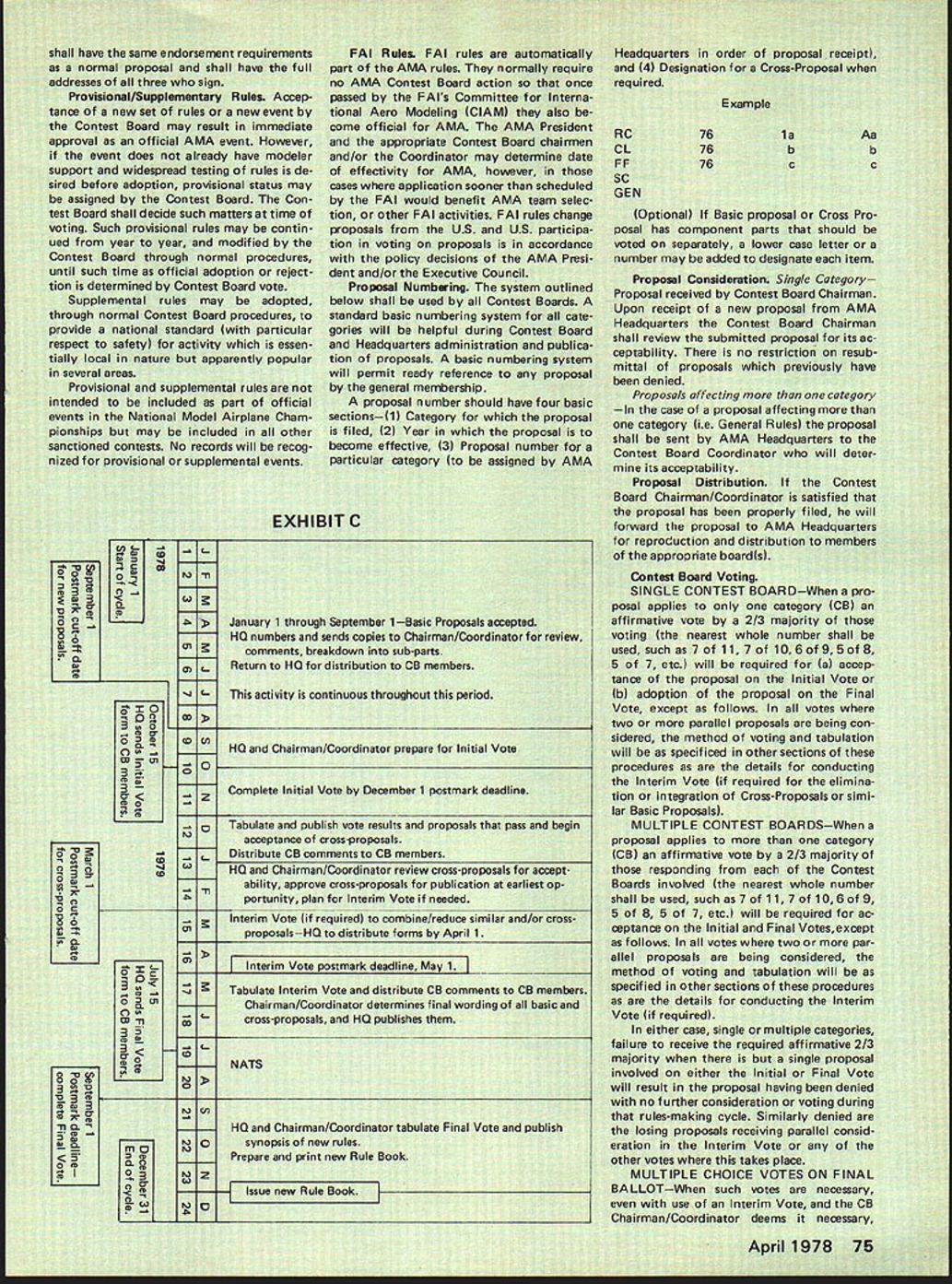
January 1 through September 1—Basic Proposals accepted. HQ numbers and sends copies to Chairman/Coordinator for review, comments, breakdown into sub-parts. Return to HQ for distribution to CB members.
This activity is continuous throughout this period.
HQ and Chairman/Coordinator prepare for Initial Vote
Complete Initial Vote by December 1 postmark deadline.
Tabulate and publish vote results and proposals that pass and begin acceptance of cross-proposals.
Distribute CB comments to CB members.
HQ and Chairman/Coordinator review cross-proposals for accept- ability, approve cross-proposals for publication at earliest op- portunity, plan for Interim Vote if needed.
Interim Vote (if required) to combine/reduce similar and/or cross- proposals—HQ to distribute forms by April 1.
Interim Vote postmark deadline, May 1.
Tabulate Interim Vote and distribute CB comments to CB members. Chairman/Coordinator determines final wording of all basic and cross-proposals, and HQ publishes them.
NATS
HQ and Chairman/Coordinator tabulate Final Vote and publish synopsis of new rules. Prepare and print new Rule Book.
Issue new Rule Book.
FAI Rules. FAI rules are automatically part of the AMA rules. They normally require no AMA Contest Board action so that once passed by the FAI's Committee for Interna- tional Aero Modeling (CIAM) they also be- come official for AMA. The AMA President and the appropriate Contest Board chairmen and/or the Coordinator may determine date of effectivity for AMA, however, in those cases where application sooner than scheduled by the FAI would benefit AMA team selec- tion, or other FAI activities. FAI rules change proposals from the U.S. and U.S. participa- tion in voting on proposals is in accordance with the policy directions of the AMA Presi- dent and/or the Executive Council.
Proposal Numbering. The system outlined below shall be used by all Contest Boards. A standard basic numbering system for all cate- gories will be helpful during Contest Board and Headquarters administration and publica- tion of proposals. A basic numbering system will permit ready reference to any proposal by the general membership.
A proposal number should have four basic sections—(1) Category for which the proposal is filed, (2) Year in which the proposal is to become effective, (3) Proposal number for a particular category (to be assigned by AMA Headquarters in order of proposal receipt), and (4) Designation for a Cross-Proposal when required.
Example
RC 76 1a Aa CL 76 1b b FF 76 1c c SC GEN
(Optional) If Basic proposal or Cross Pro- posal has component parts that should be voted on separately, a lower case letter or a number may be added to designate each item.
Proposal Consideration. Single Category— Proposal received by Contest Board Chairman. Upon receipt of a new proposal from AMA Headquarters the Contest Board Chairman shall review the submitted proposal for its ac- ceptability. There is no restriction on resub- mittal of proposals which previously have been denied.
Proposals affecting more than one category —In the case of a proposal affecting more than one category (i.e. General Rules) the proposal shall be sent by AMA Headquarters to the Contest Board Coordinator who will deter- mine its acceptability.
Proposal Distribution. If the Contest Board Chairman/Coordinator is satisfied that the proposal has been properly filed, he will forward the proposal to AMA Headquarters for reproduction and distribution to members of the appropriate board(s).
Contest Board Voting.
SINGLE CONTEST BOARD—When a pro- posal applies to only one category (CB) an affirmative vote by a 2/3 majority of those voting (the nearest whole number shall be used, such as 7 of 11, 7 of 10, 6 of 9, 5 of 8, 5 of 7, etc.) will be required for (a) accep- tance of the proposal on the Initial Vote or (b) adoption of the proposal on the Final Vote, except as follows. In all votes where two or more parallel proposals are being con- sidered, the method of voting and tabulation will be as specified in other sections of these procedures as are the details for conducting the Interim Vote (if required for the elimina- tion or integration of Cross-Proposals or simi- lar Basic Proposals).
MULTIPLE CONTEST BOARDS—When a proposal applies to more than one category (CB) an affirmative vote by a 2/3 majority of those responding from each of the Contest Boards involved (the nearest whole number shall be used, such as 7 of 11, 7 of 10, 6 of 9, 5 of 8, 5 of 7, etc.) will be required for ac- ceptance on the Initial and Final Votes, except as follows. In all votes where two or more par- allel proposals are being considered, the method of voting and tabulation will be as specified in other sections of these procedures as are the details for conducting Interim Vote (if required).
In either case, single or multiple categories, failure to receive the required affirmative 2/3 majority when there is but a single proposal involved on either the Initial or Final Vote will result in the proposal having been denied with no further consideration or voting during that rules-making cycle. Similarly denied are the losing proposals receiving parallel consid- eration in the Interim Vote or any of the other votes where this takes place.
MULTIPLE CHOICE VOTES ON FINAL BALLOT—When such votes are necessary, even with use of an Interim Vote, and the CB Chairman/Coordinator deems it necessary, multiple choice votes on the Final Ballot shall be handled as per the following example.
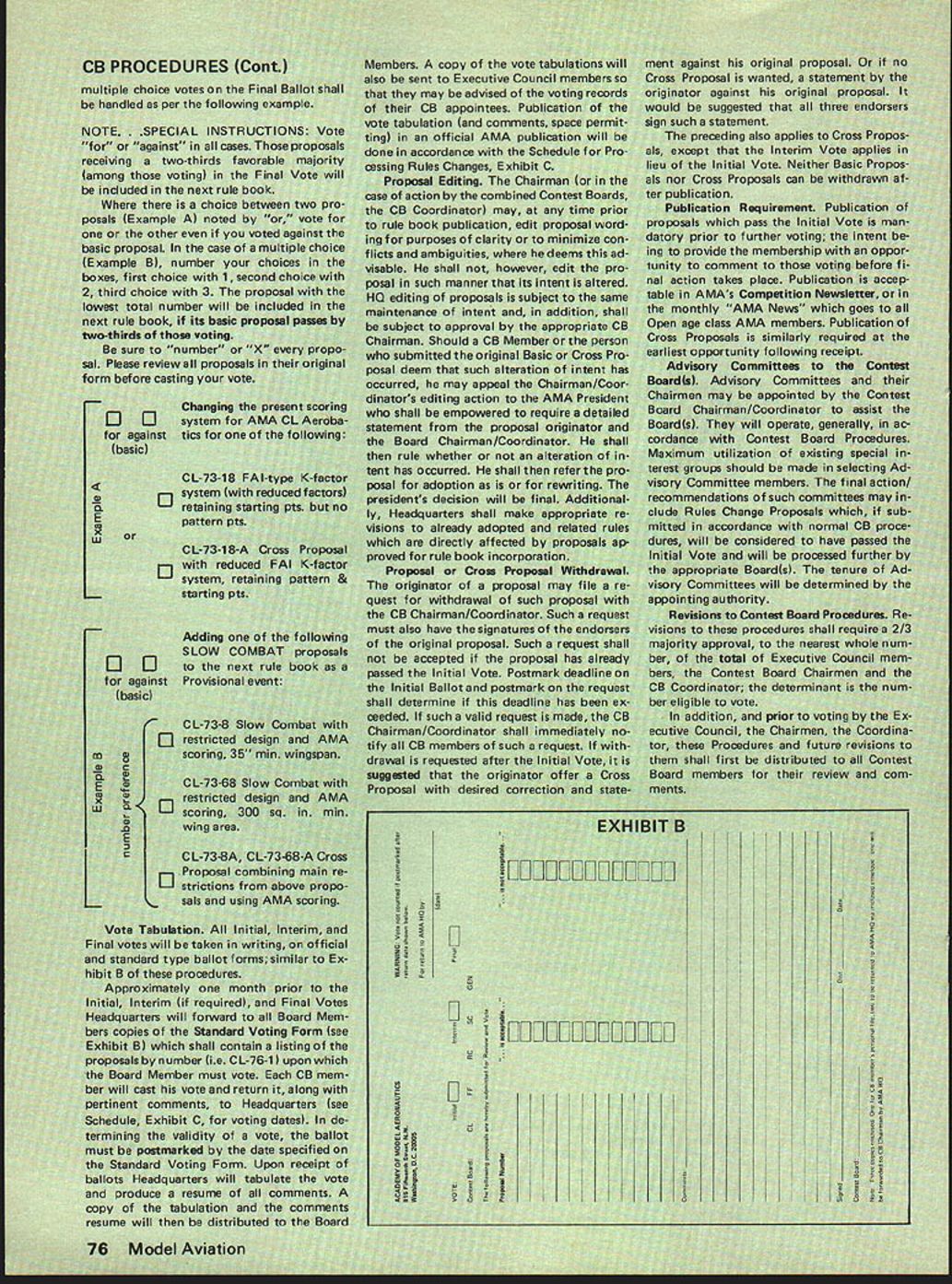
NOTE. - SPECIAL INSTRUCTIONS: Vote "for" or "against" in all cases. Those proposals receiving a two-thirds favorable majority (among those voting) in the Final Vote will be included in the next rule book.
Where there is a choice between two proposals (Example A) noted by "or," vote for one or the other even if you voted against the basic proposal. In the case of a multiple choice (Example B), number your choices in the boxes, first choice with 1, second choice with 2, third choice with 3. The proposal with the lowest total number will be included in the next rule book, if its basic proposal passes by two-thirds of those voting.
Be sure to "number" or "X" every proposal. Please review all proposals in their original form before casting your vote.
Example A
- [ ] for against (basic)
- Changing the present scoring system for AMA CL Aerobatics for one of the following:
- [ ] CL-73-18 FAI-type K-factor system (with reduced factors) retaining starting pts. but no pattern pts.
- or
- [ ] CL-73-18-A Cross Proposal with reduced FAI K-factor system, retaining pattern & starting pts.
Example B
- [ ] for against (basic)
- Adding one of the following SLOW COMBAT proposals to the next rule book as a Provisional event:
- [ ] CL-73-8 Slow Combat with restricted design and AMA scoring, 35" min. wingspan.
- [ ] CL-73-68 Slow Combat with restricted design and AMA scoring, 300 sq. in. min. wing area.
- [ ] CL-73-8A, CL-73-68-A Cross Proposal combining main restrictions from above proposals and using AMA scoring.
Vote Tabulation. All Initial, Interim, and Final votes will be taken in writing, on official and standard type ballot forms; similar to Exhibit B of these procedures.
Approximately one month prior to the Initial, Interim (if required), and Final Votes Headquarters will forward to all Board Members copies of the Standard Voting Form (see Exhibit B) which shall contain a listing of the proposals by number (i.e. CL-76-1) upon which the Board Member must vote. Each CB member will cast his vote and return it, along with pertinent comments, to Headquarters (see Schedule, Exhibit C, for voting dates). In determining the validity of a vote, the ballot must be postmarked by the date specified on the Standard Voting Form. Upon receipt of ballots Headquarters will tabulate the vote and produce a resume of all comments. A copy of the tabulation and the comments resume will then be distributed to the Board Members. A copy of the vote tabulations will also be sent to Executive Council members so that they may be advised of the voting records of their CB appointees. Publication of the vote tabulation (and comments, space permitting) in an official AMA publication will be done in accordance with the Schedule for Processing Rules Changes, Exhibit C.
Proposal Editing. The Chairman (or in the case of action by the combined Contest Boards, the CB Coordinator) may, at any time prior to rule book publication, edit proposal wording for purposes of clarity or to minimize conflicts and ambiguities, where he deems this advisable. He shall not, however, edit the proposal in such manner that its intent is altered. HQ editing of proposals is subject to the same maintenance of intent and, in addition, shall be subject to approval by the appropriate CB Chairman. Should a CB Member or the person who submitted the original Basic or Cross Proposal deem that such alteration of intent has occurred, he may appeal the Chairman/Coordinator's editing action to the AMA President who shall be empowered to require a detailed statement from the proposal originator and the Board Chairman/Coordinator. He shall then rule whether or not an alteration of intent has occurred. He shall then refer the proposal for adoption as is or for rewriting. The president's decision will be final. Additionally, Headquarters shall make appropriate revisions to already adopted and related rules which are directly affected by proposals approved for rule book incorporation.
Proposal or Cross Proposal Withdrawal. The originator of a proposal may file a request for withdrawal of such proposal with the CB Chairman/Coordinator. Such a request must also have the signatures of the endorsers of the original proposal. Such a request shall not be accepted if the proposal has already passed the Initial Vote. Postmark deadline on the Initial Ballot and postmark on the request shall determine if this deadline has been exceeded. If such a valid request is made, the CB Chairman/Coordinator shall immediately notify all CB members of such a request. If withdrawal is requested after the Initial Vote, it is suggested that the originator offer a Cross Proposal with desired correction and statement against his original proposal. Or if no Cross Proposal is wanted, a statement by the originator against his original proposal. It would be suggested that all three endorsers sign such a statement.
The preceding also applies to Cross Proposals, except that the Interim Vote applies in lieu of the Initial Vote. Neither Basic Proposals nor Cross Proposals can be withdrawn after publication.
Publication Requirement. Publication of proposals which pass the Initial Vote is mandatory prior to further voting. The intent being to provide the membership with an opportunity to comment to those voting before final action takes place. Publication is acceptable in AMA's Competition Newsletter, or in the monthly "AMA News" which goes to all Open class AMA members. Publication of Cross Proposals is similarly required at the earliest opportunity following receipt.
Advisory Committees to the Contest Board(s). Advisory Committees and their Chairmen may be appointed by the Contest Board Chairman/Coordinator to assist the Board(s). They will operate, generally, in accordance with Contest Board Procedures. Maximum utilization of existing special interest groups should be made in selecting Advisory Committee members. The final action/recommendation of such committees may include Rules Change Proposals which, if submitted in accordance with normal CB procedures, will be considered to have passed the Initial Vote and will be processed further by the appropriate Board(s). The tenure of Advisory Committees will be determined by the appointing authority.
Revisions to Contest Board Procedures. Revisions to these procedures shall require a 2/3 majority approval, to the nearest whole number, of the total of Executive Council members, the Contest Board Chairmen and the CB Coordinator; the determinant is the number of members eligible to vote.
In addition, and prior to voting by the Executive Council, the Chairmen, the Coordinator, these Procedures and future revisions to them shall first be distributed to all Contest Board members for their review and comments.
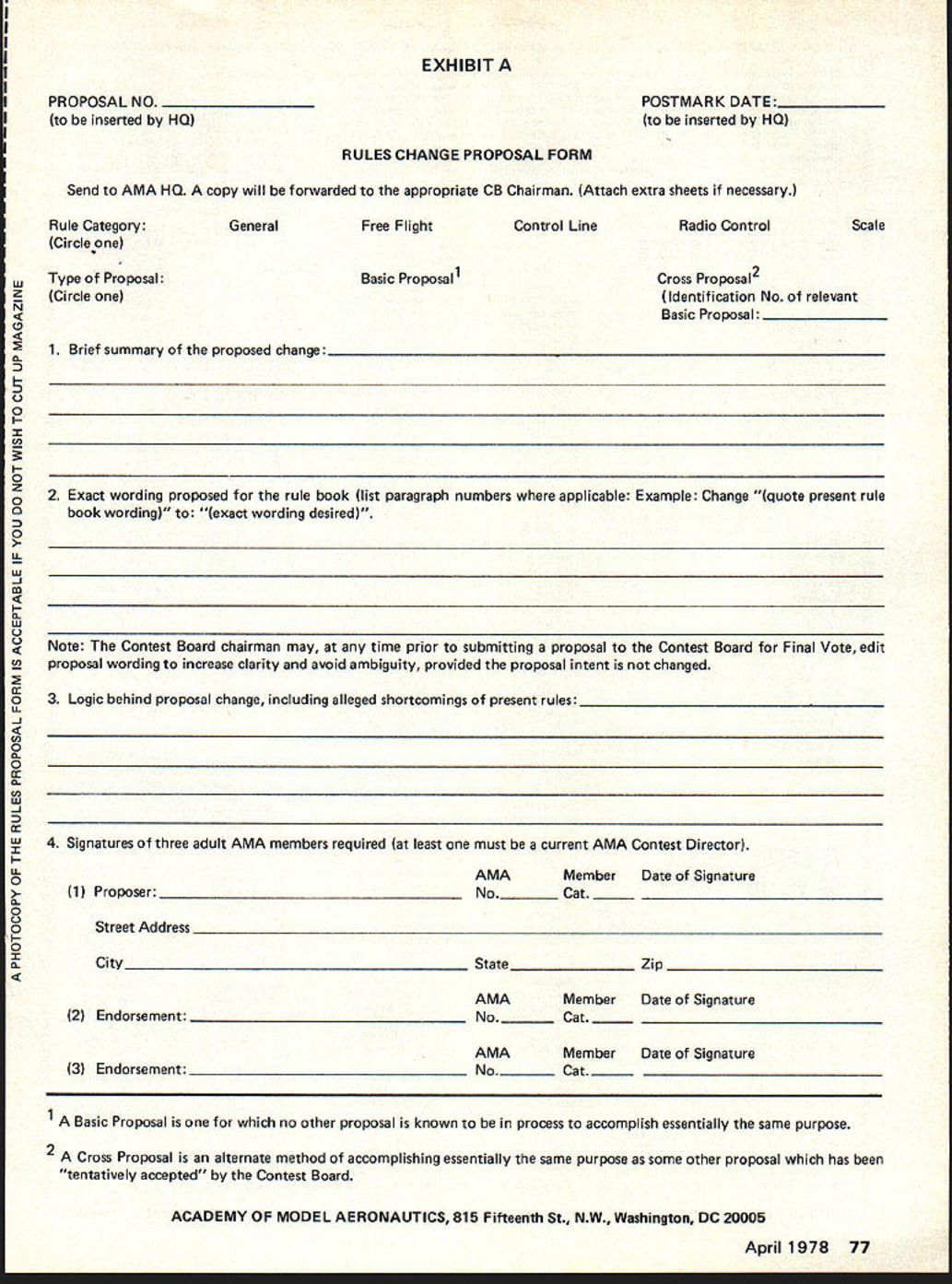
EXHIBIT A
PROPOSAL NO. _____________________ (to be inserted by HQ)
POSTMARK DATE: __________________ (to be inserted by HQ)
RULES CHANGE PROPOSAL FORM
Send to AMA HQ. A copy will be forwarded to the appropriate CB Chairman. (Attach extra sheets if necessary.)
Rule Category: (Circle one) General Free Flight Control Line Radio Control Scale
Type of Proposal: (Circle one) Basic Proposal1 Cross Proposal2 (Identification No. of relevant Basic Proposal: ____________________)
- Brief summary of the proposed change:
_______________________________________________________________________________ _______________________________________________________________________________ _______________________________________________________________________________
- Exact wording proposed for the rule book (list paragraph numbers where applicable; Example: Change "(quote present rule book wording)" to: "(exact wording desired)":
- Logic behind proposal change, including alleged shortcomings of present rules:
- Signatures of three adult AMA members required (at least one must be a current AMA Contest Director).
Note: The Contest Board chairman may, at any time prior to submitting a proposal to the Contest Board for Final Vote, edit proposal wording to increase clarity and avoid ambiguity, provided the proposal intent is not changed.
(1) Proposer: _______________________________________ Street Address __________________________________ City ________________________ State _____ Zip _____ AMA No. _______ Member Cat. _____ Date of Signature ___________
(2) Endorsement: ___________________________________ AMA No. _______ Member Cat. _____ Date of Signature ___________
(3) Endorsement: ___________________________________ AMA No. _______ Member Cat. _____ Date of Signature ___________
1 A Basic Proposal is one for which no other proposal is known to be in process to accomplish essentially the same purpose.
2 A Cross Proposal is an alternate method of accomplishing essentially the same purpose as some other proposal which has been "tentatively accepted" by the Contest Board.
A PHOTOCOPY OF THE RULES PROPOSAL FORM IS ACCEPTABLE IF YOU DO NOT WISH TO CUT UP MAGAZINE.
ACADEMY OF MODEL AERONAUTICS, 815 Fifteenth St., N.W., Washington, DC 20005
Competition Newsletter
Competition News will present, from time to time, constructive and thought-provoking ideas or criticisms of AMA rules and policies which affect competitors. When the issue has two sides, CN will endeavor to print all viewpoints that have been submitted — within the limits of available space, uniqueness, constructiveness, timeliness and good taste. Determination of the appropriateness of publication of any of these matters must of necessity rest solely with the publisher.
The thoughts presented are those of the author, and should not necessarily be construed as those of AMA HQ, AMA officers or the publisher. All should note that publication hereof a rules-change or policy-change idea does not necessarily mean that specific proposal has been presented to the Contest Board, Executive Council, or appropriate committee; such action is the responsibility of the author or anyone else interested in obtaining official action.
NO CONTEST LOSERS
This month's theme is about contests. Now a contest means winners, and we all like to win. Some enter contests because they are pretty certain who will be in that winner's circle, while others will not enter for fear of losing. Now let's analyze this situation.
First, take the person who will not enter a contest, if, just if, he were to enter some type of competition he would surely make many new friendships, find new ideas, and above all put his ego on a little bit of a trip. "Oh, I didn't get a trophy, so I lost." That just isn't true.
Even when you place last you haven't lost. Think of this: how many people are there who cannot even fly? Next time you attend a contest watch the spectators, read their expressions. They would like to be you, to be able to fly, or build like you or just be part of what's going on. Even last place is a winner when looked at in this way. You can't eat a trophy, but you can and will relive many times over the memories of good times had at a contest.
There is no contest if anyone is assured he will win. Compete with people a little better than you, and you will become more proficient at your endeavors.
One last word, do your best to take an active part in club contests, valley contests or any contest you can join in. Help your club, aircraft modeling and yourself to achieve new milestones.
(Reprinted from Vector, newsletter of the Miniature Aircraft Pilots Assn., Tempe, AZ, edited by Frank T. Smith.)
FF COUPE D'HIVER 80 VS. 100 GRAMS
Bob White Monrovia, CA
Since I have, quite recently, been informed of certain events that took place at the last CIAM meeting in Paris, I feel it is my duty as an FAI flier to give one person's opinion on what should be of interest to many other fliers in this country.
The French proposal was to approve the 100 gram rule for F1G, more familiarly known in France as Coupe d'Hiver. The vote was 11 against, and 10 in favor. European countries are in favor of the change, but the U.S. representative voted against it! We should support the increased weight to encourage a high standard of performance. It is a good event, worth flying and worth supporting, and in my opinion we should definitely instruct our representatives to vote for the 100 gm Coupe rule change.
Incidentally, there was no questionnaire or opinion inquiry sent to any of our fliers before our representative was sent to the meeting in Paris last December. (CN: See note at end.) Had we been informed of what was on the agenda for the meeting, we as individuals could have written to volunteer our preferences and opinions. I feel that there should be more of an effort made on the part of the CIAM representative to get these opinions from the people he is representing.
As one opinion, I feel that the international Coupe rule should be changed to a weight requirement of 90 grams plus 10 grams of rubber, thus making it a 100 gm plane.
I also realize that this is a reversal of an opinion which I had in the past. At that time I had a little different viewpoint on Coupe flying, and I didn't realize certain factors. Subsequently, I have been fortunate enough to fly this event in competition in Europe, in southern France, to be exact. I flew my 100 gm plane with the best of fliers in France, and it was quite an experience. With the 80 gm Coupe and the current state of the art, especially in Europe, it is not a real challenge to max, particularly in the early morning or evening air. This was my experience in France during the summer of 1977. I was flying in a contest in the evening air, and it maxed — at 100 gm weight! In the middle of the day, of course, it's another story. It wasn't easy to get a max during that time.
There is nothing that precludes our flying 80 gm Coupes in this country. At the CIAM meeting, however, we must remember that we are formulating rules for international competition. Those rules should present a challenge to the fliers and encourage a high standard of performance.
Let me go back a little and recount some of the rules changes. When Coupe d'Hiver was made a provisional event for international competition by the CIAM, one item in the rules was changed, and that was the elimination of ROG provision, a restricting factor. The plane was 80 gm, and the max was 2 minutes. Hand launching improved the performance of the airplane, and other details such as design and propeller changes have further improved its performance. I don't mean to say that it's easy to make a max with a 100 gm Coupe or even an 80 gm Coupe.
Some people have the mistaken idea that Coupe d'Hiver is for beginners as a step to Wakefield, perhaps, and so they say it must be easy and weigh 70 gm with 10 gm of rubber. They are wrong! We have plenty of events that perform the function of encouraging newcomers. Coupe has never been an event in which newcomers could excel. It is difficult and, sometimes, more difficult than Wakefield. It is a small-field, highly sophisticated form of rubber-powered competition, and before you can feel that you are successful in it you must put forth quite a bit of work and training to get any kind of good performance.
I do feel that for flying in our country, 80 grams is fine, because it is not considered the highest performance competition that Wakefield is, but in the future, with smaller fields, it probably will be. I think A1 glider is considered in the same way.
Many countries are flying Coupe at 100 gm weight because it is a better competition and, also, it's better for the small field requirements. In my part of the U.S. where I do my flying we lose many Coupes because of strong thermals. Even though they have DT'd, they keep going up and out of sight. I have lost more Coupes than any other type of rubber-powered plane, including Unlimited Rubber, because of the 80 gram weight.
Again, I strongly urge that the U.S. support the proposal for the 100 gm Coupe the next time it is offered. Our representative should vote for it, and we should support it, thus encouraging a high standard of performance in this event.
CN Note: Never has there been sufficient time (between receipt of the FAI/CIAM agenda, with the proposals, and the meeting date) to publish the proposals in advance and secure feedback from individuals, and it doesn't seem likely that there will ever be enough time for this procedure. Usually there is enough time to send pertinent portions of the agenda to the various special interest groups (such as NFFS, NSRCA, PAMPA, etc.) and to U.S. members of CIAM subcommittees for advance feedback and guidance to the U.S. delegate, but even this procedure was compromised the last time around due to late arrival of the agenda. The official agenda didn't arrive at AMA HQ until the day before Thanksgiving, although an unofficial version arrived several days earlier. As explained in the "AMA News" section of the March issue, there was a frantic effort in distributing the agenda material and collecting viewpoints.
THE FAI FF PROGRAM
Bob Stalick
At this point in time, it might be worthwhile to pause and take a look at the FAI FF Program. The number of contestants dropped somewhat from last program's high of around 300 to this year's 237. This drop in number is cause for reflection. Is the program failing? Or is the program designing itself along the lines of the wishes of its participants? For nearly two years, as program committee chairman, I listened to dire predictions, then watched as areas of the country espoused their pet theories. If these pet theories weren't followed, the story would go, then the program is going downhill. As with all kinds of ideas or plans, there would never be unanimity of opinion. In fact, there was seldom clear consensus.
Has the program bureaucratized itself into the ground? Why won't someone step forward and volunteer to be the program manager? Why are sites and sponsors so hard to find?
As I see it, these issues are complex and intertwined. The size of the committee is unwieldy. No one has the authority to do anything without polling the others. The Chairman can make decisions, but he is subject to being countermanded. AMA HQ doesn't want the headaches, and who can blame them. We are in fact stewing in our own broth. Perhaps we have run full circle. Perhaps it is time to review the whole concept of a democratic committee. Perhaps we should return to the previous format of a program administrator with his own small advisory group and let him run the whole thing—if we can find such a person.
I offer no solutions, as I believe that the entire question is too complex to be solved under the current structure.
I, for one, am enjoying flying in the program—and letting Wayne Drake represent me, because I don't want to spend the kind of time it took to be a conscientious committee chairman or member.
Besides, it's more enjoyable doing what I like to do—the reason I took up this hobby in the first place. And I believe that that's the attitude shared by far too many of us in the program. The difference is that I have been there—have you?
(Reprinted from WMC Patter, newsletter of the Willamette Modelers Club of Oregon.)
Transcribed from original scans by AI. Minor OCR errors may remain.

