
COMPETITION NEWSLETTER
RC CONTEST BOARD CHANGES MASTERS PATTERN
Due to later action by the Radio Control Contest Board, the June issue report of finalization of the Masters pattern has turned out to be in error, and neither the "Swiss Pattern" nor the 1977 FAI Pattern will be recommended for use as the Masters pattern in 1978-79 (although the 1977 FAI Pattern continues to be approved for the Expert class). This situation is explained in the following message from RC Contest Board Chairman Bill Northrop:
"Demonstrating not only its desire, but also its ability to cooperate beyond set Contest Board Procedures, the RC Contest Board has made, at the direction of its chairman, Bill Northrop, some last-minute changes in the 1978-79 rules pertaining to the Masters Pattern. These changes were made at the official request of the NSRCA (National Society of Radio Controlled Aerobatics), which met at the Weak Signals' Toledo RC Exposition, on April 8th. RC Contest Board members attending the Exposition included Chairman Bill Northrop, District X; Ed Izzo, District I; Dave Brown, District III; and Ralph Brooke, District XI.
"In a pre-meeting discussion with the NSRCA president, Mike Mueller, and former World Champs team member, Ron Chidgey, RC Contest Board Chairman Bill Northrop set up the requirements that the NSRCA would have to follow in order that the desired changes could be made and incorporated into the rule book. At that time the book was in the final stages of production, and ordinarily considered far beyond the point of making revisions.
"With the changes to be made, the Masters will fly either the complete 1978 FAI "ABC" Pattern, or, at contests where time and/or person-power does not permit, the "Finals" schedule only of the 1978 FAI "ABC" Pattern. The "Finals" schedule is a "do-it-yourself" maneuver list made up by each contestant from the maneuvers listed in Schedules A, B, and the list of extra maneuvers of the 1978 FAI Pattern. In short contests using the "Finals" schedule, the contestant would fly the "Finals" Pattern in every round."
CN Note: AMA rules permit deviations when such deviations are well advertised in advance. It is possible, thus, for Masters Class events to be run using the 1977 FAI Pattern or the "Swiss Pattern" so long as all contest announcements contain this information. It is acknowledged that, in some cases, plans to use one or the other of these patterns have gone too far, based upon previously published information. To revert, now, to the 1978 FAI "ABC" Pattern. When plans have not gone too far, however, it is recommended that the 1978 FAI "ABC" six-flight schedule be used for the Masters Class, or the "Finals" schedule, alone, of the 1978 "ABC" Pattern.
With adequate advertisement, it also is possible for contest organizers to develop a fixed maneuver sequence from the "Finals" schedule of the 1978 FAI "ABC" Pattern, instead of leaving choice of the maneuvers and sequence to the fliers.
RULE BOOK NOW PRINTED
When this was written it was expected that printing and mailing of the 1978-79 AMA rule book would be completed, and in fact many AMA members should have received their copies before receiving this issue of the magazine. Mailing of the rule book was scheduled for the first few days of May, whereas mailing of this issue was scheduled for just after mid-May.
The initial distribution of the rule book was a mass mailing to all AMA members whose applications for 1978 AMA memberships had reached AMA HQ by April 15. Rule books for those who signed up after April 15 will be mailed in weekly or bi-weekly batches, or as volume warrants.
Although many should receive their rule books prior to receiving this issue of Model Aviation, inconsistencies in mail delivery, beyond our control, may delay the rule book in some instances. Suggestion: If you believe your membership application reached AMA HQ by April 15, and if you haven't received your rule book by June 15, write to AMA HQ and inquire.
INDOOR TEAM PROGRAM APPROVED
Previous participants of Indoor Team Selection Programs have approved by a resounding 44 to 9 the two-year 1978-79 proposal as detailed in last month's CN section, page 75. Local Contests in the program, thus, can be started immediately.
Only one administrative detail concerning Local Contests has been added to what was published: points can be accumulated only at contests or Record Trials that have been AMA sanctioned; points will be based on a special Indoor Team Program reporting form which must be submitted by the Contest Director, or contest administrator, to AMA HQ. Contest Directors of all AMA sanctioned contests or Record Trials involving Indoor events will be sent the special forms for collecting program entry fees and recording the performances. Contest Directors should note that normal meet sanctioning procedures apply, requiring submission through the area Contest Coordinator, even if the event is solely for the purposes of the Indoor Team Program.
To recap, briefly, the program encompasses an unlimited number of Local Contests in 1978 and 1979, one Regional Contest in 1978 and another in 1979, each year a Final Contest to be held in 1979. Selection of the 1980 U.S. Indoor World Team is based upon accumulation of points, with the maximum attainable being 1,110 (10 from a Local Contest, 100 from a Regional Contest, and 1,000 from the Final Contest).
Since the Local Contests are already beginning, full details of this level are as follows (see the June issue for details of the Regional and Final Contests):
- At least three entrants required to hold a contest.
- The contest (or Record Trials) must be AMA sanctioned.
- Model specifications: 20" minimum span, 2 grams maximum weight.
- No qualification level required to go to Regional Contests.
- Program participants may enter as many local contests as they please; the single best contest counts. The program entry fee for each Local Contest entered is $3.00; pay at the flying site (alternatively, the program fee may be paid to AMA HQ by mail). Entrants must be current AMA members and have the $5 FAI Stamp (or pay for same prior to flying).
- The present team and manager, if he placed fourth in the selection program, may pass the Local Contest and receive 10 points for this program.
- Scoring: Total of two best out of six flights. Top score counts 10 points. Other scores are a percentage of these points based on an entrant's time divided by the winning time.
FREE FLIGHT TEAM FINALS TO TAFT
A vote by qualified finalists in the current Free Flight Team Selection Program, concluded on April 1, has resulted in 65 being for the Team Finals at Taft, CA, vs. 29 for Bong, WI. The event, therefore, will be at Taft due to the 69% majority vote. The dates, as previously decided, are over the Labor Day weekend this year.
A site at Sacramento, CA, also was offered, but for other than the approved Labor Day dates. The FF Team Selection Committee, chaired by Rol Anderson, felt that other dates could not be considered in the current program in view of the fact that the Labor Day dates had been voted on twice already in the program.
At the time of the vote, finalists had in their hands probably more information about the Taft and Bong sites than in any other previous program—thanks to the efforts of the Site Subcommittee. In addition to maps of the two sites, there were data sheets for each as well as evaluations and observations on important points by committee members.
FFCB EMERGENCY VOTE DELAYED
Concerning Acceptable Indoor Sites
Free Flight Contest Board Chairman Joe Boyle, Jr. reports that he does not intend to have the board vote on proposals to restrict or define acceptable indoor sites, on an emergency basis, until at least July. (Originally it was thought that the board would be voting in early April, as reported in the CN section of the April issue.)
The delay is intended to allow time for study and recommendation by the AMA Indoor Committee. The preliminary feeling expressed by the committee's chairman, Ray Harlan, is that any ruling in the area of acceptable sites must be thought out very carefully in order to prevent elimination of many of the relatively few sites which are available for indoor flying.
PATCH SALES TO SUPPORT U.S. TEAMS
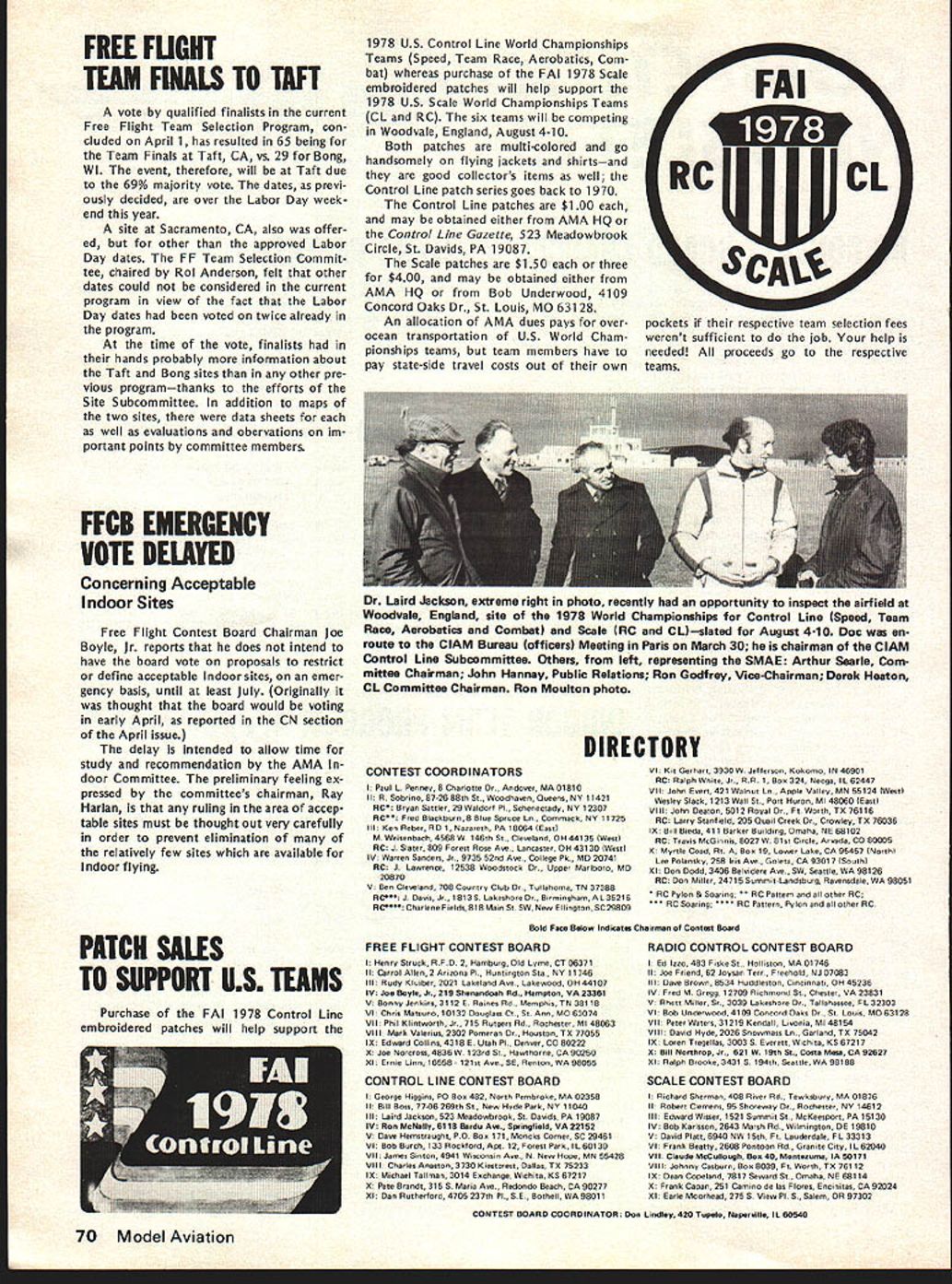
Purchase of the FAI 1978 Control Line embroidered patches will help support the 1978 U.S. Control Line World Championships Teams (Speed, Team Race, Aerobatics, Combat) whereas purchase of the FAI 1978 Scale embroidered patches will help support the 1978 U.S. Scale World Championships Teams (CL and RC). The six teams will be competing in Woodvale, England, August 4-10.
Both patches are multi-colored and go handsomely on flying jackets and shirts—and they are good collector's items as well; the Control Line patch series goes back to 1970.
The Control Line patches are $1.00 each, and may be obtained either from AMA HQ or the Control Line Gazette, 523 Meadowbrook Circle, St. Davids, PA 19087.
The Scale patches are $1.50 each or three for $4.00, and may be obtained either from AMA HQ or from Bob Underwood, 4109 Concord Oaks Dr., St. Louis, MO 63128.
An allocation of AMA dues pays for overseas transportation of U.S. World Championships teams, but team members have to pay state-side travel costs out of their own pockets if their respective team selection fees weren't sufficient to do the job. Your help is needed! All proceeds go to the respective teams.
RC CONTEST BOARD CHANGES MASTERS PATTERN
Due to later action by the Radio Control Contest Board reported in the June issue, finalization of the Masters pattern has turned out to be in error. Neither the Swiss Pattern nor the 1977 FAI Pattern will be recommended for use as the Masters pattern for 1978-79, although the 1977 FAI Pattern continues approved for the Expert class. The situation is explained in the following message from RC Contest Board Chairman Bill Northrop.
Not too far, however, it was recommended that the 1978 FAI ABC six-flight schedule be used as the Masters Class Finals schedule alone. The 1978 ABC Pattern is adequate. It is also possible for contest organizers to develop a fixed maneuver sequence Finals schedule. The 1978 FAI ABC Pattern leaves the choice of maneuver sequence to the fliers.
RULE BOOK NOW PRINTED
Demonstrating its desire and its ability to cooperate beyond the set Contest Board procedures, the RC Contest Board has made, at the direction of its chairman Bill Northrop, some last-minute changes in the 1978-79 rules pertaining to the Masters Pattern. Changes were made at the official request of NSRCA (National Society of Radio Controlled Aerobatics) and met at the Weak Signals Toledo RC Exposition April 8. RC Contest Board members attending the Exposition included Chairman Bill Northrop; District X: Ed Izzo; District V: Dave Brown; District III: Ralph Brooke; District XI: [representative].
It was expected that printing and mailing of the 1978-79 AMA rule book would be completed; in fact AMA members should have received copies before receiving this issue of the magazine. Mailing of the rule book was scheduled for the first few days of May, whereas mailing of the issue was scheduled just after mid-May. Initial distribution of the rule book would be by mass mailing to AMA members whose applications for 1978 AMA memberships reached AMA HQ by April 15. Rule books signed up after April 15 would be mailed weekly or bi-weekly in batches as the volume warranted. Although members should receive rule books prior to receiving this issue of Model Aviation, inconsistencies in mail delivery beyond our control may delay the rule book in some instances. Suggestion: if you believe your membership application reached AMA HQ April 15 and you haven't received the rule book by June 15, write AMA HQ to inquire.
At a pre-meeting discussion, NSRCA president Mike Mueller, former World Champs team member Ron Chidgey, and RC Contest Board Chairman Bill Northrop set up the requirements NSRCA would have to follow in order that desired changes could be made and incorporated into the rule book in time. The book was in final stages of production and ordinarily considered far beyond the point for making revisions. Changes made: Masters will fly either the complete 1978 FAI ABC Pattern at contests where time and/or person-power permit, and/or the Finals schedule. The 1978 FAI ABC Pattern Finals schedule is a "do-it-yourself" maneuver list made up of contestant maneuvers listed. Schedules B list extra maneuvers. For 1978 FAI Pattern short contests using the Finals schedule, the contestant would fly the Finals Pattern round.
CN Note: AMA rules permit deviations; such deviations, if well advertised in advance, are possible. Thus Masters Class events run using the 1977 FAI Pattern or Swiss Pattern in long contests where announcements contain the information. In some cases plans to use other patterns had gone too far based upon previously published information; revert now to the 1978 FAI ABC Pattern where plans have gone beyond published guidance.
INDOOR TEAM PROGRAM APPROVED
Previous participants in Indoor Team Selection Programs have approved resoundingly the two-year 1978-79 proposal detailed in last month's CN section (page 75). The Local Contests program thus can be started immediately. Only an administrative detail concerning Local Contests has been added: published points can be accumulated at contests (Record Trials) that are AMA sanctioned. Points will be based on a special Indoor Team Program reporting form which must be submitted by the Contest Director or contest administrator to AMA HQ.
Contest Directors of AMA sanctioned contests and Record Trials involving Indoor events will be sent special forms collecting program entry fees and recording performances. Contest Directors should note that normal meet sanctioning procedures apply, requiring submission through the area Contest Coordinator when the event is solely for purposes of the Indoor Team Program.
To recap briefly, the program encompasses an unlimited number of Local Contests (1978-1979) and Regional Contests (1978).
RC CONTEST BOARD CHANGES — MASTERS PATTERN
Due to later action by the Radio Control Contest Board reported in the June issue, finalization of the Masters Pattern has turned out to be in error. Neither the Swiss Pattern nor the 1977 FAI Pattern will be recommended for use as the Masters Pattern for 1978–79, although the 1977 FAI Pattern continues approved for Expert class. The situation is explained in the following message from RC Contest Board Chairman Bill Northrop.
It was felt, however, that it would be too far to recommend that the 1978 FAI ABC six-flight schedule be used for the Masters Class Finals schedule alone. The 1978 ABC Pattern is considered adequate, and it is also possible for contest organizers to develop a fixed maneuver sequence for the Finals schedule. The 1978 FAI ABC Pattern leaves the choice of maneuver sequence to the fliers.
RULE BOOK NOW PRINTED
Demonstrating its desire and its ability to cooperate beyond the set Contest Board procedures, the RC Contest Board has directed its chairman, Bill Northrop, to make some last-minute changes in the 1978–79 rules pertaining to the Masters Pattern. Changes were made at the official request of NSRCA (National Society of Radio Controlled Aerobatics) at the Weak Signals/Toledo RC Exposition, April 8. RC Contest Board members attending the Exposition included Chairman Bill Northrop, District X — Ed Izzo, District — Dave Brown, and District III — Ralph Brooke.
It was written that printing and mailing of the 1978–79 AMA rule book would be completed; in fact, AMA members should have received copies before receiving this issue of the magazine. Mailing of the rule book was scheduled the first few days of May, whereas mailing of the issue was scheduled just after mid‑May. Initial distribution of the rule book will be by mass mailing to AMA members. Applications for 1978 AMA memberships received at AMA HQ by April 15 will be included in that mailing. Rule books for memberships signed up after April 15 will be mailed in weekly or bi‑weekly batches as volume warrants.
Although members should receive rule books prior to receiving this issue of Model Aviation, inconsistencies in mail delivery beyond AMA’s control may delay the rule book in some instances. If you believe your membership application reached AMA HQ by April 15 and you have not received your rule book by June 15, write AMA HQ to inquire.
In pre-meeting discussion, NSRCA president Mike Mueller, former World Champs team member Ron Chidgey, and RC Contest Board Chairman Bill Northrop set up requirements NSRCA would have to follow in order that desired changes could be made and incorporated into the rule book in time. The book was in the final stages of production and ordinarily considered far beyond the point for making revisions, but the changes were made.
Masters will fly either the complete 1978 FAI ABC Pattern at contests where time and/or personnel permit, or the Finals schedule (1978 FAI ABC Pattern Finals schedule). The Finals schedule is a do‑it‑yourself maneuver list made up by the contestant; maneuvers are listed in Schedule B as extra maneuvers. In short, contestants at short contests using the Finals schedule would fly the Finals Pattern round.
CN Note: AMA rules permit deviations; such deviations, if well advertised in advance, are possible. Thus Masters Class events run using the 1977 FAI Pattern or the Swiss Pattern in long contest announcements must contain that information. In some cases, plans to use other patterns have gone too far based upon previously published information; revert now to the 1978 FAI ABC Pattern where plans have gone beyond published guidance.
Competition Newsletter
RULE BOOK NOW PRINTED
Demonstrating its desire and its ability to cooperate beyond the letter of the Contest Board Procedures, the RC Contest Board has made, at the direction of its chairman Bill Northrop, some last‑minute changes in the 1978‑79 rules pertaining to Masters Pattern. The changes were made at the request of NSRCA (National Society of Radio Controlled Aerobatics) at the Weak Signals Toledo RC Exposition April 8. RC Contest Board members attending the Exposition included Chairman Bill Northrop, District X Ed Izzo, District V Dave Brown, District III Ralph Brooke and District XI.
It was expected that printing and mailing of the 1978‑79 AMA rule book would be completed; in fact AMA members should have received copies before receiving this issue of the magazine. Mailing of the rule book was scheduled for the first few days of May, whereas mailing of the issue was scheduled just after mid‑May. The initial distribution of the rule book was a mass mailing to AMA members whose applications for 1978 AMA memberships reached AMA HQ by April 15. Rule books for memberships signed up after April 15 will be mailed in weekly or bi‑weekly batches as volume warrants. Although most should receive rule books prior to receiving this issue of Model Aviation, inconsistencies in mail delivery beyond our control may delay the rule book in some instances. Those who believe their membership application reached AMA HQ by April 15 but who have not received the rule book by June 15 should write AMA HQ to inquire.
INDOOR TEAM PROGRAM APPROVED
Previous participants: Indoor Team Selection Programs have approved the two‑year 1978‑79 proposal detailed in last month's CN section (page 75). The Local Contests program thus can be started immediately. Only an administrative detail concerning Local Contests has been added: what published points can be accumulated at contests. Record Trials that are AMA‑sanctioned points will be based on a special Indoor Team Program reporting form which must be submitted by the Contest Director or contest administrator to AMA HQ. Contest Directors of AMA‑sanctioned contests or Record Trials involving indoor events will be sent special forms collecting program entry fees and recording performances. Contest Directors should note normal meet sanctioning procedures apply, requiring submission through the area Contest Coordinator for the event solely for purposes of the Indoor Team Program.
To recap briefly, the program encompasses an unlimited number of Local Contests (1978‑1979), Regional Contests (1978) and
PROPOSAL TO REORGANIZE THE AMA
Mr. & Mrs. Eugene Turrolla Kent, WA
Regarding the item in the "Soapbox" on page 82 of the March 1978 issue, I consider this proposal an outright insult to me and all the men I have known who build and fly model aircraft—and have their youngsters involved in this same hobby.
One of the finest men I have ever known in airplane modeling was Dick Stark. Every time my boy had a question or a problem, Dick promptly dropped everything and did his utmost to help Gino. He also did this with all of the other youth I have seen him in contact with. Gino has a room full of trophies that he might not have won had I not been involved in getting him to build and fly model aircraft, and were it not for Dick Stark.
I think every adult, especially those over 18, should be absolutely engaged at the kind of thinking shown by this proposal. I think all adult modelers, at least those I have seen, are interested in helping our youth (that is, if they want to be helped). Perhaps the proposal should be applied to Arizona only, from whence it came. Up here in Washington State, we help our kids!
RULES PROPOSALS VS. RULE BOOK AVAILABILITY—ALSO, PYLON RACING EVENTS
Robert Camarata
I was reading in Model Aviation that it's that time again! Time to start sending in your rules proposals for 1980, even though the new rules book for 1978‑79 isn't even out yet! I proposed two years ago, and I still feel the same way. The AMA shouldn't allow new proposals until we've flown under the old rules for at least a year. This means speeding up the new rules proposal evaluation process from two years to one, or going three years between rule changes, perhaps the best way to go. Anything that speeds up an improvement over the current policy of allowing new proposals before the current rules have been flown under is desirable.
Pylon Racing. Since I'm editorializing I may as well take a poke at Dave Lane's column in Model Aviation as well. Dave wants a new racing event to interest new blood in pylon racing. Dave's arguments for this new event are the same ones heard when Formula I began, and when Formula I fillers began dropping out, as when FAI Pylon and now Quarter Midget began to diminish in number of participants.
The chronology of demise is always the same: a new event comes out that allows old pros and new flyers to compete equally or semi‑equally. Then the old pros turn in some rule improvements to the event (modified props, no nitro limitations, tuned pipes, etc.). Speeds jump 20‑40% and you can easily see who's an old pro and who isn't. Rather than propose another event I'd rather see a moratorium on any rules which would increase the technological level required to be competitive, or which would contribute to an increase in aircraft speed. Any increase in speed should result from improved building and flying skills and experience in the event, not from liberalizing the rules.
(Reprinted from Stick Times, newsletter of the Black Hawk RC Pilots, Inc., Waterloo, IA, edited by Roy Gerritsen.)
COLORS IN MINIATURE
Scale Colors—Huh?: As the AMA Rule Book is currently written, 25% of the points awarded during the static judging of Precision Scale and Sport Scale models is for "color and markings." Somehow, the part of static judging has gotten out of hand. Judges have gone "ape," thrashing wildly about and marking good models "down" for slight variations of color or hue!
For the absolute "scale nut," there'll be a color photograph of the aircraft he's modeled. But, for the hundreds upon hundreds of other scale modelers, you'll find color schemes that only approximate an original prototype. This is for a very important reason—nobody can duplicate colors exactly! Even the great Sears, Roebuck Co. publishes a caveat in its catalogs: "Because of the nature of printing ink, colors of items in this catalog may differ slightly from the merchandise." If Sears, with all of their high‑price help, can't get the colors right, how can the individual modeler be expected to duplicate the actual hue of an aircraft he's never seen? Eastman Kodak, like many other film firms, says that prints made from their film and color print paper will vary from the "real" ones. So, even if you have a slide or print of the aircraft you copied, your colors might not represent reality!
Consider the plight of the scale modeler who relies on profiles or other reference books. The color prints in these books will vary from the beginning of the press run to the end—and will drive the average modeler nuts trying to match them. Super‑research for your model may uncover a source of actual color chips, but these references are usually only available for current military types—or for the birds of World War II. What does the
(continued) modeler do if his ship is a civilian‑type, or a one‑of‑a‑prototype?
There's another consideration. Let's imagine the most outrageous of scale conditions — the modeler buys a real airplane, makes a model of it and then paints both with paints from the same can! Placed side by side, the average scale judge will detect a difference in color between the full‑size airplane and the model! The reason for this is size — the smaller model will appear to be slightly darker simply because the expanse of the painted area(s) is substantially smaller!
Black is black and white is white, but even these seemingly absolute colors can be "off" on a scale model. Is the black shiny or dull, is the white really white or a slightly off‑shade, with a little yellow in it? And — can the judges "see" the subtle difference?
The reason for this rather extended discussion: We feel that the color fetishists are full of hot air! We feel that the "color and markings" category for scale judging should be down‑played or opened up to reflect reality. In other words, if the full‑size airplane was painted crimson, then a crimson model should represent it without determining the degrees of crimson. A verbal description of the prototype colors should be acceptable to the scale judge and given equal weight to an "almost the right color" slide or printed three‑view. Only in this way can we get away from the idiocy of trying to duplicate colors that may or may not have been!
(Reprinted from the newsletter of the Pikes Peak RC Club, Colorado Springs, CO.)
WHO WINS THE NATS?
Benjamin J. Coplan, Jr. Monroeville, PA
Regarding the "Soapbox" item under this heading in the April issue, as a point of interest may I state that I have been involved in a similar controversy as a member of the Sports Car Club of America.
As an AMA member I feel that grass‑roots competition is the best source for so‑called "professionals." However, it is vital that a location for the championships of the U.S. to be found that suits the various categories of activity equally. Where it is not possible, then we have a dilemma.
I have been unable to find agreement with SCCA's selection of Road Atlanta as a site since it offers two things. One is a proximity to me and the most powerful division within the club in or about that area. Second, the event is fully sponsored with "big money" firms picking up a goodly portion of the tab. Finally, and most important, there is a travel expense allowance based on a formula that is equitable to all.
The source of these funds is simple. For every nationally sanctioned event there is a fee — part of the entrant's fee is put into the travel fund. This is a simplification, but certainly answers the nagging question of who will pay for it.
It is unfair to those who don't go to the Nats to have to pay for those who do! If we divide the real pros out (and we all know who they are — I hope) then one is taking a chance at winning or losing.
One of the authors points out his disappointment at an event — a field box in the pits wiped out his plane — he could not land elsewhere. Mario Andretti lost a Grand Prix because of a fuel pickup failure (3/4/78). The point here is that competition is a gamble. A travel fund is the only logical answer — for those who are not subsidized.
Those who wish to discuss this further are welcome to contact me (Benjamin J. Coplan, Jr., 605 Brightberry Rd., Monroeville, PA 15146). I might add that literature on these funds (travel) is available from several sources.
Let's quit crying and act. Competition of any sort costs a lot these days — and there have never been any guaranteed rewards.
Salina, KS — did you check the weather there in late September? Think about that one while trying to fly your glider.
PROPOSED FREE FLIGHT TEAM SELECTION PROGRAM
Tom McLaughlan Pensacola, FL
Whereas:
- Participation has dropped in team selection trials.
- Greater participation enhances the possibility of fielding a winning team.
- Greater participation reduces entry fees, thereby enticing more participation.
- More participation increases funds, thereby giving the selection committee greater flexibility in expanding the program.
- Greater participation encourages manufacturers to supply much needed equipment.
- Present method of team selection has made it impractical for many potential participants to compete.
- Present method of team selection has made it impractical for the average club or group to organize and hold team selection trials.
- Present method of team selection of two contests per 1/3 participants per two‑year period creates a competitive dead spot, resulting in diminishing enthusiasm, low competition, poor dissemination of information, little opportunity for each contestant to evaluate his own progress.
- Present method of team selection allowing one year for selected team members to get ready allows a major building and experimenting program, which it might have been better to have practiced with going equipment.
- Present method of team selection does not evaluate contestants' ability to compete at World Championship levels — 5–6 rounds per day vs. 7–10 rounds per day.
- Present method of team selection (3 days) does not evaluate contestants' equipment at World Championship requirements — may rework from day to day or use additional equipment.
- Present method of team selection does not evaluate contestants' ability to compete at World Championship close flight schedules.
- Proposed method of team selection reduces the period of time the team member has before competing at the World Championship. This should result in the team member being better prepared and competitively sharper.
- Proposed method of team selection provides for multi‑contests at semi‑final level, thereby giving opportunity to all and reduces major calamity and chance situations.
- Proposed method of team selection includes the Nats and U.S. FF Championships, upgrading these contests to a high prestige level. It also gives opportunity to that contestant who feels he cannot compete at the semi‑finals level.
- Proposed method of team selection reduces number of contestants per event, making it practical for many organizations to hold finals in ideal locations and at sites that otherwise would not be available.
- Proposed method of team selection of multi contests provides more practice at simulated World Championship conditions.
- Proposed method of team selection contests of one‑day duration simulates aircraft and support equipment requirements at World Championships.
- Proposed method of team selection makes it possible to have events on separate weekends. This increases the possibility of participation of more organizations, provides more sites, and flight conditions are more in line with World Championships.
- Proposed method of team selection of multi contest creates exchange of information, progressive learning, model de‑bugging and increases enthusiasm.
- Proposed method of team selection four months prior to competing at World Championships is in line with most countries — Korea selected at World Championships.
- Past history has proven that no region, regardless of numbers, has a lock on eventual team selection.
- Past history of World Championships has proven most winners have had to compete for approximately 10 rounds in one day.
Therefore, be it resolved that the present FAI Free Flight Team Selection Program be changed as follows:
- Qualifying Trials. No changes except no entry time limitations as long as contestant qualifies prior to participating in the semis, Nats and U.S. FF Championships.
- Semi‑finals.
a. Country divided into six regions. b. Qualified contestant may select one region he wishes to compete in, but once started he must continue. c. Contests will be held in regions over a 1½‑year period. There may be as many contests as desired, with a minimum of three spaced approximately six months apart and with a minimum of one month separation. d. Contestants will accumulate points at each contest he participates in — place plus tie point for each qualified contestant beaten. Contestant will be responsible and make himself available to break a tie if it should exist. e. Officials will select contestants' best three contests to establish winners. f. From each region the contestants with highest points will advance to the finals. g. Contests will be sanctioned meets of seven rounds and flyoffs as per World Championships formula. h. It will not be necessary to fly all events the same weekend. Organizers will have complete flexibility.
- Finals.
a. Eligible per event — 12 semi‑finalists, two each from Nats and U.S. FF Championships, three past team members. Total: 19 per event. When a winner in semi‑finals, Nats or U.S. FF Championships cannot compete, the next man down takes his place. b. Contests to be held four months prior to World Championships. c. Contest will be one day: 1st round 4 minutes plus (based on local conditions), six standard rounds of 3 minutes maximum, plus one round of 4 minutes, plus one round of 5 minutes. Total score will establish the winners. d. Events do not have to be held the same weekend. Organizers will have flexibility — base requirements on conditions and organizers. e. Site conditions to be as close as practical to scheduled World Championships site.
INDOOR TEAM PROGRAM APPROVED
Previous participants in the Indoor Team Selection Program have approved a resounding 44‑9 two‑year (1978–79) proposal detailed in last month's CN section (page 75). The Local Contests program thus can be started immediately. Only administrative detail concerning Local Contests has been added: what published points can be accumulated in contests. Record Trials that are AMA‑sanctioned points will be based on a special Indoor Team Program reporting form which must be submitted to the Contest Director or contest administrator at AMA HQ.
Contest Directors of AMA‑sanctioned contests and Record Trials involving indoor events will be sent special forms collecting program entry fees and recording performances. Contest Directors should note normal meet sanctioning procedures apply, requiring submission through the area Contest Coordinator for events solely for purposes of the Indoor Team Program.
To recap briefly, the program encompasses an unlimited number of Local Contests (1978–1979), Regional Contests (1978) and ...
RC CONTEST BOARD CHANGES MASTERS PATTERN
Due to later action of the Radio Control Contest Board, the June issue report finalization on the Masters pattern has turned out to be in error. Neither the Swiss Pattern nor the 1977 FAI Pattern will be recommended for use as the Masters Pattern for 1978–79, although the 1977 FAI Pattern continues approved for the Expert class. The situation is explained in the following message from RC Contest Board Chairman Bill Northrop.
Rule book now printed
Demonstrating its desire and its ability to cooperate beyond the set Contest Board Procedures, the RC Contest Board has, at the direction of its chairman Bill Northrop, made some last‑minute changes in the 1978–79 rules pertaining to the Masters Pattern. Changes were made at the official request of NSRCA (National Society Radio Controlled Aerobatics) at the Weak Signals Toledo RC Exposition April 8th. RC Contest Board members attending the Exposition included Chairman Bill Northrop, District X Ed Izzo, District ? Dave Brown, District III Ralph Brooke, District XI ?.
It is expected the printing and mailing of the 1978–79 AMA rule book would be completed; in fact AMA members should have received copies before receiving this issue of Model Aviation. Mailing of the rule book was scheduled the first few days of May, whereas mailing of the magazine issue was scheduled just after mid‑May. Initial distribution of the rule book will be by mass mailing to AMA members whose applications for 1978 AMA memberships reached AMA HQ by April 15. Rule books signed up after April 15 will be mailed weekly or bi‑weekly in batches as volume warrants. Although you should receive rule books prior to receiving this issue of Model Aviation, inconsistencies in mail delivery beyond our control may delay the rule book in some instances. Suggestion: if you believe your membership application reached AMA HQ April 15 and you haven't received your rule book by June 15, write AMA HQ to inquire.
Pre‑meeting discussion between NSRCA president Mike Mueller, former World Champs team member Ron Chidgey and RC Contest Board Chairman Bill Northrop set up requirements NSRCA would have, so desired changes could be made and incorporated in the rule book in time. The book was in final stages of production and ordinarily would be considered far beyond the point of making revisions; changes made will allow Masters to fly either the complete 1978 FAI ABC Pattern in contests, time and/or person‑power permitting, or the Finals schedule. The 1978 FAI ABC Pattern Finals schedule is a do‑it‑yourself maneuver list made up by the contest and maneuvers listed in Schedules B list extra maneuvers. For short contests using the Finals schedule, the contestant would fly the Finals Pattern round.
Note: AMA rules permit deviations; such deviations, if well advertised in advance, are possible. Thus Masters Class events run using the 1977 FAI Pattern or Swiss Pattern for long contests, provided announcements contain the information and such plans are acknowledged. In some cases plans to use other patterns had gone too far based upon previously published information; revert now to the 1978 FAI ABC Pattern.
Transcribed from original scans by AI. Minor OCR errors may remain.

