
RC AEROBATICS TEAM PROGRAM
Questions Answered
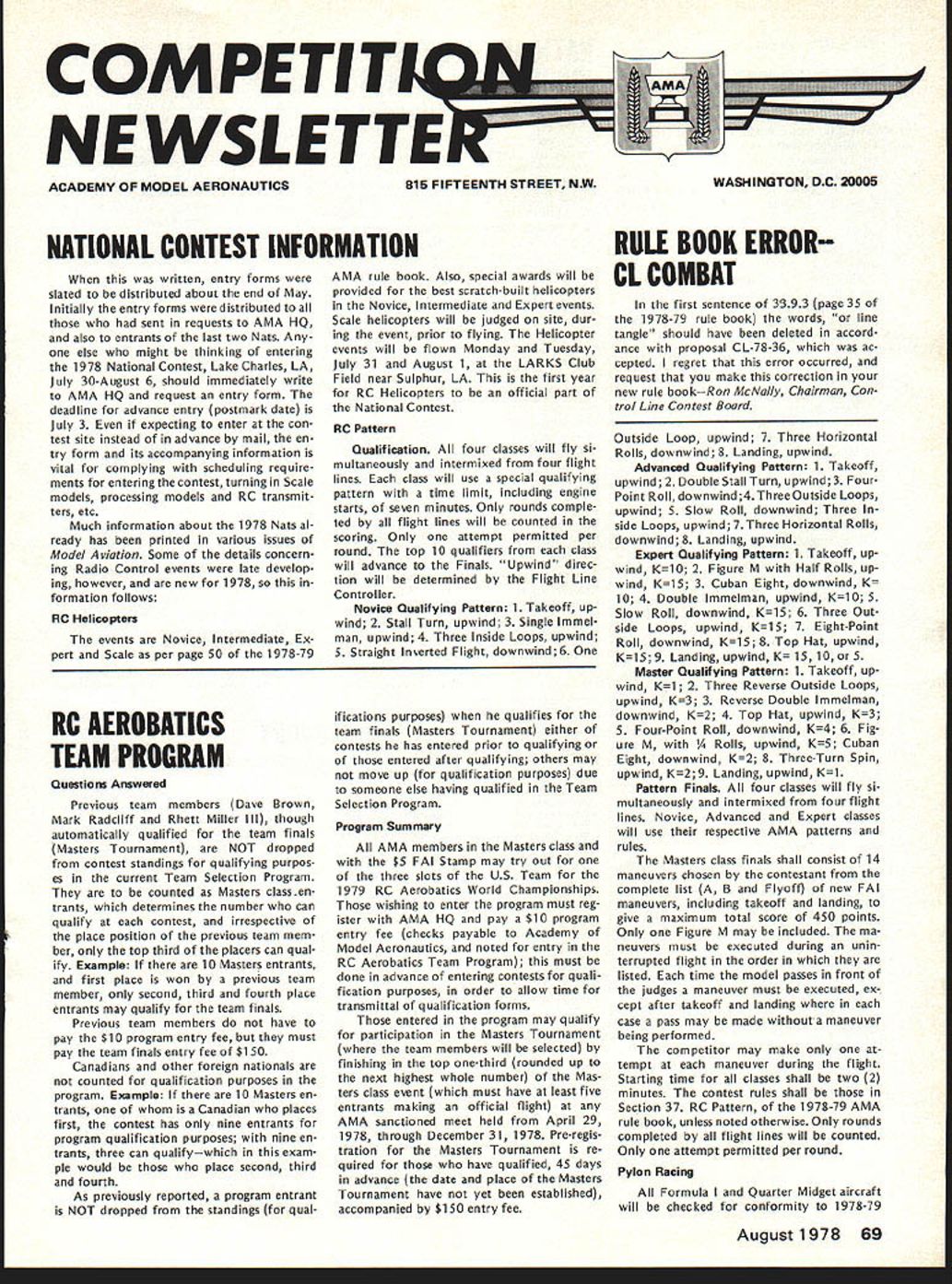
Previous team members (Dave Brown, Mark Radcliff and Rhett Miller III), though automatically qualified for the team finals (Masters Tournament), are NOT dropped from contest standings for qualifying purposes in the current Team Selection Program. They are to be counted as Masters class entrants, which determines the number who can qualify at each contest, and irrespective of the place position of the previous team member, only the top third of the placers can qualify. Example: If there are 10 Masters entrants, and first place is won by a previous team member, only second, third and fourth place entrants may qualify for the team finals.
Previous team members do not have to pay the $10 program entry fee, but they must pay the team finals entry fee of $150.
Canadians and other foreign nationals are not counted for qualification purposes in the program. Example: If there are 10 Masters entrants, one of whom is a Canadian who places first, the contest has only nine entrants for program qualification purposes; with nine entrants, three can qualify — which in this example would be those who place second, third and fourth.
As previously reported, a program entrant is NOT dropped from the standings (for qualification purposes) when he qualifies for the team finals (Masters Tournament) either of contests he has entered prior to qualifying or of those entered after qualifying; others may not move up (for qualification purposes) due to someone else having qualified in the Team Selection Program.
Program Summary
All AMA members in the Masters class and with the $5 FAI stamp may try out for one of the three slots of the U.S. Team for the 1979 RC Aerobatics World Championships. Those wishing to enter the program must register with AMA HQ and pay a $10 program entry fee (checks payable to Academy of Model Aeronautics, and noted for entry in the RC Aerobatics Team Program); this must be done in advance of entering contests for qualification purposes, in order to allow time for transmittal of qualification forms.
Those entered in the program may qualify for participation in the Masters Tournament (where the team members will be selected) by finishing in the top one-third (rounded up to the next higher whole number) of the Masters class event (which must have at least five entrants making an official flight) at any AMA sanctioned meet held from April 29, 1978, through December 31, 1978. Pre-registration for the Masters Tournament is required for those who have qualified, 45 days in advance (the date and place of the Masters Tournament have not yet been established), accompanied by a $150 entry fee.
Nats Info (Continued)
rule book specifications and given a special NMPRA-type safety inspection during processing. All Pylon aircraft will be processed during the same period as transmitter processing for each event (schedule in entry form). Contestants must remain with their aircraft until processing is completed.
Quarter Midget. The rules contained in the 1978-79 AMA rule book will govern this event. A 1/4-in. wide slot will be required in exhaust extractors. Reworked props will be permitted. The two-mile QM race course will be used. Heat racing will be conducted to determine the winners of this event. The scoring method will be in accordance with AMA rules pertaining to Operation of the Race and Scoring of the F1 Event. Takeoff procedure will be determined by a draw in each round. Hard hats required for pilot and caller will not be furnished. K&B 500 fuel will be furnished. As many flights as possible per contestant will be scheduled within the total time allotment for QM, with equal opportunity for all pilots.
Formula I. Two days (12 hours) of qualification rounds will be conducted to determine the best 28 contestants for the finals. The finalists will be determined by the fastest times posted during the qualification rounds. Ties for 28th place will be broken by the next best time during qualifying. A minimum of five rounds of qualifying will be conducted, weather permitting. Additional qualification rounds will be conducted if possible within the allotted time for the event. The names of the 28 finalists will be posted at the flight line on Friday.
No more than seven contestants will be permitted on one frequency in the finals. Contestants will be required to change frequency if this condition occurs and will be determined by best time. Alternate transmitters and receivers must be processed during registration. If contestants cannot meet these requirements, alternates will be selected from qualifying rounds.
Handicap judging will be conducted at 3 pm, August 4, in a designated area, which will be posted. A ranking system of one through four will be used, and scale judging will be determined by the event director only. Emphasis will be placed on scale fidelity, workmanship and appearance. No special consideration will be given to black panel lines. Three views will be required.
Seven rounds of heat racing will be conducted during the finals to determine the winners. The scoring method will be in accordance with AMA rules pertaining to Operation of the Race and Scoring of the F1 Event.
Soaring
There will be four competition classes: Standard (rudder-elevator only, 100" span or less), Modified Standard (100" span or less and any number of controls), Unlimited (over 100" span, any number of controls), 2-Meter (not over 78.75" wingspan). A contestant can enter only one basic class. The task selected is Task II—Duration. The duration time is 7 minutes. The landing option selected is Option D from Task II—Duration, page 52, 1978-79 AMA rule book.
The total number of entrants may be limited per frequency. If so, late entries will only be allowed to sign in on frequencies not already filled.
Contestants will not be required to fly a qualifying round prior to the actual competition.
NATIONAL CONTEST 'UNOFFICIAL' EVENTS
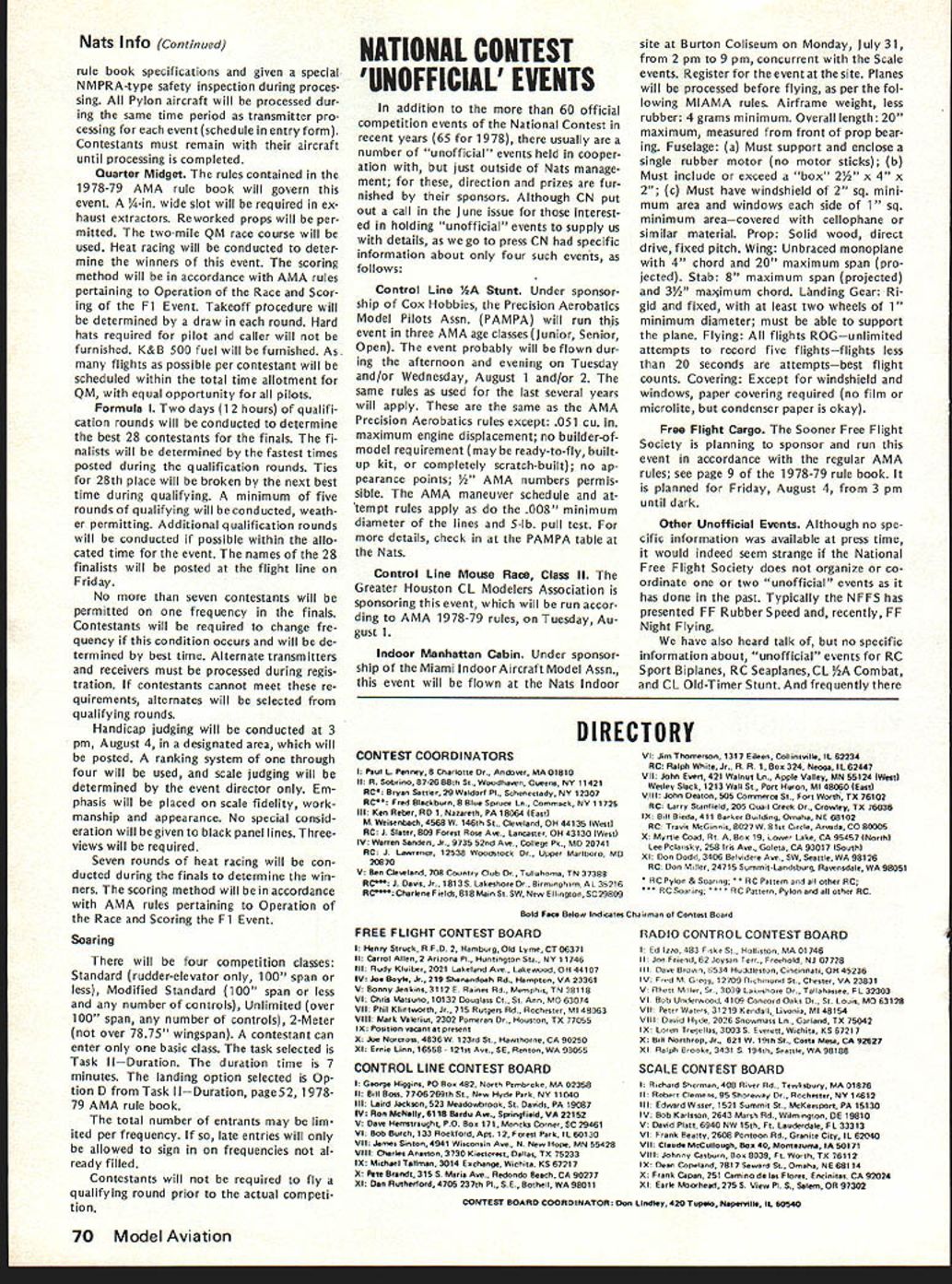
In addition to the more than 60 official competition events of the National Contest in recent years (65 for 1978), there usually are a number of "unofficial" events held in cooperation with, but just outside of Nats management; for these, direction and prizes are furnished by their sponsors. Although CN put out a call in the June issue for those interested in holding "unofficial" events to supply us with details, as we go to press CN had specific information only for such events, as follows:
Control Line 1/4A Stunt. Under sponsorship of Cox Hobbies, the Precision Aerobatics Model Pilots Assn. (PAMPA) will run this event in three AMA age classes (Junior, Senior, Open). The event probably will be flown during the afternoon and evening on Tuesday and/or Wednesday, August 1 and/or 2. The same rules as used for the last several years will apply. These are the same as the AMA Precision Aerobatics rules except: .051 cu. in. maximum engine displacement; no builder-of-model requirement (may be ready-to-fly, built-up kit, or completely scratch-built); no appearance points; 1/2" AMA numbers permissible. The AMA maneuver schedule and attempt rules apply as do the .008" minimum diameter of the lines and 5-lb. pull test. For more details, check in at the PAMPA table at the Nats.
Control Line Mouse Race, Class II. The Greater Houston CL Modelers Association is sponsoring this event, which will be run according to AMA 1978-79 rules, on Tuesday, August 1.
Indoor Manhattan Cabin. Under sponsorship of the Miami Indoor Aircraft Model Assn., this event will be flown at the Nats Indoor site at Burton Coliseum on Monday, July 31, from 2 pm to 9 pm, concurrent with the Scale events. Register for the event at the site. Planes will be processed before flying, as per the following MIAMA rules. Airframe weight, less rubber: 4 grams minimum. Overall length: 20" maximum, measured from front of prop bearing. Fuselage: (a) Must support and enclose a single rubber motor (no motor sticks); (b) Must include or exceed a "box" 2 1/2" x 4" x 2"; (c) Must have windshield of 2" sq. minimum area and windows each side of 1" sq. minimum area—covered with cellophane or similar material. Prop: Solid wood, direct drive, fixed pitch. Wing: Unbraced monoplane, fixed pitch, with 4" chord and 20" maximum span (projected). Stab: 8" maximum span (projected) and 3 1/2" maximum chord. Landing Gear: Rigid and fixed, with at least two wheels of 1" minimum diameter; must be able to support the plane. Flying: All flights ROG—unlimited attempts to record five flights—flights less than 20 seconds are attempts—best flight counts. Covering: Except for windshield and windows, paper covering required (no film or microlite, but condenser paper is okay).
Free Flight Cargo. The Sooner Free Flight Society is planning to sponsor and run this event in accordance with the regular AMA rules; see page 9 of the 1978-79 rule book. It is planned for Friday, August 4, from 3 pm until dark.
Other Unofficial Events. Although no specific information was available at press time, it would indeed seem strange if the National Free Flight Society does not organize or co-ordinate one or two "unofficial" events as it has done in the past. Typically the NFFS has presented FF Rubber Speed and, recently, FF Night Flying.
We have also heard talk of, but no specific information about, "unofficial" events for RC Sport Biplanes, RC Seaplanes, CL 1/2A Combat, and CL Old-Timer Stunt. And frequently there are FF and RC Old-Timer "unofficial" events. Where there is the possibility of a Nats "unofficial" event, but no specific information is provided here, there are two things we can suggest: (1) If you are going to the Nats anyway and have the room, take along any model which might fit into an "unofficial" event; (2) write to AMA HQ and inquire if any new information is known (state the event(s) of your interest); this article was written near the end of May, and by the time it is distributed (it should be in most subscribers' hands approximately July 1) those thinking about organizing "unofficial" events may have finalized their plans.
ANOTHER IDEA TO SUPPORT U.S. TEAMS
The CN section of the last month's issue described two efforts to help financially support U.S. 1978 World Championships Teams: a special embroidered CL patch, and a special embroidered Scale patch. Income from these items, over costs, helps to minimize out-of-pocket costs for team members. An allocation of AMA dues pays for over-ocean transportation and World Champs entry fees, but team members need to pay their own state-side travel costs if their respective team selection program fees are not sufficient to do the job.
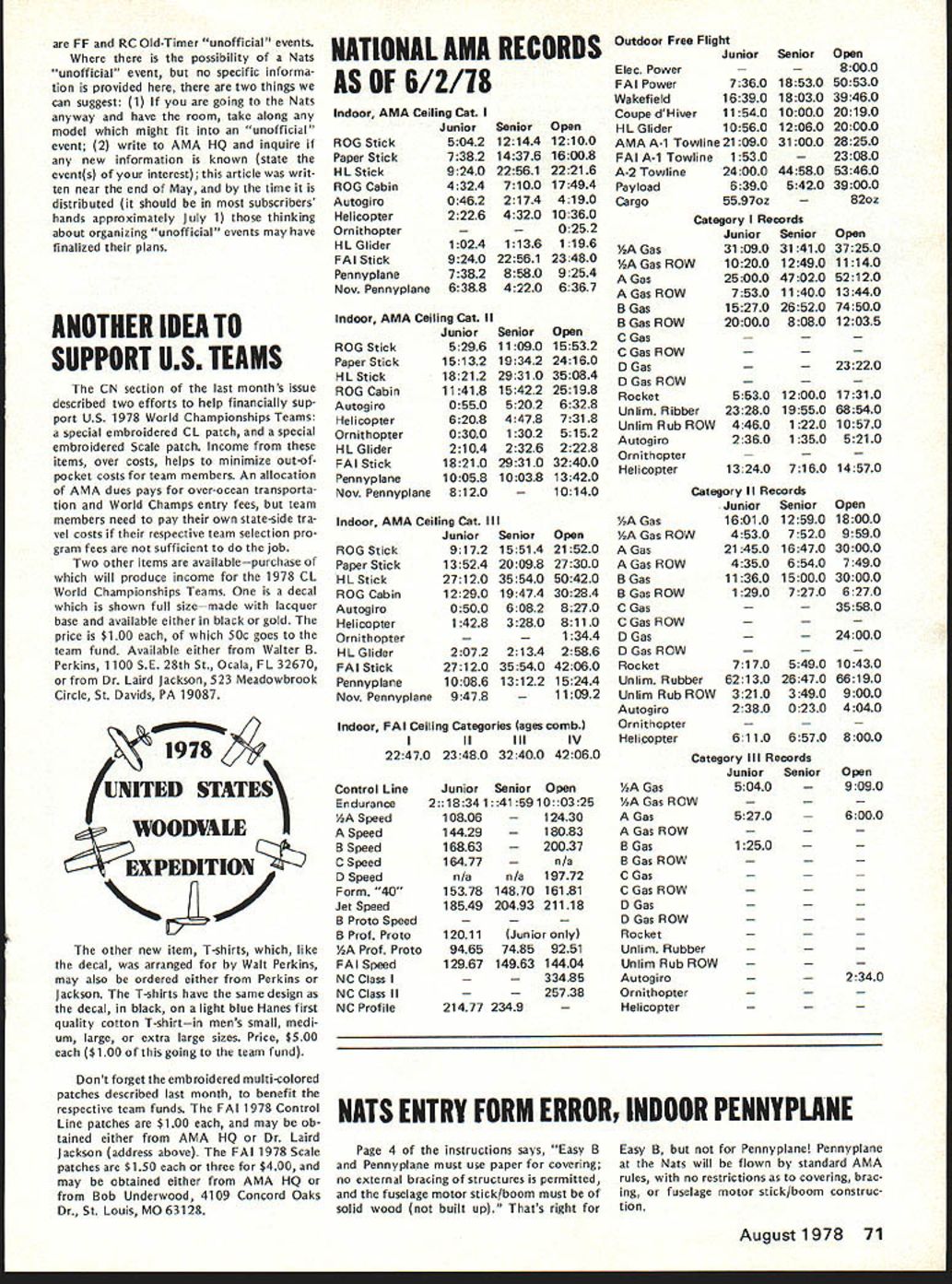
Two other items are available—purchase of which will produce income for the 1978 CL World Championships Teams. One is a decal which is shown full size—made with lacquer base and available either in black or gold. The price is $1.00 each, of which 50c goes to the team fund. Available either from Walter B. Perkins, 1100 S.E. 28th St., Ocala, FL 32670, or from Dr. Laird Jackson, 523 Meadowbrook Circle, St. Davids, PA 19087.
The other new item, T-shirts, which, like the decal, was arranged for by Walt Perkins, may also be ordered either from Perkins or Jackson. The T-shirts have the same design as the decal, in black, on a light blue Hanes first quality cotton T-shirt—in men's small, medium, large, or extra large sizes. Price, $5.00 each ($1.00 of this going to the team fund).
Don't forget the embroidered multi-colored patches described last month, to benefit the respective team funds. The FAI 1978 Control Line patches are $1.00 each, and may be obtained either from AMA HQ or Dr. Laird Jackson (address above). The FAI 1978 Scale patches are $1.50 each or three for $4.00, and may be obtained either from AMA HQ or from Bob Underwood, 4109 Concord Oaks Dr., St. Louis, MO 63128.
NATS ENTRY FORM ERROR, INDOOR PENNYPLANE
Page 4 of the instructions says, "Easy B and Pennyplane must use paper for covering; no external bracing of structures is permitted, and the fuselage motor stick/boom must be of solid wood (not built up)." That's right for Easy B, but not for Pennyplane! Pennyplane at the Nats will be flown by standard AMA rules, with no restrictions as to covering, bracing, or fuselage motor stick/boom construction.
Competition Newsletter
TREAT TOOLS WITH RESPECT
Bob Hisey
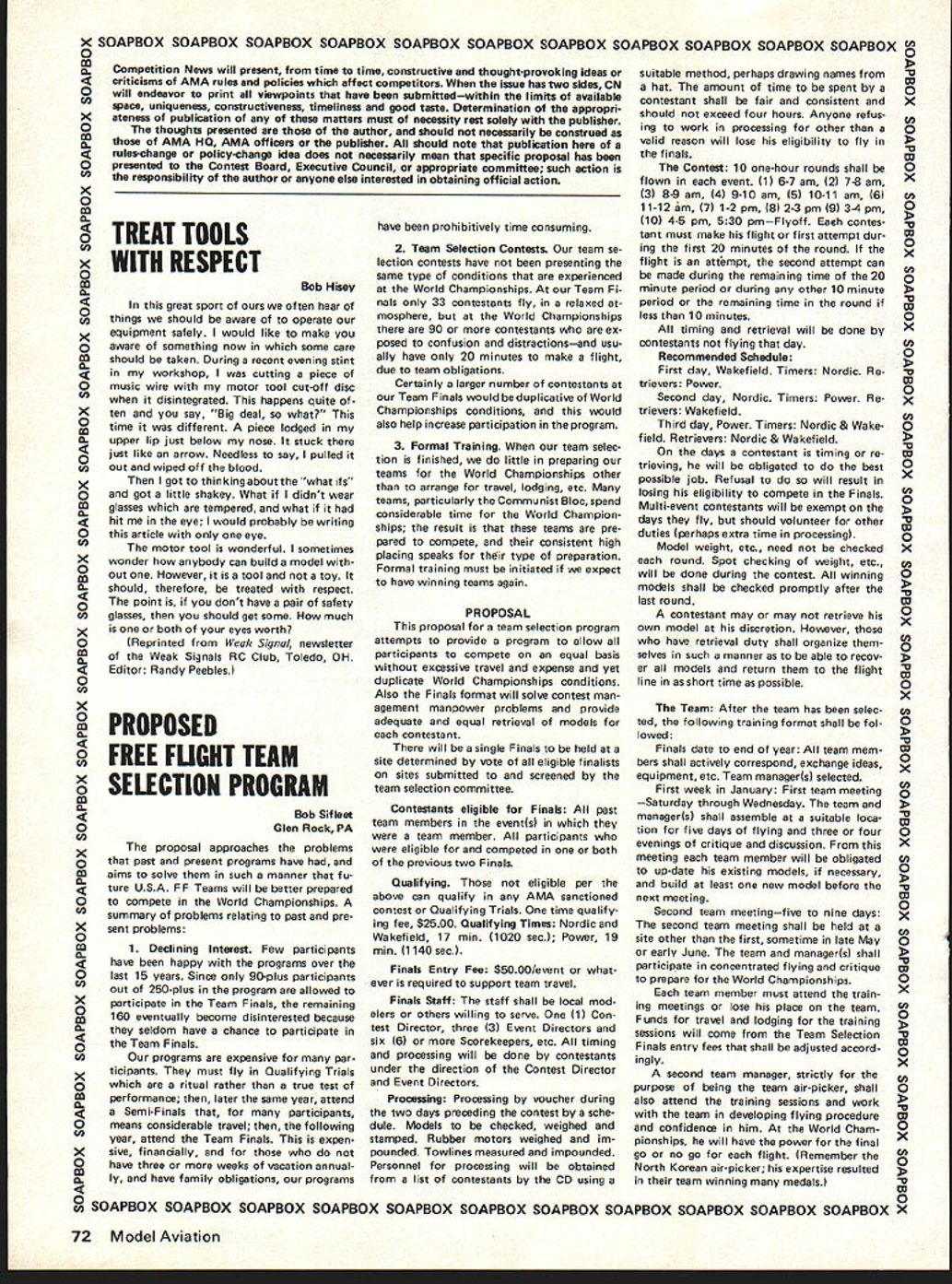
In this great sport of ours we often hear of things we should be aware of to operate our equipment safely. I would like to make you aware of something now in which some care should be taken. During a recent evening stint in my workshop, I was cutting a piece of music wire with my motor tool cut-off disc when it disintegrated. This happens quite often and you say, "Big deal, so what?" This time it was different. A piece lodged in my upper lip just below my nose. It stuck there just like an arrow. Needless to say, I pulled it out and wiped off the blood.
Then I got to thinking about the "what ifs" and got a little shaky. What if I didn't wear glasses which are tempered, and what if it had hit me in the eye; I would probably be writing this article with only one eye.
The motor tool is wonderful. I sometimes wonder how anybody can build a model without one. However, it is a tool and not a toy. It should, therefore, be treated with respect. The point is, if you don't have a pair of safety glasses, then you should get some. How much is one or both of your eyes worth?
(Reprinted from Weak Signal, newsletter of the Weak Signals R/C Club, Toledo, OH. Editor: Randy Peebles.)
PROPOSED FREE FLIGHT TEAM SELECTION PROGRAM
Bob Sifloot Glen Rock, PA
The proposal approaches the problems that past and present programs have had, and aims to solve them in such a manner that future U.S.A. F.F. Teams will be better prepared to compete in the World Championships. A summary of problems relating to past and present programs:
- Declining Interest. Few participants have been happy with the programs over the last 15 years. Since only 90-plus participants out of 250-plus in the program are allowed to participate in the Team Finals, the remaining 160 eventually become disinterested because they seldom have a chance to participate in the Team Finals.
Our programs are expensive for many participants. They must fly in Qualifying Trials which are a ritual rather than a true test of performance; then, later the same year, attend a Semi-Finals that, for many participants, means considerable travel; then, the following year, attend the Team Finals. This is expensive, financially, and for those who do not have three or more weeks of vacation annually, and have family obligations, our programs have been prohibitively time consuming.
- Team Selection Contests. Our team selection contests have not been presenting the same type of conditions that are experienced at the World Championships. At our Team Finals only 33 contestants fly, in a relaxed atmosphere, but at the World Championships there are 90 or more contestants who are exposed to confusion and distractions—and usually have only 20 minutes to make a flight, due to team obligations.
Certainly a larger number of contestants at our Team Finals would be duplicative of World Championships conditions, and this would also help increase participation in the program.
- Formal Training. When our team selection is finished, we do little in preparing our teams for the World Championships other than to arrange for travel, lodging, etc. Many countries, particularly the Communist Bloc, spend considerable time for the World Championships; the result is that these teams are prepared to compete, and their consistent high placing speaks for their type of preparation. Formal training must be initiated if we expect to have winning teams again.
PROPOSAL
This proposal for a team selection program attempts to provide a program to allow all participants to compete on an equal basis without excessive travel and expense and yet duplicate World Championships conditions. Also the Finals format will solve contest management manpower problems and provide adequate and equal retrieval of models for each contestant.
There will be a single Finals to be held at a site determined by vote of all eligible finalists on sites submitted to and screened by the team selection committee.
Contestants eligible for Finals: All past team members in the event(s) in which they were a team member. All participants who were eligible for and competed in one or both of the previous two Finals.
Qualifying. Those not eligible per the above can qualify in any AMA sanctioned contest or Qualifying Trials. One time qualifying fee, $25.00. Qualifying Times: Nordic and Wakefield, 17 min. (1020 sec.); Power, 19 min. (1140 sec.)
Finals Entry Fee: $50.00/event or whatever is required to support team travel.
Finals Staff: The staff shall be local modelers or others willing to serve. One (1) Contest Director, three (3) Event Directors and six (6) or more Scorekeepers, etc. All timing and processing will be done by contestants under the direction of the Contest Director and the Event Directors.
Processing: Processing by voucher during the two days preceding the contest by a schedule. Models to be checked, weighed and stamped. Rubber motors weighed and impounded, towlines measured and impounded. Personnel for processing will be obtained from a list of contestants by the CD using a suitable method, perhaps drawing names from a hat. The amount of time to be spent by a contestant shall be fair and consistent and should not exceed four hours. Anyone refusing to work in processing for other than a valid reason will lose his eligibility to fly in the finals.
The Contest: 10 one-hour rounds shall be flown in each event. (1) 6-7 am, (2) 7-8 am, (3) 8-9 am, (4) 9-10 am, (5) 10-11 am, (6) 11-12 am, (7) 1-2 pm, (8) 2-3 pm, (9) 3-4 pm, (10) 4-5 pm; 5:30 pm, 5:30 pm—Flyoff. Each contestant must make his flight or first attempt during the first 20 minutes of the round. If the flight is an attempt, the second attempt can be made during the remaining time of the 20 minute period or during any other 10 minute period of the remaining time in the round if less than 10 minutes.
All timing and retrieval will be done by contestants not flying that day.
Recommended Schedule: First day, Wakefield. Timers: Nordic. Retrievers: Power. Second day, Nordic. Timers: Power. Retrievers: Wakefield. Third day, Power. Timers: Nordic & Wakefield. Retrievers: Nordic & Wakefield.
On the days a contestant is timing or retrieving, he will be obligated to do the best possible job. Refusal to do so will result in losing his eligibility to compete in the Finals. Multi-event contestants will be exempt on the days they fly, but should volunteer for other duties (perhaps extra time in processing).
Model weight, etc., need not be checked each round. Spot checking of weight, etc., will be done during the contest. All winning models shall be checked promptly after the last round.
A contestant may or may not retrieve his own model at his discretion. However, those who have retrieval duty shall organize themselves in such a manner as to be able to recover all models and return them to the flight line in as short time as possible.
The Team: After the team has been selected, the following training format shall be followed:
Finals date to end of year: All team members shall actively correspond, exchange ideas, equipment, etc. Team manager(s) selected.
First week in January: First team meeting—Saturday through Wednesday. The team and manager(s) shall assemble at a suitable location for five days of flying and three or four evenings of critique and discussion. From this meeting each team member will be obligated to up-date his existing models, if necessary, and build at least one new model before the next meeting.
Second team meeting—five to nine days: The second team meeting shall be held at a site other than the first meeting in late May or early June. The team and manager(s) shall participate in concentrated flying and critique to prepare for the World Championships.
Each team member must attend the training meetings or lose his place on the team. Funds for travel and lodging for the training sessions will come from the Team Selection Finals entry fees that shall be adjusted accordingly.
A second team manager, strictly for the purpose of being the team air-picker, shall also attend training sessions and work with the team in developing flying procedure and confidence in him. At the World Championships, he will have the power for the final go or no go for each flight. (Remember the North Korean air-picker; his expertise resulted in their team winning many medals.)
Competition Newsletter
NATIONAL CONTEST INFORMATION
Written entry forms are slated to be distributed about the end of May. Initially entry forms will be distributed to those who sent requests to AMA HQ and also to entrants in the last two Nats. Anyone else who might be thinking of entering the 1978 National Contest, Lake Charles, LA, July 30–August 6, should immediately write AMA HQ and request an entry form. Deadline for advance entry is postmark date July 3. If expecting to enter at the contest site instead of advancing mailing an entry form, its accompanying information is vital for complying with scheduling requirements for entering the contest, turning Scale models, processing models, RC transmitters, etc.
Much information about the 1978 Nats already has been printed in various issues of Model Aviation. Some details concerning Radio Control events are late developing; however, new 1978 information follows.
RC Helicopters events: Novice, Intermediate, Expert. Scale (per page 50).
1978–79 RC AEROBATICS TEAM PROGRAM — Questions Answered
Previous team members Dave Brown, Mark Radcliff, Rhett Miller III, though automatically qualified for the team finals, are NOT dropped from contest standings for qualifying purposes. Under the current Team Selection Program, the number of Masters class entrants determines how many can qualify for the contest irrespective of the place position of previous team members; top third placers can qualify. Example: 10 Masters entrants — if first place was a previous team member, second, third and fourth place entrants may qualify for team finals.
Previous team members have to pay a $10 program entry fee and must pay the team finals entry fee ($150). Canadians and other foreign nationals are counted for qualification purposes in the program. Example: 10 Masters entrants — if a Canadian places first in a contest that has nine U.S. entrants for program qualification purposes, there are nine entrants; three can qualify — which example would place second, third, fourth.
As previously reported, a program entrant is NOT dropped from the standings; see AMA rule book. Also, special awards will be provided for best scratch-built helicopters in the Novice, Intermediate and Expert events. Scale helicopters will be judged on site during the event prior to flying. Helicopter events will be flown Monday–Tuesday, July 31–August 1, at LARKS Club Field near Sulphur, LA. This is the first year RC Helicopters are an official part of the National Contest.
RC Pattern Qualification: Four classes will fly simultaneously intermixed on four flight lines. Each class will use a special qualifying pattern. Time limit, including engine starts, is seven minutes. Only rounds completed on the flight lines will be counted for scoring. Only one attempt permitted per round. The top 10 qualifiers in each class will advance to Finals. Upwind direction will be determined by the Flight Line Controller.
Novice Qualifying Pattern
- Takeoff upwind
- Stall Turn upwind
- Single Immelmann upwind
- Three Inside Loops upwind
- Straight Inverted Flight downwind
For qualification purposes, qualification to team finals or Masters Tournament in either contest has entered prior to qualifying; entrants entered after qualifying may move up for qualification purposes due to someone else having qualified.
Team Selection Program — Program Summary
- AMA members, Masters class, $5 FAI Stamp may try out three slots on the US Team for the 1979 RC Aerobatics World Championships.
- Those wishing to enter the program must register with AMA HQ and pay a $10 program entry fee (checks payable to Academy of Model Aeronautics). Note: entry to the RC Aerobatics Team Program must be done in advance of entering contests for qualification purposes in order to allow time for transmittal of qualification forms. Entrants entered in the program may qualify for participation in the Masters Tournament.
- Team members will be selected by finishing in the top one-third, rounded up to the next highest whole number. Masters class event must have at least five entrants making an official flight. AMA sanctioned meets held April 29, 1978 through December 31, 1978 qualify.
- Pre-registration for the Masters Tournament is required; qualified entrants must pre-register 45 days in advance of the date and place. Masters Tournament fees have yet to be established; pre-registration is accompanied by a $150 entry fee.
RULE BOOK ERROR — CL COMBAT First sentence, 339.3, page 35, 1978–79 rule book: words "line tangle" should have been deleted in accordance with proposal CL-78-36 accepted. We regret the error occurred and request this correction in the new rule book. -- Ron McNally, Chairman, Control Li
Transcribed from original scans by AI. Minor OCR errors may remain.

