
Competition Newsletter
RC Pattern Rules Revisions/Corrections
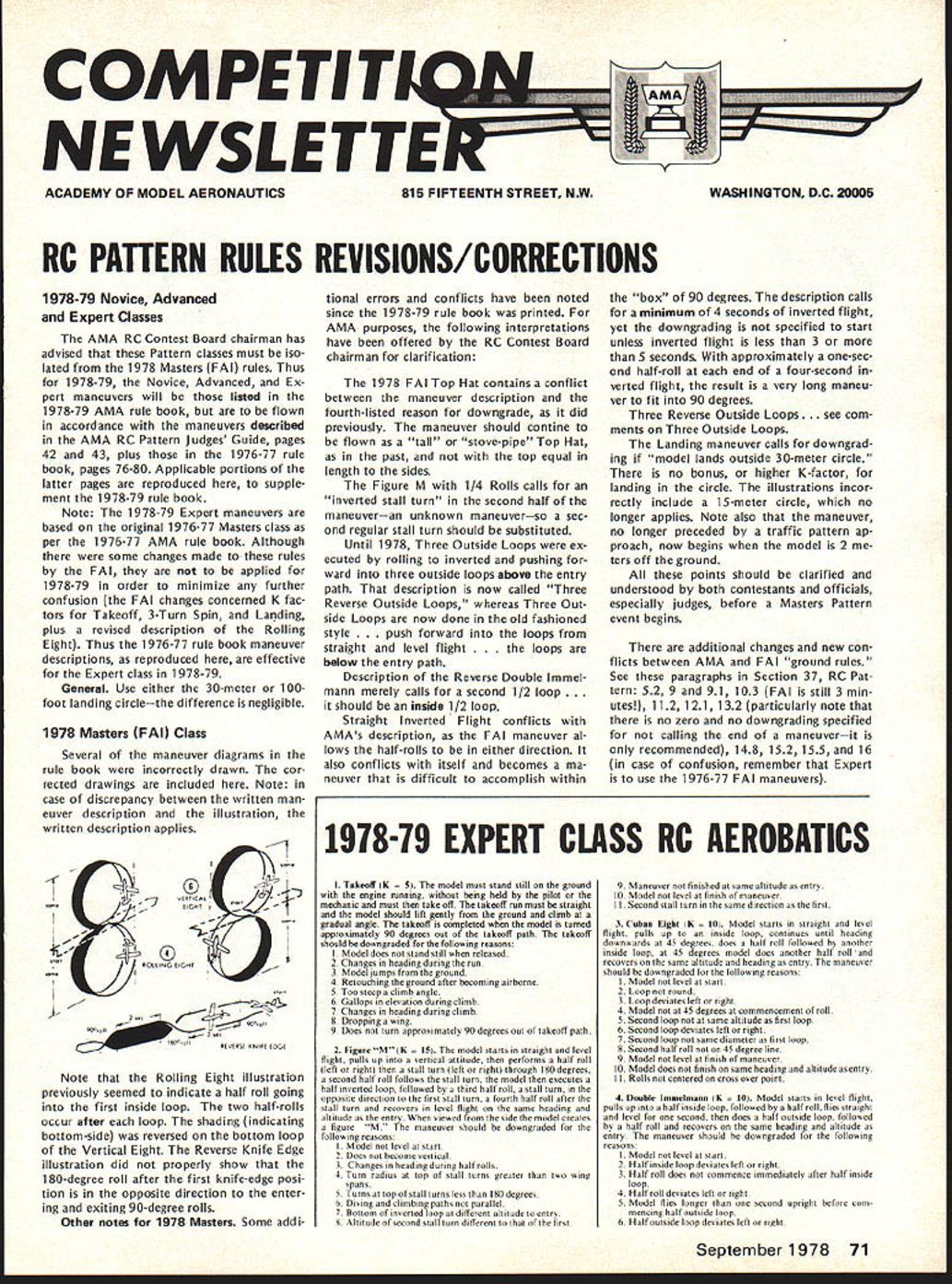
#### 1978–79 Novice, Advanced and Expert Classes The AMA RC Contest Board chairman has advised that these Pattern classes must be isolated from the 1978 Masters (FAI) rules. For 1978–79, the Novice, Advanced, and Expert maneuvers are those listed in the 1978–79 AMA rule book, but are to be flown in accordance with the maneuvers described in the AMA RC Pattern Judges' Guide (pages 42–43) and the relevant portions of the 1976–77 rule book (pages 76–80). Applicable portions of the latter pages are reproduced to supplement the 1978–79 rule book.
Note: The 1978–79 Expert maneuvers are based on the original 1976–77 Masters class (as per the 1976–77 AMA rule book). Although some changes were made by the FAI, those FAI changes (concerning K-factors for Takeoff, 3-Turn Spin, and Landing, plus a revised Rolling Eight description) are NOT to be applied for 1978–79 in order to minimize confusion. Thus the 1976–77 maneuver descriptions, as reproduced, are effective for the Expert class in 1978–79.
General: Use either the 30-meter or 100-foot landing circle — the difference is negligible.
1978 Masters (FAI) Class
Several of the maneuver diagrams in the rule book were incorrectly drawn. Corrected drawings are included. Note: in case of discrepancy between the written maneuver description and the illustration, the written description applies.
Corrections and clarifications:
- Rolling Eight: The illustration previously seemed to indicate a half-roll going into the first inside loop. In fact, the two half-rolls occur after each loop. Shading indicating bottom/side was reversed on the bottom loop.
- Reverse Knife Edge / Vertical Eight: The Reverse Knife Edge illustration now properly shows that the 180-degree roll after the first knife-edge position is in the opposite direction to the entering and exiting 90-degree rolls.
Other interpretations and clarifications offered by the RC Contest Board chairman:
- Top Hat: The 1978 FAI Top Hat contains a conflict between the description and a listed downgrade reason. The maneuver should continue to be flown as a tall "stovepipe" Top Hat (as in the past), not with the top equal in length to the sides.
- Figure M with 1/4 Rolls: Calls for an "inverted stall turn" in the second half—an unknown maneuver—so substitute a second regular stall turn.
- Three Outside Loops: Until 1978, these were executed by rolling to inverted and pushing forward into three outside loops above the entry path. The description is now called "Three Reverse Outside Loops." Three Outside Loops should be done in the older style—push forward into the loops from straight and level flight with the loops below the entry path.
- Reverse Double Immelmann: The description merely calls for a second 1/2 loop; it should specify an inside 1/2 loop.
- Straight Inverted Flight: Conflicts with AMA description. The FAI version allows half-rolls in either direction and contains internal conflict (timing vs. box width). The description calls for a minimum of 4 seconds inverted flight, yet downgrading is specified only if inverted flight is less than 3 or more than 5 seconds. With half-rolls at each end, the maneuver becomes hard to fit into the 90-degree box.
- Landing: Calls for downgrading if "model lands outside 30-meter circle." There is no bonus for landing in the circle. Illustrations that include a 15-meter circle are incorrect. Note also the maneuver now begins when the model is 2 meters off the ground (not preceded by a traffic pattern approach).
All these points should be clarified and understood by contestants and officials (especially judges) before a Masters Pattern event begins.
Additional changes and conflicts exist between AMA and FAI ground rules. See Section 37, RC Pattern (paragraphs 5.2, 9 and 9.1, 10.3 [FAI is still 3 minutes], 11.2, 12.1, 13.2 — note no zero and no downgrading specified for failing to call the end of a maneuver — 14.8, 15.2, 15.5, and 16). In case of confusion, remember that Expert is to use the 1976–77 FAI maneuvers.
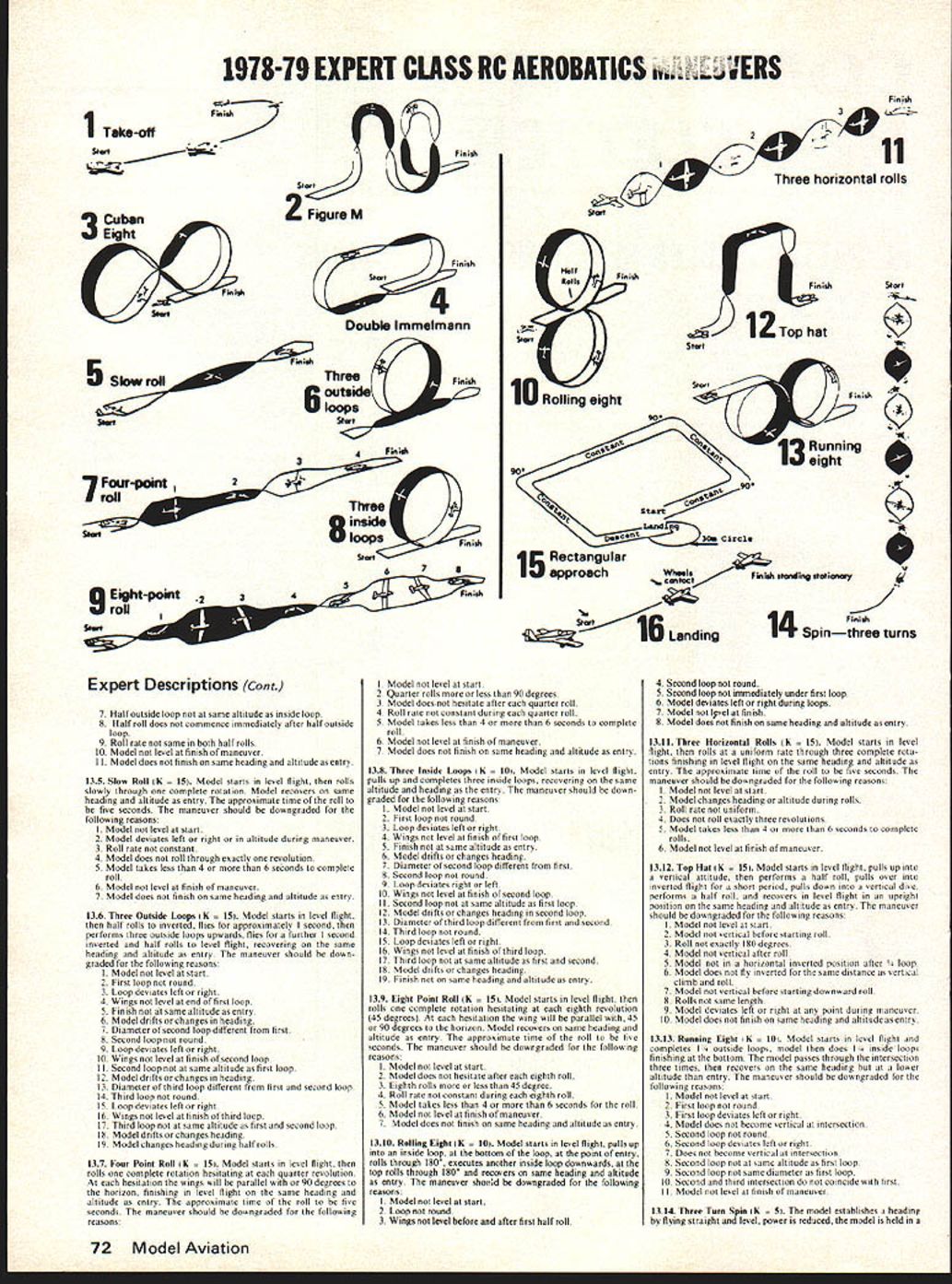
1978–79 Expert Class RC Aerobatics
- Takeoff (K = 5)
- Description: The model must stand still on the ground with the engine running, without being held by the pilot or mechanic, and then take off. The takeoff run must be straight; the model should lift gently and climb at a gradual angle. The takeoff is completed when the model is turned approximately 90 degrees out of the takeoff path.
- Downgrades:
- Model does not stand still when released.
- Changes heading during the run.
- Model jumps from the ground.
- Model rotates or rocks during run.
- Figure "M" (K = 15)
- Description: Start in straight and level flight at required altitude. Fly straight and steady over the center of the box for 10–15 model lengths, then pull up into the first (round inside) loop. After the first loop, execute a half-roll to inverted immediately followed by a half-loop, rolling back to upright. Execute a second loop, half-rolled after the loop, and finish in straight and level flight.
- Downgrades:
- Maneuver not finished at same altitude as entry.
- Model not level at finish.
- Second stall turn in the same direction as the first.
- Cuban Eight (K = 10)
- Description: Start in straight and level flight. Pull up into a 5/8 loop, half-roll through inverted at the 45-degree downline, continue to upright flight, then repeat in the opposite direction to complete the figure.
- Downgrades: deviations from shape, altitude, heading, or timing as per judges' criteria.
- Rolling Eight (K = 10)
- Description: Start in straight and level flight. Pull up into an inside loop, execute two half-rolls after the inside loop, continue into the second inside loop and two half-rolls, then return to straight and level flight.
- Note: See corrected illustration and clarifications above.
- Downgrades:
- Model not level at start or finish.
- Loop shapes not symmetrical.
- Half-rolls incorrect in position or direction.
- Roll rate not constant.
- Model does not finish on same heading and altitude as entry.
- Half Outside Loop with Roll (K = 8)
- Description: Start in straight and level flight. Pull up and perform a half outside loop with a half-roll during the maneuver, returning to level flight.
- Downgrades: improper roll timing, altitude deviations, not level at start/finish, etc.
- Reverse Double Immelmann (K = 10)
- Description: Start in straight and level flight. Pull up into a half-loop, perform a half-roll, then continue into an inside half-loop to complete the maneuver.
- Downgrades: wrong loop direction, incorrect rolls or timing, finish not on same heading/altitude.
- Slow Roll (K = 15)
- Description: Start in level flight, then roll slowly through one complete rotation. Recover on same heading and altitude as entry. Approximate time is five seconds.
- Downgrades:
- Model not level at start.
- Model deviates left/right or in altitude during maneuver.
- Roll rate not constant.
- Model does not roll through exactly one revolution.
- Model takes less than 4 or more than 6 seconds to complete roll.
- Model not level at finish.
- Three Outside Loops (K = 15)
- Description: Start in level flight, half-roll to inverted, fly the first outside loop, recover on same heading and altitude, then perform two more outside loops in succession.
- Downgrades:
- Model not level at start.
- First loop not outside.
- Loops not level or not equal size.
- Model does not recover on same heading and altitude as entry.
- Model deviates left or right during loops.
- Loops incomplete or not smooth.
- Four Point Roll (K = 15)
- Description: Start in level flight, then execute four quarter-rolls, pausing briefly at each quarter position to present four distinct points.
- Downgrades:
- Model not level at start.
- Points not distinct or pauses not evident.
- Roll rate not constant between points.
- Model does not stop at required points.
- Model not level at finish.
- Three Inside Loops (K = 10)
- Description: Start in level flight, pull up and complete three inside loops, recovering to same heading and altitude as entry.
- Downgrades:
- Model not level at start.
- Loops not round.
- Loops not equal in size or not stacked.
- Model deviates left or right during loops.
- Loops incomplete.
- Eight-Point Roll (K = 15)
- Description: Start in level flight, then execute eight quarter-rolls producing eight distinct points.
- Downgrades:
- Model not level at start.
- Points not distinct; roll rate not constant.
- Roll does not stop at each quarter.
- Model not level at finish.
- Three Horizontal Rolls (K = 15)
- Description: Start in level flight, then perform three axial (horizontal) rolls spaced along a straight flightpath and recover on same heading and altitude as entry.
- Downgrades:
- Model not level at start.
- Rolls not properly spaced or not on same line.
- Roll rate not constant.
- Model not level at finish.
- Top Hat (K = 15)
- Description: Start in level flight, pull up into a vertical climb to near-vertical attitude, perform a half-roll at the top, then descend vertical and recover to level flight on the same heading and altitude as entry.
- Downgrades:
- Model not level at start.
- Pull-up not straight or vertical.
- Half-roll at top omitted or in wrong direction.
- Model not level at finish.
- Running Eight (K = 10)
- Description: Start in level flight and complete a figure-eight laid on its side (running eight) with loops of equal size and recovery on same heading and altitude as entry.
- Downgrades:
- Model not level at start.
- Loops not equal or not smoothly connected.
- Model deviates left or right during figure.
- Model not level at finish.
- Three Turn Spin (K = 15)
- Description: Establish a spin by pulling up and applying rudder; complete three full turns and recover on the original heading and altitude.
- Downgrades:
- Model does not enter a true spin.
- Number of turns incorrect.
- Recovery not straight or not to same heading and altitude.
- Model not level at finish.
- Rectangular Approach
- Description: Enter a rectangular traffic pattern and descend in a controlled approach to the landing circle.
- Downgrades:
- Pattern not rectangular or sides not parallel.
- Altitude or spacing incorrect.
- Model does not enter landing circle correctly.
- Landing (K-factor as specified in rule book)
- Description: Model should touch down within the 30-meter (100-foot) landing circle and come to rest.
- Downgrades:
- Model lands outside the landing circle (no bonus for inside).
- Model does not touch down smoothly or bounces excessively.
- Model does not come to rest within the circle.
Other maneuvers and detailed descriptions are to be flown in accordance with the 1976–77 AMA rule book reproduction and the AMA RC Pattern Judges' Guide. Where applicable, contestants and judges should refer to accompanying diagrams and reproduced rule book sections for further clarification. Any discrepancy between illustrations and written descriptions should be resolved in favor of the written descriptions.
---
Aug. 15 Deadline for FAI Rules Proposals
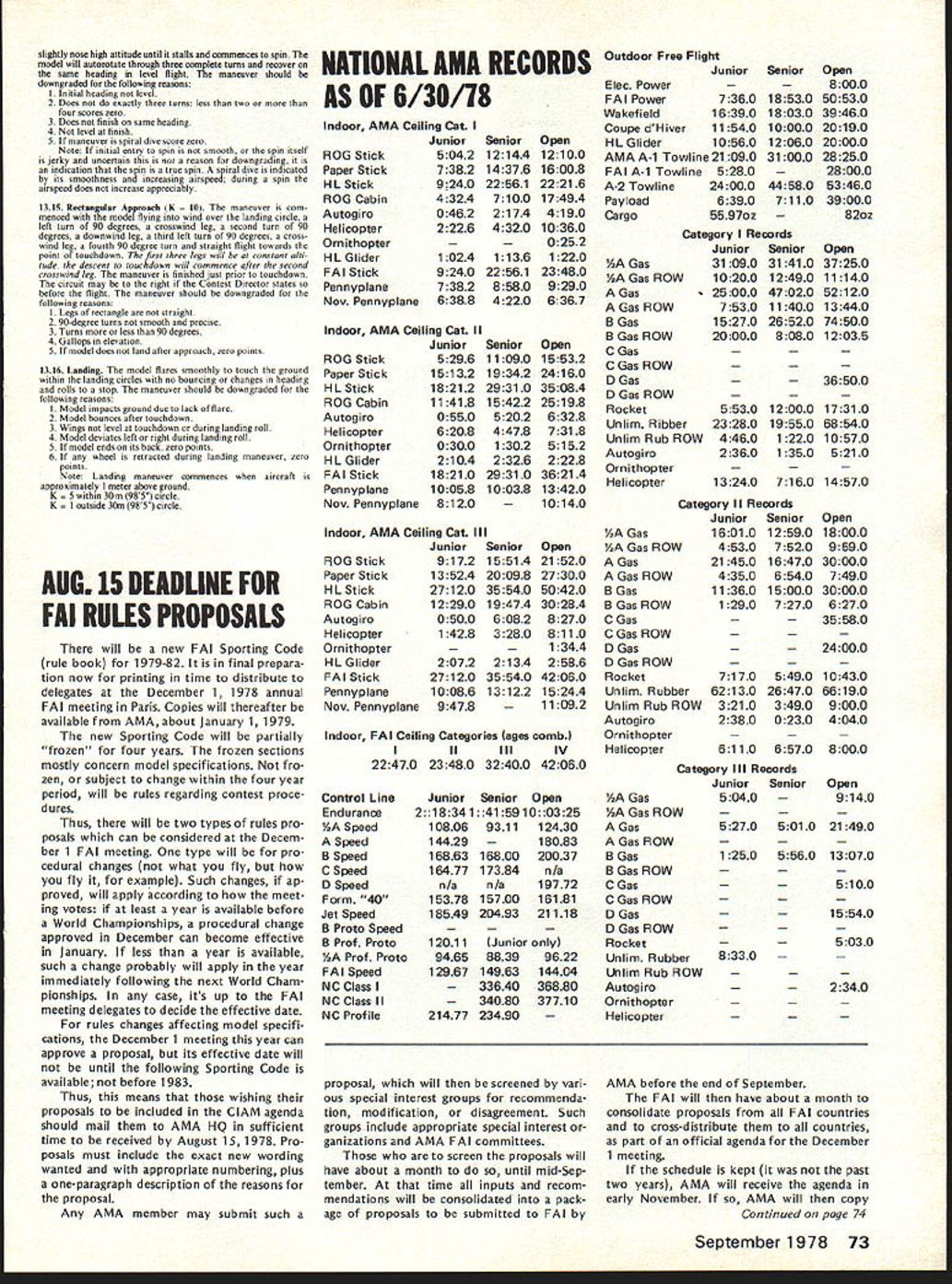
There will be a new FAI Sporting Code (rule book) for 1979–82, in final preparation for distribution to delegates at the December 1, 1978 FAI meeting in Paris. Copies will thereafter be available from AMA, about January 1, 1979.
Key points:
- The new Sporting Code will be partially "frozen" for four years. Frozen sections largely concern model specifications. Procedural rules (contest procedures) are not frozen and may change within the four-year period.
- Two types of proposals can be considered at the December 1 FAI meeting:
- Procedural changes (how you fly or conduct contests). If approved, effective date depends on the timing relative to World Championships and the FAI meeting vote.
- Changes affecting model specifications. These can be approved at the December meeting but will not take effect until the next Sporting Code is issued (not before 1983).
Submission process for CIAM agenda inclusion:
- Mail proposals to AMA Headquarters so they are received by August 15, 1978.
- Proposals must include the exact new wording desired, appropriate numbering, and a one-paragraph description of reasons.
- Any AMA member may submit a proposal. Proposals will be screened by special interest groups and AMA FAI committees for recommendation, modification, or disagreement.
- Screeners will have until mid-September to provide input. AMA will then consolidate inputs and submit a package of proposals to FAI before the end of September.
- FAI will have about a month to consolidate proposals from all countries and distribute them as part of the official agenda for the December 1 meeting.
- If schedule is kept, AMA will receive the agenda in early November and distribute pertinent sections to special interest groups and AMA‑FAI committees, who will make recommendations for U.S. voting.
The first step: get U.S. proposals to AMA HQ by August 15.
Transcribed from original scans by AI. Minor OCR errors may remain.

