
COMPETITION NEWSLETTER
RULES PROPOSALS INFORMATION
SUMMARIES OF RULES PROPOSALS BEGIN IN THIS ISSUE
The deadline for AMA members to submit rules proposals in the current, two-year rules review cycle is September 1, 1978 (postmark), which is very near to the expected delivery date of this issue. We hope that anyone intending to submit a rules proposal already will have done so (using the standard form, which is required); if the deadline hasn't passed by the time this is read, there's still time, so long as the envelope bears a postmark no later than September 1.
CN to Publish Proposals
The system for considering new AMA competition rules (see complete Contest Board Procedures in the April 1978 issue) is scheduled so that members have opportunity to study and lobby for or against proposals, or to propose revisions, before a proposal is voted into effect. CN aids in this effort by summarizing all the various proposals. Those received at AMA HQ up to mid-July are covered in this issue.
What You Can Do
- Study all the proposals pertaining to the kinds of models you expect to fly.
- For those of interest, write to the category Contest Board member of your district, and let him know if you are for or against and why.
- If there is a proposal which has parts that you like and other parts that you don't, tell your Contest Board rep.
Later On
After the September 1 deadline, and after all the proposals have been published, the Contest Boards will be taking their first votes (called Initial Vote) on all of the proposals. Those that pass will then be subject to possible modification through Cross Proposals (which must also be submitted on the standard rules proposal form). We'll cover the subject of Cross Proposals, including deadline for submission, more fully at the time of publishing Initial Vote results.
Q.M. PYLON IS OFFICIAL
The status of the RC Quarter Midget Pylon Racing rules was upgraded from "provisional" to "official" by RC Contest Board vote as reported in the February 1978 Model Aviation, page 73. By mistake, this correction was not made in the 1978-79 rule book.
RC SOARING PROGRAM QUALIFIERS
Program Chairman Ray Marvin reports the following lists of fliers who have qualified to compete in the Team Finals at Pensacola, FL, September 2-4. Qualifying was by means of Semi-Finals at six regional locations. At each site, below, the qualifiers and their scores (in parentheses) are shown in the first paragraph; alternates and their scores are shown in the second paragraph.
- Brandon, FL: J. Gunsaullus (10943), S. Pfohl (9894), A. Sark (9751), B. Miller (9434), E. Berton (9360), T. Ferentinos (9325).
Alternates: C. Raichle (8887), G. Crumb (7335), W. Ruth (6928), O. Davidson (3281), T. Fiorentino (2339), G. Musinski (2199).
- Winston-Salem, NC: W. Leathers (6793), R. Baugher (6741), W. Johnson (6104), D. Holley (5845), R. Hays (5630), F. Bien (5547), A. Marshall (5509), T. Decker (5492), B. Thomas (5448).
Alternates: A. Leftwich (5266), R. Gunn (4997), D. Corvin (4978), F. Gregg (4576), W. Wilde (4524), M. Jackson (4518), D. Gunning (4400), L. Pike (4244), J. Davis (3468).
- St. Louis, MO: B. Gill (14763), J. Hiner (13457), J. Borowski (10708).
Alternates: G. Seydel (9075), K. Olsen (8357).
- Denver, CO: B. Domer (14425), M. Sheldon (14225), H. Smith (13866), D. Cameron (13658).
Alternates: P. Bruckbauer (13189), T. Singelis (12641), J. Barr (11457), D. Cook (7215).
- Los Angeles, CA: S. Work (17208), D. Edberg (16583), C. Foxford (16427), T. Koplan (16425), P. Harris (16197), B. Gervin (15996), R. Norwood (15639).
Alternates: P. Parszik (14937), M. Reagan (14623), R. Thacker (13473), B. Mueller (10215), K. Pike (6661), G. Cook (6247), T. Williams (333).
- Ft. Worth, TX: C. Moffatt (6827), T. Williams (6660), D. Darnell (6169), J. Hamilton (6109), C. Copeland (5837), J. Trull (5583), B. Haga (5327).
Alternates: C. Haga (5211), C. Wade (4853), D. Modesto (4492), R. Elliott (4117), G. Weltsheimer (4044), C. Jones (2360).
The report indicates that previous team members Skip Miller and Dale Nutter also flew in the Semi-Finals and obtained scores of 14827 and 6768, respectively.
Pre-Novice Class (Proposed Maneuvers)
Maneuvers proposed for the Pre-Novice Class (Simpson):
- Takeoff (upwind)
- Straight Flight Out (upwind)
- Procedure Turn
- Straight Flight Back (downwind)
- Stall Turn (upwind)
- Single Immelmann (upwind)
- Inside Loops (upwind)
- Rectangular Approach (upwind)
- Landing and Spot (upwind)
Simpson says this event will bring more fliers into pattern competition due to its simplified pattern and less expensive aircraft, noting that when it has been offered in Southern California it has had more entries than any other class.
RC-80-6 — Sailplanes, Landing Options & Launch Area Prohibition
Bert C. Striegler of Houston, TX, makes two proposals:
- Add to 59.4.2 (General): "At option of the Contest Director, any flight scoring method may be combined with any landing scoring method shown in the current rule book." (Similar to point 1 of RC-80-11.)
- Revise 10.0d) (Contest Guidelines) to read: "Sailplanes must NOT be flown in the launch area. Launching sailplanes have right-of-way over sailplanes in flight."
Striegler feels the current rules are too inflexible concerning landing options, and as to part 2 he says gliders should NEVER be flown in the launch area due to the hazard and the slow-down of launching.
GENERAL RULES PROPOSALS
Gen-80-1 — Special Nats Rules
Proposal by Gail E. Jacobson, College Park, GA, to add to 1.19 (Interpretation of Regulations): "For National competition, the Nationals Event Director may change, add or modify a rule, or rules, subject to the approval of the appropriate special interest organization as defined in paragraph 1.3.7. Special Interest Organizations may specify to their event director rules changes, additions or modifications. Event rules changed in this manner will be forwarded to the appropriate Contest Board for their information and use."
Jacobson proposes this because no provision is made in the current rules for an event director to have the authority granted to Contest Directors; the event director at the Nats, he says, is the same as a CD, and minimum "red tape" should be imposed. Further, in view of the time lag with two-year rules review cycles, he feels there should be an ability for Nats events to be run by rules which are timely and in national practice, even if not in the rule book.
Gen-80-2 — National Champions
Horace D. Cain of Buffalo Grove, IL, states that the present system of selecting national champions is out-of-date and costly in time to administer—such that the awards have not been provided recently. He feels there is value to be had from Individual and Category Championships, and that the awards can be restored by simplifying the system and the rules as per the following proposal. Delete existing paragraphs 3.2 through 3.6 and replace with:
- Individual National Champions: Flying for individual National Championship awards requires that an individual enter six events. The contestant must declare one entry in radio control, one in outdoor free flight, one in control line, one in scale, one in indoor, and one optional. The contestant must complete at least one official flight in at least five of the six events.
- Scoring for Individual National Champions: Contestant will receive one (1) point for each person below him in that event's final standing. In addition, the contestant will receive a 20% bonus (of that specific event) for a 1st or 2nd place, or a 10% bonus for a 3rd through 5th place. Example: Contestant places 2nd with 27 entries. He receives 25 points plus 20% bonus—that is, 5 bonus points for a total of 30 championship points.
- Any event entry will account for only one event. Examples: An RC scale entry can count for either a radio control entry or a scale entry, but not both. An entry in outdoor hand-launched glider could be either an outdoor free-flight entry or a free flight non-gas, but not both.
- National Category Champions. Scoring for National Category Champion will be as follows:
- Outdoor Free Flight: 5 events; 2 gas, 2 non-gas, 1 optional.
- Indoor: 3 events; one must be H.L. glider.
- Control Line: 5 events; 2 speed, 1 racing, 2 optional (not more than three speed events, total).
- Radio Control: 3 events; 1 pattern, 1 racing, 1 optional.
- Scale: 3 events, all optional.
Contestant will be scored as per para. 2. Scale entries can count in only one category, not both scale and some other category.
Cain suggests an administrative form process to simplify scoring: give the contestant a two-copy form for each event designated as a championship event. The event director fills in the points, gives a copy to the contestant, and turns in the other copy to contest administration. This would reduce clerk workload and prevent possible alterations while safeguarding against loss by the event director.
CONTROL LINE RULES PROPOSALS
CL-80-1 — Scale Racing Landing Gear
S. G. Willoughby of Bensenville, IL, proposes to modify 29.2.2.2 to allow (and encourage) use of a mono-wheel instead of the present requirement for two separated struts. Use of a mono-wheel will aid in complying with 25.9.6 (keeping the lines on the ground), which is more difficult with conventional two-wheel gear since it tends to interfere with placing the inboard wing tip on the ground.
CL-80-2 — Racing (General), Line Snags
S. G. Willoughby proposes to specifically include conditions relating to a line snag on takeoff (as well as on landing) by changing the second sentence of 25.9.6 to read: "Should disregard of this rule (to keep the control lines on the ground) lead to the snagging of a second aircraft which is taking off or landing, and if, in the Event Director's opinion, the snag affected the race results of the second aircraft, the entrant whose lines were snagged shall be disqualified, and the entrant who snagged the lines will have his race rescheduled for a later time."
SCALE RULES PROPOSALS
SC-80-1 — RC Sport Scale Weight and Displacement Limits
Jack G. Fehling, Hialeah, FL, proposes to modify 48.2.6 to allow a maximum weight of 20 lbs. for single-engine models and 30 lbs. for multi-engine models (aircraft ready for flight, but without fuel); and to modify 48.2.7 to allow maximum gross displacement of 2.45 cubic inches. His intent in increasing weight and displacement limits is to allow larger quarter- and third-scale models to compete with smaller ones—preferable, he says, to creating a single class for larger models. Increasing the displacement limit would allow use of various industrial engines which have become popular.
SC-80-2 — RC Precision Scale Contestant Classification
Dave Plahn, Braintree, MA, proposes to completely eliminate section 46.4 (Contestant Classification), stating that its presence in the rule book is an unnecessary headache to both contestants and contest officials. He notes it has been used at only one National Contest (in 1974) and subsequently abandoned. It is impractical to use with the small number of entrants involved in this event.
SC-80-3 — RC Jumbo Scale (new category)
Dave Plahn proposes a new event for quarter-scale and larger models. His proposed rules:
RC JUMBO SCALE
- OBJECTIVE. To provide a radio-controlled flying scale model competition event for models that would otherwise be too heavy or too large to legally fly in present AMA RC Scale competition. Models around 1/4 scale of the prototype are especially suited.
- APPLICABILITY. All pertinent FCC regulations and AMA regulations (Sanctioned Competitions, Records, Selection of National Champions, and General) shall apply, except as specified below.
- MODEL SAFETY REQUIREMENTS
- 3.1. All models must pass a general safety inspection by the event director or his representatives before flying.
- 3.2. Any flying over a controlled spectator area will be cause for immediate disqualification of that flight.
- 3.3. Dangerous flying or poor airmanship shall be grounds for disqualification.
- 3.4. All aircraft entered must have rounded airscrew spinners or a rounded and recessed hub (e.g., "acorn nut") over the end of the airscrew driveshaft. This can be removed for scale judging if desired, but must be on the model whenever it is flying or running its engine(s).
- 3.5. Knife-edged wings are not allowed.
- 3.6. Single-engine models must not weigh more than 10 kg (22.05 lbs.) ready for flight, less fuel. Twin and multi-engined aircraft must not weigh more than 15 kg (33.1 lbs.) ready for flight, less fuel. This rule MUST be waived for any oversized models by the Contest Director or Event Director (or representative) if it can be demonstrated before the start of competition that the model can be flown safely by the pilot who will fly the model in the contest.
- 3.7. There is no limit on size of engines for single or twin engine models. Multi-engine (3 or more) models have a maximum displacement limit of 20 cm3 (1.22 in.3) per engine.
- 3.8. A standby pilot holding an auxiliary "buddy-box" control unit will be permitted for safety. If the standby pilot takes over control, the contestant's score for that flight will be canceled and no further scoring will take place for that flight.
- "B.O.M." RULE. The builder and flier of an RC Jumbo Scale model shall be the same person, but team entries (pilot-builder team) will be provided for if a special event of this type is included in a contest.
- MODEL REQUIREMENTS
- Any model resembling a man-carrying heavier-than-air aircraft, or powered lighter-than-air craft (airship), can compete.
- All engines must be equipped with a silencing device (electric motors and ducted fans exempt if the Contest Director finds no violation of field noise rules).
- Models must be either 1/4 scale or larger of the prototype, or have a wingspan and/or fuselage length of at least 2.4 m (94.5 in.). The Event Director may restrict entries to models at least 1/4 scale and must state this in all contest announcements.
- PROOF OF SCALE
- 6.1. Proof of scale is the responsibility of the contestant.
- 6.2. To be eligible for Accuracy of Outline points, provide either:
- A 3-view drawing (line, tone, or color), OR
- A selection of photos sufficient to show the model's outlines in side and front view.
- Both may be provided, but only one is required. Judges must not downgrade Accuracy of Outline if only one is provided.
- 6.3. To be eligible for Finish, Color and Markings points, provide proof of the color scheme such as:
- a photo or photos,
- a pictorial representation (magazine or published painting/drawing),
- a detailed written description from a reliable source, or
- notes and diagrams of markings on a black-and-white 3-view.
- 6.4. If no proof is provided for Accuracy of Outline or Finish, no points can be awarded for those categories. Points for Craftsmanship and Flight may still be awarded.
- STATIC JUDGING
- 7.1. Static judging shall be done at 4 m (13 ft.) from the model. An 8 m (26 ft.) circle is recommended and roped off; judges judge from the circumference only.
- 7.2. Judges cannot touch or closely examine models before or during judging. Models may be displayed on the flight line or in a scale cage for spectators.
- 7.3. Details not visible in flight (dummy engines hidden inside cowls, cockpit interiors, fine 3-D details such as rivets) cannot be used in judging. This does not include struts or bracing wires.
- 7.4. Subjects with uncowled radial engines or engine installations that necessitate exposed engines (e.g., Spitfire, Kingcobra) will not be downgraded when non-scale openings are required for cooling, servicing, or muffler installation.
- 7.5. No changes shall be made between static judging and flying that alter the scale appearance except:
- a. A flying airscrew of any diameter may be substituted for static.
- b. The spinner used in flight must be the same shape, size, and color as used in static judging, but may have different cut-outs.
- c. A radio antenna may be added.
- d. Seaplanes/flying boats may use non-scale dollies for takeoff if required; dollies must not be attached in flight. Permanently mounted recessed wheels, skids, plug-in removable gear, etc., will not result in loss of Accuracy of Outline points.
- STATIC SCORING (maximum 120 points)
- Accuracy of Outline (General Impression) — max 40 points
- Finish, Color and Markings — max 40 points
- Craftsmanship — max 40 points
- FLIGHT
- 9.1. It is suggested Scale judging take place before official flights. If flights occur before Scale judging and damage results, damage will be disregarded and not counted against the contestant. No maximum number of official flights during scheduled event time, but a minimum of 3 rounds should be scheduled.
- 9.2. All flights shall be R.O.G. unless ground conditions prevent this; then hand launching is allowed. Mooring mast must be provided for airship entries. Contest Director will specify a right- or left-hand pattern to keep maneuvers away from spectators. In very light wind or calm, the contestant may choose either pattern as long as maneuvers take him away from the spectator area.
- 9.3. Time limit for any flight is 10 minutes, not including engine starting time.
- 9.4. Special exceptions may be made for airships (e.g., castoff from mooring mast); airships may fulfill flight requirement while moored by demonstrating static balancing, etc.
- FLIGHT PLAN
- The flight plan consists of 12 maneuvers/scale operations: 4 obligatory and 8 optional.
- Proto Taxi and Unassisted R.O.G. (see 10.2)
- Fly-Past (see 10.1)
3-10. Options (any maneuvers listed in RC Precision Scale Flight Plan, AMA or FAI RC Precision Scale rules, or typical scale operations—listed before flying)
- Realism in Flight
- Landing and Proto Taxi to Hangar (see 10.2)
- 10.1. Fly-Past: 4–8 m (13–26 ft.) altitude, straight for 30 m (100 ft.). Speed may be fast or slow as appropriate. Unsafe flying results in zero for the maneuver.
- 10.2. Proto Taxi judged per RC Precision Scale Flight Plan guidelines (taxiing and taxi to hangar).
- 10.3. Options may be any maneuvers listed in RC Precision Scale Flight Plan or AMA/FAI rules, or scale operations typical of the prototype. Must be listed on the judging form before flying.
- 10.4. Touch and Go and Multi-Engine count as two options each.
- FLIGHT SCORING (maximum total flight score 120 points)
- 11.1. All maneuvers and scale operations (except Touch and Go and Multi-Engines) are scored 0–10 points.
- 11.2. Touch and Go and Multi-Engine (each counts as two options) are scored 0–20 points.
- 11.3. No maneuver or scale operation automatically receives a maximum score; all judged in relation to scale-like qualities.
- 11.4. If one or more engines of a multi-engine model stops during flight, scoring is based on the contestant's ability to continue flight. If remaining maneuvers/operations are completed, points are awarded accordingly.
SC-80-4 — RC Sport Scale Weight and Displacement Limits (alternate proposal)
Bill Simpson, Rancho Palos Verdes, CA, proposes to add to 48.2.6: "In RC, single and multi-engine models shall weigh not more than 25 lbs. ready for flight, except for fuel," and to add to 48.2.7: "In RC, maximum total displacement of the engine(s) will not exceed 2 cu. in." These larger/heavier models should be provided for since they represent the fastest growing segment of aeromodelling activities.
SC-80-5 — Sport Scale, Judging Distance
Bill Lepley, Sr., Colonial Heights, VA, proposes increasing static judging distance to 20 feet from the model (roped-off circle of 40-foot diameter) to reduce the influence of small details that would not be seen in flight.
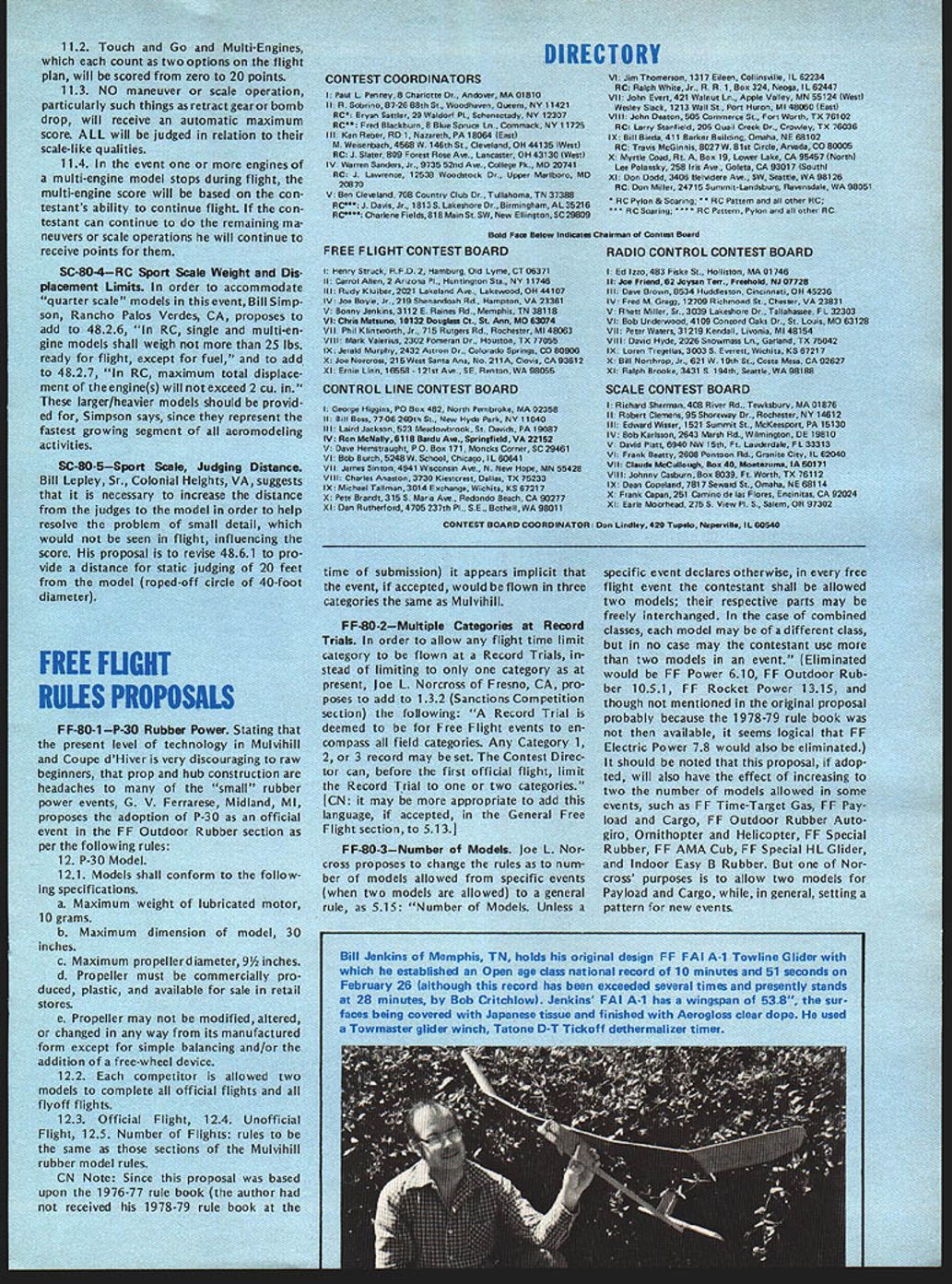
FREE FLIGHT RULES PROPOSALS
FF-80-1 — P-30 Rubber Power
G. V. Ferrarese, Midland, MI, proposes adoption of P-30 as an official event in the FF Outdoor Rubber section due to the discouraging level of technology in Mulvihill and Coupe d'Hiver for beginners and prop/hub construction headaches. Proposed rules:
- P-30 Model
- 12.1. Models shall conform to:
- a. Maximum weight of lubricated motor: 10 grams.
- b. Maximum dimension of model: 30 inches.
- c. Maximum propeller diameter: 9½ inches.
- d. Propeller must be commercially produced, plastic, and available for sale in retail stores.
- e. Propeller may not be modified except for simple balancing and/or the addition of a free-wheel device.
- 12.2. Each competitor is allowed two models to complete all official flights and flyoff flights.
- 12.3–12.5. Official Flight, Unofficial Flight, Number of Flights: rules to be the same as Mulvihill rubber model rules.
CN Note: Since this proposal was based upon the 1976-77 rule book (the author had not received his 1978-79 rule book at submission), it appears implicit that the event, if accepted, would be flown in three categories the same as Mulvihill.
FF-80-2 — Multiple Categories at Record Trials
Joe L. Norcross of Fresno, CA, proposes adding to 1.3.2 (Sanctioned Competition section): "A Record Trial is deemed to be for Free Flight events to encompass all field categories. Any Category 1, 2, or 3 record may be set. The Contest Director can, before the first official flight, limit the Record Trial to one or two categories." [CN: It may be more appropriate to add this language, if accepted, in the General Free Flight section, to 5.13.]
FF-80-3 — Number of Models
Joe L. Norcross proposes a general rule (5.15): "Number of Models. Unless a specific event declares otherwise, in every free flight event the contestant shall be allowed two models; their respective parts may be freely interchanged. In the case of combined classes, each model may be of a different class, but in no case may the contestant use more than two models in an event."
This change would eliminate specific two-model statements in individual event rules (FF Power 6.10, FF Outdoor Rubber 10.5.1, FF Rocket Power 13.15, and likely FF Electric Power 7.8). It would also increase to two the number of models allowed in some events (e.g., FF Time-Target Gas, Payload and Cargo, Outdoor Rubber Autogiro, Ornithopter and Helicopter, Special Rubber, AMA Cub, Special H/L Glider, and Indoor Easy B Rubber). Norcross aims to allow two models for Payload and Cargo while setting a general pattern for new events.
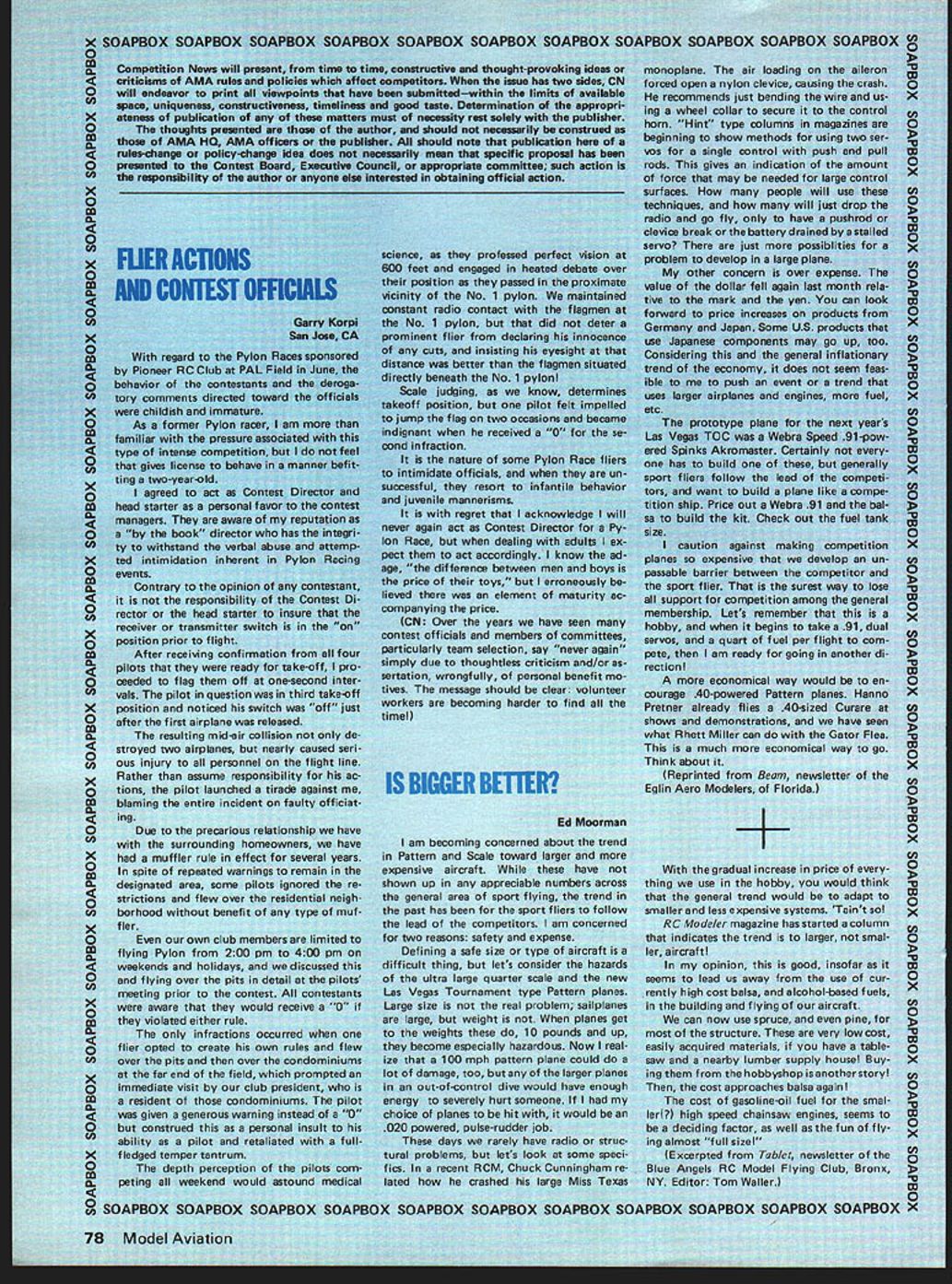
FLIER ACTIONS AND CONTEST OFFICIALS
Garry Korpi, San Jose, CA
With regard to the Pylon Races sponsored by Pioneer RC Club at PAL Field in June, the behavior of the contestants and the derogatory comments directed toward the officials were childish and immature.
As a former Pylon racer, I am familiar with the pressure associated with this type of intense competition, but I do not feel that gives license to behave in an infantile manner.
I agreed to act as Contest Director and head starter as a personal favor to the contest managers. They are aware of my reputation as a "by-the-book" director who has the integrity to withstand verbal abuse and attempted intimidation inherent in Pylon Racing events.
Contrary to the opinion of any contestant, it is not the responsibility of the Contest Director or the head starter to ensure that the receiver or transmitter switch is in the "on" position prior to flight.
After receiving confirmation from all four pilots that they were ready for take-off, I proceeded to flag them off at one-second intervals. The pilot in question was in third take-off position and noticed his switch was "off" just after the first airplane was released.
The resulting mid-air collision not only destroyed two airplanes, but nearly caused serious injury to all personnel on the flight line. Rather than assume responsibility for his actions, the pilot launched a tirade against me, blaming the entire incident on faulty officiating.
Due to the precarious relationship we have with surrounding homeowners, we have had a muffler rule in effect for several years. In spite of repeated warnings to remain in the designated area, some pilots ignored the restrictions and flew over the residential neighborhood without benefit of any type of muffler.
Even our own club members are limited to flying Pylon from 2:00 pm to 4:00 pm on weekends and holidays, and we discussed the field and flying over the pits in detail at the pilots' meeting prior to the contest. All contestants were aware that they would receive a "0" if they violated either rule.
The only infractions occurred when one flier flew over the pits and then over the condominiums at the far end of the field, prompting an immediate visit by our club president, who is a resident of those condominiums. The pilot was given a generous warning instead of a "0" but construed this as a personal insult to his ability as a pilot and retaliated with a temper tantrum.
The depth perception of the pilots competing all weekend would astound medical science, as they professed perfect vision at 600 feet and engaged in heated debate over their position as they passed near the No. 1 pylon. We maintained constant radio contact with the flagmen at the No. 1 pylon, but that did not deter the prominent flier from declaring his innocence of any cut and insisting his eyesight at that distance was better than the flagman situated directly beneath the No. 1 pylon.
Scale judging determines takeoff position, but one pilot felt impelled to jump the flag on two occasions and became indignant when he received a "0" for the second infraction.
It is the nature of some Pylon Race fliers to intimidate officials, and when they are unsuccessful, they resort to infantile behavior.
It is with regret that I acknowledge I will never again act as Contest Director for a Pylon Race, but when dealing with adults I expect them to act accordingly. I know the adage, "the difference between men and boys is the price of their toys," but I erroneously believed there was an element of maturity accompanying the price.
CN: Over the years we have seen many contest officials and committee members say "never again" simply due to thoughtless criticism and/or aspersion, wrongly accusing personal benefit motives. The message should be clear: volunteer workers are becoming harder to find all the time!
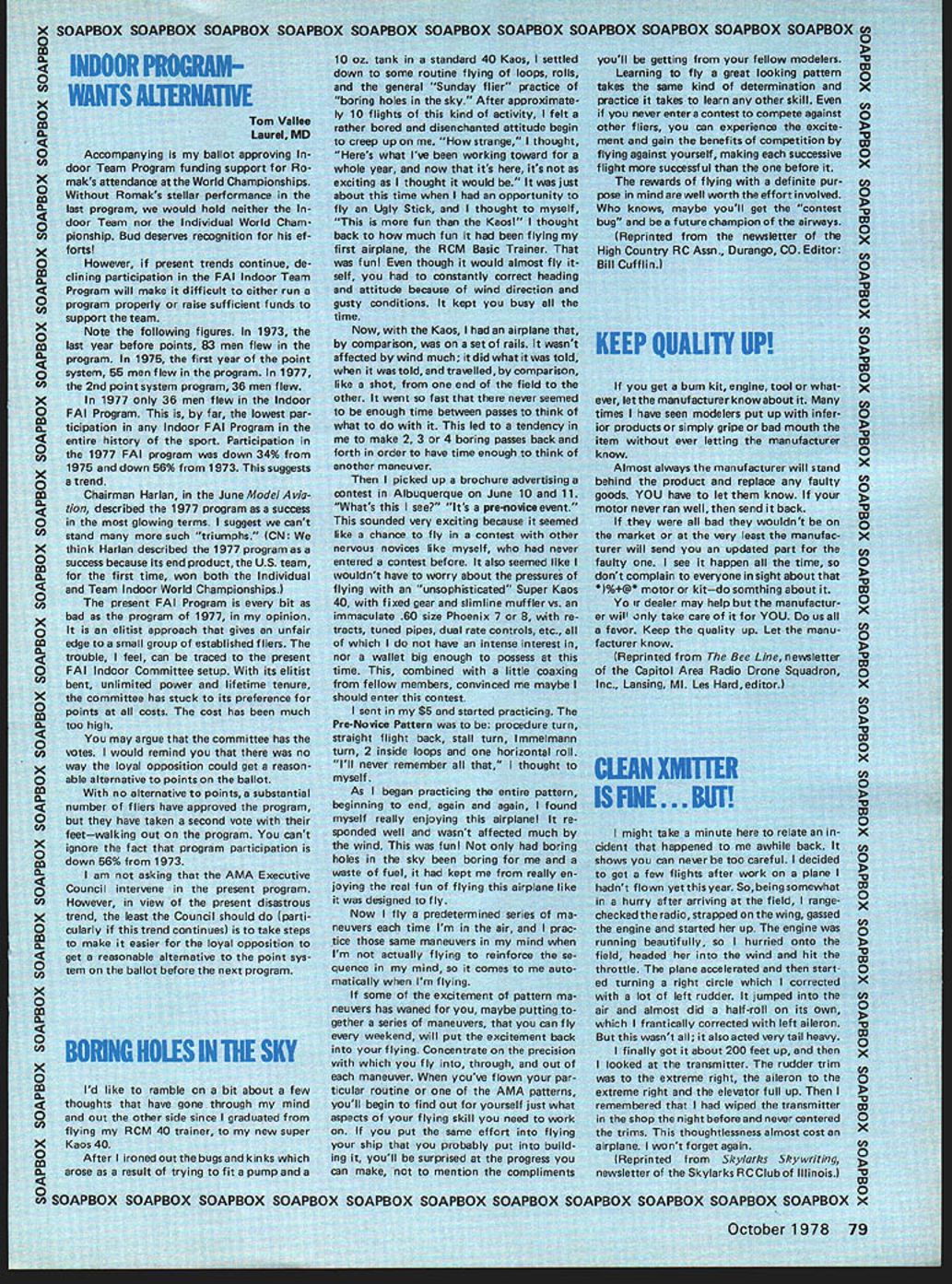
INDOOR PROGRAM — WANTS ALTERNATIVE
Tom Vallee, Laurel, MD
Accompanying is my ballot approving Indoor Team Program funding support for Romak's attendance at the World Championships. Without Romak's stellar performance in the last program, we would hold neither the Indoor Team nor the Individual World Championship. Bud deserves recognition for his efforts!
However, if present trends continue, declining participation in the FAI Indoor Team Program will make it difficult to either run a program properly or raise sufficient funds to support the team.
Note the following figures. In 1973, the last year before points, 83 men flew in the program. In 1975, the first year of the point system, 56 men flew in the program. In 1977, the 2nd point system program, 36 men flew.
In 1977 only 36 men flew in the Indoor FAI Program. This is, by far, the lowest participation in any Indoor FAI program in the entire history of the sport. Participation in the 1977 FAI program was down 34% from 1975 and down 56% from 1973. This suggests a trend.
Chairman Harlan, in the June Model Aviation, described the 1977 program as a success in the most glowing terms. I suggest we can't stand many more such "triumphs." (CN: We think Harlan described the 1977 program as a success because its end product, the U.S. team, for the first time, won both the Individual and Team Indoor World Championships.)
The present FAI Program is, in my opinion, as bad as the 1977 program. It is an elitist approach that gives an unfair edge to a small group of established fliers. The trouble, I feel, can be traced to the present FAI Indoor Committee setup. With its elitist bent, unlimited power and lifetime tenure, the committee has stuck to its preference for points at all costs. The cost has been too high.
You may argue that the committee has the votes. I would remind you that there was no way the loyal opposition could get a reasonable alternative to points on the ballot.
With no alternative to points, a substantial number of fliers have approved the program, but they have taken a second vote with their feet—walking out on the program. You can't ignore the fact that program participation is down 56% from 1973.
I am not asking that the AMA Executive Council intervene in the present program. However, in view of the present disastrous trend, the least the Council should do (particularly if this trend continues) is to take steps to make it easier for the loyal opposition to get a reasonable alternative to the point system on the ballot before the next program.
BORING HOLES IN THE SKY
(Reprinted from the newsletter of the High Country RC Assn., Durango, CO. Editor: Bill Cufflin.)
After moving from my RCM 40 trainer to a new Super Kaos 40, I found myself bored with routine flying—loops, rolls, and "boring holes in the sky." The Kaos was so stable and fast that it left little time to plan maneuvers mid-flight. I then saw a contest in Albuquerque offering a Pre-Novice event, which sounded exciting because it would let nervous novices compete without pressure against much more sophisticated ships.
I sent in my $5.00 and began practicing the Pre-Novice Pattern: procedure turn, straight flight back, stall turn, Immelmann, two inside loops, and one horizontal roll. Practicing the sequence repeatedly made flying fun again. The predetermined series of maneuvers gave me purpose and improved my skills. Even if you never enter a contest, flying a routine repeatedly will sharpen your precision and make each flight better than the last. You may even catch the "contest bug" and become a future champion.
KEEP QUALITY UP!
(Reprinted from The Bee Line, newsletter of the Capitol Area Radio Drone Squadron, Inc., Lansing, MI. Les Hard, editor.)
If you get a bum kit, engine, tool or whatever, let the manufacturer know about it. Many times modelers put up with inferior products or simply gripe without ever informing the manufacturer.
Almost always the manufacturer will stand behind the product and replace faulty goods. YOU have to let them know. If your motor never ran well, then send it back. If they were all bad they wouldn't be on the market; at the very least the manufacturer will send an updated part for the faulty one. Don't complain to everyone in sight about that 1% of motors or kits—do something about it. Your dealer may help you, and the manufacturer will only take care of it for YOU. Do us all a favor. Keep the quality up. Let the manufacturer know.
CLEAN MITTER IS FINE... BUT!
(Reprinted from Skylarks Skywriting, newsletter of the Skylarks RCC of Illinois.)
An incident: I went to the field in a hurry, ranged, checked the radio, strapped on the wing, gassed the engine and started it. The engine ran well, so I hurried onto the field, headed for the wind and hit the throttle. The plane accelerated and started a right turn which I corrected with left rudder. It jumped into the air, almost half-rolled, and acted tail heavy. I finally got it about 200 feet up and then looked at the transmitter. The rudder trim was extreme right, aileron extreme right, and elevator full up. The night before I had wiped the transmitter in the shop and never centered the trims. This thoughtlessness almost cost an airplane. I won't forget again.
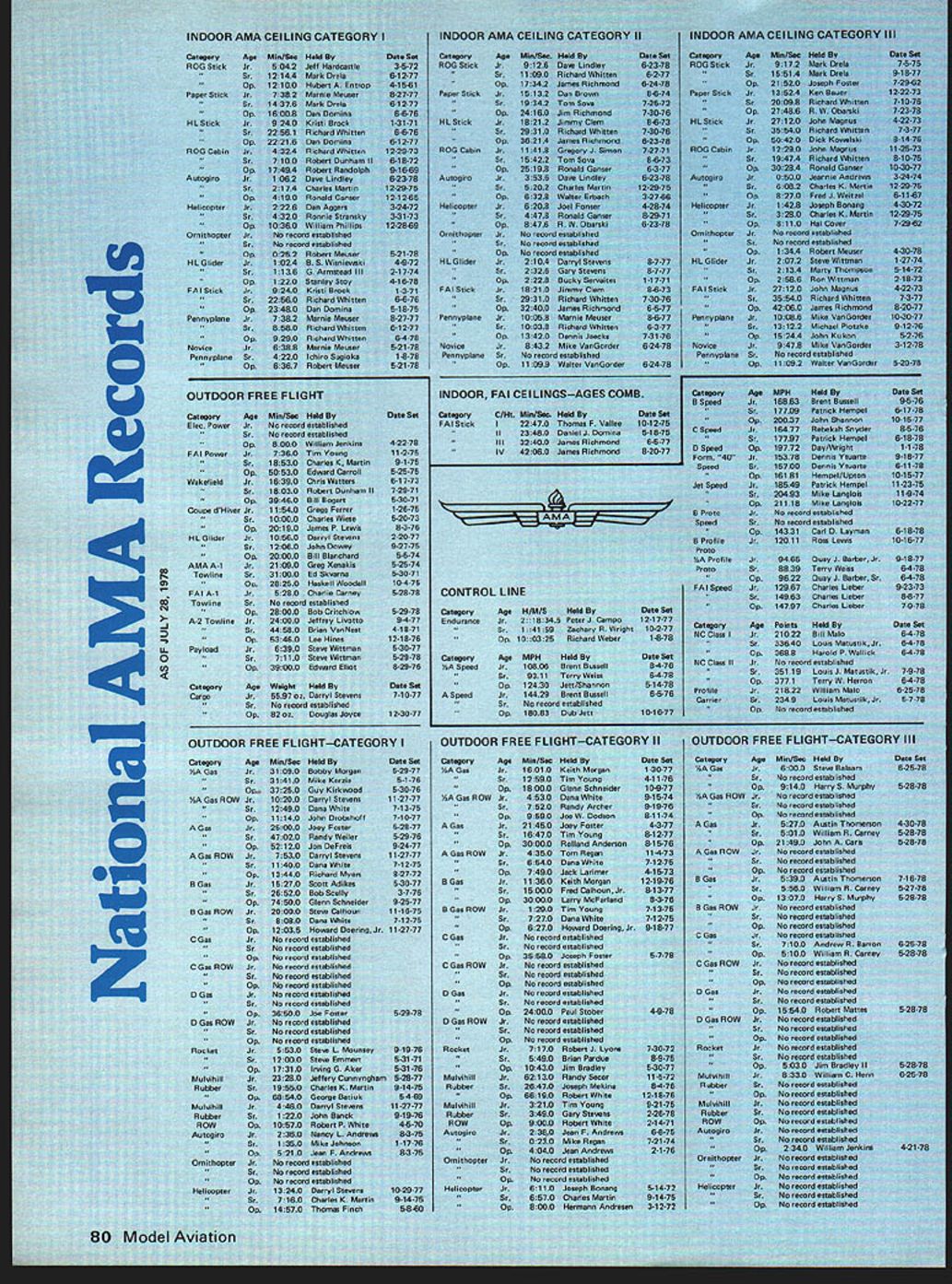
NATIONAL AMA RECORDS (AS OF JULY 28, 1978)
Note: Some entries contain uncertain characters in the original; question marks indicate unclear transcriptions.
INDOOR AMA CEILING CATEGORY I
- ROG Stick
- Jr. 5:04.4 Jeff Hardcastle 3-25-72
- Sr. 12:14.2 Mark Driba 6-27-72
- Paper Stick
- Jr. 7:33.2 Martin Messier 8-27-77
- Sr. 14:37.6 Mark Driba 6-27-72
- HL Stick
- Jr. 9:24.0 Kristi Brock 6-27-72
- Sr. 22:56.8 Richard Whitten 6-16-76
- ROG Cabin
- Jr. 4:32.4 Don Donnini 6-27-72
- Sr. 10:02.0 Robert Durham II 8-16-72
- Autogiro
- Jr. 1:08.0 Gerald Whitten 6-27-72
- Sr. 2:17.2 Charles Larmon 12-29-75
- Helicopter
- Jr. 4:32.0 Don Agnew 3-24-74
- Sr. 9:02.0 Ronn Stransky 3-31-73
- Ornithopter
- Sr. No record established
- HL Glider
- Jr. 12:02 Robert W. Messler 5-21-78
- Sr. 2:13 R. S. Winans? 4-9-72
- FAI Stick
- Jr. 2:28.6 G. Armstrong III 2-17-74
- Pennyrplane
- Jr. 3:28.0 Dan Donnini 6-16-75
- Novice Pennyrplane
- Jr. 9:20.0 Richard Whitten 5-21-78
- Sr. 9:20.0 Richard Whitten 5-21-78
INDOOR AMA CEILING CATEGORY II
- ROG Stick
- Jr. 9:12.6 Dave Lindsey 6-23-78
- Sr. 13:00.0 Richard Whitten 6-23-78
- Paper Stick
- Jr. 13:43.2 Jimmy Brown 6-24-78
- Sr. 19:14.2 Tom Sova? 7-26-73
- HL Stick
- Jr. 11:30.0 Jim Richardson 7-30-76
- Sr. 18:21.2 Jimmy Clem 6-29-74
- ROG Cabin
- Jr. 15:41.2 Tom Sova? 8-6-73
- Sr. 25:42.2 Ron Gansler 6-3-77
- Autogiro
- Jr. 6:30.2 Dave Lindsey 6-23-78
- Sr. 8:47.8 Walter Erbach? 8-29-74
- Helicopter
- Jr. 2:10.4 J. M. ? 5-21-78
- Sr. 4:47.3 Ronald Gansler 8-29-71
- HL Glider
- Jr. 21:04 Danny Stevens 6-27-77
- Sr. 22:32 Gary Stevens 8-7-71
- FAI Stick
- Jr. 2:21.0 Jimmy Clem 5-21-78
- Pennyrplane
- Jr. 13:20.0 Marnie Meuser 6-27-77
- Novice Pennyrplane
- Jr. 1:10:03 Mike VanGorder? 6-24-78
INDOOR AMA CEILING CATEGORY III
- ROG Stick
- Jr. 9:12.0 Mark Drela 7-5-75
- Sr. 15:51.4 Mark Drela 8-1-77
- Paper Stick
- Jr. 12:15.2 Ken Bejger? 6-27-72
- Sr. 24:08.0 Richard Whitten 6-27-72
- HL Stick
- Jr. 12:30.0 Howard? Foster? 6-27-72
- Sr. 43:32.6 Richard Whitten 6-27-72
- ROG Cabin
- Jr. 11:24.8 Ron Gansler? 7-3-75
- Sr. 39:31.6 Richard Whitten 6-27-72
- Autogiro
- Jr. 6:00.0 Charles K. Martin 6-22-76
- Sr. 8:27.8 J. M. ? 6-23-74
- Helicopter
- Jr. 13:28.0 Charles K. Martin 6-22-76
- Sr. 32:28.0 Charles K. Martin 6-22-76
- Ornithopter
- Jr. No record established
- Sr. No record established
- HL Glider
- Jr. 1:34:40 Robert Messler 4-30-78
- Sr. 2:07:2 Randy Whitman? 5-20-78
- FAI Stick
- Jr. 2:15:04 Ron W. Merritt? 5-19-78
- Pennyrplane
- Jr. 1:10:92 Walter VanGorder 5-20-78
INDOOR, FAI CEILINGS — AGES COMBINED
- FAI Stick
- I 24:27.0 Thomas F. Vallie 10-12-75
- II 23:47.0 Daniel J. Donnini 1-16-76
- III 42:06.0 James Richmond 8-20-77
(control line section center)
CONTROL LINE
- Endurance
- Jr. 2:18:34 Peter J. Campos 12-17-77
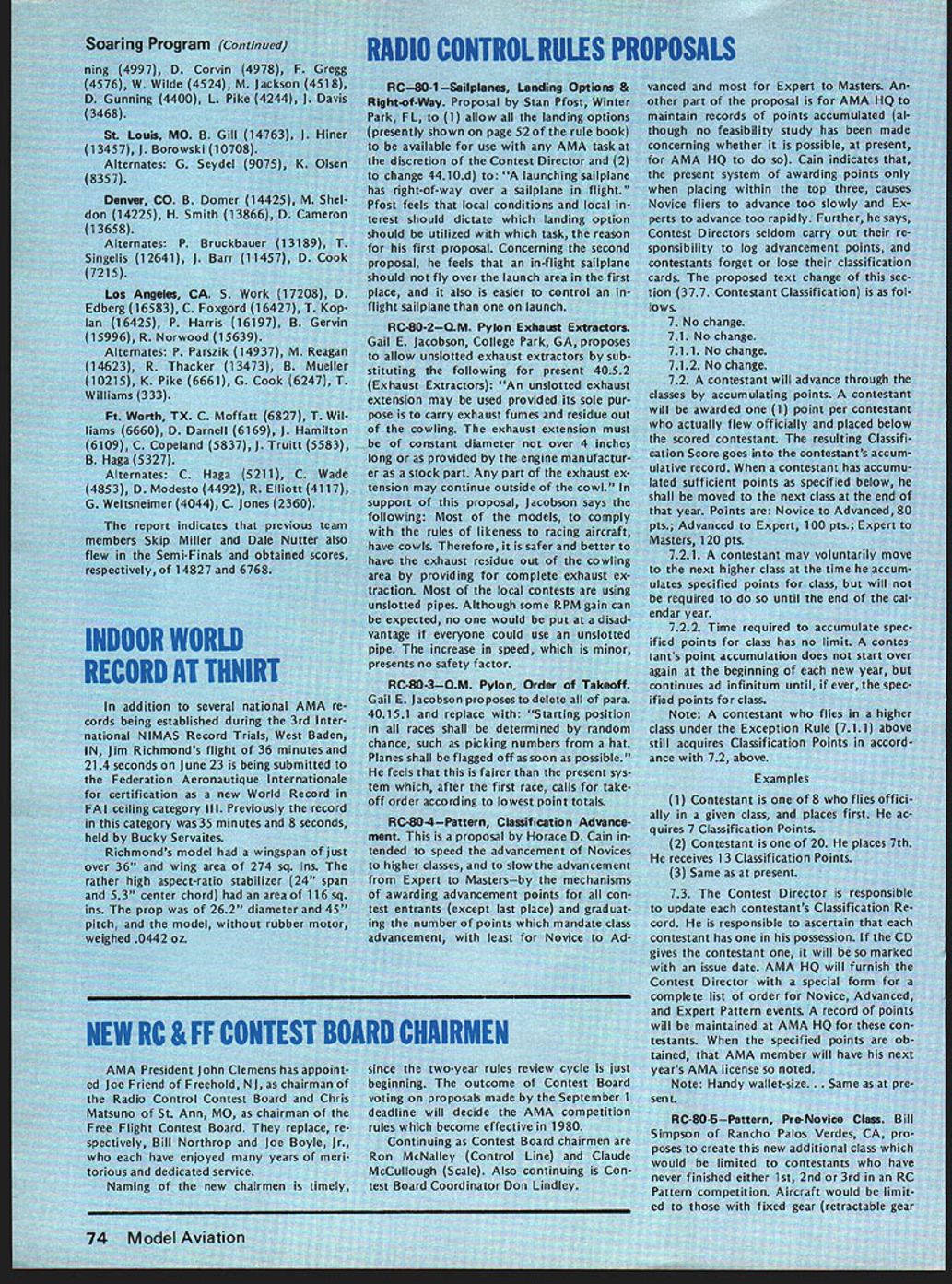
- Sr. 1:41:59 Zachary R. Wright 10-2-77
- Category A Speed
- Jr. 124.29 Brent Bassett 5-6-76
- Sr. 156.39 Terry Welch? 6-3-76
- Category B Speed
- Jr. 168.83 Brent Bassett 9-6-78
- Sr. 159.77 Pat? Harness? 10-15-76
- C Speed
- Jr. 171.23 Patrick Hensel? 8-15-76
- Sr. 157.02 Dennis ? Wright 5-11-77
- F2A (Speed)
- Jr. 204.30 Tom? Roberts 5-12-77
- Jet Speed
- Jr. 186.17 Ralph? M? 10-25-75
OUTDOOR FREE FLIGHT — SELECTED ENTRIES
CATEGORY I
- A Gas
- Jr. 31:09.0 Bobby Morgan 5-25-76
- Sr. 31:00.0 Mike Kinzler? 5-31-76
- A Gas ROW
- Jr. 12:46.0 Dan? Willett? 5-20-76
- Sr. 14:20.0 Gary Dyrine? 12-3-75
- B Gas
- Jr. 17:50.0 John Dietz? 7-10-75
- Sr. 47:02.0 Paul Reiner? 5-15-74
- Rocket
- Jr. 3:12.0 Steve M. Murry? 5-19-76
- Rubber
- Jr. 13:30 Erwin? G. Aker? 3-31-76
- Multihull Rubber
- Jr. 2:55.0 George Becker? 5-1-76
- Autogiro
- Jr. 10:57.0 Robert J. White 4-8-70
- Helicopter
- Jr. 13:06.0 William ? Martin 10-29-77
CATEGORY II
- A Gas
- Jr. 18:01.0 Keith Morgan 1-30-77
- A Gas ROW
- Jr. 7:15.0 Tom Young 4-1-76
- B Gas
- Jr. 12:59.0 Glen Schneider 9-10-76
- Rocket
- Jr. 5:33.0 Joe Binder? 5-5-76
- Rubber
- Jr. 12:40.0 John? P. Weiler 3-27-76
- Helicopter
- Jr. 6:57.0 Charles Martin 5-14-72
CATEGORY III
- A Gas
- Jr. 9:00.0 Stan? ? 6-28-78
- B Gas ROW
- Jr. 7:10.0 William R. Carey 6-28-78
(End of page)
Note: Many individual record lines contain small type and numerous names and dates. The above captures the section headings and a representative transcription of the record categories, entries, holders and dates as shown on the page.
Transcribed from original scans by AI. Minor OCR errors may remain.

