
COMPETITION RULES PROPOSALS
MORE THAN 250 UNDER REVIEW
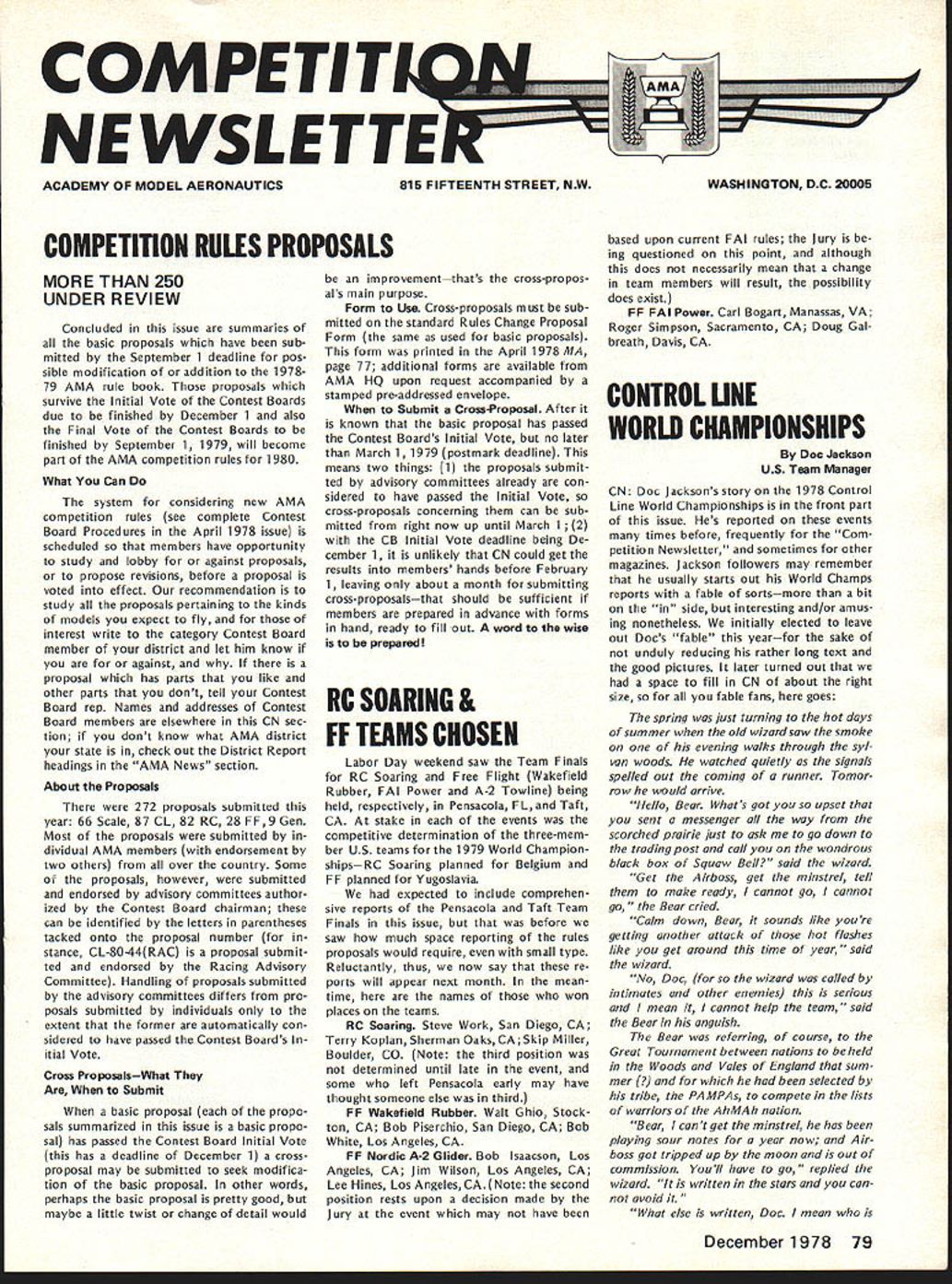
Concluded in this issue are summaries of all basic proposals submitted by the September 1 deadline for possible modification of or addition to the 1978–79 AMA rule book. Proposals that survive the Contest Boards’ Initial Vote (deadline December 1) and the Final Vote (to be finished by September 1, 1979) will become part of the AMA competition rules for 1980.
What You Can Do
The system for considering new AMA competition rules (see complete Contest Board Procedures in the April 1978 issue) is scheduled so members have an opportunity to study and lobby for or against proposals, or to propose revisions, before a proposal is voted into effect. Our recommendation: study all proposals that pertain to the kinds of models you expect to fly. For those of interest, write the category Contest Board member of your district and let him know if you are for or against, and why. If a proposal has parts you like and parts you don’t, tell your Contest Board rep.
Names and addresses of Contest Board members are elsewhere in this CN section; if you don’t know which AMA district your state is in, check the District Report headings in the “AMA News” section.
About the Proposals
There were 272 proposals submitted this year: 66 Scale, 87 CL, 82 RC, 28 FF, 9 General. Most proposals were submitted by individual AMA members (with endorsement by two others). Some were submitted and endorsed by advisory committees authorized by the Contest Board chairman; these can be identified by letters in parentheses appended to the proposal number (for example, CL-80-44(RAC) = submitted/endorsed by the Racing Advisory Committee). Proposals from advisory committees are automatically considered to have passed the Contest Board’s Initial Vote.
Cross-Proposals — What They Are, When to Submit
When a basic proposal has passed the Contest Board Initial Vote (deadline December 1), a cross-proposal may be submitted to seek modification of the basic proposal. A cross-proposal is intended for changes in detail or twists that would improve the basic proposal.
- Form to Use: Cross-proposals must be submitted on the Standard Rules Change Proposal Form (same as used for basic proposals). The form was printed in the April 1978 MA, page 77. Additional forms are available from AMA HQ upon request, accompanied by a stamped pre-addressed envelope.
- When to Submit: After it is known the basic proposal has passed the Initial Vote, but no later than March 1, 1979 (postmark deadline). Note:
- Advisory-committee proposals are already considered to have passed the Initial Vote, so cross-proposals addressing them can be submitted now through March 1.
- With the Contest Boards’ Initial Vote deadline of December 1, CN might not get results to members before February 1, leaving about a month for submitting cross-proposals; plan ahead with forms ready.
---
RC SOARING & FF TEAMS CHOSEN
Labor Day weekend hosted Team Finals for RC Soaring (Pensacola, FL) and Free Flight (Wakefield, Rubber, FAI Power and A-2 Towline — Taft, CA). These events selected the three-member U.S. teams for the 1979 World Championships (RC Soaring for Belgium; FF for Yugoslavia). Comprehensive reports will appear next month; in the meantime, team members are:
- RC Soaring: Steve Work, San Diego, CA; Terry Koplan, Sherman Oaks, CA; Skip Miller, Boulder, CO. (Note: the third position was decided late in the event; some who left Pensacola early may have thought someone else was third.)
- FF Wakefield (Rubber): Walt Ghio, Stockton, CA; Bob Piserchio, San Diego, CA; Bob White, Los Angeles, CA.
- FF Nordic A-2 Glider: Bob Isaacson, Los Angeles, CA; Jim Wilson, Los Angeles, CA; Lee Hines, Los Angeles, CA. (Note: the second position rests upon a decision by the jury which may not have been based on current FAI rules; the jury is being questioned on this point, so changes remain possible.)
- FF FAI Power: Carl Bogart, Manassas, VA; Roger Simpson, Sacramento, CA; Doug Galbreath, Davis, CA.
---
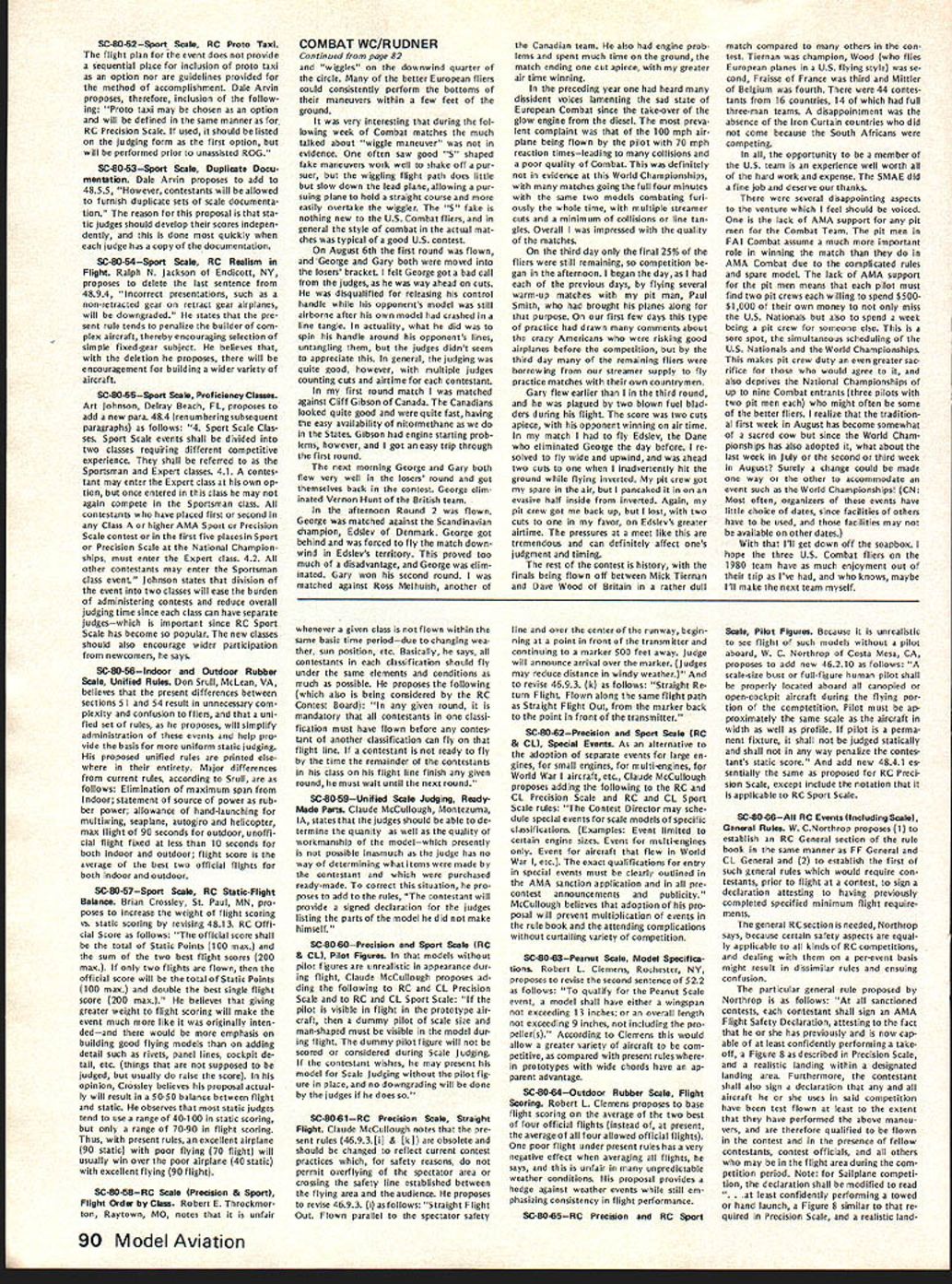
CONTROL LINE WORLD CHAMPIONSHIPS
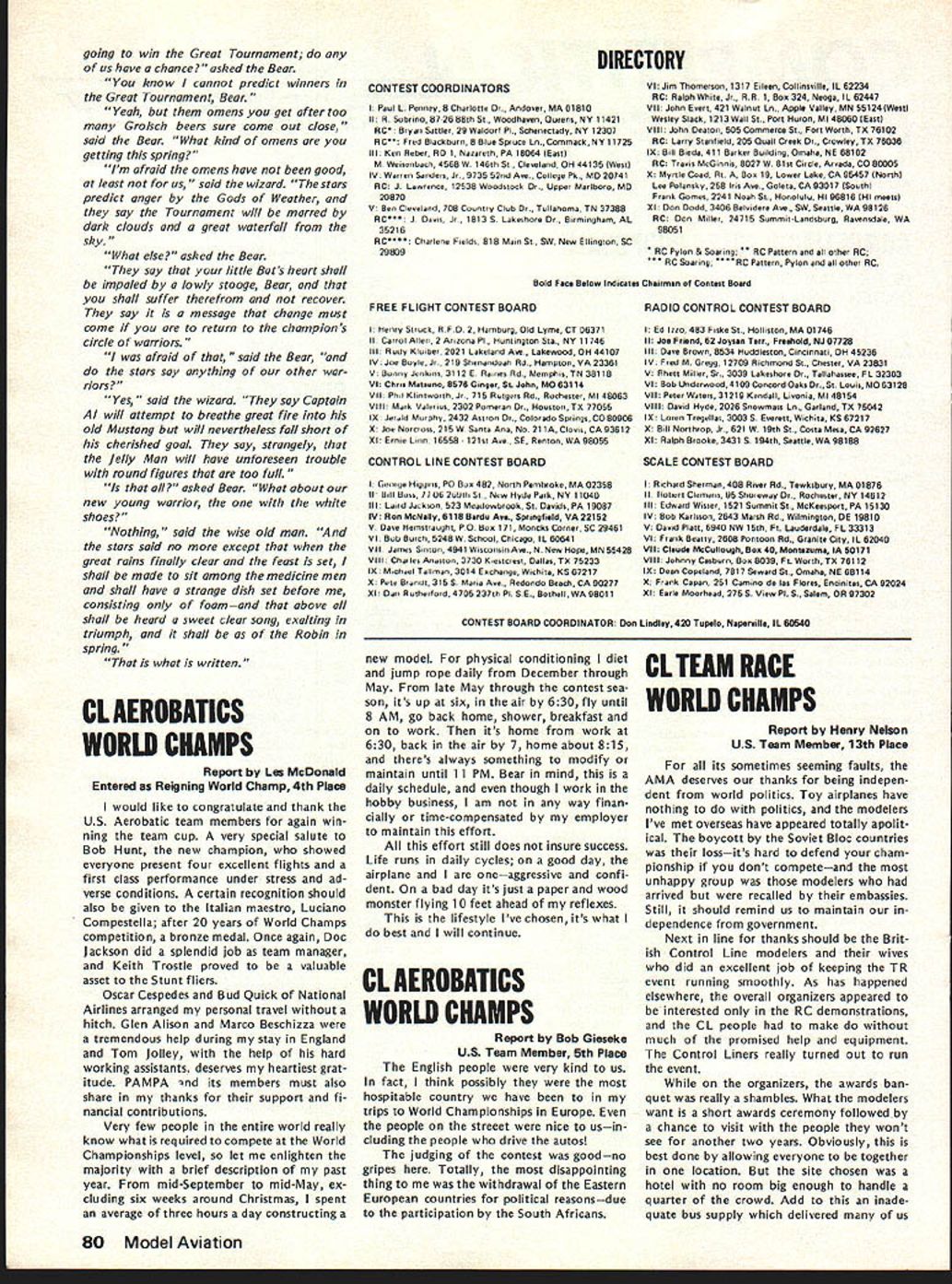
CL Aerobatics World Champs — Report by Les McDonald (Reigning World Champ — 4th Place)
Congratulations and thanks to the U.S. Aerobatic team for winning the team cup again. Special salute to Bob Hunt, the new champion, who delivered four excellent flights and a first-class performance under stress and adverse conditions. Recognition to Luciano Compestella (Italy) for a bronze medal after 20 years of World Championships competition. Doc Jackson did a splendid job as team manager, and Keith Trostle proved a valuable asset to the stunt fliers.
Thanks to Oscar Cespedes and Bud Quick of National Airlines for arranging travel; thanks to Glen Alson and Marco Becschizza for help in England; Tom Jolley and his assistants deserve gratitude; PAMPA and its members provided support and financial contributions.
A note on what it takes to compete at World Championship level: from mid-September to mid-May I averaged three hours a day constructing a new model (excluding six weeks around Christmas). For conditioning I diet and jump rope daily from December through May. From late May through contest season I would fly early intervals before work and again after work, doing maintenance until late at night. Even this effort does not guarantee success — performance varies day to day. This is the lifestyle I’ve chosen and will continue.
CL Aerobatics World Champs — Report by Bob Gieseke (U.S. Team Member — 5th Place)
The English were very kind and hospitable — possibly the most hospitable country we’ve visited for World Championships in Europe. Judging was good; my biggest disappointment was the withdrawal of Eastern European countries for political reasons (due to South African participation). That boycott hurt the competition.
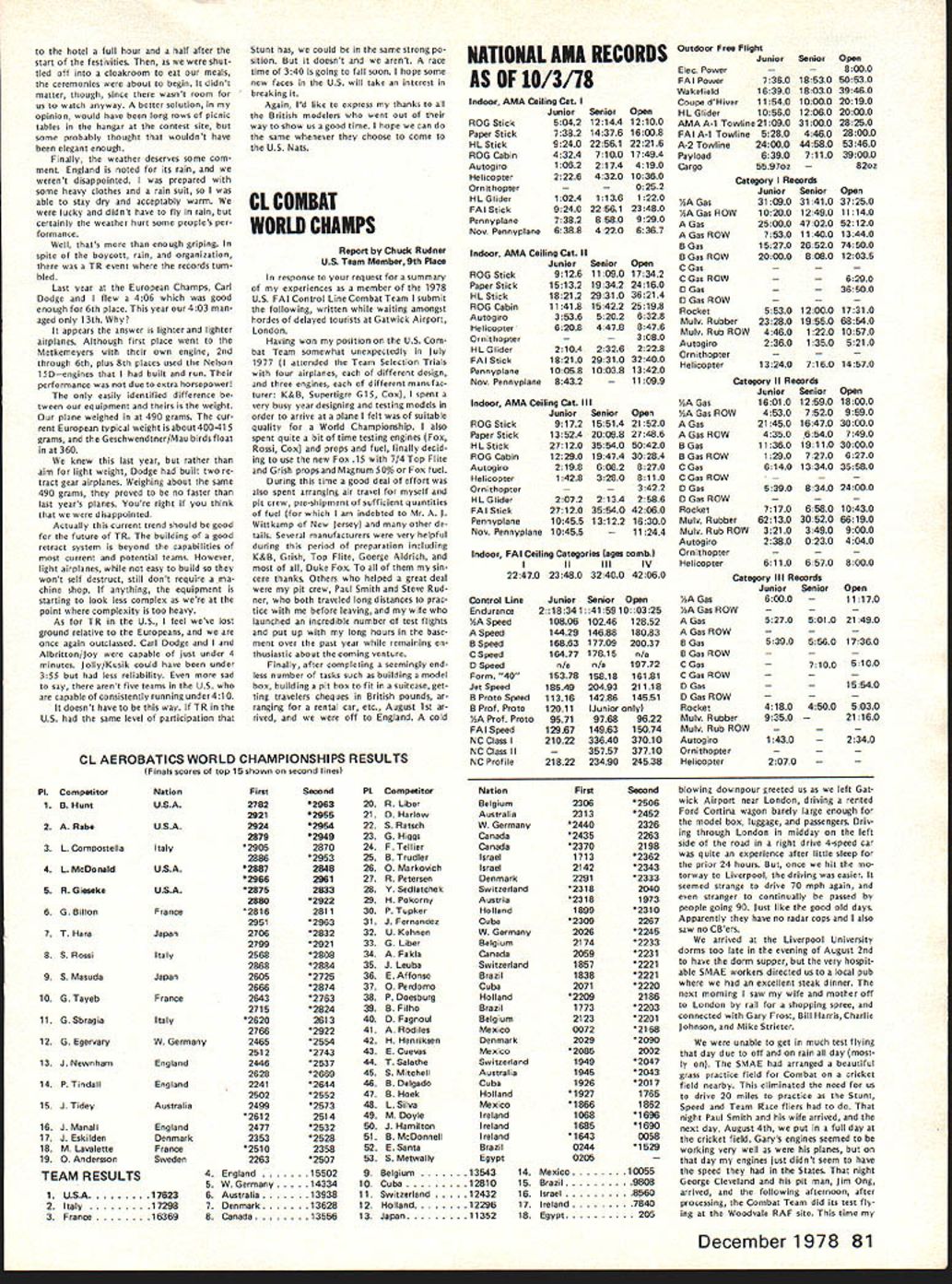
CL Team Race World Champs — Report by Henry Nelson (U.S. Team Member — 13th Place)
Thanks to the AMA for being independent of world politics. Toy airplanes and modelers are apolitical; the Soviet Bloc boycott was their loss. The British Control Line community and their wives did an excellent job keeping the TR event running smoothly. Overall event organizers focused on RC demonstrations, leaving CL people to manage with less help and equipment — the Control Liners did a fine job.
The awards banquet was poorly managed: insufficient seating, late buses, and shuttling to cloakrooms made it hard to enjoy the ceremony and visit with other modelers. A hangar picnic-table setup at the contest site would have been more practical.
Weather (rain) affected performance, though we were fortunate not to fly in rain. Records turned at the TR event despite the boycott, rain, and organizational issues.
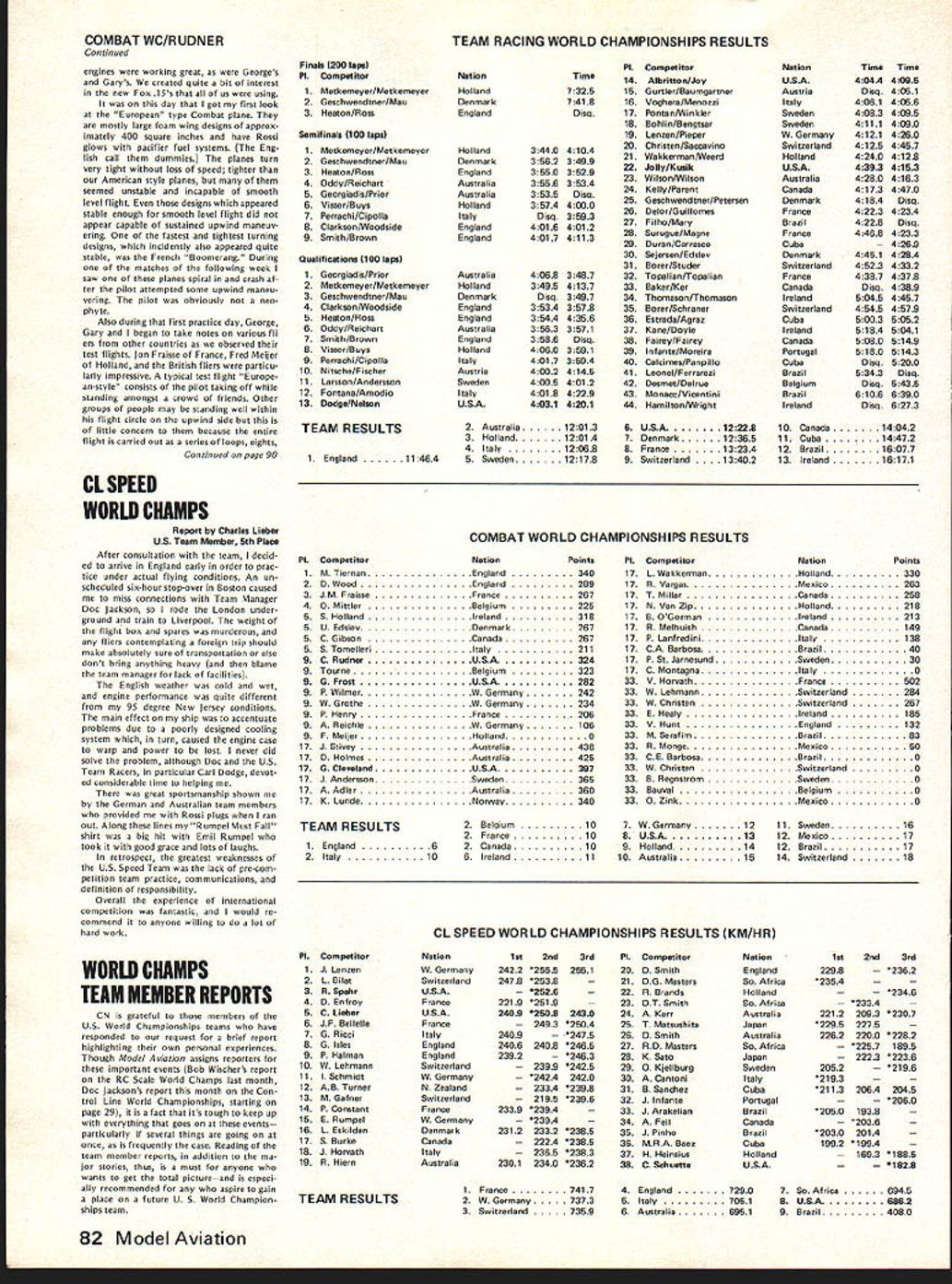
Analysis of performance: European trend is toward lighter airplanes. First-place used his own engine; 2nd–6th used Nelson 1.5D engines. Weight difference was significant: our plane weighed 490 grams; typical European weight is about 400–415 grams; the Geschwinder entry weighed 360 grams. Lighter planes (simpler, less need for machine-shop-level fabrication) make TR more accessible. U.S. TR appears to be losing ground compared with Europeans. Increased participation at the club and stunt levels would improve U.S. performance. Thanks again to British modelers for their hospitality.
---
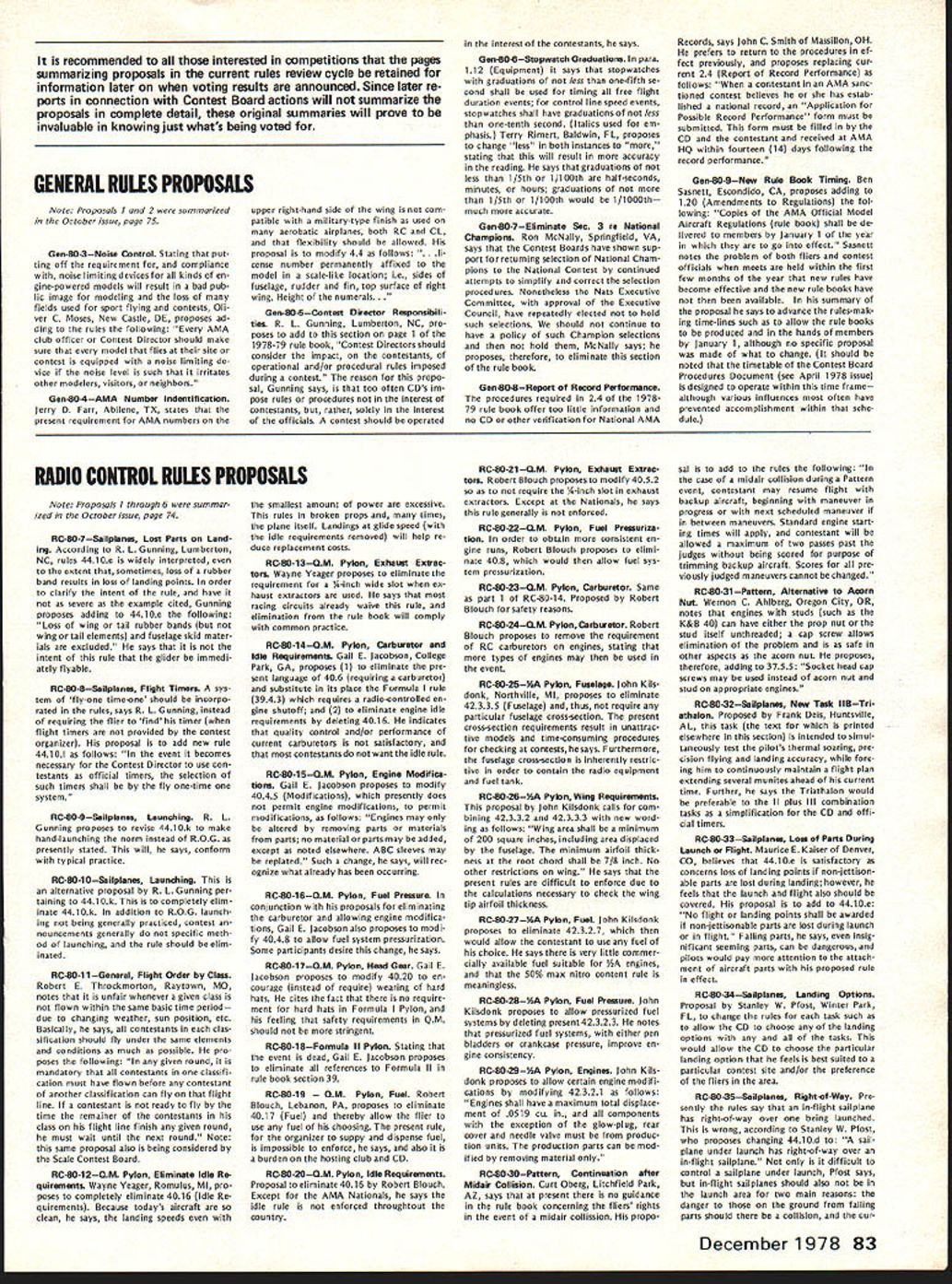
GENERAL RULES PROPOSALS
Note: Proposals 1 and 2 were summarized in the October issue, page 75.
- Gen-80-3 — Noise Control. Oliver C. Moses (New Castle, DE) proposes adding a rule requiring every AMA club officer or Contest Director to ensure every model flying at their site for contest is equipped with a noise-limiting device if the noise level irritates other modelers, visitors, or neighbors. Moses argues that postponing noise requirements will damage modeling’s public image and cost fields.
- Gen-80-4 — AMA Number Identification. Terry D. Farr (Abilene, TX) proposes allowing flexibility in AMA number placement to accommodate military-type finishes. He suggests modifying section 4.4 to permit permanent AMA numbers in scale-like locations (sides of fuselage, rudder/fin, top surface of tail), with numerals sized as specified.
- Gen-80-5 — Contest Director Responsibilities. Ben L. Gunning (Lumberton, NC) proposes adding guidance that Contest Directors should consider the impact on contestants of operational/procedural rules imposed during a contest; CDs should operate contests in the contestants’ interest.
- Gen-80-6 — Stopwatch Graduations. Terry Rimer (Baldwinsville, NY) proposes changing wording in para. 1.12 (Equipment) regarding stopwatch graduations. Present text says graduations "not less than" 1/5 or 1/10 second; Rimer proposes changing "less" to "more" to improve reading accuracy (he argues the present wording is confusing).
- Gen-80-7 — Eliminate Section on National Champions. Tom McNally (Springfield, VA) proposes eliminating the section that assigns selection of National Champions, arguing the Contest Boards and the Nats Executive Committee have effectively returned selection to the National Contest.
- Gen-80-8 — Report of Record Performance. John C. Smith (Massillon, OH) proposes replacing current section 2.4 with a requirement that a contestant who believes he has established a national record must submit an "Application for Possible Record Performance" form filled in by the Contest Director and contestant and received at AMA HQ within 14 days.
- Gen-80-9 — New Rule Book Timing. Ben Sainett (Escondido, CA) proposes adding to 1.20 (Amendments to Regulations) the requirement that copies of the AMA Official Model Aircraft Regulations be delivered to members by January 1 of the year in which they go into effect. He notes timing problems when early-year meets are held before new rule books are available.
---
RADIO CONTROL RULES PROPOSALS
Note: Proposals 1–6 were summarized in the October issue, page 74.
- RC-80-7 — Sailplanes: Lost Parts on Landing. R. L. Gunning (Lumberton, NC) proposes clarifying 44.10c to exclude loss of wing or tail rubber bands (but not wing or tail elements) and fuselage skid materials from landing-point deductions. He argues the rule has been interpreted too strictly.
- RC-80-8 — Sailplanes: Flight Times / Fly-One-Time-One. R. L. Gunning proposes adding para. 44.10.1: if the CD uses official timers, selection of timers shall follow a "fly one time — one" system (i.e., impartial assignment when official timers are needed).
- RC-80-9 — Sailplanes: Launching. R. L. Gunning proposes revising 44.10k to make hand-launching the norm instead of R.O.G. (rise-off-ground), to conform with typical practice (proposes making hand-launching the relaxed 40.0.6 standard).
- RC-80-10 — Sailplanes: Landing. R. L. Gunning proposes eliminating 44.10k so that R.O.G. (launch) would be permitted, and contest organizers could disallow certain launching methods at their discretion.
- RC-80-11 — General, Flight Order by Class. Robert E. Throckmorton (Raytown, MO) proposes requiring that in any round, all contestants in one classification must have flown before any contestant of another class may fly on that flight line. If a contestant is not ready when his class is called, he must wait until the next round. (Also under consideration by Scale Contest Board.)
- RC-80-12 — Q.M. Pylon, Eliminate Idle Requirements. Wayne Reger (Romulus, MI) proposes eliminating 40.10 (Idle Requirements) because modern aircraft land at high speeds even at idle; removing idle requirements could reduce broken props and airframe damage.
- RC-80-13 — Q.M. Pylon, Exhaust Extraction. Wayne Yeager proposes eliminating the requirement for a shroud used with exhaust extractors, noting many circuits already waive the rule.
- RC-80-14 — Q.M. Pylon, Carburetor and Idle Requirements. Gail E. Jacobson (College Park, GA) proposes (1) removing the language requiring a carburetor and substituting the Formula 1 rule requiring a radio-controlled engine shutoff, and (2) deleting engine idle requirements (40.16); organizers and CDs feel current carburetors are unsatisfactory and contestants dislike the idle rule.
- RC-80-15 — Q.M. Pylon, Engine Modifications. Gail E. Jacobson proposes modifying 40.5 to permit engine modifications by removal of material (but not adding parts); ABC sleeves may be replaced. This would recognize modifications already occurring.
- RC-80-16 — Q.M. Pylon, Fuel Pressure. Gail E. Jacobson proposes modifying 40.8 to allow fuel system pressurization.
- RC-80-17 — Q.M. Pylon, Hand Gear. Gail E. Jacobson proposes modifying 40.20 to encourage (rather than require) warning of hand gear, noting no hard-hat requirement exists for Formula I Pylon.
- RC-80-18 — Formula I Pylon. Gail E. Jacobson proposes eliminating all references to Formula I in section 39, stating the event is effectively dead.
- RC-80-19 — Q.M. Pylon, Fuel. Robert Bloch (Toledo, PA) proposes eliminating 40.17 to allow fliers to choose any fuel. He argues organizer-supplied fuel is impractical to enforce and burdensome for hosting clubs.
- RC-80-20 — Q.M. Pylon, Idle Requirements. Robert Bloch proposes eliminating 40.16, noting the idle rule is not consistently enforced.
- RC-80-21 — Q.M. Pylon, Exhaust Extractors. Robert Bloch proposes modifying 40.5.2 to remove the 1/4-inch slot requirement in extractors, noting the rule is generally not enforced except at Nationals.
- RC-80-22 — Q.M. Pylon, Fuel Pressurization. Robert Bloch proposes deleting 40.8 to allow fuel pressurization for consistent engine runs.
- RC-80-23 — Q.M. Pylon, Carburetor (Safety). Robert Bloch proposes changes similar to RC-80-14 for safety reasons.
- RC-80-24 — Q.M. Pylon, Carburetor (Expand Engine Types). Robert Bloch proposes removing the requirement for RC carburetors to allow more engine types in competition.
- RC-80-25 — S.A. Pylon, Fuselage. John Klissondok (name uncertain — Northville, MI) proposes eliminating 42.3.3.5 (fuselage) to avoid specifying particular fuselage cross-sections. He says current cross-section rules complicate modem checks and enforcement.
- RC-80-26 — S.A. Pylon, Fuel. John Klissondok proposes eliminating 42.3.2.7 to allow contestants to use any fuel; he notes limited commercial fuel availability suitable for 25A engines.
- RC-80-27 — S.A. Pylon, Fuel Pressure. John Klissondok proposes deleting 42.3.2.3 to allow pressurized fuel systems (pentane bladders or crankcase pressure) for greater engine consistency.
- RC-80-28 — S.A. Pylon, Engines. John Klissondok proposes modifying 42.3.2.1 to allow certain engine modifications while retaining maximum displacement of .049 cu in. Production parts can be modified by removing material only.
- RC-80-30 — Pattern, Continuation and Midair Collisions. Curt Degen (Litchfield Park, AZ) proposes adding guidance for midair collisions in Pattern events: in case of midair collision, the contestant may resume flying with the observer if the CD deems the model safe; previously judged maneuvers shall remain scored and cannot be changed.
- RC-80-31 — Pattern, Alternative to Acorn Nut. C. Ahlberg (Oregon City, OR) proposes allowing socket-head cap screws instead of acorn nuts (as cap screws can prevent prop nut unthreading on engines with studs).
- RC-80-32 — Sailplanes, New Task 118 — Triathlon. Frank Davis (Huntsville, AL) proposes a new Task (Triathlon) for sailplanes to test thermal soaring, precision flying, and landing accuracy in a single integrated task. (Full task text appears below.)
- RC-80-33 — Sailplanes, Loss of Parts During Launch or Flight. Maurice K. Kaiser (Denver, CO) proposes that non-recoverable parts lost during launch, flight, or landing not be penalized (no flight or landing points deducted for such losses).
- RC-80-34 — Sailplanes, Landing Options. Stanley W. Fouts (Winter Park, FL) proposes allowing the CD to choose any of the landing options outlined in task descriptions, enabling selection suited to the contest site or local flier preference.
- RC-80-35 — Sailplanes, Right-of-Way. Stanley W. Fouts proposes changing 44.10.4: a sailplane in flight shall have right-of-way over powered aircraft, except in imminent collision, in which case the other aircraft shall take evasive action.
- RC-80-36 — Numbered in error.
- RC-80-37 — Slipstreams, New Landing Option. Frank R. Deis proposes adding a new Landing Option (Graduated Runway) under Landing Options of Task II — Duration: a 50-foot centerline runway aligned with the wind, 10 inches either side; model that comes to rest within runway receives up to 100 bonus points, losing 1 point per inch from the nose to the center line. Models beyond ends of center line or more than 100 inches to the side get zero. Pilots may not stand within runway boundary; violators get zero bonus points. (Suggestion: use a marked PVC pipe to measure landing points.)
- RC-80-38 — Sailplanes, Time on Tow. Frank R. Deis proposes adding para. 44.10l: a maximum of 1 minute is allowed from the instant the pilot or helper releases the model until towline release; violations result in a zero score for that flight. This addresses the tactic of holding the model on the launching device indefinitely to await good air.
- RC-80-39 — Sailplanes, Launching (again). Frank R. Deis also proposes making hand-launching the norm instead of R.O.G. per 44.10k.
- RC-80-40 — Sailplanes, Alternative to Size Classes and Age Division. James L. Davis, Jr. (Birmingham, AL) proposes replacing size classes and standard age divisions with Novice, Intermediate, Advanced, and Expert classes. Novice would not have to meet Flight Qualification Requirements and would receive a landing bonus. Flight order would be by lot within frequency limitations and maintained by class.
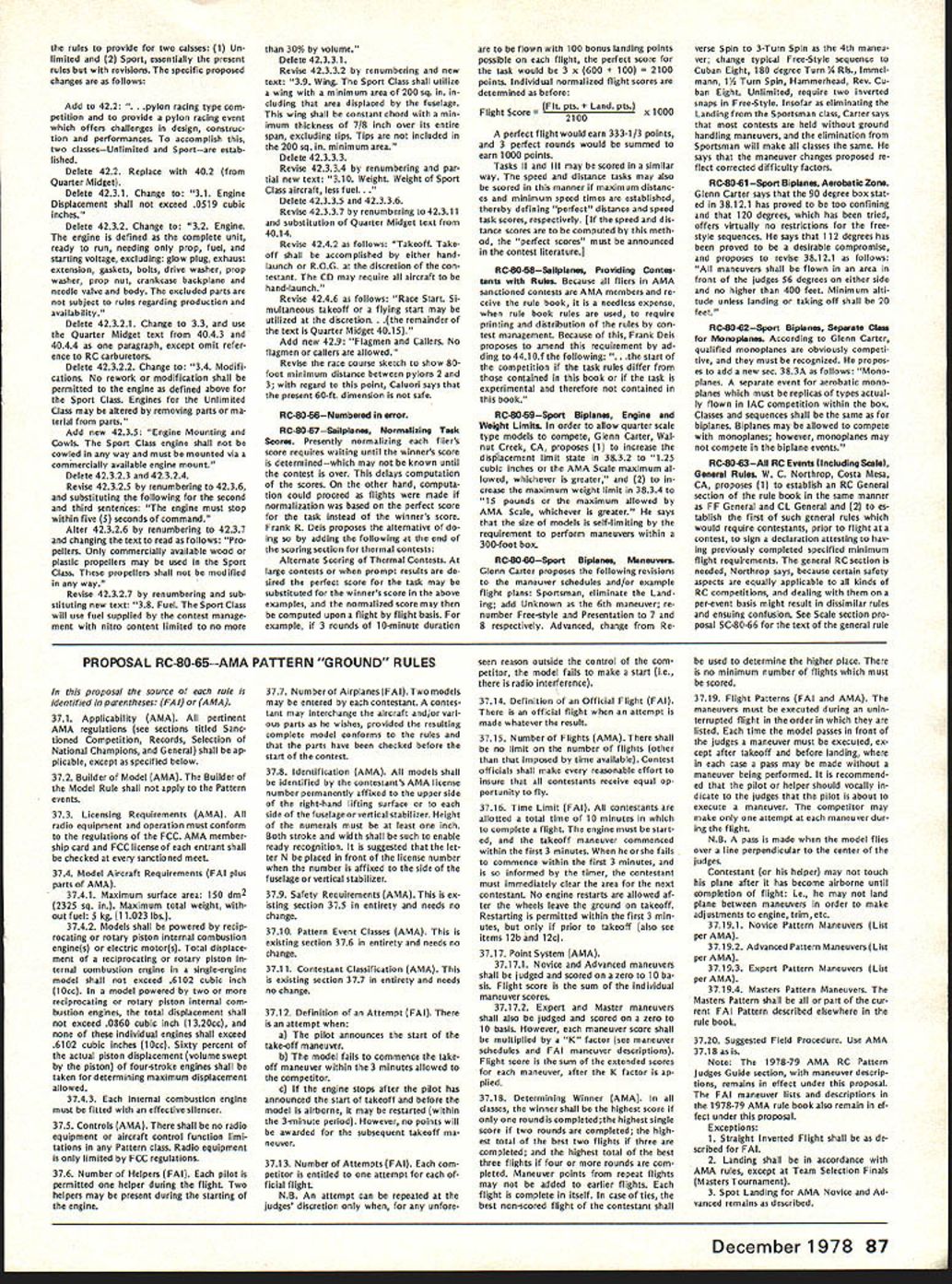
- RC-80-41 — Pylon, New Sport 500 Event. Don Engell (Goddard, KS) proposes a Sport 500 Pylon event to encourage sport fliers and novices at low cost (rules printed elsewhere in this section; see PROPOSAL RC-80-41 below).
- RC-80-42 — Pattern, Contestant Classification. David A. Davis (Hartford, IN) proposes revising 37.7.2 to award advancement points to the first five places (5–1 points), retain multipliers, and raise points required for advancement from 100 to 150.
- RC-80-43 — Sport Pylon Racing. Horace Caffar? (name illegible; Buffalo Grove, IL) proposes replacing chapter 41 with new Sport Pylon racing rules: objective, general, engine rules, aircraft rules, and more for multiple-plane races using simpler, sport-like models. (Full replacement printed elsewhere in this section.)
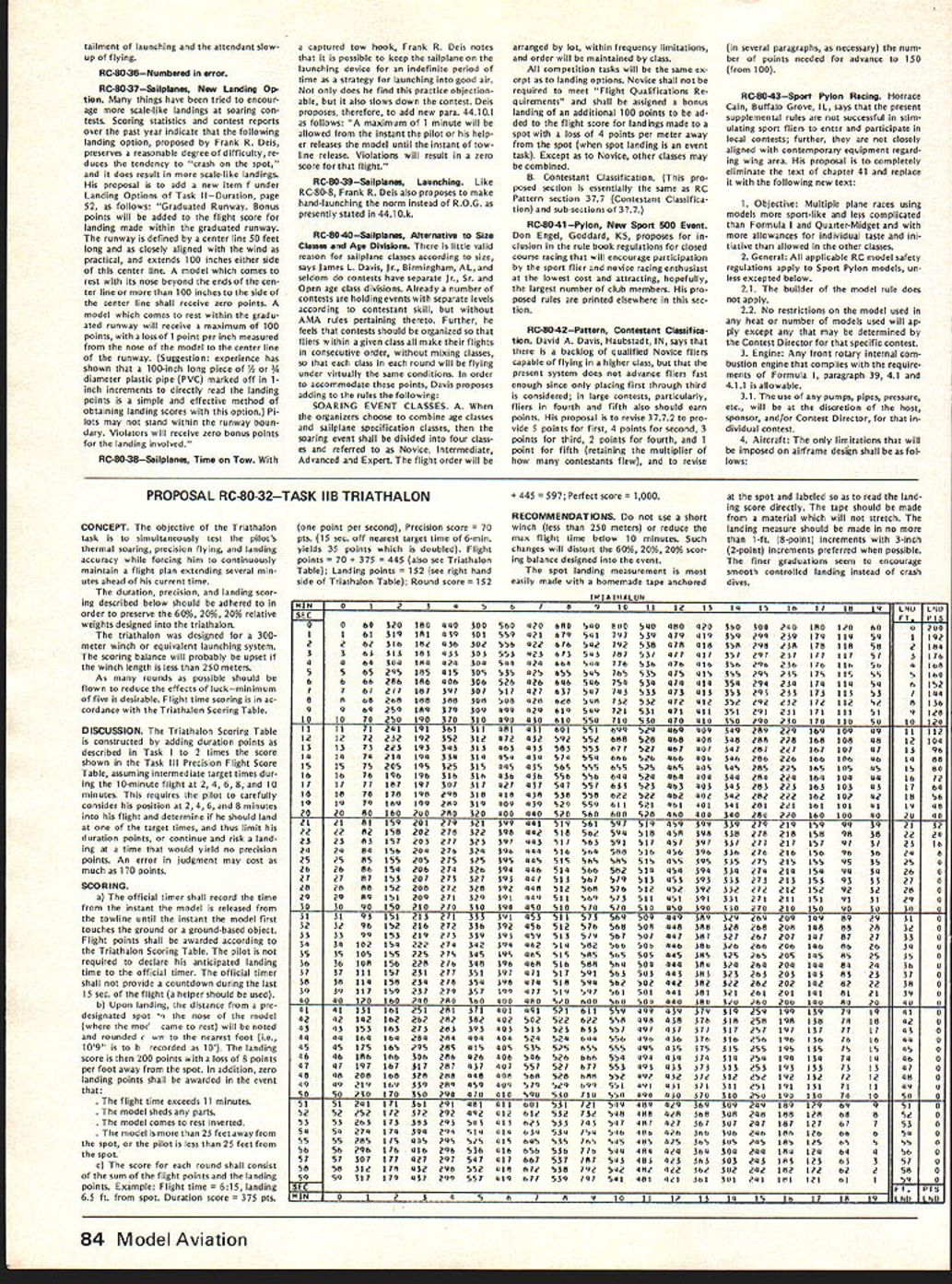
PROPOSAL RC-80-32 — TASK IIB TRIATHLON
- Concept: Triathlon tests thermal soaring, precision flying, and landing accuracy simultaneously, forcing pilots to maintain a multi-minute flight plan. Weights: duration 60%, precision 20%, landing 20%. Designed for a 300-meter winch; avoid winches shorter than 250 meters.
- Suggested minimum rounds: five.
- Scoring:
- a) Official timer records time from release until the model first touches the ground. Flight points awarded per Triathlon Scoring Table. Pilot need not state anticipated landing time to timer; no countdown in last 15 seconds.
- b) Upon landing, distance from designated spot (nose where model came to rest) recorded and rounded to nearest foot. Landing score = 200 points minus 8 points per foot away from the spot. Zero landing points if:
- Flight time exceeds 11 minutes.
- Model sheds any parts.
- Model comes to rest inverted.
- Model comes to rest more than 25 feet away from the spot, or pilot is less than 25 feet from the spot.
- c) Round score = flight points + landing points.
- Example: Flight time 6:15, landing 6.5 ft from spot: Duration 375 pts + Landing 445 = 820? (OCR example gave 597; verify when applying rules.)
- Recommendations: Avoid winches under 250 meters or reducing max flight time below 10 minutes to keep the 60/20/20 balance. Use a tape anchored at the spot labeled to read landing score directly; measure in 1-ft increments (3-inch increments preferred).
---
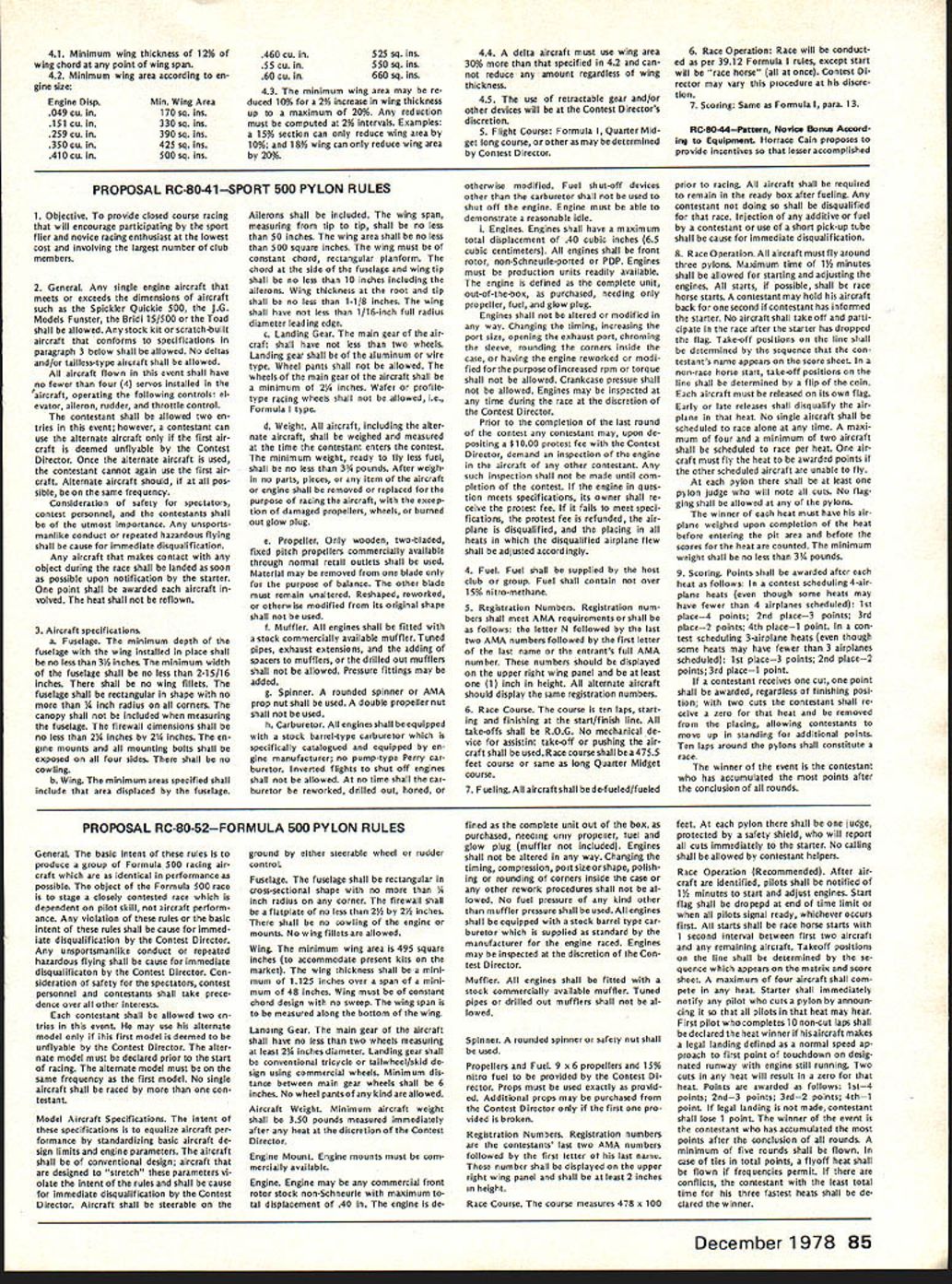
PROPOSAL RC-80-41 — SPORT 500 PYLON RULES (Summary)
- Objective: Closed-course racing to encourage sport and novice racing at low cost and with broad club participation.
- General:
- Allowed aircraft: single-engine models similar to Spitfire Quickie 500, J-6, Funster, Brital 65/500, Toad. No deltas or tailless aircraft.
- Minimum of four servos (elevator, aileron, rudder, throttle).
- Contestant allowed two entries; alternate may be used only if first aircraft is deemed unflyable.
- Safety and sportsmanship paramount; unsportsmanlike conduct or repeated hazardous flying = immediate disqualification.
- If an aircraft contacts an object during the race it must land when notified; one point awarded per aircraft involved; heat is not reflown.
- Aircraft specifications:
- a. Fuselage: min depth 3½", min width 2-15/16"; rectangular shape with max 3/4" radius corners; canopy excluded when measuring; firewall min 2¼" x 2¼"; engine mounts exposed on all four sides; no cowling.
- b. Wing: min span 50", min area 500 sq in (including fuselage area); constant chord rectangular planform; chord min 10" including ailerons; minimum thickness 1-1/8" at root and tip; min 1/16" full radius leading/trailing edges.
- c. Landing gear: at least two wheels; aluminum gear; wheel pants not allowed; wheel diameter min 2-1/4".
- d. Weight: weighed at entry; minimum ready-to-fly weight 34 lb. No parts removed after weigh-in except for racing purposes and limited exceptions (propellers, wheels, glow plug).
- e. Propeller: wooden two-bladed fixed-pitch, commercially available; material may be removed from one blade only for balance.
- f. Muffler: stock commercially available muffler required; tuned pipes, extensions, drilled or modified mufflers not allowed.
- g. Spinner: rounded spinner or AMA prop nut; no double prop nut.
- h. Carburetor: stock carburetor as supplied by engine manufacturer; no pump-type Perry or inverted carburetors; no performance carburetor modifications.
- Engines: max .40 cu in displacement (6.5 cc); front rotary, non-Schnuerle-ported production units; engines defined as complete unit including carburetor and muffler (excluding prop, fuel, glow plug). Engines must not be altered. Protest procedure: $10 deposit for engine inspection after last round.
- Fuel: supplied by host club; max 18% nitro-methane.
- Registration numbers: follow AMA requirements; display on upper right wing panel and fuselage side; at least 1" high.
- Race operation: per Formula I rules with "race-horses" start (all at once); CD may vary procedures.
- Scoring: same as Formula I para. 13.
---
PROPOSAL RC-80-52 — FORMULA 500 PYLON RULES (Summary)
- Objective: Equalize Formula 500 racing to rely on pilot skill rather than aircraft performance. Unsportsmanlike conduct or rule violations = immediate disqualification. Safety first.
- General:
- Two entries allowed per contestant; alternate must be declared and be on same frequency.
- Model specs intended to equalize performance; conventional design; steerable on ground.
- Model specifications (highlights):
- Fuselage rectangular cross-section with max 3/4" corner radius; firewall min 2¼" x 2¼"; no cowling.
- Wing min area 495 sq in; constant chord, no sweep; thickness min 1-1/8" over at least 8".
- Landing gear: at least two wheels, diameter min 2-1/4", aluminum or steel; no wheel pants.
- Weight: min 34 lb measured at CD direction.
- Engine: commercially available front rotary non-Schnuerle, max .40 cu in; out-of-the-box complete unit only, no modifications; stock carburetor and muffler required.
- Props and fuel: 9x6 propellers and 15% nitro fuel provided by the Contest Director; props must be used as supplied and not altered.
- Registration numbers: per AMA rules, visible on upper right wing panel and fuselage side.
- Race course: 478 x 100 ft; one judge per pylon with safety shield; no calling by helpers.
- Race operation: "race-horses" start; no more than six aircraft per heat; qualifying heats; points assigned 9–6–4–3–2–1 for placings in heats; highest total after heats wins.
---
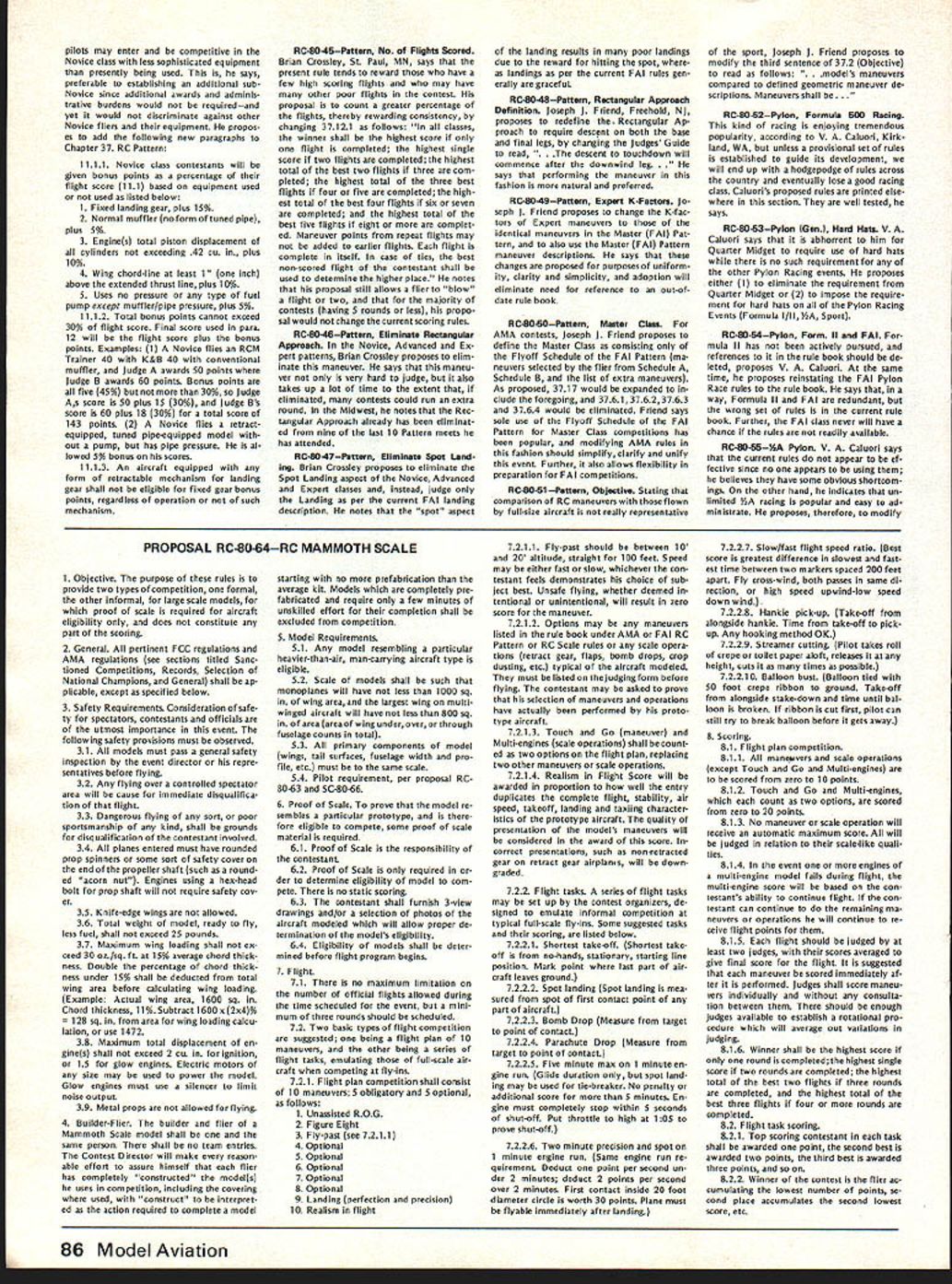
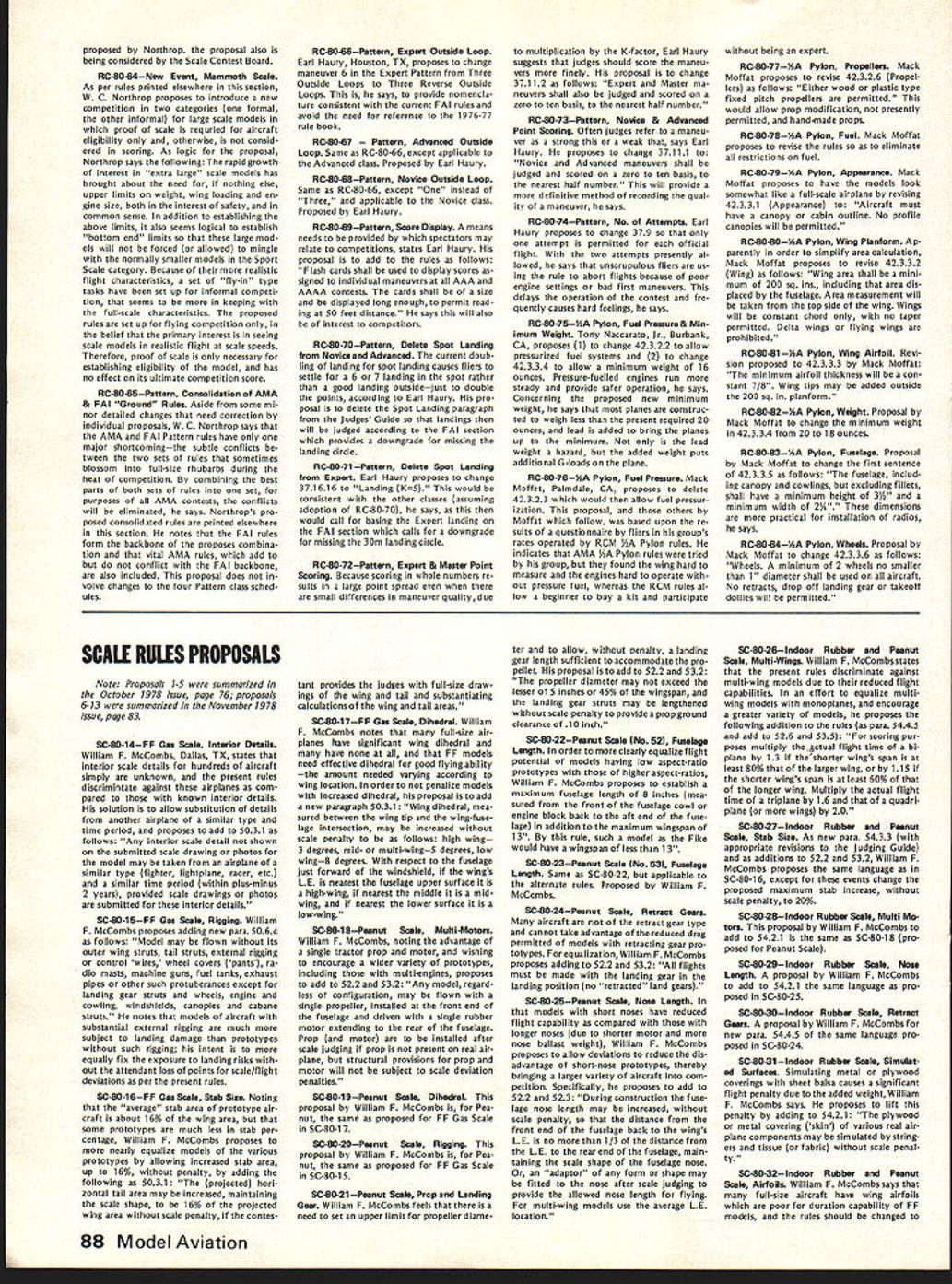
RC MAMMOTH SCALE PROPOSAL (RC-60-64 Summary)
- Objective: Provide formal and informal competition for large scale models. Proof of scale required for eligibility only; not part of scoring.
- Applicability: All pertinent FCC and AMA regulations apply except as provided.
- Safety requirements (highlights):
- General safety inspection by event director prior to flying.
- No flying over controlled spectator areas.
- Dangerous flying or poor sportsmanship grounds for disqualification.
- Rounded prop spinners or safety covers required.
- Radio-servos allowed.
- Max ready-to-fly weight (less fuel) 25 lb.
- Max wing loading 30 oz/sq ft; actual area used if root taper reduces area.
- Min engine displacement .20 cu in (ignition) or .15 cu in (glow); electric motors allowed; glow engines must use a silencer.
- Metal props not allowed.
- Builder/flier must be the same person (no team entries); CD will verify builder status.
- Model requirements:
- Model must resemble a heavier-than-air, man-carrying aircraft type.
- Minimum wing area and scales specified (text clarified in full proposal).
- Proof of scale via at least one 3-view drawing and/or photos to permit verification.
- Flight rules:
- No max total number of official flights, but max three official flights per class for scoring; CD announces how many scored flights will be used.
- Flight tasks set by organizer (e.g., precision takeoff, climb, fly-bys, stalls, spot landings).
- Fly-by parameters, options, realism criteria and scoring guidance provided.
- Awards and class divisions at contest sponsor discretion.
---
SCALE RULES PROPOSALS (Selections)
Note: Some proposals were summarized in prior issues (Oct/Nov 1978). Highlights below include many by William F. McCombs (Dallas, TX) proposing scale rule relaxations to encourage a wider variety of prototypes.
- SC-80-14 — FF Gas Scale: allow substitution of interior details from similar-type aircraft when prototype interior details are unknown (within ±2 years time period), provided supporting drawings/photos are submitted.
- SC-80-15 — FF Gas Scale: permit models to be flown without removable external items (wire bracing, struts, rigging, wheel pants, gear doors, etc.) if shown on submitted drawings; no penalty if removable items are omitted for transport and reinstalled before flying.
- SC-80-17 — FF Gas Scale: allow increased wing dihedral for flight stability without scale penalty (high wing +3°, mid/multi +5°, low wing +8°) measured between wing tip and wing-fuselage intersection.
- SC-80-18 — Peanut Scale, Multi-Motors: permit single-prop/motor operation on models representing multi-engine prototypes when flown after static judging; structural provisions for multiple motors allowed but not penalized.
- SC-80-19 — Peanut Scale: apply dihedral allowances like SC-80-17.
- SC-80-20 — Peanut Scale: rigging allowances similar to SC-80-15.
- SC-80-21 — Peanut Scale: set upper limit for prop diameter (5" or 45% of wingspan, whichever is less) and permit landing gear lengthening to allow 1.0" prop ground clearance without penalty.
- SC-80-22 / SC-80-23 — Fuselage/Nose proportion limits for Peanut and all scale classes to avoid prototype noses giving undue advantage; propose a maximum fuselage/nose proportion not exceeding 1/3 of wingspan.
- SC-80-24 — Peanut Scale: require landing gear down and locked for flights (no retract) to equalize drag advantages.
- SC-80-25 — Peanut Scale: allow increasing fuselage nose length during construction within specified proportions to improve flight capability; no adapter allowed after static judging.
- SC-80-26 — Indoor Rubber & Peanut Scale: equalize multi-wing models by permitting span or time multipliers (e.g., multiply actual flight time by a factor for models with more wings).
- SC-80-27 — Indoor Rubber & Peanut Scale: allow restricted retract gear and increase static area limits (max static increase 20%).
- SC-80-28 to SC-80-49 — Similar proposals extending the above concepts to Indoor Rubber Scale, Outdoor Rubber Scale, Sport Scale, and multi-wing allowances (details in full proposal text).
- SC-80-49 — Sport Scale: define static items not judged; propose clearer guidance that items not visible in flight are not considered.
- SC-80-50 — Sport Scale: allow demonstration (static or in-flight) of certain RC scale operations at static judging; such demonstrations score separately and may be used as tie-breakers.
- SC-80-52 — Sport Scale: include Proto Taxi as a listed option and define its performance order on the judging form.
- SC-80-53 — Sport Scale: permit duplicate sets of documentation so each judge has a copy to score independently.
- SC-80-54 — Sport Scale: delete a sentence that downgrades incorrect presentations (e.g., non-retracted gear), arguing deletion will encourage building complex subjects.
- SC-80-55 — Sport Scale: add Proficiency Classes (Sportsman and Expert) to increase competitive balance and reduce judging time; advanced contestants compelled to enter Expert.
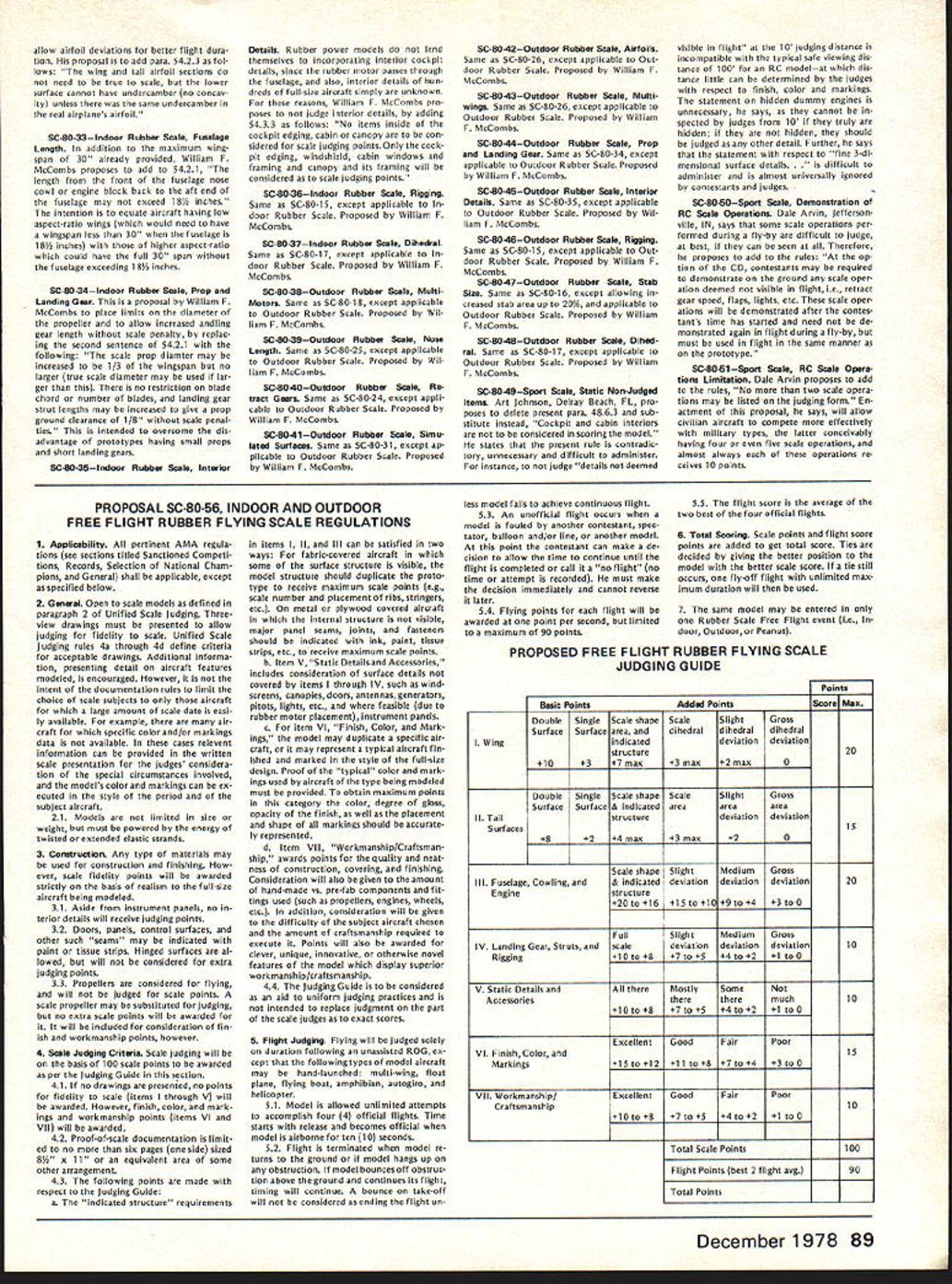
- SC-80-56 — Indoor & Outdoor Rubber Scale: unify rules and simplify administration (remove maximum span for indoor, clarify power source, allow hand-launching for some types, set 90-second max for outdoor, average best two flights for score).
- SC-80-57 — Sport Scale: increase emphasis on flight vs. static by weighting static points (100) and flight points (200) — giving a 50/50 balance.
- SC-80-58 — RC Scale: flight order by class to maintain consistent flying conditions (similar to RC-80-11).
- SC-80-59 — Precision and Sport Scale: revise Straight Flight task to avoid overflying spectators and to fly parallel to the spectator safety line with marker announcements.
- SC-80-62 — RC & GL Sport Scale: allow CDs to schedule special events (e.g., by engine size, multi-engine only, WWI aircraft) announced in sanction and contest bulletin.
- SC-80-63 — Peanut Scale: adjust qualifying dimensions to allow wider prototype variety.
- SC-80-64 — Outdoor Rubber Scale: base flight score on average of best two official flights (instead of single flight) to reduce wind luck.
- SC-80-65 — RC Precision & Sport Scale: require a scale pilot figure or decal in cockpit for realism.
- SC-80-66 — All RC Events: propose a general RC section in rules similar to FS and CL, and require declarations of minimum flight experience before contests.
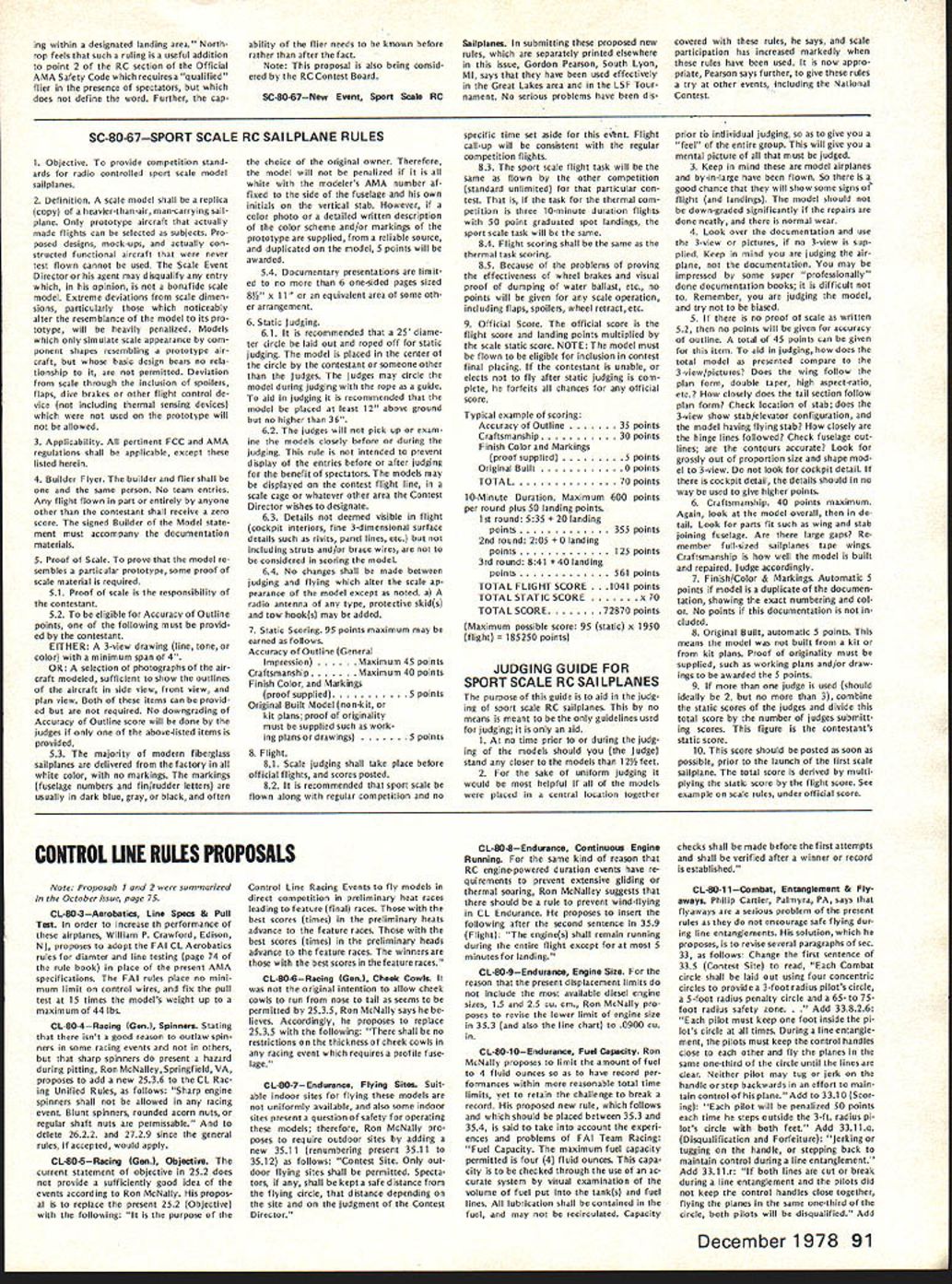
- SC-80-67 — Sport Scale RC Sailplane Rules: complete proposed rules for sport scale RC sailplanes (objective, definition, proof of scale, static and flight judging, scoring and judging guide). (Details and judging guide printed in full in proposal.)
- SC-80-56 (detailed) — Proposed Free Flight Rubber Scale Regulations: unified rules, documentation guidance, construction allowances, judging guide, and flight scoring combining scale and flight points.
(For full wording and scoring tables, refer to the complete proposals printed in this section.)
---
CONTROL LINE RULES PROPOSALS (Selections)
Note: Proposals 1–2 summarized earlier.
- CL-80-3 — Aerobatics: Adopt FAI CL Aerobatics rules for line spares and pull test (FAI fixes pull test at 15× model weight up to 44 lb; no minimum control wire size).
- CL-80-4 — Racing (General): Permit blunt/rounded spinners (no sharp engine spinners). Proposes new unified rule and deletion of duplicative rules.
- CL-80-5 — Racing (General): Ron McNally proposes clarifying the objective paragraph (25.2) to define contest structure: preliminary heats leading to final races with winners determined in finals.
- CL-80-6 — Racing (General): Define permissible spinner types and safety considerations more precisely.
- CL-80-7 — Endurance, Flying Sites: Clarify CD responsibilities for site selection and emergency/safety procedures.
- CL-80-8 — Endurance, Continuous Engine Running: Insert wording to prevent using non-powered flight to improve times; require engine running except for limited landing periods.
- CL-80-9 — Endurance, Engine Size: Adjust displacement limits to reflect availability of diesel engines and align with FAI Team Racing figures.
- CL-80-10 — Endurance, Fuel Capacity: Limit fuel carried to reasonable amounts; proposed limits to reflect FAI Team Racing experience.
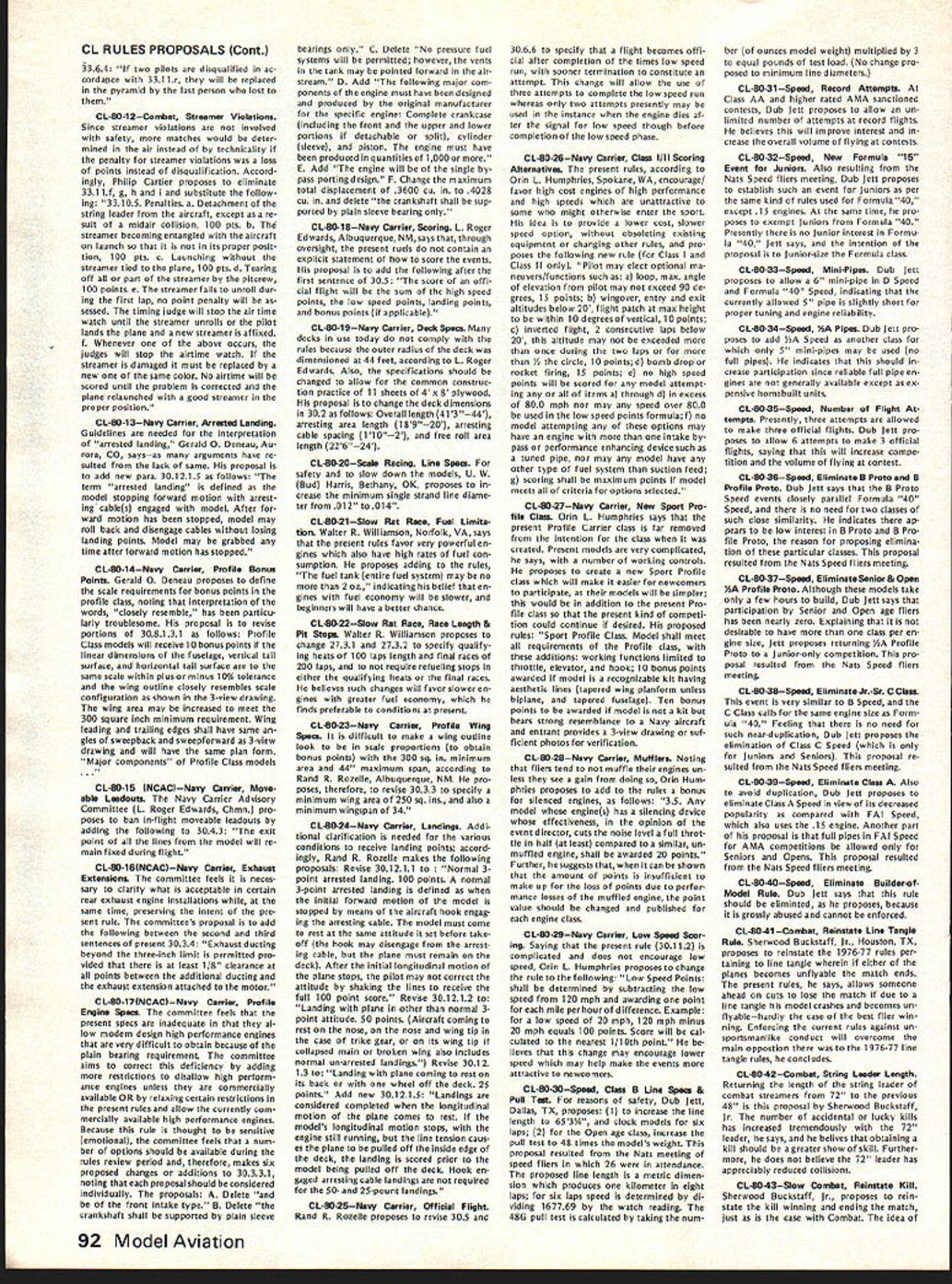
- CL-80-12 — Combat, Streamer Violations. Philip Cartier proposes replacing disqualification penalties for streamer problems with point penalties and stops to the airtime watch until corrected. Proposed penalties include 100 points for various streamer violations and procedures to stop timing until the streamer is corrected.
- CL-80-13 — Navy Carrier, Arrested Landing. Gerald O. Deneau proposes a definition: arrested landing = model stopping forward motion with arresting cable(s) engaged; model may roll back and disengage without losing landing points; model may be grabbed once forward motion stops.
- CL-80-14 — Navy Carrier, Profile Bonus Points. Define profile bonus: basic dimensions (fuselage, vertical/horizontal tails) must be within ±10% scale tolerance and wing outline must closely resemble 3-view drawing; wing area may be increased to meet 300 sq in minimum; leading/trailing edge sweep angles must be correct.
- CL-80-15 (NCAC) — Navy Carrier, Moveable Leadouts. Navy Carrier Advisory Committee proposes banning in-flight moveable leadouts; exit point of lines must be fixed.
- CL-80-16 (NCAC) — Navy Carrier, Exhaust Extensions. Provide clarification for acceptable exhaust extension installations where exhaust passes through the fuselage, including minimum clearances and prohibition of using extensions as engine supports.
- CL-80-20 — Scale Racing, Line Specs. U. W. (Bud) Harris proposes increasing line diameter for scale racing from .012" to .014" for safety and to slow models.
- CL-80-21 — Slow Rat Race, Fuel Limits. Don Walter proposes a fuel limit of 2 oz for the entire fuel system to encourage fuel-efficient engines and balance competition.
- CL-80-22 — Slow Rat Race, Race Length & Pit Stops. Walt Karr proposes qualifying heats of 100 laps, finals of 200 laps, and no refueling stops, favoring slower, fuel-efficient engines.
- CL-80-23 — Navy Carrier, Profile Wing Specs. Rand R. Rozelle proposes revising minimum wing span and area to make profile bonus attainable (minimum wing span 34", minimum area 250 sq in).
- CL-80-24 — Navy Carrier, Landings. Rand R. Rozelle proposes clarified landing point conditions and definitions of normal 3-point arrested landing (100 pts), other landings (50 pts), and landings on back or with wheels off deck (25 pts). Add clarification for when landings are considered completed.
- CL-80-25 — Navy Carrier, Official Flight. Revise 30.5/30.6 to make a flight official after completion of the timed low-speed run; allow three attempts to complete the low-speed run.
- CL-80-26 — Navy Carrier, Class I/II Scoring Alternatives. Orin L. Humphries proposes optional scoring alternatives to encourage lower-cost, slower-speed participation (details omitted).
- CL-80-28 / CL-80-30 / CL-80-33 / CL-80-34 — Navy Carrier deck dimensions and specifications proposed changes to reflect common construction and fairness (changes to deck length, arresting area, cable spacing, etc.).
- CL-80-35 — Speed: New Formula .15 event for Juniors (Dub Jett) and exempt Juniors from Formula 40 to encourage Junior participation.
- CL-80-36 — Speed: Allow 6" mini-pipe in D Speed and Formula 40 (Dub Jett).
- CL-80-37 — Speed: Allow NATS Speed as another class allowing 5" mini-pipe only.
- CL-80-38 — Speed: Increase allowed attempts — allow 6 attempts to make 3 official flights (Dub Jett).
- CL-80-39 / CL-80-40 / CL-80-41 — Speed: Proposals to eliminate B Proto, B Profile Proto, Junior/Senior Profile Proto classes, and to remove Class A; also proposed elimination of the Builder-of-Model rule for Speed events due to enforceability.
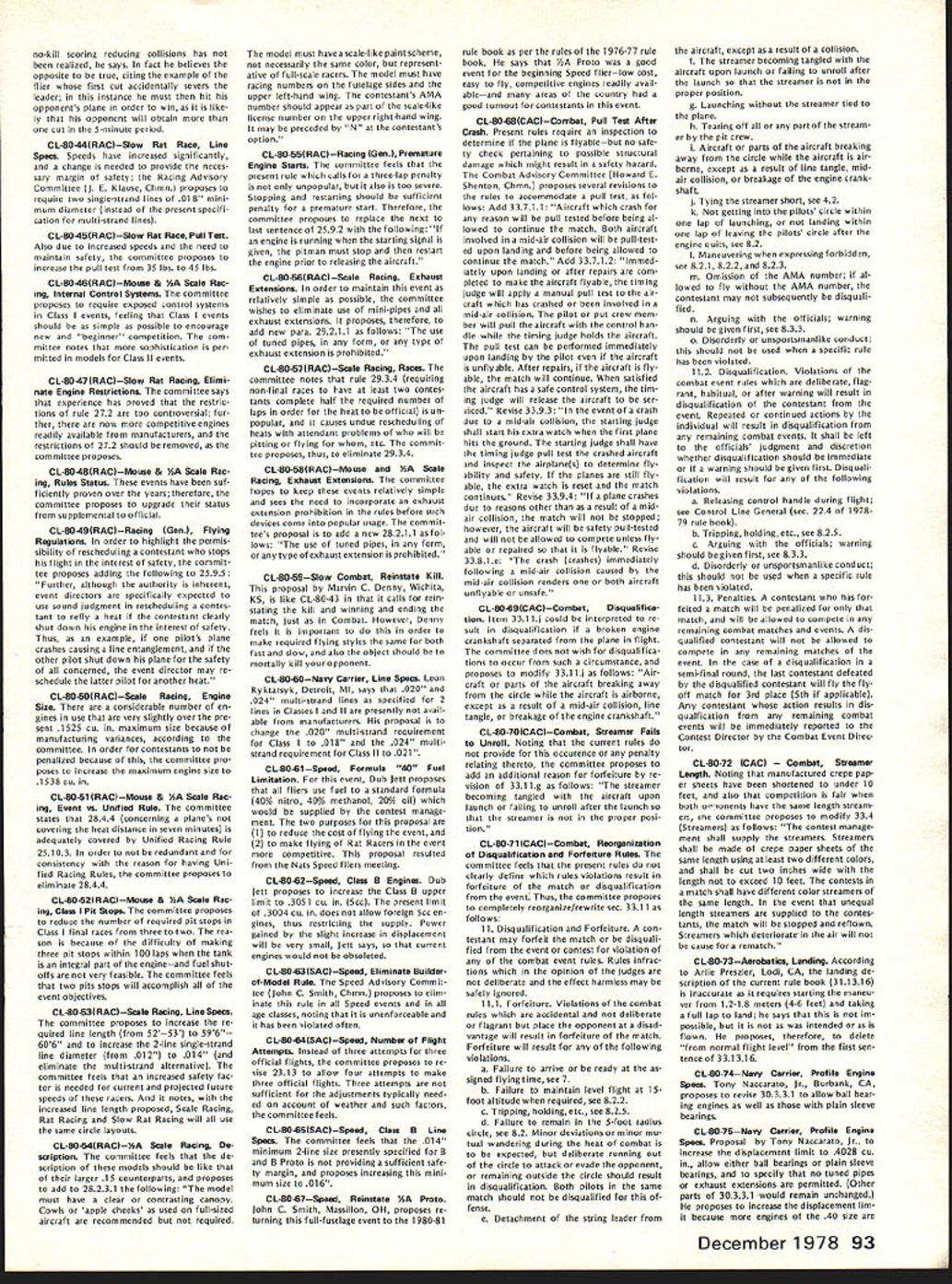
- CL-80-44 — Combat: Reinstate the 1976–77 line-tangle rule where a tangle ends the match (Sherwood Buckstaff Jr.).
- CL-80-45(RAC) — Slow Rat Race, Line Specs. Racing Advisory Committee proposes two single-strand lines of .018" minimum diameter for increased safety.
- CL-80-46(RAC) — Slow Rat Race, Pull Test. Proposes increasing pull test from 35 lb to 45 lb for safety.
- CL-80-47(RAC) — Mouse & Ya-A Scale Racing, Internal Control Systems. Proposes requiring exposed control systems in Class I events to keep events simple for beginners.
- CL-80-48(RAC) — Mouse & Ya-A Scale Racing: Upgrade event status from supplemental to official.
- CL-80-49(RAC) — Racing (Fuel), Flying Regulations. Clarifies authority to reschedule contestants who shut down engines in the interest of safety.
- CL-80-50(RAC) — Scale Racing, Engine Size. Proposes raising max engine size slightly (to .1358 cu in) to accommodate manufacturing variances.
- CL-80-51(RAC) — Mouse & Ya-A Scale Racing: eliminate redundant rule 28.4.4 (covered by unified rule 25.10.3).
- CL-80-52(RAC) — Mouse & Ya-A Scale Racing: reduce Class I final race pit stops from three to two due to tank integration and reliability issues.
- CL-80-53(RAC) — Scale Racing, Line Specs. Proposes increase line length to 59–60" and two single-strand lines of .014" diameter, eliminating multi-strand alternatives to standardize safety and circle layout.
- CL-80-54(RAC) — Ya-A Scale Racing, Description. Proposes enhancing description to require clear canopy, scale-like paint scheme and racing numbers.
- CL-80-55(RAC) — Racing (Gen.), Premature Engine Starts. Replace a 5-lap penalty with stopping and re-starting the engine to avoid severe penalty.
- CL-80-56(RAC) — Scale Racing, Exhaust Extensions. Proposes banning tuned pipes and exhaust extensions.
- CL-80-57(RAC) — Scale Racing: drop the unpopular rule requiring two contestants to complete half laps for a heat to be official.
- CL-80-58(RAC) — Mouse & Ya-A Scale Racing: ban tuned pipes/exhaust extensions.
- CL-80-59 — Slow Combat: Reinstate kill rule (Marvin C. Denny) to allow match ending when an opponent is unrepairable.
- CL-80-60 — Navy Carrier: Adjust line diameter specs because current multi-strand lines are unavailable.
- CL-80-61 — Speed: Formula — Fuel Limitation. Don Jett proposes standard fuel formula provided by contest manager to reduce cost and equalize competition.
- CL-80-62 — Speed: Class B engines. Proposes increasing Class B upper limit to .301 cu in to allow some foreign engines.
- CL-80-63(RAC) — Speed: Eliminate Builder-of-Model rule in Speed events (Speed Advisory Committee).
- CL-80-64(SAC) — Speed: Number of Flight Attempts. Speed Advisory Committee proposes four attempts to make three official flights.
- CL-80-65(SAC) — Speed: Increase 2-line min from .014" to .016" for B and D Protos for safety.
- CL-80-67 — Speed: Reinstate YA Proto as a beginner-friendly Speed class (John C. Smith).
- CL-80-68(CACI) — Combat: Pull Test After Crash. Combat Advisory Committee proposes pull-testing aircraft after crashes or mid-air collisions before allowing reflight.
- CL-80-69(CACI) — Combat: Disqualification. Revise disqualification wording to avoid automatic disqualification for crankshaft or parts breaking away unless due to deliberate action or gross negligence.
- CL-80-70(CACI) — Combat: Streamer Fails to Unroll. Add streamer unroll failure as a cause for forfeiture or penalty.
- CL-80-71(CACI) — Combat: Reorganization of Disqualification and Forfeiture Rules. Proposes reorganizing sec. 33.1.1 to clearly list causes for disqualification and forfeit.
- CL-80-72(CACI) — Combat: Streamer Length. Require contest-supplied streamers (2" wide, at least 10' long) in matched colors; contestants must have same-length streamers.
- CL-80-73 — Aerobatics, Landing. Arie Presker (Lodi, CA) requests deleting "from normal flight level" from landing description to correct inaccurate wording.
- CL-80-74 / CL-80-75 — Navy Carrier, Engine Specs. Proposals to allow ball-bearing engines, increase displacement limits to accommodate evolving engine production, and specify production/manufacturer criteria.
- CL-80-76 — Speed, Exhaust Restrictions. Larry Stockstad proposes eliminating para. 23.6.3 to allow full tuned pipes or any mini-pipe length in Open classes, arguing restrictions inhibit development.
- CL-80-77 / CL-80-78 — Speed, Y/A Events: limit engines to commercially available units produced in quantity, ban tuned pipes and exhaust extensions in Y/A Speed to keep costs and technical barriers low.
- CL-80-79 — Mouse & Y/A Scale Racing: move from supplemental to official status (Ben Sassett).
- CL-80-80 — Y/A Solo Race: Reinstate supplemental rules for postal contests (Ben Sassett).
- CL-80-81 — Y/A Combat: Propose standard rules for Y/A Combat (Ben Sassett) with engine limits and circle/pitting specs.
- CL-80-82 — Combat, Pilot Conduct. Howard Rush (Kirkland, WA) proposes requiring pilots to remain in pilot circle until plane has landed (delete allowance to chase one lap outside circle), to avoid judging ambiguities.
- CL-80-83 — Slow Combat, Fuel Tank Location. Howard Rush proposes restricting inboard tank positions that create undue pressure advantages.
- CL-80-84 — New Event: Old-Time Sport Race. Michael A. Leona (?) proposes a beginner event with modest lines, engine limits (max .36 cu in), and simple airframe specs to encourage entry-level participation.
- CL-80-85 — Records: Ronald L. McNally proposes tightening record application procedures, including submitting required form within 14 days.
- CL-80-86 — Speed: Mini-Pipes for Juniors/Seniors. Ron McNally proposes standardizing mini-pipe specifications across age classes.
- CL-80-87 — Speed: Ready-to-Fly Y/A Models. Ron McNally proposes removing the allowance for ready-to-fly or partially constructed models in Junior Y/A Speed and Y/A Profile Proto.
(End of CL proposals summary. Full wording and forms available from AMA HQ.)
---
FREE FLIGHT RULES PROPOSALS (Selections)
Note: Proposals 1–3 summarized in October; 4–19 in November.
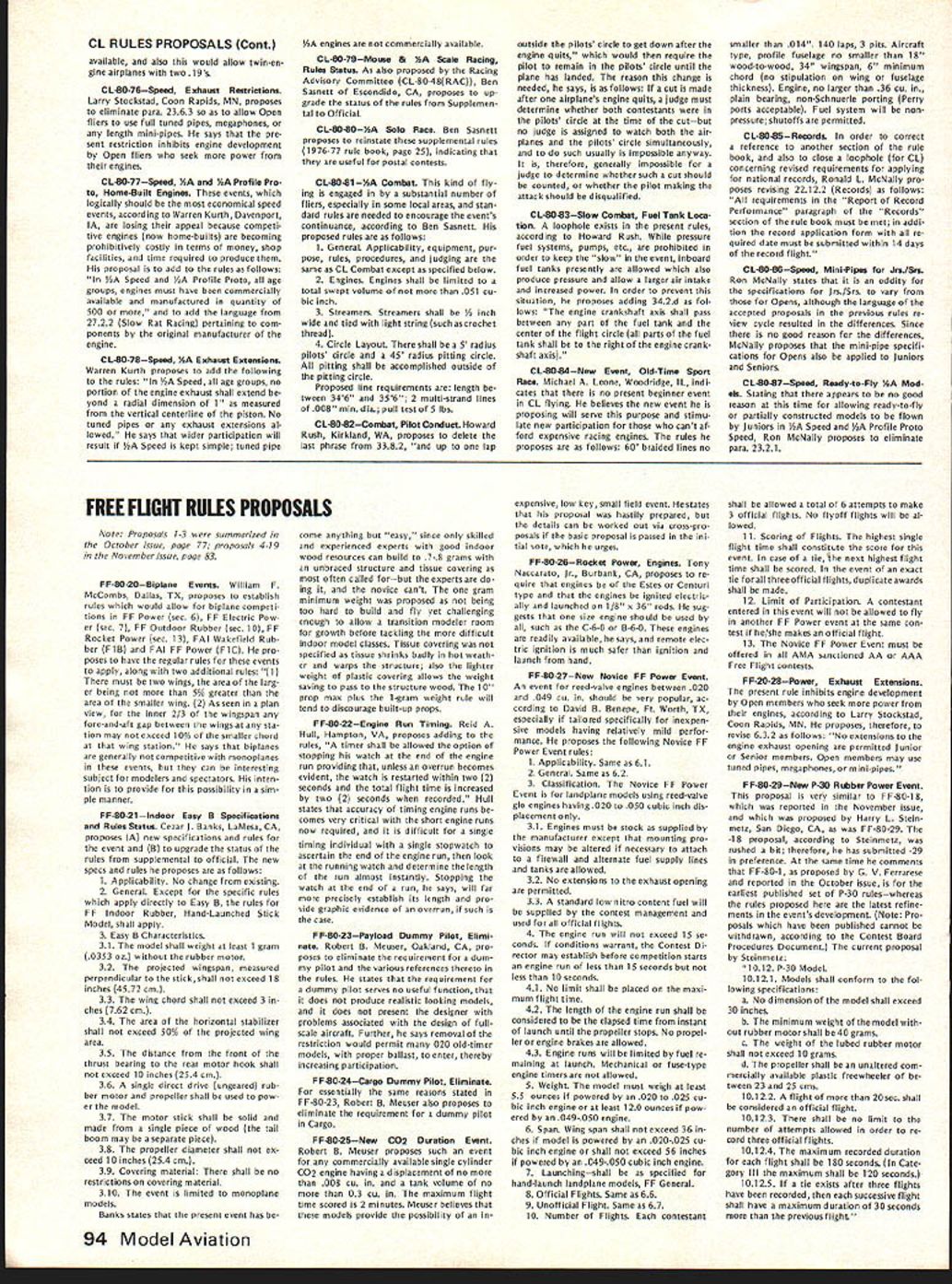
- FF-80-20 — Biplane Events. William F. McCombs proposes rules to allow biplane competition in FF events, with two additional requirements: (1) model must have two wings with area of larger wing not more than 5% greater than smaller wing; (2) fore-and-aft gap limits as percentage of chord to ensure biplane proportioning.
- FF-80-21 — Indoor Easy B Specifications. Cesar J. Saiz (?) proposes upgrading Easy B event status and revising specs to make the event more accessible. Key limits include min model weight 1 gram (without rubber), projected wingspan ≤ 18", wing chord ≤ 3", stabilizer area ≤ 50% of wing area, propeller ≤ 10", single direct-drive rubber motor, and solid one-piece motor stick.
- FF-80-22 — Engine Run Timing. Reid A. Hull (Hampton, VA) proposes a standard timing method for engine-run duration to reduce disputes and provide a consistent official procedure.
- FF-80-23 / FF-80-24 — Payload/Cargo Dummy Pilot Elimination. Robert B. Muezer (Oxnard, CA) proposes eliminating dummy pilot requirements where weight and balance checks suffice.
- FF-80-25 — New CO2 Duration Event. Robert B. Muezer proposes an event using commercially available single-cylinder CO2 engines (≤ .030 cu in displacement, tank ≤ .03 cu in) with maximum scored flight of 2 minutes to create an inexpensive small-field event.
- FF-80-26 — Rocket Power Engines. Tony Maccarato, Jr. (Burbank, CA) proposes using Estes or Centuri rocket engines, electrically ignited and launched on 1/8" x 36" rods; suggest choosing a single engine class (C6-0 or D-8) for safety and consistency.
- FF-80-27 — New Novice FF Power Event. David B. Benton (Ft. Worth, TX) proposes a Novice FF Power Event for low-displacement engines (.020–.049 cu in) with stock engines, 1/8" launch rods, run time limits (≤ 15 sec), prop max 10", min weights depending on engine size, and 6 attempts to make 3 official flights.
- FF-80-28 — Scoring of Flights. For new novice event, the highest single flight time constitutes the score; ties broken by next highest flight.
- FF-80-29 — Limit of Participation. Contestants in the new novice event cannot fly in another FF Power event at the same contest if this event is official.
- FF-80-30 — New P-30 Rubber Power Event. Similar to previous proposals to encourage low-cost rubber power flying; details as proposed by sponsor.
- FF-80-31 onward — Additional power, exhaust, engine size, safety and procedure proposals continue in the FF section. (See full proposals for specifics.)
---
NOTES & ADMINISTRATIVE
- It is recommended that those interested in competition retain these pages summarizing proposals for reference when voting results are announced. Later reports of Contest Board actions will not summarize proposals in complete detail; these original summaries will be invaluable when evaluating final actions.
- The Contest Board Procedures document (April 1978 issue) contains complete timelines and instructions on forms and submission. For additional copies of the Standard Rules Change Proposal Form or clarification of district contacts, contact AMA Headquarters.
---
End of reformatted Competition Newsletter proposals summary.
Transcribed from original scans by AI. Minor OCR errors may remain.

