
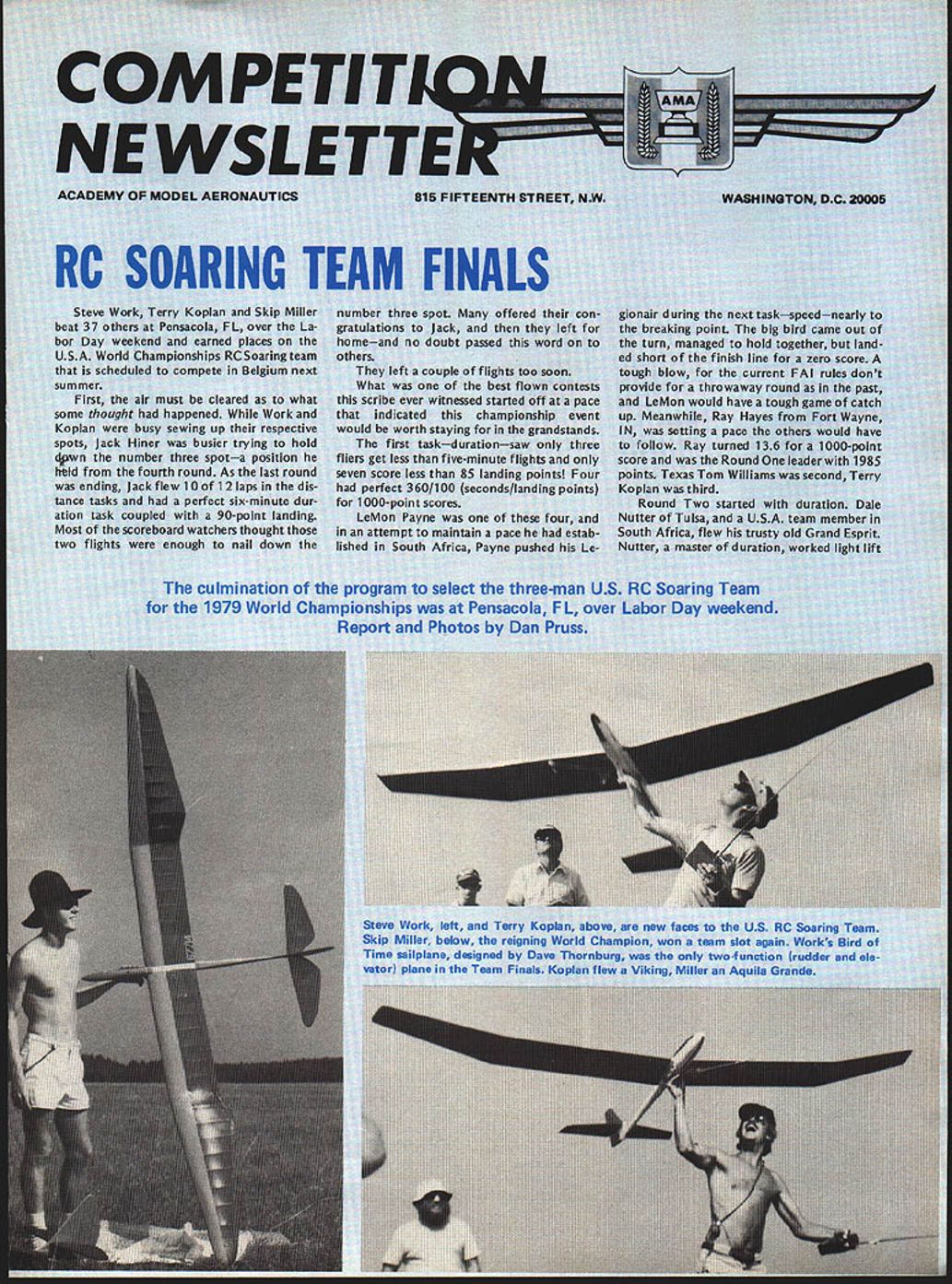
RC SOARING TEAM FINALS
Steve Work, Terry Koplan and Skip Miller beat 37 others at Pensacola, FL, over the Labor Day weekend and earned places on the U.S.A. World Championships RC Soaring team scheduled to compete in Belgium next summer. Report and photos by Dan Pruss.
The contest produced some of the best flying this scribe has witnessed. Early on, duration rounds were outstanding: only three fliers had less than five-minute flights, and only seven scored less than 85 landing points. Four competitors recorded perfect 360/100 (seconds/landing points) for 1000-point scores.
LeMon Payne was one of the four. In an attempt to maintain the pace he had set in South Africa, Payne pushed his Legionair hard in the speed task. The model came out of the turn but landed short of the finish line for a zero score — a devastating blow since FAI rules no longer provide for a throwaway round. Ray Hayes from Fort Wayne, IN, turned a 13.6 for 1000 points and led after Round One with 1,985 points; Tom Williams was second and Terry Koplan third.
Round Two began with duration. Dale Nutter of Tulsa, a U.S. team member in South Africa, flew his Grand Esprit and worked a light lift, only to have a breeze take the model downwind and cause a landing more than 100 meters from the spot — a zero by the rules. Only four fliers failed to max in that round; Bob Gill, flying his Viking II, achieved the only perfect 360/100 and 1000 points.
Distance, long the make-or-break task, had a 12-lap maximum and an eight-minute working time with the 12 laps to be flown within four minutes. Only half of the 40 fliers flew 10 laps or more; six maxed, including Steve Work and Terry Koplan. Koplan led at the end of Round Two with 3,944 points. At that point a scoring error (about 150 points) affecting Skip Miller and Blaine Miller was later corrected.
Round Three saw no perfect duration scores, but William (Bill) Johnson of New York flew a 358/100 and earned 1000 points for the round. Terry Koplan pushed speed to a 13.6, Work turned a 13.7 and Gill a 13.8 — the only "thirteens" of the task — but Hayes' 14.0 put him back in the lead at the end of the round, with Work and Koplan close behind. Hiner was fifth; Skip Miller was seventh, several hundred points back.
Day two ended with Don Edberg taking a duration task with a near-perfect 359/100, his first of three consecutive 1000-point rounds. The second day closed with several strong performances and consistent weather — hot temperatures in the 90s and a variable north to northwest wind of six to eight knots.
Labor Day (day three) was run at a brisk pace; the contest got 2½ rounds in before sunset. Distance in Round Four was the best of the contest for many fliers: over half logged 10 or more laps. At the end of Round Four the standings read Work, Koplan, Hiner, Smith, Cameron, and Skip Miller (the latter three from Colorado). Steve Work had 7,787 points out of a possible 8,000; Jack Hamilton in 10th remained within striking distance.
A dramatic mid-contest incident involved Doyle Modesto and Carrol Moffatt attempting the same airspace on lap seven; Modesto's Legionair was held together only by the metal spar while Moffatt's Aquila suffered a broken wing spar and retired with seven laps. Local repair shops patched Modesto's wing and he re-flew.
Round Five saw Don Edberg ballast his Aquila Grande and turn a 13.6 speed for his third consecutive 1000-point round. Bob Gill, in a gutsy move, added two pounds of lead to his Viking II and attempted a high-speed technique; during the high-G turn the left wing folded, forcing a conservative recovery to finish with a respectable 16.6 and 819 points. Jack Hiner tried conservative flying to protect third place but ended up too cautious; Herb Smith closed the gap.
By the end of Round Five, Work and Koplan had locked down first and second; only third place was in doubt. Round Six moved fast. Many overlooked Skip Miller, who delivered strong flights. Hiner managed 10 laps in distance while Skip logged 12. Smith turned a 356/100 for duration. On paper Jack needed only a max and good landings, and he got a 360/90 which prompted celebratory handshakes — but Miller posted a 358/100, won Round Six and surged into third.
As the sun set the scorer noticed Miller had taken third by less than two points. Rae Fritz called for a recount of the top 10; during that recount the Miller/Miller scores were straightened out and the final results were confirmed. Miller’s corrected score secured the final team spot to Belgium.
Sidelights
- The contest site was a Navy Auxiliary Landing Field — a mile square of grass, one of the best flying fields used by the Pensacola club for 21 years.
- Rae Fritz, the Contest Director and a retired Navy chief, ran an efficient event; tabulation help from Bobbie Work and Rick Hermann was singled out.
- Work’s Bird of Time is a Dave Thornburg design; Thornburg used the same design two years earlier in Denver and narrowly missed the team. The Bird has been kitted in a limited run. Steve Work was the second to achieve LSF Level V, a mark he earned three years ago.
- The contest featured very clean competition: only one speed run out of 120 crossed the center line for a zero score. Strategies were subtle and bold; most tactics will remain undisclosed until next summer.
- Thirty-six of the 40 contestants were present for the final round. Work, Koplan, and Miller earned their team spots and will represent the U.S.A. in Belgium next July.
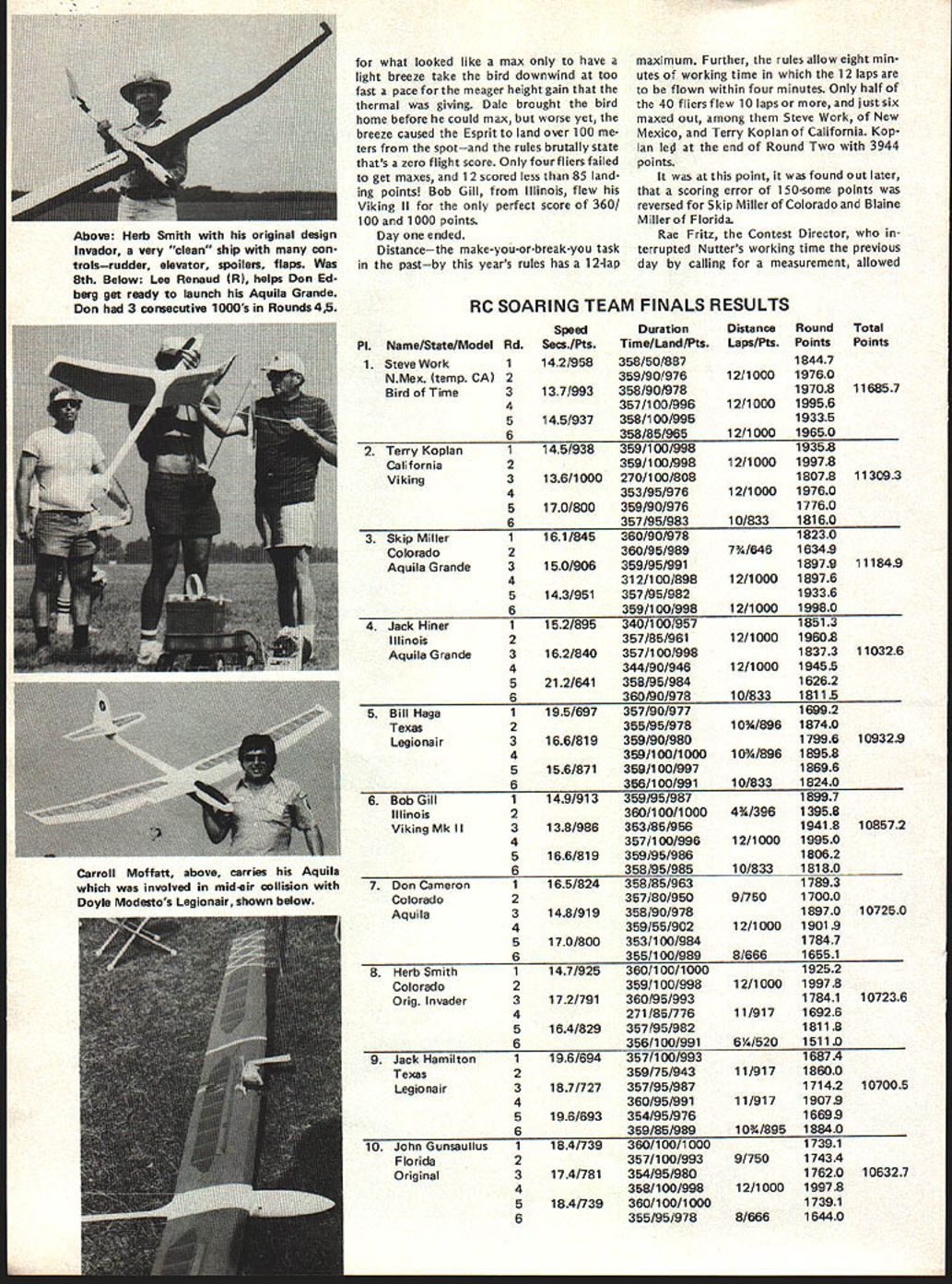
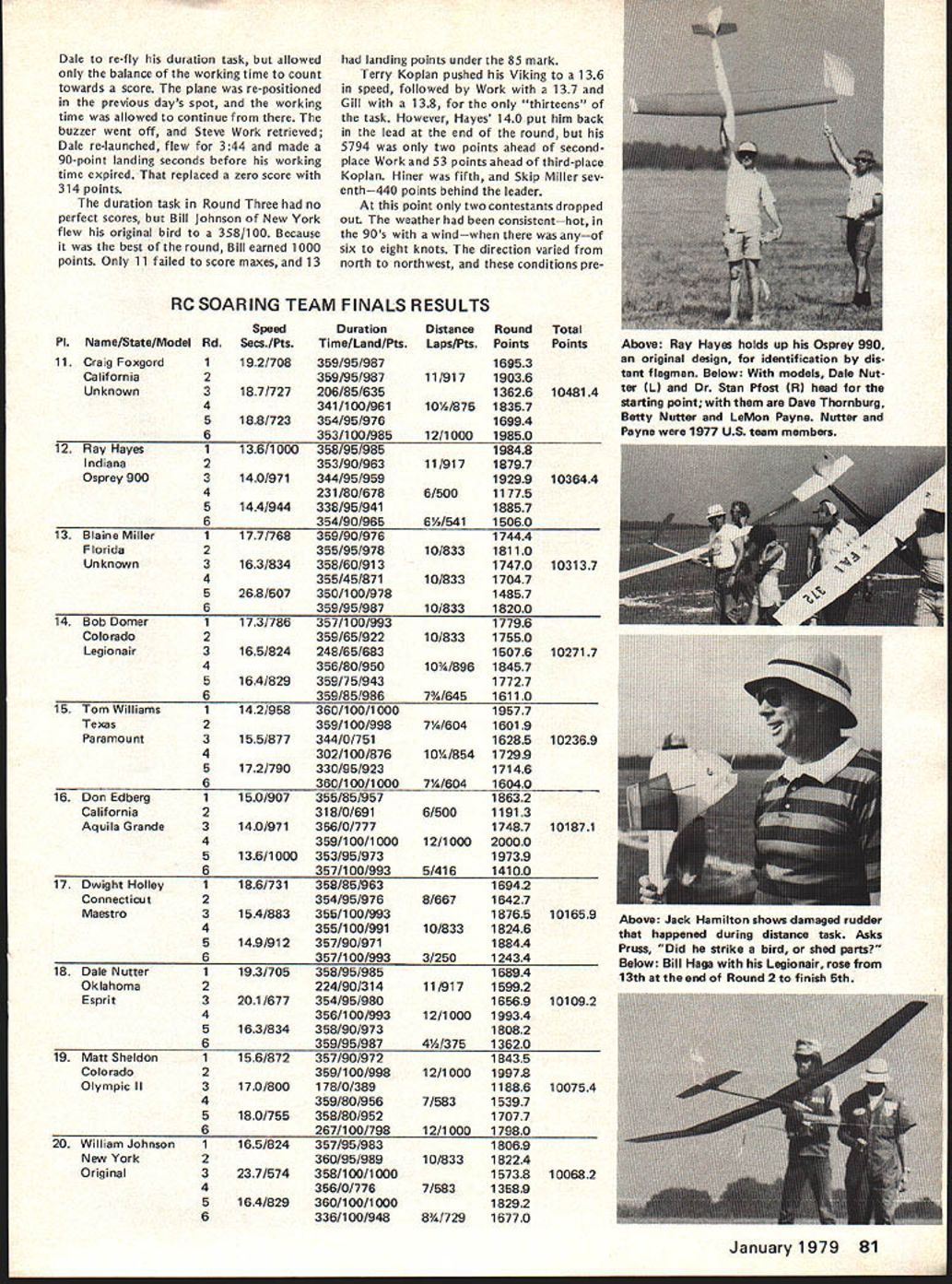
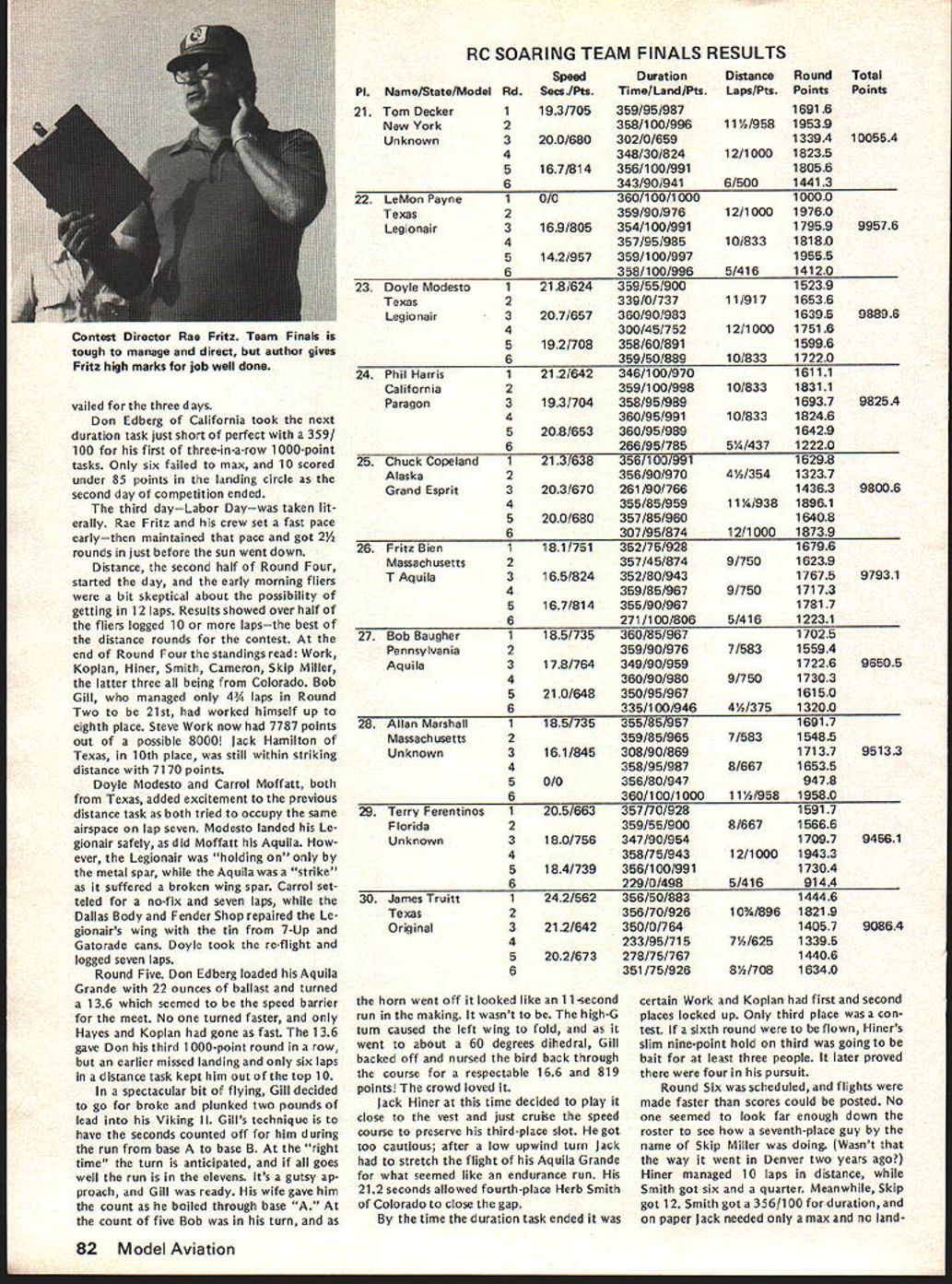
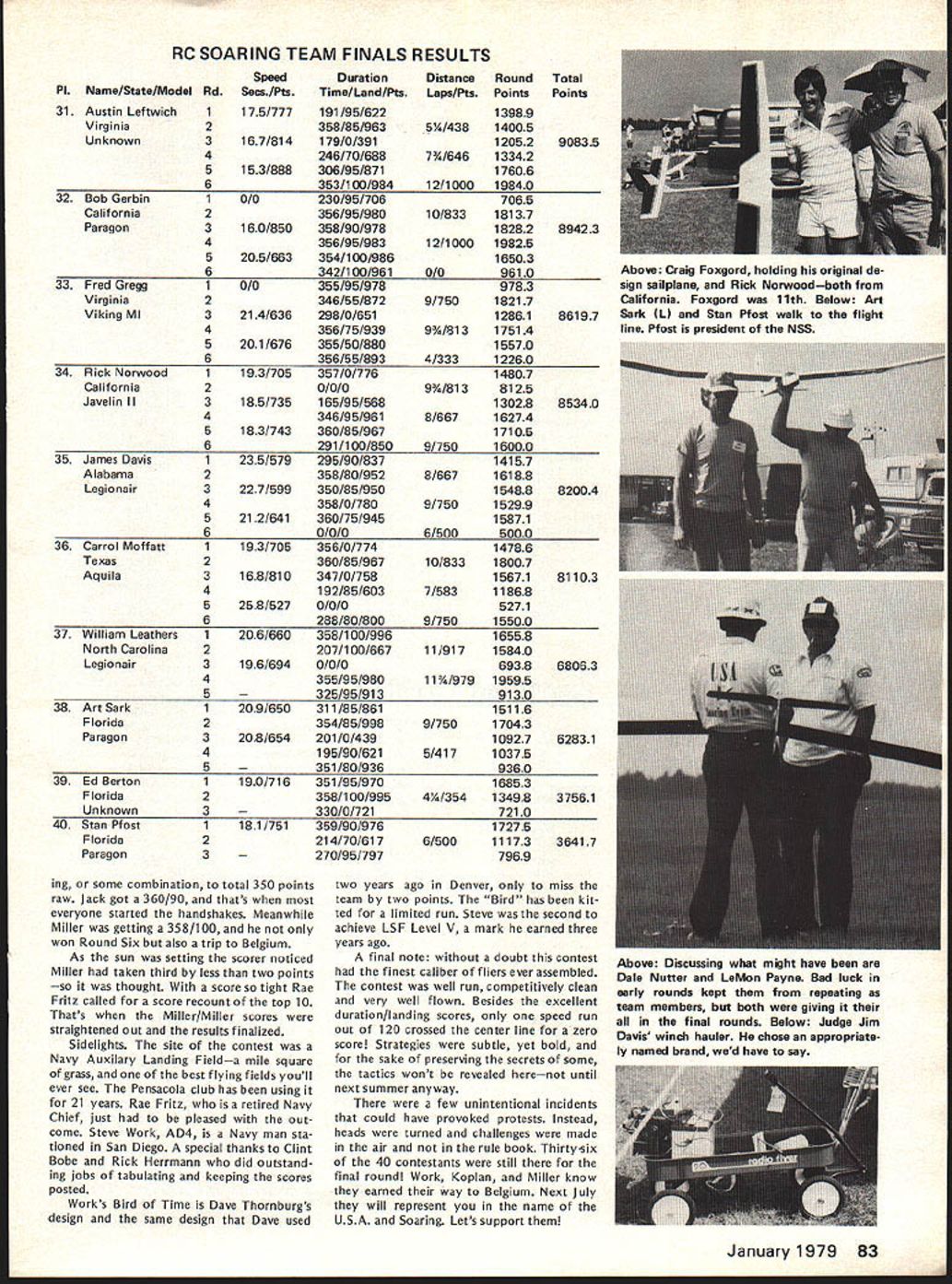
RC SOARING TEAM FINALS RESULTS
- Steve Work — N. Mex. (temp. CA) — Bird of Time — Total Points: 11,685.7
- Terry Koplan — California — Viking — Total Points: 11,309.3
- Skip Miller — Colorado — Aquila Grande — Total Points: 11,184.9
- Jack Hiner — Illinois — Aquila Grande — Total Points: 11,032.6
- Bill Haga — Texas — Legionair — Total Points: 10,932.9
- Bob Gill — Illinois — Viking Mk II — Total Points: 10,857.2
- Don Cameron — Colorado — Aquila — Total Points: 10,725.0
- Herb Smith — Colorado — Original Invader — Total Points: 10,723.6
- Jack Hamilton — Texas — Legionair — Total Points: 10,700.5
- John Gunsaullus — Florida — Original — Total Points: 10,632.7
- Craig Foxgord — California — Unknown — Total Points: 10,481.4
- Ray Hayes — Indiana — Osprey 900 — Total Points: 10,364.4
- Blaine Miller — Florida — Unknown — Total Points: 10,313.7
- Bob Domer — Colorado — Legionair — Total Points: 10,271.7
- Tom Williams — Texas — Paramount — Total Points: 10,236.9
- Don Edberg — California — Aquila Grande — Total Points: 10,187.1
- Dwight Holley — Connecticut — Maestro — Total Points: 10,165.9
- Dale Nutter — Oklahoma — Esprit — Total Points: 10,109.2
- Matt Sheldon — Colorado — Olympic II — Total Points: 10,075.4
- William Johnson — New York — Original — Total Points: 10,068.2
- Tom Decker — New York — Unknown — Total Points: 10,055.4
- LeMon Payne — Texas — Legionair — Total Points: 9,957.6
- Doyle Modesto — Texas — Legionair — Total Points: 9,889.6
- Phil Harris — California — Paragon — Total Points: 9,825.4
- Chuck Copeland — Alaska — Grand Esprit — Total Points: 9,800.6
- Fritz Bien — Massachusetts — T Aquila — Total Points: 9,793.1
- Bob Baugher — Pennsylvania — Aquila — Total Points: 9,650.5
- Allan Marshall — Massachusetts — Unknown — Total Points: 9,513.3
- Terry Ferentinos — Florida — Unknown — Total Points: 9,456.1
- James Truitt — Texas — Original — Total Points: 9,086.4
---
Cardington / International Report
(First-person account — travel and Cardington air shed experience.)
After making the team last fall I spent the winter building in preparation for flying in the salt mines of Romania; stiff motor sticks and reverse-flair props were planned. When the venue changed to England, I began a new building program and arrived with six fully tested ships and two extra wings. A 40-minute flight plus a number of 37s and 38s convinced me I was ready.
Travel complications at Kennedy Airport nearly derailed the trip; special handling arrangements and a tight connection left no margin, but the models survived with only minor patching. On return, however, all my wings were almost totally demolished.
We arrived at Gatwick early in the morning with little sleep, arranged transportation and reached the County Hotel in Bedford after some difficulty. We stayed a couple of days before and after the contest and spent time sightseeing.
Cardington's air shed was different from Goodyear’s: the sides rose almost straight up and the space narrowed between the two top catwalks. It was necessary to fly above the catwalks to achieve maximum times, but side drift made ballooning expertise valuable. Controversy over steering in the shed may lead to new rules proposals.
Sunday (test day) showed improving conditions; a 37-minute test flight ended a busy flying day. Cooler conditions on Monday required a heavier motor for adequate climb; most of the top flights were made on Sunday. I experienced frustrations: a loosened wire on one wing caused excessive wash-in and forced a 25-minute flight instead of the 38–39 minutes I expected. A second flight with a different model had insufficient power for good climb.
Overall, the British fliers flew well. Richmond and Romak performed notably — Richmond being the class of the field, with Romak close behind. The banquet was a fitting climax with toasts and socializing. Flying as a team representative is different from flying as an individual; many gracious helpers contributed materials and assistance. I am indebted to Ray Harlan and others, and to AMA for the opportunity to represent our country.
---
FREE FLIGHT TEAM FINALS
Report and photos by Bob Meuser
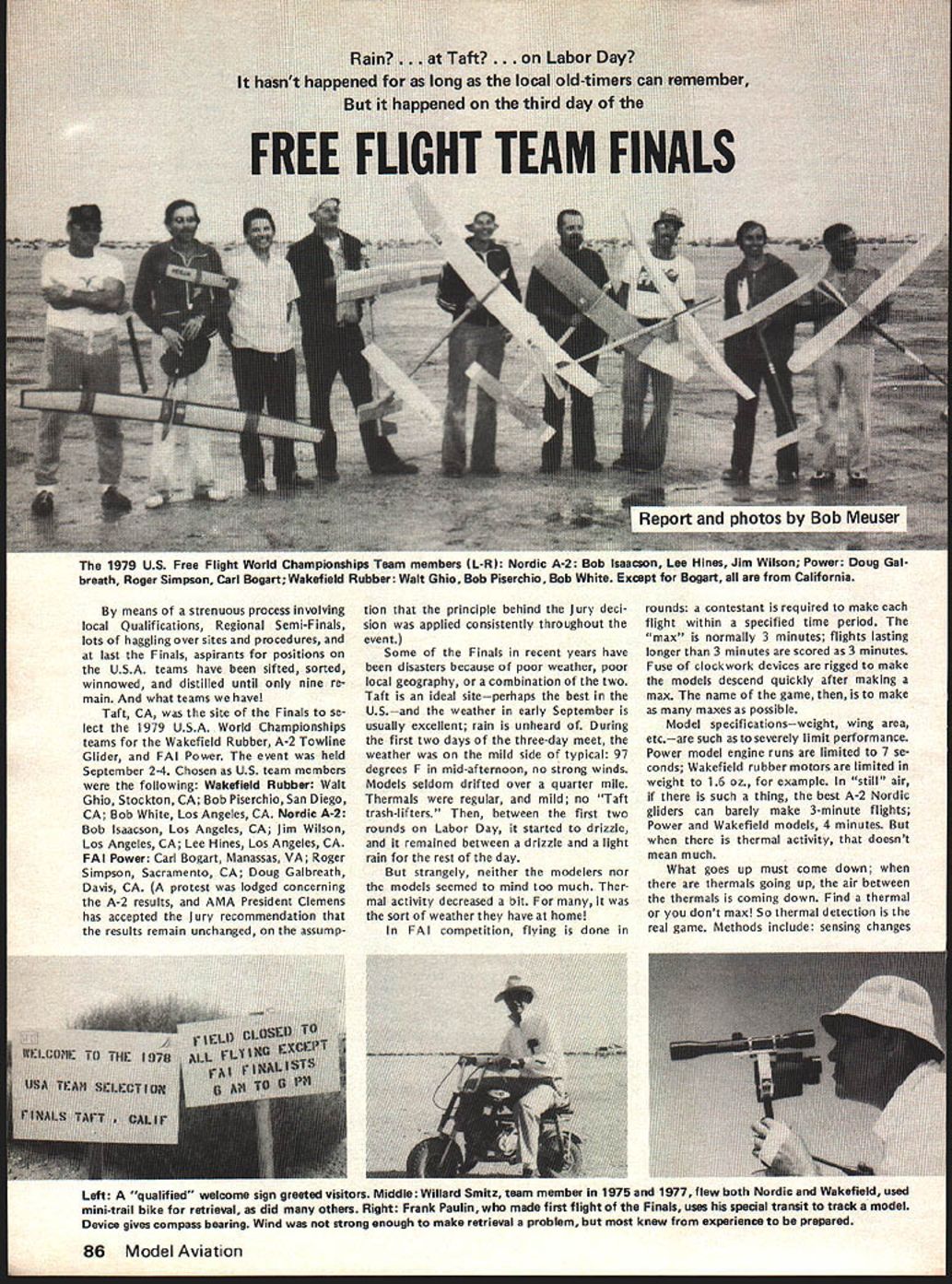
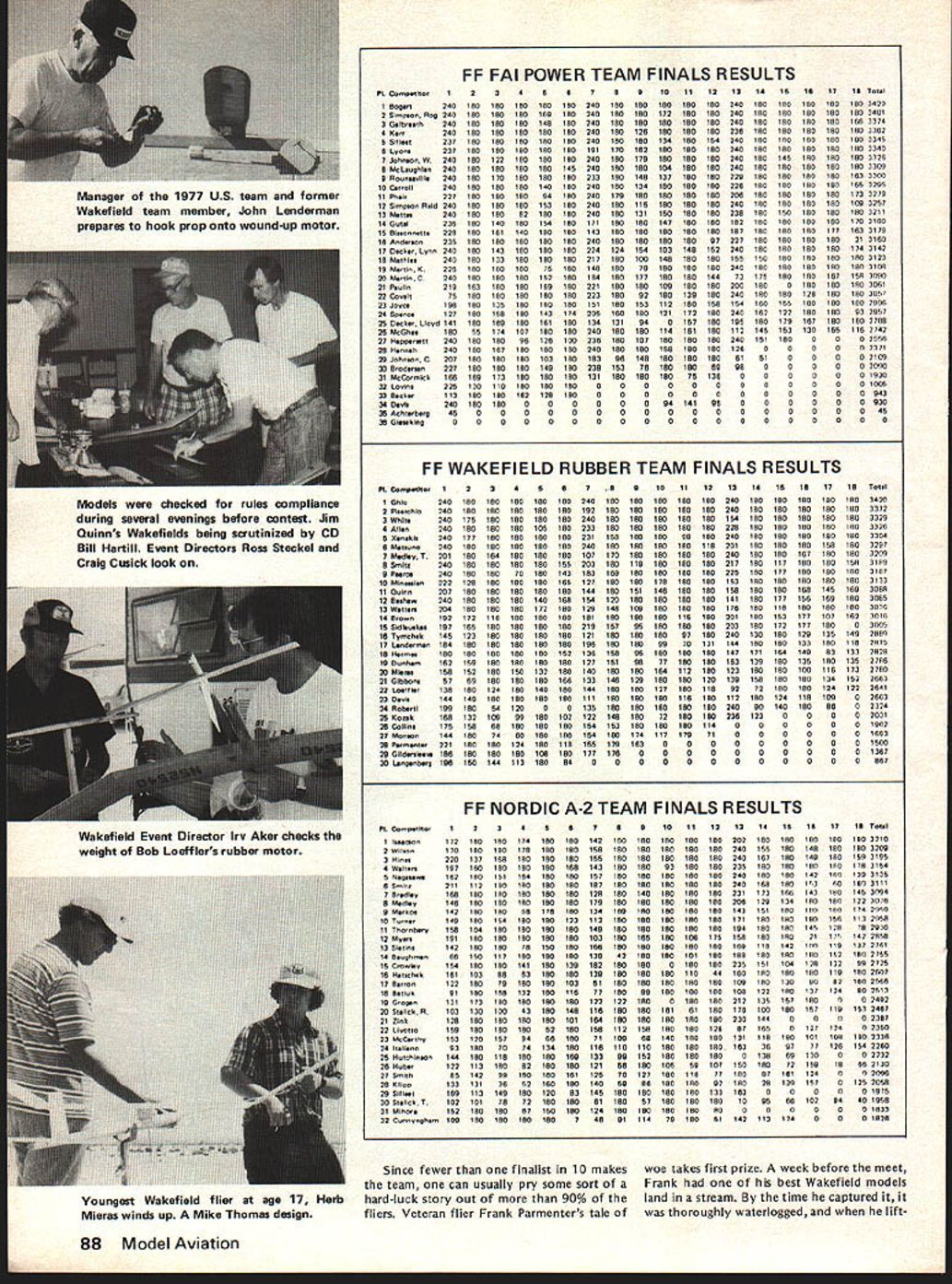
The Finals to select the 1979 U.S.A. World Championship teams for Wakefield Rubber, A-2 Towline Glider (Nordic), and FAI Power were held September 2–4 at Taft, CA. After a lengthy qualification process, nine team slots were decided.
Teams Selected
- Wakefield Rubber:
- Walt Ghio — Stockton, CA
- Bob Piserchio — San Diego, CA
- Bob White — Los Angeles, CA
- Nordic A-2 (Towline Glider):
- Bob Isaacson — Los Angeles, CA
- Jim Wilson — Los Angeles, CA
- Lee Hines — Los Angeles, CA
- FAI Power:
- Carl Bogart — Manassas, VA
- Roger Simpson — Sacramento, CA
- Doug Galbreath — Davis, CA
(A protest concerning the A-2 results was lodged; AMA President Clemens accepted the Jury recommendation that the results remain unchanged, assuming consistent application of the Jury’s principle throughout the event.)
Site and Format
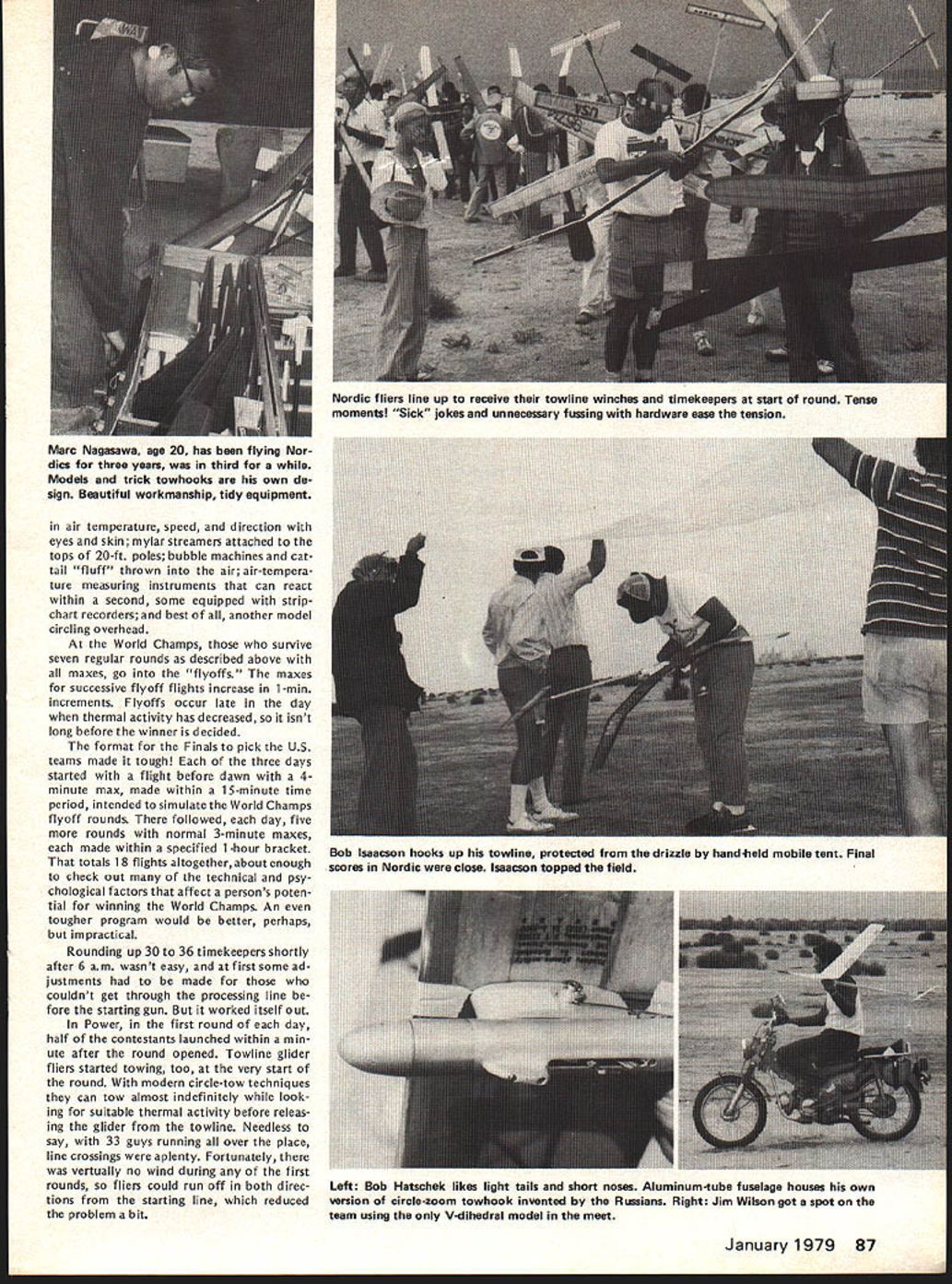
Taft proved to be an ideal site — perhaps the best in the U.S. — with reliable early-September weather. The Finals format was rigorous: each day began with a pre-dawn flight with a 4-minute max (within a 15-minute window) to simulate World Champs flyoffs, followed by five regular rounds per day with 3-minute maxes (each within designated hour brackets). That totals 18 flights over three days, a demanding program that reveals both technical skill and psychological stamina.
Thermal detection and timing are the keys in free flight. Competitors used many methods to find lift: sensing air changes with eyes and skin, mylar streamers on poles, bubble machines, cat-tail fluff, rapid-response air-temperature instruments, and spotting other models circling overhead.
Timekeepers were required for early starts; rounding up 30–36 volunteers shortly after 6 a.m. was a logistical challenge but was managed successfully.
Notable Performances and Stories
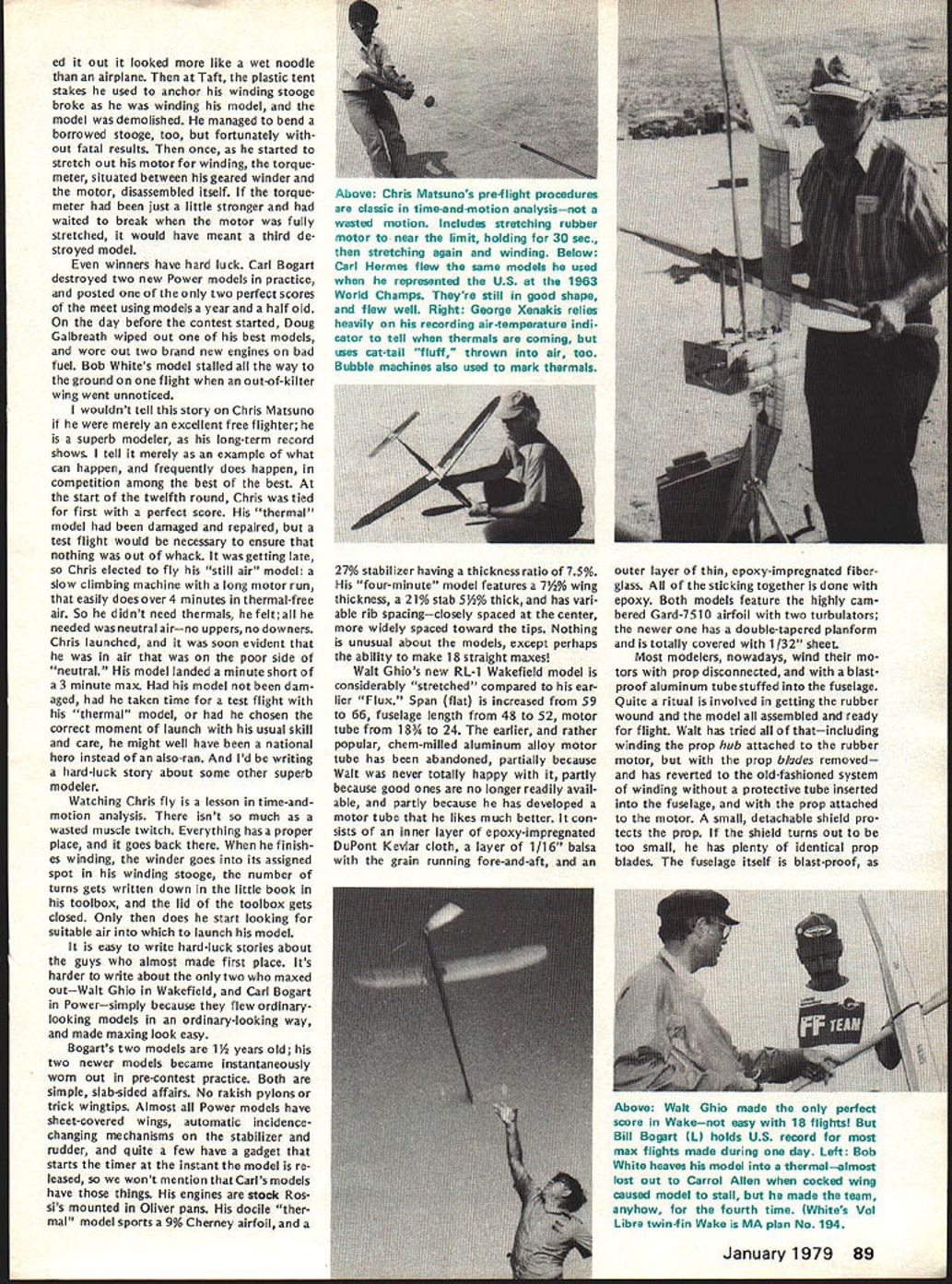
- Many finalists suffered hard luck. Frank Parmenter lost a Wakefield model to water a week before the meet, then broke another when plastic tent stakes failed during winding. A torquemeter also disassembled during winding, narrowly avoiding further destruction.
- Carl Bogart posted one of only two perfect scores of the meet in Power, flying two models a year and a half old after destroying newer ones in practice. His models are simple, robust designs with stock Rossi engines in Oliver pans.
- Walt Ghio’s new RL-1 Wakefield is a larger development of his earlier “Flux” model. Ghio abandoned the chem-milled motor tube in favor of a layered Kevlar/balsa/fiberglass tube bonded with epoxy. His meticulous building and preparation contributed to consistent maxing.
- Chris Matsuno suffered a heartbreaking miss: tied for first at the start of the twelfth round, he chose a “still air” model for a late launch. The air proved weak and he landed short of a max. The anecdote illustrates how split-second decisions and testing choices affect outcomes, even for the best competitors.
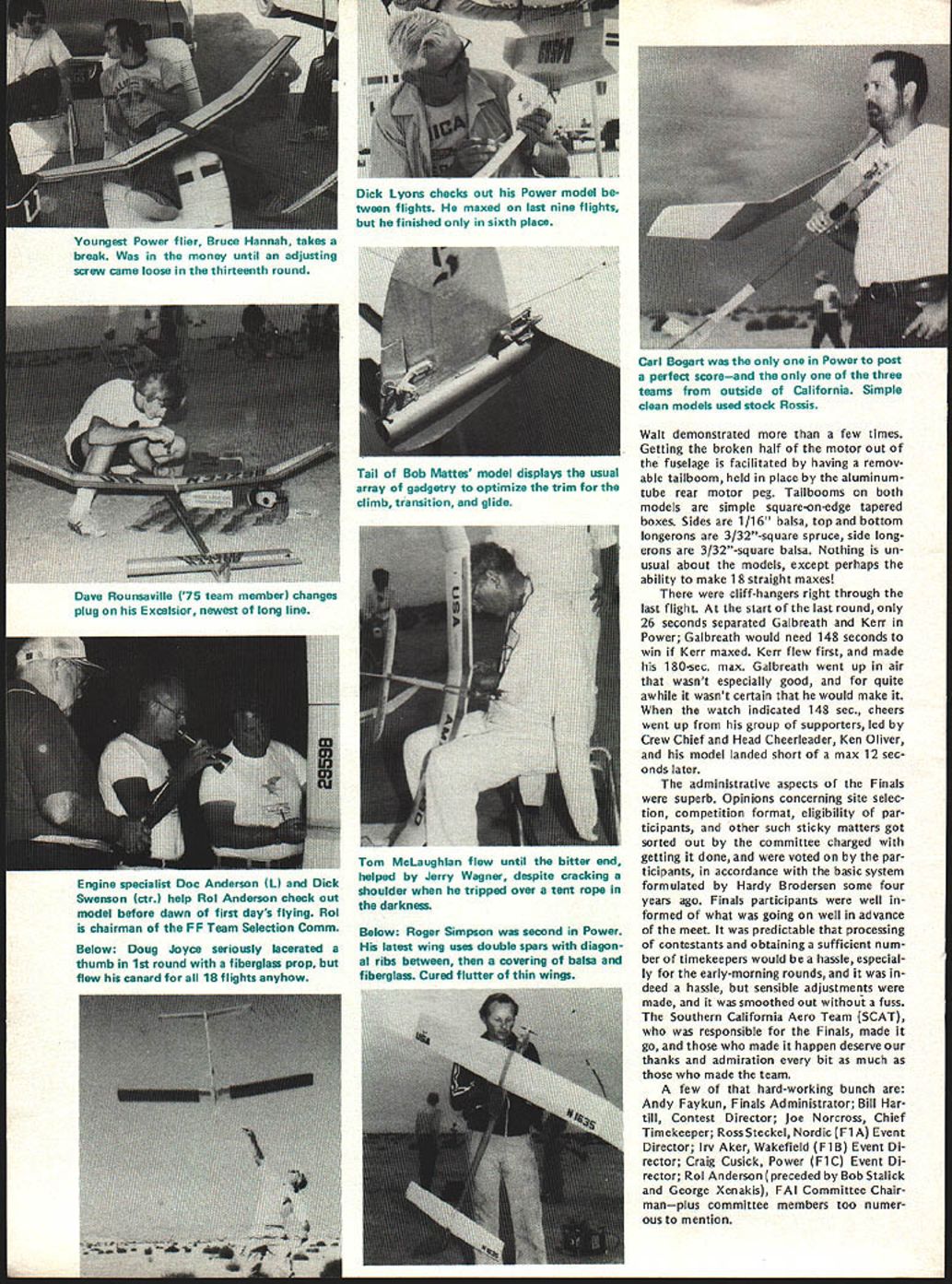
- The final round produced a cliff-hanger in Power: only 26 seconds separated Doug Galbreath and Kerr. Kerr maxed (180 sec); Galbreath needed 148 sec to clinch the win and landed 12 seconds short. Tense finishes like this highlighted the event.
Organization and Thanks
Administrative aspects were superb. Site selection, competition format, eligibility and other matters were handled by a committee and voted on by participants following the system formulated by Hardy Brodersen. Processing contestants and securing early-morning timekeepers posed predictable hassles, but sensible adjustments smoothed operations.
The Southern California Aero Team (SCAT) ran the Finals efficiently. A few of the hardworking organizers:
- Andy Faykun — Finals Administrator
- Bill Hartill — Contest Director
- Joe Norcross — Chief Timekeeper
- Ross Steckel — Nordic (F1A) Event Director
- Ivy Aker — Wakefield (F1B) Event Director
- Craig Cusick — Power (F1C) Event Director
- Rol Anderson (preceded by Bob Stalick and George Xenakis) — FAI Committee Chairman
Thanks and admiration are due to these volunteers and to all those who competed.
Transcribed from original scans by AI. Minor OCR errors may remain.

