
COMPETITION NEWSLETTER
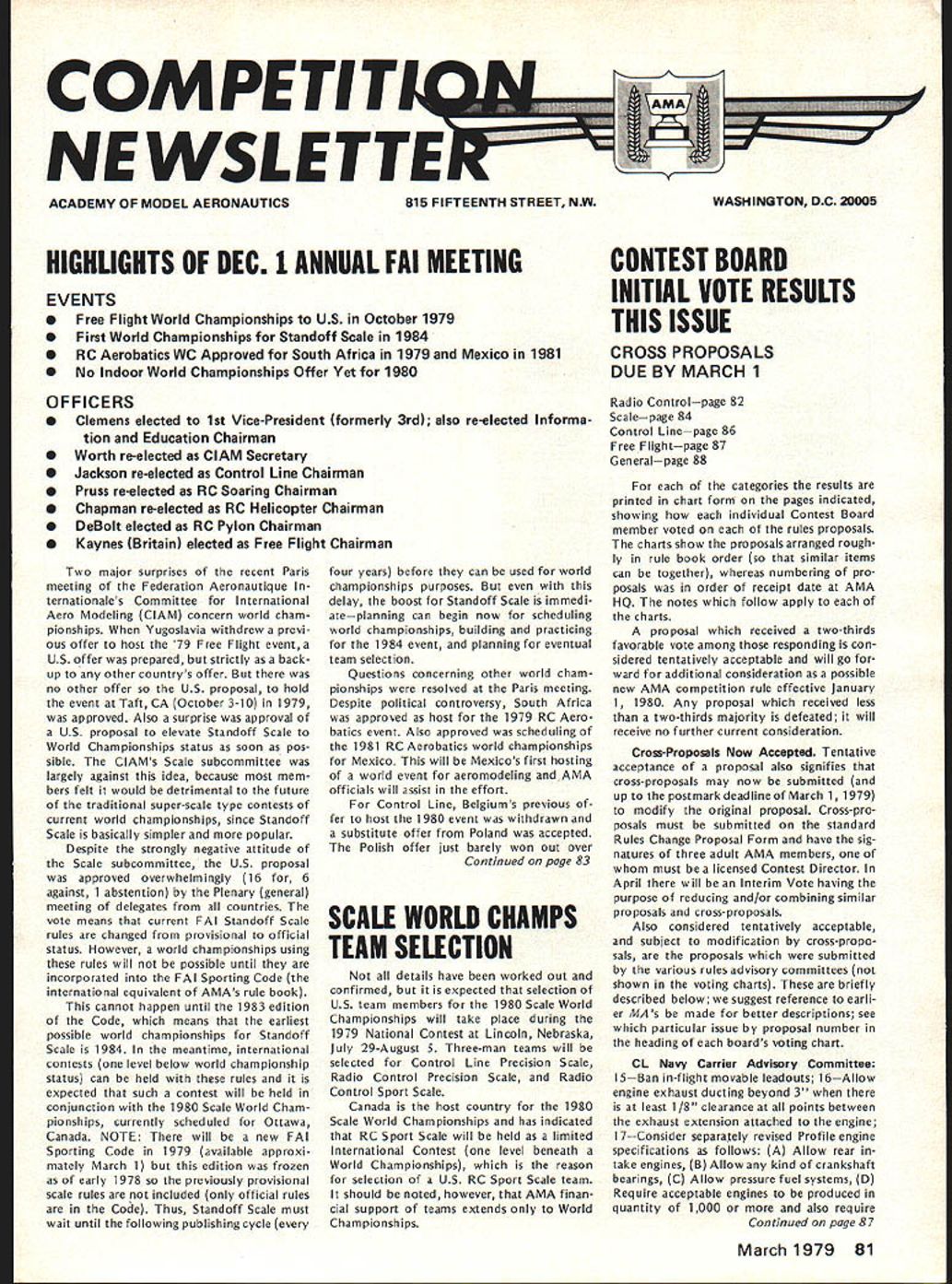
HIGHLIGHTS OF DEC. 1 ANNUAL FAI MEETING
EVENTS
- Free Flight World Championships to U.S. in October 1979
- First World Championships for Standoff Scale in 1984
- RC Aerobatics World Championships approved for South Africa in 1979 and Mexico in 1981
- No Indoor World Championships offer yet for 1980
OFFICERS
- Johnny Clemens elected 1st Vice-President (formerly 3rd); also re-elected Information and Education Chairman
- J. Worth re-elected as CIAM Secretary
- L. Jackson re-elected as Control Line Chairman
- D. Pruss re-elected as RC Soaring Chairman
- D. Chapman re-elected as RC Helicopter Chairman
- Hal DeBolt elected as RC Pylon Chairman
- Ian Kaynes (Britain) elected as Free Flight Chairman
Two major surprises at the Paris meeting of the Federation Aeronautique Internationale's Committee for International Aero Modeling (CIAM) concerned world championships. When Yugoslavia withdrew its previous offer to host the 1979 Free Flight event, a U.S. offer was prepared strictly as a backup to any other country's offer. With no other offers, the U.S. proposal to hold the event at Taft, CA (October 3–10, 1979) was approved.
Also approved was a U.S. proposal to elevate Standoff Scale to World Championships status as soon as possible. The CIAM Scale Subcommittee was largely against this because many members felt it would be detrimental to traditional super-scale contests, since Standoff Scale is simpler and more popular. Despite that opposition, the Plenary meeting approved the proposal overwhelmingly (16 for, 6 against, 1 abstention). The vote changed FAI Standoff Scale rules from provisional to official status. However, a world championship using these rules cannot occur until they are incorporated into the FAI Sporting Code.
A new FAI Sporting Code will be issued in 1979 (available approximately March 1), but that edition was frozen as of early 1978, so the provisional standoff rules are not included—only rules already official appear in the Code. Since the Code is published on a four-year cycle, the earliest possible Standoff Scale World Championships is 1984. In the meantime, international contests (one level below world championship status) can be held under the official rules, and it is expected such a contest will be held in conjunction with the 1980 Scale World Championships, currently scheduled for Ottawa, Canada. Despite the delay to 1984 for world-championship status, the approval provides an immediate boost for Standoff Scale: planning, practice and team selection can begin now.
Questions concerning other world championships were also resolved. Despite political controversy, South Africa was approved to host the 1979 RC Aerobatics event. Mexico was approved to host the 1981 RC Aerobatics World Championships—Mexico's first hosting of a major aeromodeling world event; AMA officials will assist.
For Control Line, Belgium's previous offer to host the 1980 event was withdrawn and a substitute offer from Poland was accepted. The Polish offer just barely won out over another offer from Spain.
The next indoor world championships for 1980 is not yet resolved—there were no offers from potential hosts. It is hoped this will be settled at the next general CIAM meeting at the end of 1979.
RC Pylon activity received more attention this year. Hal DeBolt (U.S.) was elected chairman of the Pylon subcommittee. Although he did not attend the meeting, he has been corresponding with pylon interests in various countries to generate new ideas to expand the activity worldwide. The CIAM meeting adopted an Australian/New Zealand proposal to determine winners by stopwatch—an old proposal previously not accepted. The meeting also approved international-class pylon contests in 1979 and 1980 (Italy and Canada, respectively) to compete for the FAI Sopwith Trophy. It was noted that existing FAI rules must be used, which means tuned pipes will not be allowed—a change from some recent contests for this trophy.
It was announced at the meeting that mainland China became an FAI member last October and that Taiwan is also expected to become a member soon. Both countries are expected to compete in international aeromodeling contests.
Other details affecting competition will be reported next month. U.S. participation in FAI-CIAM activities remains strong. Johnny Clemens moved from 3rd to 1st Vice-President (the No. 2 position after President); he had been nominated for President but declined to run.
Ian Kaynes of England was elected Chairman of the Free Flight Subcommittee, replacing Peter Annett of Canada.
The complete roster of CIAM officers for 1979:
- President: S. Pimenoff, Finland
- 1st VP: J. Clemens, U.S.A.
- 2nd VP: O. Saffek, Czechoslovakia
- 3rd VP: P. Sirotkin, Russia
- Technical Secretary: A. Aarts, Netherlands
- Secretary: J. Worth, U.S.A.
- French Secretary: P. Chaussbry, France
- Free Flight Chairman: I. Kaynes, England
- Control Line Chairman: L. Jackson, U.S.A.
- Scale Chairman: H. Ziegler, Switzerland
- Spacemodels Chairman: O. Saffek, Czechoslovakia
- Competition Chairman: J. Clemens, U.S.A.
- RC General and Aerobatics Chairman: C. Olsen, England
- RC Soaring: D. Pruss, U.S.A.
- RC Helicopter: D. Chapman, U.S.A.
- RC Pylon: H. DeBolt, U.S.A.
- RC Electric: P. Blommaert, Belgium
- RC Frequencies: A. Tigerstedt, Finland
U.S. members (not chairmen) of subcommittees included R. Chidgey (RC Aerobatics), R. Wischer (Scale), J. Beshar (RC Electric), and R. Kuhn (Spacemodels).
This was the largest CIAM meeting ever: 30 countries were represented by 71 delegates. Japan was represented for the first time, and Mexico had four delegates this year (compared with one last year). Next year both Chinas are expected to be represented for the first time.
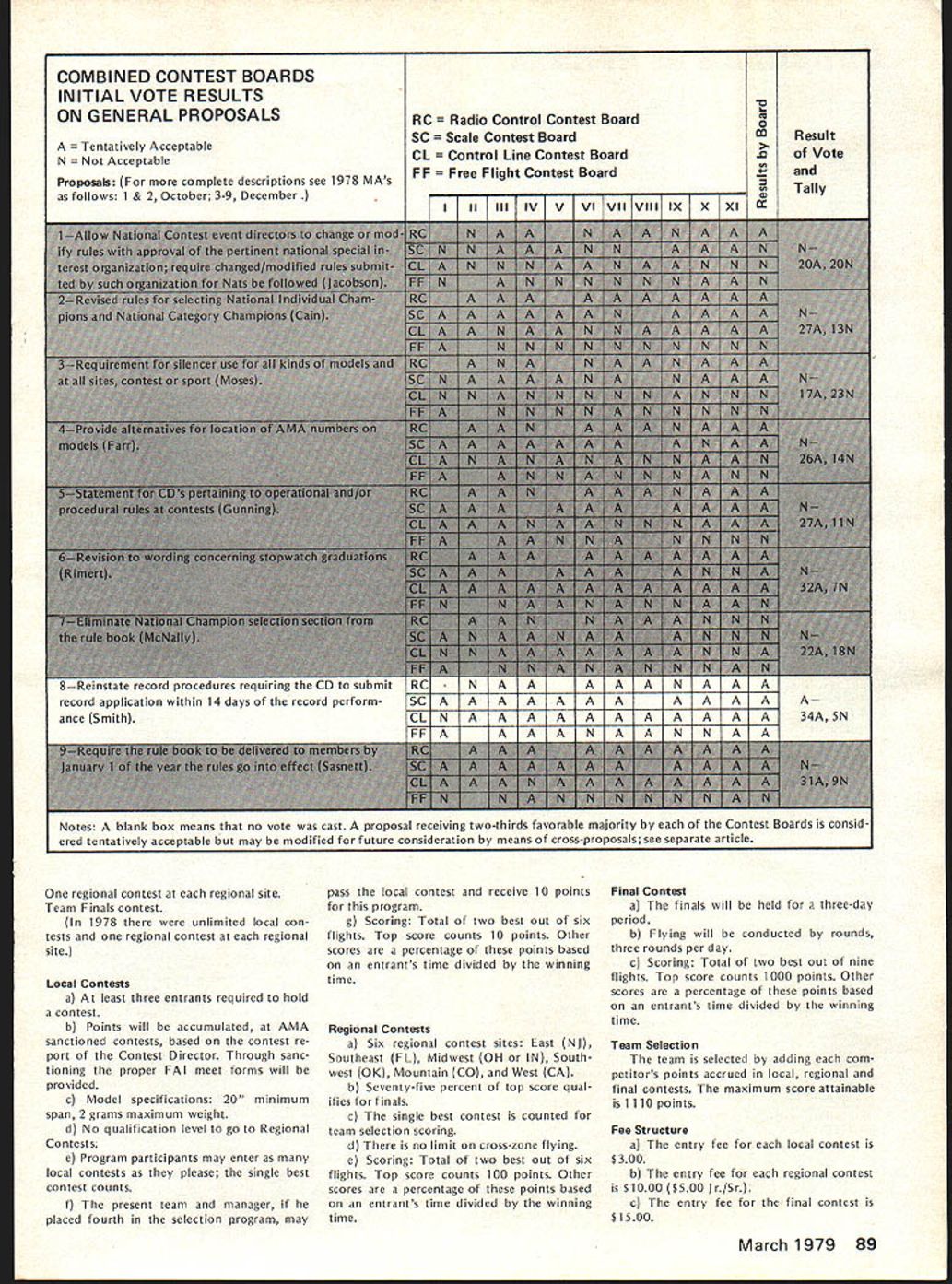
CONTEST BOARD INITIAL VOTE RESULTS THIS ISSUE
CROSS PROPOSALS DUE BY MARCH 1
- Radio Control — page 82
- Scale — page 84
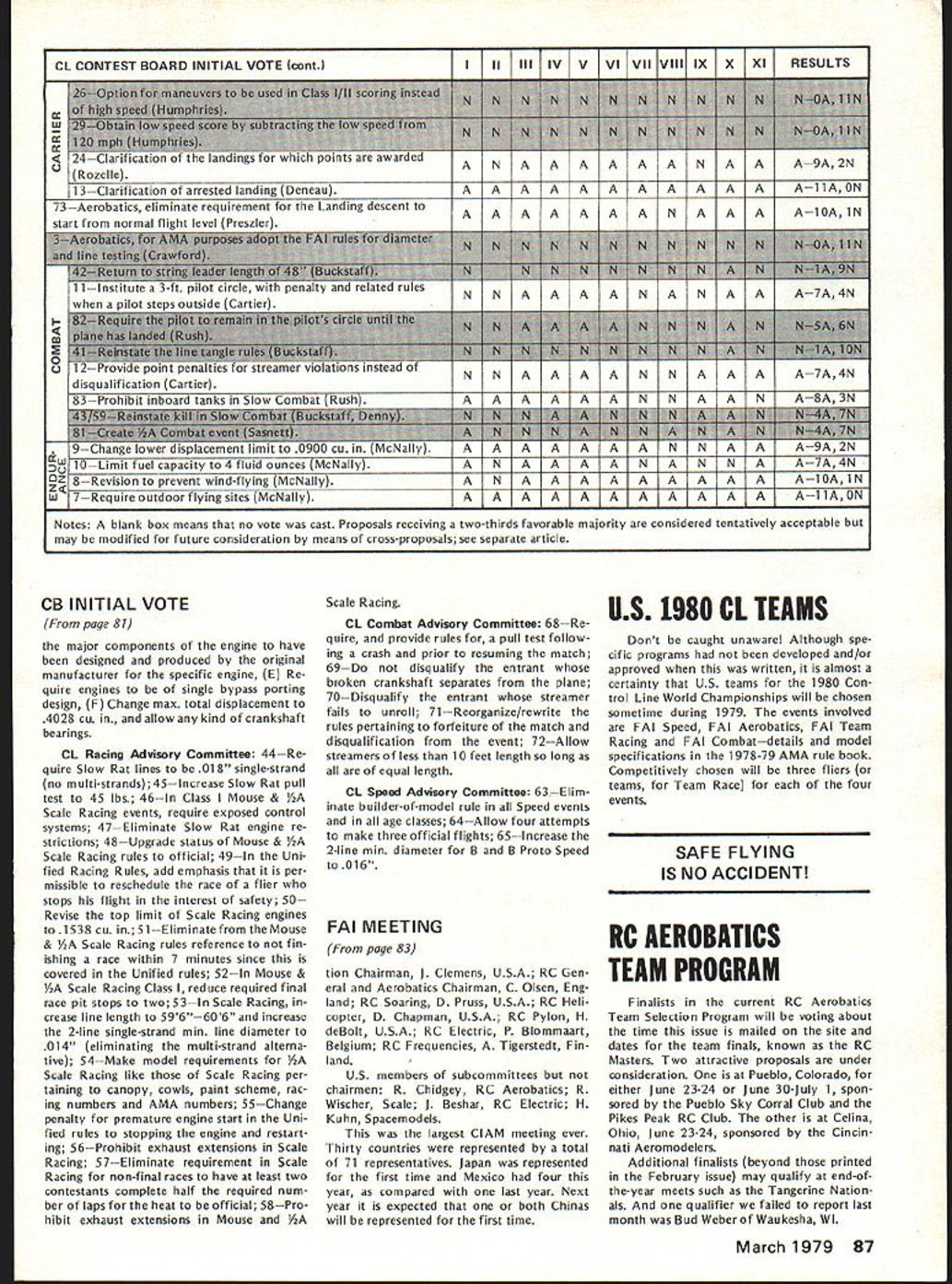
- Control Line — page 86
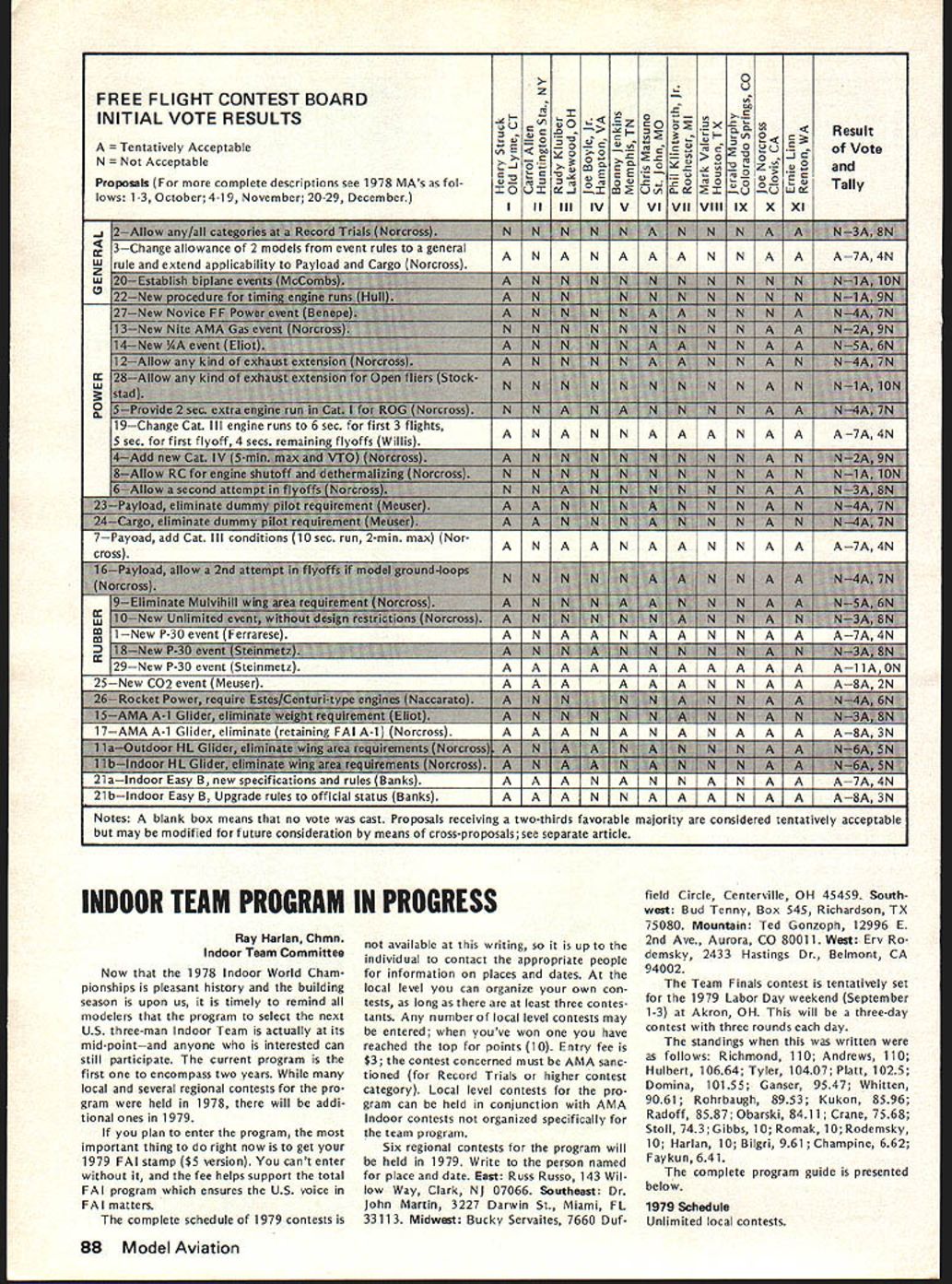
- Free Flight — page 87
- General — page 88
For each category, the results are printed in chart form on the pages indicated, showing how each individual Contest Board member voted on each rules proposal. The charts arrange proposals roughly in rule-book order so similar items are together; proposal numbering follows receipt date and is noted in each chart.
A proposal receiving a two-thirds favorable vote among responding members is considered tentatively acceptable and will go forward for additional consideration as a possible new AMA competition rule effective January 1, 1980. Any proposal receiving less than a two-thirds majority is defeated and will receive no further consideration.
Cross-proposals now accepted: Tentative acceptance of a proposal signifies that cross-proposals may be submitted (postmarked no later than March 1, 1979) to modify the original proposal. Cross-proposals must be submitted on the standard Rules Change Proposal Form and have the signatures of three adult AMA members, one of whom must be a licensed Contest Director. In April there will be an Interim Vote to reduce and/or combine similar proposals and cross-proposals.
Also considered tentatively acceptable, and subject to modification by cross-proposals, are proposals submitted by various rules advisory committees (not shown in the voting charts). These are briefly described below; see the particular issue by proposal number in the heading of each board's voting chart.
CL Navy Carrier Advisory Committee highlights:
- 1–5: Ban in-flight movable leadouts.
- 16: Allow engine exhaust ducting beyond 3" when there is at least 1/8" clearance at all points between the exhaust extension attached to the engine.
- 17: Consider separately revised Profile engine specifications as follows:
- (A) Allow rear intake engines.
- (B) Allow any kind of crankshaft bearing.
- (C) Allow pressure fuel systems.
- (D) Require acceptable engines to be produced in quantity of 1,000 or more and also require the major components of the engine to have been designed and produced by the original manufacturer for the specific engine.
- (E) Require engines to be of single bypass porting design.
- (F) Change max total displacement to .4028 cu. in., and allow any kind of crankshaft bearings.
CL Racing Advisory Committee highlights:
- 44: Require Slow Rat lines to be .018" single-strand (no multi-strands).
- 45: Increase Slow Rat pull test to 45 lbs.
- 46: In Class I Mouse & 1/2A Scale Racing events, require exposed control systems.
- 47: Eliminate Slow Rat engine restrictions.
- 48: Upgrade status of Mouse & 1/2A Scale Racing rules to official.
- 49: In Unified Racing Rules, emphasize that it is permissible to reschedule a race or flight for safety.
- 50: Revise top limit of Scale Racing engines to 1.538 cu. in.
- 51: Eliminate in Mouse & 1/2A Scale Racing reference to not finishing a race within 7 minutes since covered in Unified rules.
- 52: In Mouse & 1/2A Scale Racing Class I, reduce required final race pit stops to two.
- 53: In Scale Racing, increase line length to 39'6"–60'6" and increase 2-line single-strand min. diameter to .014".
- 54: Eliminate the multi-strand alternative.
- 55: Make model requirements for 1/2A Scale Racing like those of Scale Racing regarding canopy, cowl, paint scheme, racing numbers and AMA numbers.
- 56: Change penalty for premature engine start in Unified rules to stopping the engine and restarting.
- 57: Prohibit exhaust extensions in Scale Racing.
- 58: Eliminate requirement for non-final races to have at least two contestants complete half the required laps for the heat to be official.
- 59: Prohibit exhaust extensions in Mouse & 1/2A Scale Racing.
CL Combat Advisory Committee highlights:
- 68: Require and provide rules for a pull test following a crash and prior to resuming the match.
- 69: Do not disqualify the entrant whose broken crankshaft separates from the plane.
- 70: Disqualify the entrant whose streamer fails to unroll.
- 71: Reorganize/rewrite rules pertaining to forfeiture of the match and disqualification from the event.
- 72: Allow streamers of less than 10 foot length so long as all are of equal length.
CL Speed Advisory Committee highlights:
- 63: Eliminate builder-of-model rule in all Speed events and in all age classes.
- 64: Allow four attempts to make three official flights.
- 65: Increase 2-line min. diameter for B and B Proto Speed to .016".
SCALE WORLD CHAMPS TEAM SELECTION
Not all details have been finalized, but selection of U.S. team members for the 1980 Scale World Championships is expected to take place during the 1979 National Contest at Lincoln, Nebraska, July 29–August 5. Three-man teams will be selected for:
- Control Line Precision Scale
- Radio Control Precision Scale
- Radio Control Sport Scale
Canada is host for the 1980 Scale World Championships and has indicated that RC Sport Scale will be held as a limited international contest (one level beneath a World Championships), which is why a U.S. RC Sport Scale team will be selected. Note that AMA financial support of teams extends only to World Championships.
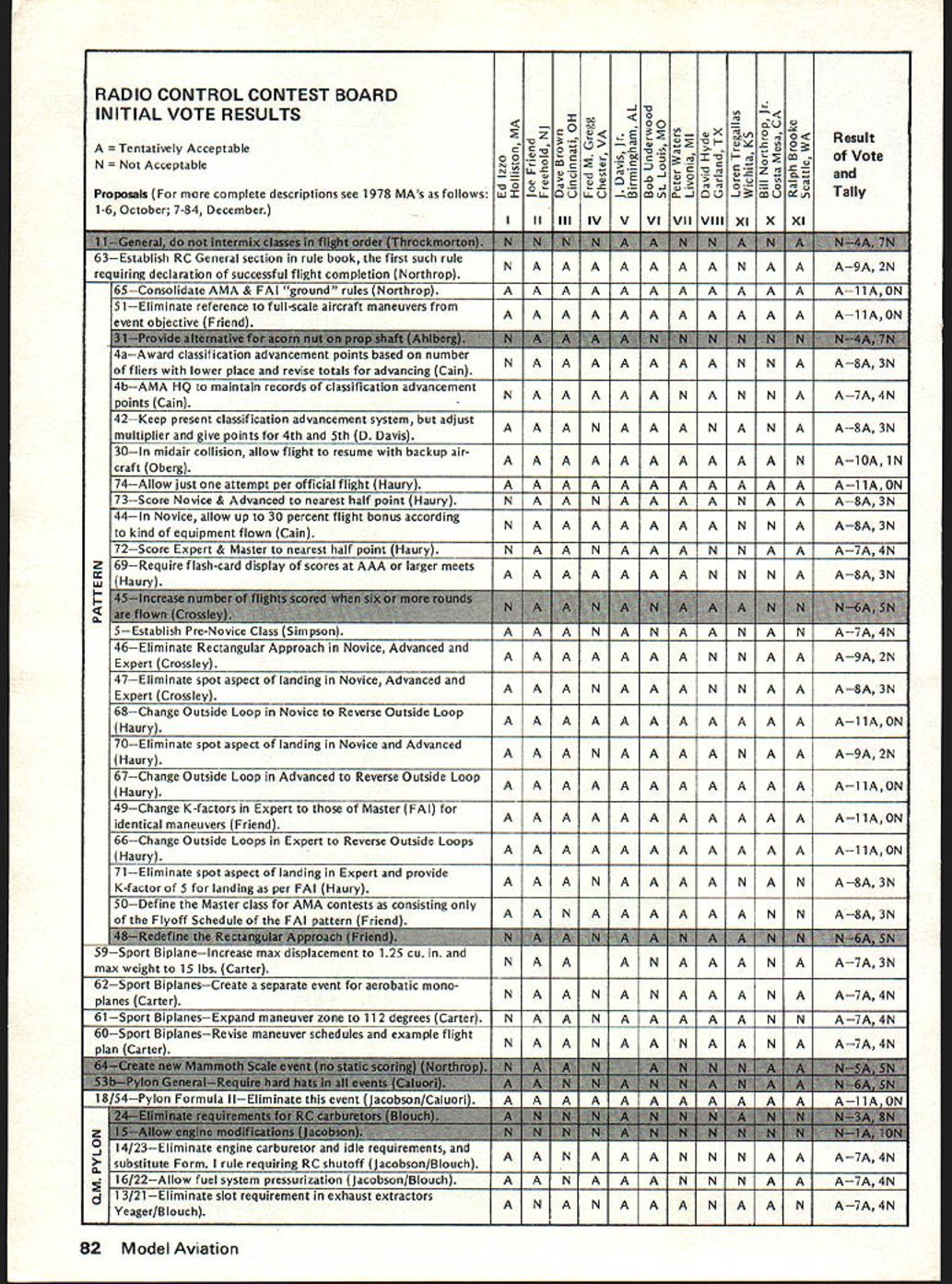
RADIO CONTROL CONTEST BOARD INITIAL VOTE RESULTS
A = Tentatively Acceptable N = Not Acceptable
Proposals: (For more complete descriptions see 1978 MA's as follows: 1–6, October; 7–84, December.)
THIS ISSUE — CROSS PROPOSALS DUE BY MARCH 1 Radio Control page 82 Scale page 84 Control Line page 86 Free Flight page 87 General page 88
The categories' results are printed in chart form on the pages indicated, showing how individual Contest Board members voted on rules proposals. A proposal receiving a two-thirds favorable vote among responding members is considered tentatively acceptable and will go forward for additional consideration.
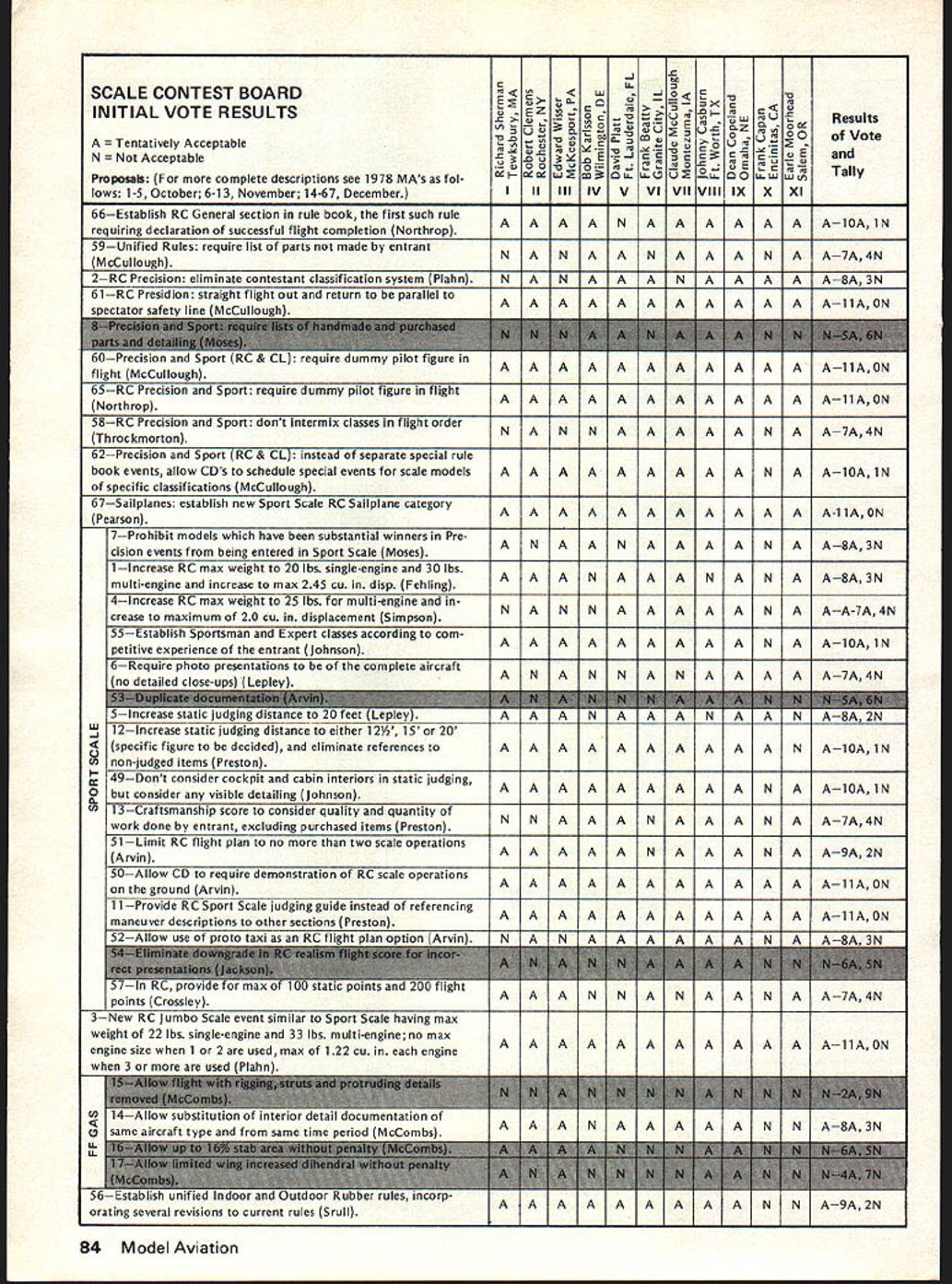
SCALE CONTEST BOARD INITIAL VOTE RESULTS
A = Tentatively Acceptable N = Not Acceptable
Proposals: (For more complete descriptions see 1978 MA's as follows: 1–5, October; 6–13, November; 14–67, December.)
- 66 — Establish RC General section in rule book, the first such rule requiring declaration of successful flight completion (Northrop). A — 10A, 1N
- 59 — Unified Rules: require list of parts not made by entrant (McCullough). A — 7A, 4N
- 2 — RC Precision: eliminate contestant classification system (Plahn). A — 8A, 3N
- 61 — RC Precision: straight flight out and return to be parallel to spectator safety line (McCullough). A — 11A, 0N
- 8 — Precision and Sport: require lists of handmade and purchased parts and detailing (Moses). N — 5A, 6N
- 60 — Precision and Sport (RC & CL): require dummy pilot figure in flight (McCullough). A — 11A, 0N
- 65 — RC Precision and Sport: require dummy pilot figure in flight (Northrop). A — 11A, 0N
- 58 — RC Precision and Sport: don't intermix classes in flight order (Throckmorton). A — 7A, 4N
- 62 — Precision and Sport (RC & CL): allow Contest Directors to schedule special events for scale models of specific classifications instead of separate special rule book events (McCullough). A — 10A, 1N
- 67 — Sailplanes: establish new Sport Scale RC Sailplane category (Pearson). A — 11A, 0N
- 7 — Prohibit models which have been substantial winners in Precision events from being entered in Sport Scale (Moses). A — 8A, 3N
- 1 — Increase RC max weight to 20 lbs. single-engine and 30 lbs. multi-engine and increase max engine displacement to 2.45 cu. in. (Fehling). A — 8A, 3N
- 4 — Increase RC max weight to 25 lbs. for multi-engine and increase max displacement to 2.0 cu. in. (Simpson). A — 7A, 4N
- 55 — Establish Sportsman and Expert classes according to competitive experience of the entrant (Johnson). A — 10A, 1N
- 6 — Require photo presentations to be of the complete aircraft (no detailed close-ups) (Lepley). A — 7A, 4N
- 53 — Duplicate documentation (Arvin). N — 5A, 6N
- 5 — Increase static judging distance to 20 feet (Lepley). A — 8A, 2N
- 12 — Increase static judging distance to either 12½', 15' or 20' (specific figure to be decided), and eliminate references to non-judged items (Preston). A — 10A, 1N
- 49 — Don't consider cockpit and cabin interiors in static judging, but consider any visible detailing (Johnson). A — 10A, 1N
- 13 — Craftsmanship score to consider quality and quantity of work done by entrant, excluding purchased items (Preston). A — 7A, 4N
- 51 — Limit RC flight plan to no more than two scale operations (Arvin). A — 9A, 2N
- 50 — Allow CD to require demonstration of RC scale operations on the ground (Arvin). A — 11A, 0N
- 11 — Provide RC Sport Scale judging guide instead of referencing maneuver descriptions to other sections (Preston). A — 11A, 0N
- 52 — Allow use of proto taxis as an RC flight plan option (Arvin). A — 8A, 3N
- 54 — Eliminate downgrade in RC realism flight score for incorrect presentations (Jackson). N — 6A, 5N
- 57 — In RC, provide for max of 100 static points and 200 flight points (Crossley). A — 7A, 4N
- 3 — New RC Jumbo Scale event similar to Sport Scale having max weight of 22 lbs. single-engine and 33 lbs. multi-engine; no max engine size when 1 or 2 are used, max of 1.22 cu. in. each engine when 3 or more are used (Plahn). A — 11A, 0N
- 15 — Allow flight with rigging, struts and protruding details removed (McCombs). N — 2A, 9N
- 14 — Allow substitution of interior detail documentation of same aircraft type and from same time period (McCombs). A — 8A, 3N
- 16 — Allow up to 16% stab area without penalty (McCombs). N — 6A, 5N
- 17 — Allow limited wing increased dihedral without penalty (McCombs). N — 4A, 7N
- 56 — Establish unified Indoor and Outdoor Rubber rules, incorporating several revisions to current rules (Srull). A — 9A, 2N
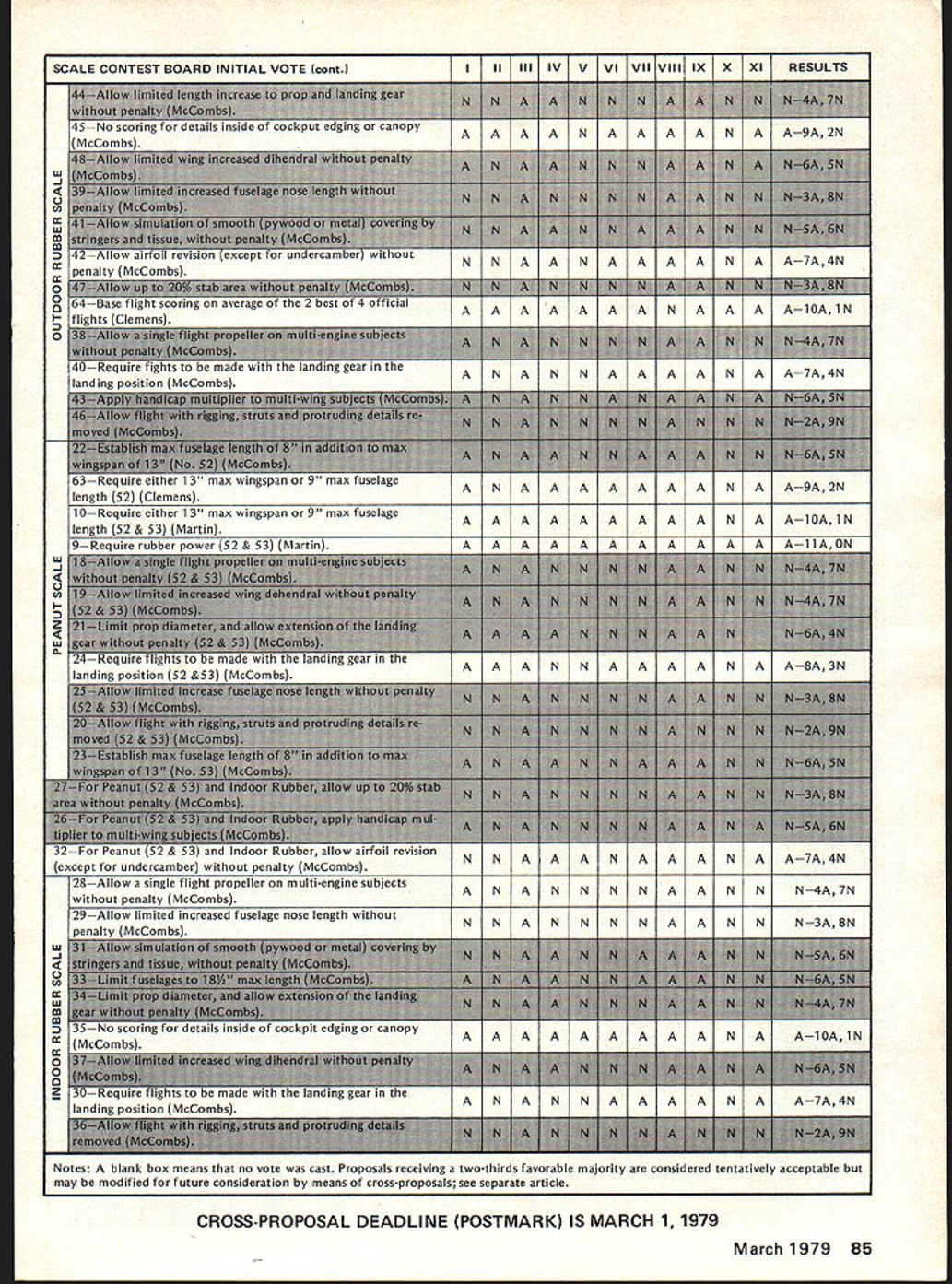
SCALE CONTEST BOARD INITIAL VOTE (cont.)
- 44 — Allow limited length increase to prop and landing gear without penalty (McCombs).
- 45 — No scoring for details inside of cockpit edging or canopy (McCombs).
- 48 — Allow limited wing increased dihedral without penalty (McCombs).
- 39 — Allow limited increased fuselage nose length without penalty (McCombs).
- 41 — Allow simulation of smooth (plywood or metal) covering by stringers and tissue, without penalty (McCombs).
- 42 — Allow airfoil revision (except for undercamber) without penalty (McCombs).
- 47 — Allow up to 20% stab area without penalty (McCombs).
- 64 — Base flight scoring on average of the 2 best of 4 official flights (Clemens).
- 38 — Allow a single flight propeller on multi-engine subjects without penalty (McCombs).
- 40 — Require flights to be made with the landing gear in the landing position (McCombs).
- 43 — Apply handicap multiplier to multi-wing subjects (McCombs).
- 46 — Allow flight with rigging, struts and protruding details removed (McCombs).
- 22 — Establish max fuselage length of 8" in addition to max wingspan of 13" (No. 52) (McCombs).
- 63 — Require either 13" max wingspan or 9" max fuselage length (52) (Clemens).
- 10 — Require either 13" max wingspan or 9" max fuselage length (52 & 53) (Martin).
- 9 — Require rubber power (52 & 53) (Martin).
PEANUT SCALE
- 18 — Allow a single flight propeller on multi-engine subjects without penalty (52 & 53) (McCombs).
- 19 — Allow limited increased wing dihedral without penalty (52 & 53) (McCombs).
- 21 — Limit prop diameter, and allow extension of the landing gear without penalty (52 & 53) (McCombs).
- 24 — Require flights to be made with the landing gear in the landing position (52 & 53) (McCombs).
- 25 — Allow limited increased fuselage nose length without penalty (52 & 53) (McCombs).
- 20 — Allow flight with rigging, struts and protruding details removed (52 & 53) (McCombs).
- 23 — Establish max fuselage length of 8" in addition to max wingspan of 13" (No. 53) (McCombs).
- 27 — For Peanut (52 & 53) and Indoor Rubber, allow up to 20% stab area without penalty (McCombs).
- 26 — For Peanut (52 & 53) and Indoor Rubber, apply handicap multiplier to multi-wing subjects (McCombs).
- 32 — For Peanut (52 & 53) and Indoor Rubber, allow airfoil revision (except for undercamber) without penalty (McCombs).
- 28 — Allow a single flight propeller on multi-engine subjects without penalty (McCombs).
- 29 — Allow limited increased fuselage nose length without penalty (McCombs).
INDOOR RUBBER SCALE
- 31 — Allow simulation of smooth (plywood or metal) covering by stringers and tissue, without penalty (McCombs).
- 33 — Limit fuselages to 18½" max length (McCombs).
- 34 — Limit prop diameter, and allow extension of the landing gear without penalty (McCombs).
- 35 — No scoring for details inside of cockpit edging or canopy (McCombs).
- 37 — Allow limited increased wing dihedral without penalty (McCombs).
- 30 — Require flights to be made with the landing gear in the landing position (McCombs).
- 36 — Allow flight with rigging, struts and protruding details removed (McCombs).
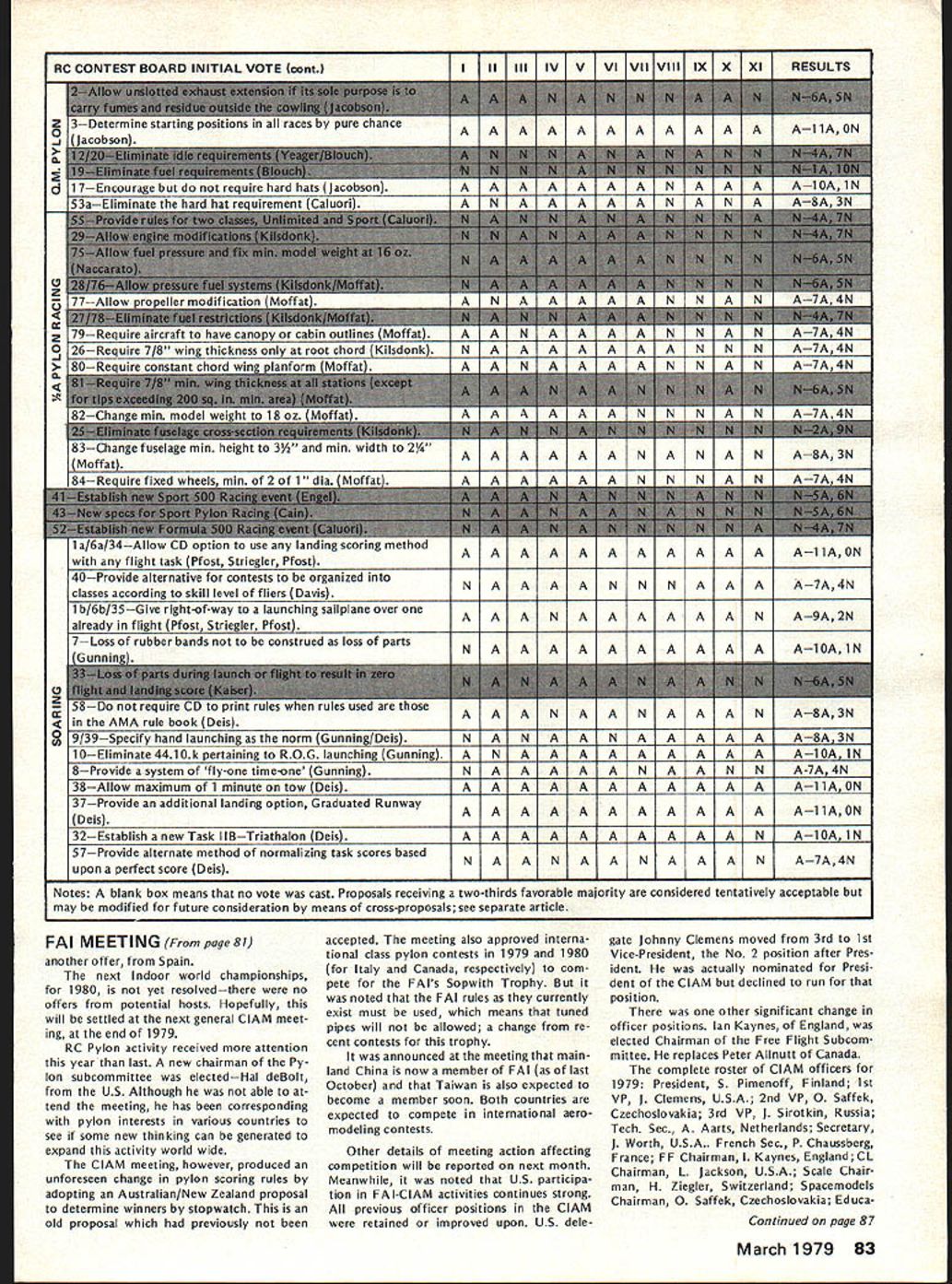
Notes: A blank box in the charts means no vote was cast. Proposals receiving a two-thirds favorable majority are considered tentatively acceptable but may be modified by cross-proposals.
CROSS-PROPOSAL DEADLINE (POSTMARK) IS MARCH 1, 1979
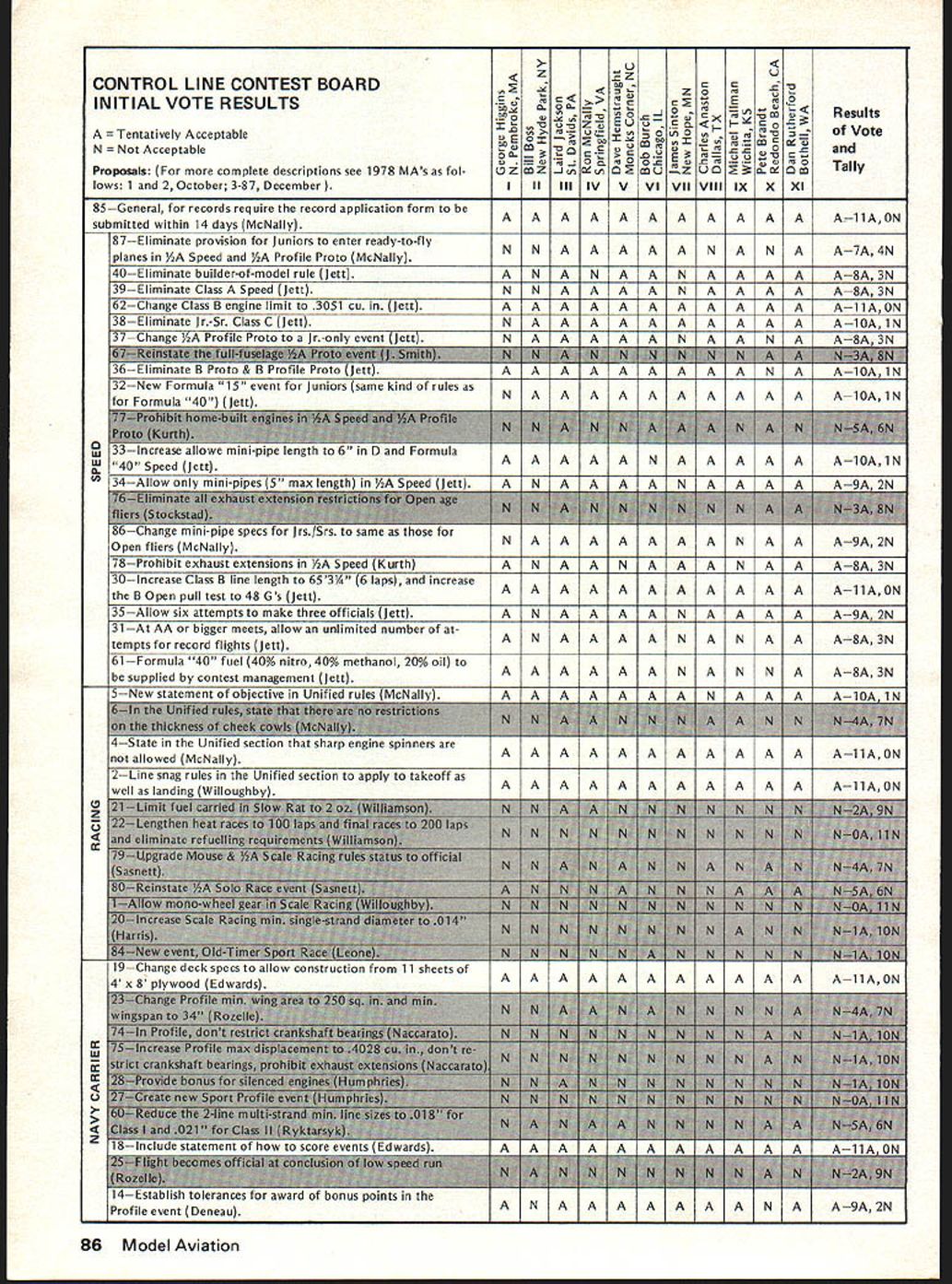
CONTROL LINE CONTEST BOARD INITIAL VOTE RESULTS
A = Tentatively Acceptable N = Not Acceptable
Proposals: (For more complete descriptions see 1978 MA's as follows: 1 and 2, October; 3–87, December).
SPEED
- 85 — For records require the record application form to be submitted within 14 days (McNally). A — 11A, 0N
- 87 — Eliminate provision for Juniors to enter ready-to-fly planes in 1/2A Speed and 1/2A Profile Proto (McNally). A — 7A, 4N
- 40 — Eliminate builder-of-model rule (Jett). A — 8A, 3N
- 39 — Eliminate Class A Speed (Jett). A — 8A, 3N
- 62 — Change Class B engine limit to .3051 cu. in. (Jett). A — 11A, 0N
- 38 — Eliminate Jr.-Sr. Class C (Jett). A — 10A, 1N
- 37 — Change 1/2A Profile Proto to a Jr.-only event (Jett). A — 8A, 3N
- 67 — Reinstate the full-fuselage 1/2A Proto event (J. Smith). N — 3A, 8N
- 36 — Eliminate B Proto & B Profile Proto (Jett). A — 10A, 1N
- 32 — New Formula "15" event for Juniors (same kind of rules as for Formula "40") (Jett). A — 10A, 1N
- 77 — Prohibit home-built engines in 1/2A Speed and 1/2A Profile Proto (Kurth). N — 5A, 6N
- 33 — Increase allowable mini-pipe length to 6" in D and Formula 40 Speed (Jett). A — 10A, 1N
- 34 — Allow only mini-pipes (5" max length) in 1/2A Speed (Jett). A — 9A, 2N
- 6 — Eliminate all exhaust extension restrictions for Open age fliers (Stockstad). N — 3A, 8N
- 86 — Change mini-pipe specs for Jrs./Srs. to same as Open fliers (McNally). A — 9A, 2N
- 78 — Prohibit exhaust extensions in 1/2A Speed (Kurth). A — 8A, 3N
- 30 — Increase Class B line length to 65 3/4" (6 laps), and increase the B Open pull test to 48 G's (Jett). A — 11A, 0N
- 35 — Allow six attempts to make three officials (Jett). A — 9A, 2N
- 31 — At AA or bigger meets, allow an unlimited number of attempts for record flights (Jett). A — 8A, 3N
- 61 — Formula "40" fuel (40% nitro, 40% methanol, 20% oil) to be supplied by contest management (Jett). A — 8A, 3N
- 5 — New statement of objective in Unified rules (McNally). A — 10A, 1N
- 6 — In the Unified rules, state that there are no restrictions on the thickness of cheek cowls (McNally). N — 4A, 7N
- 4 — State in the Unified section that sharp engine spinners are not allowed (McNally). A — 11A, 0N
- 2 — Line snag rules in the Unified section to apply to takeoff as well as landing (Willoughby). A — 11A, 0N
RACING
- 21 — Limit fuel carried in Slow Rat to 2 oz. (Williamson). N — 2A, 9N
- 22 — Lengthen heat races to 100 laps and final races to 200 laps and eliminate refueling requirements (Williamson). N — 0A, 11N
- 79 — Upgrade Mouse & 1/2A Scale Racing rules status to official (Sasnett). N — 4A, 7N
- 80 — Reinstate 1/2A Solo Race event (Sasnett). N — 5A, 6N
- 17 — Allow mono-wheel gear in Scale Racing (Willoughby). N — 0A, 11N
- 20 — Increase Scale Racing min. single-strand diameter to .014" (Harris). N — 1A, 10N
- 84 — New event, Old-Timer Sport Race (Leone). N — 1A, 10N
- 19 — Change deck specs to allow construction from 11 sheets of 4' x 8' plywood (Edwards). A — 11A, 0N
- 23 — Change Profile min. wing area to 250 sq. in. and min. wingspan to 34" (Rozelle). N — 4A, 7N
- 74 — In Profile, don't restrict crankshaft bearings (Naccarato). N — 1A, 10N
- 75 — Increase Profile max displacement to .4028 cu. in., don't restrict crankshaft bearings, prohibit exhaust extensions (Naccarato). N — 1A, 10N
- 28 — Provide bonus for silenced engines (Humphries). N — 1A, 10N
- 27 — Create new Sport Profile event (Humphries). N — 0A, 11N
- 60 — Reduce the 2-line multi-strand min. line sizes to .018" for Class I and .021" for Class II (Rytkarsky). N — 5A, 6N
- 18 — Include statement of how to score events (Edwards). A — 11A, 0N
- 25 — Flight becomes official at conclusion of low speed run (Rozelle). N — 2A, 9N
- 14 — Establish tolerances for award of bonus points in the Profile event (Deneau). A — 9A, 2N
NAVY CARRIER
(Results shown are the initial vote tallies of the Control Line Contest Board. Proposals receiving a two-thirds favorable majority are considered tentatively acceptable but may be modified for future consideration by cross-proposals.)
U.S. 1980 CL TEAMS
Although specific programs had not been fully developed when this was written, it is almost certain that U.S. teams for the 1980 Control Line World Championships will be chosen sometime during 1979. Events involved are FAI Speed, FAI Aerobatics, FAI Team Racing and FAI Combat—see details and model specifications in the 1978–79 AMA rule book. Competitively chosen will be three fliers (or teams, for Team Race) for each of the four events.
RC AEROBATICS TEAM PROGRAM
Finalists in the current RC Aerobatics Team Selection Program will be voting about the time this issue is mailed on sites and dates for the team finals, known as the RC Masters. Two proposals under consideration:
- Pueblo, Colorado — either June 23–24 or June 30–July 1, sponsored by Pueblo Sky Corral Club and Pikes Peak RC Club.
- Celina, Ohio — June 23–24, sponsored by Cincinnati Aeromodellers.
Additional finalists may qualify at end-of-season meets such as the Tangerine Nationals. One qualifier missed last month: Bud Weber of Waukesha, WI.
INDOOR TEAM PROGRAM IN PROGRESS
Ray Harlan, Chairman Indoor Team Committee
Now that the 1978 Indoor World Championships are history and the building season is upon us, the program to select the next U.S. three-man Indoor Team is at its midpoint—and anyone interested can still participate. The current program spans two years. Many local and several regional contests for the program were held in 1978; additional ones will be held in 1979.
If you plan to enter, obtain your 1979 FAI stamp ($5 version). You cannot enter without it; the fee helps support the FAI program and U.S. representation in FAI matters.
The complete 1979 schedule is not available at this writing, so contact the appropriate regional person for places and dates. Local contests can be organized by individuals, provided at least three contestants participate. Any number of local contests may be entered; the single best contest counts for points (10). Entry fee is $3; contests must be AMA sanctioned (for Record Trials or higher category). Local contests may be held in conjunction with AMA indoor contests not organized specifically for the team program.
Six regional contests for 1979 will be held. Contact:
- East: Russ Russo, 143 Willow Way, Clark, NJ 07066
- Southeast: Dr. John Martin, 3227 Darwin St., Miami, FL 33113
- Midwest: Bucky Servaites, 7660 Duffield Circle, Centerville, OH 45459
- Southwest: Bud Tenny, Box 545, Richardson, TX 75080
- Mountain: Ted Gonzoph, 12996 E. 2nd Ave., Aurora, CO 80011
- West: Ery Rodesnsky, 2433 Hastings Dr., Belmont, CA 94002
Team Finals are tentatively set for Labor Day weekend (September 1–3, 1979) at Akron, OH. This will be a three-day contest with three rounds each day.
Standings at time of writing:
- Richmond — 110
- Andrews — 110
- Hulbert — 106.64
- Tyler — 104.07
- Pratt — 102.5
- Domina — 101.55
- Gansner — 95.47
- Whitten — 90.61
- Rohrbaugh — 89.53
- Kukon — 85.96
- Radoff — 85.87
- Orsarski — 84.11
- Crane — 75.68
- Stoll — 74.3
- Gibbs — 70
- Romalio — 70
- Rodesnsky — 70
- Harlan — 10
- Bigri — 9.61
- Champine — 6.62
- Faykun — 6.41
The complete program guide is as follows.
1979 Schedule
- Unlimited local contests
- One regional contest at each regional site
- Team Finals contest
Local Contests
- At least three entrants required to hold a contest.
- Points accumulated at AMA-sanctioned contests based on Contest Director's report. Proper FAI meet forms will be provided through sanctioning.
- Model specs: 20" minimum span, 2 grams maximum weight.
- No qualification level required to attend Regional Contests.
- Participants may enter as many local contests as desired; the single best contest counts.
- The present team and manager, if he placed fourth in the selection program, may bypass local contests and receive 10 points for this program.
- Scoring: Total of two best out of six flights. Top score counts 100 points. Other scores are a percentage of these points based on entrant's time divided by the winning time.
Regional Contests
- Six regional sites: East (NJ), Southeast (FL), Midwest (OH or IN), Southwest (OK), Mountain (CO), West (CA).
- Seventy-five percent of top score qualifies for finals.
- Single best contest counts for team selection scoring.
- No limit on cross-zone flying.
- Scoring: Total of two best out of six flights. Top score counts 100 points; other scores are percentages based on time relative to winner.
Final Contest
- Finals held over three days.
- Flying conducted by rounds—three rounds per day.
- Scoring: Total of two best out of nine flights. Top score counts 1000 points; other scores are percentages based on time relative to winner.
Team Selection
- Team selected by adding each competitor's points accrued in local, regional and final contests. Maximum attainable score is 1110 points.
Fee Structure
- Local contest entry fee: $3.00.
- Regional contest entry fee: $10.00 ($5.00 Jr./Sr.).
- Final contest entry fee: $15.00.
Transcribed from original scans by AI. Minor OCR errors may remain.

