
Competition Newsletter
FLASH! Nats changes approved. The AMA Executive Council at its January 27 meeting in St. Louis added FF Electric Power (Free Flight) to the official schedule for Saturday, August 4. Control Line speed events were rearranged to provide a four-day schedule as follows:
- Monday — Formula 40, FAI Class
- Tuesday — AA, A, Proto
- Wednesday — B, C
- Thursday — D, Jet
Plan early: 1979 Nats — July 29–August 5, Lincoln, Nebraska.
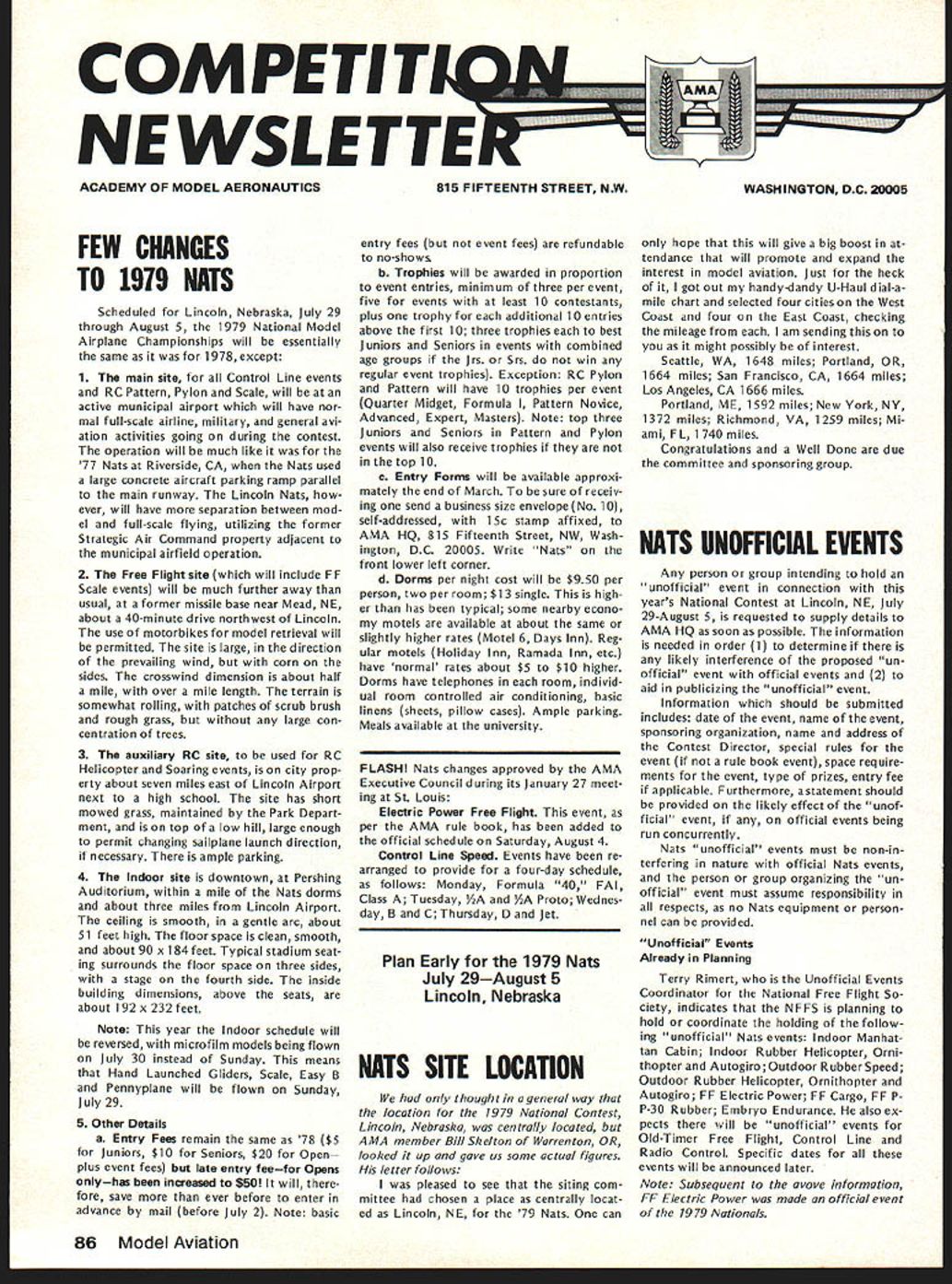
FEW CHANGES TO 1979 NATS
Scheduled for Lincoln, Nebraska, July 29 through August 5, the 1979 National Model Airplane Championships will be essentially the same as 1978 except for the following changes:
- Main Site
- The main site for all Control Line events and RC Pattern, Pylon and Scale will be at an active municipal airport with normal full-scale airline, military, and general aviation activity occurring during the contest. Operations will be similar to the '77 Nats at Riverside, CA, when the contest used a large concrete aircraft parking ramp parallel to the runway. The Lincoln Nats will have more separation between model and full-scale flying, utilizing former Strategic Air Command property adjacent to the municipal airfield.
- Free Flight Site
- The Free Flight site (including FF Scale events) will be much farther away than usual — at a former missile base near Mead, NE, about a 40-minute drive northwest of Lincoln. Motorbikes for model retrieval will be permitted. The site is large, with its long axis roughly in the direction of the prevailing wind; crosswind dimension is about half a mile, with over a mile length. Terrain is somewhat rolling, with patches of scrub brush and rough grass, and corn fields on the sides, but without any large concentration of trees.
- Auxiliary RC Site
- The auxiliary RC site, for RC Helicopter and Soaring events, is on city property about seven miles east of Lincoln Airport next to a high school. The site has short mowed grass maintained by the Park Department and sits atop a low hill large enough to permit changing sailplane launch direction if necessary. There is ample parking.
- Indoor Site
- The Indoor site is Pershing Auditorium downtown, within a mile of the Nats dorms and about three miles from Lincoln Airport. The ceiling is a smooth gentle arc about 51 feet high. Floor space is clean, smooth, approximately 90 x 184 feet. Typical stadium seating surrounds the floor on three sides, with a stage on the fourth. Inside building dimensions above the seats are about 192 x 232 feet.
- Note: This year the Indoor schedule will be reversed, with micromodels being flown on July 30 instead of Sunday. This means Hand-Launched Gliders, Scale, Easy B and Pennyplane will be flown on Sunday, July 29.
- Other Details
- a. Entry Fees — Entry fees remain the same as 1978: $5 for Juniors, $10 for Seniors, $20 for Opens, plus event fees. Late entry fee for Opens only has been increased to $50. It will therefore pay to enter in advance by mail (before July 2). Note: basic entry fees (but not event fees) are refundable to no-shows.
- b. Trophies — Trophies will be awarded in proportion to event entries: minimum of three per event; five trophies for events with at least 10 contestants; plus three additional trophies for each additional 10 entries above the first 10. For events with combined age groups, three trophies each will be awarded to the best Juniors and Seniors if the Jrs. or Srs. do not win any regular event trophies. Exception: RC Pylon and Pattern will have 10 trophies per event (Quarter Midget, Formula I, Pattern Novice, Advanced, Expert, Masters). Note: the top three Juniors and Seniors in Pattern and Pylon events will also receive trophies if they are not in the top 10.
- c. Entry Forms — Entry forms will be available approximately the end of March. To be sure of receiving one, send a business-size envelope (No. 10), self-addressed, with a 15c stamp affixed, to: AMA HQ, 815 Fifteenth Street, NW, Washington, D.C. 20005. Write "Nats" on the front lower left corner.
- d. Dorms — Dorms per night cost will be $9.50 per person (two per room); $13 single. This is higher than has been typical; some nearby economy motels (Motel 6, Days Inn) are available at about the same or slightly higher rates. Regular motels (Holiday Inn, Ramada Inn, etc.) have normal rates about $5 to $10 higher. Dorms have telephones in each room, individual room-controlled air conditioning, and basic linens (sheets, pillowcases). Ample parking. Meals available at the university.
NATS SITE LOCATION
The location of the 1979 Nationals at Lincoln, NE, was chosen in part for its central location. AMA member Bill Skelton of Warrenton, OR, provided mileage figures (U-Haul dial-a-mile) from selected cities:
- Seattle, WA — 1,648 miles
- Portland, OR — 1,664 miles
- San Francisco, CA — 1,664 miles
- Los Angeles, CA — 1,666 miles
- Portland, ME — 1,592 miles
- New York, NY — 1,372 miles
- Richmond, VA — 1,259 miles
- Miami, FL — 1,740 miles
Congratulations to the siting committee.
NATS UNOFFICIAL EVENTS
Any person or group intending to hold an "unofficial" event in connection with the National Contest at Lincoln, NE, July 29–August 5, is requested to supply details to AMA HQ as soon as possible. The information is needed to (1) determine if the proposed unofficial event will interfere with official events and (2) aid in publicizing the unofficial event.
Information to submit includes: date of the event, name of event, sponsoring organization, name and address of the Contest Director, special rules (if not a rule-book event), space requirements, type of prizes, entry fee (if applicable), and a statement on the likely effect, if any, on concurrent official events.
Unofficial events must be non-interfering and the organizers must assume full responsibility; no Nats equipment or personnel can be provided.
Unofficial Events Already in Planning (per NFFS)
- Indoor Manhattan Cabin
- Indoor Rubber Helicopter
- Ornithopter and Autogiro (indoor and outdoor)
- Outdoor Rubber Speed
- Outdoor Rubber Helicopter
- FF Electric Power (since made official)
- FF Cargo
- FF P-30 Rubber
- Embryo Endurance
- Old-Timer Free Flight, Control Line and Radio Control events are also expected; specific dates to be announced.
RADIO CONTROL
Aerobatics
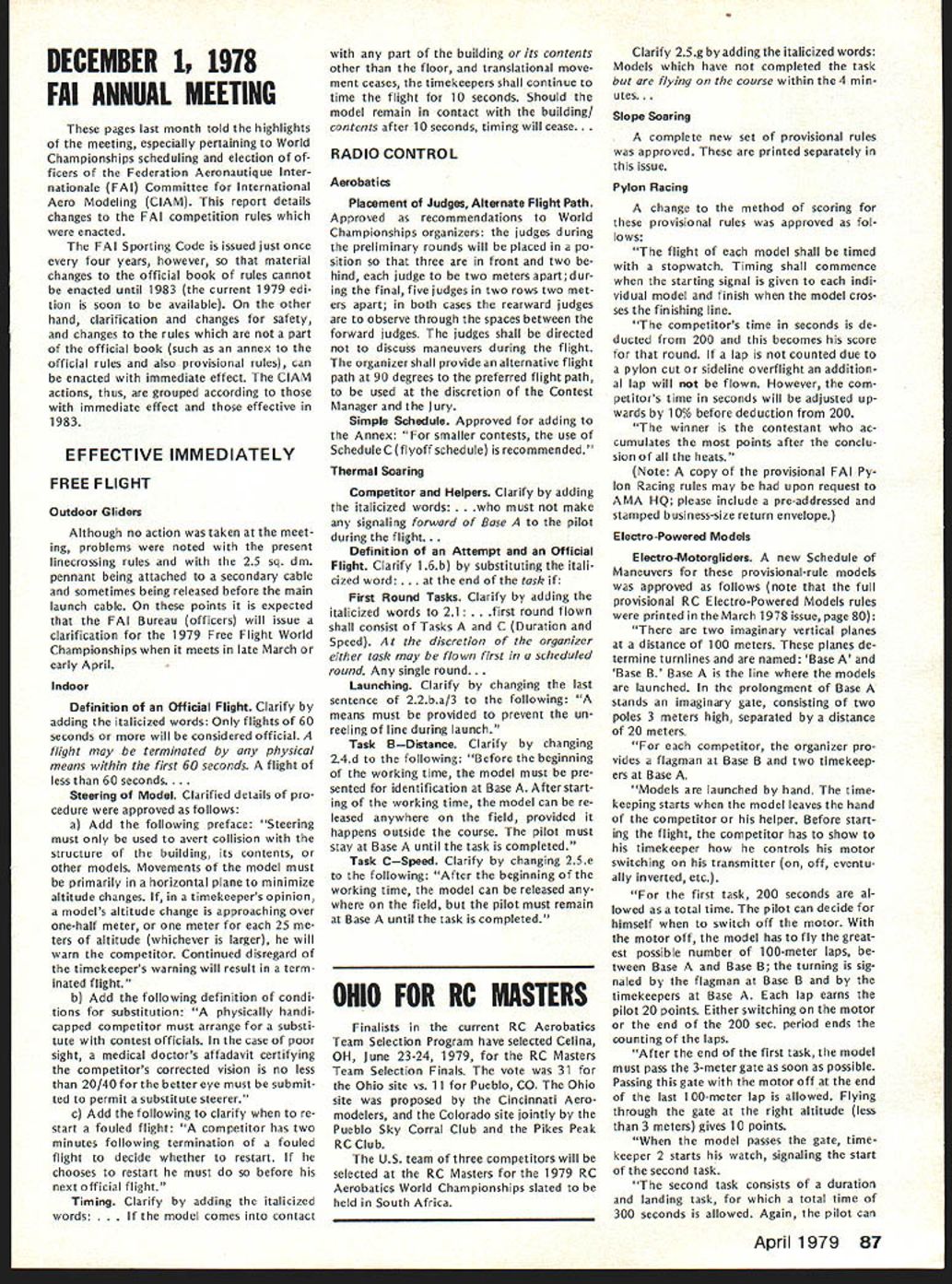
- Placement of Judges, Alternate Flight Path — Recommendations approved for World Championship organizers: during preliminaries judges will be positioned with one in front and two behind, each two meters apart; during finals five judges in two rows two meters apart, with rear judges observing through spaces between the forward judges. Judges shall not discuss maneuvers during the flight. Organizers must provide an alternative flight path at 90 degrees to the preferred path for use at the Contest Manager and Jury discretion.
- Simple Schedule — For smaller contests, the use of Schedule C (flyoff schedule) is recommended.
Thermal Soaring
- Competitor and Helpers — Clarification: helpers must not make any signaling forward of Base A to the pilot during the flight.
- Definition of an Attempt and an Official Flight — Clarified wording to 6.1.b and related sections.
- First Round Tasks — The first round flown shall consist of Tasks A and C (Duration and Speed). Either task may be flown first at the organizer's discretion in a scheduled round.
- Launching — A means must be provided to prevent the unreeled line during launch.
- Task B — Distance — Before working time begins, the model must be presented for identification at Base A. After starting working time, the model can be released anywhere on the field provided it is outside the course. The pilot must stay at Base A until the task is completed.
- Task C — Speed — After the beginning of working time, the model can be released anywhere on the field, but the pilot must remain at Base A until task completion.
- Models which have not completed the task but are flying on the course within the allowed time are treated per clarified rule 2.5.g.
Slope Soaring
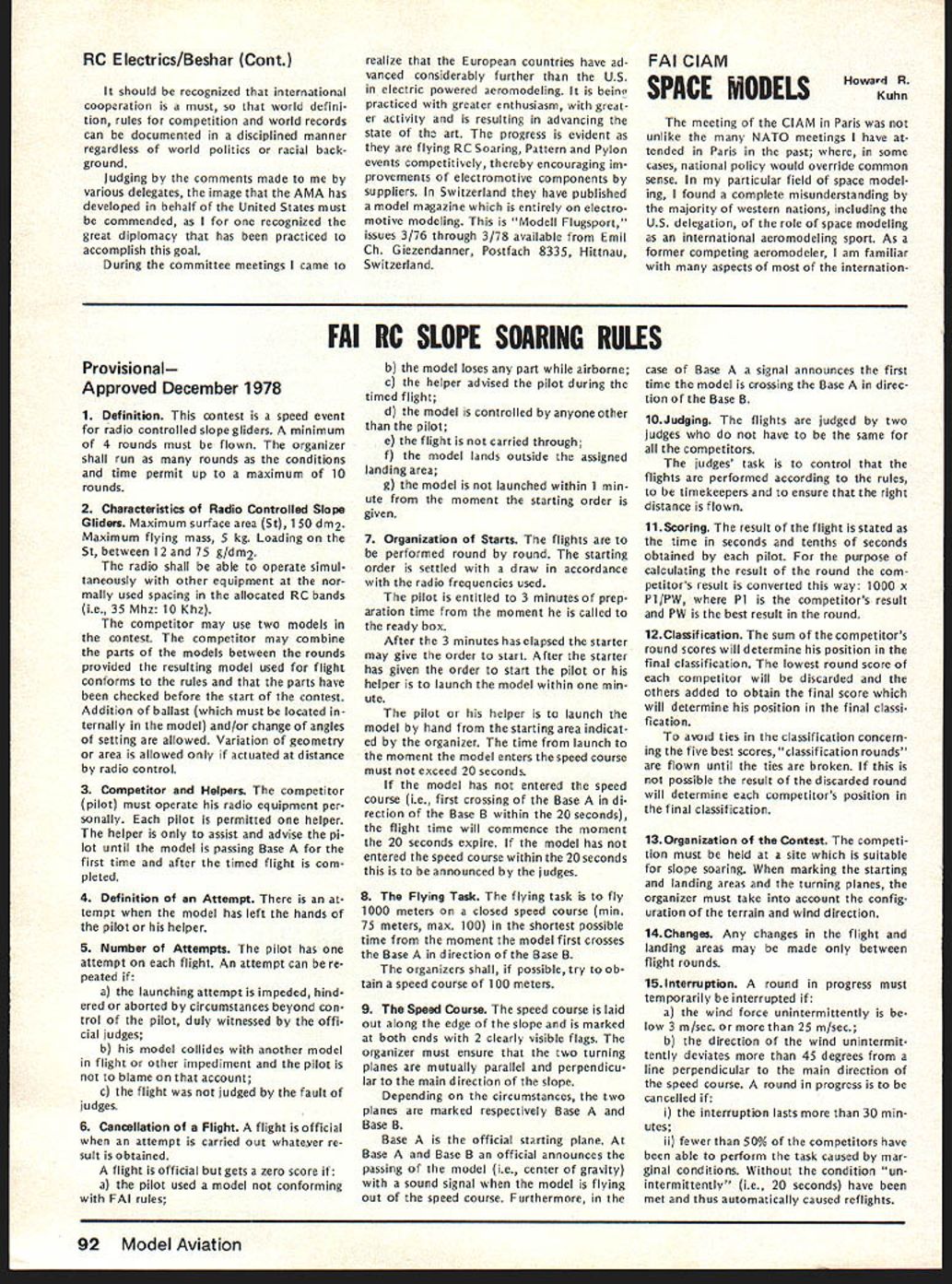
- A complete new set of provisional rules was approved. These are printed separately in this issue.
Pylon Racing
- Scoring change for provisional rules: each model's flight is timed with a stopwatch from starting signal to crossing the finish line. The competitor's time in seconds is deducted from 200 to become his score for that round. If a lap is not counted due to pylon cut or sideline overflight, an additional lap will not be flown; however, the competitor's time will be adjusted upwards by 10% before the deduction from 200. Winner is the contestant who accumulates the most points after all heats.
(Note: a copy of the provisional FAI Pylon Racing rules is available from AMA HQ; include a pre-addressed and stamped business-size return envelope.)
Electro-Powered Models — Electro-Motorgliders
- A provisional Schedule of Maneuvers was approved. Summary:
- Two imaginary vertical planes at 100 meters determine turnlines: Base A (launch line) and Base B. An imaginary gate at Base A consists of two poles 3 meters high, 20 meters apart.
- Organizer provides a flagman at Base B and two timekeepers at Base A.
- Models are launched by hand. Timekeeping starts when the model leaves the competitor's hand. Competitor must demonstrate motor switch control to timekeeper.
- First task: 200 seconds total time. Pilot decides when to switch off the motor. With motor off, model must fly the greatest possible number of 100-meter laps between Base A and Base B; each lap earns 20 points. Switching on the motor or the end of the 200-second period ends lap counting.
- After the first task, the model must pass the 3-meter gate as soon as possible. Passing the gate with the motor off at the end of the last lap is allowed. Flying through the gate at the proper altitude (less than 3 meters) gives 10 points.
- When the model passes the gate, timekeeper 2 starts his watch to signal the start of the second task.
- Second task: duration and landing, total time 300 seconds. Again, the pilot can decide for how long he will keep the motor running. Gliding timekeeping starts when the motor is switched off for the first time in the 300-second period. Gliding time ends either when the motor is switched on again or when the model comes to rest after landing. For landing, two concentric circles of 30 and 15 meters diameter must be provided. Landing in the large circle gives 15 points; in the small circle gives 30 points. Distances are measured from the circle center to the nose of the model at rest.
OHIO FOR RC MASTERS
Finalists in the RC Aerobatics Team Selection Program selected Celina, OH, June 23–24, 1979, for the RC Masters Team Selection Finals (vote 31 for Ohio vs. 11 for Pueblo, CO). The U.S. team of three competitors for the 1979 RC Aerobatics World Championships in South Africa will be selected at the RC Masters.
FAI CIAM — OVERVIEW AND U.S. REPRESENTATION
The AMA sent eight specialists to the FAI CIAM meeting: Laird Jackson (Control Line), Ray Harlan (Free Flight), Bob Webster (Scale), Ron Chidgley (RC Aerobatics), Joe Beshar (RC Electrics), Dan Pruss (RC Soaring), John Burkham (RC Helicopters), and Howard Kuhn (Space Models). Johnny Clemens attended as U.S. voting delegate and 3rd vice-president, and chaired the Information and Education Subcommittee. AMA Executive Director John Worth attended as CIAM Secretary. Bryant Thompson attended as an observer.
Reports from U.S. participants follow; each noted their attendance was important to U.S. interests and the progress of the activity.
FAI CIAM FIRST VICE-PRESIDENT — Johnny Clemens
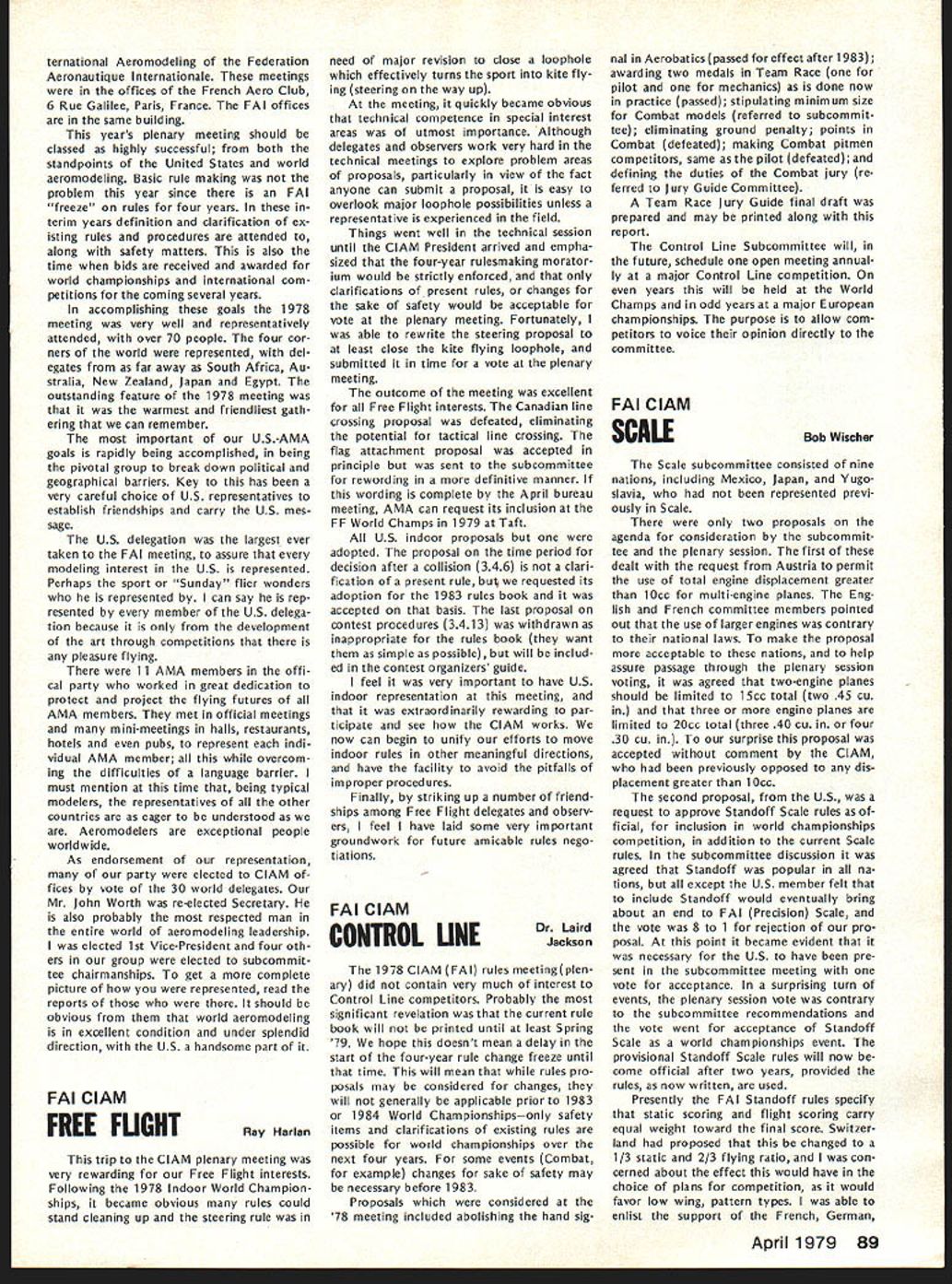
- The plenary meeting (Paris) was highly successful and well-attended, with about 70 people from 30 countries. The meeting focused on clarifications, safety, and bids for world championships because a four-year FAI rules "freeze" was in effect.
- The U.S. delegation was the largest ever taken to CIAM to ensure every modeling interest was represented. Several U.S. delegates were elected to CIAM offices. John Worth was re-elected Secretary; Johnny Clemens was elected 1st Vice-President.
FAI CIAM FREE FLIGHT — Ray Harlan
- The meeting addressed needed clarifications and closed a loophole in the steering rule that effectively allowed "kite flying" steering on the way up.
- The Canadian line crossing proposal was defeated (eliminating potential tactical line crossing). Flag attachment proposal accepted in principle and sent for rewording by the subcommittee. US indoor proposals fared well: all but one were adopted; the time-period-after-collision proposal (3.4.6) was accepted for the 1983 rules book. Another procedural proposal was withdrawn from the rules book but will be included in the contest organizers' guide.
- The meeting laid groundwork for future amicable rules negotiations and promoted international cooperation.
FAI CIAM CONTROL LINE — Dr. Laird Jackson
- Few major items for Control Line competitors. Noted the rules book would not be printed until at least Spring 1979; the four-year freeze remains in effect, so only safety and clarifications are allowed for world championships over the next four years.
- Considered proposals included abolishing the hand signal in Aerobatics (passed to take effect after 1983), awarding two medals in Team Race (pilot and mechanics — passed), stipulating minimum size for Combat models (referred to subcommittee), eliminating ground penalty in Combat (defeated), making Combat pitmen competitors (defeated), and defining Combat jury duties (referred to Jury Guide Committee).
- A Team Race Jury Guide final draft was prepared. Future Control Line Subcommittee practice: schedule one open meeting annually at a major Control Line competition (World Champs on even years; major European championship on odd years) to allow competitor input.
FAI CIAM SCALE — Bob Wischer
- Scale subcommittee had nine nations including Mexico, Japan and Yugoslavia.
- Engine displacement proposal: approved limits for multi-engine planes — two engines limited to 15cc total; three or more engines limited to 20cc total. These changes overcame prior opposition.
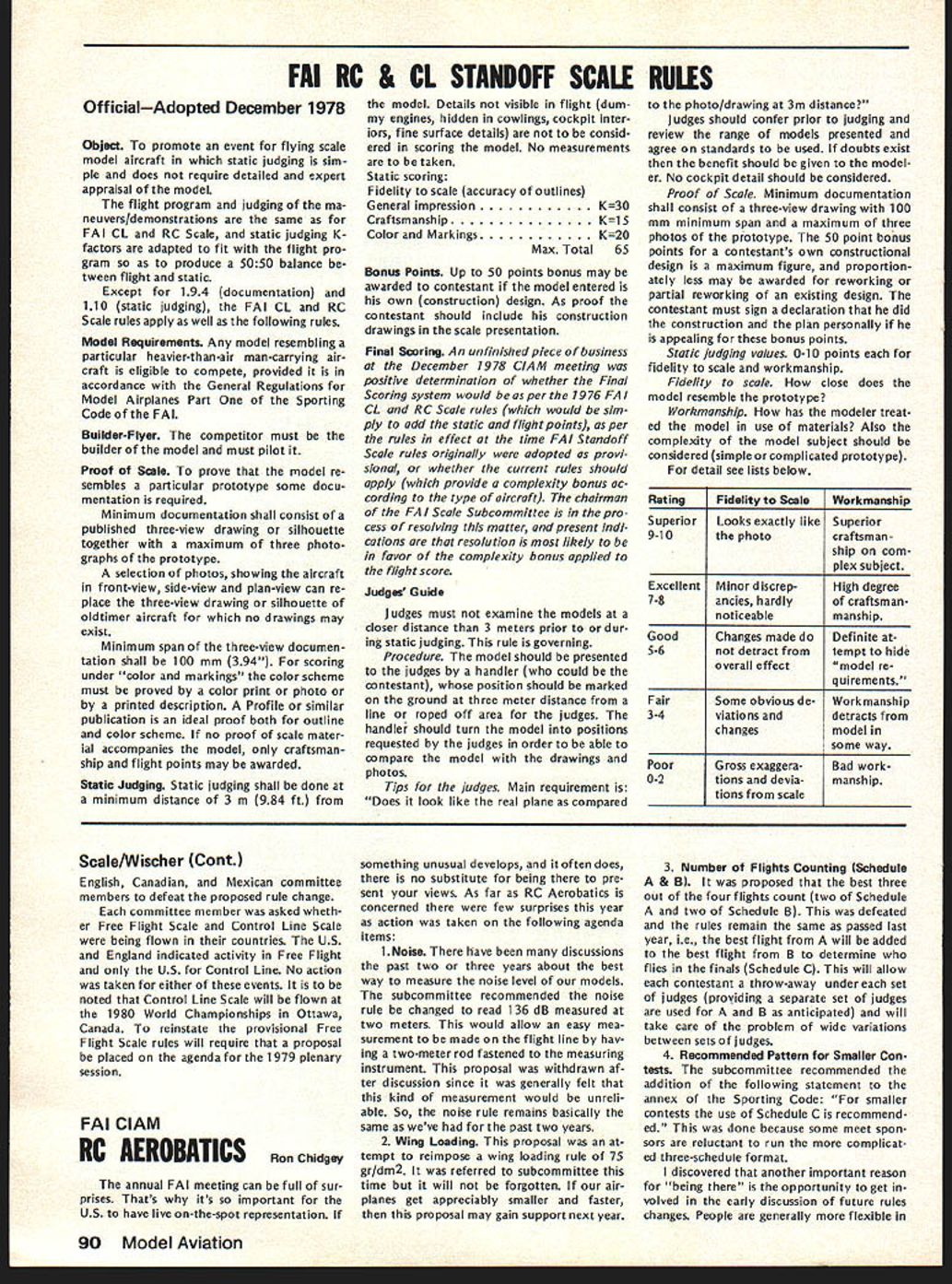
- The U.S. proposal to approve Standoff Scale rules for world championships was rejected in subcommittee (8–1) but approved by the plenary; provisional Standoff Scale rules will become official after two years if used as written. Current FAI Standoff rules weight static and flight scoring equally; a Swiss proposal to change this to 1/3 static and 2/3 flying was defeated.
- Committee members reported on Free Flight Scale and Control Line Scale activity: U.S. and England indicated Free Flight Scale activity; only the U.S. indicated Control Line Scale. Control Line Scale will be flown at the 1980 World Championships in Ottawa. Reinstating provisional Free Flight Scale rules would require a proposal for the 1979 plenary.
FAI CIAM RC AEROBATICS — Ron Chidgey
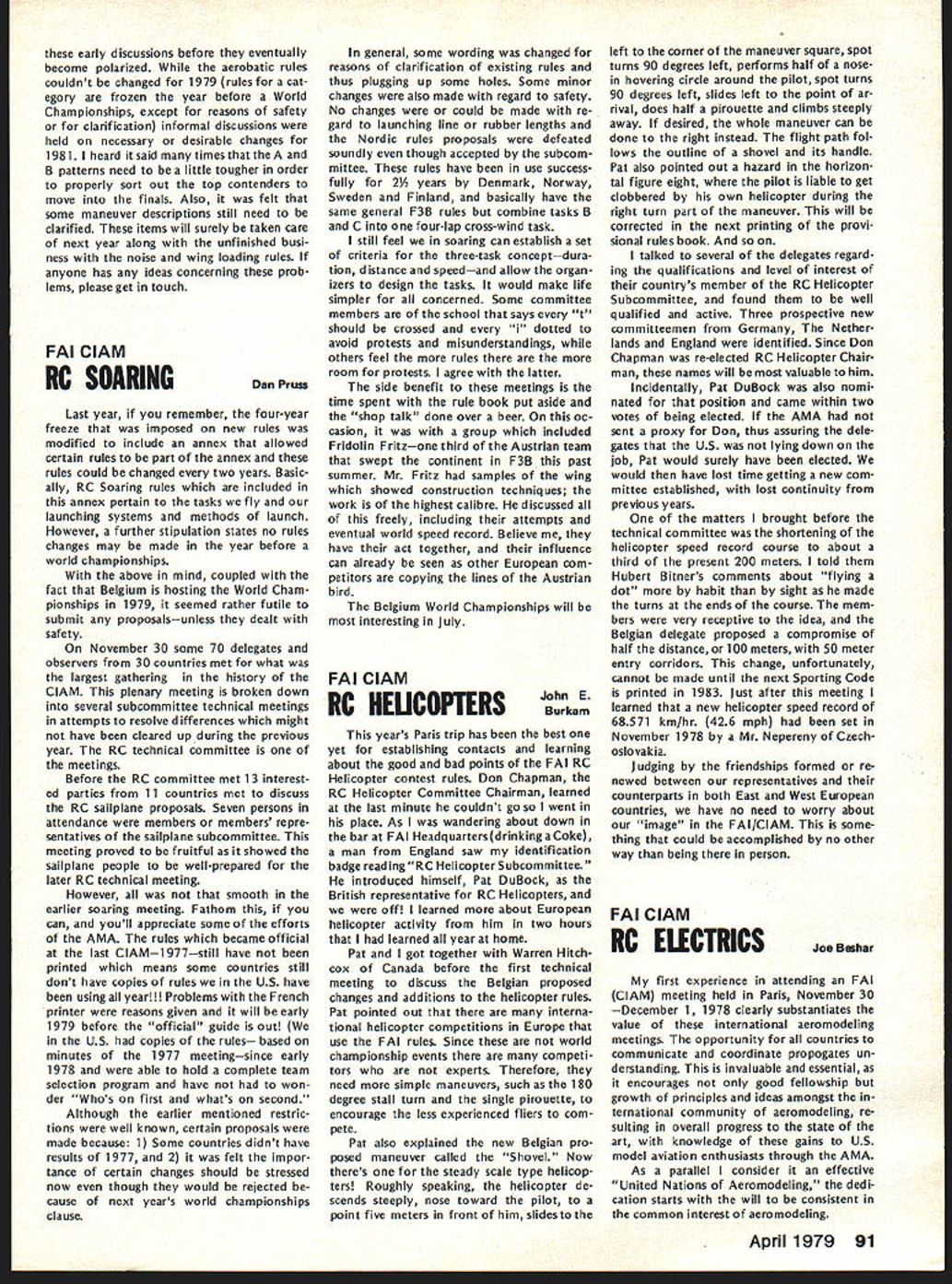
- Noise — Proposal to measure 136 dB at two meters was withdrawn after discussion; existing noise rule remains.
- Wing Loading — Proposal to impose 75 g/dm2 wing loading was referred to subcommittee.
- Number of Flights Counting (Schedule A & B) — Proposal that the best three out of four flights count was defeated; current rule remains (best flight from A plus best from B determine finalists).
- Recommended Pattern for Smaller Contests — Annex amended: "For smaller contests the use of Schedule C is recommended."
- Informal discussions began on desired changes for 1981 (tougher A and B patterns and clearer maneuver descriptions). Input from interested parties encouraged.
FAI CIAM RC SOARING — Dan Pruss
- RC Soaring rules placed in an annex can be changed every two years, but no changes may be made in the year before a World Championships. Because Belgium hosts the 1979 Worlds, only safety-related proposals were likely to be considered.
- Rule printing delays noted: rules from 1977 had not been printed for some countries; official printed rules expected early 1979.
- Some clarifications and safety-related changes were made; proposals to change launching line or rubber lengths and Nordic rules were defeated. Discussion favored simplifying task definitions (duration, distance, speed) and allowing organizers flexibility in task design.
- The Belgium World Championships (July) were expected to be most interesting.
FAI CIAM RC HELICOPTERS — John E. Burkman
- The Paris meeting was valuable for establishing contacts and discussing rule issues. European activity is strong and uses FAI rules for many competitions.
- Starting Engines — Competitors should be allowed to start engines from an allotted place, carry (not fly) their helicopter into the ready box for final adjustments. The five-minute starting period begins when the starting battery is plugged to the glow plug.
- Rectangular Approach — Lengthening of legs for this maneuver from 20 meters to 50 meters or more, with equal legs, was approved.
- K-factor Changes — Adjustments: True Loop (13.9) K=4→K=2; Double Pirouette (13.7) K=2→K=3; True Autorotative Descent and Landing (13.14) K=4→K=5.
- New Optional Maneuvers approved (summaries):
- 13.15 Single Pirouette, K=2 — 360° slow rotation (like Double Pirouette but single).
- 13.16 Stall Turn, K=2 — 180° pivot (like the 540° version but 180°).
- 13.17 Shovel, K=4 — complex sequence involving steep approach, lateral hovering and half Swiss hovering circle; described in detail.
- 13.18 Immelmann, K=3 — fixed-wing-like description.
- 13.19 Inverted Immelmann, K=4 — starts inverted.
- 13.20 Belgian Stall Turn, K=4 — pull up to vertical, half roll, pivot, recover on opposite side.
- Helicopter speed record course shortening was proposed (from 200 m to 100 m) but cannot be implemented until the next Sporting Code printing (1983). A new helicopter speed record (68.571 km/hr) was noted.
FAI CIAM RC ELECTRICS — Joe Beshar
- International cooperation is vital for world record documentation and rules. European countries have advanced further in electric-powered modeling; activity includes RC Soaring, Pattern and Pylon with competitive practice driving component development.
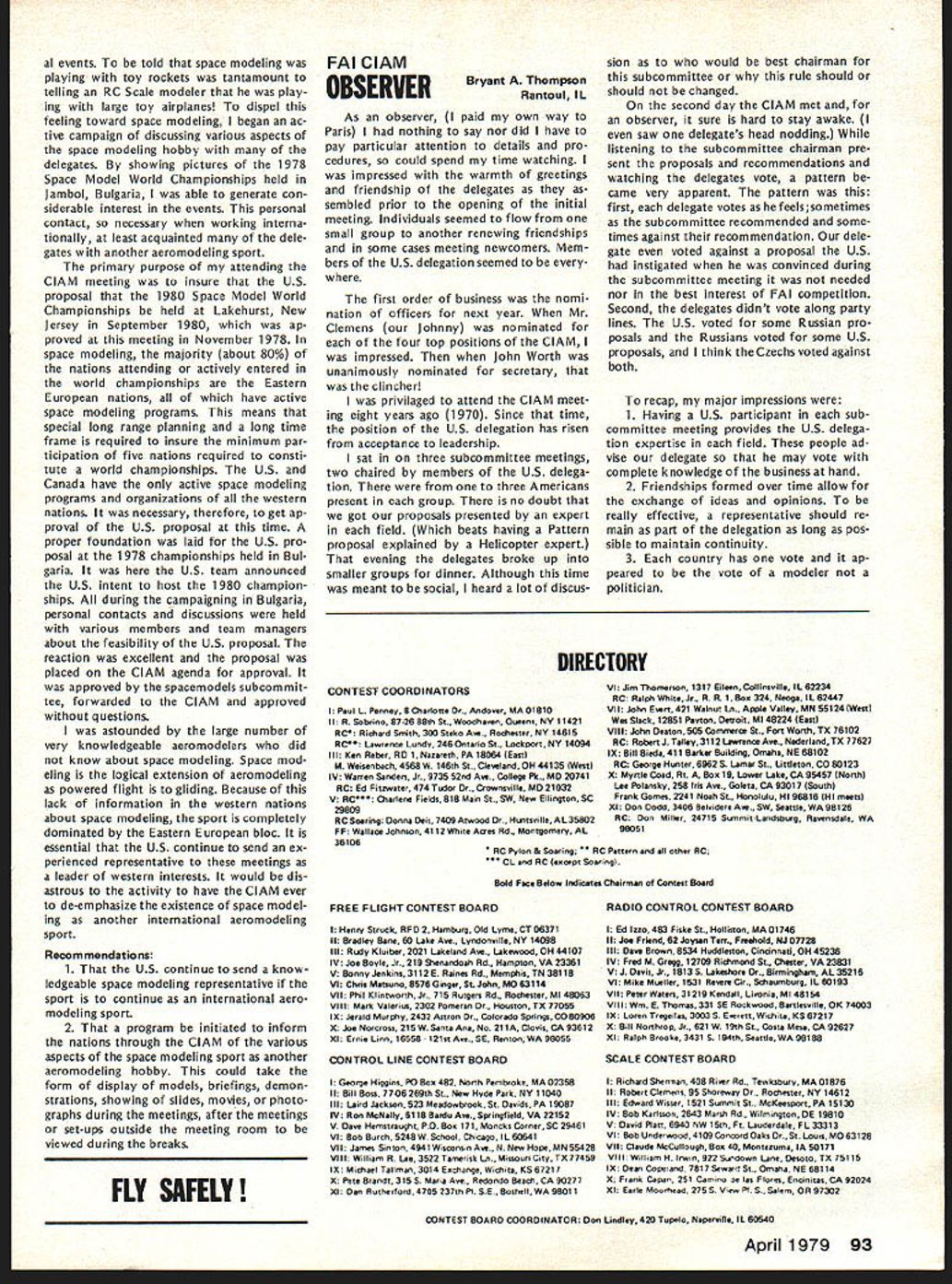
- Recommendation: continue knowledgeable U.S. representation and initiate programs to inform nations about space modeling (displays, briefings, demonstrations, slides, movies, photographs).
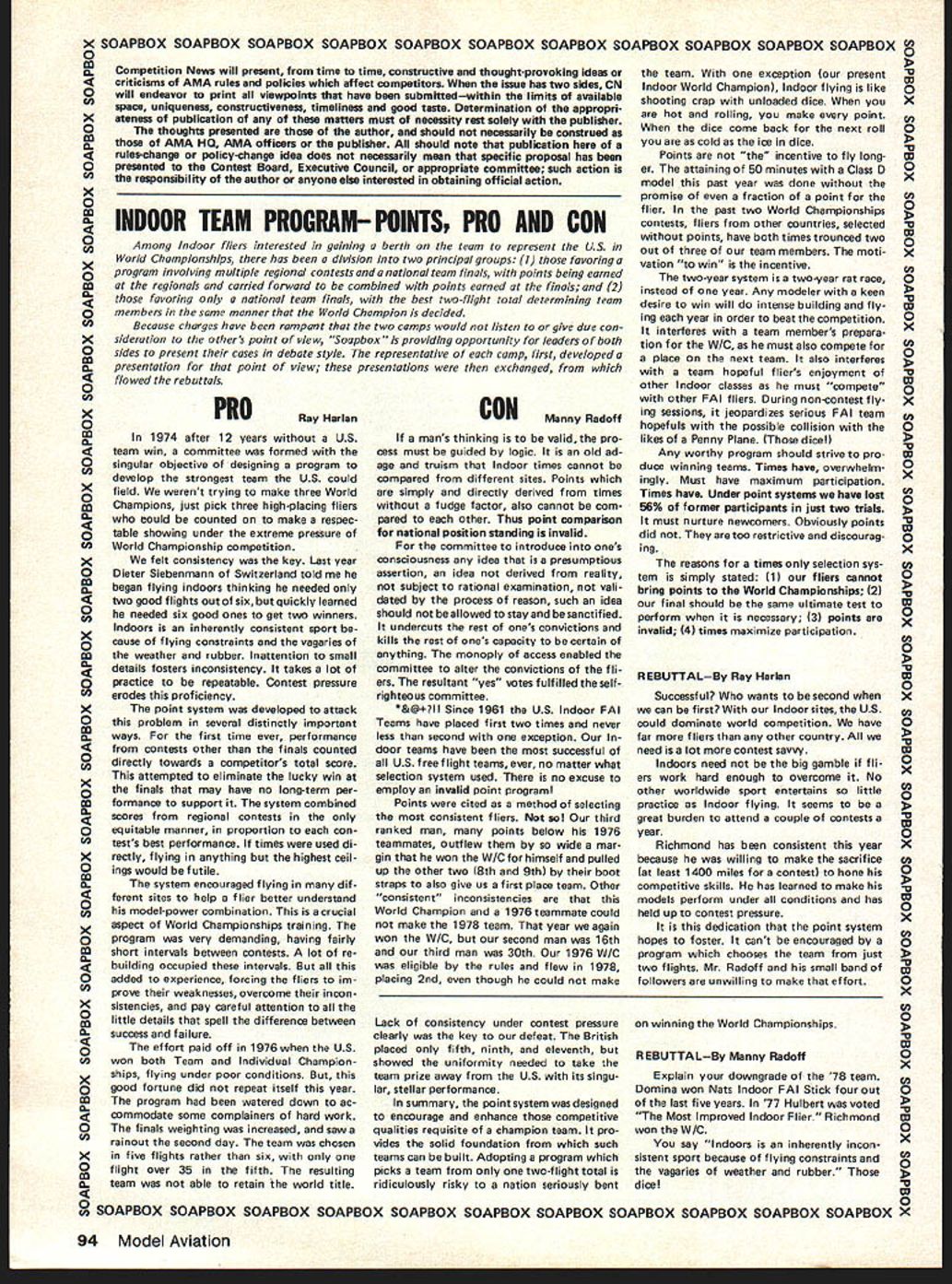
INDOOR TEAM PROGRAM — POINTS, PRO AND CON
There has been debate among Indoor fliers over team selection methods:
- Camp 1 — Favor a program with multiple regional contests and a national team finals, where points earned at regionals carry forward and combine with finals points.
- Camp 2 — Favor only a national team finals, with the best two-flight total determining team members (same method used for the World Champion).
Both sides presented arguments in a debate format.
PRO — Ray Harlan
- The point system was developed to pick the most consistent team members rather than relying on a lucky win at finals. It combines performance from regional contests proportionally, encourages flying at many sites to learn model-power combinations, and demands dedication and practice.
- The system paid off in 1976 when the U.S. won both Team and Individual Championships. The point program was intended to foster consistency and experience necessary for World Championship competition.
CON — Manny Radoff
- Times from different indoor sites cannot be compared directly; point comparisons derived from times without adequate normalization are invalid. The point program is presumptuous and not derived from a rational basis.
- Historically, U.S. Indoor FAI Teams have been highly successful under varying selection systems; points are unnecessary and can be discouraging. A times-only selection system maximizes participation, focuses on the finals as the ultimate test, and avoids the burdens of a two-year points race that distracts team members from World Championship preparation.
REBUTTAL — Ray Harlan
- Points encourage the dedication needed to practice at varied sites and develop repeatable performance under contest pressure. Selecting a team from just two flights does not foster the necessary effort and preparation.
REBUTTAL — Manny Radoff
- Questions were raised about the downgrade of the 1978 team and the consistency arguments. He asserts indoor performance can be unpredictable and that maximum participation and straightforward finals selection are preferable.
AUSTRALIA SECOND IN CL TEAM RACE
A correction: earlier print showed Austria as second in the 1978 Team Racing World Championships when it should have been Australia. The error was acknowledged and corrected in subsequent results.
MEXICANS & CANADIANS IN U.S. CONTESTS
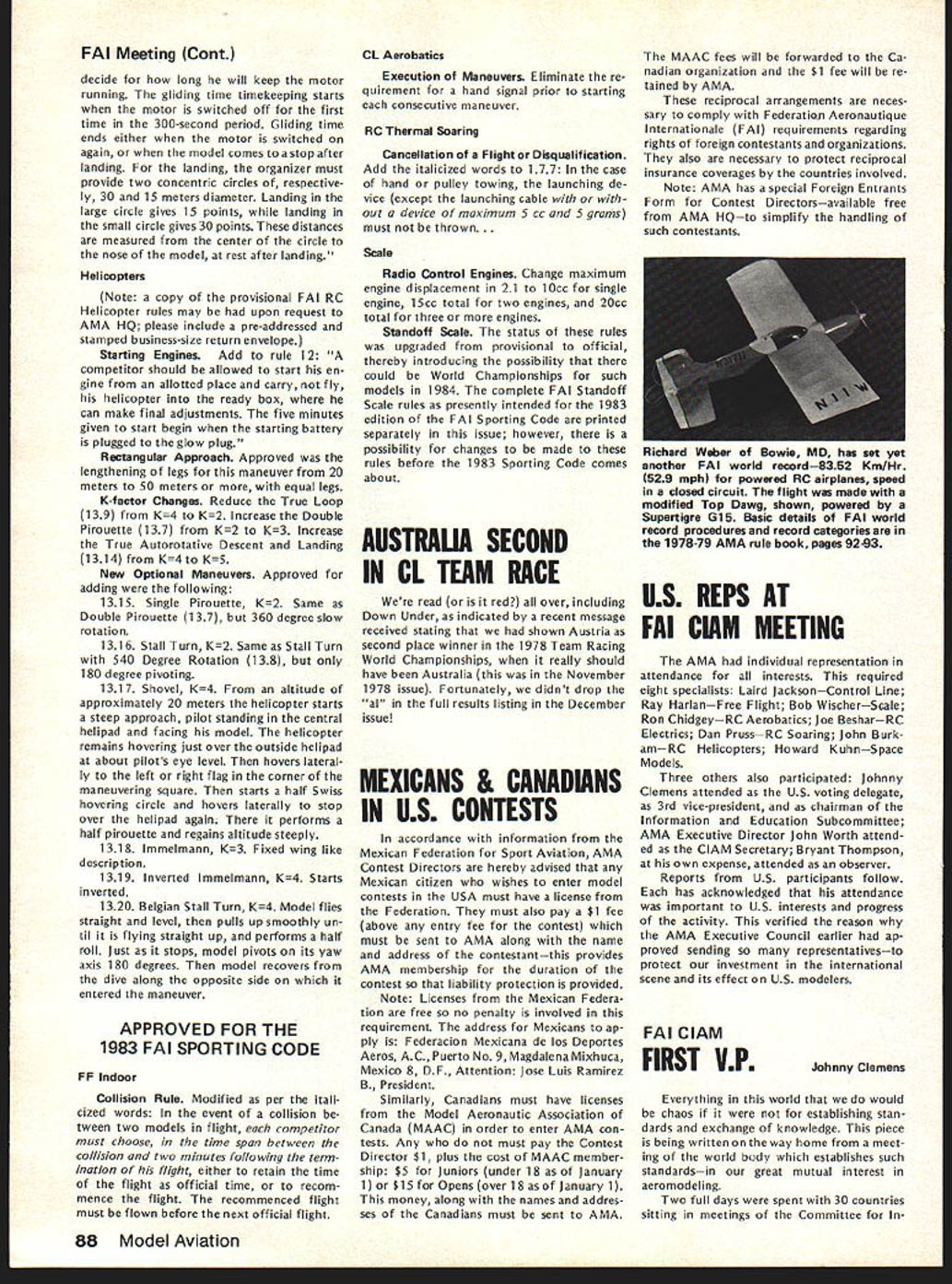
- Mexican entrants: Any Mexican citizen entering U.S. model contests must have a license from the Mexican Federation and must pay a $1 fee (above any contest entry fee) to AMA; the license is free. This provides AMA membership for the duration of the contest for liability protection. Apply to: Federacion Mexicana de los Deportes Aereos, A.C., Puente No. 9, Magdalena Mixhuca, Mexico 8, D.F., Attention: Jose Luis Ramirez B., President.
- Canadian entrants: Canadians must have licenses from the Model Aeronautic Association of Canada (MAAC) to enter AMA contests. Those without MAAC membership must pay $1 to the Contest Director plus MAAC membership cost ($5 for Juniors, $15 for Seniors). The Contest Director forwards names, addresses and fees to AMA for MAAC processing.
- Note: These reciprocal arrangements comply with FAI requirements and protect reciprocal insurance coverages. AMA has a special Foreign Entrants Form for Contest Directors, available free from AMA HQ.
U.S. REPS AT FAI CIAM MEETING
The U.S. had broad representation across interests to protect U.S. involvement internationally. Representatives included experts in Control Line, Free Flight, Scale, RC Aerobatics, RC Electrics, RC Soaring, RC Helicopters and Space Models. Their presence ensured U.S. influence in rule clarifications, safety matters and championship bids.
FAI CIAM REPORTS — SUMMARIES
FAI CIAM FREE FLIGHT — Ray Harlan
- Closed the steering loophole, defeated Canadian line crossing proposal, advanced several indoor clarifications, and laid groundwork for future rules negotiation through international friendships.
FAI CIAM CONTROL LINE — Dr. Laird Jackson
- Few major rule changes; emphasis on safety and clarifications; some proposals passed to take effect after 1983; Committee to hold annual open meeting at a major competition to hear competitor input.
FAI CIAM SCALE — Bob Wischer
- Multi-engine displacement limits approved (2 engines: 15cc total; 3+ engines: 20cc total). Standoff Scale approved by plenary to become official after two years. Static vs. flight scoring weighting was preserved (equal weight).
FAI CIAM RC AEROBATICS — Ron Chidgey
- Noise measurement proposal withdrawn; wing loading referred to subcommittee; existing flight-count rules retained; Schedule C recommended for smaller contests; informal discussion began on 1981 rule changes.
FAI CIAM RC SOARING — Dan Pruss
- Annex rules clarified; printing delays noted; safety clarifications made; no major changes to launching systems and rubber lengths; Belgium Worlds expected to be interesting.
FAI CIAM RC HELICOPTERS — John E. Burkman
- Valuable international contacts; several maneuver K-factor adjustments; new optional maneuvers approved; course-length discussion for speed records; friendships reinforced U.S. image.
FAI CIAM RC ELECTRICS — Joe Beshar
- European progress in electric modeling noted; recommendation to continue U.S. representation and to promote space modeling within CIAM.
CONTACTS AND RESOURCES
- For copies of provisional rules (Pylon Racing, RC Helicopter, FAI documents), contact AMA HQ and include a pre-addressed, stamped business-size return envelope.
- For Nats entry forms and Nats unofficial event coordination, contact AMA HQ at the address above.
--- End of Newsletter ---
Transcribed from original scans by AI. Minor OCR errors may remain.

