
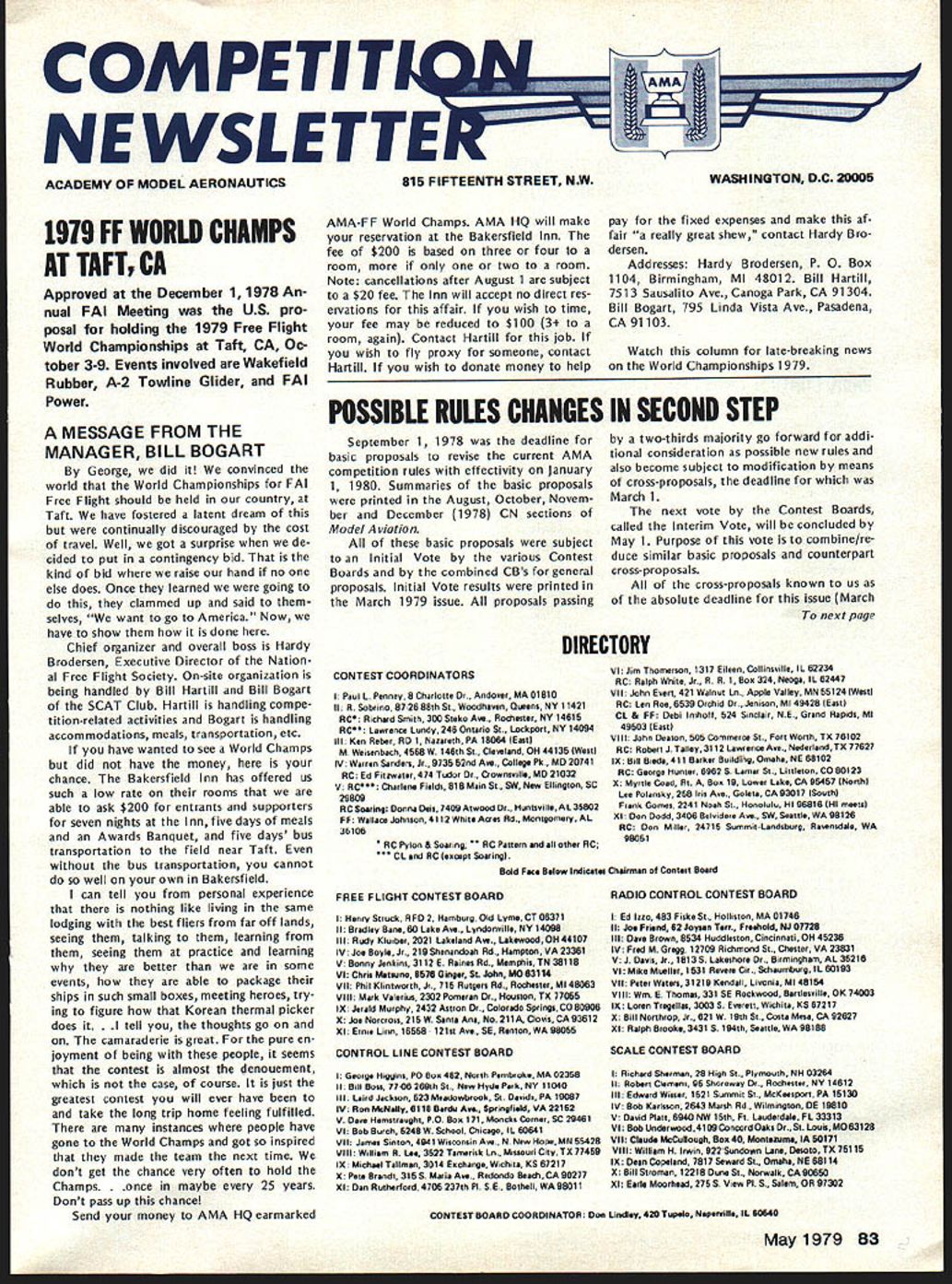
1979 FF WORLD CHAMPS AT TAFT, CA
Approved at the December 1, 1978 Annual FAI Meeting was the U.S. proposal for holding the 1979 Free Flight World Championships at Taft, CA, October 3–9. Events involved are Wakefield Rubber, A-2 Towline Glider, and FAI Power.
A MESSAGE FROM THE MANAGER, BILL BOGART
By George, we did it! We convinced the world that the World Championships for FAI Free Flight should be held in our country, at Taft. We have fostered a latent dream of this but were continually discouraged by the cost of travel. We got a surprise when we decided to put in a contingency bid — the kind of bid where we raise our hand if no one else does. Once they learned we were going to do this, they clammed up and said to themselves, "We want to go to America." Now we have to show them how it is done here.
- Chief organizer and overall boss: Hardy Brodersen, Executive Director, National Free Flight Society.
- On-site organization: Bill Hartill and Bill Bogart of the SCAT Club. Hartill is handling competition-related activities; Bogart is handling accommodations, meals, transportation, etc.
If you have wanted to see a World Champs but did not have the money, here is your chance. The Bakersfield Inn has offered us such a low room rate that we are able to offer a package at $200 for entrants and supporters, which includes:
- Seven nights at the Bakersfield Inn,
- Five days of meals and an Awards Banquet,
- Five days of bus transportation to the field near Taft.
Even without the bus transportation, you can do well on your own in Bakersfield.
Living in the same lodging with the best fliers from far-off lands — seeing them, talking to them, learning from them, watching practice — is invaluable. You learn why they are better in some events, how they package ships in such small boxes, meet heroes, and get inspired. The camaraderie is great; for many, the contest is almost the denouement of the experience. People who attend the World Champs often return inspired and sometimes make the team next time. We don't get the chance very often to hold the Champs — perhaps once in 25 years. Don't pass up this chance!
Send your money to AMA HQ earmarked "AMA-FF World Champs." AMA HQ will make your reservation at the Bakersfield Inn. The fee of $200 is based on three or four to a room (more if only one or two to a room). Note: cancellations after August 1 are subject to a $20 fee. The Inn will accept no direct reservations for this affair.
If you wish to come with different arrangements, the fee may be reduced to $100 (3+ per room). Contact Hartill for this. If you wish to fly by proxy for someone, contact Hartill. If you wish to donate money to help pay fixed expenses and make this affair "a really great show," contact Hardy Brodersen.
Addresses:
- Hardy Brodersen, P.O. Box 1104, Birmingham, MI 48012
- Bill Hartill, 7513 Sausalito Ave., Canoga Park, CA 91304
- Bill Bogart, 795 Linda Vista Ave., Pasadena, CA 91103
Watch this column for late-breaking news on the World Championships 1979.
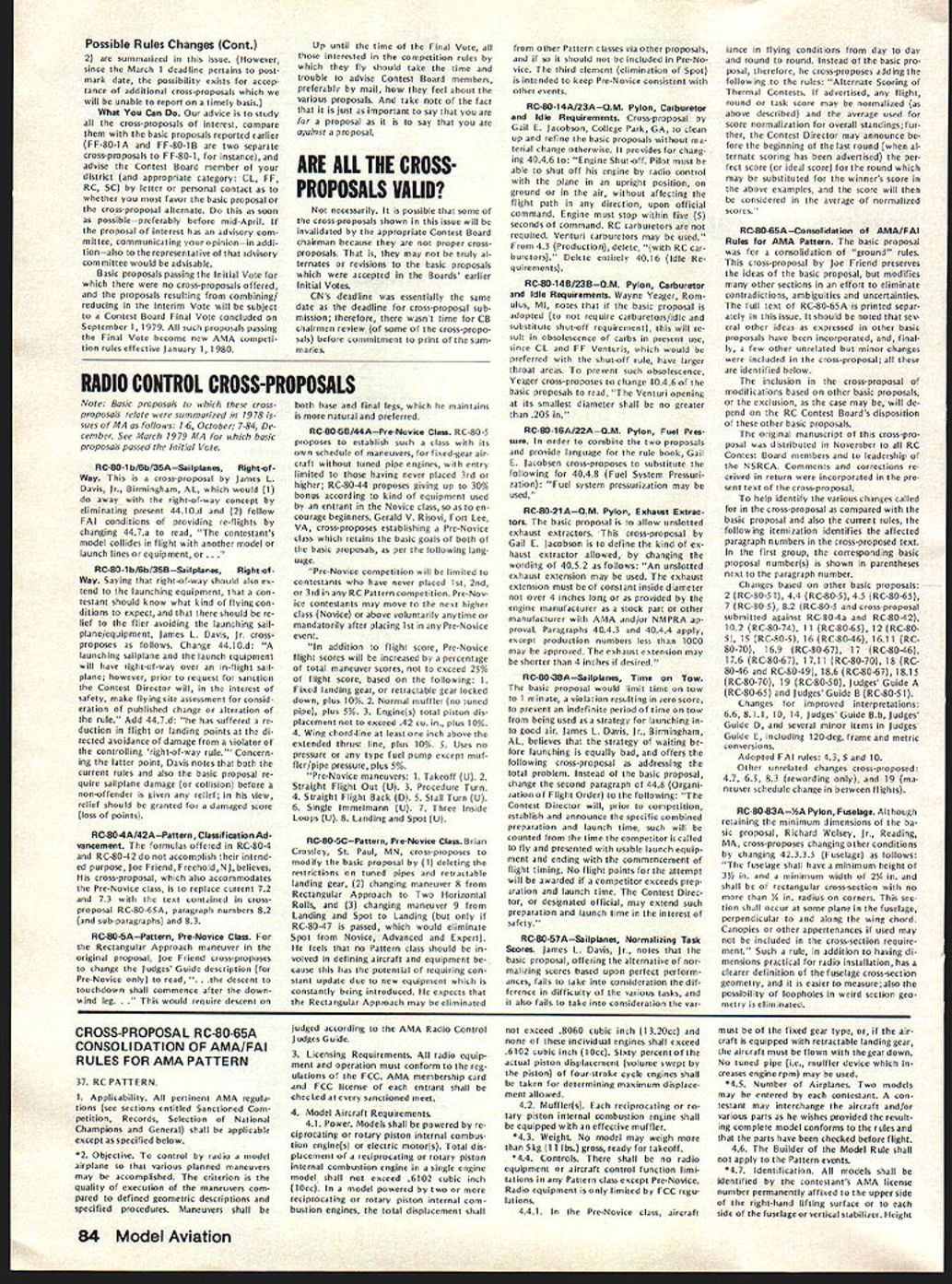
Possible Rules Changes (Continued)
Basic proposals and cross-proposals for revision of AMA competition rules were summarized in earlier issues. Note that the March 1 deadline pertains to the postmark date, so additional cross-proposals might be accepted that we cannot report on in a timely basis.
What You Can Do:
- Study all cross-proposals of interest and compare them with the basic proposals reported earlier (for example, FF-80-1A and FF-80-1B are separate cross-proposals to FF-80-1).
- Advise the Contest Board prior to your district (and appropriate category) Contest Board (CB), Field (FF), Radio Control (RC), or Scale Contest Board (SCB) by letter or personal contact whether you favor the basic proposal or a cross-proposal alternate. Do this as soon as possible — preferably before mid-April.
- If the proposal of interest has an advisory committee, communicate your opinion also to the representative of that advisory committee.
Basic proposals passing the Initial Vote for which there were no cross-proposals offered, and proposals resulting from combining/reducing in the Interim Vote, will be subject to a Contest Board Final Vote concluded on September 1, 1979. All such proposals passing the Final Vote become new AMA competition rules effective January 1, 1980.
Up until the Final Vote, everyone interested in the competition rules should take the time to advise Contest Board members, preferably by mail, how they feel about the various proposals. It is just as important to say you support a proposal as it is to say you oppose it.
ARE ALL THE CROSS-PROPOSALS VALID?
Not necessarily. Some cross-proposals may be invalidated by the appropriate Contest Board chairman because they are not proper cross-proposals — that is, they may not be true crossover revisions to the basic proposals accepted in the Boards' earlier Initial Votes.
CN's deadline was essentially the same as the deadline for cross-proposal submission; therefore, there wasn't time for some Contest Board chairmen to review certain cross-proposals before printing the summary.
RC PATTERN RULES (continued)
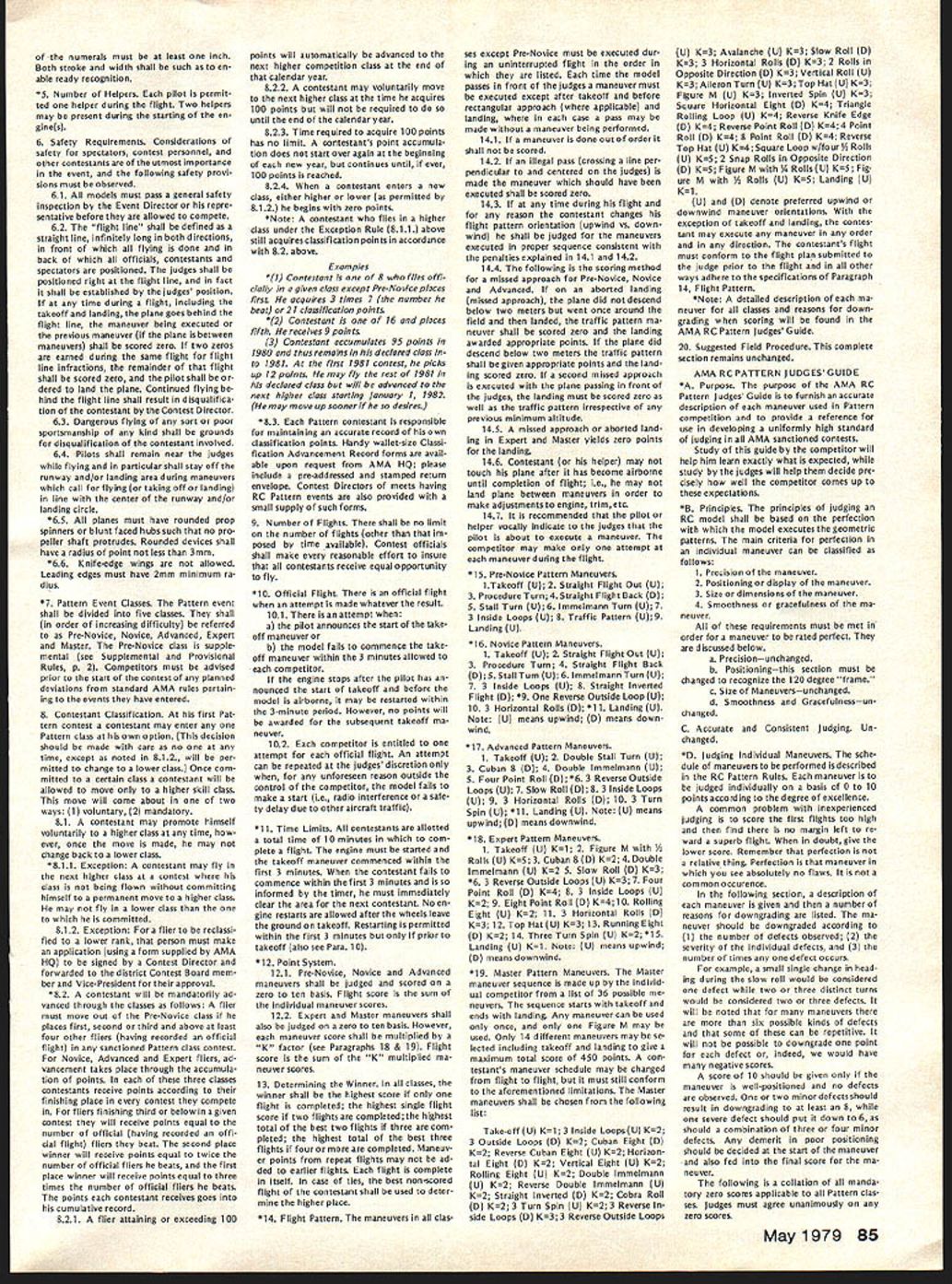
- Number of Helpers
- Each pilot is permitted one helper during the flight. Two helpers may be present during the starting of the engine(s).
- Safety Requirements
Considerations of safety for spectators, contest personnel, and other contestants are of the utmost importance. The following safety provisions must be observed:
6.1 All models must pass a general safety inspection by the Event Director or his representative before being allowed to compete.
6.2 The "flight line" shall be defined as a straight line, infinitely long in both directions, in front of which all flying is done and behind which all officials, contestants, and spectators are positioned. The judges shall be positioned at the flight line; this establishes the flight line by their position. If at any time during a flight, including takeoff and landing, the plane goes behind the flight line, the maneuver being executed (or the previous maneuver if the plane is between maneuvers) shall be scored zero. If two zeros are earned during the same flight for flight line infractions, the remainder of that flight shall be scored zero and the pilot shall be ordered to land the plane. Continued flying behind the flight line shall result in disqualification by the Contest Director.
6.3 Dangerous flying of any sort or poor sportsmanship of any kind shall be grounds for disqualification.
6.4 Pilots shall remain near the judges while flying and, in particular, shall stay off the runway and/or landing area during maneuvers which call for flying (or taking off or landing) in line with the center of the runway and/or landing circle.
6.5 All planes must have rounded prop spinners or blunt-faced hubs such that no propeller shaft protrudes. Rounded devices shall have a radius of point not less than 3 mm.
6.6 Knife-edged wings are not allowed. Leading edges must have a minimum radius of 2 mm.
- Pattern Event Classes
- The Pattern event shall be divided into five classes, in order of increasing difficulty: Pre-Novice (supplemental), Novice, Advanced, Expert, and Master. Competitors must be advised prior to the start of the contest of any planned deviations from standard AMA rules pertaining to the events they have entered.
- Contestant Classification
- At his first Pattern contest a contestant may enter any Pattern class at his option. This decision should be made with care, as no one (except where noted in 8.1.2) will be permitted to change to a lower class. Once committed to a certain class, a contestant shall be allowed to move only to a higher skill class. This move becomes automatic upon acquiring a number of wins, or may be voluntary.
8.1 Voluntary promotion
- A contestant may promote himself voluntarily to a higher class at any time; however, once the move is made, he may not change back to a lower class.
8.1.1 Exception
- A contestant may fly in the next higher class at a contest where his class is not being flown without committing himself to a permanent move to a higher class. He may not fly in a lower class than the one to which he is committed.
8.1.2 Reclassification to a lower rank
- A flier may be reclassified to a lower rank only by application (using a form supplied by AMA HQ), signed by a Contest Director and forwarded to the District Contest Board member for the District.
8.2 Mandatory advancement
- Advancement out of Pre-Novice occurs if a flier places first, second, or third and beats at least four other fliers (having recorded an official flight) in any sanctioned Pattern class contest. For Novice, Advanced, and Expert fliers, advancement takes place through the accumulation of points. Points are awarded according to finishes in every contest:
- For places third or below: points equal the number of official fliers beaten.
- Second place: twice the number of official fliers beaten.
- First place: three times the number of official fliers beaten.
8.2.1 A flier attaining or exceeding 100 points will automatically be advanced to the next higher competition class at the end of the calendar year.
8.2.2 A contestant may voluntarily move to the next higher class at the time he acquires 100 points but is not required to do so until the end of the calendar year.
8.2.3 Time required to acquire 100 points has no limit. Points accumulation continues across years until 100 points is reached.
8.2.4 When a contestant enters a new class (either higher or lower as permitted), he begins with zero points.
Note: A contestant who flies in a higher class under Exception 8.1.1 still acquires classification points per 8.2.
Examples:
- Contestant is one of 8 who flies off. If a pilot places first, he acquires 3 × 7 = 21 classification points.
- Contestant is one of 16 and places fifth. He receives 9 points.
8.3 Record keeping
- Each Pattern contestant is responsible for maintaining an accurate record of his classification points. Wallet-size Classification Advancement Record forms are available upon request from AMA HQ; include a pre-addressed and stamped return envelope. Contest Directors of meets with RC Pattern events are also provided with a supply of such forms.
- Number of Flights
- There shall be no limit on the number of flights (other than rain-out limits) per time available. Officials shall make every reasonable effort to ensure equal opportunity to fly.
- Official Flight
- There is an official flight when an attempt is made, whatever the result.
10.1 There is an attempt when: a) the pilot announces the start of the takeoff maneuver; or b) the model fails to commence the takeoff maneuver within the 3 minutes allowed to each competitor.
If the engine stops after the pilot has announced the start of takeoff and before the model is airborne, and is restarted within the 3-minute period, the attempt shall count for the subsequent takeoff maneuver.
10.2 Each competitor is entitled to one practice flight each official flight. An attempt can be repeated at the judges' discretion only when, for some unforeseen reason outside the competitor's control, the model fails to make a start (e.g., radio interference or a safety delay due to other aircraft traffic).
- Time Limits
- All contestants are allotted a total of 10 minutes to complete a flight. The engine must be started and the takeoff maneuver commenced within the first 3 minutes; otherwise the contestant fails to make a valid flight. If the engine is started within the first 3 minutes and is restarted by the timer, the contestant must immediately clear the area for the next contestant. No engine restarts are allowed after the wheel is unlocked or the ground run begins. Restarting is permitted only within the first 3 minutes and only if prior to takeoff (see Para. 10).
- Point System
12.1 Pre-Novice, Novice, Advanced
- Maneuvers are judged and scored on the 10-scale basis. Flight score is the sum of individual maneuver scores.
12.2 Expert and Master
- Maneuvers are judged on a zero-to-ten basis. Each maneuver score is multiplied by a "K" factor (see Paragraphs 18 & 19). Flight score is the sum of the K-multiplied maneuver scores.
- Determining the Winner
- If only one flight is completed, the winner is the highest score. If two flights are completed, the highest single flight score wins. If four or more flights are completed, the highest total of the best three flights wins. Maneuver points from repeat flights may not be added to earlier flights. Each flight is complete in itself.
- Flight Pattern
- Maneuvers in all classes except Pre-Novice must be executed during an uninterrupted flight in the order listed. Each time the model passes in front of the judges a maneuver must be executed except after takeoff and before rectangular approach (where applicable) and landing, where a pass may be made without a maneuver.
14.1 If a maneuver is done out of order it shall not be scored.
14.2 If an illegal pass (crossing a line perpendicular or tangent centered on the judges) is made, the maneuver which should have been executed shall be scored zero.
14.3 If at any time the contestant changes flight orientation (upwind vs. downwind), he shall be judged for maneuvers executed in proper sequence consistent with penalties in 14.1 and 14.2.
14.4 Missed approach (Pre-Novice, Novice, Advanced)
- If in an aborted landing the plane did not descend below two meters but went once around and then landed: the traffic pattern maneuver shall be scored zero and the landing awarded appropriate points. If the plane did descend below two meters, the traffic pattern shall be given appropriate points and the landing scored zero. If a second missed approach is executed with the plane passing in front of the judges, then the landing must be scored zero as well as the traffic pattern irrespective of previous minimum altitude.
14.5 Missed approach (Expert and Master)
- A missed approach or aborted landing yields zero points for the landing.
14.6 Hands-off rule
- The contestant (or helper) may not touch the plane after it has become airborne until completion of flight.
14.7 Vocal indication
- It is recommended that the pilot or helper vocally indicate to the judges that the pilot is about to execute a maneuver. Only one attempt at each maneuver is allowed.
- Pre-Novice Pattern Maneuvers
- Takeoff (U)
- Straight Flight Out (U)
- Procedure Turn
- Straight Flight Back (D)
- Stall Turn (U)
- Immelmann Turn (U)
- Inside Loops (U)
- Traffic Pattern (U)
- Landing (U)
- Novice Pattern Maneuvers
- Takeoff (U)
- Straight Flight Out (U)
- Procedure Turn
- Straight Flight Back (D)
- Stall Turn (U)
- Immelmann Turn (U)
- Inside Loops (U)
- Straight Inverted Flight (D)
- One Reverse Outside Loop (U)
- Three Horizontal Rolls (D)
- Landing (U)
Note: (U) = upwind; (D) = downwind.
- Advanced Pattern Maneuvers
- Takeoff (U)
- Double Stall Turn (U)
- Cuban Eight (D)
- Double Immelmann (U)
- Four Point Roll (D)
- Three Reverse Outside Loops (U)
- Slow Roll (D)
- Three Inside Loops (U)
- Horizontal Rolls (D)
- Three-Turn Spin (U)
- Landing (U)
- Expert Pattern Maneuvers
- Takeoff (U) — K = 2
- Figure M with ½ Rolls (U) — K = 3
- Cuban Eight (D) — K = 2
- Double Immelmann (U) — K = 2
- Slow Roll (D) — K = 3
- Stall Turn (U) — K = 2
- Reverse Outside Loops (U) — K = 2
- Three-Turn Spin (U) — K = 2
- Landing (U)
- Master Pattern Maneuvers
- The Master maneuver sequence is chosen by the competitor from a list of 36 possible maneuvers. The sequence starts with takeoff and ends with landing. Any maneuver can be used only once, and only one Figure M may be used. Only 14 different maneuvers may be selected including takeoff and landing to give a maximum total score of 450 points. A contestant's maneuver schedule may be changed from flight to flight, but must conform to these limitations. The Master maneuver schedule shall be chosen from the following list (K factors shown):
- Takeoff (U) — K = 1
- 3 Inside Loops (U) — K = 2
- 3 Outside Loops (U) — K = 2
- Cuban Eight (D) — K = 2
- Reverse Cuban Eight (U) — K = 2
- Horizontal Eight (D) — K = 2
- Vertical Eight (U) — K = 2
- Rolling Eight (U) — K = 2
- Double Immelmann (U) — K = 2
- Reverse Double Immelmann (U) — K = 2
- Straight Inverted (D) — K = 2
- Cobra Roll (D) — K = 2
- Three-Turn Spin (U) — K = 2
- Three Reverse Inside Loops (D) — K = 3
- Three Reverse Outside Loops (D) — K = 3
- Avalanche (U) — K = 3
- Slow Roll (D) — K = 3
- Horizontal Rolls (D) — K = 3
- Two Rolls in Opposite Directions (D) — K = 3
- Vertical Roll (U) — K = 3
- Aileron Turn (U) — K = 3
- Top Hat (U) — K = 3
- Figure M (U) — K = 3
- Inverted Spin (U) — K = 3
- Square Horizontal Eight (D) — K = 4
- Triangle Rolling Loop (U) — K = 4
- Reverse Knife Edge (U) — K = 4
- Reverse Point Roll (D) — K = 4
- Point Roll (D) — K = 4
- 3 Point Roll (D) — K = 4
- Suggested Field Procedure
- This complete section remains unchanged.
AMA RC PATTERN JUDGES' GUIDE
A. Purpose
- Furnish an accurate description of each maneuver used in Pattern competition and provide a reference for developing a uniformly high standard of judging in all AMA sanctioned contests. Study by competitors helps them learn expectations; study by judges aids consistent scoring.
B. Principles
Judging RC model aircraft is based on the perfecting of the model and the degree to which the pilot meets the geometric patterns. Main criteria for precision in an individual maneuver:
- Precision of the maneuver.
- Positioning or display of the maneuver.
- Size or dimensions of the maneuver.
- Smoothness or gracefulness of the maneuver.
All requirements must be met for a maneuver to be rated perfect.
a. Precision — unchanged. b. Positioning — this section must be changed to recognize the 120-degree "frame". c. Size of maneuvers — unchanged. d. Smoothness and gracefulness — unchanged.
C. Accurate and Consistent Judging
- Unchanged.
D. Judging Individual Maneuvers
- Each maneuver is judged individually on a basis of 0 to 10 points according to degree of excellence.
- Avoid underrating first flights; when in doubt, give the higher score. A score of 10 is for a well-positioned maneuver with no defects. One or two minor defects should lead to at least an 8; one or two serious defects should score about a 6. Judges must agree unanimously on any zero scores.
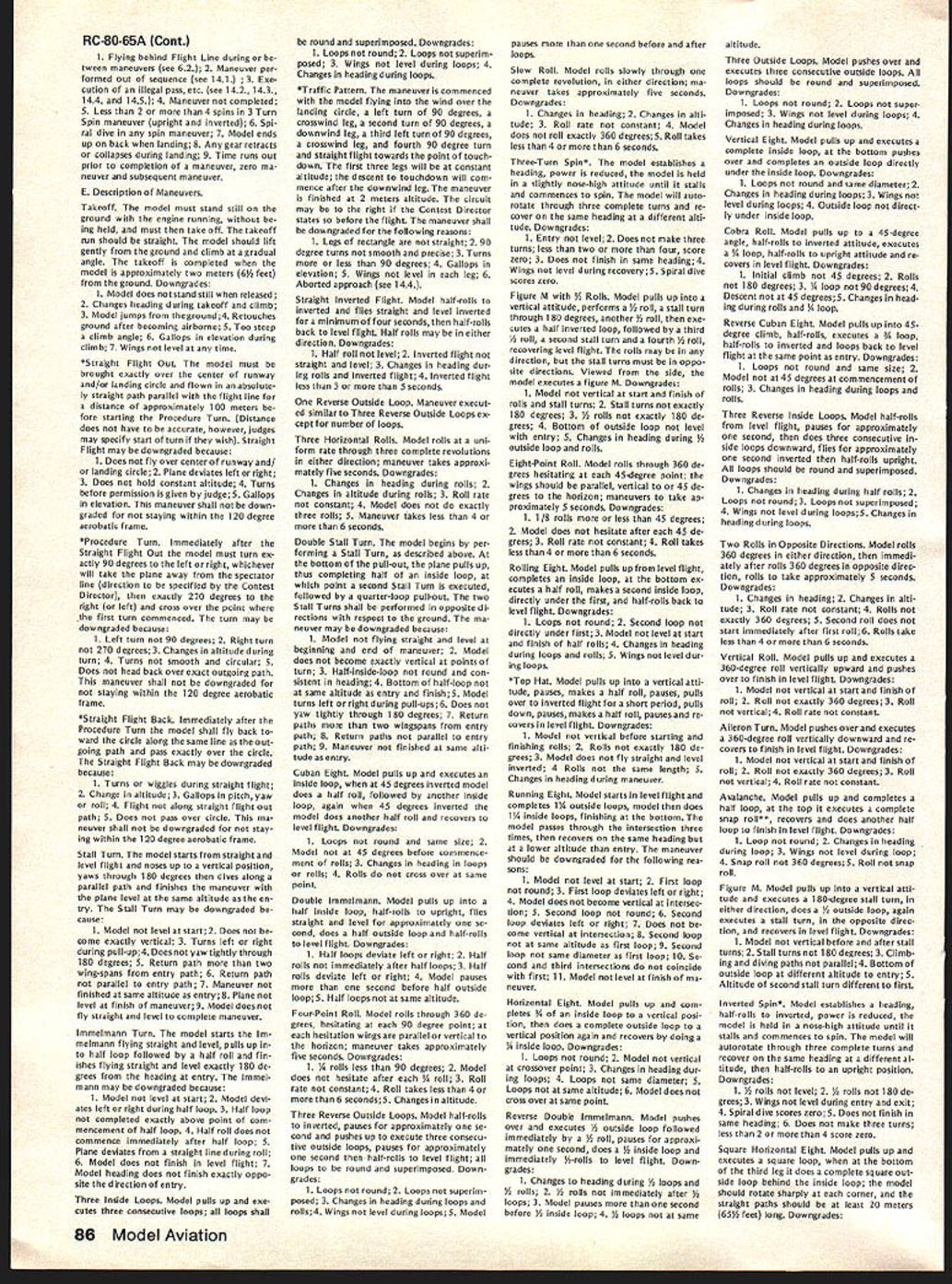
Inside Loops
- Loops should be round and superimposed.
- Downgrades:
- Loops not round.
- Loops not superimposed.
- Wings not level during loops.
- Changes in heading during loops.
- Model pauses more than one second before and after loops.
Traffic Pattern
- Commenced with the model flying into the wind over the landing circle, a left turn of 90°, downwind leg, second 90° turn, crosswind leg, third left 90° turn, downwind leg, fourth 90° turn and straight flight to touchdown. First three legs at constant altitude; descent begins after the downwind leg. Maneuver finished at 2 meters altitude. Circuit may be to the right if the Contest Director states so before the flight.
- Downgrades:
- Legs not straight.
- 90° turns not smooth and precise.
- Turns more or less than 90°.
- Gallops in elevation.
- Wings not level in each leg.
- Aborted approach (see 14.4).
Straight Inverted Flight
- Model half-rolls to inverted and flies straight and level inverted for a minimum of four seconds, then half-rolls back to level flight. Half-rolls may be in either direction.
- Downgrades:
- Half-roll not level.
- Inverted flight not straight and level.
- Changes in heading during rolls and inverted flight.
- Inverted flight less than 3 or more than 5 seconds.
One Reverse Outside Loop
- Executed similar to Three Reverse Outside Loops, but with a single outside loop.
- Downgrades follow same criteria as for multiple reverse outside loops.
Three Horizontal Rolls
- Model rolls at a uniform rate through three revolutions in either direction; approximately five seconds.
- Downgrades:
- Changes in heading during rolls.
- Changes in altitude during rolls.
- Roll rate not constant.
- Model does not do exactly three rolls.
- Maneuver takes less than 4 or more than 6 seconds.
Double Stall Turn
- Begins with a Stall Turn. At the bottom of the pull-out, the plane pulls up, completing half an inside loop, executes a second Stall Turn in the opposite direction, followed by a quarter-loop pull-out. Downgrades:
- Model not straight and level at beginning and end.
- Model does not become exactly vertical at points of turn.
- Half-inside-loop not round or consistent in heading.
- Bottom of half-loop not at same altitude as entry and finish.
- Model turns left or right during pull-outs.
- Does not fly tightly through 180°.
- Return paths more than two wingspans from entry path.
- Return paths not parallel to entry path.
- Maneuver not finished at same altitude as entry.
Cuban Eight
- Model pulls up, executes an inside loop, at 45° inverted does a half-roll, another inside loop and another half-roll, then recovers to level flight.
- Downgrades:
- Loops not round and same size.
- Model not at 45° before commencing half-roll.
- Changes in heading in loops and rolls.
- Rolls do not cross over at same point.
- Rolls not level at start.
Slow Roll
- Model rolls slowly through one complete revolution in either direction; approximately five seconds.
- Downgrades:
- Changes in heading.
- Changes in altitude.
- Roll rate not constant.
- Model does not roll exactly 360°.
- Roll takes less than 4 or more than 6 seconds.
Three-Turn Spin
- Model establishes a heading, power is reduced, model held slightly nose-high until it stalls and commences to spin. Autorotate through three complete turns and recover on the same heading at different altitude.
- Downgrades:
- Entry not level.
- Does not make three turns — less than two or more than four, score zero.
- Does not finish in same heading.
- Wings not level during recovery.
- Spiral dive scores zero.
Figure M with ½ Rolls
- Model pulls to vertical, performs ½ roll, a stall turn through 180°, another ½ roll, a half inside loop, a third ½ roll, a second stall turn, and a fourth ½ roll, recovering to level flight. Stall turns must be in opposite directions. From the side, the model executes a figure M.
- Downgrades:
- Model not vertical at start and finish of rolls and stall turns.
- Stall turns not exactly 180°.
- Rolls not exactly 180°.
- Bottom of outside loop not level with entry.
- Changes in heading during rolls and half-loops.
Eight-Point Roll
- Model rolls through 360° hesitating at each 45° point; wings should be parallel to the horizon; approx five seconds.
- Downgrades:
- 45° rolls less than 90°.
- Model does not hesitate after each 45° roll.
- Roll rate not constant.
- Roll takes less than 4 or more than 6 seconds.
Rolling Eight
- Model pulls up from level flight, completes an inside loop, at the bottom executes a half-roll, makes a second inside loop directly under the first and half-rolls back to level flight.
- Downgrades:
- Loops not round.
- Second loop not directly under first.
- Model not level at start and finish of half-rolls.
- Changes in heading in loops and rolls.
- Wings not level during loops.
Two Rolls in Opposite Directions
- Model rolls 360° in one direction, then immediately rolls 360° in the opposite direction; approx five seconds.
- Downgrades:
- Changes in heading.
- Changes in altitude.
- Roll rate not constant.
- Rolls not exactly 360°.
- Second roll does not start immediately after the first.
- Rolls take less than 4 or more than 6 seconds.
Vertical Roll
- Model pulls up, executes a 360° roll vertically upward and pushes over to finish in level flight.
- Downgrades:
- Model not vertical at start and finish.
- Roll not exactly 360°.
- Roll rate not constant.
Aileron Roll
- Model pushes over and executes a 360° roll vertically downward and recovers to level flight.
- Downgrades:
- Model not vertical at start and finish.
- Roll not exactly 360°.
- Roll rate not constant.
Avalanche
- Model pulls up and completes successive half loops in quick succession.
- Downgrades:
- Half loops not round.
- Recovery between half loops not level.
- Spacing between repetitions not uniform.
Square Horizontal Eight
- Model executes a square loop to the right, crosses the origin, executes a square loop to the left, and recovers to level flight at the original altitude. Straight segments should be at least 20 meters (65½ feet).
- Downgrades:
- Square loops not square.
- Straight segments not straight or not parallel.
- Crossing not through the same point.
- Changes in heading during straight segments.
- Wings not level in straight flight.
[End of RC Pattern continuation]
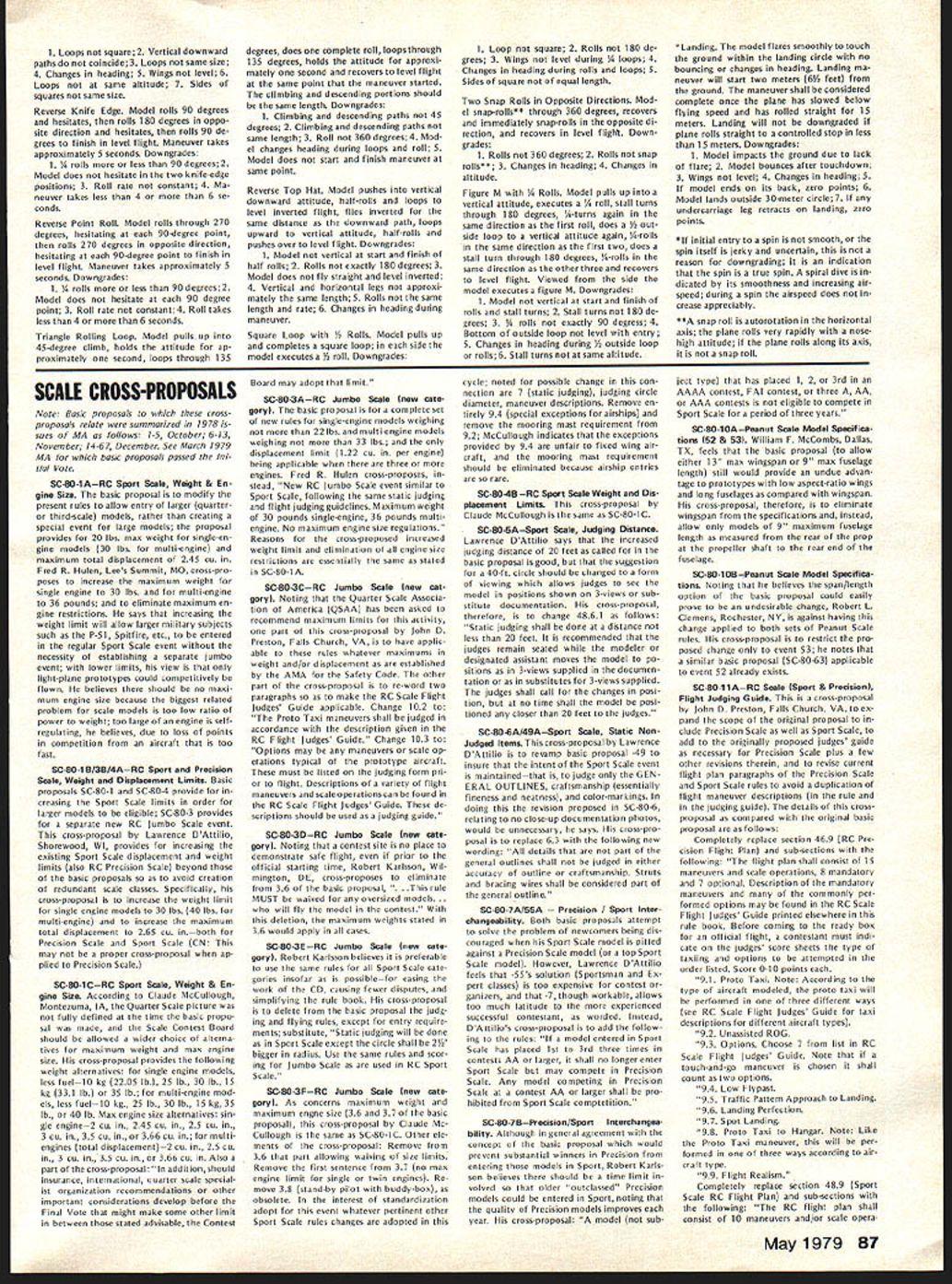
SCALE CROSS-PROPOSALS
Note: Basic proposals to which these cross-proposals relate were summarized in 1978 issues of Model Aviation. See March 1979 MA for which basic proposals passed the initial vote.
SC-80-1A — RC Sport Scale, Weight & Engine Size
- Basic proposal: modify present rules to allow larger quarter-scale or third-scale aircraft by setting limits such as 20 lb. max weight for single-engine, 30 lb. max for multi-engine, and maximum total displacement of 21.5 cu. in.
- Cross-proposal (Fred R. Hulen): increase single-engine max to 30 lb and multi-engine to 36 lb, and eliminate maximum engine restrictions to allow larger military subjects (P-51, Spitfire, etc.) to be entered without creating a separate Jumbo class.
SC-80-1B / 3A / 4A — RC Sport and Precision Scale, Weight and Displacement Limits
- Cross-proposal (Laurence D’Attilio): increase Sport Scale and Precision Scale displacement and weight limits to avoid creating redundant classes. Proposes single-engine weight to 30 lb, multi-engine to 36 lb, and max total displacement to 21.5 cu. in., with other adjustments.
SC-80-1C — RC Sport Scale, Weight & Engine Size
- Cross-proposal (Claude McCullough): provide a wider choice of alternative weight and engine size limits for Quarter Scale. Suggests weight alternatives for single-engine: 20 lb, 25 lb, 30 lb; multi-engine: 30 lb, 35 lb, 40 lb; engine size options: 12 cu. in., 25 cu. in., 36 cu. in., etc., and propose an overall prototype selection limit.
SC-80-3B — RC Jumbo Scale (new category)
- Cross-proposal (Claude McCullough and others): new RC Jumbo Scale event similar to Scale Sport with higher weight/displacement limits (e.g., 30 lb single-engine, 36 lb multi-engine). No maximum engine size restrictions; intended to accommodate genuine large-scale models.
SC-80-3C — RC Jumbo Scale (new category)
- Notes Quarter Scale Association of America (QSAA) recommendations for maximum limits; proposes rewording for consistency with RC Scale Flight Judges' Guide (e.g., how Pilot Tax maneuver is judged), remove special exceptions for engines, and remove moratorium in current rule document.
SC-80-4B — RC Sport Scale Weight and Displacement Limits
- Same as SC-80-1C (Claude McCullough).
SC-80-5A — Sport Scale, Judging Distance
- Cross-proposal (Lawrence D'Attilio): static judging minimum distance remains 20 feet, but for large airplanes judges may view from a greater distance as indicated by submitted 3-views or advance notice, allowing adequate viewing for large subjects.
SC-80-6A / 9A — Sport Scale, Static/Non-Judged Items
- Cross-proposal (Lawrence D'Attilio): remove a basic proposal that would expand judging into close-up details. Replace wording to clarify that only general outline, essential craftsmanship, fitness and neatness, and documentation are to be judged; fine close-up details should not be judged.
SC-80-7A / 5A — Precision/Sport Interchangeability
- Cross-proposal (Lawrence D'Attilio): proposes that if a model entered in Sport is judged a Precision Scale or larger, it shall not be eligible for Sport awards and prizes; also proposes changes to handling of trophies and overlapping awards.
SC-80-7B — Precision/Sport Interchangeability
- Cross-proposal (Joel F. Aldridge and others): simplify and clarify transition between Sport and Precision classes, protect both classes, and provide clear judging criteria and limits.
SC-80-10A / 10B — Peanut Scale Model Specifications
- Cross-proposals (William E. McCombs, Robert L. Clarke): revise the maximum span or length specifications for Peanut Scale and provide a more rigorous description to avoid easy compliance via kits.
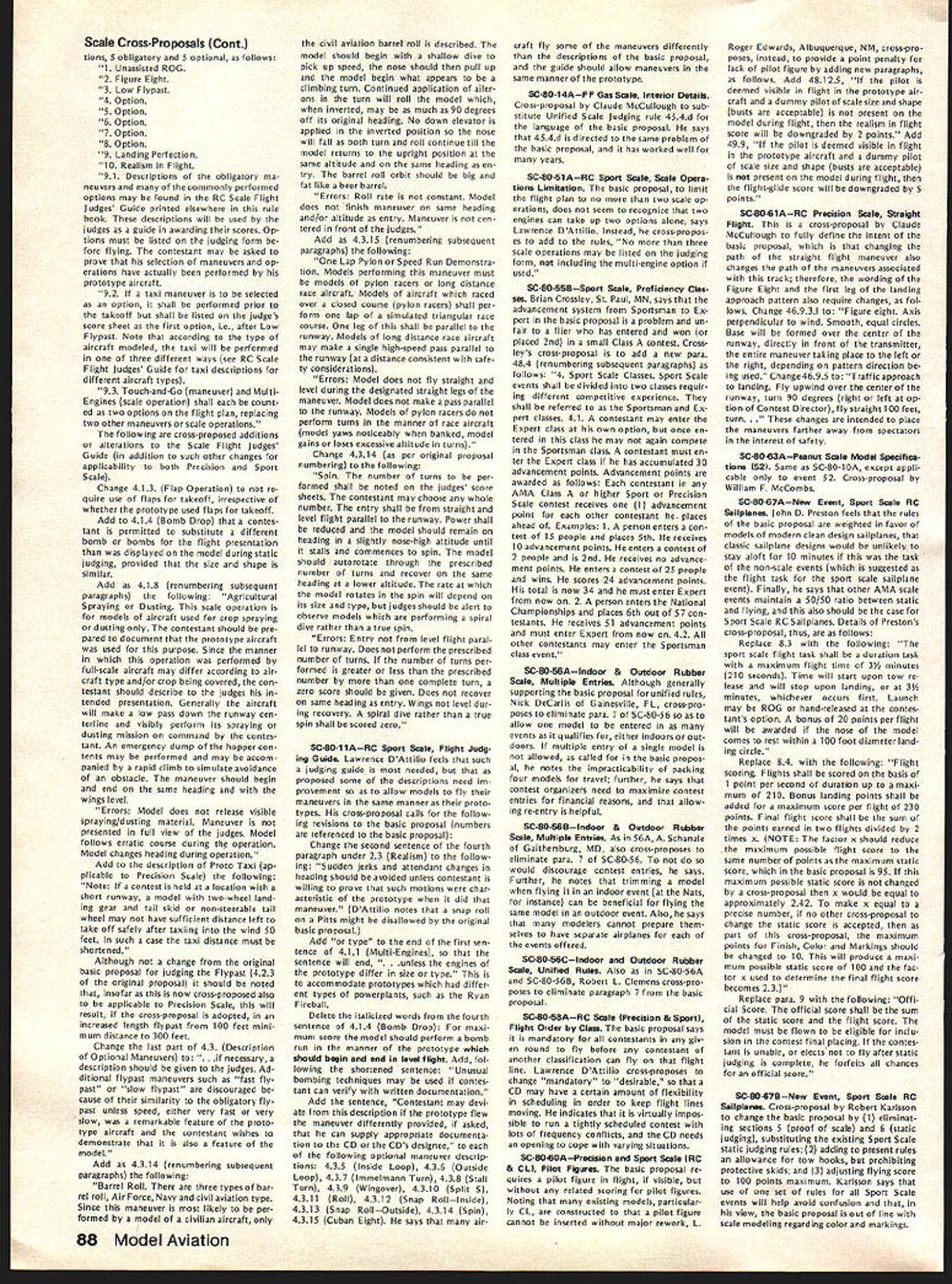
SC-80-11A / 11B — RC Scale Flight Judges' Guide
- Cross-proposals (John D. Preston and others): expand scope to clarify procedures for both Sport and Precision Scale events, adopt the Precision Scale judges' guide as a model, and create a separate judges' guide booklet to harmonize judging procedures.
SC-80-13 — Options
- Choose seven options from list in RC Scale Flight Judges' Guide. If a touch-and-go maneuver is chosen it counts as two options.
SC-80-14 — Climb Height; Traffic Pattern Approach to Landing
- Miscellaneous clarifications and tightening of language for judging and flight procedures.
SC-80-15 — Landing Orientation
- Pilot judged on how closely landing orientation matches the prototype's landing characteristics.
SC-80-16 — Traffic Pattern to Hangar
- Note: similar to proto taxi, judged according to RC judges' guide.
SC-80-19 — Flight Realism
- Proposals to add additional realism elements to judging and include more prototype-specific evaluations.
SC-80-48 / SC-80-70 series
- Miscellaneous clarifications and tune-ups regarding judging distances, static judging items, and interchangeability between classes.
(Several cross-proposals are editorial or procedural; please refer to official cross-proposal packets from the Contest Board for complete wording and context.)
[End of SCALE CROSS-PROPOSALS section]
COMPETITION NEWS (summary)
ACADEMY OF MODEL AERONAUTICS
FAI WORLD CHAMPS AT TAFT, CA — Approved December 1, 1978
- Annual FAI Meeting approved U.S. proposal to hold the 1979 Free Flight World Championships in Taft, CA, October 3–9. Events: Wakefield, Rubber A-2, Towline Glider, FAI Power.
MESSAGE FROM THE MANAGER — BILL BOGART
- (Summary above) Chief organizer: Hardy Brodersen. On-site: Bill Hartill (competition), Bill Bogart (lodging/transport). Package fee $200 (based on 3–4 per room). Contact AMA HQ to reserve; cancellations after August 1 incur $20 fee. See addresses above.
POSSIBLE RULES CHANGES — ACTION SUMMARY
- Deadline and voting schedule notes: Initial Vote results printed in March 1979 issue. Proposals passing two-thirds majority go forward. Cross-proposals deadline March 1; Interim Vote concludes May 1; Final Vote concluded September 1, 1979. New rules effective January 1, 1980 if passed.
DIRECTORY — CONTEST COORDINATORS
- I. Paul L. Penney, 8 Charlotte Dr., Andover, MA 01810
- II. R. Sobrino, 8126 88th St., Woodhaven, Queens, NY 11421
- RC. Richard Smith, 300 Steko Ave., Rochester, NY 14615
- RC. Lawrence Lundy, 248 Ontario St., Lockport, NY 14094
- III. Ken Reber, RD 1, Nazareth, PA 18064
- East. M. Weisenbach, 4568 W. 146th St., Cleveland, OH 44135
- West. V. Warren Sanders Jr., 9735 62nd Ave., College Pk., MD 20741
- NC. Ed Fitawater, 474 Tvdur Dr., (address uncertain), MD 21032
- V RC. Charlene Fields, 818 Main St. SW, New Ellenton, SC 29809
- NC Soaring. Donna Deis, 7409 Atwood Dr., Huntsville, AL 35802
- FF. Wallace Johnson, 4112 Whit Aoi Rd., Montgomery, AL 36106
Note: Names and addresses presented as printed; minor OCR corrections applied where obvious.
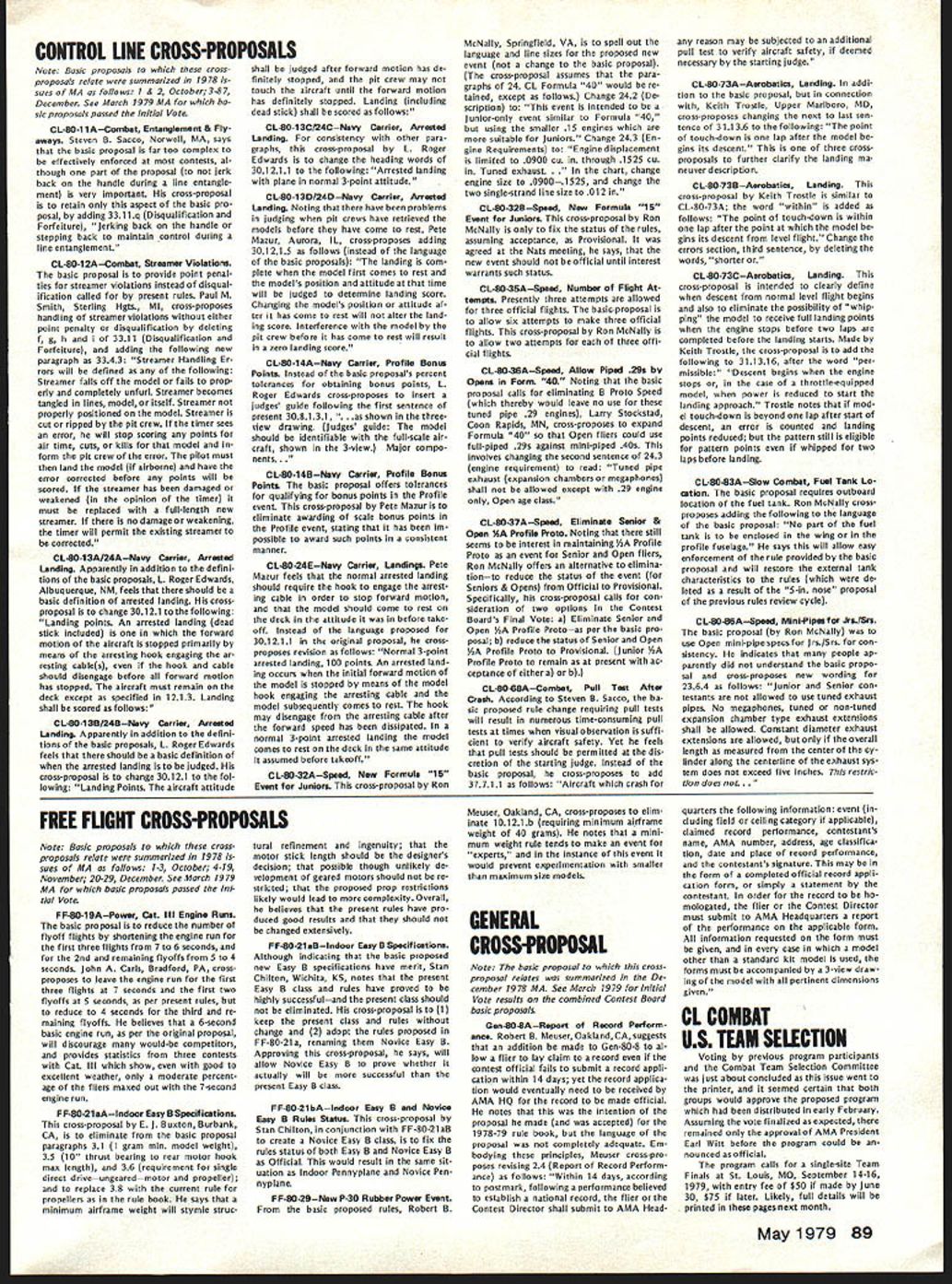
CONTROL LINE CROSS-PROPOSALS
Note: Basic proposals were summarized in 1978 issues of Model Aviation. See MA for which basic proposals passed the Initial Vote.
CL-80-11A — Combat, Entanglement & Flyaways
- Cross-proposal (Steven B. Sacco): retain core safety provisions, add 33.11.g (Disqualification and Forfeiture) to address jerking back on the handle during line entanglement. Pilot crew may not touch the aircraft until forward motion has definitely stopped. Landing (including dead stick) scoring clarified.
CL-80-13C / 24C — Navy Carrier, Arrested Landing
- Cross-proposal (R. Roger Edwards): change headings and wording to clarify arrested landing scoring. The landing is complete when the model first comes to rest; position and attitude at that time determine the score. Interference by pit crew before model comes to rest results in a zero landing score.
CL-80-14A / 14B — Navy Carrier, Profile Bonus Points
- Cross-proposals propose alternatives to percent tolerances for awarding profile bonus points. One suggests using a judge's guide 3-view to determine identification; another proposes eliminating inconsistent bonus wording.
CL-80-24E — Navy Carrier, Landings
- Cross-proposal (Pete Maurer): normal arrested landing should require the hook to engage the arresting cable to stop forward motion; model must come to rest on the deck in the attitude in which it struck. Pilot must disassemble plane before next flight.
CL-80-32A / 32B — Speed, New Formula "15" for Juniors
- Cross-proposals (Ron McNally): define language and line sizes for a junior Formula "15" event using .090–.1525 cu. in. engines; propose provisional status until interest warrants official adoption.
CL-80-35A — Speed, Number of Flight Attempts
- Cross-proposal (Ron McNally): instead of six attempts to make three official flights, allow two attempts for each of three official flights.
CL-80-36A — Speed, Allow Pit-Owned .29s by Open in Formula "40"
- Cross-proposal (Larry Stutzstad, Ron Papke, others): permit Open fliers to use full-tuned .29s against mini-tuned .40s by amending engine requirements.
CL-80-37A — Speed, Eliminate Senior & Open X/A Profile Proto
- Cross-proposal (Ron McNally): offer two options — eliminate Senior and Open X/A Profile Proto, or reduce their status to Invitational or Provisional while retaining Junior status.
CL-80-60A — Combat, Pull Test After Crash
- Cross-proposal (Dennis D. Searle): allow additional pull tests after a crash at the starting judge's discretion to verify aircraft safety.
CL-80-73A / 73B / 73C — Aerobatics, Landing
- Cross-proposals (Keith Trostle, Ron McNally): clarify when descent begins, refine wording for touchdown determination, and prevent "whipping" the model to receive full landing points when engine stops before two laps are completed.
CL-80-93A — Slow Combat, Fuel Tank Location
- Cross-proposal (Ron McNally): require that no part of the fuel tank be enclosed in the wing or fuselage to ease enforcement and restore external tank rules.
CL-80-95A — Speed, Mini-Prop for Junior/Senior
- Cross-proposal (Ron McNally and others): clarify and limit tuned exhausts/megaphones and specify exhaust length (e.g., overall length no more than five inches) for junior and senior classes.
FREE FLIGHT CROSS-PROPOSALS
Note: Basic proposals were summarized in the December 1978 MA. See March 1979 MA for initial vote results.
FF-80-11A — Power, Cat. III Engine Runs
- Cross-proposal (John A. Carls): retain shorter engine runs (first three flights at 5 seconds, first two flyoffs at 5 seconds, third flyoff at 6 seconds) to improve contest scheduling and encourage competitors.
FF-80-21A / 21B — Indoor Easy B Specifications
- Cross-proposal (E. I. Buxton): eliminate minimum airframe weight and other restrictive items from the basic proposal; retain current indoor model rules to encourage structural refinement and ingenuity.
- Cross-proposal (Stan Chelnik): retain the present Easy B class unchanged and adopt the new Easy B specification as "Novice Easy B" to allow testing of the new class without eliminating the successful present class.
FF-80-29A — New P-30 Rubber Power Event
- Cross-proposal (Robert B. Messer): eliminate minimum airframe weight (40 grams) to avoid making the event only for experts and to allow experimentation.
GENERAL CROSS-PROPOSAL
Gen-80-0A — Report of Record Performance
- Cross-proposal (Robert B. Messer): clarify GEN-SUB to allow a flier to claim a record even if the event official fails to submit a record application within 14 days; the Contest Director must still submit required information to AMA Headquarters for the record to be made official. Required information includes event, claimant, club, venue, date, location, AMA number, address, class/size/model number, record performance, and contestant signature.
CL COMBAT U.S. TEAM SELECTION
- Voting by previous program participants on the Combat Team Selection Committee was nearly concluded as this issue went to press and both major proposals were likely to be approved.
- The program, originally proposed by the contest selection committee, was scheduled to be finalized in March and announced to fliers by April 1.
- Team Trials are scheduled for St. Louis, MO, September 14–16, 1979, with an entry fee of $15 if made by June 30, 1979. Full details to be printed in next month's issue.
Transcribed from original scans by AI. Minor OCR errors may remain.

