
NATIONAL CONTEST INFORMATION
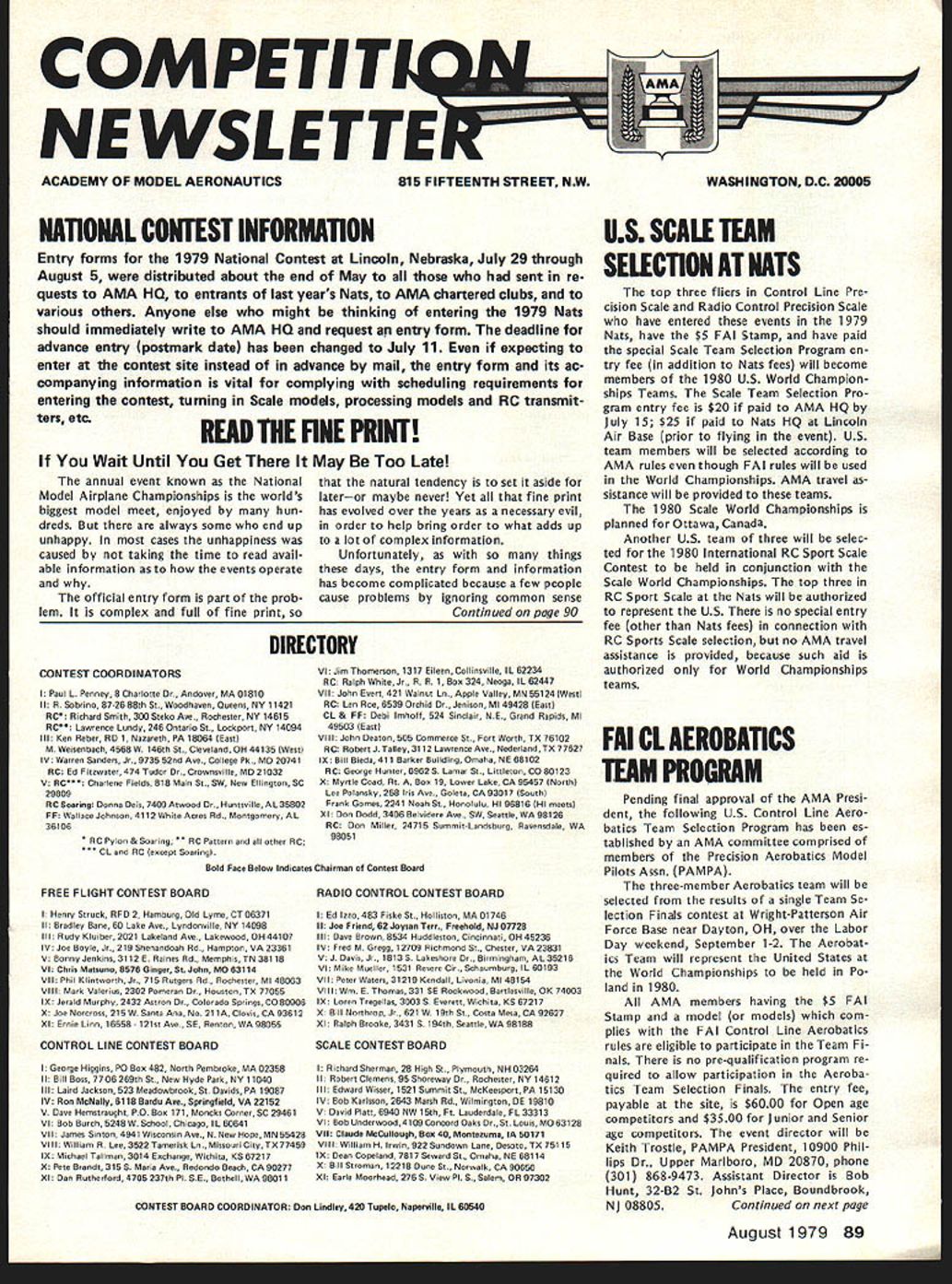
Entry forms for the 1979 National Contest at Lincoln, Nebraska, July 29 through August 5, were distributed about the end of May to all those who had sent in requests to AMA HQ, to entrants of last year's Nats, to AMA chartered clubs, and to various others. Anyone else who might be thinking of entering the 1979 Nats should immediately write to AMA HQ and request an entry form. The deadline for advance entry (postmark date) has been changed to July 11. Even if expecting to enter at the contest site instead of in advance by mail, the entry form and its accompanying information is vital for complying with scheduling requirements for entering the contest, turning in Scale models, processing models and R/C transmitters, etc.
READ THE FINE PRINT!
If You Wait Until You Get There It May Be Too Late!
The annual event known as the National Model Airplane Championships is the world's biggest model meet, enjoyed by many hundreds. But there are always some who end up unhappy. In most cases the unhappiness was caused by not taking the time to read available information as to how the events operate and why.
The official entry form is part of the problem. It is complex and full of fine print, so that the natural tendency is to set it aside for later—or maybe never! Yet all that fine print has evolved over the years as a necessary evil, in order to help bring order to what adds up to a lot of complex information.
Unfortunately, as with so many things these days, the entry form and information has become complicated because a few people cause problems by ignoring common sense and fairness concerning the rights and privileges of others. Consequently, it has become necessary to impose tight deadlines, restrict some activities, and make all kinds of special rules that normally are not needed at other model meets.
Much of the detail is necessary simply because of the numbers of people involved; typically over 2,000 (counting contestants, helpers, relatives and friends). There are obvious communications problems when dealing with so many, especially when they are dispersed over a huge airfield most of the time. And when an event runs for a week, there are many problems involving what is happening from day to day and location to location.
All this is to say that the National Meet, also known as the Nats, is a very complicated operation. But it is mostly a very orderly and enjoyable experience for those who make the effort to be informed. The Nats entry form offers a wealth of information, and particular attention is called here to some details of that information which have been overlooked or ignored by some—to their eventual disappointment.
Some people, for example, simply show up at the Nats and expect to be able to participate as contestants regardless of arrival time. Most, however, have learned that advance entry by mail is far easier and significantly cheaper. Others depend upon so-called "late entry" at the Nats, even though they know this is far more expensive. But the saddest situation involves the person who doesn't realize that there are deadlines, varying from event to event, when late entry is possible—and then only until the cutoff time that day. The Nats entry form has the exact schedule and deadlines.
Cutoff times have been experimented with from year to year, but none of the variations have ever made much difference. Almost always someone shows up a few minutes too late! The deadlines are made as late as practicable to give entrants every opportunity to enter. Don't expect favorable consideration if you ignore the deadline; the need for fairness and scheduling prohibits special adjustments for late arrivals.
Advance entry by mail is the best. It will cost less and give you the best chance to get scheduled in the events you want. Read the instructions on the entry form; fill it out completely and legibly. Include the fees and any other required material, and mail it to arrive before the postmark deadline. If you do have to enter at the meet, bring exact fees, completed forms and any required equipment for immediate processing.
A few other items deserve mention. All Scale contestants who may wish to exhibit and fly their models must also register them with Scale Control prior to any practice flights, and in any case not later than the time indicated on the entry form for turning in models. Transmitters for R/C aircraft must be processed at the R/C Frequency Control station and tagged before they can be used. If you own more than one transmitter, each must be processed.
Despite a special attempt having been made to make requirements easier on contestants, careful reading of the Nats entry form is still necessary to avoid surprise and possible disappointment. The Nats, which has gotten to be the world's biggest model meet, is manageable only by tight planning and time demands upon all participants. Those in the know don't have problems and enjoy the Nats thoroughly. Those who don't bother to become informed are often disappointed. Disappointment is avoidable and unnecessary—read the fine print!
RC HELICOPTER RULES CLARIFIED FOR NATS
Responding to a request from AMA President Earl Witt for clarification of three points of the RC Helicopter rules, RC Contest Board Chairman Joe Friend obtained recommendations from the RC Helicopter Advisory Committee (Horace Hagen, chairman) and subsequently submitted the recommendations to the RC Contest Board. With eight board members responding, the following interpretations for the Nats were approved seven-to-one:
- Landing following Auto-rotation to Landing.
- The Landing maneuver in Expert must be flown immediately after Auto-rotation to Landing with only an engine restart, and it must be within the 3-minute time limit, for the Expert Maneuver Group (III).
- Auto-rotation Landing Zone.
- In order to receive a score in Expert for Auto-rotation to Landing, the landing must be within a 100-ft. diameter circle centered on the helipad.
- A landing within the 100-ft. circle but not on the helipad will be scored 0 to 5 points maximum.
- A landing on the helipad will be scored 0 to 10 points maximum.
- A landing on the helipad is defined as one where the rotorshaft of the helicopter points to the inside of the 3-ft. diameter circle on the pad when viewed from above.
- Engine Adjustments/Restarts.
- Once the contestant has announced the start of the first maneuver, he is not allowed to make any adjustments on the helicopter. Engine restarts are not allowed except after Auto-rotation to Landing.
CONTEST BOARD INTERIM VOTES IN THIS ISSUE
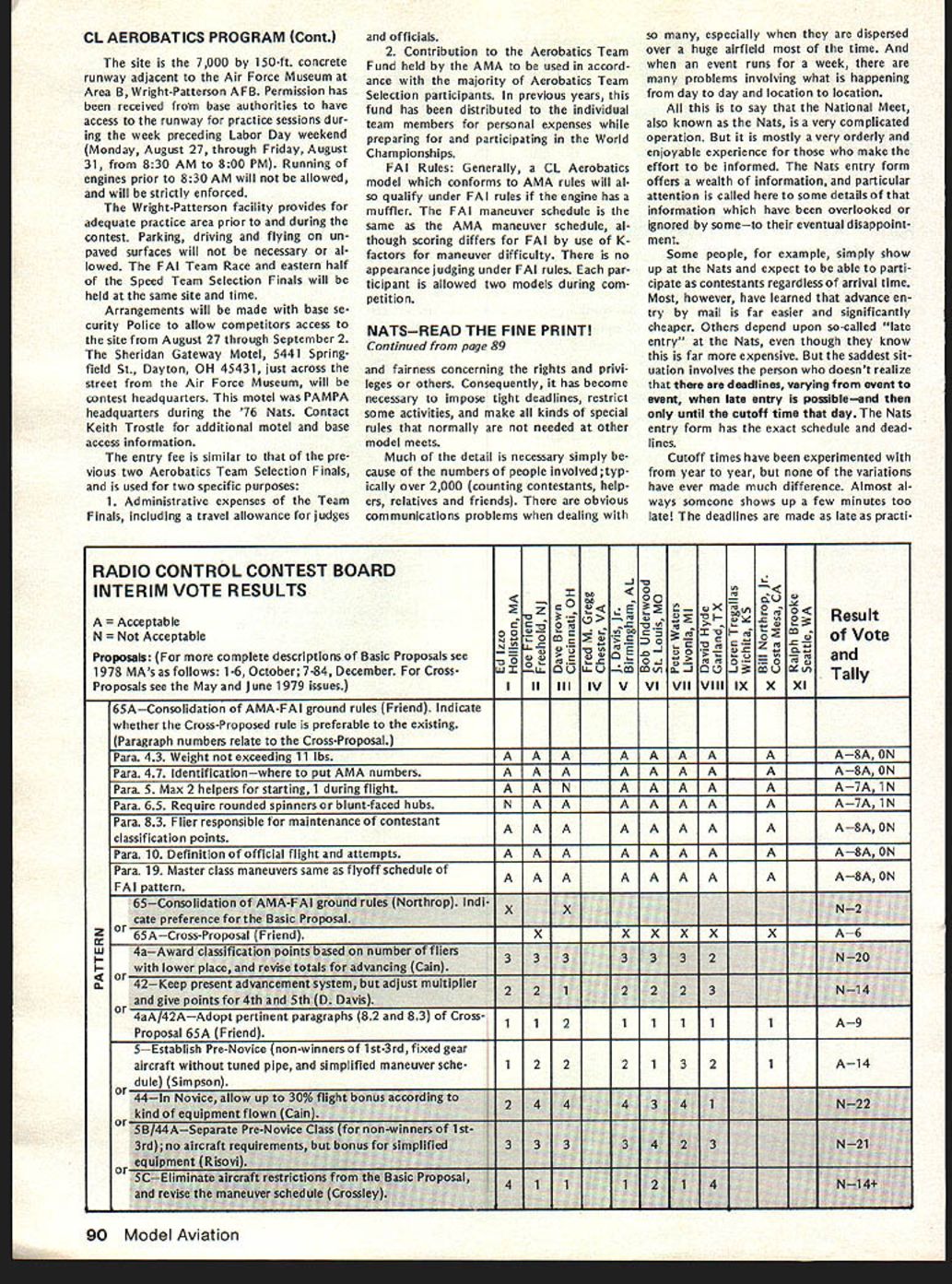
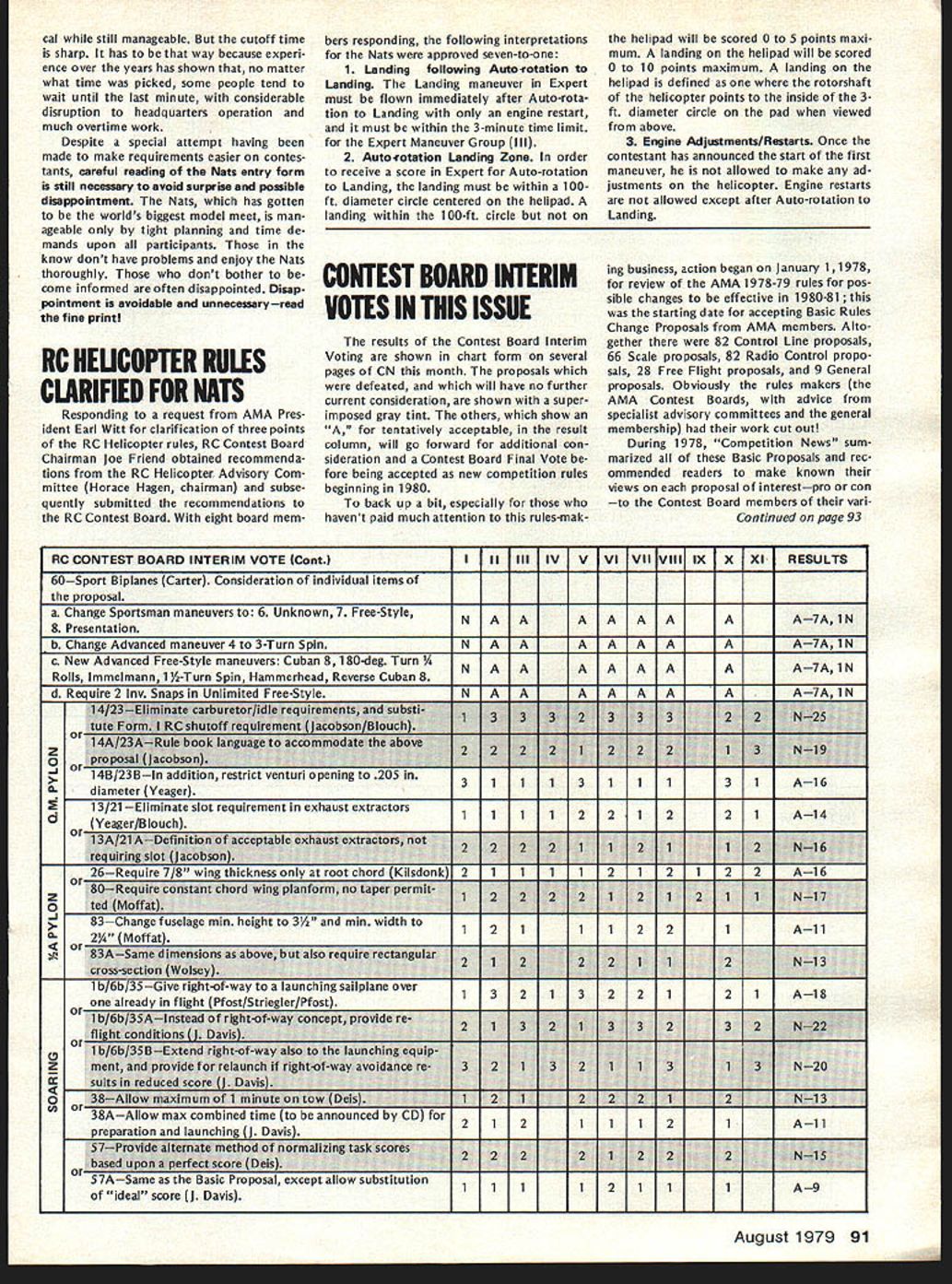
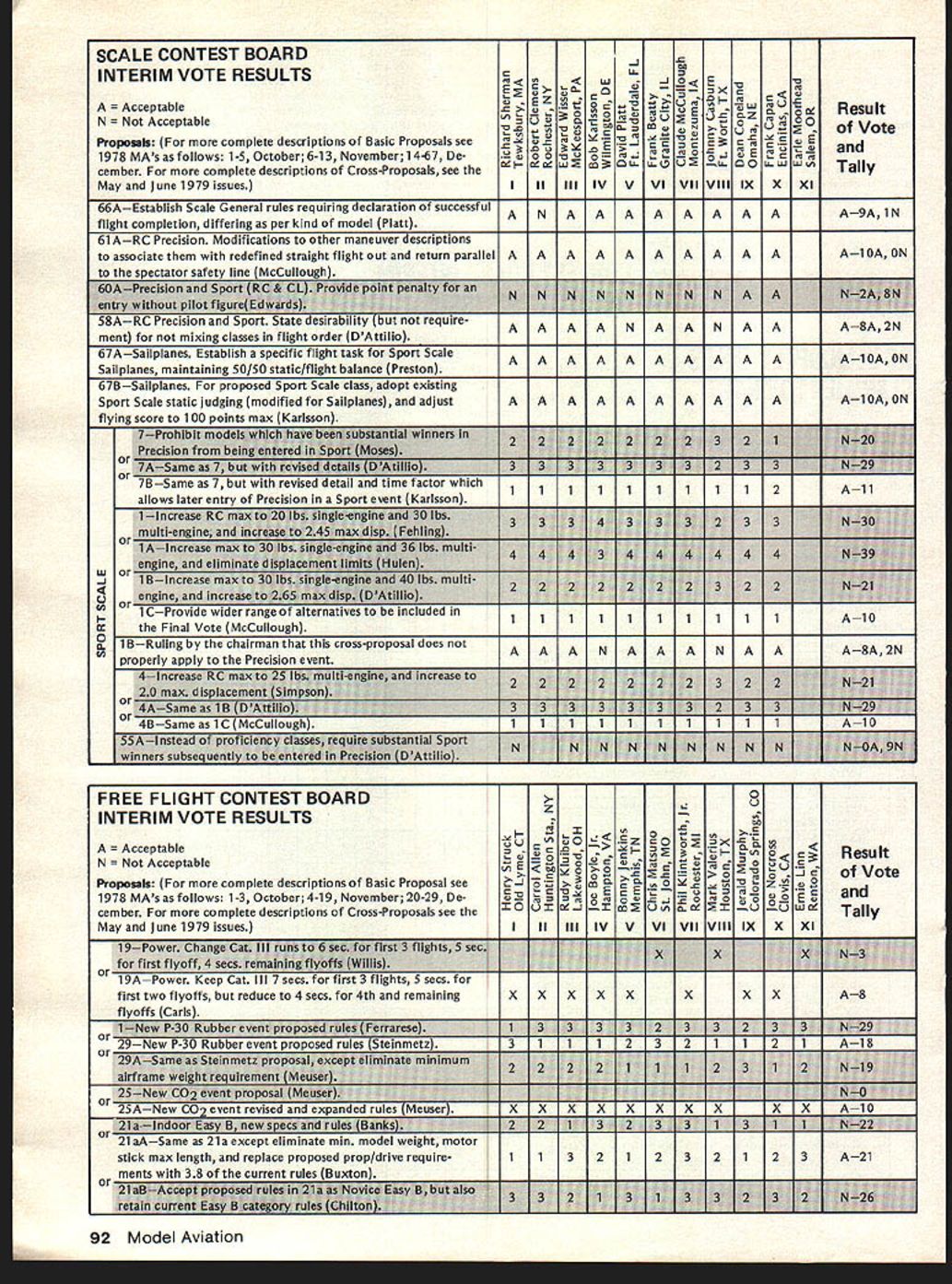
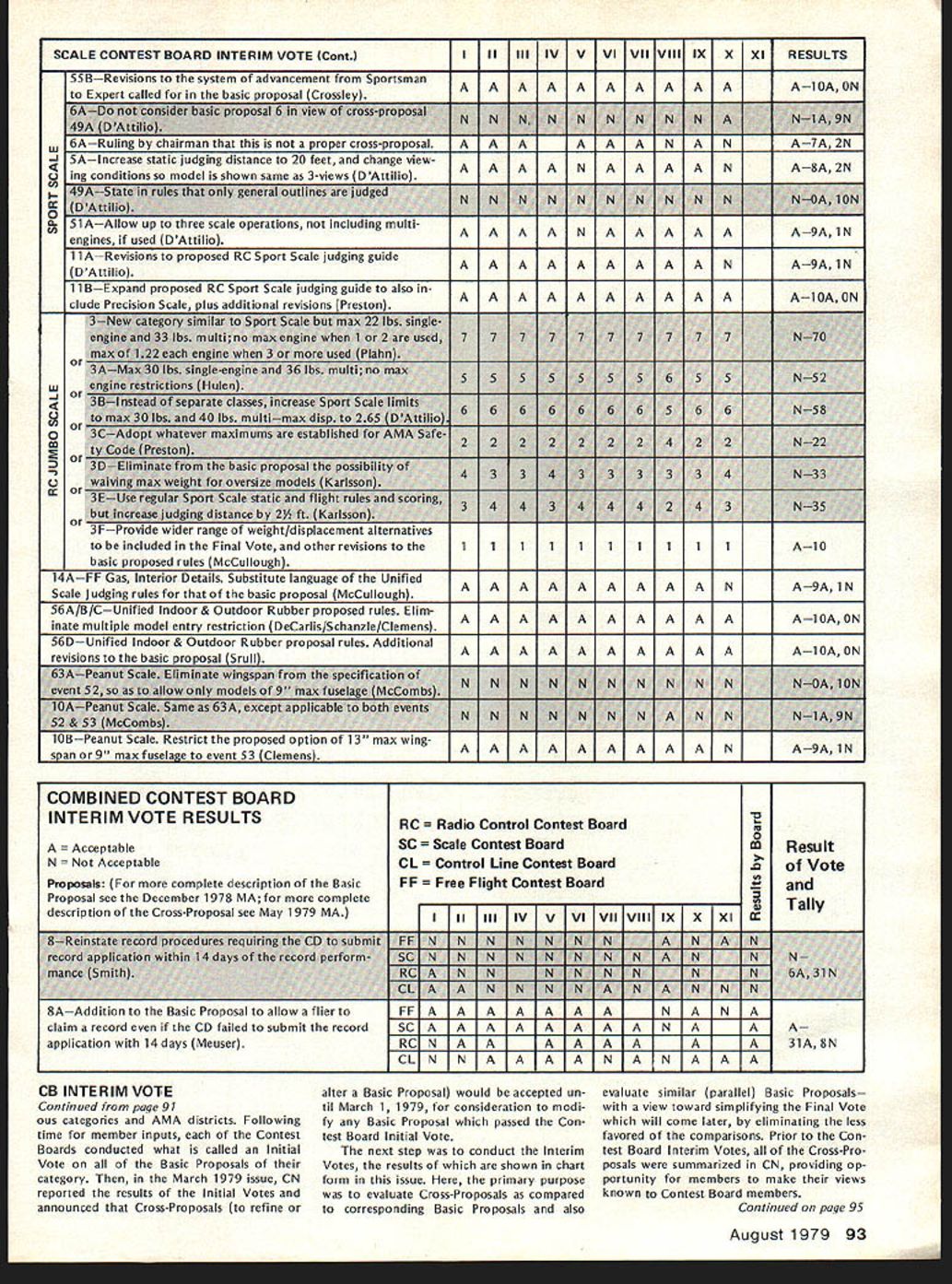
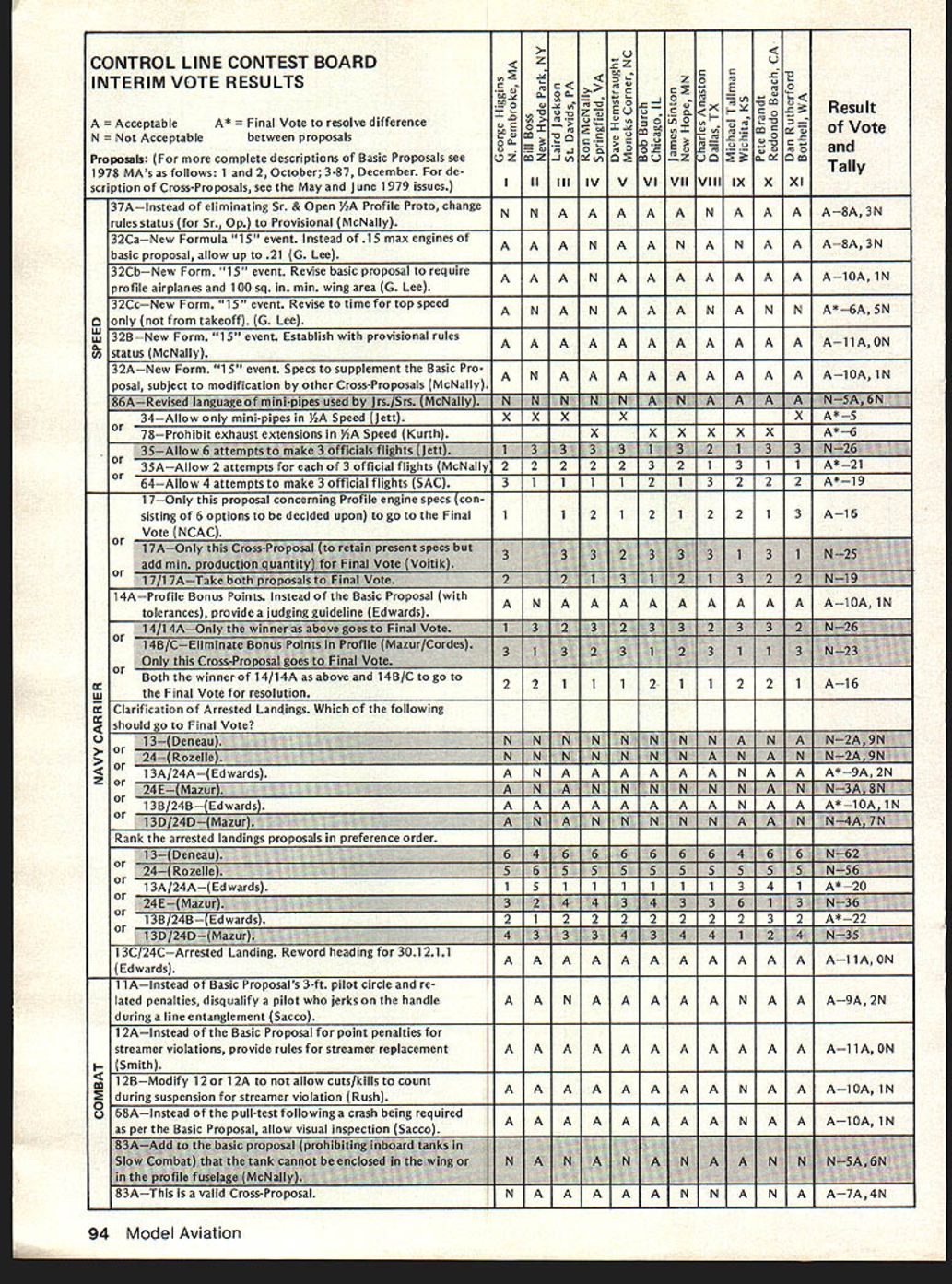
The results of the Contest Board Interim Voting are shown in chart form on several pages of CN this month. The proposals which were defeated, and which will have no further current consideration, are shown with a superimposed gray tint. The others, which show an "A" for tentatively acceptable in the result column, will go forward for additional consideration and a Contest Board Final Vote before being accepted as new competition rules beginning in 1980.
To back up a bit, especially for those who haven't paid much attention to this rules-making business, action began on January 1, 1978, for review of the AMA 1978-79 rules for possible changes to be effective in 1980-81; this was the starting date for accepting Basic Rules Change Proposals from AMA members. Altogether there were 82 Control Line proposals, 66 Scale proposals, 82 Radio Control proposals, 28 Free Flight proposals, and 9 General proposals. Obviously the rules makers (the AMA Contest Boards, with advice from specialist advisory committees and the general membership) had their work cut out!
During 1978, "Competition News" summarized all of these Basic Proposals and recommended readers make known their views on each proposal of interest—pro or con—to the Contest Board members of their various districts.
SCALE CONTEST BOARD
INTERIM VOTE RESULTS
A = Acceptable N = Not Acceptable
Proposals: (For more complete descriptions of Basic Proposals see 1978 MA's as follows: 1–5, October; 6–13, November; 14–67, December. For more complete descriptions of Cross-Proposals, see the May and June 1979 issues.)
- 66A — Establish Scale General rules requiring declaration of successful flight completion, differing as per kind of model (Platt). Result of Vote and Tally: A — 9A, 1N
- 61A — RC Precision. Modifications to other maneuver descriptions to associate them with redefined straight flight out and return parallel to the spectator safety line (McCullough). Result of Vote and Tally: A — 10A, 0N
- 60A — Precision and Sport (RC & CL). Provide point penalty for an entry without pilot figure (Edwards). Result of Vote and Tally: N — 2A, 8N
- 58A — RC Precision and Sport. State desirability (but not requirement) for not mixing classes in flight order (D'Attilio). Result of Vote and Tally: A — 8A, 2N
- 67A — Sailplanes. Establish a specific flight task for Sport Scale Sailplanes, maintaining 50/50 static/flight balance (Preston). Result of Vote and Tally: A — 10A, 0N
- 67B — Sailplanes. For proposed Sport Scale class, adopt existing Sport Scale static judging (modified for Sailplanes), and adjust flying score to 100 points max (Karlsson). Result of Vote and Tally: A — 10A, 0N
- 7 — Prohibit models which have been substantial winners in Precision from being entered in Sport (Moses). Result of Vote and Tally: N — 20
- 7A — Same as 7, but with revised details (D'Attilio). Result of Vote and Tally: N — 29
- 7B — Same as 7, but with revised detail and time factor which allows later entry of Precision in a Sport event (Karlsson). Result of Vote and Tally: A — 11
- 1 — Increase RC max to 20 lbs. single-engine and 30 lbs. multi-engine, and increase to 2.45 max disp. (Fehling). Result of Vote and Tally: N — 30
- 1A — Increase max to 30 lbs. single-engine and 36 lbs. multi-engine, and eliminate displacement limits (Hulen). Result of Vote and Tally: N — 39
- 1B — Increase max to 30 lbs. single-engine and 40 lbs. multi-engine, and increase to 2.65 max disp. (D'Attilio). Result of Vote and Tally: N — 21
- 1C — Provide wider range of alternatives to be included in the Final Vote (McCullough). Result of Vote and Tally: A — 10
- 1B — Ruling by the chairman that this cross-proposal does not properly apply to the Precision event. Result of Vote and Tally: A — 8A, 2N
- 4 — Increase RC max to 25 lbs. multi-engine, and increase to 2.0 max. displacement (Simpson). Result of Vote and Tally: N — 21
- 4A — Same as 1B (D'Attilio). Result of Vote and Tally: N — 29
- 4B — Same as 1C (McCullough). Result of Vote and Tally: A — 10
- 55A — Instead of proficiency classes, require substantial Sport winners subsequently to be entered in Precision (D'Attilio). Result of Vote and Tally: N — 0A, 9N
FREE FLIGHT CONTEST BOARD
INTERIM VOTE RESULTS
A = Acceptable N = Not Acceptable
Proposals: (For more complete descriptions of Basic Proposals see 1978 MA's as follows: 1–3, October; 4–19, November; 20–29, December. For more complete descriptions of Cross-Proposals see the May and June 1979 issues.)
- 19 — Power. Change Cat. III runs to 6 sec. for first 3 flights, 5 sec. for first flyoff, 4 secs. remaining flyoffs (Willis). Result of Vote and Tally: N — 3
- 19A — Power. Keep Cat. III 7 secs. for first 3 flights, 5 secs. for first two flyoffs, but reduce to 4 secs. for 4th and remaining flyoffs (Carls). Result of Vote and Tally: A — 8
- 1 — New P-30 Rubber event proposed rules (Ferrarese). Result of Vote and Tally: N — 29
- 29 — New P-30 Rubber event proposed rules (Steinmetz). Result of Vote and Tally: A — 18
- 29A — Same as Steinmetz proposal, except eliminate minimum airframe weight requirement (Meuser). Result of Vote and Tally: N — 19
- 25 — New CO2 event proposal (Meuser). Result of Vote and Tally: N — 0
- 25A — New CO2 event revised and expanded rules (Meuser). Result of Vote and Tally: A — 10
- 21A — Indoor Easy B, new specs and rules (Banks). Result of Vote and Tally: N — 22
- 21A — Same as 21A except eliminate min. model weight, motor stick max length, and replace proposed prop/drive requirements with 3.8 of the current rules (Buxton). Result of Vote and Tally: A — 21
- 21AB — Accept proposed rules in 21A as Novice Easy B, but also retain current Easy B category rules (Chilton). Result of Vote and Tally: N — 26
COMBINED CONTEST BOARD
INTERIM VOTE RESULTS
A = Acceptable N = Not Acceptable
Proposals: (For more complete description of the Basic Proposal see the December 1978 MA; for more complete description of the Cross-Proposal see May 1979 MA.)
- 8 — Reinstate record procedures requiring the CD to submit record application within 14 days of the record performance (Smith).
- 8A — Addition to the Basic Proposal to allow a flier to claim a record even if the CD failed to submit the record application within 14 days (Meuser).
CB INTERIM VOTE
Continued from page 91
Following time for member inputs, each of the Contest Boards conducted what is called an Initial Vote on all of the Basic Proposals of their category. Then, in the March 1979 issue, CN reported the results of the Initial Votes and announced that Cross-Proposals (to refine or alter a Basic Proposal) would be accepted until March 1, 1979, for consideration to modify any Basic Proposal which passed the Contest Board Initial Vote.
The next step was to conduct the Interim Votes, the results of which are shown in chart form in this issue. Here, the primary purpose was to evaluate Cross-Proposals as compared to corresponding Basic Proposals and also to evaluate similar (parallel) Basic Proposals, with a view toward simplifying the Final Vote which will come later, by eliminating the less favored of the comparisons. Prior to the Contest Board Interim Votes, all of the Cross-Proposals were summarized in CN, providing opportunity for members to make their views known to Contest Board members.
Continued on page 95
CONTROL LINE CONTEST BOARD
INTERIM VOTE RESULTS
A = Acceptable A* = Final Vote to resolve difference N = Not Acceptable
Proposals: (For more complete descriptions of Basic Proposals see 1978 MA's as follows: 1 and 2, October; 3–87, December. For description of Cross-Proposals, see the May and June 1979 issues.)
- 37A — Instead of eliminating Sr. & Open 1/2A Profile Proto, change rules status (for Sr., Op.) to Provisional (McNally). Result: A — 8A, 3N
- 32Ca — New Formula "15" event. Instead of .15 max engines of basic proposal, allow up to .21 (G. Lee). Result: A — 8A, 3N
- 32Cb — New Form. "15" event. Revise basic proposal to require profile airplanes and 100 sq. in. min. wing area (G. Lee). Result: A — 10A, 1N
- 32Cc — New Form. "15" event. Revise to time for top speed only (not from takeoff). (G. Lee). Result: A* — 6A, 5N
- 32B — New Form. "15" event. Establish with provisional rules status (McNally). Result: A — 11A, 0N
- 32A — New Form. "15" event. Specs to supplement the Basic Proposal, subject to modification by other Cross-Proposals (McNally). Result: A — 10A, 1N
- 86A — Revised language of mini-pipes used by Jr./Srs. (McNally). Result: N — 5A, 6N
- or 34 — Allow only mini-pipes in 1/2A Speed (Jett). Result: A* — 5
- 78 — Prohibit exhaust extensions in 1/2A Speed (Kurth). Result: A* — 6
- or 35 — Allow 6 attempts to make 3 official flights (Jett). Result: N — 26
- or 35A — Allow 2 attempts for each of 3 official flights (McNally). Result: A* — 21
- or 64 — Allow 4 attempts to make 3 official flights (SAC). Result: A* — 19
- 17 — Only this proposal concerning Profile engine specs (consisting of 6 options to be decided upon) go to the Final Vote (NCAC). Result: A — 16
- or 17A — Only this Cross-Proposal (to retain present specs but add min. production quantity) for Final Vote (Voitik). Result: N — 25
- or 17/17A — Take both proposals to Final Vote. Result: N — 19
- 14A — Profile Bonus Points. Instead of the Basic Proposal (with tolerances), provide a judging guideline (Edwards). Result: A — 10A, 1N
- or 14/14A — Only the winner as above goes to Final Vote. Result: N — 26
- or 14B/C — Eliminate Bonus Points in Profile (Mazur/Cordes). Result: N — 23
- Both the winner of 14/14A as above and 14B/C to go to the Final Vote for resolution. Result: A — 16
Clarification of Arrested Landings. Which of the following should go to Final Vote?
- or 13 — (Deneau). Result: N — 2A, 9N
- or 24 — (Rozelle). Result: N — 2A, 9N
- or 13A/24A — (Edwards). Result: A* — 9A, 2N
- or 24E — (Mazur). Result: N — 3A, 8N
- or 13B/24B — (Edwards). Result: A* — 10A, 1N
- or 13D/24D — (Mazur). Result: N — 4A, 7N
Rank the arrested landings proposals in preference order:
- or 13 — (Deneau). Votes: 6 4 6 6 6 6 6 6 6 6 6. Result: N — 62
- or 24 — (Rozelle). Votes: 5 6 5 5 5 5 5 5 5 5 5. Result: N — 56
- or 13A/24A — (Edwards). Votes: 1 5 1 1 1 1 1 1 1 1 1. Result: A* — 20
- or 24E — (Mazur). Votes: 3 2 4 4 4 4 3 3 3 3 3. Result: N — 36
- or 13B/24B — (Edwards). Votes: 2 1 2 2 2 2 2 2 2 2 2. Result: A* — 22
- or 13D/24D — (Mazur). Votes: 4 3 3 3 3 3 4 4 4 4 4. Result: N — 35
- 13C/24C — Arrested Landing. Reword heading for 30.12.1.1 (Edwards). Result: A — 11A, 0N
- 11A — Instead of Basic Proposal's 3-ft. pilot circle and related penalties, disqualify a pilot who jerks on the handle during a line entanglement (Sacco). Result: A — 9A, 2N
- 12A — Instead of the Basic Proposal for point penalties for streamer violations, provide rules for streamer replacement (Smith). Result: A — 11A, 0N
- 12B — Modify 12 or 12A to not allow cuts/kills to count during suspension for streamer violation (Rush). Result: A — 10A, 1N
- 58A — Instead of the pull-test following a crash being required as per the Basic Proposal, allow visual inspection (Sacco). Result: A — 10A, 1N
- 83A — Add to the basic proposal (prohibiting inboard tanks in Slow Combat) that the tank cannot be enclosed in the wing or in the profile fuselage (McNally). Result: N — 5A, 6N
- 83A — This is a valid Cross-Proposal. Result: A — 7A, 4N
Competition Newsletter
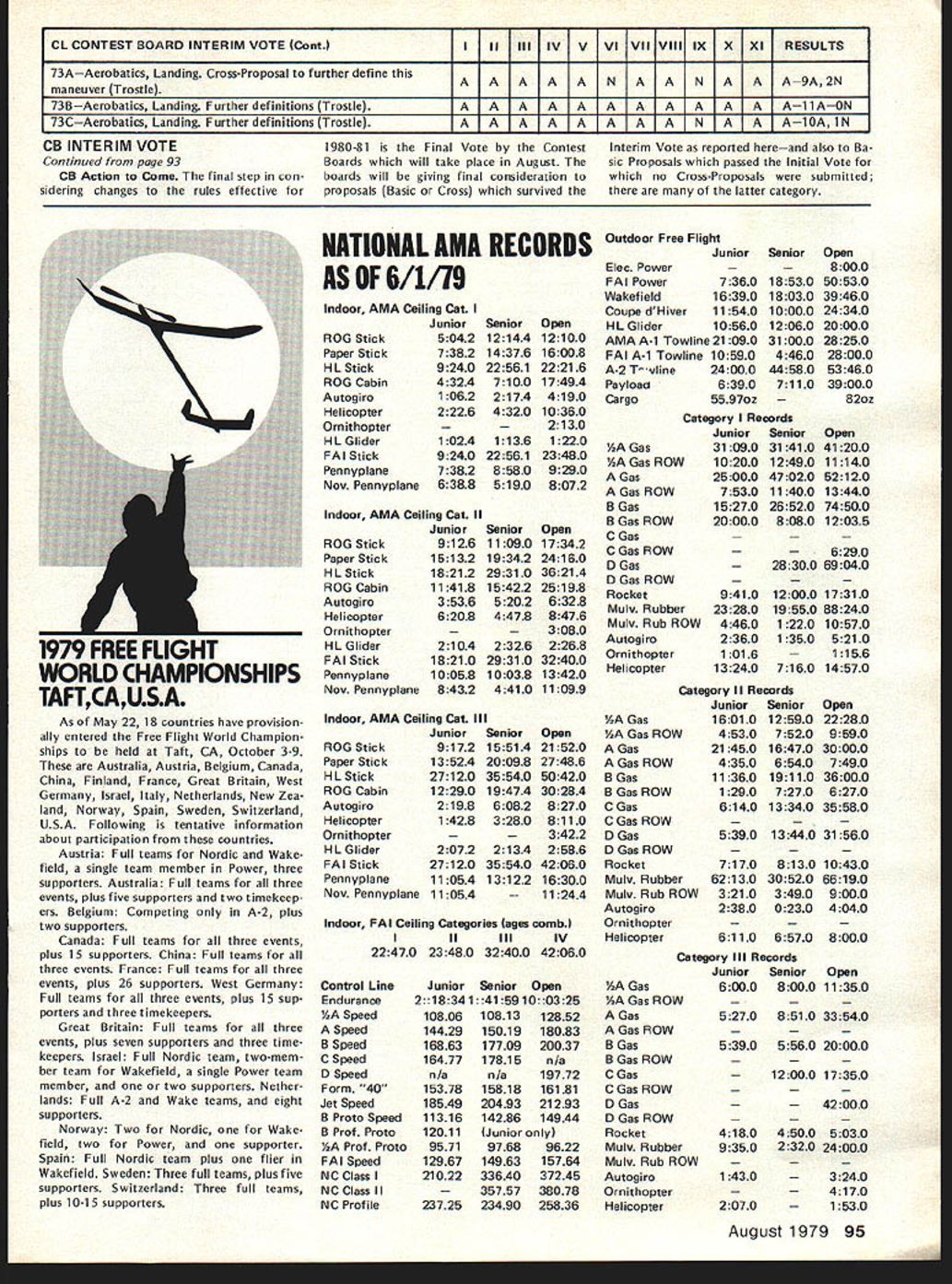
CL CONTEST BOARD INTERIM VOTE (Cont.)
- 73A — Aerobatics, Landing. Cross-Proposal to further define this maneuver (Trostle).
I A II A III A IV A V N VI A VII N VIII A IX A X A XI A. Results: A — 9A, 2N
- 73B — Aerobatics, Landing. Further definitions (Trostle).
I A II A III A IV A V A VI A VII A VIII A IX A X A XI A. Results: A — 11A, 0N
- 73C — Aerobatics, Landing. Further definitions (Trostle).
I A II A III A IV A V A VI A VII A VIII A IX A X A XI A. Results: A — 10A, 1N
CB INTERIM VOTE
Continued from page 93
CB Action to Come. The final step in considering changes to the rules effective for 1980–81 is the Final Vote by the Contest Boards which will take place in August. The boards will be giving final consideration to proposals (Basic or Cross) which survived the Interim Vote as reported here—and also to Basic Proposals which passed the Initial Vote for which no Cross-Proposals were submitted; there are many of the latter category.
NATIONAL AMA RECORDS AS OF 6/1/79
Indoor, AMA Ceiling Cat. I
- ROG Stick: Junior 5:04.2 Senior 12:14.4 Open 12:10.0
- Paper Stick: Junior 7:38.2 Senior 14:37.6 Open 16:00.8
- HL Stick: Junior 9:24.0 Senior 22:56.1 Open 22:21.6
- ROG Cabin: Junior 4:32.4 Senior 7:10.0 Open 17:49.4
- Autogiro: Junior 1:06.2 Senior 2:17.4 Open 4:19.0
- Helicopter: Junior 2:22.6 Senior 4:32.0 Open 10:36.0
- Ornithopter: Open 2:13.0
- HL Glider: Junior 1:02.4 Senior 1:13.6 Open 1:22.0
- FAI Stick: Junior 9:24.0 Senior 22:56.1 Open 23:48.0
- Pennyplane: Junior 7:38.2 Senior 8:58.0 Open 9:29.0
- Nov. Pennyplane: Junior 6:38.8 Senior 5:19.0 Open 8:07.2
Indoor, AMA Ceiling Cat. II
- ROG Stick: Junior 9:12.6 Senior 11:09.0 Open 17:34.2
- Paper Stick: Junior 15:13.2 Senior 19:34.2 Open 24:16.0
- HL Stick: Junior 18:21.2 Senior 29:31.0 Open 36:21.4
- ROG Cabin: Junior 11:41.8 Senior 15:42.2 Open 25:19.8
- Autogiro: Junior 3:53.6 Senior 5:20.2 Open 6:32.8
- Helicopter: Junior 6:20.8 Senior 4:47.8 Open 8:47.6
- Ornithopter: Open 3:08.0
- HL Glider: Junior 2:10.4 Senior 2:32.6 Open 2:26.8
- FAI Stick: Junior 18:21.0 Senior 29:31.0 Open 32:40.0
- Pennyplane: Junior 10:05.8 Senior 10:03.8 Open 13:42.0
- Nov. Pennyplane: Junior 8:43.2 Senior 4:41.0 Open 11:09.9
Indoor, AMA Ceiling Cat. III
- ROG Stick: Junior 9:17.2 Senior 15:51.4 Open 21:52.0
- Paper Stick: Junior 13:52.4 Senior 20:09.8 Open 27:48.6
- HL Stick: Junior 27:12.2 Senior 35:54.0 Open 50:42.0
- ROG Cabin: Junior 12:29.0 Senior 19:47.4 Open 30:28.4
- Autogiro: Junior 2:19.8 Senior 6:08.2 Open 8:27.0
- Helicopter: Junior 1:42.8 Senior 3:28.0 Open 8:11.0
- HL Glider: Junior 2:07.2 Senior 2:13.4 Open 2:58.6
- FAI Stick: Junior 27:12.0 Senior 35:54.0 Open 42:06.0
- Pennyplane: Junior 11:05.4 Senior 13:12.2 Open 16:30.0
- Nov. Pennyplane: Junior 11:05.4 Senior — Open 11:24.4
Indoor, FAI Ceiling Categories (ages combined)
- I: 22:47.0 II: 23:48.0 III: 32:40.0 IV: 42:06.0
Control Line
- Endurance: Junior 2:18:34 Senior 1:41:59 Open 1:03:25
- 1/2A Speed: Junior 108.06 Senior 108.13 Open 128.52
- A Speed: Junior 144.29 Senior 150.19 Open 180.83
- B Speed: Junior 168.63 Senior 177.09 Open 200.37
- C Speed: Junior 164.77 Senior 178.15 Open —
- D Speed: Junior 110.48 Senior — Open 197.72
- Jet Speed: Junior 153.78 Senior 158.18 Open 161.81
- B Proto Speed: Junior 118.45 Senior 142.86 Open 149.44
- B Prof. Proto: Junior 120.11 Senior — Open 96.22
- 1/2A Prof. Proto: Junior 95.71 Senior 97.68 Open 96.22
- FAI Speed: Junior 129.67 Senior 149.63 Open 157.64
- NC Class I: Junior 210.22 Senior 336.40 Open 372.45
- NC Class II: Junior — Senior 257.57 Open 380.78
- NC Profile: 237.25 234.90 258.36
Outdoor Free Flight
- Elec. Power: Open 8:00.0
- FAI Power: Junior 7:36.0 Senior 18:53.0 Open 50:53.0
- Wakefield: Junior 16:39.0 Senior 18:03.0 Open 39:46.0
- Coupe d'Hiver: Junior 11:54.0 Senior 10:00.0 Open 24:34.0
- HL Glider: Junior 10:56.0 Senior 12:06.0 Open 20:00.0
- AMA A-1 Towline: Junior 21:09.0 Senior 31:00.0 Open 28:25.0
- FAI A-1 Towline: Junior 10:59.0 Senior 4:46.0 Open 28:00.0
- A-2 Towline: Junior 24:00.0 Senior 44:58.0 Open 53:46.0
- Payload: Junior 6:39.0 Senior 7:11.0 Open 39:00.0
- Cargo: 55.97 oz 82 oz
Category I Records
- 1/2A Gas: Junior 31:09.0 Senior 31:41.0 Open 41:20.0
- 1/2A Gas ROW: Junior 10:20.0 Senior 12:49.0 Open 11:40.0
- A Gas: Junior 25:00.0 Senior 47:02.0 Open 52:12.0
- A Gas ROW: Junior 7:53.0 Senior 11:40.0 Open 13:44.0
- B Gas: Junior 15:27.0 Senior 26:52.0 Open 74:50.0
- B Gas ROW: Junior 20:00.0 Senior 8:08.0 Open 12:03.5
- C Gas: — — 6:29.0
- C Gas ROW: — — 6:29.0
- D Gas: — — 28:30.0 and 69:04.0 (rows)
- D Gas ROW: —
- Rocket: Junior 9:41.0 Senior 12:00.0 Open 17:31.0
- Mulv. Rubber: Junior 23:28.0 Senior 19:55.0 Open 88:24.0
- Mulv. Rub ROW: Junior 4:46.0 Senior 1:22.0 Open 10:57.0
- Autogiro: Junior 2:36.0 Senior 1:35.0 Open 5:21.0
- Ornithopter: Junior 1:01.6 Senior — Open 1:15.6
- Helicopter: Junior 13:24.0 Senior 7:16.0 Open 14:57.0
Category II Records
- 1/2A Gas: Junior 16:01.0 Senior 12:59.0 Open 22:28.0
- 1/2A Gas ROW: Junior 4:53.0 Senior 7:52.0 Open 9:59.0
- A Gas: Junior 21:45.0 Senior 16:47.0 Open 30:00.0
- A Gas ROW: Junior 4:35.0 Senior 6:54.0 Open 7:49.0
- B Gas: Junior 11:36.0 Senior 19:11.0 Open 36:00.0
- B Gas ROW: Junior 1:29.0 Senior 7:27.0 Open 6:27.0
- C Gas: Junior 6:14.0 Senior 13:34.0 Open 35:58.0
- C Gas ROW: —
- D Gas: Junior 5:39.0 Senior 13:44.0 Open 31:56.0
- D Gas ROW: —
- Rocket: Junior 7:17.0 Senior 8:13.0 Open 10:43.0
- Mulv. Rubber: Junior 62:13.0 Senior 30:52.0 Open 66:19.0
- Mulv. Rub ROW: Junior 3:21.0 Senior 3:49.0 Open 9:00.0
- Autogiro: Junior 2:38.0 Senior 0:23.0 Open 0:44.0
- Ornithopter: —
- Helicopter: Junior 6:11.0 Senior 6:57.0 Open 8:00.0
Category III Records
- 1/2A Gas: Junior 6:00.0 Senior 8:00.0 Open 11:35.0
- 1/2A Gas ROW: Junior 5:27.0 Senior 8:51.0 Open 33:54.0
- A Gas: Junior 5:39.0 Senior 5:56.0 Open 20:00.0
- A Gas ROW: —
- B Gas: —
- B Gas ROW: — 12:00.0 17:35.0
- C Gas: —
- C Gas ROW: —
- D Gas: —
- D Gas ROW: —
- Rocket: Junior 4:18.0 Senior 4:50.0 Open 5:03.0
- Mulv. Rubber: Junior 9:35.0 Senior 2:32.0 Open 24:00.0
- Mulv. Rub ROW: —
- Autogiro: —
- Ornithopter: 1:43.0 — 3:24.0
- Helicopter: 2:07.0 — 1:53.0
1979 FREE FLIGHT WORLD CHAMPIONSHIPS
TAFT, CA, U.S.A.
As of May 22, 18 countries have provisionally entered the Free Flight World Championships to be held at Taft, CA, October 3–9. These are Australia, Austria, Belgium, Canada, China, Finland, France, Great Britain, West Germany, Israel, Italy, Netherlands, New Zealand, Norway, Spain, Sweden, Switzerland, U.S.A. Following is tentative information about participation from these countries.
- Austria: Full teams for Nordic and Wakefield, a single team member in Power, three supporters.
- Australia: Full teams for all three events, plus five supporters and two timekeepers.
- Belgium: Competing only in A-2, plus two supporters.
- Canada: Full teams for all three events, plus 15 supporters.
- China: Full teams for all three events.
- France: Full teams for all three events, plus 26 supporters.
- West Germany: Full teams for all three events, plus 15 supporters and three timekeepers.
- Great Britain: Full teams for all three events, plus seven supporters and three timekeepers.
- Israel: Full Nordic team, two-member team for Wakefield, a single Power team member, and one or two supporters.
- Netherlands: Full A-2 and Wake teams, and eight supporters.
- Norway: Two for Nordic, one for Wakefield, two for Power, and one supporter.
- Spain: Full Nordic team plus one flier in Wakefield.
- Sweden: Three full teams, plus five supporters.
- Switzerland: Three full teams, plus 10–15 supporters.
Transcribed from original scans by AI. Minor OCR errors may remain.

