
RC CONTEST BOARD ENACTS RC SAILPLANE RECORDS IMMEDIATELY
On a proposal by the National Soaring Society for creation of National AMA Record categories for RC sailplanes, the Radio Control Contest Board has voted for immediate (August 1) adoption of these record categories plus related rules and procedures. This means that flights made on or after August 1 which are in accordance with these rules, provided an AMA RC Soaring Record Trials sanction has been applied for and granted, are eligible for AMA National Record recognition.
The proposal for the National Soaring Records was mainly the work of Don Clark, acting on behalf of the NSS, with assistance from AMA Technical Director Frank Ehling.
This action was in accordance with Contest Board procedures pertaining to interpretations, safety and/or emergency proposals. Alternatives considered were:
- A) immediate enactment, requiring a ratification vote four to six weeks after publication;
- B) no immediate enactment, but require publication of the proposal and vote four to six weeks later, with immediate enactment if called for by the vote;
- C) denial of any action.
With five RC Contest Board members voting (Joe Friend, Dist. II; Fred Gregg, IV; P. T. Waters, VII; William E. Thomas, VIII; and Ralph Brooke, XI), the response was unanimous for A) immediate enactment.
Prior to the vote described above a draft of the proposal was circulated among the RC Contest Board and the RC Soaring Rules Advisory Committee. Their response favored quicker-than-normal action in implementing the RC Soaring National Records, but several revisions were suggested. A separate question was asked at the time of the RCCB vote described above concerning acceptance of the revisions, and the response from the RCCB members who voted was unanimous for acceptance.
This article constitutes the publication as required by the Contest Board procedures; with this issue expected to be in readers' hands approximately August 1, the ratification vote by the RCCB is expected to take place between September 1 and September 15. Anyone wishing to affect the outcome of the ratification vote, pro or con, should state his views to the district Radio Control Contest Board member by September 1, 1979.
AMA Sanction Procedure
The procedure for obtaining AMA sanction for an AMA RC Soaring Record Trials is a bit different from regular AMA Record Trials due to the specialized nature of the RC soaring record categories. The first step is to write to AMA HQ for an Application for Individual RC Soaring Sanction. This, when completed and signed by an AMA Contest Director, is returned to AMA HQ with a fee of $2.00. (It is anticipated that most trials will involve a single individual and a single record category.)
Rules for AMA National Records—RC Sailplanes
The following records will be recognized for each of the classes: A Standard, B Modified Standard, C Unlimited, and D Two-Meter:
- Duration
- Thermal Duration
- Declared Distance
- Open Distance
- Closed Course Distance
- Altitude
- Speed
General Rules
- All record claims must be made by U.S. citizens who are members of the Academy of Model Aeronautics. An AMA sanction is required for all attempts.
- Multiple records for any one class with a single flight may be attempted provided sanctions are obtained for each task.
- A minimum of two officials must witness the record attempt. Both officials must be AMA members and at least one of the two must be a current AMA Contest Director.
- Initial record claims will have no starting minimums. After initial records are established, all subsequent records must simply better the existing records.
- Team effort is permitted for all record attempts; however, only one pilot will be permitted.
- The model must meet the following specifications:
- Maximum surface area (combined wing and horizontal stab projected areas): 150 dm2 (2325 sq. in.)
- Maximum flying weight: 5000 g (11 lb., 0.368 oz.)
- Surface loading: from 12 to 75 g/dm2 (3.95 to 24.57 oz./sq. ft.)
- A model may be hand-launched or launched by means of a line (hand tow, hi-start or winch) with a maximum launch length of 300 m (985 ft., 3 in.). Hi-start can be any combination of elastic and line but stretched length for launching cannot exceed 300 m (984 ft., 3 in.). The towline must have a pennant or parachute of suitable size and color to enable officials to determine when towline release occurs. No other type or form of launch is permitted. The launch equipment must be ground based. Once released from launch no other propulsion of the model is permitted.
Special Rules
- Duration — Timing of the flight starts at release of the model from the launch device and stops when the model touches the ground (or solid ground-based object) or disappears from the timekeeper's sight for more than five minutes. The point of landing must be within 300 m (984 ft., 3 in.) of the launch point. The time is taken by two timekeepers. The registered times must be within 1% of each other, with the lowest reading considered official.
- Thermal Duration — The flight shall be sustained on thermal lift only, over essentially flat ground, and at no time shall the model fly in slope lift. The loss of height between the start and landing points, for both Duration and Thermal Duration, cannot exceed 100 m (328 ft., 1 in.).
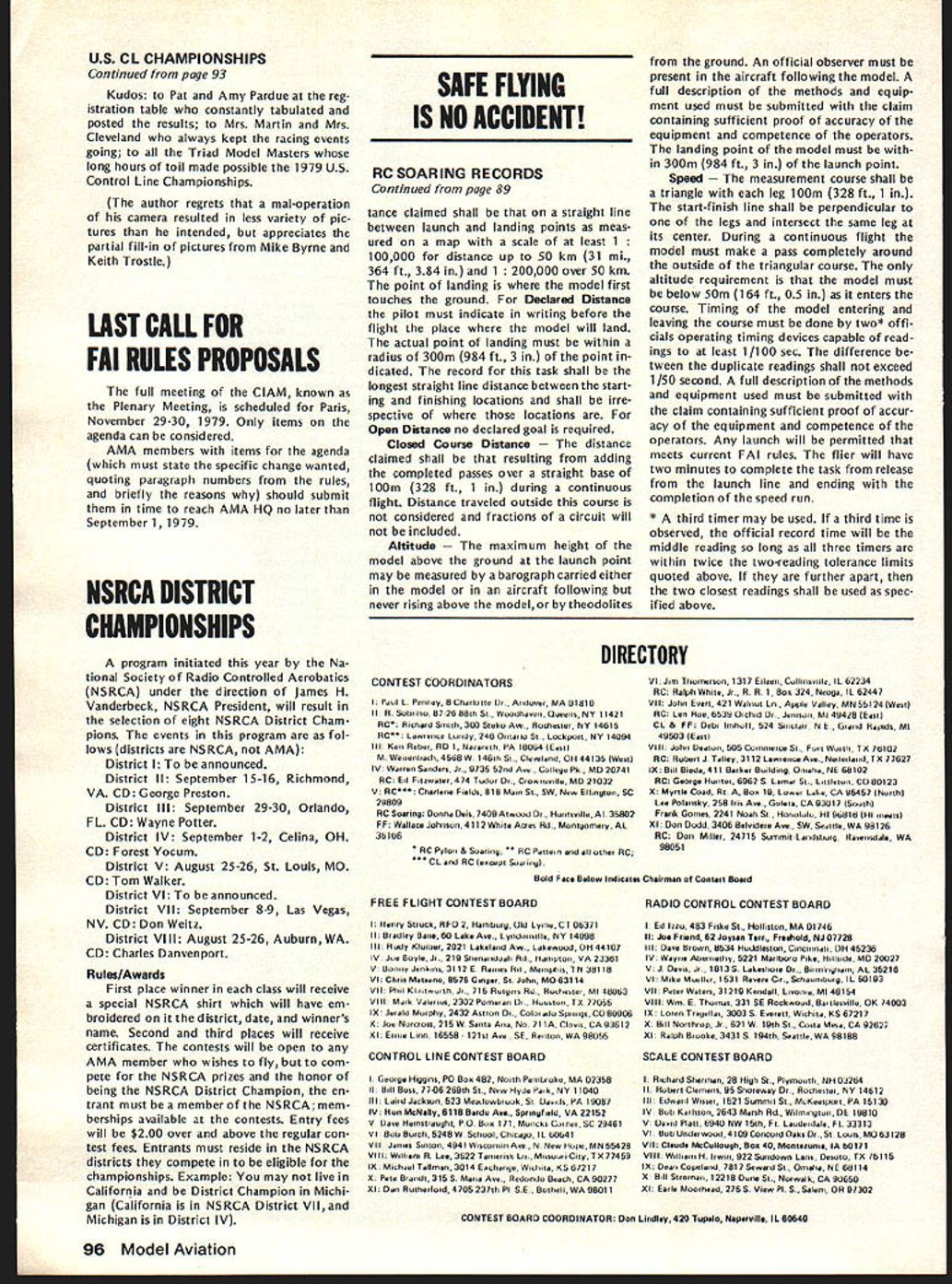
- Declared and Open Distance — The dis-
(Continued on page 96)
Competition Newsletter
1979 U.S. Control Line Championships
B.B. BROWN, JR.
Good news and bad news.
The good news is that "the meet" will be held again next year at about the same time, says Bill Pardue, master organizer for the past seven years—of which three have been AMA AAAA championship sanctions. Announcements will come later as to the managing and field CD's of next year's big CL event.
The bad news can be summed up in two statements: "Boy, it rained a lot this year," and "Can we get gas?" Yes, it did rain a bunch over June 16–17, the dates of the 1979 U.S. Control Line Championships, but there were plenty of gas stations open (without lines!) in Winston-Salem, NC, where the event was held. Still, the weather and gas question might have affected attendance, but 158 contestants did show, just a couple down from last year. And everybody put in lots of flights on Sunday when the rain backed off to just a slight drizzle.
To anybody who wants to know what control-line flying is all about, this is the contest to make, even if only as a spectator. Try to get there on Friday afternoon before the meet begins and watch through Sunday; you'll see virtually every kind of CL model there is.
Official flights started at 9 A.M. Saturday for all classes of Speed and also FAI Team Racing.
After all the Team Racing preliminary heats, Perkins/Albritton had the fastest time of 3:55 for 10 kilometers, followed by Kelly/Parent (of Canada) and Vansant/Vansant. In the 20 km finals, Perkins/Albritton looked to be the winner early in the race, but the Canadians took the first-place hardware, going the distance in 8 minutes, 34.14 seconds.
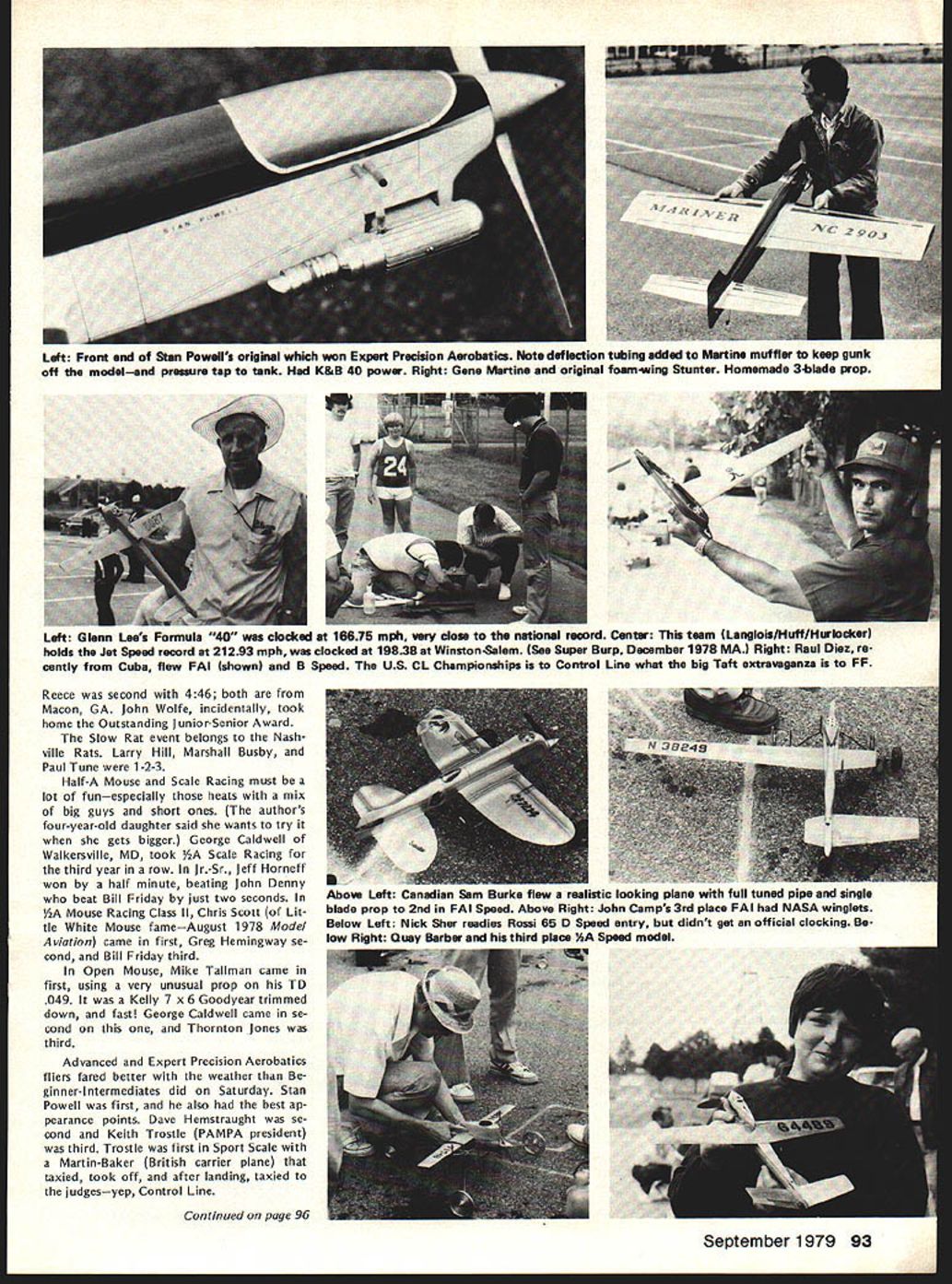
Charles Lieber of New Jersey set the FAI Speed pace early with 148 mph—which held through the contest. Lieber was a member of the U.S. World Champs team last year. Sam Burke, a Canadian artist, flew a very unusual semi-scale FAI Speed ship at a pretty fast clip—142 mph.
The Slow Combat circle had a goodly number of entries, but they were able to battle to a finish before the rains came. A new face in Combat is Gary Fentress, long known as one of the best pit men in racing events. Good is good, and Gary took second in Open, bested only by Mack Henry. In Fast Combat, Phil Cartier jousted the best. Mike Tallman came from Kansas to take second. In FAI Combat, Mack Henry, Gary Fentress and Phil Cartier were 1–2–3. FAI Combat was flown Sunday afternoon, when the weather had cleared a bit, and it drew a big crowd around the fence.
Noon Saturday was the start of the Navy Carrier events and Scale Racing (Goodyear), and that hour brought the rain—an insidious rain. Pete Mazur almost set a record low score in Class I Carrier with 98.88 points. Last year there was very little Carrier activity, but this year they flew all six hours allotted—in rain!
Beginner‑Intermediate Precision Aerobatics fliers must have had a tough time: five feet off the asphalt at 60 mph, inverted, and so on, all in the rain. John Easley took first place.
Goodyear in the rain is like Spa in auto racing. For the many entries to fly elimination heats would have taken a long time, so everybody voted to go just for a 160-lap final—and as it turned out, the speeds were phenomenal. John Ballard, first, covered 10 miles in a driving rain in just 5 minutes and 51 seconds. Ballard had three pit stops and averaged 102 mph.
On Sunday the Speed fliers came out in force. The pit area was crowded from 9 A.M. to 5 P.M. One record was set in the "slow" air: 198.16 mph in Class D by the Langlois/Hurlocker/Huff team. Glenn Lee came close in Formula 40 to breaking his own 168 mph record with a 166 mph effort. Lots of flying, lots of fun, and trophies.
Rat Racing saw two relative newcomers, Senior-age fliers at that, beat all comers. John Wolfe was first with 4:38 and Steve Reece was second with 4:46; both are from Macon, GA. John Wolfe, incidentally, took home the Outstanding Junior‑Senior Award.
The Slow Rat event belongs to the Nashville Rats. Larry Hill, Marshall Busby, and Paul Tune were 1–2–3.
Half-A Mouse and Scale Racing must be a lot of fun—especially those heats with a mix of big guys and short ones. (The author's four-year-old daughter said she wants to try it when she gets bigger.) George Caldwell of Walkersville, MD, took 1/2A Scale Racing for the third year in a row. In Jr.-Sr., Jeff Horneff won by a half minute, beating John Denny who beat Bill Friday by just two seconds. In 1/2A Mouse Racing Class II, Chris Scott of Little White Mouse fame (August 1978 Model Aviation) came in first, Greg Hemingway second, and Bill Friday third.
In Open Mouse, Mike Tallman came in first, using a very unusual prop on his TD .049. It was a Kelly 7 x 6 Goodyear trimmed down, and fast! George Caldwell came in second on this one, and Thornton Jones was third.
Advanced and Expert Precision Aerobatics fliers fared better with the weather than Beginner‑Intermediates did on Saturday. Stan Powell was first, and he also had the best appearance points. Dave Henstraught was second and Keith Trostle (PAMPA president) was third. Trostle was first in Sport Scale with a Martin‑Baker (British carrier plane) that taxied, took off, and after landing taxied to the judges—yep, Control Line.
Competition Newsletter (editorial)
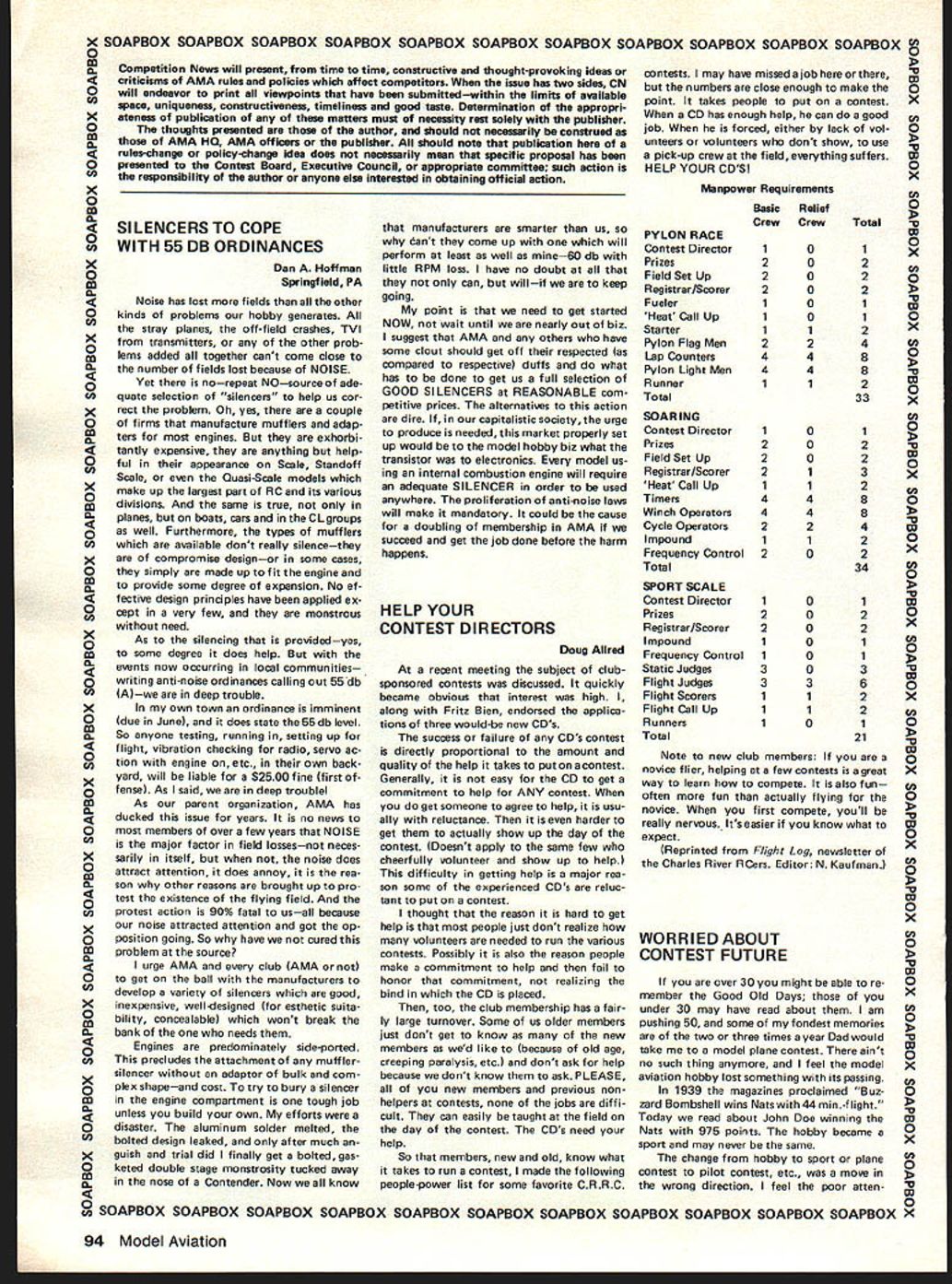
Competition News will present, from time to time, constructive and thought‑provoking ideas or criticisms of AMA rules and policies which affect competitors. When the issue has two sides, CN will endeavor to print all viewpoints that have been submitted—within the limits of available space, uniqueness, constructiveness, timeliness and good taste. Determination of the appropriateness of publication of any of these matters must of necessity rest solely with the publisher. The thoughts presented are those of the author, and should not necessarily be construed as those of AMA HQ, AMA officers or the publisher. All should note that publication here of a rules‑change or policy‑change idea does not necessarily mean that a specific proposal has been presented to the Contest Board, Executive Council, or appropriate committee; such action is the responsibility of the author or anyone else interested in obtaining official action.
I may have missed a job here or there, but the numbers are close enough to make the point. It takes people to put on a contest. When a CD has enough help, he can do a good job. When he is forced, either by lack of volunteers or volunteers who don't show, to use a pick‑up crew at the field, everything suffers. HELP YOUR CD'S!
SILENCERS TO COPE WITH 55 DB ORDINANCES
Dan A. Hoffman Springfield, PA
Noise has lost more fields than all the other kinds of problems our hobby generates. All the stray planes, the off‑field crashes, TVI from transmitters, or any of the other problems added together can't come close to the number of fields lost because of NOISE.
Yet there is no "one‑source" of adequate solution of "silencers" to help us correct the problem. Oh, yes, there are a couple of firms that manufacture mufflers and adapters for most engines. But they are exorbitantly expensive and anything but helpful in appearance on Scale, Standoff Scale, or even the Quasi‑Scale models which make up the largest part of RC and its various divisions. The same is true not only in planes, but on boats, cars, and in CL groups as well. Furthermore, the types of mufflers available don't really silence—they are compromise designs—or in some cases, they are simply made up to fit the engine and to provide some degree of expansion. No effective design principles have been applied except in a very few, and they are monstrous without need.
As to the silencing that is provided—yes, to some degree it does help. But with the events now occurring in local communities—writing anti‑noise ordinances calling out 55 dB(A)—we are in deep trouble.
In my own town an ordinance is imminent (due in June), and it does state the 55 dB level. So anyone testing, running in, setting up for flight, vibration checking for radio, servo action with engine on, etc., in their own back yard, will be liable for a $25.00 fine (first offense). As I said, we are in deep trouble!
As our parent organization, AMA has ducked this issue for years. It is no news to most members of over a few years that NOISE is the major factor in field losses—not necessarily in itself, but when the noise attracts attention it annoys, and it is the reason other reasons are brought up to protest the existence of the flying field. The protest action is 90% fatal to us—all because our noise attracted attention and got the opposition going. So why have we not cured this problem at the source?
I urge AMA and every club (AMA or not) to get on the ball with the manufacturers to develop a variety of silencers which are good, inexpensive, well‑designed (for aesthetic suitability, concealable) and affordable.
Engines are predominantly side‑ported. This precludes the attachment of any muffler‑silencer that is not an adaptor of bulk and complex shape—and cost. To try to bury a silencer in the engine compartment is one tough job unless you build your own. My effort was a disaster: the aluminum solder melted, the bolted design leaked, and only after much anguish and trial did I finally get a bolted, gasketed double-stage monstrosity tucked away in the nose of a Contender. Now we all know that manufacturers are smarter than us, so why can't they come up with one which will perform at least as well as mine—60 dB with little RPM loss? I have no doubt that they can and will—if we are to keep going.
My point is that we need to get started NOW, not wait until we are nearly out of business. I suggest that AMA and any others who have some clout should get off their respective duffs and do what has to be done to get us a full selection of GOOD SILENCERS at REASONABLE competitive prices. The alternatives to this action are dire. If, in our capitalistic society, the urge to produce is needed, this market properly set up could be the model hobby business what the transistor was to electronics. Every model using an internal combustion engine will require an adequate silencer in order to be used anywhere. The proliferation of anti‑noise laws will make it mandatory. It could be the cause for a doubling of membership in AMA if we succeed and get the job done before the harm happens.
HELP YOUR CONTEST DIRECTORS
Doug Allred
At a recent meeting the subject of club‑sponsored contests was discussed. It quickly became obvious that interest was high. I, along with Fritz Bien, endorsed the applications of three would‑be new CD's.
The success or failure of any CD's contest is directly proportional to the amount and quality of help it takes to put on a contest. Generally, it is not easy for the CD to get a commitment to help for any contest. When you do get someone to agree to help, it is usually with reluctance. Then it is even harder to get them to actually show up the day of the contest. (Doesn't apply to the same few who cheerfully volunteer and show up to help.) This difficulty in getting help is a major reason some experienced CD's are reluctant to put on a contest.
I thought the reason it is hard to get help is that most people just don't realize how many volunteers are needed to run the various contests. Possibly it is also the reason people make a commitment to help and then fail to honor that commitment, not realizing the bind in which the CD is placed.
Then, too, the club membership has a fairly large turnover. Some of us older members just don't get to know as many of the new members as we'd like to and don't ask for help because we don't know them to ask. PLEASE, all of you new members and previous non‑helpers at contests—none of the jobs are difficult. They can easily be taught at the field on the day of the contest. The CD's need your help.
So that members, new and old, know what it takes to run a contest, I made the following people‑power list for some favorite C.R.R.C. events.
- PYLON RACE
- Contest Director: Basic 1, Relief 0, Total 1
- Prizes: Basic 2, Relief 0, Total 2
- Field Set Up: Basic 2, Relief 0, Total 2
- Registrar/Scorer: Basic 1, Relief 0, Total 1
- Fueler: Basic 1, Relief 0, Total 1
- "Heat" Call Up: Basic 1, Relief 0, Total 1
- Starter: Basic 1, Relief 0, Total 1
- Pylon Flag Men: Basic 2, Relief 1, Total 3
- Lap Counters: Basic 4, Relief 4, Total 8
- Pylon Light Men: Basic 4, Relief 4, Total 8
- Runner: Basic 4, Relief 1, Total 5
- Total: 33
- SOARING
- Contest Director: Basic 1, Relief 0, Total 1
- Prizes: Basic 2, Relief 0, Total 2
- Field Set Up: Basic 2, Relief 0, Total 2
- Registrar/Scorer: Basic 1, Relief 0, Total 1
- "Heat" Call Up: Basic 1, Relief 0, Total 1
- Timers: Basic 4, Relief 4, Total 8
- Winch Operators: Basic 4, Relief 4, Total 8
- Cycle Operators: Basic 2, Relief 2, Total 4
- Impound: Basic 1, Relief 0, Total 1
- Frequency Control: Basic 2, Relief 1, Total 2
- Total: 34
- SPORT SCALE
- Contest Director: Basic 1, Relief 0, Total 1
- Prizes: Basic 2, Relief 0, Total 2
- Registrar/Scorer: Basic 1, Relief 0, Total 1
- Impound: Basic 1, Relief 0, Total 1
- Frequency Control: Basic 1, Relief 0, Total 1
- Static Judges: Basic 3, Relief 1, Total 4
- Flight Judges: Basic 3, Relief 1, Total 4
- Flight Scorers: Basic 1, Relief 0, Total 1
- Flight Call Up: Basic 1, Relief 0, Total 1
- Runners: Basic 1, Relief 0, Total 1
- Total: 21
Note to new club members: If you are a novice flier, helping at a few contests is a great way to learn how to compete. It is also fun—often more fun than actually flying for the novice. When you first compete, you'll be really nervous. It's easier if you know what to expect.
(Reprinted from Flight Log, newsletter of the Charles River R/Cers. Editor: N. Kaufman.)
WORRIED ABOUT CONTEST FUTURE
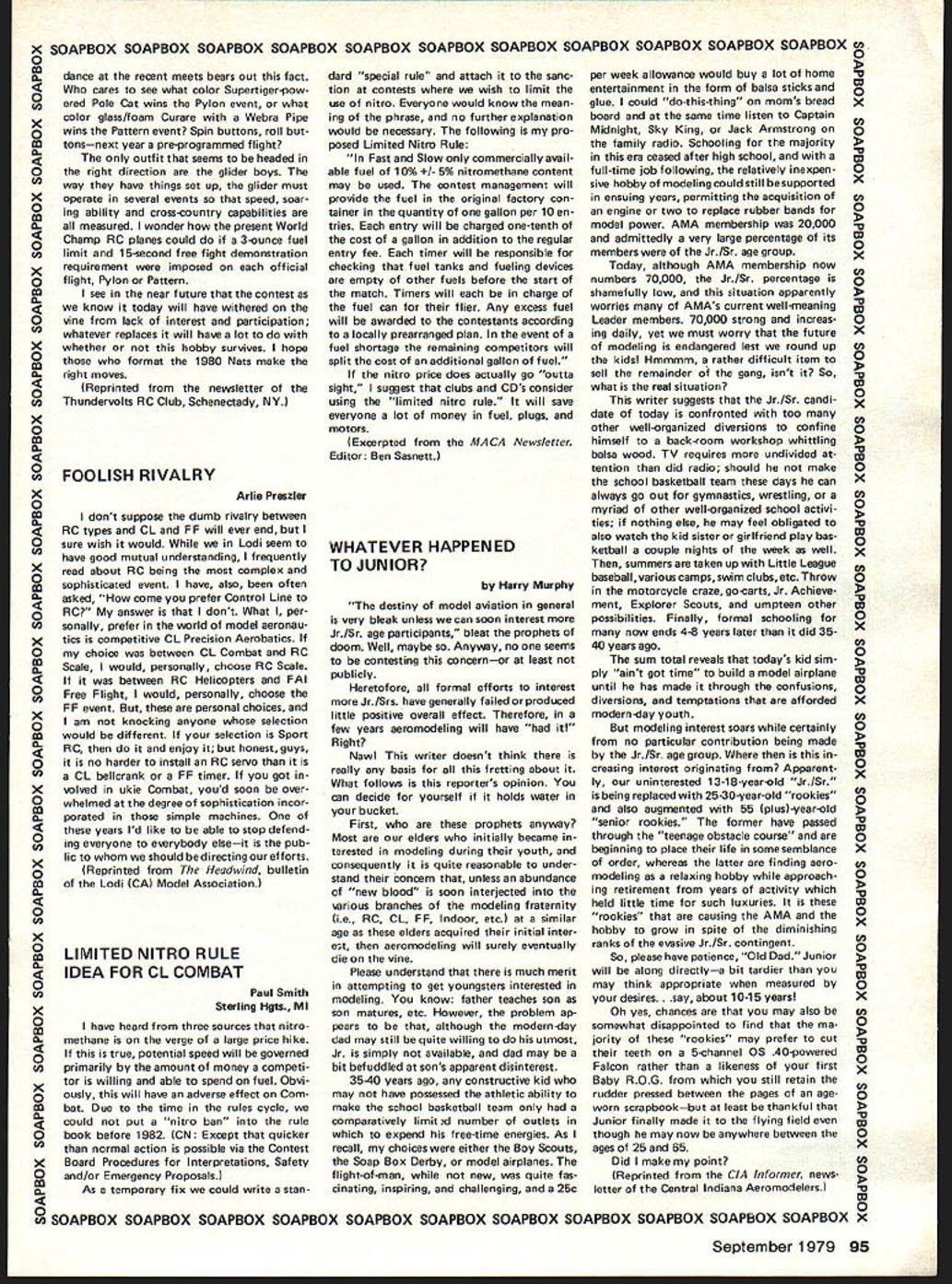
If you are over 30 you might remember the Good Old Days; those under 30 may have read about them. I am pushing 50, and some of my fondest memories are of the two or three times a year Dad would take me to a model plane contest. There ain't no such thing anymore, and I feel the model competition hobby lost something with its passing.
In 1939 the magazines proclaimed "Buzzard Bombshell wins Nats with 44 min. flight." Today we read about John Doolan winning the Nats with 975 points. The hobby became a sport and may never be the same.
The change from hobby to sport—or plane contest to pilot contest—was, I feel, a move in the wrong direction. I feel the poor attendance at recent meets bears this out. Who cares to see what color SuperTiger‑powered Pole Cat wins the Pylon event, or what color glass/foam Curare with a Weber Pipe wins the Pattern event? Spin buttons, roll buttons—next year a pre‑programmed flight? The only outfit that seems to be headed in the right direction are the glider boys. The way they have things set up, the glider must operate in several events so that speed, soaring ability and cross‑country capabilities are all measured. I wonder how the present World Champ RC planes could do if a 3‑ounce fuel limit and 15‑second free‑flight demonstration requirement were imposed on each official flight, Pylon or Pattern.
I see in the near future that the contest as we know it today will have withered on the vine from lack of interest and participation; whatever replaces it will have a lot to do with whether or not this hobby survives. I hope those who format the 1980 Nats make the right moves.
(Reprinted from the newsletter of the Thunderbolts RC Club, Schenectady, N.Y.)
U.S. CL CHAMPIONSHIPS
Kudos to Pat and Amy Pardue at the registration table who constantly tabulated and posted the results; to Mrs. Martin and Mrs. Cleveland who always kept the racing events going; and to all the Triad Model Masters whose long hours of toil made possible the 1979 U.S. Control Line Championships.
(The author regrets that a mal‑operation of his camera resulted in less variety of pictures than he intended, but appreciates the partial fill‑in of pictures from Mike Byrne and Keith Trostle.)
LAST CALL FOR FAI RULES PROPOSALS
The full meeting of the CIAM, known as the Plenary Meeting, is scheduled for Paris, November 29–30, 1979. Only items on the agenda can be considered.
AMA members with items for the agenda (which must state the specific change wanted, quoting paragraph numbers from the rules, and briefly the reasons why) should submit them in time to reach AMA HQ no later than September 1, 1979.
NSRCA DISTRICT CHAMPIONSHIPS
A program initiated this year by the National Society of Radio Controlled Aerobatics (NSRCA), under the direction of James H. Vanderschoot, NSRCA President, will result in the selection of eight NSRCA District Champions. The events in this program are as follows (districts are NSRCA, not AMA):
- District I: To be announced.
- District II: September 15–16, Richmond, VA. CD: George Preston.
- District III: September 29–30, Orlando, FL. CD: Wayne Potter.
- District IV: September 1–2, Celina, OH. CD: Forest Yocum.
- District V: August 25–26, St. Louis, MO. CD: Tom Walker.
- District VI: To be announced.
- District VII: September 8–9, Las Vegas, NV. CD: Don Weitz.
- District VIII: August 25–26, Auburn, WA. CD: Charles Davenport.
Rules/Awards
- First place winner in each class will receive a special NSRCA shirt embroidered with the district, date, and winner's name.
- Second and third places will receive certificates.
- The contests will be open to any AMA member who wishes to fly, but to compete for the NSRCA prizes and the honor of being the NSRCA District Champion, the entrant must be a member of the NSRCA; memberships will be available at the contests.
- Entry fees will be $2.00 over and above the regular contest fees.
- Entrants must reside in the NSRCA district they compete in to be eligible for the championships. Example: You may not live in California and be District Champion in Michigan (California is in NSRCA District VII, and Michigan is in District IV).
Transcribed from original scans by AI. Minor OCR errors may remain.

