
1976-77 COMPETITION RULES ANNOUNCED
Control Line, Scale, General
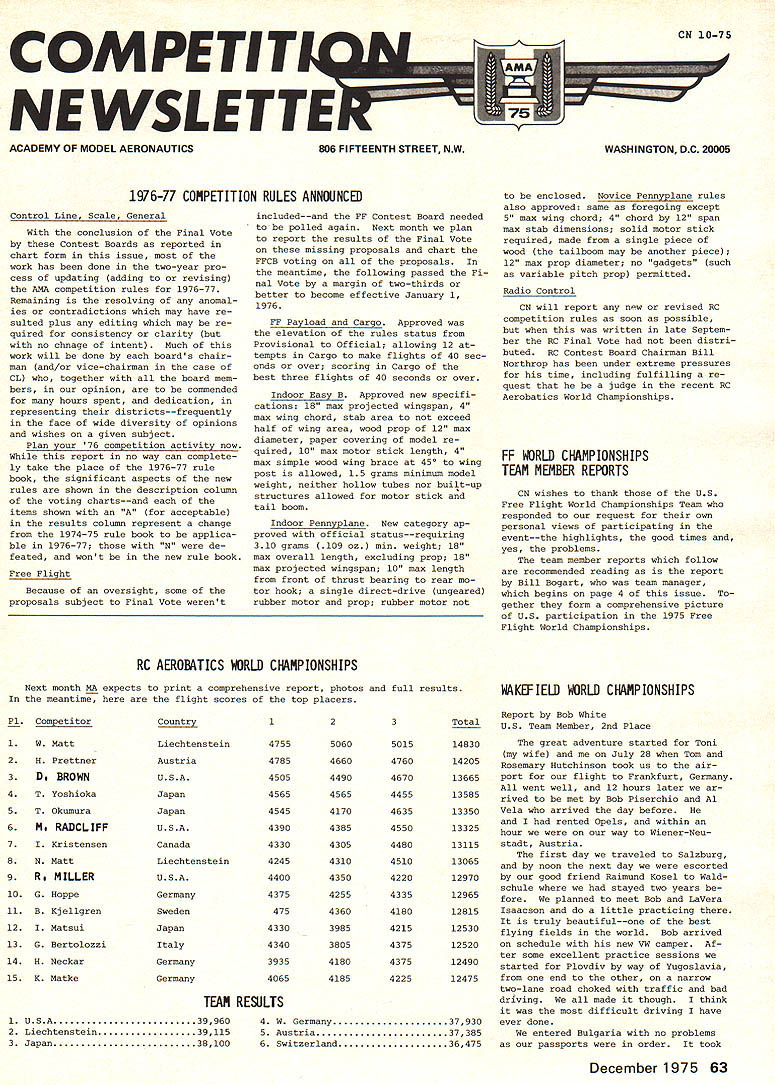
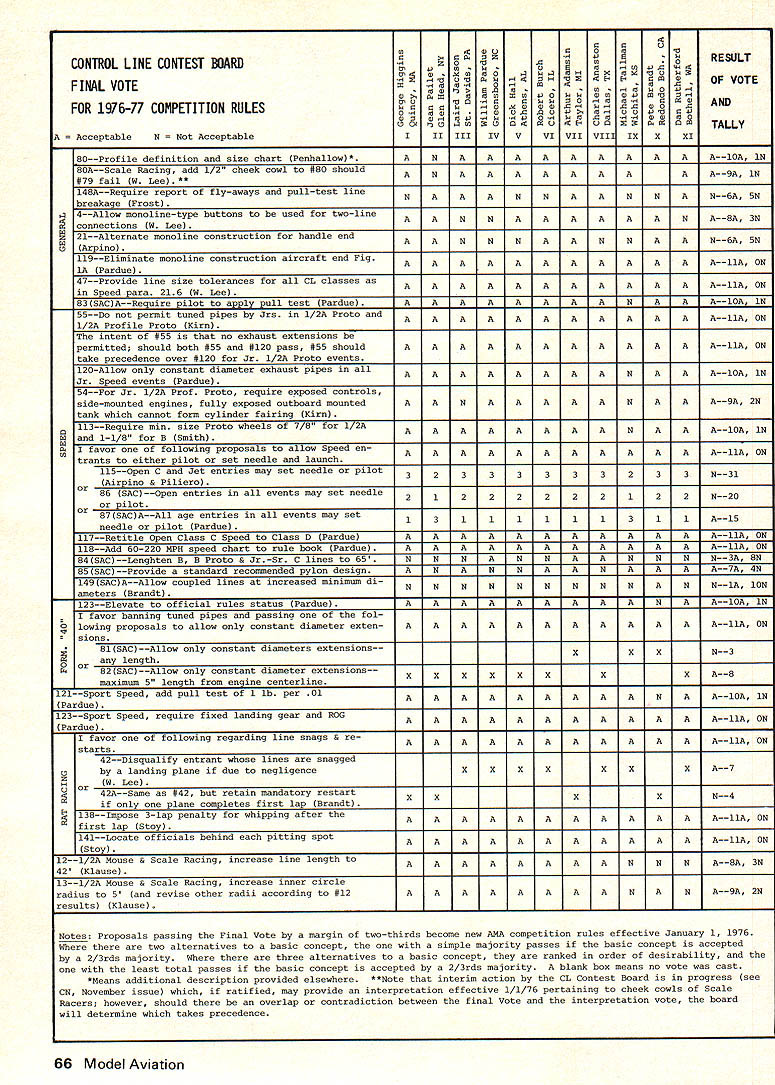
With the conclusion of the Final Vote by the Contest Boards as reported in chart form in this issue, most of the work has been done in the two-year process of updating (adding to, or revising) the AMA competition rules for 1976-77. Remaining is the resolving of any anomalies or contradictions which may have resulted plus any editing which may be required for consistency or clarity (but with no change of intent). Much of the work will be done by each board's chairman (and/or vice-chairman in the case of CL) who, together with all the board members, in our opinion, are to be commended for many hours spent, and dedication, in representing their districts—frequently faced with a wide diversity of opinions and wishes on a given subject.
Plan your 1976 competition activity now. While this report in no way can completely take the place of the 1976-77 rule book, the significant aspects of the new rules are shown in the description column, and the items shown with an "N" (for acceptable) in the results column represent a change from the 1974-75 rule book to be applicable in 1976-77; those with the "W" were defeated, and won't be in the new rule book.
Free Flight
Because of an oversight, some of the proposals subject to Final Vote weren't included—and the FF Contest Board needed to be polled again. Next month we plan to report the results of the Final Vote on these missing proposals and chart the FFCB voting on all of the proposals. In the meantime, the following passed the Final Vote by a margin of two-thirds or better to become effective January 1, 1976.
FF Payload and Cargo. Approved was the elevation of the rules status from Provisional to Official, allowing 12 attempts in Cargo to make flights of 40 seconds or over; scoring in Cargo of the best three flights of 40 seconds or over.
Indoor Easy B. Approved new specifications: 18" max projected wingspan, 4" max wing chord, stab area not to exceed half of wing area, wood prop 12" max diameter, paper covering of model required, 10" max motor stick length, 4" max simple wood wing brace at 45° to wing post allowed, 15 grams minimum model weight, neither hollow tubes nor built-up structures allowed for motor stick and tail boom.
Indoor Pennyplane. New category approved with official status—requiring 3.10 grams (.109 oz) min. weight; 18" max overall length excluding prop; 18" max projected wingspan; 10" max length from front of thrust bearing to rear motor hook; a single direct-drive (ungeared) rubber motor and prop; rubber motor not enclosed. Novice Pennyplane rules also approved; same foregoing except 5" max wing chord, 4" max chord, 12" max span, max stab dimensions, solid motor stick required made single piece wood; tailboom may be another piece; 12" max prop diameter; no "gadgets" (such as variable pitch prop) permitted.
Radio Control
CN will report any new or revised RC competition rules as soon as possible; but when this was written in late September the RC Final Vote had not been distributed. RC Contest Board Chairman Bill Northrop has been under extreme pressures of time including fulfilling a request that he be a judge in the recent RC Aerobatics World Championships. about two hours for the paperwork and money changing and red tape.
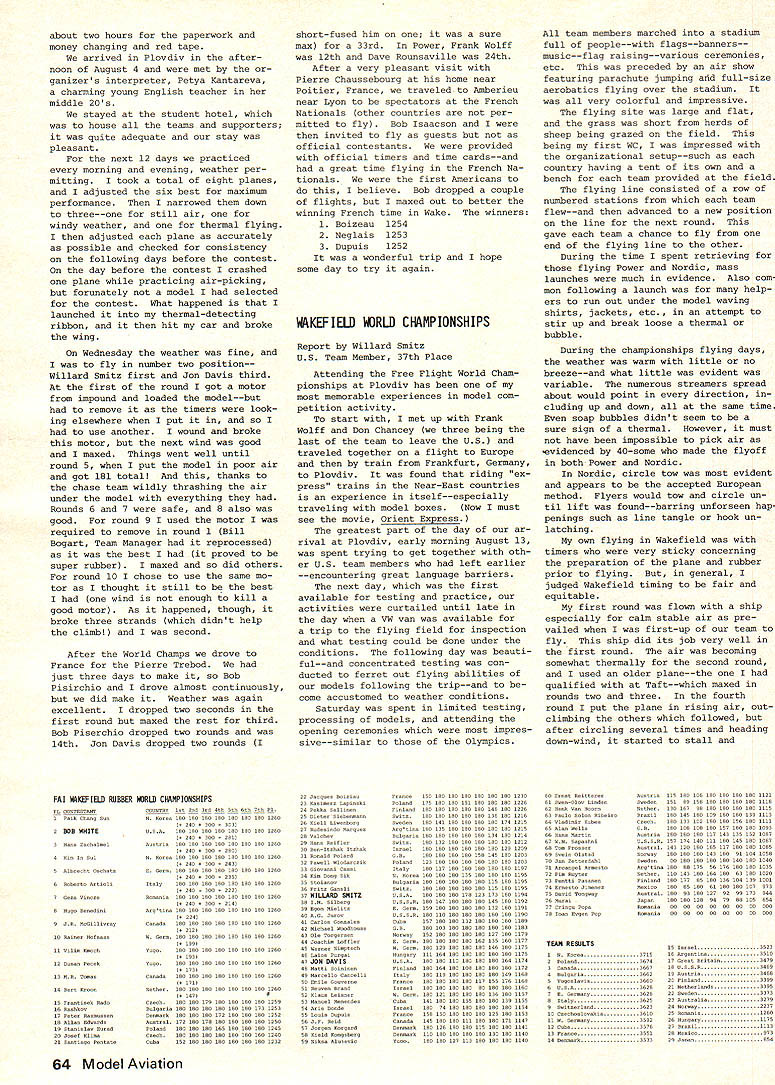
We arrived in Plovdiv in the afternoon of August 4 and were met by the organizer's interpreter, Petya Kanteva, a charming young English teacher in her middle 20's.
We stayed at the student hotel, which was to house all the teams and supporters; it was quite adequate and our stay was pleasant.
For the next 12 days, weather permitting, every morning and evening, weather permitting, I took a total of eight planes, and I adjusted the six best for maximum performance. Then I narrowed them down to three—one for still air, one for windy weather, and one for thermal flying.
I then adjusted each plane as accurately as possible and checked for consistency on the following days before the contest. On the day before the contest I crashed one plane while practicing air-picking, but fortunately not a model I had selected for the contest. What happened is that I launched it into my thermal-detecting ribbon, and it then hit my car and broke the wing.
On Wednesday the weather was fine, and I was to fly in number two position—Willard Smitz first and Jon Davis third. At the first of the round I got a motor from impound and loaded the model—but had to remove it as the timers were looking elsewhere when I put it in, and so I had to use another. I wound and broke the motor, but the next wind was good and I maxed. Things went well until round 5, when I put the model in poor air and got 181 total! And this, thanks to the chase team wildly thrashing the air under the model with everything they had. Rounds 6 and 7 were safe, and 8 also was good. For round 9 I used the motor I was required to remove in round 1 (Bill Bogart, Team Manager had it reprocessed) as it was the best. I maxed and so did others. For round 10 I chose to use the same motor as I thought it still to be the best (I had one wound in case wind is not enough to kill a good motor). As it happened, though, it broke three strands (which didn't help the climb!) and I was second.
After the World Champs we drove to France for the Pierre Trébod. We had just three days to make it, so Bob Piserchio and I drove almost continuously, but we did make it. Weather was again excellent. I dropped two seconds in the first round but maxed the rest for third. Bob Piserchio dropped two rounds and was 14th. Jon Davis dropped two rounds (I short-fused him on one; it was a sure max) for a 33rd. In Power, Frank Wolf was 12th and Dave Rounsaville was 24th.
After a very pleasant visit with Pierre Chaussebœuf at his home near Poitiers, France, we traveled to Ambérieu near Lyon to be spectators at the French Nationals (other countries are not permitted to fly). Bob Isacson and I were then invited to fly as guests but not as official contestants. We were provided with official timers and time cards—and had a great time flying in the French Nationals. We were the first Americans to do this, I believe. Bob dropped a couple of flights, but I maxed out better than the winning French time in Wake. The winners: 1. Boizeau 1254 2. Neglais 1253 3. Dupuis 1252
It was a wonderful trip and I hope some day to try it again.
WAKEFIELD WORLD CHAMPIONSHIPS
Report by Willard Smitz U.S. Team Member, 37th Place
Attending the Free Flight World Championships at Plovdiv has been one of my most memorable experiences in model competition activity.
To start with, I met up with Frank Wolf and Don Chancey (we three being the first of the team to leave the U.S.) and traveled together on a flight to Europe and then by train from Frankfurt, Germany, to Plovdiv. It was found that riding "express" trains in the Near-East countries is an experience in itself—especially traveling with model boxes. (Now I must see the movie, Orient Express.)
The greatest part of the day of our arrival at Plovdiv, early morning August 13, was spent trying to get together with other U.S. team members who had left earlier—encountering great language barriers. The next day, which was the first available for testing and practice, our activities were curtailed until late in the day when a VW van was available for a trip to the flying field for inspection and what testing could be done under the conditions. The following day was beautiful—and concentrated testing was conducted to ferret out flying abilities of our models following the trip—and to become accustomed to the weather conditions.
Saturday was spent in limited testing, processing of models, and attending the opening ceremonies which were most impressive—similar to those of the Olympics.
All team members marched into a stadium full of people—with flags—banner—music—flag-raising—various ceremonies, etc. This was preceded by an air show featuring parachute jumping and full-size aerobatics flying over the stadium. It was all very colorful and impressive.
The flying site was large and flat, and the grass was short from herds of sheep being grazed on the field. This being my first WC, I was impressed with the organizational setup—such as each country having a tent of its own and a bench for each team provided at the field. The flying line consisted of numbered stations from which each team flew—and then advanced to a new position on the line for the next round, thus giving each team a chance to fly from one end of the field to the other.
During the time I spent retrieving for those flying Power and Nordic, mass launches were much in evidence. Also common following a launch was for many helpers to run out under the model waving shirts, jackets, etc., in an attempt to stir up and break loose a thermal or bubble.
During the championships flying days, the weather was warm with little or no breeze—and what little was evident was variable. The numerous streamers spread about would point in every direction, including up and down, which made it at the same time even more confusing than usual. However, it must not have been impossible to pick air as evidenced by 40‑some who made the flyoff in both Power and Nordic.
In Nordic, circle tow was most evident and appears to be the accepted European method. Flyers would tow and circle until lift was found—then release and attempt to stay in it; this seemed to work well for many competitors.
My own flying in Wakefield was with thermals which were very sticky concerning the preparation of the plane and rubber prior to flying. But, in general, I judged Wakefield timing to be fair and equitable.
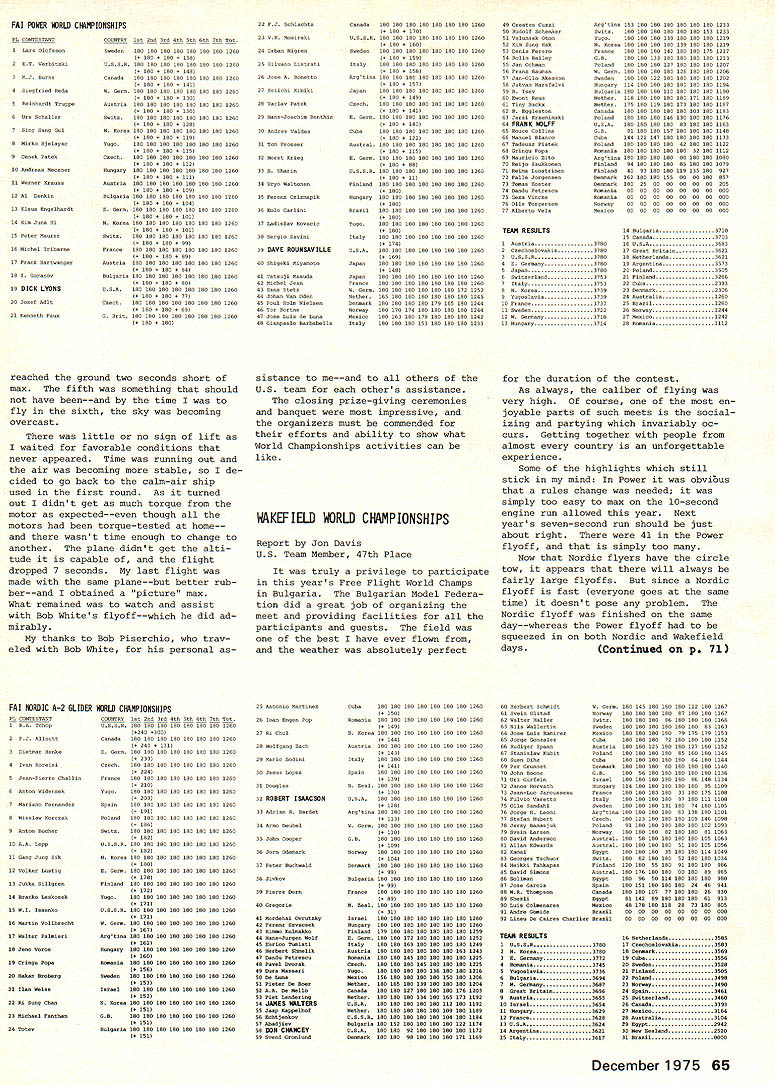
My first round was flown with a ship especially for calm, stable air as prevailed with the first up. It was a good ship and I maxed. The second round I flew the same ship and it also did well. In the fourth round I put the plane in rising air; on our climb and after several turns and heading downwind, it started to stall and the flight was lost. It reached the ground two seconds short of max. The fifth was something that should not have been—and by the time I was to fly in the sixth, the sky was becoming overcast.
There was little or no sign of lift as I waited for favorable conditions that never appeared. Time was running out and the air was becoming more stable, so I decided to go back to the calm‑air ship used in the first rounds. As it turned out I didn't get as much torque from the motor as expected—even though all the motors had been torque‑tested at home—and there wasn't time enough to change to another. The plane didn't get the altitude it is capable of, and the flight dropped 7 seconds. My last flight was made with the same plane—but better rubber—and I obtained a "picture" max. What remained was to watch and assist with Bob White's flyoff—which he did admirably.
My thanks to Bob Piserchio, who traveled with Bob White, for his personal assistance to me—and to all others of the U.S. team for each other's assistance.
The closing prize‑giving ceremony and banquet were most impressive, and the organizers must be commended for their efforts and ability to show what World Championships activities can be like.
WAKEFIELD WORLD CHAMPIONSHIPS
Report by Jon Davis
U.S. Team Member, 47th Place
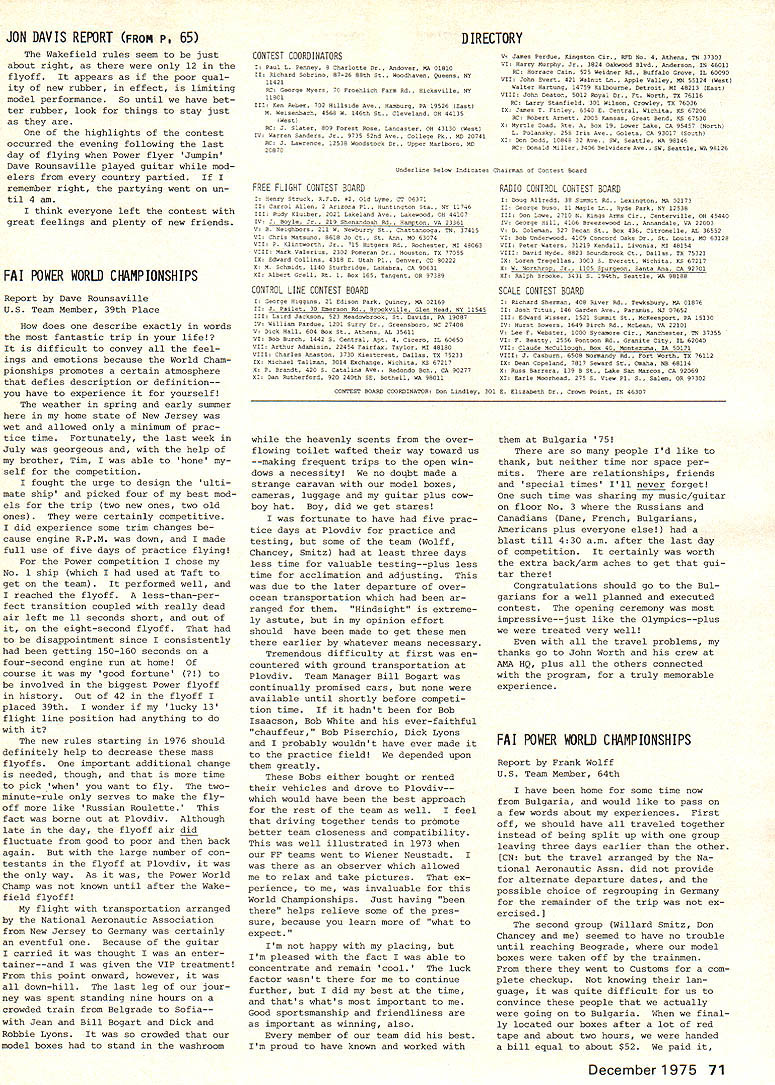
It was truly a privilege to participate in this year's Free Flight World Champs in Bulgaria. The Bulgarian Model Federation did a great job of organizing the meet and providing facilities for all the participants and guests. The field was one of the best I have ever flown from and the weather was absolutely perfect for the duration of the contest.
As always, the caliber of flying was very high. Of course, one of the most enjoyable parts of such meets is the socializing and partying which invariably occurs. Getting together with people from almost every country is an unforgettable experience.
Some of the highlights which still stick in my mind: In Power it was obvious that a rules change was needed; it was simply too easy to max on the 10‑second engine‑run allowed this year. Next year's seven‑second run should be just about right. There were 41 in the Power flyoff, and that is simply too many.
Now that Nordic flyers have the circle tow, it appears that there will always be fairly large flyoffs. But since a Nordic flyoff is fast (everyone goes at the same time) it doesn't pose any problem. The Nordic flyoff was finished on the same day—whereas the Power flyoff had to be squeezed in on both Nordic and Wakefield days.
Competition Newsletter
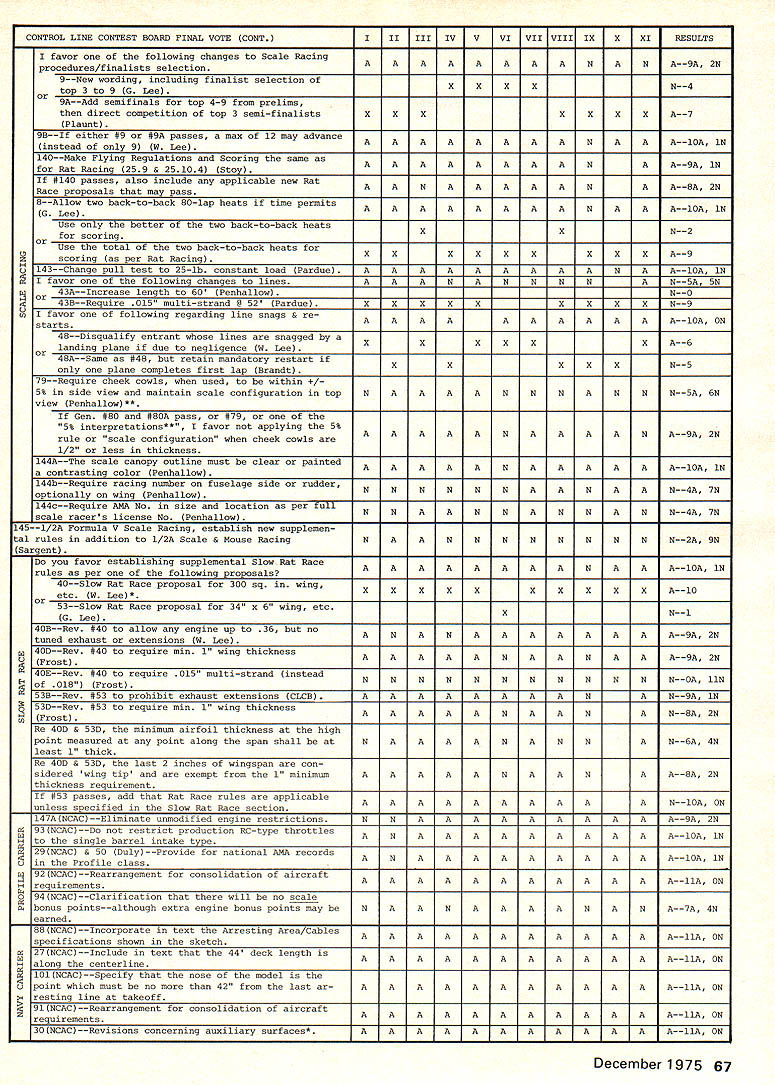
CONTROL LINE CONTEST BOARD FINAL VOTE FOR 1976-77 COMPETITION RULES
A = Acceptable N = Not Acceptable
80—Profile definition and size chart (Penhallow). 80A—Scale Racing, add 1/2" cheek cowl to #80 should #79 fail (W. Lee). 148A—Require report of fly-aways and pull-test line breakage (Frost). 4—Allow monoline-type buttons to be used for two-line connections (W. Lee). 21—Alternate monoline construction for handle end (Appino). 119—Eliminate monoline construction aircraft end Fig. 1A (Pardue). 47—Provide line size tolerances for all CL classes as in Speed para. 21.6 (W. Lee). 83(SAC)—Require pilot to apply pull test (Pardue). 55—Do not permit tuned pipes by Jrs. in 1/2A Proto and 1/2A Profile Proto (Kitim). The intent of #55 is that no exhaust extensions be permitted; should both #55 and #120 pass, #55 should take precedence over #120 for Jr. 1/2A Proto events. 120—Allow only constant diameter exhaust pipes in all Jr. Speed events (Pardue). 54—For Jr. 1/2A Prof. Proto, require exposed controls, side-mounted engines, fully exposed outboard mounted tank which cannot form cylinder fairing (Kirim). 113—Require min. size Proto wheels of 7/8" for 1/2A and 1-1/8" for B (Smith). I favor one of the following proposals to allow Speed entrants to either pilot or set needle and launch. 115—Open C and Jet entries may set needle or pilot (Airpino & Pelliero). 86 (SAC)—Open entries in all events may set needle or pilot. 87 (SAC)—All age entries in all events may set needle or pilot (Pardue). 117—Retitle Open Class C Speed to Class D (Pardue). 118—Add 60-220 MPH speed chart to rule book (Pardue). 84(SAC)—Lengthen B, B Proto & Jr.-Sr. C lines to 65'. 85(SAC)—Provide a standard recommended pylon design. 149(SAC)—Allow coupled lines at increased minimum diameters (Brandt). 123—Elevate to official rules status (Pardue). I favor banning tuned pipes and passing one of the following proposals to allow only constant diameter extensions. 81 (SAC)—Allow only constant diameter extensions—any length. 82 (SAC)—Allow only constant diameter extensions—maximum 5" length from engine centerline. 121—Sport Speed, add pull test of 1 lb. per. 0l (Pardue). 123—Sport Speed, require fixed landing gear and ROG (Pardue). I favor one of the following regarding line snags & restarts. 42—Disqualify entrant whose lines are snagged by a landing plane if due to negligence (W. Lee). 42A—Same as #42, but retain mandatory restart if only one plane completes first lap (Brandt). 138—Impose 3-lap penalty for whipping after the first lap (Stoy). 141—Locate officials behind each pitting spot (Stoy). 123—1/2A Mouse & Scale Racing, increase line length to 42' (Klauser). 13—1/2A Mouse & Scale Racing, increase inner circle radius to 5' (and revise other radii according to #12 results) (Klauser).
Notes: Proposals passing the Final Vote by a margin of two-thirds become new AMA competition rules effective January 1, 1976. Where there are two alternatives to a basic concept, the one with a simple majority passes if the basic concept is accepted by a 2/3rds majority. Where there are three alternatives to a basic concept, they are ranked in order of desirability, and the one with the least total passes if the basic concept is accepted by a 2/3rds majority. A blank box means no vote was cast.
(Interim editorial description provided elsewhere.) Note that interim action by the CL Contest Board is in progress and, on some items, may determine which takes precedence.
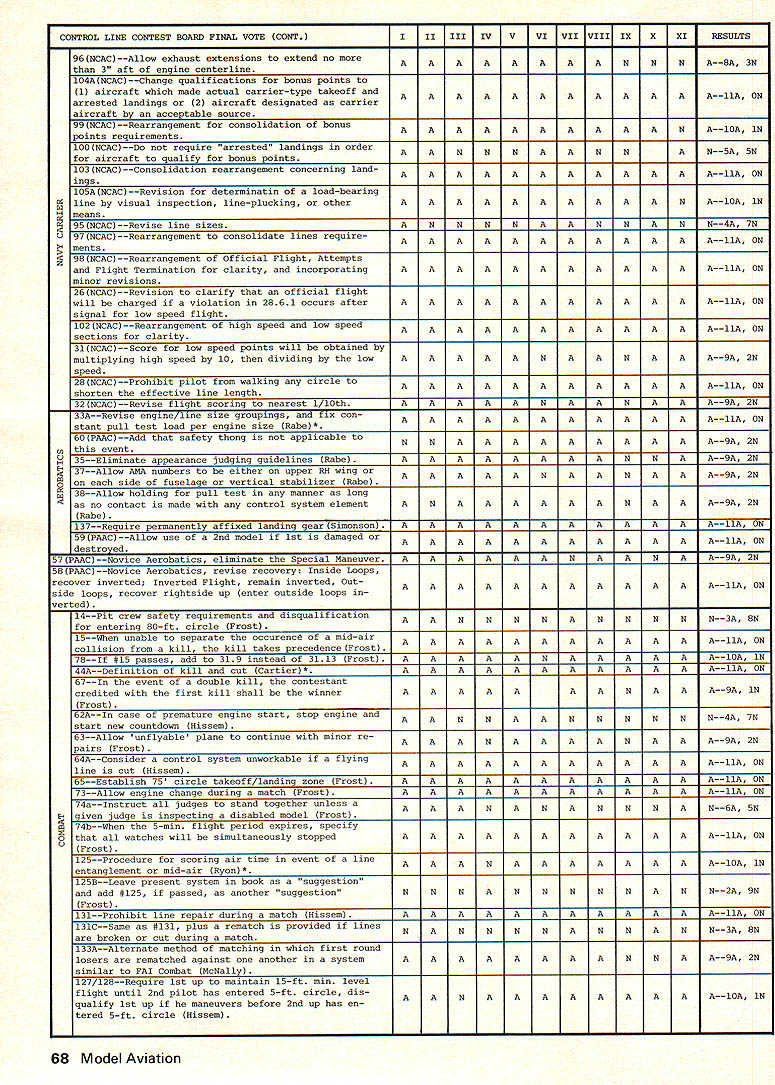
CONTROL LINE CONTEST BOARD FINAL VOTE (CONT.)
I favor one of the following changes to Scale Racing procedures/finalists selection.
9—New wording, including finalist selection of top 3 to 9 (G. Lee).
9A—Add semifinals for top 4-9 from prelims, then direct competition of top 3 semi-finalists (Plaunt).
9B—If either #9 or #9A passes, a max of 12 may advance (instead of only 9) (W. Lee).
140—Make Flying Regulations and Scoring the same as for Rat Racing (25.9 & 25.10.4) (Stoy).
If #140 passes, also include any applicable new Rat Race proposals that may pass.
8—Allow two back-to-back 80-lap heats if time permits (G. Lee).
Use only the better of the two back-to-back heats for scoring.
Use the total of the two back-to-back heats for scoring (as per Rat Racing).
143—Change pull test to 25-lb. constant load (Pardue).
I favor one of the following changes to lines.
43A—Increase length to 60' (Penhallow).
43B—Require .015" multi-strand (Pardue).
I favor one of the following regarding line snags & restarts.
48—Disqualify entrant whose lines are snagged by a landing plane if due to negligence (W. Lee).
48A—Same as #48, but retain mandatory restart if only one plane completes first lap (Brandt).
79—Require cheek cowls, when used, to be within +/- 5% in side view and maintain scale configuration in top view (Penhallow).
If Gen. #80 and #80A pass, or #79, or one of the "5% interpretations," I favor not applying the 5% rule or "scale configuration" when cheek cowls are 1/2" or less in thickness.
144A—The scale canopy outline must be clear or painted a contrasting color (Penhallow).
144B—Require racing number on fuselage side or rudder, optionally on wing (Penhallow).
144C—Require AMA No. in size and location as per full scale racer's license no. (Penhallow).
145—1/2A Formula V Scale Racing, establish new supplemental rules in addition to 1/2A Scale & Mouse Racing (Sargent).
Do you favor establishing supplemental Slow Rat Race rules as per one of the following proposals?
40—Slow Rat Race proposal for 300 sq. in. wing, etc. (W. Lee).
53—Slow Rat Race proposal for 34" x 6" wing, etc. (G. Lee).
40B—Rev. #40 to allow any engine up to .36, but no crankshaft exhaust or extensions (W. Lee).
40C—Rev. #40 to require min. 1/4" wing thickness (Frost).
40D—Rev. #40 to require .015" multi-strand (instead of .018) (Frost).
53B—Rev. #53 to prohibit exhaust extensions (CLBC).
53D—Rev. #53 to require min. 1/8" wing thickness (Frost).
Re #40 & #53D, the minimum airfoil thickness at the high point measured at any point along the span shall be at least 1/8" thick.
If #53 passes, add that Rat Race rules are applicable unless specified in the Slow Rat Race section.
147A (NCAC)—Eliminate unmodified engine restrictions.
99 (NCAC)—Do not restrict production RC-type throttles to the single barrel intake type.
29 (NCAC)—Provide for national AMA records in the Profile class.
92 (NCAC)—Rearrangement for consolidation of aircraft requirements.
94 (NCAC)—Clarification that there will be no scale bonus points—although extra engine bonus points may be earned.
38 (NCAC)—Incorporate in text the Arresting Area/Cables specifications shown in the sketch.
27 (NCAC)—Include in text that the 44" deck length is along the centerline.
101 (NCAC)—Specify that the nose of the model is the point which must be no more than 42" from the last arresting line at takeoff.
91 (NCAC)—Rearrangement for consolidation of aircraft requirements.
30 (NCAC)—Revisions concerning auxiliary surfaces.
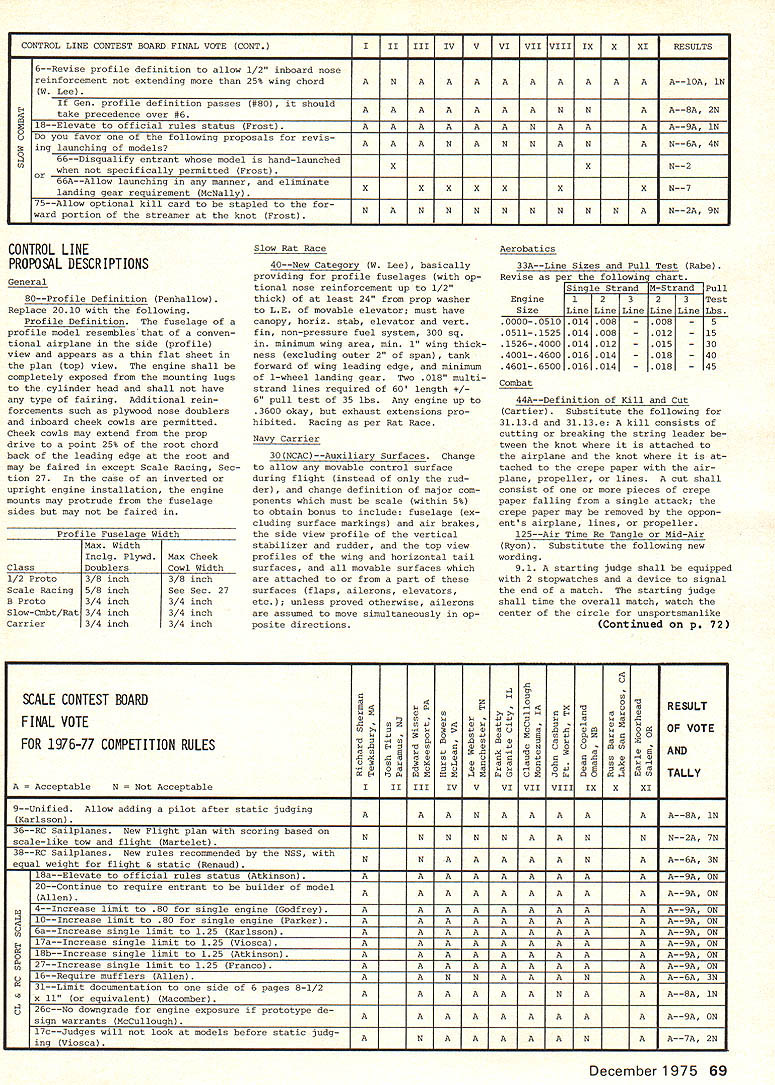
CONTROL LINE CONTEST BOARD FINAL VOTE (CONT.)
96 (NCAC)—Allow exhaust extensions to extend no more than 3" aft of engine centerline.
104A (NCAC)—Change qualifications for bonus points to (1) aircraft which made actual carrier-type takeoff and arrested landings or (2) aircraft designated as carrier aircraft by an acceptable source.
99 (NCAC)—Rearrangement for consolidation of bonus points requirements.
100 (NCAC)—Do not require "arrested" landings in order for aircraft to qualify for bonus points.
103 (NCAC)—Consolidation/rearrangement concerning landings.
105A (NCAC)—Revision for determination of a load-bearing line by visual inspection, line-plucking, or other means.
95 (NCAC)—Revise line sizes.
97 (NCAC)—Rearrangement to consolidate lines requirements.
98 (NCAC)—Rearrangement of Official Flight, Attempts and Flight Termination for clarity, and incorporating minor revisions.
26 (NCAC)—Revision to clarify that an official flight will be charged if a violation in 28.6.1 occurs after signal for low speed flight.
102 (NCAC)—Rearrangement of high speed and low speed sections for clarity.
31 (NCAC)—Score for low speed points will be obtained by multiplying high speed by 10, then dividing by the low speed.
28 (NCAC)—Prohibit pilot from walking any circle to shorten the effective line length.
32 (NCAC)—Revise flight scoring to nearest 1/10th.
33A—Revise engine/line size groupings, and fix constant pull test load per engine size (Rabe).
60 (PAAC)—Add that safety thong is not applicable to this event.
35—Eliminate appearance judging guidelines (Rabe).
37—Allow AMA numbers to be either on upper RH wing or on each side of fuselage or vertical stabilizer (Rabe).
38—Allow holding for pull test in any manner as long as no contact is made with any control system element (Rabe).
137—Require permanently affixed landing gear (Simonson).
59 (PAAC)—Allow use of a 2nd model if 1st is damaged or destroyed.
57 (PAAC)—Novice Aerobatics, eliminate the Special Maneuver.
58 (PAAC)—Novice Aerobatics, revise recovery: Inside Loops, recover inverted; Inverted Flight, remain inverted; Outside loops, recover rightside up (enter outside loops inverted).
14—Pit crew safety requirements and disqualification for entering 80-ft. circle (Frost).
15—When unable to separate the occurrence of a mid-air collision from a kill, the kill takes precedence (Frost).
78—If 15 passes, add to 31.9 instead of 31.13 (Frost).
44—Definition of kill and out (Cartlidge).
67—In the event of a double kill, the contestant credited with the first kill shall be the winner (Frost).
62A—In case of premature engine start, stop engine and start new countdown (Hissam).
63—Allow "unflyable" plane to continue with minor repairs (Frost).
64A—Consider a control system unworkable if a flying line is cut (Hissam).
65—Establish 75' circle takeoff/landing zone (Frost).
73—Allow engine change during a match (Frost).
74a—Instruct all judges to stand together unless a given judge is inspecting a disabled model (Frost).
74b—When the 5-min. flight period expires, specify that all watches will be simultaneously stopped (Frost).
125—Procedure for scoring air time in event of a line entanglement or mid-air (Ryan).
125b—Leave present system in book as a "suggestion" and add 125c. If passed, add as another "suggestion" (Frost).
131—Prohibit line repair during a match (Hissam).
131c—Same as #131, plus a rematch is provided if lines are broken or cut during a match.
133A—Alternate method of matching in which first round losers are rematched against one another in a system similar to FAI Combat (McNally).
127/128—Require list up to maintain 15-ft. min. level flight until 2nd pilot has entered 5-ft. circle, disqualify if up if he maneuvers before 2nd up has entered 5-ft. circle (Hissam).
Competition Newsletter
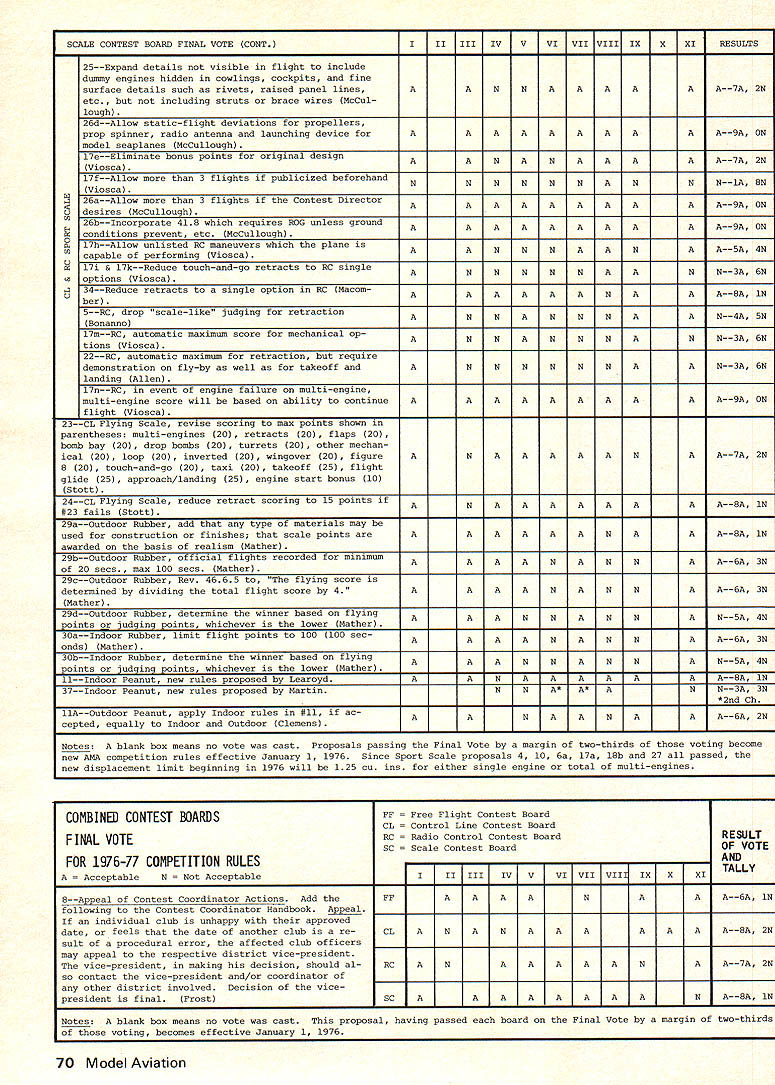
CONTROL LINE CONTEST BOARD FINAL VOTE (CONT.)
CONTROL LINE PROPOSAL DESCRIPTIONS
General
80--Profile Definition (Penhallow). Replace 20.10 with the following.
Profile Definition. The fuselage of a profile model resembles that of a conventional airplane in the side (profile) view and appears as a thin flat sheet in the plan (top) view. The engine shall be completely exposed from the mounting lugs to the cylinder head and shall not have any type of fairing. Additional reinforcements such as plywood nose doublers and inboard cheek cowls are permitted. Cheek cowls may extend from the prop drive to a point 25% of the chord back of the leading edge at the root and may be faired in except Scale Racing, section 27. In the case of an inverted or upright engine installation, the engine mounts may protrude from the fuselage sides but may not be faired in.
Profile Fuselage Width
Class Max. Width Inclg. Plywd. Max. Cheek Max. Cowl Width 1/2 Proto Scale Racing 3/8 inch 3/8 inch 3/8 inch B Proto 3/8 inch 3/8 inch 3/8 inch Slow-Cmbt/Rat 3/4 inch 3/4 inch 3/4 inch Carrier 3/4 inch 3/4 inch 3/4 inch
Slow Rat Race
40--New Category (W. Lee), basically providing for profile fuselages (with optional nose reinforcement up to 1/2" thickness); of at least 24" from prop washer to L.E. of movable elevator; must have canopy, horiz. stab, elevator and vert. fin, non-pressure fuel system, 300 sq. in. minimum wing area, min. 1" wing thickness (excluding outer 2" of span), tank forward of wing leading edge, and minimum 1-wheel landing gear. Two .018" multi-strand lines required of 60' length +/-; full test of 35 lbs. Any engine up to 3600 rpm, but exhaust extensions prohibited. Racing as per Rat Race.
Navy Carrier
30(NAC)--Auxiliary Surfaces. Change to allow any movable control surface during flight (instead of only the rudder), and change definition of major components used to obtain bonus to include (within 5%): fuselage decking, including surface markings and air brakes, the side view profile of the vertical stabilizer and rudder, and the top view profiles of the wing and horizontal tail surfaces, and all movable surfaces which are attached to or form a part of these surfaces (flaps, ailerons, elevators, etc.); unless proved otherwise, ailerons are assumed to move simultaneously in opposite directions.
Aerobatics
33A--Line Sizes and Pull Test (Rabe). Revise as per the following chart.
Engine Size Single Strand M-Strand Pull Test (lbs) .000-.0510 .004 .008 .012 5 .0511-.1250 .006 .012 .018 15 .1256-.4000 .014 .014 .018 30 .4001-.4600 .016 .014 .018 45
Combat
44--Definition of Kill and Cut (Cartier). Substitute the following for 31.13.d and 31.13.e. A kill consists of cutting or breaking the string leaders between the two where it is attached to the airplane and the knot where it is attached to the opponent's line, such that the airplane is out of control after the line is broken. The opponent shall be credited with a single attack; the opponent's plane may be removed by the opponent's airplane, lines, or propeller.
125--Air Time to Tangle or Mid-Air (Ryon). Substitute the following new wording.
9.1. A starting judge shall be equipped with two stopwatches and a device to signal the end of a match. The starting judge shall time the overall match, watch the center of the circle for unsportsmanlike ...
SCALE CONTEST BOARD FINAL VOTE (CONT.)
Notes: A blank box means no vote was cast. Proposals passing the Final Vote by a margin of two‑thirds of those voting become new AMA competition rules effective January 1, 1976. Since Sport Scale proposals 4, 10, 6a, 17a, 18b and 27 all passed, the new displacement limit beginning in 1976 will be 1.25 cu. ins. for either single engine or total of multi‑engines.
COMBINED CONTEST BOARDS
FINAL VOTE FOR 1976-77 COMPETITION RULES
A = Acceptable N = Not Acceptable
5--Appeal of Contest Coordinator Actions. Add the following to the Contest Coordinator Handbook. Appeal. If an individual club is unhappy with their approved date, or feels that the date of another club is a result of a procedural error, the affected club officers may appeal to the respective district vice-president. The vice-president, in making his decision, should also contact the vice-president and/or coordinator of any other district involved. Decision of the vice-president is final. (Frost)
Notes: A blank box means no vote was cast. This proposal, having passed each board on the Final Vote by a margin of two‑thirds of those voting, becomes effective January 1, 1976.
COMPETITION NEWSLETTER
ACADEMY OF MODEL AERONAUTICS 806 FIFTEENTH STREET NW WASHINGTON DC 20005
Control Line Scale — General conclusion — Final Vote. Contest Boards reported chart form. A great deal of work has been done — a two‑year process updating, adding, revising AMA competition rules for 1976‑77. Remaining items resolving anomalies, contradictions that may have resulted, plus editing required for consistency and clarity. No change in intent. Much work will be done by boards, chairmen and/or vice‑chairmen; in the case of CL, together with board members. Opinions commended — hours spent, dedication representing districts — frequently face wide diversity of opinions and wishes given the subject. Plan competition activity now reported; no way can completion take place for 1976‑77 rule book. Significant aspects of new rules shown in description column; voting charts — and items shown in Acceptable Results column represent change from 1974‑75 rule book applicable 1976‑77.
Note: Defeated won’t be in new rule book.
Free Flight — Because oversight some proposals subject to Final Vote weren't included — and the FF Contest Board needed to be polled again. Next month plan to report results of Final Vote missing proposals chart. FFCB voting proposals meantime following passed Final Vote margin two‑thirds; better become effective January 1, 1976.
FF Payload (Cargo) — Approved. Elevation rules status provisional official allowing 12 attempts. Cargo to make flights 40 seconds over; scoring Cargo best three flights 40 seconds or over.
Indoor — Easy B. Approved new specifications: 18" max projected wingspan; 4" max wing chord; stab area to exceed half wing area; wood prop 12" max diameter; paper covering model required; 10" max motor stick length; 4" max simple wood wing brace; 45° wing post allowed; 15 grams minimum model weight; neither hollow tubes nor built‑up structures allowed; motor stick tail boom allowed.
Indoor — Pennyplane. New category approved official status requiring 310 grams (1.09 oz?) minimum weight; 18" max overall length excluding prop; 18" max projected wingspan; 10" max length front thrust bearing; rear motor hook; single direct‑drive ungeared rubber motor; prop and rubber motor enclosed.
Novice Pennyplane rules also approved: same foregoing except 5" max wing chord; 4" chord? 12" span max; stab dimensions; solid motor stick required made single piece wood tailboom may be another piece; 12" max prop diameter; no gadgets such variable pitch prop permitted.
Radio Control — CN will report new revised RC competition rules as soon as possible; written late September. RC Final Vote distributed. RC Contest Board Chairman Bill Northrop has been under extreme pressures of time including fulfilling request to judge recent RC Aerobatics World Championships.
FF WORLD CHAMPIONSHIPS — TEAM MEMBER REPORTS. CM wishes to thank US Free Flight World Championships Team members who responded requests for their own personal views of participating in the event — the highlights, good times, yes problems. Team member reports follow; recommended reading report Bill Bogart, team manager, begins page 4 issue. Together form comprehensive picture of US participation 1975 Free Flight World Championships.
RC AEROBATICS WORLD CHAMPIONSHIPS — Next month WA expects to print comprehensive report and photos; meantime flight scores, top placers, full results.
WAKEFIELD WORLD CHAMPIONSHIPS — Report Bob White. Total US Team Member 2nd Place.
(End of Competition Newsletter material on this page.) but in the meantime the train we were supposed to transfer to had gone, and our only choice was to wait three hours for another.
We met Jim Walters and his wife at Belgrade, and they joined us in our travels. We arrived in Plovdiv about 2:30 am the next morning after what seemed like a week on the train — at all times on the train — all the while with little or nothing to eat and about the same for sleep.
We expected to be met at the train station and taken to the contestant housing, but we waited and waited in vain. We finally got to the student hotel about four o'clock in the afternoon.
A poor host doesn't necessarily carry through to the finish, but on the other hand a good start helps get a great deal.
I am not blaming my results completely on what we went through, as what happened to me on my fifth round was weather: a dust devil that fractured my fuselage. I then made a decision to repair and test, and to fly the same plane if okay. Obviously it was not the right decision.
Three days for testing turned out to be not enough time for me. The time might have been sufficient if the first had not rained practically all day, if there had been a sufficient amount of fuel left for the contest, if I was not so terribly tired and mentally exhausted from traveling for four days, if all my airplanes performed excellently without any changes or major repairs (as, under my circumstances, changing a prop brake from one airplane to another).
The American team did not have the complete togetherness that I observed of other countries. They stuck together like glue. I will end hoping that, in the future, our U.S. team will be better organized.
P.S. FAI Free Flight Power is the greatest!
NORDIC GLIDER WORLD CHAMPIONSHIPS
Report by Jim Walters U.S. Team Member, 54th Place
The WC was terrific! The level of competition was high as expected. My performance was lower than I feel (know) is my capability (was a real hill to lessen, I guess). My sixth round score was the result of a premature (almost unexplainable) release and in bad air, of course. All of my other flights were essentially solo thermal efforts; I'm no "tactical" flyer.
The contest organizers (obviously state supported) did a superb job—it's impossible to imagine their effort being duplicated here within any budget we (AMA) could muster up. They just place greater emphasis on modeling over there (too bad we've got so many distractions here).
The food provided by the organizers was healthful and more than adequate (quantity wise).
The weather during the two practice days and during the 3 days of competition was great—similar all five days. Max wind on one occasion approached only 9–10 mph; usually was 0–4 mph, and, not having resulted in very light thermals, that seemed to break loose (bubbles); sometimes eddying the models near the fringes and bottom leaving them to sink in less than a max. On many well-thermaled flights models seemed to be settling out at the time of thermalizing.
Team cooperation was basically good with at least several members enthusiastically beating the air on those close flights. Retrieving was easily done by several team members stationed downwind and of course very little drift.
Prior to the time our team had official interpreters, there was some difficulty with the language barriers — the interpreters were young (15–21) students who usually spoke several languages.
All foreign competitors were very friendly and generally willing to share ideas and show off model details. Even the North Koreans (who were obviously under close supervision) were noticed smiling, near the end of the competition.
Our A/2 Team had a great get-together session in the hotel with Tchop (A/2 winner) and Issanko both of the Russian A/2 Team who were most friendly and willing to show hardware details and share their vodka with us (after their victory of course).
The train traveled through Yugoslavia and Bulgaria since our travel budget was for the birds. I would have gladly paid the extra for airfare had I known the trouble we would have in regard to delays, impoundment of model boxes at customs and generally poor rail conditions in those countries. (Certainly smaller, less conspicuous boxes would have helped.)
The closing ceremonies were spectacular with all the teams parading before 30,000–40,000 pregame soccer fans — with acrobats, parachutists and fireworks complementing our precision marching.
The closing ceremonies were likewise elaborate with dancing and singing groups providing pre-presentation entertainment. The banquet was elaborate, but somewhat stiff with a table of the "Party" "Top Dogs" in attendance.
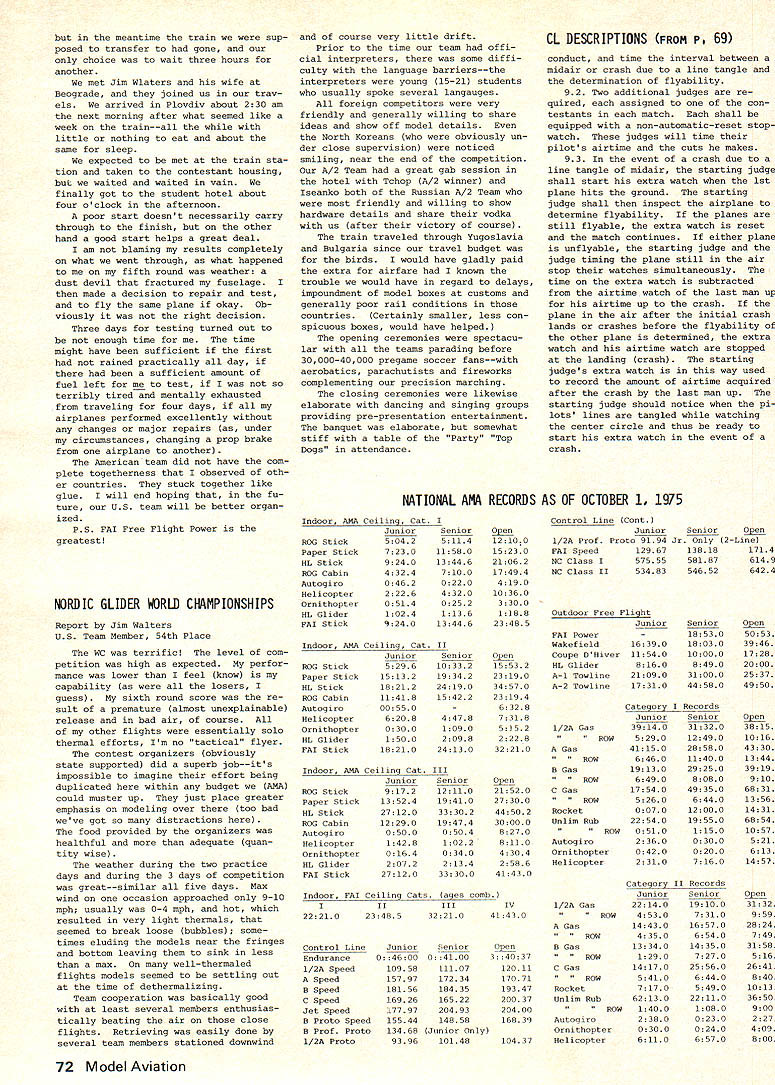
NATIONAL AMA RECORDS AS OF OCTOBER 1, 1975
Indoor, AMA Ceiling, Cat. I
- R/C Stick: Junior 5:04.2 Senior 5:11.4 Open 12:10.0
- Paper Stick: Junior 7:23.0 Senior 11:58.0 Open 15:23.0
- HL Stick: Junior 9:24.0 Senior 13:44.6 Open 23:23.5
- R/C Cabin: Junior 4:32.7 Senior 7:10.0 Open 17:49.4
- Autogiro: Junior 0:46.2 Senior 0:22.0 Open 4:19.0
- Helicopter: Junior 2:22.6 Senior 4:32.0 Open 10:36.0
- Ornithopter: Junior 0:51.4 Senior 4:25.2 Open 2:20.5
- HL Glider: Junior 1:02.4 Senior 1:13.6 Open 1:38.8
- FAI Stick: Junior 9:24.0 Senior 13:44.6 Open 23:48.5
Indoor, AMA Ceiling, Cat. II
- R/C Stick: Junior 5:29.6 Senior 10:33.2 Open 15:53.2
- Paper Stick: Junior 15:13.2 Senior 19:34.2 Open 23:19.0
- HL Stick: Junior 18:21.2 Senior 24:19.0 Open 34:57.0
- R/C Cabin: Junior 11:41.8 Senior 12:42.2 Open 23:19.4
- Autogiro: Junior 0:55.0 Senior 6:55.0 Open 6:32.8
- Helicopter: Junior 6:20.8 Senior 4:47.8 Open 7:31.8
- Ornithopter: Junior 0:30.0 Senior 1:09.0 Open 5:5.2
- HL Glider: Junior 1:50.0 Senior 2:09.8 Open 2:22.8
- FAI Stick: Junior 1:32.1 Senior 2:41.0 Open 3:21.0
Indoor, AMA Ceiling, Cat. III
- R/C Stick: Junior 9:17.2 Senior 12:11.0 Open 21:52.0
- Paper Stick: Junior 13:52.4 Senior 19:41.0 Open 27:30.0
- HL Stick: Junior 27:12.2 Senior 33:30.0 Open 41:30.0
- R/C Cabin: Junior 12:29.0 Senior 20:02.0 Open 27:39.0
- Autogiro: Junior 0:50.0 Senior 0:50.4 Open 8:27.0
- Helicopter: Junior 1:20.6 Senior 1:02.4 Open 1:11.0
- Ornithopter: Junior 0:16.4 Senior 0:16.4 Open 0:46.8
- HL Glider: Junior 2:07.2 Senior 2:33.0 Open 2:56.0
- FAI Stick: Junior 27:12.2 Senior 33:30.0 Open 41:30.0
Indoor, FAI Ceiling, Cat. I (ages 60?)
- R/C Stick: 22:21.0 23:48.5 32:21.0 41:40.0
Control Line (Cont.)
- 1/2A Prof. Proto: Junior 91.94 Senior 0ff? (2-Line)
- PAI Speed: 129.67 138.18 171.4
- NC Class I: 573.55 561.87 614.9
- NC Class II: 534.83 546.26 521.6
Outdoor Free Flight
- FAI Power: Junior 18:53.0 Senior 50:52.0 Open 50:52.0
- Wakefield: Junior 16:39.0 Senior 18:03.0 Open 19:46.0
- Coupe D'Hiver: Junior 11:54.0 Senior 10:00.0 Open 17:28.0
- HL Glider: Junior 8:16.0 Senior 8:49.0 Open 14:12.0
- A/2 Towline: Junior 21:09.0 Senior 31:00.0 Open 45:00.0
- A/2 Towline: Junior 17:31.0 Senior 44:58.0 Open 49:50.0
Category I Records (partial)
- 1/2A Gas: Junior 39:14.0 Senior 31:32.0 Open 38:15.0
- B Gas: 29:40.0 29:40.0 28:15.0
- C Gas: 19:13.0 19:13.0 21:40.0
- G Gas: 14:09.0 16:02.0 12:42.0
(Additional tables and entries continue on the page with numerous event names and times/measurements for Junior, Senior and Open classes; reproduction here preserves headings and representative entries as visible.)
72 Model Aviation
Transcribed from original scans by AI. Minor OCR errors may remain.

