
COMPETITION NEWSLETTER
RC AEROBATICS WORLD CHAMPIONSHIPS
Wolfgang Matt of Liechtenstein is the 1979 RC Aerobatics Individual World Champion, repeating his win in 1975. He scored 5,531 points. U.S. team members Dave Brown and Mark Radcliff were second and third, respectively, with 5,493 and 5,275 points.
Others in the flyoff:
- 4th: Gunter Hoppe, W. Germany, 5,264 points
- 5th: Ivan Kristensen, Canada, 5,189
- 6th: Bruno Giezendanner, Switzerland, 5,144
- U.S. team member Dean Koger placed 12th.
Dave Brown was the clear leader in the qualifying rounds, but Matt moved ahead in the first flyoff round when the judges awarded him an especially high score. Windy weather throughout the event worsened during subsequent flyoff rounds, leaving little chance for catching up.
Hanno Prettner did not participate—he had broken his hand in a fall down a flight of stairs a short while earlier.
The U.S. won the Team World Championship convincingly, with placings of 2nd, 3rd, and 12th and a team total of 1,244 points. This marks the third consecutive RC Aerobatics World Championship in which the U.S. has been the team victor. Team placings:
- 1st: United States, 1,244 points
- 2nd: Italy, 1,194
- 3rd: W. Germany, 1,172
- 4th: Switzerland, 1,159
- 5th: Liechtenstein, 1,148
- 6th: South Africa, 1,116
1980-81 COMPETITION RULES ANNOUNCED
The charts in this issue of Final Voting by the Radio Control, Control Line and Free Flight Contest Boards identify the new or changed AMA competition rules effective January 1, 1980. Final voting by the Scale and Combined Contest Boards will be presented next month.
Plan your 1980 competition activity now. While these voting charts don't provide every detail of the new rules, the most significant aspects are shown in the description columns. Items marked "A" (Acceptable) in the results column are changes or additions to the 1978-79 rules to be applicable in 1980-81; those marked "N" were defeated and will not be in the new rule book.
Where descriptions are general, refer to back issues of Model Aviation in the CN section for specifics of the original Basic Proposals and Cross‑Proposals. (Cross‑Proposals are identified by a capital letter following the proposal number; 65A, for instance, is the first Cross‑Proposal to Basic Proposal 65.)
Reference issues for proposals:
- Radio Control Basic Proposals: 1978 issues dated October (numbers 1–6) and December (7–8); RC Cross‑Proposals: 1979 issues dated May and June.
- Control Line Basic Proposals: 1978 issues dated October (1–2) and December (3–8); CL Cross‑Proposals: 1979 issues dated May and June.
- Free Flight Basic Proposals: 1978 issues dated October (1–3), November (4–19) and December (20–29); FF Cross‑Proposals: 1979 issues dated May and June.
U.S. CL SPEED, TEAM RACE & COMBAT TEAMS
Team selection for Team Race was at Dayton, OH, over Labor Day weekend; Speed selection was at Dayton and on the West Coast. Combat selection was at St. Louis, MO, September 15–16. Reports on these events are planned for next month. Those selected for the 1980 World Championships are:
- Team Racing:
- Albritton and Perkins — Vienna, VA and Ocala, FL
- Kusick and McCollum — Orange and El Toro, CA
- Jackson and Nelson — Philadelphia and Verona, PA
- Speed:
- Chuck Schuette — Lakewood, CA
- Charles Lieber — Moorestown, NJ
- Bob Spahr — Santa Ana, CA
- Combat:
- George Cleveland — Kenner, LA
- Phil Granderson — Seattle, WA
- Sherwood Buckstaff — Houston, TX
CONTROL LINE AEROBATICS TEAM FINALS
By Wynn Paul
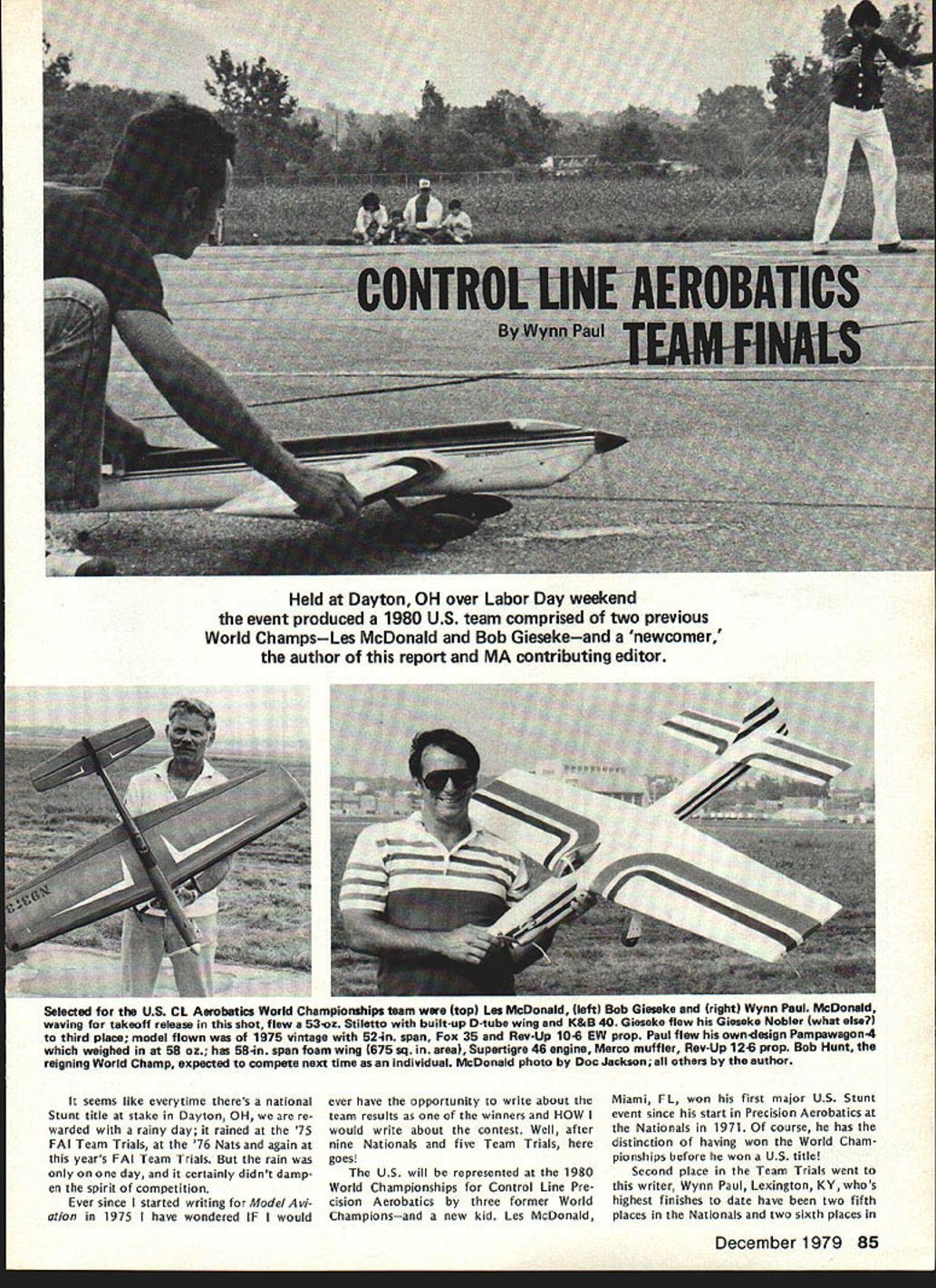
Held at Dayton, OH over Labor Day weekend, the event produced a 1980 U.S. team comprised of two previous World Champions—Les McDonald and Bob Gieseke—and a newcomer, the author of this report and MA contributing editor.
Selected for the U.S. CL Aerobatics World Championships team:
- Les McDonald (1st)
- Wynn Paul (2nd)
- Bob Gieseke (3rd)
Equipment notes and photo credits:
- McDonald flew a 53-oz. Stiletto with built-up D-tube wing and K&B .40.
- Gieseke flew his Gieseke Nobler (vintage 1975) with 52-in. span, Fox .35 and Rev-Up 10-6 EW prop.
- Paul flew his own-design Pampawagon-4 (58 oz.; 58-in. span foam wing — 675 sq. in.; Supertigre .46 engine; Marco muffler; Rev-Up 12-6 prop).
- Bob Hunt (reigning World Champ) expected to compete next time as an individual. McDonald photo by Doc Jackson; all others by the author.
It seems that every time there's a national Stunt title at stake in Dayton, OH, we are rewarded with a rainy day; it rained at the '75 FAI Team Trials, at the '76 Nationals, and again at this year's FAI Team Trials. The rain was only on one day and did not dampen the spirit of competition.
Since I started writing for Model Aviation in 1975 I have wondered if I would ever have the opportunity to write about team results as one of the winners—and how I would write about the contests. Well, after nine Nationals and five Team Trials, here goes!
Les McDonald of Miami, FL, won his first major U.S. Stunt event since he began in Precision Aerobatics at the Nationals in 1971. He has the distinction of having won the World Championships before he won a U.S. title.
Second place in the Team Trials went to this writer, Wynn Paul of Lexington, KY; my highest finishes to date had been two fifth places in the Nationals and two sixth places in the FAI Trials. Third place on the team went to current National Champion Bob Gieseke of Irving, TX; this will be his eighth appearance in the World Championships.
The Dayton site was perhaps the best ever used for team selection. We had a runway 6,000 feet long and 150 feet wide on the grounds of the Air Force Museum at Wright‑Patterson AFB. The practice area was enormous—at one time on Friday before competition I counted nine airplanes in the air at once, strung out along the runway. Colonel Bob Cordle of the Kittyhawk Chapter of the Dayton Buzzin' Buzzards was on site every day doing chores such as painting circles and mowing grass, along with Event Director Keith Trostle. The Air Force cooperation was enthusiastic and very helpful. We did have a few joggers who were quickly informed about not running on the left side of parked stunt planes. Judges were Remel Cooper, Mike Dietrich, Larry Lauer, Gene Schaffer, Jack Sheeks, and Lou Wolfgast.
Expected large turnout because of the central location resulted in an average group of 16 fliers. Bill Allen's Aero‑Challenge for Muscular Dystrophy probably attracted some entrants who might otherwise have flown at the FAI Trials, but most of the top fliers were present. Missing from this year's top 10 at the Nationals were Bob Whitely (who appeared as a spectator and worker with Bart Klapinski) and Jim Casale (who had to work). Remel Cooper judged; Gary McClellan and Frank McMillan were unable to attend. There were only 14 fliers at the '77 Trials in Atlanta, but 21 at the '75 Trials in Dayton.
Practice highlights:
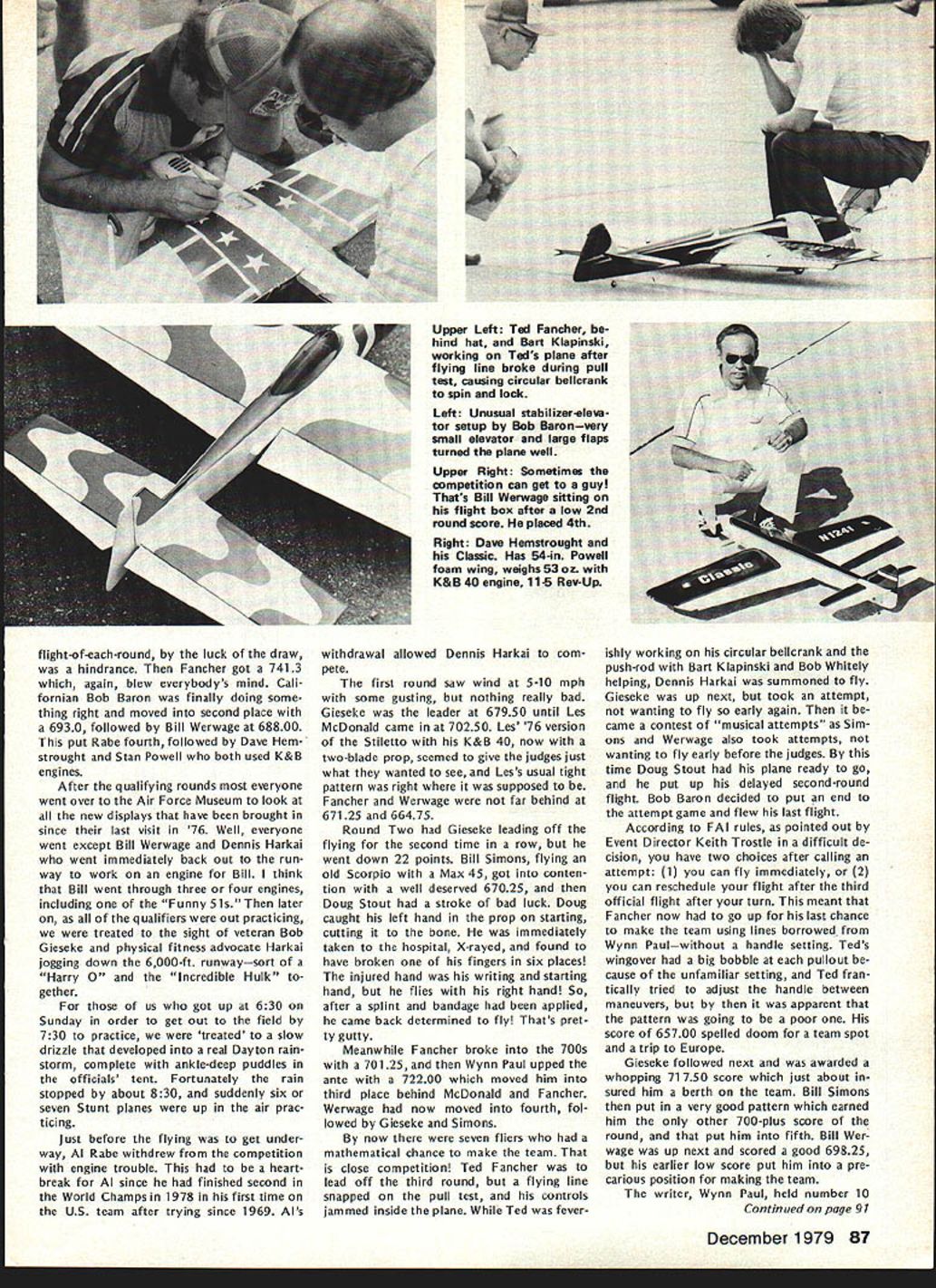
- Bob Baron debuted a new ship with a 700 sq. in. wing, Max .40 FSR, and a unique stab-elevator (mostly fixed stab with a small movable elevator). It turned nicely and Baron was in contention.
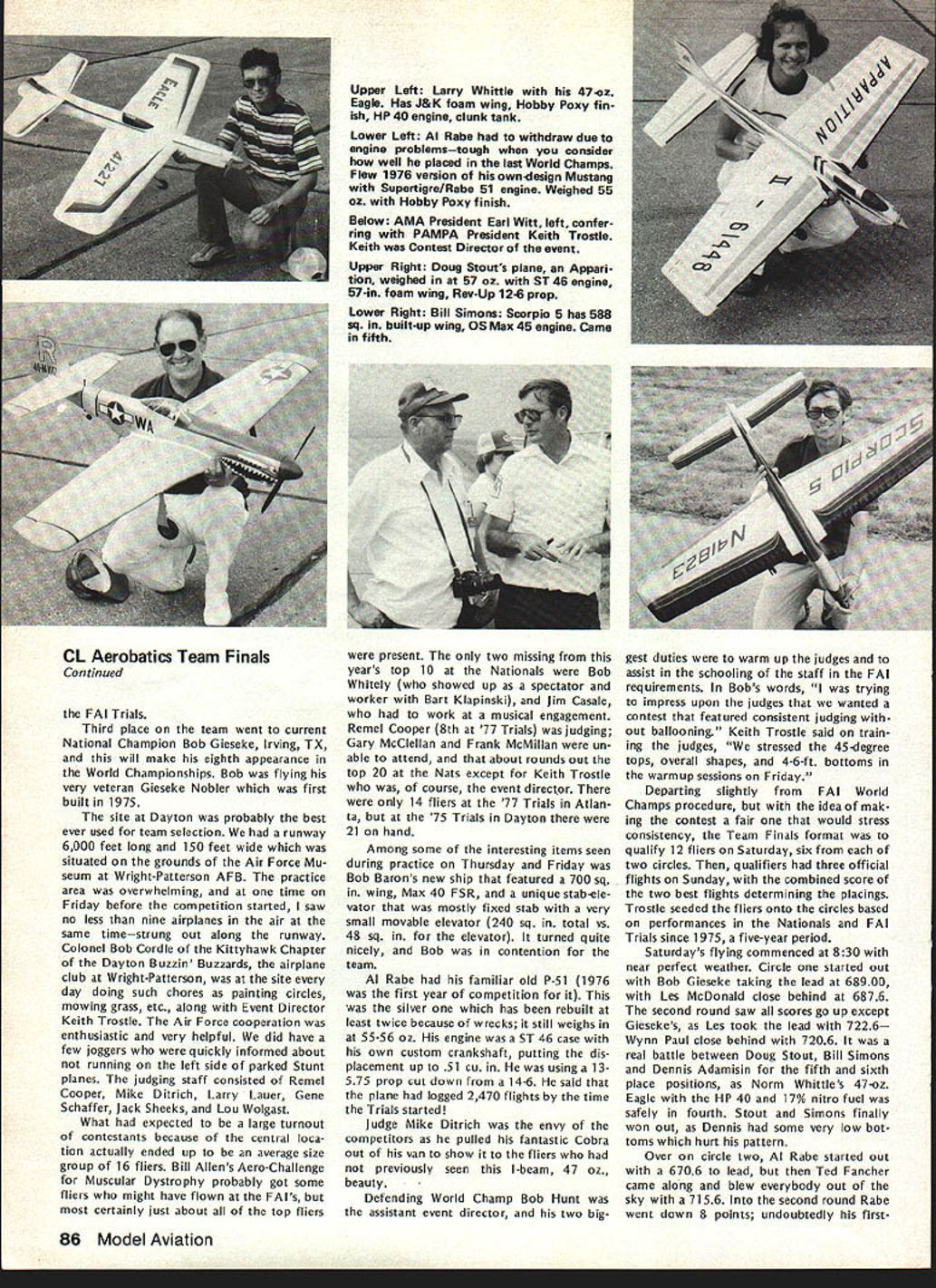
- Al Rabe flew his familiar silver P-51, rebuilt several times and weighing 55–56 oz. It used a modified ST .46 crankshaft (displacement up to .51 cu. in.) and a cut-down prop.
- Judge Mike Dietrich showed competitors his Cobra: a 1-beam, 47-oz., impressive airplane.
- Defending World Champ Bob Hunt served as assistant event director, warming up judges and assisting staff with FAI requirements. Training emphasized consistent judging without ballooning, 45-degree tops, overall shapes, and 4–6 ft. bottoms.
Format and qualifying:
- The Team Finals format qualified 12 fliers on Saturday (six from each of two circles). Qualifiers had three official flights on Sunday; combined score of the two best flights determined placings. Trostle seeded fliers onto circles based on performances in the Nationals and FAI Trials since 1975.
Saturday qualifying:
- Circle One: Bob Gieseke led early with 689.00, Les McDonald close at 687.65. Second round saw scores rise; Les took the lead with 722.6, Wynn Paul closely behind with 720.6. Tight battle for fifth and sixth among Doug Stout, Bill Simons, and Dennis Adamisin. Norm Whittle's 47-oz. Eagle (HP .40, 17% nitro) was fourth.
- Circle Two: Al Rabe led early with 670.6, then Ted Fancher scored 715.6, later 741.3. Bob Baron moved into second with 693.0, Bill Werwage at 688.00. Rabe was fourth, followed by Dave Hemstrought and Stan Powell.
After qualifying, many visited the Air Force Museum. Bill Werwage and Dennis Harkai returned to the runway to work on engines; Werwage went through multiple engines, including a "Funny 51." During practice, Bob Gieseke and Dennis Harkai were seen jogging the 6,000-ft runway.
Sunday finals and incidents:
- Early drizzle developed into a rainstorm; fortunately it stopped by about 8:30 a.m.
- Al Rabe withdrew before flying due to engine trouble, allowing Dennis Harkai to compete.
- First round: wind 5–10 mph with gusts. Gieseke led at 679.50 until Les McDonald posted 702.50. Fancher and Werwage followed.
- Second round: Gieseke dropped 22 points. Bill Simons posted 670.25. Doug Stout injured his left hand severely starting his engine (broken finger), yet came back to fly with a splint. Fancher scored 701.25; Wynn Paul posted 722.00, moving into third behind McDonald and Fancher.
- Third round: Fancher experienced a control failure (flying line snapped on pull test), forcing him to use borrowed lines with unfamiliar handle setting; his wingcover bubbled at pullouts and he scored 657.00, eliminating his team chances. Gieseke followed with 717.50, effectively securing his team berth. Bill Simons earned the other 700-plus score and moved into fifth. Bill Werwage scored 698.25 but was precariously positioned.
Final team:
- Les McDonald (1st)
- Wynn Paul (2nd)
- Bob Gieseke (3rd)
(End of Wynn Paul report.)
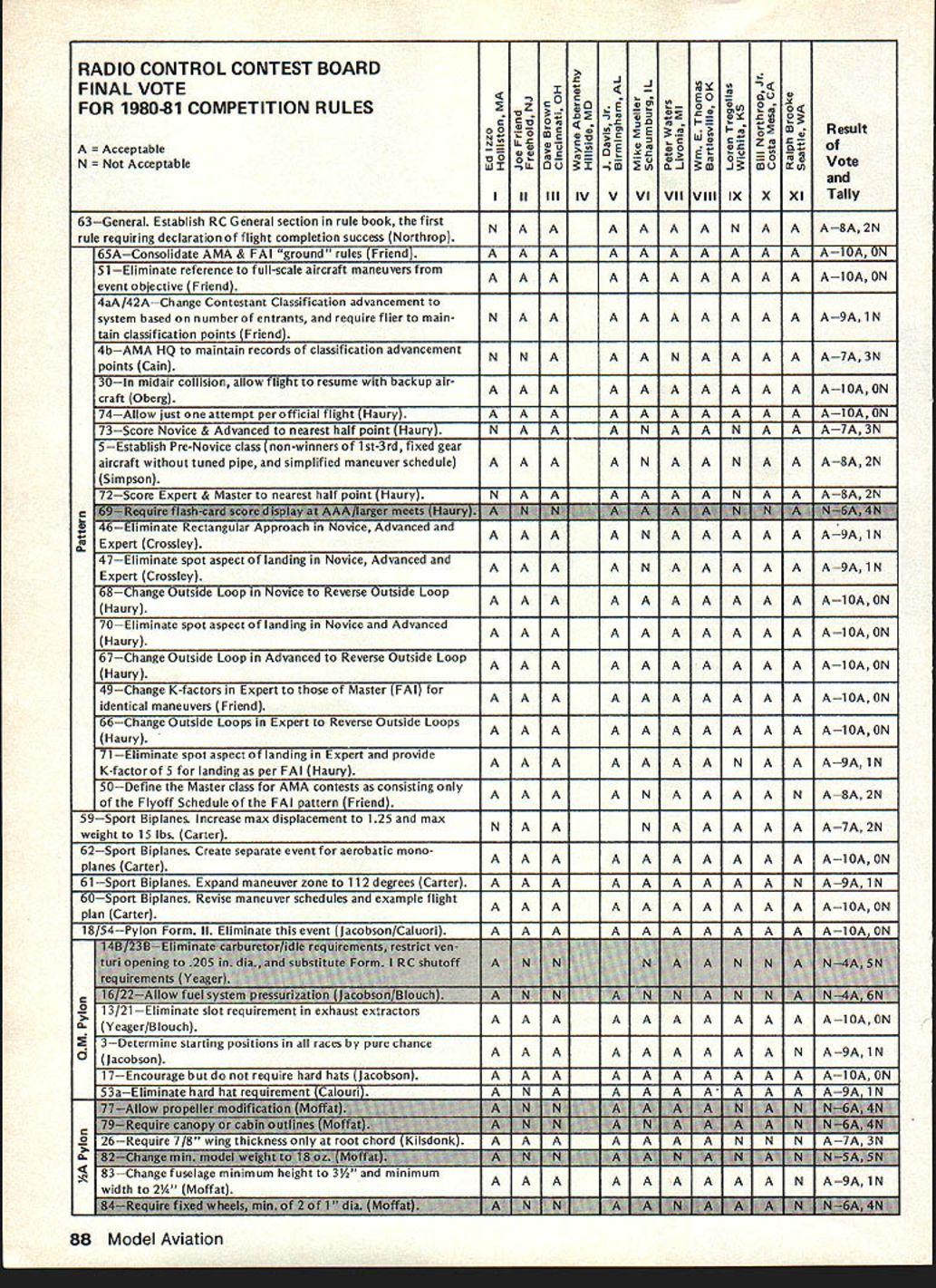
RADIO CONTROL CONTEST BOARD FINAL VOTE FOR 1980-81 COMPETITION RULES
A = Acceptable N = Not Acceptable
- 63 — General. Establish RC general section in rule book; first rule requiring declaration of flight completion success (Northrop). Result: A — 8A, 2N
- 65A — Consolidate AMA & FAI "ground" rules (Friend). Result: A — 10A, 0N
- 51 — Eliminate reference to full-scale aircraft maneuvers from event objective (Friend). Result: A — 10A, 0N
- 4aA/42A — Change contestant classification advancement to system based on number of entrants; require flier to maintain classification points (Friend). Result: A — 9A, 1N
- 4b — AMA HQ to maintain records of classification advancement points (Cain). Result: A — 7A, 3N
- 30 — In midair collision, allow flight to resume with backup aircraft (Oberg). Result: A — 10A, 0N
- 74 — Allow just one attempt per official flight (Haury). Result: A — 10A, 0N
- 73 — Score Novice & Advanced to nearest half point (Haury). Result: A — 7A, 3N
- 5 — Establish Pre‑Novice class (non‑winners of 1st–3rd, fixed-gear aircraft without tuned pipe, simplified maneuver schedule) (Simpson). Result: A — 8A, 2N
- 72 — Score Expert & Master to nearest half point (Haury). Result: A — 8A, 2N
- 69 — Require flash-card score display at AAA/larger meets (Haury). Result: N — 6A, 4N
- 46 — Eliminate Rectangular Approach in Novice, Advanced and Expert (Crossley). Result: A — 9A, 1N
- 47 — Eliminate spot aspect of landing in Novice, Advanced and Expert (Crossley). Result: A — 9A, 1N
- 68 — Change Outside Loop in Novice to Reverse Outside Loop (Haury). Result: A — 10A, 0N
- 70 — Eliminate spot aspect of landing in Novice and Advanced (Haury). Result: A — 10A, 0N
- 67 — Change Outside Loop in Advanced to Reverse Outside Loop (Haury). Result: A — 10A, 0N
- 49 — Change K-factors in Expert to those of Master (FAI) for identical maneuvers (Friend). Result: A — 10A, 0N
- 66 — Change Outside Loops in Expert to Reverse Outside Loops (Haury). Result: A — 10A, 0N
- 71 — Eliminate spot aspect of landing in Expert and provide K-factor of 5 for landing as per FAI (Haury). Result: A — 9A, 1N
- 50 — Define the Master class for AMA contests as consisting only of the Flyoff Schedule of the FAI pattern (Friend). Result: A — 8A, 2N
- 59 — Sport Biplanes. Increase max displacement to 1.25 and max weight to 15 lbs. (Carter). Result: A — 7A, 2N
- 62 — Sport Biplanes. Create separate event for aerobatic monoplanes (Carter). Result: A — 10A, 0N
- 61 — Sport Biplanes. Expand maneuver zone to 112 degrees (Carter). Result: A — 9A, 1N
- 60 — Sport Biplanes. Revise maneuver schedules and example flight plan (Carter). Result: A — 10A, 0N
- 18/54 — Pylon Form. II. Eliminate this event (Jacobson/Caluori). Result: A — 10A, 0N
- 14B/23B — Eliminate carburetor/idle requirements, restrict venturi opening to .205 in. dia., and substitute Form. I RC shutoff requirements (Yeager). Result: N — 4A, 5N
- 16/22 — Allow fuel system pressurization (Jacobson/Blouch). Result: N — 4A, 6N
- 13/21 — Eliminate slot requirement in exhaust extractors (Yeager/Blouch). Result: A — 10A, 0N
- 3 — Determine starting positions in all races by pure chance (Jacobson). Result: A — 9A, 1N
- 17 — Encourage but do not require hard hats (Jacobson). Result: A — 10A, 0N
- 53a — Eliminate hard hat requirement (Caluori). Result: A — 9A, 1N
- 77 — Allow propeller modification (Moffat). Result: N — 6A, 4N
- 79 — Require canopy or cabin outlines (Moffat). Result: N — 6A, 4N
- 26 — Require 7/8" wing thickness only at root chord (Kilsdonk). Result: A — 7A, 3N
- 82 — Change min. model weight to 18 oz. (Moffat). Result: N — 5A, 5N
- 83 — Change fuselage minimum height to 3½" and minimum width to 2½" (Moffat). Result: A — 9A, 1N
- 84 — Require fixed wheels, min. of 2 of 1" dia. (Moffat). Result: N — 6A, 4N
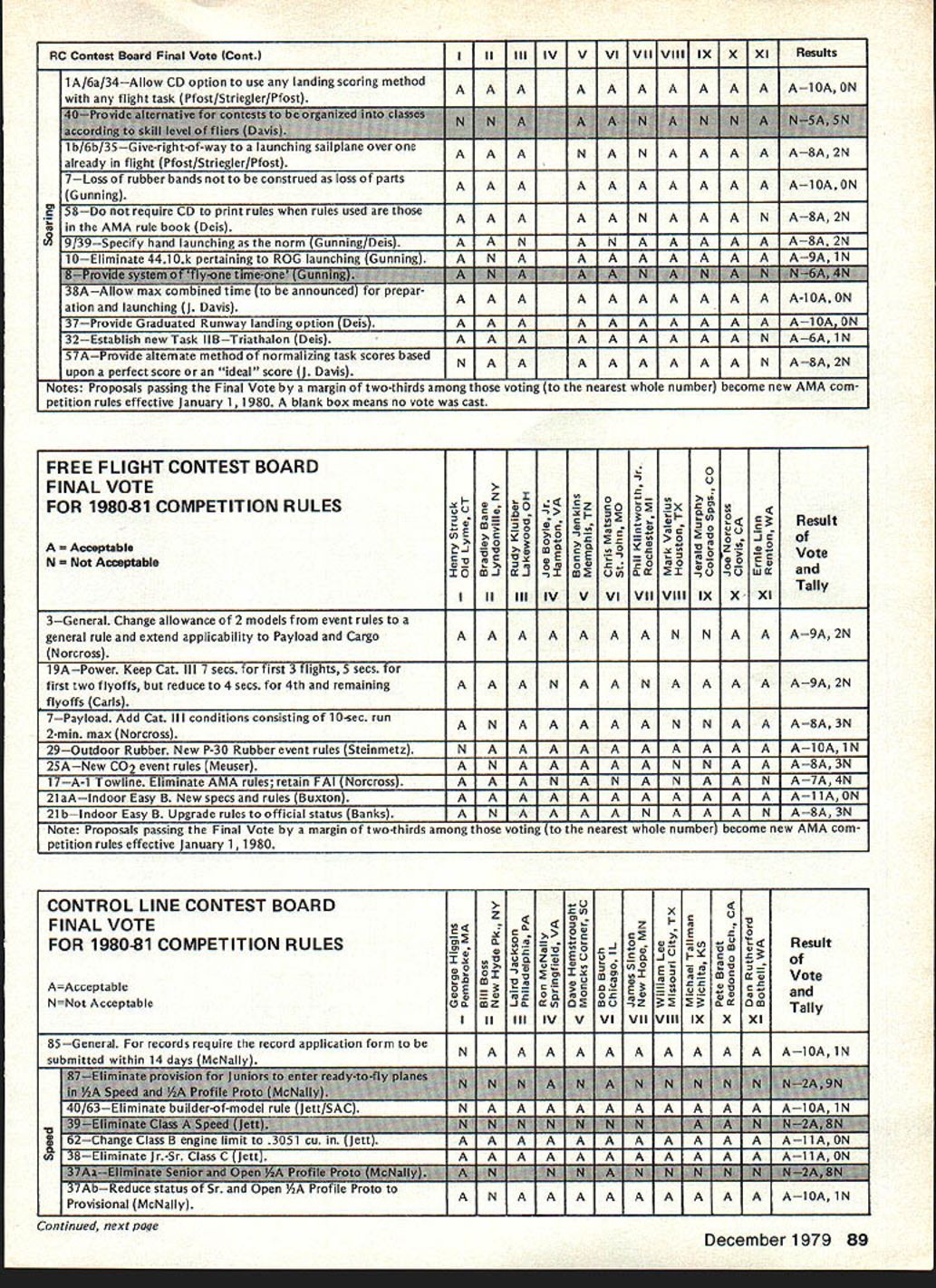
RC CONTEST BOARD FINAL VOTE (Cont.)
- 1A/6a/34 — Allow CD option to use any landing scoring method with any flight task (Pfost/Striegler/Pfost). Result: A — 10A, 0N
- 40 — Provide alternative for contests to be organized into classes according to skill level of fliers (Davis). Result: N — 5A, 5N
- 1b/6b/35 — Give right-of-way to a launching sailplane over one already in flight (Pfost/Striegler/Pfost). Result: A — 8A, 2N
- 7 — Loss of rubber bands not to be construed as loss of parts (Gunning). Result: A — 10A, 0N
- 58 — Do not require CD to print rules when rules used are those in the AMA rule book (Deis). Result: A — 8A, 2N
- 9/39 — Specify hand launching as the norm (Gunning/Deis). Result: A — 8A, 2N
- 10 — Eliminate 44.10.k pertaining to ROG launching (Gunning). Result: A — 9A, 1N
- 8 — Provide system of "fly-one time-one" (Gunning). Result: N — 6A, 4N
- 38A — Allow max combined time (to be announced) for preparation and launching (J. Davis). Result: A — 10A, 0N
- 37 — Provide Graduated Runway landing option (Deis). Result: A — 10A, 0N
- 32 — Establish new Task IIB — Triathlon (Deis). Result: A — 6A, 1N
- 57A — Provide alternate method of normalizing task scores based upon a perfect score or an "ideal" score (J. Davis). Result: A — 8A, 2N
Notes: Proposals passing the Final Vote by a margin of two-thirds among those voting (to the nearest whole number) become new AMA competition rules effective January 1, 1980. A blank box means no vote was cast.
FREE FLIGHT CONTEST BOARD FINAL VOTE FOR 1980-81 COMPETITION RULES
A = Acceptable N = Not Acceptable
- 3 — General. Change allowance of 2 models from event rules to a general rule and extend applicability to Payload and Cargo (Norcross). Result: A — 9A, 2N
- 19A — Power. Keep Cat. III 7 secs. for first 3 flights, 5 secs. for first two flyoffs, reduce to 4 secs. for 4th and remaining flyoffs (Carls). Result: A — 9A, 2N
- 7 — Payload. Add Cat. III conditions consisting of 10-sec. run, 2-min. max (Norcross). Result: A — 8A, 3N
- 29 — Outdoor Rubber. New P-30 Rubber event rules (Steinmetz). Result: A — 10A, 1N
- 25A — New CO2 event rules (Meuser). Result: A — 8A, 3N
- 1/A-1 Towline. Eliminate AMA rules; retain FAI (Norcross). Result: A — 7A, 4N
- 21A — Indoor Easy B. New specs and rules (Buxton). Result: A — 11A, 0N
- 21B — Indoor Easy B. Upgrade rules to official status (Banks). Result: A — 8A, 3N
Note: Proposals passing the Final Vote by a margin of two-thirds among those voting (to the nearest whole number) become new AMA competition rules effective January 1, 1980.
CONTROL LINE CONTEST BOARD FINAL VOTE FOR 1980-81 COMPETITION RULES
A = Acceptable N = Not Acceptable
- 85 — General. For records require the record application form to be submitted within 14 days (McNally). Result: A — 10A, 1N
- 87 — Eliminate provision for Juniors to enter ready-to-fly planes in 1/2A Speed and 1/2A Profile Proto (McNally). Result: N — 2A, 9N
- 40/63 — Eliminate builder-of-model rule (Jett/SAC). Result: A — 10A, 1N
- 39 — Eliminate Class A Speed (Jett). Result: N — 2A, 8N
- 62 — Change Class B engine limit to .305 cu. in. (Jett). Result: A — 11A, 0N
- 38 — Eliminate Jr.-Sr. Class C (Jett). Result: A — 11A, 0N
- 37A — Eliminate Senior and Open 1/2A Profile Proto (McNally). Result: A — 10A, 1N
- 37Ab — Reduce status of Sr. and Open 1/2A Profile Proto to Provisional (McNally). Result: A — 10A, 1N
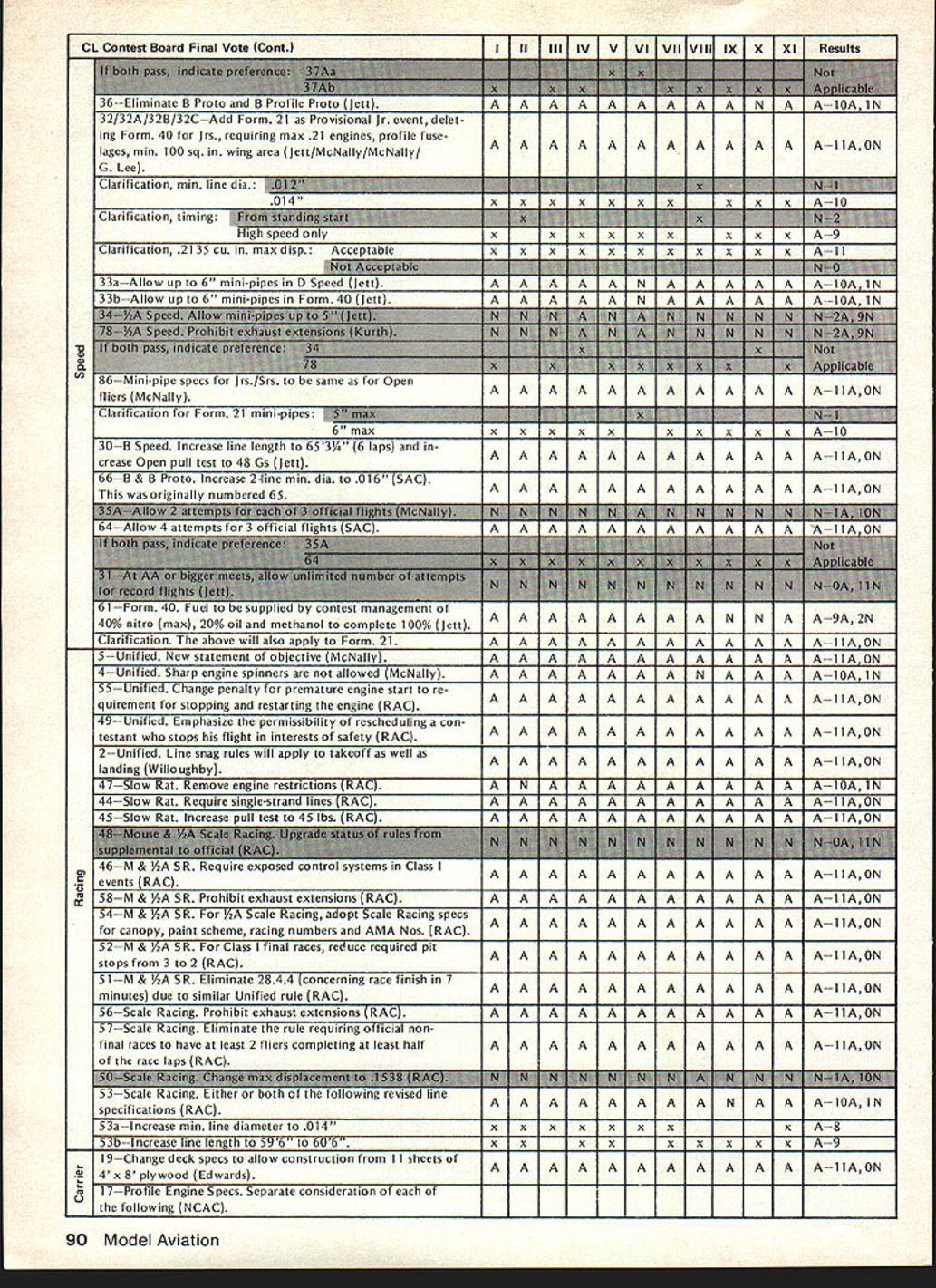
CL CONTEST BOARD FINAL VOTE (Continued)
- Clarification: min. line dia.: .012" / .014" (as noted)
- Clarification: timing: From standing start
- High speed only
- Clarification: .2135 cu. in. max disp.: Acceptable / Not Acceptable (as noted)
Proposals and items:
- 33a — Allow up to 6" mini-pipes in D Speed (Jett).
- 33b — Allow up to 6" mini-pipes in Formula 40 (Jett).
- 34 — 1/4A Speed. Allow mini-pipes up to 5" (Jett).
- 78 — 1/2A Speed. Prohibit exhaust extensions (Kurth).
- If both 34 and 78 pass, indicate preference: 34 / 78
- 86 — Mini-pipe specs for Juniors/Seniors to be same as for Open fliers (McNally).
- Clarification for Form. 21 mini-pipes: 5" max / 6" max
- 30 — B Speed. Increase line length to 65'3/4" (6 laps) and increase Open pull test to 48 Gs (Jett).
- 66 — B & B Proto. Increase 2-line min. dia. to .016" (SAC). (Originally numbered 65.)
- 35A — Allow 2 attempts for each of 3 official flights (McNally).
- 64 — Allow 4 attempts for 3 official flights (SAC).
- If both pass, indicate preference: 35A / 64
- 31 — At AA or bigger meets, allow unlimited number of attempts for record flights (Jett).
- 61 — Formula 40. Fuel to be supplied by contest management: 40% nitro (max), 20% oil, methanol to complete 100% (Jett). Clarification: The above also applies to Formula 21.
- 5 — Unified. New statement of objective (McNally).
- 4 — Unified. Sharp engine spinners are not allowed (McNally).
- 55 — Unified. Change penalty for premature engine start to requirement for stopping and restarting the engine (RAC).
- 49 — Unified. Emphasize the permissibility of rescheduling a contestant who stops his flight in interests of safety (RAC).
- 2 — Unified. Line snag rules will apply to takeoff as well as landing (Willoughby).
- 47 — Slow Rat. Remove engine restrictions (RAC).
- 44 — Slow Rat. Require single-strand lines (RAC).
- 45 — Slow Rat. Increase pull test to 45 lbs. (RAC).
- 48 — Mouse & 1/2A Scale Racing. Upgrade rules from supplemental to official (RAC).
- 46 — Mouse & 1/2A SR. Require exposed control systems in Class I events (RAC).
- 58 — Mouse & 1/2A SR. Prohibit exhaust extensions (RAC).
- 54 — For 1/2A Scale Racing, adopt Scale Racing specs for canopy, paint scheme, racing numbers and AMA Nos. (RAC).
- 52 — For Class I final races, reduce required pit stops from 3 to 2 (RAC).
- 51 — Eliminate 28.4.4 (concerning race finish in 7 minutes) due to similar Unified rule (RAC).
- 56 — Scale Racing. Prohibit exhaust extensions (RAC).
- 57 — Scale Racing. Eliminate rule requiring official non-final races to have at least 2 fliers completing at least half of the race laps (RAC).
- 50 — Scale Racing. Change max displacement to .1538 (RAC).
- 53 — Scale Racing. Either or both of the following revised line specifications (RAC):
- 53a — Increase min. line diameter to .014"
- 53b — Increase line length to 59'6" to 60'6".
- 19 — Change deck specs to allow construction from 11 sheets of 4' x 8' plywood (Edwards).
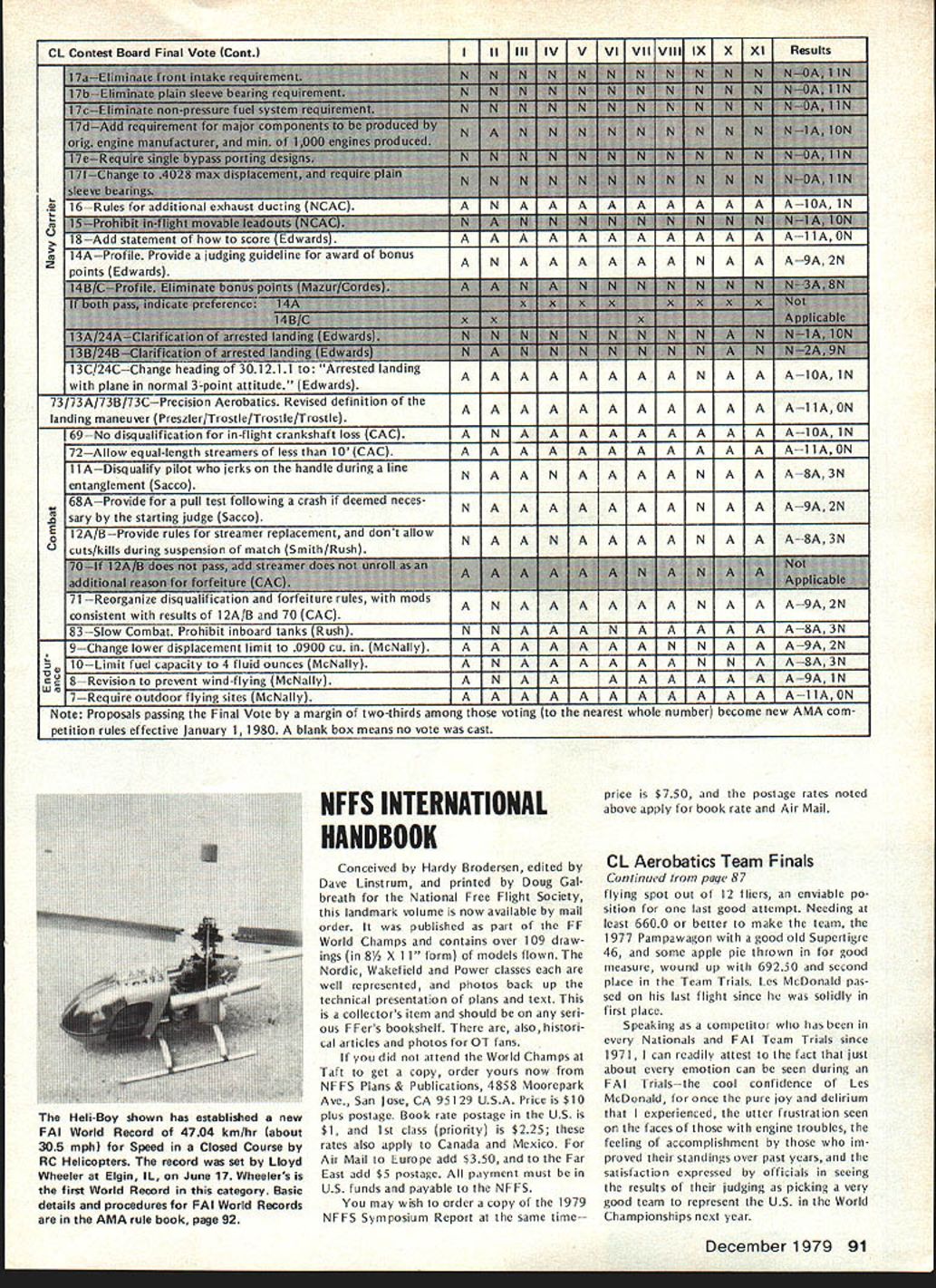
Profile engine specs (proposal 17 series — separate consideration of each):
- 17a — Eliminate front intake requirement. Result: N — 0A, 11N
- 17b — Eliminate plain sleeve bearing requirement. Result: N — 0A, 11N
- 17c — Eliminate non-pressure fuel system requirement. Result: N — 0A, 11N
- 17d — Add requirement for major components to be produced by original engine manufacturer, and minimum of 1,000 engines produced. Result: N — 1A, 10N
- 17e — Require single bypass porting designs. Result: N — 0A, 11N
- 17f — Change to .4028 max displacement, and require plain sleeve bearings. Result: N — 0A, 11N
Other CL proposals and results:
- 16 — Rules for additional exhaust ducting (NCAC). Result: A — 10A, 1N
- 15 — Prohibit in-flight movable leadouts (NCAC). Result: N — 1A, 10N
- 18 — Add statement of how to score (Edwards). Result: A — 11A, 0N
- 14A — Profile. Provide a judging guideline for award of bonus points (Edwards). Result: A — 9A, 2N
- 14B/C — Profile. Eliminate bonus points (Mazur/Cordes). Result: N — 3A, 8N
- If both pass, indicate preference: 14A / 14B/C — Not Applicable
- 13A/24A — Clarification of arrested landing (Edwards). Result: N — 1A, 10N
- 13B/24B — Clarification of arrested landing (Edwards). Result: N — 2A, 9N
- 13C/24C — Change heading of 30.12.1 to: "Arrested landing with plane in normal 3-point attitude." (Edwards). Result: A — 10A, 1N
- 73/73A/73B/73C — Precision Aerobatics. Revised definition of the landing maneuver (Preszler/Trostle/Trostle/Trostle). Result: A — 11A, 0N
- 69 — No disqualification for in-flight crankshaft loss (CAC). Result: A — 10A, 1N
- 72 — Allow equal-length streamers of less than 10' (CAC). Result: A — 11A, 0N
- 11A — Disqualify pilot who jerks on the handle during a line entanglement (Sacco). Result: A — 8A, 3N
- 68A — Provide for a pull test following a crash if deemed necessary by the starting judge (Sacco). Result: A — 9A, 2N
- 12A/B — Provide rules for streamer replacement, and don't allow cuts/kills during suspension of match (Smith/Rush). Result: A — 8A, 3N
- If 12A/B did not pass, 70 (streamer does not unroll as reason for forfeiture) would be applicable; see board results.
- 71 — Reorganize disqualification and forfeiture rules, consistent with results of 12A/B and 70 (CAC). Result: A — 9A, 2N
- 83 — Slow Combat. Prohibit inboard tanks (Rush). Result: A — 8A, 3N
- 9 — Change lower displacement limit to .0900 cu. in. (McNally). Result: A — 9A, 2N
- 10 — Limit fuel capacity to 4 fluid ounces (McNally). Result: A — 8A, 3N
- 8 — Revision to prevent wind-flying (McNally). Result: A — 9A, 1N
- 7 — Require outdoor flying sites (McNally). Result: A — 11A, 0N
Note: Proposals passing the Final Vote by a margin of two-thirds among those voting (to the nearest whole number) become new AMA competition rules effective January 1, 1980. A blank box means no vote was cast.
INDOOR TEAM FINALS
Report by Dick Kowalski
Photos by Ray Harlan
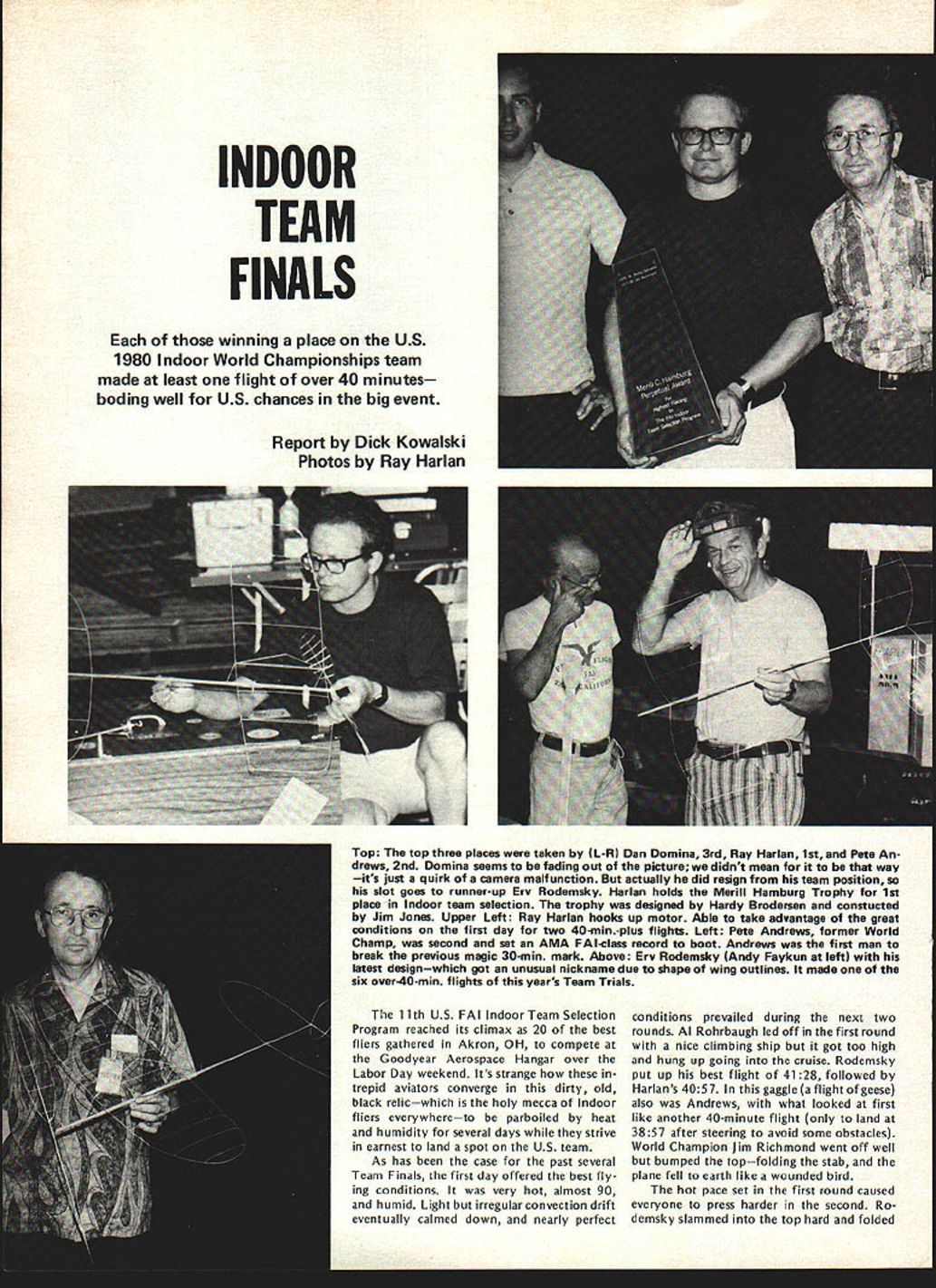
Each member of the U.S. 1980 Indoor World Championships team made at least one flight of over 40 minutes—boding well for U.S. chances in the big event.
Top placements in the Team Selection:
- 1st: Ray Harlan (Merrill Hamburg Trophy)
- 2nd: Pete Andrews (former World Champ; set an AMA FAI-class record)
- 3rd: Dan Domina (resigned team position; runner-up Erv Rodemsky replaced him)
The 11th U.S. FAI Indoor Team Selection Program gathered 20 top fliers in Akron, OH, at the Goodyear Aerospace Hangar over Labor Day weekend. Conditions were hot and humid; the first day offered the best flying conditions, with light but irregular convection drift that calmed down for nearly perfect conditions in subsequent rounds.
Round summaries:
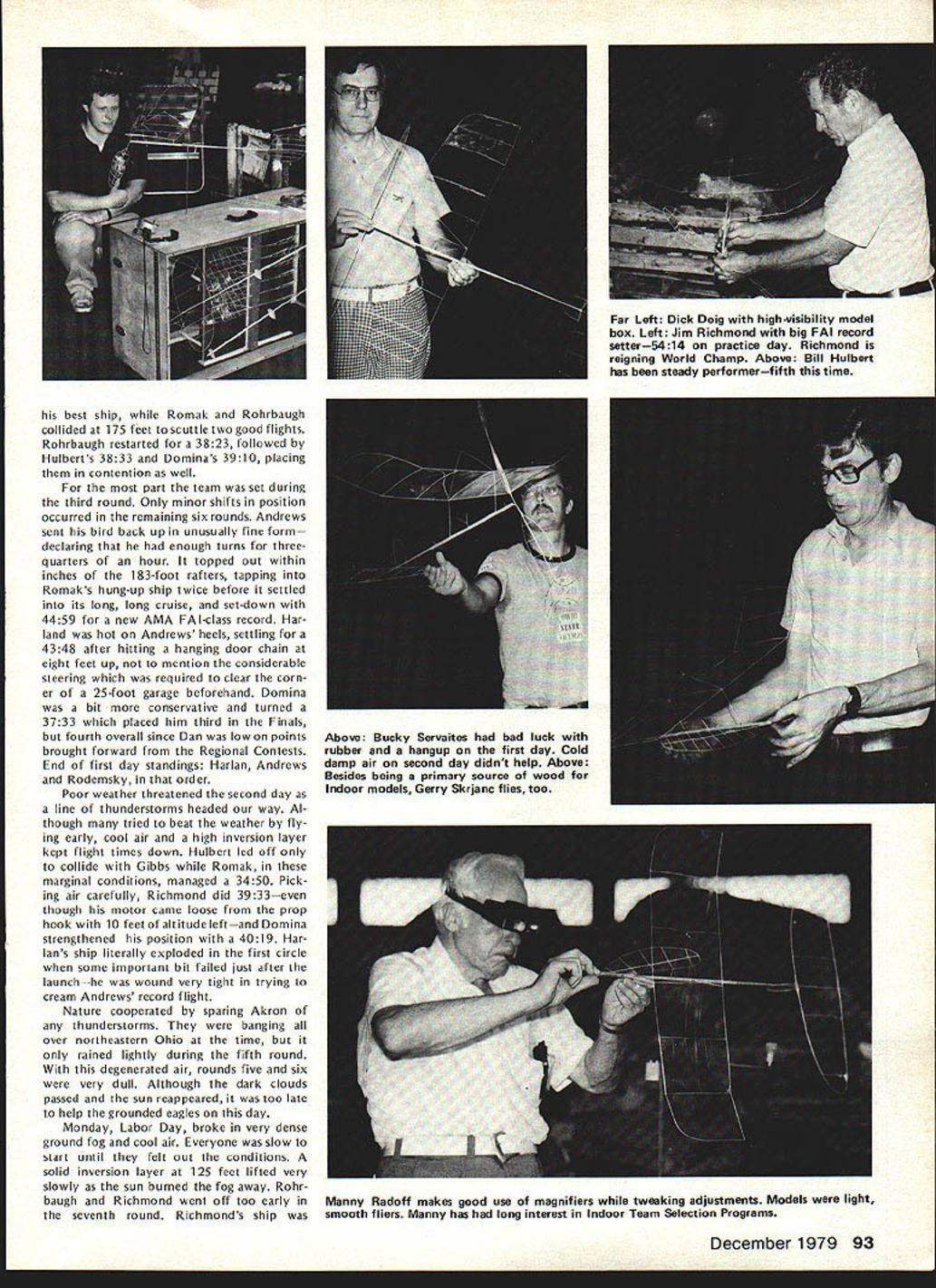
- Round 1: Rodemsky posted 41:28, Harlan 40:57. Andrews looked like he had a 40-minute flight but landed at 38:57 after steering to avoid obstacles. Jim Richmond's ship bumped the top and folded the stab.
- Round 2: Several collisions and damaged ships (Rodemsky, Romak, Rohrbaugh). Rohrbaugh restarted for 38:23, Hulbert 38:33, Domina 39:10.
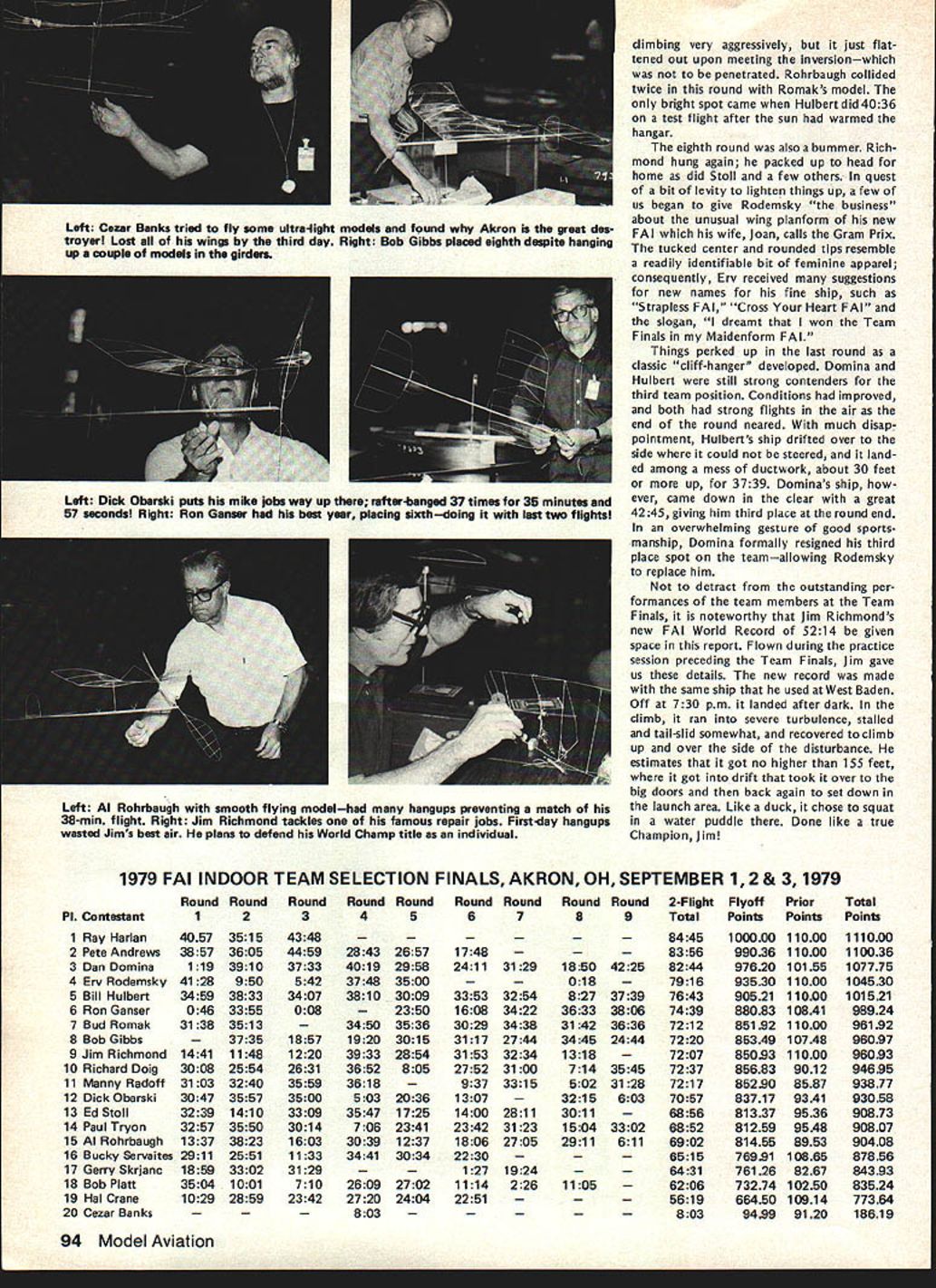
- By Round 3 the team was mostly set. Andrews launched a strong flight, topping out near the 183-foot rafters and setting down with 44:59 for a new AMA FAI-class record. Harlan recorded 43:48 after contact with a hanging chain; Domina turned 37:33 (third in the Finals, fourth overall due to regional points). End of first day standings: Harlan, Andrews, Rodemsky.
- Second day: Thunderstorm threat kept times down; Richmond managed 39:33 despite a loose motor; Domina strengthened his position with 40:19. Conditions degenerated for rounds five and six with dull flying.
- Final rounds: Dense ground fog on Monday morning delayed starts and created an inversion layer that limited climbs. Some fliers collided (Rohrbaugh and Romak). Hulbert later achieved a 40:36 test flight after the sun warmed the hangar. The last round produced a cliff‑hanger for the third team spot: Hulbert's ship landed among ductwork for 37:39; Domina's ship landed clear at 42:45, giving him third in the round. In a sportsmanlike gesture, Domina resigned his third-place team spot, allowing Erv Rodemsky to replace him.
Noteworthy performance:
- Jim Richmond's new FAI World Record of 52:14 was flown during the practice session preceding the Team Finals. Launched at 7:30 p.m., it landed after dark. Richmond reported severe turbulence during climb, a stall and tail-slide recovery, and an estimated peak of about 155 feet before drifting and setting down in the launch area.
(End of Indoor Team Finals report.)
Transcribed from original scans by AI. Minor OCR errors may remain.

