
COMPETITION NEWSLETTER
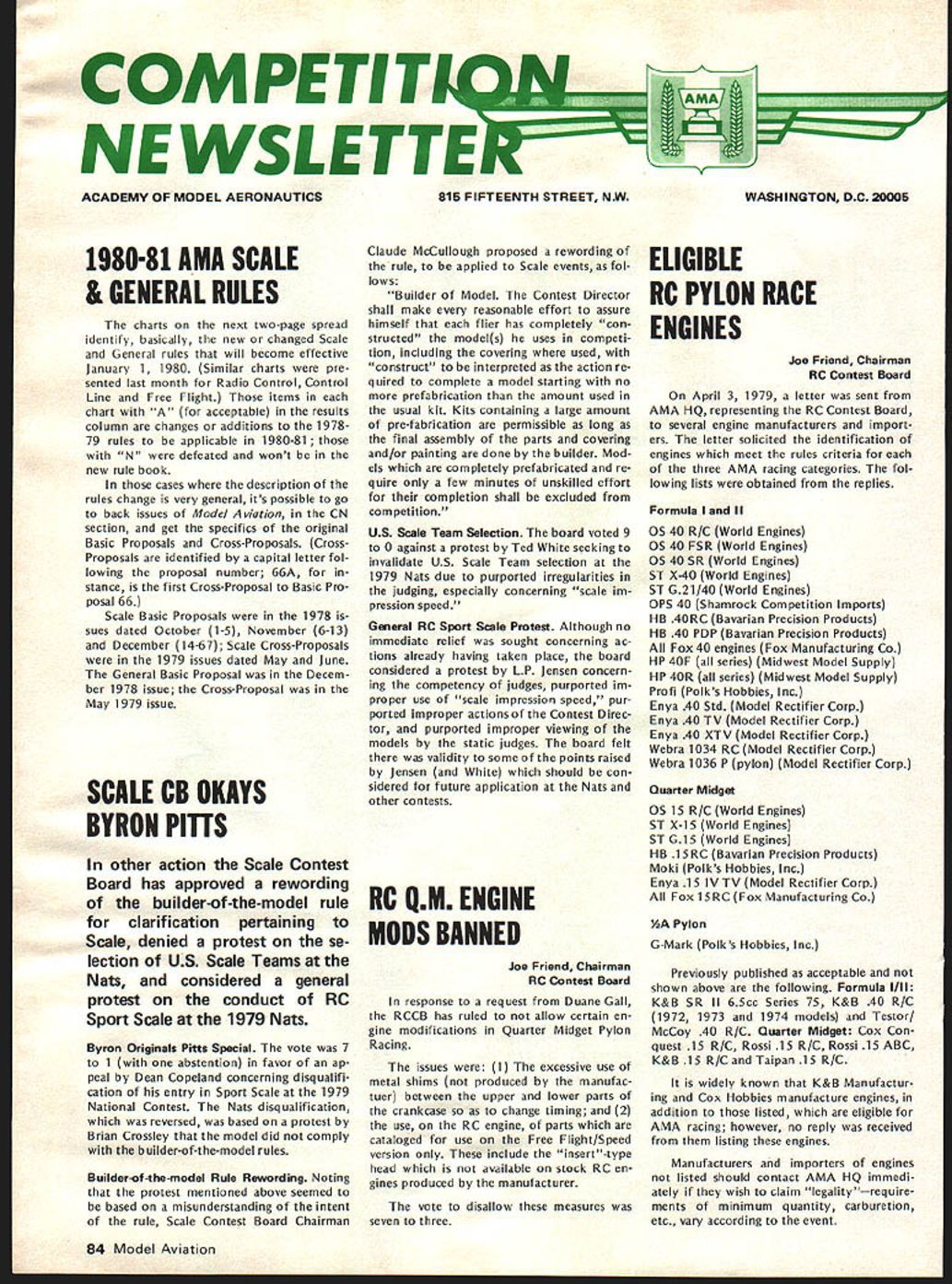
1980-81 AMA SCALE & GENERAL RULES
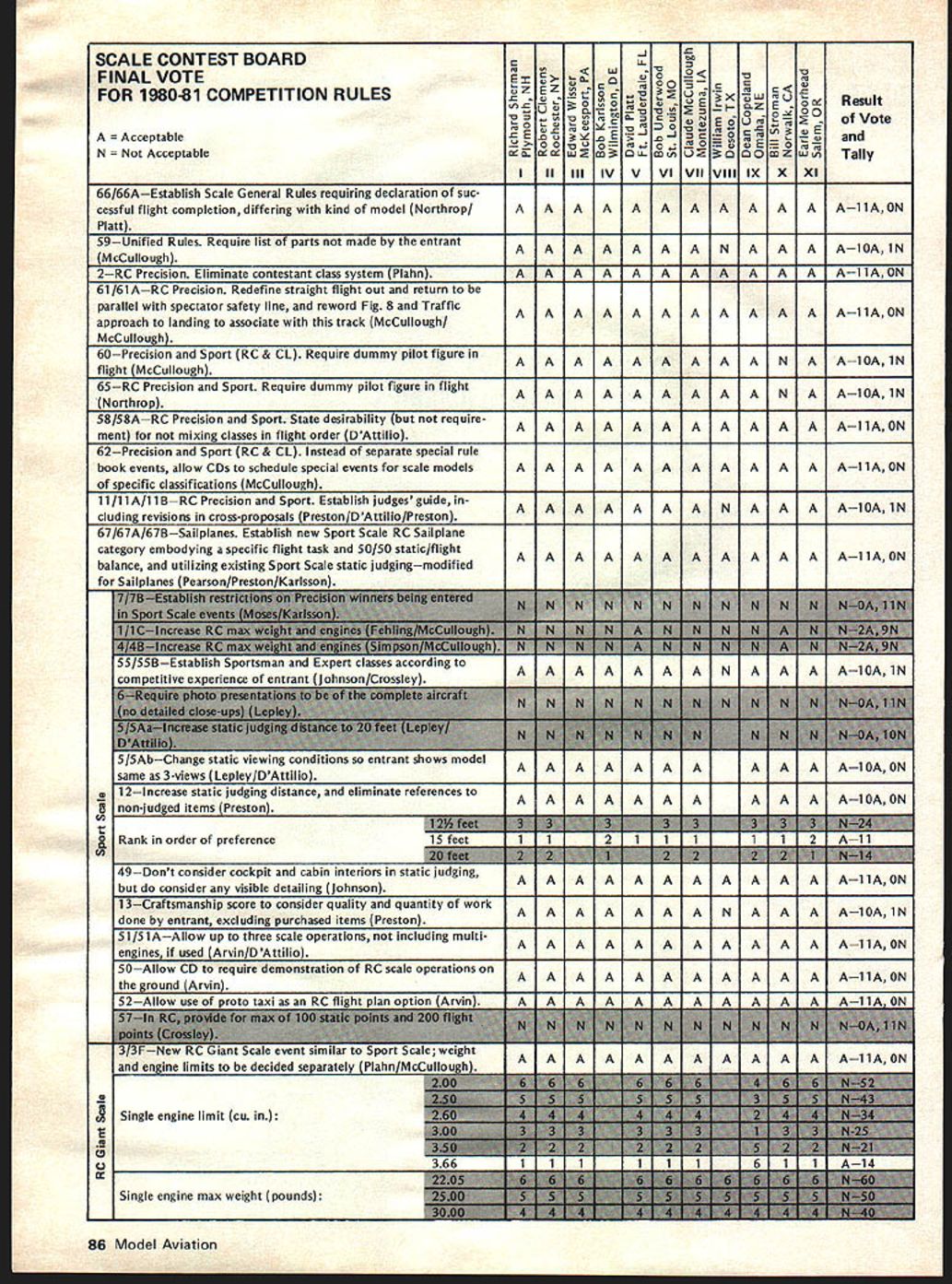
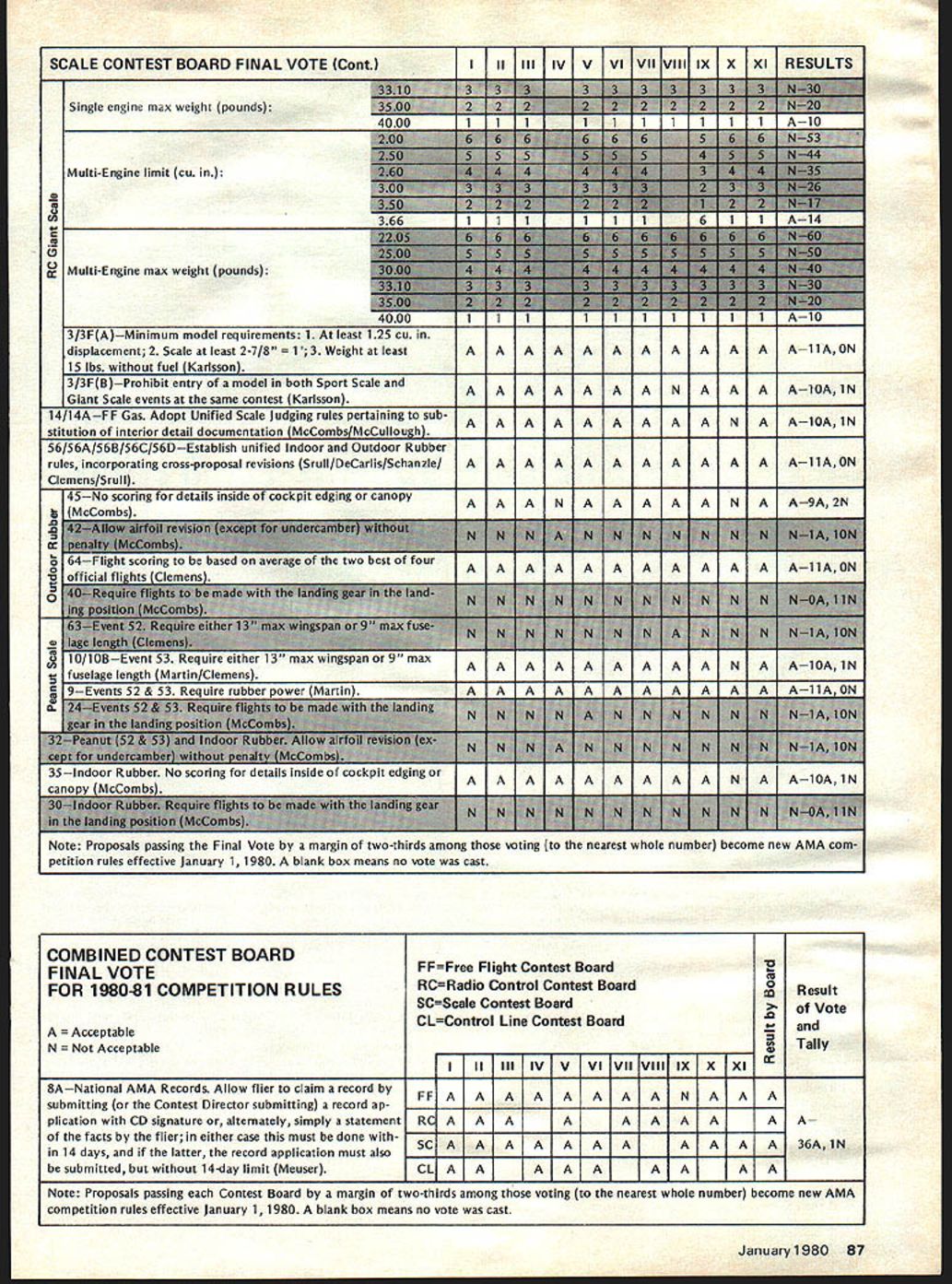
The charts on the next two-page spread identify the new or changed Scale and General rules that become effective January 1, 1980. (Similar charts were presented last month for Radio Control, Control Line and Free Flight.) Items in each chart with "A" (acceptable) are changes or additions to the 1978–79 rules to be applicable in 1980–81; those with "N" were defeated and will not be in the new rule book.
When a rule change description is general, consult back issues of Model Aviation, Competition News (CN) section, for the specifics of the original Basic Proposals and Cross-Proposals. (Cross-Proposals are identified by a capital letter following the proposal number; e.g., 66A is the first Cross-Proposal to Basic Proposal 66.)
- Scale Basic Proposals: Model Aviation 1978 issues dated October (1–5), November (6–13) and December (14–67).
- Scale Cross-Proposals: Model Aviation 1979 issues dated May and June.
- General Basic Proposal: December 1978 issue; Cross-Proposal: May 1979 issue.
---
SCALE CONTEST BOARD OKAYS BYRON PITTS
In other action the Scale Contest Board approved a rewording of the builder-of-the-model rule for clarification pertaining to Scale, denied a protest on selection of the U.S. Scale Teams at the Nationals, and considered a general protest on the conduct of RC Sport Scale at the 1979 Nationals.
Byron Originals Pitts Special
The vote was 7 to 1 (with one abstention) in favor of an appeal by Dean Copeland concerning disqualification of his entry in Sport Scale at the 1979 National Contest. The Nationals disqualification, which was reversed, had been based on a protest by Brian Crossley that the model did not comply with the builder-of-the-model rules.
Builder-of-the-model Rule Rewording
Noting the protest above seemed based on a misunderstanding of the rule's intent, Scale Contest Board Chairman Claude McCullough proposed the following rewording to be applied to Scale events:
"Builder of Model. The Contest Director shall make every reasonable effort to assure himself that each flier has completely 'constructed' the model(s) he uses in competition, including the covering where used, with 'construct' to be interpreted as the action required to complete a model starting with no more prefabrication than the amount used in the usual kit. Kits containing a large amount of pre-fabrication are permissible as long as the final assembly of the parts and covering and/or painting are done by the builder. Models which are completely prefabricated, require only a few minutes of unskilled effort for their completion, shall be excluded from competition."
U.S. Scale Team Selection
The board voted 9 to 0 against a protest by Ted White seeking to invalidate U.S. Scale Team selection at the 1979 Nationals due to alleged irregularities in judging, especially concerning "scale impression speed."
General RC Sport Scale Protest
The board considered a protest by L.P. Jensen regarding judge competency, purported improper use of "scale impression speed," alleged improper actions by the Contest Director, and alleged improper viewing of models by static judges. Although no immediate relief was sought for past actions, the board felt some points raised had validity and should be considered for future application at Nationals and other contests.
---
RC QUARTER MIDGET ENGINE MODS BANNED
Joe Friend, Chairman RC Contest Board
In response to a request from Duane Gall, the RC Contest Board ruled not to allow certain engine modifications in Quarter Midget Pylon Racing. The issues were:
- Excessive use of metal shims (not produced by the manufacturer) between the upper and lower crankcase parts to change timing.
- Use, on the RC engine, of parts cataloged for and used on the Free Flight/Speed version only (including the "insert"-type head not available on stock RC engines produced by the manufacturer).
The vote to disallow these measures was seven to three.
---
ELIGIBLE RC PYLON RACE ENGINES
Joe Friend, Chairman RC Contest Board
On April 3, 1979, the RC Contest Board solicited identification from engine manufacturers and importers of engines meeting rules criteria for each of three AMA racing categories. The following lists were obtained from replies:
- Formula I and II
- OS 40 R/C (World Engines)
- OS 40 FSR (World Engines)
- OS 40 SR (World Engines)
- ST X-40 (World Engines)
- ST G21/40 (World Engines)
- OPS 40 (Shamrock Competition Imports)
- HB .40RC (Bavarian Precision Products)
- HB .40 PDP (Bavarian Precision Products)
- All Fox 40 engines (Fox Manufacturing Co.)
- HP 40F (all series) (Midwest Model Supply)
- HP 40R (all series) (Midwest Model Supply)
- Profi (Polk's Hobbies, Inc.)
- Enya .40 Std. (Model Rectifier Corp.)
- Enya .40 TV (Model Rectifier Corp.)
- Enya .40 XTV (Model Rectifier Corp.)
- Webra 1034 RC (Model Rectifier Corp.)
- Webra 1036 P (pylon) (Model Rectifier Corp.)
- Quarter Midget
- OS 15 R/C (World Engines)
- ST X-15 (World Engines)
- ST G.15 (World Engines)
- HB .15RC (Bavarian Precision Products)
- Moki (Polk's Hobbies, Inc.)
- Enya .15 TV (Model Rectifier Corp.)
- All Fox 15RC (Fox Manufacturing Co.)
- 1/2A Pylon
- G-Mark (Polk's Hobbies, Inc.)
Previously published as acceptable and not shown above are the following:
- Formula III/II: K&B .35 R/C, K&B .40 R/C (1972, 1973 and 1974 models) and Testor/McCoy .40 R/C.
- Quarter Midget: Cox .15 R/C, Rossi .15 R/C, Rossi .15 A.B.C., K&B .15 R/C and Taipan .15 R/C.
Note: K&B Manufacturing and Cox Hobbies are known to have manufactured engines acceptable for AMA racing in the past; no reply was received from them listing engines. Manufacturers and importers of engines not listed should contact AMA HQ immediately if they wish to claim legality—requirements of minimum quantity, carburetion, etc., vary according to the event.
---
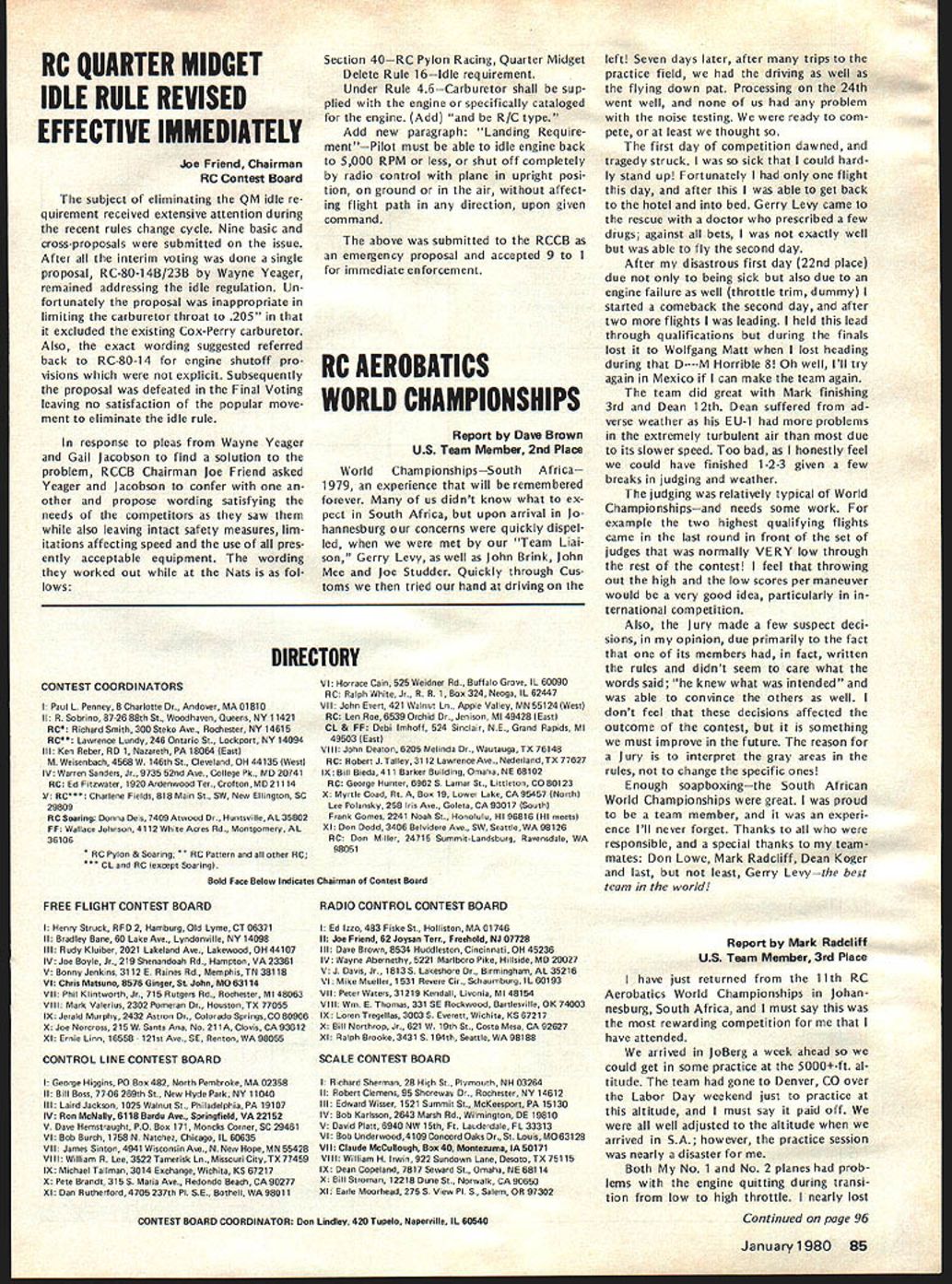
RC QUARTER MIDGET IDLE RULE REVISED — EFFECTIVE IMMEDIATELY
Joe Friend, Chairman RC Contest Board
The issue of eliminating the Quarter Midget (QM) idle requirement received extensive attention during the recent rules change cycle. After several proposals and interim voting, a final attempt (RC-80-148/23B by Wayne Yeager) that addressed idle regulation was defeated due to inappropriate limitations and references. With competitors urging a solution, RCCB Chairman Joe Friend asked Wayne Yeager and Gail Jacobson to draft wording that met competitors' needs while maintaining safety and equipment limits. The wording they produced at the Nationals was adopted as an emergency proposal and accepted 9 to 1 for immediate enforcement.
Revisions (Section 40—RC Pylon Racing, Quarter Midget):
- Delete Rule 16 — Idle requirement.
- Under Rule 4.6 — "Carburetor shall be supplied with the engine or specifically cataloged for the engine." Add: "and be R/C type."
- Add new paragraph "Landing Requirement":
- Pilot must be able to idle engine back to 5,000 RPM or less, or shut off completely by radio control with plane in upright position, on ground or in the air, without affecting flight path in any direction, upon given command.
---
SCALE CONTEST BOARD FINAL VOTE FOR 1980-81 COMPETITION RULES
A = Acceptable N = Not Acceptable
- 66/66A — Establish Scale General Rules requiring declaration of successful flight completion, differing with kind of model (Northrop/Platt). Result: A — 11A, 0N
- 59 — Unified Rules. Require list of parts not made by the entrant (McCullough). Result: A — 10A, 1N
- 2 — RC Precision. Eliminate contestant class system (Plahn). Result: A — 11A, 0N
- 61/61A — RC Precision. Redefine straight flight out and return to be parallel with spectator safety line, and reword Fig. 8 and Traffic approach to landing to associate with this track (McCullough/McCullough). Result: A — 11A, 0N
- 60 — Precision and Sport (RC & CL). Require dummy pilot figure in flight (McCullough). Result: A — 10A, 1N
- 65 — RC Precision and Sport. Require dummy pilot figure in flight (Northrop). Result: A — 10A, 1N
- 58/58A — RC Precision and Sport. State desirability (but not requirement) for not mixing classes in flight order (D’Attilio). Result: A — 11A, 0N
- 62 — Precision and Sport (RC & CL). Allow Contest Directors to schedule special events for scale models of specific classifications instead of separate special rule book events (McCullough). Result: A — 11A, 0N
- 11/11A/11B — RC Precision and Sport. Establish judges’ guide, including revisions in cross-proposals (Preston/D’Attilio/Preston). Result: A — 10A, 1N
- 67/67A/67B — Sailplanes. Establish new Sport Scale RC Sailplane category with a specific flight task and 50/50 static/flight balance, utilizing existing Sport Scale static judging modified for Sailplanes (Pearson/Preston/Karlsson). Result: A — 11A, 0N
- 7/7B — Establish restrictions on Precision winners being entered in Sport Scale events (Moses/Karlsson). Result: N — 0A, 11N
- 1/1C — Increase RC max weight and engines (Fehling/McCullough). Result: N — 2A, 9N
- 4/4B — Increase RC max weight and engines (Simpson/McCullough). Result: N — 2A, 9N
- 55/55B — Establish Sportsman and Expert classes according to competitive experience of entrant (Johnson/Crossley). Result: A — 10A, 1N
- 6 — Require photo presentations to be of the complete aircraft (no detailed close-ups) (Lepley). Result: N — 0A, 11N
- 5/5A — Increase static judging distance to 20 feet (Lepley/D’Attilio). Result: N — 0A, 10N
- 5/5AB — Change static viewing conditions so entrant shows model same as 3-views (Lepley/D’Attilio). Result: A — 10A, 0N
- 12 — Increase static judging distance, and eliminate references to non-judged items (Preston). Result: A — 10A, 0N
- Rank in order of preference: 12½ feet; 15 feet; 20 feet.
- 49 — Do not consider cockpit and cabin interiors in static judging, but do consider any visible detailing (Johnson). Result: A — 11A, 0N
- 13 — Craftsmanship score to consider quality and quantity of work done by entrant, excluding purchased items (Preston). Result: A — 10A, 1N
- 51/51A — Allow up to three scale operations, not including multi-engines, if used (Arvin/D’Attilio). Result: A — 11A, 0N
- 50 — Allow Contest Director to require demonstration of RC scale operations on the ground (Arvin). Result: A — 11A, 0N
- 52 — Allow use of proto-taxi as an RC flight plan option (Arvin). Result: A — 11A, 0N
- 57 — In RC, provide for max of 100 static points and 200 flight points (Crossley). Result: N — 0A, 11N
- 3/3F — New RC Giant Scale event similar to Sport Scale; weight and engine limits to be decided separately (Plahn/McCullough). Result: A — 11A, 0N
---
RC GIANT SCALE
- Single engine limit (cu. in.): 2.00; 2.50; 2.60; 3.00; 3.50; 3.66 (votes shown in original table)
- Single engine max weight (pounds): 22.05; 25.00; 30.00 (votes shown in original table)
---
CONTROL LINE COMBAT TEAM FINALS (continued)
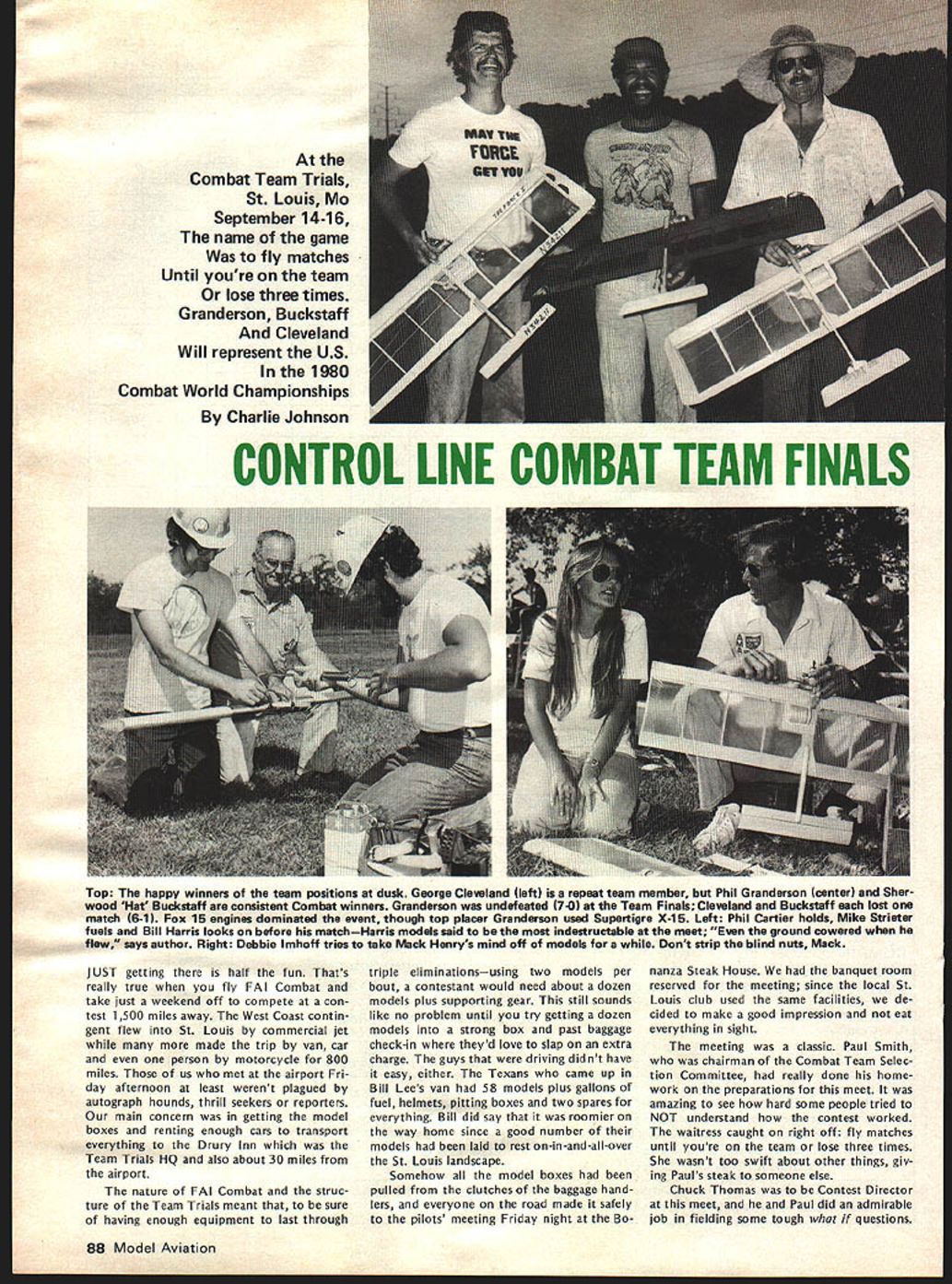
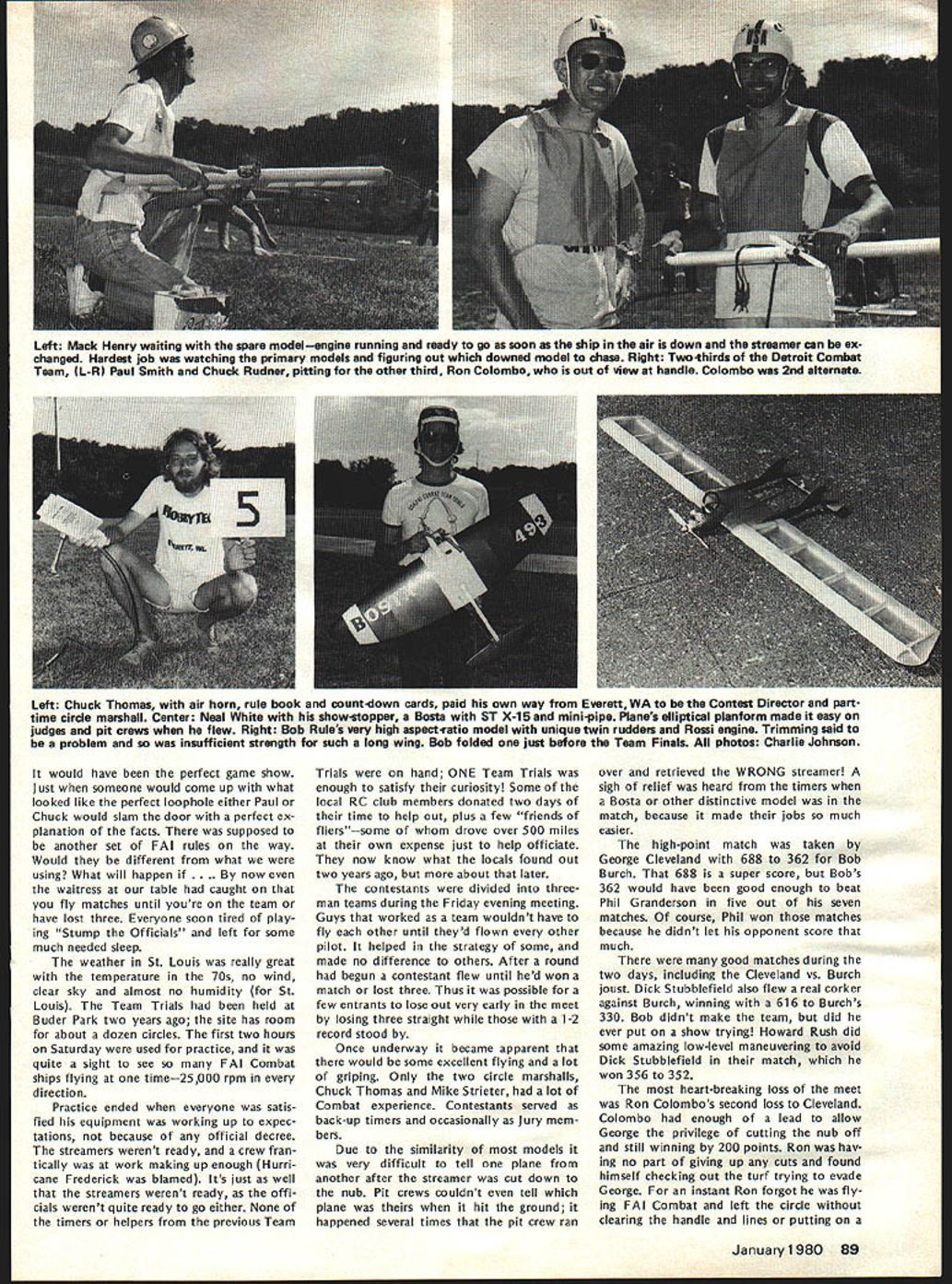
From photos and reports, the winning Combat models were all wood construction with Mylar covering. Wing areas were 350+ square inches. Team members reported models in the 12–13 oz. bracket with strong Fox .15 engines; several top performers used Rossi or Supertigre engines.
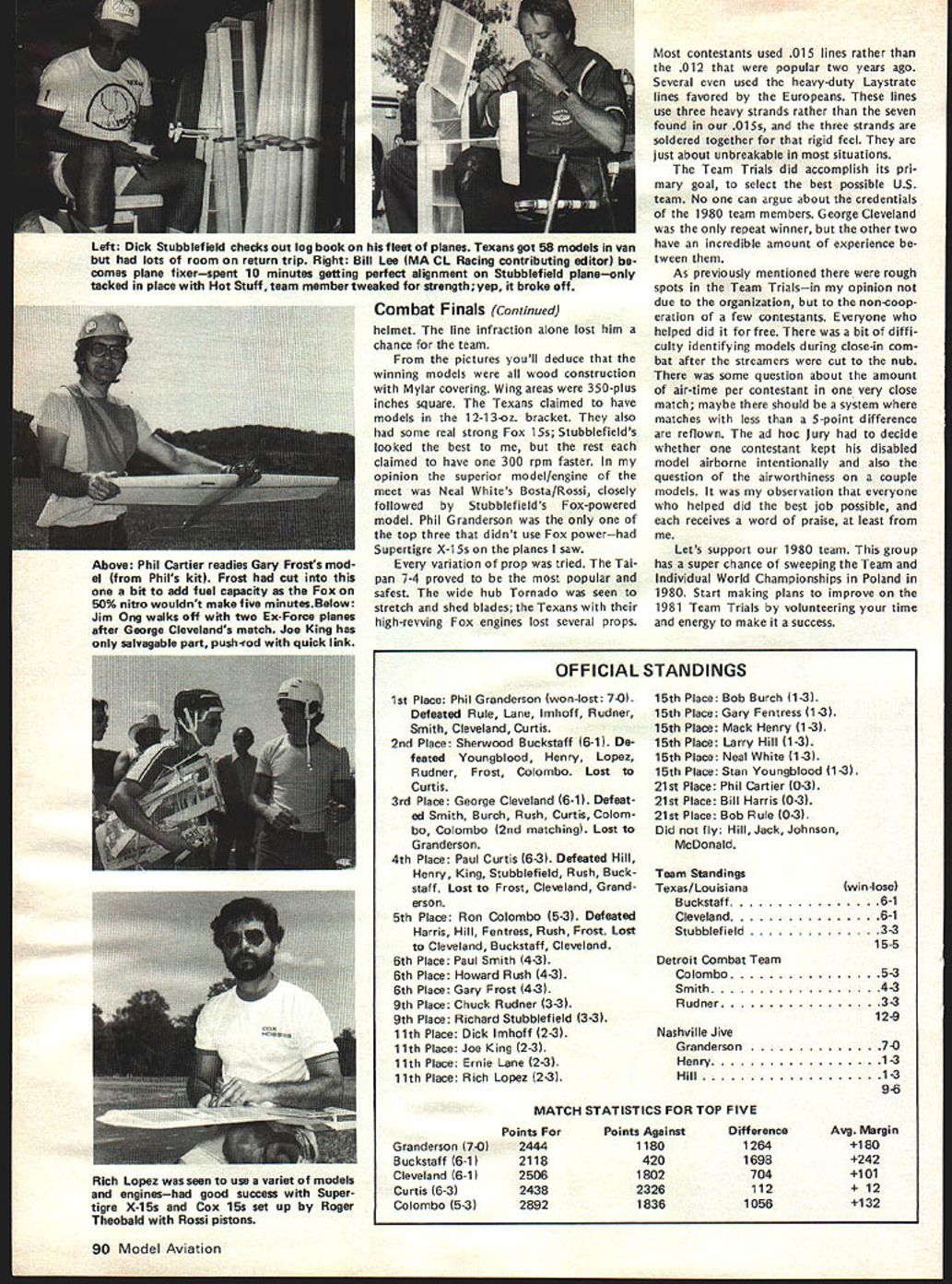
Propellers varied; the Talon 7-4 was popular and considered safe. Wide-hub Tornados were seen to stretch and shed blades; high-revving Fox engines in some models led to lost props. Most contestants used .015 lines rather than the previously popular .012; some used heavy-duty Laystrate lines favored in Europe—three heavy strands soldered together for added rigidity.
The Team Trials accomplished the goal of selecting a strong U.S. team. There were operational difficulties in a few matches (identifying models after streamers were cut, questions about air-time and airworthiness in very close matches). The ad hoc Jury handled contested calls. Overall, volunteers did their best.
Let's support the 1980 team — they appear to have a good chance in the 1980 World Championships in Poland.
OFFICIAL STANDINGS
- Phil Granderson (7–0). Defeated Rule, Lane, Imhoff, Rudner, Smith, Cleveland, Curtis.
- Sherwood Buckstaff (6–1). Defeated Youngblood, Henry, Lopez, Rudner, Frost, Colombo. Lost to Curtis.
- George Cleveland (6–1). Defeated Smith, Burch, Rush, Curtis, Colombo (twice). Lost to Granderson.
- Paul Curtis (6–3). Defeated Hill, Henry, King, Stubblefield, Rush, Buckstaff. Lost to Frost, Cleveland, Granderson.
- Ron Colombo (5–3). Defeated Harris, Hill, Fentress, Rush, Frost. Lost to Cleveland, Buckstaff, Cleveland.
- Paul Smith (4–3).
- Howard Rush (4–3).
- Gary Frost (4–3).
- Chuck Rudner (3–3).
- Richard Stubblefield (3–3).
- Dick Imhoff (2–3).
- Joe King (2–3).
- Ernie Lane (2–3).
- Rich Lopez (2–3).
- Bob Burch (1–3).
- Gary Fentress (1–3).
- Mack Henry (1–3).
- Larry Hill (1–3).
- Neal White (1–3).
- Stan Youngblood (1–3).
- Phil Cartier (0–3).
- Bill Harris (0–3).
- Bob Rule (0–3).
Did not fly: Hill, Jack; Johnson; McDonald.
TEAM STANDINGS
- Texas/Louisiana
- Buckstaff — 6–1
- Cleveland — 6–1
- Stubblefield — 3–3
- Team total: 15–5
- Detroit Combat Team
- Colombo — 5–3
- Smith — 4–3
- Rudner — 3–3
- Team total: 12–9
- Nashville Jive
- Granderson — 7–0
- Henry — 1–3
- Hill — 1–3
- Team total: 9–6
MATCH STATISTICS FOR TOP FIVE
- Granderson (7–0): Points For 2444, Points Against 1180, Difference 1264, Avg. Margin +180
- Buckstaff (6–1): Points For 2118, Points Against 420, Difference 1698, Avg. Margin +242
- Cleveland (6–1): Points For 2506, Points Against 1802, Difference 704, Avg. Margin +101
- Curtis (6–3): Points For 2438, Points Against 2326, Difference 112, Avg. Margin +12
- Colombo (5–3): Points For 2892, Points Against 1836, Difference 1056, Avg. Margin +132
---
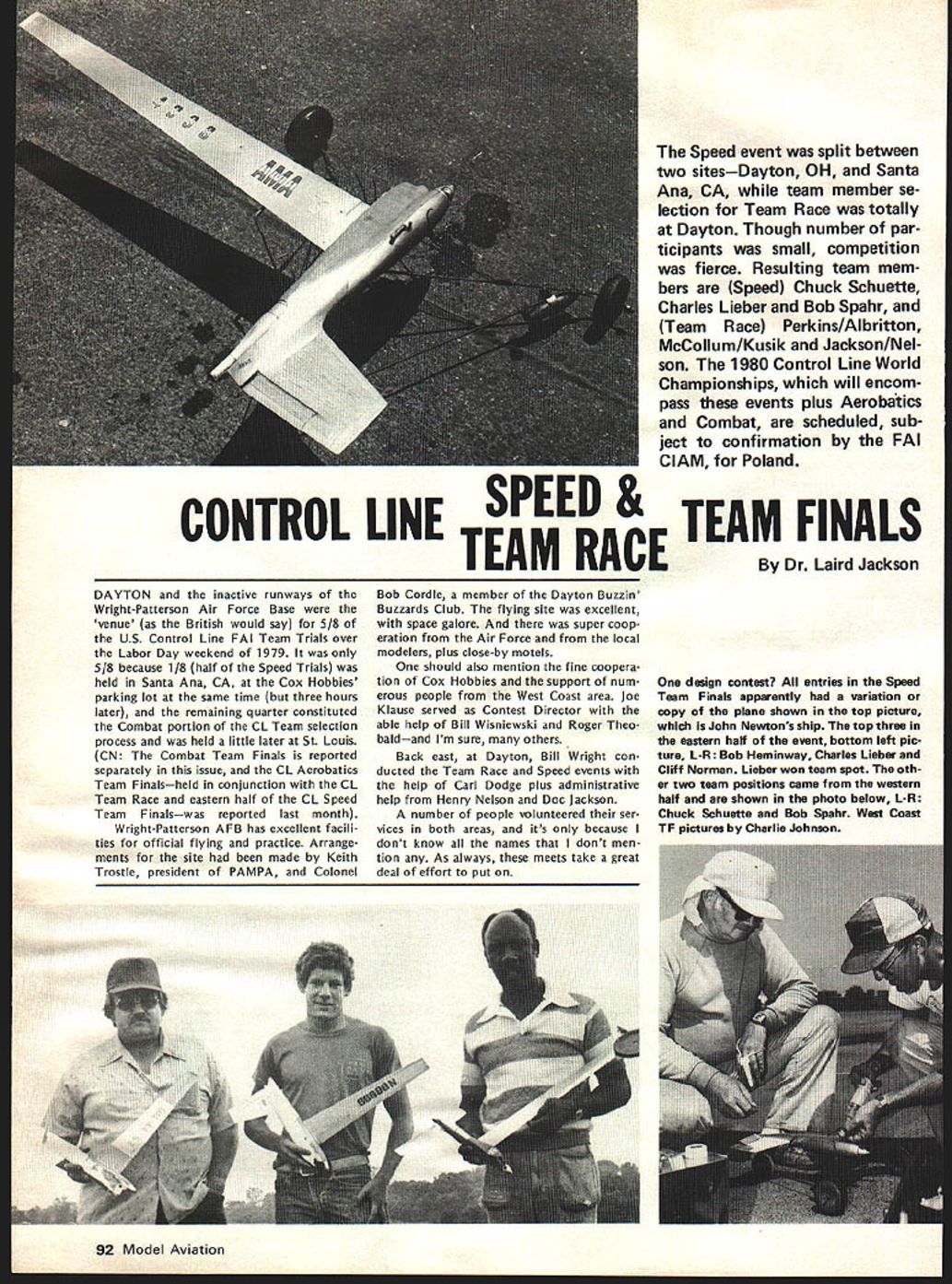
CONTROL LINE SPEED & TEAM RACE TEAM FINALS
By Dr. Laird Jackson
Dayton, Ohio, and the Wright-Patterson AFB inactive runways were the venue for 5/8 of the U.S. Control Line FAI Team Trials over Labor Day weekend 1979. One-eighth (half of the Speed Trials) was held simultaneously in Santa Ana, CA; the remaining quarter (Combat) was held later in St. Louis. The CL Aerobatics Team Finals were reported previously.
The site and facilities in Dayton were excellent, arranged with help from local clubs. Cox Hobbies and many West Coast participants provided strong support. Joe Klause served as Contest Director for the West Coast site; Bill Wright conducted Team Race and Speed events at Dayton with help from Carl Dodge, Henry Nelson and Doc Jackson.
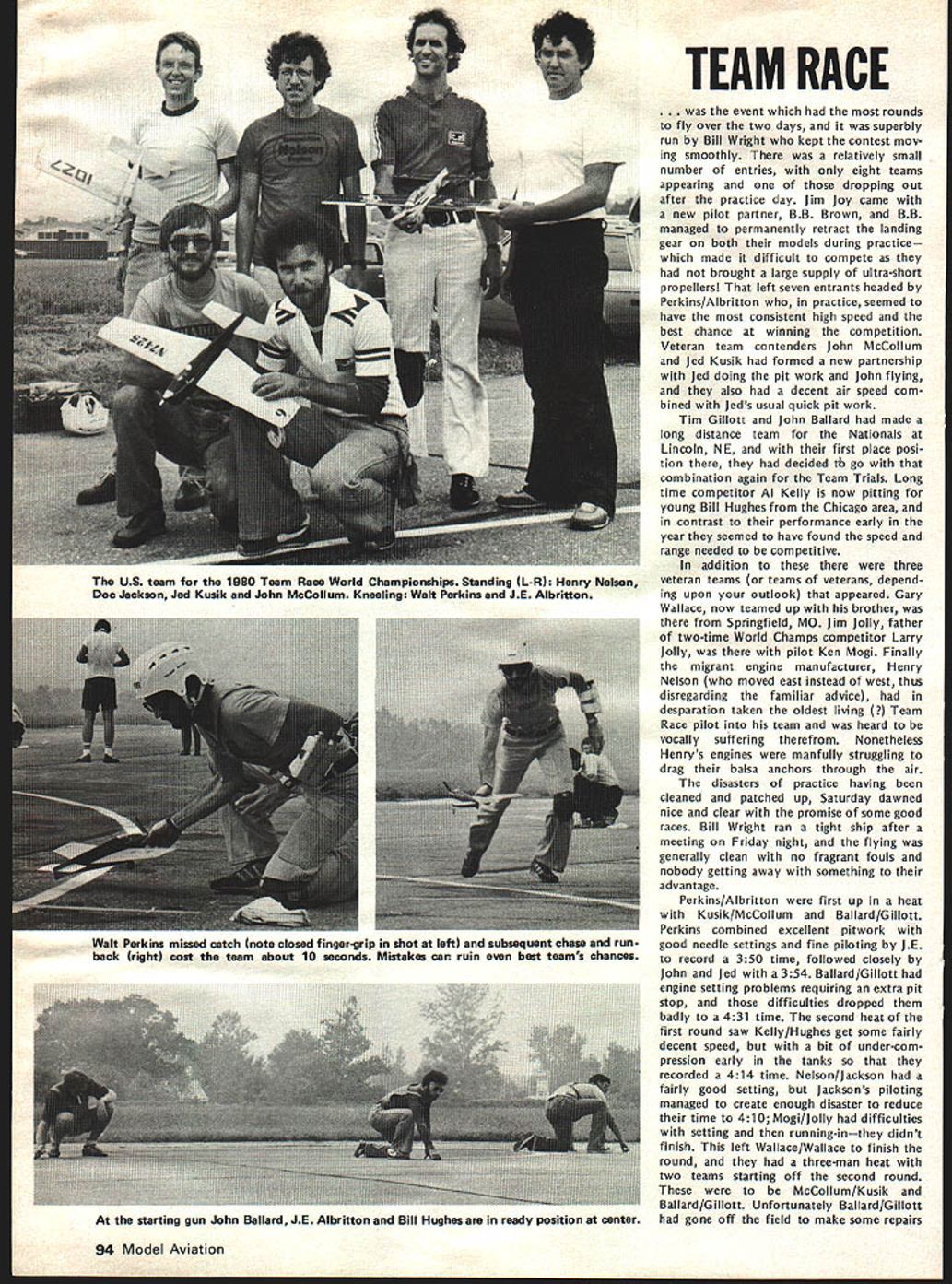
Resulting team members:
- Speed: Chuck Schuette, Charles Lieber, Bob Spahr.
- Team Race: Perkins/Albritton, McCollum/Kusik, Jackson/Nelson.
The 1980 Control Line World Championships (Speed, Team Race, Aerobatics, Combat) are scheduled—subject to FAI CIAM confirmation—for Poland.
SPEED
The event was split between Dayton (East) and Santa Ana (West). Two rounds were flown on both Saturday and Sunday at each site; the best two times counted toward the flier's average and final standing.
East Coast (Dayton) highlights:
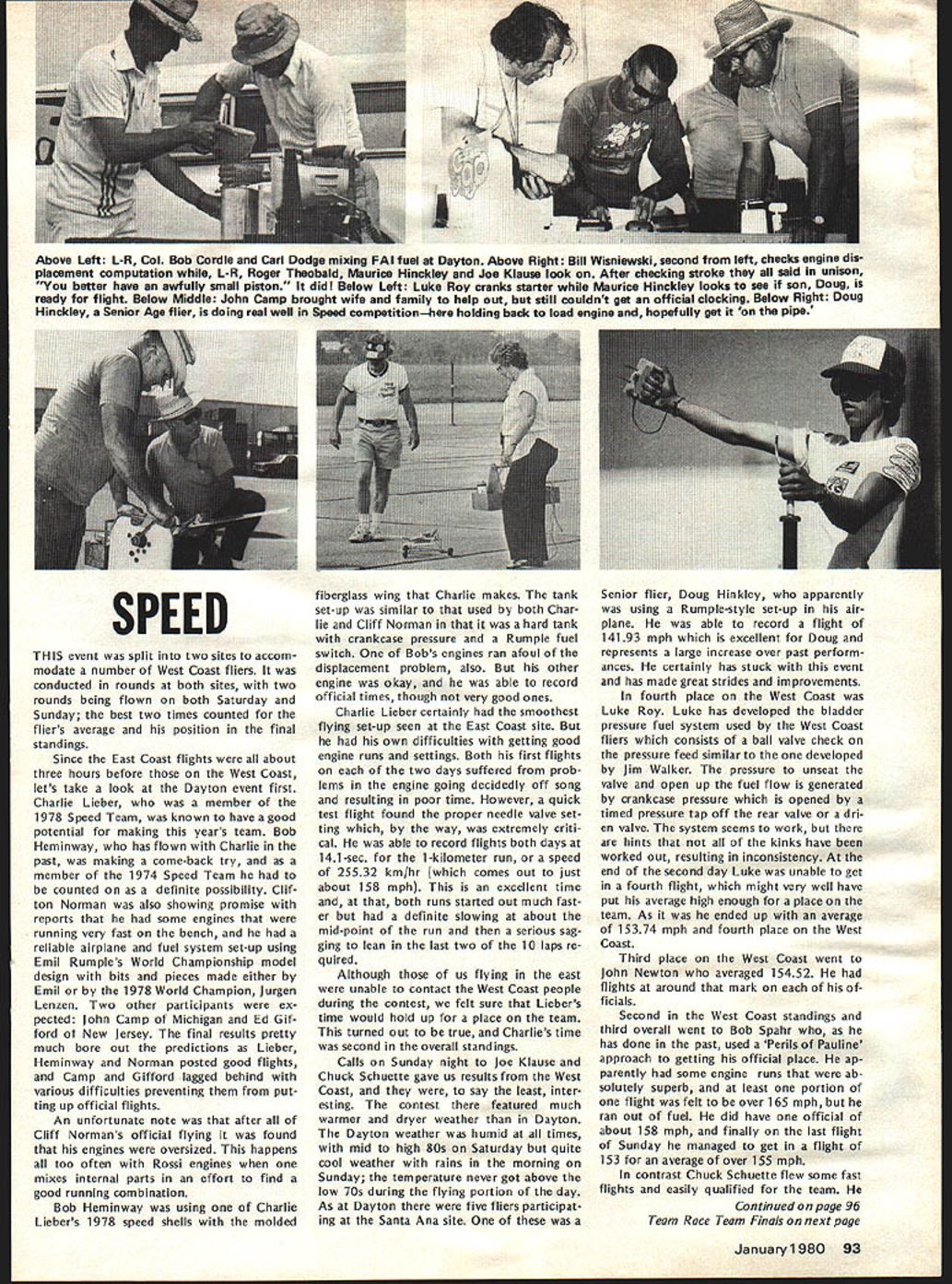
- Charlie Lieber (1978 Speed Team) posted consistent flights and recorded two official 1-km times of 14.1 seconds (255.32 km/hr ≈ 158 mph). Some flights showed sagging mid- and late-run performance.
- Bob Hemingway, using a molded fiberglass wing shell similar to Lieber's, recorded official times but had one engine ruled oversized.
- Cliff Norman showed promise but later had engines found to be oversized (a common issue when mixing internal parts in Rossi engines).
- John Camp and Ed Gifford suffered difficulties and lagged in official results.
West Coast (Santa Ana) highlights:
- Doug Hinckley (Senior) recorded a flight of 141.93 mph.
- Luke Roy averaged 153.74 mph and finished fourth on the West Coast; he uses a bladder/crankcase pressure fuel system.
- John Newton averaged 154.52 mph and placed third on the West Coast.
- Bob Spahr recorded engine runs with at least one portion over 165 mph but had a fuel issue; nevertheless he averaged over 155 mph.
- Chuck Schuette flew fast flights and easily qualified for the team.
Overall, the combined East/West results yielded team selection as listed above.
TEAM RACE
Team Race was run at Dayton under Bill Wright. Only eight teams entered (one withdrew after practice). Notable teams included Perkins/Albritton, John McCollum/Jed Kusik, Tim Gillott/John Ballard, Kelly/Hughes, Wallace/Wallace, Mogi/Jolly, and Nelson/Jackson.
Event highlights and incidents:
- Perkins/Albritton posted very consistent high speed and excellent pit work.
- McCollum/Kusik showed good speed with Jed Kusik's quick pit stops.
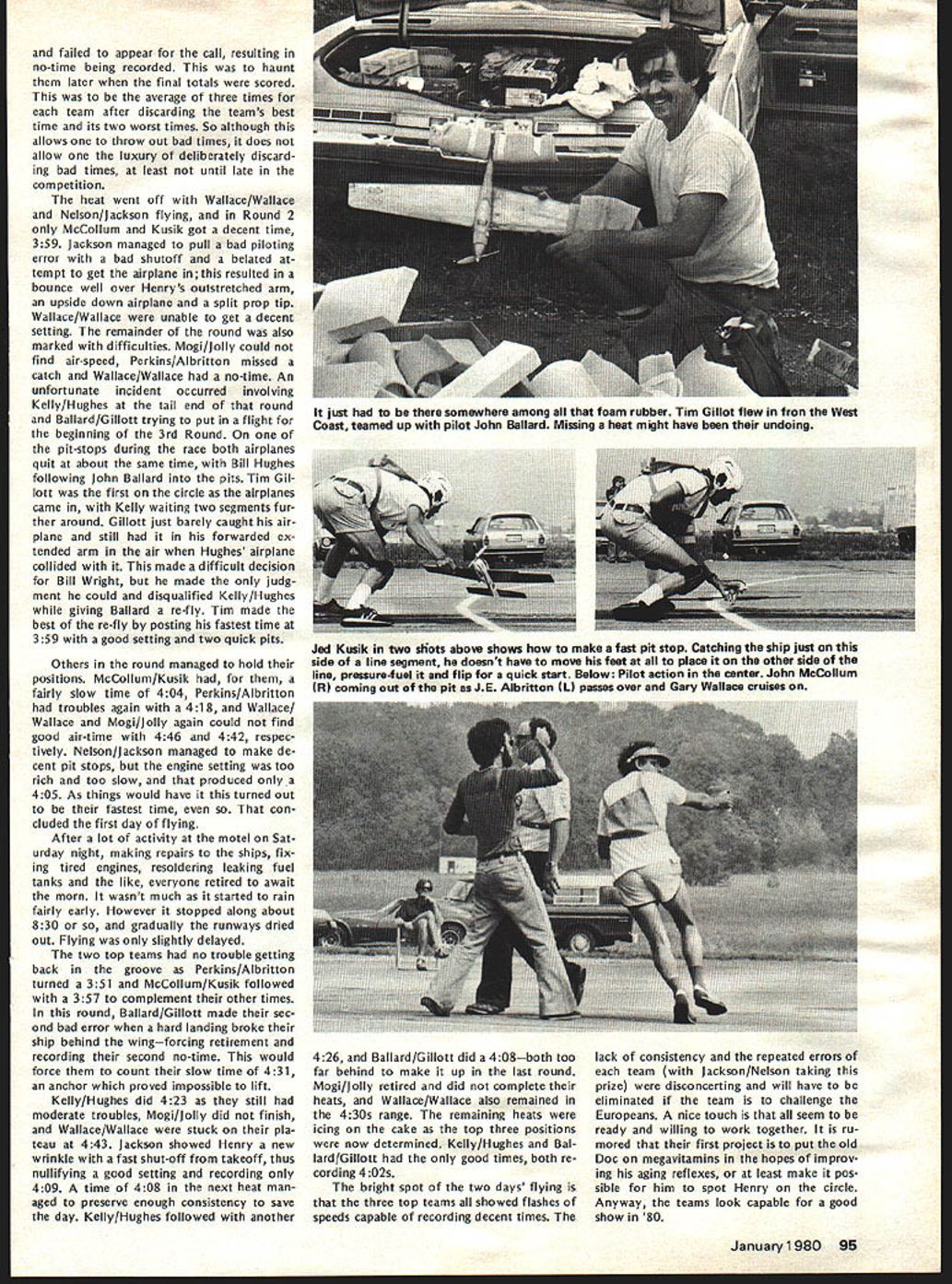
- Ballard/Gillott suffered engine setting problems and an eventual hard landing that forced retirement from contention.
- Kelly/Hughes experienced recurring issues, including a mid-event collision during a pit sequence that led to Kelly/Hughes being disqualified from that heat; Ballard/Gillott were given a re-fly.
- Several teams struggled with consistency and shutoffs; Nelson/Jackson and Wallace/Wallace had mixed results.
Scoring format: average of three times after discarding the team's best time and its two worst times (thus allowing one good time to be dropped but not permitting deliberate omission of bad times early in the contest).
Top three teams showed flashes of high speed but lacked overall consistency; the teams selected for the U.S. Team (Perkins/Albritton, McCollum/Kusik, Jackson/Nelson) demonstrated sufficient performance to represent the country.
---
NOTES
- For detailed proposal text and cross-proposal specifics, consult the cited Model Aviation issues (1978–1979) in the CN section.
- Manufacturers with unlisted engines that believe their products meet racing category criteria should contact AMA HQ immediately to claim legality and clarify category-specific requirements.
Transcribed from original scans by AI. Minor OCR errors may remain.

