
NMPRA SAFETY RECOMMENDATIONS NOW OFFICIAL
AMA insurance coverage for Pylon Racing events now hinges on adherence to these safety rules plus existing safety rules in the rule book.
Formula 1 and Quarter Midget
Following approval by the Executive Council on November 10, AMA President Earl Witt, in agreement with RC Contest Board Chairman Joe Friend, has directed that NMPRA safety recommendations for Formula 1 and Quarter Midget RC Pylon Racing be required for AMA sanctioned contests effective January 1, 1980. Previously the Executive Council amended the AMA Safety Code to require all AMA sanctioned RC Pylon Races to be in accordance with the safety aspects of the current AMA rules; these NMPRA-proposed safety rules, which have been adopted by emergency action, plus the safety rules already in the rule book, must be followed in order for AMA liability insurance to be in effect.
Sport Pylon
Similarly, by joint action of the AMA President and RC Contest Board Chairman, the previous rule book recommendation for using the Formula 1 or FAI Pylon Race courses has been changed so that it is required that either the Formula 1, Quarter Midget, or FAI Pylon courses be used—particularly in regard to spectator distances—for 1980 AMA sanctioned events.
The emergency actions described above will be followed up after publication by a ratification vote by the RC Contest Board. Any AMA member wishing to affect the outcome of this vote, either pro or con, should contact the district member of the RC Contest Board as soon as possible. If revisions are thought necessary, such suggestions should be sent as soon as possible to RC Contest Board Chairman Joe Friend, 62 Joysan Terr., Freehold, NJ 07728. Assuming ratification of these emergency actions, they will become a permanent part of the AMA rules even if not printed in the 1980–81 rule book (action may not be finalized in sufficient time for printing in the rule book).
The text of the new emergency safety rules adopted with effect on January 1, 1980, is as follows (numbering is relative to the 1978–79 rule book):
- RC Pylon Racing Formula 1
2.2. Contest Directors for this event must be familiar with the following safety rules, and these rules must be used in the operation of a contest. Violation of these safety procedures may result in cancellation of AMA sanctions, cancellation of the C.D.'s license, and cancellation of all NMPRA Championship points that the contestant who has violated these rules would have earned in such a contest.
Safety, of course, is an item that cannot wait for rules or paperwork. During the course of a racing event, an unforeseen situation may arise that requires immediate controls. The Contest Director, therefore, has the authority to initiate any procedure which he feels is necessary to eliminate a dangerous situation.
2.2.1. The pit and spectator areas must be outside the minimum distances described for the race course.
2.2.2. A protective barrier must be at the No. 1 pylon and at the lap counter stand for the workers to stand behind. The barrier should be at least 4 ft. high and made of at least 1/2 in. plywood or its equivalent.
2.2.3. No workers (except the No. 3 pylon judge) or contestants will be in the Danger Area near the No. 3 pylon.
2.2.4. The Ready Area for the heat that is after the one already flying should not be out on the course between the No. 2 and No. 3 pylons; landing of aircraft between the No. 2 and No. 3 pylons will be permitted only at the direction of the C.D. Contestants will be disqualified in the heat for violation of this rule.
2.2.5. Contestants walking across the race course during a race will be disqualified from the contest. Contestants and helpers must remain inside the course until all planes have safely landed.
2.2.6. The Contest Director or his appointees must monitor the location of spectators, contestants, and vehicles to insure that they are outside the boundaries specified for the race course outlined in the AMA Rule Book. A minimum number of people should be out on the course. The C.D. or the Starter should chase anyone out of the flying area who they feel does not belong.
2.2.7. Contestants are prohibited from consistently flying below the tops of the pylons (the top of the pylon is the uppermost part of the pylon pole). Situations may occur where one cannot avoid flying below this height. However, deliberate and repeated violations will be grounds for disqualification.
2.2.8. If an aircraft is damaged during a heat, such as a mid-air collision or hitting a pylon, and continues flying, the Starter may disqualify the contestant if, in his opinion, the aircraft has sustained enough damage to make flying unsafe. In this situation, a contestant must land his aircraft immediately after notification or face automatic disqualification from the contest. If a contestant is disqualified for unsafe flying, or receives two cuts during a heat, he must pull out of the race immediately after being personally notified or face automatic disqualification of that heat. A disqualified pilot should not land his aircraft until the remaining aircraft in the heat have finished racing. A disqualified aircraft should be flown at a higher altitude out of the way of the other aircraft; however, if a pilot is experiencing radio problems, he must land immediately. The Starter or C.D. has sole authority to disqualify a contestant for unsafe flying, and his decision is final.
If any aircraft sustains landing damage, the C.D. will inspect the model for safety before it can be flown again.
If flutter is detected on an aircraft, the contestant must land the model and it must be inspected by the C.D. before it can be flown again.
2.2.9. Hard hats are recommended for all workers and contestants on the pylon course during a race.
- Materials and Workmanship. Add the following paragraphs to this sub-section under the paragraph, "Workmanship must be . . . as a result of damage:"
All aircraft to be entered in this event, including back-up models, must undergo the following safety inspection before the contestant is accepted. It is recommended that this safety check be conducted at the time of registration.
8.1. Short pieces of rubber tubing will be used to secure all clevises to prevent them from coming disconnected in flight.
8.2. Throttle shut-off will be visually inspected, and may be functionally tested during the contest.
8.3. All screws holding the engine to the mount and the mount to the firewall must be in place and be secure.
8.4. Receiver and battery pack shall be protected against vibration in accordance with the radio manufacturer's recommendations.
8.5. Washers will be used on all screws holding the servos to mounting trays and also on screws holding the tray to the rails (all washers will be approximately the same diameter as the grommets). Servos mounted directly to rails will also have washers on the mounting screws. In addition, all servo trays will have at least one extra safety screw (not necessarily turned down tightly) placed between the grommets on the rear of the tray to prevent the tray from slipping out of the grommets in flight.
8.6. A keeper, or collar, will be on all push-rods that have a right angle bend that connects them to the servos. S-bends are acceptable. If a clevis is used at both ends of a push-rod, one of the clevises will be secured so that it will not turn.
8.7. All control surfaces will be firm on the hinge line without excess slop (at the discretion of the safety inspector).
8.8. Positive, thread type, wing bolts or screws will secure the wing in place on all two-piece aircraft.
8.9. A positive method of holding the wheel on the axle will be used, and the wheel shall not bind.
Pylon Safety Rules (Continued)
8.10. The entire aircraft shall be inspected for any stress cracks.
40. RC Pylon Racing — Quarter Midget
- General. Add the following paragraph under "all AMA regulations . . . of the utmost importance:"
All of the paragraphs under section 39 paragraph 2.2 that pertain to safety shall apply to this event.
- Materials and Workmanship. Add the following paragraph under "Workmanship must be . . . as the result of damage."
All of the paragraphs under Section 39 paragraph 8 pertaining to safety inspection shall apply to this event.
41. RC Sport Pylon Racing
Change last paragraph to:
Use of either the Formula I, Quarter Midget, or FAI Pylon Racing course is required, particularly with regard to spectator distances.
SCALE B.O.M. RULE
Last month's report of Scale Contest Board actions (page 84) inadvertently omitted the board's vote concerning Chairman Claude McCullough's proposed rewording of the builder-of-the-model rule to be applied to Scale events. The proposed rewording was approved 8 to 1.
CONTROL LINE SAFETY RULES RATIFIED
The November 1979 issue, page 86, announced the acceptance of several safety proposals for implementation as of October 1, 1979. When safety rules are enacted for "immediate" effect either by agreement of the AMA President and the chairman of the Contest Board, or by vote of the Contest Board, Contest Board procedures require a ratification vote by the CB four to six weeks after publication of the action—giving interested AMA members opportunity to state their views before final acceptance. All of these safety rules were ratified, as detailed below:
- Increase D Speed Pull Test to 48 Gs. Ratified 8 to 1. This proposal, and also the proposals to increase the Jet Speed and Open 1/2A Speed pull tests, was made because the G-load at record speeds exceeds the previous test load.
- Increase Jet Speed Pull Test to 48 Gs. Ratified 8 to 1.
- Increase Open 1/2A Speed Pull Test to 32 Gs. Ratified 8 to 1.
- Construction Guidelines for Single-Blade Props. The ratification vote to add such guidelines to the 1980–81 rule book was in favor 8 to 1. On the question of whether such guidelines should apply only to Speed events vs. all AMA CL events, the vote was 3 for Speed only, 6 for all AMA CL events. The guidelines for single-blade prop construction, thus, will apply to all AMA Control Line events. This proposal was made on the advice of the Speed Advisory Committee which favored adding safe construction guidelines to the rules as opposed to an outright ban on single-blade props (which had been voted in earlier, but not ratified).
Competition Newsletter
Competition News will present, from time to time, constructive and thought-provoking ideas or criticisms of AMA rules and policies which affect competitors. When the issue has two sides, CN will endeavor to print all viewpoints that have been submitted—within the limits of available space, uniqueness, constructiveness, timeliness and good taste. Determination of the appropriateness of publication of any of these matters must of necessity rest solely with the publisher.
The thoughts presented are those of the author, and should not necessarily be construed as those of AMA HQ, AMA officers or the publisher. All should note that publication here or a rules-change or policy-change idea does not necessarily mean that specific proposal has been presented to the Contest Board, Executive Council, or appropriate committee; such action is the responsibility of the author or anyone else interested in obtaining official action.
RC Sailplane Classes Compared to Rudder-Only Pattern
Al Doig
The present Soaring class rules controversy reminds me of the Rudder-Only, Intermediate and Multi squabble of the late '50s. Attempts to keep the Rudder-Only class simple to "give the beginner a chance" caused unbelievable turmoil. Not only was the airplane control configuration regulated but an attempt was made to regulate the radio mode by specifying "single channel." In the 1959 Nats I flew a fully proportional radio of my own design in a Rudder-Only plane, arguing that the rules did not exclude the technique used. Finally everyone threw up their hands, and "single-axis-only" contests were won using multi-channel reed radios with slow-roll, fast-roll buttons and pull-range control of overly powerful, up-thrusted engines which gave "up-elevator" control. Rudder-Only rules went out of control, and with the advent of reliable low-cost proportional radios, Rudder-Only died.
There is one big difference, however, between the Rudder-Only power class and the Standard (and now 2-Meter) Sailplane class as a vehicle to attract beginners to contests.
The "hot shot" pilot did not stay with Rudder-Only long. It was really difficult to tell from observation what the maneuvers were supposed to be. The hot shot soon graduated to Multi where it was somewhat easier to distinguish three rolls from three not-too-planar loops. Rudder-Only became populated with dedicated Rudder-Only fliers trying to improve the breed, sport fliers who were not too serious about contest flying, and the always-present guy who never could get the hang of it. The serious beginner could begin placing in contests rather quickly and soon moved to Multi.
The Standard class Sailplane event at almost any contest has a high population of experts. Many experts see no reason to fly 12-ft ships with all the bells and whistles when they can do as well with a small ship. As a case in point is the 1975 SOAR Nats. Ten out of the first 20 places were Standard class ships and only three points separated first in Standard from first in Unlimited. In the August 1975 issue of Sailplane, Warren Teichert asks: "Is it true some contestants flew Unlimited with their Standard bird because they felt it was easier, or did they just want to beat the big bird, or did they think the landing was so important that it gave the Standard plane an advantage for total score?" One Southern California flier who was among the top 20 at SOAR said many fliers were using Standard planes in Unlimited because the percentage of talented fliers in Standard class makes their chances better in Unlimited. Indeed! We now have rules against flying Standard planes in Unlimited class. If these things are so, how can Standard class be for beginners? Let's land the expert ships with a pound of lead, right? In three months he would come back with a design that would turn this to his advantage.
While Pattern competition rules went through years of trying to segregate competition by airplane class or equipment, etc., they eventually settled on skill as the class common denominator. Within a given skill class, competitors try to tune airplane characteristics to gain some advantage over their peers, but differences in flying characteristics are overshadowed by the skill factor.
One thing which tends to optimize Sailplane design and size is weather. On the second day of the 1974 Dayton DARTS contest a 25-knot wind gave less than perfect soaring conditions. Otto Hettich loaded the Challenger luggage compartment with lead, raced off a mile down-wind, maxed on a big wave, cranked in reflex flaps, put his nose down and scooted home for a precision landing and winning flight. An Olympic trying the same tactic was last seen disappearing behind an apartment complex on the other side. I could fly rings around the Challenger.
It seems to me, after all this background, that if the class objective is to allow beginners to compete, grouping by skill, not Sailplane size, makes sense. The pure size of the aircraft does not price the beginner or youngster out of an Unlimited-size airplane. It is the fiberglass fuselage, added servos for flaps and spoilers, etc., that really runs costs up. It certainly has not been proven that these things are needed to win.
If we do indeed need a class system it should be based on skill and accomplishment, not equipment used. LSF has set precedence in this area. LSF levels have no requirement on size of Sailplane or type of equipment.
If the objective of the Standard (and 2-Meter) class really is not to accommodate the beginner, we better find out what it really is. I've never heard any other strong reason.
(Reprinted from the Journal of the Torrey Pines Gulls RC Soaring Society, Inc.)
Pay Attention to Sounds!
Ed Cocciola
Do you ever listen to your airplane? Sure, everyone listens to his engine to tell if it's too rich or too lean, but I mean do you ever listen to your WHOLE AIRPLANE? If not, you may miss some very important trouble warnings that could very well save your airplane from crashing.
When an airplane is in good flying condition, it gives off a total sound that you should get familiar with, because when that sound changes it nearly always means trouble brewing. But the trouble may not be obvious, or it could be hard to find. If this causes you to ignore it, you're on the way to a crash.
For instance, last Saturday my Compensator started singing me a new song. I checked all the hinges, landing gear, muffler, and pulled on the engine to see if the mounting bolts were loose. Nothing moved, so I started it again — same unfamiliar sound. This time I looked real close in the engine compartment, after I removed the muffler, and there it was! The rear mounting bolt had worked loose, yet the engine felt tight. The point is the airplane can tell you when things like the following are going wrong:
- Engine bolts loose or broken
- Muffler coming off
- Hinges coming out
- Cracks in airframe
- Flutter in control surfaces, which in turn causes the servo gears to strip
When your airplane sings you a different tune, you had better heed it, and start looking for the problem. Or you will end up singing a new tune—THE BLUES!
(Reprinted from the Cedar Rapids (IA) Logbook.)
Are You a Hitchhiker?
With his thumb a hitchhiker says, "You furnish the gas, car, attend to the repairs and upkeep, supply the insurance, and I'll ride with you; but if you have an accident I'll sue for damages."
It sounds pretty one-sided, but one wonders how many hitchhikers there are in our club. Many members seem to say, "You go to the meetings, serve on the board and committees, do the paperwork, study the issues, pay the bills, and take care of all the things that need doing, and I'll just go along for the ride, and expect help when I need it. I'll expect somebody to waive their Magic Wand and have the field fertilized, rolled and mowed when I want to fly. If I'm asked to help I'll be too busy doing something else. If things don't suit my fancy, if I don't get my way, I will complain and criticize and probably get out and hitchhike to another group!"
HITCHHIKER or DRIVER — WHICH KIND OF MEMBER ARE YOU?
(Reprinted from the newsletter of the Flying Circuits, Inc., Ft. Wayne, IN.)
Care with Gasoline Fuels
The big birds are here to stay, and I think that's great. Much has been said about accidents, but I believe most of it is exaggerated. A very big 32-lb. plane at 50 mph has the same kinetic energy as an 8-lb. Pattern ship at 100 mph or a .22 bullet at a nominal muzzle velocity. I would prefer to take my chances with a big bird, as they are easier to dodge, and if they do hit, the energy is dissipated over a larger area for a larger period of time. For a more realistic measure, the energy involved is the same as a 100-lb. kid and a 10-speed bike at 25 mph.
There are, however, two additional areas of caution that we should concern ourselves with when flying big ships: basic design and gasoline fuel. I have previously mentioned servo loads, push-rods, servo power requirements, hinge loads, etc., and most of us are aware of these design considerations — but little has been said of the gasoline fire potential. Many fires have been caused by drop-in or powered or hydrolined gasoline lines. The 3-and-1 refueling used by these engines is quite flammable compared to our familiar glow fuel. In addition the fuel is home-mixed, so right off the bat we are in an area of involvement most of us have never been concerned with before.
Fire safety rules are no dark secret, so little would be gained by repeating them here. What I want to do is remind you that the potential hazard exists and to ask you to exercise care when mixing, storing, or using gasoline fuels.
(Reprinted from the Thunderbolts RC Club, Inc., of Schenectady, NY.)
NMPRA CHAMPIONSHIPS
The big event of the "go fast and turn left" crowd was held October 19–22, 1979, at Las Vegas. It saw Bob Root take first place with a faster time in a flyoff with Ron Gilman than had been achieved in all of the heat races.
By Bill Hager
It's been a busy season. A lot of Pylon fliers started out in 1979 with visions of going to the NMPRA Championship at season's end. This year the event was in Las Vegas, NV.
For those of you who are not familiar with the NMPRA Championship, you may be interested in knowing how the fliers qualify to compete: each must be an NMPRA (and AMA) member and either finish in the top 20% of the flier's NMPRA district, or be an NMPRA officer, or finish in the top 10 (in the same year) at the AMA Nats. The idea is to get the best Pylon fliers in the country together for the big showdown.
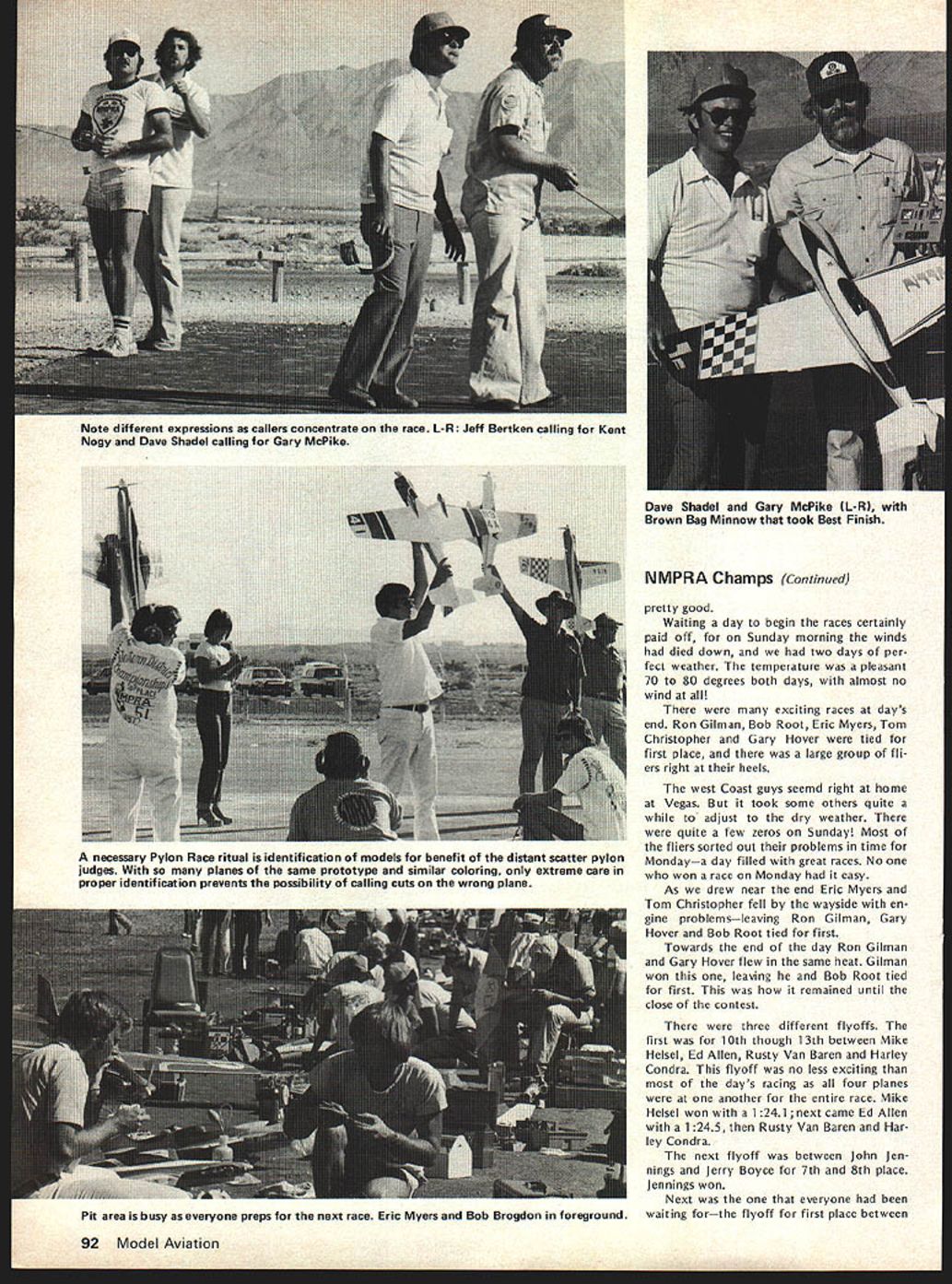
This year proved to be the best attended yet. With over 110 people qualified, 87 pilots showed up for registration on Friday, October 19. The planes were safety-checked and scale-judged for takeoff positions. A best-finish airplane was picked — a plane with such excellent workmanship as to outshine the about 150 others. This year's best-finish plane was built by Gary McPike, an NMPRA vice-president for the Western District.
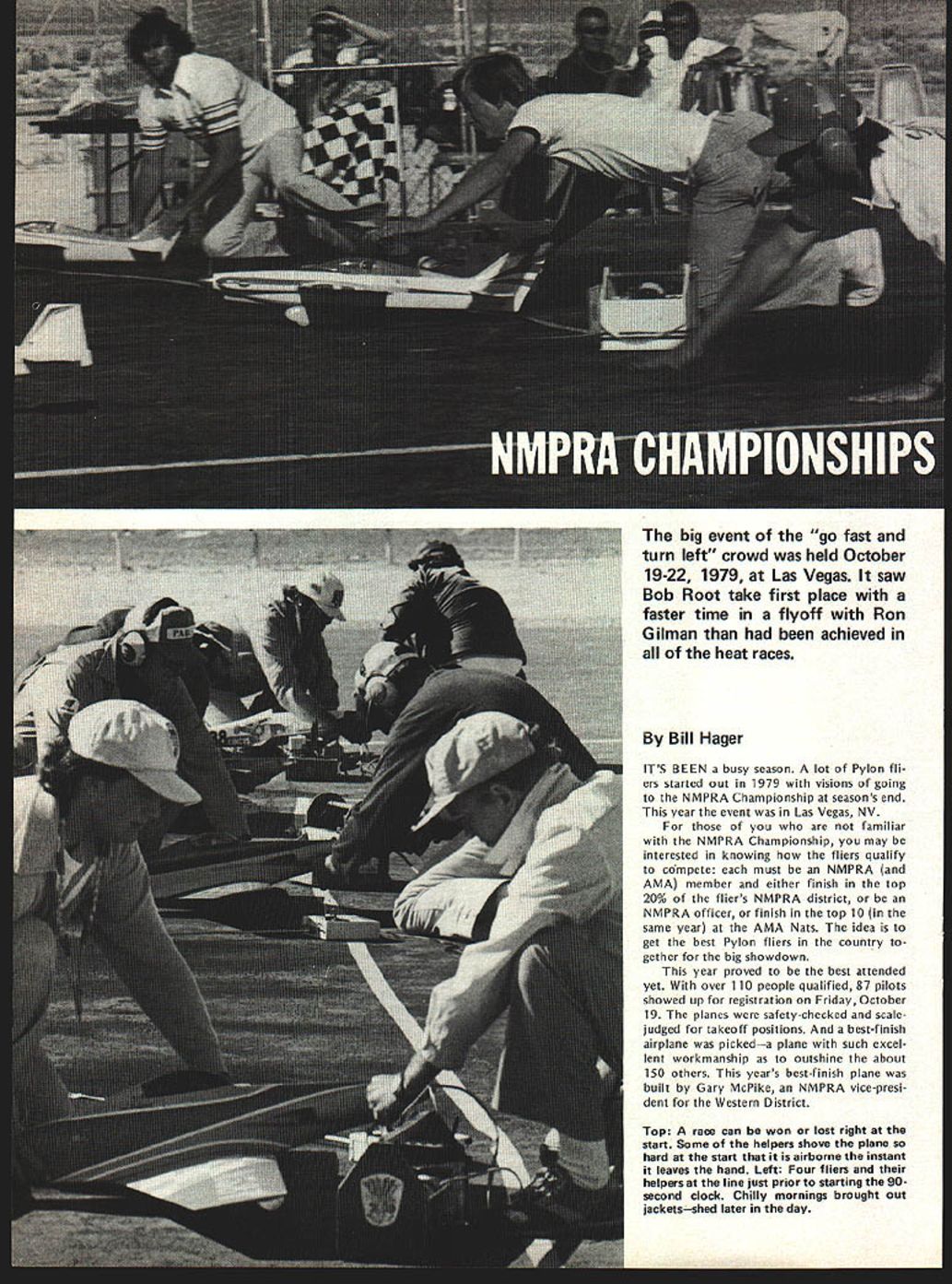
Top: A race can be won or lost right at the start. Some of the helpers shove the plane so hard at the start that it is airborne the instant it leaves the hand. Left: Four fliers and their helpers at the line just prior to starting the 90-second clock. Chilly mornings brought out jackets — shed later in the day.
Weather at Las Vegas had been fantastic all week preceding the race. But on Friday about noon the winds picked up, and the weather took a turn for the worse. On Saturday morning there still was no change; winds were gusting to over 50 mph. With such high winds and much blowing sand, the race was postponed from Saturday–Sunday to Sunday–Monday. Unfortunately a few fliers couldn't stay over through Monday, and they returned home.
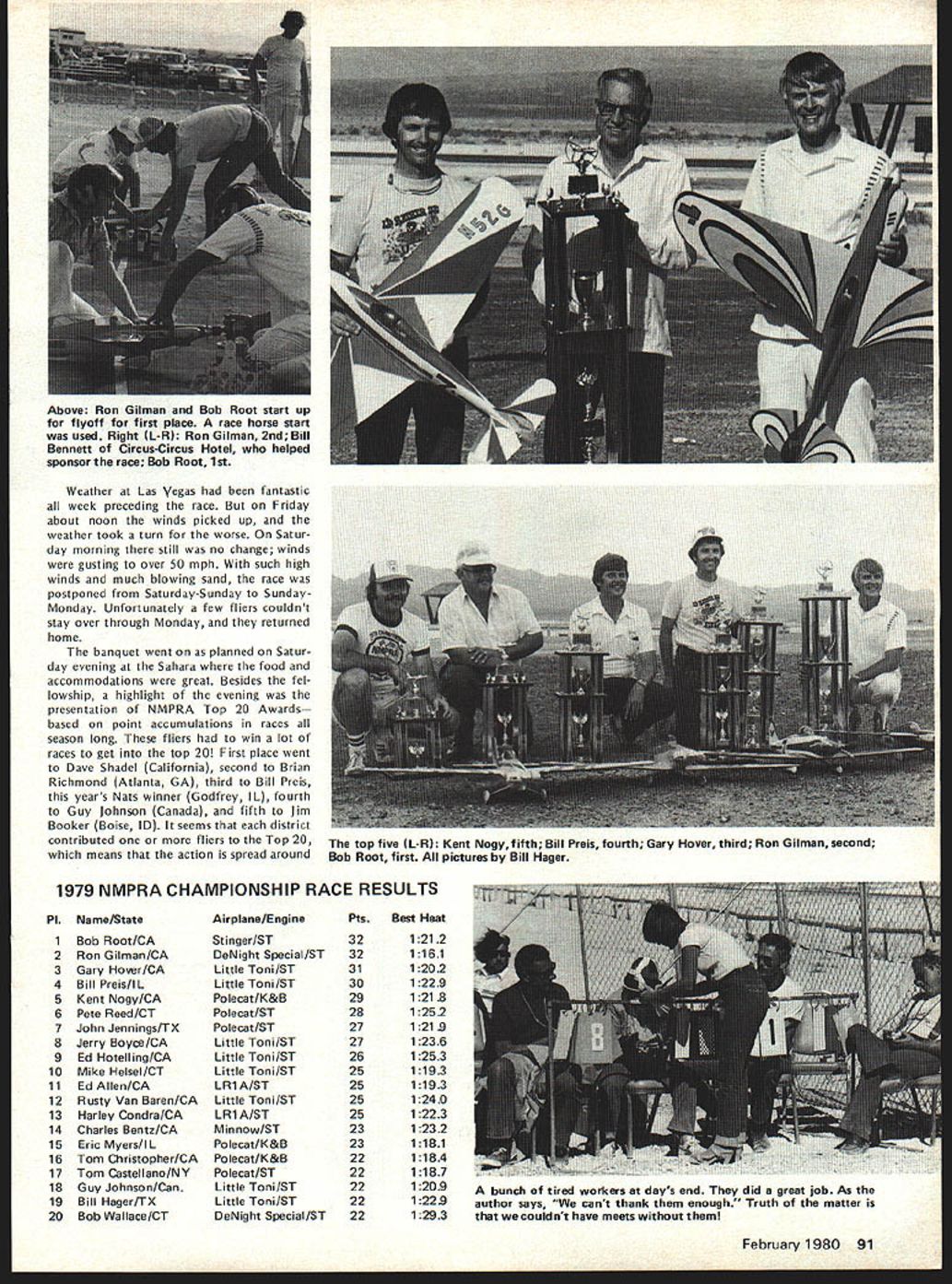
The banquet went on as planned on Saturday evening at the Sahara where the food and accommodations were great. Besides the fellowship, a highlight of the evening was the presentation of NMPRA Top 20 Awards — based on point accumulations in races all season long. These fliers had to win a lot of races to get into the Top 20! First place went to Dave Shadel (California), second to Brian Richmond (Atlanta, GA), third to Bill Preis, this year's Nats winner (Godfrey, IL), fourth to Guy Johnson (Canada), and fifth to Jim Booker (Boise, ID). It seems that each district contributed one or more fliers to the Top 20, which means that the action is spread around.
1979 NMPRA CHAMPIONSHIP RACE RESULTS
- Bob Root (CA) — Stinger/ST — 32 pts — Best Heat 1:21.2
- Ron Gilman (CA) — DeNight Special/ST — 32 pts — Best Heat 1:16.1
- Gary Hover (CA) — Little Toni/ST — 31 pts — Best Heat 1:20.2
- Bill Preis (IL) — Little Toni/ST — 30 pts — Best Heat 1:22.9
- Kent Nogy (CA) — Polecat/K&B — 29 pts — Best Heat 1:21.8
- Pete Reed (CT) — Polecat/ST — 28 pts — Best Heat 1:25.2
- John Jennings (TX) — Polecat/ST — 27 pts — Best Heat 1:21.9
- Jerry Boyce (CA) — Little Toni/ST — 27 pts — Best Heat 1:23.6
- Ed Hotelling (CA) — Little Toni/ST — 26 pts — Best Heat 1:25.3
- Mike Helsel (CT) — Little Toni/ST — 25 pts — Best Heat 1:19.3
- Ed Allen (CA) — LR1A/ST — 25 pts — Best Heat 1:19.3
- Rusty Van Buren (CA) — Little Toni/ST — 25 pts — Best Heat 1:24.0
- Harley Condra (CA) — LR1A/ST — 24 pts — Best Heat 1:22.3
- Charles Bentz (CA) — Minnow/ST — 23 pts — Best Heat 1:23.2
- Eric Myers (IL) — Polecat/K&B — 23 pts — Best Heat 1:18.1
- Tom Christopher (CA) — Polecat/K&B — 22 pts — Best Heat 1:18.4
- Tom Castellano (NY) — Polecat/ST — 22 pts — Best Heat 1:18.7
- Guy Johnson (Can.) — Little Toni/ST — 22 pts — Best Heat 1:20.9
- Bill Hager (TX) — Little Toni/ST — 22 pts — Best Heat 1:22.9
- Bob Wallace (CT) — DeNight Special/ST — 22 pts — Best Heat 1:29.3
NMPRA Champs (Continued)
Waiting a day to begin the races certainly paid off, for on Sunday morning the winds had died down, and we had two days of perfect weather. The temperature was a pleasant 70 to 80 degrees both days, with almost no wind at all!
There were many exciting races. Ron Gilman, Bob Root, Eric Myers, Tom Christopher and Gary Hover were tied for first place at one point, and there was a large group of fliers right at their heels.
The West Coast guys seemed right at home at Vegas. But it took some others quite a while to adjust to the dry weather. There were quite a few zeros on Sunday! Most of the fliers sorted out their problems in time for Monday — a day filled with great races. No one who won a race on Monday had it easy.
As we drew near the end, Eric Myers and Tom Christopher fell by the wayside with engine problems — leaving Ron Gilman, Gary Hover and Bob Root tied for first.
Towards the end of the day Ron Gilman and Gary Hover flew in the same heat. Gilman won this one, leaving him and Bob Root tied for first. This was how it remained until the close of the contest.
There were three different flyoffs. The first was for 10th through 13th between Mike Helsel, Ed Allen, Rusty Van Buren and Harley Condra. This flyoff was no less exciting than most of the day's racing as all four planes were at one another for the entire race. Mike Helsel won with a 1:24.1; next came Ed Allen with a 1:24.5; then Rusty Van Buren and Harley Condra.
The next flyoff was between John Jennings and Jerry Boyce for 7th and 8th place. Jennings won.
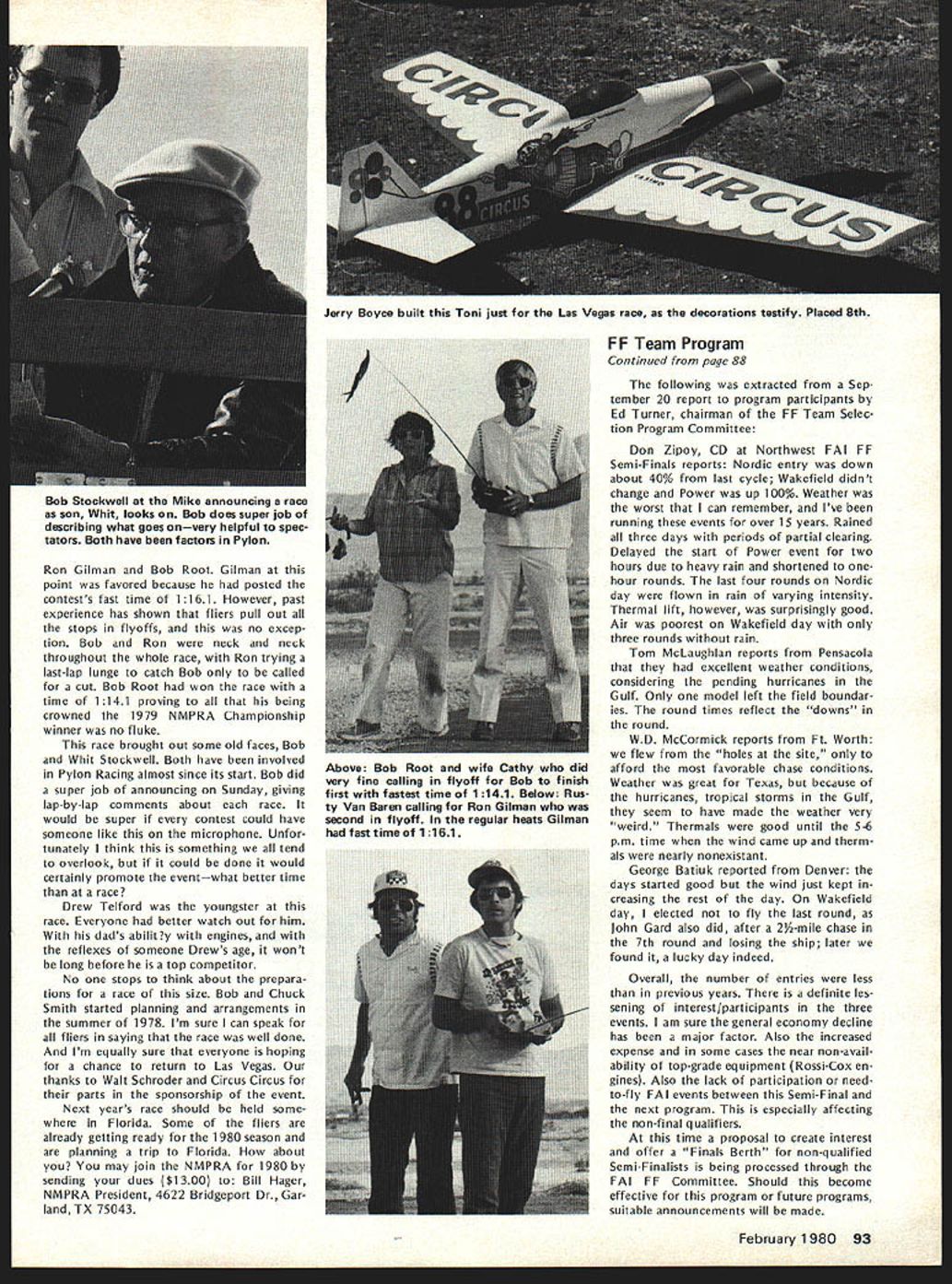
Next was the one that everyone had been waiting for — the flyoff for first place between Ron Gilman and Bob Root. Gilman at this point was favored because he had posted the contest's fast time of 1:16.1. However, past experience has shown that fliers pull out all the stops in flyoffs, and this was no exception. Bob and Ron were neck and neck throughout the whole race, with Ron trying a last-lap lunge to catch Bob only to be called for a cut. Bob Root had won the race with a time of 1:14.1, proving to all that his being crowned the 1979 NMPRA Championship winner was no fluke.
This race brought out some old faces, Bob and Whit Stockwell. Both have been involved in Pylon Racing almost since its start. Bob did a super job of announcing on Sunday, giving lap-by-lap comments about each race. It would be great if every contest could have someone like this on the microphone. Unfortunately I think this is something we all tend to overlook, but if it could be done it would certainly promote the event.
Drew Telford was the youngster at this race. Everyone had better watch out for him. With his dad's ability with engines, and with the reflexes of someone Drew's age, it won't be long before he is a top competitor.
No one stops to think about the preparations for a race of this size. Bob and Chuck Smith started planning and arrangements in the summer of 1978. I'm sure I can speak for all fliers in saying that the race was well done. And I'm equally sure that everyone is hoping for a chance to return to Las Vegas. Our thanks to Walt Schroeder and Circus Circus for their parts in the sponsorship of the event.
Next year's race should be held somewhere in Florida. Some of the fliers are already getting ready for the 1980 season and are planning a trip to Florida. How about you? You may join the NMPRA for 1980 by sending your dues ($13.00) to: Bill Hager, NMPRA President, 4622 Bridgeport Dr., Garland, TX 75043.
Transcribed from original scans by AI. Minor OCR errors may remain.

