
FAI Annual Meeting
Summary of the Most Significant Decisions at the November 29–30 Meeting in Paris
- World Championships assignments:
- 1980: USA approved to host Indoor World Championships at West Baden, IN, June 20–24; Spacemodels (Rocket) at Lakehurst, NJ, September 7–12.
- 1980: Canada approved to host RC and CL Scale in Ottawa, July 19–26.
- 1980: Control Line World Championships in Czestochowa, Poland, July 12–18.
- 1981: RC Aerobatics in Guadalajara, Mexico (late October–early November); Free Flight in Spain (Valdepeñas), August; possible RC Soaring in South Africa.
- 1982: Control Line in Sweden.
- 1983: RC Aerobatics in Ireland.
- New Noise Reduction Subcommittee established under F. Mernin (Belgium) to study engine-noise problems at events.
- Free Flight Coupe d'Hiver change rejected: French proposal to increase minimum rubber weight from 70 g to 90 g was denied.
- Control Line:
- All U.S. Combat proposals referred to a subcommittee for further study.
- New Team Race Jury Guide adopted.
- World records for Team Race (100- and 200-lap) approved, effective 1981 (see Records).
- Radio Control — Aerobatics:
- U.S. proposal to combine all patterns accepted in principle; final wording to be decided for 1981 implementation.
- Takeoffs and landings still required but will no longer be judged (i.e., not scored). Time references for rolling maneuvers (and inverted flight) were deleted.
- Minimum horizontal distance for maneuvers changed from 100 m to 150 m (see Judge Guide / Annex).
- Builder-of-model rule remains in effect; USA and German proposals withdrawn in support of a British proposal for subcommittee review of the rule.
- Top Hat maneuver now required to have a "square" top (top same length as sides).
- German proposal for large semi-scale "Las Vegas" type models and maneuvers withdrawn for further study.
- Pylon Racing:
- DeBolt proposal referred to subcommittee for rework to eliminate scale requirement, to reconsider prohibition on fiberglass props, and to substitute a noise limit for specific silencer specifications.
- British proposals to permit commercial wheels and to revise the silencer description were accepted for the current provisional rules.
- Thermal Soaring:
- Hi-start (bungee) no longer permissible.
- No change of model or parts after starting the first attempt.
- A round consists of Tasks A, B, and C; for each round the total score is A + B + C.
- If only five rounds are flown, all rounds count; if more than five rounds are flown, the lowest round score is cancelled.
- In Speed, models that do not complete the task within four minutes score zero.
- Electroflight:
- A whole new set of provisional rules for Electroflight (RC electric) was approved; they will be included in the next FAI rule book (1983).
- Scale:
- Standoff scoring modified: the Complexity flight bonus system for Precision FAI Scale (F4C) now also applies to Standoff.
- The 50-point bonus for a competitor's own design drawings was deleted.
- The words "general impression" were deleted from the Fidelity to Scale scoring factor.
- Precision Scale biplane scoring changed: delete references to single- and two-bay biplanes; biplanes are scored 5% with an extra 5% for undercamber.
- Monowheels deleted from the bonus list.
- Records:
- Beginning 1981, Team Racing World Records will be accepted for 100- and 200-lap races when all three teams finish, but only for official FAI International, Continental, or World Championship competitions.
- Beginning 1981, Electroflight records will be accepted in four classes:
- S — with rechargeable power sources
- P — with non-rechargeable power sources
- SOL — solar cells only for power
- COM — all types of power in any combination
- World Championship diplomas (certificates) will now be awarded to the first three teams at all World Championships (previously only to the first team).
CL Records (continued)
When rules for an event are sufficiently changed to make comparison of performances doubtful, new records are established and the old records are retired. Cases that are not clear-cut are resolved by board vote.
When old records are dropped and new record categories are established, all the old records are retired—even if particular aircraft or records could be argued to fit the new rules. This follows Contest Board procedures, CLCB interpretation, and established precedent; otherwise Contest Boards would be required to examine old records for compliance with rules that did not exist at the time.
The CLCB record situation is now considered clear-cut. New categories will be established and the former records retired for the following events:
- Control Line Endurance: Now limited to outdoor sites only and limited to four ounces of fuel. These changes make achieving the old high times more difficult.
- B Speed: Uses longer lines and, for the two-line case, increased line diameter; increased drag will lower achievable speeds.
- Formula 40 Speed: Fuel restrictions will limit speed, though pipe restrictions are slightly relaxed (mini-pipe max length from 5 in. to 6 in.); net effect will limit speed or at least make comparisons with old records doubtful.
Record categories will be dropped entirely for these events:
- ½A Profile Proto — Senior and Open only: records are not maintained for provisional or supplemental events.
- B Proto: the event was dropped.
- C Speed: the event was dropped.
Now it Is All Clear to You
By the way, one recurring mistake in printing competitor names should be noted. Chinese names are written surname first, followed by given name (same applies to Korean and most Asian names; Hungarian too). For example, the name of the sole F1C flier at Taft from China, Gao Qinfei, should have been printed Q. Gao (surname Gao) rather than "Gao Qinfei" in the Western order.
Chinese are proud of their naming order and generally do not change it when transliterated. Japanese are more flexible — e.g., MIKAMI YUZO (Japanese order) is often printed Yuzo Mikami in English.
According to Gao, his name in Chinese characters reads as GAO QIN FEI — meaning "High → work hard → fly." Now you know why he was so good at the contest! Mr. "High working hard to fly" — a fine name for a modeller.
Yours sincerely, (Mikami Yuzo)
RC Helicopters & RC Sport Biplane Rules Status
In an October 30 memo to the RC Contest Board, Chairman Joe Friend noted that there have been nationally recognized competitions during the past two years for RC Helicopters (Nationals) and Sport Biplanes (Omaha). The board voted 9–1 to remove the provisional status from the rules for RC Helicopters and 8–2 to remove the provisional status from the rules for RC Sport Biplanes for the 1980–81 rule book.
FF World Champs Follow-Up from Tokyo
Dear Friends — thank you very much for your prompt replies to my query on the disqualifications of Zachariah and Galbreath.
RC Aerobatics Team Selection Committee
Participants in the previous selection program for the U.S. RC Aerobatics World Championships Team ratified a new Team Selection Committee by a vote of 39 to 1. The committee consists of one representative from each of the 11 AMA districts:
- District I: Walter Damuck, 115 Windy Dr., Waterbury, CT 06705.
- District II: John Byrne, 36-29 213th St., Bayside, NY 11361.
- District III: Dave Brown, 8534 Huddleston, Cincinnati, OH 45236.
- District IV: Dave Burton, 5609 Lantana Ave., Charlotte, NC 28212.
- District V: Ron Chidgey, 1713 Pompano Dr., Pensacola, FL 32504.
- District VI: Ralph White, Jr., RR 1, Box 392, Neoga, IL 62447.
- District VII: Bud Weber, 1121 E. Roberta Ave., Waukesha, WI 53186.
- District VIII: Dwayne Brown, 930 Vincere St. Lane, Richardson, TX 75080.
- District IX: James Eide, 2608 S. Madison Dr., Littleton, CO 80121.
- District X: Rick Horn, 10399 Obsidian Ct., Fountain Valley, CA 92708.
- District XI: Bob Crump, 13220 Autumn Lane, Oregon City, OR 97045.
Committee members were nominated by the National Society of Radio Controlled Aerobatics (James Vanderbeck, President). The committee will develop a program and budget for selecting the U.S. team for the 1981 RC Aerobatics World Championships planned for Guadalajara, Mexico (late October–early November).
U.S. Reps at FAI CIAM Meeting
The AMA had representation across most interests at the CIAM plenary in Paris. Eight specialists attended:
- Laird Jackson — Control Line
- George Xenakis — Free Flight
- Bob Wischer — Scale
- Ron Chidgey — RC Aerobatics
- Joe Boshar — RC Electrics (Electroflight)
- Dan Pruss — RC Soaring
- John Burkam — RC Helicopters
- Howard Kuhn — Space Models
Three others participated:
- Earl Witt — President and U.S. voting delegate
- Johnny Clemens — 1st Vice-President and chairman of the Information and Education Subcommittee
- John Worth — Executive Director, served as CIAM secretary
- Bryant Thompson also attended as an observer at his own expense.
Each U.S. participant reported that attendance was important to U.S. interests and to the progress of their respective activities. The AMA Executive Council had authorized sending multiple representatives to protect U.S. investment in the international scene and its effects on U.S. modelers.
FAI CIAM First V.P.
Johnny Clemens
It was impressive that the AMA and the United States were represented at the 1979 Plenary Meeting by delegates with a total of 48 years of CIAM meeting experience. John Worth is the senior representative with 15 years' service and was unanimously re-elected secretary of the CIAM. The combined years of attendance by AMA representatives exceed that of any other country, justified by AMA being one of the largest aeromodelling organizations in the world.
Our representatives served to ensure that the U.S. viewpoint was fairly expressed and to present the U.S. position in the best possible light, attempting to persuade others to adopt U.S. ideas when they are in the best interests of aeromodelling.
FAI CIAM — RC Aerobatics
Ron Chidgey
The meeting was very successful for U.S. RC Pattern interests. Five U.S. proposals were steered through the Technical Committee and approved in principle by the Plenary Meeting. One U.S. proposal (eliminate the 10-minute flight-time limit) was rejected but may be approved next year if slightly amended; another (eliminate the BOM rule) was referred back to subcommittee.
Summary of key proposals and outcomes:
- U.S.A. and Germany — 5.1.2. Prefabrication of Model (eliminate the "BOM" rule): This recurring proposal was referred to subcommittee. There is a changing mood and the BOM rule may be eliminated next year unless an effective enforcement method is found.
- U.S.A. — 5.1.13. Execution of Maneuvers (eliminate the 10-minute time limit): Failed primarily because some nations argued that, theoretically, a contestant could have unlimited time in the air. Several delegates favored a compromise: a 3-minute starting time followed by a full 10-minute flight time. This compromise may be proposed next year.
- Aerobatic Subcommittee — 5.1.3. Noise: Proposal to simplify noise-measuring procedures passed in principle; specific wording to be finalized in subcommittee for the March Bureau meeting.
- Annex 5B — Schedule of Maneuvers: Proposal to delete takeoff and landing from A & B schedules and to add two high K-factor maneuvers to each schedule passed. Net effect: takeoff and landing will no longer be judged. Wording will be added to the Sporting Code to prevent hand-launches and droppable dollies.
- Annex 5C — Takeoff, Landing, and Triangle Rolling Loop: Maneuver descriptions passed in principle. Changes included raising the altitude reference for takeoff/landing from 2 m to 4 m, but since these maneuvers will not be judged, the change is largely moot. The triangle rolling loop change called for two legs of two seconds instead of one second; however, a U.S. proposal to delete time references in maneuver descriptions passed, so changes will use framing or distance references instead of time.
- Sweden and Denmark — Annex 5A (Classification): Proposal to delete Schedules A and B in favor of only Schedule C was withdrawn in favor of the U.S. proposal to simplify scheduling; K-factor review was referred back to subcommittee.
- U.S.A. — Annex 5B (eliminate Schedules A & B): Passed in principle. New wording will likely specify that each competitor has four flights (two judged by one panel, two by another), with the best score from each panel used to determine the winner. For large contests, a flyoff (top ~10% or top 5 competitors) of two flights each is recommended; flyoff to count about 50% of final score.
- Annex 5C — Description of Maneuvers: U.S. proposals passed to:
- Remove all time references from listed maneuver descriptions (Maneuvers A5, A11, B5, B7, B9, 16, 22).
- Change Top Hat downgrade: vertical and horizontal legs must be approximately the same length (Top Hat top now "square").
- Delete references to 30 m landing circle for A12, B12, Landing (since takeoff/landing are not judged, no current effect; if judged again in future, they will likely be judged for position only).
- Annex 5D.2.3 — Size of Maneuvers: change longitudinal distance references from 100 m to 150 m.
- Germany — Semi-Scale Aerobatic Program: Proposal to create a "Las Vegas" type program using large semi-scale airplanes was referred to subcommittee; provisional rules or an experiment may follow if interest continues.
FAI CIAM — RC Soaring
Dan Pruss
- The three-tasks-per-round concept (Tasks A, B, and C make a round) has been restored. The low round is discarded only if more than five rounds are flown.
- Unlimited attempts are permitted within the working time for Distance; a flier may get a restart while still on the course.
- Winch limitations remain: 200 m to the turnaround, 400 m total length. Attempts to shorten to 150/300 m or to eliminate the winch failed.
- All rules relating to the hi-start have been removed from the Sporting Code (hi-start is no longer permissible).
A French proposal to use a bonus chart to reward quicker completion of the Distance course (e.g., bonuses for finishing in less than four minutes) had some merit at club level, but did not satisfy all conditions for adoption at this meeting. Interested parties were invited to request a copy of the chart (contact: Dan Pruss, Rt. 2, Box 490D, Plainfield, IL 60544).
No formal host offer was made in the meeting for an F3B World Championships in 1981, though South Africa showed interest (14 countries indicated interest); Switzerland and Austria discussed the idea informally.
Note: The January 1980 rule changes were enabled by correcting a typographical misplacement in the Sporting Code — the definition of a round was moved into the annex, restoring flexibility and the three-task round concept.
Free Flight
George Xenakis
Attendees at the Free Flight Technical Meeting included Ian Kaynes (FF Subcommittee chairman, Great Britain), George Xenakis (USA), Werner Koelliker (Switzerland), Edwin Krill (Austria), Pierre Chaussebourg (France), Peter Allnutt (Canada), Martin Dilby (New Zealand), John Clemens (USA), Antonio Abauzza (Mexico), and Zanko Manojlovic (Yugoslavia).
General items (applicable to all competition categories):
- CIAM Internal Procedures:
- The UK proposed reaffirming that rules changes should not be made in a class during the 12 months preceding a World Championship. The proposal was referred to the Plenary Meeting because the Sporting Code already restricts changes that would affect a World Championship. Sporting Code changes and specifications generally can only be made every four years (next changes 1983) unless they involve safety or are in an annex.
- International System of Measures:
- All CIAM subcommittees were requested to ensure their Sporting Code sections conform to the International System of Units (e.g., weights in kilograms).
- Noise Regulations:
- Belgium proposed that all aeromodels with combustion engines pass a noise measurement test. The proposal was turned over to subcommittees for specific recommendations and action options. A Subcommittee for Noise was established. The FF Technical Meeting unanimously rejected a mandatory noise test for FF, but agreed to review the issue and submit considered opinions.
- Note: Local field restrictions (e.g., bans on gas models at some California sites due to R/C noise complaints) indicate this issue may become more pressing. One suggestion: develop a non-engine-crudding additive or marker in FAI fuel to give a visible exhaust trail for timing engine runs by sight, which could aid in noise/muffler situations.
- Builder-of-Model Rule:
- FF Technical Meeting unanimously supports the present builder-of-model rule and asked other committees to review it and report.
- FAI Identification:
- Austria and Switzerland dislike the present FAI identification stickers and suggested substituting a rubber stamp for a cleaner aerodynamic marking. Subcommittees were asked to review the item. The FF committee suggested national clubs be allowed to make their own lightweight stickers to a CIAM-specified format.
Specific Free Flight items:
- Free Flight World Championships:
- Spain offered (and was accepted) to host the 1981 Free Flight World Championships; the proposed location is Valdepeñas.
FAI CIAM — RC Electroflight
Joe Boshar
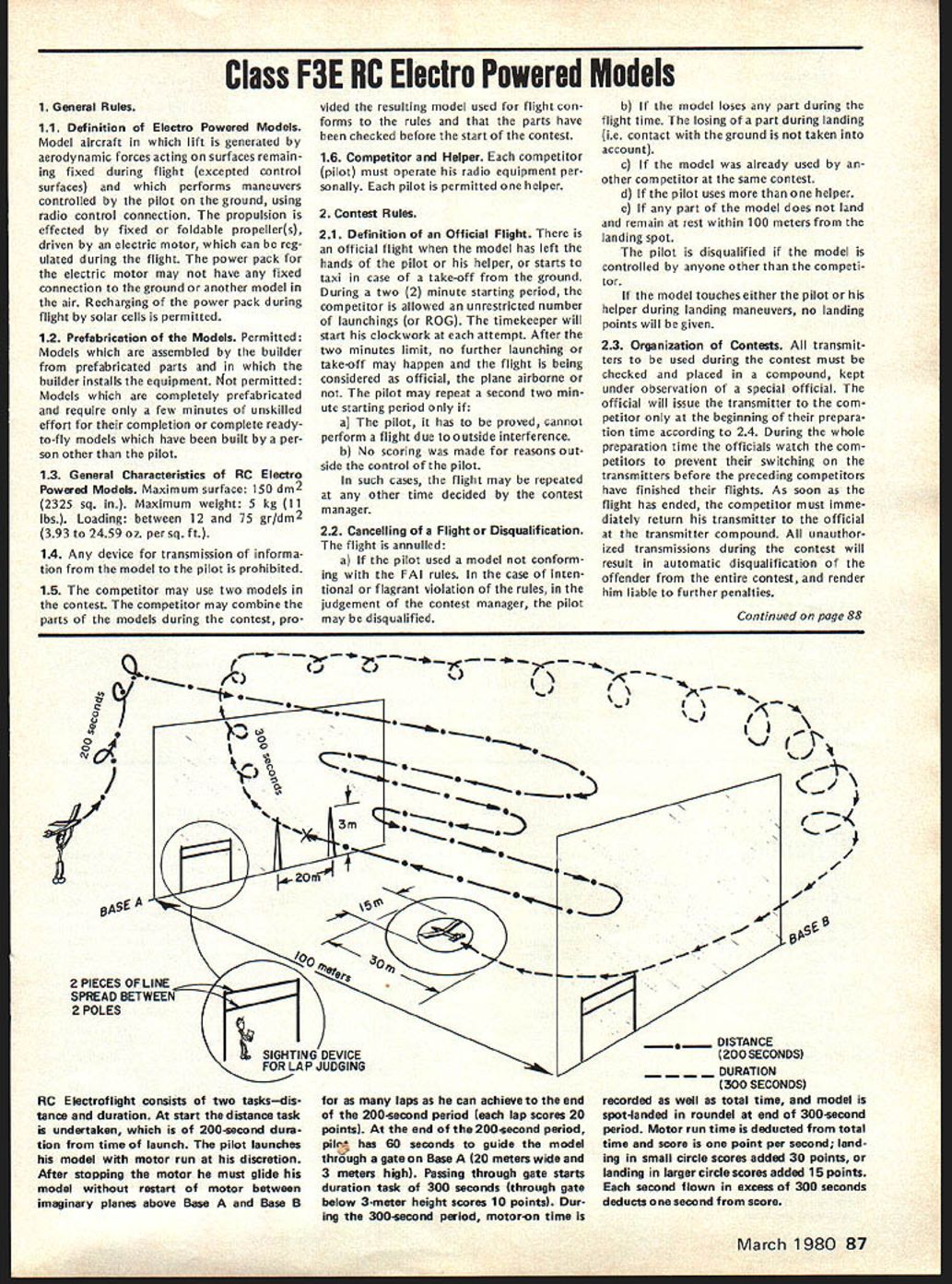
The Electroflight Subcommittee recommended and the Bureau accepted a set of provisional rules for RC Electroflight, effective January 1, 1981. The accepted rules are published separately. A pictorial representation and brief description of flight and scoring concepts were developed for easy reference.
Class F3E — RC Electro Powered Models
- General Rules
1.1. Definition of Electro Powered Models
- Model aircraft whose lift is generated by fixed aerodynamic surfaces (control surfaces excepted) and which are radio-controlled by a pilot on the ground.
- Propulsion by fixed or foldable propeller(s) driven by an electric motor, which can be regulated in flight.
- The power pack must not have any fixed connection to the ground or another model; recharging in flight by solar cells is permitted.
1.2. Prefabrication of the Models
- Permitted: models assembled by the builder from prefabricated parts in which the builder installs the equipment.
- Not permitted: models completely prefabricated that require only a few minutes of unskilled effort to complete, or ready-to-fly models built by someone other than the pilot.
1.3. General Characteristics
- Maximum surface: 150 dm2 (1,5000 cm2 = 2325 sq. in.).
- Maximum weight: 5 kg (11 lbs).
- Loading: between 12 and 75 g/dm2 (3.93 to 24.59 oz/ft2).
1.4. Any device for transmission of information from the model to the pilot is prohibited.
1.5. Competitors may use two models in the contest. Parts of the models may be combined during the contest provided the resulting model used for flight conforms to the rules and parts were checked before the contest start.
1.6. Competitor and Helper
- Each competitor (pilot) must operate his radio equipment personally.
- Each pilot is permitted one helper.
- Contest Rules
2.1. Definition of an Official Flight
- An official flight occurs when the model has left the hands of the pilot or helper or starts to taxi in a takeoff-from-ground case.
- During a two-minute starting period, the competitor is allowed an unrestricted number of launches (or ROG). The timekeeper starts his watch at each attempt.
- After the two-minute limit, no further launching or takeoff may occur; the flight is then considered official whether the plane is airborne or not.
- A competitor may repeat a second two-minute starting period only if:
a) It can be proven the pilot could not perform a flight due to outside interference. b) No scoring was made for reasons outside the pilot's control.
- In such cases, the flight may be repeated at a time decided by the contest manager.
2.2. Cancelling a Flight or Disqualification A flight is annulled if: a) The pilot used a model not conforming to FAI rules. For intentional or flagrant violations, the contest manager may disqualify the pilot. b) The model loses any part during the flight time (loss during landing after ground contact is not taken into account). c) The model was already used by another competitor at the same contest. d) The pilot uses more than one helper. e) Any part of the model does not land and remain at rest within 100 m from the landing spot.
- The pilot is disqualified if the model is controlled by anyone other than the competitor.
- If the model touches either the pilot or helper during landing maneuvers, no landing points are awarded.
2.3. Organization of Contests
- All transmitters used during the contest must be checked and placed in a compound, kept under observation by a special official.
- The official issues the transmitter to the competitor only at the beginning of the preparation time (see 2.4).
- Officials must prevent competitors from switching on transmitters before preceding competitors have finished.
- A competitor must immediately return his transmitter to the official after a flight ends.
- Unauthorized transmissions during the contest result in automatic disqualification and possible further penalties.
- RC Electroflight consists of two tasks: Distance and Duration.
- Distance: 200 seconds from time of launch. Pilot may run the motor as desired for climb; after stopping the motor, the model must glide between imaginary planes Base A and Base B for as many laps as possible (each lap scores 20 points). At the end of the 200 seconds, the pilot has 60 seconds to guide the model through a gate on Base A (20 m wide, 3 m high). Passing through the gate starts the Duration task (300 seconds). Passing through gate below 3 m scores 10 points.
- Duration: Motor-on time is recorded and deducted; gliding time scores one point per second. Landing in the small circle adds 30 points; landing in the larger circle adds 15 points. Each second flown beyond 300 seconds deducts one point.
2.4. Organization of Starts
- Pilots shall be grouped according to radio frequencies to allow simultaneous flights where possible, minimizing pilots of the same nation in one group.
- Flying order of groups is established by frequencies used.
- Competitors are entitled to five minutes of preparation time before being called for the start.
2.5. Judging
- Organizers must appoint a panel of at least three judges, preferably of different nationalities and selected from the CIAM official list.
- Contest Rules for Electro Powered Motor Gliders
3.1. Definition
- Multi-task event for RC Electro Powered Motor Gliders including two tasks:
A) Distance B) Duration and Landing
- Both tasks executed without interruption in one flight. A minimum of two flights must be flown.
3.2. Course Layout and Organization
- Two imaginary vertical planes 100 meters apart define turnlines Base A and Base B. Base A is where models are launched.
- In the plane of Base A there is an imaginary gate: two poles 3 m high, 20 m apart.
- Organizers provide a flagman at Base B and two timekeepers at Base A for each pilot.
- For landing, organizers must provide two concentric circles of 30 m and 15 m diameters.
3.3. Scoring a) Total score for each flight is the sum of partial scores A (Distance) and B (Duration & Landing). b) If more than two flights are flown, the lowest flight score of each competitor is discarded; remaining flights are added for final classification. c) Ties are broken by repeating the distance part of a flight.
3.4. Launching a) Before launching, the pilot must show timekeepers how motor(s) are controlled on his transmitter (on, off, reversing). b) Launching occurs outside the course, within 10 m of Base A. c) Model with running motor is released/thrown by hand by pilot or helper without assistance, not from a height greater than the flier's normal reach above the ground.
3.5. Distance Task a) Distance must be completed within 200 seconds from hand-launch with running motor. Timekeeper records release. b) Pilot must announce to timekeepers before stopping the motor. c) When the model, with motor off, first crosses Base A toward Base B, laps counting begins. Complete laps (Base A → Base B → Base A) count. d) Timekeepers and flagman (or audio system) signal crossings; instruments must ensure parallelism of the planes. e) Pilot must remain at Base A until the distance part is completed. f) Each completed 100 m lap gives 20 points. g) Restarting motor before 200 seconds expires terminates scoring for Distance; expiration of 200 seconds also terminates scoring. h) After the distance task, the pilot has 60 seconds to fly through the gate at Base A; passing the gate with motor off at the end of the last lap is allowed. i) Passing the gate starts the second task (Duration/landing) as signaled by the second timekeeper. j) Flying through the gate at altitude less than 3 m gives 10 points.
3.6. Duration and Landing Task a) Duration must be completed within 300 seconds from the moment the model passes the gate. b) Pilot decides how often to switch the motor on/off during this period. c) A gliding-time timekeeper starts his watch every time the motor is switched off; gliding time ends when motor is switched on again or when the model comes to rest after landing. d) Gliding time is cumulative; one point awarded for each full second gliding. e) One point is deducted for each full second flown in excess of 300 seconds. f) Landing bonuses: model at rest in large circle — 15 points; in small circle — 30 points. Distances measured from circle center to model nose. g) No additional points awarded if the landing occurs more than 330 seconds after start of this task.
3.7. Site
- Competition should be held on reasonably level terrain with a low probability of slope or wave soaring.
Competition Newsletter — Academy of Model Aeronautics
FAI Annual Meeting Summary — Most Significant Decisions (Paris, Nov 29–30)
- World Championships 1980: USA (Indoor at West Baden, IN; Spacemodels at Lakehurst, NJ); Canada (RC/CL Scale, Ottawa); Control Line in Czestochowa, Poland.
- 1981: RC Aerobatics (Guadalajara, Mexico); Free Flight (Valdepeñas, Spain); possible RC Soaring (South Africa).
- Noise reduction subcommittee formed (F. Mernin, Belgium).
- FF Coupe d'Hiver rubber-weight change rejected.
- Control Line: Combat proposals referred; Team Race jury guide adopted; Team Race world records (100 & 200 laps) approved effective 1981.
- RC Aerobatics: combined patterns accepted in principle; takeoffs/landings no longer judged; time references removed from many maneuvers; maneuver spacing increased to 150 m; builder rule remains; Top Hat now square.
- Pylon Racing: DeBolt proposal referred for rework; British proposals on wheels and silencers provisionally accepted.
- Thermal Soaring: hi-start banned; no model changes after starting first attempt; rounds now A+B+C; lowest round dropped only if more than five rounds flown; speed task zero score if not completed in four minutes.
- Electroflight: new provisional rules approved (to be official in 1983).
- Scale: standoff scoring and Precision Scale biplane scoring modified; certain bonuses removed.
- Records: Team Race and Electroflight record rules updated for 1981.
- World Championship diplomas to first three teams.
RC Giant Scale Clarification (from Scale CB Chairman Claude McCullough):
- General clarifications on Giant Scale eligibility:
- Engine displacement: 125 cu in up to (but less than) 366 cu in for powered engines (as specified).
- Scale: 2-7/8 in = 1 ft or larger scales apply.
- Minimum weight: 15 lbs (multi-engine models minimum 20 lbs, less fuel).
- Under the wording, certain 1/4-scale models could be eligible regardless of engine size if they meet weight/scale criteria; similarly, power models with multiple engines may be eligible under these definitions. These clarifications help determine whether a model enters Precision Scale or Sport Scale.
WASHINGTON, DC 20005
Transcribed from original scans by AI. Minor OCR errors may remain.

