
COMPETITION NEWSLETTER
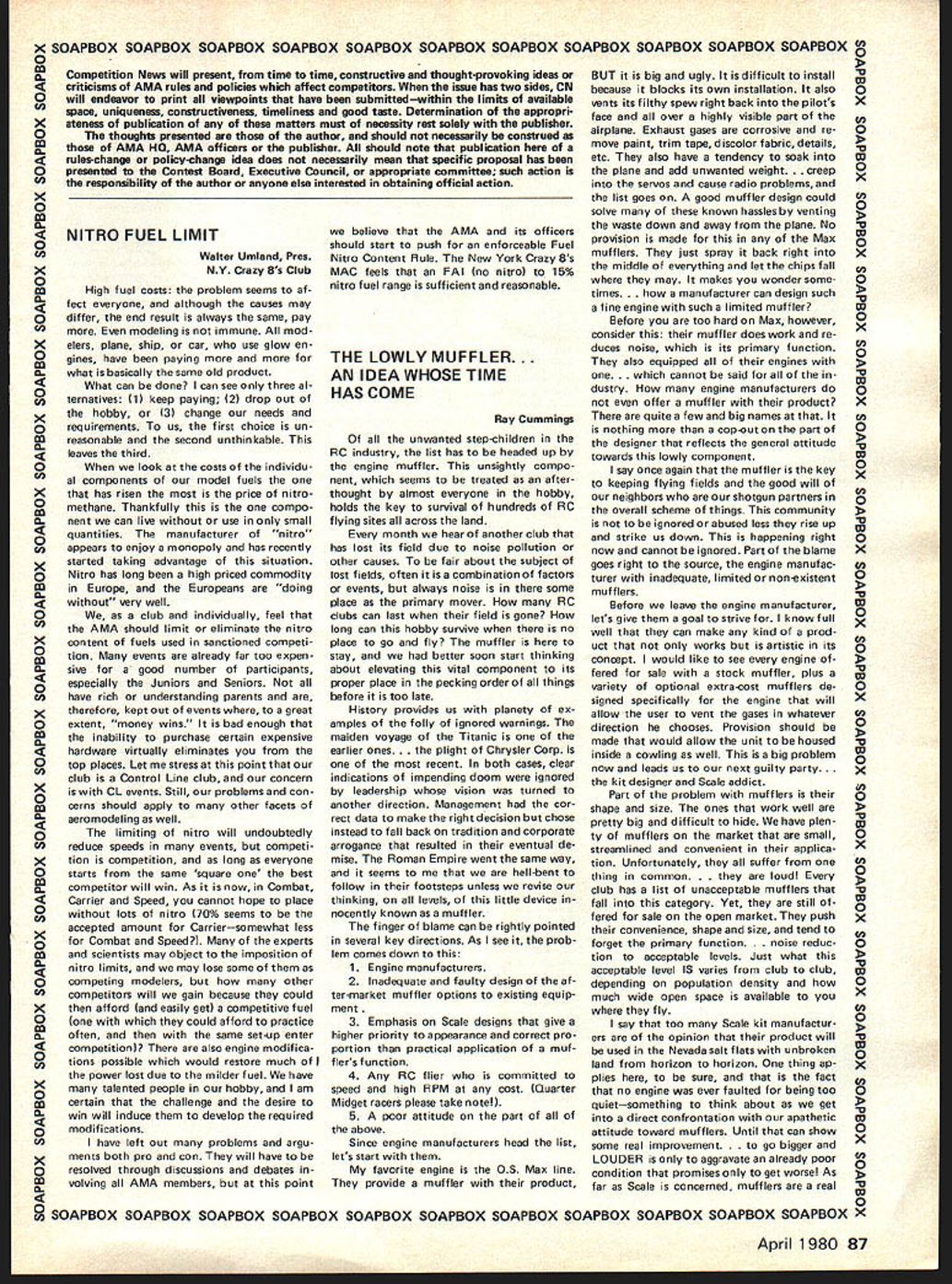
Competition News will present, from time to time, constructive and thought-provoking ideas or criticisms of AMA rules and policies that affect competitors. When an issue has two sides, CN will endeavor to print viewpoints submitted — within the limits of available space, uniqueness, constructiveness, timeliness and good taste. Determination of appropriateness for publication rests solely with the publisher. The thoughts presented are those of the author and should not necessarily be construed as those of AMA HQ, AMA officers, or the publisher. Publication here of a rules-change or policy-change idea does not necessarily mean the specific proposal has been presented to a Contest Board, the Executive Council, or an appropriate committee; such action is the responsibility of the author or anyone else interested in obtaining official action.
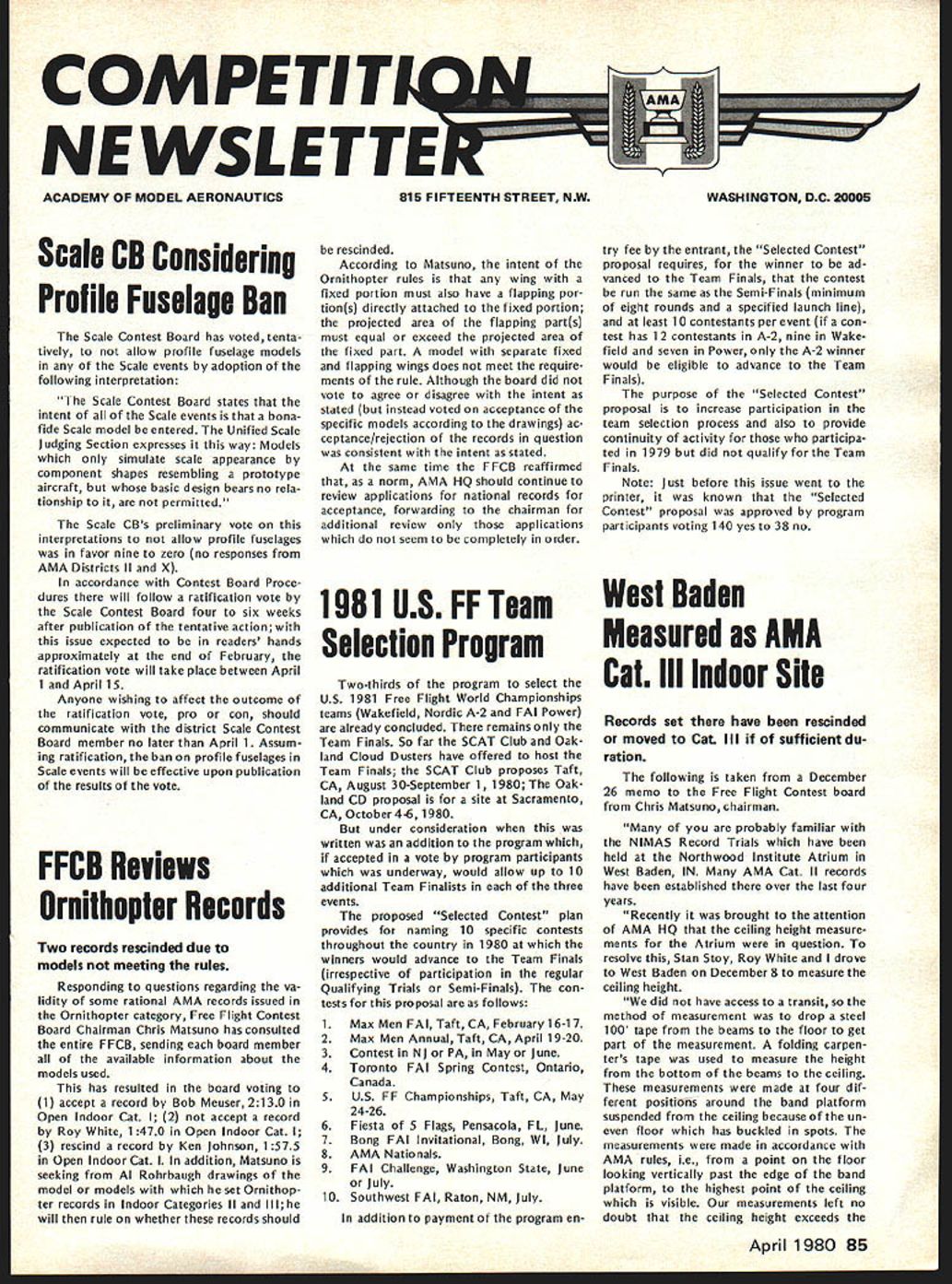
Scale CB Considering Profile Fuselage Ban
The Scale Contest Board has tentatively voted not to allow profile fuselage models in any Scale events by adoption of the following interpretation:
"The Scale Contest Board states that the intent of all of the Scale events is that a bona-fide Scale model be entered. The Unified Scale Judging Section expresses it this way: Models which only simulate scale appearance by component shapes resembling a prototype aircraft, but whose basic design bears no relationship to it, are not permitted."
The Scale CB's preliminary vote on this interpretation to not allow profile fuselages was in favor nine to zero (no responses from AMA Districts II and X).
In accordance with Contest Board procedures, a ratification vote by the Scale Contest Board will follow four to six weeks after publication of the tentative action. With this issue expected to be in readers' hands approximately at the end of February, the ratification vote will take place between April 1 and April 15.
Anyone wishing to affect the outcome of the ratification vote, pro or con, should communicate with the district Scale Contest Board member no later than April 1. Assuming ratification, the ban on profile fuselages in Scale events will be effective upon publication of the results of the vote.
FFCB Reviews Ornithopter Records
Two records rescinded due to models not meeting the rules.
Responding to questions regarding the validity of some AMA records issued in the Ornithopter category, Free Flight Contest Board Chairman Chris Matsuno consulted the entire FFCB, sending each board member all available information about the models used.
This resulted in the board voting to:
- accept a record by Bob Meuser, 2:13.0 in Open Indoor Category I;
- not accept a record by Roy White, 1:47.0 in Open Indoor Category I;
- rescind a record by Ken Johnson, 1:57.5 in Open Indoor Category I.
In addition, Matsuno is seeking drawings from Al Rohrbaugh of the model(s) that set Ornithopter records in Indoor Categories II and III; he will then rule on whether those records should be rescinded.
According to Matsuno, the intent of the Ornithopter rules is that any wing with a fixed portion must also have flapping portion(s) directly attached to the fixed portion; the projected area of the flapping part(s) must equal or exceed the projected area of the fixed part. A model with separate fixed and flapping wings does not meet the requirements of the rule. Although the board voted only on acceptance or rejection of the specific models according to drawings, the acceptance/rejection of the records in question was consistent with the stated intent.
At the same time the FFCB reaffirmed that, as a norm, AMA HQ should continue to review applications for national records for acceptance, forwarding to the chairman for additional review only those applications which do not seem to be completely in order.
1981 U.S. Free Flight Team Selection Program
Two-thirds of the program to select the U.S. 1981 Free Flight World Championships teams (Wakefield, Nordic A-2, and FAI Power) are already concluded. Only the Team Finals remain. So far the SCAT Club and Oakland Cloud Dusters have offered to host the Team Finals; the SCAT Club proposes Taft, CA, August 30–September 1, 1980; the Oakland Cloud Dusters proposal is for Sacramento, CA, October 4–6, 1980.
Under consideration was an addition to the program which, if accepted in a vote by program participants, would allow up to 10 additional Team Finalists in each of the three events.
The proposed "Selected Contest" plan provided for naming 10 specific contests throughout the country in 1980 at which the winners would advance to the Team Finals (irrespective of participation in the regular Qualifying Trials or Semi-Finals). The contests proposed were:
- Max Men FAI — Taft, CA — February 16–17
- Max Men Annual — Taft, CA — April 19–20
- Contest in NJ or PA — May or June
- Toronto FAI Spring Contest — Ontario, Canada
- U.S. Free Flight Championships — Taft, CA — May 24–26
- Fiesta of Five Flags — Pensacola, FL — June
- Bong FAI Invitational — Bong, WI — July
- AMA Nationals
- FAI Challenge — Washington State — June or July
- Southwest FAI — Raton, NM — July
In addition to payment of the program entry fee by the entrant, the Selected Contest proposal required, for the winner to be advanced to the Team Finals, that:
- the contest be run the same as the Semi-Finals (minimum of eight rounds and a specified launch line);
- there be at least 10 contestants per event (for example, if a contest has 12 contestants in A-2, nine in Wakefield and seven in Power, only the A-2 winner would be eligible to advance).
The purpose of the Selected Contest proposal was to increase participation in the team selection process and to provide continuity of activity for those who participated in 1979 but did not qualify for the Team Finals.
Note: Just before this issue went to the printer, the Selected Contest proposal was approved by program participants voting 140 yes to 38 no.
West Baden Measured as AMA Category III Indoor Site
Records set there have been rescinded or moved to Category III if of sufficient duration.
The following is taken from a December 26 memo to the Free Flight Contest Board from Chris Matsuno, chairman:
Many are familiar with the NIMA Record Trials held at the Northwood Institute Atrium in West Baden, IN. Many AMA Category II records were established there over the last four years. Recently it was brought to the attention of AMA HQ that the ceiling height measurements for the Atrium were in question. To resolve this, Stan Stoy, Roy White and I drove to West Baden on December 8 to measure the ceiling height.
We did not have access to a transit, so the method of measurement was to drop a steel 100' tape from the beams to the floor to get part of the measurement. A folding carpenter's tape was used to measure the heights from the bottom of the beams to the ceiling. These measurements were made at four different positions around the band platform suspended from the ceiling because of the uneven floor which has buckled in spots. The measurements were made in accordance with AMA rules, i.e., from a point on the floor looking vertically past the edge of the band platform, to the highest point of the ceiling which is visible. Our measurements left no doubt that the ceiling height exceeds the AMA Cat. II limit, and the site is actually Cat. III.
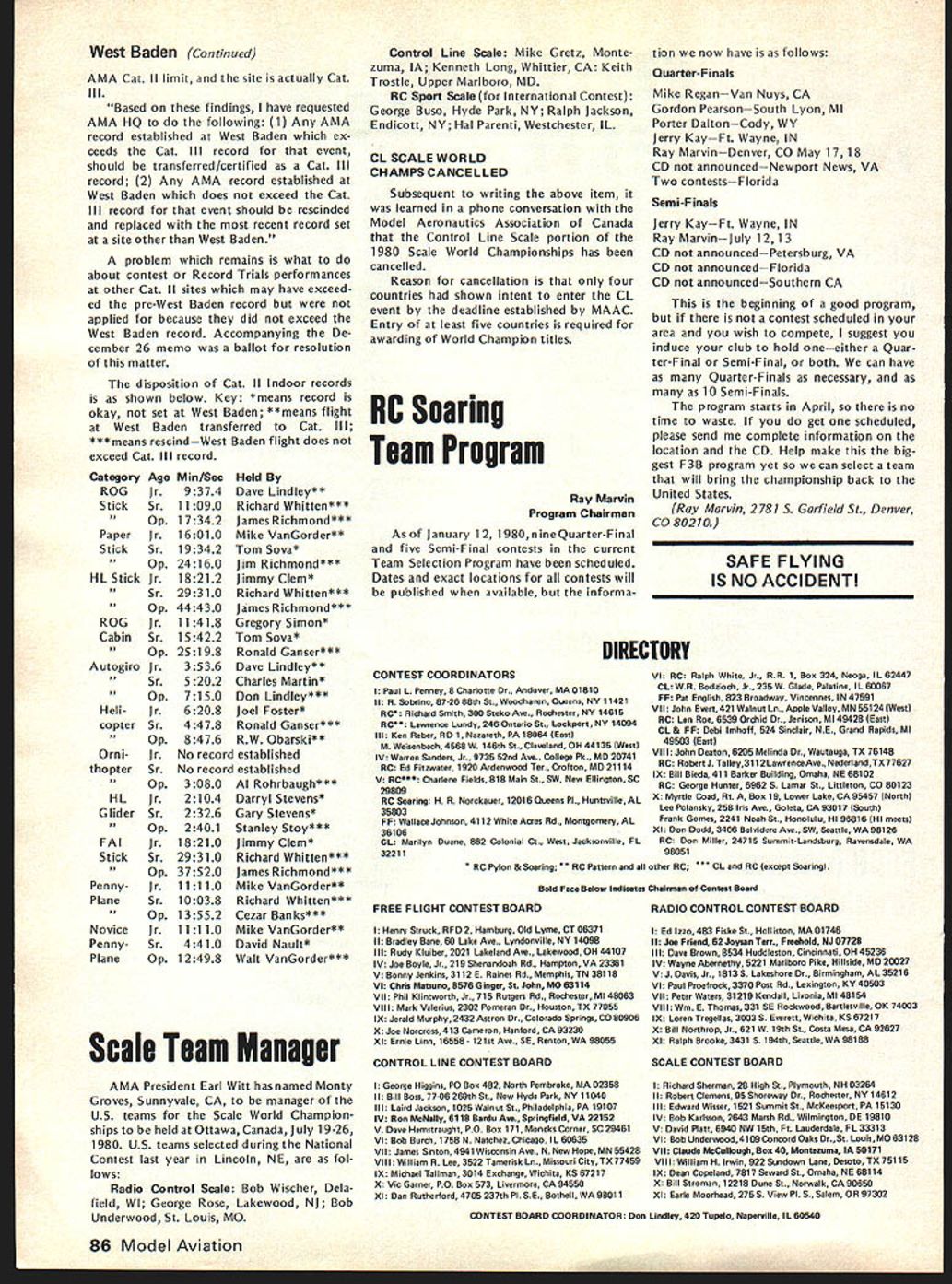
Based on these findings, I have requested AMA HQ to do the following:
- Any AMA record established at West Baden which exceeds the Cat. III record for that event should be transferred/certified as a Cat. III record.
- Any AMA record established at West Baden which does not exceed the Cat. III record for that event should be rescinded and replaced with the most recent record set at a site other than West Baden.
A remaining problem is what to do about contest or Record Trials performances at other Cat. II sites which may have exceeded the pre-West Baden record but were not applied for because they did not exceed the West Baden record. Accompanying the December 26 memo was a ballot for resolution of this matter.
Disposition of Cat. II Indoor records (Key: * = record is okay, not set at West Baden; ** = flight at West Baden transferred to Cat. III; *** = rescinded — West Baden flight does not exceed Cat. III record):
- ROG | Jr. | 9:37.4 | Dave Lindley | **
- Stick | Sr. | 11:09.0 | Richard Whitten | ***
- Stick | Op. | 17:34.2 | James Richmond | **
- Paper | Jr. | 16:01.0 | Mike VanGorder | **
- Stick | Sr. | 19:34.2 | Tom Sova | *
- HL Stick | Op. | 24:16.0 | Jim Richmond | ***
- HL Stick | Jr. | 18:21.2 | Jimmy Clem | *
- HL Stick | Sr. | 29:31.0 | Richard Whitten | ***
- HL Stick | Op. | 44:43.0 | James Richmond | **
- ROG | Jr. | 11:41.8 | Gregory Simon | *
- Cabin | Sr. | 15:42.2 | Tom Sova | *
- Autogiro | Jr. | 3:53.6 | Dave Lindley | **
- Autogiro | Sr. | 5:32.5 | Charles Martin | *
- Autogiro | Op. | 7:10.0 | Don Lindley | *
- Helicopter | Jr. | 6:20.8 | Joel Foster | *
- Helicopter | Op. | 4:47.8 | Ronald Ganser | **
- Ornithopter | Jr. | No record established
- Ornithopter | Sr. | No record established
- HL | Jr. | 3:08.0 | Al Rohrbaugh | *
- HL | Sr. | 2:10.4 | Darryl Stevens | *
- Glider | Jr. | 2:32.6 | Gary Stevens | *
- FAI Stick | Jr. | 18:21.0 | Stanley Stoye | **
- Stick | Sr. | 29:31.0 | Richard Whitten | ***
- Penny | Jr. | 5:11.0 | James Richmond | **
- Plane | Jr. | 10:03.8 | Richard Whitten | ***
- Novice | Jr. | 13:55.2 | Cezar Banks | **
- Penny | Sr. | 4:41.0 | David Nault | *
- Plane | Op. | 12:49.8 | Walt VanGorder | **
NITRO FUEL LIMIT
Walter Ullmand, Pres. — N.Y. Crazy 8's Club
High fuel costs affect everyone. Although causes differ, the result is the same: pay more. Modelers who use glow engines have been paying increasingly for essentially the same product.
Three alternatives exist: 1) keep paying; 2) drop out of the hobby; or 3) change our needs and requirements. The third is the realistic choice. The component whose price has risen the most is nitromethane. Thankfully we can live without it or use it in small quantities. Manufacturers of nitro appear to enjoy a monopoly and have taken advantage of it. Europeans have long managed with little or no nitro.
We, as a club and individually, feel that the AMA should limit or eliminate the nitro content of fuels used in sanctioned competition. Many events are already too expensive for a good number of participants, especially juniors and seniors. Not all have rich or understanding parents; they are kept out of events where, to a great extent, "money wins." Our club is a Control Line club, and our concern is primarily with CL events, but the problem applies across modeling.
Limiting nitro will undoubtedly reduce speeds in many events, but competition remains fair if everyone starts from the same baseline. In Combat, Carrier and Speed events, you cannot hope to place without lots of nitro (70% seems accepted for Carrier—less for Combat and Speed). Some experts may object, and we may lose some competitors, but many others would be able to afford competitive fuel and practice more. Engine modifications could restore much of the lost power with milder fuel; talented people in the hobby would likely meet that challenge.
We believe the AMA should start to push for an enforceable Fuel Nitro Content Rule. The New York Crazy 8's MAC feels that a range from FAI (no nitro) to 15% nitro is sufficient and reasonable.
THE LOWLY MUFFLER... AN IDEA WHOSE TIME HAS COME
Ray Cummings
Of all the unwanted step-children in the RC industry, the engine muffler heads the list. This unsightly component, treated as an afterthought by many, holds the key to survival of hundreds of RC flying sites across the country.
Every month another club loses its field due to noise pollution or other causes. Often it is a combination of factors, but noise is usually primary. How many RC clubs can last without a field? How long will this hobby survive without places to fly? The muffler is here to stay, and we must elevate this vital component before it is too late.
The finger of blame points in several directions:
- Engine manufacturers.
- Inadequate and faulty design of after-market mufflers.
- Emphasis on Scale designs that prioritize appearance over practical muffler application.
- RC flyers committed to speed and high RPM at any cost.
- A poor attitude on the part of all the above.
Many manufacturers supply mufflers that are big, awkward, vent exhaust back into the pilot's face, and soil or corrode airplane surfaces. A good muffler design could vent waste down and away from the airframe and be housed inside a cowling. Some manufacturers, however, do equip engines with mufflers that reduce noise, which is their primary function. Others offer no muffler at all — a cop-out reflecting general indifference.
Kit designers and Scale addicts also contribute: the mufflers that work are often large and hard to hide; small, streamlined aftermarket mufflers are convenient but frequently ineffective. Scale kit manufacturers often design for unobstructed salt-flat flying rather than the populated areas where many clubs operate. Until attitudes change, pushing for bigger, louder engines only aggravates the situation.
I would like to see every engine sold with a stock muffler plus a variety of optional mufflers designed for directionable venting, and with provision for housing inside a cowling. This would help reduce noise and preserve flying sites. As far as Scale is concerned, mufflers are a real problem.
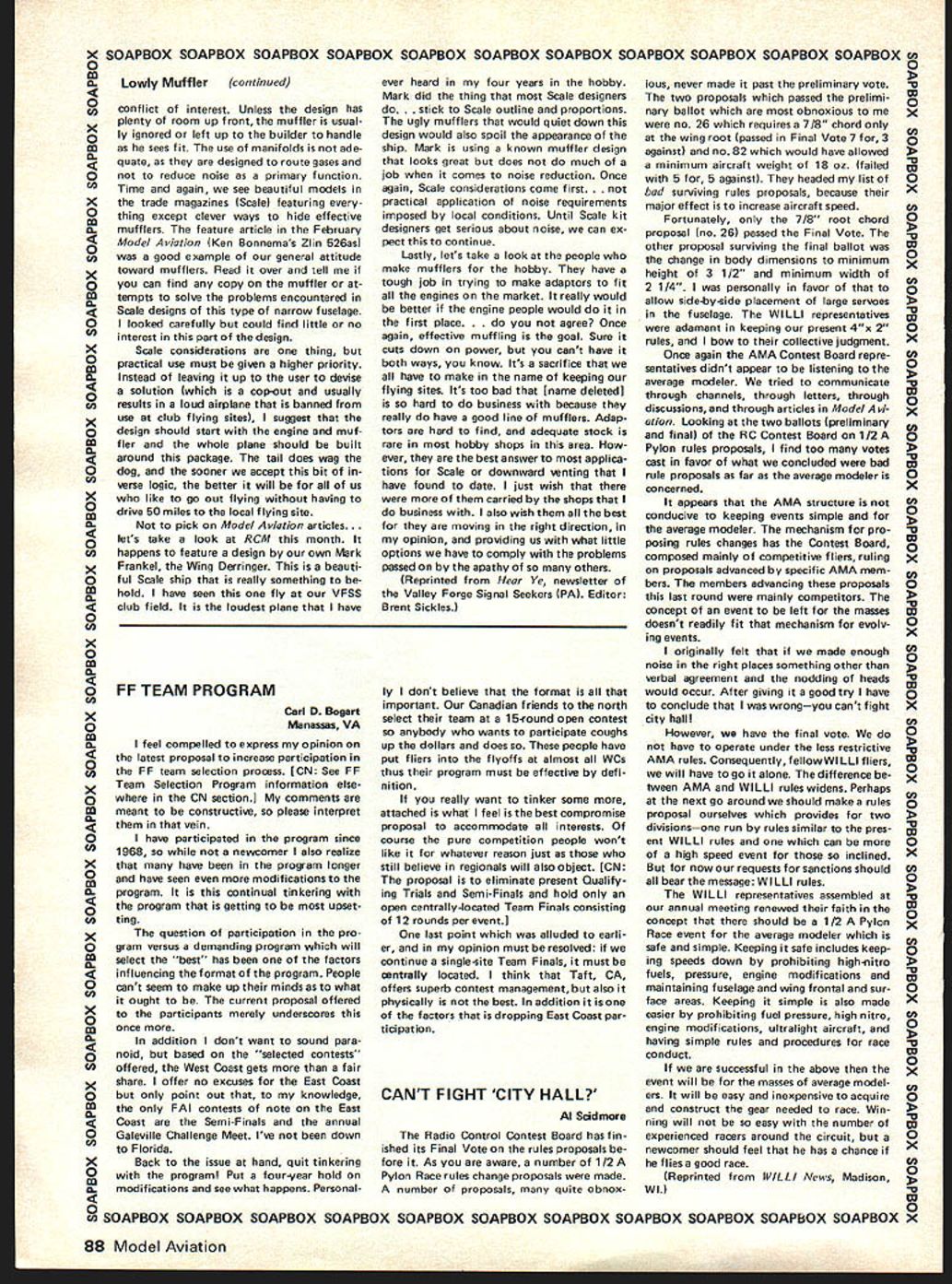
CAN'T FIGHT 'CITY HALL'?
Al Scidmore
The Radio Control Contest Board has finished final votes on the rule proposals before it. Several 1/2 A Pylon Race rule-change proposals were made. Many obnoxious proposals did not make it past the preliminary vote. Two preliminary proposals that most concerned me were no. 26 (which requires a 7 3/8" chord only at the wing root — passed in Final Vote 7 for, 3 against) and no. 82 (which would have allowed a minimum aircraft weight of 18 oz. — failed with 5 for, 5 against). These proposals tended to increase aircraft weight.
Only the 7 3/8" root chord proposal (no. 26) passed the Final Vote. The other surviving final ballot change was body dimensions to minimum height 3 1/2" and minimum width 2 1/4". I personally favored that to allow side-by-side placement of large servos in the fuselage. WILL representatives were adamant in keeping the present 4" x 2" rules, and I accept their judgment.
AMA Contest Board representatives didn't seem to listen to the average modeler. The mechanism for proposing rule changes tends to be controlled by competitive fliers who have time to be involved. The concept of an event for the masses doesn't fit that mechanism well.
I tried to influence the outcome, but have to conclude that "you can't fight city hall." However, we do not have to operate under the less restrictive AMA rules. Fellow WILL fliers, we may have to go it alone. The difference between AMA and WILL rules widens. Perhaps at the next go-around we should propose rules providing two divisions — one run by rules similar to present WILL rules and one for high-speed competitors. For now, our requests for concessions should bear the message: WILL rules.
The WILL representatives renewed their faith in having a 1/2 A Pylon event for the average modeler which is safe and simple. Keeping it safe includes keeping speeds down by prohibiting high-nitro fuels, fuel pressure, engine modifications, and maintaining fuselage and wing frontal and surface areas. Keeping it simple is aided by prohibiting fuel pressure, high nitro, engine modifications, ultralight aircraft, and having simple rules and procedures for race conduct.
If successful, the event will be for the masses: easy and inexpensive to construct and operate. A newcomer should feel he has a chance if he flies a good race.
(Reprinted from WILL News, Madison, WI.)
SCALE SPEED REVISITED
I regret missing the last Nats. From reports, Scale judges finally started scoring Scale model flights in comparison with the real thing — a long overdue action for which officials are to be commended. If a model is supposed to look like the real thing on the ground, it should look like the real thing in the air.
Scale speed is simple: flight judges should determine whether the model looks like the real thing as it maneuvers. Picture a real plane flying across the horizon between two points. Picture your one-quarter-scale model of the same plane flown at a distance where it looks the same size as the real plane. If both planes’ noses pass the horizon points at the same time, the model and real plane appear to fly together. The model would have to fly one-quarter the speed of the big plane to look alike. Scale speed varies directly with model scale. Simple.
(Reprinted from Gold Coast Flyer, newsletter of the Gold Coast Radio Controllers, Delray Beach, FL. Editors: Art and Charlotte Johnson.)
PERSONALIZED EVENTS?
Harry Grogan
One of my cardinal rules is to never steal material from other publications, so I recommend Bill Winter's editorial from October's Model Aviation, which sums up one of my pet peeves: the beginner-vs-expert conflict in the hobby. When does a hobby become a sport, lifestyle, or profession?
AMA rules are inevitably controlled by experts because they become involved enough to bend rules to their favor. "Hackers" do not take the time to be involved. This is unfortunate for modeling's overall interests: to attract and retain a portion of the population to competitive modeling. Expense and difficulty keep many out.
Why does AMA keep adding new "beginner" events without obsoleting old ones? There are too many events. It seems every special interest group has its own event because they can't win a trophy in the others. Taken to extremes, one day everyone will mail in an event name and score and AMA will mail a trophy. Experts will always prevail if vague rules allow it. There is more satisfaction in placing well in a popular event than placing first when no one else enters. Get the message?
(Reprinted from FMA News of the Florida Modelers Association.)
MANNERS AND MORALS IN INDOOR FLYING
Clarence Mather — San Diego, CA
During many indoor contests an appalling number of models are damaged or destroyed by mid-air collisions. As long as two or more models are in the air simultaneously there is some probability of collision, but much can be done to reduce that probability and the damage that may result.
Often a model is launched directly beneath another that is some distance above. In a very large building, such as a blimp hangar, the chance of collision may be small due to drift, but collisions still occur. A second model should not be launched directly under another.
Some modelers feel it is their right to launch when and where they please. Each model represents considerable time and effort. Perhaps a modeler traveled a long distance at much expense to test and position a model for a good flight. Shouldn't that modeler reasonably expect others to try to avoid a collision? We are often our own enemies because collisions often damage both models.
If the building ceiling is not high, collision probability increases. At the Nats in a 50-foot site at Lincoln, NE, many new models were launched directly under models already up, and collisions were numerous. Models stayed at similar altitudes, raising collision chances. Some modelers selected launch areas carefully and avoided problems; others did not.
In some European contests only a limited number of models are allowed high at one time; contestants must get permission to wind and launch and may have to wait until a model descends. This reduces collisions. We could exercise similar good judgment individually without formal restrictions.
Another aspect is mixing models of different fragility. Collisions between similar lightweight models often cause little damage. But when heavy, powerful models fly concurrently with very light models, the results can be disastrous for the light models. At Riverside Nats I saw a heavy model literally chew through a large microfilm model without deviation. Heavy Pennyplanes entered in Paper Stick or microfilm classes are legal but problematic when flown with light models. If there are so few entries in the light classes that overweight models can place or win, the events should be dropped. Pennyplanes should compete in their rightful events.
Often adults assist youngsters building heavyweight models, and the adult guide should show consideration for fellow modelers. An example worth following: the Brown family at Lincoln coordinated their youngsters' launches so that flights did not threaten others. The father scanned the air before each launch and guided the flyer where to launch; their teamwork prevented collisions.
At the Taft Champs we fly Novice Pennyplane and EZB events in a small gym with about 25 feet of ceiling. Pennyplanes are much heavier than EZBs and use heavier rubber motors. In previous years Pennyplane motors coupled to EZBs. Contestants agreed to alternate types — one type only at a time — and it worked well, despite a few objections.
There is always some chance of collision. I remember a day in Michigan in the early Sixties when I had the Coliseum to myself. I had two microfilm models ready to test. I wound the first and it cruised well. I wound the second, walked some distance away, and launched. Guess what happened? The second drifted over and collided with the first.
We can reduce such occurrences by exercising caution, spacing launches, and showing consideration for others.
Transcribed from original scans by AI. Minor OCR errors may remain.

