
Indoor Three-Ring Circus at West Baden in June
Hardy Brodersen
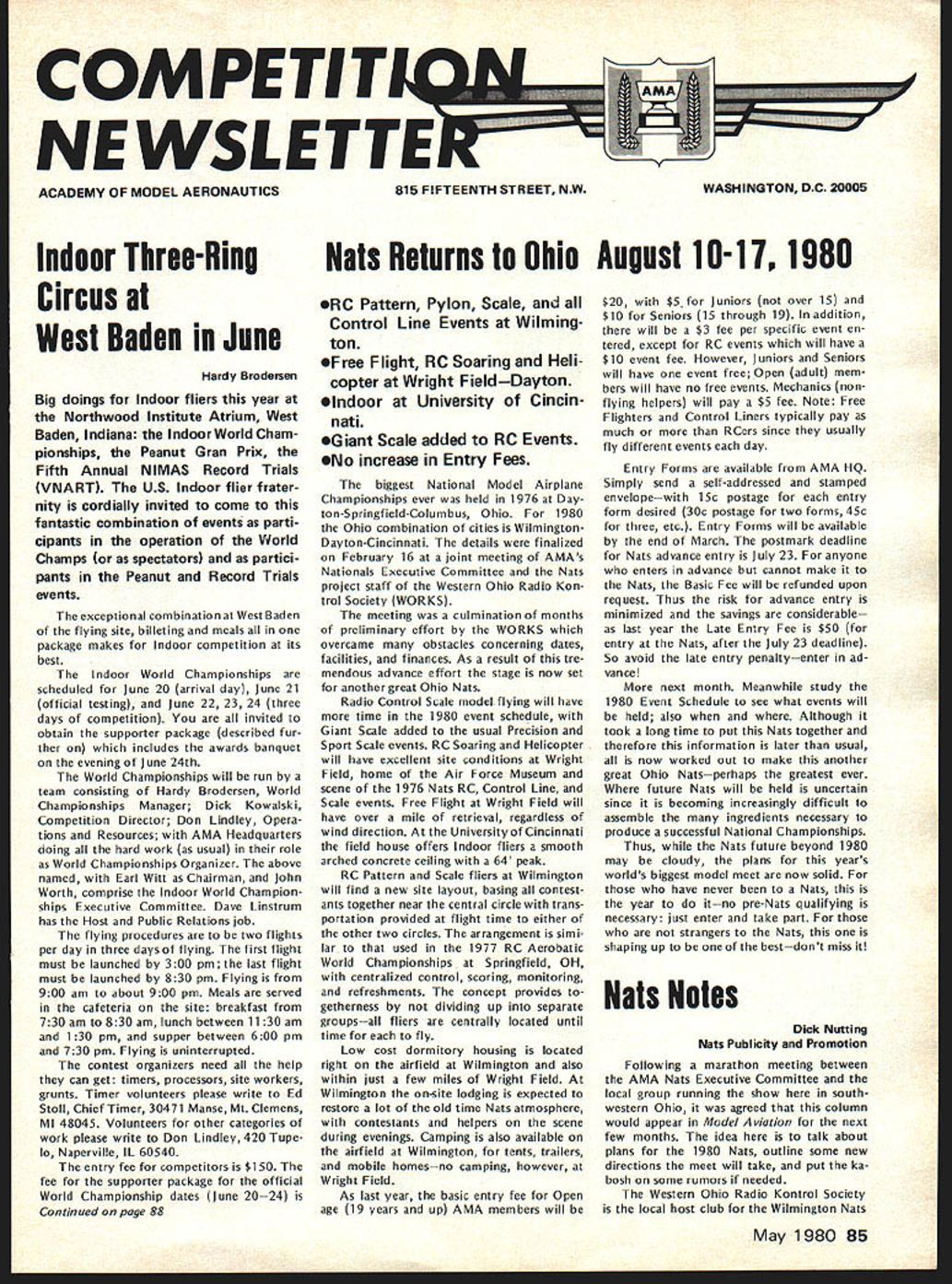
Big doings for indoor fliers this year at the Northwood Institute Atrium, West Baden, Indiana: the Indoor World Championships, the Peanut Grand Prix, and the Fifth Annual NIMAS Record Trials (VNART). The U.S. indoor flier fraternity is cordially invited to come to this fantastic combination of events as participants in the operation of the World Champs (or as spectators) and as participants in the Peanut and Record Trials events.
The exceptional combination at West Baden of the flying site, billeting and meals all in one package makes for indoor competition at its best.
The Indoor World Championships are scheduled for June 20 (arrival day), June 21 (official testing), and June 22, 23, 24 (three days of competition). You are all invited to obtain the supporter package (described further on) which includes the awards banquet on the evening of June 24.
The World Championships will be run by a team consisting of Hardy Brodersen, World Championships Manager; Dick Kowalski, Competition Director; Don Lindley, Operations and Resources; with AMA Headquarters doing all the hard work (as usual) in their role as World Championships Organizer. The above-named, with Earl Witt as Chairman, and John Worth, comprise the Indoor World Championships Executive Committee. Dave Linstrum has the Host and Public Relations job.
The flying procedures are two flights per day over three days of flying. The first flight must be launched by 3:00 pm; the last flight must be launched by 8:30 pm. Flying is from 9:00 am to about 9:00 pm. Meals are served in the cafeteria on site: breakfast from 7:30 am to 8:30 am, lunch between 11:30 am and 1:30 pm, and supper between 6:00 pm and 7:30 pm. Flying is uninterrupted.
The contest organizers need all the help they can get: timers, processors, site workers, grunts. Timer volunteers please write Ed Stoll, Chief Timer, 30471 Manse, Mt. Clemens, MI 48045. Volunteers for other categories of work please write Don Lindley, 420 Tupelo, Naperville, IL 60540.
This year the host club will be more involved than in the past. Since last summer the WORKS people have been talking with AMA officials about getting the host club more involved in running the Nats. There are a couple of reasons for this. First, we feel that the Nats has been a drain on the Academy's time and talent. Second, we think that turning over some of the action to the local club may act as an incentive to get more groups working harder to put on the big show each year.
To clear the air then: yes, the Western Ohio Radio Kontrol Society (WORKS) hopes to make some money from the Nats. After careful consideration the AMA Nats Executive Committee has agreed to let us have a portion of the concession rights at the Nats. In return, we in the WORKS are expected to do more of the local organizing and back-work than in the past, plus arrange for and staff all the concessions.
The Nats Executive Committee has taken great pains to make sure the Nats is still an Academy-controlled event. They have made it clear to us that we must make it on our own ... if at all.
Setting aside the rumor squelching for the time being, let's turn to a few positive notes. We want to get more people to this year's Nats than ever before—accordingly, a few pluses. There are more family attractions in the area of the Nats this year than in recent years. They include Kings Island Park, the Cincinnati Reds, the Air Force Museum, several beautiful state parks with camping and quiet, scenic lakes, better on-site dorm facilities than the Nats have had for years, and more and better office and activity space than I can remember since the Navy was forced to leave us in 1973.
In the months to come you will see ads urging your attendance at this year's Nats. This column will detail some of the attractions for families and how to participate. Don't worry—the competition part of the program hasn't been neglected, but we want those of you who haven't taken in modeling's greatest show for a few years to come back in the Eighties. We want those of you who have never made it for one reason or another to make your plans now.
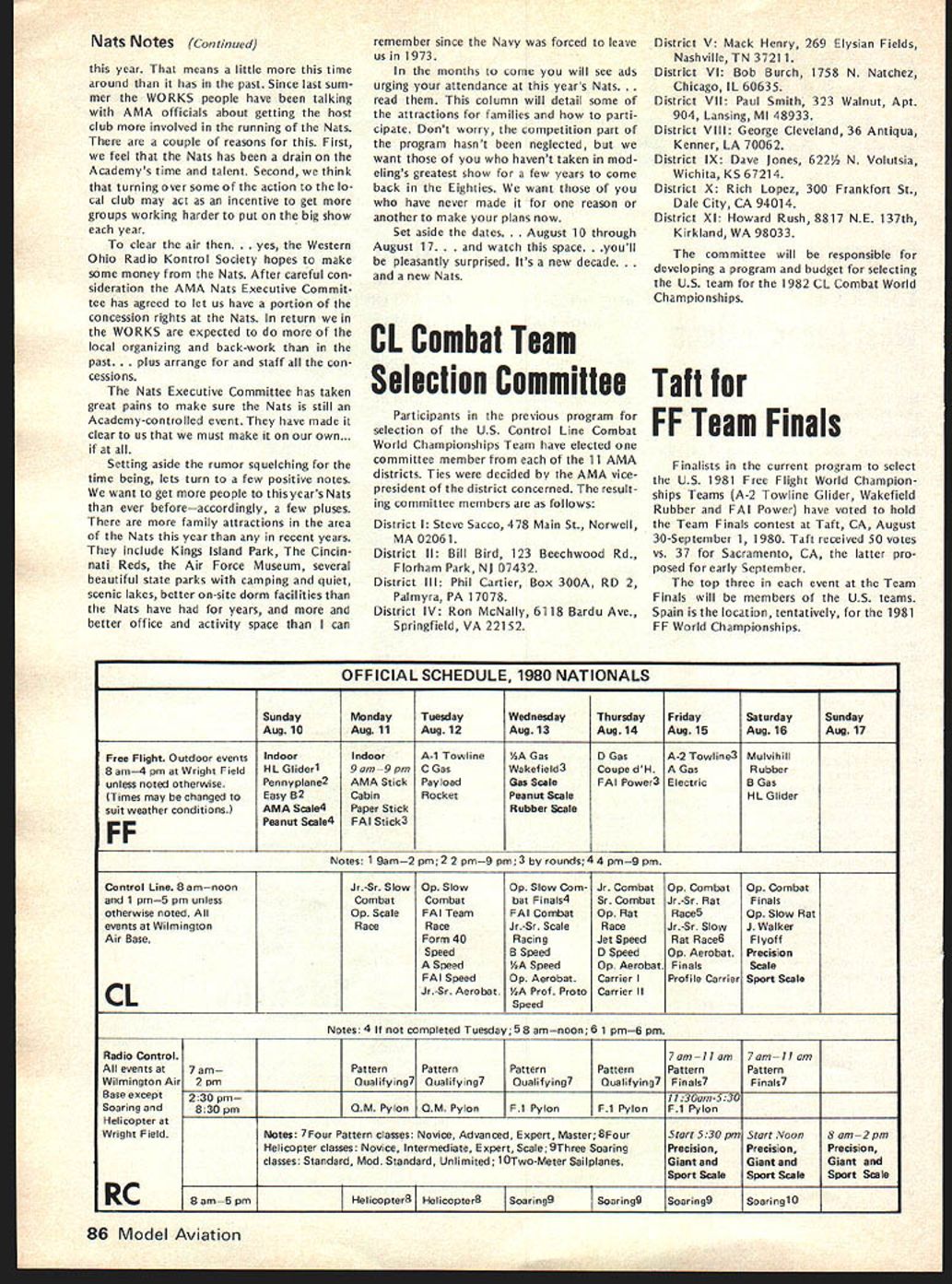
Set aside the dates—August 10 through August 17—and watch this space. You'll be pleasantly surprised. It's a new decade ... and a new Nats.
RC Aerobatics Team Program Chairman
Dave Brown has been selected as chairman of the RC Aerobatics Team Selection Committee by vote of the previously selected committee members. (Dave also is AMA District III Vice-President.) The entire committee is composed of Walter Damuck, John Byrne, Dave Brown (chairman), Dave Burton, Ron Chidgey, Ralph White, Jr., Carl (Bud) Weber, Dwayne Brown, James Eide, Rick Horn, and Bob Crump. Full addresses of committee members were in the March issue, page 84.
Indoor Team Program
A mid-February memo to the Indoor Team Selection Committee from the committee's chairman, Jim Richmond, details the results of an opinion survey among Indoor Program participants which, perhaps surprisingly to some, showed strong support for the previous program. Only seven out of 41 said they didn't like the program "as is," and the number who said they didn't like the points was only four. Of the seven who didn't like the points distribution of the previous program, four wanted fewer points in the regional vs. three who wanted more.
It appears, therefore, that the program for selection of the U.S. 1982 Indoor Team will be much like the previous 1980 program—though with the possibility of fine-tuning in several areas. If so, the program will consist of unlimited local contests and one regional contest in each of six zones in 1980; and unlimited local contests, one regional contest in each of six zones, and a single-site Team Finals in 1981. A maximum of 1,110 points could be earned—10 at a local contest, 100 at a regional contest, and 1,000 at the Team Finals.
Chairman Richmond already has made up a proposed program based upon the survey results and has transmitted it to the committee for review. Upon approval by the committee it will be transmitted to participants for their approval and subsequent announcement of the details.
District IV Committee Member: Bob Champine (2025 Tipton Rd., Newport News, VA 23606) has been elected to this position following the vacancy created by the move of Jim Richmond to District V.
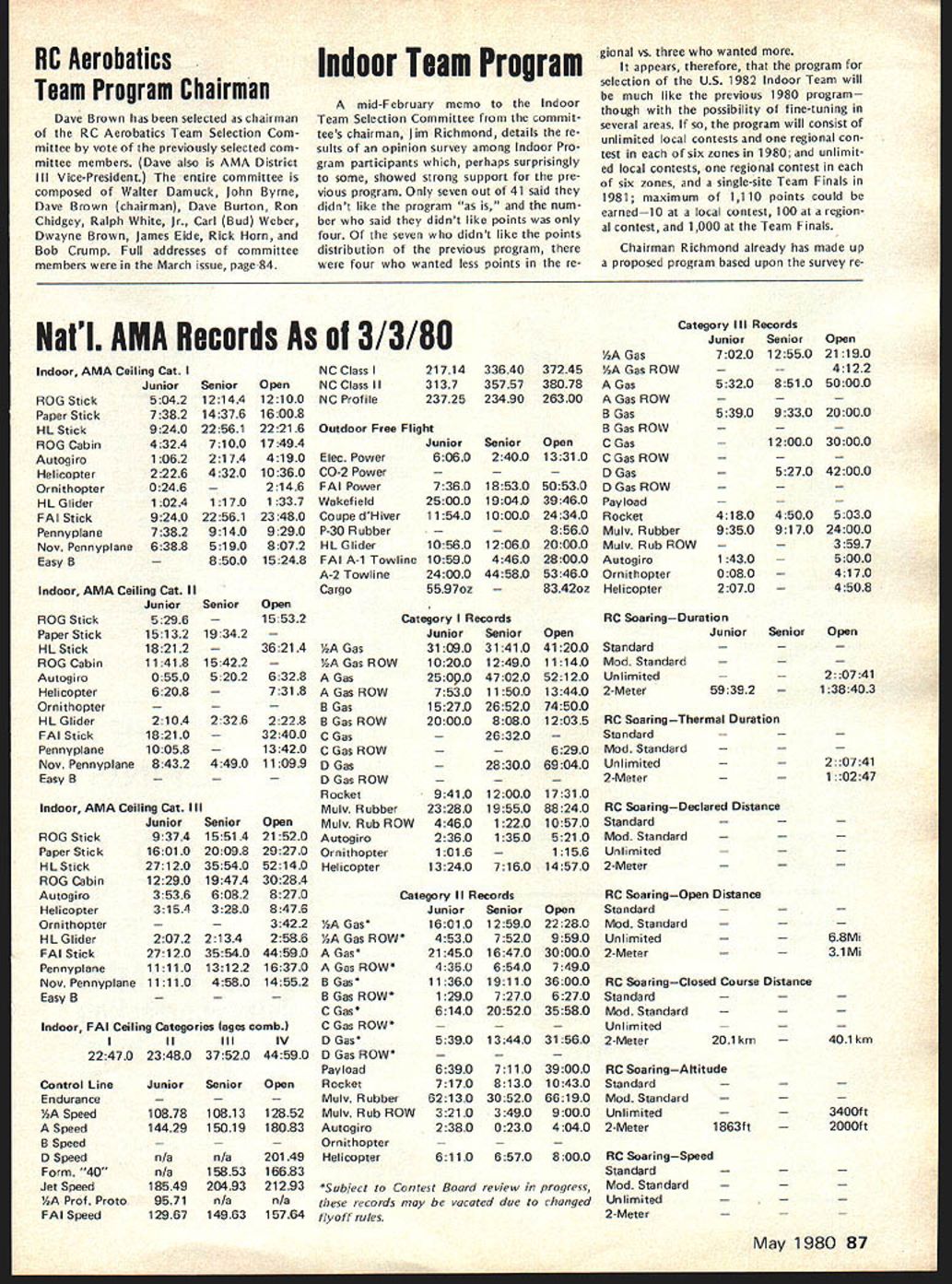
Nat'l. AMA Records As of 3/3/80
Indoor, AMA Ceiling Category I
- ROG Stick — Junior: 5:04.2; Senior: 12:14.4; Open: 12:10.0
- Paper Stick — Junior: 7:32.8; Senior: 14:37.6; Open: 16:00.8
- HL Stick — Junior: 9:24.0; Senior: 22:56.1; Open: 22:21.6
- ROG Cabin — Junior: 4:32.4; Senior: 7:10.0; Open: 17:49.4
- Autogiro — Junior: 1:06.2; Senior: 2:17.4; Open: 4:19.0
- Helicopter — Junior: 2:22.6; Senior: 4:32.0; Open: 10:36.0
- Ornithopter — Junior: 0:24.6; Senior: 0:33.4; Open: 2:14.6
- HL Glider — Junior: 1:02.4; Senior: 1:17.0; Open: 1:33.7
- FAI Stick — Junior: 9:24.0; Senior: 22:56.1; Open: 23:48.0
- Pennyplane — Junior: 7:38.2; Senior: 9:14.0; Open: 9:29.0
- Novice Pennyplane — Junior: 6:38.8; Senior: 5:19.0; Open: 8:07.2
- Easy B — Junior: —; Senior: 8:50.0; Open: 15:24.8
Indoor, AMA Ceiling Category II
- ROG Stick — Junior: 5:29.6; Senior: —; Open: 15:53.2
- Paper Stick — Junior: 15:13.2; Senior: 19:34.2; Open: 36:21.4
- HL Stick — Junior: 18:21.2; Senior: —; Open: —
- ROG Cabin — Junior: 11:41.8; Senior: 15:42.2; Open: —
- Autogiro — Junior: —; Senior: 0:55.0; Open: 5:20.2 (note: 6:32.8 also shown)
- Helicopter — Junior: 6:20.8; Senior: —; Open: 7:31.8
- Ornithopter — Junior: —; Senior: —; Open: —
- HL Glider — Junior: 2:10.4; Senior: 2:32.6; Open: 2:22.8
- FAI Stick — Junior: 18:21.0; Senior: —; Open: 32:40.0
- Pennyplane — Junior: 10:05.8; Senior: —; Open: 13:42.0
- Novice Pennyplane — Junior: 8:43.2; Senior: 4:49.0; Open: 11:09.9
- Easy B — Junior: —; Senior: —; Open: —
Indoor, AMA Ceiling Category III
- ROG Stick — Junior: 9:37.4; Senior: 15:51.4; Open: 21:52.0
- Paper Stick — Junior: 16:01.0; Senior: 20:09.8; Open: 29:27.0
- HL Stick — Junior: 27:12.0; Senior: 35:54.0; Open: 52:14.0
- ROG Cabin — Junior: 12:29.0; Senior: 19:47.4; Open: 30:28.4
- Autogiro — Junior: 3:53.6; Senior: 6:08.2; Open: 8:27.0
- Helicopter — Junior: 3:15.4; Senior: 3:28.0; Open: 8:47.6
- Ornithopter — Junior: —; Senior: —; Open: 3:42.2
- HL Glider — Junior: 2:07.2; Senior: 2:13.4; Open: 2:58.6
- FAI Stick — Junior: 27:12.0; Senior: 35:54.0; Open: 44:59.0
- Pennyplane — Junior: 11:11.0; Senior: 13:12.2; Open: 16:37.0
- Novice Pennyplane — Junior: 11:11.0; Senior: 4:58.0; Open: 14:55.2
- Easy B — Junior: —; Senior: —; Open: —
Indoor, FAI Ceiling Categories (ages combined)
- I — 22:47.0
- II — 23:48.0
- III — 37:52.0
- IV — 44:59.0
Control Line — Endurance
- 1/2A Speed — Junior: 108.78; Senior: 108.13; Open: 128.52
- A Speed — Junior: 144.29; Senior: 150.19; Open: 180.83
- B Speed — Junior: n/a; Senior: n/a; Open: 201.49
- D Speed — Junior: n/a; Senior: n/a; Open: —
- Form, "40" — Junior: 158.53; Senior: 166.83
- Jet Speed — Junior: 185.49; Senior: 204.93; Open: 212.93
- 1/2A Prof. Proto — Junior: 95.71; Senior: n/a; Open: n/a
- FAI Speed — Junior: 129.67; Senior: 149.63; Open: 157.64
NC Class
- NC Class I — Junior: 217.14; Senior: 336.40; Open: 372.45
- NC Class II — Junior: 313.7; Senior: 357.57; Open: 380.78
- NC Profile — Junior: 237.25; Senior: 234.90; Open: 263.00
Outdoor Free Flight
- Electric Power — Junior: 6:06.0; Senior: 2:40.0; Open: 13:31.0
- CO2 Power — —
- FAI Power — Junior: 7:36.0; Senior: 18:53.0; Open: 50:53.0
- Wakefield — Junior: 25:00.0; Senior: 19:04.0; Open: 39:46.0
- Coupe d'Hiver — Junior: 11:54.0; Senior: 10:00.0; Open: 24:34.0
- P-30 Rubber — Junior: —; Senior: —; Open: 8:56.0
- HL Glider — Junior: 10:56.0; Senior: 12:06.0; Open: 20:00.0
- FAI A-1 Towline — Junior: 10:59.0; Senior: 4:46.0; Open: 28:00.0
- A-2 Towline — Junior: 24:00.0; Senior: 44:58.0; Open: 53:46.0
- Cargo — Junior: 55.97 oz; Senior: —; Open: 83.42 oz
Category I Records
- 1/2A Gas — Junior: 31:09.0; Senior: 31:41.0; Open: 41:20.0
- 1/2A Gas ROW — Junior: 10:20.0; Senior: 12:49.0; Open: 11:14.0
- A Gas — Junior: 25:00.0; Senior: 47:02.0; Open: 52:12.0
- A Gas ROW — Junior: 7:53.0; Senior: 11:50.0; Open: 13:44.0
- B Gas — Junior: 15:27.0; Senior: 26:52.0; Open: 74:50.0
- B Gas ROW — Junior: 20:00.0; Senior: 8:08.0; Open: 12:03.5
- C Gas — Junior: —; Senior: 26:32.0; Open: —
- C Gas ROW — Junior: —; Senior: 28:30.0; Open: 69:04.0
- D Gas — —; Rocket — Junior: 9:41.0; Senior: 12:00.0; Open: 17:31.0
- Mulv. Rubber — Junior: 23:28.0; Senior: 19:55.0; Open: 88:24.0
- Mulv. Rub ROW — Junior: 4:46.0; Senior: 1:22.0; Open: 10:57.0
- Autogiro — Junior: 2:36.0; Senior: 1:35.0; Open: 5:21.0
- Ornithopter — Junior: 1:01.6; Senior: —; Open: 1:15.6
- Helicopter — Junior: 13:24.0; Senior: 7:16.0; Open: 14:57.0
Category II Records
- 1/2A Gas* — Junior: 16:01.0; Senior: 12:59.0; Open: 22:28.0
- 1/2A Gas ROW* — Junior: 4:53.0; Senior: 7:52.0; Open: 9:59.0
- A Gas — Junior: 21:45.0; Senior: 16:47.0; Open: 30:00.0
- A Gas ROW* — Junior: 4:35.0; Senior: 6:54.0; Open: 7:49.0
- B Gas — Junior: 11:36.0; Senior: 19:11.0; Open: 36:00.0
- B Gas ROW* — Junior: 1:29.0; Senior: 7:27.0; Open: 6:27.0
- C Gas — Junior: 6:14.0; Senior: 20:52.0; Open: 35:58.0
- C Gas ROW* — Junior: —; Senior: —; Open: —
- D Gas ROW* — Junior: 5:39.0; Senior: 13:44.0; Open: 31:56.0
- Payload — Junior: 6:39.0; Senior: 7:11.0; Open: 39:00.0
- Rocket — Junior: 7:17.0; Senior: 8:13.0; Open: 10:43.0
- Mulv. Rubber — Junior: 62:13.0; Senior: 30:52.0; Open: 66:19.0
- Mulv. Rub ROW — Junior: 3:21.0; Senior: 3:49.0; Open: 9:00.0
- Autogiro — Junior: 2:38.0; Senior: 0:23.0; Open: 4:04.0
- Ornithopter — Junior: —; Senior: —; Open: —
- Helicopter — Junior: 6:11.0; Senior: 6:57.0; Open: 8:00.0
Category III Records
- 1/2A Gas — Junior: 7:02.0; Senior: 12:55.0; Open: 21:19.0
- 1/2A Gas ROW — Junior: —; Senior: —; Open: 4:12.2
- A Gas — Junior: 5:32.0; Senior: 8:51.0; Open: 50:00.0
- A Gas ROW — Junior: —; Senior: —; Open: —
- B Gas — Junior: 5:39.0; Senior: 9:33.0; Open: 20:00.0
- B Gas ROW — Junior: —; Senior: —; Open: —
- C Gas — Junior: —; Senior: 12:00.0; Open: 30:00.0
- C Gas ROW — Junior: —; Senior: —; Open: —
- D Gas — Junior: —; Senior: 5:27.0; Open: 42:00.0
- D Gas ROW — Junior: —; Senior: —; Open: —
- Payload — Junior: —; Senior: —; Open: —
- Rocket — Junior: 4:18.0; Senior: 4:50.0; Open: 5:03.0
- Mulv. Rubber — Junior: 9:35.0; Senior: 9:17.0; Open: 24:00.0
- Mulv. Rub ROW — Junior: —; Senior: —; Open: —
- Autogiro — Junior: 1:43.0; Senior: 5:00.0; Open: 5:00.0
- Ornithopter — Junior: 0:08.0; Senior: —; Open: 4:17.0
- Helicopter — Junior: 2:07.0; Senior: —; Open: 4:50.8
RC Soaring — Duration
- Standard — Junior: —; Senior: —; Open: —
- Modified Standard — Junior: —; Senior: —; Open: —
- Unlimited — Junior: —; Senior: —; Open: —
- 2-Meter — Junior: 59:39.2; Senior: —; Open: 1:38:40.3
RC Soaring — Thermal Duration
- Standard — —
- Modified Standard — —
- Unlimited — Junior: —; Senior: —; Open: 2:07:41
- 2-Meter — Junior: —; Senior: —; Open: 1:02:47
RC Soaring — Declared Distance
- All classes — no records listed
RC Soaring — Open Distance
- Unlimited — Open: 6.8 mi
- 2-Meter — Open: 3.1 mi
RC Soaring — Closed Course Distance
- Modified Standard — Open: 20.1 km
- 2-Meter — Open: 40.1 km
RC Soaring — Altitude
- Unlimited — Open: 3,400 ft
- 2-Meter — Open: 2,000 ft
RC Soaring — Speed
- 2-Meter — Open: 1,863 ft
*Subject to Contest Board review in progress; these records may be vacated due to changed flyoff rules.
Indoor Program (Continued)
Chairman Richmond's proposed program has been transmitted to the committee for review. Upon committee approval it will be transmitted to participants for their approval and subsequent announcement of the details.
Indoor Three-Ring Circus (continued)
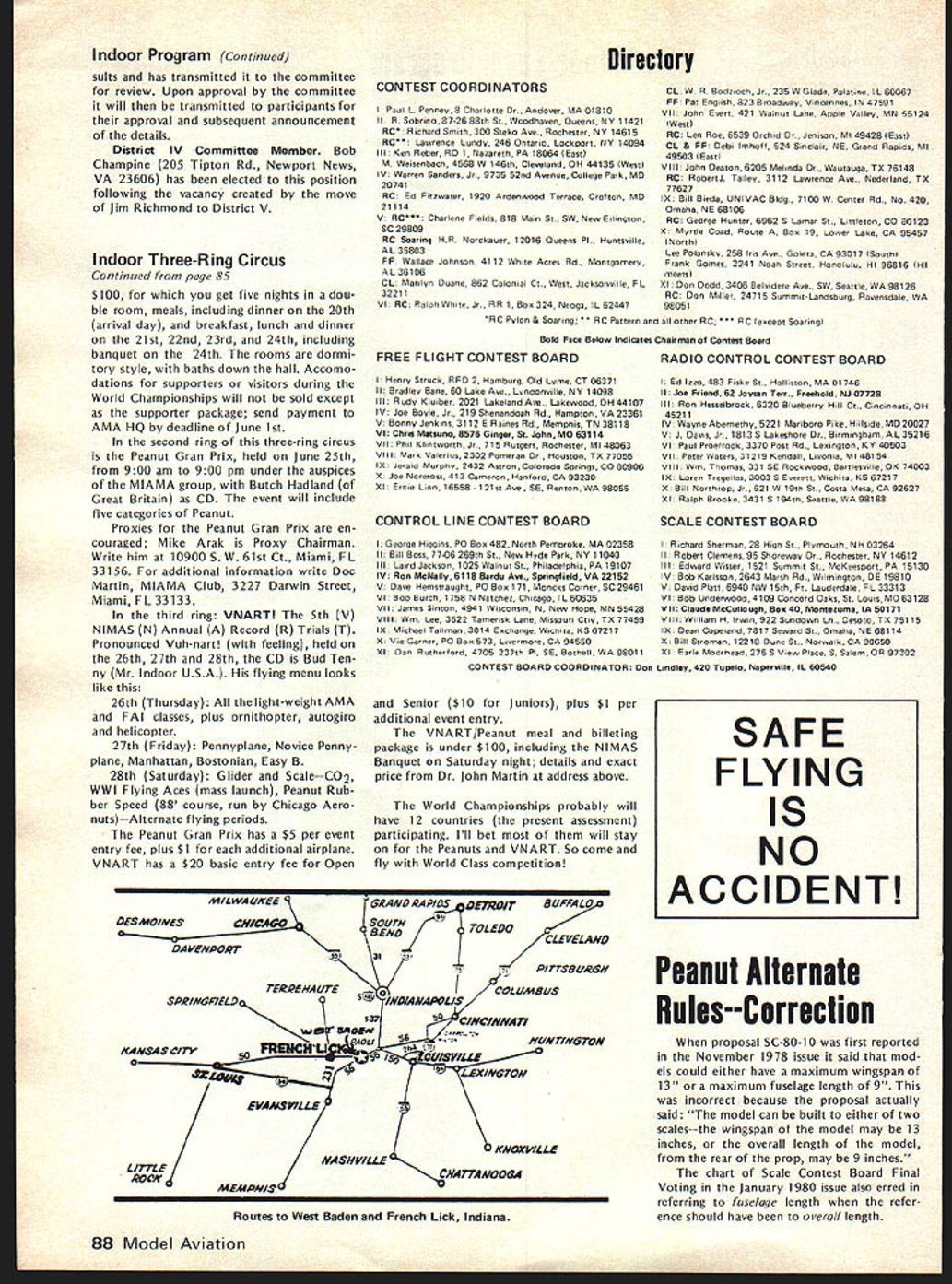
A supporter package is available for $100, which includes five nights in a double room, meals including dinner on the 20th (arrival day), and breakfast, lunch and dinner on the 21st, 22nd, 23rd, and 24th, including the banquet on the 24th. The rooms are dormitory style, with baths down the hall. Accommodations for supporters or visitors during the World Championships will not be sold except as the supporter package; send payment to AMA HQ by the deadline of June 1.
In the second ring of this three-ring circus is the Peanut Grand Prix, held on June 25, from 9:00 am to 9:00 pm under the auspices of the MIAMA group, with Butch Hadland (of Great Britain) as Contest Director. The event will include five categories of Peanut.
Proxies for the Peanut Grand Prix are encouraged; Mike Arak is Proxy Chairman. Write him at 10900 S.W. 61st Ct., Miami, FL 33156. For additional information write Doc Martin, MIAMA Club, 3227 Darwin Street, Miami, FL 33133.
In the third ring: VNART! The 5th (V) NIMAS (N) Annual (A) Record (R) Trials (T), pronounced "Vuh-nart!" (with feeling), will be held on June 26, 27 and 28. The CD is Bud Tenney (Mr. Indoor U.S.A.). His flying menu looks like this:
- June 26 (Thursday): All the lightweight AMA and FAI classes, plus ornithopter, autogiro and helicopter.
- June 27 (Friday): Pennyplane, Novice Pennyplane, Manhattan, Bostonian, Easy B.
- June 28 (Saturday): Glider and Scale-CO2, WWII Flying Aces (mass launch), Peanut Rubber Speed (88' course, run by Chicago Aeronutts) — alternate flying periods.
Entry fees:
- Peanut Grand Prix: $5 per event, plus $1 for each additional airplane.
- VNART: $20 basic entry fee for Open and Senior ($10 for Juniors), plus $1 per additional event entry.
The VNART/Peanut meal and billeting package is under $100, including the NIMAS Banquet on Saturday night; details and exact price from Dr. John Martin at the address above.
The World Championships probably will have about 12 countries participating. Most of them will likely stay on for the Peanuts and VNART. So come and fly with world-class competition!
Competition Newsletter
Competition News will present, from time to time, constructive and thought-provoking ideas or criticisms of AMA rules and policies which affect competitors. When the issue has two sides, CN will endeavor to print all viewpoints that have been submitted—within the limits of available space, uniqueness, constructiveness, timeliness and good taste. Determination of the appropriateness of publication of any of these matters must of necessity rest solely with the publisher.
The thoughts presented are those of the author, and should not necessarily be construed as those of AMA HQ, AMA officers or the publisher. All should note that publication here of a rules-change or policy-change idea does not necessarily mean that a specific proposal has been presented to the Contest Board, Executive Council, or appropriate committee; such action is the responsibility of the author or anyone else interested in obtaining official action.
Let's Hear it for the Bad Guys
With the resultant extremely low entry of this year's Nebraska Nats it can be expected that in the ensuing months the "whipping boys" at AMA HQ will receive more than the usual number of literary missiles in this regard.
Most complaints will probably align with supposed AMA poor planning, poor choice of sites, associated insufficient logistical facilities required to satisfactorily serve all factions, etc. However, should the AMA have been so influential as to have obtained O'Hare Field for a week with housing arrangements made at the Playboy Penthouse, would the attendance have been at least that of those quite successful Chicago Nats of the early '70s?
This writer ponders whether a super-site selection and/or Utopian service facilities are the entire problem in this matter.
Dyed-in-the-wool competition modelers are not normally discouraged by non-perfect flying sites, a few personal inconveniences, or an occasional management goof—for most have encountered these obstacles before. What then is the underlying problem?
This writer suggests that the numerous diversionary activities of the various "special interest" groups within the AMA are as much of a contribution to the demise of the AMA Nats as any other single factor.
There was a time when the annual AMA Nats was the focal point of all AMA competition activity. When our members totaled 30,000 paid we could expect close to 3,000, or about 10%, to attend the annual "big show." How come, then, when we are now 70,000 strong, do we struggle to gather 1,000 of the paid-up populace?
Where did everybody go? The answer would appear to be that the AMA Nats no longer serves as the focal point of the year for most factions of its membership. In years past the Nats drew the cream of the competition elite; hundreds of new "not-ready-for-prime-time-players," engine, kit, and accessory manufacturers hawking their wares; and the voluminous rows of models and on-the-spot modeling activities arrayed in the Navy airplane hangars were mute evidence as to what was the year's big show.
This atmosphere is now gone and most of everything associated with it. Many of the remaining faithful appear to attend more from a feeling of loyalty to the Nats than from any present attraction. Even the "junior days" seem to have little of the luster of those Nats of yesteryear.
Surely one must admit that many of the "special interest" groups now stage a variety of extravaganzas which compete with the present-day AMA Nats for the annual "big show" title. Just one semi-professional competitor may ignore the Nats in favor of the FAI World Championships, replacing their former interest in domestic national competition. RCers look to the super-contests such as Rough River, Rhinebeck, or Las Vegas—where first place wins a five-figure jackpot.
Manufacturers now ignore the Nats in favor of the huge winter static shows of Toledo, WRAMS, etc. RC Soaring has its own Nats. So does the Society of Antique Modelers; there is also an annual U.S. Control Line Champs, the U.S. Free Flight Champs, and last June's Indoor Record Trials at West Baden, IN, outran this year's '79 Nats total indoor entry. Those who are vying for FAI team spots often must pass up the annual Nats trip to save the cost and vacation time to pursue lengthy FAI qualification procedures in these specialized activities, and the list goes on.
The true dilemma of the Nats may well be similar to the junior problem in that youngsters simply have too many diversions placed before them these days that may be more tempting than model building. Likewise, there are many diversions being placed before the competition-oriented AMA member which vie for his modeling interests, hobby dollar and allotted vacation time—which might tend to replace the Nats as his yearly "big moment."
If the AMA Nats is to be returned to some semblance of its former status, the impetus appears to lie much with its competition members to make it happen as it does with our AMA organizers and planners. It will take the "competitors" to make it possible. The AMA can only serve as organizer and planner for the Nats, but they cannot be held responsible for the demise of the Nats if we, the members, do not support it.
Next year is another Nats at another site. Let's "all" strive to make it a well-attended one to indicate our appreciation for AMA's persistent faith and tenacity in staging the "big show"—and for once—"LET'S HEAR IT FOR THE BAD GUYS."
(Reprinted from CIA Informer, newsletter of the Central Indiana Aeromodelers. Editor: Harry Murphy.)
Don't Fly Control Line Models Near Power Lines
Does Practice Make Perfect?
Sure it does: every music teacher in the country can't be wrong! Same thing goes for flying RC—or does it? Sounds like all you gotta do is buy a tank truck full of fuel, wear out a bunch of engines, and presto—you’re a Master class Pattern flier, right?
Wrong! There's a world of difference between just doing something, and practicing.
Example: is your handwriting better now than when you were in the sixth grade? Betcha it isn't! But why not—you've had 10, 20, 30, 40, (50 or 60?) years of "practice" since then! Well, to cut the tremendous suspense, here's the reason.
Repetition without deliberately trying to improve, or achieve a preplanned or preconceived ideal, results in poorer performance with each repetition.
Same goes for flying. Just flying, boring "holes-in-the-sky," will NOT improve your flying capability. This simple fact will be heartily endorsed by every truly proficient flier in the world!
Just what is practice then? If you are really serious about improving your flying, you must adopt a very disciplined program:
- Start your flying session before you get to the field. Review your capabilities and your performance the last time out. Decide upon priorities. What do you need to improve the most? Why? Practice loops and rolls if your takeoffs or landings are crummy.
- Decide what a perfect maneuver looks like and think about how to do it. If you aren't sure, ask a pro.
- Diligently guide your aircraft exactly along the preconceived mental flight path you drew in the sky before takeoff. If you vary one millimeter from that path, cuss yourself out and do it again—and again, and again. Keep it up until all attempts are perfect. Not just most—all! Do it until it is automatic and perfect. Then concentrate harder to do it better.
- Get outside critical opinions (as objective as you can find—no buddies!). Perhaps they'll see something you don't.
- Don't have tender feelings! All of us fly "not better" in our eyes than anyone else's—but you don't judge your own flights! If you can find an experienced Pattern judge to grade you, listen to him. He can't have an axe to grind when it doesn't count. Barring that, find a "better" pilot than you are, who won't be biased, and ask him to critique your flying. Then believe him. If you can't believe him, find someone you do trust and believe.
- Don't become a one-maneuver "expert." Work hardest on your weakest maneuver, but practice all of them. Notice I said "practice," not just "do" them. Be self-critical every second of every flight.
- Don't be too impatient. It takes a heap of concentration on your flying to get really good, and you'll find you have days when your "best" maneuver turns sour. Everyone has "off" and "hot" days. Recognize it if you are "pushing" something too hard and getting worse; try less. Probably the increasing tension is making things tougher—perhaps it's better to back off and cool it until another flight—or another day.
- Don't fight an airplane that physically won't do a particular maneuver. If she won't spin, who won't spin? If you're not sure if it's you or the bird, let another "good" pilot fly your ship as a cross-check.
We can't all be a Hanno Prettner, Don Lowe, Dave Brown, or (you fill in), but we can give them a go! Remember, if you're having a ball flying, you probably aren't "practicing." That's work! But if you want to improve, practice will make perfect.
(Reprinted from The Sunbeam, newsletter of the West Orange Sunfliers, Orlando, FL. Editor: John R. Thomas II.)
Transcribed from original scans by AI. Minor OCR errors may remain.

