
Competition Newsletter
Nats Notes
Dick Nutting — Nats Publicity and Promotion
Latest addition to the list of Nats event directors is Gus Christman, who will run the RC Pattern events at Wilmington. Gus is a long-time Pattern man. He knows the event well and has the maturity to run it with restraint and fairness. Gus came on board as the result of consultation with many Pattern people — both inside and outside the NSRCA group — at the Toledo show.
When this was written in late April, the weather was breaking for the first time. We were out to the Wilmington site in the last few days. It looks a lot better than the snow-filled pictures you saw earlier in the year.
Overall Nats Chairman Bill Elliott has drawn up the final layout of events. As we speculated earlier in the year, the makeup of the site will allow us to get the events close to each other, with consideration for the AMA Safety Code. This situation means we can have one central Operations and Tabulation Area for all the Control Line and Radio Control events at Wilmington, with the exception of CL Combat.
Recent lengthy discussions have centered on whether or not we can get a huge, striped circus tent to put in that central area and to house the refreshment operation there. Little touches that grip you — ever notice stripes? The difference between the ugly O.D. cemetery tents and circus stripes can be as much as a thousand hot dogs. Frustrating.
By now the fact of contestant judging in RC Pattern is widely known. At Toledo there was some discussion of this, mostly from the south and west of the country. Believe me, fliers — we in Dave Brown and Don Lowe country have been doing it this way for years. It works, cuts down arguments, and it's great fun. The system will be computerized, and no one will be obligated for an endless length of time.
A few words about our hosts: at Wright-Patterson, site of Free Flight, Helicopter and RC Soaring events, the command structure has changed since the '76 Nats. The welcome mat is out. Those of you who fly there will find the base people friendly and helpful. FFers will be able to use small motorcycles to retrieve. At this writing the base says they must have license plates, and base rules require the wearing of helmets. There may be some change in this, and Homer Smith will be on top of it.
Indoor Team Program Approved
Jim Richmond — Chairman, Indoor Team Committee
The new program to select the team for the 1982 Indoor World Championships has been approved by a wide margin in recent voting by participants. This program is very similar to the last one, with local and regional competitions being held in both 1980 and 1981.
Entry and participation in the program has been made relatively painless by the following features:
- Basic participation only involves one local meet, one regional meet and the finals; however, you can fly in more than one local and regional if you wish.
- The program is spread over a two-year period for a more relaxed involvement than the one-year do-it-all programs of the past. This eliminates an off-year for those who like a more continuous activity. On the other hand, you can do it all in 1981 if you don't get with it this year.
- Those who may have difficulty in getting to a local meet may pass it by paying a $12 penalty fee. Prior finalists living more than 500 miles from a regional meet may enter the finals directly by paying a $25 penalty fee and accepting minimum (75) points.
- An effort will be made to hold one regional meet each year in each of six zones throughout the U.S. This will provide relatively easy access to those competitions for most participants. We have also reduced the minimum number of competitors to three (3) so that "thin" zones can also have a regional meet.
- Travel assistance to the final team selection competition will be provided to those winning a regional meet.
If you are an Indoor flier or are interested in being one, we encourage you to enter the program. You will enjoy the quality of the flying event even if you don't win the first time. The planes are just ordinary Indoor Stick models with a 25½" wingspan. The bare weight has to be at least one gram, which means the planes are easier to build than they used to be.
One thing that isn't widely advertised is that team selection programs are competitions with really lucrative prizes for quite a few people. How would you like a completely free trip to Europe (three team members plus a manager) or paid travel expenses to the team selection finals (regional meet winners)? Although World Championships are sometimes held in the U.S., they are usually in Europe. I have had the good fortune of winning four of these free European trips, and I can tell you from experience that it is worth the effort. I even found a wife on one of them. Who knows — maybe you could get lucky too.
If you are interested and would like to know more about the program, read the details which follow and also write to Micheline Madison at AMA HQ and she will put you on the mailing list for meet schedules and reports. Also, if you aren't already a member of the National Indoor Model Airplane Society, join immediately by sending $3.50 to Bud Tenny, Box 545, Richardson, TX 75080. Ask him to send back issues with FAI plans. I will furnish plans of my planes if you let Micheline Madison at AMA HQ know you want them.
Program Details
The following program details have been approved by previous program participants. The vote was 27 for approval vs. five for disapproval; five voted to approve the program with the omission of the buy-in provision for those living more than 500 miles from a regional.
Schedule:
- 1980: Unlimited local contests; one regional contest in each zone.
- 1981: Unlimited local contests; one regional contest in each zone; single-site finals.
Program Entry:
- Current AMA license with $5 FAI stamp required.
- Program may be entered by sending $3 to AMA, Attn. Micheline Madison, who will send you a form for entering a local meet (prepaid).
- Program may be entered at a local meet.
- No date restriction. Program can be accomplished entirely in 1981 if desired.
- Entry by a prior finalist living more than 500 miles from a regional can be made at the finals, if desired, provided penalty fees are paid.
Model Specifications:
- 20" minimum, 25.6" maximum wingspan.
- 1 gram minimum, 2 grams maximum weight without motor.
Local Contests:
- At least three entrants required to hold a contest.
- No limit on number of local contests entered.
- No qualification level to go to regional contests.
- Scoring: Total of two best out of six flights; top score counts 10 points; other scores get proportionate points; the best local is the only one counted.
- The present team may pass the local contest and receive 10 points for this program.
- Fee: $3 entry in each local; $15 fee if no local is entered, in which case no points are awarded — payable to AMA in advance or upon entering regional. (Note: $12 of this refunded if a local is entered after a regional contest. Points will be awarded accordingly.)
- Points will be accumulated, at AMA-sanctioned contests, based on the contest report of the Contest Director. Through sanctioning the proper FAI meet forms will be provided to the CD.
Regional Contests:
Final Contest:
- The single team selection final competition will be conducted over a three-day period.
- Flying will be conducted by rounds, three rounds per day.
- Scoring: Total of two best out of nine flights; top score counts 1,000 points; other scores get proportional points.
- Entry fee: $15.
Team Selection:
- The team is selected by adding each competitor's points accrued in local, regional and final contests. The maximum score attainable is 1,110 points.
Travel Funds:
- Travel assistance to the finals will be awarded only to those winning a first place (100 points) in a regional contest. The amount of assistance will be determined by the Indoor Committee based on funds available.
RC Soaring Team Program
An updated list of Quarter-Finals and Semi-Finals in the current program for selecting the 1981 U.S. RC Soaring World Championships team, as provided by Program Committee Chairman Ray Marvin, has information about some events not previously reported. See the June issue, page 89, for a previous listing of events in the program.
Quarter-Final Contests:
- Not listed before, but held before this issue: Portland, OR (April 20, CD: Tom Cummings) and Chicago, IL (May 18, CD: Dan Pruss).
- The previously listed QF at Van Nuys, CA, has been replaced by two QFs at Los Angeles, CA (May 24, CD: Larry Jolly) and May 25 (CD: Mike Reagan).
- South Lyon, MI QF dates: May 24-25 (CD: Gordon Pearson).
- Newport News, VA QF date changed to June 7-8 (CD: R.P. Pierce).
- Previously listed QF for Cody, WY has been canceled.
- Two new QFs added: Iowa City, IA (date to be announced, CD: Terry Edmonds) and Dover, DE (June 14 or 15, CD: Dick Schrameck).
- At this writing, dates still had not been announced for the QFs at San Francisco, CA and Ft. Wayne, IN.
Semi-Final Contests:
- The only change to last month's list is the addition of a Semi-Final at Los Angeles, CA (July 12-13, CD: Tom Williams).
Team Finals:
- The location will be decided by vote of participants.
Program Details
The full program details as proposed by the RC Soaring Team Selection Committee have been ratified by previous program participants, voting 73 to approve vs. 3 to disapprove.
General:
- Qualifications will be held during the year preceding the World Championships. There will be Quarter-Finals, Semi-Finals, and a Final to determine the three-man RC Soaring team. The team will go to the Soaring World Championships the following year.
- The above competitions (Quarter-Final, Semi-Final, and Final) will use the FAI rules as designated at the time each program is held. In other words, if duration, distance, and speed are the tasks designated, those tasks will be run in accordance with the FAI rules.
Registration:
- There will be a registration fee of $25.00, chargeable at the Quarter-Final level. This will be the only fee charged for participation in the program. The registration fee may be paid directly to AMA HQ and a form will be sent; or the fee may be paid to the CD on site.
Quarter-Finals:
- Quarter-Finals may be held anywhere in the country during April, May or June. There is no limit to the number of Quarter-Final contests held.
- A contestant may compete in two Quarter-Final contests in order to qualify to advance to the Semi-Finals (in case of bad luck or radio failure).
- A contestant must have at least 80% of the winning score to advance to the Semi-Finals.
- All contests must be AMA sanctioned.
Semi-Finals:
- Semi-Finals will be held on the first or second weekend in July. As many as 10 Semi-Final contests may be held.
- A contestant may compete in only one Semi-Final contest and may go to any Semi-Final he chooses.
- The number of contestants from each Semi-Final contest who will advance to the Finals will be based on the following formula:
- (Contestants in one Semi-Final / Total contestants in all Semi-Finals) × 36
- If any finalist cannot attend the Finals, he must inform the contest coordinator two weeks prior to the Finals, and the next highest scoring contestant from his Semi-Final will go to the Finals.
Finals:
- Only the contestants who made it through the Quarter-Finals and Semi-Finals will compete in the Finals.
- The number that will compete is 36 plus three from the preceding World Championships team.
- The Finals will be held over Labor Day weekend; as many rounds as possible will be flown over the three-day period.
- The three top scoring contestants will constitute the U.S. FAI F3B Soaring Team.
- In order for the Finals to be considered a valid contest for the selection of the soaring team, three complete rounds must be flown. If, for any reason, three rounds are not flown, the Finals will be rescheduled at a time and place to be determined by the Program Committee.
Team Manager:
- For a two-week period following the Team Selection Finals, nominations for Team Manager may be submitted by program participants, via AMA HQ, to the Program Committee. Nominations must be postmarked no later than midnight of the 14th day following completion of the Finals.
- The Team Selection Program Committee will then select the final list of nominees from those nominated in accordance with established qualification criteria.
- The new U.S. team plus the first two alternates will then vote on the nominees. To be selected as Team Manager, the nominee must receive a simple majority of the vote. In the event of a tie between two or more nominees, the AMA president will resolve the tie.
Team Assistant:
- Following selection of the Team Manager, the Team Manager and the three-man soaring team will select the Team Assistant.
Budget for Team Assistant:
- An amount of money equal to the amount necessary to send each individual team member to the World Championships is authorized to be used to send the Team Assistant to the World Championships.
Reimbursement to Clubs:
- As in previous programs, $5.00 of the $25.00 registration fee shall be set aside for distribution to the sponsoring clubs. Example:
- 100 registrants × $5.00 = $500.00 to be divided among clubs.
- Total number of contestants at Quarter-Finals (175), Semi-Finals (80) and Finals (39) = 299.
- $500.00 ÷ 299 = $1.67 per contestant.
- A club would thus be reimbursed $1.67 for each contestant it processed. If a club conducted both a Quarter-Final and a Semi-Final contest, it would be reimbursed for both contests.
- Examples:
- Quarter-Final contest, 10 contestants × $1.67 = $16.70.
- Quarter-Final contest (10 contestants) + Semi-Final contest (8 contestants) = 18 contestants × $1.67 = $30.06.
Roy Advances to U.S. CL Speed Team
With the resignation of Chuck Schuette from the U.S. 1980 Control Line Speed World Championships Team, Luke Roy of Fairfield, CA now joins the team, together with Charles Lieber and Bob Spahr. Roy was first runner-up in the team selection program.
Schuette, by the way, has been on the U.S. CL Speed Team six times previously — 1962, 1966, 1972, 1974, 1976 and 1978. He was second in the 1976 World Champs, and third in 1966 and 1974.
CL Team Managers
Although they have been named for some time and already have been doing much work in their respective roles, it occurs to us that we may unintentionally have failed to mention who these people are. Don Jehlik is the U.S. team manager (he and Herb Stockton were Team Race World Champions in 1966 and 1968), and Bill Lee is the assistant team manager (Bill is MA contributing editor for CL Racing).
The 1980 CL World Championships are to be in Czestochowa, Poland, July 12–18.
Scale CB Votes No to Profile Fuselage Ban
The April issue told of a Scale Contest Board preliminary vote to not allow profile fuselage models in any of the Scale events. This action was not final; Contest Board procedures in such cases require publication of tentative actions and a time period for interested AMA members to comment before the Contest Board takes a ratification vote. Should the proposed rule or interpretation pass the ratification vote, it becomes effective as of publication; if it does not pass the ratification vote, no further consideration is given.
In this instance, the proposed interpretation of the Scale Unified Rules to not allow profile fuselage models did not pass the ratification vote. The Scale Contest Board vote was 10 to 0 to not ratify the proposed interpretation; no vote was received from District XI.
Nats 'Unofficial' Events
In addition to the more than 60 official competition events of the National Contest, there usually are a number of "unofficial" events held in cooperation with, but just outside of, Nats management; for these, direction and prizes are furnished by their sponsors. As of the end of April we had the following information:
SAM Championships:
- The Society of Antique Modelers Championships is an entity in its own right, but this year (as it was four years ago) the SAM Champs immediately precedes the AMA Nats: August 8–10 at Wright Field, Dayton, OH.
- Bob Larsh (45 S. Whitcomb Ave., Indianapolis, IN 46241) is contest manager; a request to him for a contest package, accompanied by a large pre-addressed stamped envelope, will get you entry forms, dorm info, dinner tickets, etc.
- Woody Woodman and Meredith Chamberlain are to be directors, respectively, of the RC and FF events.
- SAM Champs event schedule:
- Friday, August 8: Class B Cabin; Class C Cabin; Class C Pylon; .30-sec Antique; Scale; Rubber Stick; RC Class A Glow; RC Class C Glow; RC Class C Ign.
- Saturday, August 9: Class A Cabin; Class B Pylon; .020 Replica; O.T. HL Glider; Slag Engine Event; RC Class B Glow; RC Class B Glow; RC Class AB Ign; RC Antique Glow/Ign.
- Sunday, August 10: Class A Pylon; Class C Cabin; Nostalgia Glow; Rubber Cabin; RC Texaco Glow/Ign.; RC V/A Texaco; RC Electric.
- The traditional SAM Champs Bean Feed is slated for Thursday evening preceding the events.
- Unofficial SAM Champs events planned within the three-day period: Compressed Air; Twin Pusher Rubber; O.F. Electric; 2F Electric; Two-Minute Precision.
- In the March–April issue of SAM Speaks, John Pond mentions that Chet Lanzo is offering the original Ed Roberts Trophy for the winner of the SAM Champs Texaco event. This is the trophy that was awarded in the first RC event of the National Contest.
FAC Nationals:
- The Flying Aces Club Nationals is planned for the same site and date as the SAM Champs — Wright Field, August 8–10. FAC events are for Free Flight Scale events.
- For many FAC events a separate registration and pre-addressed stamped envelope must be sent for entries, dorm housing, banquet, etc. Entry info: Frank H. Scott, 4233 Honeybrook Ave., Dayton, OH 45415.
- FAC schedule:
- Friday, August 8, 9 am–5 pm: WW I Peanut Dogfight; WW II Peanut Combat; Jr. (only) TOUR; Jet Catapult; Full Factor Peanut; (only) ROG.
- Saturday, August 9: Schneider Race; WW I Dogfight; WW II Combat; No-Cal; FAC Jumbo; FAC Power.
- Sunday, August 10: Thompson Trophy; Greve Trophy; Aerie Trophy; GHQ Peanut; FAC Scale; Embryo.
RC Sailplane Sport Scale:
- This event will be run concurrently with Two-Meter Sailplanes on Saturday, August 16.
- Inquiry to Gordon B. Pearson (President, League of Silent Flight, Executive Board, 8232 Earhart Rd., South Lyon, MI 48178) will get the latest details.
CL B Proto Speed:
- As per AMA 1979 rules, this event is planned for Thursday, August 14, to be run by Johnny Smith, 960 Brenner Ave. N.W., Massillon, OH 44646.
CL Cleveland Sport Race:
- Planned for Friday, August 15. Full rules and information available from Johnny Smith (address above).
- The event is for any non-racing-type airplane having a two-wheel gear and two-line control; any size; engine allowed within max of .65 cu. in. Fuel will be supplied — 5% nitro.
- Score determined by top speed (one point per mile-per-hour after deducting one point for each hundredth of cu. in. displacement) and points for quality of takeoff and landing, for flight in predetermined height zone, and for scratch-built planes.
Other Control Line Unofficial Events:
- No firm word yet on other CL unofficial events, but it would surprise us immensely if several others are not held as in past years. Typically these have included Old-Timer Stunt; Mouse Racing; 1/2A Stunt; 1/2A Combat.
Free Flight Unofficial Events:
- All of the following events are organized and/or coordinated by the National Free Flight Society. Most of these events will have an entry fee of $2.00, and NFFS members will get a $1.00 discount.
- Additional information: Terry Rimert, NFFS Nats Unofficial Events Director, 367 Orange Ave., Baldwin, FL 32234.
Events:
- Indoor Helicopter, Autogiro and Ornithopter: Scheduled for Monday, August 11. Rules as per Indoor Rubber. Separate Jr., Sr. and Open classes; no entry fee for Jrs. Sponsored and run by NFFS.
- Outdoor Helicopter, Autogiro and Ornithopter: Wednesday, August 13. Outdoor Rubber rules. Three separate age classes; Jrs. enter free. Sponsored and run by NFFS.
- Rubber Speed: Wednesday, August 13. Sponsored and run by McDonnell-Douglas Free Flight Club. NFFS will pay the winner $1.00 per mph, provided speed is over 50 mph.
- Rules: For propeller-driven rubber-powered models having no dimension more than 36 in.; neither wheels nor takeoff gear required; models must ROG and traverse a 200-ft. timed course (flat table will be provided to ROG from; the table can be tilted up or down); catapulting or pushing the model is not allowed (forward motion of either hand during launch will disqualify flight); models must not roll (along longitudinal axis) more than 360 degrees during flight; unlimited attempts permitted; best single flight scored.
- Rubber Distance: Wednesday, August 13. Sponsored and run by McDonnell-Douglas FF Club.
- Rules: Single rubber motor, free length 11 in. or less; single propeller having two fixed blades, 7 in. diameter or less; prop must be driven directly by rubber motor (no gears); no limit on number of models or flight attempts; launch method is optional; flights during which model points back to takeoff will not be scored; flights are scored on the straight-line distance from landing point closest to launch point.
- P-30 Rubber: Thursday, August 14. Sponsored and run by Chicago Aeronauts.
- Dick Korda Open Rubber: Thursday morning, August 14. Sponsored and run by McDonnell-Douglas FF Club.
- Rules: Wing area unrestricted; weight unrestricted; rubber unrestricted; no max flight time; one flight counts; timers use binoculars at launch site; launch at 6:30 am.
- FAC Battle of Britain and FAC Old-Timer Rubber Scale: Thursday, August 14. Sponsored and run by the Cleveland Free Flight Society.
- B of B rules: Models limited to max 30-in. wingspan; replicas of aircraft in combat over Britain July–October, 1940; color and markings shall be representative for the type, with 40 points plus detail, color and workmanship; mass launch — no change of motors, repairs, or launch delays.
- O/T Scale rules: Limited to plans or kits published prior to 1943, with FAC scale points applied for enhanced marking, detail, and subject handicap; construction may be altered and detail added; no folding props; hand-launching (gear may be up); no undercambered airfoils unless scale for type; two minutes max; 82½ points.
- R.O.W. Rubber and Gas: Sponsored by George Perryman. Date unknown.
Competition Newsletter (Editorial Note)
Competition News will present, from time to time, constructive and thought-provoking ideas or criticisms of AMA rules and policies which affect competitors. When the issue has two sides, CN will endeavor to print all viewpoints that have been submitted — within the limits of available space, uniqueness, constructiveness, timeliness and good taste. Determination of the appropriateness of publication of any of these matters must of necessity rest solely with the publisher.
The thoughts presented are those of the author, and should not necessarily be construed as those of AMA HQ, AMA officers or the publisher. All should note that publication here of a rules-change or policy-change idea does not necessarily mean that a specific proposal has been presented to the Contest Board, Executive Council, or appropriate committee; such action is the responsibility of the author or anyone else interested in obtaining official action.
Nats More Than a Contest
Joe Ed Pederson — Seward, NE
I believe the Nats are being sold short of their total value. In my observation the AMA only promotes the Nats as a contest. It is far more.
I attended the Lincoln Nats without entering a single model, and I would attend this year's Nats if I could. My motive for attending would be seldom if ever mentioned by the AMA: the educational value.
I've flown Control Line since the sixth grade (I'm 26) — 1/2A, Shoestrings and Ringmasters — but had never seen anyone fly the aerobatic pattern. Now I know what a good pattern looks like. I had several questions, and people like Bob Hunt and Bob Gieseke and others always had time to attentively listen to my questions, no matter how dumb they may have been, and answer them courteously.
I received the same friendly help from Indoor Free Flighters and a Wakefield flier.
The Nats' greatest asset is people. If you've never attended because you thought that competition modelers are too snooty to answer your simplest questions, you are dead wrong.
So come on, all you curious modelers from the "boondocks" (like me); attend the Nats, make some friends, and open new worlds on your hobby.
RC Scale Trends
Oliver C. Moses — New Castle, DE
The hobby of model airplanes seems to have taken a turn for the worse. Back when I started in the hobby 40 years ago there seemed to be a sense of comradeship and sportsmanship. Winning a trophy was nice, but just being there was more important.
There have been many articles and many people accusing the judges at the RC Scale meets of not knowing their job — now, to me, that is a matter of opinion. Just because you do not win does not mean the judges are incompetent. It has become so ridiculous on scale speeds and scale weights that some very stupid calculations have been made by what seems, to me, to be very stupid people.
Scale should be "scale," where model building should be the challenge of new and different subjects. A model of average workmanship which is completely built and designed by the modeler deserves much more credit than a kit that comes with dozens of prefab parts done to perfection by a machine. A true modeler is not a machine. The added satisfaction of seeing one's creation being able to fly is what the hobby is all about. The scale models that resemble and fly like Pattern ships, to me, are not for the true Scale modeler — they are for the show-off types who like to fly around like bullets and make unsafe inverted passes a couple of feet off the ground to impress the crowd.
To me there is nothing like seeing a Fieseler Storch make a S.T.O.L. takeoff with flaps, head into the wind, lower flaps and come to a complete stop — now, that is flying! Maybe the crowd does not care, nor does a "true scale judge" always know the value of that type of flying.
An Industry View On Mufflers
Art Schmalz — Du-Bro Products, Inc.
CN: The following letter, reproduced with permission, was in response to Ray Cummings' newsletter article which was reprinted in the April 1980 "Soapbox," page 87.
Congratulations! You are one of the few modelers that we have heard about who is truly concerned about an effective noise-reduction muffler. Although you and your fellow modelers are being closed in upon by housing projects, most modelers — and by most I would estimate about 80–90% — would rather use a loud muffler.
Let me explain. Noise and back-pressure are directly related. The more noise — the less back-pressure, which means more rpm and power. As soon as you start building up back-pressure, the noise level goes down and so does your power and rpm. Not many modelers want to cut down on power. Another factor is that when there are more than three or four airplanes in the air, each modeler wants to be able to hear his own engine. I sympathize with you, but a heck of a lot more modelers will have to demand a quiet muffler before any manufacturer will spend the time and money to design and produce one.
Here are some facts. Our first muffler with plates could be made as quiet as you wanted by limiting the number of plates put on the muffler. At many contests we have seen modelers cut drilled holes through the plates or put a 1/32-inch washer between each one — anything for more power. Most of the time, noise isn't even considered. Secondly, before we produced our spring-type muffler, we sent a two-page questionnaire to 75 hobby shops throughout the U.S. One question we asked was:
"We can produce a small, attractive muffler that is extremely quiet. However, it will produce more than normal back-pressure — will a quiet muffler sell?"
The answer was almost 100% no. Some shop owners went on to say that it would be nice to have one available for those modelers who are in a predicament like yourself, but on the average the loudest mufflers sell the best and the quietest the least.
I personally was pushing for a quiet muffler, but when these results came in, what could I say? If you are a manufacturer, would you intentionally produce a product that wouldn't sell?
Our spring-type muffler is selling like crazy, even though it is fairly loud. Our plate-type muffler has dropped off substantially — enough to even consider discontinuing it from our product line.
I know that this is not what you wanted to hear, but those are the facts.
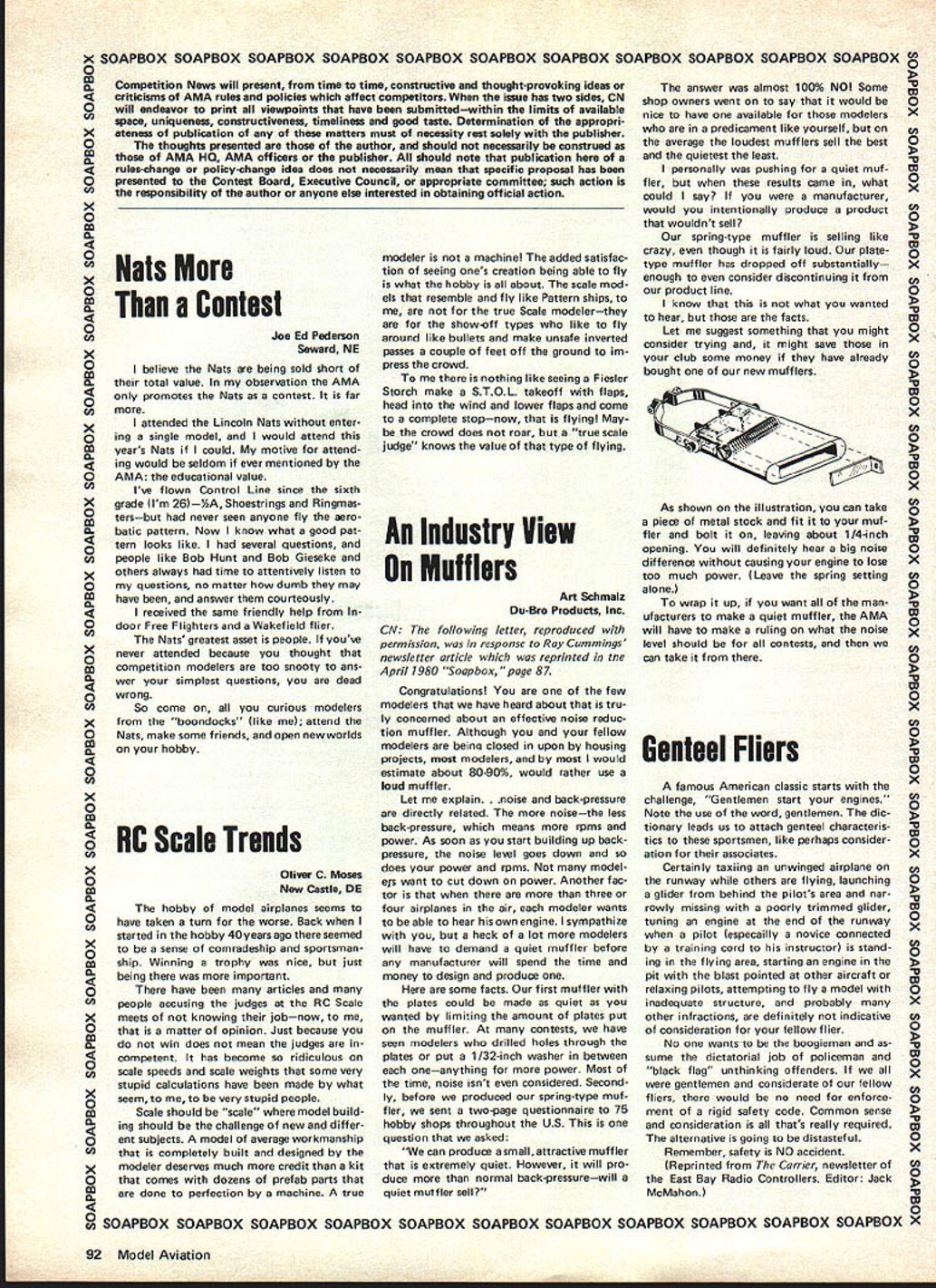
Let me suggest something you might consider trying that might save those in your club some money if they have already bought one of our new mufflers. As shown on the illustration, you can take a piece of metal stock and fit it to your muffler and bolt it on, leaving about a 1/4-inch opening. You will definitely hear a big noise difference without causing your engine to lose too much power. (Leave the spring setting alone.)
To wrap it up, if you want all of the manufacturers to make a quiet muffler, the AMA will have to make a ruling on what the noise level should be for all contests, and then we can take it from there.
Genteel Fliers
A famous American classic starts with the challenge, "Gentlemen, start your engines." Note the use of the word gentlemen. The dictionary leads us to attach genteel characteristics to these sportsmen, like perhaps consideration for their associates.
Certainly taxiing an unwinged airplane on the runway while others are flying, launching a glider from behind the pilot's area and narrowly missing with a poorly trimmed glider, taxing an engine at the end of the runway when a pilot (especially a novice connected by a training cord to his instructor) is standing in the flying area, starting an engine in the pit with the blast pointed at other aircraft or relaxing pilots, attempting to fly a model with inadequate structure, and probably many other infractions, are definitely not indications of consideration for your fellow flier.
No one wants to be both boorish and assume the dictatorial job of policeman and "black flag" thinking. If folks were gentlemen and considerate of their fellow fliers, there would be no need for enforcement of a rigid safety code. Common sense and consideration is all that's really required. The alternative is going to be a disaster.
Remember, safety is NO accident.
(Reprinted from The Carrier, newsletter of the East Bay Radio Controllers. Editor: Jack McMahon.)
Transcribed from original scans by AI. Minor OCR errors may remain.

