
Competition Newsletter
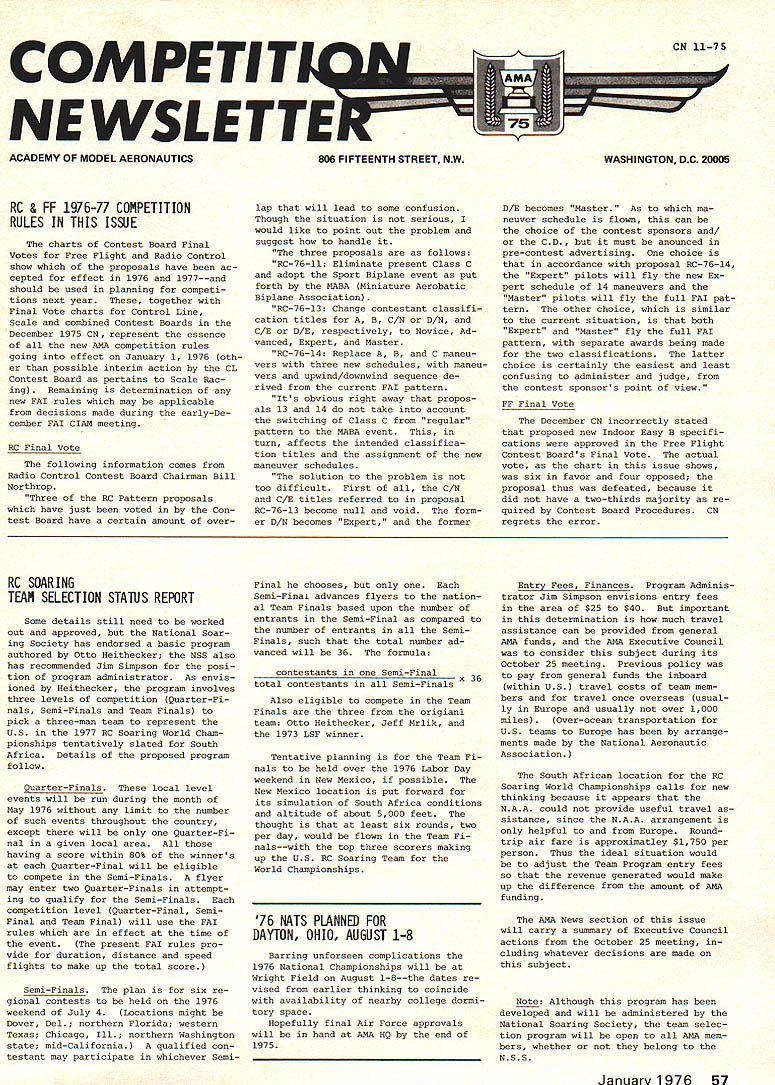
RC & FF 1976-77 COMPETITION RULES IN THIS ISSUE
The charts of Contest Board Final Votes for Free Flight and Radio Control show which of the proposals have been accepted for effect in 1976 and 1977 — and should be used in planning for competitions next year. These, together with Final Vote charts for Control Line, Scale and combined Contest Boards in the December 1975 CN, represent the essence of the new AMA competition rules going into effect on January 1, 1976 (other than possible interim action by the CL Contest Board pertaining to Scale Racing). Remaining is determination of any new FAI rules which may be applicable from decisions made during the early-December FAI CIAM meeting.
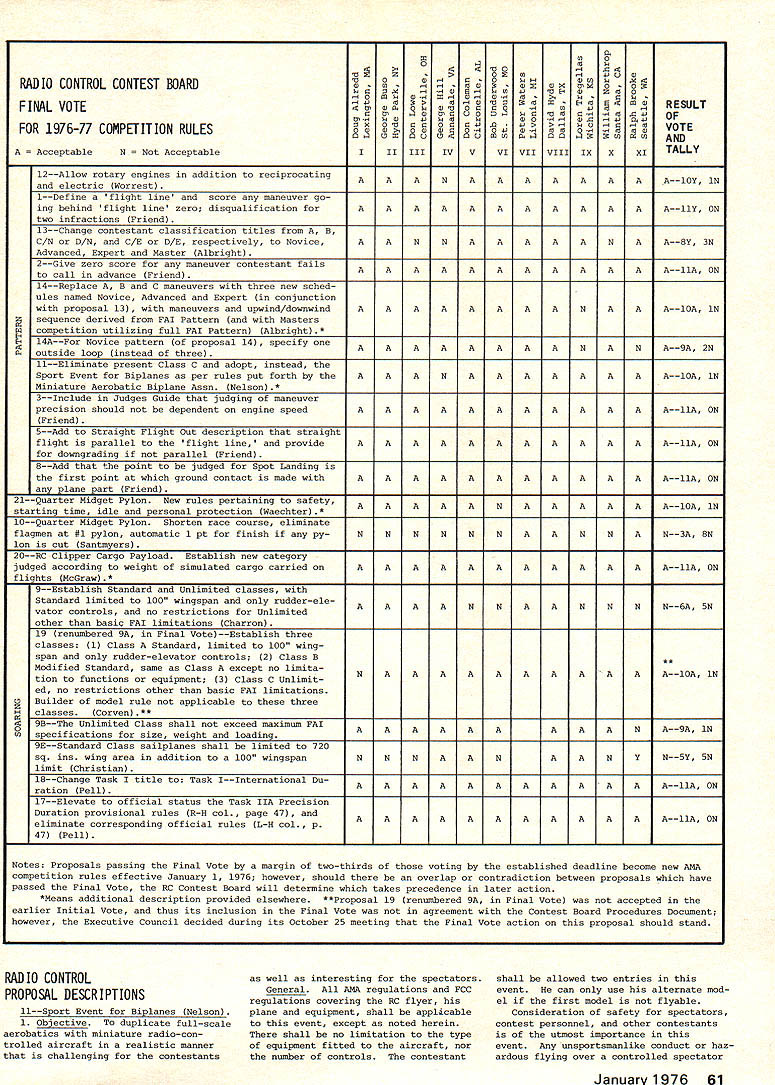
RC Final Vote
The following information comes from Radio Control Contest Board Chairman Bill Northrop.
"Three of the RC Pattern proposals which have just been voted in by the Contest Board have a certain amount of overlap that will lead to some confusion. Though the situation is not serious, I would like to point out the problem and suggest how to handle it.
"The three proposals are as follows:
- RC-76-11: Eliminate present Class C and adopt Sport Biplane event as put forth by the MABA (Miniature Aerobatic Biplane Association).
- RC-76-13: Change contestant classification titles for A, B, C/N or D/N, and C/E or D/E, respectively, to Novice, Advanced, Expert, and Master.
- RC-76-14: Replace B, A, and C maneuver schedules with three new schedules, with maneuvers and upwind/downwind sequence derived from the current FAI pattern.
"It's obvious right away that proposals 13 and 14 do not take into account the switching of Class C from 'regular' pattern to the MABA event. This, in turn, affects the intended classification titles assignment of the new maneuver schedules.
"The solution to the problem is not too difficult. First of all, the C/N and C/E titles referred to in proposal RC-76-13 become null and void. The former C/N becomes 'Expert,' and the former D/E becomes 'Master.' As to which maneuver schedule is flown, this can be the choice of the contest sponsors and/or the C.D., but it must be announced in the contest advertising. One choice is that in accordance with proposal RC-76-14, the 'Expert' pilots will fly the new Expert schedule of 14 maneuvers, while the 'Master' pilots will fly the full FAI pattern. The other choice, which is similar to the current situation, is that both Expert and Master fly the full FAI pattern, with separate awards being made for the two classifications. The latter choice is certainly the easiest and least confusing to administer and judge, from the contest sponsor's point of view."
FF Final Vote
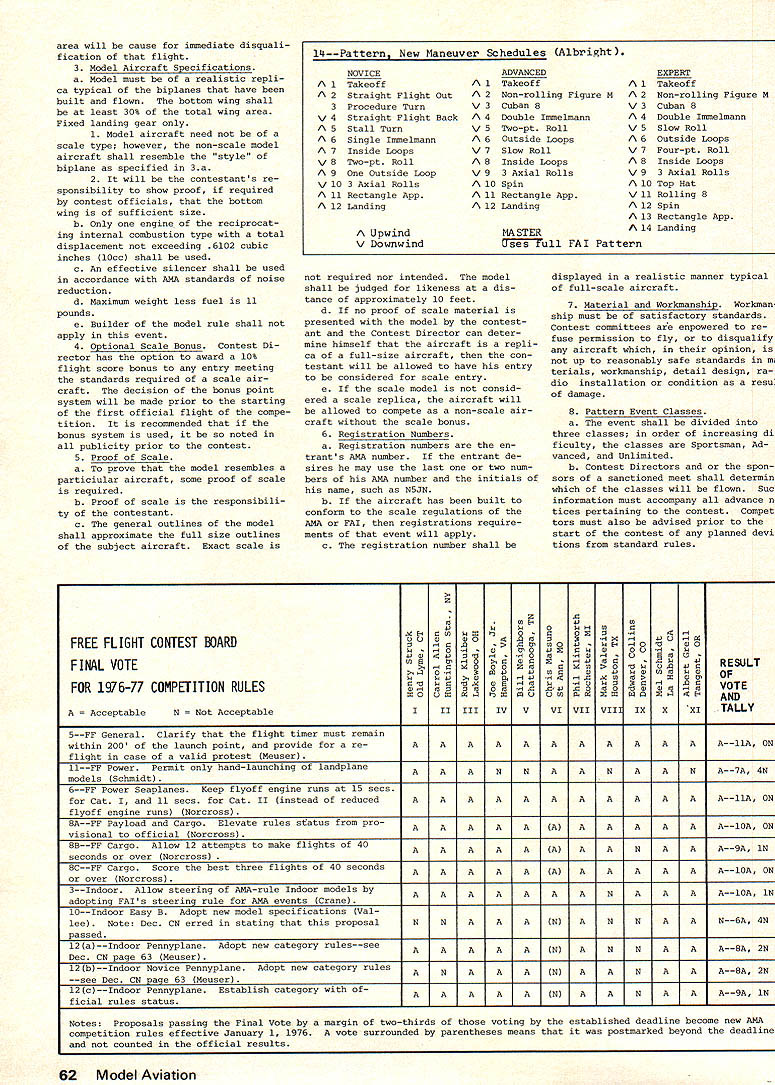
The December CN incorrectly stated that proposed new Indoor Easy B specifications were approved in the Free Flight Contest Board's Final Vote. The actual vote, as the chart in this issue shows, was six in favor and four opposed; therefore the proposal was defeated, because it did not have the two-thirds majority as required by Contest Board Procedures. CN regrets the error.
RC Soaring Team Selection Status Report
Some details still need to be worked out and approved, but the National Soaring Society has endorsed a basic program authored by Otto Neithecker; the NSS also has recommended Jim Simpson for the position of program administrator. As envisioned by Neithecker, the program involves three levels of competition (Quarter-Finals, Semi-Finals and Team Finals) to pick a three-man team to represent the U.S. in the 1977 RC Soaring World Championships tentatively slated for South Africa. Details of the proposed program follow.
Quarter-Finals. These local level events will be run during the month of May 1976 with no limit to the number of such events throughout the country, except there will be only one Quarter-Final in a given local area. All those having a score within 80% of the winner's at each Quarter-Final will be eligible to compete in the Semi-Finals. A flyer may enter two Quarter-Finals in attempting to qualify for the Semi-Finals. Each competition level (Quarter-Final, Semi-Final and Team Final) will use the FAI rules which are in effect at the time of the event. (The present FAI rules provide for duration, distance and speed flights to make up the total score.)
Semi-Finals. The plan is for six regional contests to be held on the 1976 weekend of July 4. Locations might be Dover, Del.; northern Florida; western Texas; Chicago, Ill.; northern Washington state; mid-California. A qualified contestant may participate in whichever Semi-Final he chooses, but only one. Each Semi-Final advances flyers to the national Team Finals based upon the number of entrants in the Semi-Final as compared with the number of entrants in all the Semi-Finals, such that the total number advanced will be 36. The formula is:
- (contestants in one Semi-Final ÷ total contestants in all Semi-Finals) × 36 = number advanced from that Semi-Final.
Also eligible to compete in the Team Finals are the three from the original team: Otto Neithecker, Jeff Mrlik, and the 1973 LEF winner.
Tentative planning is for the Team Finals to be held over the 1976 Labor Day weekend in New Mexico, if possible. The New Mexico location is put forward for its simulation of South African conditions and altitude of about 5,000 feet. The thought is that at least two rounds, two per day, would be flown in the Team Finals — with the top three scorers making up the U.S. RC Soaring team for the World Championships.
'76 NATS PLANNED FOR DAYTON, OHIO, AUGUST 1-8
Barring unforeseen complications the 1976 National Championships will be at Wright Field on August 1-8 — the dates revised from earlier thinking to coincide with availability of nearby college dormitory space.
Hopefully final Air Force approvals will be in hand at AMA HQ by the end of 1975.
Entry Fees, Finances. Program Administrator Jim Simpson envisions entry fees in the area of $25 to $40. But important in this determination is how much travel assistance can be provided from general AMA funds and the AMA Executive Council was to consider this subject during its October 25 meeting. Previous policy was to pay from general funds the inbound (within U.S.) travel costs of team members and for travel overseas (usually to Europe) arrangements have been made by the National Aeronautic Association.
The South African location for the RC Soaring World Championships calls for new thinking because it appears that the N.A.A. could not provide travel assistance, since N.A.A. arrangements are only helpful for travel to Europe. Round-trip air fare is approximately $1,750 per person. Thus the ideal situation would be to obtain the extra funds which could be applied to subsidize the team members' travel in addition to AMA funding.
The AMA News section of this issue will carry a summary of Executive Council actions from the October 25 meeting, including whatever decisions are made on this subject.
Note: Although this program has been developed and will be administered by the National Soaring Society, the team selection program will be open to all AMA members, whether or not they belong to the N.S.S.
FAI RC AEROBATICS WORLD CHAMPS
Report by Don Lowe Team Manager
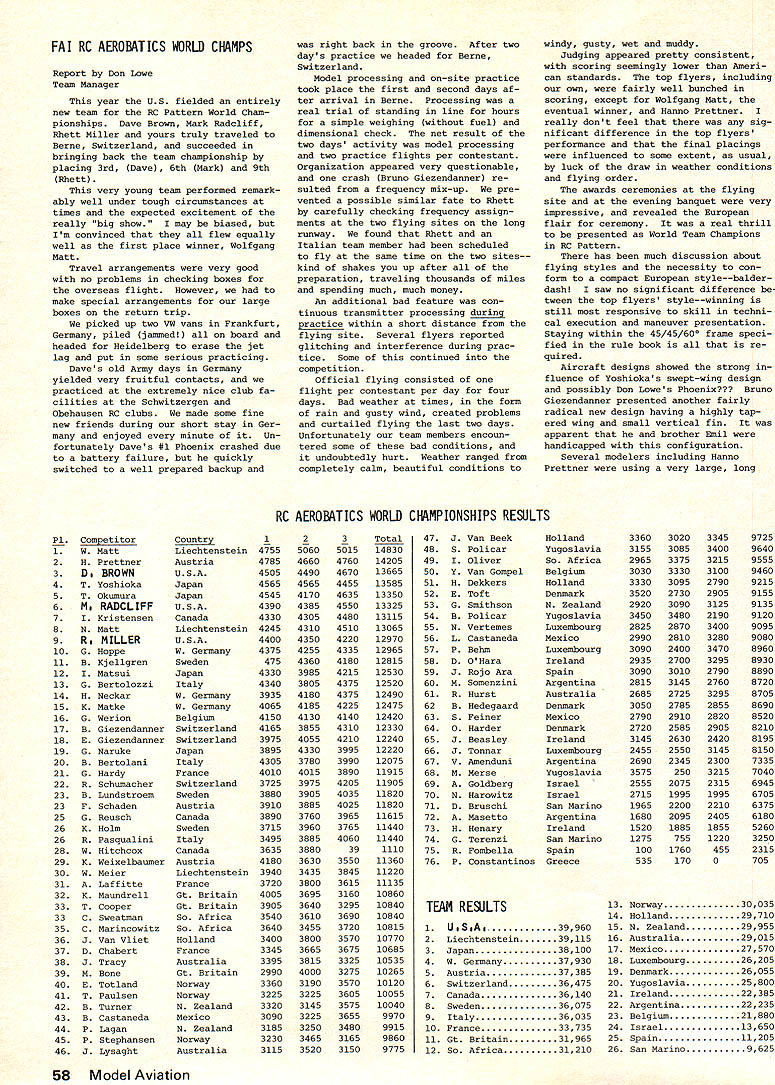
This year the U.S. fielded an entirely new team for the RC Pattern World Championships. Dave Brown, Mark Radcliff, Rhett Miller and yours truly traveled to Berne, Switzerland, and succeeded in bringing back the team championship by placing 3rd (Dave), 6th (Mark) and 9th (Rhett).
This very well under tough circumstances at times and the expected excitement of the really "big show." I may be biased, but I'm convinced that they all flew equally well as the first place winner, Wolfgang Matt.
Travel arrangements were very good with no problems in checking boxes for the overseas flight. However, we had to make special arrangements for our large boxes on the return trip.
We picked up two VW vans in Frankfurt, Germany, piled (jammed!) all on board and headed for Heidelberg to erase the jet lag and put in some serious practicing. Dave's old Army days in Germany yielded very fruitful contacts, and we practiced at the extremely nice club facilities at the Schwetzingen and Oberhausen RC clubs. We made some fine new friends during our short stay in Germany and enjoyed every minute of it. Unfortunately, Dave's Halcon cracked due to a battery failure, but he quickly switched to a well-prepared backup and was right back in the groove. After two days' practice we headed for Berne, Switzerland.
Model processing and on-site practice took place the first and second days after arrival in Berne. Processing was a real trial of standing in line for hours for a simple weighing (without fuel) and dimensional check. The net result of the two days' activity was model processing and two practice flights per contestant. Organization appeared very questionable, and one crash (Bruno Giezendanner) resulted from a frequency mix-up. We prevented a possible similar fate to Rhett by carefully checking frequency assignments at the two flying sites on the day of the warmup. We found that Rhett and an Italian team member had been scheduled to fly at the same time on the two sites — kind of shakes you up after all of the preparation, traveling thousands of miles and spending much, much money.
In addition, a bad feature was continuous transmitter processing during practice within a short distance from the flying site. Several flyers reported glitching and interference during practice. Some of this continued into the competition.
Official flying consisted of one flight per contestant per day for four days. Bad weather at times, in the form of rain and gusty wind, created problems and curtailed flying the last two days. Unfortunately our team members encountered some of these bad conditions, and it undoubtedly hurt. Weather ranged from completely calm, beautiful conditions to windy, gusty, wet and muddy.
Judging appeared pretty consistent, with scoring seemingly lower than American standards. The top flyers, including our own, were fairly well bunched in scoring, except for Wolfgang Matt, the eventual winner, and Hanno Prettner. I really don't feel that there was any significant difference in the top flyers' performance and that the final placings were influenced to some extent, as usual, by luck of the draw in weather conditions and flying order.
The awards ceremonies at the flying site and at the evening banquet were very impressive, and revealed the European flair for ceremony. It was a real thrill to be present as World Team Champions in RC Pattern.
There has been much discussion about flying styles and the necessity to conform to a compact European style—balderdash! I saw no significant difference between the top flyers' styles—winning is still most subjective to skill in technical execution and maneuver presentation. Staying within the 45/45/60 frame specified in the rule book is all that is required.
Aircraft designs showed the strong influence of Yoshikoda's swept-wing design and possibly Don Lowe's "Phoenix." Bruno Giezendanner presented another fairly radical new design having a highly tapered wing and small vertical fin. It was apparent that he and brother Emil were handicapped by competing for Switzerland.
Several modelers, including Hanno Prettner, were using a very large, long... tuned pipe muffler in an attempt at noise reduction. This seemed a rather extreme approach to a marginal improvement in noise reduction. Our team members' conventional mufflers seemed equally quiet in flight. No official noise measurements were made, and the concern about the Swiss 83 db requirement proved groundless. Similarly, the question of 72 meg. operations was unnecessarily concerned, since 30% of the flyers flew on these frequencies and no issue was made by the authorities. In fact, electing to fly on 72 meg. in spite of the uncertainty was wise since considerable interference occurred on the 27 meg. band. Even one of the 26 competitors represented had one or more contestants flying on 72 meg.
RC AEROBATICS WORLD CHAMPS Ed Keck
Well gang, we can be real proud of our team—they flew like champions, worked like champions and showed great unity of spirit and goodwill. I am sure many great friendships were made. Also, a special thanks to Don Lowe for his job as manager. There is a lot more to that job than one's first impression. Up way before dawn, and last to supper.
I finally figured out why Dave Brown does so well. That great tall girl, Sally, is just super. She should get a combination award for call girl, wife, writer and mother of the year. She just lets Dave what to do, and he does. For the trip she really did it right. For me and dad Brown were there along with his two lovely children Davy and Connie. Dave, I am surprised they only let you settle for 3rd! Big smiles. John Malowey was there rooting for his boys, Dave and Mark. I have known John a good many years, and I don't think I ever saw John watch a complete flight—until R/C Nationals; since then I don't think he has missed one of Dave's or Mark's.
Let me give just a few impressions at random as I think of them. I don't want to ramble along, because you will read lots of the other reports in detail.
The meet got off to a poor start. Frequency control was bad in the practice rounds. They had the Americans and the Italians at two different sites on the same frequencies, and to top it off they were checking transmitters all at the same time. Nothing fatal for us, but bad on the nerves. I have seen more blunders for the lack of the use of frequency clips. Maybe it's so simple it's not supposed to work—it works for us now—after Chicago! But if it will work at the World Championships after Switzerland. Bruno Giezendanner of Switzerland was one who crashed due to an error in frequency control. I admired his cool in a volatile situation.
The weather was a problem: rain, high winds, then calm. This made the exposure to constant weather for each round impossible. I believe Prettner would have done better if he had a break in the weather. On the flight it was not just raining but pouring, and it took the officials at least three minutes to make up their minds what to do. His airplane could have been in the deck as the deliberate! Mast of Japan had interference—bad; requested permission to land, fought for three minutes. After finally getting permission to land, he crashed.
Matt's new Atlas design looks real good, very steady, not too fast. In general, he uses a progressive airfoil—thick in the center, about 18%, and then at the tip, with the high point way back at the tip. It has a large stab and elevator, a long tail moment arm. Uses the new Weber mixture control, '7' pitch prop with wide blades. I understand Southern RC will be producing a kit.
Prettner had a new design named Curare with lots of swept aft wing and tuned pipe, thinner airfoil, inverted dihedral in the stab. He was flying larger, faster maneuvers than he was at Vegas and in Italy. In general, his rolling maneuvers were impressive, but over the six seconds—I don't know if this hurt him. I have heard comments that the Europeans can't fly in the wind, but Matt and Prettner disproved that.
In general, the flying was faster and larger than in Italy, but this year the American team members were flying smaller maneuvers—I thought about the right size. I am convinced the American pattern is the best in the world. We had no interference. A few glitches here or there doesn't seem to bother the Europeans. I, personally, when I get one glitch, I lose the box and it's hard to get back to the aircraft. I haven't lost an airplane due to radio problems in five years; maybe that's why I hope I saw Matt get hit bad in a slow roll, but he kept right on going—real smooth. Matt's brother, Norbert, is coming along real good. I wonder if he has any more younger brothers. Matt could be roughing it up for 20 years at this rate.
I have been asked what we have to do to win the individual R/C World Championship. My answer: keep doing what we are doing. I have seen our boys, Dave, Rhett and Mark, put up flights just at the Masters and the Nationals that would win the World Champs. If we keep working hard we will put it all together. Vegas should be real interesting.
(This article was written for K-Factor, newsletter of the National Society of Radio Controlled Aerobatics, and is printed here with the author's permission.)
COMPETITION NEWSLETTER
ACADEMY OF MODEL AERONAUTICS RC & FF 1976-77 COMPETITION RULES
IN THIS ISSUE: Contest Board Final Votes, Free Flight, Radio Control show proposals have been accepted; effect 1976–1977 and should be used in planning competitions next year. Together: Final Vote charts — Control Line, Scale combined Contest Boards December 1975. CN represents the essence of new AMA competition rules going into effect January 1, 1976; other possible interim action.
CL Contest Board pertains to Scale Racing. Remaining determination of new FAT rules may be applicable; decisions were made during the early December FAT/CIAM meeting.
RC Final Vote
The following information comes from Radio Control Contest Board Chairman Bill Northrop. Three RC Pattern proposals have just been voted on by the Contest Board. There is a certain amount of confusion which will lead to some misunderstanding. Though the situation is serious, I would like to point out the problem and suggest how to handle the three proposals as follows:
- RC-76-11: Eliminate present Class C; adopt Sport Biplane event put forth by MABA (Miniature Aerobatic Biplane Association).
- RC-76-13: Change contestant classification titles B, C/N, D/N, C/F, D/E respectively to Novice, Advanced, Expert, ??? (see board action).
- RC-76-14: Replace B and C maneuvers with three new schedules of maneuvers — an upwind/downwind sequence derived from the current FAT pattern.
It is obvious right away that proposals RC-76-13 and RC-76-14 take into account switching Class C regular pattern. The change affects intended classification title assignments and new maneuver schedules; a solution to the problem is not simple. If RC-76-13 becomes null and void in part, former D/N becomes Expert, former C/N becomes Senior, and D/E becomes Master. The maneuver schedule flown can be the choice of contest sponsors and must be announced in precontest publicity in accordance with proposal RC-76-14. Expert pilots will fly the new Expert schedule (14 maneuvers). Master pilots will fly the full FAT pattern; another choice is similar to the current situation where both Expert and Master fly the full FAI pattern with separate awards being made to the two classifications. The latter choice is certainly the easiest and least confusing to administer and judge from the contest sponsors' point of view.
FF Final Vote
In December CN we incorrectly stated the proposed new Indoor Easy B specifications were approved by the Free Flight Contest Board. The actual vote chart in this issue shows six in favor and four opposed; the proposal was thus defeated because it did not have the two-thirds majority required under Contest Board procedures. CN regrets the error.
RC Soaring Team Selection Status Report
Some details still need to be worked out. The National Soaring Society has endorsed the basic program authored by Otto Neithecker. NESS also has recommended Jim Simpson for the position of program administrator. As envisaged, the Neithecker program involves three levels of competition: Quarter-Finals, Semi-Finals, and Team Finals to pick a three-man team to represent the U.S. at the 1977 RC Soaring World Championships, tentatively slated for South Africa. Details of the proposed program follow.
Quarter-Finals: Local level events will run during the month of May 1976. There will be a limit on the number of such events throughout the country; a local area having a score within 80% of the winner at a qualifying local event will be eligible to advance to the Semi-Finals. A flyer may enter two Quarter-Finals attempting to qualify.
Semi-Finals: The Quarter-Final, Semi-Final and Team Final levels will use the FAT rules in effect for time events. Present FAT rules provide that duration, distance and speed flights make up the total score. The Semi-Finals plan six regional contests to be held the 1976 weekend of July 4. Possible locations might be: Dover, Del.; northern Florida; western Texas; Chicago, Ill.; northern Washington State; mid-California. A qualified contestant may participate in whichever Semi-Final he chooses.
Team Finals: Semi-Finals will advance flyers to the national Team Finals based upon the number of entrants in each Semi-Final compared to the total number of entrants in all Semi-Finals; the total number advanced will be 36 using the formula: (contestants in Semi-Final / total contestants in all Semi-Finals) × 36. Also eligible to compete in the Team Finals are the three original team members Otto Neithecker, Jeff Mrlik and the 1973 LEF winner. Tentative planning calls for the Team Finals to be held over the 1976 Labor Day weekend in New Mexico; a possible New Mexico location has been put forward.
(continued)
RADIO CONTROL CONTEST BOARD
FINAL VOTE
FOR 1976-77 COMPETITION RULES
Notes: Proposals passing the Final Vote by a margin of two-thirds of those voting by the established deadline become new AMA competition rules effective January 1, 1976; however, should there be an overlap or contradiction between proposals which have passed the Final Vote, the RC Contest Board will determine which takes precedence in later action.
*Means additional description provided elsewhere. **Proposal 19 (renumbered 9A, in Final Vote) was not accepted in the earlier Initiative Vote, and thus its inclusion in the Final Vote was not in agreement with the Contest Board Procedures Document; however, the Executive Council decided during its October 25 meeting that the Final Vote action on this proposal should stand.
RADIO CONTROL PROPOSAL DESCRIPTIONS
11—Sport Event for Biplanes (Nelson).
- Objective. To duplicate full-scale aerobatics with miniature radio-controlled aircraft in a realistic manner that is challenging for the contestants as well as interesting for the spectators.
General. All AMA regulations and FCC regulations covering the RC flyer, plane and equipment shall apply to all applicable rules for this event, except no tethering. There shall be no limitation to the type of equipment fitted to the aircraft, nor the number of controls. The contestant shall be allowed two entries in this event, but he can only use his alternate model if the first model is not flyable.
- Consideration of safety for spectators, contest personnel, and other contestants is of the utmost importance in this event. Any unsportsmanlike conduct or hazardous flying over a controlled spectator area will be cause for disqualification.
- Model Aircraft Specifications.
a. Model must be of a realistic replica typical of the biplanes that have been built and flown. The bottom wing shall be at least 30% of the total wing area.
b. Fixed landing gear only.
c. Model aircraft need not be of a scale type; however, the non-scale model aircraft shall resemble the "style" of biplane as specified in 3.a.
d. It will be the contestant's responsibility to show, proof, if required, by contest officials, that the bottom wing is of sufficient size.
e. Only one engine of the reciprocating internal combustion type with a total displacement not exceeding .6102 cubic inches (10cc) shall be used.
f. An effective silencer shall be used in accordance with AMA standards of noise reduction.
g. Maximum weight less fuel is 11 pounds.
- Builder of the model rule shall not apply in this event.
- Optional Scale Bonus. Contest Directors has the option to award a 10% flight score bonus to any entry meeting the standards required of a scale aircraft. The decision of the bonus point system will be made prior to the starting of the first official flight of the competition. It is recommended that if the bonus system is used, it be noted in all publicity prior to contest.
- Proof of Scale.
a. To prove that the model resembles a particular aircraft, some proof of scale is required.
b. Proof of scale is the responsibility of the contestant.
c. The general outlines of the model shall approximate the full size outlines of the subject aircraft. Exact scale is not required nor intended. The model shall be judged for likeness at a distance of approximately 10 feet.
d. If no proof of scale material is presented with the model by the contestant and the Contest Director can determine himself that the aircraft is a replica of a full-size aircraft, then the contestant will be allowed to have his entry be considered for scale entry.
e. If the scale model is not considered a scale replica, the aircraft will be allowed to compete as a non-scale aircraft without the scale bonus.
- Registration Numbers.
a. Registration numbers are the entrant's AMA number. If the entrant desires he may use the last one or two numbers of his AMA number and the initials of his name, such as N5JN.
b. If the aircraft has been built to conform to the scale regulations of the AMA or FAI, then registration requirements of that event will apply.
c. The registration number shall be displayed in a realistic manner typical of full-scale aircraft.
- Material and Workmanship. Workmanship must be of satisfactory standards. Contest committees are empowered to refuse permission to fly, or to disqualify any aircraft which, in their opinion, is not up to reasonably safe standards in materials, workmanship, detail, design, or installation or condition as a result of damage.
- Pattern Event Classes.
a. The event shall be divided into three classes, in order of increasing difficulty, the classes are Sportsman, Advanced, and Unlimited.
b. Contest Directors and the sponsor of a sanctioned meet shall determine which of the classes will be flown. Such information must accompany all advance notices pertaining to the contest. Competitors must also be advised prior to the start of the contest of any planned deviations from standard rules.
14--Pattern, New Maneuver Schedules (Albright).
NOVICE
- Takeoff
- Straight Flight Out
- Procedure Turn
- Straight Flight Back
- Stall Turn
- Single Immelmann
- Inside Loops
- Two-pt. Roll
- One Outside Loop
- 3 Axial Rolls
- Rectangle App.
- Landing
ADVANCED
- Takeoff
- Non-rolling Figure M
- Cuban 8
- Double Immelmann
- Two-pt. Roll
- Outside Loops
- Slow Roll
- Inside Loops
- 3 Axial Rolls
- No Spin
- Rectangle App.
- Landing
EXPERT
- Takeoff
- Non-rolling Figure M
- Cuban 8
- Double Immelmann
- Slow Roll
- Outside Loops
- Slow Roll
- Inside Loops
- 3 Axial Rolls
- Top Hat
- Rolling
- Spin
- Rectangle App.
- Landing
MASTER Uses full FAI Pattern
^ Upwind v Downwind
FF Final Vote. December CN incorrectly stated that the proposed new Indoor Easy B specifications were approved by the Free Flight Contest Board. The Final Vote actual vote chart in this issue shows six in favor, four opposed; the proposal was thus defeated because it did not have the two-thirds majority required by Contest Board Procedures. CN regrets the error.
RC SOARING TEAM SELECTION STATUS REPORT
Some details still need to be worked out. The approved National Soaring Society has endorsed the basic program authored by Otto Neithecker. NSS also has recommended Jim Simpson as program administrator. As envisioned, the Neithecker program involves three levels of competition: Quarter-Finals, Semi-Finals, Team Finals to pick a three-man team to represent the U.S. at the 1977 RC Soaring World Championships, tentatively slated for South Africa. Details of the proposed program follow.
Quarter-Finals: Local level events will run during the month of May 1976. Limit the number of such events throughout the country except where a Quarter-Final is given a local area having a score within 80% of the winner. A Quarter-Final winner will be eligible to compete in the Semi-Finals. A flyer may enter two Quarter-Finals in an attempt to qualify.
Semi-Finals: The competition levels Quarter-Final, Semi-Final and Team Final will use the FAT rules in effect. Present FAT rules provide that duration, distance and speed flights make up the total score. Semi-Finals plan six regional contests to be held the 1976 weekend of July 4. Locations might be Dover, Del.; northern Florida; western Texas; Chicago, Ill.; northern Washington State; mid-California. A qualified contestant may participate in whichever Semi-Final he chooses. Semi-Finals advance flyers to the national Team Finals based upon the number of entrants in a Semi-Final compared to the total number of entrants in all Semi-Finals. The total number advanced will be 36 calculated by the formula: contestants in Semi-Final / total contestants in Semi-Finals x 36. Also eligible to compete in the Team Finals are the three original team members Otto Neithecker, Jeff Mrlik (1973 LEF winner) and [the third original team member]. Tentatively the Team Finals are planned for the 1976 Labor Day weekend. New Mexico is a possible location; New Mexico location proponents have put forward its simulation.
Notes: Proposals passing the Final Vote by a margin of two-thirds of those voting by the established deadline become new AMA competition rules effective January 1, 1976. A vote surrounded by parentheses means that it was postmarked beyond the deadline and not counted in the official results.
Competition Newsletter
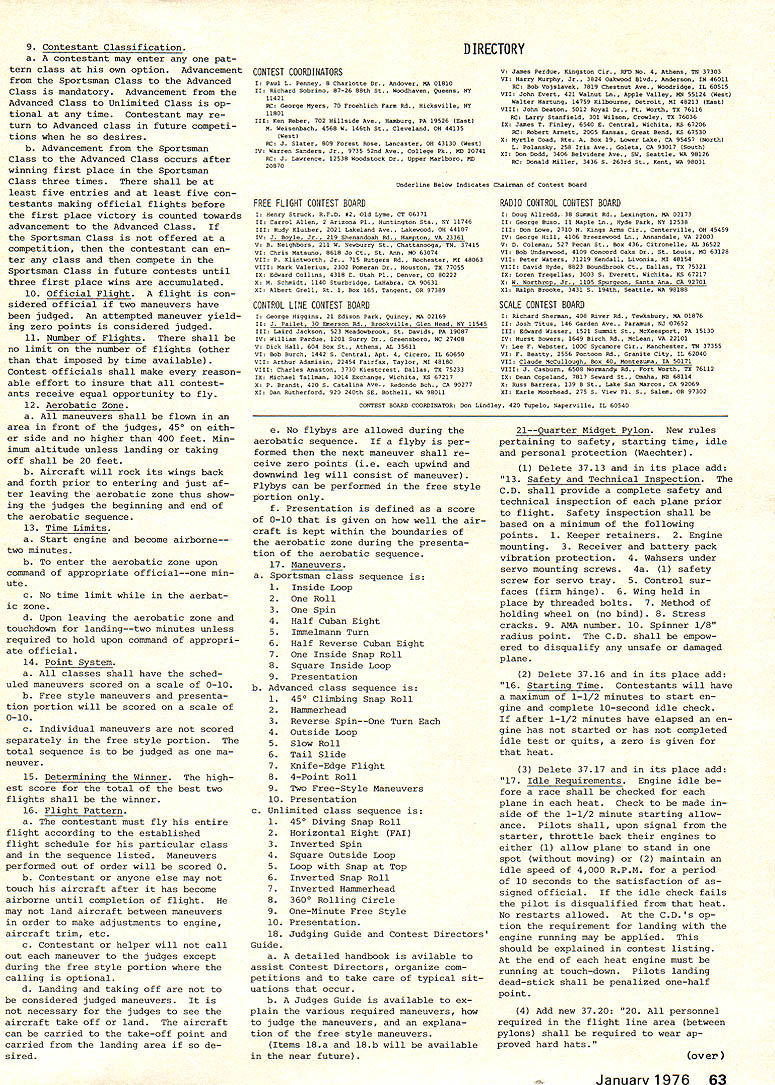
- Contestant Classification.
a. A contestant may enter any one pattern class at his own option. Advancement from the Sportsman class to the Advanced Class is mandatory. Advancement from the Advanced Class to Unlimited Class is optional at any time. Contestant may return to Advanced class in future competitions when he so desires.
b. Advancement from the Sportsman Class to the Advanced Class occurs after winning first place in the Sportsman Class three times. There shall be at least five entries and at least five contestants making official flights before the first place victory is counted toward advancement to the Advanced Class. If the Sportsman Class is not offered at a competition, then the contestant can enter any class and then compete in the Sportsman Class in future contests until three first place wins are accumulated.
- Official Flight. A flight is considered official if two maneuvers have been judged. An attempted maneuver yielding zero points is considered judged.
- Number of Flights. There shall be no limit on the number of flights (other than that imposed by time available). Contest officials shall make every reasonable effort to ensure that all contestants receive equal opportunity to fly.
- Aerobatic Zone.
a. All maneuvers shall be flown in an area in front of the judges 45° on either side and no higher than 400 feet. Minimum altitude unless landing or taking off shall be 20 feet.
b. Aircraft will rock its wings back and forth prior to entering and just after leaving the aerobatic zone thus showing the judges the beginning and end of the aerobatic sequence.
- Time Limits.
a. Start engine and become airborne—two minutes.
b. To enter the aerobatic zone upon command of appropriate official—one minute.
c. No time limit while in the aerobatic zone.
d. Upon leaving the aerobatic zone and touchdown for landing—two minutes unless required to hold upon command of appropriate official.
- Point System.
a. All classes shall have the scheduled maneuvers scored on a scale of 0-10.
b. Free style maneuvers and presentation portion will be scored on a scale of 0-10.
c. Individual maneuvers are not scored separately in the free style portion. The total sequence is to be judged as one maneuver.
- Determining the Winner. The highest score for the total of the best two flights shall be the winner.
- Flight Pattern.
a. The contestant must fly his entire flight according to the established flight schedule for his particular class and in the sequence listed. Maneuvers performed out of order will be scored 0.
b. Contestant or anyone else may not touch his aircraft after it has become airborne until completion of flight. He may not land aircraft between maneuvers in order to make adjustments to engine, aircraft trim, etc.
c. Contestant or helper will not call out each maneuver to the judges except during the free style portion where the calling is optional.
d. Landing and taking off are not to be considered judged maneuvers. It is not necessary for the judges to see the aircraft take off or land. The aircraft can be carried to the take-off point and carried from the landing area if so desired.
e. No flybys are allowed during the aerobatic sequence. If a flyby is performed where the next maneuver shall receive zero points (i.e., each upwind and downwind leg will consist of maneuver). Flybys can be performed in the free style portion only.
f. Presentation is defined as a score of 0-10 that is given on how well the aircraft is kept within the boundaries of the aerobatic zone during the presentation of the aerobatic sequence.
- Maneuvers.
a. Sportsman class sequence is:
- Inside Loop
- One Roll
- One Spin
- Half Cuban Eight
- Immelmann Turn
- Half Reverse Cuban Eight
- One Inside Snap Roll
- Square Inside Loop
- Presentation
b. Advanced class sequence is:
- 45° Climbing Snap Roll
- Hammerhead
- Reverse Spin—One Turn Each
- Outside Loop
- Slow Roll
- Stall Turn
- Knife-Edge Flight
- 4-Point Roll
- Two Free-Style Maneuvers
- Presentation
c. Unlimited class sequence is:
- 45° Diving Snap Roll
- Horizontal Eight (FAI)
- Inverted Spin
- Square Outside Loop
- Loop With Snap at Top
- Inverted Snap Roll
- Inverted Hammerhead
- 360° Rolling Circle
- One-Minute Free Style
- Presentation
- Judging Guide and Contest Directors' Guide.
a. A detailed handbook is available to assist Contest Directors, organize competitions and to take care of typical situations that occur.
b. A Judges Guide is available to explain the various required maneuvers, how to judge the maneuvers, and an explanation of the free style maneuvers.
(Items 18.a and 18.b will be available in the near future.)
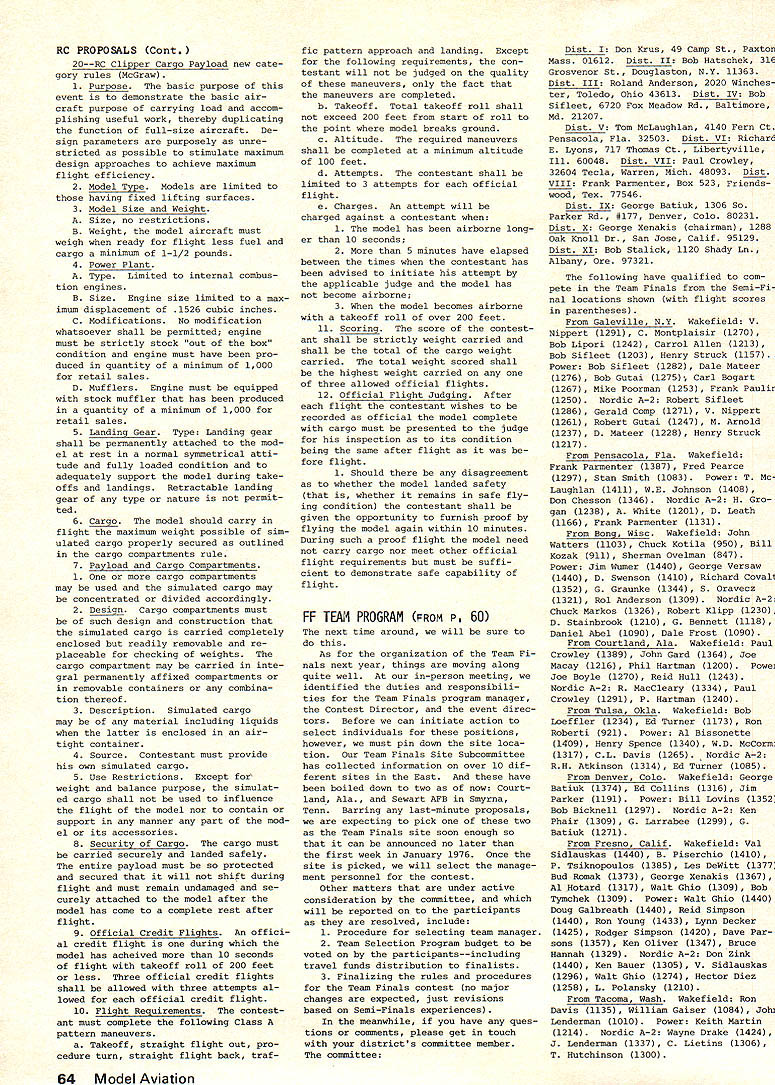
RC PROPOSALS (Cont.)
200—RC Clipper Cargo Payload new category rules (Cont.)
- Purpose. The basic purpose of this event is to demonstrate the basic aircraft purpose of carrying load and accomplishing useful work, thereby duplicating the function of full‑size aircraft. Design parameters are purposely as unrestricted as possible to stimulate maximum design approaches to achieve maximum flight efficiency.
- Model Type. Models are limited to those having fixed lifting surfaces.
- Model Size and Weight.
a. Size. No restrictions. b. Weight. The model aircraft must weigh, when ready for flight (less fuel and cargo), a minimum of 1-1/2 pounds.
- Power Plant.
a. Type. Limited to internal combustion engines. b. Size. Engine size limited to a maximum displacement of .1526 cubic inches. c. Modification. No modification whatever shall be permitted; engine must be strictly stock "out of the box" condition and engine must have been produced in a quantity of a minimum of 1,000 for retail sales. d. Mufflers. Engine must be equipped with stock muffler that has been produced in a quantity of a minimum of 1,000 for retail sales.
- Landing Gear. Type: Landing gear shall be permanently attached to the model at rest in a normal symmetrical attitude and fully loaded condition and to adequately support the model during takeoffs and landings. Retractable landing gear of any type or nature is not permitted.
- Cargo. The model should carry in flight the maximum weight possible of simulated cargo properly secured as outlined in the cargo compartments rule.
- Payload and Cargo Compartments.
- One or more cargo compartments may be used and the simulated cargo may be concentrated or divided accordingly.
- Design. Cargo compartments must be of such design and construction that the simulated cargo is carried completely enclosed but readily removable and replaceable for checking of weights. The cargo compartment may be carried in integral permanently affixed compartments or in removable containers or any combination thereof.
- Description. Simulated cargo may be of any material including liquids when the latter is enclosed in an airtight container.
- Source. Contestant must provide 5 oz simulated cargo.
- Use Restrictions. Except for weight and balance purposes, the simulated cargo shall not be used to influence the flight of the model nor to contain or support in any manner any part of the model or its accessories.
- Security of Cargo. The cargo must be carried securely and handled safely. The entire payload must be so protected and secured that it will not shift during flight and must remain undamaged and securely attached to the model after the model has come to a complete rest after flight.
- Official Credit Flights. An official credit flight is one during which the model has achieved more than 10 seconds of flight with takeoff roll of 200 feet or less. Three official credit flights shall be allowed with three attempts allowed for each official credit flight.
- Flight Requirements. The contestant must complete the following Class A pattern maneuvers.
a. Takeoff, straight flight out, procedure turn, straight flight back, traffic pattern approach and landing. Except for the following requirements, the contestant will not be judged on the quality of these maneuvers, only the fact that the maneuvers are completed. b. Takeoff. Total takeoff roll shall not exceed 200 feet from start of roll to the point where model breaks ground. c. Altitude. The required maneuvers shall be completed at a minimum altitude of 100 feet. d. Attempts. The contestant shall be limited to 3 attempts for each official flight. e. Charges. An attempt will be charged against a contestant when:
- The model has been airborne longer than 10 seconds;
- More than 5 minutes have elapsed between the times when the contestant has been advised to initiate the attempt by the applicable judge and the model has not become airborne;
- When the model becomes airborne with a takeoff roll of over 200 feet.
f. Scoring. The score of the contestant shall be strictly weight carried and shall be the total of the cargo weight carried. The total weight scored shall be the highest weight carried on any one of three allowed official flights.
- Official Flight Judging. After each official flight, the contestant wishing to be scored as official must present the model for inspection as to its condition being the same after flight as it was before the flight.
- Should there be any disagreement as to whether the model landed safely (as to whether it remains in safe flying condition) the contestant shall be given the opportunity to furnish proof by flying the model again within 10 minutes. During such a proof flight the model need not carry cargo nor meet other official flight requirements but must be sufficient to demonstrate safe capability of flight.
FF TEAM PROGRAM (FROM P. 60)
The next time around, we will be sure to do this.
As for the organization of the Team Finals next year, things are moving along quite well. At our in‑person meeting we identified the duties and responsibilities for the Team Finals program manager, the Contest Director, and the event directors. Before we can initiate action to select individuals for these positions, however, we must pin down the sites and dates. Our Team Finals Site Subcommittee has collected information on over 10 different sites in the East, and these have been boiled down to two as of now: Courtland, Ala., and Stewart AFB in Smyrna, Tenn. Barring any last‑minute proposals, we are expecting to pick one of these two as the Team Finals site soon enough so that it can be announced no later than the first week in January 1976. Once the site is picked, we will select the management personnel for the contest.
Other matters that are under active consideration by the committee, and which will be reported on to the participants as they are resolved, include:
- Procedure for selecting team manager.
- Team Selection Program budget to be voted on by the participants — including travel funds distribution to finalists.
- Finalizing the rules and procedures for the Team Finals contest (no major changes are expected, just revisions based on Semi‑Finals experiences).
In the meanwhile, if you have any questions or comments, please get in touch with your district's contest committee member.
The committee: Otto Neithecker, Jim Simpson, [additional committee members to be announced].
(End of Competition Newsletter — page 8)
Transcribed from original scans by AI. Minor OCR errors may remain.

