
RC Aerobatics Team Selection Program
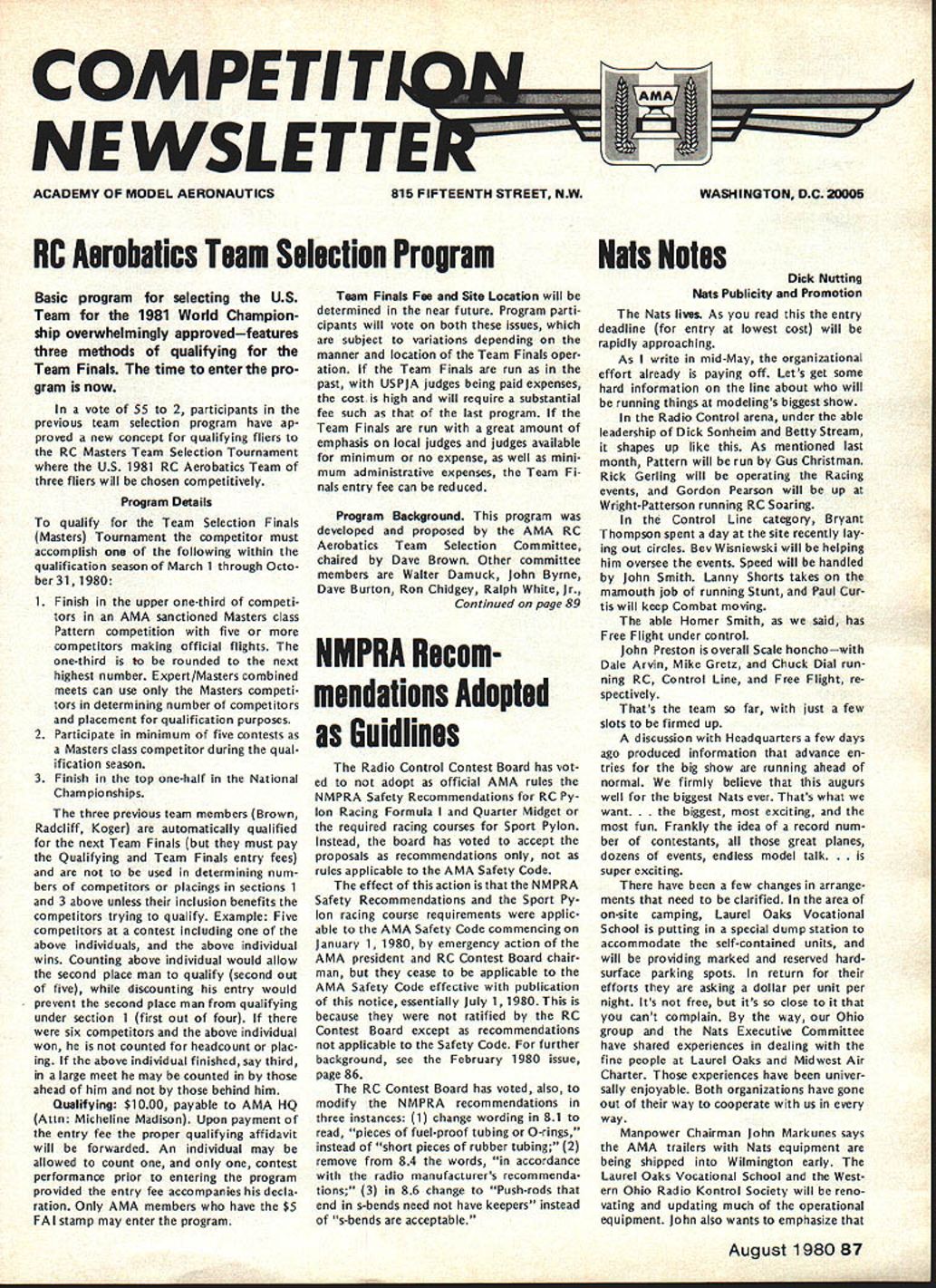
Basic program for selecting the U.S. Team for the 1981 World Championship was overwhelmingly approved. It features three methods of qualifying for the Team Finals (Masters). The time to enter the program is now.
In a vote of 55 to 2, participants in the previous team selection program approved a new concept for qualifying fliers to the RC Masters Team Selection Tournament where the U.S. 1981 RC Aerobatics Team of three fliers will be chosen competitively.
Program Details
To qualify for the Team Selection Finals (Masters Tournament) the competitor must accomplish one of the following within the qualification season of March 1 through October 31, 1980:
- Finish in the upper one-third of competitors in an AMA-sanctioned Masters class Pattern competition with five or more competitors making official flights. The one-third is to be rounded to the next highest number. Expert/Masters combined meets can use only the Masters competitors in determining number of competitors and placement for qualification purposes.
- Participate in a minimum of five contests as a Masters class competitor during the qualification season.
- Finish in the top one-half at the National Championships.
The three previous team members (Brown, Radcliff, Koger) are automatically qualified for the next Team Finals, but they must pay the qualifying and Team Finals entry fees. These three are not to be used in determining numbers of competitors or placings in sections 1 and 3 above unless their inclusion benefits competitors trying to qualify. Example: If five competitors attend a contest and one is a previously qualified team member who wins, counting that individual would allow the second-place finisher to qualify (second of five); discounting his entry would prevent the second-place finisher from qualifying under section 1 (first of four). If there were six competitors and a previous member won, he is not counted for headcount or placing. If a previous member finished, say, third in a large meet, he may be counted by those ahead of him and not by those behind him.
Qualifying fee: $10.00, payable to AMA HQ (Attn: Micheline Madison). Upon payment of the entry fee the proper qualifying affidavit will be forwarded. An individual may be allowed to count one, and only one, contest performance prior to entering the program provided the entry fee accompanies his declaration. Only AMA members who have the $5 FAI stamp may enter the program.
Team Finals fee and site location will be determined in the near future. Program participants will vote on both issues; fees are subject to variation depending on the manner and location of the Team Finals operation. If the Team Finals are run as in the past, with USPJA judges being paid expenses, costs will be high and will require a substantial fee. If the Team Finals emphasize local judges and judges available for minimum or no expense, and minimize administrative costs, the Team Finals entry fee can be reduced.
Program Background
This program was developed and proposed by the AMA RC Aerobatics Team Selection Committee, chaired by Dave Brown. Other committee members are Walter Damuck, John Byrne, Dave Burton, Ron Chidgey, and Ralph White, Jr.
The two-year cycle for considering competition rules changes with effect January 1, 1982, began on January 1, 1980 — the opening date for accepting basic rules-change proposals. The deadline for submitting basic rules-change proposals in the current cycle is September 1, 1980 (postmark). Use the proposal form printed later in this document; photocopies are acceptable. Additional rules-proposal forms may be obtained from AMA HQ (please include a pre-addressed and stamped envelope with requests).
Quote from Dave Brown to previous program participants (insight on the "why's" of the current program):
"There are many different opinions on the subject of qualification systems, running the whole spectrum from points acquired at local contests as we did in years prior to '78, to a completely open Masters Tournament. While I feel that the old points system was great in that it forced a competitor to get out and compete, it is not practical with gasoline at $1.50 a gallon and going up.
The totally open Masters Tournament would attract from the prestige of the event and end up with so many competitors as to render it no better than the Nats as a finals. So a compromise must be established.
One of the major problems we have is to make the qualifications system as equitable across the nation as possible, and this is not necessarily easy. For example, any system favoring participation in a lot of contests would favor the Midwest, while any system favoring high placements in contests would put some fliers at a disadvantage in the Midwest due to the high level of competition.
My basic feeling regarding qualification is that it should be such that any modeler with normal ability and ambition should be able to qualify, but that everyone should have to demonstrate above-average ability or ambition to qualify. As such, I feel a multi-part qualification system is our best bet — with more than one way to qualify."
National Contest Info
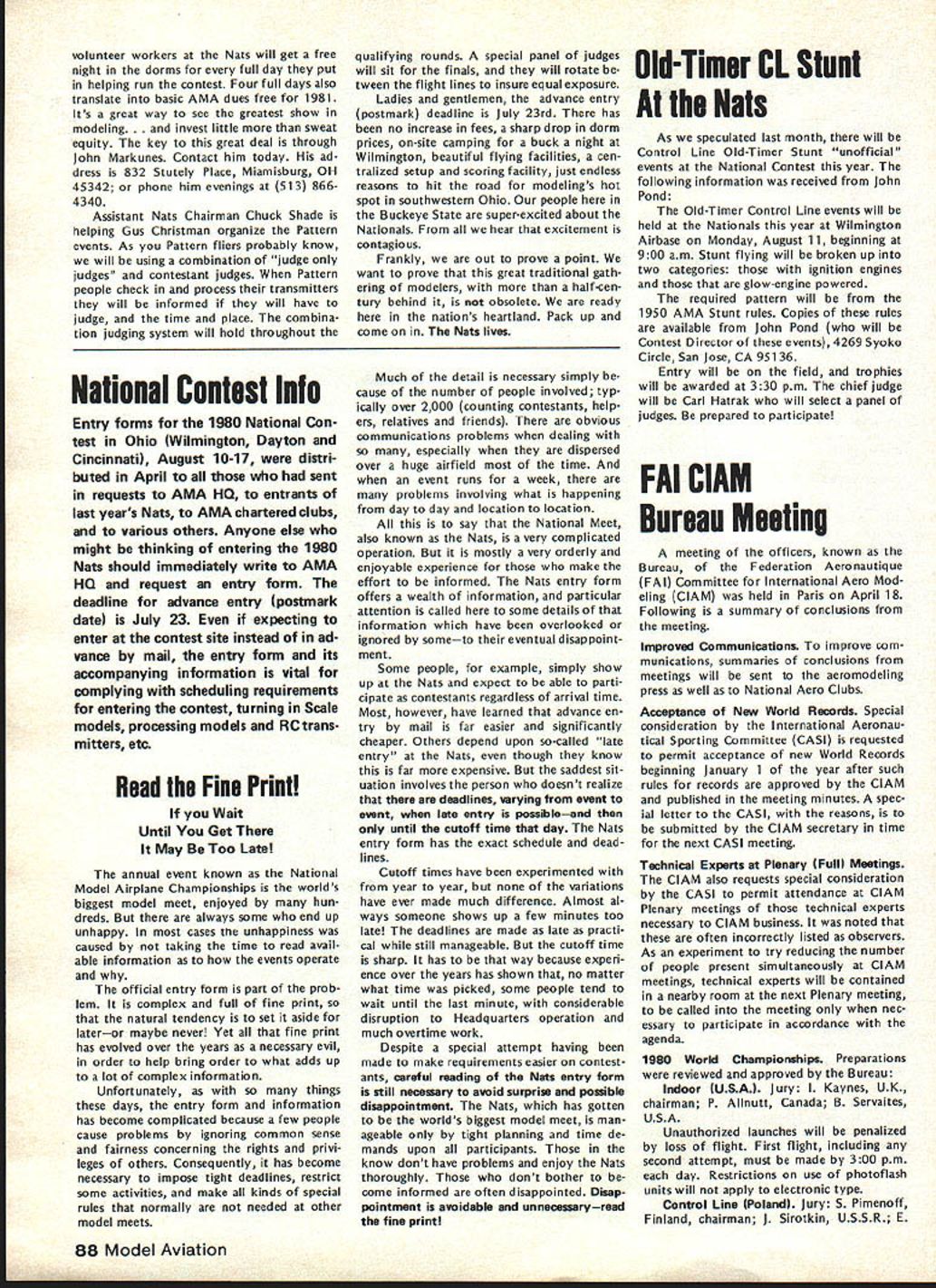
Entry forms for the 1980 National Contest in Ohio (Wilmington, Dayton and Cincinnati), August 10–17, were distributed in April to all who had requested them from AMA HQ, to entrants of last year's Nats, to AMA chartered clubs, and to various others. Anyone else thinking of entering the 1980 Nats should immediately write to AMA HQ and request an entry form. The deadline for advance entry (postmark) is July 23. Even if you expect to enter at the contest site instead of in advance by mail, the entry form and its accompanying information are vital for complying with scheduling requirements, turning in Scale models, processing models and RC transmitters, etc.
Volunteer Workers and Dorms
Volunteer workers at the Nats will receive a free night in the dorms for every full day they help run the contest. Four full days also translate into basic AMA dues free for 1981. It's a great way to see the greatest show in modeling and invest little more than sweat equity. Contact John Markunes: 832 Sturtevant Place, Miamisburg, OH 45342; phone evenings at (513) 866-4340.
Assistant Nats Chairman Chuck Shade is helping Gus Christman organize the Pattern events. Pattern competitors will be using a combination of "judge-only judges" and contestant judges. When Pattern people check in and process their transmitters they will be informed if they will have to judge, and the time and place. The combination judging system will hold throughout the qualifying rounds. A special panel of judges will sit for the finals and will rotate between flight lines to ensure equal exposure.
Advance entry (postmark) deadline: July 23. There has been no increase in fees, dorm prices have dropped sharply, on-site camping is available for $1 per night at Wilmington, and there are excellent flying facilities, centralized setup and scoring. Volunteers and local organizers in Ohio are enthusiastic about the Nationals.
Read the Fine Print!
If you wait until you get there it may be too late.
The National Model Airplane Championships (the Nats) is the world's biggest model meet, typically involving over 2,000 people (contestants, helpers, relatives and friends). Because of the size and scope of the event, the entry form is complex and contains necessary fine print evolved to bring order to a complex operation.
Some people simply show up and expect to participate regardless of arrival time. Advance entry by mail is far easier and significantly cheaper. Late entry at the Nats is more expensive, and some events allow late entry only until a daily cutoff time. The Nats entry form contains the exact schedule and deadlines.
Cutoff times are sharp because experience shows that a few people waiting until the last minute can cause considerable disruption and overtime work for Headquarters' operation. Despite attempts to make requirements easier, careful reading of the Nats entry form is necessary to avoid surprise and disappointment. Those who are informed enjoy the Nats thoroughly; disappointment is avoidable — read the fine print!
International Juries, Judges, and Subcommittee Notes
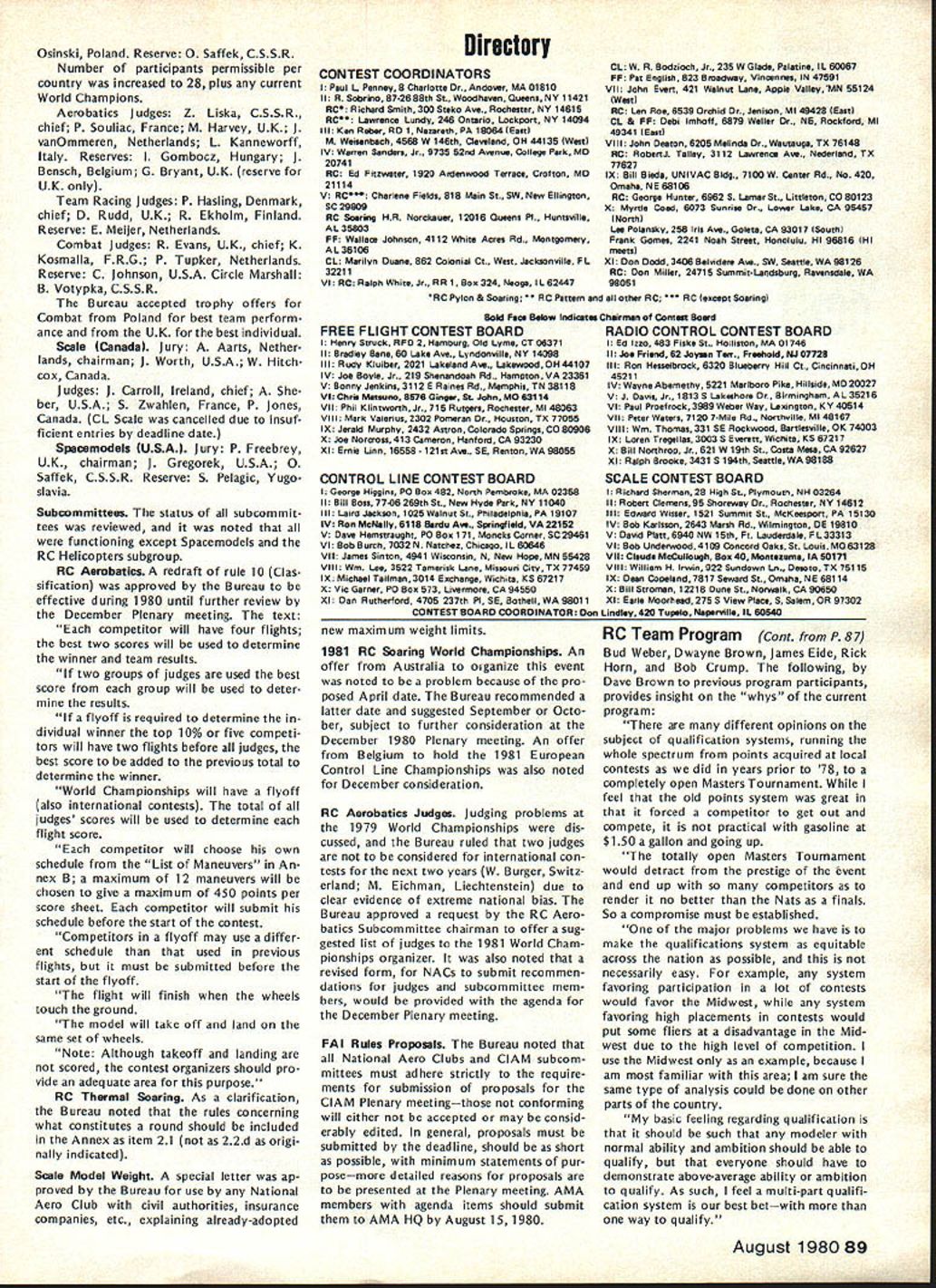
- Host / Reserve note: Osinski, Poland. Reserve: O. Saffek, C.S.S.R.
- Number of participants permissible per country was increased to 28, plus any current World Champions.
Aerobatics Judges:
- Z. Liska, C.S.S.R., chief
- P. Souliac, France
- M. Harvey, U.K.
- J. vanGommerren, Netherlands
- L. Kanneworff, Italy
- Reserves: J. Gomboecz, Hungary; J. Bensch, Belgium; G. Bryant, U.K. (reserve, U.K. only)
Team Racing Judges:
- P. Hasling, Denmark, chief
- D. Rudd, U.K.
- R. Ekholm, Finland
- Reserves: E. Meijer, Netherlands
Combat Judges:
- R. Evans, U.K., chief
- K. Kosmalla, F.R.G.
- P. Tupker, Netherlands
- Reserve: C. Johnson, U.S.A.
- Circle Marshall: B. Votycka, C.S.S.R.
The Bureau accepted trophy offers for Combat from Poland for best team performance and from the U.K. for the best individual.
Scale (Canada):
- Jury: A. Aarts, Netherlands, chairman; J. Worth, U.S.A.; W. Hitchcox, Canada.
- Note: CL Scale was cancelled due to insufficient entries by the deadline date.
Spacemodels (U.S.A.):
- Jury: P. Freebery, U.K., chairman; J. Gregorek, U.S.A.; O. Saffek, C.S.S.R.
- Reserve: S. Pelagic, Yugoslavia
Subcommittees:
- All subcommittees were functioning except Spacemodels and the RC Helicopters subgroup.
RC Aerobatics — Redraft of Rule 10 (Classification)
A redraft of rule 10 (Classification) was approved by the Bureau to be effective during 1980 until further review by the December Plenary meeting. The text:
- Each competitor will have four flights; the best two scores will be used to determine the winner and team results.
- If two groups of judges are used the best score from each group will be used to determine the results.
- If a flyoff is required to determine the individual winner the top 10% or five competitors will have two flights before all judges; the best score to be added to the previous total to determine the winner.
- World Championships will have a flyoff (also international contests). The total of all judges' scores will be used to determine each flight score.
- Each competitor will choose his own schedule from the "List of Maneuvers" in Annex B; a maximum of 12 maneuvers will be chosen to give a maximum of 450 points per score sheet. Each competitor will submit his schedule before the start of the contest.
- Competitors in a flyoff may use a different schedule than that used in previous flights, but it must be submitted before the start of the flyoff.
- The flight will finish when the wheels touch the ground.
- The model will take off and land on the same set of wheels.
- Note: Although takeoff and landing are not scored, the contest organizers should provide an adequate area for this purpose.
Other Notes
- RC Thermal Soaring: As a clarification, the Bureau noted that the rules concerning what constitutes a round should be included in the Annex as item 2.1 (not as 2.2.d as originally indicated).
- Scale Model Weight: A special letter was approved by the Bureau for use by any National Aero Club with civil authorities, insurance companies, etc., explaining already-adopted new maximum weight limits.
- 1981 RC Soaring World Championships: An offer from Australia to organize this event was noted to be a problem because of the proposed April date. The Bureau recommended a later date and suggested September or October, subject to further consideration at the December 1980 Plenary meeting. An offer from Belgium to hold the 1981 European Control Line Championships was also noted for December consideration.
- RC Aerobatics Judges: Judging problems at the 1979 World Championships were discussed. The Bureau ruled that two judges are not to be considered for international contests for the next two years (W. Burger, Switzerland; M. Eichmann, Liechtenstein) due to clear evidence of extreme national bias. The Bureau approved a request by the RC Aerobatics Subcommittee chairman to offer a suggested list of judges to the 1981 World Championships organizer. A revised form for NACs to submit recommendations for judges and subcommittee members will be provided with the agenda for the December Plenary meeting.
- FAI Rules Proposals: The Bureau noted that all National Aero Clubs and CIAM subcommittees must adhere strictly to requirements for submission of proposals for the CIAM Plenary meeting. Proposals not conforming will be either not accepted or may be considerably edited. Proposals must be submitted by the deadline, be as short as possible with minimum statements of purpose; more detailed reasons for proposals are to be presented at the Plenary meeting. AMA members with agenda items should submit them to AMA HQ by August 15, 1980.
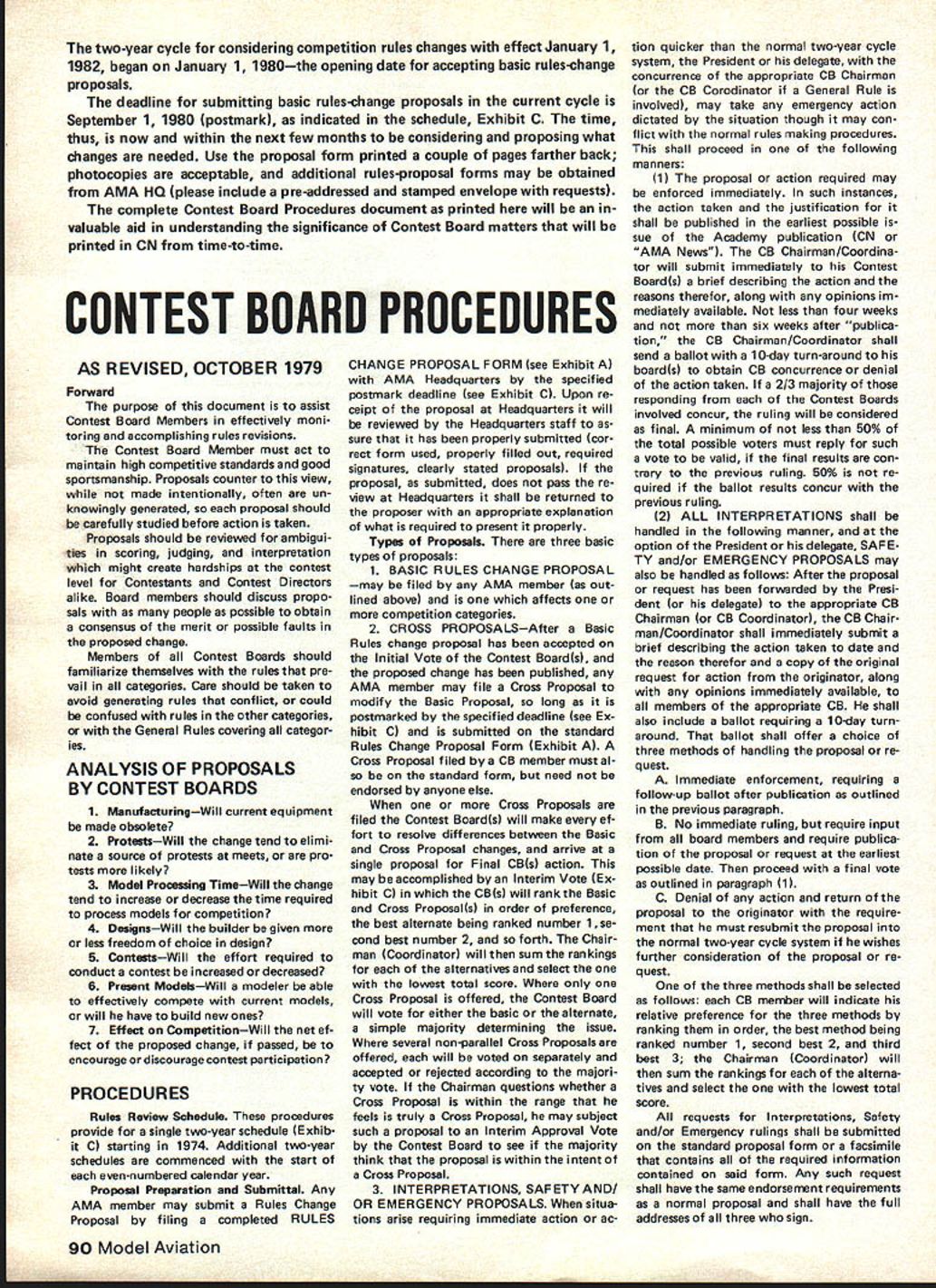
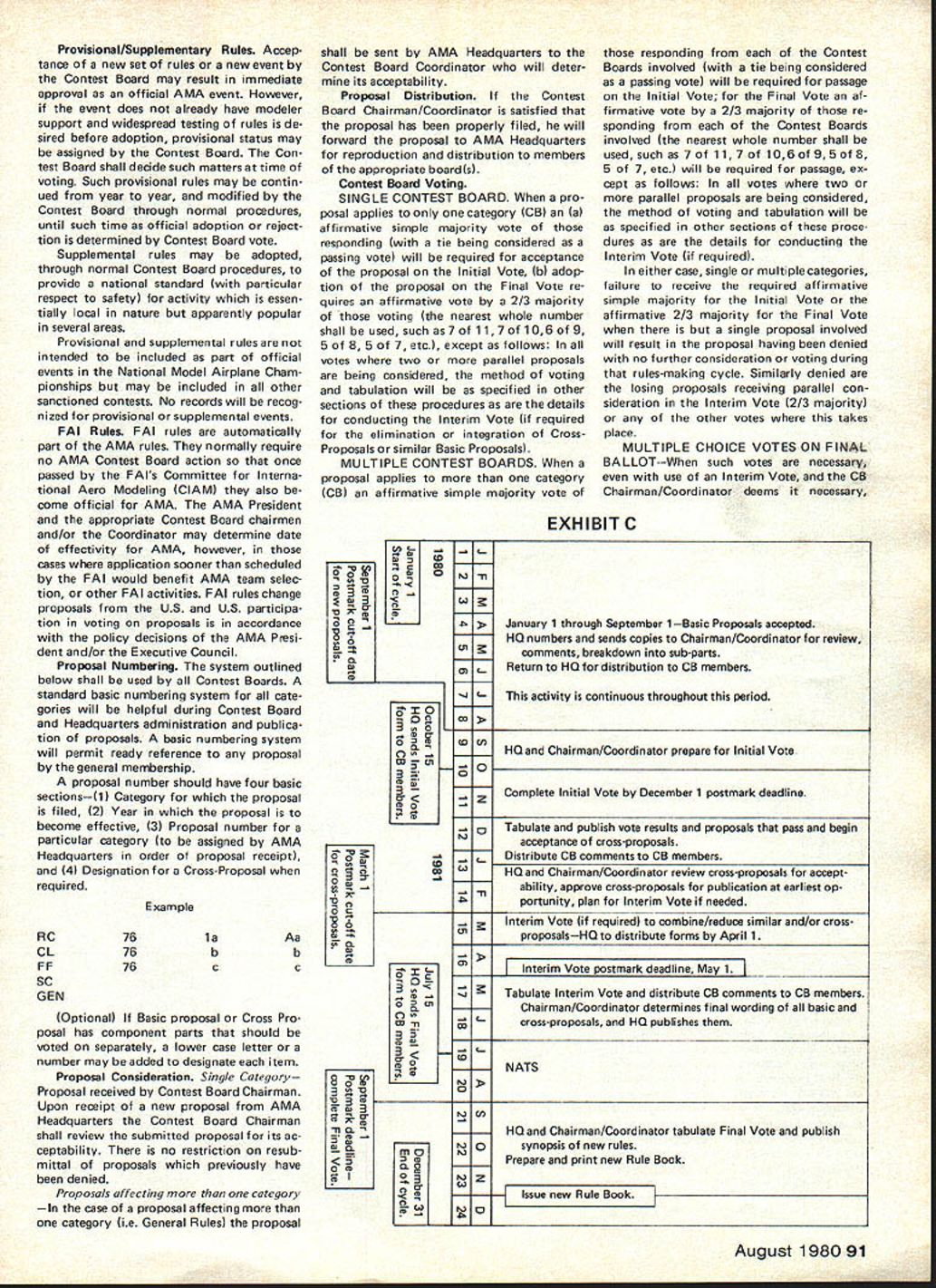
CONTEST BOARD PROCEDURES
As Revised, October 1979
Forward: The purpose of this document is to assist Contest Board Members in effectively monitoring and accomplishing rules revisions.
Contest Board Members must act to maintain high competitive standards and good sportsmanship. Proposals should be carefully studied for ambiguities in scoring, judging, and interpretation which might create hardships at the contest level for contestants and contest directors alike. Board members should discuss proposals with as many people as possible to obtain a consensus of the merits or faults in a proposed change.
Members of all Contest Boards should familiarize themselves with the rules that prevail in all categories. Care should be taken to avoid generating rules that conflict with or could be confused with rules in other categories or with the General Rules covering all categories.
Analysis of Proposals by Contest Boards
Consider the following when evaluating proposals:
- Manufacturing — Will current equipment be made obsolete?
- Protests — Will the change tend to eliminate a source of protests at meets, or will protests be more likely?
- Model Processing Time — Will the change tend to increase or decrease time required to process models for competition?
- Designs — Will the builder be given more or less freedom of choice in design?
- Contests — Will the effort required to conduct a contest be increased or decreased?
- Present Models — Will a modeler be able to effectively compete with current models, or will he have to build new ones?
- Effect on Competition — Will the net effect of the proposed change, if passed, be to encourage or discourage contest participation?
Procedures
Rules Review Schedule:
- These procedures provide for a single two-year schedule (Exhibit C) starting in 1974. Additional two-year schedules commence with the start of each even-numbered calendar year.
Proposal Preparation and Submittal:
- Any AMA member may submit a Rules Change Proposal by filing a completed RULES CHANGE PROPOSAL FORM (Exhibit A) with AMA Headquarters by the specified postmark deadline (Exhibit C).
- Headquarters staff will review proposals for correct form, completeness, required signatures, and clarity. If a proposal is improperly submitted it will be returned with an explanation of what is required.
Types of Proposals:
- BASIC RULES CHANGE PROPOSAL — may be filed by any AMA member and affects one or more competition categories.
- CROSS PROPOSALS — After a Basic Proposal has been accepted on the Initial Vote and published, any AMA member may file a Cross Proposal to modify the Basic Proposal, provided it is postmarked by the specified deadline and submitted on the standard Rules Change Proposal Form. A Cross Proposal filed by a CB member must also be on the standard form but need not be endorsed by others.
- When Cross Proposals are filed, the Contest Board(s) will try to resolve differences and arrive at a single proposal for Final action. This may be accomplished by an Interim Vote where CBs rank Basic and Cross Proposals in order of preference. The Chairman/Coordinator sums rankings and selects the lowest total score alternative. If only one Cross Proposal is offered, the Contest Board votes for either the basic or alternate; a simple majority determines the issue. Where several non-parallel Cross Proposals are offered, each will be voted on separately.
- INTERPRETATIONS, SAFETY AND/OR EMERGENCY PROPOSALS — When situations require immediate or faster action than the normal two-year cycle, the President or his delegate, with concurrence of the appropriate CB Chairman (or CB Coordinator for General Rules), may take emergency action. This proceeds in one of the following manners:
- (1) Immediate enforcement: Action may be enforced immediately and the justification published in the earliest possible issue of Academy publications (CN or AMA News). The CB Chairman/Coordinator will send a ballot to his board(s) 4–6 weeks after publication to obtain CB concurrence or denial. If a 2/3 majority of respondents from each involved CB concurs, the ruling is final. A minimum of 50% of total possible voters must reply for such a vote to be valid if the final results are contrary to the previous ruling. (50% is not required if the ballot results concur with the previous ruling.)
- (2) Interpretations procedure: The CB Chairman/Coordinator immediately distributes a brief describing action taken and reasons, plus the original request and any immediate opinions, to all CB members with a ballot requiring a 10-day turnaround. The ballot offers three methods:
A. Immediate enforcement, requiring a follow-up ballot after publication. B. No immediate ruling; require input from all board members and publication, then proceed with a final vote as in (1). C. Denial of action and return of the proposal to the originator for normal two-year cycle resubmission.
- CB members rank the three methods in order of preference; the Chairman/Coordinator sums the rankings and selects the lowest total score.
- All requests for interpretations, safety, and/or emergency rulings must be submitted on the standard proposal form or a facsimile containing all required information, with the same endorsement requirements and full addresses of the three signers.
Proposal Distribution:
- If the Contest Board Chairman/Coordinator is satisfied that a proposal has been properly filed, he may forward it to AMA Headquarters for reproduction and distribution to board members.
Contest Board Voting
Single Contest Board:
- When a proposal applies to only one category, an affirmative simple majority of those responding (tie counts as passing) is required for acceptance on the Initial Vote.
- Adoption on the Final Vote requires an affirmative 2/3 majority of those voting (nearest whole number).
Multiple Contest Boards:
- When a proposal applies to more than one category, an affirmative simple majority of those responding from each involved Contest Board is required for passage on the Initial Vote.
- For the Final Vote, an affirmative 2/3 majority of those responding from each involved Contest Board is required.
- Failure to receive required majorities results in the proposal being denied for that cycle. Losing parallel proposals in Interim Votes are similarly denied.
Multiple Choice Votes on Final Ballot:
- When necessary, multiple choice votes on the Final Ballot shall be handled as specified by the CB Chairman/Coordinator.
Exhibit C (Schedule Summary)
- January 1 through September 1 — Basic Proposals accepted. HQ numbers and sends copies to Chairman/Coordinator for review, comments, and breakdown into sub-parts. Return to HQ for distribution to CB members.
- HQ and Chairman/Coordinator prepare for Initial Vote.
- Complete Initial Vote by December 1 postmark deadline.
- Tabulate and publish vote results and proposals that pass; begin acceptance of cross-proposals. Distribute CB comments to CB members.
- HQ and Chairman/Coordinator review cross-proposals for acceptability, approve cross-proposals for publication, plan for Interim Vote if needed.
- Interim Vote (if required) — HQ to distribute forms by April 1.
- Interim Vote postmark deadline — May 1.
- Tabulate Interim Vote and distribute CB comments. Chairman/Coordinator determines final wording of all basic and cross-proposals, and HQ publishes them.
- HQ and Chairman/Coordinator tabulate Final Vote and publish synopsis of new rules. Prepare and print new Rule Book. Issue new Rule Book.
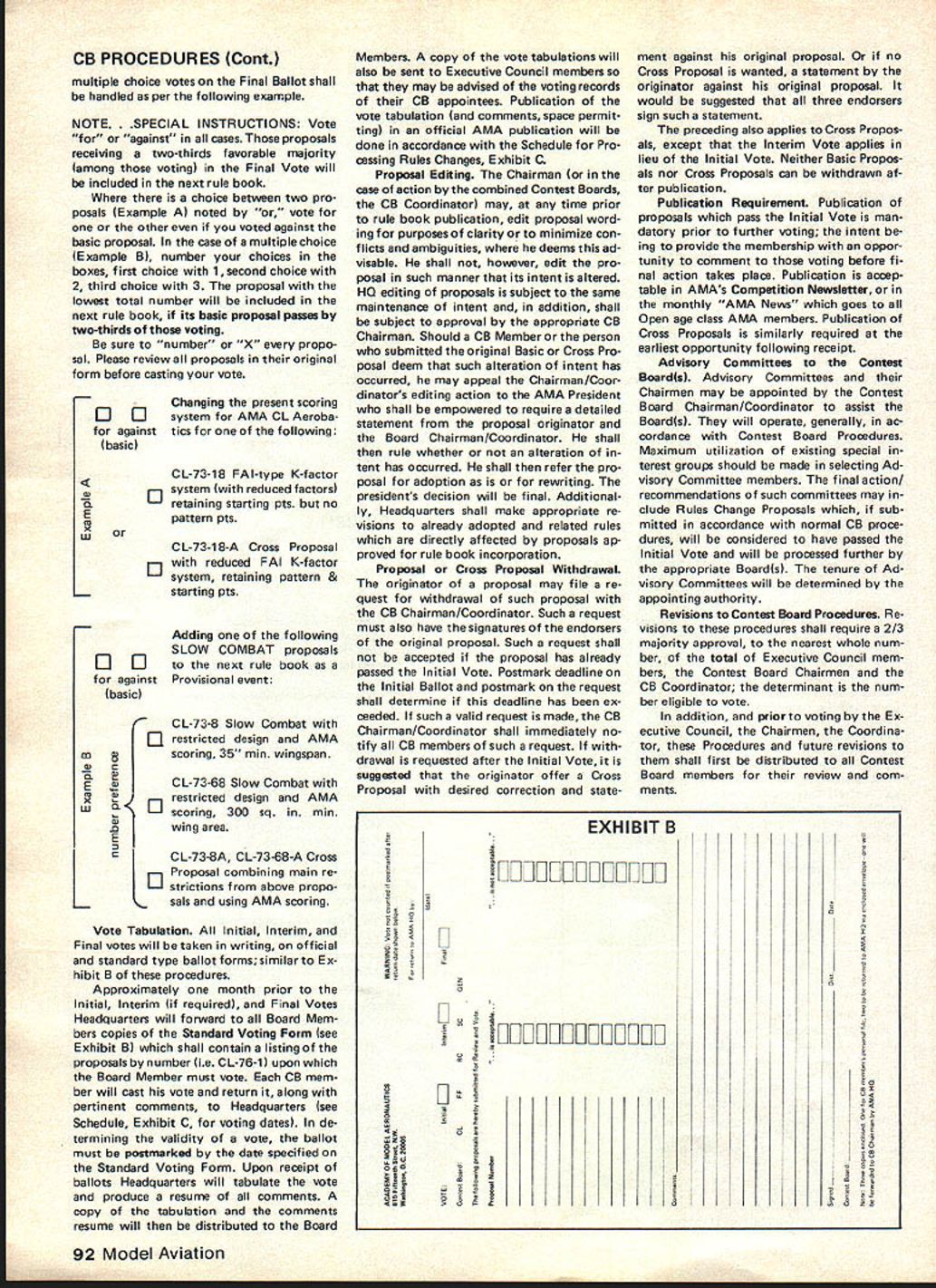
CB Procedures (Continued)
Special instructions: Vote "for" or "against" in all cases. Proposals receiving a two-thirds favorable majority (among those voting) in the Final Vote will be included in the next rule book.
- Where there is a choice between two proposals (noted by "or"), vote for one or the other even if you voted against the basic proposal.
- In the case of a multiple choice, number your choices on the ballot: first choice = 1, second = 2, third = 3. The proposal with the lowest total number will be included in the next rule book if its basic proposal passes by two-thirds of those voting.
- Number or X every proposal. Review all proposals in their original form before casting your vote.
Example items under consideration (illustrative):
- Changing the present scoring system for AMA CL Aerobatics to:
- (basic) CL-73-18 FAI-type K-factor system (with reduced factors) retaining starting points but no pattern points.
- CL-73-18-A Cross Proposal with reduced FAI K-factor system, retaining pattern & starting points.
- Adding one of the following Slow Combat proposals to the next rule book as a Provisional event:
- (basic) CL-73-8 Slow Combat with restricted design and AMA scoring, 35" minimum wingspan.
- CL-73-68 Slow Combat with restricted design and AMA scoring, 300 sq. in. minimum wing area.
- CL-73-8A / CL-73-68-A Cross Proposal combining main restrictions from above proposals and using AMA scoring.
Vote Tabulation
- All Initial, Interim, and Final votes will be taken in writing on official ballot forms similar to Exhibit B.
- Approximately one month prior to each vote, Headquarters will forward to all Board Members the Standard Voting Form listing proposals by number (e.g., CL-76-1).
- Each CB member casts his vote and returns it with comments to Headquarters by the specified postmark date. Headquarters tabulates votes and produces a resume of all comments, which is then distributed to Board Members. Executive Council members also receive vote tabulations.
- Publication of vote tabulation (and comments, space permitting) will be done according to the Schedule for Processing Rules Changes (Exhibit C).
Proposal Editing
- The Chairman (or CB Coordinator for combined Contest Boards) may edit proposal wording prior to rule book publication for clarity or to minimize conflicts and ambiguities, provided the proposal intent is not altered.
- HQ editing is subject to approval by the appropriate CB Chairman. If a CB Member or the proposal originator deems an alteration of intent has occurred, he may appeal the editing to the AMA President, who will rule whether an alteration occurred. The President's decision is final.
- Headquarters will make appropriate provisions to already-adopted and related rules directly affected by proposals approved for incorporation.
Proposal or Cross Proposal Withdrawal
- The originator may request withdrawal by filing with the CB Chairman/Coordinator; the request must have the signatures of endorsers. Such a request is not accepted if the proposal has already passed the Initial Vote.
- Postmark deadlines on the Initial Ballot and on the withdrawal request determine acceptability.
- If withdrawal is requested after the Initial Vote, the originator may offer a Cross Proposal with corrections and a statement against his original proposal, or a signed statement against the original proposal. All three endorsers are suggested to sign.
- The same provisions apply to Cross Proposals, except the Interim Vote applies in lieu of the Initial Vote. Neither Basic nor Cross Proposals can be withdrawn after publication.
Publication Requirement
- Publication of proposals that pass the Initial Vote is mandatory prior to further voting to give membership an opportunity to comment. Publication is acceptable in AMA's Competition Newsletter or in the monthly "AMA News." Publication of Cross Proposals is likewise required at the earliest opportunity.
Advisory Committees
- Advisory Committees and their Chairmen may be appointed by the Contest Board Chairman/Coordinator to assist the Board(s) and will operate generally in accordance with Contest Board Procedures.
- Maximum use of existing special interest groups is recommended when selecting Advisory Committee members.
- Final actions or recommendations of such committees may include Rules Change Proposals which, if submitted in accordance with normal CB procedures, will be considered to have passed the Initial Vote.
- Tenure of Advisory Committees is determined by the appointing authority.
Revisions to Contest Board Procedures
- Revisions require a 2/3 majority approval (nearest whole number) of the total of Executive Council members, Contest Board Chairmen, and the CB Coordinator — the determinant is the number eligible to vote.
- Prior to voting by the Executive Council and Chairmen, these Procedures and future revisions shall first be distributed to all Contest Board members for review and comments.
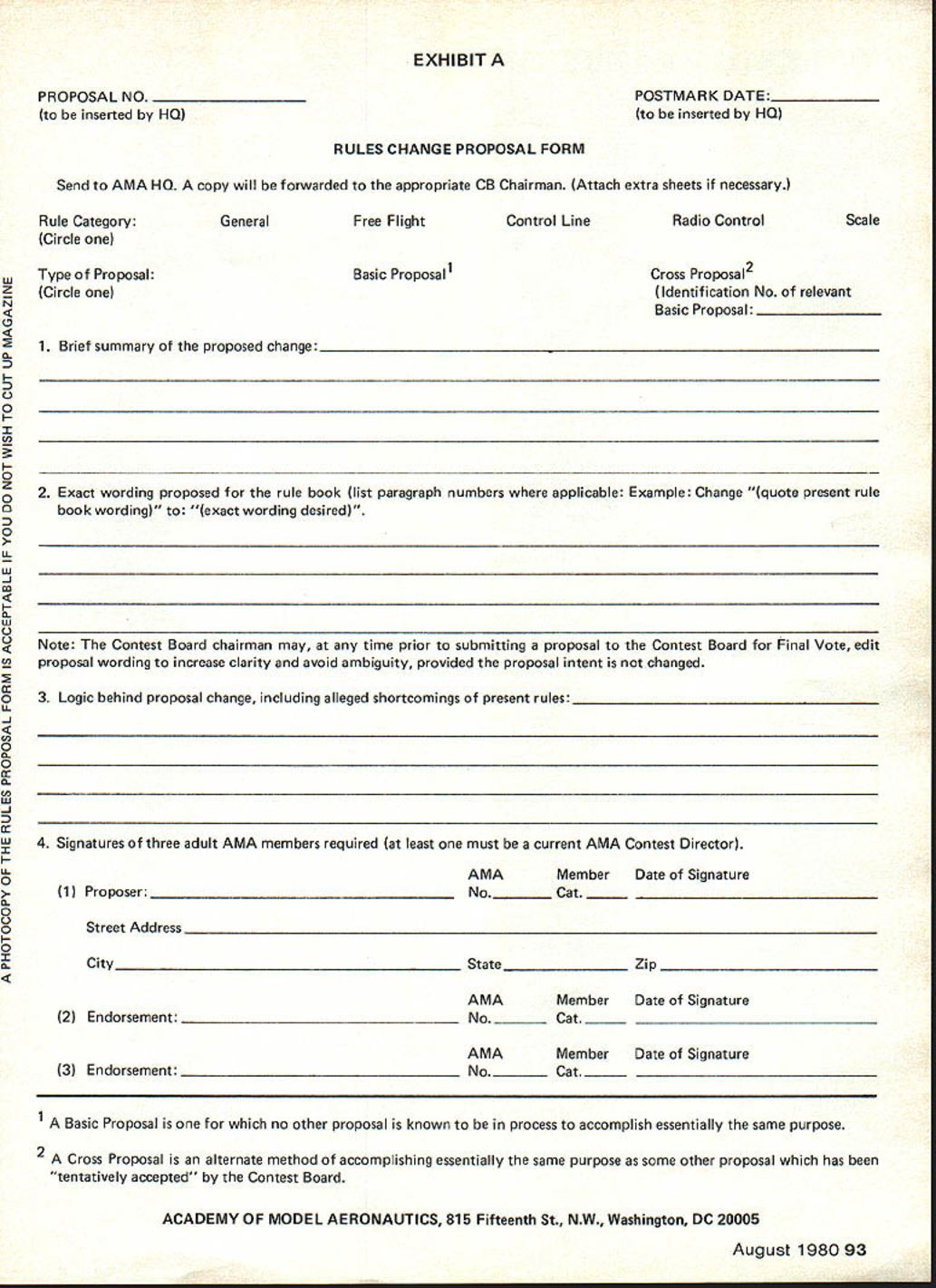
EXHIBIT A / EXHIBIT B
(PROPOSAL FORMS AND BALLOT FORMS)
PROPOSAL NO. _______________________ (to be inserted by HQ) POSTMARK DATE: _______________ (to be inserted by HQ)
RULES CHANGE PROPOSAL FORM
Send to AMA HQ. A copy will be forwarded to the appropriate CB Chairman. (Attach extra sheets if necessary.)
Rule Category: (Circle one) General / Free Flight / Control Line / Radio Control / Scale
Type of Proposal: (Circle one) Basic Proposal¹ / Cross Proposal² (Identification No. of relevant Basic Proposal: ____________________)
- Brief summary of the proposed change:
______________________________________________________________________________ ______________________________________________________________________________ ______________________________________________________________________________ ______________________________________________________________________________
- Exact wording proposed for the rule book (list paragraph numbers where applicable: Example: Change "(quote present rule book wording)" to: "(exact wording desired)"):
- Logic behind proposal change, including alleged shortcomings of present rules:
- Signatures of three adult AMA members required (at least one must be a current AMA Contest Director).
Note: The Contest Board chairman may, at any time prior to submitting a proposal to the Contest Board for Final Vote, edit proposal wording to increase clarity and avoid ambiguity, provided the proposal intent is not changed.
(1) Proposer: ________________________________________ AMA No. _____ Member Cat. _____ Date __________ Street Address _____________________________________________________________________________________ City ______________________________________ State ____________ Zip ____________
(2) Endorsement: _____________________________________ AMA No. _____ Member Cat. _____ Date __________
(3) Endorsement: _____________________________________ AMA No. _____ Member Cat. _____ Date __________
1 A Basic Proposal is one for which no other proposal is known to be in process to accomplish essentially the same purpose.
2 A Cross Proposal is an alternate method of accomplishing essentially the same purpose as some other proposal which has been "tentatively accepted" by the Contest Board.
ACADEMY OF MODEL AERONAUTICS, 515 Fifteenth St., N.W., Washington, DC 20005
Competition Newsletter
The Competition Newsletter shall be sent by AMA Headquarters to the Contest Board Coordinator who will determine its acceptability.
Transcribed from original scans by AI. Minor OCR errors may remain.

