
COMPETITION NEWSLETTER
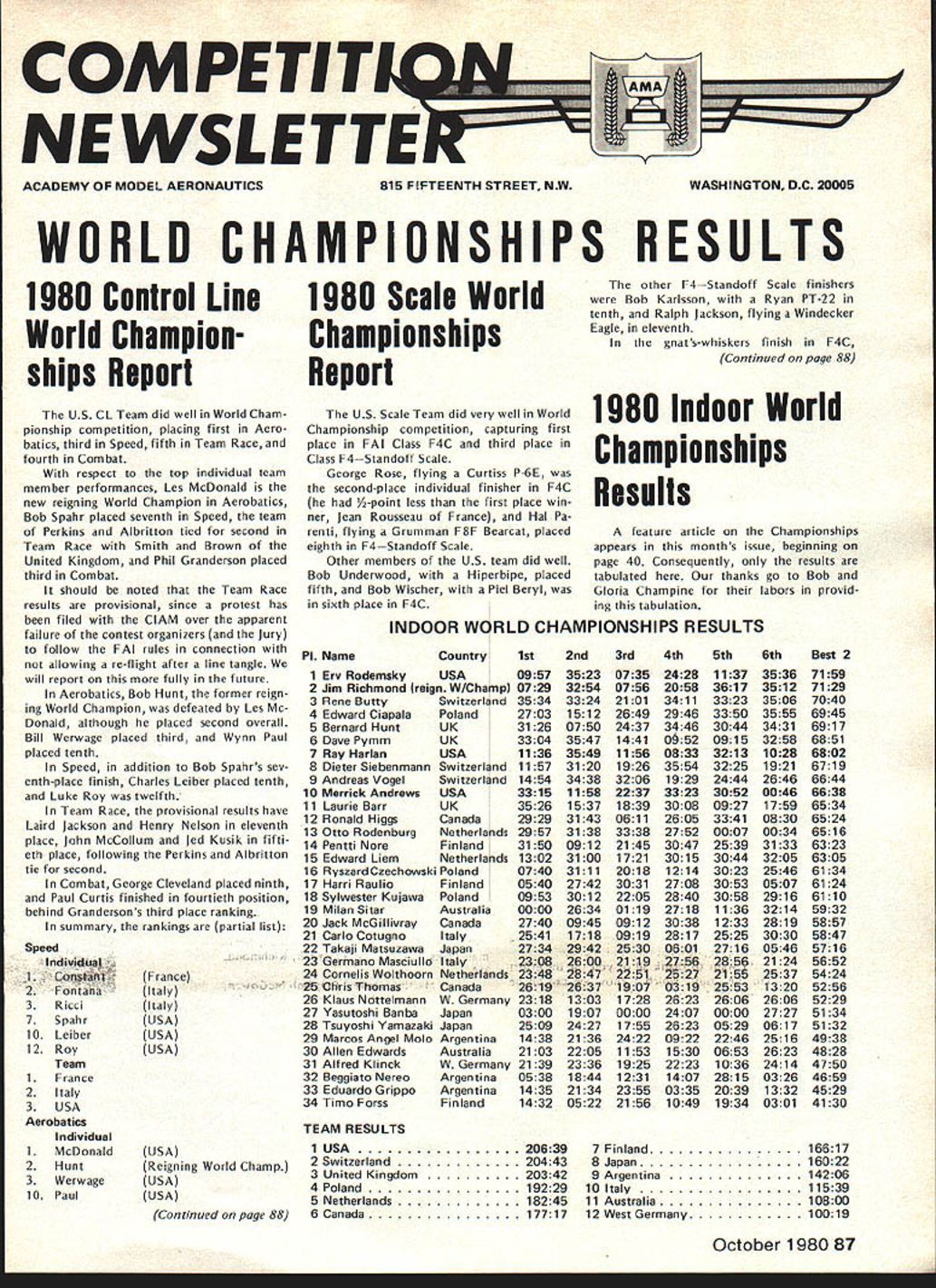
WORLD CHAMPIONSHIPS RESULTS
1980 Control Line World Championships Report
The U.S. CL Team performed well at the World Championships, placing first in Aerobatics, third in Speed, fifth in Team Race (provisional), and fourth in Combat.
Top individual team performances included:
- Les McDonald — new World Champion in Aerobatics.
- Bob Spahr — 7th in Speed.
- Perkins and Albritton — tied for 2nd in Team Race (provisional, tied with Smith and Brown of the United Kingdom).
- Phil Granderson — 3rd in Combat.
A protest has been filed with CIAM regarding the Team Race results. The protest alleges the contest organizers and the Jury failed to follow FAI rules by not allowing a re-flight after a line tangle; the Team Race results are therefore provisional. Further reporting will follow.
Additional individual results:
- Aerobatics: Bob Hunt (former reigning World Champion) was second overall; Bill Werwage placed third; Wynn Paul placed tenth.
- Speed: Charles Leiber placed 10th; Luke Roy placed 12th.
- Team Race (provisional placements mentioned in reporting): Laird Jackson and Henry Nelson placed 11th; John McCollum and Jed Kusik placed 50th, following the Perkins/Albritton tie for second.
- Combat: George Cleveland placed 9th; Paul Curtis finished 40th, behind Phil Granderson's 3rd place.
Summary — partial rankings
Speed
- Individual
- Constant (France)
- Fontana (Italy)
- Ricci (Italy)
- Spahr (USA)
- Leiber (USA)
- Roy (USA)
- Team
- France
- Italy
- USA
Aerobatics
- Individual
- McDonald (USA)
- Hunt (reigning World Champion)
- Werwage (USA)
- Paul (USA)
1980 Scale World Championships Report
The U.S. Scale Team captured first place in FAI Class F4C and third place in Class F4 Standoff Scale.
Individual highlights:
- George Rose, flying a Curtiss P-6E, finished 2nd in F4C, half a point behind Jean Rousseau of France.
- Hal Parenti, flying a Grumman F8F Bearcat, placed 8th in F4 Standoff Scale.
- Bob Underwood (Hiperbipe) placed 4th in F4C.
- Bob Wischer (Piel Beryl) placed 5th in F4C.
- Other F4 Standoff Scale finishers: Bob Karlsson (Ryan PT-22) 10th; Ralph Jackson (Windecker Eagle) 11th.
In F4C the finish was extremely close.
Partial summary
Class F4C
- Individual
- J. Rousseau (CAP 20) — France
- G. Rose (P-6E) — USA
- M. Reeves (Spitfire) — UK
- R. Underwood (Hiperbipe) — USA
- R. Wischer (Piel Beryl) — USA
- Team
- USA
- UK
- Canada
Class F4 — Standoff Scale
- Individual
- I. Helmbro (AT-6 Harvard) — Sweden
- M. Carlson (Pfalz D.12) — Sweden
- G. Smith (Pomilio PE) — UK
- H. Parenti (F8F) — USA
- R. Karlsson (PT-22) — USA
- R. Jackson (Windecker Eagle) — USA
- Team
- Sweden
- UK
- USA
1980 Indoor World Championships Results
A feature article on the Championships appears elsewhere in this issue. The results below were provided by Bob and Gloria Champine.
Individual results
- Erv Rodemsky — USA
- Jim Richmond (reigning World Champion) — USA
- Rene Butty — Switzerland
- Edward Ciapala — Poland
- Bernard Hunt — UK
- Dave Pymm — UK
- Ray Harlan — USA
- Dieter Siebenmann — Switzerland
- Andreas Vogel — Switzerland
- Merrick Andrews — USA
- Laurie Barr — UK
- Ronald Higgs — Canada
- Otto Rodenburg — Netherlands
- Pentti Nore — Finland
- Edward Liem — Netherlands
- Ryszard Czechowski — Poland
- Harri Raulio — Finland
- Sylwester Kujawa — Poland
- Milan Sitar — Australia
- Jack McGillivray — Canada
- Carlo Cotugno — Italy
- Takaji Matsuzawa — Japan
- Germano Masciullo — Italy
- Cornelis Wolthoorn — Netherlands
- Vris Ihania — Canada
- Klaus Nottelmann — West Germany
- Yasutoshi Banba — Japan
- Tsuyoshi Yamazaki — Japan
- Marcos Angel Molo — Argentina
- Allen Edwards — Australia
- Alfred Klinck — West Germany
- Beggiato Nereo — Argentina
- Eduardo Grippo — Argentina
- Timo Forss — Finland
Team results
- USA — 206:39
- Switzerland — 204:43
- United Kingdom — 203:42
- Poland — 192:29
- Netherlands — 182:45
- Canada — 177:17
- Finland — 166:17
- Japan — 160:22
- Argentina — 142:06
- Italy — 115:39
- Australia — 108:00
- West Germany — 100:19
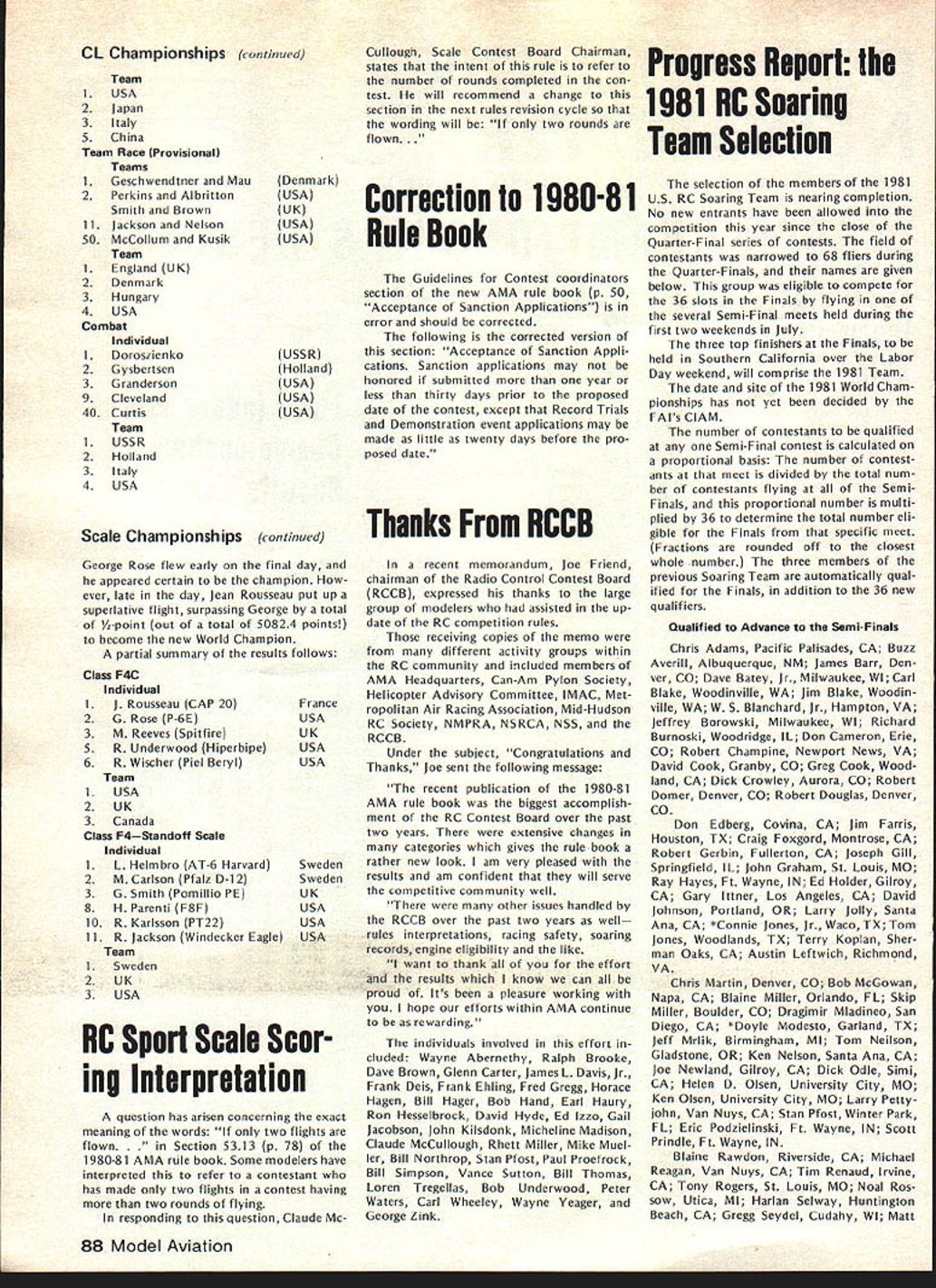
CL CHAMPIONSHIPS (continued)
Team results (additional)
- USA
- Japan
- Italy
- China
Team Race (Provisional)
- Teams
- Geschwendtner and Mau (Denmark)
- Perkins and Albritton (USA)
- Smith and Brown (UK)
- Jackson and Nelson (USA)
- McCollum and Kusik (USA)
Other team listings
- Team
- England (UK)
- Denmark
- Hungary
- USA
Combat — Individual
- Doroszienko (USSR)
- Gysbertsen (Holland)
- Granderson (USA)
- Cleveland (USA)
- Curtis (USA)
Combat — Team
- USSR
- Holland
- Italy
- USA
Scale Championships (continued)
George Rose flew early on the final day and appeared certain to be champion. Late in the day, Jean Rousseau produced a superlative flight, surpassing George by a small margin (out of a total of 5082.4 points) to become the new World Champion.
(See the partial summaries under the Scale World Championships report above.)
RC Sport Scale Scoring Interpretation
A question arose about the meaning of the phrase "If only two flights are flown . . ." in Section 53.13 (p. 78) of the 1980–81 AMA rule book. Some modelers interpreted this to mean a contestant who made only two flights in a contest with more than two rounds.
Claude McCullough, Scale Contest Board Chairman, states the rule refers to the number of rounds completed in the contest. He will recommend revising the wording in the next rules revision cycle to: "If only two rounds are flown . . ."
SEMI-FINAL QUALIFIERS (partial)
The following contestants were listed as qualifiers (eligibility of two contestants was not definitely determined at the time the list was compiled):
- Sheldon, Wheatridge, CO
- Herb Smith, Denver, CO
- James Smith, Orlando, FL
- Richard Spicer, San Jose, CA
- H.A. Stokley, Virginia Beach, VA
- Norm Timbs, Jr., Northridge, CA
- Stan Watson, Hazel Crest, IL
- Mark Wieland, Denver, CO
- Jim White, Huntington Beach, CA
- Jim Wiseman, Fullerton, CA
- George Wood III, Mobile, AL
- Steve Work, Albuquerque, NM
- Joe Watts, Granada Hills, CA
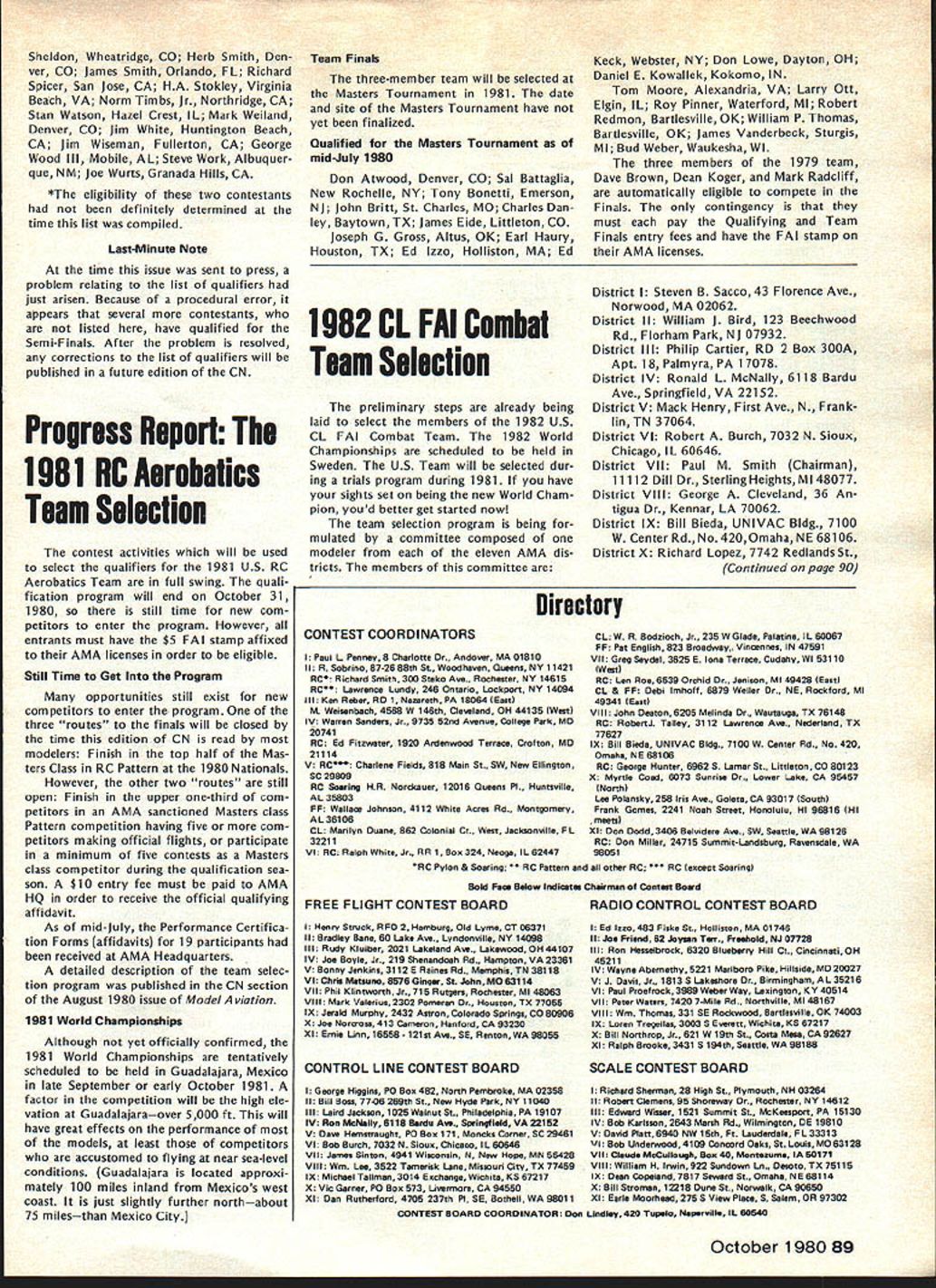
Note: At press time a procedural error was discovered affecting the list of qualifiers. Several more contestants appear to have qualified for the Semi-Finals. Corrections to the list will be published in a future edition of the Competition Newsletter.
Last-minute note: The eligibility of the two contestants mentioned above had not been definitely determined when the list was compiled.
Progress Report: The 1981 RC Aerobatics Team Selection
The contest activities used to select qualifiers for the 1981 U.S. RC Aerobatics Team are in full swing. The qualification program ends October 31, 1980. Entrants must have the $5 FAI stamp affixed to their AMA licenses to be eligible.
Still Time to Get Into the Program
Three "routes" to the finals were established:
- Finish in the top half of the Masters Class in RC Pattern at the 1980 Nationals (this route will be closed for most readers).
- Finish in the upper one-third of competitors in an AMA-sanctioned Masters class Pattern competition with five or more competitors making official flights.
- Participate in a minimum of five contests as a Masters class competitor during the qualification season.
A $10 entry fee must be paid to AMA Headquarters to receive the official qualifying affidavit. As of mid-July, Performance Certification Forms (affidavits) for 19 participants had been received at AMA Headquarters. A detailed description of the program was published in the Competition Newsletter section of the August 1980 issue of Model Aviation.
1981 World Championships
Tentatively scheduled for Guadalajara, Mexico in late September or early October 1981 (not yet officially confirmed). Guadalajara's elevation—over 5,000 ft—will significantly affect model performance; competitors used to near sea-level flying should prepare accordingly. Guadalajara is approximately 100 miles inland from Mexico's west coast and about 75 miles north of Mexico City.
Team Finals
The three-member team will be selected at the Masters Tournament in 1981. Date and site to be finalized.
Qualified for the Masters Tournament (as of mid-July 1980)
Don Atwood, Denver, CO Sal Battaglia, New Rochelle, NY Tony Bonetti, Emerson, NJ John Britt, St. Charles, MO Charles Danley, Baytown, TX James Elde, Littleton, CO Joseph G. Gross, Altus, OK Earl Haury, Houston, TX Ed Izzo, Holliston, MA Ed Keck, Webster, NY Don Lowe, Dayton, OH Daniel E. Kowallek, Kokomo, IN Tom Moore, Alexandria, VA Larry Ott, Elgin, IL Roy Pinner, Waterford, MI Robert Redmon, Bartlesville, OK William P. Thomas, Bartlesville, OK James Vanderbeck, Sturgis, MI Bud Weber, Waukesha, WI
The three members of the 1979 team—Dave Brown, Dean Koger, and Mark Radcliff—are automatically eligible for the Finals if they pay the Qualifying and Team Finals entry fees and have the FAI stamp on their AMA licenses.
1982 CL FAI COMBAT TEAM SELECTION
Preliminary steps are underway to select the 1982 U.S. CL FAI Combat Team. The 1982 World Championships are scheduled for Sweden; the U.S. Team will be selected through trials in 1981.
A selection committee, with one representative from each of the eleven AMA districts, is formulating the program. Members of the committee:
- District I: Steven B. Sacco, 43 Florence Ave., Norwood, MA 02062
- District II: William J. Bird, 123 Beechwood Rd., Florham Park, NJ 07932
- District III: Philip Cartier, RD 2 Box 300A, Apt. 18, Palmyra, PA 17078
- District IV: Ronald L. McNally, 6118 Bardu Ave., Springfield, VA 22152
- District V: Mack Henry, First Ave. N., Franklin, TN 37064
- District VI: Robert A. Burch, 7032 N. Sioux, Chicago, IL 60646
- District VII: Paul M. Smith (Chairman), 11112 Dill Dr., Sterling Heights, MI 48077
- District VIII: George A. Cleveland, 36 Antigua Dr., Kenner, LA 70062
- District IX: Bill Bleda, UNIVAC Bldg., 7100 W. Center Rd., No. 420, Omaha, NE 68106
- District X: Richard Lopez, 7742 Redlands St., Apt. D2039, Playa del Rey, CA 90291
- District XI: Howard M. Rush, 8817 N.E. 137th, Kirkland, WA 98033
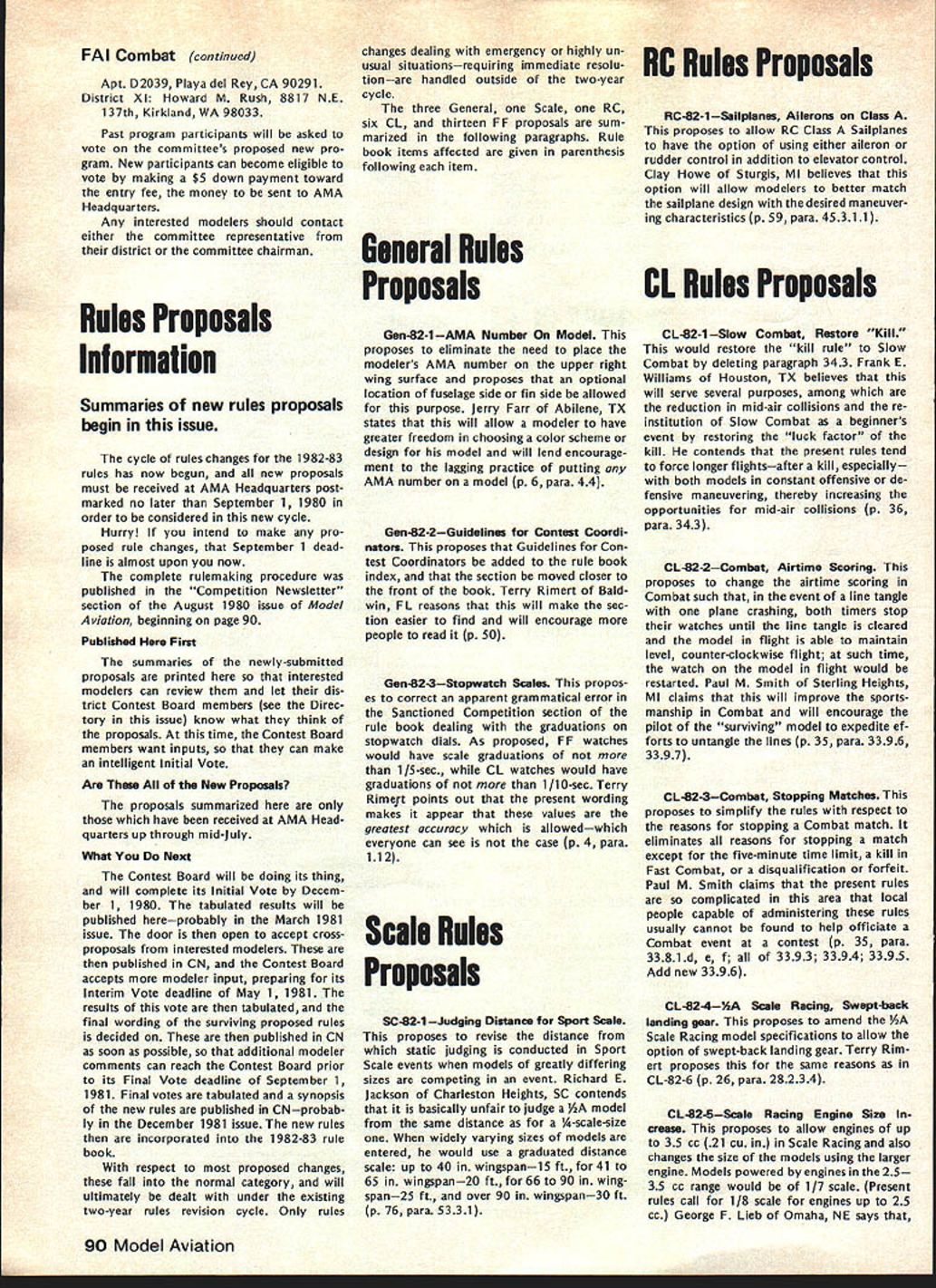
Past program participants will be asked to vote on the committee's proposed program. New participants can become eligible to vote by making a $5 down payment toward the entry fee (send to AMA Headquarters). Interested modelers should contact their district representative or the committee chairman.
FAI Combat (continued)
(Program and contact information continued as above.)
RULES PROPOSALS INFORMATION
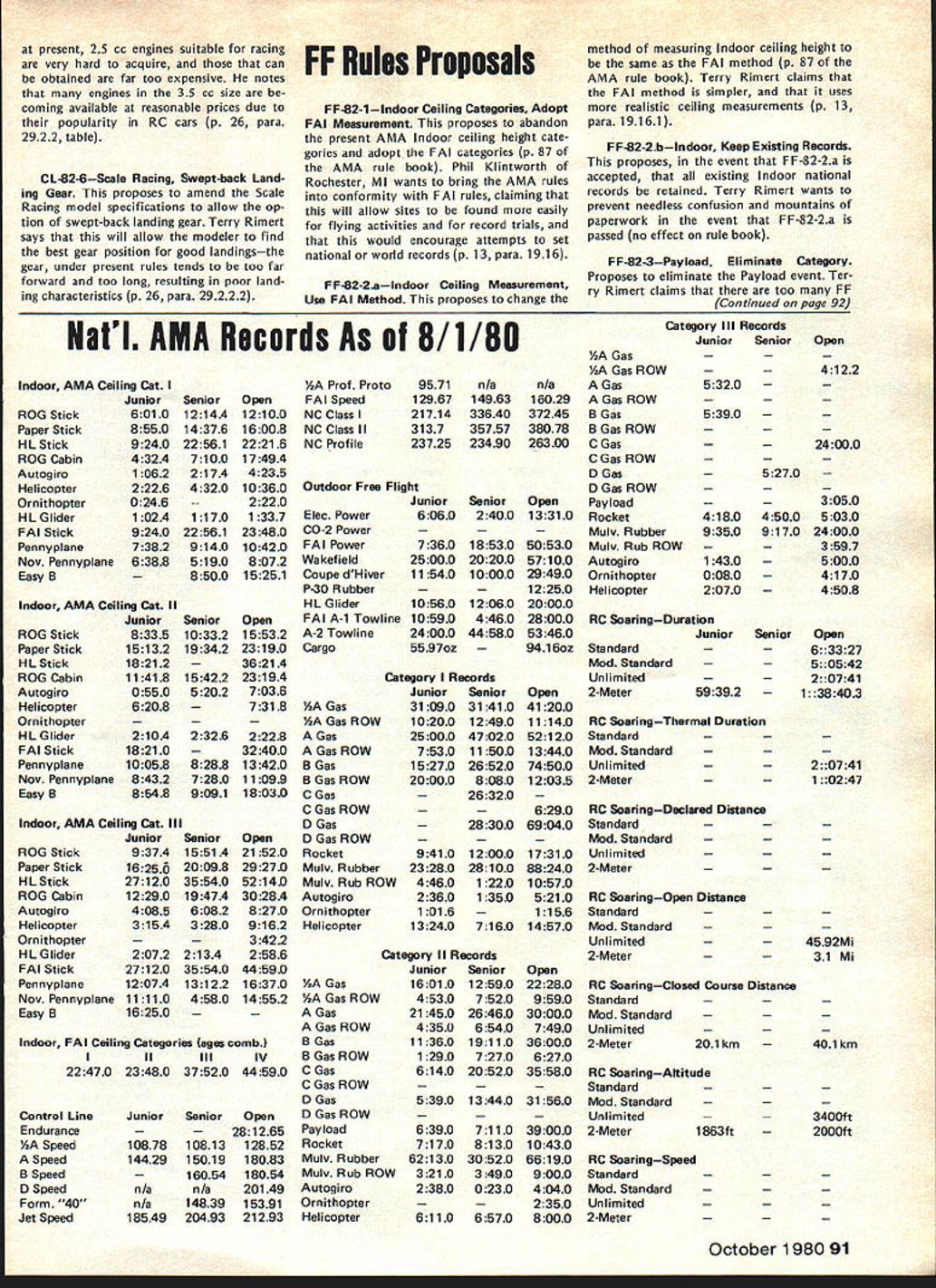
Summaries of newly submitted rules proposals are presented here. The proposal cycle for the 1982–83 rule book has begun. All new proposals must be postmarked at AMA Headquarters no later than September 1, 1980 to be considered in this cycle.
The complete rulemaking procedure was published in the Competition Newsletter section of the August 1980 issue of Model Aviation (beginning page 90). The summaries below are those received at AMA Headquarters through mid-July.
Process overview:
- The Contest Board will complete its Initial Vote by December 1, 1980; results will be published (likely March 1981).
- Cross-proposals may then be submitted; the Contest Board accepts more input and prepares its Interim Vote by May 1, 1981.
- Final wording is decided thereafter; Final Vote deadline is September 1, 1981.
- A synopsis of new rules will be published (probably December 1981) and the new rules incorporated into the 1982–83 rule book.
Only emergency or highly unusual issues are handled outside the normal two-year revision cycle.
The proposals summarized here include three General, one Scale, one RC, six CL, and thirteen FF items. Rule book items affected are noted in parentheses.
Gen-82-1 — AMA Number on Model
Proposal: Eliminate the requirement to place the modeler's AMA number on the upper right wing surface and allow optional locations such as fuselage side or fin side. Proponent: Jerry Farr, Abilene, TX. Rationale: Greater freedom of color scheme and design; may encourage more modelers to put their AMA number on their models. (p. 6, para. 4.4)
Gen-82-2 — Guidelines for Contest Coordinators
Proposal: Add Guidelines for Contest Coordinators to the rule book index and move the section closer to the front of the book. Proponent: Terry Rimert, Baldwin, FL. Rationale: Easier to find and more likely to be read. (p. 50)
Gen-82-3 — Stopwatch Scales
Proposal: Correct wording in the Sanctioned Competition section concerning stopwatch dial graduations. Proposed wording: FF watches — graduations of not more than 1/5 sec.; CL watches — graduations of not more than 1/10 sec. Proponent: Terry Rimert. Rationale: Present wording could be misread as restricting maximum possible accuracy. (p. 4, para. 1.12)
SC-82-1 — Judging Distance for Sport Scale
Proposal: Revise static judging distance in Sport Scale events when models of greatly differing sizes compete. Proposed graduated distances by wingspan:
- up to 40 in. — 15 ft.
- 41–65 in. — 20 ft.
- 66–90 in. — 25 ft.
- over 90 in. — 30 ft.
Proponent: Richard E. Jackson, Charleston Heights, SC. Rationale: Fairer judging for widely varying model sizes. (p. 76, para. 3.3.1)
RC-82-1 — Sailplanes: Ailerons on Class A
Proposal: Allow RC Class A Sailplanes the option of using aileron or rudder control in addition to elevator. Proponent: Clay Howe, Sturgis, MI. Rationale: Better match between design and maneuvering characteristics. (p. 59, para. 45.3.1.1)
CL-82-1 — Slow Combat: Restore "Kill"
Proposal: Restore the "kill rule" to Slow Combat by deleting paragraph 34.3. Proponent: Frank E. Williams, Houston, TX. Rationale: Reduce mid-air collisions and restore Slow Combat as a beginner's event by reinstating the "kill" (adds a luck element). (p. 36, para. 34.3)
CL-82-2 — Combat: Airtime Scoring
Proposal: Change airtime scoring so that if a line tangle causes one plane to crash, both timers stop until the tangle is cleared and the surviving model maintains level, counter-clockwise flight; then restart the surviving model's timer. Proponent: Paul M. Smith, Sterling Heights, MI. Rationale: Improve sportsmanship and encourage quick line untangling. (p. 35, paras. 33.9.6, 33.9.7)
CL-82-3 — Combat: Stopping Matches
Proposal: Simplify rules for stopping a Combat match by eliminating all reasons for stopping except: the five-minute time limit, a kill in Fast Combat, disqualification, or forfeit. Proponent: Paul M. Smith. Rationale: Present rules are overly complicated and difficult for local contests to administer. (p. 35, paras. 33.8.1, e, f; 33.9.3–33.9.5; add new 33.9.6)
CL-82-4 — ½A Scale Racing: Swept-back Landing Gear
Proposal: Amend ½A Scale Racing specifications to allow optional swept-back landing gear. Proponent: Terry Rimert. Rationale: Improves landing characteristics (see CL-82-6). (p. 26, para. 28.2.3.4)
CL-82-5 — Scale Racing: Engine Size Increase
Proposal: Allow engines up to 3.5 cc (.21 cu. in.) in Scale Racing and change model scale designation: models powered by 2.5–3.5 cc engines would be 1/7 scale (presently 1/8 scale for engines up to 2.5 cc). Proponent: George F. Lieb, Omaha, NE. Rationale: 2.5 cc racing engines are scarce and expensive; 3.5 cc engines are becoming available and affordable. (p. 26, para. 29.2.2, table)
CL-82-6 — Scale Racing: Swept-back Landing Gear
Proposal: Amend Scale Racing specifications to allow optional swept-back landing gear. Proponent: Terry Rimert. Rationale: Allows better gear positioning for landings; current gear position tends to be too far forward and too long, producing poor landings. (p. 26, para. 29.2.2.2)
FF-82-1 — Indoor Ceiling Categories: Adopt FAI Measurement
Proposal: Replace AMA Indoor ceiling height categories with FAI categories. Proponent: Phil Klintworth, Rochester, MI. Rationale: Conformity with FAI makes indoor sites and record attempts easier to arrange. (p. 13, para. 19.16)
FF-82-2-a — Indoor Ceiling Measurement: Use FAI Method
Proposal: Change the indoor ceiling height measurement method to the FAI method. Proponent: Terry Rimert. Rationale: FAI method is simpler and provides more realistic measurements. (p. 13, para. 19.16.1)
FF-82-2-b — Indoor: Keep Existing Records
Proposal: If FF-82-2-a is adopted, retain all existing Indoor national records to avoid confusion and paperwork. Proponent: Terry Rimert. (no effect on rule book)
FF-82-3 — Payload: Eliminate Category
Proposal: Eliminate the Payload event. Proponent: Terry Rimert. Rationale: Too many Free Flight events.
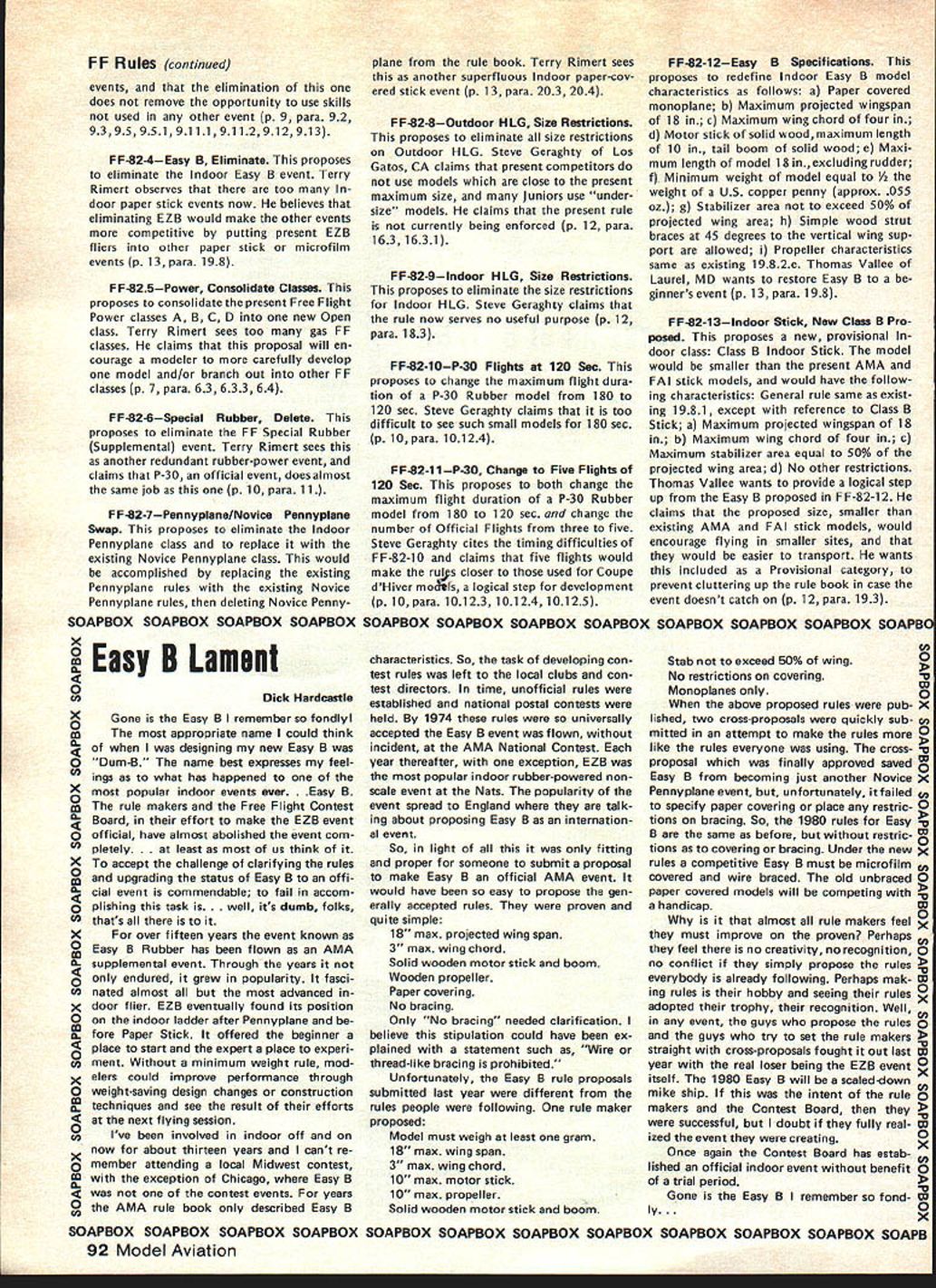
FF-82-4 — Easy B: Eliminate
Proposal: Eliminate the Indoor Easy B (EZB) event. Proponent: Terry Rimert. Rationale: Reduce redundant paper-stick events and encourage EZB fliers to enter other events. (p. 13, para. 19.8)
FF-82-5 — Power: Consolidate Classes
Proposal: Consolidate Free Flight Power classes A–D into a single Open class. Proponent: Terry Rimert. Rationale: Too many gas FF classes; consolidation encourages development of one model or branching into other classes. (p. 7, paras. 6.3, 6.3.3, 6.4)
FF-82-6 — Special Rubber: Delete
Proposal: Eliminate the FF Special Rubber (Supplemental) event. Proponent: Terry Rimert. Rationale: Redundant with P-30. (p. 10, para. 11)
FF-82-7 — Pennyplane/Novice Pennyplane Swap
Proposal: Replace the Indoor Pennyplane class with Novice Pennyplane rules and delete the Novice Pennyplane rules (effectively swapping and eliminating redundancy). Also replace Indoor A Pennyplane with Novice Pennyplane rules and delete Novice Pennyplane rules. Proponent: Terry Rimert. Rationale: Reduce superfluous indoor paper-covered stick events. (p. 13, paras. 20.3, 20.4)
FF-82-8 — Outdoor HLG: Size Restrictions
Proposal: Eliminate all size restrictions on Outdoor HLG. Proponent: Steve Geraghty, Los Gatos, CA. Rationale: Competitors do not use models near the maximum size; rule is not being enforced. (p. 12, paras. 16.3, 16.3.1)
FF-82-9 — Indoor HLG: Size Restrictions
Proposal: Eliminate size restrictions for Indoor HLG. Proponent: Steve Geraghty. Rationale: Current restriction serves no useful purpose. (p. 12, para. 18.3)
FF-82-10 — P-30: Flights at 120 Sec.
Proposal: Change the maximum flight duration of P-30 rubber models from 180 sec to 120 sec. Proponent: Steve Geraghty. Rationale: Small models are difficult to see for 180 sec. (p. 10, para. 10.12.4)
FF-82-11 — P-30: Five Flights of 120 Sec.
Proposal: Change P-30 max flight duration to 120 sec and increase the number of Official Flights from three to five. Proponent: Steve Geraghty. Rationale: Easier timing and alignment with Coupe d'Hiver practices. (p. 10, paras. 10.12.3–10.12.5)
FF-82-12 — Easy B Specifications
Proposal: Redefine Indoor Easy B model characteristics: a) Paper-covered monoplane b) Maximum projected wingspan: 18 in. c) Maximum wing chord: 4 in. d) Motor stick of solid wood, max length 10 in.; tail boom of solid wood e) Maximum length: 18 in. (excluding rudder) f) Minimum weight: ~0.055 oz. (1/2 U.S. penny) g) Stabilizer area ≤ 50% of projected wing area h) Simple wood strut braces at 45° to vertical wing support allowed i) Propeller characteristics same as existing rule 19.8.2.c Proponent: Thomas Vallee, Laurel, MD. Rationale: Restore Easy B as a beginner's event. (p. 13, para. 19.8)
FF-82-13 — Indoor Stick: New Class B Proposed
Proposal: Create a provisional Indoor Class B Stick smaller than existing AMA/FAI stick models, with characteristics similar to FF-82-12 (max wingspan 18 in., max chord 4 in., stabilizer area ≤ 50% of wing area). Proponent: Thomas Vallee. Rationale: Logical step up from Easy B; encourages flying in smaller sites and easier transport. Include as Provisional to avoid cluttering the rule book if it does not catch on. (p. 12, para. 19.3)
Note: The Contest Board seeks input on these proposals. Initial Vote by the Contest Board is due December 1, 1980.
MISCELLANEOUS
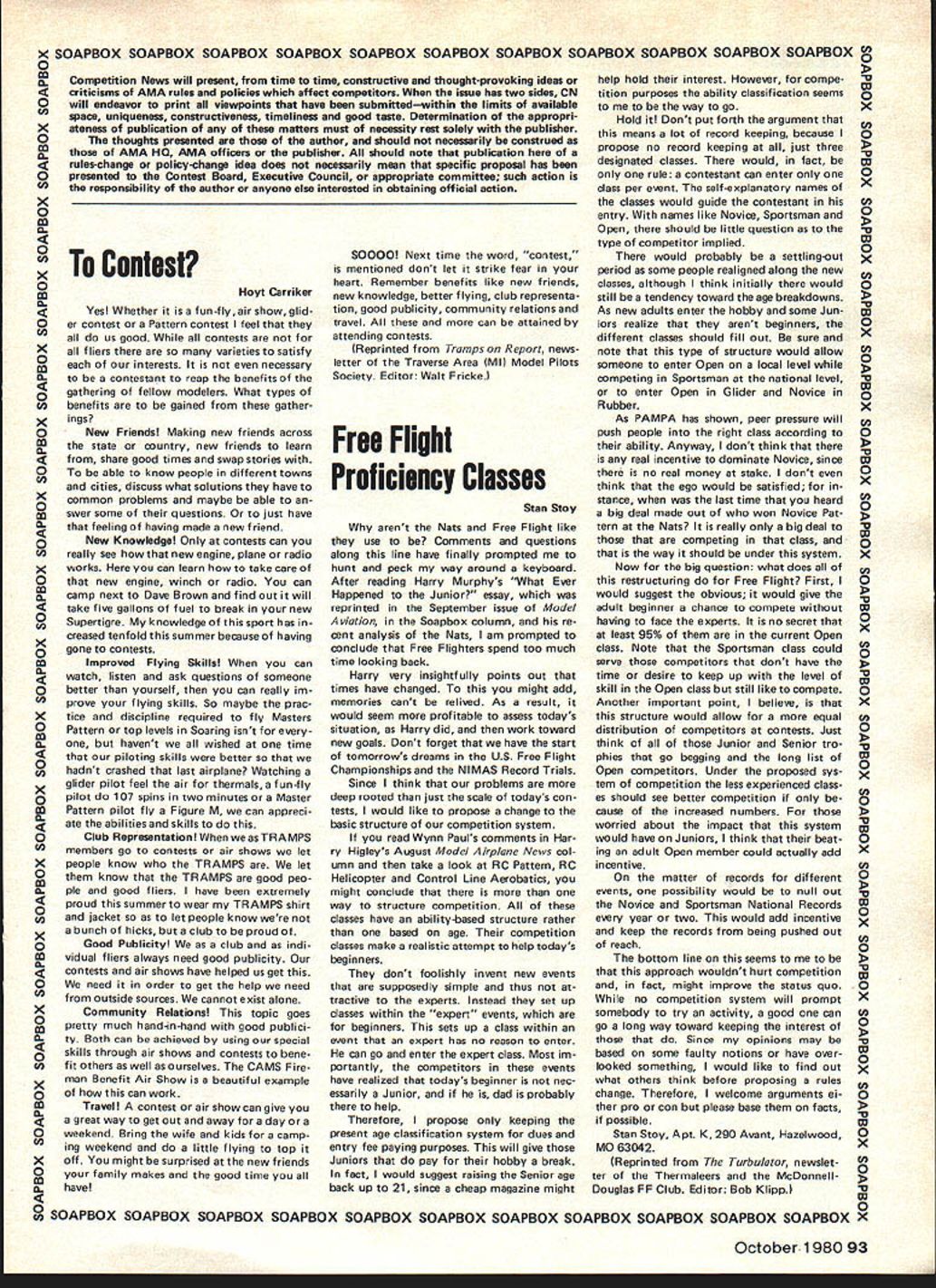
A reminder: contests offer many benefits — new friends, new knowledge, better flying, club representation, good publicity, community relations, and travel. Don't let the idea of "contest" be intimidating. (Reprinted from Tramps on Report, Traverse Area (MI) Model Pilots Society. Editor: Walt Fricke.)
FREE FLIGHT PROFICIENCY CLASSES
Stan Stoy
Why aren't the Nats and Free Flight like they used to be? Comments and questions along this line prompted this essay.
After reading Harry Murphy's "What Ever Happened to the Junior?" and his analysis of the Nats, it seems clear times have changed and memories can't be relived. It's more profitable to assess today's situation and work toward new goals. We already have the U.S. Free Flight Championships and the NIMAS Record Trials as starting points for tomorrow's development.
I propose restructuring competition to be ability-based rather than age-based. Events such as RC Pattern, RC Helicopter, and Control Line Aerobatics use an ability structure with classes that help beginners compete without facing experts. This approach sets up classes within expert events—classes beginners can enter without drawing expert competitors away from the top class.
My proposal:
- Keep the present age classification only for dues and entry-fee purposes (so Juniors retain a break).
- Use three ability classes for competition: Novice, Sportsman, and Open.
- Rule: a contestant can enter only one class per event.
- No extensive record-keeping changes—just designated classes with self-explanatory names.
Benefits:
- Adult beginners can compete without facing the experts (many are now in Open).
- Sportsman class serves those who like to compete but cannot maintain Open-level skill.
- More balanced competitor distribution at contests; more meaningful competition in lower classes.
- Juniors may be motivated by beating adult Open members.
On records: consider nulling Novice and Sportsman national records every year or two to keep records attainable and encourage participation.
This approach should not hurt competition and may improve the status quo. I welcome arguments for and against, preferably based on facts.
Stan Stoy, Apt. K, 290 Avant, Hazelwood, MO 63042
(Reprinted from The Turbulator, newsletter of the Thermaleers and the McDonnell-Douglas FF Club. Editor: Bob Klipp.)
Transcribed from original scans by AI. Minor OCR errors may remain.

