
COMPETITION NEWSLETTER
RC SOARING, FF TEAMS FINALS REPORTS
1981 RC Soaring Team Finals
Dan Pruss Photos by the author
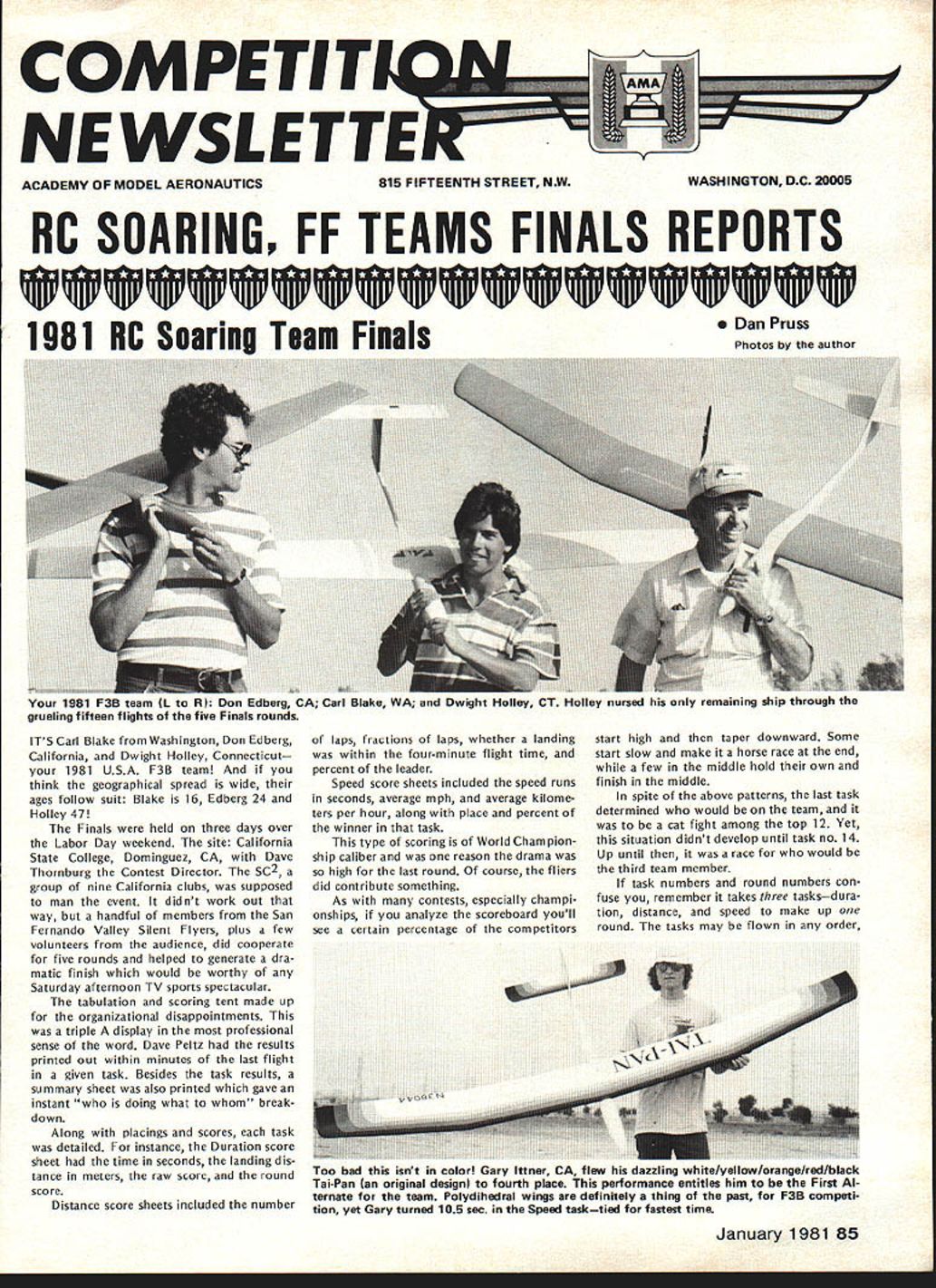
It's Carl Blake from Washington, Don Edberg from California, and Dwight Holley from Connecticut — your 1981 U.S.A. F3B team! And if you think the geographical spread is wide, their ages follow suit: Blake is 16, Edberg 24, and Holley 47.
The Finals were held on three days over the Labor Day weekend at California State College, Dominguez, CA, with Dave Thornburg as Contest Director. The SC2, a group of nine California clubs, was supposed to staff the event. That arrangement didn't work out entirely, but a handful of members from the San Fernando Valley Silent Flyers, plus a few volunteers from the audience, cooperated for five rounds and helped generate a dramatic finish worthy of any Saturday-afternoon TV sports spectacular.
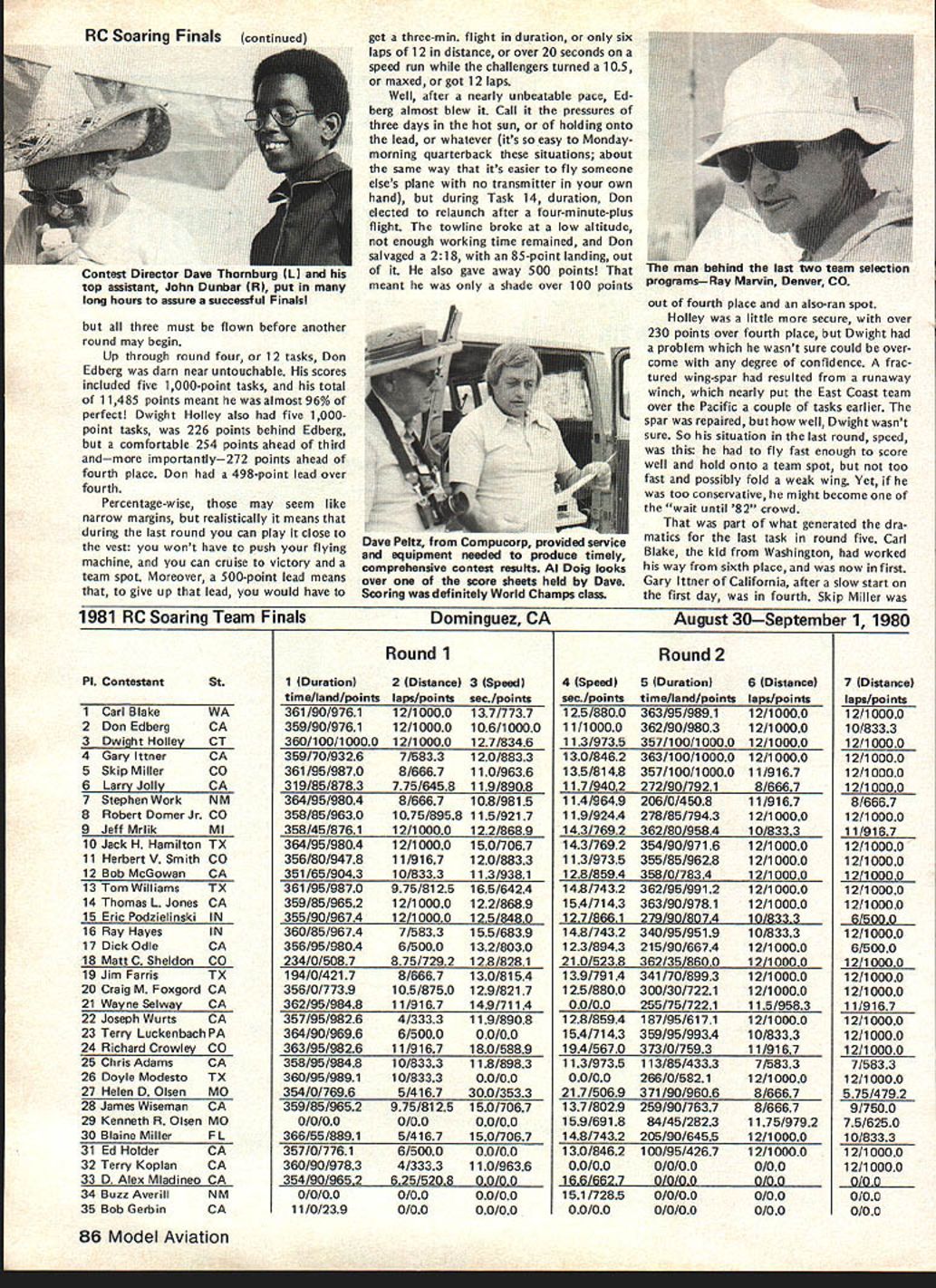
The tabulation and scoring tent made up for the organizational disappointments. This was a triple-A display in the most professional sense of the word. Dave Peltz had results printed within minutes of the last flight in a given task. Besides task placings and scores, a summary sheet gave an instant "who is doing what to whom" breakdown.
Each task was detailed. For example:
- Duration score sheets listed the time in seconds, the landing distance in meters, the raw score, and the round score.
- Distance score sheets included the number of laps, fractions of laps, whether a landing occurred within the four-minute flight time, and percent of the leader.
- Speed score sheets included the speed runs in seconds, average mph, and average kilometers per hour, along with place and percent of the winner in that task.
This type of scoring is of World Championship caliber and was one reason the drama was so high for the last round. Of course, the fliers contributed as well.
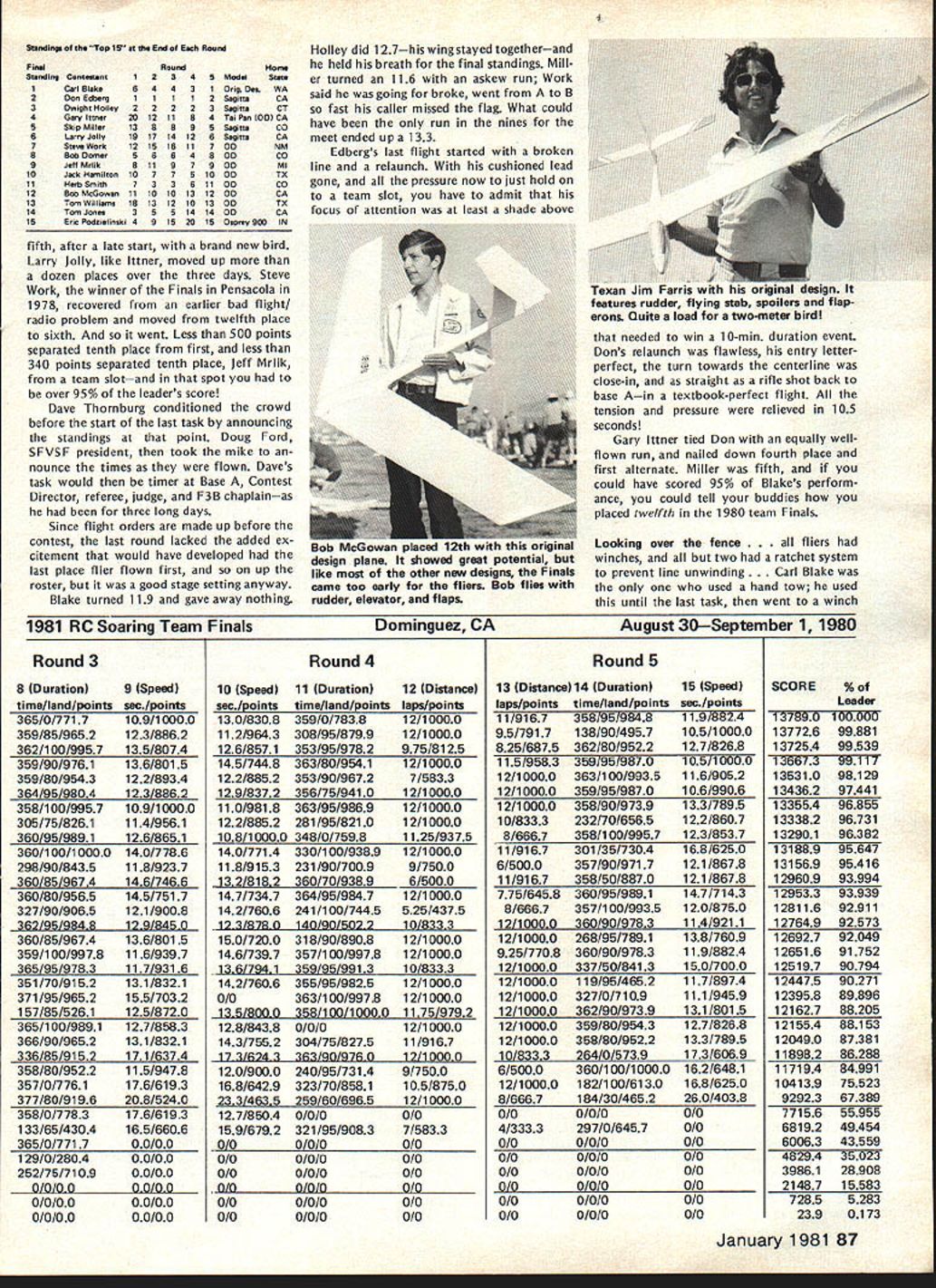
As with many contests, especially championships, patterns emerge on the scoreboard. Some competitors start high and taper downward, some start slow and make a late charge, and a few hold steady in the middle. Up through round four (12 tasks), Don Edberg was nearly untouchable. His scores included five 1000-point tasks. A total of 11,485 points meant almost 96% perfect. Dwight Holley also had five 1000-point tasks and sat 226 points behind Edberg, comfortably 254 points ahead of third and, more importantly, 272 points ahead of fourth place. Don had a 498-point lead over fourth.
Percentage-wise these margins may seem narrow; realistically it meant that during the last round a pilot could play it safe and still cruise to victory and a team spot. A 500-point lead meant giving up the lead would require losing three minutes of duration, six laps in distance, or over 20 seconds in the speed run. Challengers turned 10.5-second speed runs, maxed, and got 12 laps.
Well, after a nearly unbeatable pace, Edberg almost blew it. Call it pressure: three days of hot sun holding onto the lead will do it. During Task 14 duration, Don elected to relaunch after a four-minute-plus flight when the towline broke at low altitude. With enough working time remaining, Don salvaged a 218; an 85-point landing-out cost him 500 points and meant he was over 100 points out of fourth place and the also-ran spot.
Holley, secure by about 230 points over fourth place, had a problem: he wasn't sure he could overcome a lack of confidence after a fractured wing-spar resulted in a runaway winch which nearly put the East Coast team over the Pacific a couple tasks earlier. The spar was repaired well, but Dwight wasn't sure. So the situation for the last round was a delicate balance: fly fast enough in speed to score well and hold the team spot; fly too fast and risk folding the weak wing; be too conservative and risk dropping out of contention.
That tension generated the dramatics for the last task in round five. Carl Blake, the kid from Washington, had worked his way from sixth place to first. Gary Ittner of California, after a slow start on the first day, was in fourth. Skip Miller was fifth. If you could have scored 95% of Blake's performance, you could tell your buddies you placed twelfth in the 1980 Team Finals.
Holley did 12.7 seconds — his wing stayed together — and he held his breath for the final standings. Miller turned an 11.6 with an askew run; Work said he was going for broke and went from A to B so fast his caller missed the flag. What could have been the only run in the nines for the meet ended up a 13.3.
Edberg's last flight started with a broken line and a relaunch. With his cushioned lead gone and all the pressure now to just hold a team slot, his focus had to be razor-sharp. Don's relaunch was flawless, his entry letter-perfect, the turn toward the centerline was close-in, and he flew straight back to base A — textbook perfect. All the tension and pressure were relieved in 10.5 seconds.
Gary Ittner tied Don with an equally well-flown run and nailed down fourth place and first alternate.
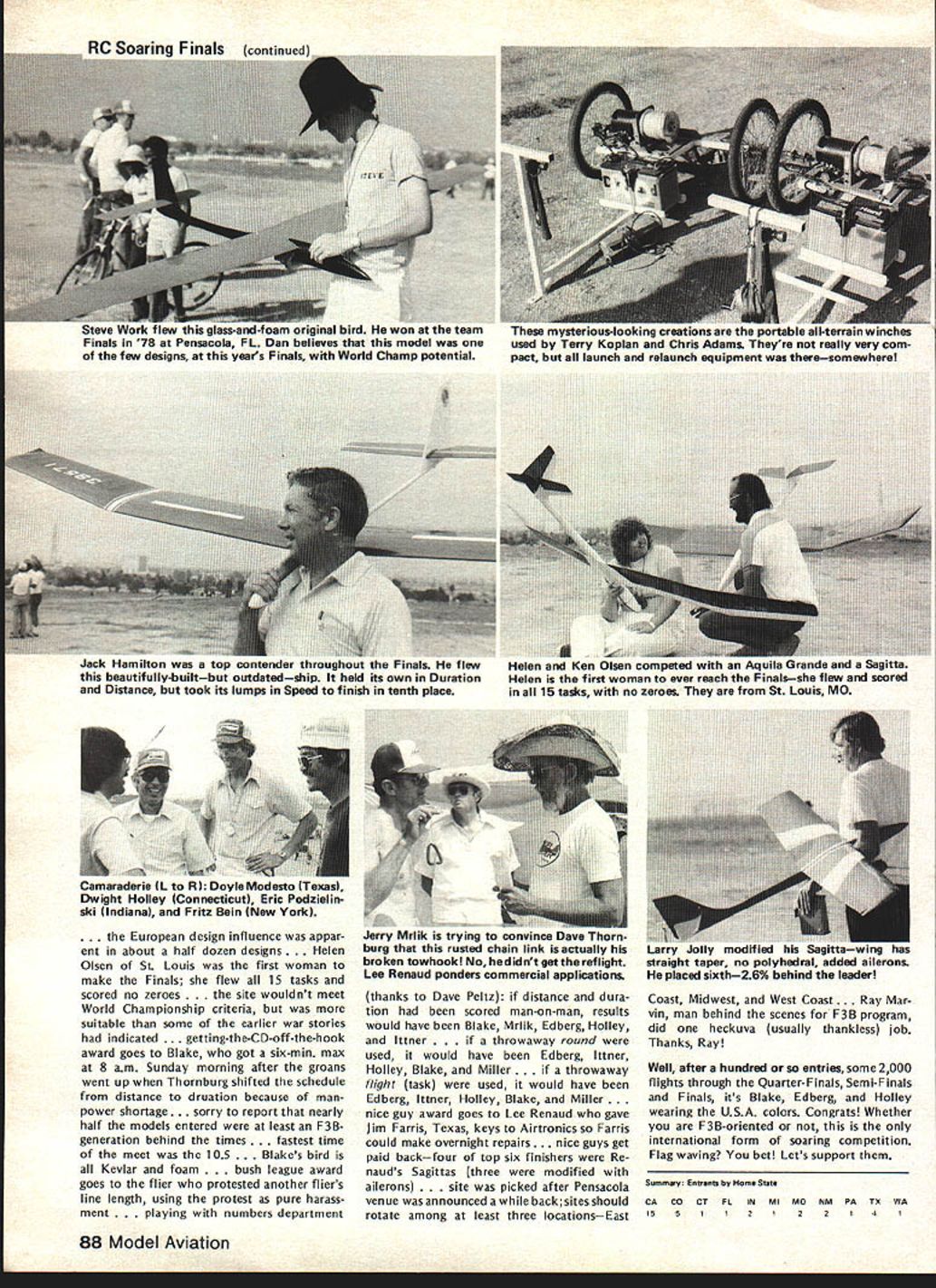
Looking around the field: all fliers had winches, and all but two had a ratchet system to prevent line unwinding. Carl Blake was the only one who used a hand tow until the last task, when he switched to a winch. European design influence was apparent in about half a dozen models. Helen Olsen of St. Louis was the first woman to make the Finals; she flew all 15 tasks and scored no zeroes. The site wouldn't meet World Championship criteria, but was more suitable than some earlier reports had indicated.
Getting-the-CD-off-the-hook award goes to Blake, who got a six-minute max at 8 a.m. Sunday morning after groans went up when Thornburg shifted the schedule from distance to duration because of manpower shortage. Sorry to report that nearly half the models entered were at least an F3B-generation behind the times. The fastest time of the meet was 10.5 seconds. Blake's bird is all Kevlar and foam. Bush-league award goes to the flier who protested another flier's line length using the protest as pure harassment.
Thanks to Dave Peltz:
- If distance and duration had been scored man-on-man, results would have been Blake, Mrlik, Edberg, Holley, and Ittner.
- If a throwaway round were used, it would have been Edberg, Ittner, Holley, Blake, and Miller.
- If a throwaway flight (task) were used, it would have been Edberg, Ittner, Holley, Blake, and Miller.
Nice-guy award goes to Lee Renaud, who gave Jim Farris of Texas keys to Airtronics so Farris could make overnight repairs. Nice guys get paid back: four of the top six finishers were Renaud's Sagittas (three modified with ailerons). The site was picked after the Pensacola venue was announced; sites should rotate among at least three locations — East Coast, Midwest, and West Coast. Ray Marvin, man behind the scenes for the F3B program, did one heck of a (usually thankless) job. Thanks, Ray!
After some 100 or so entries and about 2,000 flights through the Quarter-Finals, Semi-Finals, and Finals, it's Blake, Edberg, and Holley wearing the U.S.A. colors. Congrats! Whether you are F3B-oriented or not, this is the only international form of soaring competition. Flag waving? You bet! Let's support them.
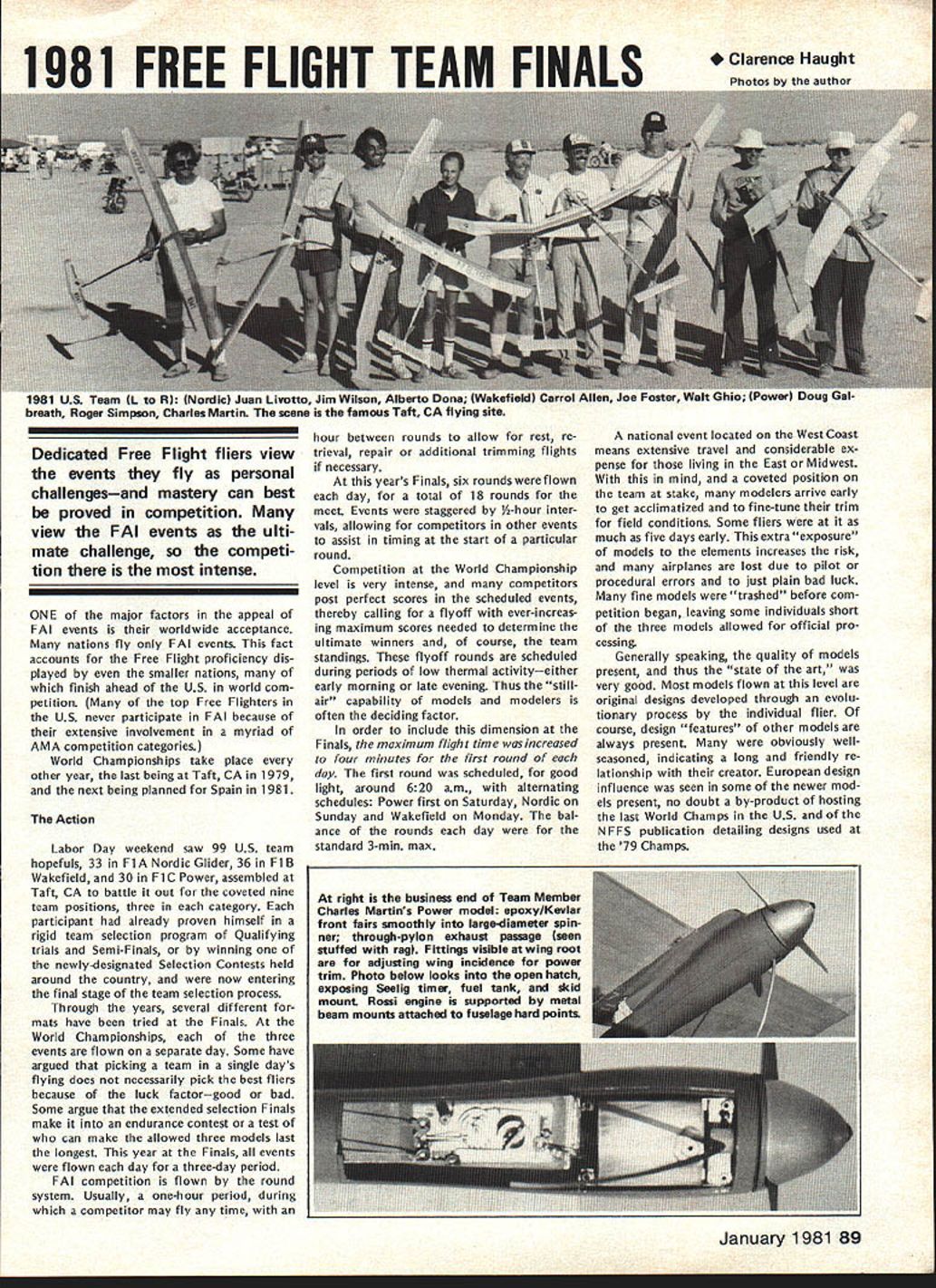
1981 FREE FLIGHT TEAM FINALS
Clarence Haught Photos by the author
Dedicated Free Flight fliers view the events they fly as personal challenges — and mastery is best proved in competition. Many view FAI events as the ultimate challenge, so competition there is the most intense.
One major factor in the appeal of FAI events is their worldwide acceptance. Many nations fly only FAI events; this accounts for the Free Flight proficiency displayed by even smaller nations, many of which finish ahead of the U.S. in world competition. Many top Free Fliers in the U.S. never participate in FAI because they are heavily involved in a myriad of AMA competition categories.
World Championships take place every other year, the last being at Taft, CA in 1979, with the next planned for Spain in 1981.
The Action
Labor Day weekend saw 99 U.S. team hopefuls gathered at Taft, CA: 33 in F1A Nordic Glider, 36 in F1B Wakefield Rubber, and 30 in F1C Power, all battling for the coveted nine team positions (three in each category). Each participant had already proven himself in a rigid selection program of Qualifying trials and Semi-Finals, or by winning a designated Selection Contest, and were now entering the final stage.
Through the years, several formats have been tried at the Finals. At the World Championships, each event is flown on a separate day. Some argue that picking a team in a single day's flying introduces too much luck; others argue extended Finals test endurance or who can make the allowed three models last the longest. This year, all events were flown each day for a three-day period.
FAI competition is flown by the round system — typically a one-hour period during which a competitor may fly anytime, with an hour between rounds for rest, retrieval, repair, or additional trimming flights.
At this year's Finals, six rounds were flown each day for a total of 18 rounds. Events were staggered by half-hour intervals, allowing competitors in other events to assist timing at the start of a particular round.
Competition at World Championship level is intense, and many competitors post perfect scores in scheduled events, requiring flyoffs with ever-increasing maximums to determine winners and team standings. Flyoffs are scheduled in periods of low thermal activity — early morning or late evening — so still-air capability often decides outcomes.
To include this dimension, the maximum flight time was increased to four minutes for the first round of each day. The first round was scheduled around 6:20 a.m., with alternating schedules: Power first on Saturday, Nordic on Sunday, and Wakefield on Monday. The balance of rounds each day used the standard three-minute max.
A national event on the West Coast means extensive travel and expense for those from the East or Midwest. Many modelers arrive early to acclimatize and fine-tune trim; some arrived five days early. This extra exposure increases risk, and many airplanes are lost due to pilot errors, procedural issues, or bad luck, leaving some individuals short of the three models allowed for official processing.
Generally, the quality of models present — the state of the art — was very good. Most models are original designs developed by their fliers, though design features from other models appear. European design influence was seen in some newer models, a by-product of hosting the '79 World Champs in the U.S. and publications detailing designs used there.
Trends observed:
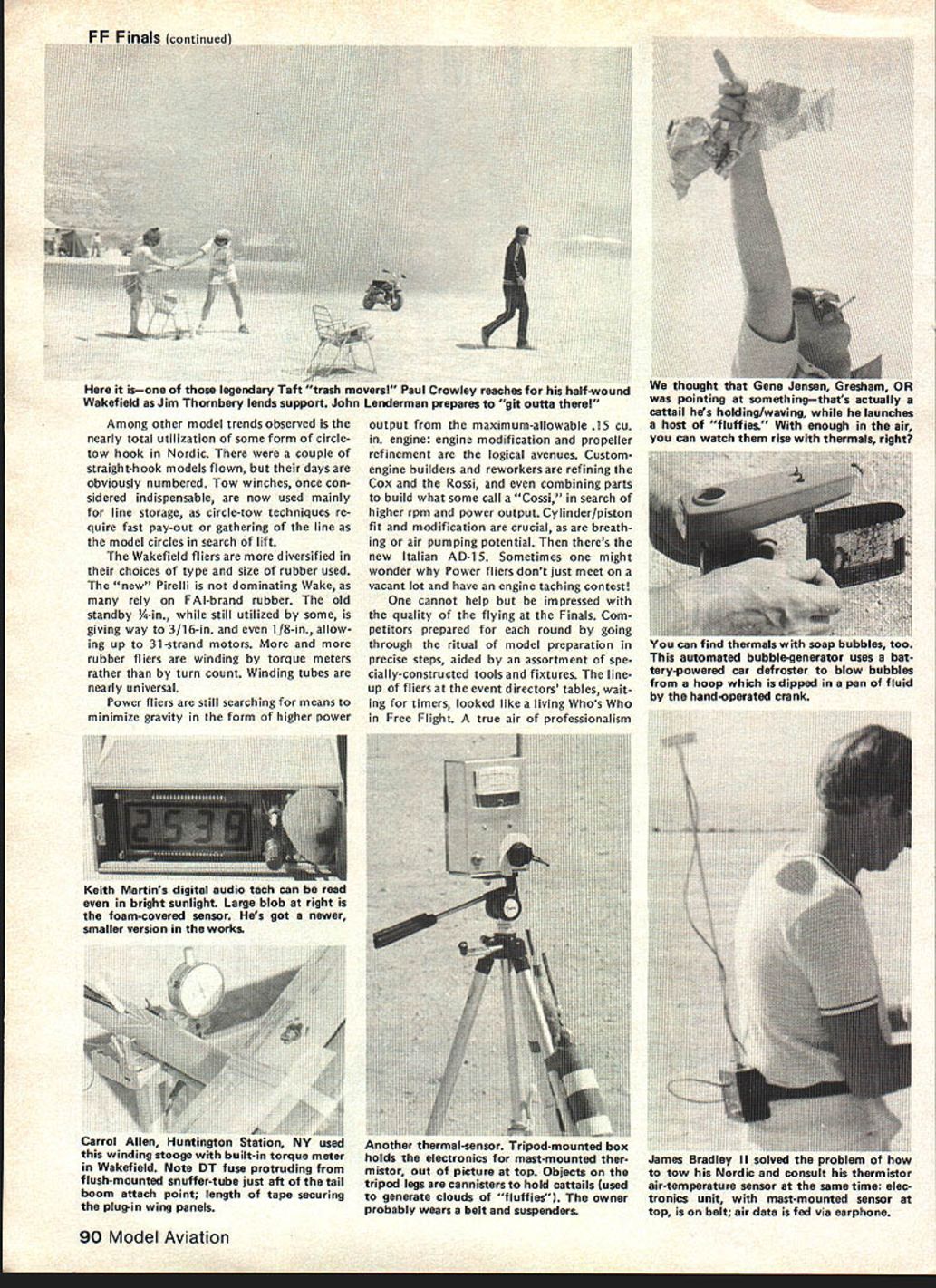
- Nordic: Nearly total utilization of some form of circle-tow hook. Tow winches, once indispensable, are now mainly used for line storage, as circle-tow techniques require fast payout or gathering of the line.
- Wakefield: Diversified choices of rubber type and size. The "new" Pirelli is not dominating; many use FAI-brand rubber. The old 3/8-in. is giving way to 3/16-in. and even 1/8-in., allowing up to 31-strand motors. More fliers wind by torque meters rather than turn count; winding tubes are nearly universal.
- Power: Fliers seek higher power output from the maximum-allowable .15 cu. in. engine through engine modification and propeller refinement. Custom engine builders refine Cox and Rossi engines, sometimes combining parts to create hybrids in search of higher rpm and power.
Competitors prepared precisely for each round, aided by specially constructed tools and fixtures. The line-up of fliers waiting for timers looked like a Who's Who in Free Flight; a true air of professionalism prevailed.
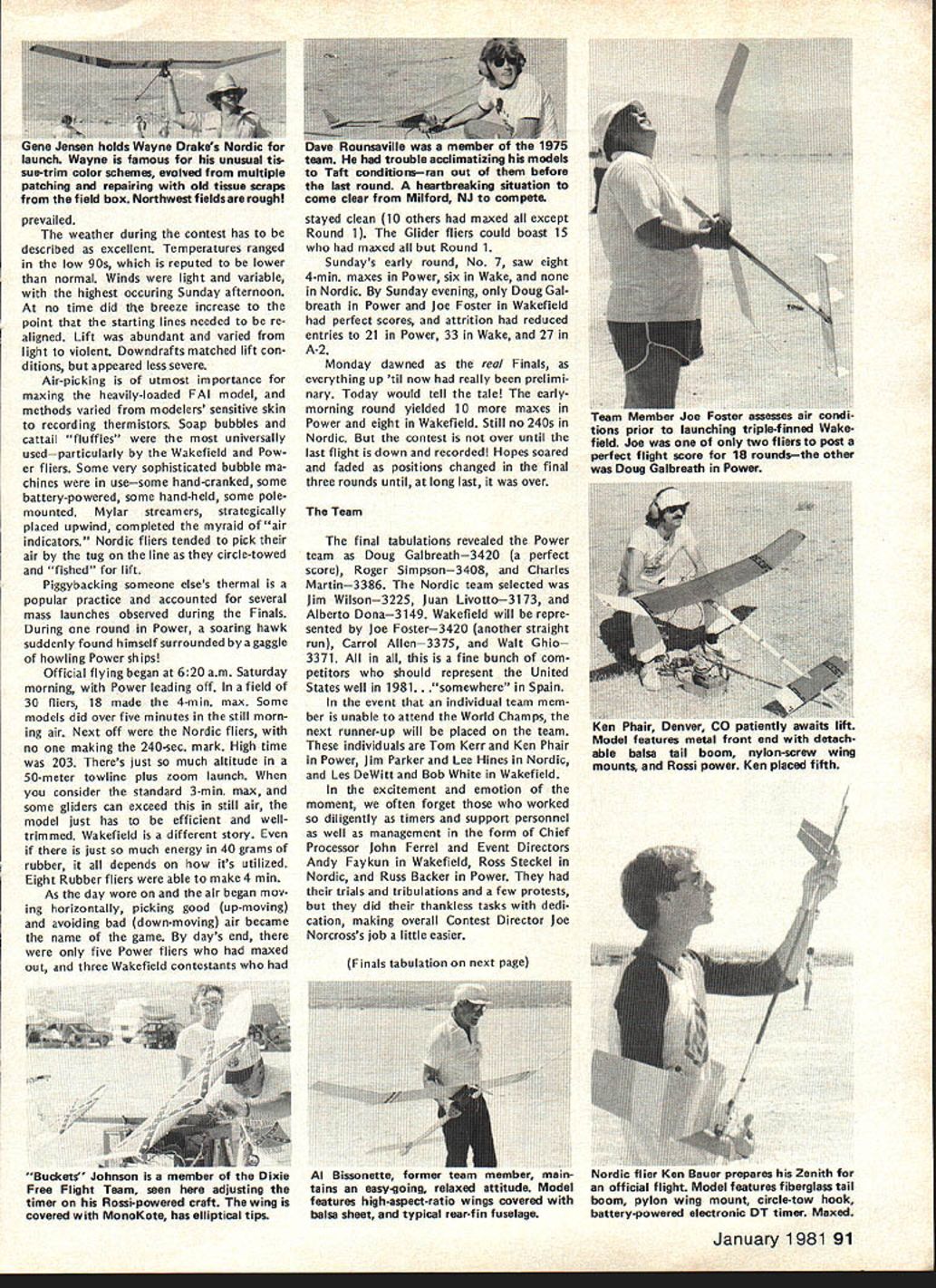
Weather was excellent: temperatures in the low 90s, light and variable winds, and abundant lift varying from light to violent. Downdrafts matched lift conditions but seemed less severe. Air-picking was crucial for maxing heavily-loaded FAI models; methods ranged from sensitive feeling to recording thermistors. Soap bubbles and cattail "fluffies" were most universally used, especially by Wakefield and Power fliers. Some sophisticated bubble machines were in use, and Mylar streamers completed the air indicators. Nordic fliers tended to pick air by the tug on the line while circle-towing.
Piggybacking someone else's thermal was common and accounted for several mass launches. During one Power round, a soaring hawk suddenly found himself surrounded by a gaggle of howling Power ships!
Official flying began at 6:20 a.m. Saturday, with Power leading off. In a field of 30 fliers, 18 made the four-minute max; some models did over five minutes in still air. Nordic had no one make the 240-second mark; high time was 203 seconds. Wakefield saw eight rubber fliers make four minutes.
As the day wore on and air moved horizontally, picking up-moving air and avoiding down-moving air became the goal. By day's end, only five Power fliers had maxed out, and three Wakefield contestants had stayed clean (10 others had maxed all except Round 1). The Glider fliers had 15 who had maxed all but Round 1.
Sunday's early round (No. 7) saw eight 4-minute maxes in Power, six in Wake, and none in Nordic. By Sunday evening, only Doug Galbreath (Power) and Joe Foster (Wakefield) had perfect scores. Attrition reduced entries to 21 in Power, 33 in Wake, and 27 in A-2.
Monday dawned as the real Finals. The early round yielded 10 more maxes in Power and eight in Wakefield. Still no 240s in Nordic. Positions changed in the final three rounds until, at last, it was over.
The Team
Final tabulations revealed the teams as follows:
- Power:
- Doug Galbreath — 3420 (perfect score)
- Roger Simpson — 3408
- Charles Martin — 3386
- Nordic:
- Jim Wilson — 3225
- Juan Livotto — 3173
- Alberto Dona — 3149
- Wakefield:
- Joe Foster — 3420 (perfect score)
- Carrol Allen — 3375
- Walt Ghio — 3371
Runners-up (in case a team member cannot attend the World Champs):
- Power alternates: Tom Kerr and Ken Phair
- Nordic alternates: Jim Parker and Lee Hines
- Wakefield alternates: Les DeWitt and Bob White
Acknowledgments go to timers, support personnel, Chief Processor John Ferrel, and Event Directors Andy Faykun (Wakefield), Ross Steckel (Nordic), and Russ Backer (Power). They handled protests and management duties with dedication, easing Contest Director Joe Norcross's job.
FF Finals (continued)
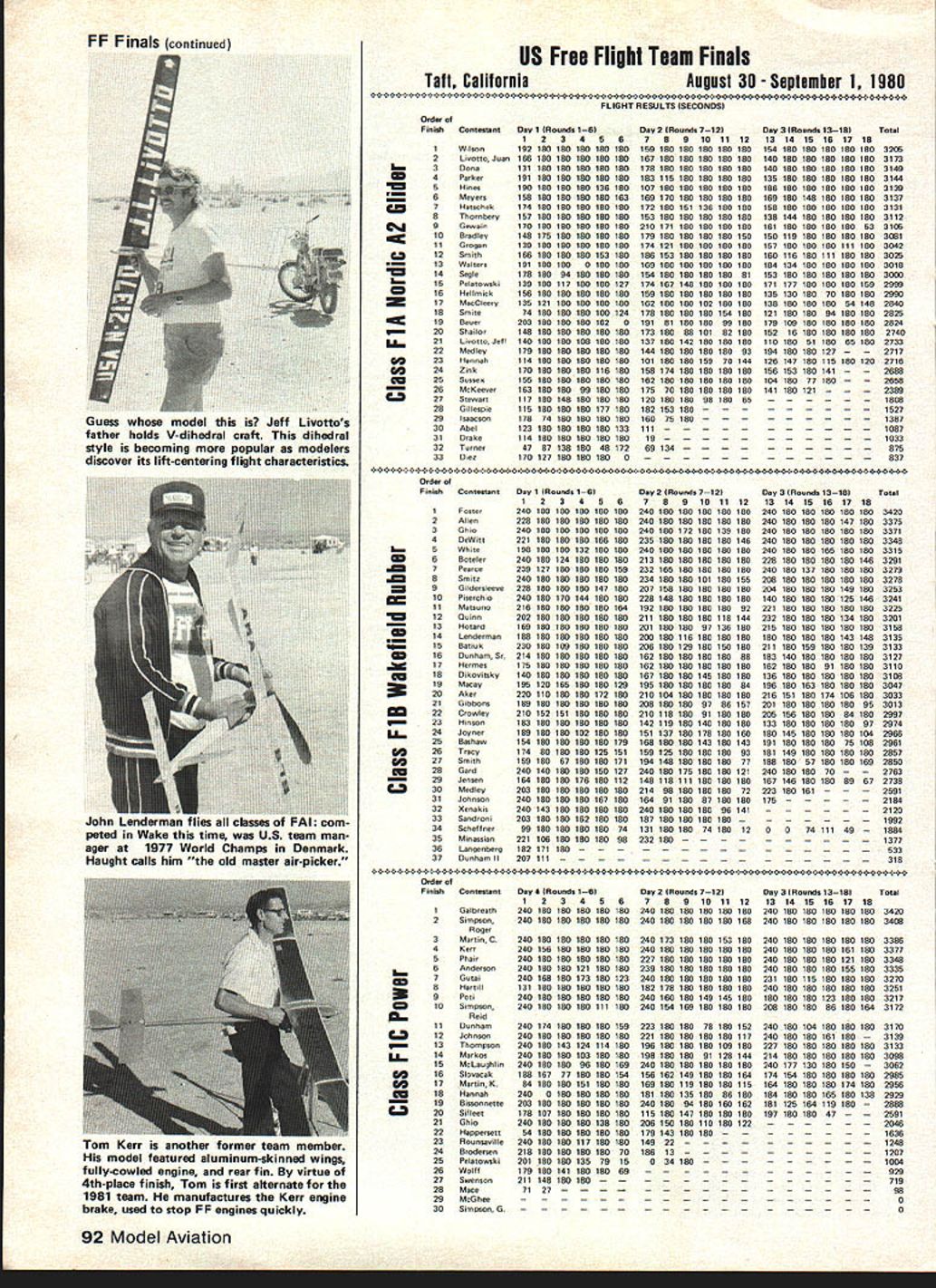
- Jeff Livotto's father holds a V-dihedral craft in a photo. This dihedral style is becoming more popular as modelers discover its lift-centering flight characteristics.
- John Lenderman flies all classes of FAI; he competed in Wake this time and was U.S. team manager at the 1977 World Champs in Denmark. Haught calls him "the old master air-picker."
- Tom Kerr is another former team member. His model featured aluminum-skinned wings, a fully cowled engine, and rear fin. By virtue of a fourth-place finish, Tom is first alternate for the 1981 team. He manufactures the Kerr engine brake, used to stop FF engines quickly.
US Free Flight Team Finals
Taft, California — August 30 - September 1, 1980
Flight results (seconds) for Class F1A Nordic A-2 Glider, Class F1B Wakefield Rubber, and Class F1C Power are presented in the table on the page.
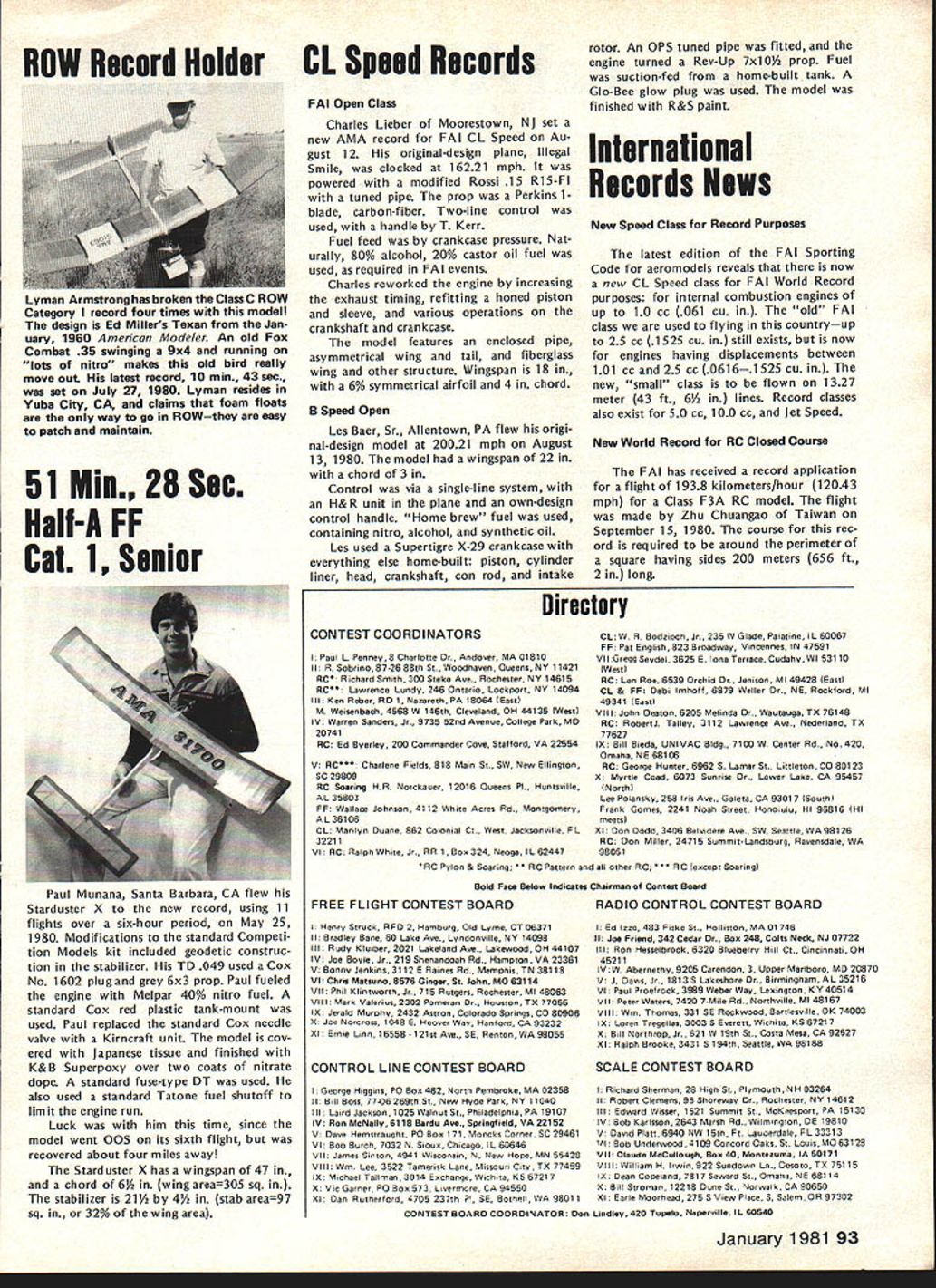
ROW Record Holder
Lyman Armstrong has broken the Class C ROW Category 1 record four times with this model! The design is Ed Miller's Texan from the January 1960 American Modeler. An old Fox Combat .35 swinging a 9x4 and running on "lots of nitro" makes this old bird really move out. His latest record, 10 minutes, 43 seconds, was set on July 27, 1980. Lyman resides in Yuba City, CA, and claims that foam floats are the only way to go in ROW — they are easy to patch and maintain.
51 Min., 28 Sec. Half-A FF Cat. 1, Senior
Paul Munana of Santa Barbara, CA flew his Starduster X to the new record of 51 minutes, 28 seconds using 11 flights over a six-hour period on May 25, 1980. Modifications to the standard Competition Models kit included geodetic construction in the stabilizer. His TD .049 used a Cox No. 1602 plug and a 6x3 prop. Paul fueled the engine with Melpar 40% nitro fuel. A standard Cox red plastic tank-mount was used. Paul replaced the standard Cox needle valve with a Kincraft unit. The model is covered with Japanese tissue and finished with K&B Superpoxy over two coats of nitrate dope. A standard fuse-type DT was used. He also used a standard Tatone fuel shutoff to limit the engine run.
Luck was with him: the model went OOS on its sixth flight but was recovered about four miles away!
Starduster X specifications:
- Wingspan: 47 in.
- Chord: 6 in. (wing area = 305 sq. in.)
- Stabilizer: 21.5 in. by 4.5 in. (stab area = 97 sq. in., or 32% of wing area)
CL Speed Records
FAI Open Class
Charles Lieber of Moorestown, NJ set a new AMA record for FAI CL Speed on August 12. His original-design plane, Illegal Smile, was clocked at 162.21 mph. It was powered with a modified Rossi .15 R15-F1 with a tuned pipe. The prop was a Perkins one-blade, carbon-fiber. Two-line control was used, with a handle by T. Kerr.
Fuel feed was by crankcase pressure. Fuel was 80% alcohol and 20% castor oil, as required in FAI events.
Charles reworked the engine by increasing exhaust timing, refitting a honed piston and sleeve, and performing various operations on the crankshaft and crankcase.
The model features an enclosed pipe, asymmetrical wing and tail, and fiberglass wing and other structure. Wingspan is 18 in., with a 6% symmetrical airfoil and 4 in. chord.
B Speed Open
Les Baer, Sr., of Allentown, PA flew his original-design model at 200.21 mph on August 13, 1980. The model had a wingspan of 22 in. with a chord of 3 in.
Control was via a single-line system, with an H&R unit in the plane and an own-design control handle. Home-brew fuel containing nitro, alcohol, and synthetic oil was used.
Les used a SuperTiger X-29 crankcase with home-built piston, cylinder liner, head, crankshaft, con rod, and intake rotor. An OPS tuned pipe was fitted, and the engine turned a Rev-Up 7x10½ prop. Fuel was suction-fed from a home-built tank. A Glo-Bee glow plug was used. The model was finished with R&S paint.
International Records News
New Speed Class for Record Purposes
The latest edition of the FAI Sporting Code for aeromodels introduces a new CL Speed class for FAI World Record purposes: internal combustion engines up to 1.0 cc (.061 cu. in.). The former FAI class up to 2.5 cc (.1525 cu. in.) still exists but now covers engines with displacements between 1.01 cc and 2.5 cc (.0616–.1525 cu. in.). The new "small" class is to be flown on 13.27-meter (43 ft., 6½ in.) lines. Record classes also exist for 5.0 cc, 10.0 cc, and Jet Speed.
New World Record for RC Closed Course
The FAI has received a record application for a flight of 193.8 kilometers/hour (120.43 mph) for a Class F3A RC model. The flight was made by Zhu Chuanqao of Taiwan on September 15, 1980. The course for this record is around the perimeter of a square with sides 200 meters (656 ft., 2 in.) long.
Competition Newsletter
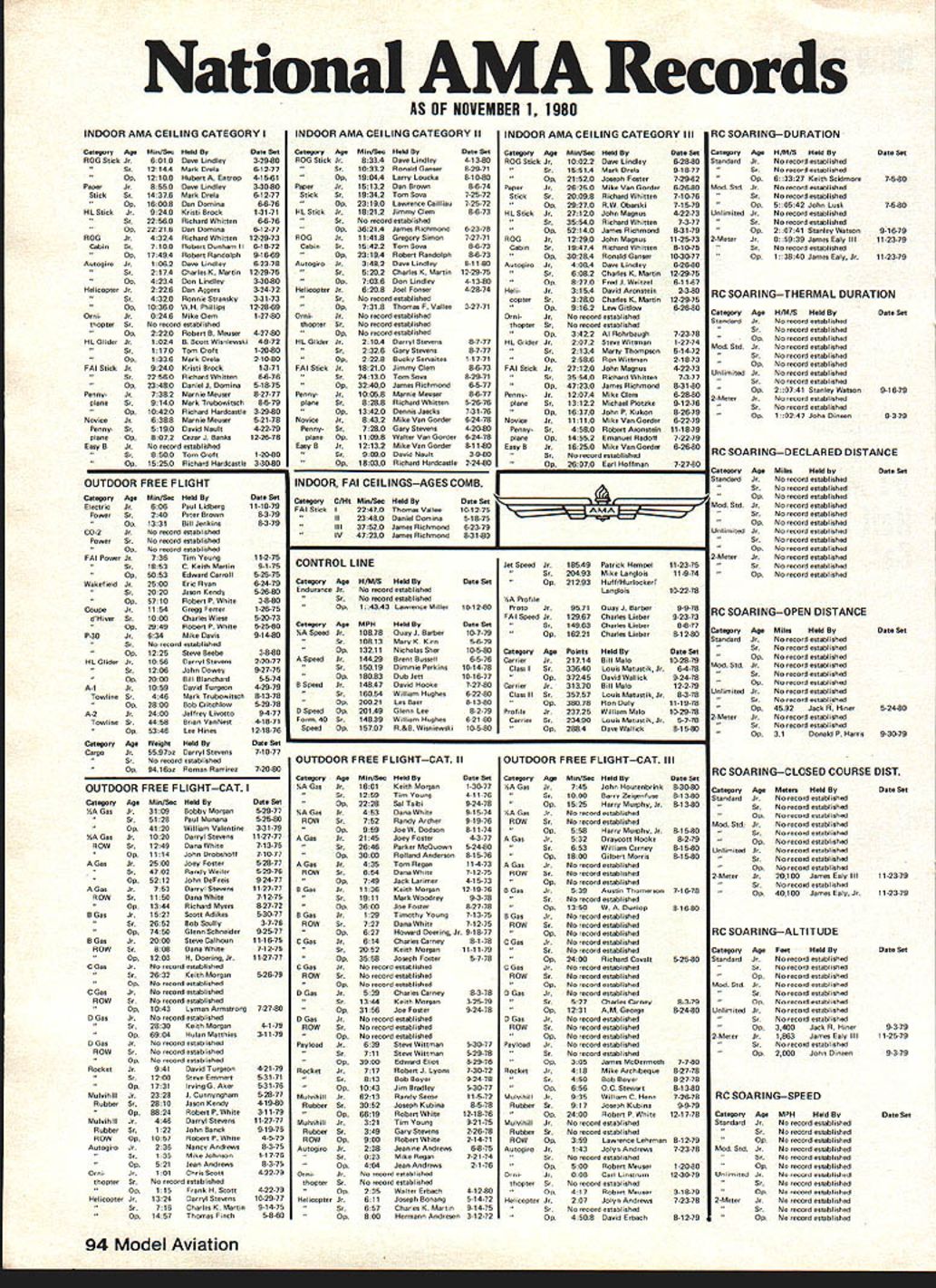
No continuation of the "Competition Newsletter" article appears on this scanned page. The page contains National AMA Records tables and does not include the requested article text.
Transcribed from original scans by AI. Minor OCR errors may remain.

