
Competition Newsletter
ACADEMY OF MODEL AERONAUTICS 815 Fifteenth Street NW Washington, DC 20005
1981 Nationals — Texas (Aug. 2–9)
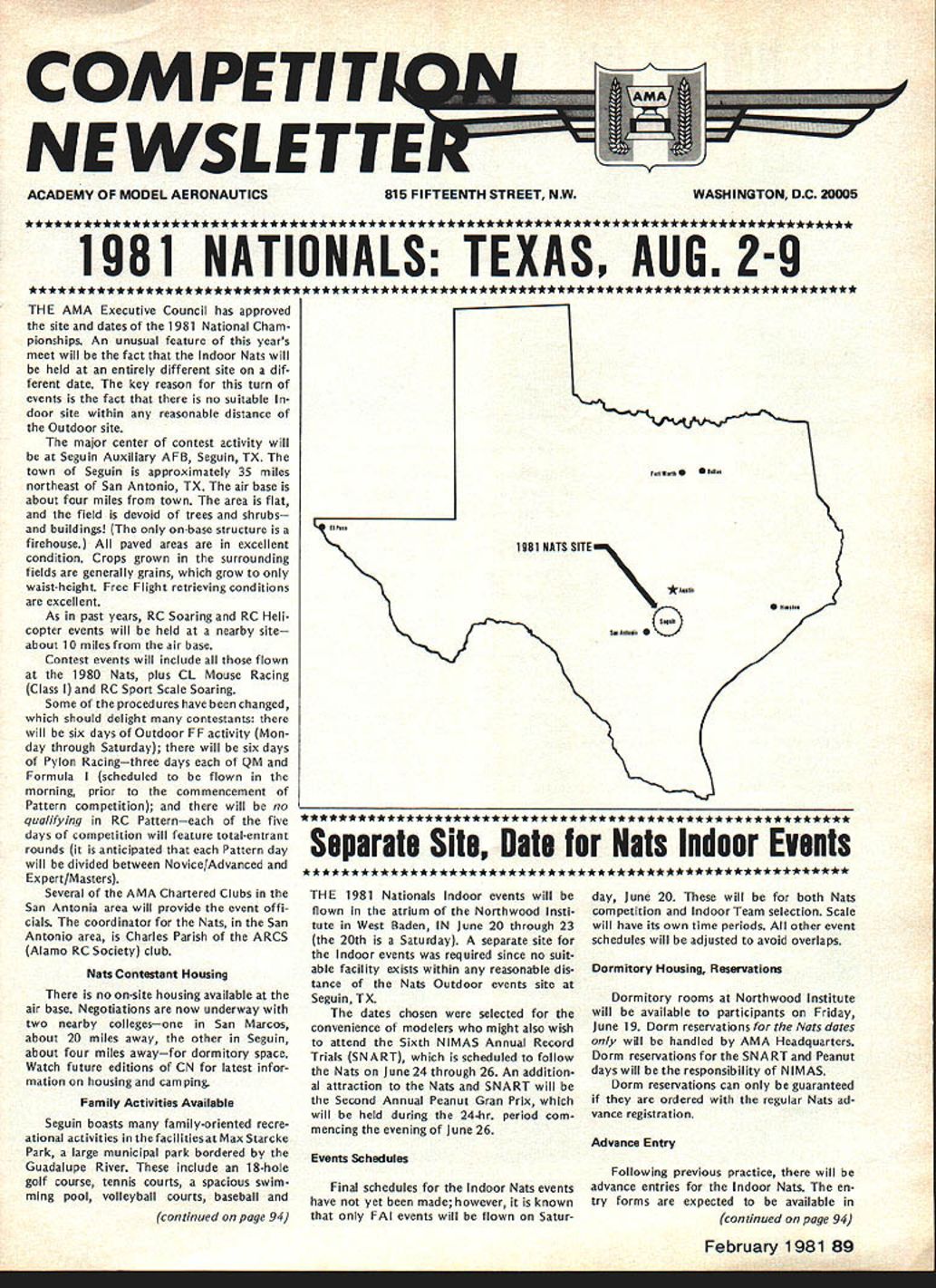
The AMA Executive Council has approved the site and dates for the 1981 National Championships. An unusual feature of this year's meet is that the Indoor Nationals will be held at an entirely different site and on different dates, because no suitable indoor facility exists within reasonable distance of the outdoor site.
Outdoor Site and Facilities
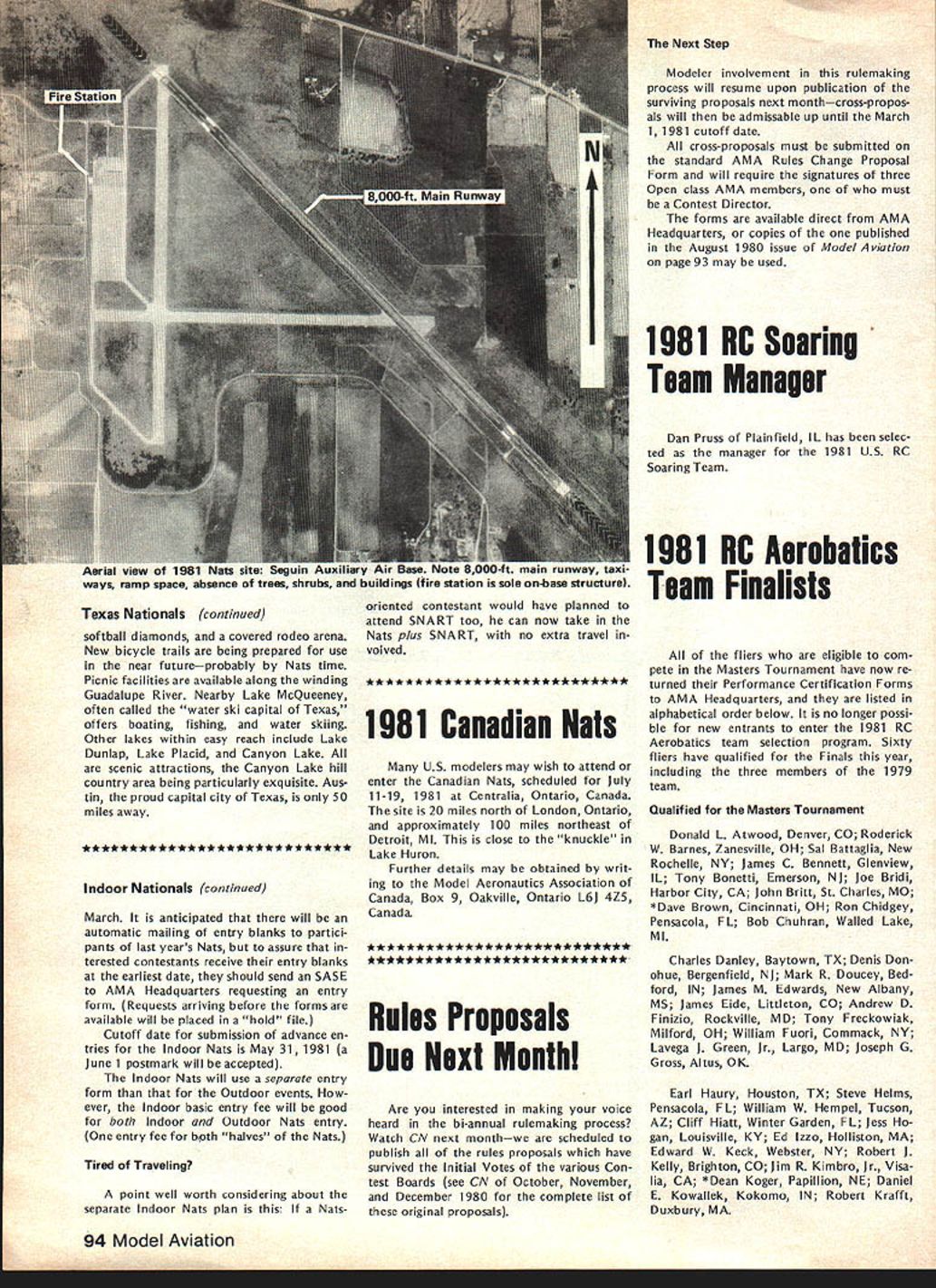
- Major center of contest activity: Seguin Auxiliary AFB, Seguin, TX (about 35 miles northeast of San Antonio; air base about 4 miles from town).
- Field: flat, free of trees, shrubs, and buildings (only on-base structure is a firehouse); paved areas in excellent condition.
- Surrounding crops are generally waist-high grains, making free-flight retrieving conditions excellent.
Events and Procedures
- Events: all events flown at the 1980 Nats, plus CL Mouse Racing (Class II) and RC Sport Scale Soaring.
- RC Soaring and RC Helicopter events: held at a nearby site about 10 miles from the air base.
- Schedule changes:
- Six days of outdoor free-flight activity (Monday through Saturday).
- Six days of pylon racing — three days of Q/M and three days of Formula I (scheduled in the mornings, prior to Pattern competition).
- RC Pattern: no qualifying; each of five competition days will feature total-entrant rounds. Pattern days are anticipated to be divided between Novice/Advanced and Expert/Masters.
- Several AMA-chartered clubs in the San Antonio area will provide event officials. Coordinator in the San Antonio area: Charles Parish (ARCS — Alamo RC Society).
Contestant Housing
- No on-site housing is available at the air base.
- Negotiations are underway with two nearby colleges for dormitory space: one in San Marcos (about 20 miles away) and one in Seguin (about 4 miles away).
- Watch future editions of CN for the latest information on housing and camping.
Family Activities
Seguin offers many family-oriented recreational facilities at Max Starcke Park (bordered by the Guadalupe River), including:
- 18-hole golf course
- Tennis courts
- Spacious swimming pool
- Volleyball courts
- Baseball and softball diamonds
- Covered rodeo arena
- Picnic facilities along the Guadalupe River
Nearby lakes: Lake McQueeney (popular for water skiing), Lake Dunlap, Lake Placid, and Canyon Lake. Austin is about 50 miles away.
Separate Site and Date for Indoor Nationals (West Baden, IN — June 20–23)
The 1981 Nationals indoor events will be flown in the atrium of Northwood Institute, West Baden, IN, June 20–23 (Saturday, June 20, through Tuesday, June 23). A separate site was necessary because no suitable indoor facility exists near Seguin, TX.
- Dates were selected so modelers could also attend the Sixth NIMAS Annual Record Trials (SNART), scheduled to follow June 24–26.
- The Second Annual Peanut Grand Prix will be held during the 24-hour period commencing the evening of June 26.
Events Schedule (Indoor)
- Final schedules not yet complete.
- Only FAI events will be flown on Saturday, June 20 (for both Nats competition and Indoor Team selection).
- Scale will have its own time periods.
- Other event schedules will be adjusted to avoid overlaps.
Dormitory Housing and Reservations (Northwood Institute)
- Dorm rooms available from Friday, June 19.
- Dorm reservations for the Nats dates only will be handled by AMA Headquarters.
- Dorm reservations for SNART and Peanut days will be handled by NIMAS.
- Dorm reservations can be guaranteed only if ordered with regular Nats advance registration.
Advance Entry
- There will be advance entries for the Indoor Nats.
- Entry forms are expected to be available in March.
- It is anticipated that entry blanks will be mailed automatically to participants of last year's Nats; to ensure early receipt, send an SASE to AMA Headquarters requesting an entry form. (Requests received before forms are available will be placed in a hold file.)
- Cutoff date for advance entries for the Indoor Nats: May 31, 1981 (a June 1 postmark will be accepted).
- The Indoor Nats will use a separate entry form from the Outdoor events, but the Indoor basic entry fee will be good for both Indoor and Outdoor Nats (one entry fee for both halves of the Nats).
Note on Travel
If a contestant planned to attend SNART as well, they can now attend the Indoor Nats and SNART without extra travel.
NMPRA Race — Weekend Report
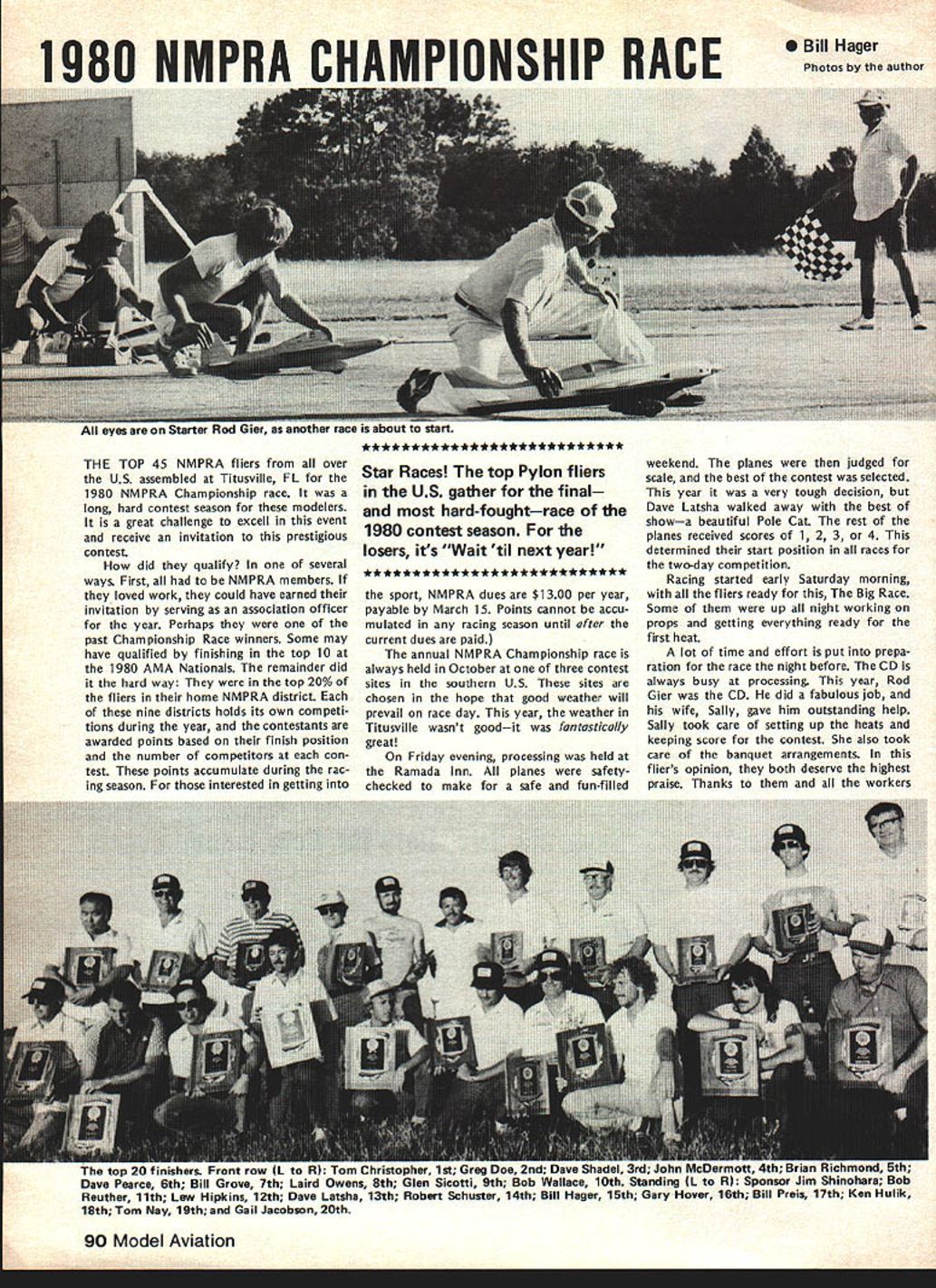
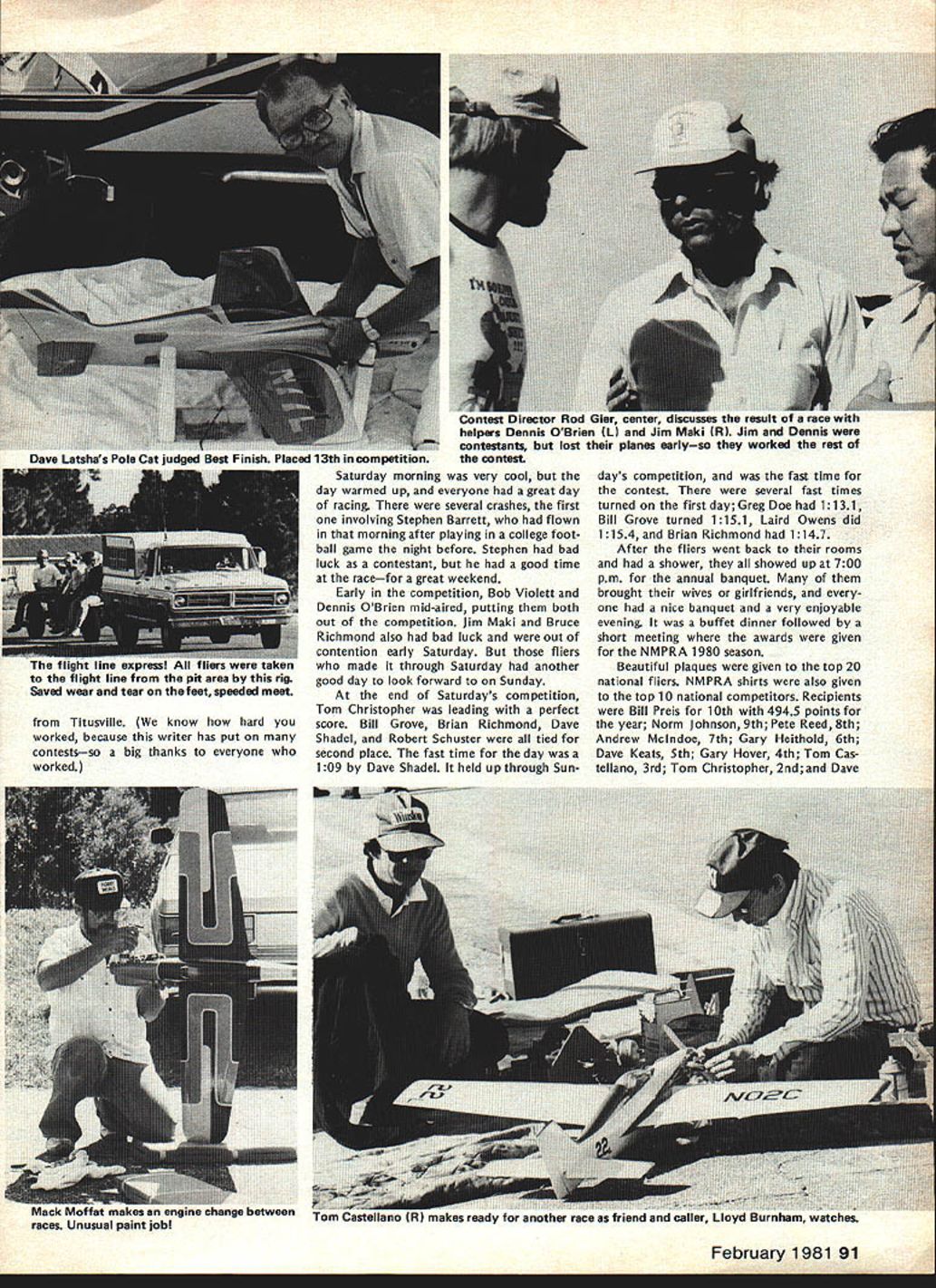
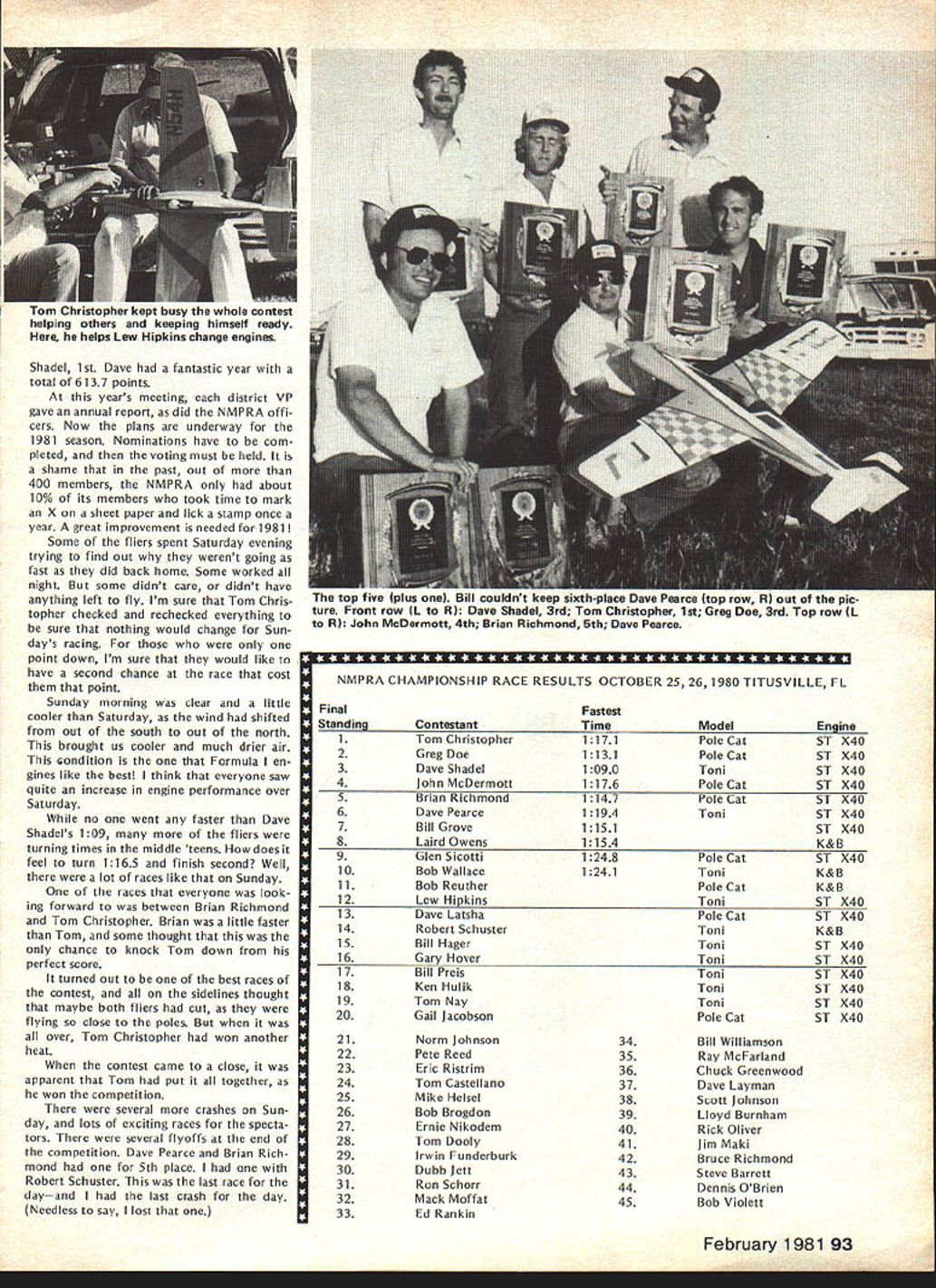
Saturday morning was cool but warmed up for a great day of racing. There were several crashes; the first involved Stephen Barrett, who had flown in that morning after playing in a college football game the previous night. Early in the competition, Bob Violett and Dennis O'Brien mid‑aired, eliminating both. Jim Maki and Bruce Richmond also had early exits. Those who survived Saturday looked forward to Sunday.
At the end of Saturday, Tom Christopher led with a perfect score. Bill Grove, Brian Richmond, Dave Shadel, and Robert Schuster were tied for second. The fast time for the day was Dave Shadel's 1:09, which held up through Sunday and was the contest’s fastest time. Other fast Saturday times: Greg Doe 1:13.1; Bill Grove 1:15.1; Laird Owens 1:15.4; Brian Richmond 1:14.7.
That evening many attended the annual banquet. Awards were presented for the NMPRA 1980 season. Beautiful plaques were given to the top 20 national fliers and NMPRA shirts to the top 10. Recipients included:
- 10th: Bill Preis — 494.5 points
- 9th: Norm Johnson
- 8th: Pete Reed
- 7th: Andrew McIndoe
- 6th: Gary Heithold
- 5th: Dave Keats
- 4th: Gary Hover
- 3rd: Tom Castellano
- 2nd: Tom Christopher
- 1st: Dave Shadel — 613.7 points
District VPs and NMPRA officers gave annual reports. Planning for the 1981 season is underway; nominations and voting remain. Historically, participation in ballots has been low (about 10% of members voting), and improved member involvement is needed for 1981.
Some competitors spent Saturday evening troubleshooting performance issues; Sunday brought cooler, drier air with a wind shift from south to north, which improved Formula I engine performance. While no one beat Shadel’s 1:09, many times improved into the mid-teens. A highlighted race between Brian Richmond and Tom Christopher was extremely close, but Tom won the heat and ultimately won the competition. Several flyoffs were required for final placings; the author notes a final crash in a flyoff.
Photo Captions and Notes
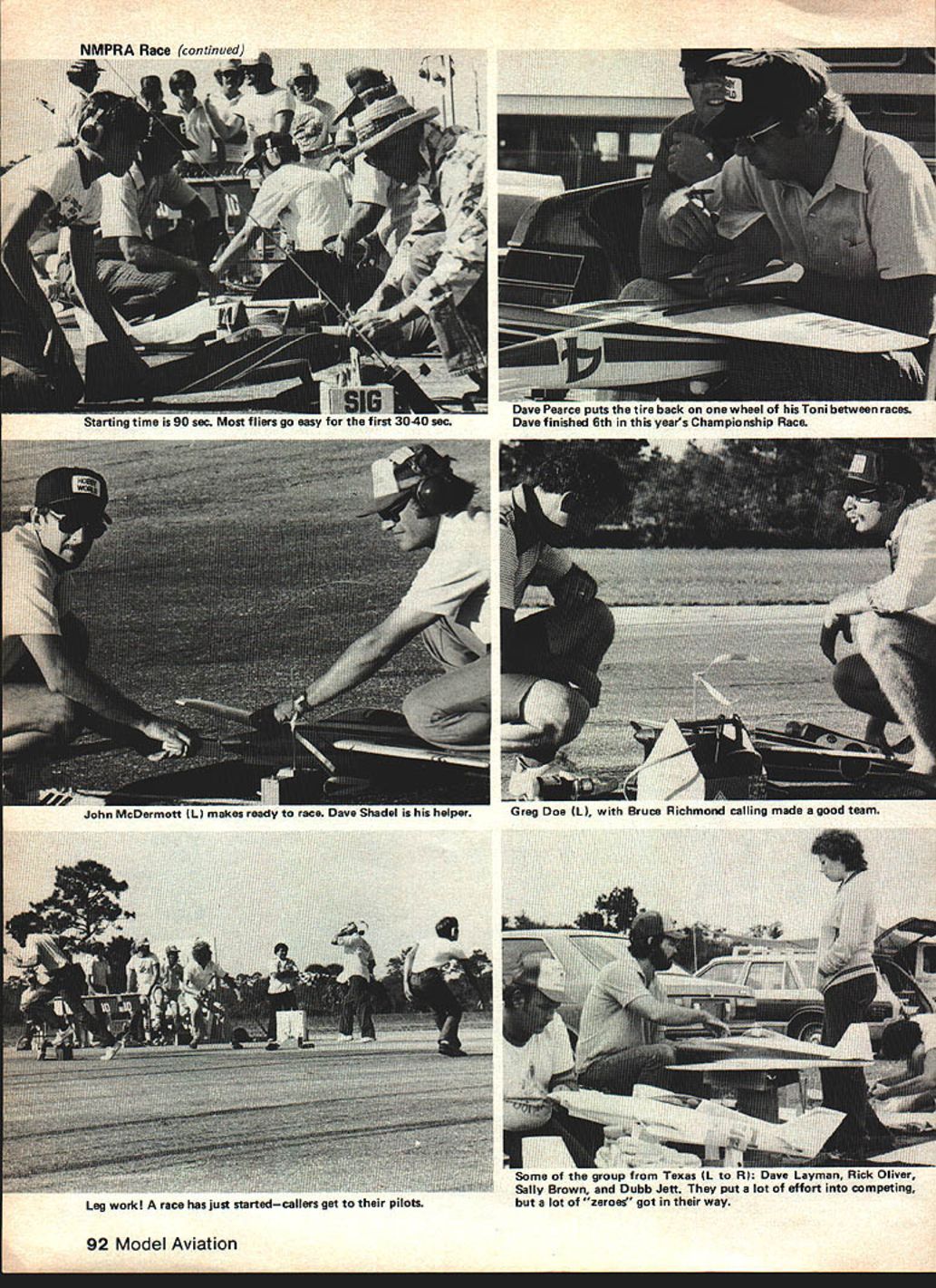
- Starting time is 90 seconds. Most fliers go easy for the first 30–40 seconds.
- Dave Pearce repairs a wheel between races; he finished 6th in the Championship Race.
- John McDermott prepares to race with Dave Shadel as his helper.
- Greg Doe, with Bruce Richmond calling, made a good team.
- Leg work is crucial when a race starts — callers get to their pilots.
- Texas group (L to R): Dave Layman, Rick Oliver, Sally Brown, and Dubb Jett — they put a lot of effort into competing despite many "zeroes."
1982 Indoor Team Program Progress
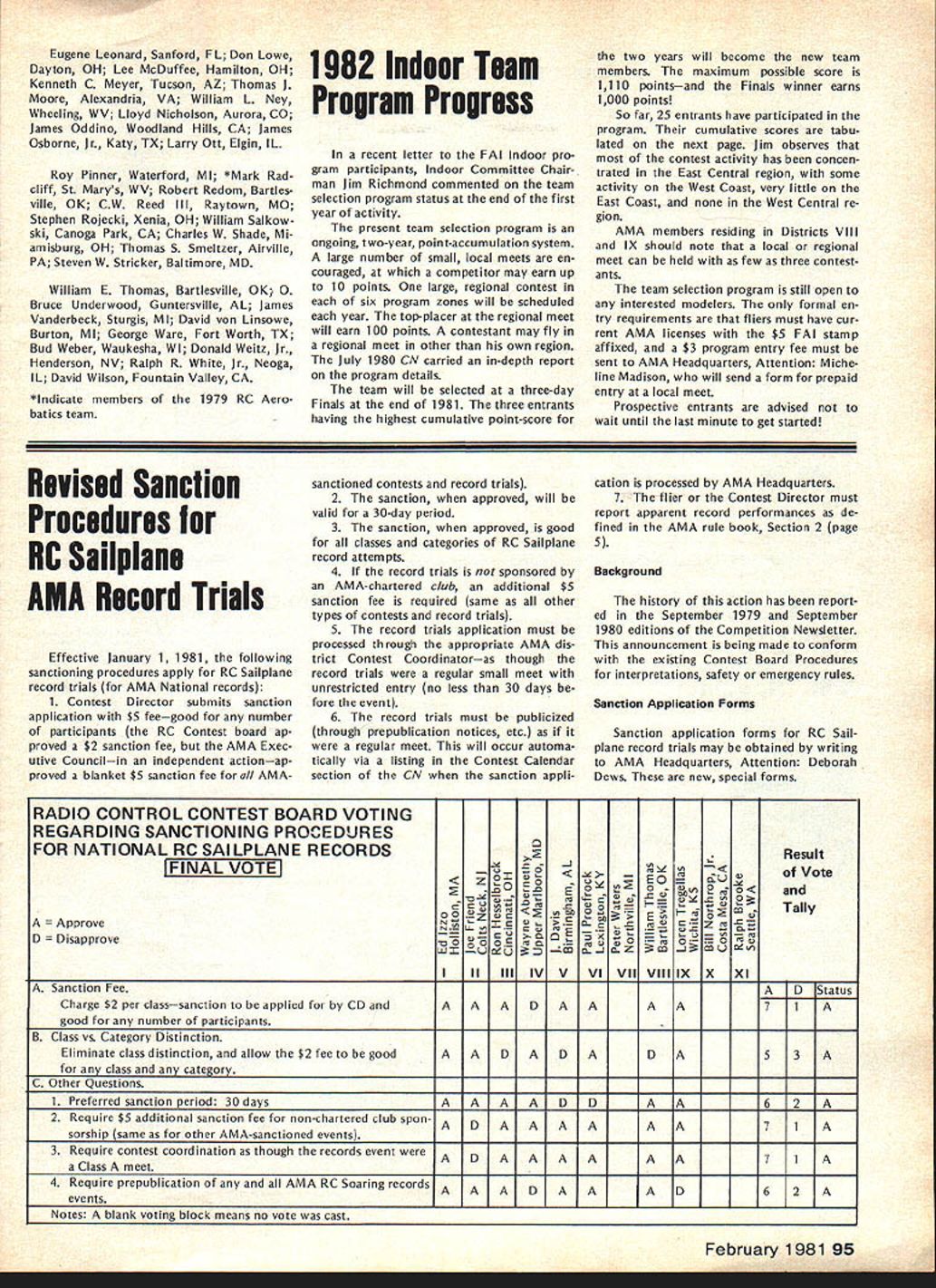
Indoor Committee Chairman Jim Richmond reported on the team selection program after the program’s first year.
- Program format: ongoing, two-year point-accumulation system.
- Local meets: many small local meets are encouraged; a competitor may earn up to 10 points at those meets.
- Regional meets: one large regional contest in each of six program zones will be scheduled each year; the regional winner earns 100 points. Competitors may fly in a regional meet outside their own region.
- Finals: the team will be selected at a three-day Finals at the end of 1981. The three entrants with the highest cumulative two-year point totals will become team members.
- Maximum possible score: 1,110 points (Finals winner earns 1,000 points).
- Participation to date: 25 entrants have participated. Activity has been concentrated in the East Central region, some on the West Coast, very little on the East Coast, and none in the West Central region.
- Note: AMA members in Districts VIII and IX: a local or regional meet may be held with as few as three contestants.
- Entry requirements: current AMA license with the $5 FAI stamp affixed, and a $3 program entry fee sent to AMA Headquarters (Attention: Michele Madison), who will send a prepaid entry form for local meets.
- Prospective entrants are advised not to wait until the last minute to begin.
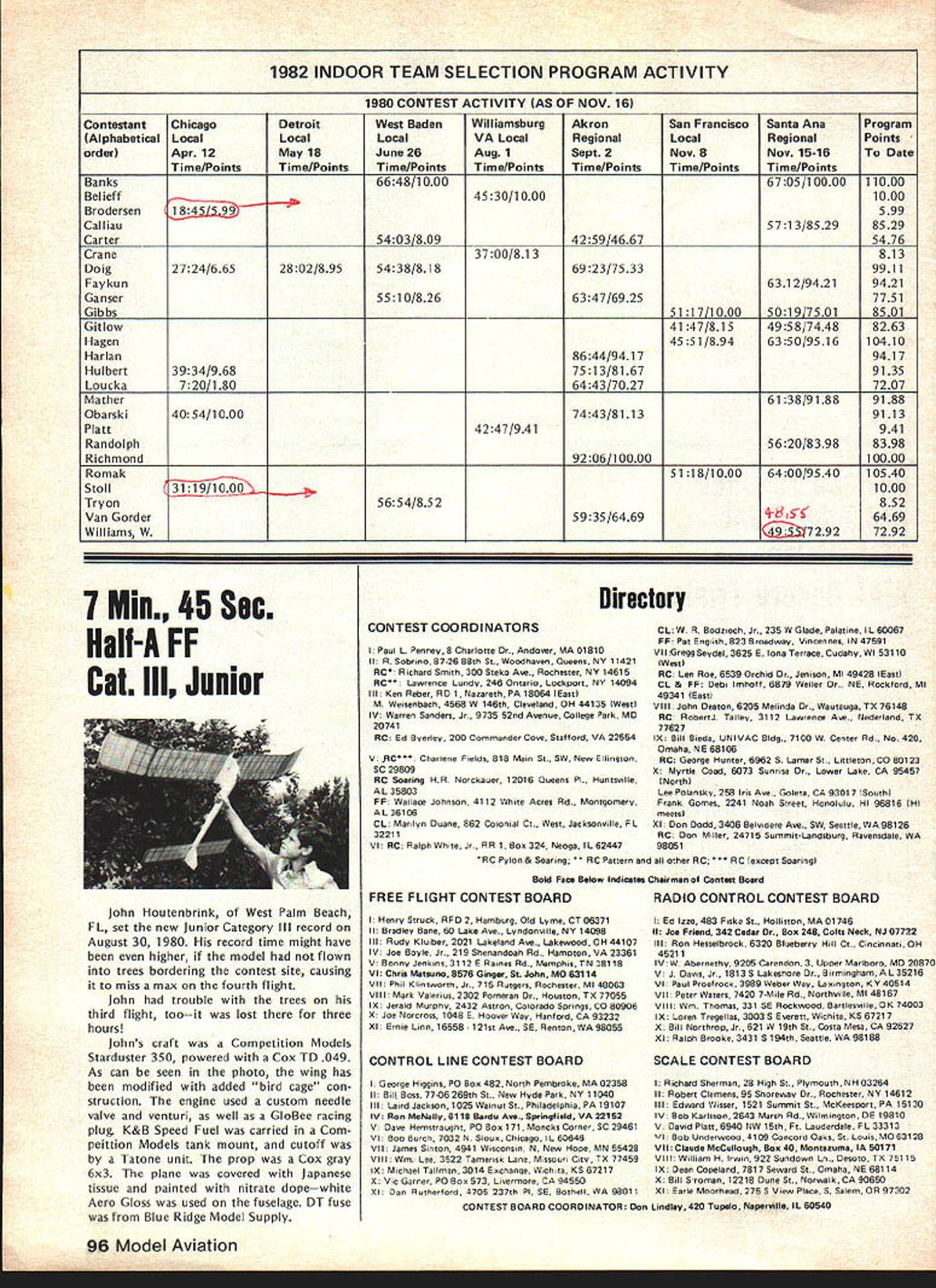
1982 Indoor Team Selection Program Activity — 1980 Contest Activity (as of Nov. 16)
(Note: Times are MM:SS; point totals follow slashes. Blank entries indicate no recorded activity as of Nov. 16, 1980.)
- Banks
- West Baden Local (June 26): 66:48 / 10.00
- Williamsburg, VA Local (Aug. 1): 45:30 / 10.00
- San Francisco Local (Nov. 8): 67:05 / 100.00
- Program Points to Date: 110.00
- Belieff
- Program Points to Date: 10.00
- Brodersen
- Chicago Local (Apr. 12): 18:45 / 5.99
- San Francisco Local (Nov. 8): 57:13 / 85.29
- Program Points to Date: 5.99
- Caillau
- Program Points to Date: 85.29
- Carter
- West Baden Local (June 26): 54:03 / 8.09
- San Francisco Local (Nov. 8): 42:59 / 46.67
- Program Points to Date: 54.76
- Crane
- Williamsburg, VA Local (Aug. 1): 37:00 / 8.13
- Program Points to Date: 8.13
- Doig
- Chicago Local (Apr. 12): 27:24 / 6.65
- Detroit Local (May 18): 28:02 / 8.95
- West Baden Local (June 26): 54:38 / 8.18
- Akron Regional (Sept. 2): 69:23 / 75.33
- Santa Ana Regional (Nov. 15–16): 63:12 / 94.21
- Program Points to Date: 99.11
- Faykun
- San Francisco Local (Nov. 8): 63:47 / 69.25
- Program Points to Date: 94.21
- Ganser
- West Baden Local (June 26): 55:10 / 8.26
- Santa Ana Regional (Nov. 15–16): 50:19 / 75.01
- San Francisco Local (Nov. 8): 51:17 / 10.00
- Program Points to Date: 77.51
- Gibbs
- Program Points to Date: 85.01
- Gitlow
- San Francisco Local (Nov. 8): 41:47 / 8.15
- Santa Ana Regional (Nov. 15–16): 49:58 / 74.48
- Program Points to Date: 82.63
- Hagen
- Akron Regional (Sept. 2): 45:51 / 8.94
- San Francisco Local (Nov. 8): 63:50 / 95.16
- Program Points to Date: 104.10
- Harlan
- Chicago Local (Apr. 12): 39:34 / 9.68
- San Francisco Local (Nov. 8): 86:44 / 94.17
- Program Points to Date: 94.17
- Hulbert
- San Francisco Local (Nov. 8): 75:13 / 81.67
- Program Points to Date: 91.35
- Loucka
- Chicago Local (Apr. 12): 7:20 / 1.80
- San Francisco Local (Nov. 8): 64:43 / 70.27
- Program Points to Date: 72.07
- Mather
- Santa Ana Regional (Nov. 15–16): 61:38 / 91.88
- Program Points to Date: 91.88
- Obarski
- Chicago Local (Apr. 12): 40:54 / 10.00
- Williamsburg, VA Local (Aug. 1): 42:47 / 9.41
- Akron Regional (Sept. 2): 74:43 / 81.13
- Program Points to Date: 91.13
- Platt
- Santa Ana Regional (Nov. 15–16): 56:20 / 83.98
- Program Points to Date: 9.41
- Randolph
- Program Points to Date: 83.98
- Richmond
- Akron Regional (Sept. 2): 92:06 / 100.00
- Program Points to Date: 100.00
- Romak
- Detroit Local (May 18): 31:19 / 10.00
- Santa Ana Regional (Nov. 15–16): 64:00 / 95.40
- Program Points to Date: 105.40
- Stoll
- Williamsburg, VA Local (Aug. 1): 51:18 / 10.00
- Program Points to Date: 10.00
- Tryon
- West Baden Local (June 26): 56:54 / 8.52
- San Francisco Local (Nov. 8): 59:35 / 64.69
- Program Points to Date: 8.52
- Van Gorder
- Santa Ana Regional (Nov. 15–16): 48:55
- Program Points to Date: 64.69
- Williams, W.
- Santa Ana Regional (Nov. 15–16): 49:55 / 72.92
- Program Points to Date: 72.92
Revised Sanction Procedures for RC Sailplane AMA Record Trials
(Effective January 1, 1981)
- Contest Director submits sanction application with $5 fee — good for any number of participants. (Note: RC Contest Board approved $2, but AMA Executive Council approved a blanket $5 sanction fee for all AMA-sanctioned contests and record trials.)
- When approved, the sanction is valid for a 30-day period.
- The sanction covers all classes and categories of RC Sailplane record attempts.
- If the record trials are not sponsored by an AMA-chartered club, an additional $5 sanction fee is required (same as other contests and record trials).
- The record trials application must be processed through the appropriate AMA district Contest Coordinator — treated as a regular small meet with unrestricted entry (no less than 30 days before the event).
- The record trials must be publicized (prepublication notices, etc.) as if a regular meet. This will occur automatically via a listing in the Contest Calendar section of CN when the sanction application is processed by AMA Headquarters.
- The flier or Contest Director must report apparent record performances as defined in the AMA rule book, Section 2 (page 5).
Background: The history of this action was reported in the September 1979 and September 1980 editions of Competition Newsletter. This announcement conforms with existing Contest Board Procedures for interpretations, safety, or emergency rules.
Sanction application forms for RC Sailplane record trials may be obtained by writing to AMA Headquarters, Attention: Deborah Dews. These are new, special forms.
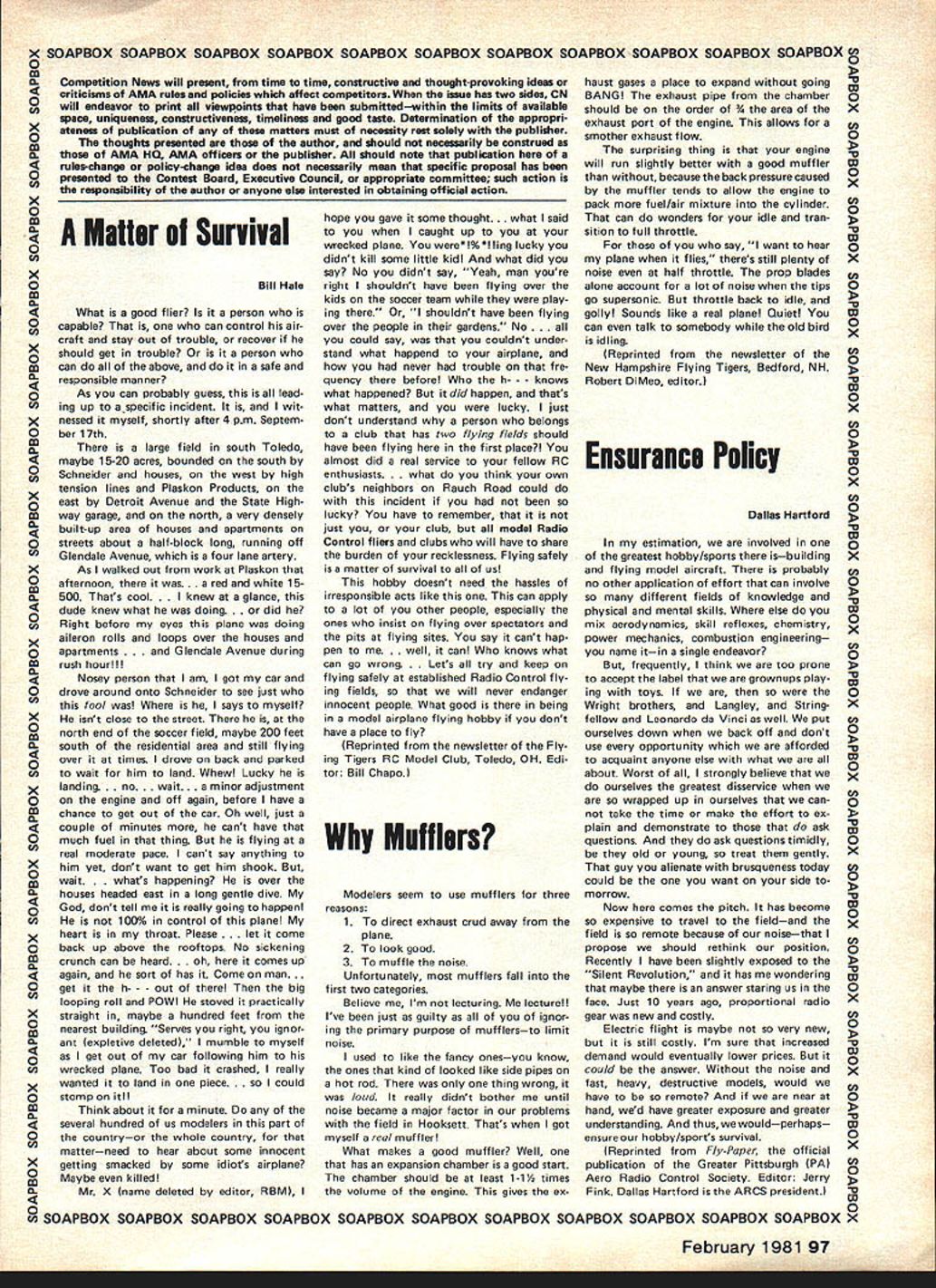
Competition Newsletter — Editorial Policy
Competition News will occasionally present constructive and thought-provoking ideas or criticisms of AMA rules and policies that affect competitors. When an issue has two sides, CN will endeavor to print viewpoints that have been submitted — within limits of available space, uniqueness, constructiveness, timeliness, and good taste. The publisher determines appropriateness of publication.
Thoughts presented are those of the author and should not necessarily be construed as those of AMA HQ, AMA officers, or the publisher. Publication here of a proposed rules or policy change does not necessarily mean that the proposal has been presented to the Contest Board, Executive Council, or an appropriate committee; presentation is the responsibility of the author or anyone seeking official action.
A Matter of Survival
By Bill Hale (reprinted from the Flying Tigers RC Model Club newsletter, Toledo, OH)
What is a good flier? Someone capable of controlling an aircraft and recovering from trouble? Or someone who does all that in a safe and responsible manner?
Bill Hale recounts an incident witnessed shortly after 4 p.m. on September 17th in south Toledo. A pilot was flying a red-and-white 15-500 performing aileron rolls and loops over houses, apartments, and Glendale Avenue during rush hour. Hale followed the pilot to the crash site after the aircraft nearly impacted rooftops and ultimately hit the ground about 100 feet from the nearest building.
Hale admonishes the pilot for reckless flying and stresses that irresponsible acts endanger innocent people and jeopardize permissions and flying fields for all RC fliers. He urges flying safely at established RC flying fields to avoid endangering bystanders and to preserve the hobby’s access to flying sites.
Why Mufflers?
(Reprinted from the New Hampshire Flying Tigers newsletter, Bedford, NH — Robert DiMeo, editor)
Modelers tend to use mufflers for three reasons:
- To direct exhaust crud away from the plane.
- To look good.
- To muffle the noise.
Unfortunately, most mufflers serve the first two purposes but do not effectively reduce noise. A good muffler typically has an expansion chamber at least 1–1.5 times the engine volume; this lets exhaust gases expand without an explosive “bang.” The exhaust pipe from the chamber should be roughly 3/4 the area of the engine’s exhaust port to allow smoother flow.
Surprisingly, a proper muffler can slightly improve engine performance by creating back pressure that helps pack more fuel/air mixture into the cylinder, improving idle and transition to full throttle. For those who want to hear their plane in flight, there is still plenty of noise at higher throttle settings; but throttling back to idle yields much quieter operation, allowing conversation while the model idles.
Insurance Policy
By Dallas Hartford (reprinted from Fly-Paper, Greater Pittsburgh Aero Radio Control Society)
Dallas Hartford praises model aviation as a rich, multidisciplinary hobby combining aerodynamics, reflexes, chemistry, power mechanics, and combustion engineering. He warns against accepting the dismissive label that modelers are “grownups playing with toys,” noting that pioneers like the Wright brothers also worked in such spheres.
Hartford encourages modelers to engage the public positively: explain and demonstrate the hobby to those who ask, and treat inquiries courteously. He suggests reconsidering reliance on noisy combustion-powered models and exploring electric flight as a path to quieter operation and more accessible flying sites. If electric flight becomes more popular and affordable, closer fields and greater public exposure might help secure the hobby’s future.
Transcribed from original scans by AI. Minor OCR errors may remain.

