
COMPETITION NEWSLETTER
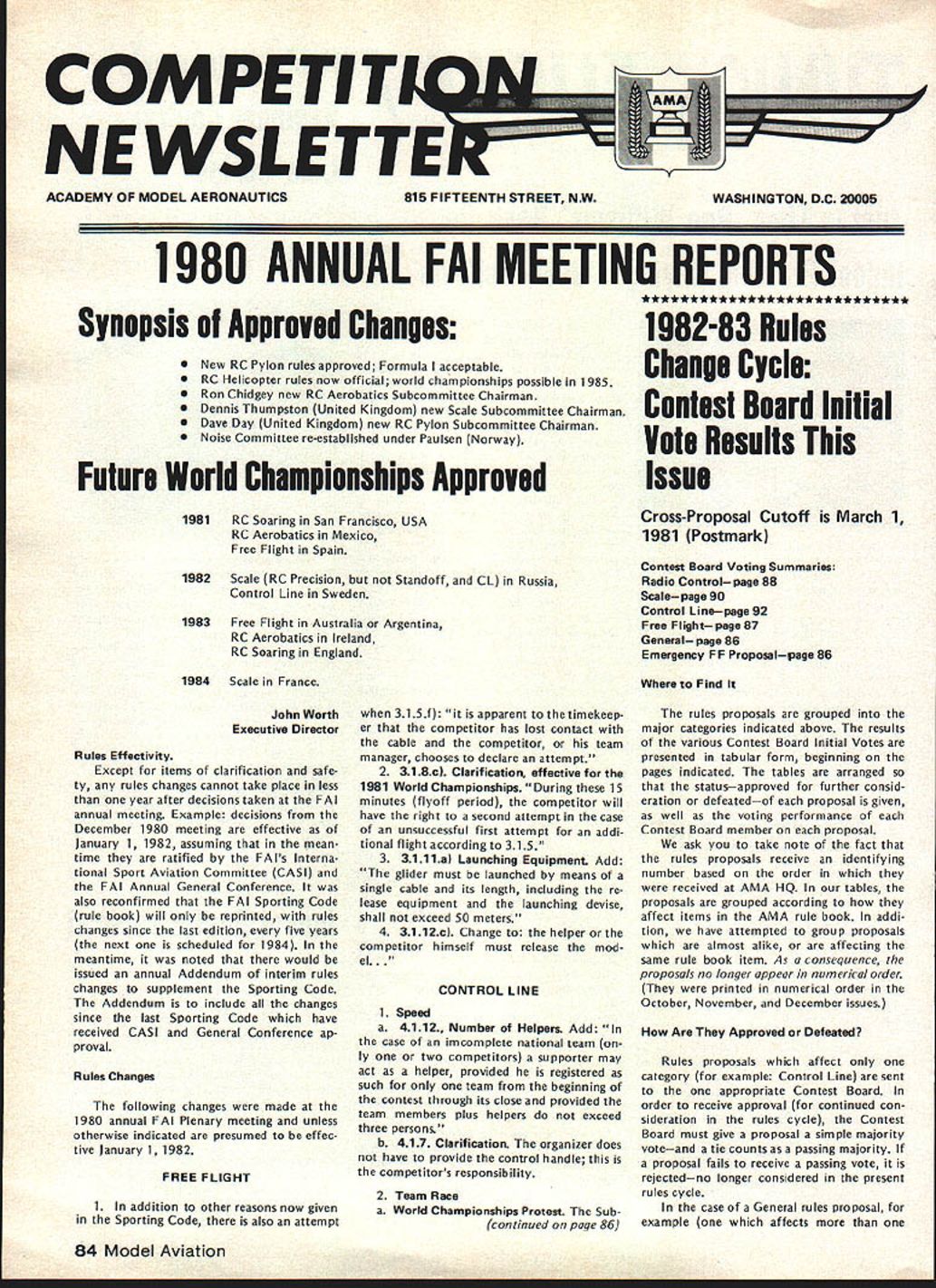
1980 ANNUAL FAI MEETING REPORTS
Synopsis of Approved Changes:
- New RC Pylon rules approved; Formula I acceptable.
- RC Helicopter rules now official; world championships possible in 1985.
- Ron Chidgey named RC Aerobatics Subcommittee Chairman.
- Dennis Thumpston (United Kingdom) named Scale Subcommittee Chairman.
- Dave Day (United Kingdom) named RC Pylon Subcommittee Chairman.
- Noise Committee re-established under Paulsen (Norway).
Future World Championships Approved
- 1981
- RC Soaring in San Francisco, USA
- RC Aerobatics in Mexico
- Free Flight in Spain
- 1982
- Scale (RC Precision, but not Standoff, and CL) in Russia
- Control Line in Sweden
- 1983
- Free Flight in Australia or Argentina
- RC Aerobatics in Ireland
- RC Soaring in England
- 1984
- Scale in France
John Worth Executive Director
Rules Effectivity
- Except for items of clarification and safety, rules changes cannot take place in less than one year after decisions taken at the FAI annual meeting. Example: decisions from the December 1980 meeting are effective as of January 1, 1982, assuming they are ratified by the FAI's International Sport Aviation Committee (CASI) and the FAI Annual General Conference.
- The FAI Sporting Code (rule book) will be reprinted, with rules changes since the last edition, only every five years (the next one is scheduled for 1984).
- An annual Addendum of interim rules changes will be issued to supplement the Sporting Code. The Addendum will include all changes since the last Sporting Code which have received CASI and General Conference approval.
Rules Changes
The following changes were made at the 1980 annual FAI Plenary meeting and, unless otherwise indicated, are presumed to be effective January 1, 1982.
FREE FLIGHT
- In addition to other reasons now given in the Sporting Code, add to 3.1.5.j: "It is apparent to the timekeeper that the competitor has lost contact with the cable and the competitor, or his team manager, chooses to declare an attempt."
- 3.1.8.c — Clarification, effective for the 1981 World Championships: "During these 15 minutes (flyoff period), the competitor will have the right to a second attempt in the case of an unsuccessful first attempt for an additional flight according to 3.1.5."
- 3.1.11.a Launching Equipment — Add: "The glider must be launched by means of a single cable and its length, including the release equipment and the launching device, shall not exceed 50 meters."
- 3.1.12.c — Change to: "the helper or the competitor himself must release the model..."
CONTROL LINE
- Speed
- 4.1.12 Number of Helpers — Add: "In the case of an incomplete national team (only one or two competitors) a supporter may act as a helper, provided he is registered as such for only one team from the beginning of the contest through its close and provided the team members plus helpers do not exceed three persons."
- 4.1.7 — Clarification: The organizer does not have to provide the control handle; this is the competitor's responsibility.
- Team Race
- (Further team-race rule changes and clarifications appear under the FAI Summary section below.)
1982–83 Rules Change Cycle
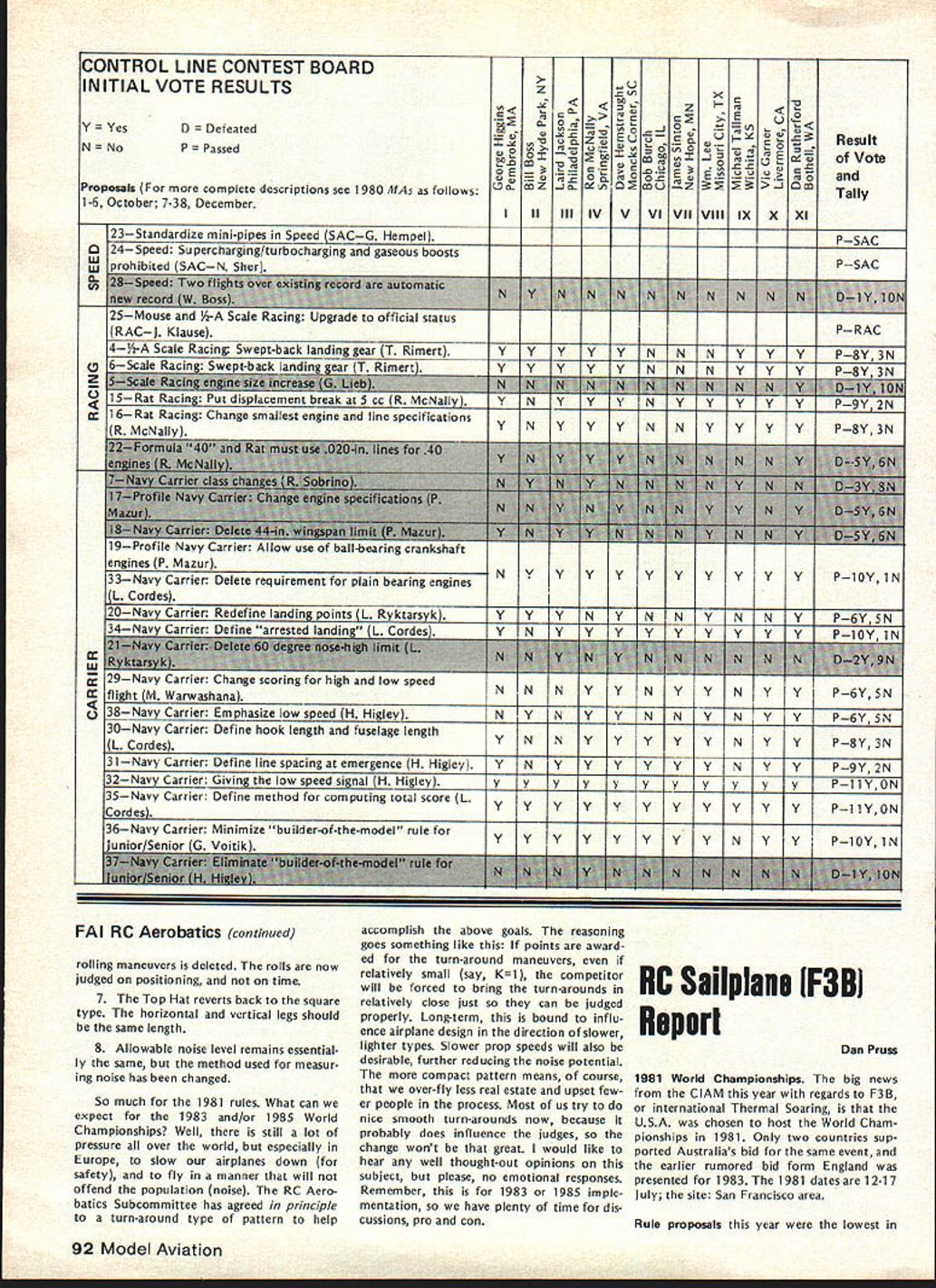
- Contest Board Initial Vote Results — This Issue.
- Cross-Proposal cutoff: March 1, 1981 (postmark).
Contest Board Voting Summaries
- Radio Control — page 88
- Scale — page 90
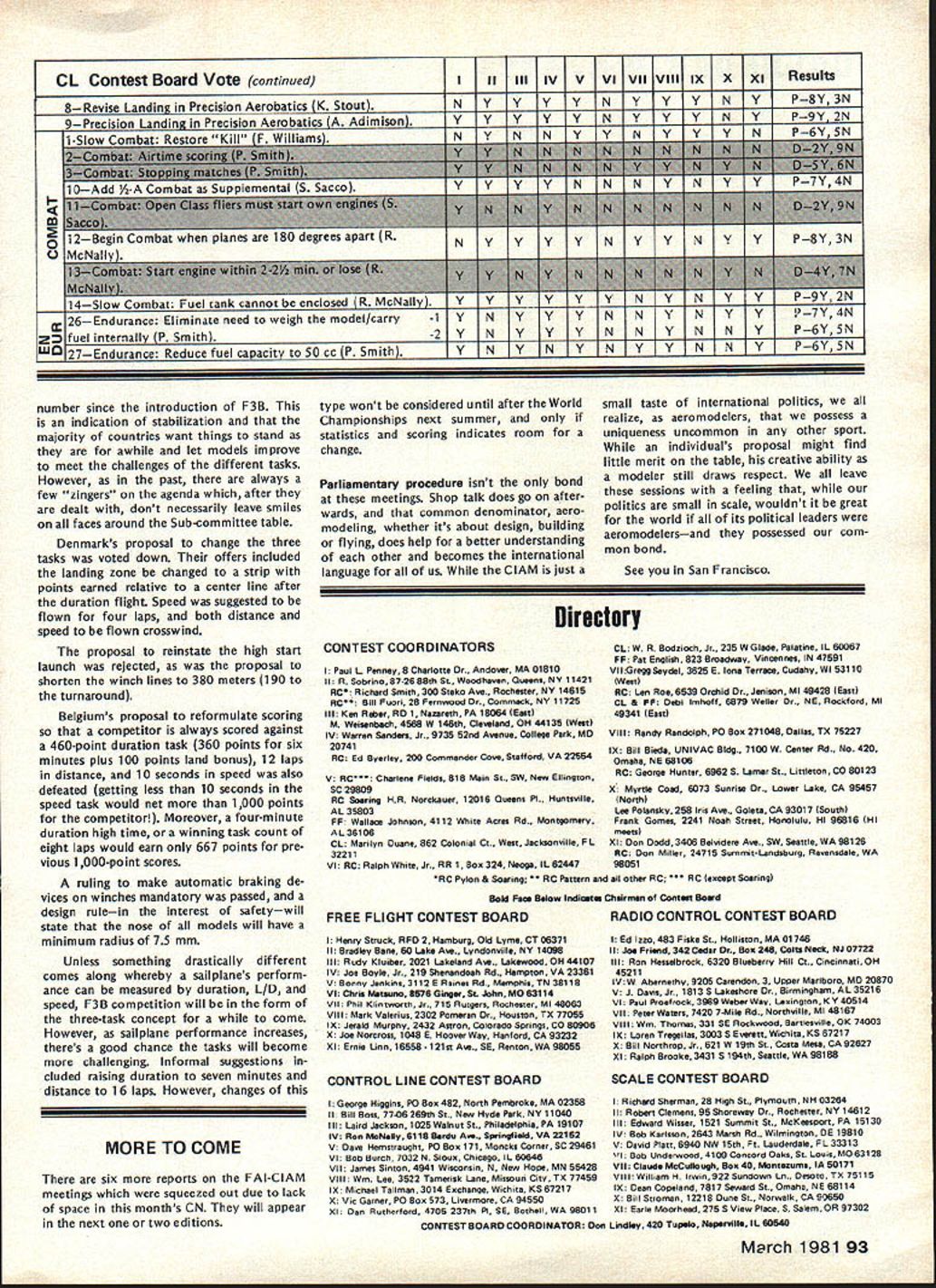
- Control Line — page 92
- Free Flight — page 87
- General — page 86
- Emergency FF Proposal — page 86
Where to Find It
- The rules proposals are grouped into the major categories indicated above. Results of the Contest Board Initial Votes are presented in tabular form starting on the pages indicated. The tables show whether each proposal was approved for further consideration or defeated, and the voting performance of each Contest Board member on each proposal.
- Proposals have identifying numbers based on the order received at AMA HQ. In the tables, proposals are grouped according to how they affect AMA rule book items, and similar proposals are grouped together, so they may not appear in numerical order.
How Are Proposals Approved or Defeated?
- Proposals affecting only one category (e.g., Control Line) are sent to the appropriate Contest Board. To receive approval for continued consideration, the Contest Board must give the proposal a simple majority vote (a tie counts as a passing majority). If a proposal fails to receive a passing vote, it is rejected for the present rules cycle.
- General proposals (affecting more than one category) must be approved by every Contest Board to "survive." A proposal can receive a combined majority yet fail if any single board defeated it.
Modeler Input Desired
Individual AMA members can participate in the rules process in two ways:
- Submit a cross-proposal to one of the "passed" proposals (details below).
- Give your opinion — pro or con — of a "passed" proposal to the Contest Board member in your AMA district. That Contest Board member will then have a better basis for his next (Interim or Final) vote on the proposal.
Cross-Proposals
- Cross-proposals are submitted on the official AMA form (copies available from AMA HQ or by copying the form printed on p. 93 of the August 1980 Model Aviation).
- A cross-proposal requires the signed approvals of three other Open-age AMA members, one of whom is a Contest Director.
- The Contest Board procedures require that a cross-proposal be submitted no later than March 1 (postmark) to be considered.
- Accepted cross-proposals will be published in the CN (probably June issue). Contest Boards then make Interim (if needed) and Final Votes, with deadlines of May 1 and September 1, respectively. Modeler comments can be submitted to Contest Board members up until the September 1 deadline.
- Results of the Final Votes will be published in the CN (probably December issue). This will give competitors a good idea of what the 1982–83 rules will be like; final details will be available when the new rule books are distributed.
New Rule Books Out When?
- The new rule book is supposed to be published and distributed by January 1, 1982. Production usually delays this target; it is hoped the book will be available within a month or two afterward.
- There is some possibility of official AMA action to defer the effective date of the new rules until January 1, 1983 (see "Rule Book Delay?" below).
Correction
One proposed rule was left out of the summary in the November 1980 issue. It is presented here for the record.
SC-82-13 — Reduce Multi-Engine Flight Points
- This proposal would reduce the maximum flight points for the multi-engine option from 20 to 10. John W. Workman of Nashville, TN argues that, except during malfunctions/engine failures, this option requires no demonstration of flying skills or aircraft characteristics, yet it normally receives maximum points. The proposed change would make the multi-engine option equivalent to all other built-in options.
- Proposed wording: Delete "and multi-engines" from 53.9.1, and delete paragraph 53.9.2, substituting: "Touch and go shall count as two options and be scored from zero to 20 points" (p. 77, para. 53.9.1, 53.9.2).
- This change would not alter the rules-change-proposal schedule—all would stay the same, except for stretching out use of the existing rule book for another year.
- Many members who initially commented against this proposal indicated they misunderstood it and would now favor it. Individual AMA members are encouraged to convey their convictions to the appropriate district Contest Board and/or Executive Council member (vice-president).
John Worth Executive Director
Rule Book Delay?
RULE BOOK EFFECTIVITY PROPOSALS REJECTED
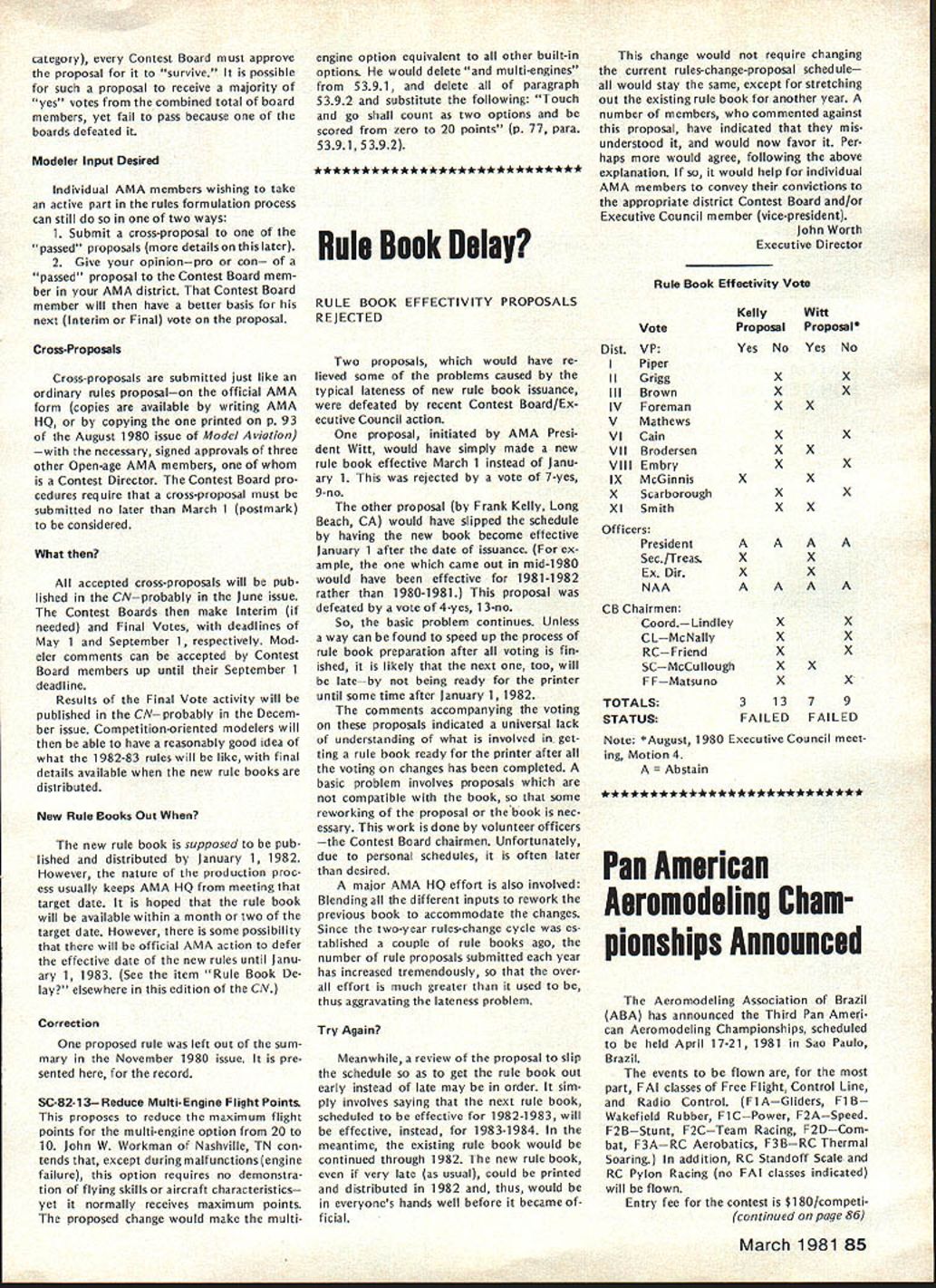
- Two proposals intended to ease problems caused by late rule book issuance were defeated by recent Contest Board/Executive Council action:
- A proposal by AMA President Witt to make a new rule book effective March 1 instead of January 1 — rejected 7 yes, 9 no.
- A proposal by Frank Kelly (Long Beach, CA) to have the new book become effective the January 1 after its issuance (so a mid-1980 book would be effective for 1981–82 rather than 1980–81) — defeated 4 yes, 13 no.
- The basic problem continues: unless the rule book preparation process after voting is speeded up, the next book may also be late (not ready for printer until after January 1, 1982).
- Comments emphasized a widespread lack of understanding of what is involved in preparing the rule book for the printer after voting. Problems include proposals incompatible with the existing book that require reworking; that work is done by volunteer officers (Contest Board chairmen) and is often delayed by personal schedules.
- AMA HQ must also blend many inputs to rework the previous book to accommodate changes. Since the two-year rules-change cycle was established, the number of proposals submitted each year has increased, greatly increasing the workload and aggravating lateness.
Try Again?
- A review is suggested of the proposal to slip the schedule so the next rule book (scheduled to be effective for 1982–83) would instead be effective for 1983–84. The existing rule book would be continued through 1982. The new book, even if printed late in 1982, would then be distributed well before its official effective date.
Rule Book Effectivity Vote (summary)
- TOTALS: 3 13 7 9
- STATUS: FAILED FAILED
- Note: *August, 1980 Executive Council meeting, Motion 4. A = Abstain
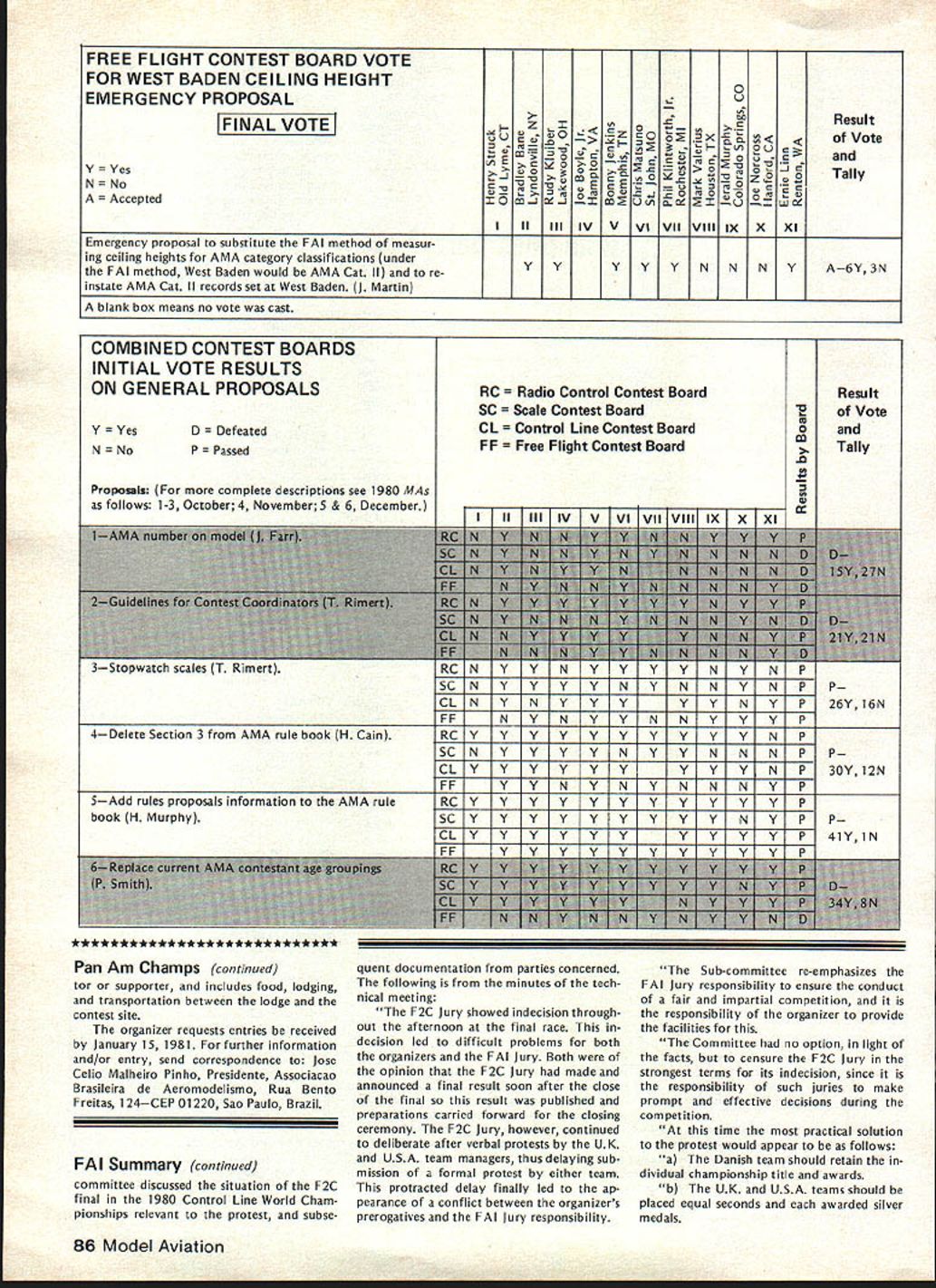
FREE FLIGHT CONTEST BOARD VOTE FOR WEST BADEN CEILING HEIGHT EMERGENCY PROPOSAL
- FINAL VOTE
- Y = Yes
- N = No
- A = Accepted
- Emergency proposal to substitute the FAI method of measuring ceiling heights for AMA category classifications (under the FAI method, West Baden would be AMA Cat. II) and to reinstate AMA Cat. II records set at West Baden. (J. Martin)
- A blank box in the published table means no vote was cast.
COMBINED CONTEST BOARDS INITIAL VOTE RESULTS ON GENERAL PROPOSALS
- Y = Yes
- N = No
- D = Defeated
- P = Passed
Proposals (for descriptions see 1980 Model Aviation issues: 1–3, October; 4, November; 5 & 6, December)
- 1 — AMA number on model (J. Farr)
- 2 — Guidelines for Contest Coordinators (T. Rimert)
- 3 — Stopwatch scales (T. Rimert)
- 4 — Delete Section 3 from AMA rule book (H. Cain)
- 5 — Add rules proposals information to the AMA rule book (H. Murphy)
- 6 — Replace current AMA contestant age groupings (P. Smith)
RC = Radio Control Contest Board SC = Scale Contest Board CL = Control Line Contest Board FF = Free Flight Contest Board
****************************
Pan Am Champs (continued)
- The organizer offers lodging that includes food and transportation between the lodge and the contest site.
- Entries requested by January 15, 1981.
- For information or entry, send correspondence to: Jose Celio Malheiro Pinho, Presidente, Associacao Brasileira de Aeromodelismo, Rua Bento Freitas, 124 — CEP 01220, Sao Paulo, Brazil.
FAI Summary (continued)
- The committee discussed the situation of the F2C final in the 1980 Control Line World Championships relative to the protest and subsequent documentation from parties concerned. From the minutes of the technical meeting:
"The F2C Jury showed indecision throughout the afternoon at the final race. This indecision led to difficult problems for both the organizers and the FAI Jury. Both were of the opinion that the F2C Jury had made and announced a final result soon after the close of the finals so this result was published and preparations carried forward for the closing ceremony. The F2C Jury, however, continued to deliberate after verbal protests by the U.K. and U.S.A. team managers, thus delaying submission of a formal protest by either team. This protracted delay finally led to the appearance of a conflict between the organizer's prerogatives and the FAI Jury responsibility."
"The Sub-committee re-emphasizes the FAI Jury responsibility to ensure the conduct of a fair and impartial competition, and it is the responsibility of the organizer to provide the facilities for this."
"The Committee had no option, in light of the facts, but to censure the F2C Jury in the strongest terms for its indecision, since it is the responsibility of such juries to make prompt and effective decisions during the competitions."
"At this time the most practical solution to the protest would appear to be as follows: a) The Danish team should retain the individual championship title and awards. b) The U.K. and U.S.A. teams should be placed equal seconds and each awarded silver medals. c) Although there is no suggestion that the Danish team was at fault during the final race of the F2C event at the World Championships, it is felt that, in view of the fact that the remaining two teams were unable to satisfactorily finish the race, the Danish team should be requested to relinquish its right as individuals under paragraph 2.3.5 of the Sporting Code."
- The Sub-committee feels strongly that F2C jury composition is critical to proper conduct at team race competition. To improve this aspect, the Committee will publish a list of recommended jury members and monitor and report on jury performance and problems in the coming year. The Committee further recommends that Mr. Rudd (U.K.) and Mr. Meijer (Netherlands), who have been on two consecutive major juries receiving significant protest, not be considered for any major jury for a period of one year.
Control Line Rule Changes (selected)
- 4.3.2.a) — Delete "the limits of which define the starting and refueling points;" and replace with: "at each sector, a starting and refueling area one meter in length, shall be marked on the outside of the flight circle, known as the pitting area." Also change "starting point" to "pitting area" in 4.3.6.d), 4.3.7.a), and change 4.3.7.k) to read "...he must go to the pitting area at (or immediately behind) the point at which..." For 4.3.14.g), delete and replace with "If a mechanic services the model outside a designated pitting area."
- 4.3.8.a) — Revise to read: "For any team any heat or semi-final that has been..."
- 4.3.8.d) — Add: "In a final race, when one team is granted an attempt because of interruption of the race through obstruction or collision, for which it is not responsible, before any team has completed 100 laps, the final race shall be stopped and reflown. Any team which has already been disqualified shall be excluded from the refly."
- 4.3.7.k) — Change to: "Should the model stop between the two pitting areas, the mechanic must go toward the nearest free pitting area."
- 4.3.13 and 4.3.14 — Clarification: Replace the term "heat" with "race" wherever it appears so that the rules apply to finals and semi-finals as well as preliminary races.
- 4.4.3 (Combat safety package) — Change from three to two concentric circles: a) the flying circle, radius 19.5 meters; and b) the center (piloting) circle, radius three meters.
- 4.12.a.1 — Add: "The pilot may be outside the pilot's circle for the launch, and the aircraft must be launched from the outside edge of the 19.5 meter pitting circle."
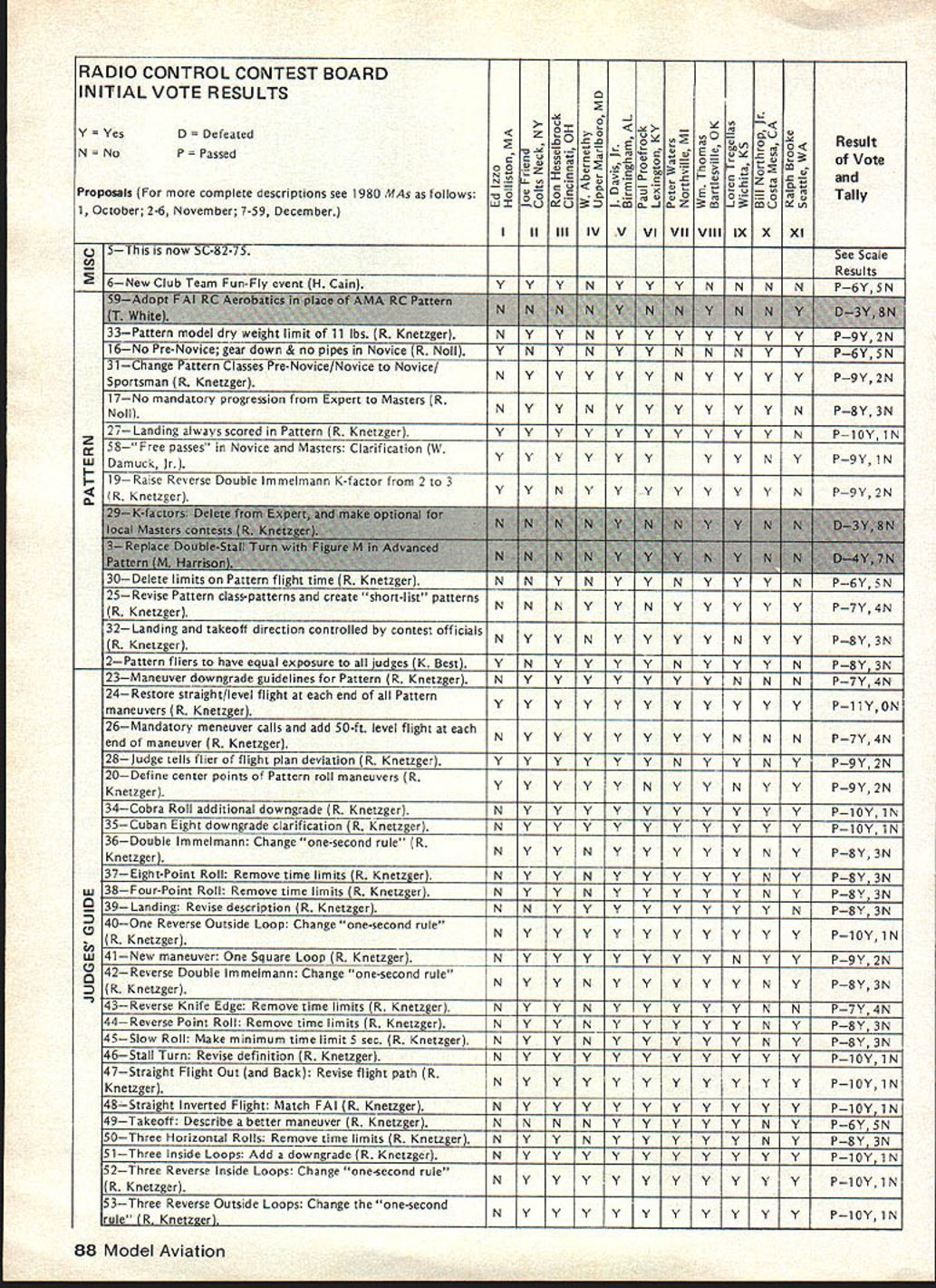
RADIO CONTROL CONTEST BOARD INITIAL VOTE RESULTS
- Y = Yes
- D = Defeated
- N = No
- P = Passed
Proposals (see 1980 Model Aviation: 1, October; 2–6, November; 7–59, December)
MISC
- 5 — Now SC-82-75 (see Scale results).
- 6 — New Club Team Fun-Fly event (H. Cain). Result: Passed (6 Yes, 5 No).
- 59 — Adopt FAI RC Aerobatics in place of AMA RC Pattern (T. White). Result: Defeated (3 Yes, 8 No).
- 33 — Pattern model dry weight limit of 11 lbs. (R. Knetzger). Result: Passed (9 Yes, 2 No).
- 16 — No Pre-Novice; gear down & no pipes in Novice (R. Noll). Result: Passed (6 Yes, 5 No).
- 31 — Change Pattern Classes Pre-Novice/Novice to Novice/Sportsman (R. Knetzger). Result: Passed (9 Yes, 2 No).
- 17 — No mandatory progression from Expert to Masters (R. Noll). Result: Passed (8 Yes, 3 No).
- 27 — Landing always scored in Pattern (R. Knetzger). Result: Passed (10 Yes, 1 No).
- 58 — "Free passes" in Novice and Masters: Clarification (W. Damuck, Jr.). Result: Passed (9 Yes, 1 No).
- 19 — Raise Reverse Double Immelmann K-factor from 2 to 3 (R. Knetzger). Result: Passed (9 Yes, 2 No).
- 29 — K-factors: Delete from Expert, and make optional for local Masters contests (R. Knetzger). Result: Defeated (3 Yes, 8 No).
- 3 — Replace Double-Stall Turn with Figure M in Advanced Pattern (M. Harrison). Result: Defeated (4 Yes, 7 No).
- 30 — Delete limits on Pattern flight time (R. Knetzger). Result: Passed (6 Yes, 5 No).
- 25 — Revise Pattern class-patterns and create "short-list" patterns (R. Knetzger). Result: Passed (7 Yes, 4 No).
- 32 — Landing and takeoff direction controlled by contest officials (R. Knetzger). Result: Passed (8 Yes, 3 No).
- 2 — Pattern fliers to have equal exposure to all judges (K. Best). Result: Passed (8 Yes, 3 No).
- 23 — Maneuver downgrade guidelines for Pattern (R. Knetzger). Result: Passed (7 Yes, 4 No).
- 24 — Restore straight/level flight at each end of all Pattern maneuvers (R. Knetzger). Result: Passed (11 Yes, 0 No).
- 26 — Mandatory maneuver calls and add 50-ft. level flight at each end of maneuver (R. Knetzger). Result: Passed (7 Yes, 4 No).
- 28 — Judge tells flier of flight plan deviation (R. Knetzger). Result: Passed (9 Yes, 2 No).
- 20 — Define center points of Pattern roll maneuvers (R. Knetzger). Result: Passed (9 Yes, 2 No).
- 34 — Cobra Roll additional downgrade (R. Knetzger). Result: Passed (9 Yes, 2 No).
- 35 — Cuban Eight downgrade clarification (R. Knetzger). Result: Passed (10 Yes, 1 No).
- 36 — Double Immelmann: Change "one-second rule" (R. Knetzger). Result: Passed (8 Yes, 3 No).
JUDGES GUIDE (selected)
- 37 — Eight-Point Roll: Remove time limits (R. Knetzger). Passed (8 Yes, 3 No).
- 38 — Four-Point Roll: Remove time limits (R. Knetzger). Passed (8 Yes, 3 No).
- 39 — Landing: Revise description (R. Knetzger). Passed (8 Yes, 3 No).
- 40 — One Reverse Outside Loop: Change "one-second rule" (R. Knetzger). Passed (10 Yes, 1 No).
- 41 — New maneuver: One Square Loop (R. Knetzger). Passed (9 Yes, 2 No).
- 42 — Reverse Double Immelmann: Change "one-second rule" (R. Knetzger). Passed (8 Yes, 3 No).
- 43 — Reverse Knife Edge: Remove time limits (R. Knetzger). Passed (7 Yes, 4 No).
- 44 — Reverse Point Roll: Remove time limits (R. Knetzger). Passed (8 Yes, 3 No).
- 45 — Slow Roll: Make minimum time limit 5 sec. (R. Knetzger). Passed (8 Yes, 3 No).
- 46 — Stall Turn: Revise definition (R. Knetzger). Passed (10 Yes, 1 No).
- 47 — Straight Flight Out (and Back): Revise flight path (R. Knetzger). Passed (10 Yes, 1 No).
- 48 — Straight Inverted Flight: Match FAI (R. Knetzger). Passed (10 Yes, 1 No).
- 49 — Takeoff: Describe a better maneuver (R. Knetzger). Passed (6 Yes, 5 No).
- 50 — Three Horizontal Rolls: Remove time limits (R. Knetzger). Passed (8 Yes, 3 No).
- 51 — Three Inside Loops: Add a downgrade (R. Knetzger). Passed (10 Yes, 1 No).
- 52 — Three Reverse Inside Loops: Change "one-second rule" (R. Knetzger). Passed (10 Yes, 1 No).
- 53 — Three Reverse Outside Loops: Change the "one-second rule" (R. Knetzger). Passed (10 Yes, 1 No).
FAI Summary (continued)
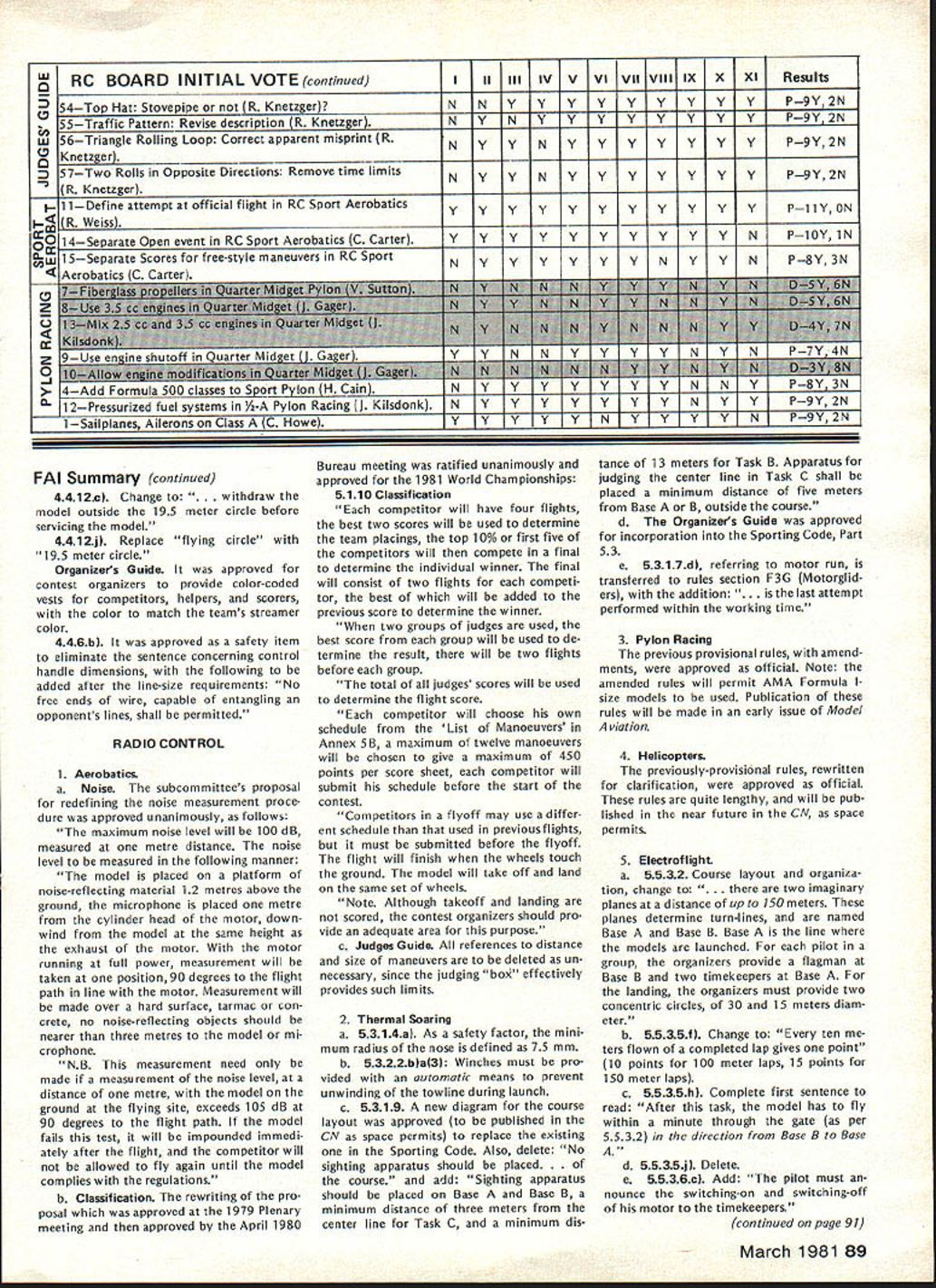
- 4.4.12.c) — Change to: "... withdraw the model outside the 19.5 meter circle before servicing the model."
- 4.4.12.j) — Replace "flying circle" with "19.5 meter circle."
- Organizer's Guide — It was approved for contest organizers to provide color-coded vests for competitors, helpers, and scorers, with the color to match the team's streamer color.
- 4.4.6.b) — Approved as a safety item to eliminate the sentence concerning control handle dimensions, and add after the line-size requirements: "No free ends of wire, capable of entangling an opponent's lines, shall be permitted."
RADIO CONTROL
#### 1. Aerobatics
a. Noise — The subcommittee's proposal redefining the noise measurement procedure was approved unanimously:
- Maximum noise level: 100 dB measured at one metre distance.
- Measurement procedure:
- Place the model on a platform of noise-reflecting material 1.2 metres above the ground.
- Place the microphone one metre from the cylinder head of the motor, downwind from the model at the same height as the exhaust.
- With the motor running at full power, take the measurement at one position, 90 degrees to the flight path in line with the motor.
- Measurement should be over a hard surface (tarmac or concrete) with no noise-reflecting objects nearer than three metres to the model or microphone.
- Note: This measurement need only be made if a measurement of the noise level at a distance of one metre with the model on the stand at the flying site exceeds 105 dB at 90 degrees to the flight path. If the model fails this test, it will be impounded immediately after that flight, and the competitor will not be allowed to fly again until the model complies.
b. Classification — The rewrite approved earlier was ratified unanimously and approved for the 1981 World Championships (5.1.10 Classification):
- Each competitor will have four flights; the best two scores will be used to determine team placings.
- The top 10% or the first five competitors will compete in a final to determine the individual winner.
- The final will consist of two flights for each competitor; the best will be added to the previous score to determine the winner.
- When two groups of judges are used, the best score from each group will be used to determine the result; there will be two flights before each group.
- The total of all judges' scores will be used to determine the flight score.
- Each competitor will choose his own schedule from the "List of Manoeuvres" in Annex 5B; a maximum of twelve manoeuvres may be chosen to give a maximum of 450 points per score sheet. Schedules must be submitted before the start of the contest.
- Competitors in a flyoff may use a different schedule than in previous flights, but it must be submitted before the flyoff.
- The flight will finish when the wheels touch the ground; the model will take off and land on the same set of wheels.
- Note: Although takeoff and landing are not scored, contest organizers should provide an adequate area for takeoff and landing.
c. Judges Guide — All references to distance and size of manoeuvres are to be deleted as unnecessary since the judging "box" provides limits.
#### 2. Thermal Soaring
- 5.3.1.4.a) — As a safety factor, the minimum radius of the nose is defined as 7.5 mm.
- 5.3.2.2.b(3) — Winches must have automatic means of preventing unwinding of the towline during launch.
- 5.3.1.9 — A new diagram for the course layout was approved (to be published in the CN as space permits) to replace the existing one in the Sporting Code. Also delete: "No sighting apparatus should be placed ... of the course." Add: "Sighting apparatus should be placed on Base A and Base B, a minimum distance of three meters from the center line for Task C, and a minimum distance of 13 meters for Task B. Apparatus for judging the center line in Task C shall be placed a minimum distance of five meters from Base A or B, outside the course."
- Organizer's Guide — Approved for incorporation into the Sporting Code, Part 5.3.
- 5.3.17.d — Referring to motor run, transferred to rules section F3G (Motorgliders), with addition: "... is the last attempt performed within the working time."
#### 3. Pylon Racing
- The previous provisional rules, with amendments, were approved as official. The amended rules permit AMA Formula 1-size models to be used. Publication of these rules will be made in an early issue of Model Aviation.
#### 4. Helicopters
- The previously provisional rules, rewritten for clarification, were approved as official. These rules are lengthy and will be published in the CN as space permits.
#### 5. Electroflight
- 5.5.3.2 Course layout and organization — Change to: "... there are two imaginary planes at a distance of up to 150 meters. These planes determine turn-lines, and are named Base A and Base B. Base A is the line where the models are launched. For each pilot in a group, the organizers provide a flagman at Base B and two timekeepers at Base A. For the landing, the organizers must provide two concentric circles, of 30 and 15 meters diameter."
- 5.5.3.5(1) — Change to: "Every ten meters flown of a completed lap gives one point" (10 points for 100 meter laps, 15 points for 150 meter laps).
- 5.5.3.5(h) — Complete first sentence: "After this task, the model has to fly within a minute through the gate (as per 5.5.3.2) in the direction from Base B to Base A."
- 5.5.3.5(j) — Delete.
- 5.5.3.6.c) — Add: "The pilot must announce the switching on and switching off of his motor to the timekeepers."
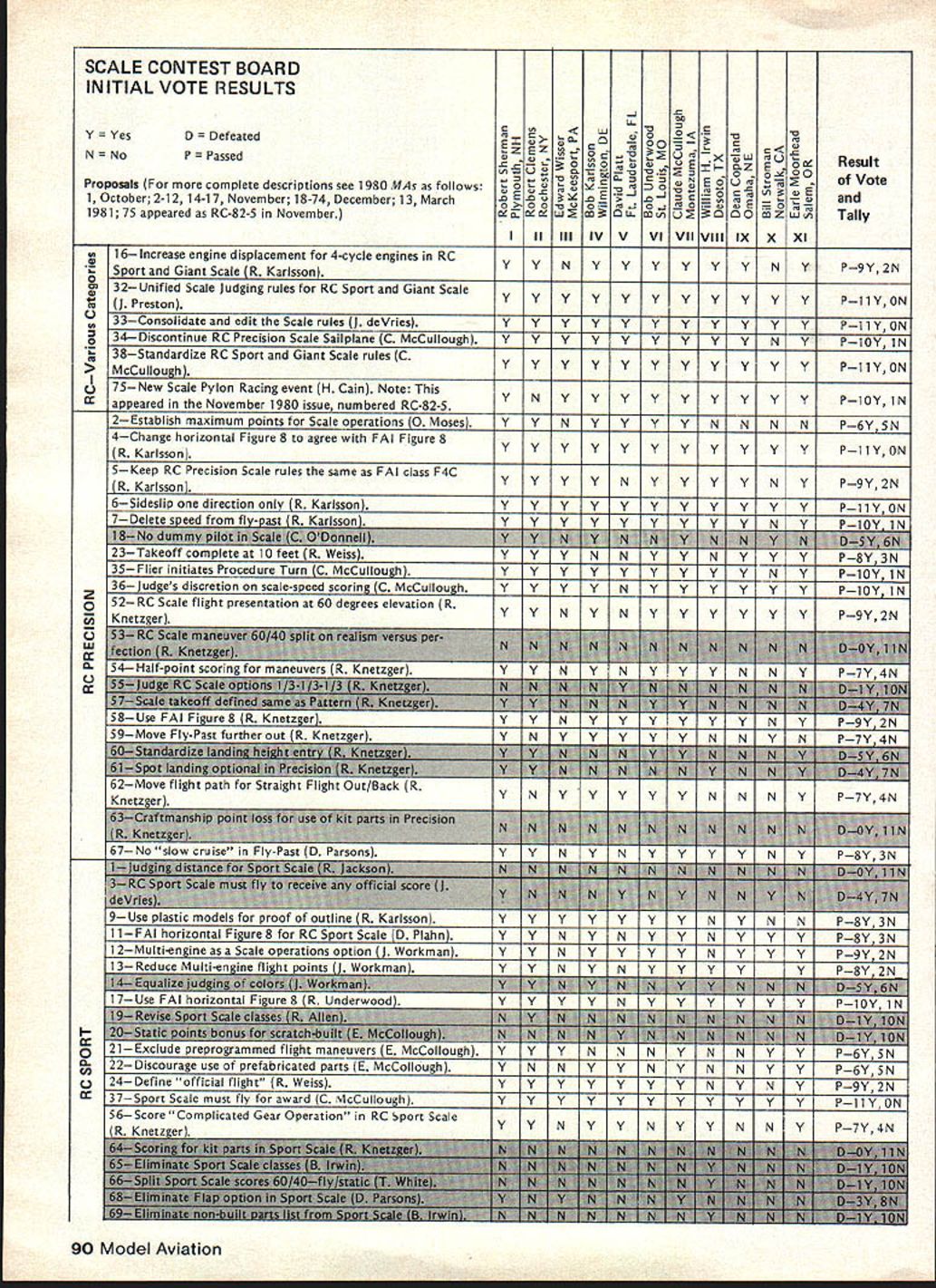
SCALE CONTEST BOARD INITIAL VOTE RESULTS
- Y = Yes
- D = Defeated
- N = No
- P = Passed
Proposals (see 1980 Model Aviation: 1, October; 2–12, 14–17, November; 18–74, December; 13, March 1981; 75 appeared as RC-82-5 in November)
- 16 — Increase engine displacement for 4-cycle engines in RC Sport and Giant Scale (R. Karlsson). Result: Passed (9 Yes, 2 No)
- 32 — Unified Scale Judging rules for RC Sport and Giant Scale (J. Preston). Passed (11 Yes, 0 No)
- 33 — Consolidate and edit the Scale rules (J. deVries). Passed (11 Yes, 0 No)
- 34 — Discontinue RC Precision Scale Sailplane (C. McCullough). Passed (10 Yes, 1 No)
- 38 — Standardize RC Sport and Giant Scale rules (C. McCullough). Passed (11 Yes, 0 No)
- 75 — New Scale Pylon Racing event (H. Cain). (Appeared as RC-82-5 in November.) Passed (10 Yes, 1 No)
- 2 — Establish maximum points for Scale operations (O. Moses). Passed (6 Yes, 5 No)
- 4 — Change horizontal Figure 8 to agree with FAI Figure 8 (R. Karlsson). Passed (11 Yes, 0 No)
- 5 — Keep RC Precision Scale rules the same as FAI class F4C (R. Karlsson). Passed (9 Yes, 2 No)
- 6 — Sideslip one direction only (R. Karlsson). Passed (11 Yes, 0 No)
- 7 — Delete speed from fly-past (R. Karlsson). Passed (10 Yes, 1 No)
- 18 — No dummy pilot in Scale (C. O'Donnell). Defeated (5 Yes, 6 No)
- 23 — Takeoff complete at 10 feet (R. Weiss). Passed (8 Yes, 3 No)
- 35 — Flier initiates Procedure Turn (C. McCullough). Passed (10 Yes, 1 No)
- 36 — Judge's discretion on scale-speed scoring (C. McCullough). Passed (10 Yes, 1 No)
- 52 — RC Scale flight presentation at 60 degrees elevation (R. Knetzger). Passed (9 Yes, 2 No)
- 53 — RC Scale manoeuver 60/40 split on realism versus perfection (R. Knetzger). Defeated (0 Yes, 11 No)
- 54 — Half-point scoring for maneuvers (R. Knetzger). Passed (7 Yes, 4 No)
- 55 — Judge RC scale options 1/3-1/3-1/3 (R. Knetzger). Defeated (1 Yes, 10 No)
- 57 — Scale takeoff defined same as Pattern (R. Knetzger). Passed (4 Yes, 7 No)
- 58 — Use FAI Figure 8 (R. Knetzger). Passed (4 Yes, 7 No)
- 59 — Move Fly-Past further out (R. Knetzger). Passed (9 Yes, 2 No)
- 60 — Standardize landing height entry (R. Knetzger). Passed (7 Yes, 4 No)
- 61 — Spot landing optional in Precision (R. Knetzger). Defeated (5 Yes, 6 No)
- 62 — Move flight path for Straight Flight Out/Back (R. Knetzger). Passed (7 Yes, 4 No)
- 63 — Craftsmanship point loss for use of kit parts in Precision (R. Knetzger). Defeated (0 Yes, 11 No)
- 67 — No "slow cruise" in Fly-Past (D. Parsons). Passed (8 Yes, 3 No)
- 1 — Judging distance for Sport Scale (R. Jackson). Defeated (0 Yes, 11 No)
- 3 — RC Sport Scale must fly to receive any official score (J. deVries). Defeated (4 Yes, 7 No)
- 9 — Use plastic models for proof of outline (R. Karlsson). Passed (8 Yes, 3 No)
- 11 — FAI horizontal Figure 8 for RC Sport Scale (D. Plahn). Passed (8 Yes, 3 No)
- 12 — Multi-engine as a Scale operations option (J. Workman). Passed (8 Yes, 2 No)
- 13 — Reduce Multi-engine flight points (J. Workman). Passed (8 Yes, 2 No)
- 14 — Equalize judging of colors (J. Workman). Defeated (5 Yes, 6 No)
- 17 — Use FAI horizontal Figure 8 (R. Underwood). Passed (10 Yes, 1 No)
- 19 — Revise Sport Scale classes (R. Allen). Defeated (1 Yes, 10 No)
- 20 — Static points bonus for scratch-built (E. McCollough). Defeated (1 Yes, 10 No)
- 21 — Exclude preprogrammed flight maneuvers (E. McCollough). Passed (6 Yes, 5 No)
- 22 — Discourage use of prefabricated parts (E. McCollough). (Result unclear in table)
- 24 — Define "official flight" (R. Weiss). Passed (9 Yes, 2 No)
- 37 — Sport Scale must fly for award (C. McCullough). Passed (11 Yes, 0 No)
- 56 — Score "Complicated Gear Operation" in RC Sport Scale (R. Knetzger). Passed (7 Yes, 4 No)
- 64 — Scoring for kit parts in Sport Scale (R. Knetzger). Defeated (0 Yes, 11 No)
- 65 — Eliminate Sport Scale classes (B. Irwin). Defeated (1 Yes, 10 No)
- 66 — Split Sport Scale scores 60/40 — fly/static (T. White). Defeated (1 Yes, 10 No)
- 68 — Eliminate flap option in Sport Scale (D. Parsons). Defeated (3 Yes, 8 No)
- 69 — Eliminate non-built parts list from Sport Scale (B. Irwin). Defeated (1 Yes, 10 No)
Model Aviation
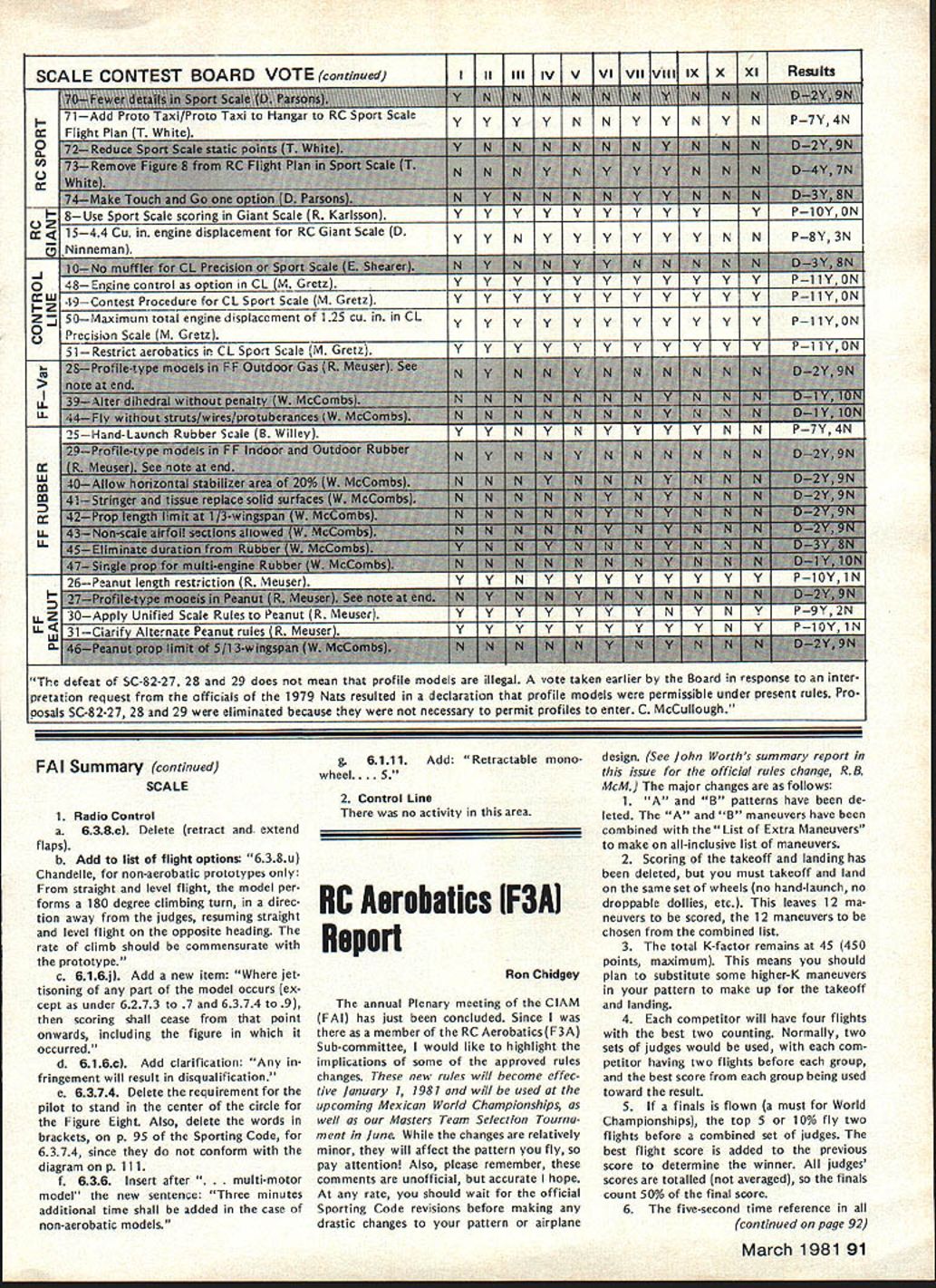
FAI Summary (continued) — SCALE
- Radio Control
- 6.3.8.c — Delete (retract and extend flaps).
- Add to list of flight options:
- 6.3.8.u Chandelle, for non-aerobatic prototypes only: From straight and level flight, the model performs a 180 degree climbing turn, in a direction away from the judges, resuming straight and level flight on the opposite heading. The rate of climb should be commensurate with the prototype.
- 6.1.6.j — Add new item: "Where jettisoning of any part of the model occurs (except as under 6.2.7.3 to .7 and 6.3.7.4 to .9), then scoring shall cease from that point onwards, including the figure in which it occurred."
- 6.1.6.c — Add clarification: "Any infringement will result in disqualification."
- 6.3.7.4 — Delete the requirement for the pilot to stand in the center of the circle for the Figure Eight. Also delete the words in brackets on p. 95 of the Sporting Code for 6.3.7.4, since they do not conform with the diagram on p. 111.
- 6.3.6 — Insert after "... multi-motor model" the new sentence: "Three minutes additional time shall be added in the case of non-aerobatic models."
- 6.1.11 — Add: "Retractable mono-wheel...5". (Published wording to follow.)
- Control Line
- No activity in this area.
RC AEROBATICS (F3A) REPORT
Ron Chidgey
- The annual Plenary meeting of the CIAM (FAI) has been concluded. As a member of the RC Aerobatics (F3A) Sub-committee, I highlight the implications of some approved rules changes. These new rules become effective January 1, 1981 and will be used at the upcoming Mexican World Championships and our Masters Team Selection Tournament in June.
- While the changes are relatively minor, they will affect the pattern you fly. These comments are unofficial but accurate; wait for official Sporting Code revisions before making major changes to your pattern or airplane design. (See John Worth's summary for the official rules change.)
Major changes:
- "A" and "B" patterns have been deleted. The "A" and "B" maneuvers have been combined with the "List of Extra Maneuvers" to make an all-inclusive list of maneuvers.
- Scoring of the takeoff and landing has been deleted, but you must take off and land on the same set of wheels (no hand-launch, no droppable dollies, etc.). This leaves 12 maneuvers to be scored, chosen from the combined list.
- The total K-factor remains at 45 (450 points maximum). Plan to substitute some higher-K maneuvers to make up for the deleted takeoff and landing scores.
- Each competitor will have four flights with the best two counting. Normally two sets of judges would be used; each competitor has two flights before each group, and the best score from each group is used toward the result.
- If a finals is flown (required for World Championships), the top 5 or 10% fly two flights before a combined set of judges. The best flight score is added to the previous score to determine the winner. All judges' scores are totaled (not averaged), so the finals count 50% of the final score.
- The five-second time reference in all rolling maneuvers is deleted. Rolls are now judged on positioning, not time.
- The Top Hat reverts to the square type. The horizontal and vertical legs should be the same length.
- Allowable noise level remains essentially the same, but the noise measurement method has changed.
Looking ahead:
- There is pressure, especially in Europe, to slow airplanes down for safety and noise reasons. The RC Aerobatics Subcommittee has agreed in principle to a turn-around type of pattern to help: awarding points for turn-arounds will encourage competitors to bring them in closer for judging, influencing aircraft design toward slower, lighter types and reduced noise. This is a long-term idea for possible implementation in 1983 or 1985.
- Please send well-considered opinions on this subject (no emotional responses). This is for future consideration, so there is time for discussion.
- Additional FAI-CIAM reports were omitted from this CN due to space; they will appear in the next one or two editions.
MORE TO COME
- Six more reports on the FAI-CIAM meetings will appear in the next one or two editions.
Transcribed from original scans by AI. Minor OCR errors may remain.

