
1981 RC SOARING WORLD CHAMPS: SACRAMENTO
The Red Lion Inn, one of the finest hotels ever associated with an aeromodeling world championships, will be the lodging headquarters for the FAI Thermal Soaring World Championships, July 12–17, 1981. The location is Sacramento, CA, about an hour-and-a-half drive northeast of San Francisco.
The Inn is on the southeast side of Sacramento, and the flying site is about 25 miles south, near Courtland. The site is excellent — very flat for miles around with few trees or other obstructions. It was the location used for the 1980 Quarter Scale meet, which was highly praised for the perfect terrain.
A package deal on lodging and meals is being offered through the Academy of Model Aeronautics (AMA). The package price, per person (double occupancy/two beds), is $250 and covers six nights at the Inn and four days of meals (including the closing banquet), plus airfield entry identification and world championships souvenirs. This is far cheaper than the usual cost for these superior accommodations. Other arrangements (single occupancy, three- or four-person rooms, one bed instead of two) will be offered at varying prices.
Teams from approximately 20 countries are expected to participate, bringing some of the best RC soaring fliers in the world. They will fly Duration, Distance, and Speed tasks under Federation Aeronautique Internationale (FAI) rules. The AMA is the host organization for the USA, acting on behalf of the National Aeronautic Association. Organization of the event is much like the Olympics, with an international atmosphere — flags, team uniforms, national anthems — all part of the scene.
Three AMA-member Californians are among the local leaders providing support: Don Anthony, David Vincze, and Jerry Slates. They met with AMA President Earl Witt and Executive Director John Worth in Sacramento on January 12 to examine the site and hotel and to make preliminary plans. Also involved in initial planning were Tully Simoni (former president of the South Bay Soaring Society) and Rick Schramek, who initiated the northern California offer after a southern California offer was withdrawn.
The event is being supported primarily by volunteers from San Francisco Bay area soaring clubs, with additional volunteers expected from across the country. Under AMA auspices, world championships of various types have been held in recent years: Indoor at West Baden, IN (1980); Free Flight at Taft, CA (1979); RC Aerobatics in Springfield, OH (1977) and Doylestown, PA (1971); AerOlympics at Lakehurst, NJ (1974).
---
Competition Newsletter
FAI/CIAM Reports Continue
Some have wondered about the usefulness of sending an AMA contingent to FAI meetings, since attendance involves considerable investment of AMA membership dues. Sending a large delegation demonstrates leadership and maximizes our voice in arriving at international competition rules.
At the meeting we found two countries represented by RC Helicopter technical advisors — Belgium and the USA. Mr. Francis DeProft discussed the RC Helicopter rules proposal before it was presented to the RC Subcommittee. During discussion, a number of amendments were added based on experience directing helicopter contests over the last five years. We are glad Mr. DeProft agreed to the suggestions, so the rules presented for official approval contained necessary corrections.
We hope additional countries, especially those with significant helicopter activity, will send RC Helicopter technical advisors to future discussions. That will result in a better set of FAI rules. We also encourage contest directors in each country to use the FAI maneuver schedule to gain experience and help develop competitors.
Want '81 hats? Entry forms — Indoor Nats, Outdoor Nats
- Both Nats request entry forms from AMA Headquarters.
- Please be sure to indicate which Nats form you want; this will save headaches and speed processing at HQ.
---
1982 FAI CL Combat Team Selection Program — Finals Site Approved
- Finals site: Nashville, TN — September 19–20, 1981.
- In recently completed balloting, team participants voted to hold the Finals in Nashville. Approval affects future-year programs inasmuch as current planning is now separated from the basic program. One beneficial aspect is that the program can remain stable even though locations and people may change from year to year.
Complete program details are available from AMA HQ. Send a request, Attention: Michelline Madison.
---
Pylon Racing / FAI Class F3D (discussion and points)
All of you know I love this event and have flown it for many years. I'd like to encourage AMA modelers to get started in this sport. Here are points for serious consideration:
- Pylon Racing in the U.S. is stalemated at a high level of activity. Worldwide, it is stalemated. There has been nothing new or exciting in several years. This FAI event is all-new, challenging, and capable of being very exciting.
- With respect to the new FAI RC Pylon Racing model:
- Most existing Formula 1 models will meet the rules and will be competitive.
- A highly developed model, refined for the FAI event, would be superior to a current Formula 1 model and would probably be the finest racer conceivable within our limitations.
- The engine for the Class F3D model:
- Has only one limitation — displacement: it can be no larger than .40 cu in.
- Could be right out of one of our existing Formula 1 racers; removing a head shim might be the only adaptation required.
- Competition costs should be lower:
- The fuel specified (80% methanol, 20% oil) is cheap and is furnished free at the contests.
- Engine wear and tear should be greatly reduced with no nitro in the fuel.
- Less noise! Class F3D models must be quiet, making them more acceptable in many locales:
- Tuned pipe exhaust systems are allowed.
- The "Magic Muffler" and other styles are allowed.
- Tuned exhaust systems will allow experimentation with supercharging.
- This event is worldwide, not restricted to the U.S.
- The scoring method for F3D recognizes individual performance in every heat; "freebies" and weak competition cannot unduly affect the race outcome.
- Competition at several levels should be stimulated:
- Strictly American races can be held at the local level.
- International meets involving contestants from several nations are part of the FAI program.
- For the first time there will be an RC Pylon Racing World Championship; a World Champion and a World Champion Team will be determined.
This new FAI class could address many problems facing RC Pylon Racing and could produce the finest pylon racing the world has seen. However, for FAI to succeed, they need more participation in Pylon; the logical source is the United States.
Semi-Finals, Selected Contests, and Finals will be flown in rounds using the FAI field layout. Advancement from Semi-Finals is based on a formula identifying how many fliers may be advanced at each meet based on the number flying locally and nationally, limited to approximately 30 fliers. One flier is assured advancement at each Semi-Final, as is any flier scoring at least 95% of the winning time in his event at that meet.
Advancement formula:
- N = (L / C) × K
- N = number of fliers to be advanced to Finals from a local Semi-Final
- L = number of fliers in any one event at the local Semi-Final
- C = total number of fliers in any one event in all Semi-Finals
- K = program constant = 30
- Alternates may be selected at Semi-Finals if they score at least 80% of the time of the lowest Finals qualifier at that meet.
Selected Contests advancement:
- Limited to the winner in each event only — and only if there are at least five fliers in the event.
Contest Entry Fees:
- $5 basic qualification entry fee gets you into one (or more) Qualification Trials or AMA-sanctioned contests.
- If you advance to the Semi-Finals: $20 per event per contestant (Juniors exempt).
- Entry into Selected Contests: one-time $10 payment (in addition to $20 Semi-Finals fee and $5 qualification fee); fees sent to AMA HQ.
- Advancement to Finals: $40 per event per contestant (Juniors exempt).
---
FF Team (continued)
Advancement formula for each Semi-Final:
- N = (L / C) × K
Plus:
- At least one flier per event advanced from each Semi-Final.
- Any flier scoring at least 95% of the winning time in his event can also advance.
- Alternates may be selected for invitation to the Finals if the flier scores at least 80% of the time of the lowest Finals qualifier at that Semi-Final.
- Entry fee: $20 per event per contestant. No charge to Juniors.
---
Selected Contests
- Approximately 15 meets in 1981.
- One-time $10 fee (in addition to Qualification and Semi-Finals entry fees).
- Only one flier per event advanced — and only if there are at least five fliers per event entered. (No alternates.)
- Must forward entry form/affidavit to AMA HQ within seven days (postmark) of the meet.
---
Finals
- Structured: fly in rounds, FAI field layout, etc.
- Single-site: location/date determined by vote of finalists.
- Three-day event.
- Expected timeframe: August 1 — November 1, 1982.
- Entry fee: $40 per event per contestant. No charge to Juniors.
- Models: no more than three per event per day.
---
Combat Team (continued)
Late entry: up until 7:00 p.m. on the Friday night before the Finals (late entry fee $75 — payable at the Finals site). For the current program, that deadline is September 18, 1981. If you desire to enter the next program, you can get in on early planning by making a $5 down payment on the entry fee to AMA HQ.
Participation is open to any U.S. citizen with an AMA license and an FAI competition stamp ("$5 stamp") who pays the entry fee.
Items of Interest
- Protests at the Finals:
- If a verbal protest cannot be reconciled and the contestant wishes to file a written protest, he must first pay a $10 filing fee.
- The protest will be reviewed by an on-site FAI jury, who will decide the matter.
- If the protest is rejected, the filing fee will go into the team fund.
- If the protest is upheld (resulting in reversal of the protested match) or if a re-fly is ordered, the filing fee is returned to the competitor.
- If the protest fee is paid, the contest director must suspend flying of any subsequent matches dependent on the protest outcome until the FAI jury decides.
- Triple-elimination phase:
- Ends when three or fewer contestants remain who have more wins than everyone eliminated.
- If remaining contestants have fewer wins than an eliminated competitor, they may continue to fly until they have lost three times.
- When no more matches are possible, final scoring is posted based on precedence:
- Most wins first.
- Within equal wins, least losses placed higher.
- At least the top 10 will be listed as team members and possible alternates.
---
FAI Helicopters (continued)
FAI Helicopters can participate in a world championships to be held in the near future. A copy of the FAI rules is available on request. Address: 15 Parkway Place, Red Bank, NJ 07701.
On the way back to the States, a brief stopover in England allowed meetings with local helicopter enthusiasts. Dave Nieman's hobby shop is dedicated entirely to RC Helicopters, stocking virtually every copter kit and accessory, with a workshop in back. I saw Dave building a tandem-rotor machine powered by two .60s to carry a TV camera for movie work.
I also met Mick Wilshire of World Engines (U.K.), involved in producing a rate gyro for RC Helicopters. I enjoyed exchanging ideas and hope to maintain contact.
At Henry Nicholls' hobby shop I saw the Ishimasa EH-1 helicopter kit powered by electric motors. It can be flown using a 21-ft extension cord connected to a 12-volt car battery, or using an onboard nicad good for about three minutes — ideal for backyard or indoor gym training sessions.
One final note: food and hobby items in France and England cost about twice as much as in the U.S., and gasoline is much more expensive. It is remarkable how modelers in those countries can afford the hobby.
---
1980 CIAM Plenary Meeting
G. Xenakis Free Flight Subcommittee Member
The CIAM agenda for the 1980 plenary meeting contained items of interest to FAI Free Flighters. Four were general items of interest to all CIAM classes, 11 were specific proposals for the F1A class, and two were new proposals. One new proposal, if adopted, would have substantially changed the Free Flight world championships. The Free Flight technical meeting considered each item the day before the plenary; the plenary adopted the technical meeting's recommendations without change.
Attending the technical meeting were: Ian Kaynes (U.K., chairman); G. Xenakis (U.S.); Pierre Chaussebourg (France); Martin Dilly (New Zealand); Peter Wanngard (Sweden); Werner Koelliker (Switzerland); Liu Wezhang (China); Jose Garrido (Spain); Tony Aarts (Netherlands); and Albrecht Oschatz (German Democratic Republic).
General Items
- Belgium — Noise: The imposition of noise restrictions on Free Flight models was voted down (four against, four abstentions) because it would increase timing problems and have little effect on public acceptance.
- Sweden — Junior championships: The vote (five in favor, three abstentions) favored changing the Sporting Code to allow organizers to arrange Junior championships. In the CIAM Sporting Code there are two classes, Junior (18 and under) and Open (over 18); most countries use this two-level split.
- USA — Rules changes applicable the year following the decision: The vote (six in favor, two abstentions) supported the USA proposal, implementing a change already instituted by CASI.
- Denmark — Eliminate proxy flying in Free Flight: The meeting supported this proposal (six in favor, two abstentions) on the rationale that the flier is generally more important than the model.
Sporting Code Specific Proposals
- Par. 3.1.5.b — The Swedish proposal was unanimously approved to expand the definition of an attempt: "3.1.5.f) It is apparent to the timekeepers that the competitor has lost contact with the cable and the competitor or his team manager chooses to declare an attempt."
- Par. 3.1.5.c — The Swedish proposal to clarify this paragraph as: "The moment of release of the cable cannot be properly established by the timekeepers" was approved (eight in favor).
- 3.1.5.d — The Swedish proposal to clarify when a part of the model was detached was defeated; the present wording was felt adequate.
- 3.1.5.e, 3.1.6, and 3.1.7 — Proposed changes stemming from the Swedish proposal were defeated (five against, two in favor, two abstentions). It was felt clearer for Timers to time a one-minute period after an incident, rather than require judging of "in clear consequence of the collision."
- 3.1.8 — Swedish proposal to make clear that a competitor in a fly-off could have two attempts in the 15-minute fly-off period was approved (seven in favor, one against).
- 3.1.9.b — Swedish proposal about whether the Timer should continue timing if the model touched the ground or an obstacle and kept flying (e.g., slid down a roof and continued). No consensus; referred to the Free Flight Subcommittee.
- 3.1.11.c — Swedish proposal to allow non-homogeneous single line (use of swivels or different materials) was accepted (eight in favor).
- 3.1.11.c (pennant size) — Swedish proposal to specify minimum length and width of the pennant was rejected (two in favor, four against, two abstentions) but referred to the subcommittee.
- Par. 3.1.12.c — Swedish proposal to allow the model to be launched within five meters of the starting pole position by the helper or competitor was accepted by adopting wording of paragraph 3.2.12c.
Proposed New Rules
- New Rule No. 1 — Swedish proposal to prohibit thermal-detection devices was defeated (two in favor, five against, one abstention). The main reason was enforcement difficulty.
- New Rule No. 2 — Swedish proposal to prohibit flapping with skirts under a model was approved (four in favor, three against, two abstentions) and referred to the subcommittee to develop appropriate wording.
Concluding Comments
It was encouraging that Australia and Argentina put bids in for the 1983 Free Flight world champs. The plenary committee voted to postpone selecting between them until the 1981 meeting, when bids could be considered in more detail.
A point was raised about ensuring that only propellers and spinners can be changed between static and flight judging. It was recommended that future score sheets include a space for the contestant's signature certifying the rule was observed. Photos could be used but may be impractical; a verbal quiz of the contestant and team manager or a designated monitor were also suggested. These are recommendations to organizers unless a rule proposal is made for the 1981 plenary session. Setting up a standard scoresheet for world championships may be sufficient.
Good news for Control Line Scale modelers: the USSR requested to conduct World Championships in 1982 for F4B (CL) and F4C (RC). RC Standoff Scale will not be included. Unless another nation requests Scale at the 1981 plenary session, the USSR will host in 1982, site at Kiev or in the Black Sea area. France has tentatively requested Scale in 1984, Switzerland in 1986.
---
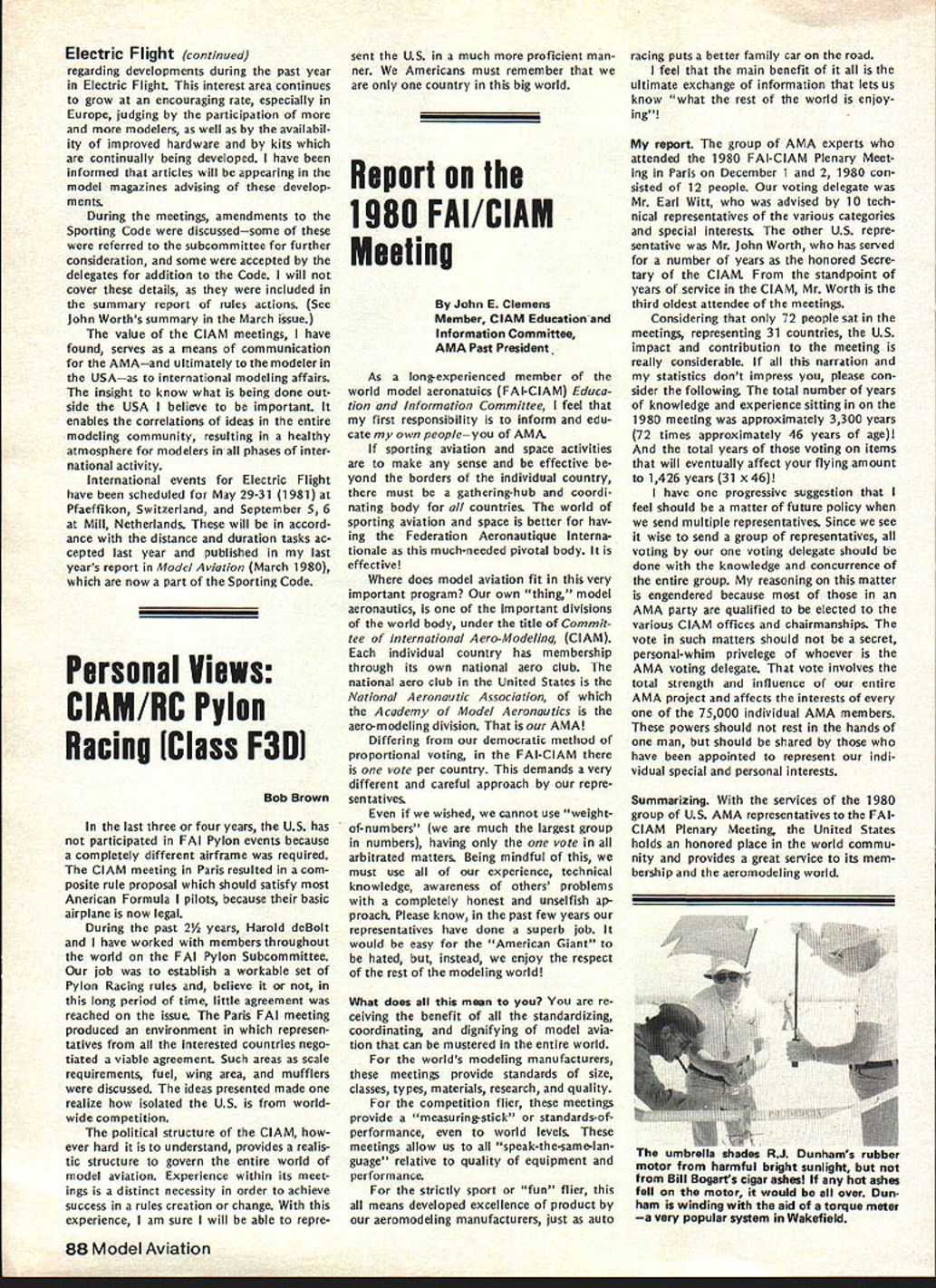
Report on the 1980 FAI/CIAM Meeting
By John E. Clemens Member, CIAM Education and Information Committee, AMA Past President
As a long-experienced member of the CIAM Education and Information Committee, my responsibility is to inform and educate AMA members.
The Federation Aeronautique Internationale (FAI) is the coordinating body for international sporting aviation and space activities. Model aeronautics is a division under the Committee of International Aero-Modelling (CIAM). Each country is a member through its national aero club; in the U.S. that is the National Aeronautic Association, with the AMA as the aero-modelling division.
In FAI-CIAM there is one vote per country, unlike democratic proportional voting. This demands a different and careful approach by our representatives. We cannot use weight-of-numbers; we must use experience, technical knowledge, and an honest, unselfish approach. Our representatives have done a superb job and the U.S. enjoys respect in the modeling world.
What does this mean to you?
- For manufacturers: meetings provide standards of size, classes, types, materials, research, and quality.
- For competition fliers: meetings provide a measuring stick or standards of performance up to world levels.
- For sport fliers: meetings encourage developed excellence of product by manufacturers.
My report: the AMA experts who attended the 1980 FAI-CIAM Plenary Meeting in Paris (Dec 1–2, 1980) consisted of 12 people. Our voting delegate was Earl Witt, advised by 10 technical representatives. John Worth served as the honored Secretary of the CIAM. Considering 72 people represented 31 countries, the U.S. impact and contribution were considerable.
One suggestion: when we send multiple representatives, all voting by our one voting delegate should be done with the knowledge and concurrence of the entire group. Votes on matters affecting CIAM offices and chairmanships should reflect the collective view of our representatives, not just the personal whim of the AMA voting delegate. These powers affect the interests of all AMA members and should be shared.
Summarizing: the 1980 group of U.S. AMA representatives to the FAI-CIAM Plenary Meeting provided valued service and helped maintain the United States' honored place in the world community.
---
Thoughts on FAI
Ray Horst
Here we are again in the midst of another FAI team selection year. Less than 25% of our club members are participating. A major reason seems to be that the European approach — with extensive technical equipment and specialized building — has scared many off. Few have the time, money, or team organization to build perfect sailplanes or access extensive technical resources.
Money is a big factor:
- No kitted sailplane currently available in the U.S. can compete at world class; you must design your own plane to be competitive.
- Most FAI planes require multi-channel radios.
- Launch equipment (winches) is often required.
- Entry fees and travel expenses for Semi-Finals, Finals, and team practice add up.
These factors make the effort and sacrifice of successful competitors like Skip Miller especially impressive.
One possible solution: create two divisions, Novice and Expert (or Amateur and Professional). Everyone would fly together but declare their class:
- Expert: unchanged rules.
- Novice: $5 entry fee, kit-built sailplanes only, CD or club provides launch equipment, partial payouts for Semi-Final and Final winners, and no travel to Finals (they would go as far as Semi-Finals in their area).
- Novice entries would not compete for team selection; highest aspiration would be a Semi-Final trophy.
A lower-cost class might attract many newer competitors and serve as a stepping stone to the higher class.
I admire the determination of current participants and wish them luck. I simply suggest a possible alternative to encourage broader participation.
(Reprinted from Thermals, newsletter of the Rocky Mountain Soaring Association, Denver, CO. Editor: Byron Blakeslee.)
---
Competition Newsletter — Academy of Model Aeronautics (reprint / summary)
1981 FAI Thermal Soaring World Championships — Sacramento
Red Lion Inn will be the lodging headquarters for the Championships, July 12–17, 1981. The flying site is about 25 miles south near Courtland. The site is excellent — very flat with few obstructions — and was used for the 1980 Quarter Scale meet.
A lodging and meals package is offered through the AMA: $250 per person (double occupancy, two beds) covering six nights, four days' meals including the closing banquet, airfield entry, identification, and souvenirs. Other room arrangements available at varying prices.
Teams from about 20 countries are expected to fly Duration, Distance, and Speed tasks under FAI rules. The AMA is hosting on behalf of the National Aeronautic Association. Local support includes Don Anthony, David Vincze, Jerry Slates, Tully Simoni, and Rick Schramek. Volunteers primarily from San Francisco Bay area soaring clubs will support the event.
Past AMA-hosted world championships include:
- Indoor — West Baden, IN (1980)
- Free Flight — Taft, CA (1979)
- RC Aerobatics — Springfield, OH (1977) and Doylestown, PA (1971)
- AerOlympics — Lakehurst, NJ (1974)
FAI/CIAM Reports — RC Helicopters
Sending an AMA delegation to FAI meetings is worthwhile. Two countries (Belgium and USA) had RC Helicopter technical advisors at the meeting. Mr. Francis DeProft presented the RC Helicopter rules proposal and accepted several amendments. Additional countries should send technical advisors to improve the rules. Contest Directors are encouraged to use the FAI maneuver schedule to develop competitors.
- Request entry forms from AMA Headquarters and indicate which Nats form you want to speed processing.
1982 FAI CL Combat Team — Team Selection Program Finals Site Approved
- Finals: Nashville, TN — September 19–20, 1981.
- Program approval allows separation of current planning from the basic program, enabling stability while locations and people change year-to-year.
Transcribed from original scans by AI. Minor OCR errors may remain.

