
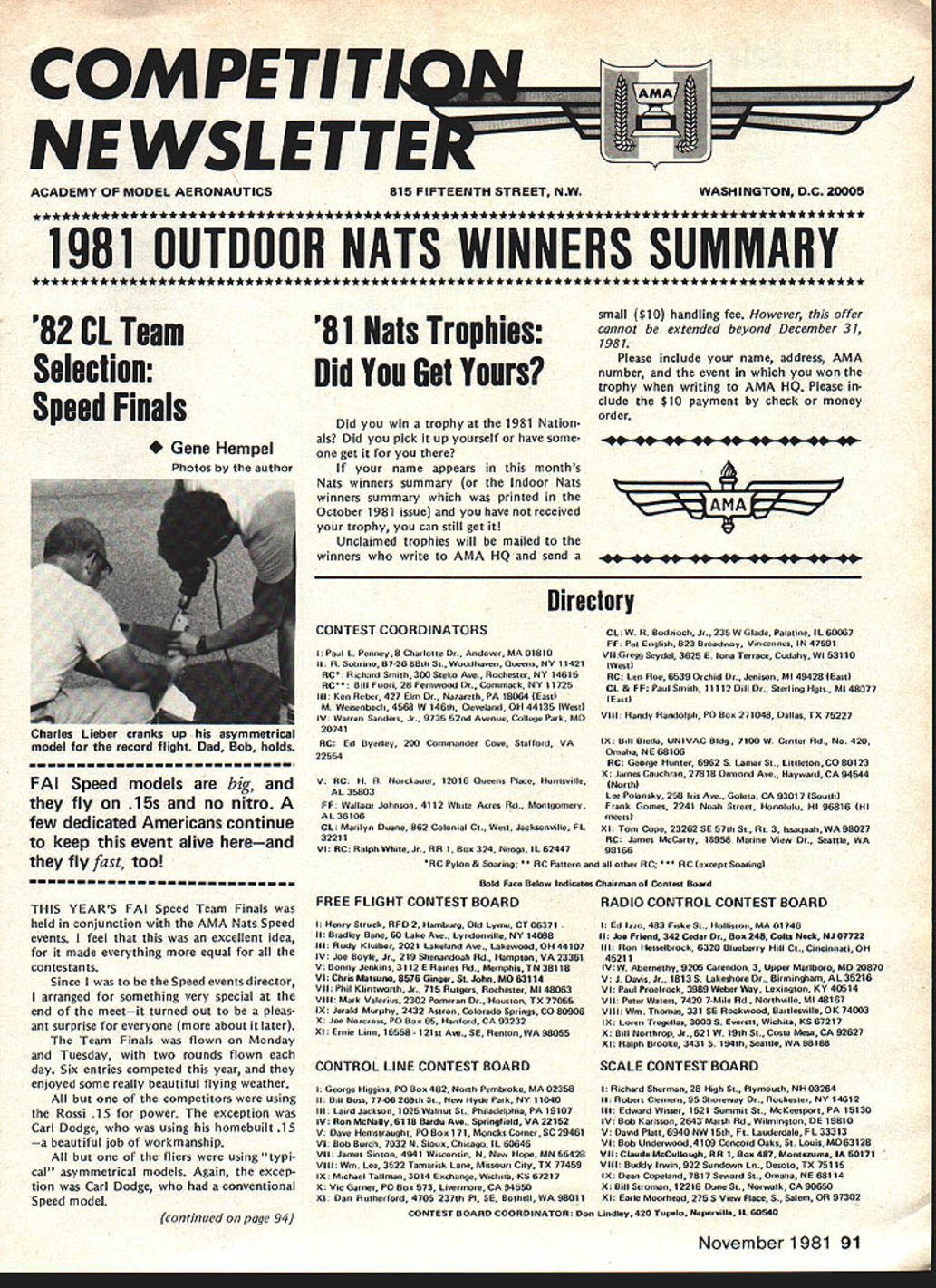
'82 CL Team Selection: Speed Finals
Gene Hempel Photos by the author
FAI Speed models are big, and they fly on .15s and no nitro. A few dedicated Americans continue to keep this event alive here—and they fly fast, too!
This year's FAI Speed Team Finals was held in conjunction with the AMA Nats Speed events. I feel that this was an excellent idea, for it made everything more equal for all the contestants.
Since I was to be the Speed events director, I arranged for something very special at the end of the meet—it turned out to be a pleasant surprise for everyone (more about it later).
The Team Finals was flown on Monday and Tuesday, with two rounds flown each day. Six entries competed this year, and they enjoyed some really beautiful flying weather.
All but one of the competitors were using the Rossi .15 for power. The exception was Carl Dodge, who was using his homebuilt .15—a beautiful job of workmanship.
All but one of the fliers were using typical asymmetrical models. Again, the exception was Carl Dodge, who had a conventional Speed model.
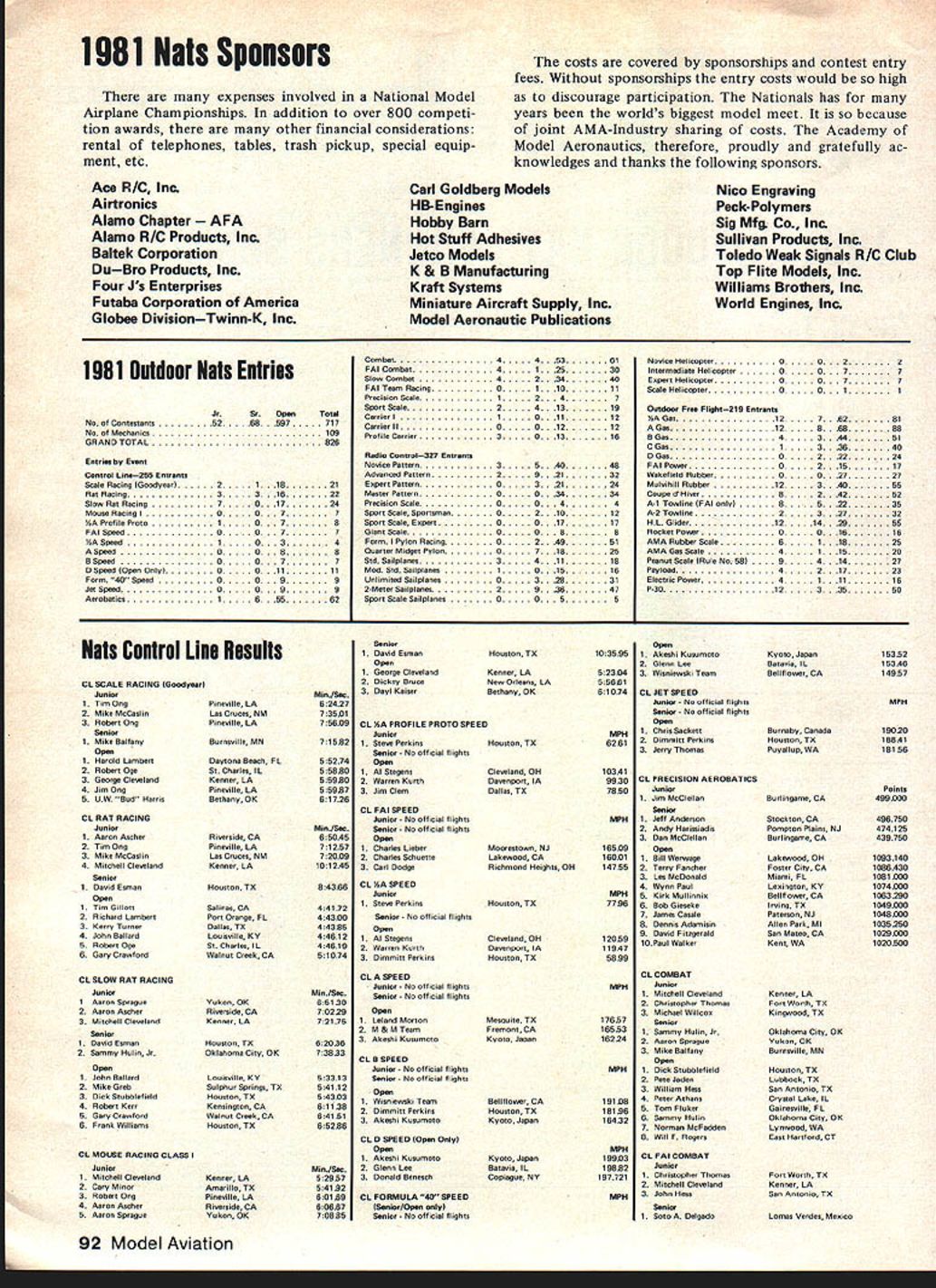
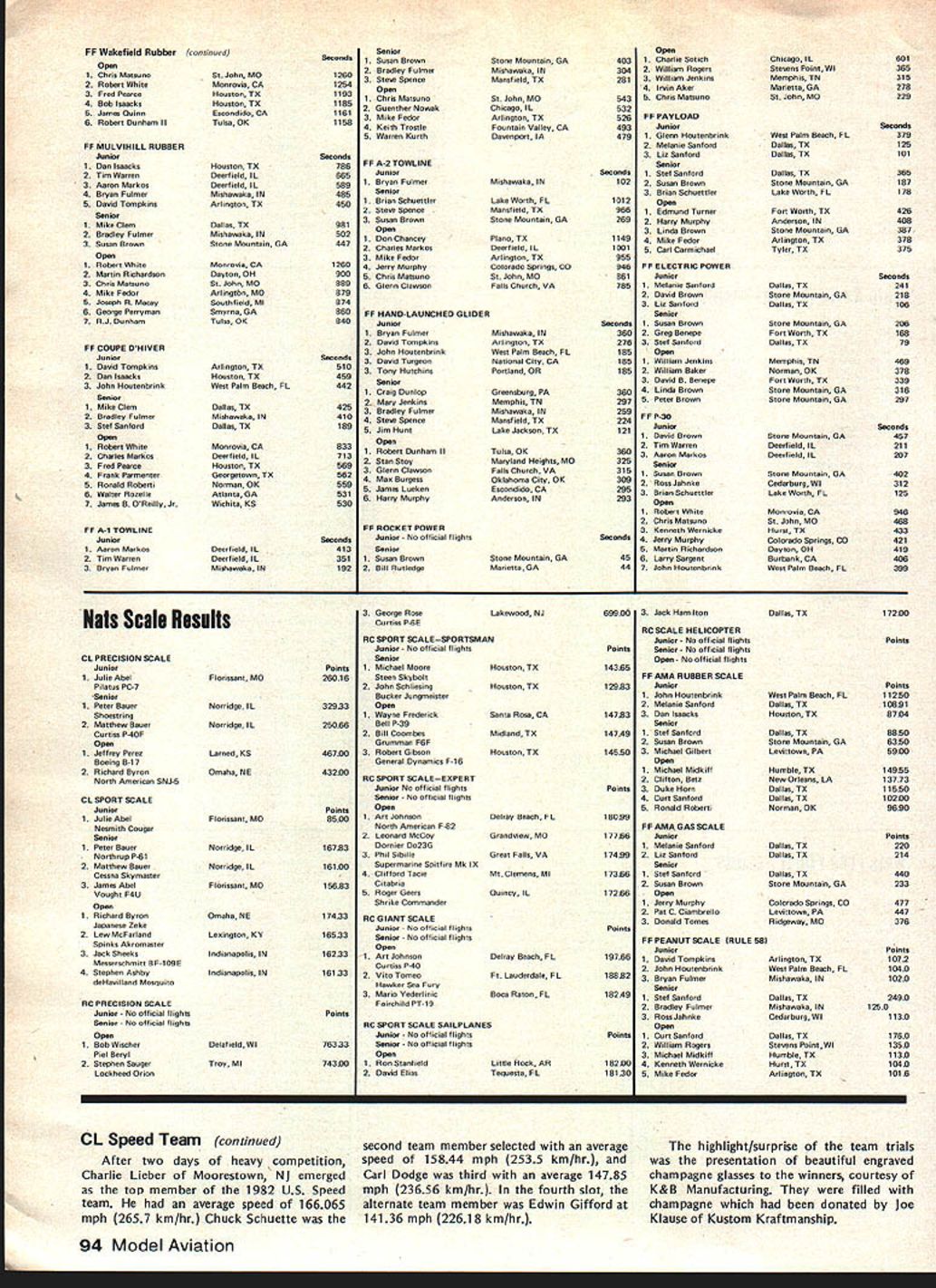
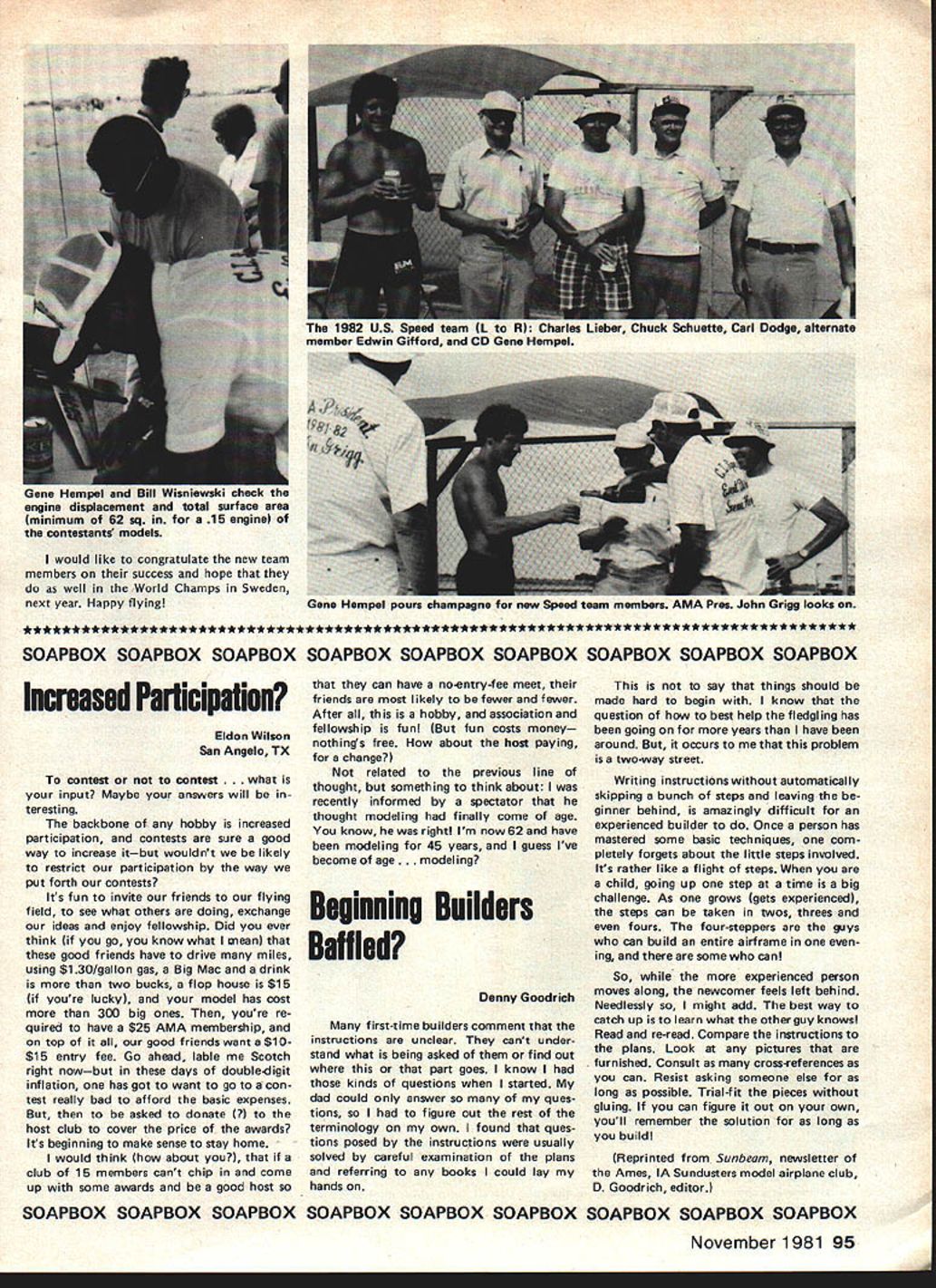
After two days of heavy competition, Charlie Lieber of Moorestown, NJ emerged as the top member of the 1982 U.S. Speed team. He had an average speed of 166.065 mph (265.7 km/h). Chuck Schuette was the second team member selected with an average speed of 158.44 mph (253.5 km/h), and Carl Dodge was third with an average 147.85 mph (236.56 km/h). In the fourth slot, the alternate team member was Edwin Gifford at 141.36 mph (226.18 km/h).
The highlight and surprise of the team trials was the presentation of beautiful engraved champagne glasses to the winners, courtesy of K&B Manufacturing. They were filled with champagne which had been donated by Joe Klause of Kustom Kraftmanship.
Congratulations to the new team members on their success — best wishes for good results at the World Champs in Sweden next year. Happy flying!
'82 CL Team Selection: Team Race Finals
Bill Lee
FAI Team Race is not an event of raw power and blazing speed. Top competitors must conquer the smallest details of building, tuning, and flying and remember a set of not-so-simple rules. The models are marvels of clean design and fast, reliable diesel power!
This year, the FAI Team Race Team Selection Finals was held in conjunction with the AMA Nationals. (The Aerobatics and Combat Team Selection Finals will be at two separate contests in September.) Eleven teams were present to compete for the three berths on the U.S. team.
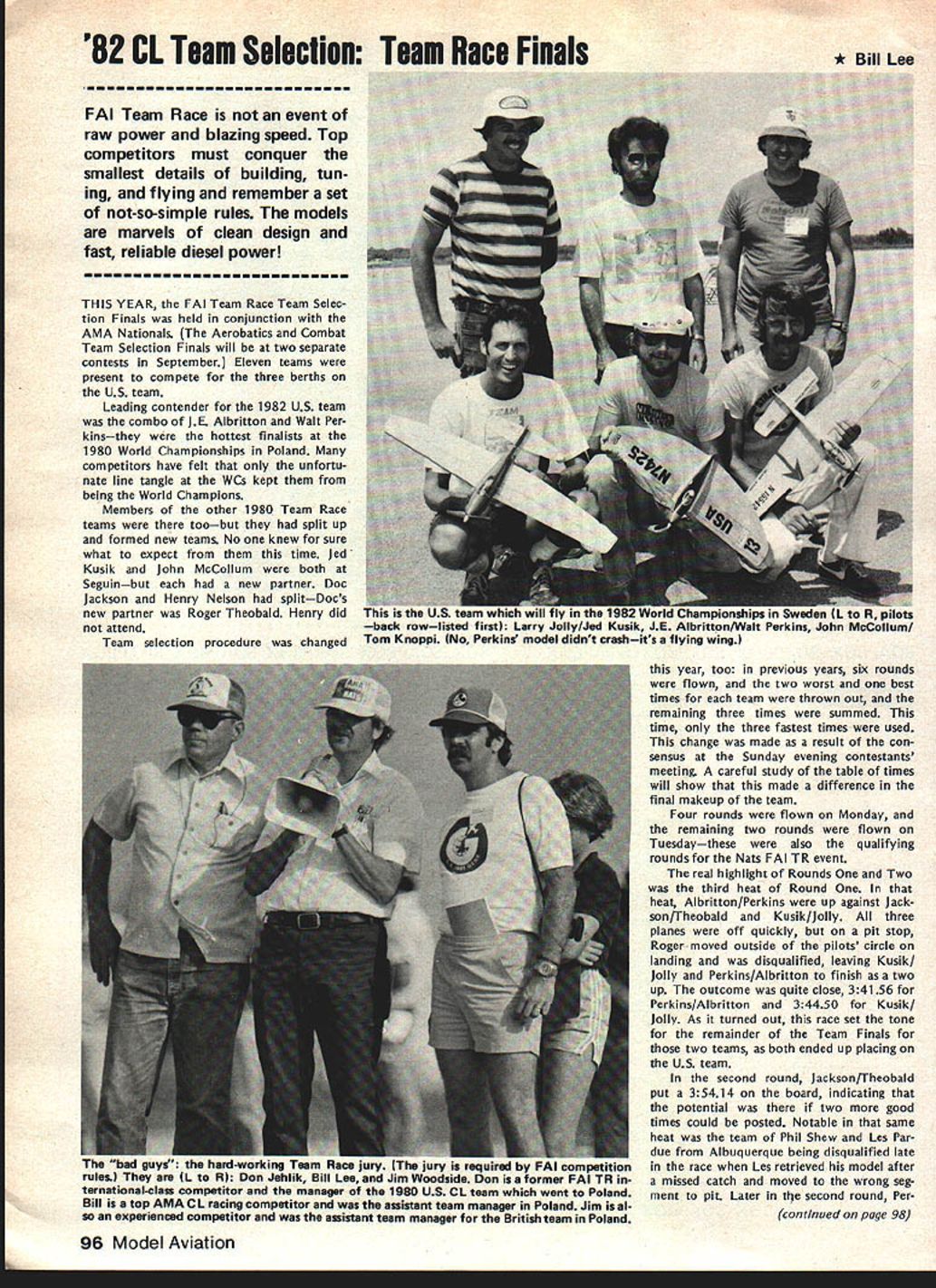
Leading contender for the 1982 U.S. team was the combo of J.E. Albritton and Walt Perkins — they were the hottest finalists at the 1980 World Championships in Poland. Many competitors have felt that only the unfortunate line tangle at the WCs kept them from being the World Champions.
Members of the other 1980 Team Race teams were there too — but they had split up and formed new teams. No one knew for sure what to expect from them this time. Jed Kusik and John McCollum were both at Seguin — but each had a new partner. Doc Jackson and Henry Nelson had split — Doc's new partner was Roger Theobald. Henry did not attend.
Team selection procedure was changed this year, too: in previous years, six rounds were flown, and the two worst and one best times for each team were thrown out, and the remaining three times were summed. This time, only the three fastest times were used. This change was made as a result of the consensus at the Sunday evening contestants' meeting. A careful study of the table of times will show that this made a difference in the final makeup of the team.
Four rounds were flown on Monday, and the remaining two rounds were flown on Tuesday—these were also the qualifying rounds for the Nats FAI T/R event.
The real highlight of Rounds One and Two was the third heat of Round One. In that heat, Albritton/Perkins were up against Jackson/Theobald and Kusik/Jolly. All three planes were off quickly, but on a pit stop, Roger moved outside of the pilots' circle on landing and was disqualified, leaving Kusik/Jolly and Perkins/Albritton to finish as a two-up. The outcome was quite close, 3:41.56 for Perkins/Albritton and 3:44.50 for Kusik/Jolly. As it turned out, this race set the tone for the remainder of the Team Finals for those two teams, as both ended up placing on the U.S. team.
In the second round, Jackson/Theobald put a 3:54.14 on the board, indicating that the potential was there if two more good times could be posted. Notable in that same heat was the team of Phil Shew and Les Pardue from Albuquerque being disqualified late in the race when Les retrieved his model after a missed catch and moved to the wrong segment to pit.
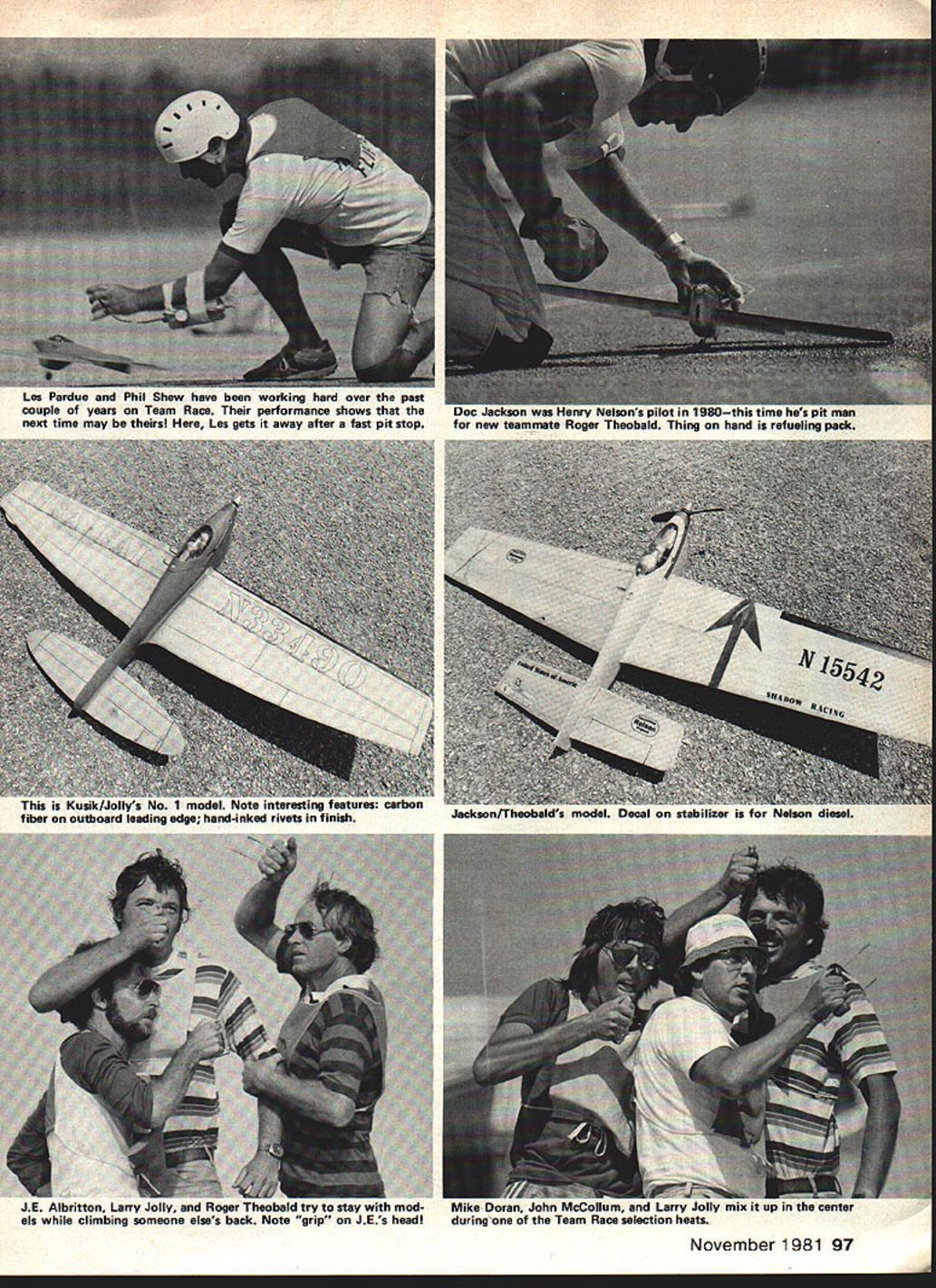
Photo captions
- Les Pardue and Phil Shew have been working hard over the past couple of years on Team Race. Their performance shows that the next time may be theirs! Here, Les gets it away after a fast pit stop.
- Doc Jackson was Henry Nelson's pilot in 1980—this time he's pit man for new teammate Roger Theobald. On hand is a refueling pack.
- This is Kusik/Jolly's No. 1 model. Note interesting features: carbon fiber on outboard leading edge; hand-linked rivets in finish.
- Jackson/Theobald's model. Decal on stabilizer is for the Nelson diesel.
- J.E. Albritton, Larry Jolly, and Roger Theobald try to stay with models while climbing someone else's back. Note the "grip" on J.E.'s head!
- Mike Doran, John McCollum, and Larry Jolly mix it up in the center during one of the Team Race selection heats.
FAI Team Race (continued)
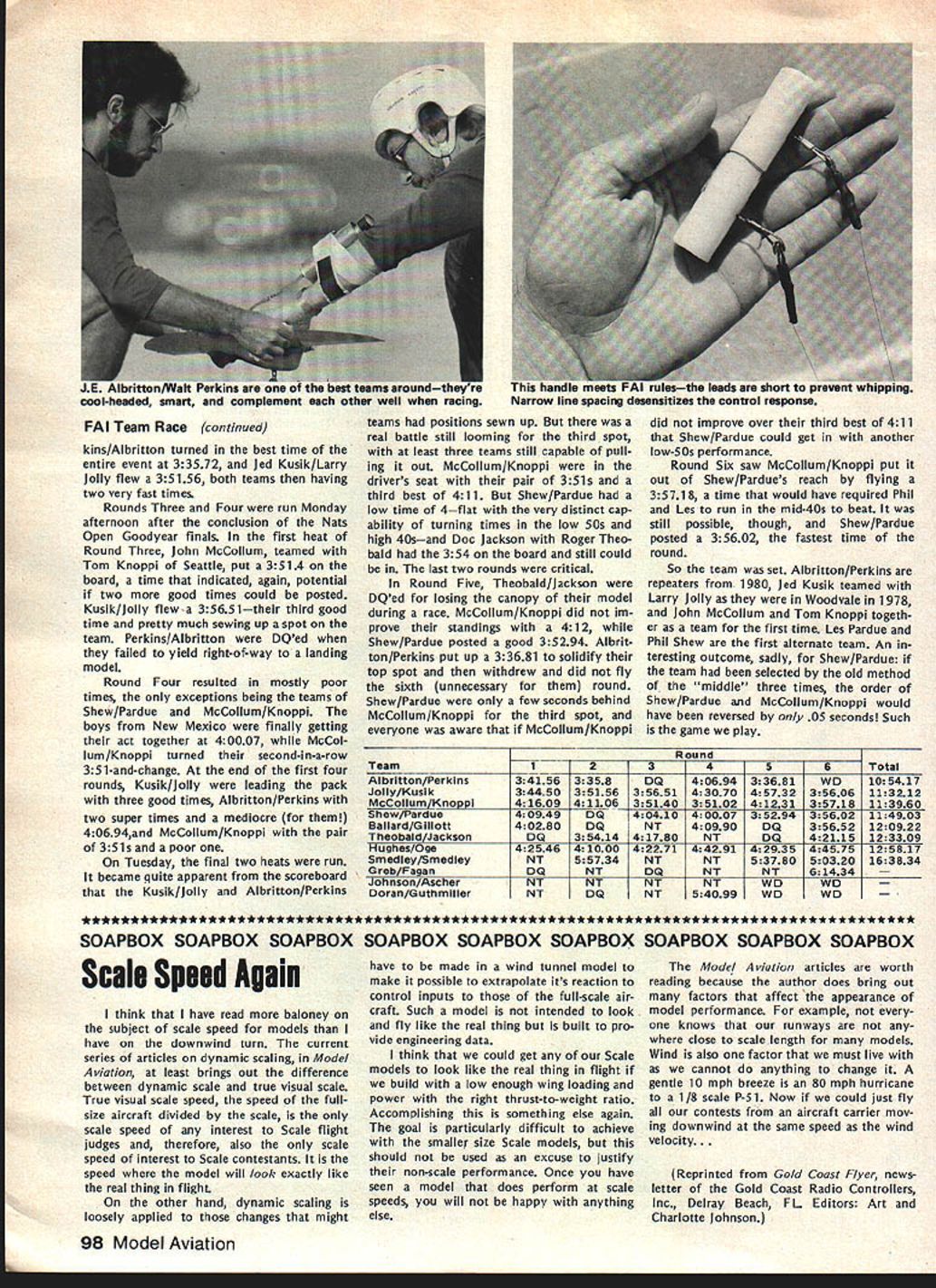
Perkins/Albritton turned in the best time of the entire event at 3:35.72, and Jed Kusik/Larry Jolly flew a 3:51.56; both teams then had two very fast times.
Rounds Three and Four were run Monday afternoon after the conclusion of the Nats Open Goodyear finals. In the first heat of Round Three, John McCollum, teamed with Tom Knoppi of Seattle, put a 3:51.40 on the board, a time that indicated, again, potential if two more good times could be posted. Kusik/Jolly flew a 3:56.50—then third good time and pretty much sewing up a spot on the team. Perkins/Albritton were DQ'd when they failed to yield right-of-way to a landing model.
Round Four resulted in mostly poor times, the only exceptions being the teams of Shew/Pardue and McCollum/Knoppi. The boys from New Mexico were finally getting their act together at 4:00.07, while McCollum/Knoppi turned their second-in-a-row 3:51-and-change. At the end of the first four rounds, Kusik/Jolly were leading the pack with three good times, Albritton/Perkins with two super times and a mediocre (for them) 4:06.94, and McCollum/Knoppi with the pair of 3:51s and a poor one.
On Tuesday, the final two heats were run. It became quite apparent from the scoreboard that the Kusik/Jolly and Albritton/Perkins teams had positions sewn up. But there was a real battle still looming for the third spot, with at least three teams still capable of pulling it out. McCollum/Knoppi were in the driver's seat with their pair of 3:51s and a third best of 4:11. But Shew/Pardue had a low time of 4:00 with the very distinct capability of turning times in the low 50s and high 40s—and Doc Jackson with Roger Theobald had the 3:54 on the board and still could be in. The last two rounds were critical.
In Round Five, Theobald/Jackson were DQ'd for losing the canopy of their model during a race. McCollum/Knoppi did not improve their standings with a 4:12, while Shew/Pardue posted a good 3:52.94. Albritton/Perkins put up a 3:36.81 to solidify their top spot and then withdrew and did not fly the sixth (unnecessary for them) round. Shew/Pardue were only a few seconds behind McCollum/Knoppi for the third spot, and everyone was aware that if McCollum/Knoppi did not improve over their third best of 4:11 that Shew/Pardue could get in with another low-50s performance.
Round Six saw McCollum/Knoppi put it out of Shew/Pardue's reach by flying a 3:57.18, a time that would have required Phil and Les to run in the mid-40s to beat. It was still possible, though, and Shew/Pardue posted a 3:56.02, the fastest time of the round.
So the team was set. Albritton/Perkins are repeaters from 1980, Jed Kusik teamed with Larry Jolly as they were in Woodvale in 1978, and John McCollum and Tom Knoppi together as a team for the first time. Les Pardue and Phil Shew are the first alternate team. An interesting outcome, sadly, for Shew/Pardue: if the team had been selected by the old method of the "middle" three times, the order of Shew/Pardue and McCollum/Knoppi would have been reversed by only 0.05 seconds! Such is the game we play.
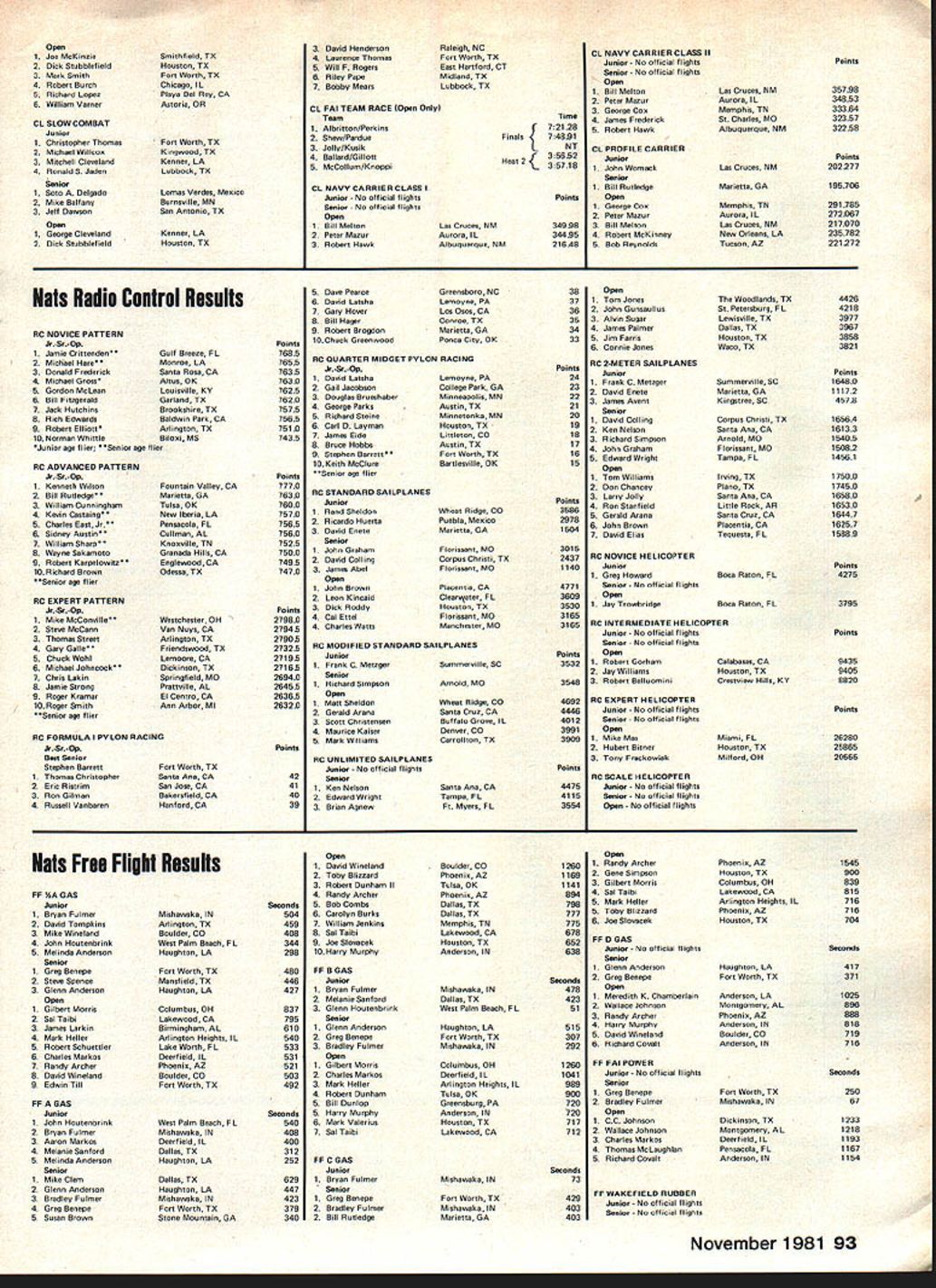
Team Results
- Albritton/Perkins — R1: 3:41.56 — R2: 3:35.72 — R3: DQ — R4: 4:06.94 — R5: 3:36.81 — R6: WD — Total: 10:54.17
- Kusik/Jolly — R1: 3:44.50 — R2: 3:51.56 — R3: 3:51.56 — R4: 3:51.40 — R5: 3:51.02 — R6: 3:56.06 — Total: 11:32.12
- McCollum/Knoppi — R1: 4:16.09 — R2: 4:11.06 — R3: 3:51.40 — R4: 3:51.02 — R5: 4:12.31 — R6: 3:57.18 — Total: 11:39.60
- Shew/Pardue — R1: 4:09.49 — R2: DQ — R3: 3:52.94 — R4: 4:00.10 — R5: 4:00.07 — R6: 3:56.02 — Total: 11:49.03
- Ballard/Gillot — R1: 4:02.80 — R2: DQ — R3: NT — R4: 4:09.90 — R5: DQ — R6: 4:09.90 — Total: 12:09.22
- Theobald/Jackson — R1: DQ — R2: 3:54.14 — R3: 4:17.80 — R4: 4:17.80 — R5: DQ — R6: 4:22.35 — Total: 12:33.09
- Hughes/Ogle — R1: 4:25.46 — R2: 4:24.00 — R3: 4:22.71 — R4: 4:42.91 — R5: 4:29.35 — R6: 4:45.75 — Total: 12:58.17
- Smedley/Smedley — R1: NT — R2: 5:57.34 — R3: NT — R4: NT — R5: 5:37.80 — R6: 5:03.20 — Total: 16:38.37
- Grob/Fagan — R1: DQ — R2: NT — R3: DQ — R4: NT — R5: NT — R6: NT — Total: 6:14.34
- Johnson/Ascher — R1: NT — R2: NT — R3: NT — R4: NT — R5: WD — R6: WD — Total: WD
- Doran/Guthmiller — R1: NT — R2: DQ — R3: NT — R4: NT — R5: 5:40.99 — R6: WD — Total: WD
Legend: DQ = Disqualified, WD = Withdrew, NT = No Time Recorded
Transcribed from original scans by AI. Minor OCR errors may remain.

