
U.S. Team Wins RC World Champs
The RC Aerobatics World Championships, Acapulco, Mexico, September 22–27, 1981. Winner: U.S.A.; Germany 2nd, Japan 3rd, Austria 4th, and Canada 5th.
Austria's Hanno Prettner was individual winner and new World Champion. The U.S.'s Dave Brown was 2nd, 124 points down. Mark Radcliff finished 5th, and Steve Helms was 8th, tied with Canada's Ivan Kristensen.
Competitors from 27 nations participated. The scoring system used four judges for each flight line for four rounds; the two highest scores were used to select six finalists for a two-round flyoff. The best of the flyoff scores (from eight judges) was added to the base score to get the final score. Bertram Lossen of Germany, one of the younger fliers, posted identical scores of 2,911 on each of his flights, out-pointing all other finalists — 18 points more than Prettner! However, his base score was too far down to let him overtake the leaders, and he finished 4th.
RC Masters Pattern — Jr.-Sr.-Op. Points
- Tony Bonetti — Emerson, NJ — 3421.5
- Steve Helms — Pensacola, FL — 3417.0
- Dave Brown — Cincinnati, OH — 3414.0
- Ivan Kristensen — Guelph, Ont., Canada — 3403.0
- Donald Weitz — Henderson, NV — 3386.5
- Tony Frackowiak — Milford, OH — 3384.0
- Steve Stricker — Baltimore, MD — 3367.5
- David Wilson — Fountain Valley, CA — 3351.5
- Ron Gilman — Bakersfield, CA — 3345.5
- Dean Koger — Papillion, NE — 3326.5
FAI Indoor Team Selection Finals
Erv Rodemsky Photos by the author
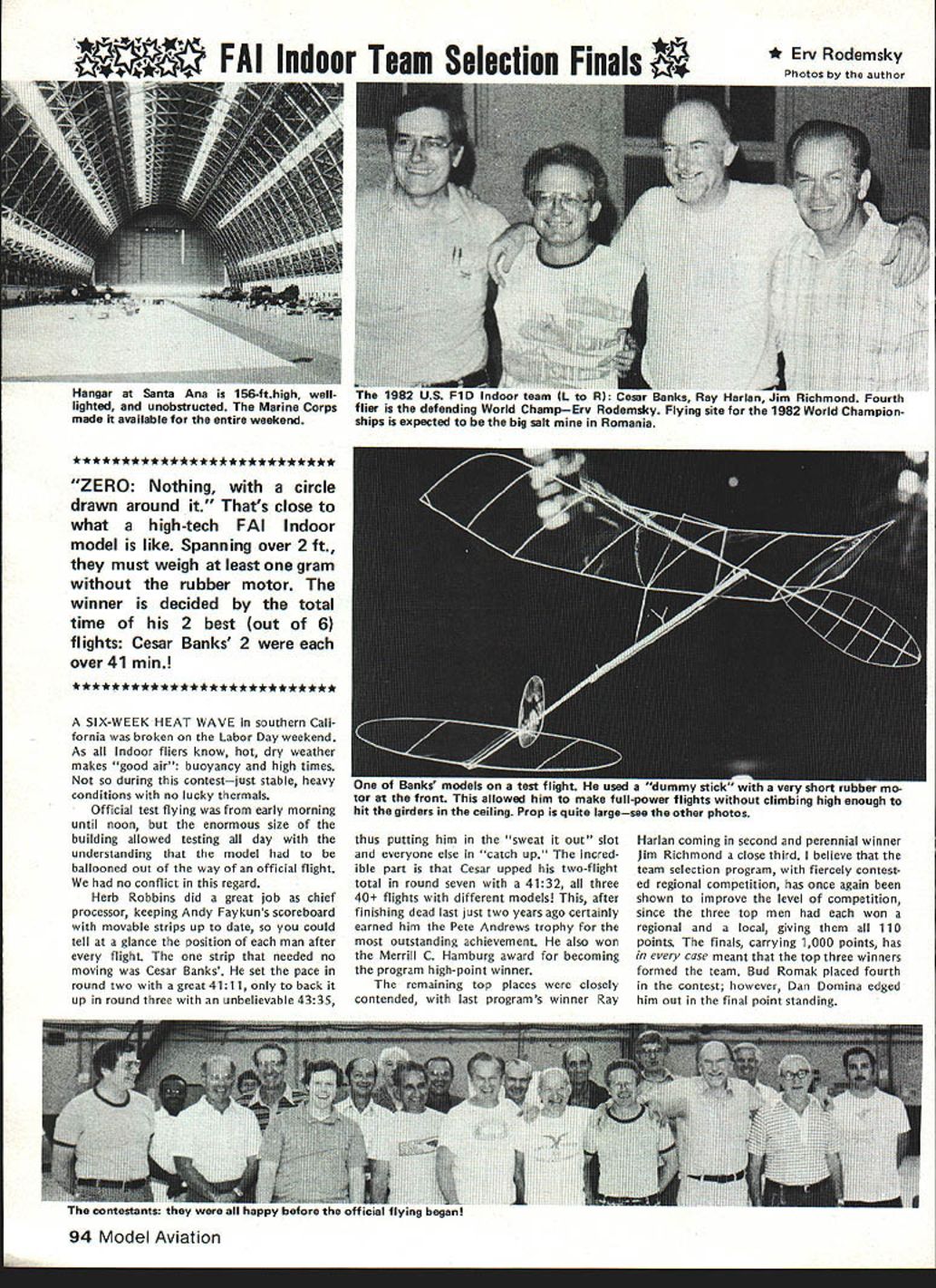
"ZERO: Nothing, with a circle drawn around it." That's close to what a high-tech FAI Indoor model is like. Spanning over 2 ft., they must weigh at least one gram without the rubber motor. The winner is decided by the total time of his two best (out of six) flights; Cesar Banks' two were each over 41 minutes!
A six-week heat wave in southern California was broken on the Labor Day weekend. As all Indoor fliers know, hot, dry weather makes "good air": buoyancy and high times. Not so during this contest—conditions were stable and heavy with no lucky thermals.
Official test flying was from early morning until noon, but the enormous size of the building allowed testing all day with the understanding that the model had to be ballooned out of the way of an official flight. We had no conflict in this regard.
Herb Robbins did a great job as chief processor, keeping Andy Faykun's scoreboard with movable strips up to date, so you could tell at a glance each man's position after every flight. The one strip that needed no moving was Cesar Banks'. He set the pace in round two with a great 41:11, only to back it up in round three with an unbelievable 43:35, thus putting him in the "sweat it out" slot and everyone else in "catch up." The incredible part is that Cesar cupped his two-flight total in round seven with a 41:32 — all three 40+ flights with different models! This, after finishing dead last just two years ago, certainly earned him the Pete Andrews trophy for the most outstanding achievement. He also won the Merrill C. Hamburg award for becoming the program high-point winner.
The remaining top places were closely contended, with last program's winner Ray Harlan coming in second and perennial winner Jim Richmond a close third. I believe that the team selection program, with fiercely contested regional competition, has once again been shown to improve the level of competition, since the three top men had each won a regional and a local, giving them all 110 previous points. The finals, carrying 1,000 points, has in every case meant that the top three winners formed the team. Bud Romak placed fourth in the contest; however, Dan Domina edged him out in the final point standing.
No major new development was seen in this year's models; however, the three winners all used a technique that was different from the rest. They all used higher-pitch, slow-turning props, while the others had higher average rpm. It seems that both methods can produce 40+ flights; the difference being that the low-rpm models did not need to "rafter bang" nearly as much due to the time. Therefore, Bud and Dan lost winning flights by too much climb and hanging up. Romania seems to be the site for next year's championship, so perhaps our team will have to get some tips from the fast-climbing boys, since the big problem is to get enough climb in the underground salt-mine flying site with its 50° temperature.
There were several long discussions about the fragility of models built to the present specifications and their vulnerability due to the time spent in "rafter banging" even in the highest sites. It was felt by many that restrictions on area and rubber weight would make the models much more practical. This was the intent of the one-gram rule over 10 years ago; however, the models have grown to the point where they are as difficult as ever to handle, borne out by the fact that virtually every flier destroyed at least half of his models.
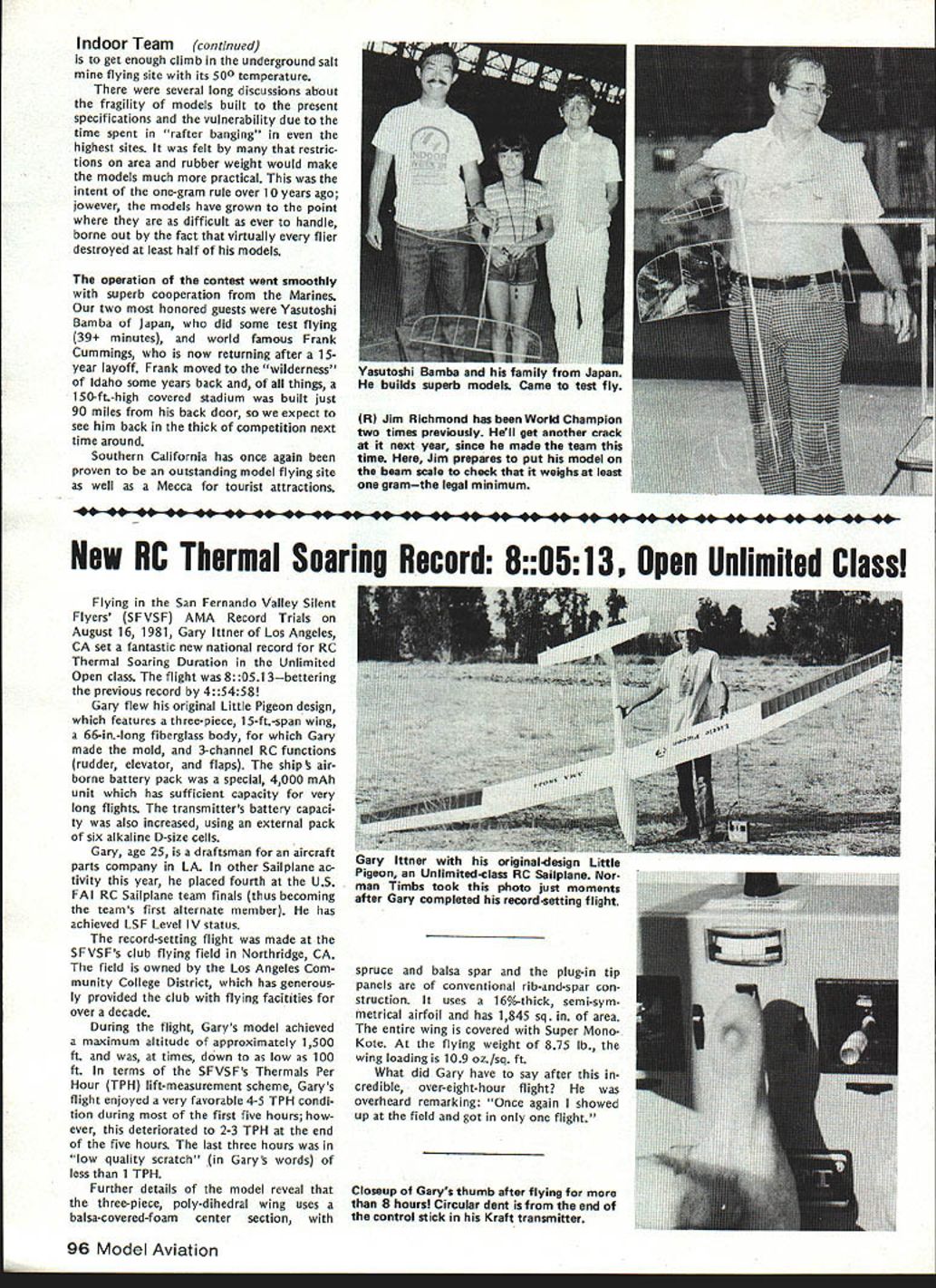
The operation of the contest went smoothly with superb cooperation from the Marines. Our two most honored guests were Yasutoshi Bamba of Japan, who did some test flying (39+ minutes), and world-famous Frank Cummings, who is returning after a 15-year layoff. Frank moved to the "wilderness" of Idaho some years back and, of all things, a 150-ft.-high covered stadium was built just 90 miles from his back door, so we expect to see him back in the thick of competition next time around.
Southern California has once again been proven to be an outstanding model flying site as well as a Mecca for tourist attractions.
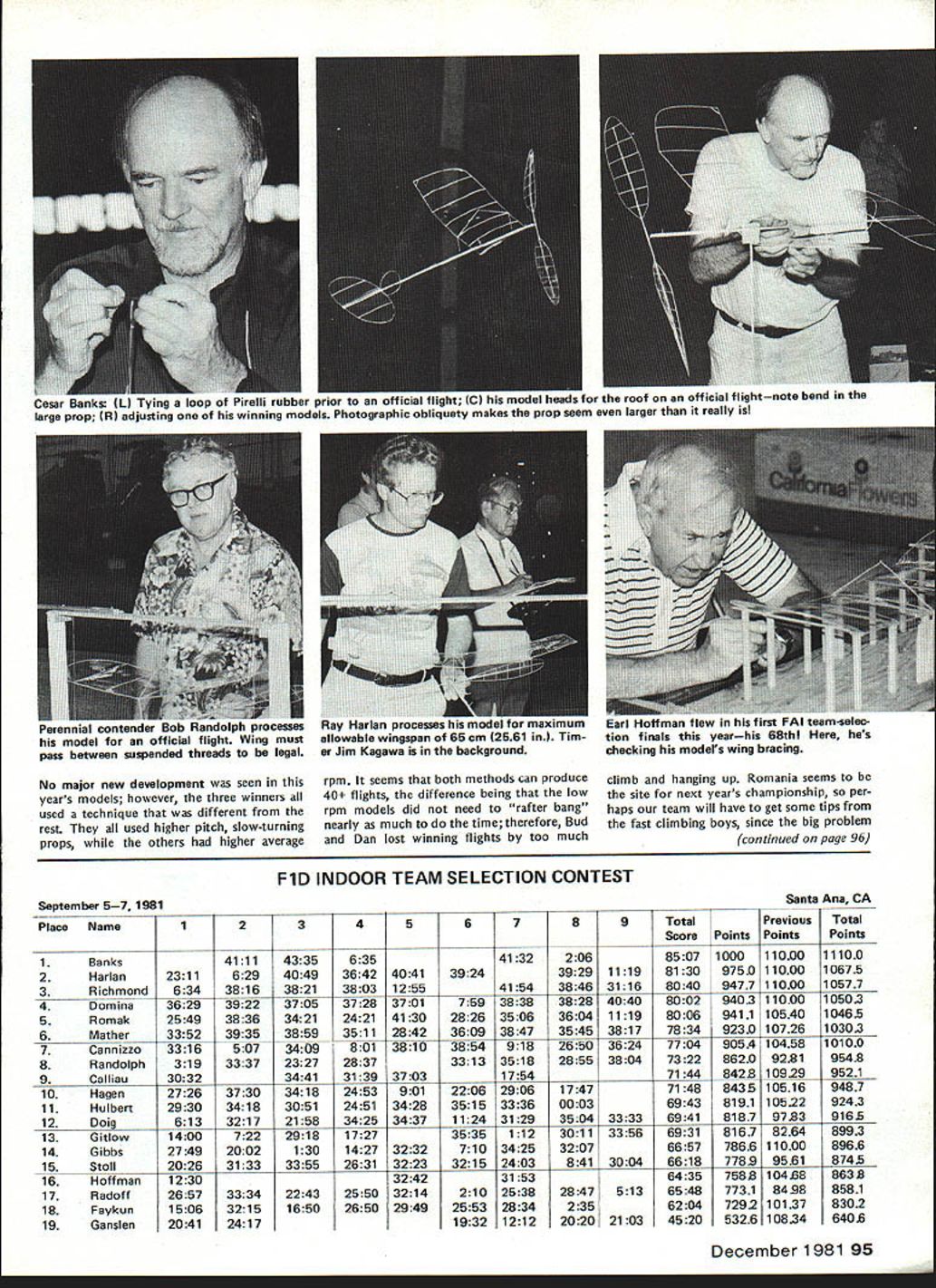
F1D INDOOR TEAM SELECTION CONTEST
September 5–7, 1981 — Santa Ana, CA
- Banks — Total Score: 85:07; Points: 1000; Previous Points: 110.00; Total Points: 1110.0
- Harlan — Total Score: 81:30; Points: 975.0; Previous Points: 92.50; Total Points: 1067.5
- Richmond — Total Score: 80:40; Points: 947.0; Previous Points: 110.70; Total Points: 1057.7
- Domina — Total Score: 80:02; Points: 940.3; Previous Points: 110.00; Total Points: 1050.3
- Romak — Total Score: 80:06; Points: 941.1; Previous Points: 105.40; Total Points: 1046.5
- Mather — Total Score: 78:34; Points: 923.0; Previous Points: 107.26; Total Points: 1030.3
- Cannizzo — Total Score: 77:04; Points: 905.4; Previous Points: 104.58; Total Points: 1010.0
- Randolph — Total Score: 73:22; Points: 862.0; Previous Points: 92.81; Total Points: 954.8
- Callow — Total Score: 71:44; Points: 842.8; Previous Points: 109.29; Total Points: 952.1
- Hagen — Total Score: 71:48; Points: 843.5; Previous Points: 105.21; Total Points: 948.7
- Hulbert — Total Score: 69:43; Points: 819.1; Previous Points: 105.22; Total Points: 924.3
- Doig — Total Score: 69:41; Points: 818.7; Previous Points: 97.83; Total Points: 916.5
- Gitlow — Total Score: 69:31; Points: 816.2; Previous Points: 82.64; Total Points: 899.3
- Gibbs — Total Score: 66:57; Points: 786.6; Previous Points: 110.00; Total Points: 896.6
- Stoll — Total Score: 66:18; Points: 778.9; Previous Points: 95.61; Total Points: 874.5
- Hoffman — Total Score: 64:35; Points: 758.8; Previous Points: 104.88; Total Points: 863.8
- Radoff — Total Score: 65:48; Points: 773.1; Previous Points: 84.98; Total Points: 858.1
- Faykun — Total Score: 62:04; Points: 729.2; Previous Points: 101.37; Total Points: 830.2
- Ganslen — Total Score: 45:20; Points: 532.6; Previous Points: 108.34; Total Points: 640.6
Indoor Team (continued)
The big problem is to get enough climb in the underground salt-mine flying site with its 50° temperature.
There were several long discussions about the fragility of models built to the present specifications and the vulnerability due to the time spent in "rafter banging" in even the highest sites. It was felt by many that restrictions on area and rubber weight would make the models much more practical. This was the intent of the one-gram rule over 10 years ago; however, the models have grown to the point where they are as difficult as ever to handle, borne out by the fact that virtually every flier destroyed at least half of his models.
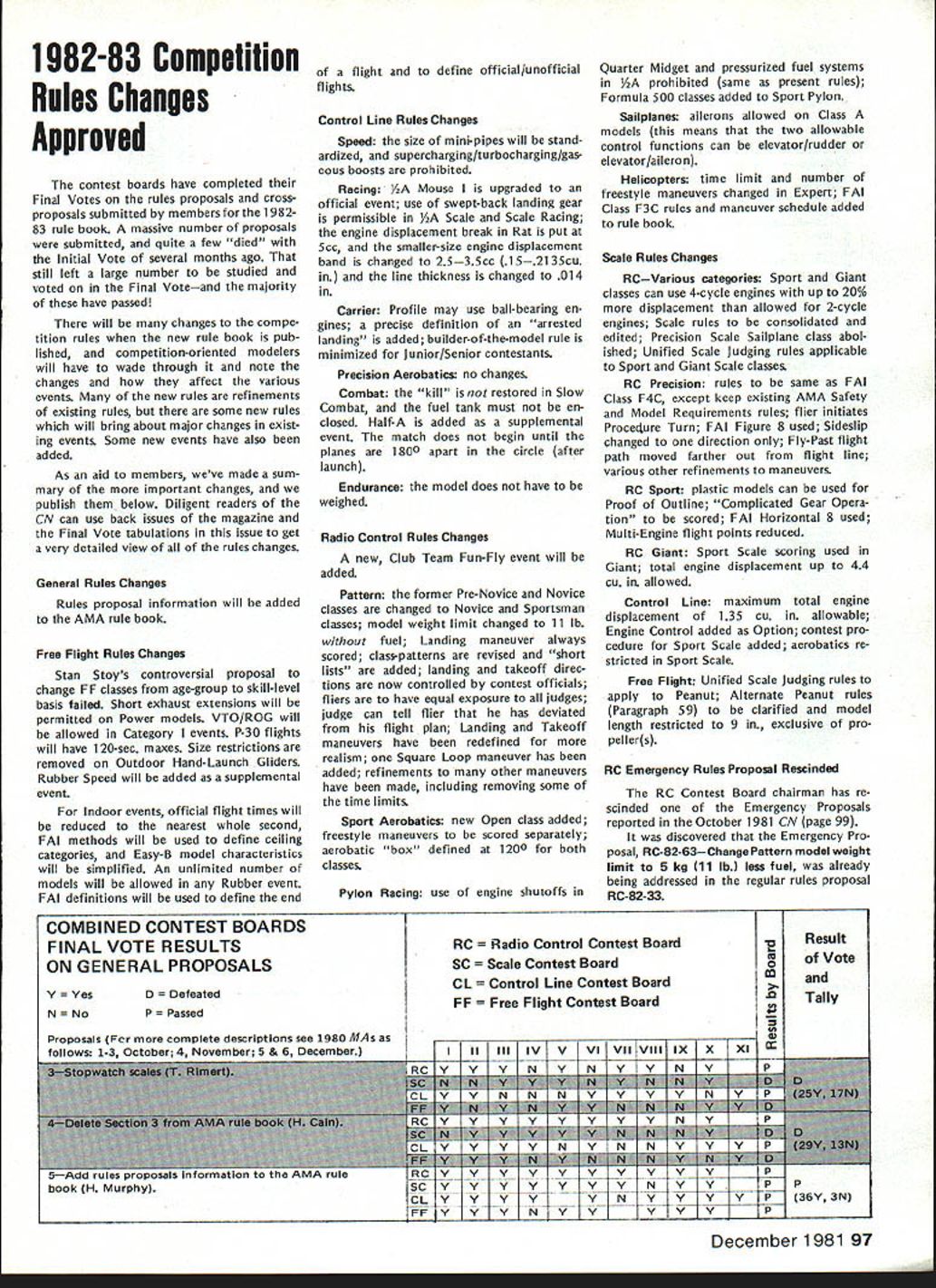
1982–83 Competition Rules Changes Approved
The contest boards have completed their Final Votes on the rules proposals and cross-proposals submitted by members for the 1982–83 rule book. A massive number of proposals were submitted; quite a few "died" with the Initial Vote several months ago. That still left a large number to be studied and voted on in the Final Vote—and the majority of these have passed.
There will be many changes to the competition rules when the new rule book is published, and competition-oriented modelers will have to wade through it and note the changes and how they affect the various events. Many of the new rules are refinements of existing rules, but there are some new rules which will bring about major changes in existing events. Some new events have also been added.
As an aid to members, we've made a summary of the more important changes below. Diligent readers of the CN can use back issues of the magazine and the Final Vote tabulations in this issue to get a very detailed view of all of the rules changes.
General Rules Changes
- Rules proposal information will be added to the AMA rule book.
Free Flight Rules Changes
- Stan Stoy's controversial proposal to change FF classes from age-group to skill-level basis failed.
- Short exhaust extensions will be permitted on Power models.
- VTO/ROG will be allowed in Category I events.
- P-30 flights will have 120-sec. maxes.
- Size restrictions are removed on Outdoor Hand-Launch Gliders.
- Rubber Speed will be added as a supplemental event.
For Indoor events:
- Official flight times will be reduced to the nearest whole second.
- FAI methods will be used to define ceiling categories.
- Easy-B model characteristics will be simplified.
- An unlimited number of models will be allowed in any Rubber event.
- FAI definitions will be used to define the end of a flight and to define official/unofficial flights.
Control Line Rules Changes
- Speed: the size of mini-pipes will be standardized; supercharging/turbocharging/gas-boosts are prohibited.
- Racing: 1/2A Mouse I is upgraded to an official event; swept-back landing gear is permissible in 1/2A Scale and Scale Racing; the engine displacement break in Rat is set at 5 cc, and the smaller-size engine displacement band is changed to 2.5–3.5 cc (.15–.213 cu. in.); line thickness is changed to .014 in.
- Carrier: Profile may use ball-bearing engines; a precise definition of an "arrested landing" is added; builder-of-the-model rule is minimized for Junior/Senior contestants.
- Precision Aerobatics: no changes.
- Combat: the "kill" is not restored in Slow Combat, and the fuel tank must not be enclosed. Half-A is added as a supplemental event. The match does not begin until the planes are 180° apart in the circle (after launch).
- Endurance: the model does not have to be weighed.
Radio Control Rules Changes
- A new Club Team Fun-Fly event will be added.
Pattern:
- The former Pre-Novice and Novice classes are changed to Novice and Sportsman classes.
- Model weight limit changed to 11 lb. without fuel.
- Landing maneuver always scored.
- Class patterns are revised and "short lists" are added.
- Landing and takeoff directions are now controlled by contest officials.
- Fliers are to have equal exposure to all judges.
- A judge can tell a flier that he has deviated from his flight plan.
- Landing and Takeoff maneuvers have been redefined for more realism.
- One Square Loop maneuver has been added.
- Refinements to many other maneuvers have been made, including removing some time limits.
Sport Aerobatics:
- New Open class added; freestyle maneuvers to be scored separately; aerobatic "box" defined at 1,200' for both classes.
Pylon Racing:
- Use of engine shutoffs in Quarter Midget and pressurized fuel systems in 1/2A prohibited (same as present rules); Formula 500 classes added to Sport Pylon.
Sailplanes:
- Ailerons allowed on Class A models (this means that the two allowable control functions can be elevator/rudder or elevator/aileron).
Helicopters:
- Time limit and number of freestyle maneuvers changed in Expert; FAI Class F3C rules and maneuver schedule added to rule book.
Scale Rules Changes
RC — Various categories:
- Sport and Giant classes can use 4-cycle engines with up to 20% more displacement than allowed for 2-cycle engines.
- Scale rules to be consolidated and edited.
- Precision Scale Sailplane class abolished.
- Unified Scale Judging rules applicable to Sport and Giant Scale classes.
RC Precision:
- Rules to be same as FAI Class F4C, except keep existing AMA Safety and Model Requirements rules; flier initiates Procedure Turn; FAI Figure 8 used; Sideslip changed to one direction only; Fly-Past flight path moved farther out from flight line; various other refinements to maneuvers.
RC Sport:
- Plastic models can be used for Proof of Outline; "Complicated Gear Operation" to be scored; FAI Horizontal 8 used; Multi-Engine flight points reduced.
RC Giant:
- Sport Scale scoring used in Giant; total engine displacement up to 4.4 cu. in. allowed.
Control Line:
- Maximum total engine displacement of 1.35 cu. in. allowable; Engine Control added as Option; contest procedure for Sport Scale added; aerobatics restricted in Sport Scale.
Free Flight:
- Unified Scale Judging rules to apply to Peanut; Alternate Peanut rules (Paragraph 59) to be clarified and model length restricted to 9 in., exclusive of propeller(s).
RC Emergency Rules Proposal Rescinded
The RC Contest Board chairman has rescinded one of the Emergency Proposals, reported in the October 1981 CN (page 99). It was discovered that the Emergency Proposal RC-82-63 — Change Pattern model weight limit to 5 kg (11 lb.) less fuel — was already being addressed in the regular rules proposal RC-82-33.
COMBINED CONTEST BOARDS FINAL VOTE RESULTS ON GENERAL PROPOSALS
Y = Yes D = Defeated N = No P = Passed
(Proposals: For more complete descriptions see 1980 MAs as follows: 1–3, October; 4, November; 5 & 6, December.)
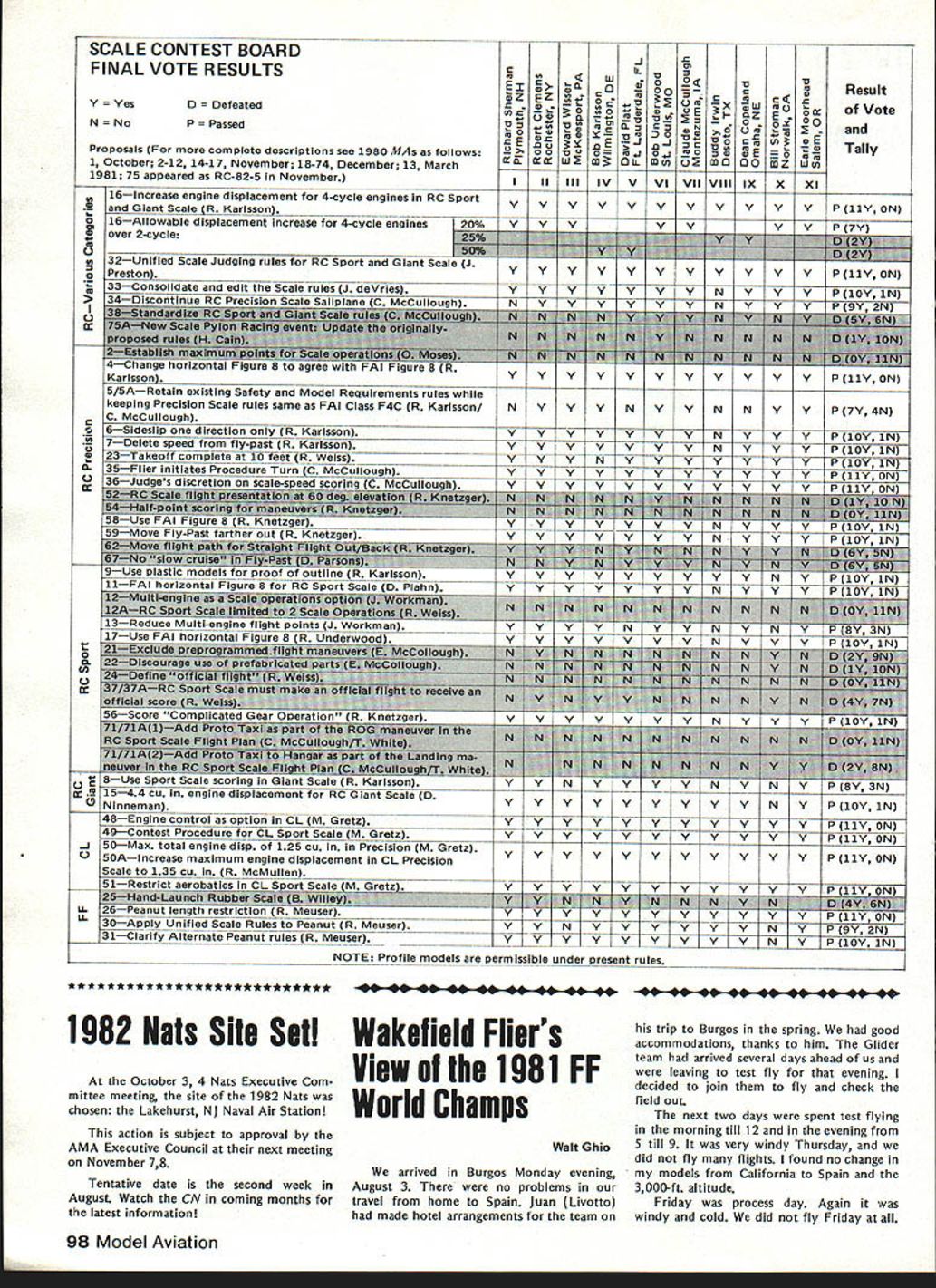
SCALE CONTEST BOARD FINAL VOTE RESULTS
Y = Yes D = Defeated N = No P = Passed
Proposals (For more complete descriptions see 1980 MAs as follows: 1, October; 2–12, 14–17, November; 18–74, December; 13, March 1981; 75 appeared as RC-82-5 in November.)
RC — Various Categories
- 16 — Increase engine displacement for 4-cycle engines in RC Sport and Giant Scale (R. Karlsson). Result: P (11Y, 0N)
- 16 — Allowable displacement increase for 4-cycle engines over 2-cycle: 20%, 25%, 50%. Result: D (2Y, ?N) [vote split on percentages]
- 32 — Unified Scale Judging rules for RC Sport and Giant Scale (J. Preston). Result: P (11Y, 0N)
- 33 — Consolidate and edit the Scale rules (J. deVries). Result: P (10Y, 1N)
- 34 — Discontinue RC Precision Scale Sailplane (C. McCullough). Result: P (9Y, 2N)
- 38 — Standardize RC Sport and Giant Scale rules (C. McCullough). Result: P (9Y, 2N)
- 75A — New Scale Pylon Racing event: Update the originally-proposed rules (H. Cain). Result: D (1Y, 10N)
RC Precision
- 2 — Establish maximum points for Scale operations (O. Moses). Result: D (0Y, 11N)
- 4 — Change horizontal Figure 8 to agree with FAI Figure 8 (R. Karlsson). Result: P (11Y, 0N)
- 5/5A — Retain existing Safety and Model Requirements rules while keeping Precision Scale rules same as FAI Class F4C (R. Karlsson/C. McCullough). Result: P (7Y, 4N)
- 6 — McCullough. Result: N (various)
- 7 — Sideslip one direction only (R. Karlsson). Result: P (10Y, 1N)
- 7A — Delete speed from fly-past (R. Karlsson). Result: P (10Y, 1N)
- 23 — Takeoff complete at 10 feet (R. Weiss). Result: P (11Y, 0N)
- 35 — Flier initiates Procedure Turn (C. McCullough). Result: P (11Y, 0N)
- 36 — Judge's discretion on scale-speed scoring (C. McCullough). Result: P (11Y, 0N)
- 52 — RC Scale flight presentation at 60° elevation (R. Knetzger). Result: N (1Y, 10N)
- 54 — Half-point scoring for maneuvers (R. Knetzger). Result: N (0Y, 11N)
- 58 — Use FAI Figure 8 (R. Knetzger). Result: P (10Y, 1N)
- 59 — Move Fly-Past farther out (R. Knetzger). Result: P (10Y, 1N)
- 62 — Move flight path for Straight Flight Out/Back (R. Knetzger). Result: P (10Y, 1N)
- 67 — No "slow cruise" in Fly-Past (D. Parsons). Result: D (6Y, 5N)
- 9 — Use plastic models for proof of outline (R. Karlsson). Result: P (10Y, 1N)
- 11 — FAI horizontal Figure 8 for RC Sport Scale (D. Plahn). Result: P (10Y, 1N)
- 12 — Multi-engine as a Scale operations option (J. Workman). Result: D (0Y, 11N)
- 12A — RC Sport Scale limited to 2 Scale Operations (R. Weiss). Result: D (8Y, 3N)
- 13 — Reduce Multi-engine flight points (J. Workman). Result: P (8Y, 3N)
- 17 — Use FAI horizontal Figure 8 (R. Underwood). Result: N (8Y, 3N)
- 21 — Exclude preprogrammed flight maneuvers (E. McCullough). Result: D (7Y, 4N)
- 22 — Discourage use of prefabricated parts (E. McCullough). Result: D (2Y, 9N)
- 24 — Define "official flight" (R. Weiss). Result: D (10Y, 1N)
- 37/37A — RC Sport Scale must make an official flight to receive an official score (R. Weiss). Result: D (10Y, 1N)
- 56 — Score "Complicated Gear Operation" (R. Knetzger). Result: P (10Y, 1N)
- 71/71A(1) — Add Proto Taxi as part of the ROG maneuver in the RC Sport Scale Flight Plan (C. McCullough/T. White). Result: D (0Y, 11N)
- 71/71A(2) — Add Proto Taxi to Hangar as part of the Landing maneuver in the RC Sport Scale Flight Plan (C. McCullough/T. White). Result: D (2Y, 9N)
RC Giant
- 8 — Use Sport Scale scoring in Giant Scale (R. Karlsson). Result: P (8Y, 3N)
- 15 — 4.4 cu. in. engine displacement for RC Giant Scale (D. Ninnenam). Result: P (10Y, 1N)
CL (Control Line)
- 48 — Engine control as option in CL (M. Gretz). Result: P (11Y, 0N)
- 49 — Contest procedure for CL Sport Scale (M. Gretz). Result: P (11Y, 0N)
- 50 — Max. total engine disp. of 1.25 cu. in. in Precision (M. Gretz). Result: P (11Y, 0N)
- 50A — Increase maximum engine displacement in CL Precision Scale to 1.35 cu. in. (R. McMullen). Result: P (11Y, 0N)
- 51 — Restrict aerobatics in CL Sport Scale (M. Gretz). Result: P (11Y, 0N)
- 55 — Hand-Launch Rubber Scale (R. Wiley). Result: D (4Y, 6N)
FF (Free Flight)
- 26 — Peanut length restriction (R. Meuser). Result: P (11Y, 0N)
- 30 — Apply Unified Scale Rules to Peanut (R. Meuser). Result: P (9Y, 2N)
- 31 — Clarify Alternate Peanut rules (R. Meuser). Result: P (10Y, 1N)
NOTE: Profile models are permissible under present rules.
Champs / Ghio (continued)
Saturday again was windy for the opening ceremony. Again, no flying for the day.
Sunday was Glider day. Windy and cold were the conditions. The chase crew had their work cut out for them this day. Our team lost one model in the trees. Many teams had two or three models lost. The walkie-talkies that the team had purchased paid for themselves on this day. With the use of the cars, we had models come back before the round was over.
Monday, Wakefield day, was not as windy. I was to fly first and had decided with Reid Simpson to fly at the very start of the round. Joe Foster flew next, and then Carrol Allen. We each had maxes in the first and second rounds. In the next round, I held the motor for approximately 13 minutes and had a power stall, dropping 18 seconds. I then made four more maxes to end up in fifth place. Joe had his model spin in for 142 seconds in the sixth round—to end his run for the flyoff. Carrol had his model spin in the sixth round also. His reserve model did the same thing in the seventh round.
Power day had the best weather of the three days. The morning did not start out good. Roger Simpson had a wing tip break off and a shaft break in his other model in test flying. Doug Galbreath was OK. Charlie Martin had a wing break on DT and a leak in a tank. We were able to fix all the problems and get settled for the first round. We did not have anybody in the flyoff, but the team did get first place.
I would like to thank all the team members for their help before and during the contest. Juan Livotto and Alberto Dona were a big help with the language problem.
My wife, Judy, gets a big "thank you" for putting up with me the last year. A special thanks goes to the people who helped chase models and worked on the flight line: Hector Diez, Steve Geraghty, John Lenderman, John Hannah, and my father, John Ghio, plus all the fliers' wives. Special thanks must also go to Bud Romak for his contribution to the team fund.
Our models were as good, or better, than any others on the field. The Glider and Wakefield teams had a shot at third and second place going into the last round. Future team members must test fly in bad weather. I know it is work and not fun, but it must be done.
Following is a list of the donors; to you I say, "thanks" on behalf of one grateful team.
Clubs
- Duxbury Skywapers
- Detroit Balsa Bugs
- Ft. Worth Pilots
- Magnetic Mountain Men
- Oakland Cloudbusters
- SCAT
- Sierra Eagles
Manufacturers / Commercial
- A & L Distributors
- Astro Flight, Inc.
- Cal-Body Steel Forming
- Carl Goldberg Models
- Dubro Products
- Fall Model Supply
- Jim Crockett Replicas
- Model Builders Magazine
- Rogers Trim Works
- Slot and Wing Hobbies
- Swee-Aid (Richard Swanson)
Individuals
- Don Hughes
- Roger Maves
- Robert Mueser
- Garry Passow
- Clifford Reed
- Ed Turner
- Jack Woodland
OTHER '79 FAI Free Flight Team
Spain: Flying Field, Wind, Host Organization
The flying site, Villafría Aerodrome, was a fair-sized grass-and-rock military airfield. Like many fields throughout the world, it would have been adequate for calm-to-light wind conditions. However, for the winds we experienced, it was just not big enough; the woods, rivers, mountains, and industrial complexes did not help. (Why were we even flying in Burgos?) The Spanish Free Flighters didn't want the WCs there, but as it turned out, FENDA, Spain's Aero Club, didn't ask them. Could it have been because the president of FENDA lives in Burgos?
The fact that FENDA (Federacion Espanola de Deportes Aereos) did things its own way without the benefit of past World Championship experience or adherence to the FAI rules became more evident as the days progressed.
It was a good thing that the U.S.A. team arrived five days prior to the competition. This gave us two good days of practice, its flight to moderate-to-high winds. The last three days prior to competition, the wind blew at gale force, and only a few of the world's competitors (3–5%) tried to fly. During this time, Wilt Gibo, Jim Wilson, and I searched out the off-field access roads, dress areas, set up checkpoints, and after observing a high-wind flight put in by Joe Fountain and tracked by binoculars and radios, we devised our retrieval plans. The entire team was briefed and, in three cases, spent most of one afternoon exploring the area and checking points. These retrieval plans enabled the U.S.A. to have the best retrieval system on the field; out of 72 official flights, we only lost one airplane. Jose Dona's Nordic glider came down in dense woods. Chasing involved high winds and low winds, team cars and private cars, many shouts and wires, and also the much-appreciated help of four great supporters: Hector Diez, John Hannah, John Lenderman, and Steve Geraghty. Our thanks to them; their help was not only appreciated, it was sorely needed. There is so much work required and so few hands to do it.
What's it like to fly in a World Champs hosted by a non-FAI-registered host? Just as we did. We (the team) — all 36 contestants, including the Spanish team — marched in the opening ceremonies. FENDA did not give a single air show opening ceremony that was on schedule, but the airshow of skydivers, full-scale aerobatic aircraft, and graceful sailplanes followed the welcoming speeches and performed beautifully despite 30–40 mph winds. FENDA's efforts on housing and feeding were adequate and plentiful, but their approach to team camaraderie raised problems: at each meal a small flag for each country was placed on a table — and that was the only rule as to where national teams were supposed to sit. An evening meal with Argentina, Canada, and the U.S.A. all sharing a table was interrupted by a FENDA official telling each country to go to its own table. When the countries protested, they were told that this was "just our custom." The countries refused to move.
Problems really started with FENDA when we got down to flying. The team managers' meeting was a fiasco, with FENDA becoming greatly offended when the team managers refused to allow them to make up rules which would adversely affect all teams. Once again, a lack of knowledge of Free Flight was apparent. It did not matter what had been done at past World Championships. Things like hooking up a second glider, loading up a second Wakefield, or even fueling a second Power ship were almost beyond their comprehension.
The biggest argument of the evening was over low-lying helpers beneath models to break loose a thermal. This argument escalated to proposals that no one but a team member could be within 500 meters of the flight line. Finally, when no answer was available, they adjourned the meeting in order to give out special gifts to the team managers — all of this at 2:30 a.m. — hardly what we went to Spain for. All during the course of the meeting, there was one FENDA official, the chief timer, who was highly respected and who continually objected to FENDA's proposed rules.
The timers' meeting was held the next night. Scheduled for 10:00 p.m., it started at midnight and lasted till after 2:00 a.m. Once again, a single subject became the center of controversy. Rather than reviewing the rules (which was never done), a decision of how the timers were to be used became the point. At first, the timers were to be assigned to a specific team for the duration of the contest; then, to go with a team for three rounds, stop, pick up a new team, and go with them for three rounds. Finally, it was suggested they do as at past World Championships and assign timers to a given pole and let the team rotate.
At this point it should be noted that the teams had not been given their FAI starting pole assignments, and had it not been that my timer (one of the two U.S.A. timers) learned of it at the timers' meeting and passed it on to me, we would have started Wakefield off not knowing where to report. All of the teams had this same problem. The main contesting at the timers' meeting was our old friend, the chief timer, again.
The Competition
F1A (Nordic Glider) day
The day was cold, cloudy, and windy. Was it blowing hard enough to cancel? The team managers huddled for officials to find out. Jose Dona watched the process with an alternate model; we hunted for officials. We didn't know where to go to do it — FENDA could not tell us where they would be, only that it must be done by 8:00 a.m.
It turned out that everyone was hunting for the officials, including Sandy Pinnimoff, the president of CIAM, and fellow jury member Ian Kaynes of Great Britain. But no FENDA officials were on the field. The starting time of 8:30 came and went — still no officials. Finally, Pinnimoff and Kaynes laid out a starting line, positioned the timers, and started the competition — only one hour and twenty minutes late. The wind speed — 35 km/h, hour gusts to 42. A steady 37 km/h is required to cancel; they said it never got there. Confusion existed as to where a helper may be and where the manager may be during the lunch. It differed with each timer, but we saw that all of the teams were having the same problem, so we coped.
Circle towing was almost out of the question. Even the Russians flying two poles away were having problems. As the day progressed, Wilt Gibo and I picked up a thermal with darkening clouds at the far end of the field. The glider was released in the thermal. This process worked fairly well, as we watched the models get blown instantly up and away. The radios provided instant communication to the contest Chief (Charles Martin) downwind on the last high crest before the land dropped away to wheat fields — they instantly picked up our models, tracked until they were downed, and then dispatched retrieval teams with exact compass headings.
We watched the models go, and amazingly they kept coming back in time for the next round. The team hung in, high in the stands, and in the last round, due to the late start, it was cold and our thermal rhythm was lost. Our team did not have much luck, and we dropped out of the top three. We tried hard. No flyoffs were required since, for the first time in years, no one maxed out.
That evening, a second team managers' meeting was held to straighten out what was then realized by all to be a problem within the organization's ability to conduct a competition of this size or importance. When the president of CIAM, Sandy Pinnimoff, asked the president of FENDA why the meet did not start on time, he was given this explanation: "Well, it's Sunday, and nothing happens too fast in Burgos on Sunday."
F1B (Wakefield) day
Finally, the wind dropped. It was cool with a light drizzle which built to medium winds by the end of the day. The FENDA officials finally got the line established, and the first round started only 15 minutes late this day. The retrieving team had struggled all day; the first few teams had staged early fly-offs and 300-yard marches, so the early rounds progressed, then gradually withdrew the edge of the field for auto chasing.
Sixth place out of 27 was our final, just 90 seconds out of second and 70 seconds out of third. A quick team meeting was held to discuss the next day's chase cars and retrieval assignments, and then the team joined the other fliers to watch Lother Doring of West Germany win the Wakefield crown in the five-minute round.
F1C (Power) day
Another day for flying. Again, the contest was delayed until after 9:00 p.m. before a starting signal was finally put up. But it was what happened before the signal that showed what teamwork really means. Our team had gathered at the south end of the field for some early test flights. Everything seemed to be going well with flights going up and being retrieved downwind with no problems.
Then everything seemed to break loose at once. Roger Simpson's No. 2 model was returned with a wing tip broken off on DT; Ian and his friends (Wilson and Livotto) had a sheet of foam fly. No sweat! They dove in, and with all the precision of a surgeon, they glued, epoxied, and glass-clothed and fixed them back on.
Then Charles Martin's No. 2 model's motor went sick. In a row, Don Ghio and Livotto's swap-out number two had a big leak in the tank. An extra eighth from ship No. 4 replaced it, and while they were patching up and going back for 10–1, the team still got into the air.
Just as we thought everyone was set, the crankshaft on Roger's No. 2 motor broke, and the prop was lying at the feet of Wilt's dad, John Gibo. Gibo and Wilson began breaking the motor down, and shortly a new shaft was inserted, and the motor was howling once more. Finally, we said, "Let's do it!" What the heck, nothing else could go wrong. But by the third round, Doug Galbreath's model was having its broken tip reinstalled by the same Nordics. Thank God for hot stuff and teamwork.
As the day progressed, so did the problems with the organizers. Out of nowhere someone issued an edict that no cars could be used for any retrieval on the aerodrome. It had been stated earlier that no cars were to be in the 500-meter downwind area, but all countries had been using them around the field perimeter. When we found out via the radio that the police were going to threaten to disqualify all countries that refused to follow their orders, however, no announcements had been made to any of the team managers of this rule. We used our cars to stay put and headed for the Jury. Sandy Pinnimoff and Ian Kaynes had been notified and they were with us. However, the lights went out and the meeting broke up. Officials then allowed cars to be used (many people thought this was one of the reasons our retrievals were so good).
Our only big problem concerned allowing a lot of float to be put up between the rounds, a common practice at all World Championships and allowable through the first two days in Burgos. All of a sudden, our two Spaniards (tellers of the next rounds) started protesting wildly that this was not permissible. We were immediately berated by our old foes, the head timekeeper again. He used Spanish and we understood both the timeliness for a low-wing lift was in effect. Needless to say, our next two official flights were overrun. My watch read 6:03 for the first; that's 7/5; the second quick is 6:31. I read my watch and hurried to ask the timer if it was good. As I turned my head, the clerk's hands had said, "Overrun." We were getting the picture. Following the round, I again sought out the Jury. "No," they replied, "there was no rule against flying between rounds." Once again, it was just FENDA's way of making up rules.
In the midst of this run with the timers and officials, the police again issued strong orders to get the cars off the airfield. We were ordered to sit and watch while other teams used their cars to retrieve models off the field. The team managers from all countries protested and finally had the cars restored. That was the way it was.
FENDA, the Police, and the Contestants
"The World Champs is over; let's just relax and enjoy the company of the other competitors and then pick up a trophy and go home." That's what we thought; that's what the other contestants thought, also. However, in the midst of the last-night celebration at the monastery (the second housing facility), FENDA decided that they should — for some reason (never clearly explained) — separate those not living in the monastery and send them away. Why it happened is not as important as what happened.
The police (who were being egged on by our head timekeeper) attacked those whom they felt did not belong and began throwing them out bodily; those who resisted were shoved, pushed, and physically roughed. When a camera came out to take a picture of the bedlam, the camera was damaged and the film destroyed. Lother Doring of West Germany (the Wakefield winner and owner of the camera) was thrown down, severely kicked and beaten, and ended up requiring medical care. Those who tried to come to his aid were also ejected, no matter where they lived. My brother and his wife were witnesses to this from outside the glass monastery door, as it all broke out just as they were preparing to enter to visit the Russian Power team. A meeting was held that night with the team managers and Sandy Pinnimoff to discuss the claims of some teams to boycott the closing ceremonies and the banquet; a plea was issued to him to find out what had happened and what was going to happen.
The team managers met again with Sandy Pinnimoff just prior to the closing ceremonies. FENDA offered no explanation, so all of the countries refused to march to honor the host organization. The trophies were awarded to the individual and team winners to the loud applause of the teams. But nobody gave a hand like the one given Lother Doring when he appeared hobbling on crutches and was assisted up on the platform. In the midst of this, I must tell you that there was no prouder moment than when Old Glory was raised and the national anthem was played for our F1C team. We all knew that we live where there is freedom.
It's a shame that an incident like this had to happen. Our entire stay in Spain was pleasant, and the people in Burgos were really great. They treated the American contingency in a really fantastic way. That is how I would have liked to remember Spain.
Closing comments
I also have a comment on the job of team manager. While it was an honor and privilege to be chosen to do the job, I must state that it is too big a job for just one person to do. After nine months of administrative chores, plus the team practice, I arrived at Burgos still in an administrative frame of mind, and the administrative tasks did not diminish as the contest went on. Meanwhile, on the field, another type of manager was required. The coordination of the entire team — testing, flying, retrieving and communications — is an instant-decision type of responsibility.
I did all of these jobs, and I know I did a good job. I know that not one small detail was left undone nor uncommunicated for nine months, and that the end result was a tremendous team. I also know that I was exhausted when the job was over, and that although I would love to have the opportunity to do the job again, I would hope that I would not have to do the job by myself again. I believe that the job should be reevaluated. It has become a large job where large sums of money depend on a job being well done with absolutely no mistakes.
AMA, the FAI program, and the individual team members who make this their vacation with their wives accompanying them all have a stake in a job being executed properly.
After arriving at the World Champs, there are situations where, once again, excellence is required. I think we owe the entire manager's effort more consideration for what we want out of them. I also believe that the team manager elected should be able to pick his assistant so that they would be compatible and, if at all possible, live close by so work can be easily accomplished. I know that I could have worked very easily with either Dick Myers, the '79 team manager, or Bob Isaacson from Los Angeles who tied with me in the last balloting. I hope someday to again have this opportunity.
Transcribed from original scans by AI. Minor OCR errors may remain.

