
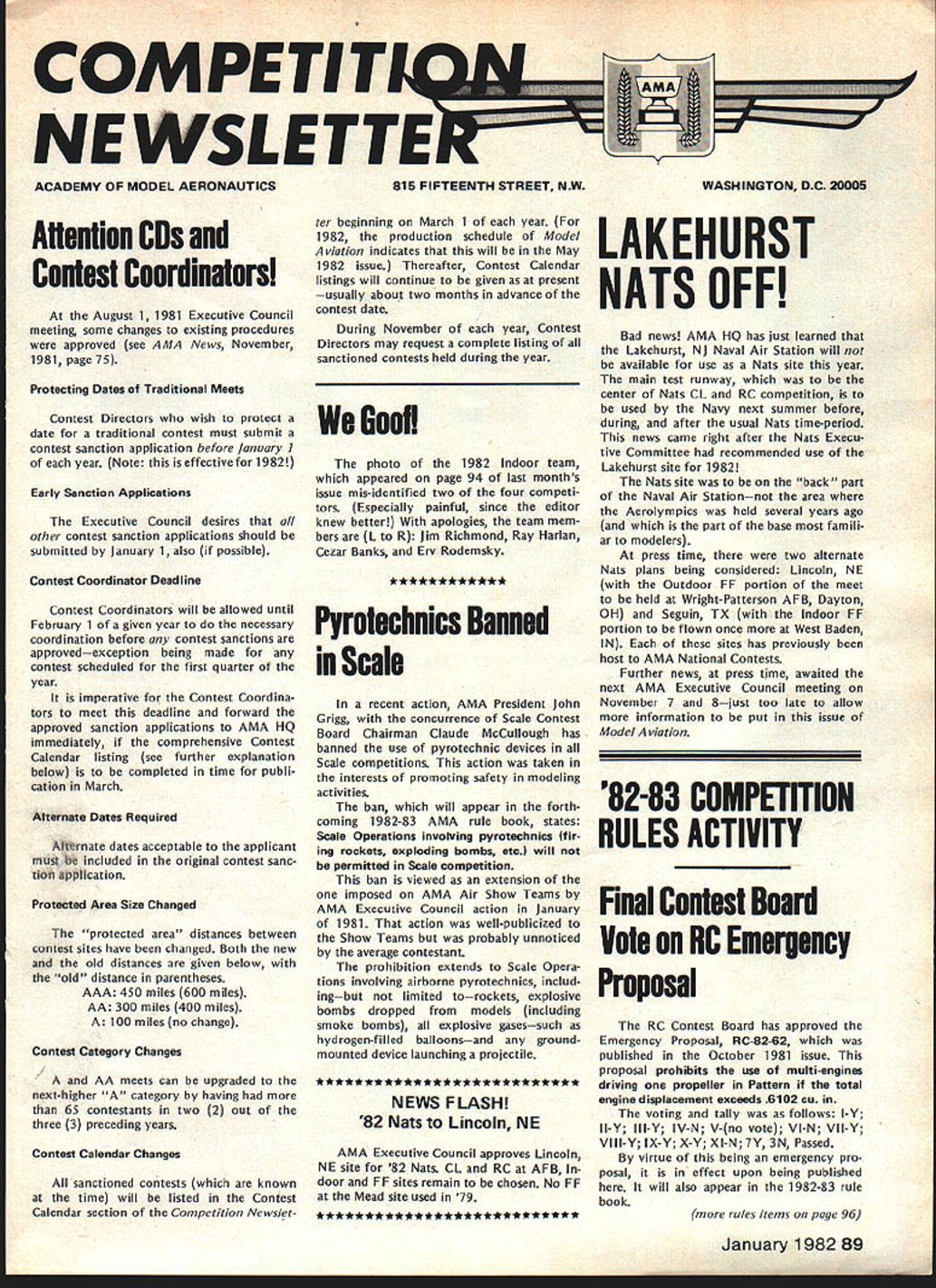
Competition Newsletter
Attention: Contest Directors (CDs) and Contest Coordinators
At the August 1, 1981 Executive Council meeting, several changes to existing procedures were approved (see AMA News, November 1981, p. 75). Key points follow.
Protecting Dates — Traditional Meets
- Contest Directors who wish to protect the date of a traditional contest must submit a contest sanction application before January 1 of each year. (Note: this is effective for 1982.)
Early Sanction Applications
- The Executive Council requests that all other contest sanction applications be submitted by January 1 as well, if possible.
Contest Coordinator Deadline
- Contest Coordinators will be allowed until February 1 of a given year to perform necessary coordination before any contest sanctions are approved. Exception: contests scheduled for the first quarter of the year.
- It is imperative that Contest Coordinators meet this deadline and forward approved sanction applications to AMA Headquarters immediately so the comprehensive Contest Calendar can be completed in time for publication (see Contest Calendar Changes).
Alternate Dates Required
- Alternate dates acceptable to the applicant must be included in the original contest sanction application.
Protected Area Size Changed
Protected-area distances between contest sites have been changed. New and old distances (old in parentheses):
- AAA: 450 miles (600 miles)
- AA: 300 miles (400 miles)
- A: 100 miles (no change)
Contest Category Changes
- A and AA meets can be upgraded to the next-higher category by having had more than 65 contestants in two out of the three preceding years.
Contest Calendar Changes
- All sanctioned contests known at press time will be listed in the Contest Calendar section of the Competition Newsletter beginning March 1 each year. (For 1982, Model Aviation's production schedule indicates this will appear in the May 1982 issue.)
- Thereafter, Contest Calendar listings will continue to be given about two months in advance of the contest date.
- During November each year, Contest Directors may request a complete listing of all sanctioned contests held during the year.
We Goof!
The photo of the 1982 Indoor team that appeared on p. 94 of last month's issue misidentified two of the four competitors. With apologies, the team members are (L to R): Jim Richmond, Ray Harlan, Cezar Banks, and Erv Rodemsky.
Pyrotechnics Banned in Scale
By action of AMA President John Grigg, with concurrence of Scale Contest Board Chairman Claude McCullough, the use of pyrotechnic devices is banned in all Scale competitions. The ban will appear in the 1982–83 AMA rule book and states:
- "Scale operations involving pyrotechnics (firing rockets, exploding bombs, etc.) will not be permitted in Scale competition."
The prohibition extends to airborne pyrotechnics and related devices including, but not limited to:
- rockets;
- explosive bombs dropped from models (including smoke bombs);
- explosive gases such as hydrogen-filled balloons;
- ground-mounted devices launching a projectile.
This is viewed as an extension of the prohibition imposed on AMA Air Show Teams by Executive Council action in January 1981.
NEWS FLASH
- ’82 Nats to Lincoln, NE — AMA Executive Council approved Lincoln, Nebraska as the site for the 1982 Nationals. CL and RC will be at AFB; indoor and FF sites remain to be chosen. The FF Mead site used in ’79 will not be used in 1982.
Lakehurst Nats Off!
- The Lakehurst, NJ Naval Air Station will not be available for use as a Nats site in 1982 because the main test runway will be used by the Navy during the Nats time period. This decision came after the Nats Executive Committee had recommended Lakehurst for 1982.
- At press time, two alternate Nats plans were under consideration:
- Lincoln, NE (outdoor FF possibly at Wright-Patterson AFB, Dayton, OH)
- Seguin, TX (indoor FF possibly at West Baden, IN)
- Further details awaited the AMA Executive Council meeting on November 7–8.
'82–'83 Competition Rules Activity
Final Contest Board Vote — RC Emergency Proposal
- The RC Contest Board approved Emergency Proposal RC-82-62 (published October 1981). This emergency proposal, effective upon publication and to be included in the 1982–83 rule book, prohibits the use of multi-engines driving one propeller in Pattern if the total engine displacement exceeds .6102 cu. in.
(more rules items printed elsewhere)
RC Contest Board Final Vote Concludes
- RC-82-16 — "No Pre-Novice; gear down & no pipes in Novice" (proposed by R. Noll) — This proposal was defeated.
- Voting by district: I-Y; II-N; III-N; IV-Y; V-N; VI-N; VII-Y; VIII-N; IX-N; X-Y; XI-Y.
- Tally and Result: 5 Y, 6 N — Defeated.
'82 CL Combat Team Selection Finals
Charlie Johnson (photos by the author)
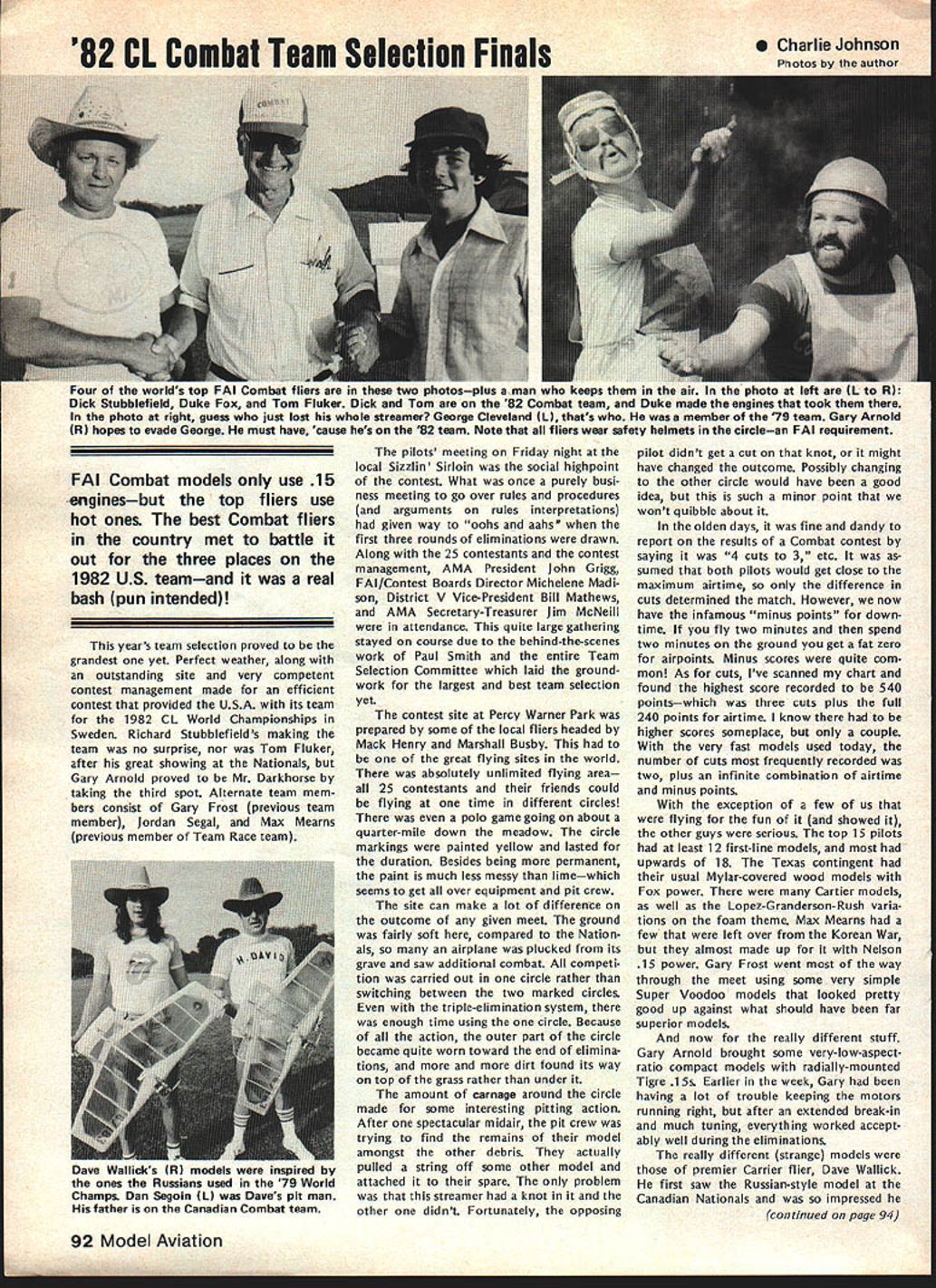
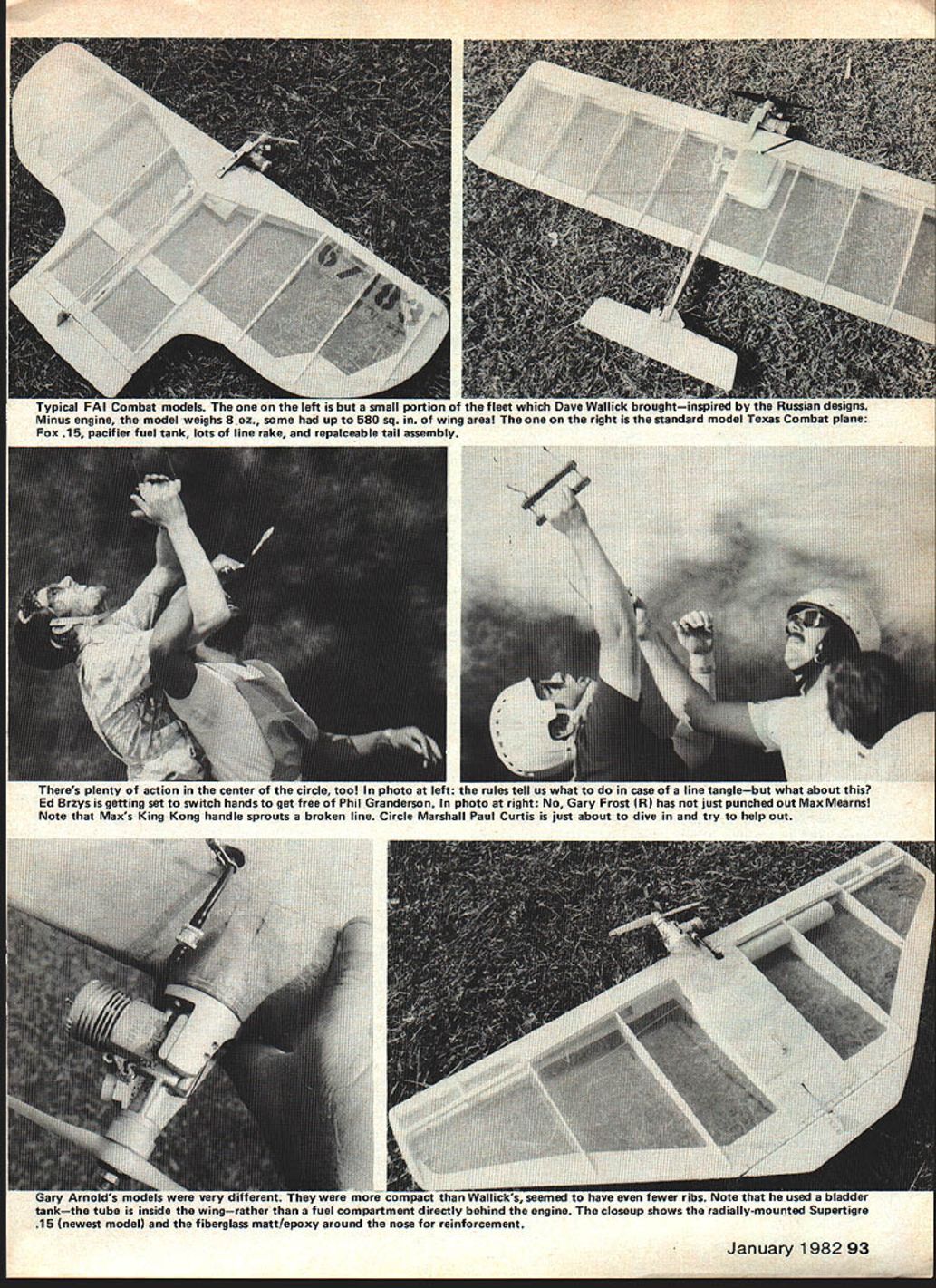
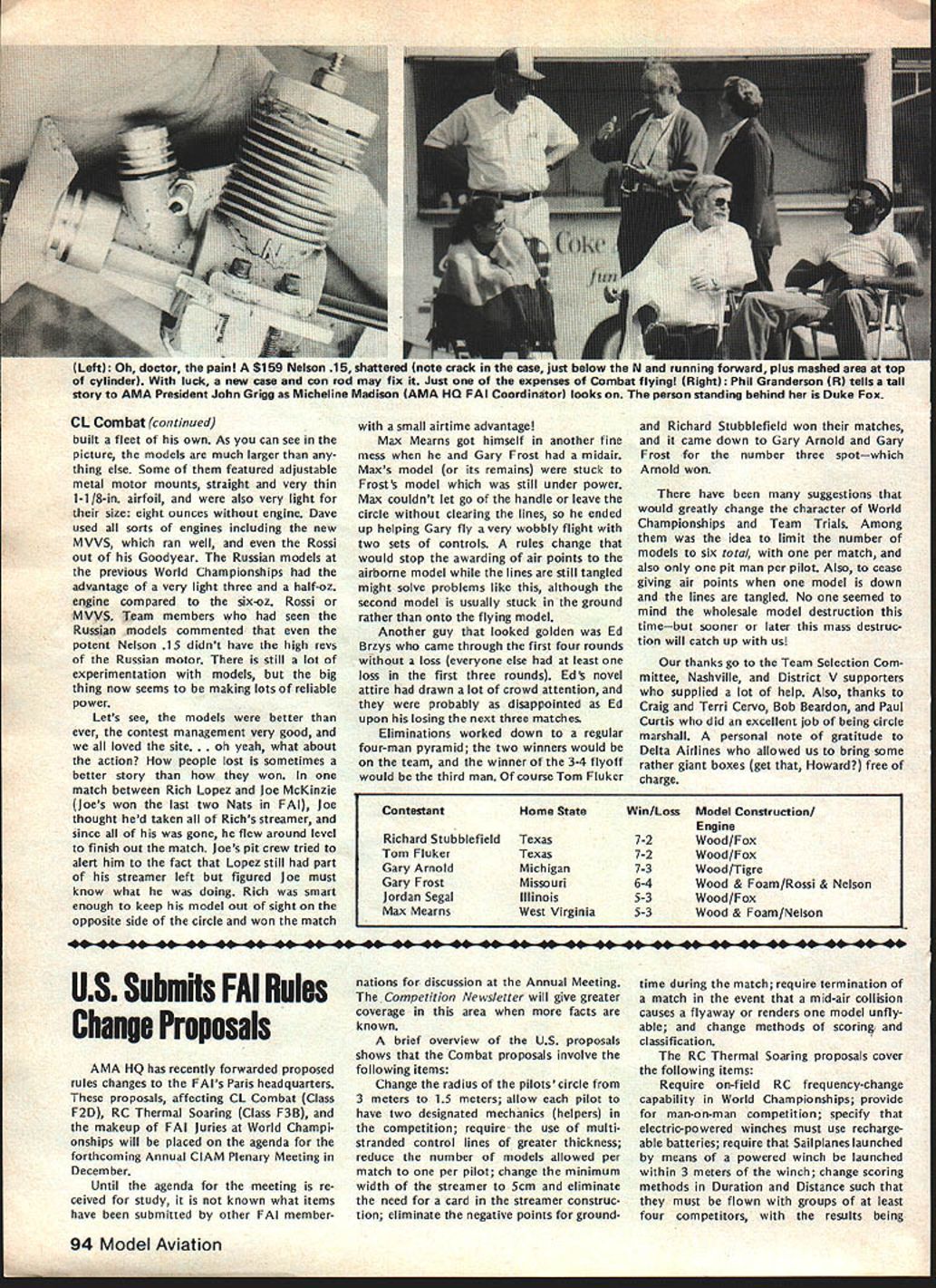
FAI Combat models use .15 engines. The best Combat fliers in the country met to select three places on the 1982 U.S. team for the CL World Championships in Sweden.
- Winners (team members): Richard Stubblefield (TX), Tom Fluker (TX), Gary Arnold (MI).
- Alternate team members: Gary Frost (MO), Jordan Segal (IL), Max Mearns (WV).
Highlights and notes:
- Perfect weather, an outstanding site at Percy Warner Park (prepared by local fliers Mack Henry and Marshall Busby), and competent contest management produced an efficient team selection contest.
- The pilots' meeting at a local restaurant served as a social highlight.
- The site allowed all 25 contestants to fly simultaneously in different circles; circle markings were painted yellow (preferred over lime).
- The triple-elimination format ran using a single circle for all eliminations.
- The advent of "minus points" for downtime has changed how match results are evaluated — airtime losses and negative airpoints became significant.
- Pilots displayed a wide variety of models and powerplants: Mylar-covered wood with Fox engines, Carter models, Lopez-Granderson-Rush foam variations, Nelson-powered older designs, Rossi/MVVS power, and others.
- Notable model innovations included Gary Arnold's compact low-aspect-ratio models with radially-mounted Supertigre .15s and Dave Wallick's large Russian-inspired designs (very light airframe, large area, adjustable metal motor mounts, thin airfoil).
Incidents and contest anecdotes:
- Midairs, tangled lines, and creative pitting made for dramatic matches.
- Suggestions for rule changes discussed included: limiting number of models to six, one pit man per pilot, and ceasing air points while lines are tangled.
Contestant results summary (Win/Loss and model/engine where given)
- Richard Stubblefield — Texas — 7–2 — Wood / Fox
- Tom Fluker — Texas — 7–2 — Wood / Fox
- Gary Arnold — Michigan — 7–3 — Wood / Tigre
- Gary Frost — Missouri — 6–4 — Wood & Foam / Rossi & Nelson
- Jordan Segal — Illinois — 5–3 — Wood / Fox
- Max Mearns — West Virginia — 5–3 — Wood & Foam / Nelson
Thanks:
- Team Selection Committee, Nashville supporters, circle marshals Craig and Terri Cervo, Bob Beardon, Paul Curtis, and Delta Airlines for shipping help.
'82 CL Combat (continued) — Photo/Caption Notes
- Typical FAI Combat models described: large Russian-style designs (left) and standard Texas Combat planes with Fox .15 (right).
- Photo captions described action in the circle, line tangles, and equipment details (e.g., radially-mounted Supertigre .15, bladder tanks).
FAI Indoor Team Selection Committee Actions
- Manager of the 1982 Indoor team: Bud Romak, Moraga, CA.
- Chairman of the 1982–83 FAI Indoor team selection program: Ray Harlan, Wayland, MA.
- Most improved flier in the current program: Cezar Banks, La Mesa, CA.
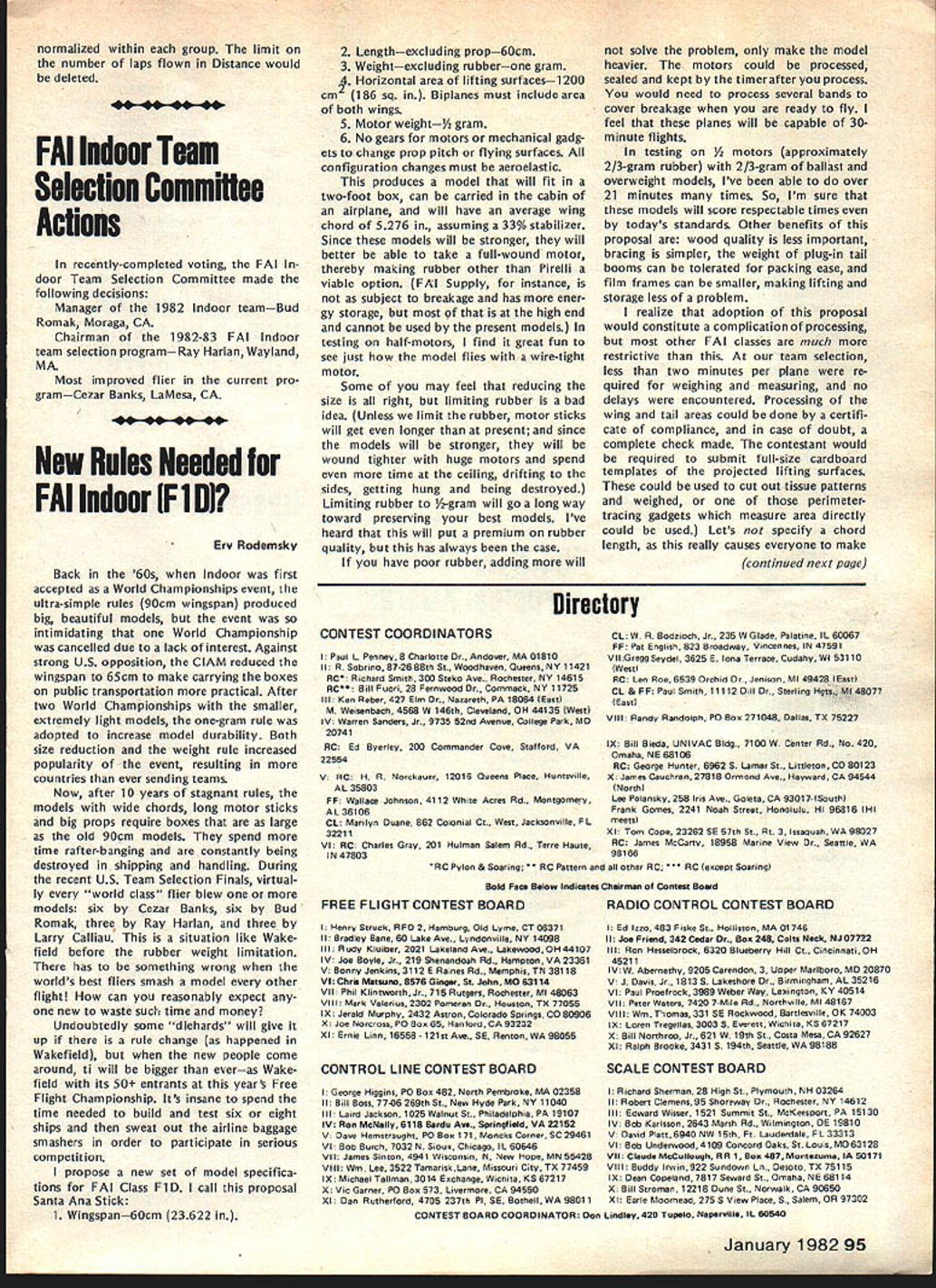
New Rules Needed for FAI Indoor (F1D)? — Erv Rodemsky
- Background: Early F1D rules led to big models; subsequent reductions (to 65 cm wingspan) and a 1-gram rule increased popularity and durability. After a decade, models have again become large, fragile, and expensive to transport.
- Proposal: "Santa Ana Stick" — suggested new F1D specifications to improve durability and practicality:
Proposed specifications:
- Wingspan: 60 cm (23.622 in.)
- Length (excluding prop): 60 cm
- Weight (excluding rubber): 1 gram
- Horizontal area of lifting surfaces: 1200 cm² (186 sq. in.) — biplanes count both wings
- Motor weight: 0.5 gram
- No gears or mechanical gadgets to change prop pitch or flying surfaces; configuration changes must be aerolastic
Rationale and remarks:
- Models would fit in a two-foot box and be transportable in the cabin.
- Average wing chord would be reasonable; models would be stronger and better able to withstand airline handling.
- Limiting motor weight (rubber) would prevent ever-longer motor sticks and excessively powerful motors that cause ceiling drift and model destruction.
- Processing and measuring could be handled by certificate of compliance and sample checks; contestants could be required to submit full-size cardboard templates of lifting surfaces.
- The proposal is offered for comment. If modeler response is favorable, AMA may present it to FAI for possible adoption in time for the 1984 Indoor World Championships.
- Send comments to AMA HQ, Attention: Micheline Madison.
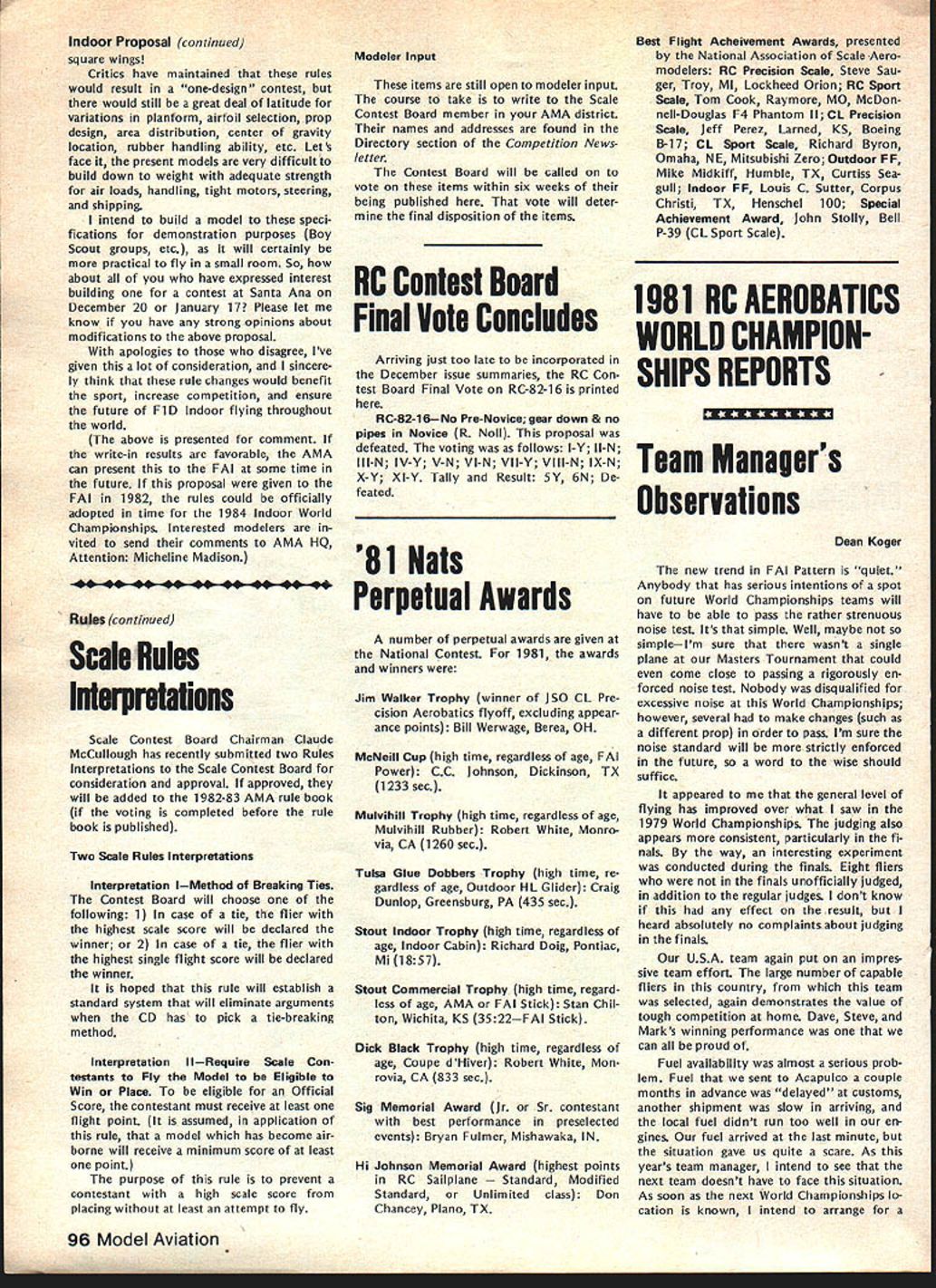
Scale Rules Interpretations
Scale Contest Board Chairman Claude McCullough submitted two proposed rules interpretations for consideration. If approved, they will be added to the 1982–83 AMA rule book.
Interpretation I — Method of Breaking Ties
- The Contest Board will choose one of the following standard tie-breaking methods:
- In case of a tie, the flier with the highest scale (static) score will be declared the winner; or
- In case of a tie, the flier with the highest single flight score will be declared the winner.
- Purpose: to establish a standard system and eliminate arguments when the Contest Director must pick a tie-breaking method.
Interpretation II — Require Scale Contestants to Fly the Model to Be Eligible to Win or Place
- To be eligible for an official score and for trophies, the contestant must fly the model. In the event of mechanical failure occurring on the flight line, the contestant may substitute a duplicate model only if the substitute is declared to be essentially the same model.
- Purpose: to prevent a contestant with a high static score from placing without at least an attempt to fly.
Modeler input:
- These items are open to modeler input. Write to the Scale Contest Board member in your AMA district (addresses in the Competition Newsletter Directory).
- The Contest Board will vote on these items within six weeks of publication here; that vote will determine final disposition.
Best Flight Achievement Awards (presented by the National Association of Scale Aeromodelers)
- RC Precision Scale: Steve Sauter, Troy, MI — Lockheed Orion
- RC Sport Scale: Tom Cook, Raymore, MO — McDonnell-Douglas F4 Phantom II
- CL Precision Scale: Jeff Perez, Larned, KS — Boeing B-17
- CL Sport Scale: Richard Byron, Omaha, NE — Mitsubishi Zero
- Outdoor FF: Mike Mickiff, Humble, TX — Curtiss Seagull
- Indoor FF: Louis C. Sutter, Corpus Christi, TX — Henschel 100
- Special Achievement Award: John Stolly — Bell P-39 (CL Sport Scale)
'81 Nats Perpetual Awards
- Jim Walker Trophy (winner of JSO CL Precision Aerobatics flyoff, excluding appearance points): Bill Wenerage, Berea, OH
- McNeill Cup (high time, regardless of age, FAI Power): C.C. Johnson, Dickinson, TX — 1,233 sec.
- Mulvihill Trophy (high time, regardless of age, Mulvihill Rubber): Robert White, Monrovia, CA — 1,260 sec.
- Tulsa Glue Dobbers Trophy (high time, regardless of age, Outdoor HL Glider): Craig Dunlop, Greensburg, PA — 435 sec.
- Stout Indoor Trophy (high time, regardless of age, Indoor Cabin): Richard Doig, Pontiac, MI — 18:57
- Stout Commercial Trophy (high time, regardless of age, AMA or FAI Stick): Stan Chilton, Wichita, KS — 35:22 (FAI Stick)
- Dick Black Trophy (high time, regardless of age, Coupe d'Hiver): Robert White, Monrovia, CA — 833 sec.
- Sig Memorial Award (Jr. or Sr. contestant with best performance in preselected events): Bryan Fulmer, Mishawaka, IN
- Hi Johnson Memorial Award (highest points in RC Sailplane — Standard, Modified Standard, or Unlimited class): Don Chancey, Plano, TX
Team Fund, Shipment, and Thanks
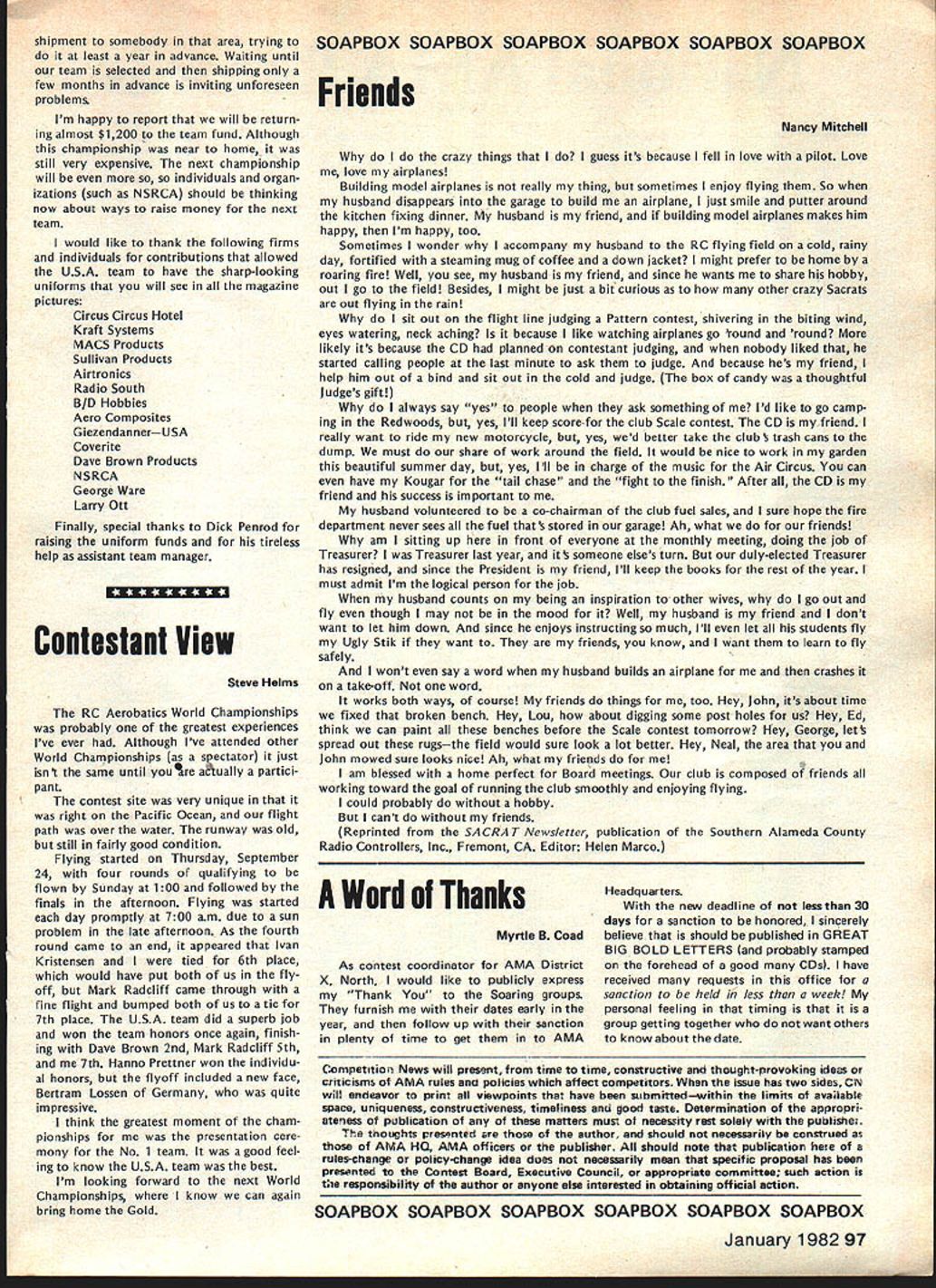
- Note: ship team gear well in advance (at least a year when feasible) to avoid last-minute problems.
- Reported return to team fund: nearly $1,200.
- Thanks to firms and individuals who contributed toward team uniforms and support:
- Circus Circus Hotel
- Kraft Systems
- MACS Products
- Sullivan Products
- Airtronics
- Radio South
- B/D Hobbies
- Aero Composites
- Giezendanner—USA
- Coverite
- Dave Brown Products
- NSRCA
- George Ware
- Larry Ott
- Special thanks to Dick Penrod for raising uniform funds and serving as assistant team manager.
Contact / Feedback
- For contest calendar requests, rule comments, or Scale interpretation input, write to AMA Headquarters or to the appropriate Contest Board member in your district (see Competition Newsletter Directory).
Transcribed from original scans by AI. Minor OCR errors may remain.

